

Submitted:
25 August 2026
Posted:
25 August 2026
You are already at the latest version
Abstract
Physician career sustainability depends on adequate and relevant prevention of negative psychological states. Burnout is one. Recent research modifying Csikszentmihalyi’s four-quadrant model identifies the inverse relationship between achieving psychological flow and burnout. The burned out are those who can also achieve psychological flow. As such, the term “burnout” has inappropriately classified other negative states as burned out. Physicians as a profession have one of the highest rates of burnout. Thus, this finding is significant for them. Psychological states erroneously identified as burnout regarding the model of work engagement include apathy, anxiety, and boredom. Achieving appropriate work engagement promotes career sustainability. It can be achieved when a differentiation is made among treatments into the four types of negative work engagement. This study will utilize the modified four-quadrant model specifically for physicians. Successful methods in reducing the four negative psychological states in physicians will be considered and evaluated for their ability to reduce work exhaustion and promote work engagement. The conclusion is that when there is a division of physicians’ negative psychological factors into the four regarding work engagement, avoiding each of burnout, apathy, anxiety, and boredom is possible to sustain physician careers in a way that previously has not been identified.
Keywords:
physicians
; career sustainability
; work engagement
; burnout
; apathy
; anxiety
; boredom
; work exhaustion
; Csikszentmihalyi
; psychological flow
1. Introduction
Career sustainability for physicians refers to their evolving capacity to adapt their work experiences and well-being over their careers amid changing environments [1]. It is an interplay between the context in which they function and their self-regulation [2] and depends on adequate and relevant prevention of negative psychological states [3]. As a negative psychological state, physician burnout is a significant contributor to reducing the sustainability of physician careers [4].
In 2025, an Entry of mine was published in Encyclopedia entitled “Physician Burnout: Historical Context, Psychosomatic Division, Evolution, Results, Solutions, and Recommendations”[5]. The content described physician burnout as a timely topic, noting that the incidence of burnout ranges from 25% to 80% among physicians [6]. This topic has received significant attention, especially since the COVID-19 pandemic [7,8]. The Entry identified physician burnout as a multi-level problem requiring a coordinated effort on all levels to address successfully. The levels were categorized as macro, meso, and micro. The macro level was described as corresponding to systemic conditions that affect physician burnout. Positive changes at this level depend on refinements in legislation, electronic recordkeeping, pandemic control, and dedicated improvements in the physician’s workplace. Factors at the meso level involve time-related adjustments in careers, gaining additional years of practice, and making interpersonal accommodations with colleagues and patients. The micro level concerns relevant differences in physicians’ psychological and physical traits. These are evident based on appropriate time-dependent testing when physicians are burned out. Table 1 presents the three levels and their associated factors, combining the first two tables from reference [5].
Freudenberger was the first researcher to study and define burnout. He did so regarding those providing care in alternative organizations to which they were philosophically committed. In this context, physicians were among those he described as working in free clinics and therapeutic communities in 1974 [9]. He offered ten points to mitigate burnout—ones that were reiterated and expanded upon in a 1975 publication [10]. Table 2 lists Freudenberger’s ten points.
Separate from the stage levels of burnout in reference [5] are prevention levels of burnout of the physician’s lifestyle experiences. These were described in a 2021 publication by Merlo & Rippe [11]. The first is primordial prevention. It is a strategy of avoiding risk factors before they develop. Next is systems-based primary prevention. It regards organizational change. Secondary prevention interventions are reactive rather than addressing the source of the problem. Tertiary prevention regards managing an established ongoing burnout condition. Table 3 compares the stage and prevention levels of Freudenberger’s ten points, combining Table 3 and Table 4 from reference [5]. Two points are notable. The first is that the arrangement of Freudenberger’s ten points corresponds to the macro, meso, and micro stage levels, but it is not identical. “Provide significant vacation time (5)” is a macro prevention method. Yet, it is mentioned lower on Freudenberger’s list than the first two macro-related points. “Ensure sufficient physicians for the population (9)” is a macro prevention method even lower on the list of ten points. It was not included with the other systemic changes mentioned by Freudenberger at the top of his list. The reason is not provided in his text. All of Freudenberger’s ten points can be categorized into one of the three levels.
In contrast, the ten points relate to primordial and systems-based primary prevention in the prevention levels alone. This outcome demonstrates that Freudenberger’s points are primarily intended to address the source of the problem, rather than a focus on relieving physician burnout once it has been established. For example, Freudenberger is explicit in advising against meditation and yoga as effective in reducing burnout. In his words regarding point 10, “Engage in any activity that will make you physically tired. Many times the exhaustion of the burn-out is an emotional and mental one. It is this type of exhaustion that will not let you sleep. That is why it is not always a good idea, in my opinion, to shift into meditation, or yoga, which cause a mental dropping inward. Introspection is not what the burnt-out person requires. He requires physical exhaustion, not further mental strain and fatigue” [10]. He had no advice regarding alleviating burnout in those experiencing it as an ongoing condition. Neither do the authors of the 2021 publication [11], who identified this level of prevention. Finally, it is notable that the combination of the ten points in the first two levels demonstrates that the categorization of macro-and meso-stage levels is not equivalent to that of primordial and systems-based primary prevention.
With these two ways of interpreting the levels of burnout, regarding different arrangements of ten distinct points concerning burnout, solving physician burnout has been described as overwhelming [12]. In writing reference [5], I was equally impressed by the complexity and enormity of the problem of physician burnout. My advice offered in that publication was to structure any approach to physician burnout by considering the problem in relation to Freudenberger’s ten points. This remained my position until April 2026. Then, I began researching work engagement and burnout, which was published in June 2026 as “Increasing Work Engagement as Social Justice: Reimagining the Four-Quadrant Model of Skill and Challenge for Options to Eliminate Work-Related Exhaustion” [13]. In writing that paper, I realized that considering physician burnout with the individual as the focus of the burnout represented the primary reason for the complications. I found that if the focus is reinterpreted as work exhaustion, the complexity of the problems becomes manageable. It is made more manageable by investigating work exhaustion through a consideration of Csikszentmihalyi’s four-quadrant model of work engagement. The finding was that career sustainability of physicians is promoted with appropriate work engagement. It can be achieved by differentiating work exhaustion treatments into the four types of negative work engagement, using a modified version of Csikszentmihalyi’s four-quadrant model of work engagement.
Based on references [5,13], this study aims to review successful work engagement interventions through Freudenberger’s ten points on burnout prevention. The hypothesis is that, using these ten points, many of the experiences of physicians diagnosed as burnout are better described by apathy, anxiety, and boredom. Additionally, in making this reassessment, solutions to the lack of career sustainability in physicians can be offered to promote work engagement.
2. Model and Method
In 1975, Csikszentmihalyi published his first work on his investigations into activities in themselves that provide people with the most enjoyment [14]. His finding was that people enjoy those activities most for which they have complete work engagement. This engagement depends on two aspects: (1) having the appropriate skills to complete the work at a level the person considers valuable, and (2) that the work stretches the person’s abilities to their limit as a challenge. Csikszentmihalyi called this state psychological flow because those in it felt as if the work flowed without their awareness of time or self.
From this beginning, along with LeFevre, Csikszentmihalyi developed the four-quadrant model of work engagement to represent a relationship between skill and challenge. It was first described in 1989 [15]. As part of my work on reference [13], I drew this relationship as a two-dimensional graph, which is comparable to the drawings of previous researchers [16,17,18]. Examining the graph, I noted something that had been neglected since 1989. Three of the four quadrants referred to negative psychological states while the upper right quadrant alone represented a positive psychological state. Based on this discovery, I modified the four-quadrant model to contain both positive and negative psychological states in each quadrant. Figure 1 is a combination of Figure 1 and Figure 2 from reference [13].
With this modification, it became evident that burnout, like psychological flow, is possible only when a person displays a high level of skill and their work represents a significant challenge. In all other combinations of skill and challenge, the worker may experience work-related exhaustion; however, they don’t experience burnout. In addition to burnout, Csikszentmihalyi identified three types of work-related exhaustion. These are apathy (low skill and challenge), anxiety (low skill and high challenge), and boredom (high skill and low challenge). The aim should be to eliminate all forms of work-related exhaustion, not only burnout, as all affect physician career sustainability. To accomplish this aim regarding Freudenberger’s ten points to mitigate burnout, these points are categorized by the negative states regarding each of Csikszentmihalyi’s four quadrants in Table 4.
3. Results
This section examines various interventions that have been shown to successfully mitigate each of the four negative psychological states within the modified four-quadrant model. What measures their success is that work engagement is the result. Referring to the positive psychological states of each quadrant indicates what produces work engagement. For the apathetic, involvement brings with it work engagement. The anxious must become calm to realize work engagement. The bored require work-related interest to achieve their work engagement. The burned-out will have work engagement when they can achieve psychological flow. However, if work engagement is the result, it is not equivalent to task completion. Physicians may become reengaged in their work and still fail to complete the task for various reasons [19,20,21]. This study does not include methods to ensure task completion.
3.1. Apathy (Low Skill and Low Challenge)
Regarding the modified four-quadrant model, the apathetic physician experiences work-related exhaustion arising from a low skill level and engaging in low-challenge tasks. Apathy can arise when, for example, resident physicians are charged with the care of inadequately processed stigmatized patients [22]. This can lead to “compassion fatigue” due to the constant demands of caring for others from persistent charity appeals [23]. Additionally, the apathetic physician may lack sufficient computer literacy to manage patient charts due to cognitive overload [24]. As a result, their focus is on uncomplicated diagnosis and treatment plans that require minimal computer expertise to record [25]. Consequently, their type of work-related exhaustion may compromise patient health [26]. As such, physician apathy is not just emotional indifference, but a lack of ethical participation in the therapeutic relationship [27]. They may inappropriately depend on other healthcare colleagues to accomplish work that should be their responsibility—a particularly acute problem during the COVID-19 pandemic [28]. Arising from their work-related exhaustion, these physicians are unable to act responsibly to take appropriate action, leading to their workplace silence [29,30].
According to the modified four-quadrant model, to engender work engagement in these physicians who lack skill and challenge, they must become involved with their work. Demonstrating deficits in both areas, their involvement will depend on their feeling a level of control in their professional life [28]. They cannot improve their skill level or take on any additional challenges without first achieving the work engagement that comes from a belief in autonomy over their professional activities [31,32].
Referring to Freudenberger’s ten points, those that would be relevant to creating this sense of life control would be (4), (5), (6), (7), and (10). The first two points regard gaining control over their time. Point (4) limits the number of working hours while point (5) promotes sufficient vacation time. The next two points are gaining control over their relationships with colleagues. Point (6) concerns a work-related control of people by providing back-up. Point (7) is the control of their interpersonal relationships with others by sharing their feelings. The final point (10) is gaining control over their body through exercise.
What is necessary to produce a sense of control in the apathetic physician depends on the particular physician. Attending to only one of these points may be sufficient in some cases. In contrast, other apathetic physicians may need to gain control of all the relevant points to achieve work engagement.
3.2. Anxiety (Low Skill and High Challenge)
The anxious physician, regarding the modified four-quadrant model, confronts a difficult challenge but lacks the skill to accomplish their task. The work exhaustion experienced by this type of physician may take the form of irritability with colleagues and patients [33], various forms of addiction [34], physical ailments [35], or psychiatric difficulties [36]. The anxious physician requires calmness to have work engagement [37]. This calmness will reduce the physician’s focus on themselves and redirect their energies to the required task.
Those of Freudenberger’s ten points relevant to help create this sense of calmness are (2) and (4)–(10). Anxious physicians have unpredictable and inappropriate behavior when faced with a difficult challenge. Point (2) identifies that it is the responsibility of medical educators to recognize anxious physicians during their training so that those who show unrealistic commitment are guided into medical specialties that reduce the risk of the anxious physician encountering high challenges that provoke their anxiety. However, according to Freudenberger, this option is available only during training. Calmness for the anxious physician when they encounter a high level of challenge can be addressed through most of the other relevant points. To achieve this calmness, it will be the responsibility of the healthcare facility administration to be aware of what triggers these anxious physicians and to have available methods to reduce their anxiety. These methods can extend to (4) reducing their working hours, (5) suggesting time off, (6) asking other physicians to cover for the anxious one, (7) getting appropriate psychiatric help, (8) having them attend workshops with a focus on reducing their anxiety, or (10) providing opportunities to support regular exercise. Regarding point (9), some anxious physicians may achieve calmness following encouragement to proactively help resolve the broader problem of an insufficient number of physicians to serve the population.
Similar to the apathetic physician, which of these points are relevant to producing calmness in any particular anxious physician will be entirely dependent on the negative response that the physician has regarding their anxiety. To help healthcare administrators determine the type of anxiety that is producing physician exhaustion, various validated tests are available [38,39].
3.3. Boredom (High Skill and Low Challenge)
Regarding the modified four-quadrant model, the bored physician is one with a high skill level insufficiently or inappropriately matched to challenges beneath their ability. Bored physicians are cynical as a result [40]. They may distort judgments, contributing to biased and potentially harmful social outcomes [41]. For the bored physician to achieve work engagement, their task interest is necessary, prompting the creation of greater stimulation [42]. When the challenge cannot be better matched to their ability, this is achieved by reducing the time spent on boring tasks, or their skill level gaining appreciation and respect [43].
Most of the points in the middle of Freudenberger’s ten are those that can create work engagement in the bored physician. The first method is point (3). It suggests that administrators rotate functions so that those physicians prone to boredom are required to attend to boring tasks less frequently than they might. Similarly, limiting the number of hours they are required to perform boring tasks, as in point (4), reduces the period they will be bored. When bored physicians must attend to boring tasks, their boredom can be reduced if, as in point (6), they are provided with back-up. Each of these points aims to reduce the time bored physicians spend on boring tasks. The other approach is to recognize a bored physician’s expertise. This can come from them mentoring less experienced physicians—point (7). It can also refer to point (8)—asking them to share their knowledge in presentations at workshops.
As a highly skilled practitioner, the bored physician needs the opportunity to display their skill to experience work engagement. By reducing boring tasks, or by providing bored physicians with special opportunities to demonstrate their skill creatively, they can become engaged in their work and relieve their work-related exhaustion.
3.4. Burnout (High Skill and High Challenge)
Each of the apathetic, anxious, and bored physicians experiences work-related exhaustion. However, regarding the modified four-quadrant model, only one type of work-related exhaustion in physicians can be referred to as burnout. The physician must be highly skilled and committed to a difficult challenge such that, when their work is going well, they can experience psychological flow [44]. This is a point noted in a 2021 systematic review of cognitive flow in healthcare settings [45]. Under the relevant conditions, this type of physician will always complete their task because they are committed to accomplishing the work [44,46]. These physicians are resourceful and will work to overcome difficulties in task completion—especially during the COVID-19 pandemic [47]. Burnout occurs during a task if the accommodations to a work schedule, resource allocation, association with colleagues, priorities, or assumptions are insufficient, and the task remains incomplete [48]. Burnout can also result following a challenging task, and the physician lacks another challenging task to pursue, impacting patient care [49].
For the burned-out physician, Freudenberger’s first three points and point (6) are relevant for encouraging work engagement. Point (1) is most applicable for reducing burnout by ensuring an adequate training period for physicians. Physicians cannot achieve psychological flow and avoid burnout without a high level of skill. Similarly, with point (2), during the training period, medical educators should recognize medical students with the potential to achieve psychological flow through their realistic dedication and encourage their pursuits. To encourage physicians to achieve psychological flow, functions should be rotated to provide time for their work engagement, as specified by point (3). Finally, when these physicians become burned out, due to a lack of resources or because they have just completed a major project, they are provided with the backup mentioned in point (6), permitting them the opportunity to re-engage with their work.
Physician burnout has been considered a perplexing problem. Regarding the four-quadrant model, its solution is possible with appropriate resources and scheduling. In the 2024 study, “Psychological flow and mental immunity as predictors of job performance for mental healthcare practitioners during COVID-19” [50], the results demonstrated that psychological flow represents a form of mental immunity to burnout. This was one of the reports that led me to conclude in “A Scoping Review of Burnout Avoidance by Employees During the COVID-19 Pandemic: The Role of Psychological Flow”, another 2025 review of mine for Encyclopedia, that psychological flow represents the opposite of burnout in contrast to workplace stimulation [51]. As such, it is similar to biological immunity. In contrast, the solution to apathy, anxiety, and boredom is complex and individual-dependent.
4. Discussion
The Results demonstrate that when burnout is examined through the modified four-quadrant model of Csikszentmihalyi [15], Freudenberger’s definition [9] more accurately includes apathy, anxiety, boredom, and burnout. In all, these experiences represent the range of work exhaustion, extending beyond burnout. Of Freudenberger’s ten points for burnout prevention he offered in 1974 [9] and expanded on in 1975 [10], only four of his points (1–3, and 6) are relevant to burnout prevention (see Table 4). The others concern prevention for each of apathy (points 4–7 and 10), anxiety (points 2 and 5–10), and boredom (points 3, 4, and 6–8). Significantly, of the ten points, burnout regards only four. This number represents the fewest of the four types of work exhaustion. There are five for apathy, seven for anxiety, and five for boredom. However, although there are fewer points concerning burnout when examined through the modified four-quadrant model of Csikszentmihalyi, they reveal that burnout is initially resolved by macro or primordial prevention in medical education (see Table 3) by ensuring that students have a high skill level. The reason is that without a high skill level, psychological flow is not possible [52]. However, having an appropriate skill level is only one of the two components to experience psychological flow. The other is a significant challenge to which the physician is committed to completing [44,45].
The appropriate skill level and type, and the commitment to completing a difficult challenge, are the core ingredients for psychological flow [15]. Simultaneously, they represent the qualities of those whom Freudenberger judged as likely to become burned out [9,10]. These qualities continued to be recognized for preventing burnout [53] and as corresponding to the promotion of psychological flow [48]. Yet, in extending burnout prevention to six additional points—judged by his own criteria for burnout—Freudenberger laid the groundwork for burnout literature to focus on all forms of work exhaustion. It is this equation of burnout with work exhaustion that is the primary reason for the “epidemic” of physician burnout currently reported in the literature [54,55,56,57]. The Results of this study demonstrate that burnout in physicians must be equated only with those demonstrating the appropriate skill and commitment to complete a significant challenge. All other forms of work exhaustion from apathy, anxiety, and boredom should be classified as such and removed from those counted as burned out. Doing so will gain an accurate understanding of the number of physicians who are burned out, whether their number is increasing to epidemic proportions, and how best to prevent burnout.
4.1. Meditation and Yoga
Freudenberger considers meditation and yoga likely to be unhelpful for burnout prevention because they are the wrong type of intervention. The reason is that “Introspection is not what the burnt-out person requires. He requires physical exhaustion, not further mental strain and fatigue” [10]. Nevertheless, several recent publications report that meditation is preventative regarding burnout [58,59,60,61,62]. Similarly, yoga is recognized in other studies as another valuable prevention method [63,64,65,66]. One study additionally finds positive results through employing both meditation and yoga [67]. Although all of these studies found that burnout improves with meditation or yoga, they accept the World Health Organization (WHO) 2019 definition of burnout from 2019 [68]. This definition is taken from the 11th Revision of the International Classification of Diseases (ICD-11) by the WHO.
“Burn-out is a syndrome conceptualized as resulting from chronic workplace stress that has not been successfully managed. It is characterized by three dimensions:
feelings of energy depletion or exhaustion;
increased mental distance from one’s job, or feelings of negativism or cynicism related to one’s job; and
reduced professional efficacy.
Burn-out refers specifically to phenomena in the occupational context and should not be applied to describe experiences in other areas of life.”
This definition is problematic for several reasons. The first is that the initial point is the only one of the three that is fully determined by the person experiencing the chronic workplace stress that has been unsuccessfully managed. For the other two points, it is unclear who makes the assessment. In contrast to the clarity of the first point, the second point is three separate and very different points. Each of these points is connected by “or”, meaning that any one of them is sufficient for identifying burnout. The selection is increased mental distance or cynicism—either of which may be assessed by the person experiencing the symptoms, their supervisor, or a health professional charged with testing the afflicted person for burnout. Unexpectedly in this second point, negativism is to be judged by feelings alone, similar to energy depletion or exhaustion. The difference is that, unlike the feelings concerning point 1, those of point 2 are not necessary to a judgement of burnout. Lastly, point three refers to reduced professional efficacy. It is unknown whether the burned-out individual, their supervisor, a test result, or an industry standard defines this reduction.
The result is that the 2019 WHO definition of burnout is unclear and can be used to support the diagnosis of burnout from several different and incommensurable perspectives. This problem with the 2019 WHO definition was recognized in a 2023 study that concluded, “Disconcerting as it may be, no clear evidence has emerged for the existence of a work-induced syndrome of exhaustion, cynicism and inefficacy, leaving burnout as a catchy but confusing label” [69]. State that “The burnout epidemic narrative is based on studies that estimated burnout prevalence with arbitrary and elastic criteria”. These authors recommend that burnout status be revised “deleting the burnout category from the ICD-11”.
Regarding the modified four-quadrant model of Csikszentmihalyi [15], I agree that the term “burnout” has been used to include other work-related exhaustion beyond what can legitimately be called burnout. Reserving the term burnout for individuals with high skill and commitment to difficult challenges, Freudenberger’s initial belief that meditation and yoga are not useful in preventing burnout appears accurate. What burned-out physicians require is the resources to complete their task, or a new job that they value. On the other hand, meditation and yoga are useful in creating calmness. Those with low skill and a high challenge, representing the anxious, require such calmness to decrease their work exhaustion. Anxiety, unlike burnout, is a well-defined term [34]. Each of the studies that claim burnout is helped with meditation or yoga uses methods that help to reduce anxiety. As such, although meditation and yoga are ineffective in reducing burnout regarding the modified four-quadrant model of Csikszentmihalyi, they are useful in preventing anxiety in physicians and can be recommended in this capacity.
4.2. Artificial Intelligence
Neither Freudenberger in 1974/1975 [9,10] nor Merlo & Rippe in 2021 [11] considered burnout solvable once it becomes an established and ongoing condition. According to the modified four-quadrant model, work exhaustion is divided into apathy, anxiety, boredom, and burnout. In this respect, combining burnout with these three other forms has increased the difficulty of finding a solution to physician burnout. However, for each of them, there is evidence that developments in artificial intelligence (AI) that have only recently become available may help in reducing all forms of established work exhaustion. As such, AI has shown promise in tertiary prevention through the effect of utilizing ambient artificial intelligence notes [70,71]. Point 6 of the ten points of Freudenberger, Provide backup to burned-out physicians, is the one point of the ten relevant to each of burnout, anxiety, boredom, and apathy for burnout prevention. AI can act as a backup for physicians, reducing their workload in a self-managed way to provide the type of help they value by decreasing documentation time, enhancing physician-patient communication, supporting collegial communication, and improving the clinical workflow [72,73,74]. In this regard, the use of Ambient AI Scribes [75] has the potential to help physicians who are (1) apathetic, by providing their needed sense of control, (2) anxious, by covering for them without the need of asking for help from colleagues, (3) bored, by taking over the tasks these physicians find most boring, and (4) burned out, by taking over tasks that take time away from their engaging with the tasks to which they are committed [76,77].
4.3. Limitations
The limitations of this work regard the solo aspect of the research. This work is primarily informed by two previous articles of mine, both publications of this journal [5,51]. Additionally, this work is conceptualized, researched, and written by me alone. Without additional authors, this work is susceptible to several biases. One type is cognitive bias [78,79]. Cognitive bias would be evident if my personal beliefs had shaped the facts of this article. However, this bias is unlikely, as my original articles on burnout in employees in general [51] and physicians specifically [5] presented a different understanding of burnout. It was only after a more recent publication of mine on work engagement regarding Csikszentmihalyi’s four-quadrant model [13] that I realized burnout is more productively conceptualized in relation to that model. An additional bias that a sole author may experience is confirmation bias [80,81]. With this bias, I would only search for facts that prove what I already believed to be true. Although some of my searches were for articles concerning my arguments, I was cognizant of the many previously published articles that view burnout regarding the 2019 WHO definition. Several of these recent publications are cited. Yet, regardless of the precautions I took to avoid these methodological biases, the work remained l vulnerable to single-author bias [82,83]. Single-author bias refers to the lack of objective oversight that occurs when an article is (1) conceptualized, (2) written, and (3) evaluated by only one person. Although this work was conceptualized, researched, and written by me alone, I was not alone in evaluating it. This work has been scrutinized by the editor of this journal and the reviewers who provided their comments and suggestions. As such, this work gains objectivity by its publication in a peer-reviewed journal. Nevertheless, future work in this area should include a team of researchers to reduce the possibility of these biases.
4. Conclusions
Representing a dynamic relationship between the context in which they function and their self-regulation, physician career sustainability is directly affected by burnout, as one dimension of work exhaustion. Employing a modified version of Csikszentmihalyi’s four-quadrant model of work engagement, the other dimensions of work exhaustion are apathy, anxiety, and boredom. The reported high incidence of burnout in physicians should be reinterpreted to acknowledge that previous estimates have conflated burnout with the other three dimensions. By differentiating the four types of work exhaustion, burned-out physicians are identified as those who can experience psychological flow in their work under circumstances providing them with sufficient resources. The reason is that psychological flow represents the inverse of burnout. Once each of the four factors of work exhaustion is differentiated, Freudenberger’s ten points for burnout reduction can be applied appropriately to mitigate their relevant form of work exhaustion, as these ten points extend beyond burnout to include all forms of work exhaustion. By applying the ten points, prevention measures can be employed to reduce work exhaustion as hypothesized. The growing problem of physician burnout is found to be less extensive and more easily managed in creating work engagement than previously imagined. Similarly, although apathy, anxiety, and boredom are found to be more challenging to reduce than burnout, they too have the potential to be eliminated with the application of appropriate preventative methods. By reducing work exhaustion and improving work engagement, the context of the function in which a work task is performed can correspond with self-regulation. The result is improved sustainability of physician careers.
Funding
This research received no external funding.
Institutional Review Board Statement
Not applicable.
Informed Consent Statement
Not applicable.
Data Availability Statement
No new data were created or analyzed in this study. Data sharing is not applicable to this article.
Acknowledgments
No use was made of GenAI for any purpose.
Conflicts of Interest
The author declares no conflicts of interest.
References
- Rotenstein, L.; Harry, E.; Shanafelt, T. The Early Career Phase: Fostering Physician Well-Being Over the Career Life Cycle. Mayo Clin. Proc. 2025, 100, 1836–1845. [Google Scholar] [CrossRef]
- Van De Voort, I.; Grossmann, I.; Leistikow, I.; Weenink, J.-W. What’s up Doc? Physicians’ Reflections on Their Sustainable Employability throughout Careers: A Narrative Inquiry. BMC Health Serv. Res. 2024, 24, 539. [Google Scholar] [CrossRef]
- Bamforth, K.; Rae, P.; Maben, J.; Lloyd, H.; Pearce, S. Perceptions of Healthcare Professionals’ Psychological Wellbeing at Work and the Link to Patients’ Experiences of Care: A Scoping Review. Int. J. Nurs. Stud. Adv. 2023, 5, 100148. [Google Scholar] [CrossRef]
- Hodkinson, A.; Zhou, A.; Johnson, J.; Geraghty, K.; Riley, R.; Zhou, A.; Panagopoulou, E.; Chew-Graham, C.A.; Peters, D.; Esmail, A.; et al. Associations of Physician Burnout with Career Engagement and Quality of Patient Care: Systematic Review and Meta-Analysis. BMJ 2022, 378, e070442. [Google Scholar] [CrossRef] [PubMed]
- Nash, C. Physician Burnout: Historical Context, Psychosomatic Division, Evolution, Results, Solutions, and Recommendations. Encyclopedia 2025, 5, 74. [Google Scholar] [CrossRef]
- Grotowska, M.; Łukasiewicz, M.; Strawińska, A.; Wydro, M. Burnout among Physicians: Prevalence, Contributing Factors and Solutions: A Review of Literature. Qual. Sport 2025, 37, 57716. [Google Scholar] [CrossRef]
- Fernández-Martínez, S.; Armas-Landaeta, C.; Pérez-Aranda, A.; Guzmán-Parra, J.; Monreal-Bartolomé, A.; Carbonell-Aranda, V.; García-Campayo, J.; López-del-Hoyo, Y. Post-COVID Job Stressors and Their Predictive Role on Mental Health: A Cross-Sectional Analysis Between Physicians and Nurses. SAGE Open Nurs. 2024, 10, 23779608241278861. [Google Scholar] [CrossRef]
- Alkhamees, A.A.; Aljohani, M.S.; Kalani, S.; Ali, A.M.; Almatham, F.; Alwabili, A.; Alsughier, N.A.; Rutledge, T. Physician’s Burnout during the COVID-19 Pandemic: A Systematic Review and Meta-Analysis. IJERPH 2023, 20, 4598. [Google Scholar] [CrossRef]
- Freudenberger, H.J. Staff Burn-Out. J. Soc. Issues 1974, 30, 159–165. [Google Scholar] [CrossRef]
- Freudenberger, H.J. The Staff Burn-out Syndrome in Alternative Institutions. Psychother. Theory Res. Pract. 1975, 12, 73–82. [Google Scholar] [CrossRef]
- Merlo, G.; Rippe, J. Physician Burnout: A Lifestyle Medicine Perspective. Am. J. Lifestyle Med. 2021, 15, 148–157. [Google Scholar] [CrossRef]
- Wojda, P.J. Physician Burnout: The Making of a Crisis. Health Care Anal. 2025, 33, 15–34. [Google Scholar] [CrossRef]
- Nash, C. Increasing Work Engagement as Social Justice: Reimagining the Four-Quadrant Model of Skill and Challenge for Options to Eliminate Work-Related Exhaustion. Businesses 2026, 6, 35. [Google Scholar] [CrossRef]
- Csikszentmihalyi, M. Beyond Boredom and Anxiety, The Jossey-Bass behavioral science series, 1st ed.; Jossey-Bass Publishers: San Francisco, 1975; ISBN 978-0-87589-261-0. [Google Scholar]
- Csikszentmihalyi, M.; LeFevre, J. Optimal Experience in Work and Leisure. J. Personal. Soc. Psychol. 1989, 56, 815–822. [Google Scholar] [CrossRef]
- Abuhamdeh, S. Investigating the “Flow” Experience: Key Conceptual and Operational Issues. Front. Psychol. 2020, 11, 158. [Google Scholar] [CrossRef]
- Mao, Y.; Yang, R.; Bonaiuto, M.; Ma, J.; Harmat, L. Can Flow Alleviate Anxiety? The Roles of Academic Self-Efficacy and Self-Esteem in Building Psychological Sustainability and Resilience. Sustainability 2020, 12, 2987. [Google Scholar] [CrossRef]
- Obadă, D.R. Flow Theory and Online Marketing Outcomes: A Critical Literature Review. Procedia Econ. Financ. 2013, 6, 550–561. [Google Scholar] [CrossRef]
- Dello, S.; De Smet, K.; Sermeus, W. Care Left Undone Among Physicians: An Explorative Thematic Analysis. BMJ Open Qual. 2025, 14, e003657. [Google Scholar] [CrossRef]
- Prenestini, A.; Palumbo, R.; Grilli, R.; Lega, F. Exploring Physician Engagement in Health Care Organizations: A Scoping Review. BMC Health Serv. Res. 2023, 23, 1029. [Google Scholar] [CrossRef]
- Rao, S.; Ferris, T.G.; Hidrue, M.K.; Lehrhoff, S.R.; Lenz, S.; Heffernan, J.; McKee, K.E.; Del Carmen, M.G. Physician Burnout, Engagement and Career Satisfaction in a Large Academic Medical Practice. Clin. Med. Res. 2020, 18, 3–10. [Google Scholar] [CrossRef]
- McLaughlin, J.; Nguyen, K.; Bromley, E.; Burton, J.; Buchbinder, L.; Nafisi, A.; Sandesara, U. Resident Physicians’ Work-Related Emotional Experiences: A Scoping Review of Qualitative Research. J. GEN INTERN MED 2026. [Google Scholar] [CrossRef]
- Noor, A.M.; Suryana, D.; Kamarudin, E.M.E.; Naidu, N.B.M.; Kamsani, S.R.; Govindasamy, P. Compassion Fatigue in Helping Professions: A Scoping Literature Review. BMC Psychol. 2025, 13, 349. [Google Scholar] [CrossRef]
- Asgari, E.; Kaur, J.; Nuredini, G.; Balloch, J.; Taylor, A.M.; Sebire, N.; Robinson, R.; Peters, C.; Sridharan, S.; Pimenta, D. Impact of Electronic Health Record Use on Cognitive Load and Burnout Among Clinicians: Narrative Review. JMIR Med. Inf. 2024, 12, e55499. [Google Scholar] [CrossRef]
- Ash, J.S. Some Unintended Consequences of Information Technology in Health Care: The Nature of Patient Care Information System-Related Errors. J. Am. Med. Inform. Assoc. 2003, 11, 104–112. [Google Scholar] [CrossRef]
- Graves, J.; Joyce, C.; Hegazi, I. From Empathy to Compassion Fatigue: A Narrative Review of Implications in Healthcare. In Empathy: Advanced Research and Applications; IntechOpen: London, 2023; pp. 1–28. ISBN 978-1-80356-613-9. [Google Scholar]
- Rakoczy, K.; Rudno-Rudzińska, J.; Dąsal, M. Between Knowledge and Hope—the Relationship between the Patient and the Doctor. BMC Med. Ethics 2025, 26, 142. [Google Scholar] [CrossRef]
- Byrne, J.-P.; Creese, J.; McMurray, R.; Costello, R.W.; Matthews, A.; Humphries, N. Feeling like the Enemy: The Emotion Management and Alienation of Hospital Doctors. Front. Sociol. 2023, 8, 1232555. [Google Scholar] [CrossRef]
- Creese, J.; Byrne, J.-P.; Matthews, A.; McDermott, A.M.; Conway, E.; Humphries, N. “I Feel I Have No Voice”: Hospital Doctors’ Workplace Silence in Ireland. JHOM 2021, 35, 178–194. [Google Scholar] [CrossRef]
- Creese, J.; Byrne, J.P.; Conway, E.; O’Connor, G.; Humphries, N. “They Say They Listen. But Do They Really Listen?”: A Qualitative Study of Hospital Doctors’ Experiences of Organisational Deafness, Disconnect and Denial. Health Serv. Manag. Res. 2025, 38, 62–70. [Google Scholar] [CrossRef]
- Zhang, H.; Zhao, Y.; Zou, P.; Liu, Y.; Gan, L. Engagement among Physicians Fighting COVID-19: The Mediating Role of Autonomy. Occup. Med. 2021, 71, 9–11. [Google Scholar] [CrossRef]
- Bernales-Turpo, D.; Quispe-Velasquez, R.; Flores-Ticona, D.; Saintila, J.; Ruiz Mamani, P.G.; Huancahuire-Vega, S.; Morales-García, M.; Morales-García, W.C. Burnout, Professional Self-Efficacy, and Life Satisfaction as Predictors of Job Performance in Health Care Workers: The Mediating Role of Work Engagement. J. Prim. Care Community Health 2022, 13, 21501319221101845. [Google Scholar] [CrossRef]
- Fava, G.A. The Role of Well-Being in Physicians’ Health. Am. J. Med. 2024, 137, 83–84. [Google Scholar] [CrossRef]
- Ryan, E.; Hore, K.; Power, J.; Jackson, T. The Relationship between Physician Burnout and Depression, Anxiety, Suicidality and Substance Abuse: A Mixed Methods Systematic Review. Front. Public Health 2023, 11, 1133484. [Google Scholar] [CrossRef]
- Niewiadomska, E.; Łabuz-Roszak, B.; Pawłowski, P.; Wypych-Ślusarska, A. The Physical and Mental Well-Being of Medical Doctors in the Silesian Voivodeship. IJERPH 2022, 19, 13410. [Google Scholar] [CrossRef]
- Fond, G.; Boulangeat, C.; Messiaen, M.; Duba, A.; Boucekine, M.; Auquier, P.; Lançon, C.; Boyer, L. Anxiety and depression in young physicians: Prevalence and associated factors. The MESSIAEN national study. L’Encéphale 2022, 48, 26–30. [Google Scholar] [CrossRef]
- Stan, R.; Buhaş, R. Linking Emotional Dissonance and Job Autonomy to Doctors’ Wellbeing at Work: A Moderation Analysis. Int. J. Educ. Psychol. Community 2024, 14, 18–35. [Google Scholar]
- Mughal, A.Y.; Devadas, J.; Ardman, E.; Levis, B.; Go, V.F.; Gaynes, B.N. A Systematic Review of Validated Screening Tools for Anxiety Disorders and PTSD in Low to Middle Income Countries. BMC Psychiatry 2020, 20, 338. [Google Scholar] [CrossRef]
- O’Connor, E.A.; Henninger, M.L.; Perdue, L.A.; Coppola, E.L.; Thomas, R.G.; Gaynes, B.N. Anxiety Screening: Evidence Report and Systematic Review for the US Preventive Services Task Force. JAMA 2023, 329, 2171. [Google Scholar] [CrossRef]
- Toscanelli, C.; Urbanaviciute, I.; De Witte, H.; Massoudi, K. Better Bored than Burned-out? Cynicism as a Mediator between Boredom at Work and Exhaustion. Br. J. Guid. Couns. 2024, 52, 274–285. [Google Scholar] [CrossRef]
- Müller-Boysen, T.; Dadzie, V.B.; Danckert, J. Why Are You so Boring? The Role of Agency in Perceived Boringness. Personal. Individ. Differ. 2026, 259, 113855. [Google Scholar] [CrossRef]
- Saravanan, A.; Cullen, C.M.; Huang, C.; Chung, K.C. Is Boredom Really All That Bad? Plast. Reconstr. Surg. 2026, 157, 311e–317e. [Google Scholar] [CrossRef]
- Thomas, H.; Lynch, J.; Burch, E.; Best, M.; Ball, L.; Sturgiss, E.; Sturman, N. Where the Joy Comes from: A Qualitative Exploration of Deep GP-Patient Relationships. BMC Prim. Care 2023, 24, 268. [Google Scholar] [CrossRef]
- Shreffler, J.; Huecker, M. Physician Flow at Work: Examining Work Absorption, Clinical Flow, Work Fulfillment, and Flow Thieves. Workplace Health Saf. 2022, 70, 484–491. [Google Scholar] [CrossRef]
- McQueen, S.; Jiang, S.; McParland, A.; Hammond Mobilio, M.; Moulton, C. Cognitive Flow in Health Care Settings: A Systematic Review. Med. Educ. 2021, 55, 782–794. [Google Scholar] [CrossRef]
- Sweeny, K.; Medina Huerta, J.; Hawes, J.; Susoeff, S. Just Keep Flowing: A Meta-Analysis on the Relationship between Flow and Well-Being. Emotion 2026. [Google Scholar] [CrossRef]
- Al Eid, N.A.; Arnout, B.A.; Al-Qahtani, T.A.; Farhan, N.D.; Al Madawi, A.M. Psychological Flow and Mental Immunity as Predictors of Job Performance for Mental Health Care Practitioners during COVID-19. PLoS ONE 2024, 19, e0311909. [Google Scholar] [CrossRef]
- Aust, F.; Beneke, T.; Peifer, C.; Wekenborg, M. The Relationship between Flow Experience and Burnout Symptoms: A Systematic Review. IJERPH 2022, 19, 3865. [Google Scholar] [CrossRef]
- Al-Busaidi, S.; Al-Maqrashi, N.; Al Amri, U.; Al Habsi, N.; Al Rasbi, S.; Kashoub, M.; Al Rawahi, M.; Al Kaabi, H.; Al Alawi, A.M. Physician Burnout: Systemic Challenges and Individual Resilience. JOMA 2025, 2, 10. [Google Scholar] [CrossRef]
- Al Eid, N.A.; Arnout, B.A.; Al-Qahtani, T.A.; Farhan, N.D.; Al Madawi, A.M. Psychological Flow and Mental Immunity as Predictors of Job Performance for Mental Health Care Practitioners during COVID-19. PLoS ONE 2024, 19, e0311909. [Google Scholar] [CrossRef]
- Nash, C. A Scoping Review of Burnout Avoidance by Employees During the COVID-19 Pandemic: The Role of Psychological Flow. Encyclopedia 2025, 5, 56. [Google Scholar] [CrossRef]
- Csikszentmihalyi, M. Flow and the Foundations of Positive Psychology: The Collected Works of Mihaly Csikszentmihalyi, 1st ed. 2014.; Springer Netherlands: Dordrecht, 2014; ISBN 978-94-017-9088-8. [Google Scholar]
- Maslach, C.; Leiter, M.P. The Burnout Challenge: Managing People’s Relationships with Their Jobs; Harvard University Press: Cambridge, Massachusetts, 2022; ISBN 978-0-674-28730-3. [Google Scholar]
- Zador, L.; Nowak, K.; Sitarik, A.; MacLean, L.; Han, X.; Kalsi, M.; Yeldo, N.; Sibai, N.; Penning, D.; Lewis, M. The Burnout Epidemic Within A Viral Pandemic: Impact of a Wellness Initiative. Perioper. Care Oper. Room Manag. 2022, 27, 100251. [Google Scholar] [CrossRef] [PubMed]
- Sharma, S.; Abelson, J.S. Physician Burnout and Impact of Policy. Semin. Colon Rectal Surg. 2024, 35, 101042. [Google Scholar] [CrossRef]
- Di Vincenzo, M.; Arsenio, E.; Della Rocca, B.; Rosa, A.; Tretola, L.; Toricco, R.; Boiano, A.; Catapano, P.; Cavaliere, S.; Volpicelli, A.; et al. Is There a Burnout Epidemic among Medical Students? Results from a Systematic Review. Medicina 2024, 60, 575. [Google Scholar] [CrossRef]
- Elbanna, M.F.; Thomas, M.R.; Patel, P.R.; McHenry, M.S. Cultivating Cultural Humility to Address the Healthcare Burnout Epidemic–Why It Matters. Glob. Adv. Integr. Med. Health 2023, 12, 27536130231162350. [Google Scholar] [CrossRef]
- Fnu, V.; Rajasekaran, D.; Pilaniya, A.; Aggarwal, K.; Virmani, M.; Gupta, A.; Jain, R. Reducing Healthcare Burnout through Meditation: Benefits and Challenges. Cogent Ment. Health 2025, 4, 2477699. [Google Scholar] [CrossRef]
- Banjac, S.; Sablot, D.; Chaouch, M.A.; Lethimonnier, C.; Chapy, A.; Gal, C.; Fattal, C.; Guyon, A.; Flahault, C. Meditative Relaxation as an Original Multimodal Mind-Body Tool: A Randomized Exploratory Study among French Hospital Physicians. Front. Med. 2026, 13, 1788066. [Google Scholar] [CrossRef]
- Loiselle, M.; Brown, C.; Travis, F.; Gruener, G.; Rainforth, M.; Nidich, S. Effects of Transcendental Meditation on Academic Physician Burnout and Depression: A Mixed Methods Randomized Controlled Trial. J. Contin. Educ. Health Prof. 2023, 43, 164–171. [Google Scholar] [CrossRef]
- Schneider, R.H.; Travis, F.; Nader, T. Addressing Clinician Burnout: A Unifying Systems Medicine Model with Meditation as a Heart-Mind Intervention. Heart Mind 2024, 8, 5–11. [Google Scholar] [CrossRef]
- Jammes, C.; Heiman, I.; Amri, H. A Pilot Intervention to Reduce Burnout and Enhance Resilience through Transcendental Meditation among Georgetown University Medical Students. BMC Med. Educ. 2025, 25, 478. [Google Scholar] [CrossRef]
- Atencio, M.A.; Luini, J.A.; Cappella, R.B.; Mattei, L.; Giuffre, C.V.; Pereyra Huertas, J.; Scherñuk Schroh, M.P.; Davit Baridón, N.S.; Boscardin, C.; Esandi, M.E.; et al. Effectiveness of Strategies to Prevent Burnout Syndrome in Hospital-Based Healthcare Personnel: An Overview of Systematic Reviews. Rev. Fac. Cien Med. Univ. Nac. Cordoba 2026, 83, e49503. [Google Scholar] [CrossRef]
- Bélisle, M.-P.; Dupuis, G.; Fleet, R. Online Yoga Programme for Resident Physicians in Québec: An Evaluation of Feasibility and Impact on Mental Health. BMJ Open 2024, 14, e082391. [Google Scholar] [CrossRef]
- Esperança, M.B.; Ferreira, A.; Costa, S. Yoga, Mindfulness and Acupuncture Impact on Burnout: A Preliminary Meta-Analysis. Psychol. Health Med. 2026, 31, 250–278. [Google Scholar] [CrossRef]
- Di Mario, S.; Raffone, A.; Peruzzo, M.; Ferrara, V.; La Torre, G. Yoga, Mindfulness, and Visual Thinking Strategies as a Tool to Reduce Stress and Burnout in Healthcare Workers: Results of a Single-Center Clinical Trial. J. Public Health (Berl.) 2025. [Google Scholar] [CrossRef]
- Korkmaz, A.; Bernhardsen, G.P.; Cirit, B.; Koprucu Suzer, G.; Kayan, H.; Biçmen, H.; Tahra, M.; Suner, A.; Lehto, S.M.; Sag, D.; et al. Sudarshan Kriya Yoga Breathing and a Meditation Program for Burnout Among Physicians: A Randomized Clinical Trial. JAMA Netw. Open 2024, 7, e2353978. [Google Scholar] [CrossRef]
- World Health Organization. Burn-out an “Occupational Phenomenon”: International Classification of Diseases. News 2019. [Google Scholar]
- Bianchi, R.; Schonfeld, I.S. Examining the Evidence Base for Burnout. Bull. World Health Organ 2023, 101, 743–745. [Google Scholar] [CrossRef]
- Misurac, J.; Knake, L.A.; Blum, J.M. The Effect of Ambient Artificial Intelligence Notes on Provider Burnout. Appl. Clin. Inf. 2025, 16, 252–258. [Google Scholar] [CrossRef]
- Shah, S.J.; Devon-Sand, A.; Ma, S.P.; Jeong, Y.; Crowell, T.; Smith, M.; Liang, A.S.; Delahaie, C.; Hsia, C.; Shanafelt, T.; et al. Ambient Artificial Intelligence Scribes: Physician Burnout and Perspectives on Usability and Documentation Burden. J. Am. Med. Inform. Assoc. 2025, 32, 375–380. [Google Scholar] [CrossRef]
- Lim, J.-Y.; Kim, K.-H.; Mun, S.-K. How Does Medical Artificial Intelligence Revolutionize Physician Productivity? Yonsei Med. J. 2026, 67, 1–8. [Google Scholar] [CrossRef]
- Ko, C.; Shectman, B.; Uy, D.; Minars, C.; Ingram, B.; Chary, N.; Chung, K.; Girdler, G.; Le, H.; Miri, S.; et al. A Scoping Review of the Role of Artificial Intelligence in Physician Burnout. Cureus 2025. [Google Scholar] [CrossRef]
- Rubinstein, B.; Matos, S. Value Creation for Healthcare Ecosystems through Artificial Intelligence Applied to Physician-to-Physician Communication: A Systematic Review. Neural Process Lett. 2025, 57, 6. [Google Scholar] [CrossRef]
- Lukac, P.J.; Turner, W.; Vangala, S.; Chin, A.T.; Khalili, J.; Shih, Y.-C.T.; Sarkisian, C.; Cheng, E.M.; Mafi, J.N. Ambient AI Scribes in Clinical Practice: A Randomized Trial. NEJM AI 2025, 2. [Google Scholar] [CrossRef]
- Misurac, J.; Knake, L.A.; Blum, J.M. The Effect of Ambient Artificial Intelligence Notes on Provider Burnout. Appl. Clin. Inf. 2025, 16, 252–258. [Google Scholar] [CrossRef]
- Olson, K.D.; Meeker, D.; Troup, M.; Barker, T.D.; Nguyen, V.H.; Manders, J.B.; Stults, C.D.; Jones, V.G.; Shah, S.D.; Shah, T.; et al. Use of Ambient AI Scribes to Reduce Administrative Burden and Professional Burnout. JAMA Netw. Open 2025, 8, e2534976. [Google Scholar] [CrossRef]
- Soprano, M.; Roitero, K.; La Barbera, D.; Ceolin, D.; Spina, D.; Demartini, G.; Mizzaro, S. Cognitive Biases in Fact-Checking and Their Countermeasures: A Review. Inf. Process. Manag. 2024, 61, 103672. [Google Scholar] [CrossRef]
- Croskerry, P. The Importance of Cognitive Errors in Diagnosis and Strategies to Minimize Them. Acad. Med. 2003, 78, 775–780. [Google Scholar] [CrossRef]
- Klayman, J. Varieties of Confirmation Bias. In Psychology of Learning and Motivation; Elsevier, 1995; Vol. 32, pp. 385–418. ISBN 978-0-12-543332-7. [Google Scholar]
- Bergerot, C.; Barfuss, W.; Romanczuk, P. Moderate Confirmation Bias Enhances Decision-Making in Groups of Reinforcement-Learning Agents. PLoS Comput Biol. 2024, 20, e1012404. [Google Scholar] [CrossRef]
- Oxman, A.D.; Guyatt, G.H. Guidelines for Reading Literature Reviews. CMAJ 1988, 138, 697–703. [Google Scholar]
- Praus, P. A Note on the Topic of Single-Author Articles in Science. Scientometrics 2025, 130, 3071–3088. [Google Scholar] [CrossRef]
Figure 1.
The four-quadrant model of Csikszentmihalyi, based on the original four factors (Anxiety, Flow, Apathy, and Boredom), which he developed and tested with LeFevre (1989) through variance analysis, and the modified four-quadrant model. I created both drawings.
Figure 1.
The four-quadrant model of Csikszentmihalyi, based on the original four factors (Anxiety, Flow, Apathy, and Boredom), which he developed and tested with LeFevre (1989) through variance analysis, and the modified four-quadrant model. I created both drawings.
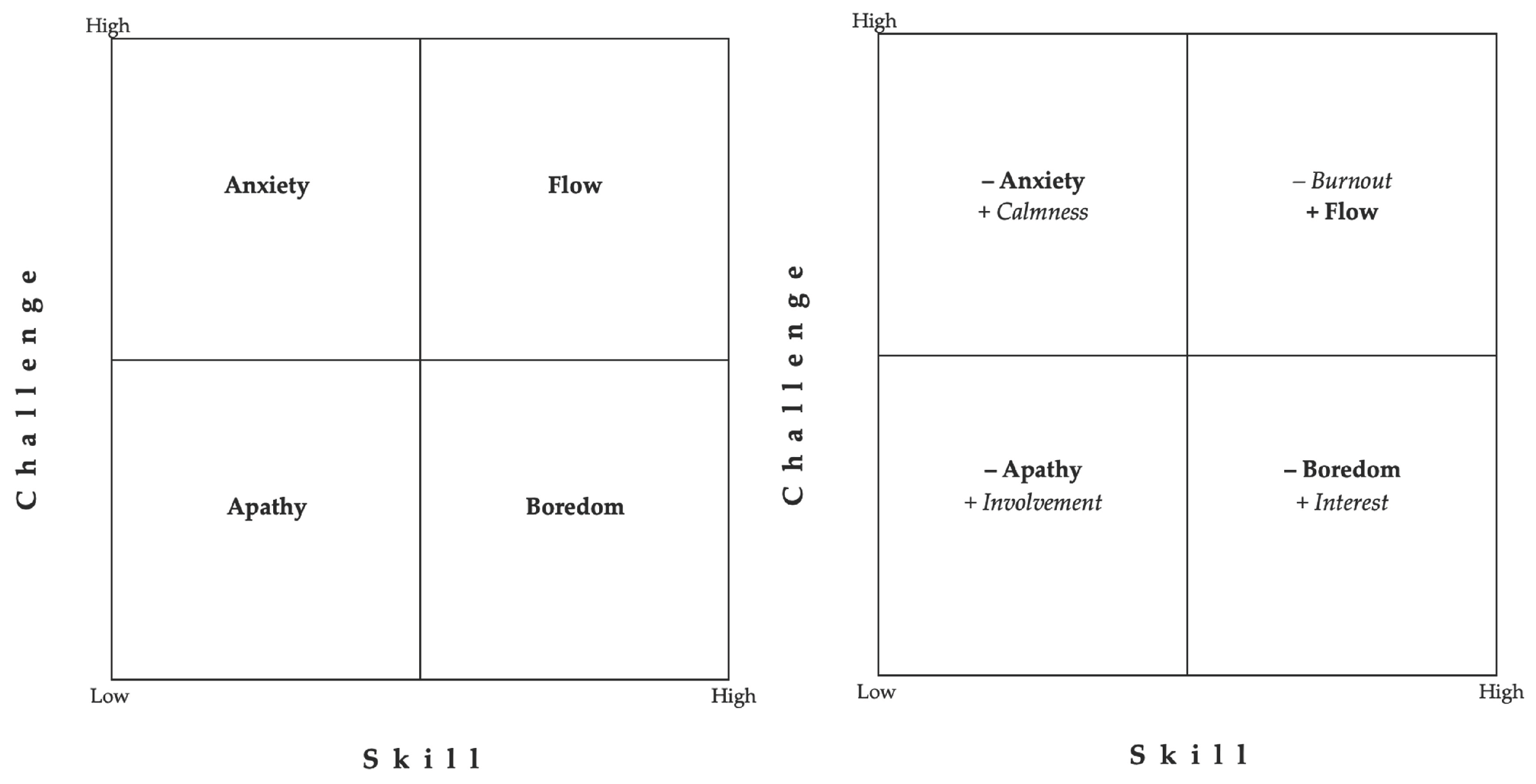

Table 1.
Stage levels of physician burnout and their associated factors, evolving physician burnout, and promoting burnout improvement.
Table 1.
Stage levels of physician burnout and their associated factors, evolving physician burnout, and promoting burnout improvement.
| Stage Level | Factor Evolving Physician Burnout |
Factor Promoting Burnout Improvement |
|---|---|---|
| Macro | Corporate structure Electronic recordkeeping COVID-19 |
Fundamental physician rights Adequate working conditions Increased salaries Career and professional development Improvements to physical and social environment Clear professional guidelines and protocols Increased staffing |
| Meso | Doctor-patient communication Increase in women and minorities |
Career re-engagement Increased years of experience Better treatment by patients, their families, and visitors |
| Micro | Professionalism Psychological traits |
Identification of biological risk factors Heart variability testing Hair cortisol testing |
Table 2.
Freudenberger’s ten points to mitigate burnout, with the point number in round brackets.
| Freudenberger’s Ten Points to Mitigate Burnout |
|---|
| Ensure adequacy of the physician training period (1) |
| Train medical educators to differentiate realistic dedication from unrealistic commitment (2) |
| Rotate functions (3) |
| Limit the number of working hours (4) |
| Provide significant vacation time (5) |
| Provide backup to burned-out physicians (6) |
| Encourage physicians to share their experiences (7) |
| Attend workshops (8) |
| Ensure sufficient physicians for the population (9) |
| Encourage physicians to get adequate physical exercise (10) |
Table 3.
Stage levels and prevention levels of physician burnout, regarding their relationship to Freudenberger’s ten points, with the point number in round brackets.
Table 3.
Stage levels and prevention levels of physician burnout, regarding their relationship to Freudenberger’s ten points, with the point number in round brackets.
| Stage Level | Prevention Level |
|---|---|
| Macro (1)(2)(5)(9) | Primordial prevention (1)(2)(7)(8)(10) |
| Meso (3)(4)(6) | Systems-based primary prevention (3)(4)(5)(6)(9) |
| Micro (7)(8)(10) | Secondary prevention—Meditation not recommended |
| Tertiary prevention—No advice |
Table 4.
Freudenberger’s ten points to mitigate burnout, with the point number in round brackets and the relevant negative psychological state of Csikszentmihalyi’s four-quadrant model following.
Table 4.
Freudenberger’s ten points to mitigate burnout, with the point number in round brackets and the relevant negative psychological state of Csikszentmihalyi’s four-quadrant model following.
| Freudenberger’s Ten Points to Mitigate Burnout Regarding the Four Quadrant Model |
|---|
| Ensure adequacy of the physician training period (1) burnout |
| Train medical educators to differentiate realistic dedication from unrealistic commitment (2) burnout or anxiety |
| Rotate functions (3) burnout or boredom |
| Limit the number of working hours (4) anxiety, boredom, or apathy |
| Provide significant vacation time (5) anxiety, or apathy |
| Provide backup to burned-out physicians (6) burnout, anxiety, boredom, or apathy |
| Encourage physicians to share their experiences (7) anxiety, boredom, or apathy |
| Attend workshops (8) anxiety, boredom |
| Ensure sufficient physicians for the population (9) anxiety |
| Encourage physicians to get adequate physical exercise (10) anxiety, or apathy |
Disclaimer/Publisher’s Note: The statements, opinions and data contained in all publications are solely those of the individual author(s) and contributor(s) and not of MDPI and/or the editor(s). MDPI and/or the editor(s) disclaim responsibility for any injury to people or property resulting from any ideas, methods, instructions or products referred to in the content. |
© 2026 by the author. Licensee MDPI, Basel, Switzerland. This article is an open access article distributed under the terms and conditions of the Creative Commons Attribution (CC BY) license.
Copyright: This open access article is published under a Creative Commons CC BY 4.0 license, which permit the free download, distribution, and reuse, provided that the author and preprint are cited in any reuse.