

Submitted:
24 August 2026
Posted:
25 August 2026
You are already at the latest version
Abstract
Monocular reconstruction under severe low light is ill-posed because underexposure removes repeatable texture, view-dependent camera processing violates photometric consistency, and pose or depth errors can be absorbed as blurred or distorted Gaussian primitives. We propose LL-3DGS Reconstruction, a coupled geometric–photometric framework that estimates a canonical normally illuminated Gaussian scene while retaining raw low-light observations as explicit evidence. Its geometry front end preserves view identity and order, selects a raw or fixed enhanced stream for learned multi-view inference, and converts the estimated cameras, depth, and points into a density-aware Gaussian seed with optional Sim(3) co-registration. The Gaussian back end constrains one shared 3D field through a bounded luminance restoration path and a low-light re-degradation path, preventing independent per-view corrections from becoming inconsistent scene content. Dark-region weighting, reliability-aware supervision, staged activation, bounded densification, and scale–anisotropy constraints further regularize flexible Gaussian primitives against noise, illumination errors, and weak geometry. Finally, co-registered metric depth supplies surface geometry while the canonical Gaussian rendering supplies restored color for colored-point and TSDF fusion. With paired normal-light supervision, the method obtains 25.44 dB PSNR, 0.898 SSIM, and 0.247 LPIPS on five LOM scenes and averages 21.195 dB, 0.449 SSIM, and 0.523 LPIPS across eight LLRS scenes. A controlled LOM-sofa ablation shows that low-light consistency supports observation explainability, while four-scene TSDF outputs document the explicit reconstruction path without claiming geometric accuracy in the absence of 3D ground truth.
Keywords:
low-light 3D reconstruction
; 3D Gaussian Splatting
; monocular depth estimation
; camera pose estimation
; degradation modeling
; TSDF fusion
1. Introduction
Three-dimensional Gaussian Splatting (3DGS) combines an explicit scene representation with differentiable rasterization and real-time novel-view rendering [1]. Its success nevertheless relies on reliable camera poses, informative gradients, and approximately consistent multi-view appearance. Monocular low-light capture violates all three assumptions at once. Underexposure suppresses the texture required for correspondence matching; shot and read noise create false gradients; small light sources and reflective surfaces saturate; and automatic exposure, white balance, denoising, and tone mapping introduce nonlinear changes between views. In this setting, low-light enhancement and 3D reconstruction cannot be treated as two independent problems: a visually brighter frame may still provide unreliable geometry, while a photometrically well-fitted 3DGS may encode the darkness and noise instead of the underlying scene.
Existing research first addresses the problem as two-dimensional image restoration, spanning curve-based Zero-DCE, RetinexFormer, zero-shot illumination-guided ZERO-IG, multi-condition diffusion LightDiff, generative Diff-Retinex, and real-world joint denoising/enhancement LIVENet [2,3,4,5,6,7]. Despite improving visibility, noise handling, and illumination correction, these methods primarily optimize individual-frame quality, so independent processing can change exposure, color, noise statistics, and edge profiles across views. Since clipped or near-black pixels remain ambiguous, higher enhancement PSNR does not ensure stable SfM correspondences, camera estimation, depth, or 3DGS surface geometry.
A second line of work moves illumination correction into a radiance field. LLNeRF and Aleth-NeRF model low-light formation within NeRF, improving relighting from posed image collections while retaining externally provided camera geometry [8,9]. Luminance-GS introduces view-adaptive color and curve adjustment for challenging exposure conditions, but still optimizes appearance under the input views of a conventional 3DGS setup [10]. LL-Gaussian combines learned Gaussian initialization with illumination decomposition for low-light novel-view synthesis [11], whereas DelowlightSplat improves feed-forward Gaussian prediction from sparse, posed low-light context views [12]; neither formulation jointly recovers monocular cameras, metric depth, and a fused surface when darkness causes the geometric front end to fail. Collectively, these results establish the value of three-dimensional illumination modeling but leave open the complete low-light pipeline from camera/depth estimation to geometrically validated surface reconstruction.
Geometry-aware Gaussian methods improve surface behavior in well-conditioned captures: 2DGS constrains primitives toward oriented surface elements, SuGaR extracts mesh-compatible surfaces, and PGSR adds planar and depth-aware regularization [13,14,15]. Learned reconstruction systems provide complementary geometric priors—DUSt3R predicts pointmaps, VGGT jointly estimates cameras, points, depth, and tracks, and LingBot-Map extends such prediction to streaming sequences [16,17,18]. Under severe darkness, however, their feature and correspondence models remain exposed to photometric domain shift, while enhanced inputs may change the same edges on which the geometry estimator relies. The resulting ambiguity lets pose, depth, exposure, and Gaussian parameters compensate for one another, so enlarged or semi-transparent splats can hide pose errors and still produce a plausible held-out view. A complete low-light reconstruction therefore also requires explicit control of frame order, resized intrinsics, depth scale, and the coordinate hand-off from the geometry estimator to 3DGS and TSDF fusion.
To address cross-view photometric inconsistency, unstable monocular geometry, and the coupling of appearance and Gaussian-geometry errors in low-light scenes, we propose LL-3DGS Reconstruction, a degradation-consistent Gaussian framework that combines enhancement-aware geometry bootstrapping, dual-domain appearance modeling, structure-constrained Gaussian optimization, and aligned-depth surface fusion. The geometry front end processes a recorded stream of raw or enhanced frames, uses an external learned mapper to predict cameras, points, and depth, applies density-biased Gaussian initialization, and performs intrinsic rescaling and camera-center Sim(3) co-registration when reference cameras are available. The Gaussian back end optimizes one canonical scene through a luminance path with range-regularized exposure, color correction, and adaptive tone curves, and a degradation path that maps the same render back to the captured low-light domain; shared geometry, reliability weighting, staged activation, and scale/anisotropy-aware densification prevent enhancement artifacts from being absorbed as inconsistent 3D content. Finally, aligned mapper depth supplies fusion geometry and enhanced Gaussian renders supply color at the same cameras, producing a colored point cloud and TSDF mesh while avoiding the bias of Gaussian expected depth and the loss of restored appearance from raw RGB fusion.
The core contributions are:
- We formulate low-light 3DGS as dual-domain reconstruction rather than direct dark-image fitting. A shared Gaussian field is constrained by a normal-light luminance path and an observation-consistent degradation path, so restoration remains accountable to the captured dark sequence.
- We develop an enhancement-aware monocular geometry interface. Explicit input selection and frame ordering, density-biased initialization, intrinsic rescaling, and Sim(3) co-registration keep images, cameras, depths, and Gaussians in a traceable common frame.
- We formulate a geometry–appearance decoupled surface reconstruction strategy that combines co-registered learned depth with degradation-consistent Gaussian radiance. Assigning surface geometry to aligned depth and appearance to the canonical Gaussian rendering reduces the depth bias induced by enlarged or semi-transparent primitives while preserving restored multi-view appearance in explicit point-cloud and TSDF representations.
2. Related Work
2.1. Low-Light Enhancement and Neural Rendering
Low-light image enhancement improves visibility through curve estimation, decomposition, denoising, or learned illumination correction. Zero-DCE learns image-specific enhancement curves without paired supervision [2], while RetinexFormer uses a one-stage illumination-guided Retinex formulation [3]. Applying such methods independently to multi-view images does not enforce correspondence-level consistency. LLNeRF jointly decomposes and enhances a radiance field from low-light sRGB inputs [8], and Aleth-NeRF uses an illumination-adaptive concealing field [9]. Luminance-GS adapts 3DGS to low, high, and varying exposure with view-dependent color and curve adjustment [10]. LL-Gaussian introduces learning-based initialization and illumination decomposition [11], and DelowlightSplat targets feed-forward inference from sparse low-light context views [12]. Our method instead connects the photometric model to monocular camera/depth bootstrapping and explicit surface fusion, while requiring the canonical rendering to remain explainable in the observed low-light domain.
2.2. Learned Monocular Geometry and Camera Estimation
Learning-based camera estimation reduces dependence on handcrafted correspondences. DROID-SLAM performs recurrent dense bundle adjustment [19], while DPVO optimizes learned patch tracks [20]. More recent geometric foundation models infer stronger cross-view priors: DUSt3R represents pairwise geometry as pointmaps [16], MASt3R grounds image matching in 3D [21], and VGGT jointly predicts cameras, depth, points, and tracks [17]. MASt3R-SLAM incorporates such priors into dense SLAM [22], whereas LingBot-Map extends learned reconstruction to ordered streaming sequences [18]. However, none explicitly resolves the low-light observation process: underexposure removes repeatable texture, noise corrupts correspondence scores, and independently enhanced frames can displace the edges used for camera and depth estimation. Our method therefore introduces an enhancement-aware geometry interface that controls input selection, frame order, intrinsic scaling, depth convention, and Sim(3) co-registration before the learned geometry enters Gaussian optimization.
2.3. Gaussian Reconstruction and Surface Fusion
Geometry-aware Gaussian representations narrow the gap between novel-view rendering and explicit reconstruction. 2DGS replaces volumetric ellipsoids with oriented surface elements [13], SuGaR regularizes Gaussians toward an extractable surface [14], and PGSR introduces planar and depth-aware constraints for high-fidelity geometry [15]. Gaussian-SLAM and SplaTAM jointly optimize camera motion and Gaussian maps, but obtain their geometric supervision from RGB-D input [23,24]. Hybrid representations make the surface variable more explicit: GS-Fusion couples Gaussian appearance with TSDF fusion [25], while GSDF combines Gaussian splatting with a neural signed-distance field [26]. These methods are effective under reliable poses, depth, and photometric evidence, yet low-light appearance errors can still be absorbed by enlarged or semi-transparent primitives, producing plausible images but biased rendered depth. Our method therefore decouples the two reconstruction roles: co-registered learned depth defines the fused surface, while the shared, degradation-consistent Gaussian field supplies restored multi-view color at the same cameras.
3. Method
As summarized in Figure 1, we formulate low-light reconstruction as the joint estimation of scene geometry, canonical normal-light appearance, and view-dependent photometric degradation within a unified Gaussian representation. The method combines enhancement-aware monocular geometry bootstrapping, a shared Gaussian representation constrained in both canonical and observed illumination domains, structure-adaptive optimization that suppresses photometric errors from becoming distorted primitives, and geometry–appearance decoupled surface fusion. This design preserves the captured low-light evidence throughout optimization while assigning camera and depth recovery, appearance restoration, Gaussian structure, and explicit surface extraction distinct and verifiable roles.
3.1. Overview
Given a monocular low-light sequence
we seek camera parameters , co-registered metric depths , a canonical normally illuminated Gaussian field G, and an explicit colored surface . Rather than treating enhancement, camera recovery, and reconstruction as independent tasks, our formulation assigns geometry, canonical appearance, and the low-light observation process to distinct but coupled variables. The complete processing graph is
where denotes geometry bootstrapping, denotes degradation-consistent Gaussian optimization, and denotes explicit surface fusion.
First, the enhancement-aware geometry front end (Section 3.2) selects either the raw sequence or a fixed enhanced sequence according to geometric reliability. It preserves natural temporal order, predicts cameras, depth, and dense points with a learned multi-view mapper, and converts these predictions into a bounded, density-balanced Gaussian initialization . Intrinsics, depth scale, and image identity are propagated explicitly; when reference cameras are available, a camera-center Sim(3) aligns the predicted geometry to their coordinate frame. Thus, enhancement is treated as optional evidence for correspondence recovery rather than as geometric ground truth.
Second, the degradation-consistent appearance model (Section 3.3) optimizes a single Gaussian field through two complementary photometric paths. The luminance path maps its base rendering to a normally illuminated image using bounded exposure, color, and tone parameters , whereas the degradation path maps the same scene back to the captured low-light domain through constrained parameters . Their shared geometry prevents independent per-view enhancement from becoming independent 3D content and requires the restored appearance to remain explainable by the actual observations.
Third, structure-adaptive optimization (Section 3.4) addresses the tendency of Gaussian primitives to absorb noise, pose error, and illumination error as blurred or elongated geometry. Dark-region weighting, reliability-aware losses, staged module activation, edge and optional depth constraints, and bounded densification progressively refine appearance and structure while limiting scale and anisotropy. Finally, Section 3.5 decouples explicit geometry from restored color: co-registered mapper depth supplies the fusion surface, and the canonical Gaussian field supplies multi-view-consistent enhanced color at the same cameras. Their joint integration produces the fused point cloud and TSDF mesh .
Figure 2 expands this formulation into its concrete data flow, photometric branches, optimization constraints, and exported representations.
3.2. Enhancement-Aware Monocular Geometry
3.2.1. Ordered Image Stream
Dataset-specific identifiers do not necessarily preserve acquisition order under conventional string sorting. We therefore recover the sequence using a numeric-aware natural ordering and assign each observation a monotonically increasing canonical index before geometry inference. Consequently, the temporal order remains invariant even when an external mapper internally enumerates its inputs lexicographically.
After inference, we store
where denotes the persistent identity of the ith source observation. Conversion to COLMAP format and depth fusion require exact agreement with ; a mismatch terminates processing rather than binding a pose or depth to the wrong observation.
3.2.2. Monocular Camera, Depth, and Point Prediction
An ordered image stream is processed by a learned multi-view mapper, which returns predicted camera-to-world transforms , intrinsics , dense points , confidence, and depths . Although the source is monocular RGB, the temporal multi-view context resolves more geometry than isolated single-image depth. The current implementation uses LingBot-Map [18]; the interface also admits related feed-forward models.
If prediction and target resolutions are and , the intrinsic parameters are rescaled as
Depth export uses nearest-neighbor resizing so that foreground and background depth are not averaged at discontinuities. Sky masking and a confidence threshold can reject geometrically unreliable pixels.
Role of enhancement.
When the raw sequence is too dark for stable correspondence, a fixed enhancement stream can be selected as the mapper input. It improves edge visibility but is not treated as geometric truth. The raw images are retained as the observation domain for the degradation loss, and the selected geometry stream is reported in every experiment. This separation permits a direct raw-versus-enhanced geometry ablation.
3.2.3. Density-Biased Gaussian initialization
Dense predicted points are inappropriate as a direct 3DGS initialization because strongly textured or nearby regions dominate point density. We apply LLGIM-style density-biased pruning [11]. Let denote a local density estimate. The retained sampling tendency is inversely related to density,
The implementation uses a prune ratio near , pre-subsamples extremely large clouds, and applies a hard cap of points. The resulting positions and colors are validated for finiteness and implausible dynamic range before being written as COLMAP-format sparse/0.
3.2.4. Optional Sim(3) Co-Registration
Two installation modes are supported. If conventional SfM fails, predicted cameras and pruned points are installed together, so depth and Gaussian initialization naturally share one frame. If trusted reference cameras exist, their intrinsics and poses are retained and only the predicted geometry is aligned.
Let and be corresponding predicted and reference camera centers. We estimate
and transform points by . Camera orientations and centers follow the same similarity. Because the world unit changes, metric depth is also multiplied by ; equivalently, the stored depth divisor is divided by . The transform and its median and 95th-percentile camera-center residuals are saved in the sparse metadata.
3.3. Degradation-Consistent Gaussian Enhancement
3.3.1. Shared Gaussian Field
The scene is represented by
where is position, is rotation, is anisotropic scale, is opacity, and contains spherical-harmonic appearance coefficients. Differentiable rasterization produces a base rendering
Depending on the configured photometric target, is either a canonical normal-light estimate or a shared intermediate rendering. The final enhanced output is always identified explicitly as .
3.3.2. Paired Luminance Path
The normal-light output applies bounded per-view exposure, a color matrix, and an adaptive curve:
The color matrix is initialized as identity. A compact cross-attention module predicts from image features and a view embedding. Its sigmoid outputs restrict the power-law exponent to , the S-curve pivot to , and the shape exponent to .
With a paired normal-light image or an explicitly labeled pseudo-reference , the luminance objective is
When the canonical Gaussian is directly supervised by a normal-light target, as in the LLRS-sharp setting, ; low-light fidelity is then assigned exclusively to the degradation path.
3.3.3. Low-Light Degradation Path
To prevent bright restoration from discarding the actual observation, the same base rendering is mapped back to the low-light domain:
The parameters obey
The residual is a two-layer convolutional network bounded by , preventing it from independently reconstructing the image.
An adaptive reliability mask downweights extremely dark, saturated, or currently unexplained pixels. The low-light consistency loss is
Exposure, gamma, bias, color perturbation, and residual weights are regularized toward their initialization. Smooth-L1 penalties between adjacent ordered views encourage slowly varying camera response, and total variation regularizes the residual filters.
3.4. Structure-Adaptive Gaussian Optimization
3.4.1. Dark-Region Weighting
Uniform L1 underweights dark pixels because their absolute errors are small. For target I, we define
and use
The normalization keeps the mean weight at one. The LOM-quality configuration uses ; it is disabled when a normal-light canonical target makes inverse-luminance weighting counterproductive.
3.4.2. Staged Training and Densification
Optimization proceeds through warm-up, luminance, geometry, and refinement stages. Warm-up stabilizes Gaussian position, scale, and opacity. The luminance stage activates Equation (9); V5 also activates edge consistency early to counter enhancement blur. The geometry stage adds highlight downweighting, edge loss, and optional depth/normal terms. The final stage jointly refines all enabled modules. The degradation path can be delayed until the base field is stable.
Densification is driven by projected gradients, but growth is bounded. For each primitive,
The LLRS-sharp preset uses , caps the map at Gaussians, raises the gradient threshold, and stops densification earlier than the long LLRS preset. Log-scales are clamped symmetrically around their geometric mean so that the permitted interval has width . Non-finite losses skip the update; auxiliary gradients are sanitized and clipped.
The complete objective is
Depth supervision is optional in the current implementation and is not treated as an always-active contribution.
3.5. Metric Geometry and Enhanced-Color Fusion
For each exported depth pose, we render the trained 3DGS at exactly the same camera and apply the checkpoint’s enhancement path once. Historical LOM checkpoints use the legacy curve-only path; current LLRS checkpoints use exposure, color matrix, and curve. Reapplying a curve would over-enhance the texture.
Let be the co-registered metric depth and the enhanced Gaussian color. A valid pixel is back-projected by
Depth is restricted to a robust percentile range. A Gaussian alpha threshold can suppress unsupported colors; an optional mode preserves valid depth in low-alpha regions when geometric completeness is more important.
The pairs are integrated in a voxel TSDF with truncation
where v is voxel size and by default. The system exports both the fused point cloud and mesh. Keeping both is diagnostically important: a correct point cloud with a damaged mesh indicates TSDF filtering or topology failure, whereas both being distorted indicates pose, depth, intrinsic, or Sim(3) inconsistency.
3.6. Implementation Notes
The LOM V5 schedule uses iterations, at least initial points, at most initialization points, dark weight , and densification up to approximately iterations. LLRS presets use the full enhancement path and nearest-training-camera appearance parameters for held-out cameras. The LLRS-sharp preset limits anisotropy and Gaussian count. The successful sofa mesh uses a voxel size and a alpha threshold. Outdoor scenes require scene-specific voxel and depth-range validation; their parameters are not silently substituted for the stable sofa configuration.
4. Experiments
4.1. Experimental Protocol
Datasets and evaluation scopes.
We evaluate appearance and reconstruction on three public low-light multi-view benchmarks. LOM provides paired low- and normal-exposure images for the five scenes bike, buu, chair, shrub, and sofa [9]. In our current LOM runs, one of every eight images is held out; the remaining paired normal-exposure images supervise canonical appearance, while their low-exposure counterparts supervise the degradation path. Enhanced held-out renders are evaluated against normal-exposure views. Consequently, these runs are labeled paired and are not directly rankable with published low-only methods. A second, explicitly separated LOM-sofa experiment evaluates 33 common observed views so that Inria 3DGS, GS-ICP-SLAM, RTG-SLAM, GPS-SLAM, and our reconstruction can be compared on exactly the same images. It measures reconstruction fidelity rather than unseen-view generalization.
LLRS-sRGB contains eight real indoor and outdoor scenes. Six of them (chair, firehydrant, path, pole, staircase, and stone) form the protocol used by LL-Gaussian [11]; apartment and building are retained for local robustness analysis. The current LLRS result uses paired normal-light training views and is therefore reported as Ours (paired), separate from low-only published methods. Finally, LLNeRF contains D5, cart, campus-path, and book but no paired normal-exposure ground truth [8]. We use it only to verify the qualitative and raw-observation evaluation pipeline; we do not invent a normal-light PSNR ranking for this dataset.
Metrics.
For normal-light novel-view synthesis (NVS), we report PSNR, SSIM, and LPIPS between the enhanced rendering and its normal-light reference. For the degradation loop, the same metrics compare a re-degraded rendering with the original low-light observation. We always label whether a number is held-out NVS, observed-view reconstruction, input-domain fidelity, or a published reference. Local metrics operate on RGB images in : PSNR uses RGB mean-squared error, SSIM uses an 11-pixel grayscale window, and LPIPS uses the VGG backbone. Dataset summaries are scene-macro averages; published rows retain the evaluator of their cited source. Fused point clouds and TSDF meshes are reported as saved three-dimensional artifacts; because LOM and LLRS do not provide laser-scan ground truth, their geometry is not assigned an unsupported Chamfer or F-score.
Implementation.
The paired LOM quality recipe runs for 30k iterations with , bounded Gaussian refinement, and a 30k–100k learned geometry initialization. LLRS uses the sharp-natural schedule with bounded anisotropy and the full exposure–color–curve enhancement path. Test-view appearance parameters are inherited from the nearest training camera. Metric depth and Gaussian color are fused only after verifying that their cameras share a coordinate system. Local numerical results below follow the corresponding fixed evaluator summaries, while values attributed to prior work retain the protocol and evaluator reported by their cited source.
4.2. LOM Normal-Light Reconstruction
Five-scene held-out evaluation.
Table 1 places our final model alongside the five-scene values reported by LL-Gaussian. The published rows use low-light input under their source protocol, whereas our row uses paired normal-light supervision and a local held-out split. The numerical values are therefore reported for context, not as a same-protocol ranking. Table 2 and Figure 3 report our paired result scene by scene. Within this local evaluation, sofa has the highest PSNR and buu the lowest.
Observed-view reconstruction comparison.
The 33-view sofa experiment is a protocol-asymmetric pipeline study rather than an algorithm leaderboard. Table 3 uses the same normal-light reference and evaluator for all methods, but not the same training supervision. The four external pipelines fit frames enhanced by MBLLEN [27]. We denote our setting as paired dual-domain: “paired” indicates that every training view has an aligned normal-light target, while “dual-domain” indicates that the same Gaussian scene is constrained in two image domains. Its canonical and enhanced renderings are supervised by the paired normal-light frames, whereas a learned degradation path maps that shared scene back to the raw low-light observations. Thus, our pipeline directly uses raw low-light images but does not use MBLLEN outputs. For this sofa run, the paired normal-light stream also supplies the learned-mapper geometry initialization, so this result is paired supervision rather than a raw-only reconstruction result. The raw-input runs of the four external pipelines are between 5.97 and 6.15 dB PSNR in the saved evaluation, so Table 3 shows their MBLLEN-input condition. The paired dual-domain result reaches 27.121 dB, 0.9069 SSIM, and 0.1287 LPIPS. This is an observed-view paired-reconstruction result and is not substituted for the held-out result in Table 1.
Figure 4.
LOM sofa observed-view pipeline comparison at five of the 33 evaluated cameras. The four external pipelines fit MBLLEN-enhanced inputs; Ours uses raw observations together with paired normal-light canonical supervision. The final column is the normal-light reference. The panel shows visible differences in blur and boundary artifacts, but the unequal supervision prevents a same-protocol method ranking.
Figure 4.
LOM sofa observed-view pipeline comparison at five of the 33 evaluated cameras. The four external pipelines fit MBLLEN-enhanced inputs; Ours uses raw observations together with paired normal-light canonical supervision. The final column is the normal-light reference. The panel shows visible differences in blur and boundary artifacts, but the unequal supervision prevents a same-protocol method ranking.
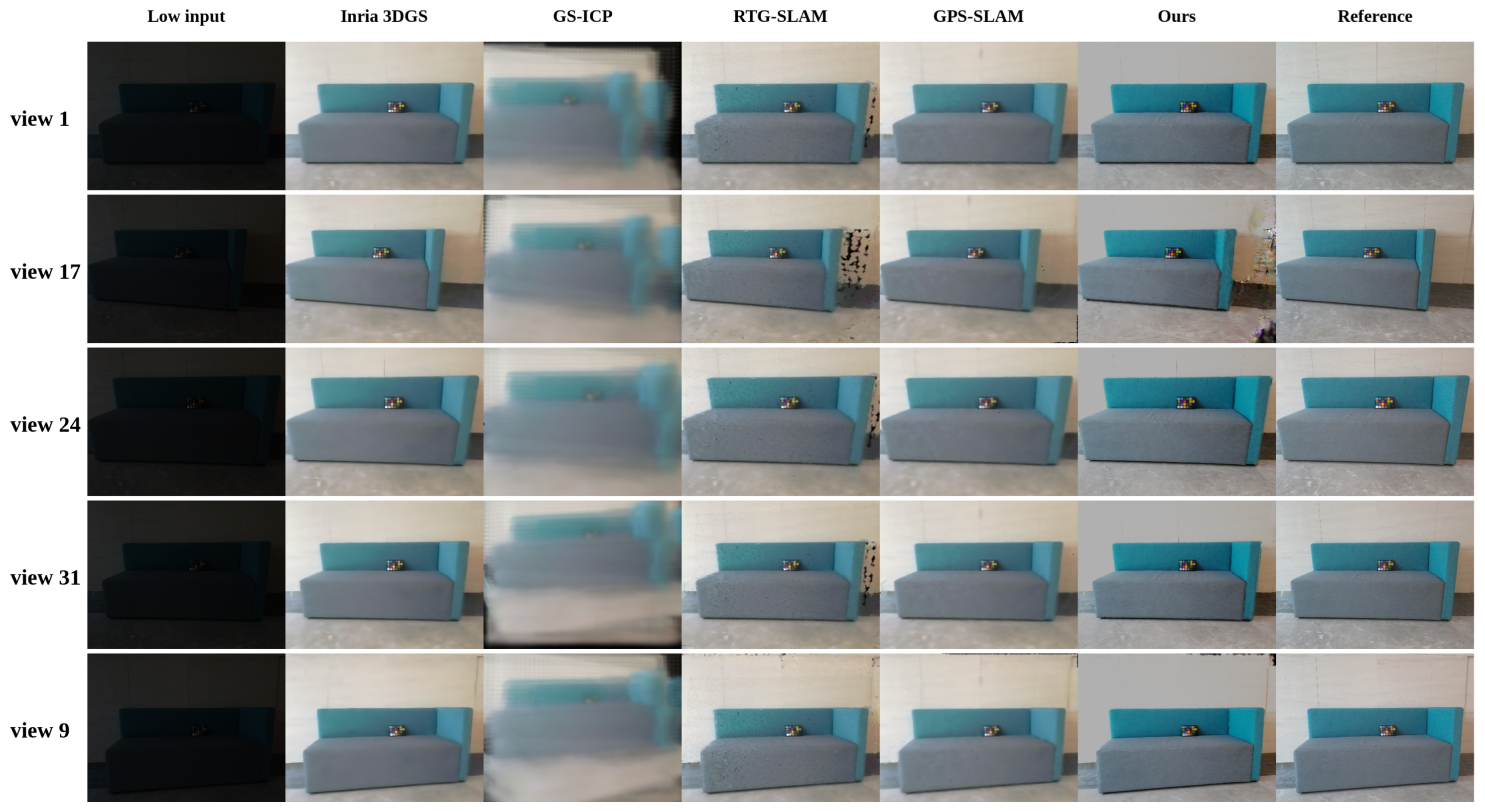
The runtime records should not be interpreted as a homogeneous speed benchmark: Inria 3DGS and ours are offline 30k optimizers, whereas the three SLAM systems are online mappers. In the recorded runs, ours used 416,917 Gaussians and 1,410 s; Inria+MBLLEN used 41,764 Gaussians and 94 s; GS-ICP, RTG, and GPS-SLAM completed their online passes in 5–10 s. We report these values only as resource context.
4.3. LLRS Robustness and Input-Domain Study
Table 4 places our local six-scene output next to the LLRS-6 values reported by LL-Gaussian. The separation in the table is essential: the first block is low-only and follows the published protocol; our current result uses paired normal-light training views and a local fixed split. It is therefore a diagnostic of current reconstruction quality, not a claim of superiority over LL-Gaussian. On all eight local scenes, our enhanced average is 21.195 dB / 0.449 / 0.523; the macro-average over the six scenes shared with the published protocol is 21.551 dB / 0.429 / 0.520.

Table 5.
Our completed LLRS sharp-natural fixed-test outputs. Values are enhanced PSNR/SSIM/LPIPS.
| Scene | Views | Enhanced P/S/L |
| apartment | 6 | 19.297 / 0.452 / 0.516 |
| building | 5 | 20.956 / 0.564 / 0.520 |
| chair | 5 | 20.350 / 0.302 / 0.495 |
| firehydrant | 4 | 21.369 / 0.343 / 0.469 |
| path | 4 | 22.059 / 0.473 / 0.548 |
| pole | 4 | 23.452 / 0.622 / 0.546 |
| staircase | 4 | 20.211 / 0.427 / 0.521 |
| stone | 4 | 21.867 / 0.406 / 0.538 |
| Mean | 36 | 21.195 / 0.449 / 0.523 |
Controlled input-domain and system comparison.
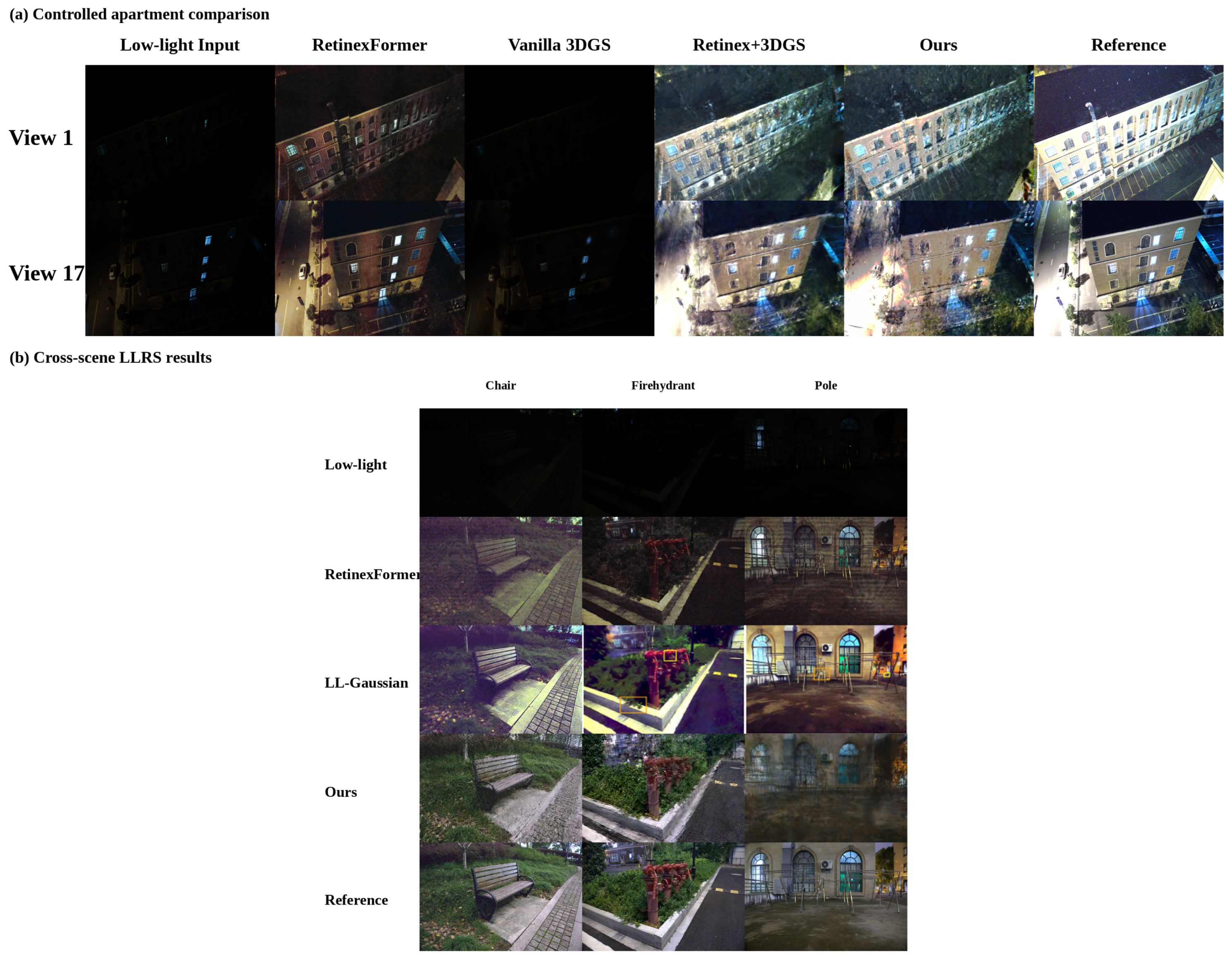
Figure 6 complements the published-method comparison in Figure 5 at exactly matched apartment cameras. Vanilla Inria 3DGS is fitted directly to the raw low-light frames; we additionally show the standalone RetinexFormer enhancement. The sequential baseline uses RetinexFormer-enhanced frames with otherwise identical camera poses, split, initialization, hyperparameters, and 30k budget. The complete LL3DGS model is shown separately because it additionally uses paired canonical supervision and is not a single-variable baseline. We further report held-out outputs on chair, firehydrant, and pole against LL-Gaussian to illustrate behavior beyond the apartment sequence; these cross-scene cells are not a controlled generalization test.
Raw versus enhanced 3DGS input.
We additionally train standard Inria 3DGS for 30k iterations on the LLRS apartment using either raw images or RetinexFormer-finetuned images [3]. Relative to the normal-light target, enhanced input increases PSNR from 5.682 to 14.341 dB and SSIM from 0.0266 to 0.2296, while LPIPS falls from 0.7604 to 0.6348. However, input-domain PSNR drops from 36.00 to 17.52 dB, confirming that the enhanced-input run is optimized toward a different photometric target. Figure 6 shows residual blur and saturation after sequential enhancement; this experiment does not isolate whether those artifacts originate from cameras, enhancement inconsistency, or the 3DGS representation.
Figure 5.
LLRS matched-view qualitative comparison on pole, firehydrant, and path. The test-view composites, Scaffold-GS, LLNeRF, Gaussian-DK, LE3D, and reference cells are reorganized from LL-Gaussian Figure 5 [11]; Ours inserts the local paired-supervision render at the corresponding held-out camera. Yellow insets highlight local blur and artifacts. Because supervision and evaluator provenance differ, this panel is a visual diagnostic rather than a same-protocol ranking.
Figure 5.
LLRS matched-view qualitative comparison on pole, firehydrant, and path. The test-view composites, Scaffold-GS, LLNeRF, Gaussian-DK, LE3D, and reference cells are reorganized from LL-Gaussian Figure 5 [11]; Ours inserts the local paired-supervision render at the corresponding held-out camera. Yellow insets highlight local blur and artifacts. Because supervision and evaluator provenance differ, this panel is a visual diagnostic rather than a same-protocol ranking.
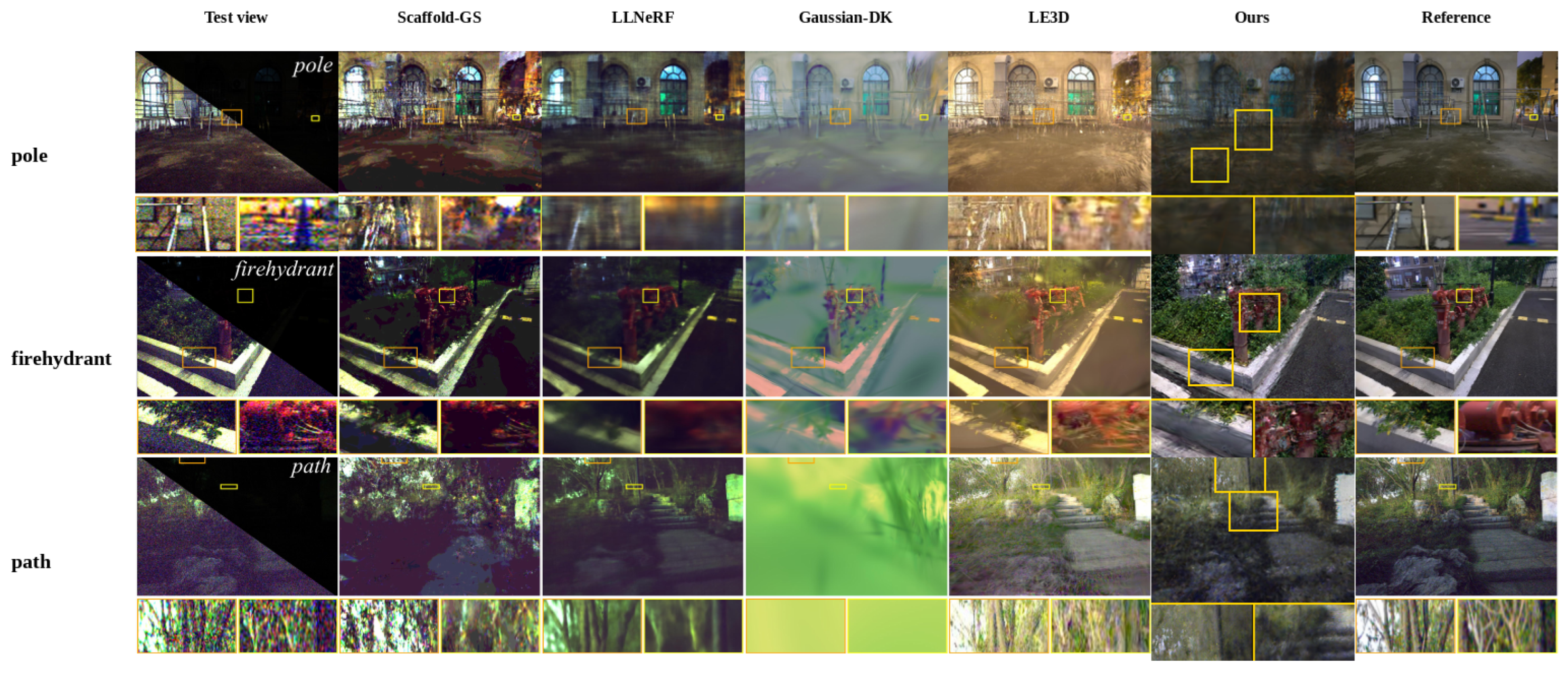
Figure 6.
Controlled and cross-scene LLRS comparisons. (a) At two apartment cameras, the columns show the low-light input, standalone RetinexFormer output, vanilla 3DGS fitted to raw frames, the same 3DGS pipeline fitted to RetinexFormer frames, our paired-supervision output, and the normal-light reference. Retinex+3DGS and our paired model are brighter than vanilla 3DGS, but both retain visible blur or saturation relative to the reference. (b) Chair, firehydrant, and pole show one camera each; the LL-Gaussian cells combine a local 8k chair checkpoint with published firehydrant and pole crops, so this panel is qualitative and has mixed provenance.
Figure 6.
Controlled and cross-scene LLRS comparisons. (a) At two apartment cameras, the columns show the low-light input, standalone RetinexFormer output, vanilla 3DGS fitted to raw frames, the same 3DGS pipeline fitted to RetinexFormer frames, our paired-supervision output, and the normal-light reference. Retinex+3DGS and our paired model are brighter than vanilla 3DGS, but both retain visible blur or saturation relative to the reference. (b) Chair, firehydrant, and pole show one camera each; the LL-Gaussian cells combine a local 8k chair checkpoint with published firehydrant and pole crops, so this panel is qualitative and has mixed provenance.
LLNeRF evaluation boundary.
The released-code LL-Gaussian reproduction on D5, cart, campus-path, and book obtains raw-observation PSNRs of 36.77, 38.13, 36.92, and 35.52 dB, respectively. These values measure reconstruction of the dark target, not normal-light enhancement accuracy. Since LLNeRF has no paired normal-light GT, we retain the numerical experiment as an implementation check and exclude it from Table 1 and Table 4. Figure 7 instead adds our matched-camera 30k render as qualitative evidence, without treating the unpaired dataset as a normal-light quantitative benchmark.
4.4. Ablation Studies
Dual-domain degradation model.
Table 6 uses a controlled 12k LOM-sofa run with five test views. The row without the degradation loop is a non-isomorphic paired-luminance reference and is not treated as a single-variable ablation; the remaining rows use the same controlled configuration. Removing low-light consistency leaves normal-light PSNR almost unchanged but reduces re-degraded PSNR from 33.70 to 12.49 dB, showing that the low-light consistency term is required by this configuration to reproduce the raw observations. Removing multi-view parameter smoothness reduces low-light PSNR by 6.11 dB. The no-residual variant is numerically stronger than the nominal full model on this scene, indicating that the learned residual remains over-parameterized under the small 12k setting; we report this counterexample rather than claiming monotonic gains from every component. Accordingly, the evidence supports the constrained degradation path but does not establish the residual branch as indispensable; a 30k multi-scene check remains required.
Dark-region weighting and Gaussian refinement.
The left block of Table 7 changes only the dark weight. A moderate value of 0.3 gives the best enhanced PSNR and SSIM; the three-run comparison does not identify why performance decreases at 0.7. At 12k, refinement increases the map from 5,000 to 79,573 Gaussians and improves LPIPS from 0.382 to 0.299, but decreases PSNR. The 30k quality recipe recovers PSNR while further improving LPIPS to 0.275. Because it also changes the training duration and stage boundaries, the last row is identified as a complete recipe rather than a pure single-variable densification result.
4.5. Three-Dimensional Reconstruction
The reconstruction path exports a colored fused point cloud and a triangle mesh extracted from a TSDF volume. Figure 8 shows four scenes: LOM sofa and chair together with LLRS chair and firehydrant. All panels use the same representation and fusion rule: LingBot metric depth supplies the geometry and the co-registered enhanced Gaussian rendering supplies color. Thus, unlike a mixed point/Gaussian overview, every panel visualizes an actual colored TSDF triangle mesh. Compact indoor scenes recover coherent objects and nearby support surfaces, whereas the wider LLRS captures expose partial boundaries, missing observations, and residual depth/pose errors. The visual alignment indicates that the implemented export path can associate mapper depth with enhanced color and save an explicit surface. It does not quantify co-registration accuracy or demonstrate that LL3DGS improves the LingBot geometry itself, and it remains qualitative because these datasets provide no trajectory, depth, or laser-scan surface ground truth.
4.6. Discussion
The experiments support three bounded observations. First, the paired LOM model reaches 25.44 dB, 0.898 SSIM, and 0.247 LPIPS on the local held-out split; because the published rows use low-only supervision, this is not a same-protocol ranking. Second, on the 12k LOM-sofa ablation, removing low-light consistency reduces re-degraded PSNR from 33.70 to 12.49 dB while leaving enhanced PSNR similar, showing the role of that loss in reproducing the observed low-light frames. Third, RetinexFormer preprocessing improves the apartment standard-3DGS normal-light metrics, but visible blur and saturation remain; the experiment does not isolate their geometric or photometric cause.
5. Limitations
The current implementation is an offline reconstruction system and uses external multi-view geometry, so its computational cost and final surface quality depend partly on the mapper and the selected optimization budget. Aligned normal-light targets are used in the supervised protocols, while extremely dark or clipped regions remain challenging for the bounded photometric model. Because the evaluated datasets do not provide trajectory or laser-scan ground truth, the exported TSDF surfaces are presently assessed qualitatively. These scope constraints motivate low-only adaptation, joint pose/depth refinement, geometric benchmarking, and more efficient optimization, while preserving the central focus on degradation-consistent appearance and explicit reconstruction.
6. Conclusions
We presented LL-3DGS Reconstruction, a unified framework that couples enhancement-aware monocular geometry, degradation-consistent Gaussian optimization, and explicit surface fusion for low-light scene reconstruction. By representing normal-light appearance and low-light observations through a shared Gaussian field, the method constrains photometric restoration without discarding the captured dark-image evidence and exports co-registered colored points and TSDF surfaces. Experiments on LOM and LLRS demonstrate improved restored appearance over direct low-light fitting, with the paired five-scene LOM evaluation reaching 25.44 dB PSNR, 0.898 SSIM, and 0.247 LPIPS. The controlled ablations support the contribution of low-light consistency, while the qualitative TSDF examples verify the reconstruction export path but do not establish metric surface accuracy. The present conclusions remain limited by paired supervision, offline optimization, and the absence of trajectory and laser-scan ground truth; future work will address low-only training, joint pose refinement, geometric benchmarking, and more efficient optimization.
Author Contributions
Conceptualization, Y.W. and H.W.; methodology, Y.W. and H.W.; software, Y.W.; validation, Y.W. and B.W.; formal analysis, Y.W.; investigation, Y.W. and B.W.; resources, J.X.; data curation, Y.W.; writing—original draft preparation, Y.W.; writing—review and editing, B.W., J.X., Y.G. and H.W.; visualization, Y.W.; supervision, H.W.; project administration, H.W.; funding acquisition, J.X. and H.W. All authors have read and agreed to the published version of the manuscript.
Funding
This research was funded by the Liaoning Provincial Science and Technology Joint Program (Natural Science Foundation–Doctoral Research Start-up Project), grant number 2025-BSLH-333, and the Shandong Provincial Natural Science Foundation, grant number ZR2024QE098.
Institutional Review Board Statement
Not applicable.
Informed Consent Statement
Not applicable.
Data Availability Statement
The experimental archive contains configurations, Gaussian models, TSDF meshes, colored point clouds, rendering samples, and machine-readable metric tables. Data and code will be made available upon publication.
Conflicts of Interest
The authors declare no conflict of interest.
References
- Kerbl, B.; Kopanas, G.; Leimkühler, T.; Drettakis, G. 3D Gaussian Splatting for Real-Time Radiance Field Rendering. ACM Trans. Graph. 2023, 42, 139:1–139:14. [CrossRef]
- Guo, C.; Li, C.; Guo, J.; Loy, C.C.; Hou, J.; Kwong, S.; Cong, R. Zero-Reference Deep Curve Estimation for Low-Light Image Enhancement. In Proceedings of the In Proceedings of the IEEE/CVF Conference on Computer Vision and Pattern Recognition (CVPR), Seattle, WA, USA, 13–19 June, 2020, pp. 1780–1789.
- Cai, Y.; Bian, H.; Lin, J.; Wang, H.; Timofte, R.; Zhang, Y. Retinexformer: One-Stage Retinex-Based Transformer for Low-Light Image Enhancement. In Proceedings of the In Proceedings of the IEEE/CVF International Conference on Computer Vision (ICCV), Paris, France, 1–6 October, 2023, pp. 12504–12513.
- Shi, Y.; Liu, D.; Zhang, L.; Tian, Y.; Xia, X.; Fu, X. ZERO-IG: Zero-Shot Illumination-Guided Joint Denoising and Adaptive Enhancement for Low-Light Images. In Proceedings of the In Proceedings of the IEEE/CVF Conference on Computer Vision and Pattern Recognition (CVPR), Seattle, WA, USA, 16–22 June, 2024, pp. 3015–3024.
- Li, J.; Li, B.; Tu, Z.; Liu, X.; Guo, Q.; Juefei-Xu, F.; Xu, R.; Yu, H. Light the Night: A Multi-Condition Diffusion Framework for Unpaired Low-Light Enhancement in Autonomous Driving. In Proceedings of the In Proceedings of the IEEE/CVF Conference on Computer Vision and Pattern Recognition (CVPR), Seattle, WA, USA, 16–22 June, 2024, pp. 15205–15215.
- Yi, X.; Xu, H.; Zhang, H.; Tang, L.; Ma, J. Diff-Retinex: Rethinking Low-Light Image Enhancement with a Generative Diffusion Model. In Proceedings of the In Proceedings of the IEEE/CVF International Conference on Computer Vision (ICCV), Paris, France, 1–6 October, 2023, pp. 12302–12311.
- Makwana, D.; Deshmukh, G.; Susladkar, O.; Mittal, S.; R., S.C.T. LIVENet: A Novel Network for Real-World Low-Light Image Denoising and Enhancement. In Proceedings of the In Proceedings of the IEEE/CVF Winter Conference on Applications of Computer Vision (WACV), Waikoloa, HI, USA, 4–8 January, 2024, pp. 5856–5865.
- Wang, H.; Xu, X.; Xu, K.; Lau, R.W.H. Lighting up NeRF via Unsupervised Decomposition and Enhancement. In Proceedings of the In Proceedings of the IEEE/CVF International Conference on Computer Vision (ICCV), Paris, France, 1–6 October, 2023, pp. 12632–12641.
- Cui, Z.; Gu, L.; Sun, X.; Ma, X.; Qiao, Y.; Harada, T. Aleth-NeRF: Illumination Adaptive NeRF with Concealing Field Assumption. In Proceedings of the In Proceedings of the 38th AAAI Conference on Artificial Intelligence (AAAI-24), Vancouver, BC, Canada, 20–27 February, 2024, Vol. 38, pp. 1435–1444. [CrossRef]
- Cui, Z.; Chu, X.; Harada, T. Luminance-GS: Adapting 3D Gaussian Splatting to Challenging Lighting Conditions with View-Adaptive Curve Adjustment. In Proceedings of the In Proceedings of the IEEE/CVF Conference on Computer Vision and Pattern Recognition (CVPR), Nashville, TN, USA, 11–15 June, 2025, pp. 26472–26482.
- Sun, H.; Yu, F.; Xu, H.; Zhang, T.; Zou, C. LL-Gaussian: Low-Light Scene Reconstruction and Enhancement via Gaussian Splatting for Novel View Synthesis. In Proceedings of the In Proceedings of the 33rd ACM International Conference on Multimedia (ACM MM), Dublin, Ireland, 27–31 October, 2025, pp. 4261–4270. [CrossRef]
- Jiang, F.; Xie, Z.; Li, Z. DelowlightSplat: Feed-Forward Gaussian Splatting for Lowlight 3D Scene Reconstruction. arXiv 2026, arXiv:2605.26629.
- Huang, B.; Yu, Z.; Chen, A.; Geiger, A.; Gao, S. 2D Gaussian Splatting for Geometrically Accurate Radiance Fields. In Proceedings of the In Proceedings of the ACM SIGGRAPH 2024 Conference Papers, Denver, CO, USA, 28 July–1 August, 2024.
- Guédon, A.; Lepetit, V. SuGaR: Surface-Aligned Gaussian Splatting for Efficient 3D Mesh Reconstruction and High-Quality Mesh Rendering. In Proceedings of the In Proceedings of the IEEE/CVF Conference on Computer Vision and Pattern Recognition (CVPR), Seattle, WA, USA, 16–22 June, 2024, pp. 5354–5363.
- Chen, D.; Li, H.; Ye, W.; Wang, Y.; Xie, W.; Zhai, S.; Wang, N.; Liu, H.; Bao, H.; Zhang, G. PGSR: Planar-Based Gaussian Splatting for Efficient and High-Fidelity Surface Reconstruction. arXiv 2024, arXiv:2406.06521.
- Wang, S.; Leroy, V.; Cabon, Y.; Chidlovskii, B.; Revaud, J. DUSt3R: Geometric 3D Vision Made Easy. In Proceedings of the In Proceedings of the IEEE/CVF Conference on Computer Vision and Pattern Recognition (CVPR), Seattle, WA, USA, 16–22 June, 2024, pp. 20697–20709.
- Wang, J.; Chen, M.; Karaev, N.; Vedaldi, A.; Rupprecht, C.; Novotny, D. VGGT: Visual Geometry Grounded Transformer. In Proceedings of the In Proceedings of the IEEE/CVF Conference on Computer Vision and Pattern Recognition (CVPR), Nashville, TN, USA, 11–15 June, 2025, pp. 5294–5306.
- Chen, L.Z.; Gao, J.; Chen, Y.; Cheng, K.L.; Sun, Y.; Hu, L.; Xue, N.; Zhu, X.; Shen, Y.; Yao, Y.; et al. Geometric Context Transformer for Streaming 3D Reconstruction. arXiv 2026, arXiv:2604.14141.
- Teed, Z.; Deng, J. DROID-SLAM: Deep Visual SLAM for Monocular, Stereo, and RGB-D Cameras. Adv. Neural Inf. Process. Syst. 2021, 34, 16558–16569.
- Teed, Z.; Lipson, L.; Deng, J. Deep Patch Visual Odometry. Adv. Neural Inf. Process. Syst. 2022, 35, 39035–39047.
- Leroy, V.; Cabon, Y.; Revaud, J. Grounding Image Matching in 3D with MASt3R. In Proceedings of the In Proceedings of the European Conference on Computer Vision (ECCV), Milan, Italy, 29 September–4 October, 2024, pp. 71–91. [CrossRef]
- Murai, R.; Dexheimer, E.; Davison, A.J. MASt3R-SLAM: Real-Time Dense SLAM with 3D Reconstruction Priors. In Proceedings of the In Proceedings of the IEEE/CVF Conference on Computer Vision and Pattern Recognition (CVPR), Nashville, TN, USA, 11–15 June, 2025, pp. 16695–16705.
- Yugay, V.; Li, Y.; Gevers, T.; Oswald, M.R. Gaussian-SLAM: Photo-Realistic Dense SLAM with Gaussian Splatting. arXiv 2023, arXiv:2312.10070.
- Keetha, N.; Karhade, J.; Jatavallabhula, K.M.; Yang, G.; Scherer, S.; Ramanan, D.; Luiten, J. SplaTAM: Splat, Track & Map 3D Gaussians for Dense RGB-D SLAM. In Proceedings of the In Proceedings of the IEEE/CVF Conference on Computer Vision and Pattern Recognition (CVPR), Seattle, WA, USA, 16–22 June, 2024, pp. 21357–21366.
- Wei, J.; Leutenegger, S. GSFusion: Online RGB-D Mapping Where Gaussian Splatting Meets TSDF Fusion. IEEE Robot. Autom. Lett. 2024, 9, 11865–11872. [CrossRef]
- Yu, M.; Lu, T.; Xu, L.; Jiang, L.; Xiangli, Y.; Dai, B. GSDF: 3DGS Meets SDF for Improved Rendering and Reconstruction. Adv. Neural Inf. Process. Syst. 2024, 37. [CrossRef]
- Lv, F.; Lu, F.; Wu, J.; Lim, C. MBLLEN: Low-Light Image/Video Enhancement Using CNNs. In Proceedings of the In Proceedings of the British Machine Vision Conference (BMVC), Newcastle upon Tyne, UK, 3–6 September, 2018.
Figure 1.
From raw low-light images to explicit 3D reconstruction. LL-3DGS restores multi-view appearance and reconstructs a colored Gaussian/TSDF scene. All panels are native inputs and outputs from the LOM sofa experiment.
Figure 1.
From raw low-light images to explicit 3D reconstruction. LL-3DGS restores multi-view appearance and reconstructs a colored Gaussian/TSDF scene. All panels are native inputs and outputs from the LOM sofa experiment.
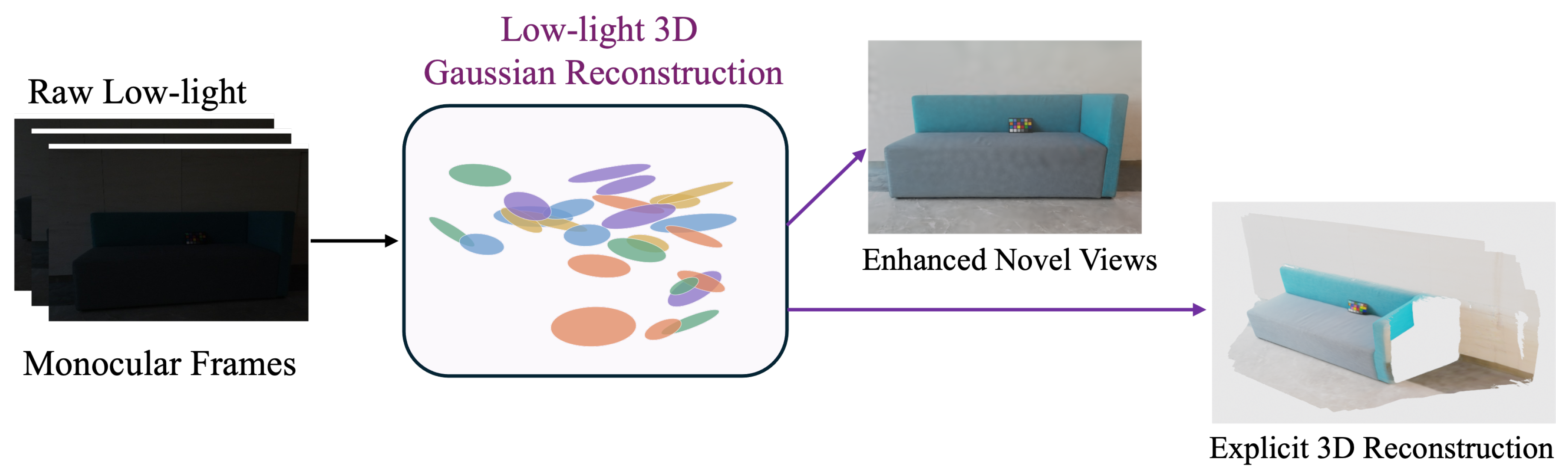
Figure 2.
Detailed architecture of LL-3DGS Reconstruction. (A) The geometry front end selects a raw or fixed enhanced stream, preserves its natural order, and predicts cameras, depth, and points before density-biased initialization and optional Sim(3) co-registration. (B) A shared Gaussian field is constrained by a normal-light luminance path, a low-light degradation path, and structure-adaptive optimization. (C) Co-registered depth provides surface geometry while the canonical Gaussian rendering provides restored color for point-cloud and TSDF fusion. The image panels are native LOM sofa examples; the fixed enhanced panel is an offline preprocessing input rather than a Gaussian rendering.
Figure 2.
Detailed architecture of LL-3DGS Reconstruction. (A) The geometry front end selects a raw or fixed enhanced stream, preserves its natural order, and predicts cameras, depth, and points before density-biased initialization and optional Sim(3) co-registration. (B) A shared Gaussian field is constrained by a normal-light luminance path, a low-light degradation path, and structure-adaptive optimization. (C) Co-registered depth provides surface geometry while the canonical Gaussian rendering provides restored color for point-cloud and TSDF fusion. The image panels are native LOM sofa examples; the fixed enhanced panel is an offline preprocessing input rather than a Gaussian rendering.
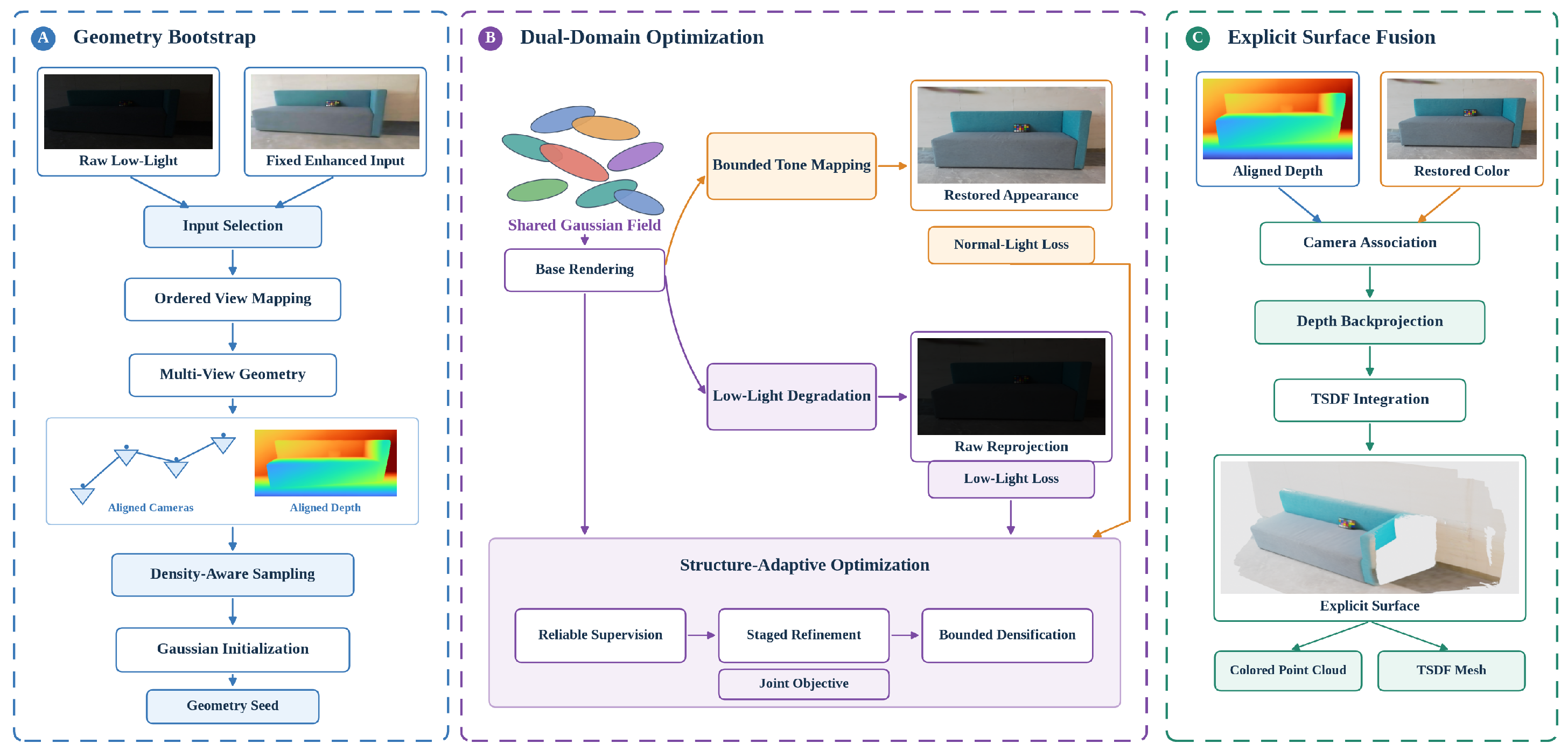
Figure 3.
Per-scene enhanced PSNR of the final model on LOM held-out views.
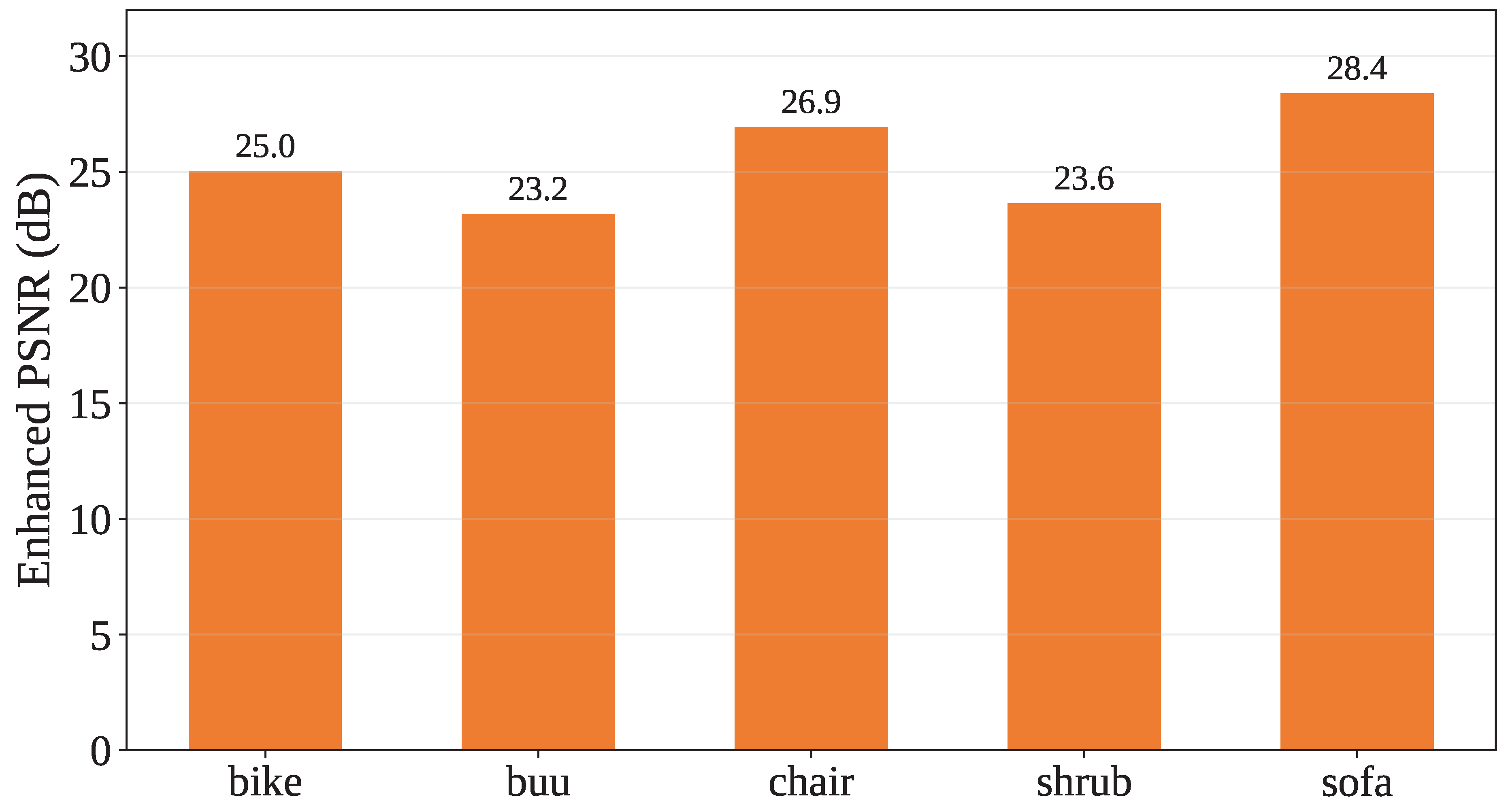
Figure 7.
LLNeRF qualitative comparison. The first five columns are reorganized from LL-Gaussian supplementary Figure 3 [11]; the final column adds our local 30k render at the matched camera. Our results retain recognizable scene content but exhibit noise, color bias, and incomplete restoration, particularly on campus-path and book. Because LLNeRF provides no paired normal-light target and the cells come from different implementations, no normal-light ranking is assigned.
Figure 7.
LLNeRF qualitative comparison. The first five columns are reorganized from LL-Gaussian supplementary Figure 3 [11]; the final column adds our local 30k render at the matched camera. Our results retain recognizable scene content but exhibit noise, color bias, and incomplete restoration, particularly on campus-path and book. Because LLNeRF provides no paired normal-light target and the cells come from different implementations, no normal-light ranking is assigned.
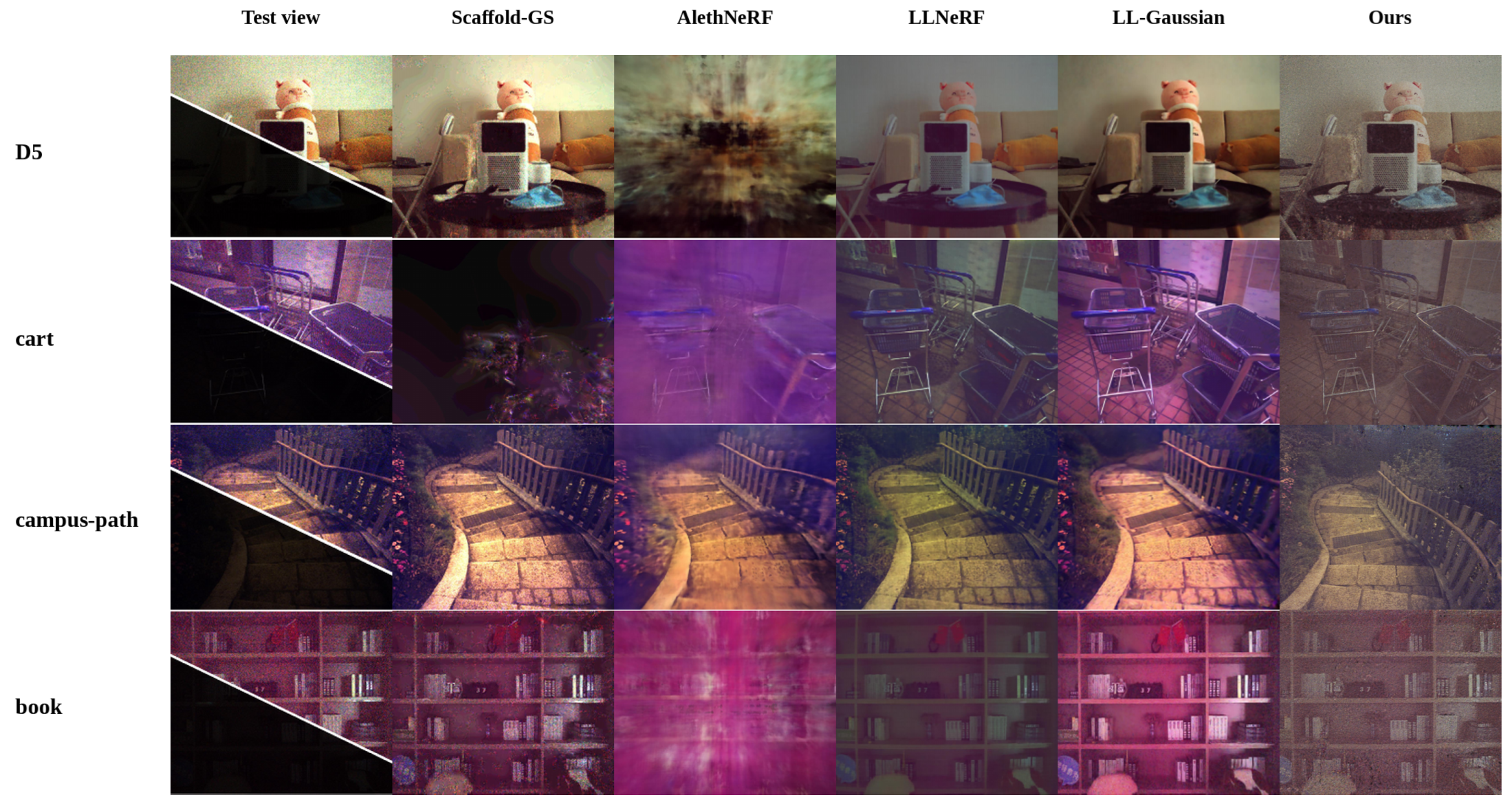
Figure 8.
Four-scene colored TSDF reconstruction on LOM and LLRS. From top to bottom, the rows show LOM sofa, LOM chair, LLRS firehydrant, and LLRS chair. Each row pairs a representative raw low-light observation with two standardized views of its saved TSDF triangle mesh. Metric-depth geometry is fused with co-registered LL3DGS enhanced color; incomplete boundaries in wider scenes reflect limited depth coverage, so this figure documents explicit reconstruction output and color fusion rather than geometry accuracy against unavailable 3D scans.
Figure 8.
Four-scene colored TSDF reconstruction on LOM and LLRS. From top to bottom, the rows show LOM sofa, LOM chair, LLRS firehydrant, and LLRS chair. Each row pairs a representative raw low-light observation with two standardized views of its saved TSDF triangle mesh. Metric-depth geometry is fused with co-registered LL3DGS enhanced color; incomplete boundaries in wider scenes reflect limited depth coverage, so this figure documents explicit reconstruction output and color fusion rather than geometry accuracy against unavailable 3D scans.
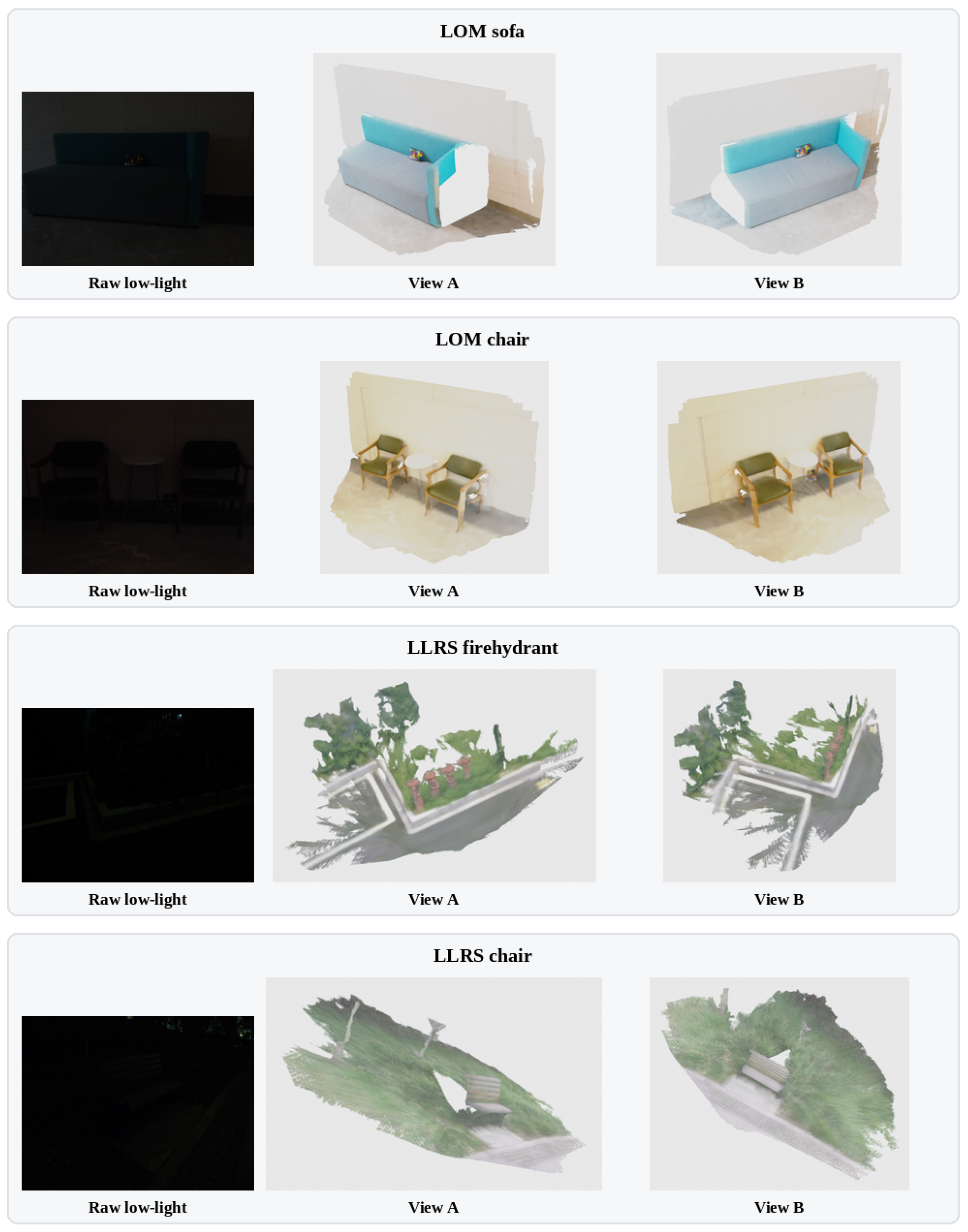
Table 1.
LOM five-scene normal-light NVS values. Published low-only values are from LL-Gaussian Table 2 [11]; our paired-supervision mean uses a different training protocol and local split and is not directly rankable with those rows.
Table 1.
LOM five-scene normal-light NVS values. Published low-only values are from LL-Gaussian Table 2 [11]; our paired-supervision mean uses a different training protocol and local split and is not directly rankable with those rows.
| Method | Supervision | PSNR↑ | SSIM↑ | LPIPS↓ |
| Scaffold-GS | Low-only | 24.64 | 0.801 | 0.334 |
| LLNeRF | Low-only | 23.37 | 0.823 | 0.309 |
| Aleth-NeRF | Low-only | 23.85 | 0.792 | 0.316 |
| LL-Gaussian | Low-only | 24.52 | 0.839 | 0.217 |
| Ours | Paired | 25.44 | 0.898 | 0.247 |
Table 2.
Our per-scene paired-supervision LOM results on 25 held-out normal-light views. The mean reported in Table 1 is the macro-average of these five scene values.
Table 2.
Our per-scene paired-supervision LOM results on 25 held-out normal-light views. The mean reported in Table 1 is the macro-average of these five scene values.
| Scene | Views | PSNR↑ | SSIM↑ | LPIPS↓ |
| bike | 5 | 25.04 | 0.839 | 0.264 |
| buu | 4 | 23.18 | 0.896 | 0.286 |
| chair | 6 | 26.94 | 0.938 | 0.258 |
| shrub | 5 | 23.64 | 0.911 | 0.154 |
| sofa | 5 | 28.39 | 0.904 | 0.275 |
Table 3.
LOM sofa common-view reconstruction (33 observed views). External methods fit MBLLEN-enhanced low-light frames; our paired dual-domain model uses raw observations and aligned normal-light training targets. The supervision differs, so values are pipeline context rather than a same-protocol ranking.
Table 3.
LOM sofa common-view reconstruction (33 observed views). External methods fit MBLLEN-enhanced low-light frames; our paired dual-domain model uses raw observations and aligned normal-light training targets. The supervision differs, so values are pipeline context rather than a same-protocol ranking.
| Pipeline | PSNR↑ | SSIM↑ | LPIPS↓ |
| Inria 3DGS + MBLLEN | 26.469 | 0.8797 | 0.3423 |
| GS-ICP + MBLLEN | 16.740 | 0.7186 | 0.7464 |
| RTG-SLAM + MBLLEN | 25.911 | 0.8175 | 0.3446 |
| GPS-SLAM + MBLLEN | 25.155 | 0.8567 | 0.3699 |
| Ours (paired dual-domain) | 27.121 | 0.9069 | 0.1287 |
Table 4.
Published LLRS normal-light NVS values and our local paired-supervision result. Scope denotes the number of averaged scenes. The published low-only rows and local paired row are not directly rankable; Gaussian-DK excludes path after a reported failure [11].
Table 4.
Published LLRS normal-light NVS values and our local paired-supervision result. Scope denotes the number of averaged scenes. The published low-only rows and local paired row are not directly rankable; Gaussian-DK excludes path after a reported failure [11].
| Method | Scope | PSNR↑ | SSIM↑ | LPIPS↓ |
| Scaffold-GS | 6 scenes | 16.790 | 0.294 | 0.667 |
| LLNeRF | 6 scenes | 17.018 | 0.215 | 0.716 |
| Gaussian-DK | 5 scenes | 15.472 | 0.381 | 0.732 |
| LE3D | 6 scenes | 15.517 | 0.280 | 0.645 |
| LL-Gaussian | 6 scenes | 18.290 | 0.414 | 0.595 |
| Ours (paired) | 6 scenes | 21.551 | 0.429 | 0.520 |
Table 6.
LOM sofa module ablation. “Enhanced” is evaluated against the normal-light reference; “Re-degraded” is evaluated against the raw low-light observation. The row without the degradation loop is a reference configuration; the remaining rows form the controlled component study.
Table 6.
LOM sofa module ablation. “Enhanced” is evaluated against the normal-light reference; “Re-degraded” is evaluated against the raw low-light observation. The row without the degradation loop is a reference configuration; the remaining rows form the controlled component study.
| Configuration | Enhanced | Re-degraded | ||||
| PSNR↑ | SSIM↑ | LPIPS↓ | PSNR↑ | SSIM↑ | LPIPS↓ | |
| Without degradation loop | 25.019 | 0.881 | 0.381 | – | – | – |
| Without low-light consistency | 28.351 | 0.889 | 0.386 | 12.494 | 0.390 | 0.444 |
| Without degradation residual | 28.544 | 0.901 | 0.378 | 35.087 | 0.959 | 0.295 |
| Without multi-view smoothness | 27.879 | 0.889 | 0.384 | 27.588 | 0.783 | 0.332 |
| Without residual TV | 28.158 | 0.891 | 0.381 | 33.925 | 0.949 | 0.298 |
| Full model | 27.690 | 0.891 | 0.385 | 33.698 | 0.949 | 0.299 |
Table 7.
Optimization studies on LOM sofa. P/S/L denotes enhanced PSNR/SSIM/LPIPS.
| Configuration | Steps | #GS | Enhanced P/S/L |
| , no refine | 12k | 5,000 | 26.974/.887/.386 |
| , no refine | 12k | 5,000 | 28.612/.895/.382 |
| , no refine | 12k | 5,000 | 26.922/.893/.384 |
| , refine | 12k | 79,573 | 26.448/.893/.299 |
| Quality recipe | 30k | 70,814 | 28.388/.904/.275 |
Disclaimer/Publisher’s Note: The statements, opinions and data contained in all publications are solely those of the individual author(s) and contributor(s) and not of MDPI and/or the editor(s). MDPI and/or the editor(s) disclaim responsibility for any injury to people or property resulting from any ideas, methods, instructions or products referred to in the content. |
© 2026 by the authors. Licensee MDPI, Basel, Switzerland. This article is an open access article distributed under the terms and conditions of the Creative Commons Attribution (CC BY) license.
Copyright: This open access article is published under a Creative Commons CC BY 4.0 license, which permit the free download, distribution, and reuse, provided that the author and preprint are cited in any reuse.