

Submitted:
22 August 2026
Posted:
25 August 2026
You are already at the latest version
Abstract
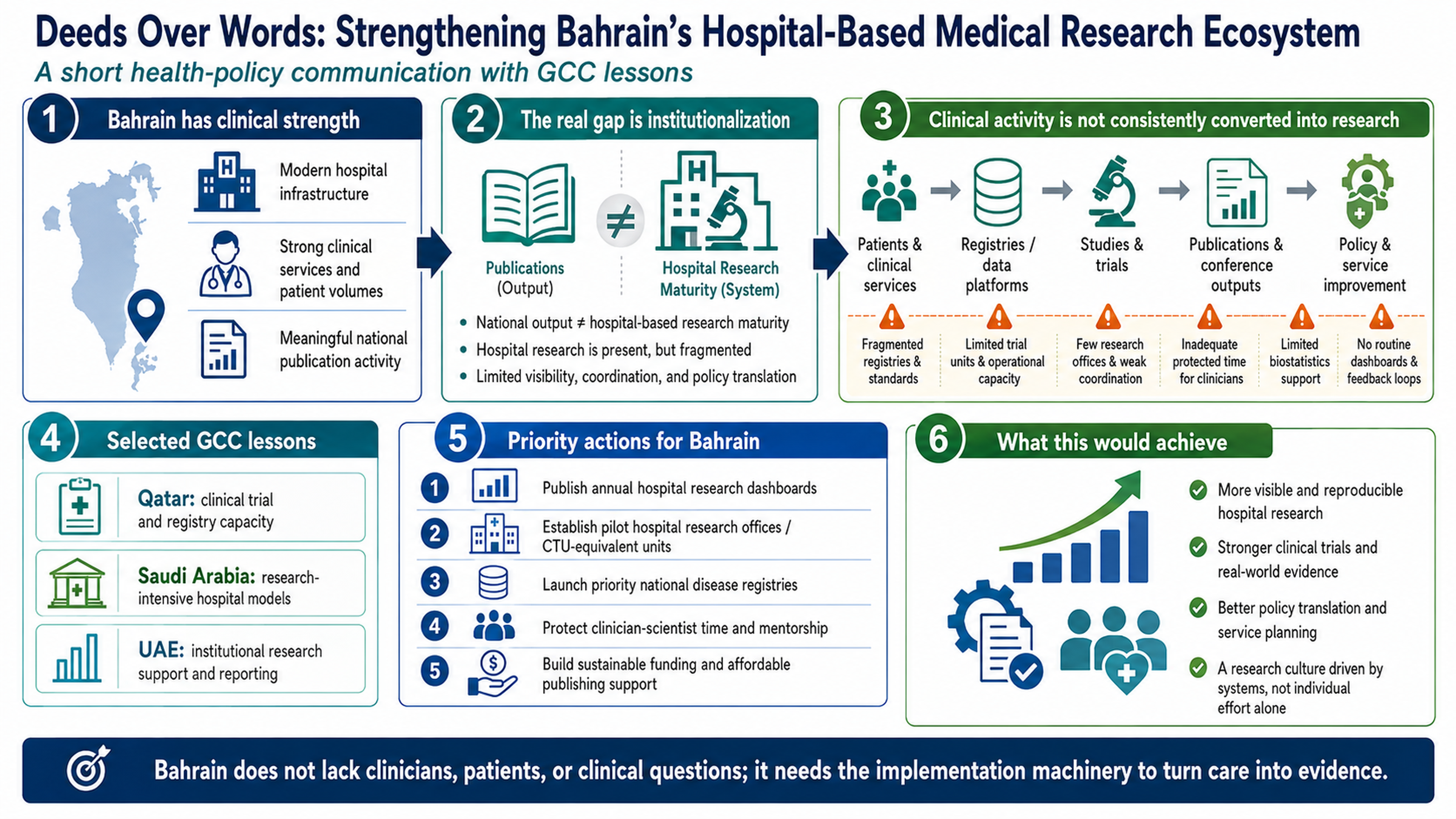
Bahrain has the clinical infrastructure, specialist services and patient volumes of a modern Gulf health system, yet the maturity of its hospital-based research ecosystem remains less visible than its service capacity would predict. This narrative health-policy analysis argues that Bahrain's challenge is best understood as compositional rather than simply volumetric: national medical publication output is real and has grown, but publication volume does not by itself demonstrate a hospital research system capable of producing registries, pragmatic trials, implementation studies, health-economic evidence, transparent dashboards and policy-changing local data. The paper applies a health-research-systems lens to Bahrain's public and quasi-public clinical institutions, drawing on published bibliometric evidence, regulatory and ethical guidance, recent Bahrain clinical-trials evidence, and selected Gulf Cooperation Council examples. It distinguishes academic-sector productivity from hospital-based research maturity, identifies the clinical-service-to-research conversion gap, and proposes a sequenced reform agenda mapped to stewardship, financing, resources, and production and use of research. Priority actions include annual hospital research dashboards, professionalised research and ethics committees, pilot research offices or clinical-trial-unit-equivalent structures, registry governance aligned with data-protection and demographic realities, protected clinician-scientist time, responsible metrics, workforce-equity monitoring, public and patient engagement, sustainable funding, and affordable publishing support. Bahrain's compact scale should be treated as a design advantage. By the end of 2027, progress should be visible in public dashboards, audited research assets, named priority registries, functioning research-support units, and documented outputs beyond declarations alone.
Keywords:
Bahrain
; health policy
; biomedical research
; capacity building
; registries
; clinical trials as topic
; health services research
; Gulf Cooperation Council
; research ethics committees
Introduction
Bahrain possesses the visible infrastructure of a modern health system. Salmaniya Medical Complex (SMC), Government Hospitals, Ministry of Health services, primary care centres, the Public Health Directorate, Bahrain Defence Force/Royal Medical Services (BDF/RMS), King Hamad University Hospital (KHUH), Mohammed Bin Khalifa Cardiac Center (MBKCC), Bahrain Oncology Centre (BOC), the NBB Multiple Sclerosis Center and the Crown Prince Center for Training and Medical Research collectively manage much of the national burden of emergency care, chronic disease, cancer, cardiovascular disease, neurological disease, maternal and child health, infectious disease, rehabilitation and preventive medicine [1,2,3,4].
This concentration of patients, clinicians, clinical data and unanswered service questions should position Bahrain as a small-state model for applied, policy-relevant medical research. Compact geography, centralised tertiary services, electronic health records and a high burden of noncommunicable and genetic disease should allow the country to generate national registries, real-world treatment studies, pragmatic trials, service audits, health-economic analyses, implementation research and local guidelines [1,4,5]. This is not only an academic aspiration; it is part of high-value care, post-pandemic research preparedness, precision medicine, workforce development, economic diversification and evidence-informed policy [1,5,6,7,8].
The question addressed here is deliberately narrow. It is not whether Bahrain produces medical research; it does. Nor is it whether academic institutions such as Arabian Gulf University (AGU), Princess Al-Jawhara Center, RCSI Medical University of Bahrain and other educational partners contribute to national scholarship; they clearly do. The sharper policy question is whether Bahrain's major public and quasi-public clinical institutions are converting their patient datasets, service responsibilities and clinical questions into proportionate research output, registries, trials, clinical pathways, measurable outcomes and policy-changing local evidence.
In this paper, public clinical institutions refer mainly to government-funded or government-administered health services and hospitals. Quasi-public clinical institutions refer to state-linked, defence, specialist or publicly mandated institutions that serve major national clinical functions but do not sit neatly within a single conventional Ministry of Health hospital category. The distinction is imperfect, and one objective of the paper is precisely to argue that Bahrain needs transparent institutional reporting rather than reliance on loose labels.
The core thesis is not that Bahrain lacks clinical talent or publication activity. Rather, Bahrain's deficit is compositional and institutional. Per capita or national publication indicators may look respectable, yet still coexist with a hospital sector that has limited protected research time, limited visible clinical-trial-unit capacity, incomplete registry infrastructure, variable research support, insufficient biostatistical and methodological services, and weak public reporting of institutional research performance. In short, publication volume is not the same as hospital-based research maturity.
Novelty and contribution: The contribution of this paper is the structured application of a health-research-systems lens to Bahrain's hospital sector. Rather than presenting publication counts as sufficient evidence of maturity, the analysis distinguishes national biomedical output from the institutional machinery needed to convert clinical service into reproducible, visible and policy-relevant evidence. The novelty is therefore not the general observation that publications are an incomplete proxy for research capacity, which is well established in the health-research-systems literature [9]. It is the Bahrain-specific reframing of the problem as a clinical-service-to-research conversion gap, and the translation of that gap into a practical reform agenda for stewardship, financing, resource development, registries, trial readiness, responsible metrics, workforce equity and policy translation.
Methods and Scope
This article is a narrative health-policy analysis and conceptual review. It is not a new bibliometric study, systematic review, scoping review, clinical trial, institutional audit or primary-data research project. It synthesises published bibliometric analyses, Bahrain-related clinical and policy literature, official regulatory and ethical guidance, publicly available institutional information, and selected GCC examples relevant to hospital-based research infrastructure.
The analysis is organised around the four principal functions of a health research system described by Pang and colleagues: stewardship, financing, creating and sustaining resources, and producing and using research [9]. These functions map closely onto Bahrain's policy challenge. Stewardship concerns national direction, accountability and governance. Financing concerns ring-fenced funding and sustainable research-support models. Creating and sustaining resources concerns protected time, research workforce, registries, data platforms, research offices and methods support. Producing and using research concerns trials, observational studies, service audits, implementation research, conference outputs, publications, dashboards and policy translation.
The GCC comparison is selective and purposive. Qatar, Saudi Arabia and the United Arab Emirates were selected as illustrative infrastructure comparators because they provide publicly visible examples of research funding, academic-health partnerships, specialist-hospital research identity, clinical-trial units, research offices, annual reporting or regulatory standards relevant to hospital-based research capacity [18,19,20,21,22,23,24,25,26,27,28,29,30]. These comparators are not used to rank countries. Kuwait and Oman are important future comparators, particularly because of their closer population and system comparability to Bahrain in some respects; their exclusion here reflects the illustrative rather than exhaustive purpose of this preprint version.
The paper intentionally stops short of a formal desk audit. A definitive national assessment would require standardised affiliation variants, Scopus-level or comparable bibliometric extraction, author-position analysis, clinical-trial registry searches, REC performance data, registry inventories, conference-output mapping, cost and staffing data, and institutional verification. The absence of such a public dashboard is itself part of the policy problem being described.
Author positionality: the author is a Bahraini neurologist, former Chairman of Clinical Neurosciences at Salmaniya Medical Complex, founder of the NBB Multiple Sclerosis Center, and retired from Bahrain public medical service since 2020. This background informs the policy perspective of the article. The analysis is based on publicly available sources and is intended as a constructive systems-level contribution rather than an assessment of individual departments, officeholders or institutions.
The analysis is also informed by the author’s more than three decades of clinical, administrative, academic, publication, and scientific-conference experience across Bahrain’s public and private medical sectors. This includes hospital-based clinical practice, private clinical practice, departmental leadership, postgraduate training, academic teaching, clinical governance, peer-reviewed publication, and long-standing participation in regional and international neurological and medical meetings as an attendee, moderator, speaker, presenter, organiser, and scientific contributor. This experiential perspective provides practical insight into how clinical questions arise, how research culture is enabled or constrained, how conference outputs and publications develop, and how institutional support influences the translation of clinical service into evidence. These observations are presented as a declared positionality lens and are not used as a substitute for empirical measurement, formal institutional audit, or independently verifiable published evidence.
National Output Versus Hospital-Based Research Maturity
Total national publication output is not the same as hospital-based research-system strength. Academic institutions may produce research through faculty projects, laboratory collaborations, student research, medical-education studies and external partnerships. Hospitals should generate a complementary form of knowledge: patient outcomes, disease registries, real-world effectiveness, safety monitoring, clinical pathways, quality-improvement cycles, health-service utilisation, implementation studies and policy-relevant evidence [5,16].
A recent Scopus-based analysis identified 5,445 medical and biomedical publications from Bahraini institutions between 2005 and 2024 [5]. It reported that AGU contributed 30.2% of total publications, academic institutions overall contributed 55.6%, public health institutions contributed 28.7%, Royal Medical Services contributed 20.9%, and SMC/governmental hospitals, KHUH/BOC and BDF/MBKCC appeared as meaningful author-share contributors across institutional and author-position categories [5]. These data demonstrate progress and should prevent any simplistic claim that Bahrain's hospitals are research-inactive.
They also require careful interpretation. Several reported indicators use different denominators: some describe shares of publications, whereas others describe institutional or author-position shares. In addition, some institutions are organisationally nested or closely linked. Table 1 therefore separates publication-share indicators from institutional/author-position indicators and explicitly warns against summing these values.
Bahrain's deficit is therefore best understood as compositional rather than simply volumetric. The country has demonstrable publication activity, including respectable output relative to its size in some regional analyses [6]. The more strategic question is whether that output reflects a mature hospital-based research system capable of producing trials, registries, implementation studies, outcomes research, health-economic evaluation and policy-relevant evidence. A country can publish increasingly while still lacking the institutional machinery that makes hospital research routine.
The point is not to diminish AGU, Princess Al-Jawhara Center, RCSI-MUB or other academic contributors. On the contrary, academic partners are essential. The problem arises when national publication volume is read as proof that the clinical sector has mature research offices, dashboards, trial infrastructure and disease registries. National output and hospital research-system maturity are related but non-identical measures.
Bahrain Assets, Constraints and the Event-Driven Capacity Lesson
A constructive critique must acknowledge progress. Bahrain has research committees, regulatory structures, training platforms, professional societies, academic partners and clinical centres that could support future research [1,2,3,4,13]. Recent SMC-linked publications in cystic fibrosis genetics, antimicrobial resistance, sickle-cell pregnancy outcomes, personal protective equipment practices and other service-relevant topics demonstrate that public-sector clinicians can publish clinically relevant work [37,38,39,40]. MBKCC has contributed a visible cardiology-focused identity, and oncology bibliometric work demonstrates the feasibility of mapping national research evolution over time [17].
The National Health Plan 2016-2025 placed research and evidence-informed planning within Bahrain's health-system discourse [1]. Its nominal period has now ended, which creates an opportunity for public accountability: which research commitments were delivered, which were not, and what successor mechanisms will make the next plan measurable? Similarly, NHRA clinical-trial regulations provide an important governance foundation [13], but public reporting should clarify implementation indicators such as authorised trials, study type, review timelines, results reporting and institutional sites.
Bahrain's pandemic-era experience is particularly instructive. In 2020, the Ministry of Health announced a Phase III clinical trial of an inactivated COVID-19 vaccine in Bahrain, conducted with G42 Healthcare and a vaccine developed by Sinopharm CNBG, targeting about 6,000 citizens and resident volunteers and approved by NHRA [14,15]. This precedent strengthens rather than weakens the thesis of this paper. It shows that clinical-trial capacity is mobilisable at scale when national priority, external sponsorship, central coordination and public visibility align. The policy question is why such capacity should remain event-driven rather than being converted into permanent CTU-equivalent infrastructure, trained coordinator teams, registry platforms and routine investigator-initiated research capacity.
Funding remains a major constraint. International innovation profiles and World Bank-derived indicators suggest that Bahrain's research and development expenditure is limited relative to gross domestic product [7,8]. This denominator has limitations in hydrocarbon-weighted economies, so future assessments should also report absolute and per-capita research spending. The operational point is unchanged: medical research cannot flourish on aspiration alone. It requires ring-fenced funding, coordinators, research nurses, data managers, methodologists, biostatisticians, ethics-administration support, registry infrastructure, publication support and conference support.
Root Causes and the Hospital-Sector Conversion Gap
The limited maturity of hospital-based research has plausible local causes. Public hospitals carry heavy clinical loads, with clinicians expected to deliver service, teaching, administration, audit and professional development without protected research sessions. In this environment, research becomes an after-hours activity rather than part of job design.
Capacity constraints are equally important. Many hospitals lack sufficient research coordinators, registry officers, trained research nurses, health economists, methodologists, data managers and biostatisticians. Clinicians may have important ideas but lack support for protocol development, database design, ethics navigation, statistical analysis, grant management, patient recruitment and manuscript preparation. Short contracts and workforce turnover can weaken longitudinal research programmes. Limited publication and conference funding further reduce visibility and collaboration.
Recent qualitative evidence on clinical trials in Bahrain reinforces these concerns. Key opinion leaders identified interconnected barriers that included regulatory and operational challenges, resource and capacity limitations, public-engagement and cultural factors, strategic-collaboration needs and research-conduct challenges [12]. This reference has been verified and should be retained because it provides the most direct local evidence for the clinical-trial barriers discussed here. The implication is not that Bahrain lacks interest in research; it is that routine trial activity requires coordinated governance, operational support and sustained workforce capacity.
The hospital-sector conversion gap can therefore be summarised simply: Bahrain has clinical activity, but insufficient conversion machinery. The missing machinery includes protected time, research offices, CTU-equivalent units, registry infrastructure, research nurses, data platforms, biostatistical support, methodological review, publication support, patient and public engagement, conference-output tracking and career incentives tied to responsible research deliverables. Figure 1 illustrates this pathway conceptually.
Registry Feasibility: Legal, Demographic and Data-Governance Preconditions
National registries are central to the reform agenda, but they cannot be recommended as technical projects alone. They require legal authority, data governance, sustainable staffing, common variables, coding standards, consent or lawful-basis models, de-identification procedures, cross-institutional data-sharing agreements, security controls, audit trails and mechanisms for returning findings to clinicians and policymakers.
Bahrain's Personal Data Protection Law, Law No. 30 of 2018, is directly relevant to secondary use of health data, cross-institutional linkage, confidentiality, transfer of personal data and governance of identifiable or potentially re-identifiable datasets [16]. A registry-first strategy should therefore start with a legal and ethical operating model, not only a database. The model should clarify whether consent is required, when de-identified or pseudonymised data are sufficient, who acts as data controller, who may access data, how long data are retained, how breaches are managed, and how patients can understand the public value of registry participation.
Bahrain's demographic structure adds further complexity. A large expatriate population, mobility in and out of the country, entitlement-linked care pathways and cross-sector care may create denominator instability, differential loss to follow-up and incomplete outcome ascertainment. A registry that captures only one hospital, one sector or one payer pathway may be clinically useful but should not be described as national unless coverage is defined transparently.
The recommendation is therefore not to create registries from scratch as if nothing exists. Bahrain already has important registry-related assets, including cancer-registration activity and GCC cancer-registry participation. The immediate policy task is to inventory existing registries, assess data quality and outputs, strengthen governance, and select two or three priority registries where feasibility, burden of disease and policy value align. Candidate registries should be judged by their ability to produce annual reports, quality indicators, peer-reviewed outputs and service changes, not by the presence of a registry name alone.
GCC Benchmarking and Adaptable Lessons
The purpose of GCC benchmarking is not to suggest that Bahrain can or should copy larger or better-funded systems. It is to identify design features that are adaptable to a small, centralised health system. Qatar demonstrates how funding mechanisms, academic-health partnerships, precision-health ambitions, research offices and clinical-academic integration can create visible capacity [18,19,20,21,22,23]. Saudi Arabia, especially through specialist and academic health systems such as KFSHRC, illustrates how research can become part of hospital identity rather than an optional activity [24,25,26]. The UAE demonstrates that clinical-trial units, research departments, active studies and regulatory standards can be incorporated into hospital operations [27,28,29,30].
The comparison is intentionally illustrative. Kuwait and Oman should be included in a future hard-indicator comparator table because they may be closer to Bahrain in population scale, geography and health-system configuration. That future table should include population, health expenditure, gross domestic expenditure on research and development, national health-research funding, visible CTU infrastructure, registered trials per million population, national research strategy status and registry indicators. For the present policy analysis, selected lessons are summarised in Table 2.
Figure 2 should be interpreted cautiously. A maturity ladder may be useful pedagogically, but it can imply ranking. The safer interpretation is as a capability-domain self-assessment tool rather than an ordinal ranking of countries or hospitals.
Funding, Publishing Infrastructure and Responsible Incentives
Bahrain has a strong tradition of philanthropy and corporate social responsibility. Banks, family foundations, charitable societies, national companies and private donors already support buildings, equipment, campaigns and patient assistance. With transparent governance, part of this generosity could support a Health Research Endowment Fund, disease registries, young-investigator awards, clinical-trial infrastructure, publication support and conference participation. Disease-specific funds could support diabetes, cancer, sickle-cell disease, thalassemia, multiple sclerosis, dementia, epilepsy, stroke, cardiovascular disease and rare genetic disorders.
Affordable publishing infrastructure is also essential. Bahrain should consider establishing or strengthening high-quality, peer-reviewed, open-access medical publishing channels that meet international standards for editorial independence, methodology, indexing, publication ethics, digital preservation and global discoverability. Such channels should not become repositories for weak local output; rather, they should help clinician-researchers convert well-designed audits, registries, observational studies, implementation projects and policy analyses into publishable evidence.
One immediately feasible strategy would be to strengthen Bahrain Medical Bulletin as a national developmental platform through sustained financial, editorial, methodological and academic support. The journal has a long-standing national identity and open online availability, but its stated article-processing charge of USD 1,249 may deter unfunded clinicians, residents, nurses, allied-health professionals and young investigators [41]. Its journal-metric visibility should also be interpreted transparently and date-stamped; SCImago-listed indicators such as SJR and quartile status change over time and should not be used as a blunt measure of article or researcher quality [42]. If Bahrain Medical Bulletin is expected to serve as a serious channel for domestic medical research, fee waivers or heavy subsidies for unfunded Bahraini clinical research, stronger methodological review and broad academic stewardship should be considered.
Research incentives should also follow responsible-metrics principles. DORA, the Leiden Manifesto and the Hong Kong Principles all caution against over-reliance on journal-based metrics or crude citation indicators for individual assessment [34,35,36]. Journal quartiles and citation indicators may be reported descriptively at institutional level, but promotion, leadership selection and grants should emphasise research integrity, completed protocols, trial registration and reporting, registry quality, data-sharing, reproducibility, patient and public involvement, mentorship, policy translation and documented service improvement. This is especially important in an emerging research ecosystem, where poorly designed incentives could encourage predatory publishing or quantity over quality.
Research Governance, Culture and Workforce Equity
Research governance must protect participants, ensure scientific integrity, manage conflicts of interest, safeguard data and promote ethical completion. WHO, CIOMS and ICH-GCP emphasise independence, multidisciplinary expertise, ethical competence, written procedures, conflict-of-interest management, training and documentation [31,32,33]. Bahrain should publish transparent committee standards, including membership criteria, training requirements, review timelines, approval rates, reasons for major delay or rejection, and outcomes of approved studies.
Strengthening existing institutional research and ethics committees should be an early reform priority. Bahrain does not only need more research committees; it needs committees with the right expertise, independence, operating procedures and enabling culture. Institutional research governance should distinguish between scientific-methodological review, which helps investigators improve protocol quality, and ethics review, which protects participants, safeguards data, manages conflicts of interest and ensures proportional risk assessment. Committees should include members with demonstrated experience in clinical research, epidemiology, biostatistics, clinical trials, research ethics, data governance, patient engagement and health-system implementation. Membership should be transparent, periodically renewed, supported by training in Good Clinical Practice and research ethics, and supplemented by external expert review when local expertise is insufficient. The objective is not to create additional bureaucracy, but to make good research easier to design, approve, complete, publish and translate into policy. Table 3 outlines proposed minimum expertise and role specifications.
The leadership question should be framed as governance design rather than personal criticism. A national research strategy should be informed by people with publication records, grant experience, clinical-trial knowledge, registry expertise, health-economics literacy, data-governance competence and international academic networks. The objective is not to criticise incumbents; it is to ensure that research policy is advised by people who understand the practical requirements of conducting, supervising, funding, publishing and translating research.
Conference participation should be treated as an early marker of research vitality. A research-active health system should be represented through oral presentations, moderated posters, registry reports, clinical audits, multicentre studies and invited scientific lectures. Each major institution should report accepted abstracts, invited talks, awards and subsequent full-paper publications. These indicators are not prestige exercises; they show whether local service questions are entering regional and international scientific discussion.
Research-capacity reform should also include workforce equity. The principal Bahrain bibliometric source used in this paper focuses on gender differences as well as institutional patterns [5]. If protected time, grants, authorship opportunities, training and research-leadership pathways are created, they should be monitored by gender, career stage, profession and institution. Otherwise, new research infrastructure may reproduce existing inequities rather than expand participation. Equity indicators should include gender distribution of first, last and corresponding authorship, grant awards, protected research sessions, conference support and registry leadership.
Prioritised Reform Agenda for 2026-2028 and Beyond
Bahrain does not need more general statements praising research. It needs a sequenced, accountable hospital-based reform plan led nationally and implemented institution by institution. The first phase should prioritise measurement and low-cost system building before large-scale expansion. Table 4, Table 5 and Table 6 translate the health-research-system functions into practical actions, accountable bodies and measurable outputs.
The first priority is measurement. SCH should publish a national hospital-research dashboard template and require each major public or quasi-public clinical institution to report annual publications, study types, conference abstracts, active studies, registered trials, grants, registries, research and ethics committee membership, ethics-review timelines, protected research sessions, workforce-equity indicators and policy-impact outputs. A national inventory of existing registries, research committees, studies and data platforms should be created.
The second priority is governance infrastructure. Institutional research and ethics committees should first be strengthened as described above, and at least one pilot hospital research office or CTU-equivalent unit should be established at SMC, with a realistic mandate: protocol support, ethics navigation, database design, biostatistics access, research-coordinator support, grant administration, patient-recruitment support, registry development and manuscript support. MBKCC or BOC could serve as specialty-focused pilot nodes for registry-linked output or clinical-trial readiness.
The third priority is protected time and workforce development. Consultants, residents, fellows, nurses, pharmacists and allied-health professionals should receive funded research sessions tied to deliverables. Protected time should not be symbolic. It should be attached to approved protocols, registry development, publications, conference abstracts, grant submissions or documented implementation outputs.
The fourth priority is registries. Bahrain should launch or strengthen two to three national priority registries selected for feasibility and policy value. Each registry should have governance, core variables, data-quality audits, patient-protection safeguards, annual reports and publication targets. Existing registry assets should be strengthened before new structures are created.
The fifth priority is financing. A national health-research fund and philanthropic endowment should be created, with competitive peer review and annual impact reporting. Early awards should support young investigators, pilot registries, conference presentations, publication support linked to quality and visibility, and multicentre GCC collaborations.
Limitations and Next Empirical Step
This analysis has limitations. It is not a formal institutional bibliometric study, clinical-trial registry audit, systematic review or complete GCC benchmarking exercise. Some institutional activities may be under-recognised if they are not publicly reported, not indexed or not clearly affiliated in publication databases. The GCC examples are illustrative rather than exhaustive, and differences in population size, budget, history and institutional mandate must be considered.
These limitations strengthen rather than weaken the main recommendation. Bahrain needs transparent dashboards and verified institutional reporting so future assessment can move from impression to measurement. The next empirical step should be a structured desk audit of SMC/Government Hospitals, RMS/BDF, KHUH, MBKCC, BOC, primary care/MOH and the Crown Prince Center, documenting visible research offices, REC procedures, annual reports, registered trials, registry participation, staffing and outputs. Search strings, extraction dates and records should be deposited in OSF or Zenodo before submission to a methods-intensive journal.
Conclusion
Bahrain's major public and quasi-public clinical institutions are not devoid of research. Recent clinical publications, specialty outputs, oncology bibliometric work and the broader national increase in medical and biomedical publications show that clinicians and institutions are producing useful work [5,17,37,38,39,40]. The more important question is whether this activity has matured into a visible, supported and accountable hospital-based research ecosystem. At present, the answer remains incomplete.
The core weakness is systemic and compositional. Bahrain has hospitals, patients, clinicians, disease burdens, official research language and policy need. What remains insufficiently developed is the coordinated infrastructure that makes research routine: funded time, trained support staff, ethical and efficient governance, registries, trial readiness, data management, responsible publishing and conference support, and career incentives tied to measurable and responsible outputs.
AGU, Princess Al-Jawhara Center, RCSI-MUB and other academic partners should remain important contributors to Bahrain's research future. Their contribution, however, should not obscure the separate responsibility of public and quasi-public clinical institutions to generate evidence from the patients they serve. Hospitals should not be only service-delivery platforms. They should be learning institutions that measure outcomes, evaluate costs, improve pathways and publish knowledge.
The falsifiable test is simple. If the agenda is adopted, by the end of 2027 Bahrain should have at least one public hospital research dashboard template, a national inventory of active studies and registries, published research and ethics committee membership standards, ethics-review performance indicators, one operational pilot research office or CTU-equivalent support pathway, named priority registries with governance plans, and funded protected research sessions tied to outputs. If those indicators remain absent, then the country will still be relying on individual enthusiasm rather than institutional research machinery. Deeds, not declarations, will determine Bahrain's medical research maturity.
Funding
No specific funding was received for the preparation of this manuscript.
Competing interests
The author declares no financial conflicts of interest relevant to this manuscript. The author's former institutional roles in Bahrain's public medical sector are disclosed in the positionality statement. No current governance, editorial or financial role in the institutions or journals discussed is declared.
Declaration on use of artificial intelligence
During manuscript preparation, an AI-assisted writing tool was used only to support language polishing, structural organisation and formatting. The author independently reviewed, edited, verified and approved the final manuscript and remains fully responsible for its content, accuracy, interpretation, references and conclusions. No AI tool was used as an author.
Data availability
No new primary data were generated for this narrative health-policy analysis / conceptual review. The manuscript is based on published bibliometric studies, publicly available institutional information, regulatory and ethical guidance documents and publicly searchable indexed literature. A future institutional desk-audit dataset should be deposited in an open repository if the paper is expanded into a formal empirical policy audit.
Ethics statement
Not applicable. This article does not involve primary data collection from human participants, patient records, biological samples or identifiable personal information.
Patient consent
Not applicable.
Author Contributions
Isa A. Alsharoqi conceived the article, developed the policy argument, reviewed the available literature and public sources, drafted and revised the manuscript, developed the tables and figure concepts, and approved the final version for preprint submission.
Acknowledgments
The author acknowledges the publicly available bibliometric, regulatory, ethical and institutional sources that informed this narrative health-policy analysis.
Abbreviations
AGU, Arabian Gulf University; BDF/RMS, Bahrain Defence Force/Royal Medical Services; BOC, Bahrain Oncology Centre; CIOMS, Council for International Organizations of Medical Sciences; CTU, Clinical Trials Unit; DoH, Department of Health; DORA, San Francisco Declaration on Research Assessment; GCC, Gulf Cooperation Council; HRS, health research system; ICH-GCP, International Council for Harmonisation Good Clinical Practice; KFSHRC, King Faisal Specialist Hospital and Research Centre; KHUH, King Hamad University Hospital; MBKCC, Mohammed Bin Khalifa Cardiac Center; NBB MS Center, National Bank of Bahrain Multiple Sclerosis Center; NHRA, National Health Regulatory Authority; PDPL, Personal Data Protection Law; QRDI/QNRF, Qatar Research, Development and Innovation Council/Qatar National Research Fund; REC, research ethics committee; SCH, Supreme Council of Health; SMC, Salmaniya Medical Complex; SSMC, Sheikh Shakhbout Medical City; UAE, United Arab Emirates; WHO, World Health Organization.
References
- Supreme Council of Health; Kingdom of Bahrain. National Health Plan 2016-2025; Supreme Council of Health: Manama, 2016. [Google Scholar]
- Ministry of Health; Kingdom of Bahrain. Guidance to applicants for the approval of health research proposals; Ministry of Health: Manama, 2016. [Google Scholar]
- Government Hospitals; Kingdom of Bahrain. Salmaniya Medical Complex institutional profile; Government Hospitals: Manama.
- National Health Regulatory Authority; Kingdom of Bahrain. Clinical Trials Regulations Version 3.0; NHRA: Manama, March 2021. [Google Scholar]
- Hamadeh, R.R.; Khedr, E.; Jahrami, H. Medical and biomedical research productivity in Bahrain: an analysis of gender differences and patterns over two decades. Front. Res. Metr. Anal. 2026, 11, 1714436. [Google Scholar] [CrossRef] [PubMed]
- Al-Farsi, Y.M.; Albali, N.H.; Alsaqabi, M.K.; Sayed, M.; Al-Mawali, A.H.; Al-Adawi, S. Period-prevalence and publication rate of health research productivity in seven Arabian Gulf countries: bibliometric analysis from 1996 to 2018. Oman Med. J. 2021, 36(6), e316. [Google Scholar] [CrossRef]
- World Intellectual Property Organization. Global Innovation Index 2024: Bahrain Economy Profile; WIPO: Geneva, 2024; Available online: https://www.wipo.int/global_innovation_index/ (accessed on 22 August 2026).
- World Bank. Research and development expenditure (% of GDP): Bahrain. World Development Indicators; World Bank: Washington, DC; Available online: https://data.worldbank.org/indicator/GB.XPD.RSDV.GD.ZS?locations=BH (accessed on 22 August 2026).
- Pang, T.; Sadana, R.; Hanney, S.; Bhutta, Z.A.; Hyder, A.A.; Simon, J. Knowledge for better health: a conceptual framework and foundation for health research systems. Bull. World Health Organ. 2003, 81(11), 815–820. [Google Scholar] [PubMed]
- CEIC Data. Bahrain BH: Research and development expenditure: % of GDP; CEIC Data, 2024; Available online: https://www.ceicdata.com/ (accessed on 22 August 2026).
- Crown Prince Center for Training and Medical Research. Institutional information and events. Bahrain Defence Force Royal Medical Services. Available online: https://www.bdfmedical.org/ (accessed on 22 August 2026).
- Esther, A.; AlHafnawi, H.; Shehata, M.H.; Ahmed, J.; Rizk, D. Barriers and opportunities for clinical trials in Bahrain: a qualitative study of key opinion leaders. BMJ Open 2026, 16(6), e117241. [Google Scholar] [CrossRef] [PubMed] [PubMed Central]
- Ministry of Health; Kingdom of Bahrain. The Public Health Directorate announces the initiation of Phase III clinical trial for a COVID-19 inactivated vaccine in Bahrain. Ministry of Health: Manama, 2020. Available online: https://www.moh.gov.bh/News/Details/4317?lang=en (accessed on 22 August 2026).
- Ministry of Health; Kingdom of Bahrain. Phase III clinical trial of COVID-19 inactivated vaccine details and volunteer information. Ministry of Health: Manama, 2020. Available online: https://www.moh.gov.bh/COVID19/Details/4321?lang=en (accessed on 22 August 2026).
- Kingdom of Bahrain. Law No. (30) of 2018 with Respect to Personal Data Protection Law. Available online: https://www.moh.gov.bh/Ministry/HealthLawNew?CategoryEn=1&lang=en (accessed on 22 August 2026).
- Gulf Centre for Disease Prevention and Control. Public health research priorities in the Gulf Cooperation Council countries. East. Mediterr. Health Journal. 2025, 31(11), 641–648. [Google Scholar] [CrossRef]
- Hamadeh, R.R.; Khedr, E.; Jahrami, H. Oncology research in the Kingdom of Bahrain: a four-decade bibliometric evolution. Front. Oncol. 2026, 16, 1829889. [Google Scholar] [CrossRef]
- Qatar Foundation. Driving global research and innovation from Qatar; Qatar Foundation: Doha; Available online: https://www.qf.org.qa/ (accessed on 22 August 2026).
- Qatar Research; Development and Innovation Council / Qatar National Research Fund. Research programmes and national priority funding; QRDI/QNRF: Doha; Available online: https://qrdi.org.qa/ (accessed on 22 August 2026).
- Medicine, Sidra. PMFG 2025 spotlights Qatar's precision medicine implementation milestones and Clinical Trials Unit; Sidra Medicine: Doha, 2025; Available online: https://www.sidra.org/ (accessed on 22 August 2026).
- Weill Cornell Medicine-Qatar. Research programmes and biomedical research training; Weill Cornell Medicine-Qatar: Doha; Available online: https://qatar-weill.cornell.edu/ (accessed on 22 August 2026).
- Hamad Medical Corporation. Medical Research Center; Hamad Medical Corporation: Doha; Available online: https://www.hamad.qa/ (accessed on 22 August 2026).
- Hamad Medical Corporation. Clinical Trial Unit; Hamad Medical Corporation: Doha, 2024; Available online: https://www.hamad.qa/ (accessed on 22 August 2026).
- King Faisal Specialist Hospital and Research Centre. Innovation and research; KFSHRC: Riyadh; Available online: https://www.kfshrc.edu.sa/ (accessed on 22 August 2026).
- King Faisal Specialist Hospital and Research Centre. Annual Research Report 2022; KFSHRC: Riyadh, 2022; Available online: https://www.kfshrc.edu.sa/ (accessed on 22 August 2026).
- King Faisal Specialist Hospital and Research Centre. KFSH tops Saudi healthcare sector in Nature Index 2025; KFSHRC: Riyadh, 2026; Available online: https://www.kfshrc.edu.sa/ (accessed on 22 August 2026).
- Cleveland Clinic Abu Dhabi. Clinical trials and research studies; Cleveland Clinic Abu Dhabi: Abu Dhabi; Available online: https://www.clevelandclinicabudhabi.ae/ (accessed on 22 August 2026).
- Cleveland Clinic. Cleveland Clinic Abu Dhabi named top research hospital in UAE for second year running; Cleveland Clinic Newsroom, 2024; Available online: https://newsroom.clevelandclinic.org/ (accessed on 22 August 2026).
- Sheikh Shakhbout Medical City. Clinical Trials Unit; Sheikh Shakhbout Medical City: Abu Dhabi; Available online: https://ssmc.ae/ (accessed on 22 August 2026).
- Department of Health Abu Dhabi. Standard for Clinical Research Unit Center of Excellence; Department of Health Abu Dhabi: Abu Dhabi, 2025; Available online: https://www.doh.gov.ae/ (accessed on 22 August 2026).
- Council for International Organizations of Medical Sciences. International Ethical Guidelines for Health-related Research Involving Humans, 4th ed.; CIOMS: Geneva, 2016. [Google Scholar]
- World Health Organization. Standards and operational guidance for ethics review of health-related research with human participants; WHO: Geneva, 2011. [Google Scholar]
- International Council for Harmonisation of Technical Requirements for Pharmaceuticals for Human Use. ICH E6 Good Clinical Practice Guideline; ICH: Geneva.
- American Society for Cell Biology. San Francisco Declaration on Research Assessment (DORA). 2013. Available online: https://sfdora.org/read/ (accessed on 22 August 2026).
- Hicks, D.; Wouters, P.; Waltman, L.; de Rijcke, S.; Rafols, I. Bibliometrics: The Leiden Manifesto for research metrics. Nature 2015, 520(7548), 429–431. [Google Scholar] [CrossRef] [PubMed]
- Moher, D.; Bouter, L.; Kleinert, S.; Glasziou, P.; Sham, M.H.; Barbour, V.; et al. The Hong Kong Principles for assessing researchers: fostering research integrity. PLoS Biol. 2020, 18(7), e3000737. [Google Scholar] [CrossRef]
- Majed, O.A.K.; Majed, F.O.; Almoamen, N.J.; Alsatrawi, H.B.; Shehabi, S.D.; Hrbkova, J.; et al. Distribution of pathogenic variants in the CFTR gene in a representative cohort of people with cystic fibrosis in the Kingdom of Bahrain. Mol. Genet. Genom. 2024, 299(1), 52. [Google Scholar] [CrossRef]
- Ahmed, F.; Abraham, B.; Saeed, N.K.; Naser, H.M.; Sridharan, K. Retrospective tertiary care-based cohort study on clinical characteristics and outcomes of ceftazidime-avibactam-resistant carbapenem-resistant Klebsiella pneumoniae infections. Crit. Care Res. Pract. 2024, 2024, 3427972. [Google Scholar] [CrossRef]
- Marhoon, B.J.; et al. Pregnancy outcomes among women with sickle cell disease at Salmaniya Medical Complex. Cureus 2024, 16(7), e64995. [Google Scholar] [CrossRef]
- Naser, A.S.; et al. Healthcare workers' perception and compliance on personal protective equipment use in critical care units of a tertiary care hospital in Bahrain. Cureus 2024, 16(9), e69106. [Google Scholar] [CrossRef]
- Bahrain Medical Bulletin. Instructions to Authors; Bahrain Medical Bulletin; Available online: https://www.bahrainmedicalbulletin.com/instructions.html (accessed on 22 August 2026).
- SCImago Journal & Country Rank. Bahrain Medical Bulletin journal profile. SCImago. Available online: https://www.scimagojr.com/ (accessed on 22 August 2026).
- Bahrain Economic Development Board. Bahrain Economic Vision 2030; Economic Development Board: Manama; Available online: https://www.bahrainedb.com/ (accessed on 22 August 2026).
Figure 1.
Hospital clinical activity-to-research conversion pathway. Bahrain has substantial clinical assets and meaningful research activity, but the key gap is the incomplete conversion of clinical service into sustained institutional research outputs. The figure is a conceptual policy schematic rather than a validated performance model [5,12].
Figure 1.
Hospital clinical activity-to-research conversion pathway. Bahrain has substantial clinical assets and meaningful research activity, but the key gap is the incomplete conversion of clinical service into sustained institutional research outputs. The figure is a conceptual policy schematic rather than a validated performance model [5,12].
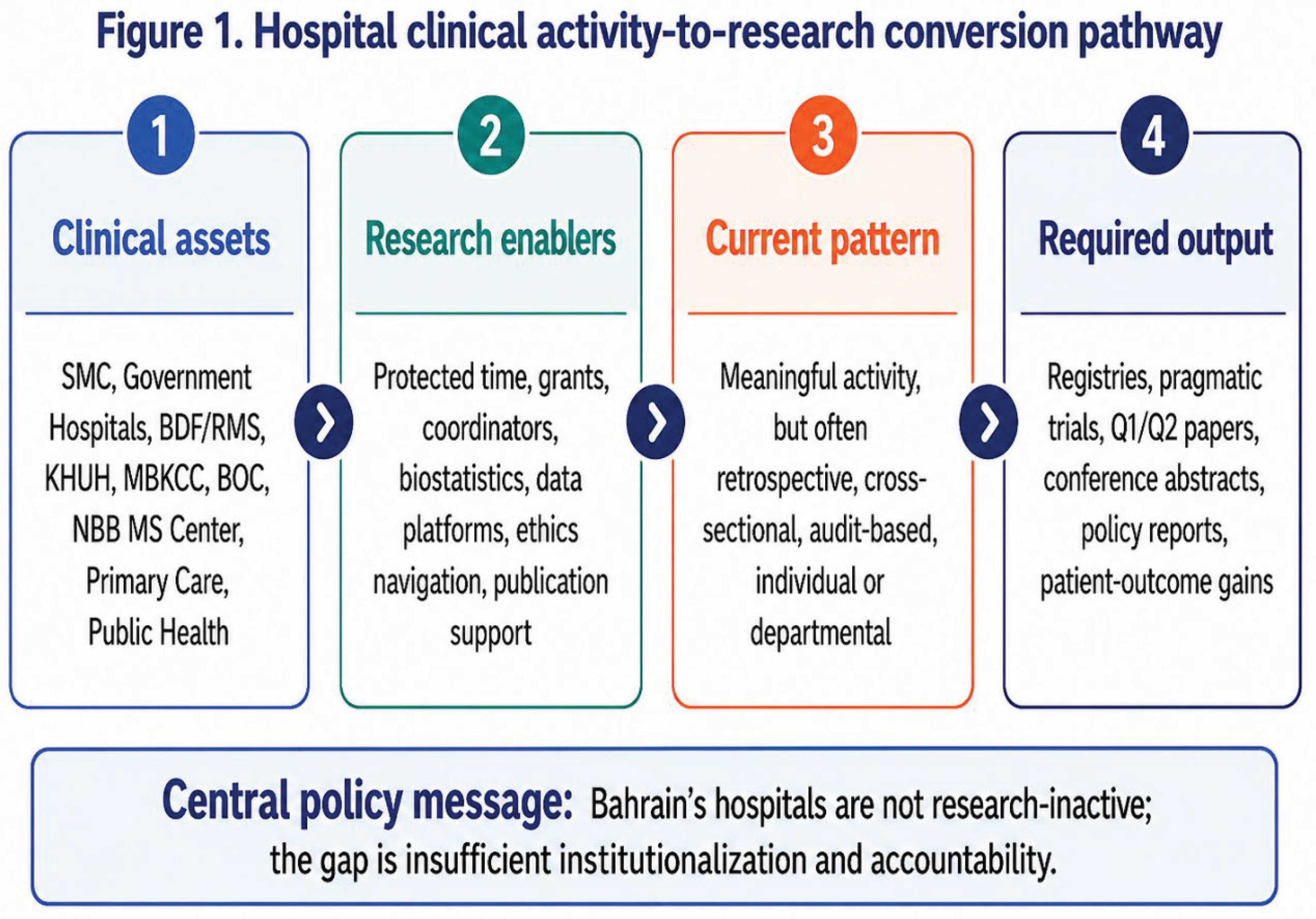
Figure 2.
Hospital research-system capability domains relevant to Bahrain. The figure presents author-derived capability domains for policy discussion and institutional self-assessment. It is not intended to rank countries or institutions. Domains include occasional publication activity, departmental research activity, institutional research-office capacity, clinical-trial and registry infrastructure, and research-intensive hospital or academic-health-system capacity [18,19,20,21,22,23,24,25,26,27,28,29,30].
Figure 2.
Hospital research-system capability domains relevant to Bahrain. The figure presents author-derived capability domains for policy discussion and institutional self-assessment. It is not intended to rank countries or institutions. Domains include occasional publication activity, departmental research activity, institutional research-office capacity, clinical-trial and registry infrastructure, and research-intensive hospital or academic-health-system capacity [18,19,20,21,22,23,24,25,26,27,28,29,30].
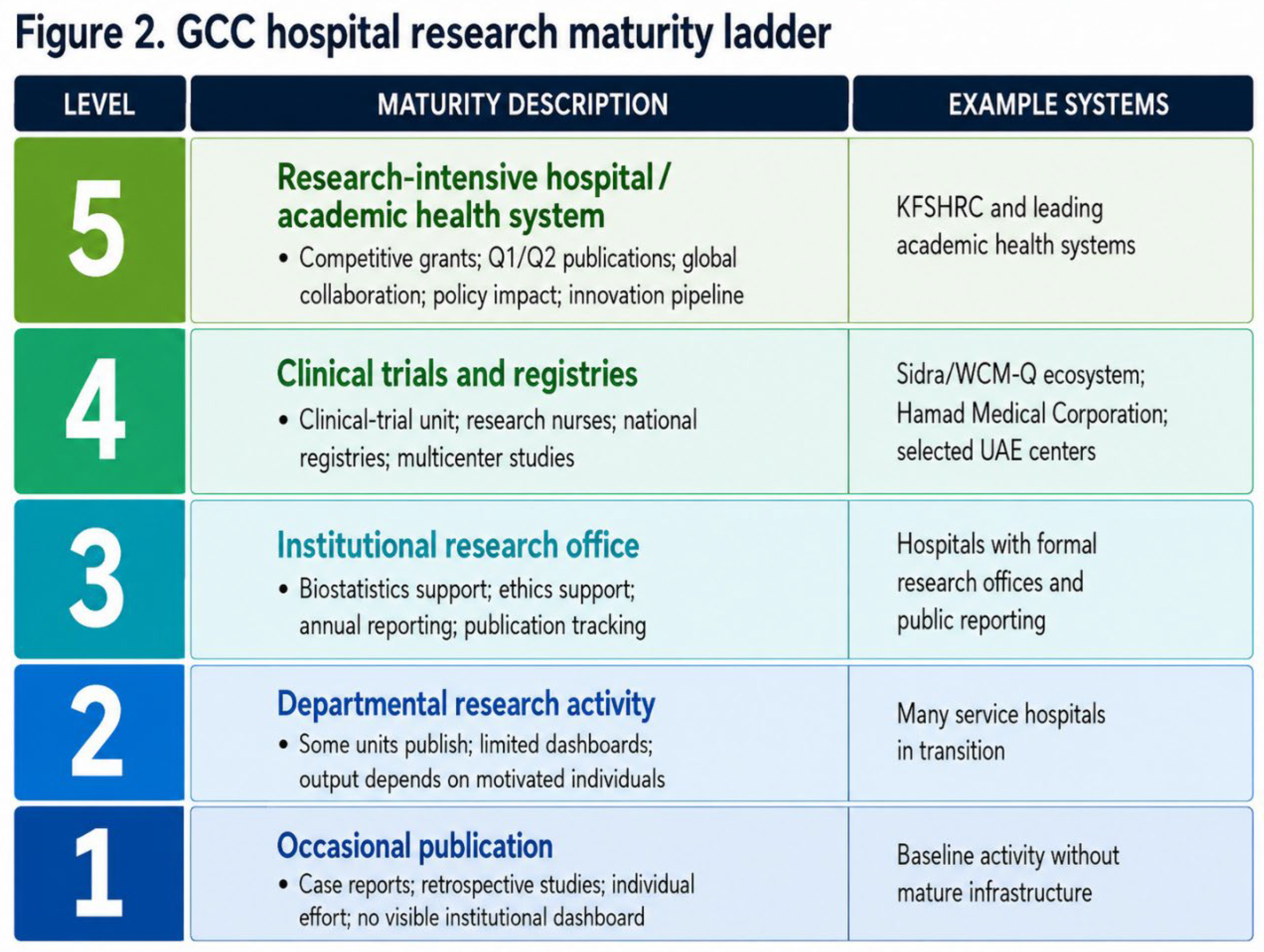

Table 1.
Selected Bahrain research-output indicators and denominator cautions from Hamadeh et al. (2005-2024).
Table 1.
Selected Bahrain research-output indicators and denominator cautions from Hamadeh et al. (2005-2024).
| Indicator block | Indicator | Reported value | Denominator/source note and policy reading |
|---|---|---|---|
| A. Publication-share indicators | Total Bahrain medical and biomedical publications | 5,445 publications | Scopus-based publication count for 2005-2024; confirms meaningful national output. |
| A. Publication-share indicators | AGU share of total publications | 30.2% | Publication-share indicator; shows major academic-sector contribution. |
| A. Publication-share indicators | Academic institutions overall | 55.6% | Publication-share indicator; academic output can mask the separate hospital-sector question. |
| A. Publication-share indicators | Public health institutions | 28.7% | Publication-share indicator; demonstrates meaningful public-sector contribution. |
| A. Publication-share indicators | Local journals | 54.0% of national output | Publication-venue indicator; local relevance is valuable but should be balanced with regional and international visibility. |
| B. Institutional / author-position indicators | Royal Medical Services system | 20.9% | Institutional category reported in the source; should not be treated as independent of related specialist or defence-linked units. |
| B. Institutional / author-position indicators | SMC/governmental hospitals | Approximately 17.2-19.6% | Author-position or institutional author-share range across positions; requires discrete first, last and corresponding-author reporting in future audits. |
| B. Institutional / author-position indicators | KHUH/BOC author-share estimate | Approximately 9.6-11.2% | Related specialist/university-hospital indicator; should be interpreted within the institutional hierarchy rather than as a summable category. |
| B. Institutional / author-position indicators | BDF/MBKCC author-share estimate | Approximately 10.3-10.9% | Defence/specialist cardiology-linked indicator; demonstrates activity but not necessarily mature research infrastructure. |
Note: Indicators are taken from the Scopus-based analysis by Hamadeh et al. [5]. Values are used for policy interpretation rather than as a new bibliometric analysis. Percentages reflect different denominators and should not be interpreted as mutually exclusive categories that sum to 100%. Future national dashboards should report publication shares and author-position shares separately.
Table 2.
Selected GCC hospital-based research benchmarks and practical lessons for Bahrain.
| Domain | Current Bahrain gap | Illustrative GCC benchmark | Adaptable lesson |
|---|---|---|---|
| Funding | No highly visible, ring-fenced national competitive hospital-research fund | QRDI/QNRF ecosystem; KFSHRC specialist-hospital research infrastructure | Create transparent national health-research funding with peer review and annual reporting. |
| Clinical-trial infrastructure | Limited public visibility of CTU-equivalent units in public hospitals | Sidra/HMC, KFSHRC, Cleveland Clinic Abu Dhabi and SSMC CTU models | Pilot one or two CTU-equivalent hospital research-support units. |
| Institutional reporting | Limited visible hospital-level research dashboards | KFSHRC annual reporting and active-study reporting in selected GCC institutions | Publish annual institutional dashboards and asset inventories. |
| Research identity | Service-dominant hospital identity | Specialist-hospital and academic-health-system models | Make research part of institutional mission, not an optional departmental activity. |
| Governance | Fragmented research support and variable committee-performance reporting | Research advisory structures, IRB/REC systems and Department of Health Abu Dhabi standards | Separate ethical oversight from operational research support while reporting both transparently. |
Table 3.
Minimum expertise and role specifications for strengthened institutional research and ethics committees.
Table 3.
Minimum expertise and role specifications for strengthened institutional research and ethics committees.
| Committee domain / member specification | Minimum expertise or qualification | Main role in the committee | Why this matters |
|---|---|---|---|
| Chair or co-chair with research experience | Senior clinician, academic or health professional with peer-reviewed publications, protocol-review experience and no unmanaged conflict of interest | Lead deliberations, ensure balanced scientific and ethical review, maintain independence and prevent unnecessary delay | Research governance should be led by people who understand how research is designed, conducted, completed and published. |
| Clinician-investigator member | Consultant or senior clinician with active or recent involvement in clinical studies, registries, audits or trials | Assess clinical relevance, feasibility, recruitment pathway, patient-safety implications and service impact | Ensures that approved studies are clinically meaningful and feasible in real hospital settings. |
| Epidemiologist / methodologist | Training or experience in epidemiology, study design, observational research, implementation research or health-services research | Review study design, sampling, bias, confounding, feasibility and appropriateness of proposed methods | Prevents weak protocols from passing ethics review simply because the topic is important. |
| Biostatistician or quantitative scientist | Formal statistical training and experience with sample-size estimation, analysis plans, registries and clinical datasets | Review statistical validity, sample size, endpoints, missing-data handling and analysis plans | Poor statistical planning is a common reason studies remain unpublished or produce unreliable findings. |
| Clinical trials / GCP expert | Training in Good Clinical Practice and experience with interventional trials, trial monitoring or clinical-trial operations | Assess trial feasibility, safety oversight, monitoring plans, adverse-event reporting and regulatory alignment | Essential for moving from retrospective studies toward trial readiness. |
| Research ethics expert | Training in research ethics, CIOMS/WHO/ICH-GCP principles or prior REC/IRB experience | Ensure proportional review, participant protection, consent adequacy, justice, confidentiality and conflict-of-interest management | Protects participants while avoiding unnecessary obstruction of low-risk research. |
| Data governance / privacy expert | Knowledge of Bahrain's Personal Data Protection Law, health-data governance, de-identification, data linkage and secure storage | Review registry governance, secondary use of data, data-sharing, consent models and cross-institutional linkage | Crucial for national registries, real-world evidence and multi-institutional studies. |
| Nursing / allied-health research representative | Nurse, pharmacist, physiotherapist, laboratory professional or allied-health member with research or quality-improvement experience | Represent non-physician research capacity and ensure multidisciplinary feasibility | Hospital research should not be physician-only; many service-improvement questions are multidisciplinary. |
| Patient or public representative | Trained lay member independent of the institution, with orientation to confidentiality and research ethics | Review participant-facing materials, burden, acceptability, consent clarity and public-trust issues | Improves relevance, transparency and public engagement, especially for registries and trials. |
| Legal or regulatory advisor | Familiarity with NHRA requirements, institutional policies, data protection and research contracts | Advise on regulatory compliance, liability, trial agreements, data-sharing and institutional obligations | Prevents avoidable delays and ensures regulatory consistency. |
| Research administration / secretariat | Dedicated administrative support with training in submissions, minutes, documentation, timelines and tracking | Maintain standard operating procedures, agendas, decisions, correspondence, approval letters, metrics and annual reports | A committee without a competent secretariat becomes slow, inconsistent and difficult to audit. |
| External expert reviewers when needed | Topic-specific expertise not available within the committee | Provide ad hoc methodological, disease-specific, statistical or technical review | Allows small institutions to maintain quality without pretending to have all expertise internally. |
Note: REC/IRB membership should be multidisciplinary, independent, transparent and periodically refreshed. Scientific support and ethics oversight should be linked but not confused: investigators need methodological help before submission, while ethics committees should focus on participant protection, proportional review, data safeguards and accountable approval processes. Committees should publish annual performance indicators, including number of applications reviewed, median review time, approval rate, major reasons for delay, study-completion rate, and publication or policy-translation outcomes.
Table 4.
Top immediate actions for Bahrain hospital-based research.
| Action | Accountable body | Practical first step / resource envelope | Measurable output by end-2027 |
|---|---|---|---|
| Publish a national dashboard template | SCH with Government Hospitals, NHRA and major public/quasi-public institutions | Low-cost administrative action: standard annual reporting template | First national hospital-research dashboard template published and piloted. |
| Audit existing research assets | SCH/NHRA with institutional research committees | Low-cost desk audit of active studies, registries, RECs, data platforms and research staff | Public inventory of active studies, registries, committees and research-support capacity. |
| Strengthen institutional research and ethics committees | SCH/NHRA with institutional research and ethics committees | Publish membership criteria, standard operating procedures, training requirements, review timelines, conflict-of-interest rules and annual performance indicators; include research-experienced clinicians, methodologists, biostatisticians, ethics experts, data-governance expertise and lay representation. | Committee standards published; multidisciplinary membership confirmed; review-time, study-completion and policy-translation metrics reported. |
| Pilot one research office or CTU-equivalent unit | Government Hospitals/SMC, with possible MBKCC or BOC specialty node | Pilot staffing package: research coordinator, data manager, part-time biostatistics/methods support and ethics-navigation function | Operational protocol-support pathway and first annual output report. |
| Select two to three priority registries | SCH with disease-programme leads and data-governance oversight | Registry feasibility assessment: burden, legal basis, data variables, coverage, staffing and output plan | Named priority registries with governance, minimum dataset and annual reporting plan. |
| Create protected research sessions and young-investigator awards | Government Hospitals, RMS, KHUH, academic partners and philanthropic funders | Competitive seed funding and deliverable-linked sessions | Funded sessions and awards tied to approved protocols, abstracts, registry outputs or submissions. |
| Introduce open-science and visibility levers | Institutions and academic partners | Institutional repository, preprint policy, data-sharing guidance and conference-output tracking | Repository launched; preprint/data-sharing guidance approved; annual conference-output report. |
Note: Resource envelopes are intentionally indicative rather than costed. They identify the type of capacity required without implying a formal budget estimate.
Table 5.
Responsible Bahrain hospital research accountability dashboard.
| Domain | Annual reporting indicator |
|---|---|
| Research portfolio | Total studies by institution, department, study type, disease area, author position and stage of completion. |
| Clinical trials | Active, recruiting, completed, industry-sponsored and investigator-initiated trials; registry number; results-reporting status. |
| Registries | Number of registries, governance model, coverage, core variables, data completeness, annual reports and publications. |
| Ethics and governance | Applications received, median review time, approval rate, reasons for delay or rejection, protocol completion rate. |
| Protected time and workforce | Number and distribution of clinicians and health professionals with funded research sessions by gender, career stage, profession and institution. |
| Methods and support capacity | Availability of research coordinators, data managers, biostatistics, health economics, grant support and manuscript support. |
| Publication and visibility | Publications by study type and institution; local versus international journals; journal indicators as descriptive context only. |
| Open science and reporting | Preprints, institutional repository deposits, data-sharing statements, protocol registration and reporting compliance. |
| Conference output | Oral presentations, moderated posters, posters, invited talks, awards and conversion to full papers. |
| Patient and public involvement | Documented patient/public engagement in registry design, consent materials, priority setting or dissemination. |
| Policy and service impact | Guidelines, pathways, procurement decisions, quality-improvement changes or health-service planning decisions based on local data. |
| Collaboration | GCC and international multicentre studies, public-private partnerships and academic-clinical projects. |
Note: Journal quartiles and citation indicators should be reported only as descriptive institutional context and should not be used as stand-alone measures of individual researcher quality. Assessment should prioritise responsible metrics, including study completion, registry quality, trial registration and results reporting, policy translation, patient benefit, data-sharing, mentorship, equity and ethical governance [34,35,36].
Table 6.
Prioritised roadmap for Bahrain hospital-based research.
| Time frame | Priority actions | Accountable bodies | Measurable outputs |
|---|---|---|---|
| 2026-2027 | Create dashboard template; audit existing studies and registries; publish research and ethics committee membership standards; identify priority disease registries. | SCH, NHRA, Government Hospitals, RMS, KHUH, MBKCC, BOC and academic partners | National dashboard template; registry inventory; committee membership and ethics-review performance indicators; first asset audit. |
| 2027-2028 | Pilot research office/clinical research unit at SMC; establish protected research sessions; launch young-investigator awards. | Government Hospitals/SMC with SCH/NHRA oversight and academic-methods support | Protocol-support pathway; funded research sessions; first annual hospital dashboard; accepted abstracts. |
| 2028-2030 | Launch or strengthen two to three priority registries; develop specialty research nodes; mobilise philanthropic endowment. | SCH, disease-programme leads, MBKCC/BOC/KHUH/RMS and funders | Registry reports; publications; grant awards; conference outputs; multicentre GCC collaborations. |
| Beyond 2030 | Scale clinical-trial capacity; participate in GCC multicentre trials; integrate data with national policy and health economics. | National research-governance structure with hospital and academic partners | Investigator-initiated studies; pragmatic trials; policy-changing local evidence; improved patient outcomes. |
Note: The roadmap is intentionally pragmatic and can be adapted to national resources and institutional readiness. More precise costing should follow a formal institutional desk audit and staffing assessment.
Disclaimer/Publisher’s Note: The statements, opinions and data contained in all publications are solely those of the individual author(s) and contributor(s) and not of MDPI and/or the editor(s). MDPI and/or the editor(s) disclaim responsibility for any injury to people or property resulting from any ideas, methods, instructions or products referred to in the content. |
© 2026 by the authors. Licensee MDPI, Basel, Switzerland. This article is an open access article distributed under the terms and conditions of the Creative Commons Attribution (CC BY) license (http://creativecommons.org/licenses/by/4.0/).
Copyright: This open access article is published under a Creative Commons CC BY 4.0 license, which permit the free download, distribution, and reuse, provided that the author and preprint are cited in any reuse.