Submitted:
22 August 2026
Posted:
24 August 2026
You are already at the latest version
Abstract
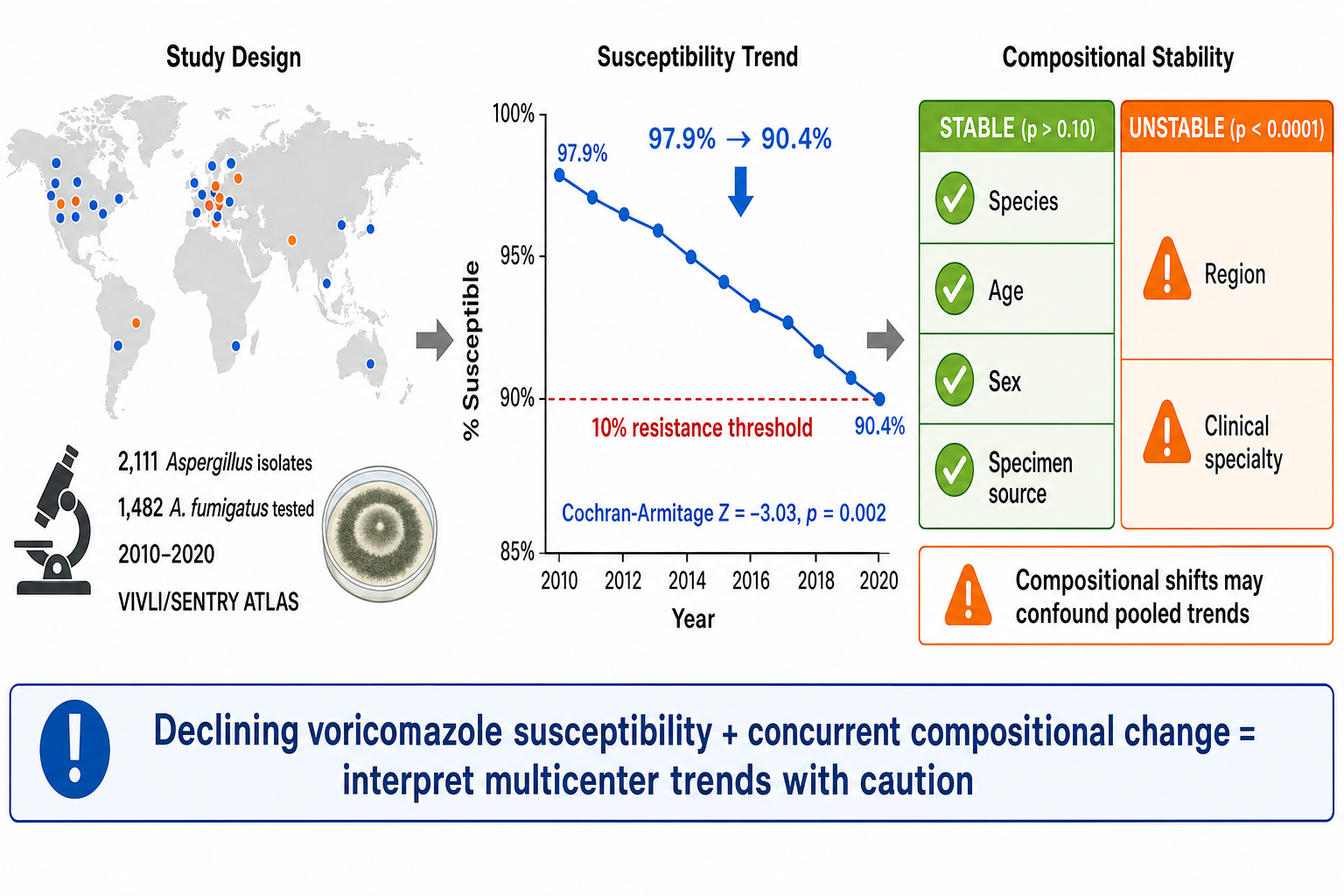
Azole resistance in Aspergillus fumigatus is an emerging threat to invasive and chronic aspergillosis management, yet multicenter trend analyses rarely verify whether the composition of surveillance data remained stable over time. We performed a longitudinal, secondary-data analysis of 2,111 Aspergillus isolates registered in the VIVLI AMR platform (ATLAS Antifungals, SENTRY Program) between 2010 and 2020. Because Clinical and Laboratory Standards Institute (CLSI) voriconazole breakpoints are established only for A. fumigatus in this dataset, the susceptibility-trend analysis was restricted to A. fumigatus isolates with a valid interpretation (n = 1,482/1,483). A. fumigatus accounted for 70.3% of all Aspergillus isolates; most originated from Europe (43.9%) and North America (35.2%). Region and clinical specialty differed significantly across the three study periods (both p < 0.0001), while species, age, sex and specimen-source distributions remained stable (p > 0.10). Voriconazole susceptibility in A. fumigatus declined from 97.9% (2010) to 90.4% (2020), with a significant linear downward trend (Cochran-Armitage Z = −3.03, p = 0.002). This decline was statistically robust, but the concurrent shift in participating regions and specialties indicates that compositional changes in surveillance sampling should be considered alongside biological resistance emergence when interpreting multicenter antifungal surveillance trends.