

Submitted:
22 August 2026
Posted:
24 August 2026
You are already at the latest version
Abstract
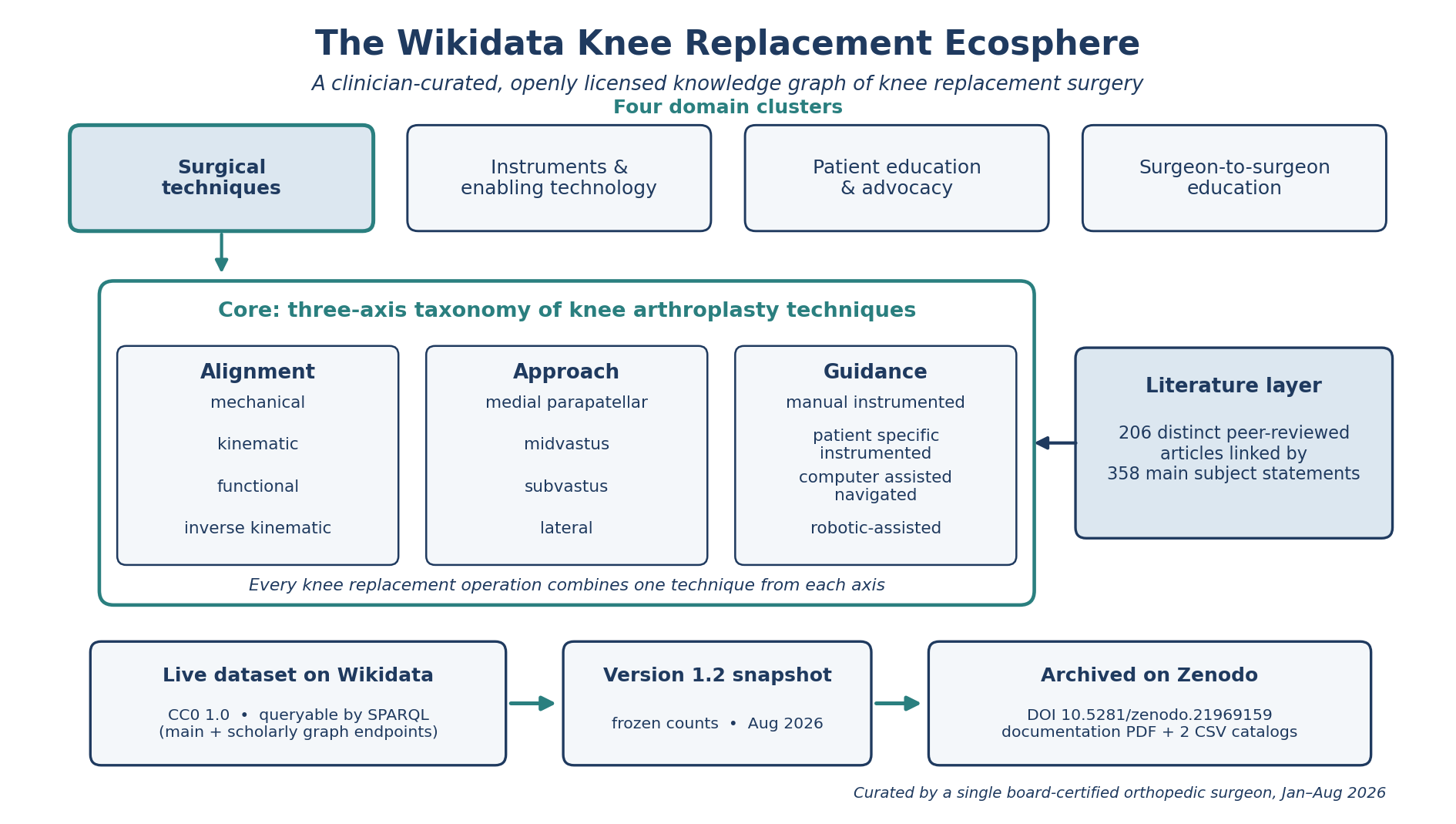
The Wikidata Knee Replacement Ecosphere is a structured knowledge graph dataset of knee replacement surgery. It was built and curated on Wikidata by a single board certified orthopedic surgeon between January 17, 2026 and August 16, 2026. The dataset organizes into four domain clusters: surgical techniques; instruments and enabling technology; patient education and advocacy organizations; and surgeon to surgeon education and collaboration platforms. The core of the dataset is a three axis taxonomy of knee arthroplasty techniques. The axes cover alignment, approach, and guidance. The literature layer links 206 distinct peer reviewed scholarly articles to the taxonomy through 358 main subject statements. The counts were frozen on August 17, 2026. All external identifiers were verified against their live source databases under a documented identifier verification protocol, the Reference Verification Convention v2.0. The live data are public on Wikidata under the CC0 1.0 public domain dedication and are queryable through the Wikidata SPARQL endpoints. A version 1.2 snapshot is deposited on Zenodo at DOI 10.5281/zenodo.21969159. The deposit contains a documentation PDF and two machine readable CSV catalog files. Appendix A lists the 34 items created for the dataset. Appendix B catalogs the scholarly works created for the dataset and contains a total of 148 rows. This article describes the data model, the construction and verification methodology, and the SPARQL queries that reproduce the reported counts.
Keywords:
Wikidata
; knowledge graph
; knee arthroplasty
; surgical techniques
; SPARQL
; open data
; semantic web
; scholarly metadata
Specifications Table
| Subject | Health and medical sciences; Computer science. |
| Specific subject area | Orthopedic surgery (knee arthroplasty); biomedical knowledge representation on the Wikidata open knowledge graph. |
| Type of data | Structured knowledge graph (Wikidata items and statements); two machine readable CSV catalog files; documentation PDF; SPARQL enumeration results (tables in this article). |
| Data collection | Items and statements were created and curated on Wikidata between January 17, 2026 and August 16, 2026 by a single board certified orthopedic surgeon, primarily by hand through the Wikidata editing interface, with QuickStatements for batch operations and SourceMD for scholarly article items carrying existing PubMed or DOI identifiers. All external identifiers were verified against their live source databases under a documented identifier verification protocol (Reference Verification Convention v2.0). SPARQL queries against the Wikidata query endpoints were used for auditing and for the enumerations reported here. |
| Data source location | Primary data: Wikidata (wikidata.org), Wikimedia Foundation, San Francisco, CA, USA. Snapshot documentation and catalog files: Zenodo, hosted by CERN, Geneva, Switzerland. |
| Data accessibility | Repository name: Zenodo. Data identification number: DOI 10.5281/zenodo.21969159 (version 1.2); concept DOI 10.5281/zenodo.21852663 resolves to the latest version. Direct URL: https://doi.org/10.5281/zenodo.21969159. The underlying live data are public on Wikidata under the CC0 1.0 public domain dedication and are queryable at query.wikidata.org (main graph) and query-scholarly.wikidata.org (scholarly graph). |
| Related research article | None. |
Value of the Data
- To our knowledge, the dataset provides the first formally modeled, openly licensed taxonomy of knee arthroplasty techniques on a major public knowledge graph, curated directly by a practicing orthopedic surgeon. Researchers, search systems, and AI applications can now draw on clinically grounded structured assertions rather than inferring them from unstructured text.
- Researchers in biomedical semantics, knowledge representation, and evidence synthesis can reuse the class hierarchy, the property patterns, and the identifier verified statements as a worked example of expert curation on Wikidata. The taxonomy can be extended under the CC0 1.0 dedication without permission or attribution requirements.
- The literature layer links 206 distinct peer reviewed articles to the technique taxonomy through 358 main subject statements. Technique specific evidence is retrievable by SPARQL query, which supports bibliometric, information retrieval, and retrieval augmented generation research based on clinician assigned subject links.
- The enclosed dated catalog files, together with the live SPARQL queries reported in the methods, allow any reader to reproduce the counts in this article. The same materials support measuring the growth of the dataset over time against the deposited snapshot.
- The curation methodology is reusable by other domain experts who wish to contribute verified structured knowledge in their own fields. It includes a documented identifier verification protocol developed for editing sessions that involve AI assistance.
Objective
Patients, clinicians, and machine systems increasingly encounter surgical concepts through search engines and AI answer engines whose underlying structured knowledge layer for surgical technique is thin. Where structured knowledge is absent, these systems infer, and inference in medicine produces error. The Wikidata Knee Replacement Ecosphere was built to replace inference with structured assertion. It is a formally modeled, referenced, and openly licensed knowledge graph. It covers knee replacement surgical techniques; instruments and enabling technology; and the surrounding landscape of patient education, advocacy, and professional education. It was curated by a practicing board certified orthopedic surgeon. This data article describes the dataset, its data model and methodology, the version 1.2 snapshot deposited on Zenodo, and the reproducible counts of its literature layer. The goal is a dataset that is citable, discoverable, and verifiable against its stated methodology.
Data Description
The dataset is a structured knowledge graph built on Wikidata beginning January 17, 2026 under the contributor account Orthodoc10. It organizes into four domain clusters: surgical techniques; instruments and enabling technology; patient education and advocacy organizations; and surgeon to surgeon education and collaboration platforms.
The core is a three axis taxonomy of knee arthroplasty techniques. Every knee replacement operation combines one alignment technique, one approach technique, and one guidance technique. The alignment axis contains four techniques: mechanical alignment, kinematic alignment, functional alignment, and inverse kinematic alignment. The approach axis contains four techniques: medial parapatellar, midvastus, subvastus, and lateral approaches. The guidance axis contains four techniques: manual instrumented, patient specific instrumented, computer assisted navigated, and robotic-assisted knee replacement.
Each axis is modeled as a class of surgical technique populated with individual technique items. All three descend from an intermediate class, surgical technique in knee replacement (Q139682277). This intermediate class connects the taxonomy to the wider ontology as a subclass of surgical technique and a facet of knee replacement (Q1693864).
Supporting items include person items for surgeons of historical significance to the modeled techniques, book and journal items, instrument class items, and a robotic platform item. Each technique item within an axis is explicitly disambiguated from every other technique on that axis using the different from property (P1889), declared reciprocally. This yields 36 statements in total, twelve on each of the alignment, approach, and guidance axes. The property is applied within axes only. Within an axis, the techniques are alternatives, and a surgeon uses one. Across axes, the techniques are complementary.
The structural registry of 34 items created for the dataset is enclosed with the Zenodo record as Appendix A (ecosphere items created 2026-08-16.csv), listing each item by Wikidata QID, label, description, and registry cluster. The dataset also connects into the wider medical ontology through statement level modifications to pre-existing Wikidata items. These modifications are documented in Section 6.2 of the Zenodo documentation PDF. They cannot be listed by a query against the live graph, so the Zenodo documentation is the authoritative record.
The patient education and advocacy cluster contains seven items. BoneSmart is an online joint replacement patient education platform and community forum, operated by BoneSmart, LLC, which organizes the annual Joint Replacement Awareness Day. Healthify He Puna Waiora is a New Zealand consumer health information website. The Health In Hand Foundation, the Acetaminophen Awareness Coalition, and the Know Your Dose campaign promote the safe use of acetaminophen, a medication central to pain management after knee replacement. The surgeon to surgeon education and collaboration cluster contains two items. VuMedi is a video education platform for physicians, and DocMatter is a peer to peer collaboration platform for healthcare professionals.
The literature layer of the dataset is cataloged in Appendix B of the Zenodo record (ecosphere scholarly articles created 2026-08-16.csv). The catalog contains a total of 148 rows. It lists 142 scholarly article items created for the dataset, four journal items created as publication venues, one scholarly chapter, and one edited volume. Each article item carries the bibliographic metadata that its source databases provide. The articles serve two functions. They form the evidence base of the graph. Substantive clinical and historical claims on technique, instrument, and person items are referenced to this literature. Most articles also carry main subject links into the taxonomy, connecting each modeled technique to the published evidence that studies it. The distribution of these links is reported in Table 1. The remaining articles were created to establish the surrounding foundational literature of knee replacement surgery as structured items within the dataset. Separately, the contributor added main subject statements to pre-existing scholarly article items, many of which were created by automated literature imports and lacked links to the specific surgical techniques they study.
Because the literature layer grows continuously, the authoritative counts come from live SPARQL query, and this article reports counts frozen on August 17, 2026. Against the 19 technique, instrument, and platform target items of the taxonomy, the scholarly graph endpoint returned 353 main subject statements distributed across 206 distinct scholarly articles. The main graph endpoint returned 5 additional statements, for 358 in total. Table 1 reports the per target distribution. Coverage concentrates on individual techniques rather than structural class nodes. The deepest coverage lies on the guidance and alignment axes. The two zero counts are by design. The parent class of the taxonomy is structural scaffolding, and the cutting block instrument class has its literature linked at the technique level.
Data formats. The live dataset consists of Wikidata items and statements under CC0 1.0. The Zenodo version 1.2 record (DOI 10.5281/zenodo.21969159, published August 16, 2026) contains the documentation PDF and the two CSV catalog files, and the concept DOI 10.5281/zenodo.21852663 resolves to the latest version of the record as the dataset is versioned through planned expansions.
Experimental Design, Materials and Methods
Construction. Items on the main graph were primarily built by hand through the Wikidata editing interface, with iterative refinement across editing sessions covering labels, descriptions, aliases, relational properties, and references. QuickStatements was used for batch operations where appropriate. Scholarly article items were created primarily with SourceMD from their existing PubMed or DOI identifiers. Properties used throughout the dataset include subclass of, instance of, facet of, significant person, field of work, described by source, different from, main subject, parent organization and child organization pairs, has part(s), part of, founded by, and owned by. Technique classes descend from the intermediate class through subclass of statements pointing to their immediate parent class. Person items for surgeons of documented historical significance to the modeled techniques connect to those techniques through significant person statements, with object of statement has role used as a precision qualifier. Organizational clusters use start time and end time qualifiers to preserve historical transitions. Enabling technology items link to alignment and guidance technique items. They do not link to approach technique items. Approach techniques are modeled as a separate axis of the taxonomy.
Verification. All statements follow the Reference Verification Convention (RVC) v2.0, a documented identifier verification protocol under which every external identifier (QID, PMID, DOI, PMCID) was verified against its live source database before and after inclusion. Citation research was conducted through live PubMed and PubMed Central lookups. The verification methodology is documented on the contributor user page [3]. A case study of observed AI reference failure modes, and of the protocol designed in response, is preserved on Wikidata [4]. In the Wikidata work, AI tools were used only for profile cataloging and documentation. No AI system performed edits to Wikidata, wrote item descriptions, or supplied references.
Enumeration. Wikidata splits its query infrastructure across two SPARQL endpoints. Scholarly article items reside on a dedicated scholarly graph (query-scholarly.wikidata.org). All other items reside on the main graph (query.wikidata.org). Queries for the literature layer must therefore run against the scholarly endpoint. Main graph only queries silently undercount the literature layer. The frozen counts of August 17, 2026 came from two queries against the scholarly endpoint with the 19 technique, instrument, and platform target items of the taxonomy. The first returns the distinct article count and the total number of main subject statements:
SELECT (COUNT(DISTINCT ?article) AS ?distinct_articles)
(COUNT(?article) AS ?total_statements)
WHERE {
VALUES ?target {
wd:Q139682277 wd:Q138049485 wd:Q137917642
wd:Q138049383 wd:Q138042843 wd:Q138640611
wd:Q138042721 wd:Q138032075 wd:Q137897095
wd:Q138042557 wd:Q139059878 wd:Q140620942
wd:Q140605726 wd:Q140605770 wd:Q140605834
wd:Q140441543 wd:Q140605477 wd:Q140605691
wd:Q137881865
}
?article wdt:P921 ?target .
}
The second returns the per target distribution reported in Table 1:
SELECT ?target (COUNT(?article) AS ?statements)
WHERE {
?article wdt:P921 ?target .
FILTER(?target IN (
wd:Q139682277, wd:Q138049485, wd:Q137917642,
wd:Q138049383, wd:Q138042843, wd:Q138640611,
wd:Q138042721, wd:Q138032075, wd:Q137897095,
wd:Q138042557, wd:Q139059878, wd:Q140620942,
wd:Q140605726, wd:Q140605770, wd:Q140605834,
wd:Q140441543, wd:Q140605477, wd:Q140605691,
wd:Q137881865
))
}
GROUP BY ?target
Two implementation notes are necessary for reproduction. The grouped query expresses its target set as a FILTER IN clause rather than as a VALUES block. On this endpoint the combination of a VALUES block with GROUP BY returned empty result sets, while the equivalent FILTER IN construction returned correctly. The grouped query also returns only targets carrying at least one statement. The two items with no linked articles are therefore absent from its output and are recorded as zero in Table 1. A reader reproducing the query should expect seventeen rows against the nineteen row table. Execution times of roughly thirty seconds are typical on the scholarly endpoint and should not be mistaken for failure. The same queries were run separately against the main graph, which captured the 5 statements residing there. No federation was used in any run.
Limitations
The counts reported here are frozen as of August 17, 2026. Because the dataset is actively maintained and expanding, the live graph is authoritative for current counts. The Appendix A and Appendix B catalogs are derived from the contributor’s complete contribution log, obtained through the public MediaWiki API. Row content was retrieved by SPARQL query. The catalogs are exhaustive for created items as of August 16, 2026. Statement level modifications to pre-existing items cannot be listed by a query against the live graph. Their authoritative record is Section 6.2 of the Zenodo documentation and the contribution registry maintained on the contributor user page (wikidata.org/wiki/User:Orthodoc10). The dataset reflects curation by a single contributor. That curation followed a documented verification protocol. All external identifiers were verified against their live source databases, and substantive clinical and historical claims are referenced to published sources. The choice of which techniques to model and which literature to link, however, was one surgeon’s judgment. Recent edits to Wikidata can take time to appear in SPARQL query results. The item page shows the current state. Wikidata is a collaboratively edited platform, and items may be modified by other editors after the snapshot date.
CRediT Author Statement
Brian R. Hatten: Conceptualization, Data curation, Formal analysis, Investigation, Methodology, Validation, Visualization, Writing—original draft, Writing—review and editing.
Ethics Statement
This work involved no human subjects, no animal experiments, and no data collected from social media platforms. All described data are public, structured metadata about surgical techniques, organizations, platforms, published literature, and persons of documented historical significance to the modeled techniques, referenced to published sources. Ethical approval was not applicable to this work.
Data Availability
The live dataset is public on Wikidata under CC0 1.0. The version 1.2 snapshot, including the documentation PDF and both appendix CSV files, is deposited on Zenodo at DOI 10.5281/zenodo.21969159. The concept DOI 10.5281/zenodo.21852663 resolves to the latest version. The query texts are reported in full in the methods section of this article.
Acknowledgments
The author thanks the Wikidata community editors who provided modeling guidance and review during construction, as documented on the contributor user page. This work received no external funding.
Declaration of Competing Interest
The author is the founder and sole author of My Knee Guide, a free patient education platform, and serves as a Surgeon Educator and Kinematic Alignment Advisory Board member for J&J MedTech (DePuy Synthes), a compensated advisory and teaching role connected to the VELYS robotic platform, which appears as one item in the dataset. The Wikidata work described here was neither solicited nor compensated by any organization. My Knee Guide does not have a Wikidata item, no items in the dataset contain links to My Knee Guide, and My Knee Guide has never received external funding.
Declaration of Generative AI and AI-assisted Technologies in the Writing Process
During the preparation of this work the author used Claude (Anthropic) to assist with drafting and editing the manuscript text, constructing SPARQL queries, and auditing the catalog files. The author reviewed, revised, and approved all AI-assisted output throughout the process and takes full responsibility for the content of the publication.
References
- Hatten BR. The Wikidata Knee Replacement Ecosphere: Dataset Description and Documentation. Version 1.2. Zenodo; 2026. [CrossRef]
- Vrandečić D, Krötzsch M. Wikidata: a free collaborative knowledgebase. Communications of the ACM. 2014;57(10):78-85. [CrossRef]
- Wikidata contributor page and methodology: https://www.wikidata.org/wiki/User:Orthodoc10 (accessed August 20, 2026).
- Hatten BR. Designing the Reference Verification Convention: a case study in building workflows against observed AI failure modes. Wikidata; 2026. https://www.wikidata.org/wiki/User:Orthodoc10/Reference_Verification_Convention_case_study (accessed August 20, 2026).

Table 1.
Main subject statements on the scholarly graph endpoint linking scholarly articles to each target item of the taxonomy, frozen August 17, 2026. Each count is the number of scholarly articles asserting the target item as their main subject. Five additional statements reside on the main graph endpoint, for a dataset total of 358. The two zero counts are by design. One item is the parent class of the taxonomy, and the other is an instrument class whose literature is linked at the technique level.
Table 1.
Main subject statements on the scholarly graph endpoint linking scholarly articles to each target item of the taxonomy, frozen August 17, 2026. Each count is the number of scholarly articles asserting the target item as their main subject. Five additional statements reside on the main graph endpoint, for a dataset total of 358. The two zero counts are by design. One item is the parent class of the taxonomy, and the other is an instrument class whose literature is linked at the technique level.
| Target item | QID | Main subject statements |
| robotic-assisted knee replacement surgery | Q140441543 | 83 |
| functional alignment in knee replacement | Q138042557 | 36 |
| manual instrumented knee replacement | Q140605726 | 34 |
| kinematic alignment in knee replacement | Q137897095 | 29 |
| computer assisted navigated knee replacement | Q140605834 | 27 |
| mechanical alignment in knee replacement | Q138032075 | 24 |
| subvastus approach in knee replacement | Q137917642 | 22 |
| medial parapatellar approach in knee replacement | Q138042843 | 17 |
| midvastus approach in knee replacement | Q138049383 | 16 |
| alignment technique in knee replacement | Q138042721 | 15 |
| lateral approach in knee replacement | Q138640611 | 12 |
| inverse kinematic alignment in knee replacement | Q139059878 | 11 |
| patient specific instrumented knee replacement | Q140605770 | 9 |
| approach technique in knee replacement | Q138049485 | 8 |
| VELYS Robotic-Assisted Solution | Q137881865 | 6 |
| surgical instrument in knee replacement | Q140605477 | 2 |
| guidance technique in knee replacement | Q140620942 | 2 |
| surgical technique in knee replacement | Q139682277 | 0 |
| cutting block in knee replacement | Q140605691 | 0 |
Disclaimer/Publisher’s Note: The statements, opinions and data contained in all publications are solely those of the individual author(s) and contributor(s) and not of MDPI and/or the editor(s). MDPI and/or the editor(s) disclaim responsibility for any injury to people or property resulting from any ideas, methods, instructions or products referred to in the content. |
© 2026 by the authors. Licensee MDPI, Basel, Switzerland. This article is an open access article distributed under the terms and conditions of the Creative Commons Attribution (CC BY) license (http://creativecommons.org/licenses/by/4.0/).
Copyright: This open access article is published under a Creative Commons CC BY 4.0 license, which permit the free download, distribution, and reuse, provided that the author and preprint are cited in any reuse.