

Submitted:
21 August 2026
Posted:
24 August 2026
You are already at the latest version
Abstract
Ageing well in place requires a living environment that meets the evolving needs of older adults. While the role of safety in healthy ageing is widely recognised, the contribution of a stimulating environment has received less attention. This study aims to develop an expert-weighted system quantifying how living environments provide physical and cognitive stimulation, as well as safety for older adults. Following an iterative process, multidisciplinary experts in ageing and housing weighted the importance of items for assessing an older adult’s level of physical and cognitive stimulation, and safety. They then judged sub-items for their influence (increase, decrease, or neutral) within each domain. Each sub-item was also assessed as beneficial, harmful, or person-dependent. Final weights were computed by multiplying importance and influence values. Agreement was assessed using the Median Absolute Deviation for importance (MAD < 2.5) and a ≥75% threshold for influence. For importance, 76% of stimulation-related items and 85% of safety items reached consensus, with remaining outliers explored through qualitative analyses. For influence, ≥75% agreement was achieved for 50% of physical-stimulation sub-items, 33% of cognitive-stimulation sub-items, and 59% of safety sub-items. Most sub-items were considered beneficial across domains. This weighting system allows an older adult’s living environment to be evaluated in terms of physical and cognitive stimulation, as well as safety. However, as some items and sub-items did not reach the predefined agreement thresholds, these weightings should be used with caution. These weightings enables benchmarking, environmental audits and targeted design interventions to support ageing well in place.
Keywords:
ageing in place
; healthy ageing
; housing assessment
; interdisciplinary experts
; mixed method
1. Introduction
According to the World Health Organization, the global population is ageing: the number of older people is increasing and will continue to increase over the coming years (Boonkhao et al., 2024), raising various societal challenges (World Health Organization, 2020a). Among these, the question of how to create safe and supportive living environments to favour healthy ageing is key (Wong et al., 2015). For several years now, “ageing in place” has been favored by both older people and public policymakers (Decker et al., 2013; Gobbens & van Assen, 2018). However, for older people to continue living in non-institutional housing as long as possible, their living environment should be adapted to their needs (Bojanowska, 2021).
In line with this observation, the “HabitAge” research project of the University of Liège was created with the aim of studying the links between the living environment of older people (considering their home and neighbourhood within a 500m radius) and their health. More specifically, the research is based on the hypothesis that the type of environment has an impact on older persons’ levels of physical activity and rest-activity cycles.
In accordance with age-friendly housing guidance, including the Home Safety Self-Assessment Tool (Horowitz et al., 2013), the Home Falls and Accidents Screening Tool (Mackenzie et al., 2002), or the Westmead Home Safety Assessment (Clemson et al., 1999), the HabitAge project recognises the centrality of safe living spaces for older adults. However, beyond safety considerations, it examines how the physical and cognitive stimulation provided by residential environments can support long-term health.
Within this framework, our article aims to develop a criteria weighting system for the living environment of older adults. It focuses on three main research questions: (1) According to multidisciplinary experts in ageing, to what extent can specific living environment items impact the physical stimulation, cognitive stimulation, and safety of older people? (2) How can safety and physical stimulation coexist within a single living environment? and (3) What is the relationship between physical and cognitive stimulation within that same environment?
The developed weighting system will eventually (in later phases of the project) be used to classify and compare living environments of older people along (i) a physical stimulation continuum; (ii) a cognitive stimulation continuum and (iii) a safety continuum.
1.1. Living Environment and Physical Stimulation
It is recognized that maintaining physical capacity is essential for “healthy ageing” (Donath et al., 2014). Yet, a systematic review found that the global ageing population is largely sedentary, whether measurements are subjective or objective (Harvey et al., 2013). The living environment plays a significant role in supporting physical activity among older people, and thus their overall health and well-being. For instance, an umbrella review (Bonaccorsi et al., 2020) has demonstrated that walkable, aesthetically pleasant neighbourhoods with greenery, adequate lighting, and access to various amenities positively impact physical activity levels. At the housing level, features such as the presence of a garden, stairs, well-designed rooms layouts and dedicated areas for physical activity have also been shown to encourage movement in daily life among older adults (Meghani et al., 2023). Conversely, in the world of architecture and urban planning, the trend for many years in terms of land-use planning and housing for seniors has been towards universality, accessibility, inclusiveness and the eradication of obstacles (e.g., favouring single-storey living) (Schaff et al., 2022). While these ambitions for more “just” and “equitable” places are laudable and partly necessary (especially for people with reduced mobility or impairment), they in turn recreate a mismatch between certain users and their environments (e.g., especially seniors capable of climbing a few steps).
1.2. Living Environment and Cognitive Stimulation
Maintaining the cognitive abilities of older people is also a major health and economic challenge (Krivanek et al., 2021). Recently, the effects of the living environment on cognition in older adults have been investigated. According to a systematic review, although the associations appear to be moderate, several positive trends have been identified between higher population density, walkable neighbourhood, presence of green spaces, and cognitive function (Chen et al., 2022). In this sense, an individual's environment can be seen as a form of brain training that contributes to optimal cognitive ageing (Cassarino & Setti, 2015). For example, walking from home to the shop requires the use of several cognitive functions, such as remembering the route, keeping in mind a shopping list, and staying focused despite potential distractions along the way (Cassarino & Setti, 2015). When done regularly, such activities provide consistent cognitive stimulation that actively supports cognitive function (Cassarino & Setti, 2015). It is also important to recognize that the level of cognitive stimulation provided by the environment may have different effects depending on the individual's profile (influenced by the level of cognition, character, work, leisure activities, social interactions, etc.) : either beneficial if well suited to the person's abilities, or detrimental if not (Cassarino & Setti, 2015).
1.3. Living Environment and Safety
“Safety” and “security” are often used interchangeably in everyday language. However, academic literature distinguishes between the two concepts: safety is defined as “the state of being away from hazards caused by natural forces or human errors randomly,” whereas security refers to “the state of being away from hazards caused by deliberate intention of human to cause harm” (Nas, 2015). Many studies emphasize that security - along with accessibility and proximity to diverse amenities - is essential for older adults (Lee, 2022). For example, the perception of security in parks among older people is influenced by various factors, including maintenance and cleanliness, vandalism, smoking, debris, and litter (Lee, 2022). Grab rails in sanitary facilities have also been identified by older citizens as a key feature that helps them feel safer at home (Brookfield et al., 2015). Moreover, a growing body of literature supports the idea that environmental features, particularly safety, are linked to physical activity in older adults (Keysor et al., 2010). Additionally, positive perceptions of neighbourhood safety have been associated with a lower prevalence of mental health issues in this population (Gobbens & van Assen, 2018). In the context of this study, both dimensions are considered important, and we thus use “safety” as an umbrella term encompassing both concepts.
2. Materials and Methods
In order to weight the living environment items in terms of physical stimulation, cognitive stimulation and safety (each referred to in this article as a “domain”, and further defined in the Glossary section), expert-based perspectives are essential. This approach, based on the combined insights of specialists from diverse disciplines related to ageing, provides a nuanced, interdisciplinary reflection of the importance and influence of each item. This is a key step in developing a reliable, consistent, and scientifically robust weighting system. All the steps described in the following sections of the Materials and Methods are also schematically illustrated in Figure 1.
2.1. Items selection
We created a preliminary list of criteria of the living environment that could impact safety, physical and cognitive stimulation, based on existing literature, tools, and guidelines for assessing the living environment of older adults. Initially, an architectural researcher identified these tools from open-access scientific articles through a non-systematic search using databases such as Scopus, PubMed, Web of Science, Google Scholar, and grey literature. In total, 209 criteria were identified. These criteria were divided into two broad groups: housing and neighbourhood.
An initial selection among them was carried out blindly by the two architects and the architectural engineer of the HabitAge project's multidisciplinary team. Criteria that received three votes “for” were automatically retained, whereas those which received only one or two votes were discussed until reaching consensual agreement in terms of inclusion or exclusion.
The final list of criteria (SM1) as then submitted to the entire research team (eight experts from different fields, including medicine, psycho-social, and architecture, with a focus on older people) for validation, revision, and enrichment. Each criterion was clustered into items (e.g.: “private outdoor space”) and related sub-items (e.g.: “balcony”, “garden”, etc.). This iterative process was repeated several times, ultimately resulting in a final list consisting of 128 sub-items spread over 50 items (SM1). Within the safety domain, it should be noted that the items “Residents' sense of safety in their dwelling” (AJ) and “Residents' sense of safety in the neighbourhood” (BX), together with their associated sub-items “Very low feeling of safety” and “Very high feeling of safety”, were not weighted, as these items are directly related to safety itself. Consequently, unlike the physical and cognitive stimulation domains, which each comprises 50 items and 128 sub-items, the safety domain includes 48 items and 124 sub-items.
2.2. Data collection
To develop the weighting system, several stakeholders were recruited between 13 June 2024 and 15 April 2025, including older people as well as experts in ageing and/or housing from five disciplines: architecture, universal design, medicine, psycho-social, and home care. Table 1 provides information on each expert. All experts received remuneration for their contributions.
Data collection was performed in two phases. In the first phase, 13 experts participated: two from each discipline and three older adults. They were asked to weight the important items to be considered to assess an older adult’s level of physical stimulation, cognitive stimulation, and safety. Each item was weighted using a Likert scale ranging from 0 (not at all important to consider) to 10 (very important to consider), with the order of the items randomized for each participant. The evaluation was based on the profile of an older adult with sufficient physical ability to move without major difficulty, and sufficient cognitive ability to make decisions independently. For each of the three domains, we provided a definition, and we supplemented each item with concrete examples to ensure optimal understanding (see glossary). This phase took the form of semi-structured interviews. All interviews were recorded with the prior written consent of the participants. The interviews were conducted in two formats: online (via Teams and using Miro’s website) or face-to-face (with physical materials adapted from the online version), following expert’s preference. Three out of the 13 experts participated face-to-face, while the remaining ten completed the process online. At the end of each assessment, the experts could suggest additional items that they considered relevant but missing from the initial list. The average duration, including the interview, was 1 hour and 45 minutes.
The second phase involved 16 experts, including the original 13 from the first phase, plus one additional expert from each of the following disciplines: architecture, medicine, and psycho-social. In this phase, they were asked to weigh the influence (increase, decrease, no effect) of the sub-items on older adult’s physical stimulation, cognitive stimulation, and safety. Each sub-item was weighted using a Likert scale ranging from -5 (strong decrease) to +5 (strong increase), with 0 indicating a neutral effect. As in the first phase, the order of the sub-items was randomized for each expert, and the definitions of the three concepts assessed remained unchanged. Due to the large number of sub-items to be assessed and the time and careful reflection required for the evaluation, it was essential to allow experts to respond independently at their own pace. For this reason, the evaluation was conducted via a self-administered online questionnaire developed on REDCap electronic data capture tools hosted at the University of Liège (Harris et al., 2009, 2019), preceded by an explanatory video produced by the research team. In average, self-administration lasted two hours. To gather qualitative data on expert weighting justifications, a comment box was provided beneath each sub-item, but only 10% of those were completed by the experts.
Furthermore, when experts assigned a score between –5 and –1 or between +1 and +5, they were asked to specify whether the influence of the sub-items was beneficial or harmful (with respect to seniors’ stimulation and safety), or whether it varied depending on the profile of the older adults. In the case of a neutral score (0), they were asked to indicate whether this meant that the sub-item had no relationship with the domain being assessed (physical stimulation, cognitive stimulation and safety), or whether its effect varied depending on the older adult’s profile - which could justify the use of a neutral score despite the potential for very different effects. Although this additional input was not considered in the scoring - as it involved selecting an option rather than assigning a numerical value - it introduced an important qualitative dimension to the interpretation of the results.
2.2.1. Institutional review board statement
This study was conducted in accordance with the Declaration of Helsinki and has been approved both by the Liège University Hospital Ethics Committee [ref : 2024/123, approval date : 09/04/2024] and the Liège University Human and Social Sciences Ethics Committee [ref : 2024-22, approval date : 06/06/2024].
2.3. Data analysis
To conduct data analysis, we opted for a mixed-methods approach, which integrates both qualitative and quantitative methods within the same study (Hong et al., 2018). We indeed aimed to answer the research question through a quantitative analysis, based on the weightings assigned to each item and sub-item, and a qualitative exploration, to understand the reasoning behind the experts’ weighting. This combination of qualitative and quantitative data allowed us to identify limitations, convergences, and divergences between the two, leading to a richer and more nuanced interpretation of the results.
2.3.1. Quantitative analysis
First, after obtaining the individual weightings from the experts in the two phases, we calculated the final weight of each sub-item as the product of the median of the item from Phase 1 (ranging from 1 to 10) and the median of the corresponding sub-items from Phase 2 (ranging from -5 to 5). We chose the median to counteract the relatively small number of experts and reduce the influence of outlier weightings on the final weight of items. The agreement among experts was evaluated at the level of individual items using the Median Absolute Deviation (MAD). This statistic was chosen because it provides a robust measure of variability, being less sensitive to outliers than the standard deviation (Rindskopf & Shiyko, 2010), and is therefore more appropriate for analyses based on a limited number of experts. We consider that experts disagreed on a given item if the calculated MAD was equal or greater than 2.5, as moderately conservative threshold (Leys et al., 2013). However, the MAD was not adapted to estimate the level of experts’ disagreement on each sub-item in the second phase, as the positive score is conceptually different from a negative or zero score. To accommodate this, we separated the weightings into three categories: increasing (score > 0), decreasing (score < 0) and neutral (score = 0), and if one of the categories obtained at least 75% majority, we considered that experts reached the agreement for a given sub-item. Regarding the evaluation of the reliability of the weightings obtained in each phase, we measured the global level of agreement between the experts using the Intraclass Correlation Coefficient (ICC) (Shrout & Fleiss, 1979) using two-way random effect, with average measure (or ICC(3, k) using Fleiss nomenclature). The choice of the model is dictated by the manual selection of experts without generalization of their weightings to the larger population of experts (Liljequist et al., 2019). Reliability is deemed acceptable when the ICC reaches 0.70, with values above 0.80 or 0.90 indicating increasingly better levels of reliability (de Vet et al., 2011). To detect if there’s an expert(s) which is in a systematic disagreement with other experts, we re-calculated the ICC excluding experts one-by-one. A significant improvement of ICC (Δ ICC) will indicate an expert in systematic disagreement with other experts. We judge an improvement significant if newly calculated ICC (ICC + Δ ICC) is outside of 95% confidence interval of original global ICC. We also calculated the ICC within groups, although the low number of experts in individual groups (between 2 and 3) may limit the reliability of the estimation. Quantitative analysis has been performed with Python 3.10.13 namely using packages numpy (2.0.0), pandas (2.2.2), scipy (1.13.1) and pingouin (0.5.4).
2.3.4. Qualitative analysis
The qualitative analysis was based on the semi-structured interviews conducted during Phase 1, in which audio recordings were transcribed using the Transkriptor software. Based on the transcripts, each expert justification for the weighting of an item was coded in NVivo and linked to the corresponding item and domain. To understand the sources of disagreement among experts in Phase 1, we qualitatively analyzed the justifications on which experts disagreed (MAD ⩾ 2.5). The justifications were classified into four categories: (1) The expert provided a justification that differed from those of the other experts; (2) The expert used a different weighting approach, although the justification was similar to the others; (3) The expert appeared not to understand the item or did not know how to weight it, and (4) No justification was provided. The experts’ justifications responses presented in the results were translated from French into English, as all the experts were French speaking. For items on which experts agreed (MAD < 2.5), we focused on individual cases of disagreement. Specifically, we identified experts whose scores differed by 4 points or more from the median score for a given item. These experts were considered to be in disagreement with the rest of the group (referred to as “outlier experts”). We then examined the justifications provided by these experts in disagreement to explore the reasons behind their diverging weightings.
3. Results
3.1. Importance and influence weightings
Phases 1 and 2 of the study enabled us to derive a definitive weighting for each sub-item in each domain (SM2 for the physical stimulation, SM3 for the cognitive stimulation and SM4 for the safety). It should be noted that even items and sub-items that fell below the agreed thresholds were given weightings.
From median scores of items in Phase 1, we have identified the items that experts judged as very important (high median ≥ 8) and little important (low median ≤ 3) for the evaluation of physical stimulation, cognitive stimulation, and safety in the living environment of older adults. In the safety domain, 27 out of 48 items (56%) (SM4) achieved a high median (e.g.: general condition of the dwelling, obstacles in the neighbourhood); 21 out of 50 items (42%) (SM2) attained a high median in the physical stimulation domain (e.g.: typology of dwelling, gradient in the neighbourhood), and 8 out of 50 items (16%) (SM3) achieved a high median in the cognitive stimulation domain (e.g.: type of shared housing, shops and public places within 500m of the dwelling). Conversely, a low median was assigned to 3 items (6%) (SM4) for safety (e.g.: internal surface area of the dwelling, aesthetics of the neighbourhood), 5 items (10%) (SM2) for physical stimulation (e.g.: proximity between toilets and dining/living room, population density in the municipality of the dwelling), and 12 items (24%) (SM3) for cognitive stimulation (e.g.: grab bars in sanitary facilities, parking space/garage less than 50m from the dwelling).
We then estimated the influence on safety, physical and cognitive stimulation from the median scores of sub-items in Phase 2. As shown in Table 2, a majority of sub-items increase (median > 0) physical stimulation (SM2) (e.g.: garden, sport or leisure facilities within 500m of the dwelling), cognitive stimulation (SM3) (e.g.: shared housing, meeting place within 500m of the dwelling) and safety (SM4) (e.g.: very good condition of the dwelling, lots of pedestrian crossings).
The results also indicate that for 21 out of 124 sub-items (17%), an increase in physical stimulation is accompanied by a decrease in safety (SM5) (e.g.: single-storey dwelling with occasional steps between rooms, very poor evenness in the neighbourhood), while 42 sub-items (34%) show that a rise in physical stimulation is associated with an improvement in safety or the feeling of safety (SM6) (e.g.: available views of nature or human activity, many pavements). Regarding the relationship between physical and cognitive stimulation, the results show that 67 out of 128 sub-items (52%) lead to a simultaneous increase in both dimensions (SM7) (e.g.: shared housing, a park or other place offering a link with nature). Conversely, 12 sub-items (9%) indicate a parallel decrease in physical and cognitive stimulation (SM8) (e.g.: very unpleasant temperature, very low feeling of safety).
The findings relating to influence (SM2-SM4) also indicate that most sub-items were considered beneficial for both types of stimulation and safety (Table 3). Among the three domains, safety had the greatest number of sub-items evaluated as harmful (e.g.: bathtub, very poor evenness in the neighbourhood, etc.). The three domains had sub-items that were assessed as being too dependent on the individual to determine a clear influence (e.g.: lightweight dwelling for physical stimulation, high population density for cognitive stimulation, and stairs with more than 3 steps with a stairlift for safety). Only few sub-items were assessed as being not relevant for physical stimulation (e.g.: very noisy indoor environment), cognitive stimulation (e.g.: grab bar in the WC) and safety (e.g.: no vegetation in the neighbourhood).
3.2. Agreement between experts
3.2.1. Agreement in phase 1 (focus on the importance of the items)
Items without agreement - Regarding the quantitative analysis, among the 50 assessed items, 12 items (24%) shown a MAD greater than or equal to 2.5 in both the physical (SM2) and cognitive (SM3) stimulation domains, while 7 out of 48 items (15%) exceeded this threshold in the safety domain (SM4). This indicates that there was a general disagreement among the 13 experts. To better understand these disagreements among them, we classified their justifications for physical stimulation (Figure 2), cognitive stimulation (Figure 3), and safety (Figure 4).
We found that, across all three domains, experts’ justifications rarely fall into the third category (the expert appeared not to understand the item or did not know how to weight it), except for the safety weighting related to the item “population density in the municipality of the dwelling” (median = 5, MAD = 3), as seen on Figure 4. Also, the second category, where the expert used a different weighting approach but a similar justification to the others, was never the majority category across domains except for the items “ability of the dwelling to maintain a pleasant temperature in summer and winter” (median = 5, MAD = 3) and “technological or home automation elements linked to safety” (median = 4, MAD = 3). These items were both related to the assessment of physical stimulation, as shown in Figure 2.The majority category for physical stimulation (50%) corresponded to cases where the expert's justification differed from that of the other experts. In contrast, the majority of items did not receive any justification for cognitive stimulation (83.34%) and safety (71.43%). A notable exception was observed for cognitive stimulation domain was the item “home automation elements related to safety” (median = 6, MAD = 3), which stood out due to the highly divergent justifications provided by the experts, leading to considerable disagreement in its weighting. Two experts (one psycho-social and one senior) explained that the presence of these devices prompted cognitive engagement through their use. An architect highlighted that the safety level afforded by these systems impacted attentional functions, while a universal design expert noted that the light emitted by home automation devices stimulated visuospatial functions. In contrast, two experts (an architect and a home care specialist) argued that these devices had no impact on cognitive stimulation. One senior expert clarified that this item was related solely to safety, not cognitive stimulation. Finally, six experts did not provide any justification for their weighting choices.
Items with agreement - Even among the items for which an agreement has been reached (MAD < 2.5), some experts’ weightings strongly deviated from the median. Specifically, out of the 38 items for physical and cognitive stimulation, and 41 items for safety that met the agreement threshold, there were outliers in 32, 34, and 37 items, respectively. We categorized the justifications of such experts in the same way as for the items without agreement (MAD ≥ 2.5). The qualitative analysis (Table 4) shows that physical stimulation was the domain in which outlier experts most frequently provided justifications that differed from those of the agreeing experts. These alternative justifications were most often provided by senior experts and those from the psycho-social field. For example, two main justifications emerged regarding the item “street lighting in the neighbourhood” (median = 8, MAD = 1). Some experts consider it essential as it directly facilitates walking. As one expert in universal design explained: “If it’s, I don’t know, winter and it’s already dark at 4 p.m., and there’s no public lighting, the person won’t leave their home”. Others believe that public lighting fosters a sense of safety, which in turn encourages people to go outside. However, two outlier experts - a psychosocial (score of 3) and a home care expert (score of 2) - offered a different justification. Both argued that public lighting is inherently related to safety rather than to physical stimulation. More specifically, the psychosocial expert initially considered it relevant to physical stimulation, but later changed their mind, concluding that it was solely a matter of safety, as explained: “For me, it matters in winter because people are so set in their routines. Once it gets dark, they don’t go out. I’m actually going to rate it a bit lower. I think maybe it could allow for other activities… No, I’d place it more under safety.”. Unlike the other experts, the two outlier experts did not draw a connection between the feeling of safety and the motivation to engage in physical activity.
Unlike in the physical stimulation domain, most of the outlier experts in the cognitive stimulation domain (Table 5) and safety domain (Table 6) did not offer alternative justification; instead, they provide no justification for the weightings they assigned. The senior experts were the most represented among those providing no justification in the cognitive stimulation and safety domains.
The category “same justification but different way of weighting than the other experts” accounted for only a small proportion in all three domains. For instance, in the safety domain, the item “luminosity of the dwelling” (median = 9, MAD = 1) was considered a critical factor in reducing the risk of falls by all experts who provided a justification. However, only one expert - an architect - did not emphasize the importance of lightness in the safety of older people to the same degree as the others (score of 5). In contrast, a universal design expert clearly articulated the importance of this item (score of 10), stating: “The better it is lit, adapted, … I would almost say that we should carry out lighting studies [...] and reimbursed [them] to people so that they don't fall over themselves in their flat because there is a shadowy area that they haven't spotted, so it seems obvious”. In terms of how this type of justification was distributed across expert groups, the physical stimulation domain showed a relatively even spread across the groups – meaning no expert profile stood out. In the cognitive stimulation domain, only two groups - with a slight predominance of senior experts – had this type of justification. In the safety domain, although only three groups of experts were affected, this justification was predominantly given by medical experts.
Finally, items that were misunderstood or for which experts indicated uncertainty represented a small proportion across all three domains. There was a slight predominance of senior experts in the physical stimulation domain, a predominance of psycho-social experts in the cognitive stimulation domain, and no clear predominance of any expert group in the safety domain.
General agreement between items - Overall, experts’ weighting showed a high level of agreement in both phases and in all domains. No experts presented a systematic disagreement (Table 7). When excluding experts one by one from global ICC, no significant improvement of ICC was found, indicating that none of the experts systematically disagreed with other experts, as biggest decrease of ICC after excluding an expert (column “increase ICC”, Table 7) is comprised within 95% CI of the global ICC. A global agreement of experts within each group is, in general, not reached in Phase 1 (SM9). However, the home care experts show an acceptable level of agreement in physical stimulation (ICC(3,k) = 0.78) and safety (ICC(3,k) = 0.70). Additionally, in cognitive stimulation, both senior and medical experts reached an acceptable level of agreement (ICC(3,k) = 0.73, and 0.73 respectively). Regarding Phase 2 (SM10), an acceptable threshold agreement was reached for the safety domain in each group. For the two other domains, this was only the case for architecture experts. Due to the limited number of experts within groups, the ICC coefficients reported in SM9 and SM10 should be interpreted with caution.
3.2.2. Agreement in phase 2 (focus on the influence of the sub-items)
Of the 128 sub-items that were assessed for their influence on the physical stimulation of older adults, 50% (Table 8) (SM2) achieved at least 75% agreement (with 86% of these items considered to increase) (Table 9) among the 16 experts. Within these 64 sub-items, 56% (SM2) reached 75% agreement regarding the type of influence (Table 10). More specifically (Table 11), 83% sub-items were considered beneficial (e.g.: garden, a sport or leisure facility within 500m of the dwelling), 14% were considered harmful (e.g.: very poor luminosity in the dwelling, no pavements in the neighbourhood), and 3% was considered not relevant (burglar alarm) (SM2). Regarding the latter, this is consistent with the fact that the median was 0 in phase 2, indicating that there was no influence on stimulation. The remaining 44% sub-items (e.g.: very pleasant temperature in the dwelling, sloping path in the neighbourhood), did not reach an agreement on type of influence. This lack of agreement highlights how subjective these sub-items can be - that is, how much their interpretation depends on the individual profile of the older adult.
Of the 128 sub-items weighted for their influence on cognitive stimulation in older adults (increase, decrease, or no effect), 33% (Table 8) (SM3) reached at least 75% agreement (with 81% of these items considered to increase) (Table 9) among the experts. Among these 42 sub-items, 74% (SM3) also reached consensus on the type of influence (Table 10). More specifically (SM3), 87% were evaluated as beneficial (e.g.: shared housing, a meeting place such as cafe or library within 500m of the dwelling), and 13% as harmful (e.g.: no view of nature or human activity from the dwelling, a neighbourhood not at all aesthetic) (Table 11). For the remaining sub-items (26%) (e.g.: detached house, lots of street lighting in the neighbourhood) (Table 10), although the experts agreed that there was an influence on cognitive stimulation, there was no agreement (<75%) on the type of influence (Table 11), again suggesting a subjective dimension linked to individual characteristics.
In terms of safety, 59% (Table 8) (SM4) of the 124 sub-items analyzed to determine whether they increased, decreased, or had no effect on the safety of older adults reached at least 75% agreement (with 62% of these items considered to increase) (Table 9) among the experts. Of these, 78% of sub-items (SM4) reached consensus (Table 10) on the value attributed to the change (Table 11): 69% were considered beneficial (e.g.: grab bar in bathtub, a pharmacy within 500m of the dwelling), and 32% as harmful (e.g.: slippery staircase floor, no pedestrian crossings in the neighbourhood). The remaining sub-items (22%) (e.g.: stairs with more than 3 steps, a bus-tram or metro stop within 500m of the dwelling) showed agreement on the presence of a change in safety level, but no agreement (<75%) on the type of influence - again reflecting the subjectivity of certain criteria depending on the profile of the individual.
4. Discussion
This study developed an expert-weighted system related to the home or neighbourhood, which quantify the extent to which a living environment provides physical stimulation, cognitive stimulation and safety for older people. Furthermore, the relationships between physical stimulation and safety, as well as between physical stimulation and cognitive stimulation, will be examined in order to address the research questions. In addition, exploring the items and sub-items that did or did not achieve agreement provides valuable insight into the alignment of our experts' assessments with existing literature.
As previously introduced, both safety and physical stimulation are crucial components for enabling older adults to age in good health. While these two concepts may appear to be in tension (with stimulation potentially implying risks and safety implying restrictions), they are not necessarily mutually exclusive. Is it possible for them to coexist within the same environment? This question is in line with the concern raised by Gilroy & Townshend (p. 1) (Gilroy & Townshend, 2024) : “Can activity be designed back into environments without undoing the benefits of accessibility and causing harm to others?”. In other words, does a physically stimulating environment inherently compromise safety? A promising indication suggests that such a balance is possible since more than one-third of the sub-items (n=124) were defined as increasing both physical stimulation and safety. To better capture this dynamic derived from Phase 2 of the weighting process, this analysis focused on the effect (increase, decrease, neutral) of variations, regardless of the 75% consensus threshold. This approach enables us to maintain a comprehensive assessment of the observed effects. Regarding the neighbourhood, our results show that a strong sense of safety among residents; access to various services and facilities (medical care, mobility options, shops, meeting places, leisure areas); high aesthetic quality; an obstacle-free environment and accessibility for people with reduced mobility, all contribute to promoting both physical activity and safety. These findings are fully consistent with Van Cauwenberg et al. (p. 509) (Van Cauwenberg et al., 2014), who state that “neighborhoods that provide easy access to facilities, high aesthetic quality, safety from crime, and safe walking facilities can be expected to minimize television viewing time among their older inhabitants”, or any other sedentary behaviour. Additional elements, highlighted by our experts, related to public space design, such as enough pavements, pedestrian crossings, non-slippery surfaces, and sufficient street lighting, align with these findings. Brookfield et al. (Brookfield et al., 2015) confirms these observations by noting that several studies have highlighted a link between various outdoor environmental characteristics and the physical activity of older adults. These characteristics include street lighting, pedestrian crossings, soft mobility infrastructure, access to certain recreational facilities (like public parks), and proximity to various shops. Another study (Chastin et al., 2014) reported also that all participants (community-dwelling women aged 65 and over, living independently in their own homes) stated that the lack of resting areas at regular intervals in the neighbourhood reduced their motivation and confidence to remain active and to go outside for a walk. This observation is supported by a consensus among the experts in our study, who affirm that the presence of benches in the neighborhood strengthens both physical stimulation and safety. The possibility to stop along the way to rest or enjoy the environment indeed encourages older adults to leave their homes. However, some experts nuance this idea, noting that the presence of benches is not always a decisive factor in encouraging older adults to go out, as it largely depends on their individual profile. Regarding the indoor of the dwelling, grab bars installed in bathrooms and circulation areas have been identified by experts as elements promoting both physical stimulation and safety for older adults. According to some, these features encourage movement or allow continued mobility because they reinforce the feeling of safety and self-confidence, especially for those who need them. Conversely, single-storey houses and toilet seat risers were considered to have a neutral influence on physical stimulation, although they contribute to improved safety. All these adaptations are perceived as supports that help maintain daily activities while reducing risk factors, notably falls (Brookfield et al., 2015). In addition, maintaining a pleasant temperature, both in summer and winter, is essential for older adults, who are particularly vulnerable to extreme temperatures (Shahzad et al., 2025). From a safety standpoint, our experts emphasize that a home’s ability to guarantee thermal comfort can impact both physical and cognitive stimulation. During winter, this can notably reduce the risk of illness, and more generally, knowing that the home remains comfortable helps reduce mental load. Moreover, they highlight that the decline in muscle strength and work capacity with age, combined with reduced activity by older adults in cold weather, can impair mobility. Indeed, Lindemann et al. (Lindemann et al., 2016) showed that exposure to cool environments affects the mobility of healthy older women, thus compromising their ability to live independently. However, experts differ on the link between indoor temperature and physical stimulation: some believe that a cooler environment can encourage movement to warm up, while others think it favors sedentary behavior. Finally, living as a couple or sharing a home was perceived by experts as a factor that enhances both physical stimulation and safety among older adults. Indeed, social connections, including in the neighbourhood, are very important for strengthening the sense of safety for older adults wishing to age in place (Golovchanova et al., 2022). Similarly, cohabiting with another person can provide a reassuring presence and contribute to a better sense of daily safety (Martinez et al., 2020). Furthermore, according to our experts, living with others promotes shared activities, which stimulates not only the physical dimension but also cognitive capacities in older adults.
Some sub-items identified in our study (21 out of 124) appear to promote physical stimulation while reducing safety. These elements can be grouped into two main categories: (i) housing dimensions and (ii) floor characteristics. Housing dimensions: large homes, such as detached houses, multi-level houses, or those exceeding 150 m², offer more movement opportunities. However, according to experts, they also present a higher risk of falls, notably due to stairs and longer distances to travel. Additionally, these homes may generate a stronger feeling of insecurity, due to greater isolation (less proximity to neighbours) and a higher perceived risk of burglary, compared to apartments. More specifically, regarding multiple steps within the home and according to our experts, the greater the number of steps, the greater the perceived risk, and the greater the stimulation of the older adults’ muscles. Regarding safety aspect, this aligns with a recent study showing that older adults living in multi-storey homes had a higher incidence of falls than those living in single-storey dwellings (Takahashi et al., 2024). For physical stimulation, qualitative studies (Brookfield et al., 2015; Meghani et al., 2023) suggest that while some older adults perceive home steps as a challenge, others emphasize their importance as a means of enhancing daily physical activity.
Floor characteristics: irregularities inside the home (e.g., raised shower trays) as well as outside (uneven surfaces, poorly leveled pavements) can compromise older adults’ stability. Indeed, several of our experts emphasised that the absence of pavements, or the presence of narrow, uneven ones, poses a significant safety risk and deters older adults from going outside. The same reasoning applies to the flatness of neighbourhood surfaces: when the ground is flat, it reduces the risk of falls and can therefore encourage physical activity and outdoor mobility.
Similarly to the comparison between physical stimulation and safety, it is also worthwhile to explore the relationship between physical and cognitive stimulation resulting from Phase 2, disregarding the 75% agreement threshold. Several studies, including those focusing on ageing, have demonstrated that increased physical activity can enhance or maintain cognitive function (Krivanek et al., 2021) and that the reverse is also true (Cheval et al., 2020; Daly et al., 2015). Consistent with these findings, none of the sub-items identified as enhancing physical stimulation were found to decrease cognitive stimulation. Furthermore, our results suggest that 52% of sub-items (n=67) enhancing physical stimulation also enhance cognitive stimulation. Notably, features such as the presence of shops, sports and recreational facilities, and meeting places within 500 meters of the dwelling were all associated with enhanced physical and cognitive stimulation. These findings echo those of a systematic scoping review (Wood et al., 2022), which identified the accessibility of local services and infrastructure (e.g. shops, cafés and libraries) as the main facilitator to healthy ageing - i.e. maintaining the physical and cognitive abilities necessary for independent living (World Health Organization, 2020b). Public transport was also identified as an element that increases both physical and cognitive stimulation. Specifically, sub-items such as bus, tram or metro stops, train stations and walkable paths (e.g., bike lanes) were associated with increases in both domains. Indeed, the density and availability of public transport stops are linked to increased walking to and from these stops, which contributes to physical stimulation in older adults (Twardzik et al., 2023). Furthermore, proximity to public transport, including bus stops (Chiatti et al., 2017), has been linked to improved cognitive health (Rambaldini-Gooding et al., 2021). One possible explanation is that living closer to transport stops encourages more frequent use, which in turn may promote greater engagement in various activities and thus have a positive impact on cognitive function (Chiatti et al., 2017). Finally, the presence of a garden was identified as a factor that enhances both physical and cognitive stimulation. In terms of physical stimulation, this finding is consistent with a qualitative study (Meghani et al., 2023), in which participants emphasized that the garden was a key factor in helping them stay physically active. Regarding cognitive stimulation, this beneficial effect may be explained by the fact that gardening is associated with increased levels of brain-derived neurotrophic factor (BDNF), a protein which enhances memory and supports neurogenesis, thereby positively influencing cognitive function (Lentoor, 2024).
Beyond the exploration of associations across domains, it is also important to examine individually which sub-items did or did not reach the consensus threshold of 75%. Indeed, the absence of consensus may indicate that a sub-item is too subjective to be assessed and therefore difficult to weigh for older adults. Regarding physical stimulation, 64 sub-items (SM2) reached a consensus of at least 75% among experts, while another 64 fell below this threshold. In line with a recent systematic review (Bonaccorsi et al., 2020), several environmental factors - such as abundant greenery in the neighbourhood, very aesthetic neighbourhood, adequate public lighting, and a strong sense of safety - were identified by experts as contributing to increased physical stimulation in older adults. Surprisingly, some sub-items did not reach the 75% agreement threshold. For instance, having a home adapted for people with reduced mobility (PRM) was considered as a factor that enhanced physical stimulation but only for 56% of the experts. Yet, a qualitative study (Brookfield et al., 2015) reported that many participants placed significant importance on features such as wider doorways, which they felt supported their mobility. The lack of agreement on the accessibility of the living environment for PRM can be explained by the fact that we instructed experts to weight the impact for healthy older adults with sufficient physical ability to move without major difficulty, and thus not dependent on PRM adaptations of habitat. However, the accessibility of the living environment has been identified as a promising key factor in the autonomy of older people (even those without significant limitations), as it has a direct impact on their ability to carry out daily activities both inside and outside the home (Afacan, 2019). Another interesting finding concerns the presence of a high gradient in the neighbourhood, which did also not reach 75% of agreement on whether it increases physical stimulation. While hilly environments are associated with higher levels of physical activity in older people compared with low-slope areas (Abe et al., 2020), other findings suggest the opposite. For instance, one study (Keskinen et al., 2020) found that older people living in neighbourhoods with steeper slopes were more likely to experience walking difficulties, which inevitably leads to reduced mobility (and lower physical stimulation). These conflicting results may reflect that slopes can serve either as a good physical stimulus for older adults with sufficient functional capacity, or as a barrier for those with diminished abilities. This dual perspective was also highlighted by one architect expert in our study, who stated: “Physical stimulation: the gradient activates different muscles, but the difficulty may result in people staying at home” (score of 0). Furthermore, as noted by Abe et al. (Abe et al., 2020), older adults who have lived and worked in sloped environments throughout their lives may not perceive steep gradients as environmental barriers, in contrast to those accustomated to flat terrains.
For the cognitive stimulation, 42 sub-items (SM3) reached a 75% consensus among experts, while 86 did not. In line with a recent systematic review (Chen et al., 2022), the presence of a park or another natural environment was identified by 94% of our experts as a factor that enhances cognitive stimulation in older adults. Surprisingly, certain sub-items did not reach a consensus on whether they increase or decrease cognitive stimulation. This was particularly the case for the three sub-items related to population density (low, medium, and high). Indeed, only 69% of experts agreed that medium and high population densities increased cognitive stimulation (which is slightly below the consensus threshold of 75%), while only 31% of experts considered the low population densities to decrease cognitive stimulation. However, according to a literature review (Chen et al., 2022), medium and high population densities are associated with improved cognitive function, whereas low population density may have the opposite effect. Nonetheless, it should be noted that one study found that cognition (more specifically, processing speed) deteriorates at very high levels of density (Wörn et al., 2017). Furthermore, one study found no significant relationship between levels of urbanisation and the cognitive abilities of older people (Ng et al., 2018).
Concerning safety, at least 75% agreement was reached among the experts for 59% (n = 73) (SM4) of the 124 sub-items analyzed in the influence assessment. In contrast, 51 sub-items did not reach consensus. In line with guidelines for falls prevention in older adults (Montero-Odasso et al., 2022), both slippery staircase surfaces and poor luminosity were identified as factors that reduce safety for older individuals. Furthermore, according to people of all ages, the riskiest room is the bathroom, where trips or slips occur (Golovchanova et al., 2022). Indeed, some elements of this room, such as grab bars in bathtubs and toilets, were associated with increased safety, whereas others, like slippery floors were identified as hazards. These findings are consistent with those of a systematic review (Afifi et al., 2015), which also identified these environmental protective and risk factors. Surprisingly, however, the presence of a stairlift did not reach expert consensus regarding its role in improving safety. Nevertheless, this modification is widely recognized as an effective way to reduce the risk of falls compared to homes with stairs alone (O’Malley et al., 2020). Also, one sub-item particularly, the bathtub caught our attention. Although experts generally (69%) agree that it reduces safety, a 75% consensus was not reached. This result seems surprising, since actions involving getting into or out of a bathtub, as well as sitting down or standing up in one, are considered difficult tasks for older adults (Afifi et al., 2015) and among the most hazardous for all ages (Stevens et al., 2011).
We can also observe that the number of sub-items with a good level of consensus (at least 75%) (SM2-SM4) regarding the type of influence for the physical stimulation, cognitive stimulation and safety is relatively low compared to the total number of sub-items. This finding could be attributed to the heterogeneity of the older adult population (Nguyen et al., 2021). Indeed, it may be challenging to determine what type of influence a given item might have on an older individual. However, it should be noted that after evaluating the agreement threshold, the ‘beneficial’ category still predominates in the 3 domains, and the ‘harmful’ category predominates for the safety domain.
The weighting process allowed each sub-item to be assigned a final weight. However, some sub-items received a score of 0, which can be explained by a median score of 0 in either phase 1 or phase 2. This outcome may be due to one of the following reasons: (1) the majority of experts weighted the item as 0 in phase 1, considering it not relevant for assessing physical stimulation, cognitive stimulation, or safety in the living environment; (2) there was significant variability in expert weightings in phase 2 regarding whether the sub-item increased, decreased, or had no effect on these dimensions; or (3) a general consensus indicated that the impact of the sub-item was too dependent on individual characteristics to be meaningfully weighted. In the latter case, a score of 0 does not mean that the sub-item is irrelevant for assessing the stimulating or safe nature of the living environment, but rather that it is difficult to determine a generalizable effect. The impact may vary greatly depending, for example, on the person's health status, needs, preferences, or lifestyle. A follow-up study could be valuable to assess these sub-items according to different profiles of older adults.
4.1. Strengths and limits
Assessing the living environment of older people is a field of research that has been widely explored in scientific literature, and has led to the creation of numerous tools, guides and questionnaires. However, many existing instruments focus essentially on the dimensions of safety, falls prevention and accessibility, without considering other fundamental aspects such as physical and cognitive stimulation as a main focus. One of the major originalities of our approach lies precisely in the explicit integration of these dimensions of stimulation in the evaluation of the habitat. Another distinctive feature is the method of weighting the items and sub-items, carried out by an interdisciplinary consortium of experts on ageing from various fields as well as by older people themselves. We took the latter into account, acknowledging them as “experts in their own experience,” with knowledge drawn from their lived, day-to-day reality. We felt it was essential to set up this consortium to tackle the complexity of ageing, a multidimensional phenomenon that requires an integrated approach that brings together knowledge from interdependent and indissociable disciplines.
This study also has several limitations. Firstly, the identification of the 50 items and 128 sub-items was not based on a systematic literature review. Nevertheless, the selected criteria were derived from a rigorous analysis and enriched by the expertise of the research team. Secondly, the length of the self-administered questionnaire in phase 2 may have run the risk of reducing the concentration of the experts. Indeed, in this phase, the sub-items had to be assessed for their impact and influence on physical stimulation, cognitive stimulation, and safety. However, the questionnaire could be completed in several sessions, allowing the experts to resume the task at their convenience and helping to reduce this risk. Then, unlike phase 1 which took place in the presence of a researcher who could answer questions and clarify the weighting, phase 2 was conducted via a self-administered questionnaire without semi-structured interviews. This is a limitation in terms of the overall understanding of the weighting process. Without direct interaction, we can only hypothesize - rather than confirm - how the experts interpreted the weighting system. In addition, the lack of expert comments in the open-comment boxes hinders qualitative analysis which could allow to understand the reasoning behind the weightings awarded. Consequently, the reasons for the recurring disagreements, including those between the three senior experts and the other professionals, could not be interpreted. However, the clearest possible explanations were provided in both written and video formats, and the research team remained available via e-mail or telephone to address any questions. Furthermore, we focused the analysis on older adults with sufficient physical and cognitive capacity to live independently. As a result, we excluded certain profiles from our study, such as older people with dementia or those who use mobility aids such as wheelchairs. Although these profiles represent a significant segment of the ageing population (Nie et al., 2024; World Health Organization, 2017), they involve additional considerations and standards that fall outside the scope of the present study. Nonetheless, conducting a similar evaluation for these groups would be both relevant and necessary. Finally, some items and sub-items did not meet the predefined agreement thresholds. Although their weightings were calculated (SM2-SM4), they should be used and interpreted with a certain degree of caution when assessing the stimulation and safety nature of living environments of older adults.
4.2. Future research
This study also identifies several promising avenues of inquiry that warrant further investigation through future research. First, the weighting system will allow for the assignment of an overall stimulation and safety score to older adults’ living environments, thereby supporting targeted studies, such as those investigating how living environmental stimulation impacts older adults’ health, one of the key objectives of the HabitAge project. Once adapted and weighted using the same methodology, the list of items and sub-items could also be applied to residential settings, such as nursing homes, to evaluate how stimulating (both physically and cognitively) and safe these environments are for older residents. Such an assessment would be particularly relevant in this context, given the high levels of sedentary behavior observed among residents, while maintaining physical and cognitive activity is essential for healthy ageing (Mitsiokapas et al., 2023).
It is also important to emphasize that the items were selected and evaluated by researchers and experts from a specific European geographical context, namely Belgium and France, reflecting their local culture and perception. The relative importance of these items may vary across cultural settings. While maintaining the same methodology, it would therefore be pertinent to adapt them to other geographical contexts in order to assess their validity and relevance. In a similar vein, regarding public space, this study focused on a limited number of elements within a 500-metre radius of the residence. These items could also be expanded and applied on a larger scale to public spaces, through the specific lens of the physical and cognitive stimulation potential of the living environment for older adults.
In general, the weighting system has the potential to be refined through the incorporation of more specific sub-items, thereby achieving greater granularity. In the present study, we intentionally maintained a broad perspective, considering 128 sub-items across 50 items, while acknowledging that each could be further subdivided into more precise categories. For instance, we included the sub-item “a park or other place offering a link with nature”; a finer level of differentiation could allow for the separation of blue spaces (e.g. lakes, rivers, the sea) from green spaces (e.g. forests, parks), which may be associated with distinct weightings.
Finally, it would be valuable to administer this exercise to a larger cohort of both older adults and professional experts (disciplines related to ageing and housing) to compare their perspectives. This approach could help better understand the gap between the spaces designed and perceived by professionals and those actually experienced by older adults.
5. Conclusion
This weighting system allows an older adult’s living environment to be evaluated in terms of physical and cognitive stimulation, as well as safety. However, as some items and sub-items did not reach the predefined agreement thresholds, these weightings should be used with caution. Beyond this, such an assessment is especially relevant in the context of an ageing population, given the recognition of the role of living environments in supporting healthy ageing. The results of this study suggest also that it is possible to combine stimulation and safety within the same environment, as these two aspects can be complementary and mutually reinforcing. Those weighted items and sub-items will form the basis of a future assessment tool which aims to determine whether the levels of physical and cognitive stimulation and safety offered by a given living environment are adapted to the needs and abilities of a specific profile of older people.
Funding
This work was supported by a grant provided by “Velux Stiftung” and an “Actions de Recherche Concertées” grant (No.ARC 23/27-01-habitage) provided by Federation Wallonie-Bruxelles (FWB) and allocated by University of Liège (ULiege).
CrediT Contributions
VT: conceptualisation; formal analysis; investigation; methodology; visualisation; writing – original draft preparation MS: conceptualisation; formal analysis; investigation; methodology; visualisation; writing – original draft preparation CE: conceptualisation; funding acquisition; methodology; supervision; writing – review and editing NB: conceptualisation; data curation; formal analysis; investigation; methodology; software; visualisation; writing – original draft preparation SA: conceptualisation; funding acquisition; methodology; supervision; writing – review and editing CS: conceptualisation; funding acquisition; methodology; supervision; writing – review and editing OB: conceptualisation; funding acquisition; methodology; supervision; writing – review and editing GS: conceptualisation; formal analysis; investigation; methodology; project administration; visualisation; writing – review and editing.
Data availability
All raw quantitative data files are available from the Zenodo database (DOI: 10.5281/zenodo.17977372).The raw qualitative data are not publicly available, as they contain information that could compromise the anonymity guaranteed to the experts who participated in the study.
Acknowledgments
We gratefully acknowledge the valuable contributions, time, and dedication of all the experts who participated in this study.
Conflict of interest
None reported.
Complementary information
Glossary
1° Physical stimulation
Physical stimulation involves the activation of one or more muscles, thereby promoting bodily movement. A living environment can be considered physically stimulating if it engages an individual's motor functions. For example, climbing a step requires the use of body’s muscles.
2° Cognitive stimulation
Cognitive stimulation refers to the activation of one or more areas of an individual's cognitive abilities, including memory (both short- and long-term), visual-spatial functions (ability to perceive and orientate), attention, processing speed, linguistic and verbal skills (verbal fluency and learning), and executive functions (flexibility and adaptability in non-routine contexts). A living environment can be considered cognitively stimulating when it engages an individual's cognitive functions. For example, using public transport requires cognitive effort, as one must plan the journey, maintain attention, navigate in time and space to reach the bus stop, and get off at the desired stop, etc.
3° Safety
Safety refers to a situation that limits or excludes risks and dangers for an individual, giving them a feeling of safety. A living environment can therefore be safe for an individual when it presents little or no risk of accident, theft, burglary, aggression, or deterioration. For example, being able to lock the front door gives a greater sense of safety.
Abbreviations
CS
Cognitive stimulation
ICC
Intraclass Correlation Coefficient
MAD
Mean Absolute Deviation
NA
Not available
OA
Older adult
PS
Physical stimulation
S
Safety
Supplementary materials
SM1. Final List of Items and Sub-items.
SM2. List of items (n=50) and sub-items (n=128) with phase-specific weightings, final weightings and agreement levels in the domain of physical stimulation.
SM3. List of items (n=50) and sub-items (n=128) with phase-specific weightings, final weightings and agreement levels in the domain of cognitive stimulation.
SM4. List of items (n=48) and sub-items (n=124) with phase-specific weightings, final weightings and agreement levels in the domain of safety. The items “AJ” and “BX”, together with their associated sub-items were not weighted (“NA” appear in these rows).
SM5. Summary of sub-items that are considered by experts (n=16) as simultaneously increasing physical stimulation and decreasing safety.
SM6. Summary of sub-items that are considered by experts (n=16) as simultaneously increasing physical stimulation and safety.
SM7. Summary of sub-items that are considered by experts (n=16) as simultaneously increasing physical and cognitive stimulation.
SM8. Summary of sub-items that are considered by experts (n=16) as simultaneously decreasing physical and cognitive stimulation.
SM9. Experts Agreement within groups between Items across the three Domains in Phase 1. ICC- Intraclass Correlation Coefficient, 95% CI – confidence interval at 95%, F – F statistics, df1 and df2 – numerator and denumerator degress of freedom, pval – p-value. Groups in which experts reached an agreement (ICC >= 0.70) are highlighted.
SM10. Experts Agreement within group between Sub-items across the three Domains in Phase 2. ICC- Intraclass Correlation Coefficient, 95% CI – confidence interval at 95%, F – F statistics, df1 and df2 – numerator and denumerator degress of freedom, pval – p-value. Groups in which experts reached an agreement (ICC >= 0.70) are highlighted.
References
- Abe, T.; Okuyama, K.; Hamano, T.; Takeda, M.; Isomura, M.; Nabika, T. Hilly environment and physical activity among community-dwelling older adults in Japan : A cross-sectional study. BMJ Open 2020, 10(3), e033338. [Google Scholar] [CrossRef] [PubMed]
- Afacan, Y. Extending the importance–performance analysis (IPA) approach to Turkish elderly people’s self-rated home accessibility. J. Hous. Built Environ. 2019, 34(2), 619-642. [Google Scholar] [CrossRef]
- Afifi, M.; Al-Hussein, M.; Bouferguene, A. Geriatric bathroom design to minimize risk of falling for older adults–a systematic review. Eur. Geriatr. Med. 2015, 6(6), 598-603. [Google Scholar] [CrossRef]
- Bojanowska, E. Environment and living place for elderly people. Polityka Społeczna 2021, 572-573(11-12), 10-16. [Google Scholar] [CrossRef]
- Bonaccorsi, G.; Manzi, F.; Del Riccio, M.; Setola, N.; Naldi, E.; Milani, C.; Giorgetti, D.; Dellisanti, C.; Lorini, C. Impact of the Built Environment and the Neighborhood in Promoting the Physical Activity and the Healthy Aging in Older People : An Umbrella Review. Int. J. Environ. Res. Public Health 2020, 17(17), 6127. [Google Scholar] [CrossRef] [PubMed]
- Boonkhao, L.; Puangjan, K.; Ouengprasert, I.; Laosupap, K.; Bootsorn, A.; Junsiri, S.; Thongdamrongtham, S.; Chaikhan, S.; Pramaya, P.; Rattanachaikunsopon, P. Home Environmental Factors Associated with Falls Among Elderly in Ubon Ratchathani, Thailand. J. Multidiscip. Healthc. 2024, 17, 1363-1373. [Google Scholar] [CrossRef] [PubMed]
- Brookfield, K.; Fitzsimons, C.; Scott, I.; Mead, G.; Starr, J.; Thin, N.; Tinker, A.; Ward Thompson, C. The home as enabler of more active lifestyles among older people. Build. Res. Inf. 2015, 43(5), 616-630. [Google Scholar] [CrossRef]
- Cassarino, M.; Setti, A. Environment as ‘Brain Training’ : A review of geographical and physical environmental influences on cognitive ageing. Ageing Res. Rev. 2015, 23, 167-182. [Google Scholar] [CrossRef] [PubMed]
- Chastin, S. F. M.; Fitzpatrick, N.; Andrews, M.; DiCroce, N. Determinants of Sedentary Behavior, Motivation, Barriers and Strategies to Reduce Sitting Time in Older Women : A Qualitative Investigation. Int. J. Environ. Res. Public Health 2014, 11(1), 773-791. [Google Scholar] [CrossRef] [PubMed]
- Chen, X.; Lee, C.; Huang, H. Neighborhood built environment associated with cognition and dementia risk among older adults : A systematic literature review. Soc. Sci. Med. 2022, 292, 114560. [Google Scholar] [CrossRef] [PubMed]
- Cheval, B.; Orsholits, D.; Sieber, S.; Courvoisier, D.; Cullati, S.; Boisgontier, M. P. Relationship between decline in cognitive resources and physical activity. In Health Psychology: Official Journal of the Division of Health Psychology; American Psychological Association, 2020; Volume 39, 6, p. 519-528. [Google Scholar] [CrossRef] [PubMed]
- Chiatti, C.; Westerlund, Y.; Ståhl, A. Access to public mobility services and health in old age : A cross-sectional study in three Swedish cities. J. Transp. Health 2017, 7, 218-226. [Google Scholar] [CrossRef]
- Clemson, L.; Fitzgerald, M. H.; Heard, R. Content Validity of an Assessment Tool to Identify Home Fall Hazards : The Westmead Home Safety Assessment. Br. J. Occup. Ther. 1999, 62(4), 171-179. [Google Scholar] [CrossRef]
- Daly, M.; McMinn, D.; Allan, J. L. A bidirectional relationship between physical activity and executive function in older adults. Front. Hum. Neurosci. 2015, 8, 1044. [Google Scholar] [CrossRef] [PubMed]
- Decker, P. D.; Meeus, B.; Schillebeeckx, E.; Oosterlynck, S. Should I stay or should I go ? Preparing for old age in Flanders, Belgium – an exploration . ENHR 2013, Tarragona, 2013. [Google Scholar]
- de Vet, H. C. W.; Terwee, C. B.; Mokkink, L. B.; Knol, D. L. Measurement in Medicine : A Practical Guide; Cambridge University Press, 2011. [Google Scholar] [CrossRef]
- Donath, L.; Faude, O.; Roth, R.; Zahner, L. Effects of stair-climbing on balance, gait, strength, resting heart rate, and submaximal endurance in healthy seniors. Scand. J. Med. Sci. Sports 2014, 24(2), e93-101. [Google Scholar] [CrossRef] [PubMed]
- Gilroy, R.; Townshend, T. Avoiding ‘bungalow legs’ : Active ageing and the built environment. J. Urban Des. 2024, 30(2), 143-152. [Google Scholar] [CrossRef]
- Gobbens, R. J. J.; van Assen, M. A. L. M. Associations of Environmental Factors With Quality of Life in Older Adults. The Gerontologist 2018, 58(1), 101-110. [Google Scholar] [CrossRef] [PubMed]
- Golovchanova, N.; Andershed, Henrik; Boersma, Katja; Hellfeldt, K. Perceived reasons of unsafety among independently living older adults in Sweden. Nord. J. Criminol. 2022, 23(1), 44-60. [Google Scholar] [CrossRef]
- Harris, P. A.; Taylor, R.; Minor, B. L.; Elliott, V.; Fernandez, M.; O’Neal, L.; McLeod, L.; Delacqua, G.; Delacqua, F.; Kirby, J.; Duda, S. N.; REDCap Consortium. The REDCap consortium : Building an international community of software platform partners. J. Biomed. Inform. 2019, 95, 103208. [Google Scholar] [CrossRef] [PubMed]
- Harris, P. A.; Taylor, R.; Thielke, R.; Payne, J.; Gonzalez, N.; Conde, J. G. Research electronic data capture (REDCap)—A metadata-driven methodology and workflow process for providing translational research informatics support. J. Biomed. Inform. 2009, 42(2), 377-381. [Google Scholar] [CrossRef] [PubMed]
- Harvey, J. A.; Chastin, S. F. M.; Skelton, D. A. Prevalence of Sedentary Behavior in Older Adults : A Systematic Review. Int. J. Environ. Res. Public Health 2013, 10(12), 6645-6661. [Google Scholar] [CrossRef] [PubMed]
- Hong, Q. N.; Pluye, P.; Fàbregues, S.; Barlett, G.; Boardman, F. Mixed Methods Appraisal Tool (MMAT), version française 2018 – Outil d’évaluation de la qualité méthodologique des études incluses dans une revue mixte : Manuel pour les usagers | CCNMO . 2018. Available online: https://www.nccmt.ca/fr/referentiels-de-connaissances/interrogez-le-registre/232.
- Horowitz, B. P.; Nochajski, S. M.; Schweitzer, J. A. Occupational therapy community practice and home assessments : Use of the home safety self-assessment tool (HSSAT) to support aging in place. Occup. Ther. Health Care 2013, 27(3), 216-227. [Google Scholar] [CrossRef] [PubMed]
- Keskinen, K. E.; Rantakokko, M.; Suomi, K.; Rantanen, T.; Portegijs, E. Hilliness and the Development of Walking Difficulties Among Community-Dwelling Older People. J. Aging Health 2020, 32(5-6), 278-284. [Google Scholar] [CrossRef] [PubMed]
- Keysor, J. J.; Jette, A. M.; LaValley, M. P.; Lewis, C. E.; Torner, J. C.; Nevitt, M. C.; Felson, D. T. Community environmental factors are associated with disability in older adults with functional limitations : The MOST study. J. Gerontol. Ser. A Biol. Sci. Med. Sci. 2010, 65(4), 393-399. [Google Scholar] [CrossRef] [PubMed]
- Krivanek, T. J.; Gale, S. A.; McFeeley, B. M.; Nicastri, C. M.; Daffner, K. R. Promoting Successful Cognitive Aging : A Ten-Year Update. J. Alzheimer’s Dis. 2021, 81(3), 871-920. [Google Scholar] [CrossRef] [PubMed]
- Lee, H.-S. Developing and testing the senior park environment assessment in Korea (SPEAK) audit tool. Landsc. Urban Plan. 2022, 227, 104545. [Google Scholar] [CrossRef]
- Lentoor, A. G. Effect of gardening physical activity on neuroplasticity and cognitive function. Explor. Neuroprotective Ther. 2024, 251-272. [Google Scholar] [CrossRef]
- Leys, C.; Ley, C.; Klein, O.; Bernard, P.; Licata, L. Detecting outliers : Do not use standard deviation around the mean, use absolute deviation around the median. J. Exp. Soc. Psychol. 2013, 49(4), 764-766. [Google Scholar] [CrossRef]
- Liljequist, D.; Elfving, B.; Skavberg Roaldsen, K. Intraclass correlation—A discussion and demonstration of basic features. PLoS ONE 2019, 14(7), e0219854. [Google Scholar] [CrossRef] [PubMed]
- Lindemann, U.; Klenk, J.; Becker, C. Assessment of fatigability of older women during sit-to-stand performance. Aging Clin. Exp. Res. 2016, 28(5), 889-893. [Google Scholar] [CrossRef] [PubMed]
- Mackenzie, L.; Byles, J.; Higginbotham, N. Reliability of the Home Falls and Accidents Screening Tool (HOME FAST) for identifying older people at increased risk of falls. Disabil. Rehabil. 2002, 24(5), 266-274. [Google Scholar] [CrossRef] [PubMed]
- Martinez, L.; Mirza, R. M.; Austen, A.; Hsieh, J.; Klinger, C. A.; Kuah, M.; Liu, A.; McDonald, L.; Mohsin, R.; Pang, C.; Rajewski, J.; Salomons, T.; Sheikh, I. More Than Just a Room : A Scoping Review of the Impact of Homesharing for Older Adults. Innov. Aging 2020, 4(2), igaa011. [Google Scholar] [CrossRef] [PubMed]
- Meghani, N. A. A.; Hudson, J.; Stratton, G.; Mullins, J. Older adults’ perspectives on physical activity and sedentary behaviour within their home using socio-ecological model. PLoS ONE 2023, 18(11), e0294715. [Google Scholar] [CrossRef] [PubMed]
- Mitsiokapas, V.; Siarampi, E.; Smixioti, V. V.; Mitsiokapa, E.; Karatzaferi, C.; Koulouvaris, P.; Mavrogenis, A. F.; Giannaki, C. D.; Sakkas, G. K. Inadequate functional capacity and health-related outcomes in older adults living in nursing homes in Greece. Aging Health Res. 2023, 3(1), 100118. [Google Scholar] [CrossRef]
- Montero-Odasso, M.; van der Velde, N.; Martin, F. C.; Petrovic, M.; Tan, M. P.; Ryg, J.; Aguilar-Navarro, S.; Alexander, N. B.; Becker, C.; Blain, H.; Bourke, R.; Cameron, I. D.; Camicioli, R.; Clemson, L.; Close, J.; Delbaere, K.; Duan, L.; Duque, G.; Dyer, S. M. the Task Force on Global Guidelines for Falls in Older Adults World guidelines for falls prevention and management for older adults : A global initiative. Age Ageing 2022, 51(9), afac205. [Google Scholar] [CrossRef] [PubMed]
- Nas, S. The Definitions of Safety and Security. J. ETA Marit. Sci. 2015, 3(2), 53-54. [Google Scholar] [CrossRef]
- Ng, T. P.; Nyunt, M. S. Z.; Shuvo, F. K.; Eng, J. Y.; Yap, K. B.; Hee, L. M.; Chan, S. P.; Scherer, S. The Neighborhood Built Environment and Cognitive Function of Older Persons : Results from the Singapore Longitudinal Ageing Study. Gerontology 2018, 64(2), 149-156. [Google Scholar] [CrossRef] [PubMed]
- Nguyen, Q. D.; Moodie, E. M.; Forget, M.-F.; Desmarais, P.; Keezer, M. R.; Wolfson, C. Health Heterogeneity in Older Adults : Exploration in the Canadian Longitudinal Study on Aging. J. Am. Geriatr. Soc. 2021, 69(3), 678-687. [Google Scholar] [CrossRef] [PubMed]
- Nie, Q.; Rice, L. A.; Sosnoff, J. J.; Shen, S.; Rogers, W. A. Understanding Wheelchair Use in Older Adults From the National Health and Aging Trends Study. Arch. Phys. Med. Rehabil. 2024, 105(3), 514-524. [Google Scholar] [CrossRef] [PubMed]
- O’Malley, O.; Ryan, O.; Wilson, G.; Islam, M.; Smith, T. O.; Hing, C. B. Mortality and morbidity of stairlift injuries : Analysis of the UK TARN database. Injury 2020, 51(6), 1306-1311. [Google Scholar] [CrossRef] [PubMed]
- Rambaldini-Gooding, D.; Molloy, Luke; Parrish, Anne-Maree; Strahilevitz, Michal; Clarke, Rodney; Dubrau, Josh Mei-Ling; Perez, P. Exploring the impact of public transport including free and subsidised on the physical, mental and social well-being of older adults : A literature review. Transp. Rev. 2021, 41(5), 600-616. [Google Scholar] [CrossRef]
- Rindskopf, D.; Shiyko, M. Measures of Dispersion, Skewness and Kurtosis. In International Encyclopedia of Education (Third Edition); Peterson, P., Baker, E., McGaw, B., Eds.; Elsevier, 2010; p. 267-273. [Google Scholar] [CrossRef]
- Schaff, G.; Petermans, A.; Vanrie, J.; Courtejoie, F.; Elsen, C. Architecture of home in later life : Towards a fivefold theoretical model. Archnet-IJAR Int. J. Archit. Res. 2022, 16(2), 413-433. [Google Scholar] [CrossRef]
- Shahzad, S.; Gomez Torres, S.; Rijal, H. B.; Nicol, F. Lack of Thermal Comfort Is a Matter of Life and Death : A Systematic Review for Older People. Buildings 2025, 15(7), 7. [Google Scholar] [CrossRef]
- Shrout, P. E.; Fleiss, J. L. Intraclass correlations : Uses in assessing rater reliability. Psychol. Bull. 1979, 86(2), 420-428. [Google Scholar] [CrossRef] [PubMed]
- Stevens, J. A.; Haas, E. N.; Haileyesus, T. Nonfatal bathroom injuries among persons aged ≥15years—United States, 2008. J. Saf. Res. 2011, 42(4), 311-315. [Google Scholar] [CrossRef] [PubMed]
- Takahashi, P. Y.; Ryu, E.; King, K. S.; Dixon, R. E.; Porcher, J. C.; Wheeler, P. H.; Wi, C. I.; Juhn, Y. J. Housing Characteristics of Areas With More Falls by Older Adults Living in Single-Family Detached Dwellings : A Cohort Study Using Geospatial Analysis. Mayo Clin. Proc. Digit. Health 2024, 2(2), 259-269. [Google Scholar] [CrossRef] [PubMed]
- Twardzik, E.; Falvey, J. R.; Clarke, P. J.; Freedman, V. A.; Schrack, J. A. Public transit stop density is associated with walking for exercise among a national sample of older adults. BMC Geriatr. 2023, 23(1), 596. [Google Scholar] [CrossRef] [PubMed]
- Van Cauwenberg, J. V.; Donder, L. D.; Clarys, P.; Bourdeaudhuij, I. D.; Owen, N.; Dury, S.; Witte, N. D.; Buffel, T.; Verté, D.; Deforche, B. Relationships of Individual, Social, and Physical Environmental Factors With Older Adults’ Television Viewing Time 2014, 22(4), 508-517.
- Wong, M.; Chau, P.; Cheung, F.; Phillips, D.; Woo, J. Comparing the Age-Friendliness of Different Neighbourhoods Using District Surveys : An Example from Hong Kong. PLoS ONE 2015, 10(7), e0131526. [Google Scholar] [CrossRef] [PubMed]
- Wood, G. E. R.; Pykett, J.; Daw, P.; Agyapong-Badu, S.; Banchoff, A.; King, A. C.; Stathi, A. The Role of Urban Environments in Promoting Active and Healthy Aging : A Systematic Scoping Review of Citizen Science Approaches. J. Urban Health 2022, 99(3), 427-456. [Google Scholar] [CrossRef] [PubMed]
- World Health Organization. Global action plan on the public health response to dementia 2017–2025 . World Health Organization, 2017. Available online: https://iris.who.int/items/b1315b31-3533-4e10-9b75-92dfd133a345.
- World Health Organization. Decade of Healthy Ageing : Plan of Action 2021–2030; World Health Organization, 2020a; Available online: https://www.who.int/publications/m/item/decade-of-healthy-ageing-plan-of-action.
- World Health Organization. Healthy ageing and functional ability : Questions and answers; World Health Organization, 2020b; Available online: https://www.who.int/news-room/questions-and-answers/item/healthy-ageing-and-functional-ability.
- Wörn, J.; Ellwardt, L.; Aartsen, M.; Huisman, M. Cognitive functioning among Dutch older adults : Do neighborhood socioeconomic status and urbanity matter? Soc. Sci. Med. 2017, 187, 29-38. [Google Scholar] [CrossRef] [PubMed]
Figure 1.
Graphical Overview of the Materials and Methods. OA: older adult; PS: physical stimulation; CS: cognitive stimulation; S: safety.
Figure 1.
Graphical Overview of the Materials and Methods. OA: older adult; PS: physical stimulation; CS: cognitive stimulation; S: safety.
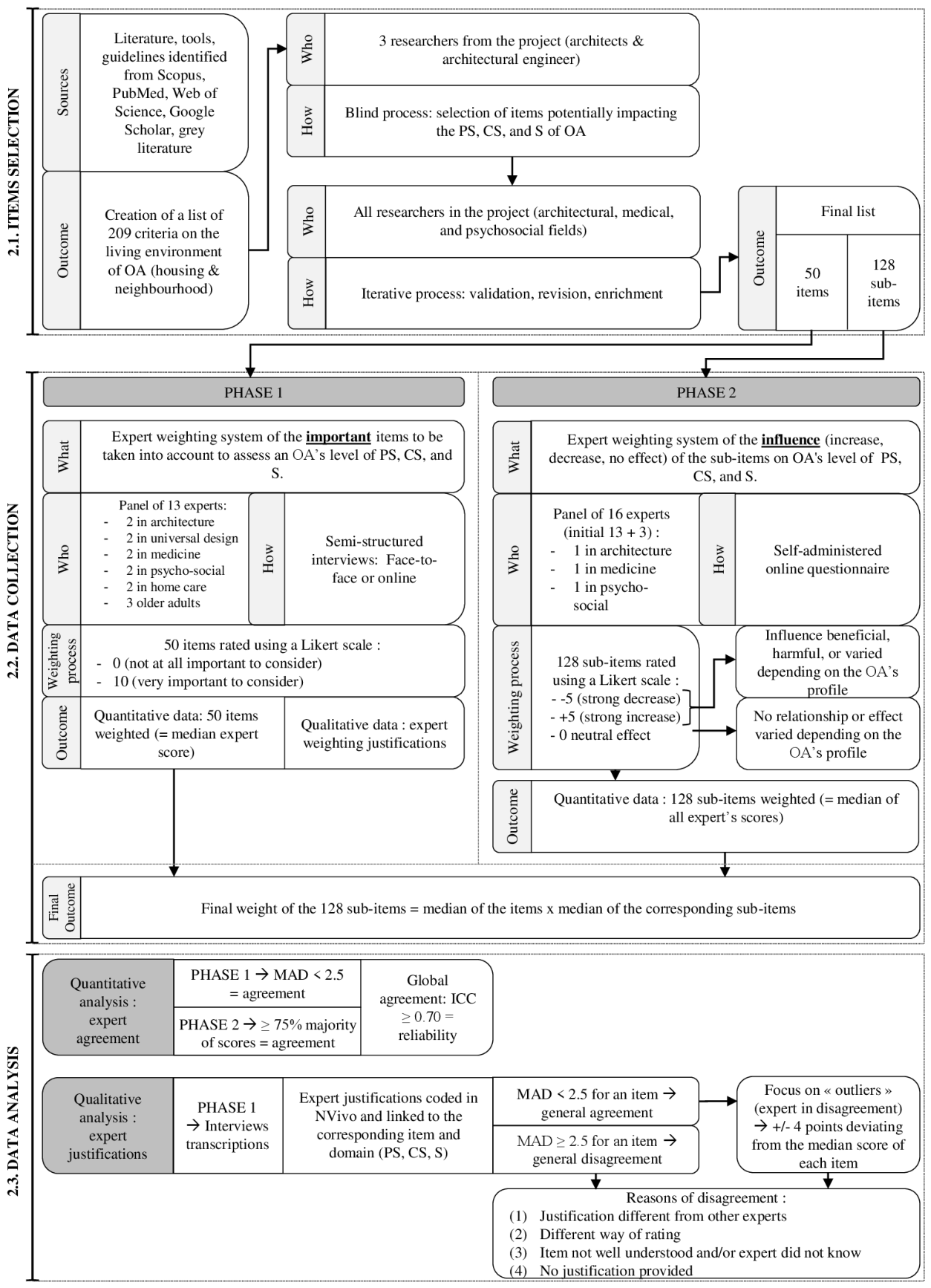
Figure 2.
Physical Stimulation: Distribution of the number of expert justifications by type for each item that did not reach agreement (Phase 1: n = 13 experts, MAD ≥ 2.5). AF: Ability of the dwelling to maintain a pleasant temperature in summer and winter, AI: View of nature or human activity from one or more windows in the dwelling, AJ: Residents' sense of security in their dwelling, AK: General condition of the dwelling, AL: Sufficient space to accommodate guests in the living room and/or dining room, AM: Room available to accommodate someone for the medium or long term, AP: Lift inside the dwelling, AT: Type of shower/bathtub, AU: Seating in the shower and/or bath, AV: Grab bars in sanitary facilities, BA: Technological or home automation elements linked to safety, BL: Population density in the municipality of the dwelling.
Figure 2.
Physical Stimulation: Distribution of the number of expert justifications by type for each item that did not reach agreement (Phase 1: n = 13 experts, MAD ≥ 2.5). AF: Ability of the dwelling to maintain a pleasant temperature in summer and winter, AI: View of nature or human activity from one or more windows in the dwelling, AJ: Residents' sense of security in their dwelling, AK: General condition of the dwelling, AL: Sufficient space to accommodate guests in the living room and/or dining room, AM: Room available to accommodate someone for the medium or long term, AP: Lift inside the dwelling, AT: Type of shower/bathtub, AU: Seating in the shower and/or bath, AV: Grab bars in sanitary facilities, BA: Technological or home automation elements linked to safety, BL: Population density in the municipality of the dwelling.
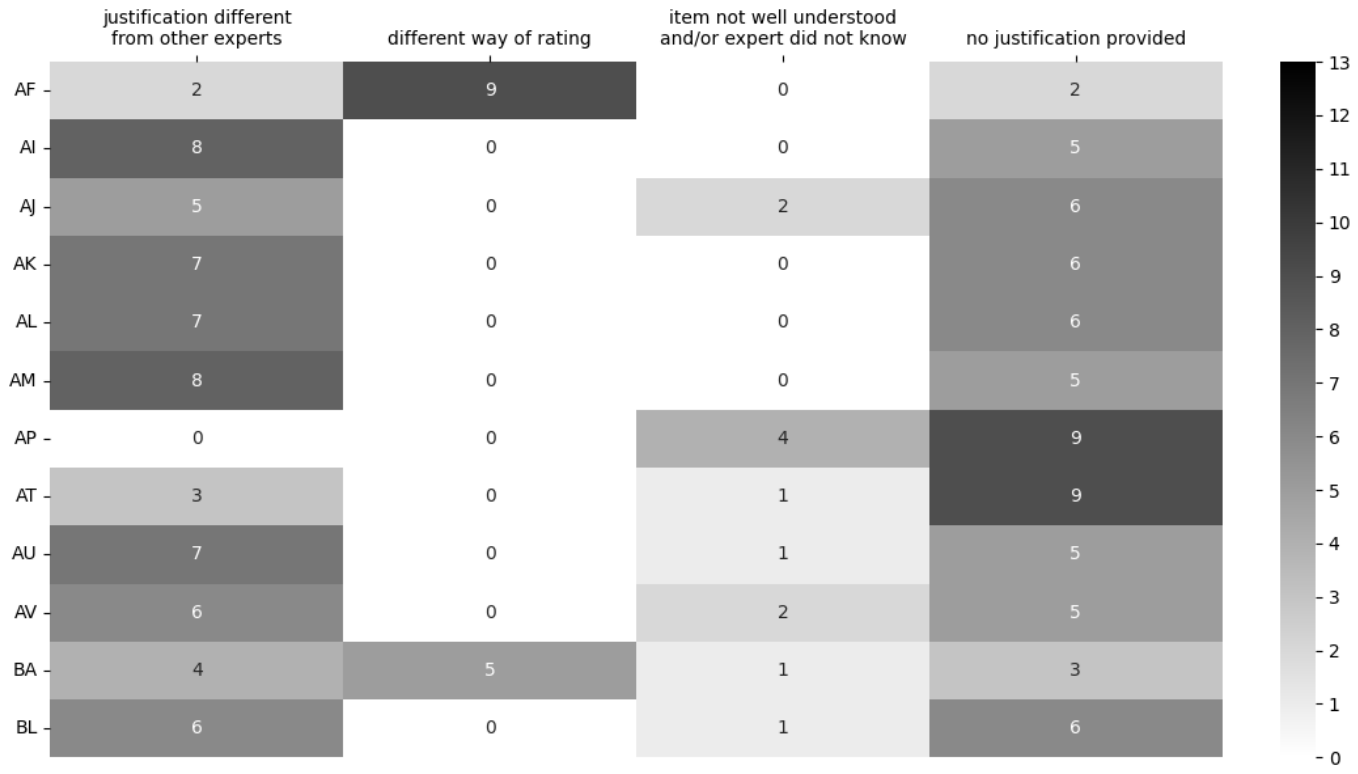
Figure 3.
Cognitive Stimulation: Distribution of the number of expert justifications by type for each item that did not reach agreement (Phase 1: n = 13 experts, MAD ≥ 2.5). AA: Typology of dwelling, AC: Number of storey(s) in the dwelling, AF: Ability of the dwelling to maintain a pleasant temperature in summer and winter, AH: Ease of opening / closing doors and windows, AJ: Residents' sense of security in their dwelling, AO: Steps inside the dwelling, AT: Type of shower/bathtub, BA: Technological or home automation elements linked to safety, BF: Guardrail/ handrails / grab bars outside private accomodation, BP: Eveness of the floor coverings in the neighbourhood, BQ: Slipperiness of the floor coverings in the neighbourhood, BR: Pedestrian crossings in the neighbourhood.
Figure 3.
Cognitive Stimulation: Distribution of the number of expert justifications by type for each item that did not reach agreement (Phase 1: n = 13 experts, MAD ≥ 2.5). AA: Typology of dwelling, AC: Number of storey(s) in the dwelling, AF: Ability of the dwelling to maintain a pleasant temperature in summer and winter, AH: Ease of opening / closing doors and windows, AJ: Residents' sense of security in their dwelling, AO: Steps inside the dwelling, AT: Type of shower/bathtub, BA: Technological or home automation elements linked to safety, BF: Guardrail/ handrails / grab bars outside private accomodation, BP: Eveness of the floor coverings in the neighbourhood, BQ: Slipperiness of the floor coverings in the neighbourhood, BR: Pedestrian crossings in the neighbourhood.
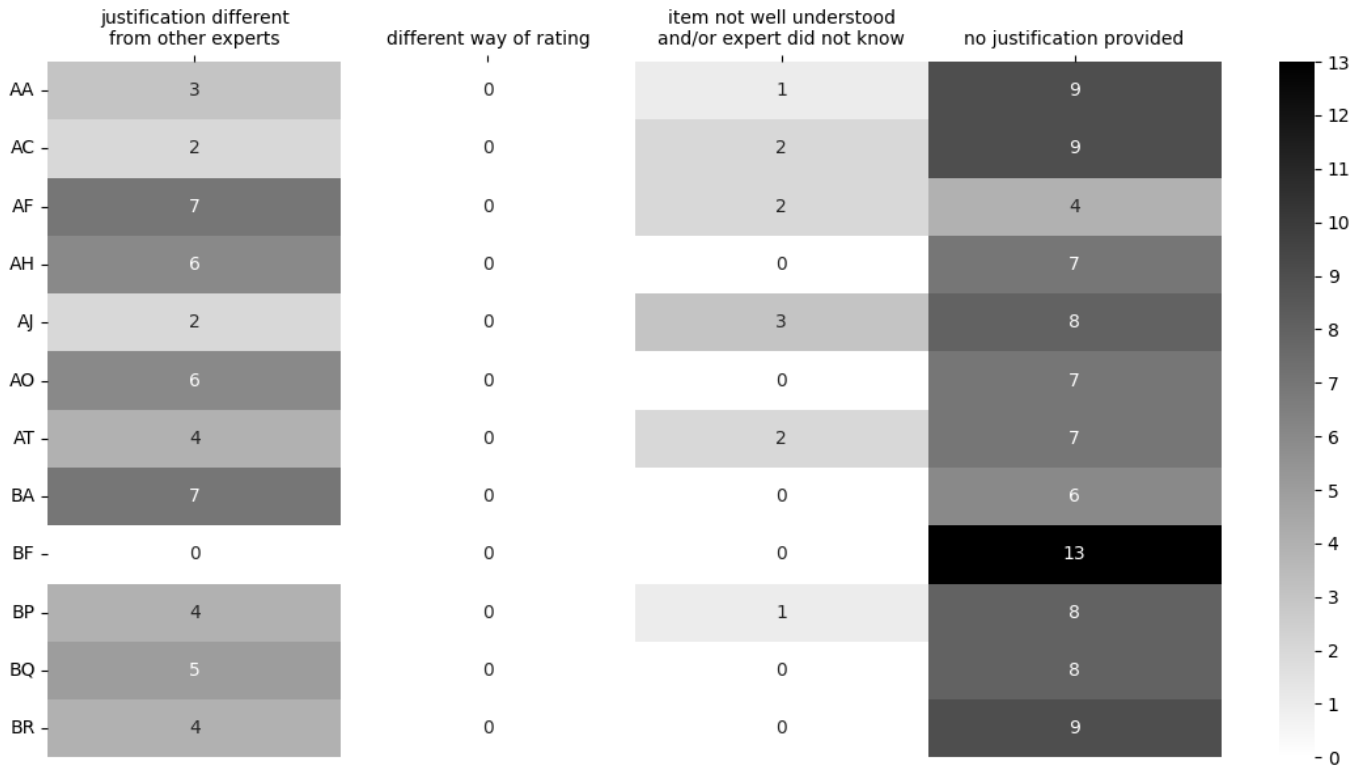
Figure 4.
Safety: Distribution of the number of expert justifications by type for each item that did not reach agreement (Phase 1: n = 13 experts, MAD ≥ 2.5). AC: Number of storey(s) in the dwelling, AF: Ability of the dwelling to maintain a pleasant temperature in summer and winter, AL: Sufficient space to accommodate guests in the living room and/or dining room, AP: Lift inside the dwelling, AY: Proximity between toilets and dining/living room, BI: Shops and public places within 500m of the dwelling, BL: Population density in the municipality of the dwelling.
Figure 4.
Safety: Distribution of the number of expert justifications by type for each item that did not reach agreement (Phase 1: n = 13 experts, MAD ≥ 2.5). AC: Number of storey(s) in the dwelling, AF: Ability of the dwelling to maintain a pleasant temperature in summer and winter, AL: Sufficient space to accommodate guests in the living room and/or dining room, AP: Lift inside the dwelling, AY: Proximity between toilets and dining/living room, BI: Shops and public places within 500m of the dwelling, BL: Population density in the municipality of the dwelling.
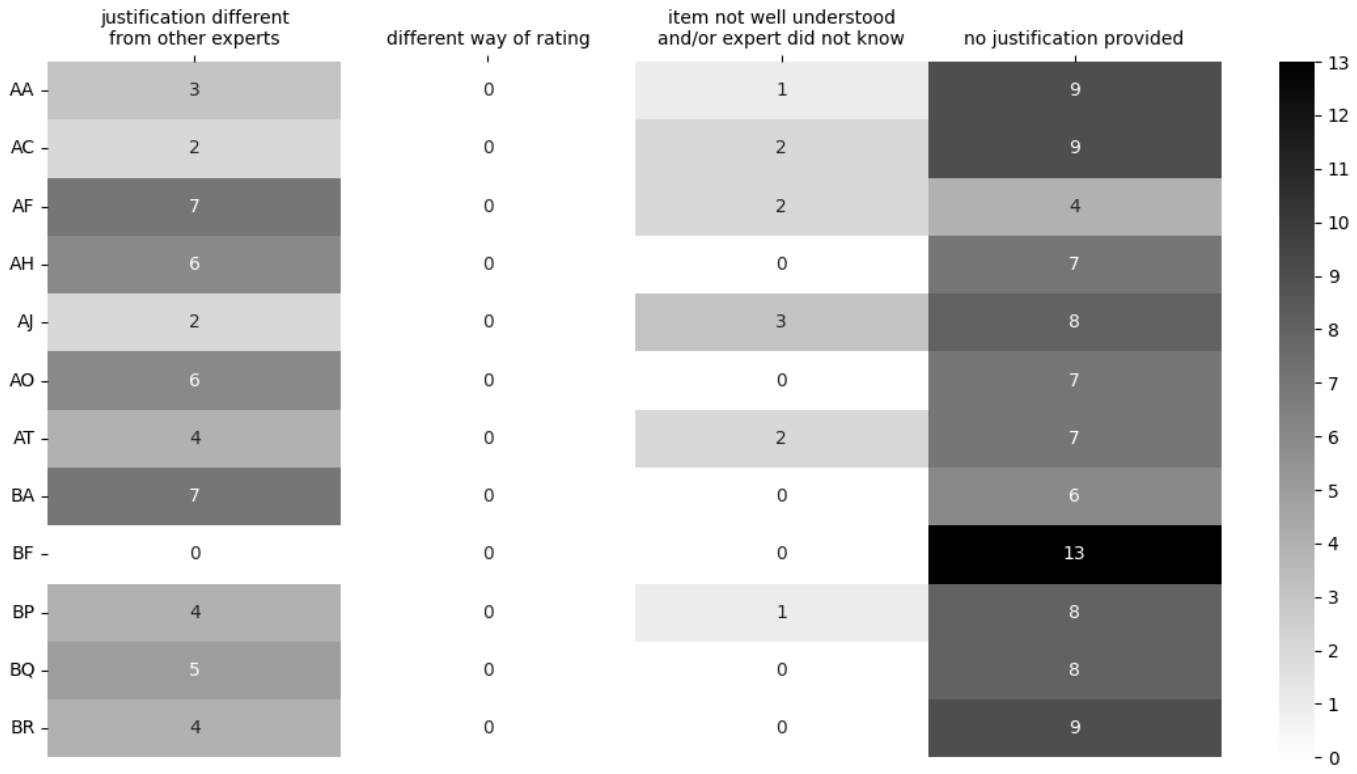

Table 1.
Characteristics of Expert Consultants.
| Expert ID | Disciplines | Profession/profile & Special interest | Years of experience | Recruitment channel | Participation phase |
|---|---|---|---|---|---|
| Expert 1 | Architecture | University lecturer and researcher in architecture, specialising in research on housing and ageing | 6 | Snowballing | 1 & 2 |
| Expert 2 | Architecture | Associate architect, university lecturer, member of a research project on housing and ageing | 12 | Targeted Web Search | 1 & 2 |
| Expert 16 | Architecture | University lecturer and researcher, with educational background in architectural engineering, specialising in living environment, housing, and ageing. | 7 | Internal recruitment (study investigator) | 2 |
| Expert 3 | Medicine | Geriatrician; member of the provincial advisory council for older people | 41 | Snowballing | 1 & 2 |
| Expert 4 | Medicine | Neurologist; researcher on ageing, memory, cognitive functions, and quality of life | 40 | Snowballing | 1 & 2 |
| Expert 15 | Medicine | University lecturer and researcher in epidemiology and geriatric rehabilitation | 27 | Internal recruitment (study investigator) | 2 |
| Expert 5 | Psycho-social | Sociologist specialising in the living environment of older people | 20 | Snowballing | 1 & 2 |
| Expert 6 | Psycho-social | Neuropsychologist in the field of ageing | 17 | Snowballing | 1 & 2 |
| Expert 14 | Psycho-social | University lecturer and researcher specialising in the psychology of ageing, with expertise in cognitive ageing, ageing and mental health, supporting ageing in nursing homes and environmental gerontology. | 26 | Internal recruitment (study investigator) | 2 |
| Expert 7 | Home care | Occupational therapist specialising in accessibility and home adaptation for people with disabilities | 22 | Targeted Web Search | 1 & 2 |
| Expert 8 | Home care | Home care worker for older people | NA | Networking | 1 & 2 |
| Expert 9 | Universal Design | Accessibility consultant architect | 5 | Targeted Web Search | 1 & 2 |
| Expert 10 | Universal Design | Founder of an association promoting the inclusion and participation of people with disabilities in society | NA | Networking | 1 & 2 |
| Expert 11 | Older people | Volunteer and resident of an Abbeyfield house | Age: 85 | Networking | 1 & 2 |
| Expert 12 | Older people | Member of a seniors’ association | Age: 65 | Networking | 1 & 2 |
| Expert 13 | Older people | Member of a seniors’ association and secretary of a neighbourhood committee | Age: 72 | Networking | 1 & 2 |
NA: not available
Table 2.
Summary of Sub-Items Classified as Increasing, Decreasing, or Neutral in Terms of Physical Stimulation, Cognitive Stimulation, and Safety domains.
Table 2.
Summary of Sub-Items Classified as Increasing, Decreasing, or Neutral in Terms of Physical Stimulation, Cognitive Stimulation, and Safety domains.
| Domains | Increasing | Decreasing | Neutral | Total |
|---|---|---|---|---|
| Physical stimulation | 79 (62%) | 19 (15%) | 30 (23%) | 128 (100%) |
| Cognitive stimulation | 77 (60%) | 13 (10%) | 38 (30%) | 128 (100%) |
| Safety | 64 (52%) | 39 (31%) | 21 (17%) | 124 (100%) |
Table 3.
Distribution of types of influence (numbers and percentages).
| Domains | Beneficial | Harmful | Depends on the person | Not relevant | No majority | Total |
|---|---|---|---|---|---|---|
| Physical stimulation | 70 (55%) | 27 (21%) | 14 (11%) | 5 (4%) | 12 (9%) | 128 (100%) |
| Cognitive stimulation | 57 (45%) | 25 (19%) | 28 (22%) | 11 (9%) | 7 (5%) | 128 (100%) |
| Safety | 61 (49%) | 36 (29%) | 22 (18%) | 3 (2%) | 2 (2%) | 124 (100%) |
“No majority” refers to cases in which the responses of the experts (n = 16) are evenly distributed, resulting in no clear majority.
Table 4.
Frequency of justification types of the outlier experts in physical stimulation domain, by expert’s disciplines.
Table 4.
Frequency of justification types of the outlier experts in physical stimulation domain, by expert’s disciplines.
| Experts' disciplines | Justification different from other experts |
Different way of weighting | Item not well understood and/or expert did not know |
No justification provided |
|---|---|---|---|---|
| Architecture | 4 | 1 | 0 | 3 |
| Medical | 3 | 0 | 2 | 5 |
| Psycho-social | 7 | 2 | 0 | 6 |
| Home care | 3 | 2 | 0 | 3 |
| Universal design | 6 | 1 | 0 | 3 |
| Older people | 8 | 2 | 3 | 2 |
| Total | 31 | 8 | 5 | 22 |
Table 5.
Frequency of justification types of the outlier experts in cognitive stimulation domain, by expert’s disciplines.
Table 5.
Frequency of justification types of the outlier experts in cognitive stimulation domain, by expert’s disciplines.
| Experts' disciplines | Justification different from other experts |
Different way of weighting | Item not well understood and/or expert did not know |
No justification provided |
|---|---|---|---|---|
| Architecture | 0 | 1 | 0 | 11 |
| Medical | 1 | 0 | 0 | 8 |
| Psycho-social | 2 | 0 | 2 | 6 |
| Home care | 1 | 0 | 1 | 7 |
| Universal design | 12 | 0 | 1 | 12 |
| Older people | 5 | 2 | 1 | 14 |
| Total | 21 | 3 | 5 | 58 |
Table 6.
Frequency of justification types of the outlier experts in safety domain, by expert’s disciplines.
Table 6.
Frequency of justification types of the outlier experts in safety domain, by expert’s disciplines.
| Experts' disciplines | Justification different from other experts |
Different way of weighting | Item not well understood and/or expert did not know |
No justification provided |
|---|---|---|---|---|
| Architecture | 1 | 1 | 0 | 9 |
| Medical | 4 | 4 | 2 | 5 |
| Psycho-social | 1 | 0 | 2 | 5 |
| Home care | 2 | 0 | 0 | 1 |
| Universal design | 9 | 1 | 0 | 9 |
| Older people | 7 | 0 | 2 | 13 |
| Total | 24 | 6 | 6 | 42 |
Table 7.
General Agreement between Items across the three Domains in Phase 1 and Phase 2.
| Domains | Phase | ICC | 95% CI | F | df1 | df2 | pval | Increase ICC |
|---|---|---|---|---|---|---|---|---|
| Physical stimulation | Phase 1 | 0,83 | [0,76; 0,89] | 5,97 | 49 | 588 | < 0.001 | 0,003 |
| Phase 2 | 0,92 | [0,90; 0,94] | 12,35 | 127 | 1905 | < 0.001 | 0 | |
| Cognitive stimulation | Phase 1 | 0,90 | [0,85; 0,94] | 9,82 | 49 | 588 | < 0.001 | 0,001 |
| Phase 2 | 0,89 | [0,86; 0,92] | 9,34 | 127 | 1905 | < 0.001 | 0,004 | |
| Safety | Phase 1 | 0,86 | [0,80; 0,91] | 7,22 | 47 | 564 | < 0.001 | 0,005 |
| Phase 2 | 0,97 | [0,96; 0,98] | 35,66 | 123 | 1845 | < 0.001 | 0 |
ICC- Intraclass Correlation Coefficient, 95% CI – confidence interval at 95%, F – F statistics, df1 and df2 – numerator and denumerator degress of freedom, p-val – p-value, Increase ICC - maximum improvement of ICC when excluding experts one-by-one.
Table 8.
Number and percentages of sub-items that achieved or not agreement for the influence assessment.
Table 8.
Number and percentages of sub-items that achieved or not agreement for the influence assessment.
| Domains | Influence | ||
|---|---|---|---|
| Global | No agreement (< 75%) | Agreement ( ≥ 75%) | |
| Physical stimulation | 128 (100%) | 64 (50%) | 64 (50%) |
| Cognitive stimulation | 86 (77%) | 42 (33%) | |
| Safety | 124 (100%) | 51 (41%) | 73 (59%) |
Table 9.
Number and percentages of sub-items for the influence assessment (with an agreement of ≥ 75%).
Table 9.
Number and percentages of sub-items for the influence assessment (with an agreement of ≥ 75%).
| Domains | Influence (Agreement ≥ 75%) | |||
|---|---|---|---|---|
| Global | Increase | Decrease | Neutral | |
| Physical stimulation | 64 (100%) | 55 (86%) | 6 (9%) | 3 (5%) |
| Cognitive stimulation | 42 (100%) | 34 (81%) | 4 (9,5%) | 4 (9,5%) |
| Safety | 73 (100%) | 45 (62%) | 26 (36%) | 2 (3%) |
Table 10.
Number and percentages of sub-items for the type of influence assessment (only for those sub-items having at least 75% of agreement for the influence assessment).
Table 10.
Number and percentages of sub-items for the type of influence assessment (only for those sub-items having at least 75% of agreement for the influence assessment).
| Domains | Influence type | ||
|---|---|---|---|
| Sub-items ≥ 75% agreement for the influence | No agreement (<75%) | Agreement ( ≥ 75%) | |
| Physical stimulation | 64 (100%) | 28 (44%) | 36 (56%) |
| Cognitive stimulation | 42 (100%) | 11 (26%) | 31 (74%) |
| Safety | 73 (100%) | 16 (22%) | 57 (78%) |
Table 11.
Number and percentages of sub-items with at least 75% of agreement for the three domains for the type of influence assessment.
Table 11.
Number and percentages of sub-items with at least 75% of agreement for the three domains for the type of influence assessment.
| Domains | Influence type (Agreement ≥ 75%) | ||||
|---|---|---|---|---|---|
| Global | Beneficial | Harmful | Depends on the profile | Not relevant | |
| Physical stimulation | 36 (100%) | 30 (83%) | 5 (14%) | 0 (0%) | 1 (3%) |
| Cognitive stimulation | 31 (100%) | 27 (87%) | 4 (13%) | 0 (0%) | 0 (0%) |
| Safety | 57 (100%) | 39 (69%) | 18 (32%) | 0 (0%) | 0 (0%) |
Disclaimer/Publisher’s Note: The statements, opinions and data contained in all publications are solely those of the individual author(s) and contributor(s) and not of MDPI and/or the editor(s). MDPI and/or the editor(s) disclaim responsibility for any injury to people or property resulting from any ideas, methods, instructions or products referred to in the content. |
© 2026 by the authors. Licensee MDPI, Basel, Switzerland. This article is an open access article distributed under the terms and conditions of the Creative Commons Attribution (CC BY) license (http://creativecommons.org/licenses/by/4.0/).
Copyright: This open access article is published under a Creative Commons CC BY 4.0 license, which permit the free download, distribution, and reuse, provided that the author and preprint are cited in any reuse.