

Submitted:
21 August 2026
Posted:
21 August 2026
You are already at the latest version
Abstract
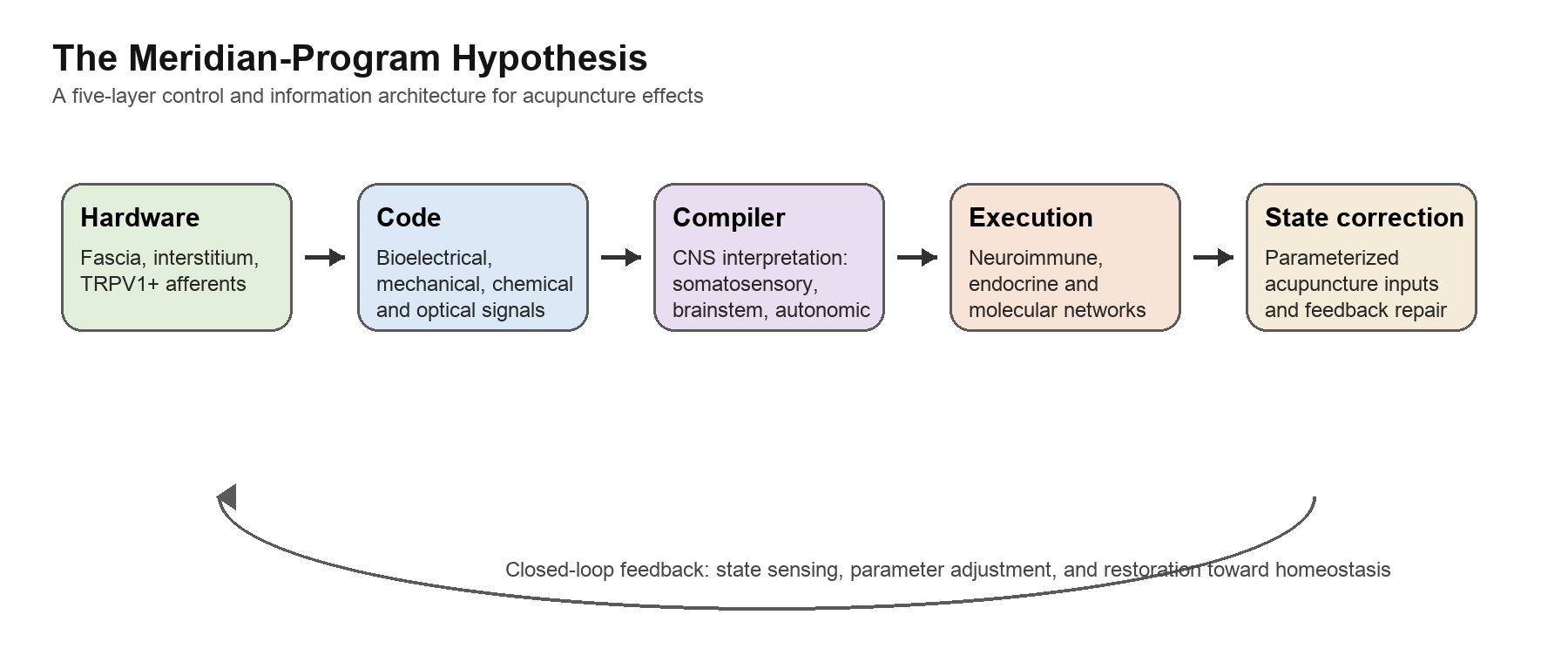
Acupuncture is supported by a long clinical tradition and a growing body of mechanistic research, yet the classical meridian system remains difficult to reconcile with conventional anatomical models. The persistent difficulty may arise from a category error: meridians have often been sought as discrete anatomical tubes, whereas the relevant biological object may be a dynamic control and information system. Here we propose the Meridian-Program Hypothesis, which reinterprets the acupuncture system as a five-layer bioelectrical and mechanochemical control network. In this framework, connective-tissue and neural substrates form the hardware layer; local bioelectrical, mechanical, chemical and optical signals form the code layer; central nervous system processing acts as a compiler that assigns context-dependent physiological meaning; neuroimmune, endocrine and molecular pathways constitute the execution layer; and acupuncture functions as a parameterized state-correction input that may shift dysregulated states toward homeostasis. The model does not claim that traditional meridians are already proven anatomical structures. Instead, it offers a testable systems-level language that integrates evidence from electrical impedance studies, fascia research, somatotopic electroacupuncture circuits, neuroimaging, neuroimmune modulation and molecular network studies. We outline three experimental routes: multimodal signal fingerprinting of acupoints, causal chain testing from peripheral input to central processing and organ response, and mapping of pathology-specific stimulation parameters. By turning the meridian question from 'Where is the structure?' to 'How does the control system operate?', the hypothesis may help bridge traditional acupuncture theory with contemporary neuroscience, systems biology and precision neuromodulation.
Keywords:
acupuncture
; meridian
; bioelectricity
; fascia
; neuroimmune regulation
; control theory
; systems biology
; precision medicine
Copyright: This open access article is published under a Creative Commons CC BY 4.0 license, which permit the free download, distribution, and reuse, provided that the author and preprint are cited in any reuse.