

Submitted:
19 August 2026
Posted:
20 August 2026
You are already at the latest version
Abstract
This study explored the effectiveness of participatory adult education approaches in enhancing training and capacity development among emerging farmers in rural communities of the Eastern Cape, South Africa. The study examined how participatory and experiential learning contribute to farmer empowerment, knowledge acquisition, innovation adoption and sustainable rural development. A qualitative Participatory Action Research (PAR) design was employed with a purposive sample of 80 respondents comprising emerging farmers, agricultural extension officers, facilitators and lecturers. Data were collected through semi-structured interviews, focus group discussions, reflective workshops and direct observations and were analysed thematically. Findings indicated that participatory workshops, farmer field schools, peer learning and practical demonstrations improved farmer participation, practical learning, problem-solving and knowledge sharing. Respondents also reported greater confidence in applying sustainable agricultural practices and increased opportunities for exchanging local and indigenous knowledge. Participatory learning further strengthened social interaction, innovation and community resilience. The study concludes that participatory adult education can provide an effective approach for strengthening agricultural training and rural development when learning is practical, learner-centred and grounded in local realities. It recommends greater institutionalisation of participatory training, stronger extension support, investment in climate-smart agriculture and collaborative partnerships among government, universities, civil society and farming communities.
Keywords:
participatory adult education
; emerging farmers
; agricultural extension
; experiential learning
; rural development
; participatory action research
; sustainable agriculture
; Eastern Cape
1. Introduction
Agriculture remains a vital component of rural livelihoods and an important strategy for poverty reduction, food security and local economic development in South Africa. The Eastern Cape continues to experience substantial socio-economic challenges, including poverty, unemployment and inequality, which place considerable pressure on rural households and agricultural livelihoods (Statistics South Africa, 2021). Emerging farmers in the province operate within this challenging environment and face multiple constraints that affect their capacity to establish viable and sustainable enterprises.
These constraints include limited access to appropriate agricultural training, inadequate extension support, restricted access to modern technologies and productive inputs, weak infrastructure and limited financial resources (Food and Agriculture Organization of the United Nations [FAO], 2020; World Bank, 2019). Rural infrastructure constraints, including poor roads, unreliable water supplies and limited storage facilities, can further reduce market participation and contribute to post-harvest losses. Access to affordable finance is also important because smallholder farmers often require working capital and investment resources to improve production systems and adopt new technologies (World Bank, 2019).
Climate change has intensified these challenges. Changes in rainfall patterns, prolonged droughts, rising temperatures and other climate-related stresses can reduce crop and livestock productivity and increase livelihood vulnerability (Intergovernmental Panel on Climate Change [IPCC], 2021). Climate-related risks therefore increase the need for agricultural education approaches that enable farmers to experiment, adapt and develop locally appropriate responses.
Although South Africa has implemented policies and programmes intended to support agricultural development and rural transformation, emerging farmers continue to experience barriers related to productive resources, technical knowledge, institutional support and market participation (Department of Agriculture, Forestry and Fisheries [DAFF], 2018; FAO, 2020). These challenges indicate that agricultural support should not be limited to the transfer of technical information. It should also strengthen farmers’ capacity to analyse problems, make decisions, experiment with new practices, share knowledge and collectively develop solutions.
Adult education approaches are particularly relevant because farmers are adult learners whose existing experiences, indigenous knowledge and practical expertise can form an important foundation for new learning. Adult learning theory emphasises the importance of learner experience, relevance, participation and problem-centred learning (Knowles, 1980; Merriam & Bierema, 2014). Experiential learning similarly emphasises the role of experience, reflection, conceptualisation and experimentation in the learning process (Kolb, 1984).
Participatory approaches extend these principles by positioning farmers as active participants and co-producers of knowledge rather than passive recipients of technical information. Participatory action research, for example, emphasises collaboration, reflection, collective learning and action to address locally defined problems (Kemmis & McTaggart, 2000; Reason & Bradbury, 2008). Participatory agricultural learning can therefore strengthen the relevance and ownership of training while supporting locally appropriate innovation (Pretty, 1995).
Against this background, the study explored participatory adult education approaches for emerging farmer training in rural communities of the Eastern Cape. The study specifically examined how participatory and experiential learning approaches contribute to farmer participation, knowledge acquisition, problem-solving, innovation adoption and sustainable rural development.
2. Theoretical Framework
The study was informed by adult learning, experiential learning and participatory action research perspectives. Adult learning theory, particularly andragogy, recognises adults as learners who bring existing knowledge and experience into educational settings and who generally respond positively to learning that is relevant to their immediate needs and practical problems (Knowles, 1980). This perspective is important for agricultural training because farmers possess experiential and local knowledge that can be incorporated into formal extension and training processes.
Experiential learning theory proposes that learning develops through a cycle involving concrete experience, reflective observation, abstract conceptualisation and active experimentation (Kolb, 1984). In agricultural education, this approach can be operationalised through demonstration plots, farmer field schools, practical exercises, experimentation and reflection on farming outcomes.
Participatory Action Research provides a complementary framework by emphasising collaboration between researchers, practitioners and community members in the generation of knowledge and the identification and resolution of practical problems (Kemmis & McTaggart, 2000; Reason & Bradbury, 2008). Participatory approaches can also strengthen empowerment by enabling participants to contribute to decisions affecting their livelihoods.
The integration of these perspectives suggests that effective emerging farmer education should be learner-centred, practical, collaborative and responsive to local conditions. It should combine technical agricultural knowledge with farmers’ existing experience and indigenous knowledge and create opportunities for experimentation, reflection, peer learning and collective action.
3. Materials and Methods
The study adopted a qualitative Participatory Action Research (PAR) design. PAR was selected because it promotes active participation, co-learning, empowerment and collective problem-solving within communities (Kemmis & McTaggart, 2000; Reason & Bradbury, 2008). The approach was considered appropriate for examining how emerging farmers experience and respond to participatory agricultural education and training.
A purposive sample of 80 respondents was selected from rural communities within the Eastern Cape Province. The sample included emerging farmers, agricultural extension officers, facilitators and lecturers involved in agricultural training and rural development. Purposive sampling enabled the researcher to select participants with direct experience and knowledge of agricultural education, extension and farmer development.
Data were collected through semi-structured interviews, focus group discussions, reflective workshops and direct observations. These methods generated detailed information about participants’ experiences, perceptions and practices relating to agricultural training and participatory learning. The use of multiple qualitative methods also supported triangulation of evidence.
Data were analysed thematically to identify recurring patterns and themes relating to participation, knowledge acquisition, practical learning, problem-solving, innovation adoption, social interaction and barriers to effective agricultural training (Braun & Clarke, 2006).
Ethical principles were observed throughout the study. Participation was voluntary, informed consent was obtained, and confidentiality and anonymity were maintained. Participants were informed about the purpose of the research and their right to withdraw without penalty.
4. Results
4.1. Demographic Profile of Respondents
Table 1 presents the demographic profile of the 80 respondents.
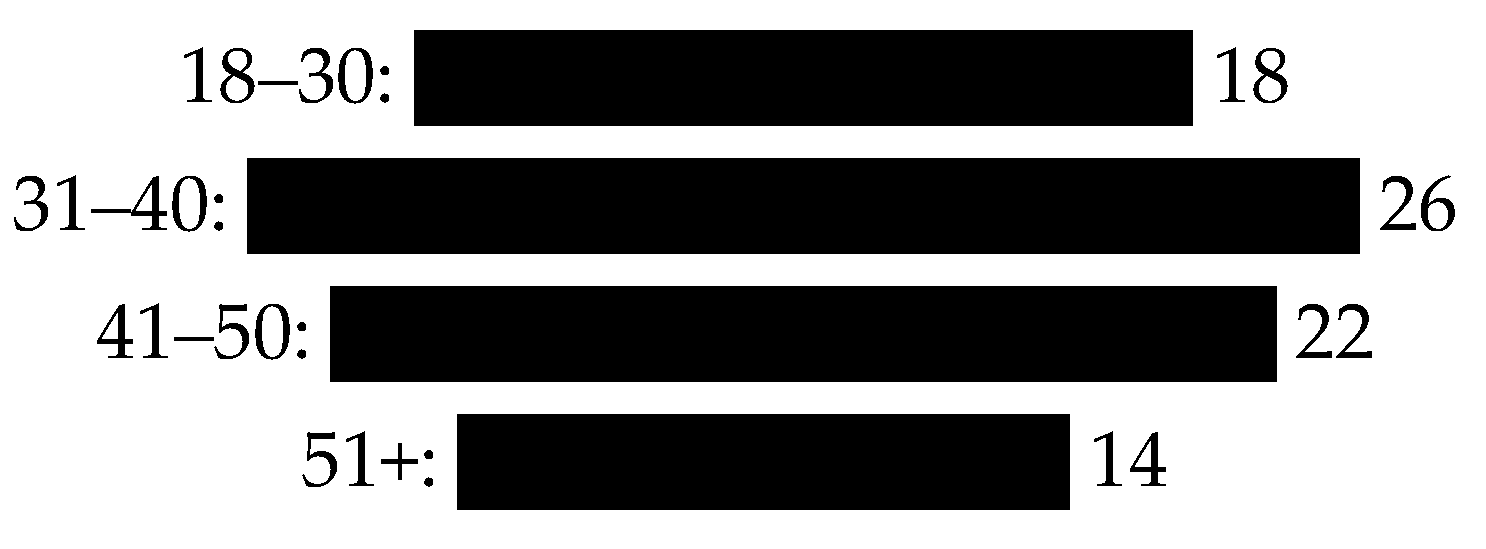
The demographic findings indicate that the majority of respondents were male (60%), although female participation was also significant (40%). Most participants were between 31 and 50 years of age, indicating that economically active adults constituted a substantial proportion of the study population. The education profile also showed variation, with secondary education being the most common level. This variation reinforces the importance of designing agricultural training programmes that accommodate different literacy and educational backgrounds and use accessible, practical learning methods.
4.2. Gender Distribution
Figure 1.
Gender distribution of respondents.

4.3. Age Distribution
Figure 2.
Age distribution of respondents.
4.4. Perceived Effectiveness of Participatory Training Approaches
Table 2 presents respondents’ perceptions of the effectiveness of participatory adult education approaches.
As shown in Table 2, 80% of respondents rated participatory adult education approaches as either very effective or effective. This finding suggests a generally positive perception of learner-centred and participatory methodologies among the study participants.
4.5. Qualitative Findings
The findings demonstrated that participatory adult education approaches improved knowledge acquisition, farmer engagement and practical problem-solving among emerging farmers. Respondents reported that participatory workshops, group discussions, practical demonstrations and peer-learning activities enhanced their understanding of sustainable agricultural practices.
Participants highlighted that experiential learning opportunities enabled them to apply theoretical concepts directly within farming contexts. Demonstration plots, farmer field schools and collaborative activities were perceived as useful because they connected learning to practical farming problems and enabled farmers to observe, test and discuss new practices.
The study also found that participatory learning strengthened social interaction and collective problem-solving. Farmers were able to exchange indigenous and experiential knowledge, discuss common agricultural challenges and identify context-specific solutions. These processes contributed to knowledge sharing, innovation and community resilience.
Respondents nevertheless identified barriers affecting agricultural training effectiveness, including limited access to finance, inadequate extension services, insufficient training materials, poor infrastructure and climate-related challenges such as drought and unpredictable rainfall. Participants nonetheless expressed positive perceptions of participatory approaches because they were viewed as inclusive, practical and relevant to local realities.
5. Discussion
The findings are consistent with literature emphasising the importance of participatory and experiential approaches in adult learning and agricultural development. Adult learners are more likely to engage when learning is relevant to their experiences and immediate needs (Knowles, 1980; Merriam & Bierema, 2014). The strong positive perceptions reported by respondents therefore support the use of practical, problem-centred and learner-centred methodologies in emerging farmer development.
The findings also support experiential learning theory, which emphasises learning through experience, reflection and experimentation (Kolb, 1984). Farmer field schools, demonstration plots and practical activities provide opportunities for farmers to observe agricultural practices, test innovations and reflect on results. Such approaches can strengthen confidence and practical competence.
The participatory dimension of the findings is consistent with participatory action research and participatory learning literature, which emphasise collective knowledge generation, local ownership and action-oriented learning (Kemmis & McTaggart, 2000; Pretty, 1995; Reason & Bradbury, 2008). The exchange of indigenous knowledge and peer experiences can complement formal technical knowledge and support context-specific innovation.
The findings further indicate that agricultural extension officers and facilitators have an important role in creating participatory learning environments. Effective facilitation can connect technical information with farmers’ existing knowledge, encourage experimentation, support reflection and strengthen collective action. This is particularly relevant in rural areas where farmers face diverse production, market, institutional and climate-related constraints.
At the same time, participatory education cannot address structural constraints on its own. Limited finance, infrastructure, extension capacity and climate risks can constrain farmers’ ability to apply newly acquired knowledge. Participatory education should therefore be embedded within broader agricultural support systems that include extension, finance, infrastructure, market development and climate adaptation measures (FAO, 2020; IPCC, 2021; World Bank, 2019).
6. Recommendations
1. Government departments and agricultural training institutions should institutionalise participatory adult education methodologies within agricultural extension programmes.
2. Farmer field schools, practical demonstrations, peer-learning initiatives and community-based training should be expanded because they connect agricultural knowledge to farmers’ real production contexts.
3. Investment in agricultural extension services should be strengthened to provide continuous facilitation, technical support and follow-up after training.
4. Training programmes should incorporate climate-smart agricultural practices and practical adaptation strategies to help farmers respond to climate variability and environmental risks (IPCC, 2021).
5. Training materials should be adapted to different educational and literacy levels and should make appropriate use of local languages, visual materials and practical demonstrations.
6. Indigenous and experiential knowledge should be incorporated alongside scientific and technical agricultural knowledge to improve contextual relevance and strengthen local ownership.
7. Partnerships among government departments, universities, agricultural colleges, NGOs, private-sector organisations and farmer organisations should be strengthened to support knowledge sharing, innovation and market development.
7. Conclusions
The study concludes that participatory adult education represents a valuable approach for strengthening agricultural training among emerging farmers in rural South Africa. The evidence from the 80 respondents indicates that participatory workshops, experiential learning, farmer field schools, peer learning and practical demonstrations can strengthen farmer participation, knowledge sharing, problem-solving and confidence in applying agricultural practices.
Participatory learning also has a broader developmental value because it can foster social interaction, collective action, innovation and community resilience. By positioning farmers as active participants in knowledge generation, participatory approaches promote ownership and make learning more responsive to local realities.
However, the effectiveness of participatory education depends on the wider support environment. Training should therefore be linked with adequate extension services, finance, infrastructure, market access and climate adaptation support. A coordinated approach is required if improvements in learning and farmer capability are to translate into sustainable agricultural productivity, food security and rural livelihoods.
Participatory adult education should consequently be regarded not as a stand-alone training technique but as a core component of a broader farmer-development and rural-development strategy. Its institutionalisation within agricultural extension and training systems could contribute meaningfully to farmer empowerment and sustainable rural transformation in the Eastern Cape and other rural areas of South Africa.
References
- Braun, V., & Clarke, V. (2006). Using thematic analysis in psychology. Qualitative Research in Psychology, 3(2), 77–101. [CrossRef]
- Department of Agriculture, Forestry and Fisheries. (2018). National agricultural development policies and programmes. Government of South Africa.
- Food and Agriculture Organization of the United Nations. (2020). The state of food and agriculture 2020: Overcoming water challenges in agriculture. FAO.
- Intergovernmental Panel on Climate Change. (2021). Climate change 2021: The physical science basis. Cambridge University Press.
- Kemmis, S., & McTaggart, R. (2000). Participatory action research. In N. K. Denzin & Y. S. Lincoln (Eds.), Handbook of qualitative research (2nd ed., pp. 567–605). SAGE Publications.
- Knowles, M. S. (1980). The modern practice of adult education: From pedagogy to andragogy. Cambridge Books.
- Kolb, D. A. (1984). Experiential learning: Experience as the source of learning and development. Prentice Hall.
- Merriam, S. B., & Bierema, L. L. (2014). Adult learning: Linking theory and practice. Jossey-Bass.
- Pretty, J. N. (1995). Participatory learning for sustainable agriculture. World Development, 23(8), 1247–1263. [CrossRef]
- Reason, P., & Bradbury, H. (Eds.). (2008). The SAGE handbook of action research: Participative inquiry and practice (2nd ed.). SAGE Publications.
- Statistics South Africa. (2021). Poverty trends in South Africa: An examination of absolute poverty between 2006 and 2015. Statistics South Africa.
- World Bank. (2019). South Africa rural development and agricultural development resources. World Bank.

Table 1.
Demographic profile of respondents (N = 80).
| Variable | Category | Frequency | Percentage |
| Gender | Male | 48 | 60.0% |
| Gender | Female | 32 | 40.0% |
| Age Group | 18–30 | 18 | 22.5% |
| Age Group | 31–40 | 26 | 32.5% |
| Age Group | 41–50 | 22 | 27.5% |
| Age Group | 51+ | 14 | 17.5% |
| Education Level | Primary | 20 | 25.0% |
| Education Level | Secondary | 34 | 42.5% |
| Education Level | Certificate/Diploma | 18 | 22.5% |
| Education Level | Tertiary | 8 | 10.0% |
Table 2.
Perceived effectiveness of participatory training approaches.
| Response Category | Frequency | Percentage |
| Very Effective | 36 | 45.0% |
| Effective | 28 | 35.0% |
| Moderately Effective | 10 | 12.5% |
| Not Effective | 6 | 7.5% |
Disclaimer/Publisher’s Note: The statements, opinions and data contained in all publications are solely those of the individual author(s) and contributor(s) and not of MDPI and/or the editor(s). MDPI and/or the editor(s) disclaim responsibility for any injury to people or property resulting from any ideas, methods, instructions or products referred to in the content. |
© 2026 by the author. Licensee MDPI, Basel, Switzerland. This article is an open access article distributed under the terms and conditions of the Creative Commons Attribution (CC BY) license.
Copyright: This open access article is published under a Creative Commons CC BY 4.0 license, which permit the free download, distribution, and reuse, provided that the author and preprint are cited in any reuse.