

Submitted:
18 August 2026
Posted:
19 August 2026
You are already at the latest version
Abstract
Plastic pollution is disproportionately affecting low- and middle-income countries, where evidence-based interventions suited to local needs, cultural practices and available resources are needed. We conducted a systematic review of literature to identify interventions that have been implemented in these settings to reduce the use of plastic and improve plastic waste management. Three databases were searched, supplemented by manual citation searching. Of 4,631 records screened, 17 studies were included after assessing 144 full texts. Studies were conducted in Asia (n=16) and Sub-Saharan Africa (n=1). Interventions fell into four categories: regulations targeting single-use plastics and open waste burning (n=7), integrated solid waste management (n=4), community-based initiatives (n=3), and technological solutions (n=3). Despite initial positive effects, single use plastic ban policies often caused an overall increase in plastic use due to absence of viable alternatives and weak policy enforcement. Adequate policy-level support and community awareness were effective for integrated solid waste management and community-based initiatives. Additionally, technological solutions were reported as potentially effective measures to complement policy and infrastructure. While multisectoral efforts and interventions are needed to effectively address this issue, future studies should also consider the human health impacts of implementing such solutions.
Keywords:
plastic waste management
; open waste burning
; low-resource settings
; low- and middle-income countries
; sustainable solutions
Introduction
Global plastic production has increased by 20 times over the past five decades, rising from approximately 2 million tonnes in 1950 to around 368 million metric tonnes in 2019 (Walker & Fequet, 2023). While plastics have become integral to modern economies, their widespread use has also led to escalating volumes of plastic waste, much of which is mismanaged, particularly in low- and middle-income countries (LMICs) (Pathak et al., 2023). In many of these settings, inadequate waste collection, recycling infrastructure, and formal disposal systems have contributed to the common practice of burning plastic waste in open areas. While burning plastics can be a short-term solution, it poses profound risks to both public health and the environment (Alabi et al., 2019; Irianti & Prasetyoputra, 2019; Pathak et al., n.d.; Velis & Cook, 2021). The combustion of plastic materials releases a complex mixture of toxic pollutants, including fine particulate matter (PM2.5), dioxins, furans, and polycyclic aromatic hydrocarbons (PAHs) (Kearns et al., 2024). These emissions have been linked to a range of health conditions, including respiratory and cardiovascular diseases (Marfella et al., 2024; Prattichizzo et al., 2024; Ramadan et al., 2023), reproductive disorders (Ragusa et al., 2022; Zurub et al., 2024), and increased risk of cancers (Alabi et al., 2019). A recent study on global health burdens of plastics estimated a cumulative 83 million disability-adjusted-life-years (DALYs) if global plastic production and consumption continue as usual, calling for urgent action to reduce emissions and associated health risks (Deeney et al., 2026). Moreover, plastic burning contributes to environmental degradation, including soil and water contamination, as well as long-term ecological harm (Dey et al., 2024).
In many LMICs, waste management systems are either underdeveloped or overwhelmed. Rapid urbanisation, population growth, and financial constraints have contributed to high volumes of unmanaged solid waste. For example, in parts of Indonesia, up to 83% of generated waste remains uncollected, prompting households to burn plastics in open spaces (Ramadan et al., 2023; The Institute of Development Studies and Partner Organisations, 2019). This infrastructural gap is further compounded by the prevalence of informal waste collection networks, which often lack regulatory oversight or access to recycling facilities. Informal waste workers, who play a central role in waste handling in resource-constrained countries frequently burn non-recyclable plastics in open environments, leading to widespread, uncontrolled emission of harmful pollutants (Kristanto et al., 2021; Nandan et al., 2017).
Beyond structural and regulatory limitations, cultural norms and economic hardship also sustain the practice of plastic burning. In many settings, burning is perceived as a practical and low-cost solution to growing waste accumulation. This perception is reinforced by limited public awareness of the associated health risks and the absence of viable alternatives (Kanhai et al., 2021). A recent study conducted in 26 countries in Global South found that households used plastic waste as a fuel due to unaffordable clean fuels, as well as to self-manage waste (Bharadwaj et al., 2026). As such, reducing exposure to plastic burning requires not only technical and regulatory reforms but also culturally sensitive, community-based approaches that address the socio-economic realities of affected populations.
In response to these challenges, a diverse range of interventions have emerged in recent years to reduce plastic waste accumulation and its management through open burning in order to reduce its environmental and health impacts. Policy and regulatory reforms have been among the most widely adopted approaches, including bans on single-use plastics and open burning (Godfrey, 2019). Decentralised and community-based waste management systems have also gained traction, particularly in settings where formal infrastructure is lacking. Waste banks in Indonesia, for instance, have been established at both community and municipal levels to facilitate waste collection and recycling (Budiyarto et al., 2025; Fatmawati et al., 2022). Smart technologies that incorporate artificial intelligence and the Internet of Things represent a more recent but growing area to enhance waste collection, sorting and recycling processes of intervention (Lakhouit, 2025).
However, the effectiveness, equity, and health impact of these interventions remain insufficiently mapped, particularly in LMICs. Existing systematic reviews have examined health risks associated with open plastic burning (Velis & Cook, 2021) and theoretical frameworks for behaviour change in waste management (Raheel et al., 2026). In addition, a narrative review of plastic waste practices in developing countries have drawn on the author’s experience and case studies rather than systematic search strategies (Ferronato et al., 2024), limiting the generalisability of their findings. However, a comprehensive synthesis of interventions that have been implemented and evaluated in real-world LMIC settings is lacking. To date, no systematic review has mapped the full landscape of implemented interventions, spanning regulatory, community-based, and technological approaches, assessed how they are evaluated in practice, and examined whether and how health outcomes are considered.
This systematic review aims to synthesise the available literature on interventions designed to reduce the use of plastic and improve plastic waste management in LMICs. Our goal is to highlight the nature and scope of existing approaches, identify common pathways through which they aim to reduce human exposure to plastic pollution, and examine whether and how health outcomes are considered. In doing so, we seek to inform future research, policy, and practice at the intersection of environmental management and public health.
Methods
This systematic review was conducted following the Cochrane Handbook for Systematic Reviews of Interventions and reported in accordance with the PRISMA 2020 guidelines. The protocol was developed a priori and registered with Prospero (CRD42024501288).
Eligibility Criteria
Studies were selected using predefined inclusion criteria structured around the PICOS framework:
- -
- Population: Adults and children in low-resource settings or low- and middle-income countries (LMICs).
- -
- Intervention or exposure: Any intervention targeting the plastic life cycle.
- -
- Comparator or context: Studies with or without a comparator or control group.
- -
- Outcomes: Any outcomes related to plastic waste management and reduction in air pollution due to plastic burning. Secondary outcomes include improvement in population health, social, and/or economic outcomes from plastic waste management.
- -
- Study Characteristics: Primary studies including randomized controlled trials, non-randomized controlled trials, observational studies, case reports, and qualitative implementation science studies.
- -
- Other: Only studies published in English were included.
Exclusion criteria included studies conducted in high-resource settings; theoretical or modelled interventions not implemented in real-world LMIC contexts; conference abstracts and reports lacking sufficient methodological detail; laboratory-based studies not reporting real-world implementation; secondary literature including reviews, editorials, and commentaries; and studies that did not explicitly report on the impact or outcomes of an implemented intervention.
Search Strategy
A comprehensive search strategy was developed to identify relevant studies across three primary databases: MEDLINE, Embase, and Global Health. The search focused on combinations of three core concepts:
- LMIC Context: Terms included “low-resource settings,” “developing countries,” “low- and middle-income countries,” and specific country names classified by the World Bank as LMICs.
- Plastics and Non-Biodegradable/Open Waste: Keywords included “plastic waste,” “non-biodegradable,” “open dumping,” “plastic pollution,” and “synthetic polymers.”
- Plastic Management Strategies: Terms encompassed “incineration,” “reduction,” “reuse,” “recycling,” “pollution control,” “waste management,” “solid waste,” and “environmental health.”
Boolean operators and truncation were used to optimize sensitivity and specificity. The full search strategy for each database is provided in Appendix 1. Searches were conducted from inception to 13th October 2025, and reference lists of included studies were manually screened for additional eligible articles.
Study Selection
All identified records were imported into Covidence reference management software and duplicates were removed. Two independent reviewers screened all titles and abstracts for relevance. Full-text articles of potentially eligible studies were retrieved and assessed against the inclusion criteria. Disagreements were resolved through discussion or consultation with a third reviewer.
Data Extraction
A single reviewer independently extracted data from each included study using a standardized form developed in MS excel. Extracted variables included study design, setting, population characteristics, intervention details, outcomes, and key findings. Authors were contacted for clarification or missing data when necessary.
Data Synthesis
Due to anticipated heterogeneity in interventions and outcomes, a narrative synthesis was conducted with a meta-analysis following existing guidelines (Popay et al., 2006). Data were synthesized based on intervention types and their associated implementation outcomes.
Quality assessment
The National Institutes of Health (NIH) quality assessment tool for case series was used to assess the quality of each included study (Appendix 2).
Results
Study characteristics
In total 4631 studies were identified for title and abstract screening after searching five databases and manually searching list of references from relevant systematic reviews and primary studies. Full texts of 144 articles were screened, of which 17 articles were selected (Figure 1). Out of the 17 selected studies, 13 met all seven quality assessment criteria. Among the other four studies, two did not clearly describe the intervention (Chaudhary et al., 2022; Zaman et al., 2024). Study designs were either not appropriate or could not be determined for two studies (Ramadan et al., 2021; Suryadi & Abdurahman, 2022). These studies also did not include clearly defined, valid, and reliable outcome measures. Three studies were of poor quality in terms of description of results (Ramadan et al., 2021; Suryadi & Abdurahman, 2022; Zaman et al., 2024).
Most studies were conducted in Southeast Asia, including eight in Indonesia (Brasika et al., 2023; Kubota et al., 2020; Kurniawan et al., 2022; Premakumara et al., 2011; Ramadan et al., 2021; Suryadi & Abdurahman, 2022; Zahrah et al., 2024; Zaman et al., 2024) and two studies in Thailand (Mongkolnchaiarunya, 2005; Panyagometh et al., 2023). Among the remaining studies, four studies were conducted in China (He, 2012; B. Wang et al., 2021; B. Wang & Li, 2021; Z. Wang et al., 2020), and one study each in India (Chaudhary et al., 2022), Nepal (Bharadwaj et al., 2021) and Zimbabwe (Muisa Zikali et al., 2022). Table 1 describes the key characteristics of the included studies.
We categorised the interventions implemented to reduce plastic related pollution in the selected studies into four groups: i) Regulations to reduce single use plastic and waste burning, ii) Solid waste management, iii) Community-based initiatives, and iv) Technological solutions. Of the 17 studies, seven explored the effects of regulations to prohibit single use of plastic use and plastic waste burning. Three studies were conducted in China that focused on different regulation implementation over the years (2008-2021), and the remaining were conducted in Nepal, Indonesia and Thailand. Four studies focused on integrated solid waste management—two in Indonesia, one in Zimbabwe and one in China. Among the three studies that explored community-based waste management initiatives, two were conducted in Indonesia, and one was conducted in Thailand. Finally, three studies described technological solutions, including two digital applications (apps) for improved waste management in Indonesia and locally developed low-cost incinerators in India.
Types of interventions implemented and their outcomes
Regulations to reduce single use plastic and plastic burning
Seven studies described the effectiveness of plastic ban to reduce single use plastic at source (Table 2.1). All but one of the studies were published within the past five years and were conducted in China (n=3), Thailand (n=1), Nepal (n=1), and Indonesia (n=2). He (2012) described the effect of the Chinese plastic bag regulation introduced in 2008, which required the retailers to charge for plastic shopping bags (He, 2012). The study conducted two surveys—one month before and four months after the implementation of the regulation and found a 49% reduction in the overall plastic bag consumption in the two surveyed cities—Guiyang and Beijing. However, the results varied by region, individual’s attitude and the type of markets (supermarket vs open market). While there was a preliminary positive effect, the author suggests that the use of monetary incentive tools alone may not sustain a long-term impact on pollution control.
In more recent studies, Panyagometh et al. (2023), Wang and Li (2021) and Wang et al. (2021) reported similar results. Panyagometh et al. (2023) explored the effectiveness of plastic bag ban by 75 major Thai retailers in Bangkok and Phuket that came into effect on 1st January 2020 (Panyagometh et al., 2023). The survey findings suggested an overall reduction in plastic bag use in both cities while the use was higher in fresh markets, restaurants and food delivery compared to supermarkets and convenience stores. Among the survey respondents, those with knowledge of the environmental impact of plastic waste had a more positive attitude towards reducing plastic bag use. Similarly, Wang and Li (2021) explored the key factors influencing change in plastic bag use after the implementation of 2020 law, banning the use of non-biodegradable bags in supermarkets (B. Wang & Li, 2021). From a field study conducted in eight vegetable markets and nine supermarkets, the authors reported that, the use of inner plastic bag as an alternative increased, despite an overall 44% decrease in the usage of plastic carrier bags. The findings also suggest gender and generational differences where females and older consumers tended to use more reusable bags. Wang et al. (2021) used the same data collection method to analyse people’s bag usage before and after the introduction of the tougher plastic ban policies in 2021 (B. Wang et al., 2021). Data collectors in this study counted the use of bags in nine supermarkets, including three grocery and six non-grocery supermarkets. Study findings suggest a decrease of over 40% in the use of charged carrier bags by both types of stores. In addition, there was a 46% reduction in the purchase of charged carrier bags by the customers and an increase in the use of reusable bags (36.39%) and old plastic bags (117.02%). However, there was a significant increase in the use of inner bags in non-grocery markets, highlighting a policy loophole.
In contrast, a longitudinal study conducted in Nepal found that although there was strict monitoring in the beginning, the effort reduced over the course of one year study period (Bharadwaj et al., 2021). The authors conducted three surveys (at the time of planning plastic ban, one month after and a year after). The use of plastic bag reduced in the second round and then stabilised, whereas the use of reusable bag substantially increased in the second round but reduced a year after the ban implementation. The sellers also expected less fine after one year compared to after one month of policy implementation, highlighting the weakening of policy enforcement. Suryadi and Abdurahman (2022) explored to what extent the regulation to reduce the use of plastics was followed in traditional markets in Banjarmasin city, Indonesia (Suryadi & Abdurahman, 2022). Through a qualitative study combining interviews and observations, the authors found that even after five years since the regulation was implemented in 2016, it was not effective in traditional markets and focused mainly on modern and mini markets. In traditional markets where products such as fruits, vegetables and fish are sold, both buyers and sellers consider using plastic bags as a cultural practice. Alternative carrier bags are either not promoted or available, and there were no disciplinary actions for continued use of plastic bags. Although the customers brought their own baskets in one of the traditional markets, they still used plastic bags to carry individual items inside the basket.
Zaman et al. (2024) reported on emission reduction strategies to reduce open waste burning in Demak Regency in Indonesia (Zaman et al., 2024). Although the government launched Law number 18 in 2008 that prohibits open waste burning, enforcement is weak as the regency lacks adequate technical infrastructure to manage waste. A centralised waste burner was proposed to overcome limited waste management and reduce direct exposure of communities.
Integrated solid waste management
Four studies conducted in China, Zimbabwe and Indonesia explored integrated solid waste management processes (Table 2.2). The earliest case study from Surabaya, the second largest city in Indonesia, demonstrated that a combination of strategies, including source separation at the household level, community-managed waste collection and local regulation supporting these activities, can successfully reduce municipal waste (Premakumara et al., 2011). In this case, waste generation was reduced by more than 20% in four years since an environmental collaboration was initiated between Surabaya and Kitakyushu city in Japan in 2004. Integration of different stakeholder groups and community involvement was highlighted as a key factor contributing to success.
The study conducted in Mutare city in Zimbabwe assessed reuse and recycling practices among households in three different suburbs (Muisa Zikali et al., 2022). The authors showed a discrepancy between plastics and other recyclable materials that were reused or recycled by comparing household’s responses with the actual waste quantities. Economic potential of the recyclable materials that were not recovered was found to be significant—ranging from US$600 to US$45000, depending on the area and population density. Education and awareness among communities for source separation, especially those living in low-income areas was suggested to deem full economic benefits of recyclable materials.
Zahrah et al. (2024) described how an integrated approach can help tackle the plastic waste management crisis in three cities in Indonesia (Zahrah et al., 2024). Each city (Bandung, Yogyakarta, and Magelang) implemented their Regional Policy and Strategy (JAKSTRADA) on waste management. Most recyclable plastics there were recovered through a combination of community-based waste banks and private collection services. For example, Yogyakarta municipality launched the ‘zero inorganic waste initiative’ in 2023. The policy prohibits landfilling of inorganic waste and segregation at source by the residents, leading to a 30% reduction in the waste volume reaching landfills. Three digital waste management services were operational in these cities—Faur Resik, Rapel, and Duitin, who act as recycling aggregators. Although these private companies had support from the local government, there was a lack of formal integration into the municipal waste management system.
Similar to above, an investigation of the environmental and economic performance an integrated solid waste management plant by Wang et al. (2020) also highlighted the importance of source separation to improve energy efficiency and reduce environmental impact (Z. Wang et al., 2020). Waste management plants can be energy intensive and involve other additional costs such as equipment and tax. However, environmental and economic burdens can be offset by adequately separating solid waste prior to processing and using biogas as a sustainable energy source.
Community-based initiatives
Community-based waste management initiatives have emerged since early 2000s, particularly in rural areas where there is a lack of infrastructure for standard waste management practices. Three studies described such initiatives—one in Thailand and two in Indonesia (Table 2.3). In Thailand, the recycling project, Garbage for Eggs (GFE) emerged from a slum area near Klong Toey port and was later extended in other districts of Bangkok (Mongkolnchaiarunya, 2005). The project gave eggs to community members in exchange for recyclable materials, where the number of eggs was dependent on weight, types, quality of waste separation, and the socio-economic status of the groups. GFE operated for a year between 2000 and 2001 in Yala jurisdiction. The initiative helped clear up the backlog of recyclables from the households, predominantly glass (76.5%), followed by paper (13.6%) and plastic (7.1%). Although there was an initial enthusiasm, it dissipated over time as the total amount of recyclables decreased. There was also an unintended consequence of affective the incomes of municipal collection crews and informal waste pickers whose earning depended on selling recyclable materials from different sources.
Kubota et al. (2020) and Ramadan et al. (2021) reported on community-based waste bank initiatives in two different cities in Indonesia, Makassar and Semarang respectively (Kubota et al., 2020; Ramadan et al., 2021). These case studies paint contrasting but complementary pictures of how appropriate institutional and government support can facilitate operationalisation. In case of Semarang, the waste treatment facility was established in 2008 in collaboration with a self-help community group and the management (Ramadan et al., 2021). However, without adequate support from the local government, the facility workers were providing service without receiving a salary or reward and the facility was functioning sub-optimally. There were also no formal waste management regulations and monitoring in place. On the other hand, in Makassar, the local government implemented a formal waste management policy and established a central waste bank to further strengthen and integrate community-based waste banks (Kubota et al., 2020). This initiative led to a five-fold increase in waste collection and helped generate waste management data. However, there was a lack of transparency and accountability in practice which led to inconsistencies on the ground, such as a lack of enforcement of standard pricing and the amount of revenue the waste bank had to pay the local government.
Technological solutions
Three studies described technological solutions implemented in LMICs (Table 2.4). Chaudhary et al. (2022) explored the potential use of two low-cost devices for controlled plastic waste burning and a reduction in health-relevant emissions (Chaudhary et al., 2022). The devices were a burn basket and a local water heater that are being used by communities in rural North India. The authors created four ‘what-if’ scenarios and compared burning dry plastic and multilayer packaging waste in these devices against the regular practice of open waste burning and replacing biofuel, such as dung cakes and firewood. The results show that using dry plastic waste as a fuel instead of biofuel in the improved water heater has the potential to significantly reduce primary emissions (e.g. Benzene—29 Ggy-1) and ozone formation potential (-2960 Ggy-1). While these devices have the potential to be implemented in similar low-resource settings, these water heaters are currently largely restricted to the mountainous regions of northern India.
Kurniawan et al. (2022) and Brasika et al. (2023) described two digital applications, developed locally in Indonesia to better manage plastic waste (Brasika et al., 2023; Kurniawan et al., 2022). Rapel is a pioneering digital app that connects waste collectors and sellers and allows waste sellers to collect points (0.1 USD equivalent per kg) (Kurniawan et al., 2022). The app was created and promoted in April 2020, shortly after the COVID-19 outbreak. At the time of reporting the app had over 10,000 users and created 780 new jobs for waste collectors in Yogyakarta. Combining the app with the city’s community-based solid waste management system increased monthly waste recycling from 10.54 Mt to 147.19 Mt, a 65% waste and 0.2 Mt GHG emissions reduction. A similar digital waste bank app, Griya Luhu was implemented in 13 villages in Gianyar Regency, Indonesia (Brasika et al., 2023). The app integrated digital technology and community awareness to improve segregation of non-biodegradable waste at source, although the exact app featured were not clearly described. Initially, there was a slow uptake of digital waste banks in the first two months, but the numbers increased rapidly and by the end of the one-year study period there were 80 new units and over 5000 new customers. This resulted in an increase of 12,900 kg additional waste being managed by the waste banks in a year. The authors also estimated a reduction of 54% inorganic waste generation that could have leaked into the ocean.
Barriers and facilitators to intervention implementation
Across all included studies, key facilitators of effective plastic waste management interventions included multisectoral collaboration, government support and financial incentives, clear policy design, community involvement and awareness, and taking an integrated approach. On the other hand, weak and inconsistent policy enforcement, inadequate waste segregation practices, lack of funding, infrastructure, community awareness and integration across sectors were considered as barriers.
In case of single use plastic ban, policy awareness campaigns, integration of waste management technologies as well as adequate monitoring and evaluation supported effective implementation (B. Wang et al., 2021). However, absence of buy-in from different sellers and higher cost of alternatives to plastic weakened public practices over time (Bharadwaj et al., 2021; Panyagometh et al., 2023; Suryadi & Abdurahman, 2022; B. Wang & Li, 2021). Similarly, digital technologies and community initiatives, such as waste banks were effective in improving waste management practices in several regions when public engagement and involvement were facilitated through campaigns, legislative support and multi-sector collaboration (Kubota et al., 2020; Zahrah et al., 2024). Infrastructure challenges, cybersecurity risks, capability gaps and lack of formal integration prevented maximum utilisation of digital technologies (Zahrah et al., 2024). Integrated waste management systems performed optimally when supported by adequate waste segregation at source (Z. Wang et al., 2020). However, limited funding to implement comprehensive waste management systems and lack of awareness among communities make it challenging to implement such systems in low-resource settings.
Discussion
The review systematically generated comprehensive evidence from 17 studies conducted in six LMICs around the types of interventions that have been implemented in real life to address the challenge of unmanaged plastic waste. Interventions included policies banning single use plastic and plastic waste burning, integrated solid waste management systems, community-based initiatives, and technological solutions, such as digital applications and locally developed low-cost devices for controlled plastic waste burning. However, none of the studies assessed direct or indirect health outcomes. Additionally, despite the urgency to develop biodegradable plastic and other alternative solutions, existing evidence in LMICs are largely limited to experimental settings and lacks evidence of real-life implementation (Flury & Narayan, 2021).
In light of a global call to reduce plastic pollution (Stallard & Poynting, 2025), several countries have implemented single use plastic ban. China is one of the front runners where the first ban was introduced in 2008 (He, 2012) and a tougher ban followed in 2021 (B. Wang et al., 2021). Although the ban resulted in an initial reduction of plastic use, this change was not sustained and using inner plastic bags led to a boomerang effect. Similar trends were seen in Thailand (Panyagometh et al., 2023) and Nepal (Bharadwaj et al., 2021). In such settings, the use of plastics in day-to-day lives of communities, particularly in fresh markets is often part of the local culture. Previous research suggests that such measures can also often have unintended consequences when poorly implemented; for example, potential job losses, illegal smuggling of plastic bags into the country, and socio-economic implications due to more expensive alternatives (Amankwaa & Danquah, 2025; Godfrey, 2019). Therefore, enforcing ban should involve adequate planning prior to implementation and offer sustainable and viable alternatives for different population groups. Furthermore, plastic ban policies in China are all penalty-oriented, where no incentives are offered to businesses or consumers to comply with these policies. To improve the effectiveness of plastics management, future studies are encouraged to explore how various incentives could shape people’s usage of plastic bags and conduct longitudinal studies to estimate the effect over time (B. Wang et al., 2021).
Community-based initiatives have shown promising results in several countries where there is a lack of advanced waste management systems (Kubota et al., 2020; Zahrah et al., 2024). Studies have reported that increased community involvement leads to more responsible behaviour, increased environmental awareness, and a higher willingness to pay among users of a waste management system. By empowering groups of stakeholders that have had limited access to decision-making power and resources, such initiatives can help build social capital within the community (Premakumara et al., 2011). Community education and training to better manage plastic waste is also important. Panyagometh et al. (2023) showed significant relationship between the knowledge about environmental impact and attitude towards reducing plastic waste, highlighting the importance of awareness generation to influence positive attitudes (Panyagometh et al., 2023). Similar to our study findings, a recent review of behavioural interventions related to plastic waste management in LMICs suggests that education was the most common intervention, followed by environmental restructuring, incentivisation, and persuasion (Raheel et al., 2026). A gender-based lens should be considered when designing and implementing such community-based initiatives as women are often the more involved but underpaid in the informal recycling sector (Kristanto et al., 2021; Pakasi et al., 2024).
Successful behavioural and policy interventions need to be supported by adequate infrastructure, technological and financial support that can enhance the capacity to effectively manage waste. Among the selected studies, one study reported the development and implementation of a solid waste management plant in China (Z. Wang et al., 2020). Community waste banks that allow sorting, collection and selling of plastic waste are more common in Indonesia. One of the studies conducted in India explored the use of a burn basket and locally manufactured water heater for controlled plastic waste burning as fuel (Chaudhary et al., 2022). Although the authors suggest that replacing biofuels with dry plastic waste would reduce primary emissions, there can be unintended consequences if such processes are improperly handled. For example, users need to be educated about different plastic types to avoid burning of PVC and Teflon which lead to harmful emissions. Also, products of combustion could contaminate water and soil with microplastics if released in the environment (Velis & Cook, 2021). Therefore, technologies for waste handling should be co-designed and evaluated with relevant stakeholders that consider both environmental and health co-benefits.
Finally, plastic waste management is a complex issue that requires a multisectoral approach. This is evidenced by case studies in Indonesia (Zahrah et al., 2024), where waste banks focus on collecting plastic waste from communities and private waste management companies play a crucial role by integrating digital transformation strategies to collect waste from diverse sources. However, formal collaboration across stakeholders, integration of services, and appropriate policy enforcement are essential for effective and context-specific waste management measures in low-resource settings.
Strengths and Limitations
To the best of our knowledge, the present review is the first to systematically report on the landscape of different types of interventions that have been implemented to improve plastic waste management in LMIC settings. This review synthesized qualitative, quantitative and mixed methods studies by searching four major databases and reported on implementation outcomes of different interventions. Our findings draw a comprehensive picture of the enablers and challenges to effectively manage plastic waste in these settings and highlight the need for cross-sectoral collaborations.
The review has few limitations, however. Only peer reviewed studies published in English were included and grey literature was not included. While most studies met the quality assessment criteria, four studies had issues related to appropriate study designs, outcomes measures and reporting of results. A meta-analysis was not conducted due to heterogeneity of intervention types. The synthesised evidence also has geographic limitations, with majority of the studies conducted in Asia. Finally, although we set out to assess health outcomes linked to intervention implementation, none of the selected studies directly measured health related outcomes.
Conclusion
This systematic review provides a comprehensive overview of policies, community-based and integrated waste management systems, and technological solutions that have been implemented in LMICs to reduce the health and environmental burden of plastic waste. Although upstream policies showed immediate improvements, such effects often tend to be short-term when not supported by adequate infrastructure and viable alternatives to plastic. Community engagement and empowerment is crucial to ensure appropriate waste separation and optimisation of waste recycling value. Interventions designed to be implemented in such settings should be co-developed with community members to ensure cultural relevance and local buy-in. Future studies should systematically assess both environmental and health co-benefits of waste management interventions in order to provide a more comprehensive and holistic assessment of potential benefits and harms of any intervention deployed to reduce plastic waste.
Author Contributions
LD, AM and SS conceptualised the study. LD, AM and NK developed the methodology. AM and NK conducted database searches. HH, AM, LD, NK, DRR and MA contributed to screening of the studies and data extraction. NK synthesised the findings and wrote the original draft with input from AM. LD and AM reviewed and edited the manuscript.
Statements and Declarations
Funding acknowledgment: This research was funded by the NIHR-Global Health Research Centre award scheme (Grant number GHRC for NCDs and EC: NIHR203247) using UK international development funding from the UK Government to support global health research. The views expressed in this publication are those of the author(s) and not necessarily those of the NIHR or the UK government.
Ethical approval
Ethical approval was not required for this study since no primary data were collected.
Conflicts of interest
The authors have no conflicts of interest to declare.
Use of Generative AI
Generative AI was not used in the research and manuscript preparation process.
Data availably statement
No new data were created or analysed in this study; therefore, data sharing is not applicable to this article. All data extracted from the studies are available within the manuscript.
References
- Alabi, O.; Ologbonjaye, K.; Awosolu, O.; Alalade, O. Public and Environmental Health Effects of Plastic Wastes Disposal: A Review. J. Toxicol. Risk Assess. 2019, 5. [Google Scholar] [CrossRef]
- Amankwaa, E. F.; Danquah, M. Balancing the ban: Navigating the economic and environmental trade-offs of single-use plastics in Ghana. J. Environ. Manag. 2025, 388, 126020. [Google Scholar] [CrossRef]
- Bharadwaj, B.; Gates, T.; Rose, S.; Antriyandarti, E.; Praveena, S. M.; Oranu, C. O.; Borthakur, M.; Dhungana, P. K.; Shazly, A.; De-la-Torre, G. E.; Allison, A. L.; Abeywardhana, D. M. Y.; Mabaso, S.; Adom, P. K.; Banga, M.; Dlamini, W.; Kabera, T.; Bohlmann, J.; Areeprasert, C.; …; Ashworth, P. Prevalence of plastic waste as a household fuel in low-income communities of the Global South. Nat. Commun. 2026, 17(1), 50. [Google Scholar] [CrossRef]
- Bharadwaj, B.; Subedi, M. N.; Chalise, B. K. Where is my reusable bag? Retailers’ bag use before and after the plastic bag ban in Dharan Municipality of Nepal. Waste Manag. 2021, 120, 494–502. [Google Scholar] [CrossRef]
- Brasika, I. B. M.; Hendrawan, I. G.; Karang, I. W. G. A.; Pradnyaswari, I. G. A. I.; Pratiwi, N. P. O. M. K.; Wiguna, I. G. M. Evaluating the collection and composition of plastic waste in the digital waste bank and the reduction of potential leakage into the ocean. Waste Manag. Res. 2023, 41(3), 676–686. [Google Scholar] [CrossRef]
- Budiyarto, A.; Clarke, B.; Ross, K. Overview of waste bank application in Indonesian regencies. Waste Manag. Res. 2025, 43(3), 306–321. [Google Scholar] [CrossRef]
- Chaudhary, P.; Singh, R.; Shabin, M.; Sharma, A.; Bhatt, S.; Sinha, V.; Sinha, B. Replacing the greater evil: Can legalizing decentralized waste burning in improved devices reduce waste burning emissions for improved air quality? Environ. Pollut. 2022, 311, 119897. [Google Scholar] [CrossRef]
- Deeney, M.; Hamelin, L.; Vialle, C.; Yan, X.; Green, R.; Yates, J.; Kadiyala, S. Global health burdens of plastics: A lifecycle assessment model from 2016 to 2040. Lancet Planet. Health 2026, 10(1). [Google Scholar] [CrossRef]
- Dey, S.; Veerendra, G. T. N.; Babu, P. S. S. A.; Manoj, A. V. P.; Nagarjuna, K. Degradation of Plastics Waste and Its Effects on Biological Ecosystems: A Scientific Analysis and Comprehensive Review. Biomed. Mater. Devices 2024, 2(1), 70–112. [Google Scholar] [CrossRef]
- Fatmawati, F.; Mustari, N.; Haerana, H.; Niswaty, R.; Abdillah, A. Waste Bank Policy Implementation through Collaborative Approach: Comparative Study—Makassar and Bantaeng, Indonesia. Sustainability 2022, 14(13). [Google Scholar] [CrossRef]
- Ferronato, N.; Maalouf, A.; Mertenat, A.; Saini, A.; Khanal, A.; Copertaro, B.; Yeo, D.; Jalalipour, H.; Raldúa Veuthey, J.; Ulloa-Murillo, L. M.; Thottathil, M. S.; Shuaib; bin, N. A.; Caplin, R.; Mohandas, V. J. A review of plastic waste circular actions in seven developing countries to achieve sustainable development goals. Waste Manag. Res. 2024, 42(6), 436–458. [Google Scholar] [CrossRef]
- Flury, M.; Narayan, R. Biodegradable plastic as an integral part of the solution to plastic waste pollution of the environment. Curr. Opin. Green Sustain. Chem. 2021, 30, 100490. [Google Scholar] [CrossRef]
- Godfrey, L. Waste Plastic, the Challenge Facing Developing Countries—Ban It, Change It, Collect It? Recycling 2019, 4(1). [Google Scholar] [CrossRef]
- He, H. Effects of environmental policy on consumption: Lessons from the Chinese plastic bag regulation. Environ. Dev. Econ. 2012, 17(4), 407–431. [Google Scholar] [CrossRef]
- Irianti, S.; Prasetyoputra, P. OPEN BURNING OF HOUSEHOLD SOLID WASTE AND CHILD RESPIRATORY HEALTH: EVIDENCE FROM INDONESIA. J. Ekol. Kesehat. 2019, 17, 123–134. [Google Scholar] [CrossRef]
- Kanhai, G.; Agyei-Mensah, S.; Mudu, P. Population awareness and attitudes toward waste-related health risks in Accra, Ghana. In International Journal of Environmental Health Research; (world), 2021; Available online: https://www.tandfonline.com/doi/abs/10.1080/09603123.2019.1680818.
- Kearns, K. A.; Naeher, L. P.; McCracken, J. P.; Boyd Barr, D.; Saikawa, E.; Hengstermann, M.; Mollinedo, E.; Panuwet, P.; Yakimavets, V.; Lee, G. E.; Thompson, L. M. Estimating personal exposures to household air pollution and plastic garbage burning among adolescent girls in Jalapa, Guatemala. Chemosphere 2024, 348, 140705. [Google Scholar] [CrossRef]
- Kristanto, G. A.; Kemala, D.; Nandhita, P. A. Challenges confronting waste pickers in Indonesia: An on-field analysis. In Waste Management & Research; Sage UK: London, England, 2021. [Google Scholar] [CrossRef]
- Kubota, R.; Horita, M.; Tasaki, T. Integration of community-based waste bank programs with the municipal solid-waste-management policy in Makassar, Indonesia. J. Mater. Cycles Waste Manag. 2020, 22(3), 928–937. [Google Scholar] [CrossRef]
- Kurniawan, T. A.; Dzarfan Othman, M. H.; Hwang, G. H.; Gikas, P. Unlocking digital technologies for waste recycling in Industry 4.0 era: A transformation towards a digitalization-based circular economy in Indonesia. J. Clean. Prod. 2022, 357, 131911. [Google Scholar] [CrossRef]
- Lakhouit, A. Revolutionizing urban solid waste management with AI and IoT: A review of smart solutions for waste collection, sorting, and recycling. Results Eng. 2025, 25, 104018. [Google Scholar] [CrossRef]
- Marfella, R.; Prattichizzo, F.; Sardu, C.; Fulgenzi, G.; Graciotti, L.; Spadoni, T.; D’Onofrio, N.; Scisciola, L.; Grotta, R. L.; Frigé, C.; Pellegrini, V.; Municinò, M.; Siniscalchi, M.; Spinetti, F.; Vigliotti, G.; Vecchione, C.; Carrizzo, A.; Accarino, G.; Squillante, A.; …; Paolisso, G. Microplastics and Nanoplastics in Atheromas and Cardiovascular Events. In New England Journal of Medicine; (world); 2024. [Google Scholar] [CrossRef]
- Mongkolnchaiarunya, J. Promoting a community-based solid-waste management initiative in local government: Yala municipality, Thailand. Habitat Int. 2005, 29(1), 27–40. [Google Scholar] [CrossRef]
- Muisa Zikali, N.; Chingoto, R. M.; Utete, B.; Kunedzimwe, F. Household solid waste handling practices and recycling value for integrated solid waste management in a developing city in Zimbabwe. Sci. Afr. 2022, 16, e01150. [Google Scholar] [CrossRef]
- Nandan, A.; Yadav, B. P.; Baksi, S.; Bose, D. Recent Scenario of Solid Waste Management in India; 2017. [Google Scholar]
- Pakasi, D. T.; Hardon, A.; Hidayana, I. M.; Rahmadhani, P. Gendered community-based waste management and the feminization of environmental responsibility in Greater Jakarta, Indonesia. Gend. Technol. Dev. 2024, 28(2), 205–222. [Google Scholar] [CrossRef]
- Panyagometh, A.; Jirapornvaree, I.; Keeratiratanalak, A. Understanding Plastic Bag Consumption and Management in Thailand: Integrating a KAP Model. J. Environ. Assess. Policy Manag. 2023, 25(02), 2350007. [Google Scholar] [CrossRef]
- Pathak, G.; Nichter, M.; Hardon, A.; Moyer, E. The Open Burning of Plastic Wastes is an Urgent Global Health Issue. Ann. Glob. Health n.d., 90(1), 3. [Google Scholar] [CrossRef]
- Pathak, G.; Nichter, M.; Hardon, A.; Moyer, E.; Latkar, A.; Simbaya, J.; Pakasi, D.; Taqueban, E.; Love, J. Plastic pollution and the open burning of plastic wastes. Glob. Environ. Change 2023, 80, 102648. [Google Scholar] [CrossRef]
- Popay, J.; Roberts, H.; Sowden, A.; Petticrew, M.; Arai, L.; Rodgers, M.; Britten, N. Guidance on the Conduct of Narrative Synthesis in Systematic Reviews; 2006. [Google Scholar] [CrossRef]
- Prattichizzo, F.; Ceriello, A.; Pellegrini, V.; La Grotta, R.; Graciotti, L.; Olivieri, F.; Paolisso, P.; D’Agostino, B.; Iovino, P.; Balestrieri, M. L.; Rajagopalan, S.; Landrigan, P. J.; Marfella, R.; Paolisso, G. Micro-nanoplastics and cardiovascular diseases: Evidence and perspectives. Eur. Heart J. 2024, 45(38), 4099–4110. [Google Scholar] [CrossRef] [PubMed]
- Premakumara, D. G. J.; Abe, M.; Maeda, T. Reducing municipal waste through promoting integrated sustainable waste management (ISWM) practices in Surabaya city, Indonesia; 2011; pp. 457–468. [Google Scholar] [CrossRef]
- Ragusa, A.; Principi, G.; Matta, M. Pregnancy in the Era of the Environmental Crisis: Plastic and Pollution. Clin. Exp. Obstet. Gynecol. 2022, 49(10), 10. [Google Scholar] [CrossRef]
- Raheel, H.; Ferguson, A.; Leslie, S. L.; Guardado-Menjivar, V.; Chen, K.; Merceron, A.; Arciniegas, J.; Lovvorn, A. E.; Higgins, M.; Barr, D. B.; Saikawa, E.; Handley, M. A.; Thompson, L. M. Behavioral interventions related to plastic waste management in low-and middle-income countries: A systematic review using the behavior change wheel and the theoretical domains framework. Environ. Res. Lett. 2026, 21(5), 053003. [Google Scholar] [CrossRef]
- Ramadan, B. S.; Huboyo, H. S.; Sutrisno, E.; Sari, A. M.; Samadikun, B. P.; Hardyanti, N.; Karmilia, A. Community based solid waste management to reduce open burning incidents: A case study of waste treatment facility in Gajahmungkur District, Semarang City. IOP Conf. Ser. Earth Environ. Sci. 2021, 894(1), 012035. [Google Scholar] [CrossRef]
- Ramadan, B. S.; Rosmalina, R. T.; Syafrudin, Munawir; Khair, H.; Rachman, I.; Matsumoto, T. Potential Risks of Open Waste Burning at the Household Level: A Case Study of Semarang, Indonesia. Aerosol Air Qual. Res. 2023, 23(5), 220412. [Google Scholar] [CrossRef]
- Stallard, E.; Poynting, M. Global plastic talks collapse as countries remain deeply divided. BBC News, 15 August 2025. Available online: https://www.bbc.co.uk/news/articles/cvgpddpldleo.
- Suryadi, B.; Abdurahman, H. Failure of the policy to limit the use of plastic bags in traditional markets. Nat. Volatiles Essent. Oils 2022, 9(1), 72–85. [Google Scholar] [CrossRef]
- The Institute of Development Studies and Partner Organisations. No Time to Waste: Tackling the Plastic Pollution Crisis Before it’s Too Late; Figshare, 14 May 2019; Available online: https://opendocs.ids.ac.uk/articles/online_resource/No_Time_to_Waste_Tackling_the_Plastic_Pollution_Crisis_Before_it_s_Too_Late/26428678/1.
- Velis, C. A.; Cook, E. Mismanagement of Plastic Waste through Open Burning with Emphasis on the Global South: A Systematic Review of Risks to Occupational and Public Health. Environ. Sci. Technol. 2021, 55(11), 7186–7207. [Google Scholar] [CrossRef]
- Walker, T. R.; Fequet, L. Current trends of unsustainable plastic production and micro(nano)plastic pollution. TrAC Trends Anal. Chem. 2023, 160, 116984. [Google Scholar] [CrossRef]
- Wang, B.; Li, Y. Plastic bag usage and the policies: A case study of China. Waste Manag. 2021, 126, 163–169. [Google Scholar] [CrossRef]
- Wang, B.; Zhao, Y.; Li, Y. How Do Tougher Plastics Ban Policies Modify People’s Usage of Plastic Bags? A Case Study in China. Int. J. Environ. Res. Public Health 2021, 18(20), 10718. [Google Scholar] [CrossRef]
- Wang, Z.; Lv, J.; Gu, F.; Yang, J.; Guo, J. Environmental and economic performance of an integrated municipal solid waste treatment: A Chinese case study. Sci. Total Environ. 2020, 709, 136096. [Google Scholar] [CrossRef]
- Zahrah, Y.; Yu, J.; Liu, X. How Indonesia’s Cities Are Grappling with Plastic Waste: An Integrated Approach towards Sustainable Plastic Waste Management. Sustainability 2024, 16(10), 3921. [Google Scholar] [CrossRef]
- Zaman, B.; Bagus Priyambada, I.; Budiharjo, M. A.; Surya Ramadan, B.; Sila Puspita, A.; Putri Cahyati, A. Waste Management Strategy as an Effortto Reduce Emissions Due to Open WasteBurning: Demak Regency Case Study. Pol. J. Environ. Stud. 2024, 33(4), 3953–3962. [Google Scholar] [CrossRef]
- Zurub, R. E.; Cariaco, Y.; Wade, M. G.; Bainbridge, S. A. Microplastics exposure: Implications for human fertility, pregnancy and child health. Front. Endocrinol. 2024, 14. [Google Scholar] [CrossRef] [PubMed]
Figure 1.
PRISMA diagram.
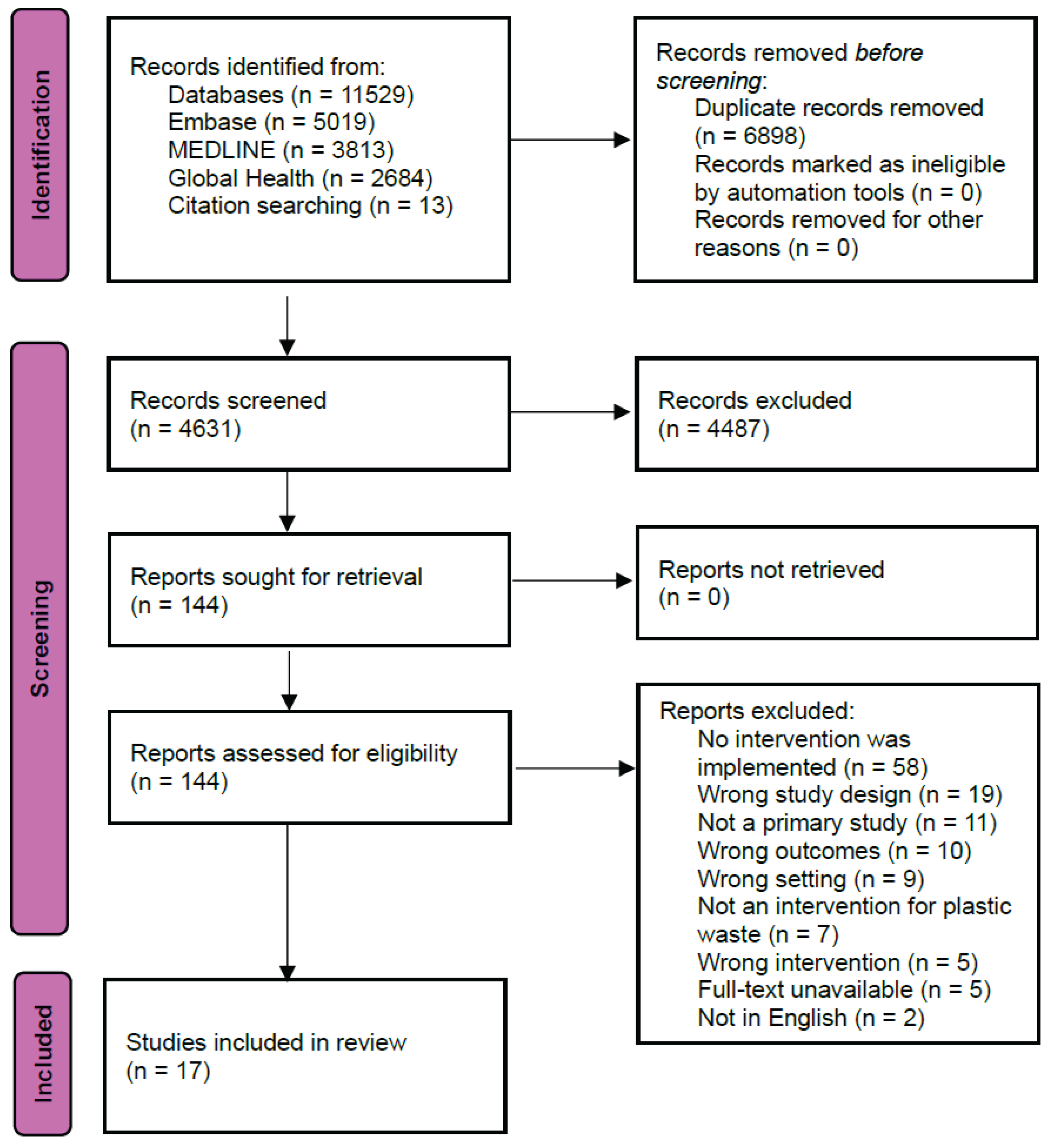

Table 1.
Characteristics of the included studies.
| First author and publication year | Study setting | Study design | Data collection | Intervention(s) |
|---|---|---|---|---|
| He (2012) | China | Cross-sectional surveys (ex-ante and ex post) | Ex-ante survey was conducted from late April to early May 2008. Ex post survey was conducted from October to November 2008. | Plastic bag regulation (The Administrative Byelaw for Non-free Use of Plastic Shopping Bags in Retailer Situations) |
| Bharadwaj et al. (2021) | Dharan Municipality, Nepal | Surveys (three rounds including two follow-up surveys) | First follow-up survey was done a month after the ban came into effect and the second was done a year after | Ban of single use plastic bag of less than 20 µm. |
| Panyagometh et al. (2023) | Bangkok and Phuket, Thailand | Cross-sectional survey | 2022 | Ban of plastic bag use by 75 major retailers in Bangkok and Phuket. |
| Suryadi and Abdurahman (2022) | Banjarmasin city, Indonesia | Qualitative interviews and observational study | Not reported | Regulation no. 18, 2016—Reducing The Use of Plastic Bags |
| Wang and Li (2021) | Shanghai, China | Field study—bag counting at 8 vegetable markets and 9 supermarkets | July to September 2020 | 2020 law banning the use of non-biodegradable bags in all supermarkets |
| Wang et al. (2021) | Shanghai, China | Field study. Data collectors counted the number of different bags used before and after plastic ban was introduced. | July to August 2020 and late January to February 2021 | Tougher plastic ban measure in 2021 |
| Zaman et al. (2024) | Damak Regency, Indonesia | Mixed methods study including data from transect walk surveys and field interviews, followed by a material flow analysis and air pollution modelling | Not reported | Regulation to prohibit open waste burning in households (Law Number 18 of 2008 concerning Waste Management) |
| Wang et al. (2020) | Inner Mongolia Province, China | A combined life cycle assessment (LCA) and life cycle costing (LCC) | 2018 | Integrated municipal solid waste (MSW) management |
| Premakumara et al. (2011) | Surabaya, Indonesia | Qualitative case study analysis based on field observations and discussion with the stakeholders | Not reported | Integrated Sustainable Waste Management System |
| MuisaZikali et al. (2022) | Mutare City, Zimbabwe | Cross-sectional survey and waste quantification | July 2016 | Integrated solid waste management |
| Zahrah et al. (2024) | Bandung, Yogyakarta, and Magelang cities in Indonesia | Multiple-case-study approach using data from semi-structured interviews, direct observations, and plastic waste data from waste banks. | 29 May to 28 August 2023, and on 1 December 2023 | Plastic waste management system in three cities where Regional Policy and Strategy (JAKSTRADA) on waste management have been implemented. |
| Mongkolnchaiarunya (2005) | Yala municipality, Thailand | Qualitative action research (Participatory observations, records review, focus group discussions and interviews) | January 2000—October 2001 | Garbage for Eggs (community-based recycling initiative–one of the four components of the programme) |
| Kubota et al. (2020) | Makassar, Indonesia | Qualitative study including a desk review, semi structured interviews and field surveys | May 2017- March 2019 | Community-based waste bank, supported by a government regulation to develop a central waste bank in 2016 |
| Ramadan et al. (2021) | Semarang, Indonesia | Institutional survey, field survey, interviews, and questionnaires. | Not reported | Ngudi Kamulyan waste treatment facility |
| Brasika et al. (2023) | Gianyar Regency, Bali, Indonesia | Cross-sectional study with waste management data collected over 12-months (October 2020-September 2021) and a household waste generation survey conducted in October 2022. |
October 2022 | Digital waste bank application (app), Griya Luhu that promoted the integration of digital technology and community empowerment to improve waste segregation at source. |
| Kurniawan et al. (2022) | Yogyakarta, Indonesia | Mixed methods study including quantitative data from waste banks pre- and post-implementation of the Rapel app and focus group discussions with waste bank managers | Literature review was conducted in 2022. Qualitative data collection period was not reported | Digital app, Rapel to sell non-biodegradable waste with economic value that has been segregated by the waste owner |
| Chaudhary et al. (2022) | India | Experimental, intervention scenario-based study using two devices that were used for the purpose of waste disposal in rural India. | 2020 | A burn basket and a locally manufactured improved water heater |
Table 2.1.
Implementation outcomes of regulations to reduce single use plastics and plastic waste burning.
Table 2.1.
Implementation outcomes of regulations to reduce single use plastics and plastic waste burning.
| Regulations | Implementation period or start date | Implementation outcomes |
|---|---|---|
| Plastic bag regulation (The Administrative Byelaw for Non-free Use of Plastic Shopping Bags in Retailer Situations) (He, 2012) |
2008 | - Increase in the reuse of plastic bags (from 0.6 to 1.3 times). - Decrease in the average number of new bags used by 64%. - Increase in the average weight of goods per new plastic bag by approximately 50%. |
| Ban of single use plastic bag of less than 20 µm. (Bharadwaj et al., 2021) | August 2013 | - Mean plastic bag use dropped after one month (136.89 gm/day) but increased by 7.51 gm/day after one year. - Mean reusable bag use increased by 112.17 gm/day after one month, but the usage dropped by 65.67 gm/day while still remaining higher than pre-ban. - Reduction in the expected fine after one year compared to the first month. |
| Ban of plastic bag use by 75 major retailers in Bangkok and Phuket. (Panyagometh et al., 2023) | 1st January 2020 | - The ban resulted in significant reduction in overall plastic bag consumption (1.2 bags per person/day in Bangkok and 0.7 in Phuket), with the major sources being fresh markets, restaurants and food delivery. - People’s attitudes towards plastic bag use and knowledge about the environmental impact of plastics had a direct effect on their behaviour. |
| Regulation no. 18, 2016—Reducing The Use of Plastic Bags (Suryadi & Abdurahman, 2022) | 2016 | - The regulation was focused on modern markets and not in traditional markets selling fruits and vegetables. - Using plastic bags was part of the culture for both buyers and sellers in these markets, and no alternative options are usually available. |
| 2020 law banning the use of non-biodegradable bags in all supermarkets (B. Wang & Li, 2021) | 2020 | - Gender and generational differences were observed in the frequency of plastic bag use. Male and middle-young customers used more plastic bags in both types of markets. - Although charging for plastic carrier bags had a positive impact in the reduction of plastic bags, this also led to an increased amount of usage of inner plastic bag which could diminish the positive effect. |
| Tougher plastic ban measure in 2021 (B. Wang et al., 2021) | January 2021 | - Over 40% reduction in charged carrier bags usage by both grocery and non-grocery markets. - Consumers reduced their purchasing of charged carrier bags by 46% and instead increased the use of reusable bags (36.39%) and old plastic bags (117.02%). - 50% drop in inner bag use within grocery stores but 2.7% increase within non-grocery markets. |
| Regulation to prohibit open waste burning in households (Law Number 18 of 2008 concerning Waste Management) (Zaman et al., 2024) | 2008 | The regulation is not effective in practice due to a lack of adequate infrastructure. In the Demak Regency 571,847 out of 841,241 tons of unmanaged waste is estimated to be burned by households daily. There will be estimated 42.76% reduction is alternative waste management strategies were implemented. |
Table 2.2.
Implementation outcomes of integrated solid waste management processes.
| Integrated solid waste management | Implementation period or start date | Implementation outcomes |
|---|---|---|
| Integrated municipal solid waste (MSW) management (Z. Wang et al., 2020) | Construction period between 2015-August 2016; pilot run during 2016-2017; full implementation 1st January 2018. | - MSW plants can be energy intensive, therefore source separation is important for energy efficiency and reduction of environmental impact. - Based on the disposal of one functional unit of MSW, the sales of recycled plastics (157.5 CNY), compost (48.0 CNY) and RDF (36.7 CNY) are determined as the top three incomes, while the top three expenses are the production of paper (34.6 CNY), recycled plastics (31.0 CNY) and bricks (26.4 CNY). - The environmental burdens associated with the production of the secondary products can be offset by the environmental savings of replacing the corresponding primary products. Bricks, metals and plastics have the greatest environmental benefits. |
| Integrated Sustainable Waste Management System (Premakumara et al., 2011) | 2005 | - Waste generation reduction by 20% over four years. - Issuance of a new local regulation (No. 1/2006) to continue the community-based waste management strategy. - 16 community-based composting centres produced about 300 metric tons of compost per month. - Increased awareness among households, leading to knowledge transfer and adaptation of the composting method for household-level. |
| Integrated solid waste management (Muisa Zikali et al., 2022) | Not reported | Solid waste management practices varied across neighbourhoods, with lower reuse and recycling among low-income households. However, about 84% recyclables were found in the waste bins of all three suburbs. Through improper waste handling, the low-income neighbourhood loses approximately $45000 potential income per month from recyclables. |
| Plastic waste management system in three cities where Regional Policy and Strategy (JAKSTRADA) on waste management have been implemented (Zahrah et al., 2024) | 2023 | - Waste banks in the selected three cities collect and sell valuable plastics and support other grassroots initiatives such as handicrafts made from plastics. - Hard plastics, PET bottles and thick plastics are considered of higher value for recycling. - Multilayer plastics, such as those from food packaging are least recovered due to lack of expertise and machineries. - Use of digital system run by private sectors is growing but formal integration into the existing municipal waste collection system is lacking. - Manual sorting of plastics without any protective kits at waste bank facilities expose the workers to health risks from injuries and contamination. - Lack of local government budget allocated for waste management hinders implementation of effective strategies. |
Table 2.3.
Implementation outcomes of community-based waste management initiatives.
| Community-based initiatives | Implementation period or start date | Implementation outcomes |
|---|---|---|
| Garbage for Eggs (community-based recycling initiative—one of the four components of the programme) (Mongkolnchaiarunya, 2005) | December 1999—September 2001 | A total of 66.8 ton of recyclables from 4251 individuals were exchanged for 49,380 eggs. 76% of the recyclables constituted of glass and 7.1% plastic—a downward trend compared to the composition of solid waste in the city, due to zero demand of glass from recycling factories. |
| Community-based waste bank, supported by a government regulation to develop a central waste bank in 2016 (Kubota et al., 2020) | Launch of first community-based waste bank in 2011; Regulation No. 13 was issued by the Ministry of Environment in 2012; regulation for the development of the community-based waste bank programme issued in 2015 | The development of a central waste bank supported by the mayor’s regulation resulted in rapid growth of community waste banks (500 by the end of 2017) and a nearly five times increase in waste collection. It also helped generate waste data which was not possible when the process was informal. However, despite a fixed price list being set by the local government, recyclers use market prices for actual waste transactions, reflecting shortcoming in the implementation of this regulation. Political changes have affected motivation and uptake in 2018. |
| Ngudi Kamulyan waste treatment facility (Ramadan et al., 2021) | 2008 | The waste management facility was functioning at a sub-optimal level due to a lack of governmental support, funding and regulations to effectively upscale waste management. Waste treatment facility officers acted as community volunteers without receiving any rewards or salary. |
Table 2.4.
Implementation outcomes of technological solutions.
| Technological solutions | Implementation period or start date | Implementation outcomes |
|---|---|---|
| Digital waste bank application (app), Griya Luhu that promoted the integration of digital technology and community empowerment to improve waste segregation at source (Brasika et al., 2023) | October 2020—September 2021 | - A growth of up to 80 waste bank units that served 5500 households. - 22.5-fold increase in the amount of waste managed yearly by waste banks. - On average digital waste banks reduced 54% inorganic waste generation (range 29-84%). |
| Digital app, Rapel to sell non-biodegradable waste with economic value that has been segregated by the waste owner (Kurniawan et al., 2022) | First app implementation in April 2020 | - 10,800 app users (waste collectors and sellers) after the pandemic. - 780 new jobs for waste collectors. - The app contributed to 22% of total waste reduction or 68% of non-biodegradable waste reduction monthly. - Potential monthly turnover from the waste recycling transaction through the app was about US$ 2,000/waste bank. - 0.2 Mt reduction in GHG emissions. |
| A burn basket and a locally manufactured improved water heater (Chaudhary et al., 2022) | No specific timeline reported, both types of devices were in use in some rural locations during field visits for the study | Four “what-if” intervention scenarios were tested. Scenario IV was the most effective where traditional biofuels were replaced by dry plastic waste in the improved water heater. This can significantly reduce primary emissions and ozone formation potential (-2960 Ggy-1). |
Disclaimer/Publisher’s Note: The statements, opinions and data contained in all publications are solely those of the individual author(s) and contributor(s) and not of MDPI and/or the editor(s). MDPI and/or the editor(s) disclaim responsibility for any injury to people or property resulting from any ideas, methods, instructions or products referred to in the content. |
© 2026 by the authors. Licensee MDPI, Basel, Switzerland. This article is an open access article distributed under the terms and conditions of the Creative Commons Attribution (CC BY) license (http://creativecommons.org/licenses/by/4.0/).
Copyright: This open access article is published under a Creative Commons CC BY 4.0 license, which permit the free download, distribution, and reuse, provided that the author and preprint are cited in any reuse.