

Submitted:
18 August 2026
Posted:
19 August 2026
You are already at the latest version
Abstract
For the intersection of two disks meeting at angle 2α, let C(α) be the least constant in the associated spectral-set inequality, uniformly over operators for which each disk separately is a spectral set. The exact value of C(α) is unknown except at the disk endpoint α = π/2. We give a self-contained Möbius reduction to the corresponding numerical-range problem on a sector and compute the sharp constant on the infinite-dimensional class of affine square-zero operators B = λI + N, N2 = 0: Csq0(α) = πsin α/2α. A 2 × 2 matrix and a conformal extremal attain equality and yield an explicit lens lower-bound certificate. At the right angle we prove the conjectural 2 estimate, in arbitrary dimension, for the full palindromic quadratic family. Exact rational matrix certificates further cover the complex post-automorphism disk |c| ≤ 19/20, the complete imaginary diameter and a transverse cusp, and boundary-reaching phase arcs whose union misses only 9.17 degrees of the parameter circle near -1. For every symmetric three-node set in the right-angle disk coordinate, we also prove the sharp identity-multiplier estimate on the complete admissible-kernel cone; the proof combines an exact extreme-ray rank bound, scalar Pick interpolation on the rank-one faces, and a two-variable Bernstein certificate on the rank-(2, 2) face. A nested exact certificate extends this result to the genuinely asymmetric two-parameter patch ρ = (−a, 0, b), 1/6 ≤ a, b ≤ 5/6. On a rank-one localized face we also prove a three-real-parameter singular-boundary family: for Φ(c) = eiθc2, sin θ > 1/√2, the sharp target is positive for every quadratic Blaschke product w(w − a)/(1 − a¯w) with a ∈ D. At the central square, a polynomial bidisk extension and Ando’s theorem prove ∥w2∥ ≤ κ0 < √2, where 276889/127200 − 6103√2/10600 = 1.362560 . . .. We also derive an exact two-complex-parameter consequence: the same construction proves a strict √2 bound for every bαbβ with |α|, |β| ≤ 1/150, allowing two independently phased nonzero zeros. We also derive an exact two-moment criterion for the remaining boundary layer and a verified angle-dependent envelope. Every computer-assisted assertion has an exact rational verifier. These results are dimension-free but do not determine the unrestricted fixed-lens constant.
Keywords:
spectral set
; numerical range
; convex lens
; sectorial operator
; von Neumann inequality
; sharp constant
MSC: primary 47A25; secondary 47A12; 30C35; 15A60
1. The Fixed-Lens Problem and the Scope of the Result
Let be closed disks whose boundary circles meet in two distinct points and whose intersection has nonempty interior. We say that is of -type if
By von Neumann’s inequality, (1.1) is equivalent to the assertion that each is a spectral set for A. If the two interior boundary arcs meet at angle , Beckermann and Crouzeix proved that the least uniform constant depends only on and equals the numerical-range constant of a sector of the same angle [1]. The sector estimates underlying this reduction go back to [2]; a complete uniform bound for intersections of spherical disks was subsequently obtained in [3]. Exact dimension-two constants, including the sector constants used below, are characterized in [4], and the later survey [5] records numerical evidence in higher dimensions.
We use the following normalization:
The vertices of are and 1. Define
This polynomial formulation is equivalent to the usual rational formulation; the equivalence follows from Mergelyan approximation because the complement of a convex lens is connected.
The unrestricted value of (1.4) remains open for . The main theorem of this paper is deliberately more specific. It identifies exactly what the standard first-order nonnormal model can and cannot contribute.
Theorem 1
(Sharp square-zero constant). Let . Among all complex Hilbert spaces, all operators
and all functions f holomorphic in the interior of , continuous on its one-point compactification, and satisfying , one has
The constant is best possible. Equality is attained on by
where the power is taken with .
The corresponding lens matrix is exceptionally simple.
Corollary 1
(Exact fixed-lens subclass). Restrict (1.4) to operators A for which and the Cayley transform satisfies
The least constant on this subclass is exactly
Allowing direct sums with the scalar operator 1 does not change this constant.
Corollary 2
(Explicit lens certificate). Put
Then is of -type, with equality in both disk constraints, and
More precisely, there is a sequence of polynomials with and
At the right angle we can also treat a nonlinear two-zero family for every admissible operator, rather than restricting the operator to a Jordan model.
Theorem 2
(Palindromic quadratic family). Let satisfy . For every ,
Consequently the conjectural right-angle constant holds for every degree-two Blaschke product on the right half-plane whose zeros are either both positive real or form a conjugate pair. The estimate is valid in arbitrary Hilbert-space dimension.
The palindromic restriction is not forced by the method. The following one-parameter family crosses the full imaginary diameter of the normalized post-automorphism disk and lies outside it except at the centre.
Theorem 3
(Imaginary post-automorphism diameter). Let satisfy . For every ,
where at the common polynomial factor is cancelled before evaluation. Equivalently, the estimate holds on the full diameter , , for
The estimate is valid in arbitrary Hilbert-space dimension.
The exact quotient-space margin in the preceding certificate also gives a two-real-dimensional region reaching both degenerate endpoints.
Theorem 4
(A nonsymmetric cusp). Let satisfy . If satisfies
then
At the tips the quotient is understood after cancellation. The estimate is valid in arbitrary Hilbert-space dimension.
The next result fills a full two-real-dimensional disk across the centre of the normalized parameter space.
Theorem 5
(A central complex post-automorphism disk). Let satisfy , and let
Then
The rational functions in (1.15) are degree-two Blaschke products on the right half-plane. For example, at their zeros are
so the theorem contains genuinely nonsymmetric zero pairs and strictly extends the real and imaginary diameters to an open two-dimensional family. The estimate is valid in arbitrary Hilbert-space dimension.
The radius is not a barrier at every phase. The following result crosses it on a genuinely open set and reaches the boundary of the normalized parameter disk.
Theorem 6
(An almost-complete boundary-phase arc). For put
Whenever
every with satisfies
The same assertion holds with c replaced by . Since decreases from at through 0 at , the two arcs cover the unit circle except for the arc centred at of angular length
Every radial segment below the covered arcs is admissible. At the quotient is understood after cancellation of its common polynomial factor.
At the centre , the preceding bound is not sharp even within the available argument. A low-degree bidisk extension gives the following strict improvement without any dimension restriction.
Proposition 1
(A strict central-square bound). Let satisfy and put
Then
The estimate holds in arbitrary Hilbert-space dimension.
The strict reserve in Proposition 1 controls two independently moving Blaschke zeros, not merely the double zero at the centre.
Theorem 7
(A two-small-zero disk). Let satisfy and put
If satisfy
then
The estimate is valid in arbitrary Hilbert-space dimension. In particular, and give two distinct nonzero zeros on the boundary of the certified parameter bidisk.
The lower bound (1.8) was already present in [1,2]; after affine normalization, the same nilpotent model is displayed in [5]. The point of Theorem 1 is the matching upper bound for every square-zero perturbation, in arbitrary Hilbert-space dimension. The point of Theorems 2–7 and Proposition 1 is different: the operator is unrestricted, while the Schur function belongs to a nonlinear quadratic family. No claim of a new value for the unrestricted constant is made.
2. Möbius Reduction: A Lens Is a Compactified Sector
The Möbius map
maps the interior of conformally onto the interior of , sending to 0 and 1 to ∞. Each circular arc is sent to one of the rays .
For a bounded operator T, recall
A closed half-plane is a spectral set for T precisely when lies in that half-plane. Applying this fact to the two half-planes bounded by the rays of gives the operator form of (2.1).
Proposition 2
(Lens–sector equivalence). Suppose and put . Then
Consequently the fixed-lens constant equals the least K such that
for every sectorial B with and every rational r bounded on the sector.
Proof.
The scalar map (2.1) sends the two disks to the two supporting half-planes of . The functional-calculus identity transports the two disk spectral-set inequalities to the two half-plane spectral-set inequalities. The half-plane criterion just recalled proves (2.2). It also gives both inequalities between the best constants after composing test functions with and .
If , one first replaces A by ; the normalized lens is convex and contains 0, so both inequalities in (1.1) are preserved. Letting gives the result by norm continuity of polynomial functional calculus. The reverse passage is obtained directly because and hence . This is the standard argument of [1]. □
Thus the original two-disk problem is not merely analogous to a sectorial numerical-range problem; the optimal constants are identical. We shall use this equivalence again in Section 5.
3. Three Sharp Lemmas
We isolate the geometric, function-theoretic, and operator-norm ingredients of the proof.
Lemma 1
(Numerical range of a square-zero operator). If and , then
with closure understood when the norm is not attained. Consequently, for with ,
Proof.
Since , relative to the operator has the form
Its numerical range is the disk centred at zero of radius ; this follows at once by varying the relative phase and the two norms of a unit vector in the displayed decomposition. Since , the first assertion follows. The largest disk centred at and contained in the sector has radius equal to the distance to the nearer boundary ray, namely . □
Lemma 2
(Sector Schwarz–Pick estimate). Let and let be holomorphic. At , , one has
Moreover,
Proof.
The power map sends conformally onto the right half-plane. Schwarz–Pick in that half-plane gives
Since and , this is (26).
For fixed , the function is increasing on . Indeed, its logarithmic derivative is , because is decreasing there. Comparing with proves (3.4). □
Lemma 3
(Exact norm formula). If , , , and , then
For , if and , then
Proof.
Using the block form in the proof of Lemma 1, phases may be removed by unitaries. The norm is the supremum of the largest singular value of over , which gives (3.5); approximate norming vectors cover the case in which is not attained.
After squaring, the difference between the right and left squares is . □
4. Proof of the Sharp Square-Zero Theorem
Proof of Theorem 1.
If , sector containment and Lemma 1 force , and the claim is immediate. If lies on a boundary ray, the same geometry forces , so the claim again follows from . We may therefore assume that lies in the sector interior. Write and set
The holomorphic functional calculus truncates exactly at first order:
Combining Lemmas 1 and 2 gives
For sharpness let and use (1.6). By Lemma 1, is the disk with centre 1 and radius , which is tangent to both boundary rays of . The function maps the sector to the unit disk, while
Therefore
This proves equality. □
Proof of Corollary 1.
Apply Proposition 2. Composition with identifies the restricted lens functional calculus isometrically with the class in Theorem 1. The upper bound follows from that theorem and sharpness follows from Corollary 2. A scalar direct summand at 1 contributes at most the supremum norm of the test function. □
For , inspection of the inequalities in the proof gives necessary conditions for equality: the centre lies on the symmetry axis, the numerical-range radius is maximal, the Schwarz–Pick inequality is sharp, and . We do not need, and do not claim, a classification of all equality cases, particularly at the half-plane endpoint .
5. The Explicit Lens Certificate
Proof of Corollary 2.
For , the exact norm formula gives
Hence both disks in (1.2) are spectral sets for . Moreover,
The function is bounded by one on the lens, continuous on its closure, and holomorphic in its interior. Although it need not be rational when , Mergelyan’s theorem provides polynomials uniformly on . On a small circle around the sole eigenvalue 0 the convergence is locally uniform, so also . Consequently in norm. Rescaling by yields the asserted , and
□
When is an integer, itself is rational and the approximation step may be omitted. The important point is that (7) is an entirely finite-dimensional, machine-checkable lower certificate: the two disk constraints and the functional-calculus value are closed-form identities.
6. A Right-Angle Palindromic Two-Zero Sum of Squares
We first locate the families in the full moduli space of quadratic inner functions. Write .
Proposition 3
(Critical-point normal form). Let F be a degree-two finite Blaschke product on . There are , , , and such that
Thus, up to positive input dilation and an irrelevant output phase, the quadratic moduli consist of one real critical-point parameter s and one disk parameter c. The real post-automorphism diameter , is the palindromic family of Theorem 2; Theorems 3–5 concern genuinely complex c in the same slice .
Proof.
A degree-two disk Blaschke product has one critical point in the disk, counting multiplicity. Conjugating by a half-plane–disk Möbius map gives the corresponding unique critical point of F. Write with , and conjugate by on the input. The resulting disk Blaschke product G has its critical point at zero. If , then
is a degree-two Blaschke product with a double zero at zero, hence equals for some . Solving for G and absorbing the unimodular factor in the output gives exactly (32), with .
For , put . Direct substitution gives
so runs through the real diameter as u runs through the two palindromic ranges used in Theorem 2. □
We now prove 2. The algebraic selector in the next lemma is somewhat lengthy, but every quantity is explicit and the resulting identity is dimension-free. For a polynomial , write
Lemma 4
(Global algebraic selector). For every there are real numbers , with , such that, for every and
the polynomials
satisfy the hereditary identity
Proof.
For , define
where
For these coefficients have signs in increasing degree. For the only two non-obvious brackets, put and group
each displayed group is positive. Thus for .
The discriminant of is
where, on writing ,
Hence (34) is strictly negative. The quartic has exactly two simple real roots; the sign pattern excludes negative roots. Denote its smaller positive root by . It is continuous for .
Set
At one has
It follows that and .
For , direct substitution gives
where , while
when . Consequently for large . Substitution gives, after division by ,
Thus , and (6.4) gives
The continuous function therefore starts below 2 and tends to infinity. Its image contains .
Fix the prescribed and choose and with . Put , , and
Exact coefficient comparison shows that (6.2) is equivalent to
The displayed parameters solve the first four and the sixth equations. The fifth is precisely ; after this substitution the residual in the seventh is
This proves the identity. □
The preceding selector covers . The complementary interval admits one matrix-polynomial certificate. We write
and, for ,
Lemma 5
(Exact interval certificate). There are Hermitian matrices
which are positive semidefinite and have respective ranks . Put
For , every , and
one has the exact hereditary identity
Proof.
The four matrices are given entry by entry in the ancillary file ancillary/symmetric_u_exact_certificate.py; every entry is an exact element of the displayed number field. We record the finite audit so that the certificate is independently checkable. Put and
The prescribed kernels are
| matrix | order | kernel basis | rank |
| 15 | 13 | ||
| 10 | 8 | ||
| 12 | 10 | ||
| 8 | 7 |
On a full-rank principal compression of each matrix, exact symmetric elimination gives respectively positive pivots in . Positivity of an element is decided using only rational comparisons (for opposite signs, compare with ). Thus the four matrices are positive semidefinite with the asserted ranks. The ancillary verifier performs precisely these operations in exact SymPy arithmetic; it uses no floating-point test.
It remains to check the identity. Put
Coefficient comparison in powers of u gives the five target matrices
Expanding the three terms on the right of (6.5) gives exactly the same five matrices. This is a finite equality in , checked entrywise by the ancillary verifier. Hence (6.5) is an exact polynomial identity. Finally the Markov–Lukacs forms defining are positive semidefinite for , proving the lemma. □
Proof of Theorem 2.
Put , , and . Spectral inclusion for the numerical range and spectral mapping give . Both zeros of lie in the open left half-plane, so D is invertible. Sector containment gives and . If , apply Lemma 4; if , apply Lemma 5. In either case the relevant identity has a positive right-hand side. Congruence by yields
which is (1.9).
For positive real half-plane zeros , replace T by and take . For a conjugate pair , , with , replace T by and take . Indeed, with ,
This proves both stated Blaschke-product consequences. □
6.1. The Complete Imaginary Post-Automorphism Diameter
Let denote the reversal matrix. The following exact matrix certificate is the core of 3.
Lemma 6
(Exact imaginary-diameter certificate). Put
There are positive semidefinite Hermitian matrices
of respective ranks . For , set
If , , , and
then the hereditary identity
holds exactly.
Proof.
We give the finite audit because the matrices are most compactly recorded by exact affine coordinates. Their machine-readable data are in ancillary/imaginary_interval_certificate.py, and the independent reconstruction is ancillary/verify_imaginary_interval.py.
Write
The coefficient matrices of in degrees are
Starting with Hermitian indeterminates of orders , expand the two Markov–Lukacs forms in the statement, use , and equate all hereditary coefficients through degree four to (6.7) and two zero matrices. At impose the natural endpoint face
Finally impose the following kernel dimensions:
| matrix | order | kernel vectors | rank |
| 15 | for four independent | 11 | |
| 10 | 8 | ||
| 12 | , | 8 | |
| 8 | 7 |
Here are the coordinate vectors and, with
one may take
For the first row of the table the verifier uses
All these entries lie in , since and the remaining real radicals are rational functions of a.
After real and imaginary parts are separated, the construction is a sparse exact affine system of rank 328. The ancillary certificate lists its 205 free indices and integer numerators, with common denominator ; exact row reduction determines every pivot coordinate. Substitution gives zero in all 438 equations, which proves (6.6).
It remains only to certify positivity. The displayed kernels are independent. On full-rank principal compressions the verifier performs exact elimination. The selected orders and the smallest pivots are shown below; the decimal column is only a readable display of an exact sign calculation.
| matrix | order | principal indices (zero based) | smallest pivot |
| 11 | |||
| 8 | |||
| 8 | |||
| 7 |
No floating-point sign decision is used. Every real pivot is reduced to a cubic polynomial in a. Rational endpoints first isolate the positive root of (the polynomial is strictly increasing for ); rational interval Horner evaluation then gives a strictly positive lower endpoint for every pivot. Thus the four matrices are positive semidefinite with exactly the ranks in the statement, completing the exact audit. If is the orthogonal projection onto , the same exact elimination on the order-11 compression also gives the quantitative margin
The smallest pivot in this additional audit is ; once again its strictly positive rational interval, rather than the decimal display, is what proves the assertion. □
Proof of Theorem 3.
First suppose . Sector containment gives , so Lemma 6 makes the right side of (6.6) positive. Put and . Spectral inclusion puts in the closed right half-plane, hence every scalar spectral value of w has modulus at most one. Since , spectral mapping shows that is invertible; equivalently, is invertible. Congruence of (6.6) by gives
and proves (1.10) for . At one has , so the reduced rational function is the constant .
For , apply the result for to . Directly from (1.11),
and . The endpoint similarly reduces to the constant i. This proves the full diameter. □
Proof of Theorem 4.
It suffices by the adjoint symmetry in the preceding proof to take with and . Let
The kernel of in Lemma 6 is . For put . Orthogonally decomposing into gives
Combining this with (6.8) and yields
Put
and put
Let be the coefficient matrix of in the basis . Direct expansion gives
Because ,
If , then give
For this is positive. Replace by this perturbed ordinary Gram matrix in (6.6); the two localized Grams are unchanged. Condition (1.12) also gives away from the tips, so the same spectral-mapping argument makes the denominator in (1.13) invertible. Congruence proves the estimate. At condition (1.12) forces , which is the already treated constant endpoint. □
6.2. A Full Complex Parameter Disk
We prove Theorem 5 by one bivariate matrix Putinar certificate. Order the monomials of total degree at most k as
and put .
Lemma 7
(Exact complex-disk certificate). There are positive definite rational Hermitian matrices
with the following property. If , , set
For , , , and
one has the exact hereditary identity
Proof.
Put
The coefficient matrices of at the parameter monomials are, respectively,
Expand the four matrix Putinar terms in the statement and equate their hereditary output to (6.12), with . The integer seed file stores the Hermitian coordinates of the four constant Gram matrices with common denominator . Rounding alone need not preserve the affine equations, so the verifier removes its residual exactly. For a parameter monomial , it applies a rational right inverse of the fixed finite-dimensional map
and lifts the resulting correction into and . Every monomial of degree at most six is a product of two monomials of degree at most three, so this lift is exact. A fresh expansion gives precisely the six matrices in (6.12) and zero at the other 22 parameter monomials.
We also record the exact positivity audit. For each corrected matrix A, the verifier constructs rational matrices and puts
Set
The square roots are replaced in the computation by rational upper bounds. Since , the inequalities and imply . The exact rational comparisons, with decimal displays, are
| matrix | ||||
| order | 50 | 30 | 40 | 24 |
| ℓ | ||||
The decimals only display certified rational bounds. The independent verifier reads no floating-point discovery Gram: it reconstructs the exact affine point from the integer seed, checks all 28 hereditary coefficient matrices, and repeats the four positivity comparisons. This proves the lemma. □
6.3. A Boundary-Reaching Phase Arc
We now prove Theorem 6. The proof has three finite exact parts: a rational seed certificate identifying the forced faces, a rational interpolation audit showing that 72 selected coefficient equations imply the full hereditary identity, and six matrix Bernstein certificates giving strict rational sections in two complementary row charts. Put and retain the vectors
Lemma 8
(Exact radial seed and continuation). For and , there are positive semidefinite Hermitian matrices and for which
where
The matrices may be chosen continuously in t.
Proof.
For fixed t, the tangential Grams have the form
where each tilde Gram is the affine interpolation of positive endpoint Grams at and . For the ordinary Gram put
and use the odd matrix Markov–Lukacs form
Thus positivity on follows once the two endpoint edge Grams and are positive on their forced supports.
Those supports are rational in t. Define
The endpoint edge supports are and . Writing , a six-dimensional support for is
For the other Markov–Lukacs multiplier set
and let be the coefficient-convolution map from to . An eight-dimensional support for is
At one has and . The ancillary rational data give six positive definite reduced Grams on the supports above, of orders
Their smallest exact pivots have the decimal displays
Every number in (6.21) displays a positive rational pivot. The verifier re-expands all four coefficients in in (6.13) exactly. It also checks that the exact rank-two projector occurring in the U-face annihilates . Since both spaces have complementary dimensions two and three, this proves (6.19) without a numerical eigenspace assertion.
It remains to justify that the strict certificate continues with t. Choose the elementary rational bases in (6.16)–(6.19), and record Hermitian matrices by real coordinates. Comparing the four coefficients in gives
A fixed set of 72 rows and of 72 columns, selected at , gives a square minor with . The exact identities
hold in .
For completeness, we describe the finite audit of (6.23). Clear denominators independently in each column. Among the 72 selected columns, the resulting degree multiset is
An arbitrary added map or target column has degree at most eight. Hence every relevant bordered determinant has degree at most
At each of the 189 distinct rational points , exact rational inversion of gives both identities in (6.23) entry by entry. The bordered determinants therefore have 189 roots and vanish identically. The ancillary continuation audit performs the denominator, degree, inversion, and residual checks from scratch; no floating-point rank decision enters this interpolation step.
We next give the interval certificates. Let
and write . The first five intervals use the row set above. A second fixed set of 72 rows, selected at , is used on ; all indices are recorded in the verifier. Put
For each j, the ancillary integer data specify a Bernstein section
As before, every control vector encodes six reduced Hermitian blocks in the orders (6.20). Fraction-free proves that every control block exceeds . The same data give a polynomial matrix . With
and the analogous notation , exact Bernstein arithmetic proves
where the certified bounds are
Every entry in the last column is greater than .
Here are the exact details behind these finite inequalities. The common positive denominator
clears every selected entry of A and b. After substituting t as an affine function of , its Bernstein controls are strictly positive. The entries of and are polynomials of explicitly bounded degree. The verifier expands every scalar entry in the Bernstein basis over , takes the maximum absolute row sum of the controls, and divides by the smallest control of . This gives (6.27) without interval sampling. It also applies exact to all rational Gram controls. The smallest pivot after subtracting the stated has decimal display
The stored candidates and right-inverse controls have common denominator ; only these integers, not the discovery SDP, are read by the verifier.
Since , the Neumann lemma makes invertible and
is an exact right inverse of . If , define
Then and
The rational identities (6.23) imply that the augmented matrix has rank at most 72 for every , by vanishing of its 73-minors. On , (6.27) shows that the second row chart has rank 72 as well. Thus solving either selected row system solves all 144 coefficient equations, including at points where the base minor is singular.
Finally, if every real coordinate of a Hermitian block of order at most eight changes by at most q, its maximum absolute row sum, and hence its operator norm, changes by less than . Equations (6.30) and the last column of the table therefore show that every corrected reduced block is larger than . Equations (6.14) and (6.15) finish the proof. □
Proof of Theorem 6.
For , the assertion is Theorem 5. For , sector containment gives , so Lemma 8 implies . Moreover is invertible. Congruence by proves (1.19). At the scalar rational function cancels to the constant , so the endpoint follows directly.
Finally . Applying the result to and taking adjoints, using commutativity of the two polynomial factors, replaces c by . Since , the phases in (1.17) trace a nondegenerate arc. More precisely, is strictly decreasing, and
Thus traces the upper semicircle from to 1. At the omitted upper angle is ; reflection doubles it and gives the stated total omitted length. This proves all assertions. □
Proof of Proposition 1.
Put
Congruence by and the two sector inequalities give
Consequently u and v are commuting contractions and . This affine relation also makes both operators invertible. Indeed, follows from , and the same estimate for makes the range of u dense; the argument for v is identical.
Set and define
The scalar linear-fractional maps in (6.32) map into itself. For example,
follows after squaring from . Von Neumann’s inequality therefore shows that C and D are commuting contractions. Since and , elementary algebra gives, with ,
For the first identity we used and .
We now give the promised bidisk extension. For scalar variables put
By (6.33), and hence . We claim that
Here is an exact elementary maximization. On the distinguished boundary write
and put , ,
After removing a unit-modulus factor, direct expansion gives
and hence
For fixed , the right side is a concave quadratic in .
Set . At , the larger modulus is
While , this concave quadratic in r attains its maximum at
and that maximum is
While , (6.37) is increasing and its endpoint value is strictly smaller than , since their difference is
It remains to check the interior vertex of (6.36). Such a vertex belongs to only if
For this is impossible, since
For , the vertex value is
As a function of , this is convex. Exact endpoint evaluation gives
Thus every interior vertex is smaller than . Equality in (6.34) occurs in the edge calculation at and the appropriate choice . This proves the claimed exact norm. The script tmp/research/rightanglesquareextensionexact.py replays the expansion and all comparisons over . In particular,
Proof of Theorem 7.
Keep the commuting contractions and the polynomial F from the proof of Proposition 1, and write
For define the rational bidisk function
On the curve one has , so the numerator and denominator in (6.39) factor respectively as
Since and , it follows that
The first lower bound is strictly positive. Indeed, gives
Thus (6.39) is analytic on a neighborhood of the closed bidisk.
The exact reserve is also sufficient. From the displayed value of ,
after clearing denominators, the last strict inequality follows from
Consequently
Equations (6.41)–(6.42) therefore give the strict scalar norm bound displayed in (1.21). Finally, Ando’s theorem applied to the commuting contractions , together with (6.40), gives the same bound for the operator rational function: indeed, (6.39) is analytic on a neighborhood of the closed bidisk, so its Taylor polynomials converge there uniformly and Ando’s polynomial inequality passes to the limit. The endpoint choices , are allowed because every estimate above holds on the closed parameter bidisk. □
6.4. The Exact Remaining Criterion for the Centred Slice
The preceding certificates leave only a thin boundary annulus in the c-parameter. The following reduction identifies its precise operator-theoretic content; in particular, there is no additional formal branch in the two-moment region.
Proposition 4
(Two-moment criterion). Let satisfy , put
and, for a unit vector ξ, put
Then
holds if and only if
Equivalently, the nonautomatic part of (6.44) is
Proof.
By Proposition 1, , and hence . For , spectral mapping makes invertible. Congruence by this operator shows that (6.43) is equivalent to positivity, for every , of
Indeed, (6.46) is the expansion of
Writing and minimizing first over gives
Both endpoint values in are nonnegative: the value at zero is , while the value at one is .
If , the quadratic in (6.47) is concave, so its endpoint values suffice. Suppose . If its critical point is outside , the endpoints again suffice. If , then
so the critical value is nonnegative as well. Thus the range is automatic.
7. The Sharp Two-Node Admissible-Kernel Theorem
We record explicitly the two-node result used below. For write
for the pseudohyperbolic distance, and put
Lemma 9
(Radial scaling and right-angle geometry). For ,
If , , satisfy
then
Proof.
We first prove (7.2). More generally, fix . After a common rotation write and
Direct simplification gives
For fixed s its maximum occurs at . Differentiating in s gives , hence when . The resulting maximum is . Taking gives (7.2); the case follows by continuity.
For (7.4), undo the disk and half-plane Cayley maps in (7.3) and write the two sector points as and , with . Set
Then and . Cayley invariance and direct calculation give, with and ,
If , these identities imply
Theorem 8
(Two-node right-angle completion). Let two triples satisfy (7.3), let h be Schur on , and put . If a Hermitian matrix L satisfies
then
The same conclusion holds after independent disk automorphisms in the two test coordinates, because their Pick kernels change only by invertible diagonal congruences.
Proof.
Schwarz–Pick, 9, and monotonicity of give
8. A Complete Symmetric Three-Node Theorem
We next record a finite but genuinely three-node instance of the sharp right-angle multiplier problem. Besides giving a new exact family, the proof identifies the first algebraic obstruction beyond the two-node theorem: a single phase on a rank- extreme face.
For , put
For a Hermitian matrix L, all products below are entrywise.
Theorem 9
(Symmetric three-node completion). If
then
Thus the identity disk multiplier has norm at most on the complete right-angle admissible-kernel cone over the nodes (8.1).
We first give the two finite-dimensional ingredients. For a Hermitian correlation matrix C, set
Lemma 10
(Extreme-ray rank bound). Let be an invertible real-linear Schur multiplier on , and let
If P generates an extreme ray of , then
Proof.
Let be the range projections of P and . The real spans of their minimal positive-semidefinite faces are
of dimensions and . Hence
If this intersection contained a Hermitian H independent of P, then and would be positive for sufficiently small : on their ranges are positive definite, and the perturbations vanish on their kernels. This would split the ray of P. The intersection is therefore one-dimensional, which proves (8.5). □
Lemma 11
(Exact phase elimination). Let p be a rank-at-most-two correlation matrix. After diagonal unitary conjugation, write
where . Put , and . For a normalized Hermitian multiplier m, define
Then
Suppose , , and . With
both admissible phases satisfy if and only if
Proof.
Proof of Theorem 9.
All entries of are nonzero. The change of variable identifies (8.2) with
Intersecting this cone with gives a compact base. For a fixed vector, the compression of the target in (8.3) is linear in P. Thus a negative minimum, if one existed, would occur on an extreme ray. By Lemma 10, its rank pattern is one of
We first treat the rank- pattern. Positive diagonal congruence normalizes and the target to correlation matrices . Their one- and two-index target minors are positive by 8. It remains only to prove .
If a diagonal entry of P or Q vanishes, positivity makes the corresponding row and column vanish; because the localization factors are nonzero, the same is true of L and the target. This reduces directly to Theorem 8. We may therefore assume all diagonal entries are positive when making the correlation normalization above.
The two quantities in (8.11) now have exact polynomial certificates. First, if
the bilinear polynomial has tensor Bernstein control matrix
where
Its degree-six Bernstein controls on are
Every entry in (8.18) is therefore positive, so .
Next write
The bidegree- tensor Bernstein controls of are the symmetric matrix determined by
where
The Bernstein controls of on are respectively
For , ; hence every is positive.
For the remaining small parameters put , . Direct factorization gives
where
For and , the three factors in are positive. The two sign-changing factors in are both negative, so . Thus for . Since , (8.11) proves the desired rank- determinant for all . If , the second rank condition and (8.13) force or ; the remaining determinant is affine and its endpoint gaps are
It remains to handle the five patterns in (8.13) with a rank-one side. Apply the disk automorphisms
They are automorphisms of the u- and v-disks, respectively, so their Pick kernels differ from those in (8.2) by invertible diagonal congruences. Moreover
Suppose the c-localized matrix has rank one and full support. Diagonal congruence reduces positivity of the d-localized matrix to
The scalar Pick theorem supplies a Schur function with . On the finite reproducing-kernel space with Gram matrix , both c and are contractive multipliers. Since ,
The multiplier Pick criterion is exactly (8.3). If the rank-one factor has a zero coordinate, the corresponding target row and column vanish and the assertion reduces to at most two nodes, where Theorem 8 applies. Interchanging treats a rank-one second side. Thus every extreme ray in (8.13) satisfies the target. Convexity of the compact base and homogeneity now prove (8.3) for every admissible L. □
The phase calculation also gives a genuinely nonsymmetric patch. Its proof is computer assisted only in the finite sense that a displayed family of rational Bernstein controls is reconstructed and checked in exact arithmetic.
Theorem 10
(Asymmetric three-node patch). Let
Proof.
The compact-base and extreme-ray arguments above are unchanged. Every extreme ray with a rank-one side is handled by (8.21)–(8.22) and scalar Pick interpolation, and a zero diagonal reduces to at most two nodes. It remains to treat the rank- pattern.
Put
Exact normalization of the three target edges gives
For the phase quantities of Lemma 11, direct kernel substitution gives
where .
Regard the numerators of F and S in (8.10) as polynomials in . Their tensor Bernstein control arrays have sizes 2 by 2 and 3 by 3. Exact factorization reduces all thirteen controls to positive elementary factors and four parameter polynomials ; the only sign requirements are
The first one has the global sum-of-squares identity
For the remaining three, set , . Their exact tensor Bernstein expansions on have respectively 49, 169, and 81 rational controls. Every control of is positive; their least values are
The exact verifier cited in the reproducibility statement reconstructs (8.23)–(8.24), divides the thirteen controls by their displayed positive factors with zero remainder, and computes all 299 rational controls from the monomial-to-Bernstein formula. Thus (8.25) holds and the first Bernstein layer gives , for every .
If , Lemma 11 now gives . If , the second rank condition forces or , and the target determinant is respectively
Remark 1.
Theorems 9 and 10 control whole admissible-kernel cones, not only rank- faces. Their scope is nevertheless precise: the multiplier is the identity, and the nonsymmetric theorem covers only the displayed parameter box. The general three-node problem still contains the rank- phase inequality outside this box and a degree-two Blaschke determinant for arbitrary Schur data. The arbitrary-node right-angle constant therefore remains open.
9. A Complex-Zero Quadratic Singular Family
The rank-one localized faces reduce to scalar Pick matrices on three nodes, and their extreme scalar data are quadratic Blaschke products. We now prove the sharp target on a full two-real-dimensional disk of such products. Put
Let , let be the roots of
and set
For , define
Theorem 11
is positive semidefinite of rank two. For every , the actual target
is positive definite. The same conclusion holds for a unimodular multiple of .
Proof.
Vieta’s formulas and a direct modulus calculation give, with ,
and , . Thus . The change
then shows that . Moreover
so R is the rank-two Gram matrix of the distinct vectors .
Because , take the Schur complement of T at . For , put
Then and . Also
Hence the diagonal entries of M are positive, and it is enough to prove .
On the two roots of (9.2),
Thus has a unique affine representative . Its Cramer denominator is
Put and
The two-point determinant identity is
Furthermore
and therefore
We prove . The coefficient is affine in v, and
Thus . The latter is a quadratic with . The seven Bernstein controls of on are
They are strictly positive by rational squaring, whence
Since and , set
This is cubic in x. Under , , its exact cubic Bernstein expansion is
where
We certify and on .
Put and . Exact tensor Bernstein conversion over gives positive controls for on
There are 147 controls, all strictly positive. Next factor
For P, use ; each of the six v-intervals
over ; and the last five of these intervals over . The resulting 12 boxes have 294 positive and six zero controls. The omitted local rectangle is positive because, for , ,
and ; the last comparison is equivalent to .
For G, use , , and the following pairs of v-intervals:
These 12 boxes have 429 positive and three zero controls. On the omitted square , write
The quadratic part is at least . Every monomial of R has total degree at least three and is divisible by or ; using , the sums of coefficient majorants in degrees 3 through 8 are
Consequently
so there as well.
Thus the final rectangular certificate contains 879 exact controls: 870 are positive and nine are zero. (The preliminary count 574 corresponds to a coarser box list whose Bernstein controls are not all nonnegative, and is not the proof certificate.) No sign decision uses floating-point arithmetic.
Remark 2.
The lower endpoint is excluded: one node reaches the unit circle and . The endpoint is included and has . The strict condition ensures both and above; is used only as a closure face in the polynomial certificate. The proof treats the complex phase directly rather than reducing to the real-zero theorem. The theorem nevertheless concerns only this singular arc and products with one zero fixed at the origin. It does not settle arbitrary singular nodes, arbitrary quadratic inner functions, or the unrestricted fixed-lens constant.
10. The Unrestricted Angle-Dependent Envelope
For context, we now place 1 inside the best bounds that can be verified from the literature cited below. Define
The integral in (10.3) is positive and finite for ; its endpoint values are understood by limits.
Proposition 5
(Verified envelope). For ,
In particular,
Proof.
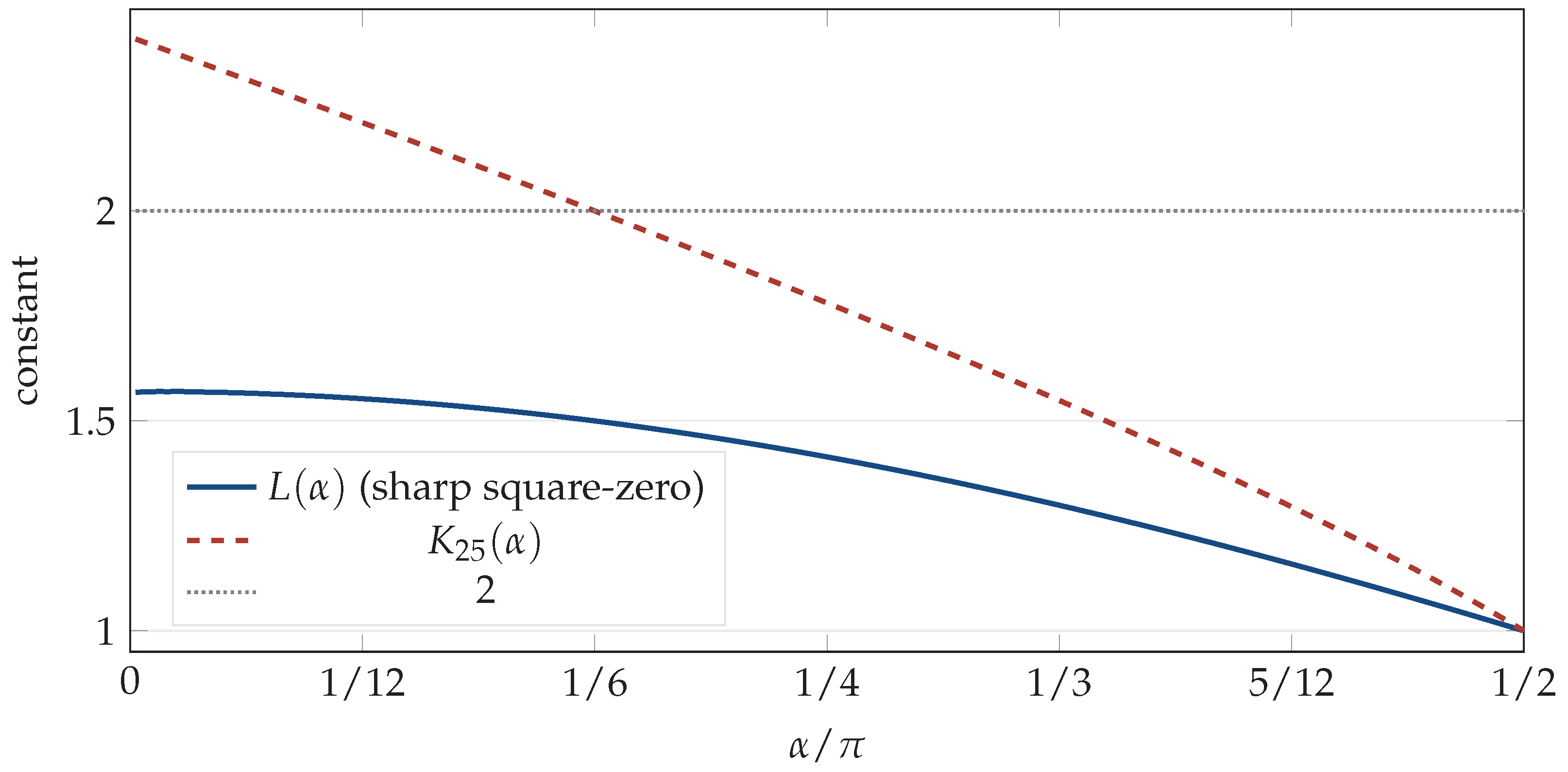
At representative angles the two explicit curves in Figure 1 are:
These numbers are illustrations only; all claims in Proposition 5 are exact symbolic inequalities.
The square-zero curve should not be confused with the full dimension-two constant. Crouzeix’s characterization [4, Theorem 4.2] determines ; in the strip limit it gives [5]. Thus even in dimension two a pair of distinct spectral points can outperform every one-point square-zero model. At , by contrast, the dimension-two value equals the square-zero value .
At the disk endpoint, with ,
Thus the known upper and lower slopes still differ by a factor of two. At the sharp-lens endpoint , whereas .
11. A Recent Uniform-Two Claim and What it Does Not Settle
After the preceding results, Jin posted a preprint claiming that the numerical range is a 2-spectral set and, as a corollary, that the intersection of two spherical disks has uniform constant 2 [9]. The same preprint explicitly lists the optimal constant for an individual crossing lens as open. At the date on this manuscript the item is labelled by its host as not peer reviewed.
If that theorem is accepted, one may add the term 2 to the minimum on the right of (10.5); none of the proofs in sec:proofsec:bounds uses it. Even the uniform inequality would not identify : for , (10.6) is already strictly smaller, and for every nontrivial angle the lower certificate leaves a gap.
This distinction matters. A uniform theorem answers
whereas the fixed-lens problem asks for the entire function , including its extremal operators and functions.
12. Consequences for the Search for the Exact Constant
The sharp calculation rules out a common first numerical strategy as a route to the full answer: no optimization restricted to a single eigenvalue and a square-zero perturbation can exceed . Any strict improvement of the lower bound must therefore use at least one of the following mechanisms:
- 1.
- two or more spectral points whose Pick constraints interact;
- 2.
- a nilpotent chain of order at least three;
- 3.
- a genuinely infinite-dimensional sectorial operator;
- 4.
- a matrix-valued test function if the completely bounded constant is larger than the scalar one.
The first two options lead to finite semidefinite programs: sample a Herglotz representation after the power map, impose the two supporting half-plane inequalities on a matrix B, and optimize the norm of the Pick functional calculus. A valid lower bound must be exported as exact algebraic data (matrix, function, and norm certificate), not only as floating-point output. Conversely, a new upper bound requires a positive kernel or a sum-of-squares decomposition valid for every sectorial operator. The equality conditions in supply useful constraints for both searches.
13. Conclusions
The fixed crossing-lens constant is exactly the sectorial numerical-range constant, but its unrestricted value is not presently determined. We have computed the constant on the full affine square-zero class and shown that it equals the classical global lower curve , with a closed-form lens certificate. The calculation is sharp, dimension-free, and independent of any uniform-two theorem. At the right angle, the two exact sums of squares in Section 6 prove the conjectural estimate for the entire palindromic quadratic family , hence for positive-real and conjugate pairs of half-plane zeros, and for every admissible operator. The exact certificates in Theorems 3 and 4 cover the complete imaginary post-automorphism diameter and an explicit two-real-dimensional cusp around it, while the bivariate rational certificate in Theorem 5 fills the full complex disk . The exact radial, interpolation, and matrix Bernstein certificates in Theorem 6 cross that circle for ; together with reflection they reach all but degrees of the boundary-phase circle. At the centre, 1 gives the strictly stronger bound by an explicit polynomial bidisk extension. The reserve in that extension also yields the genuinely two-complex-parameter result 7: every pair , including two independently phased nonzero zeros, satisfies a strict bound for every admissible operator. This is an open target-zero neighborhood, not an arbitrary-function theorem. Theorems 9 and 10 supply a different kind of exact advance: they prove the sharp identity multiplier on complete three-node admissible-kernel cones, for every symmetric triple and for the genuinely asymmetric patch , . Their restriction to one multiplier and three nodes is essential; Remark 1 records the remaining determinant gates. On the singular rank-one-side boundary, Theorem 11 proves the quadratic target for the full arc and every complex second Blaschke zero in the disk. This is a genuine three-real-parameter scalar-face theorem, but Remark 2 explains why it does not close the arbitrary quadratic singular boundary. Proposition 4 reduces the remaining boundary parameters in this centred slice to the single variance inequality (6.45); this is an equivalence, not an asserted proof of that inequality. The unrestricted gap in (10.5) nevertheless cannot be closed by first-order Jordan models or by these degree-two subfamilies alone. The remaining complex post-automorphism parameters—in particular the small phase gap about left by the radial certificate—the critical-point frequency, and higher-order spectral interaction are the next obstacles.
14. Reproducibility Statement
All constants and matrices needed for the main result are displayed in (1.6) and (1.7). The two disk constraints reduce to the scalar identity in the proof of Corollary 2; the functional calculus truncates by . For , the displayed quartic, discriminant, selector, and five-term identity give a wholly symbolic audit. For the remaining computer-assisted identities, the ancillary README lists the exact data, independent verifiers, and replay commands. These verifiers reconstruct the algebraic-number kernel compressions, hereditary coefficient identities, rational positivity comparisons, radial and boundary-phase Gram certificates, row-space identities, and the polynomial bidisk extension. All proof decisions use exact rational or algebraic arithmetic; floating-point discovery factors are not trusted in any proof. For Theorem 9, tmp/research/verifythreenoderank22elimination.py reconstructs the normalized multipliers and checks the phase-elimination, Bernstein, and small-parameter factorization identities in exact SymPy arithmetic; tmp/research/rightanglethreenoderank13exact.py independently checks the polarized quotient identity and scalar-face normalization. For Theorem 10, tmp/research/verifythreenoderank22asymmetricbox.py reconstructs the kernel invariants and phase criterion, verifies the global sum-of-squares identity (8.26), and checks all 299 rational parameter Bernstein controls exactly. For Theorem 11, tmp/research/verifyrank13phithetacomplexa.py independently rebuilds the quadratic reduction, the root-free determinant, 879 exact tensor Bernstein controls over , and the two local corner certificates. Separate referee and certificate audits in audit/RANK13PHITHETACOMPLEXAREFEREEAUDIT.md and audit/RANK13PHITHETACOMPLEXACERTIFICATEAUDIT.md reconstruct the disk, rank, Schur-complement, coverage, strictness, and endpoint arguments not encoded by the script. For Theorem 7, tmp/research/verifyglobaltwosmallzerotargetfamily.py checks the two complex curve factorizations, the pole-free denominator bound, and the strict exact norm reserve. The independent report audit/GLOBALTWOSMALLZEROTARGETFAMILYREFEREEAUDIT.md reconstructs the conjugations, parameter boundary, Ando transfer, and finite-kernel consequence. The stable polynomial core is also compiled in Lean as formal/RightAngleThreeNodeRank22Algebra.lean; its axiom audit reports only propext, Classical.choice, and Quot.sound. The narrower singular-family algebra is checked in formal/RightAngleSingularW2Algebra.lean; this does not formalize 11 or the analytic Pick-theoretic bridges. The plot evaluates only the explicit formulas (10.1) and (10.2).
References
- Beckermann, B.; Crouzeix, M. A lenticular version of a von Neumann inequality. Arch. Math. 2006, 86, 352–355. [Google Scholar] [CrossRef]
- Crouzeix, M.; Delyon, B. Some estimates for analytic functions of strip or sectorial operators. Arch. Der Math. 2003, 81, 559–566. [Google Scholar] [CrossRef]
- Badea, C.; Beckermann, B.; Crouzeix, M. Intersections of several disks of the Riemann sphere as K-spectral sets. Commun. Pure Appl. Anal. 2009, 8, 37–54. [Google Scholar] [CrossRef]
- Crouzeix, M. Bounds for analytical functions of matrices. Integral Equ. Oper. Theory 2004, 48, 461–477. [Google Scholar] [CrossRef]
- Crouzeix, M. Some Constants Related to Numerical Ranges. SIAM J. Matrix Anal. Appl. 2016, 37, 420–442. [Google Scholar] [CrossRef]
- Andô, T. On a pair of commutative contractions. Acta Sci. Math. 1963, 24, 88–90. [Google Scholar]
- Beckermann, B.; Crouzeix, M. Operators with numerical range in a conic domain. Arch. Der Math. 2007, 88, 547–559. [Google Scholar] [CrossRef]
- Crouzeix, M. Numerical Ranges and Spectral Sets: the unbounded case, 2025. arXiv arXiv:mathversion 1. [CrossRef]
- Jin, S. The Numerical Range Is a 2-Spectral Set, 2026. Preprints.org 202607.1919, version 4. posted. submitted 6 August 2026; not peer-reviewed. [CrossRef]
Figure 1.
The exact square-zero constant and the 2025 aperture upper bound. The vertical gap is the part not resolved by first-order nilpotent models. The line is crossed at .
Figure 1.
The exact square-zero constant and the 2025 aperture upper bound. The vertical gap is the part not resolved by first-order nilpotent models. The line is crossed at .
Disclaimer/Publisher’s Note: The statements, opinions and data contained in all publications are solely those of the individual author(s) and contributor(s) and not of MDPI and/or the editor(s). MDPI and/or the editor(s) disclaim responsibility for any injury to people or property resulting from any ideas, methods, instructions or products referred to in the content. |
© 2026 by the authors. Licensee MDPI, Basel, Switzerland. This article is an open access article distributed under the terms and conditions of the Creative Commons Attribution (CC BY) license (http://creativecommons.org/licenses/by/4.0/).
Copyright: This open access article is published under a Creative Commons CC BY 4.0 license, which permit the free download, distribution, and reuse, provided that the author and preprint are cited in any reuse.