

Submitted:
17 August 2026
Posted:
18 August 2026
You are already at the latest version
Abstract
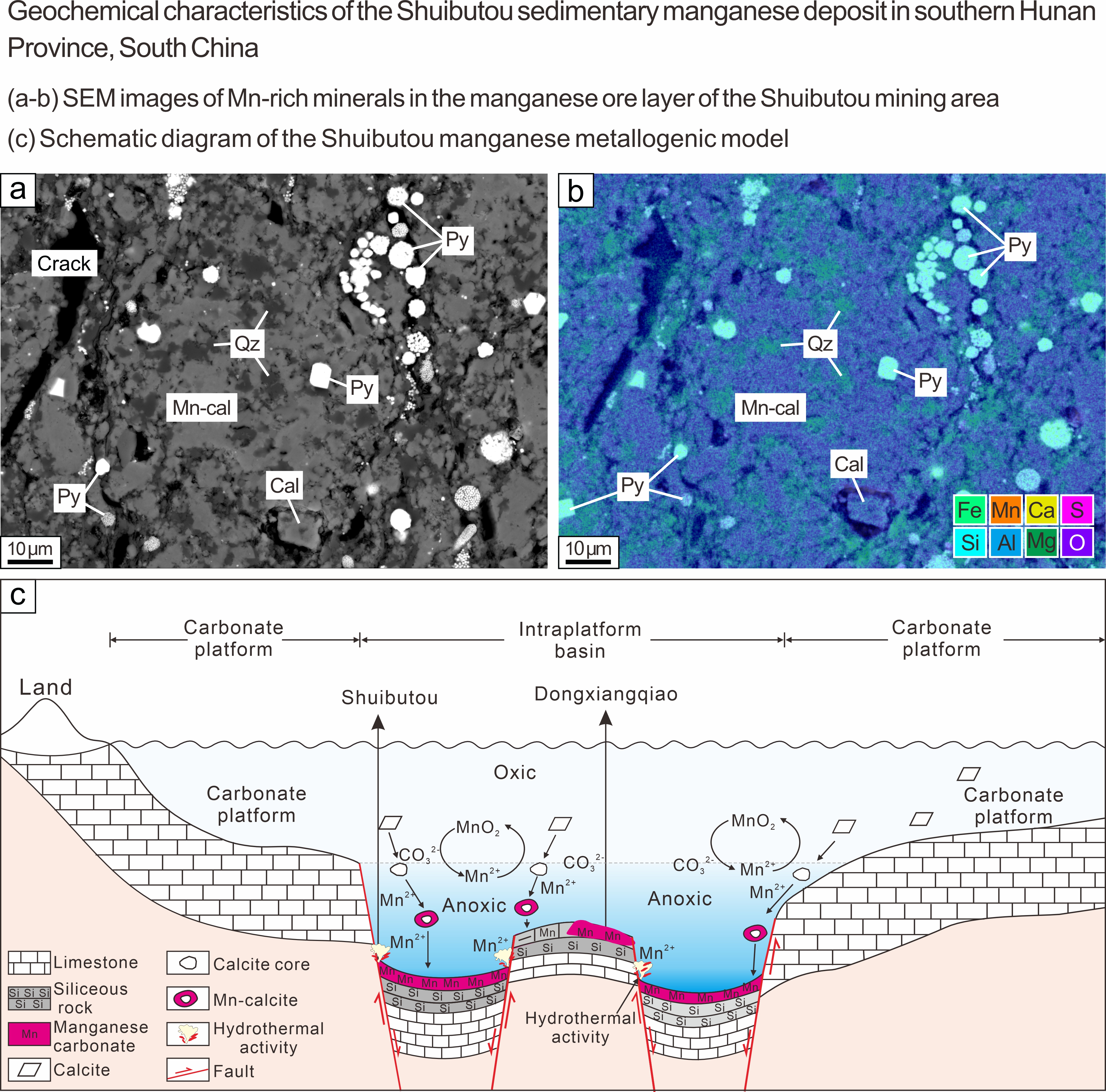
Permian sedimentary manganese carbonate deposits in the Qiling Basin exhibit substantial resource potential, yet their depositional environments and precipitation pathways remain insufficiently constrained. This study integrates petrographic, mineralogical, whole-rock geochemical, and carbonate C–O isotope data from the Shuibutou Mn deposit in southern Hunan. We compare this deposit with the coeval Dongxiangqiao deposit and other Permian marine sedimentary Mn deposits to constrain its depositional setting, Mn-carbonate precipitation mechanisms, and potential Mn sources. The Shuibutou ores contain 10.88–17.18 wt.% MnO and are characterized by spherulitic–oolitic textures, abundant bioclasts, and framboidal pyrite. Mo–U enrichment indicates anoxic bottom waters, whereas the near-marine δ¹³Ccarb values of ore carbonates (−0.24‰ to 1.28‰) are consistent with pre-cipitation within a marine carbonate system and suggest direct precipitation of Mn(II) carbonates from dissolved Mn²⁺ under anoxic conditions. In this setting, dissolved Mn²⁺ accumulated below the chemocline. Partial dissolution of platform-derived calcite grains near the chemocline increased local dissolved inorganic carbon and alkalinity, driving Mn-carbonate supersaturation and the authigenic precipitation of manganoan calcite, ultimately forming manganese carbonate ores. The low Al/(Al + Fe + Mn) ratios, high Fe/Ti ratios, and Co–Ni–Zn and REY geochemical characteristics are consistent with a possible contribution from Mn-rich deep fluids to the dissolved Mn²⁺ inventory of the basin waters. Similarities in mineralogy, geochemistry, and depositional setting between Shuibutou and Dongxiangqiao point to a possible regional role for the direct precipitation of Mn(II) carbonates under anoxic conditions in the Middle Permian Qiling Basin. Relatively deep intraplatform basins may therefore represent favorable targets for manganese carbonate exploration and provide a reference for exploration targeting of Permian sedimentary Mn deposits within the Qiling Basin.
Keywords:
Qiling Basin
; Permian
; Gufeng formation
; sedimentary manganese deposit
; geochemistry
1. Introduction
Manganese is a strategically critical metal essential to steelmaking and increasingly important for advanced batteries and other low-carbon energy technologies [1,2]. Permian marine sedimentary Mn deposits are widespread across South China but are generally characterized by low ore grades, limited tonnage of individual orebodies, and numerous discrete occurrences [3]. Recent exploration in Guizhou and Hunan provinces has nevertheless yielded important discoveries, including the large Tongluojing deposit in Zunyi, Guizhou [4,5], and the medium- to large-sized Dongxiangqiao and Shuibutou deposits in southern Hunan [6,7]. These discoveries highlight the considerable resource potential and exploration prospects of Permian sedimentary Mn carbonate deposits in South China. Southern Hunan is an important Mn-producing region of China [6]. Decades of intensive mining have largely depleted near-surface supergene Mn oxide resources, shifting exploration efforts toward deeply buried primary sedimentary Mn ores. Recent geological surveys have identified locally developed Mn carbonate intervals containing >20 wt.% MnO. These findings challenge the long-standing view that primary sedimentary Mn ores in southern Hunan are uniformly low-grade (MnO <10 wt.%) and of limited economic value. Consequently, the Permian Mn-bearing successions of the Qiling Basin have attracted increasing attention as important targets for deep exploration.
Despite recent exploration advances, the ore genesis and Mn-carbonate precipitation mechanisms of Permian sedimentary Mn deposits in the Qiling Basin remain debated [6,7], limiting both the understanding of regional metallogenesis and reliable resource assessment. Previous studies have focused primarily on the Dongxiangqiao deposit, whereas the Shuibutou deposit has received comparatively little investigation. Based on redox-sensitive elements and carbonate C–O isotopes from the Dongxiangqiao deposit, Liao et al. [7] proposed that Mn mineralization was jointly controlled by seawater CO₃²⁻ concentrations and depositional redox conditions. In this model, high-grade Mn ores formed under weakly reducing conditions through direct precipitation of Mn carbonates. Tan et al. [6] suggested that Permian Mn carbonate deposits in the Qiling Basin formed through direct Mn-carbonate precipitation when Mn-rich hydrothermal fluids entered anoxic to euxinic waters. Although these models differ in the degree of oxygen depletion inferred for mineralization, both emphasize the important role of direct Mn-carbonate precipitation under relatively reducing conditions. However, whether direct Mn-carbonate precipitation under reducing conditions also operated in other coeval Mn deposits within the Qiling Basin remains poorly constrained. These interpretations contrast with the prevailing model for ancient Mn carbonate deposits, in which Mn carbonates are mainly generated through the early diagenetic reduction of solid Mn(III/IV) oxides that were initially precipitated in oxygenated waters [8,9,10]. Under this conventional framework, Mn ore grades may even increase with increasing water-column oxygenation [11,12,13]. Therefore, the regional applicability of the direct precipitation model under reducing conditions requires further evaluation using other coeval Mn deposits.
The Shuibutou deposit, adjacent to Dongxiangqiao, is a coeval sedimentary Mn-carbonate deposit with a reported carbonate manganese ore resource of 49.1 Mt (Figure 1) [14]. More importantly, the Shuibutou deposit formed within a relatively deep intraplatform-basin setting and may have experienced persistent and stable anoxic conditions during mineralization [15], making it an ideal locality for evaluating direct Mn-carbonate precipitation under anoxic conditions and assessing the basin-scale applicability of this metallogenic model. Against this background, this study investigates the Shuibutou sedimentary Mn deposit in Yongzhou, southern Hunan. Representative primary Mn ores and wall rocks were analyzed using petrographic and mineralogical observations, scanning electron microscopy coupled with energy-dispersive spectroscopy (SEM–EDS), whole-rock major- and trace-element geochemistry, and carbonate carbon and oxygen isotopes. The objectives are to (1) reconstruct the depositional redox conditions and evaluate the mechanism of Mn-carbonate precipitation, (2) assess geochemical constraints regarding source of ore-forming materials, and (3) compare the mineralization processes at Shuibutou and Dongxiangqiao. The results refine a process-based model for Permian Mn-carbonate mineralization in the Qiling Basin and provide constraints for regional exploration.
2. Geological Background
2.1. Regional Geological Setting
The Qiling Basin is located in southern Hunan, in the central part of the South China Block, along the southeastern margin of the Yangtze Block and within the Gui–Xiang–Gan Fold Belt [16]. During the Permian, the South China Block was a relatively isolated continental block in the low-latitude region of the eastern Paleo-Tethys Ocean [17]. In the late Early Permian, deglaciation following the Late Paleozoic Ice Age and the associated sea-level rise drove a regional marine transgression, shifting deposition from the coastal siliciclastic facies of the Liangshan Formation to the widespread carbonate-platform limestones of the Qixia Formation [18,19]. During the Middle Permian, regional subsidence and eustatic sea-level fluctuations promoted progressive retreat of the Yangtze carbonate-platform margins and local drowning of the platform interior, producing a paleogeographic mosaic of shallow-water carbonate platforms, platform-margin slopes, and deep-water intraplatform depressions [16,20]. This interval was also an important episode of Mn mineralization in South China, during which large- to medium-sized sedimentary Mn deposits formed along the margins of the Yangtze Block and within intraplatform fault-controlled basins. The orebodies are commonly associated with siliceous, argillaceous, and carbonate rocks [21].
The tectono-sedimentary evolution of the Qiling Basin was principally controlled by NE- and NW-trending deep-seated faults. Persistent fault-controlled subsidence created accommodation for Permian marine deposition, and the principal Permian units comprise, in ascending order, the Qixia, Gufeng, Longtan, and Dalong formations. The upper member of the Gufeng Formation is the principal Mn-bearing interval [15]. During deposition of the Gufeng Formation, fault-controlled differential subsidence generated a depositional system comprising carbonate platforms, platform-margin slopes, and intraplatform deep-water depressions, thereby governing the lithologic assemblages, thickness, and spatial distribution of the Mn-bearing succession. Both the Shuibutou and Dongxiangqiao Mn deposits developed within this slope-to-intraplatform-depression depositional system [15]. At the Shuibutou deposit, the Gufeng Formation contains abundant siliceous lithologies together with Mn-bearing limestone, whereas Dongxiangqiao contains a higher proportion of Mn-bearing limestone [8,16]. This lithologic contrast is consistent with the Shuibutou deposit occupying a relatively more basinward and deeper-water position.
2.2. Geological Characteristics of the Ore Deposit
The Shuibutou Mn deposit is located approximately 12 km southwest of Lingling District, Yongzhou City, in the southwestern Qiling Basin within the Gui–Xiang–Gan Fold Belt of the South China Block (Figure 1a). The exposed succession comprises the Carboniferous Hutian Group (C₂₊₃ht), the Permian Qixia (P₁q), Gufeng (P₁g), Longtan (P₂l), and Dalong (P₂d) formations, the Triassic Daye Formation (T₁d), and Quaternary deposits (Figure 2) [15]. The Hutian Group consists mainly of limestone and dolomite, whereas the Qixia Formation is dominated by limestone. The lower member of the Gufeng Formation comprises mainly Mn-bearing limestone and siliceous limestone, with local dolomite. The upper member consists mainly of Mn-bearing limestone, muddy limestone, and siliceous limestone, with local dolomite and bioclast-bearing marl near the top. The Longtan Formation is dominated by silty mudstone and shale with quartz-sandstone interbeds, whereas the Dalong Formation comprises limestone and siliceous limestone with local quartz sandstone. The Daye Formation consists mainly of limestone and muddy limestone with minor silty mudstone, and Quaternary deposits locally cover the older strata.
The deposit is structurally controlled by the NE-trending Shuibutou syncline, which extends approximately 7.5 km along strike. Its western limb is relatively intact and dips E–ESE at 35°–55°, whereas the eastern limb and hinge zone are more complex, with secondary folds, variable bedding attitudes, dips of 56°–75°, and locally overturned strata (Figure 1b). The syncline core consists mainly of limestone and muddy limestone of the Daye Formation, while Permian and Carboniferous strata crop out successively toward both limbs. Faulting is limited and concentrated mainly on the eastern limb, where faults locally offset the ore-bearing succession. The WNW–ESE-trending A–A′ section crosses both limbs and the hinge zone, illustrating the distribution, attitude, and down-dip continuity of the ore-bearing strata (Figure 1b,c).
From bottom to top, the Gufeng Formation hosts Ore Layers III, II, and I, with Layer III in the lower member (P₁g¹) and Layers II and I in the upper member (P₁g²) (Figure 2). The orebodies are stratiform to stratoid and locally lenticular, occur on both limbs of the syncline, and define a U-shaped outcrop pattern opening to the NNE (Figure 1b). Layer I occurs in Mn-bearing limestone immediately below a laterally continuous bioclast-bearing marl unit near the Gufeng–Longtan boundary. Ore Layer II is the principal orebody and consists mainly of microlaminated Mn-bearing limestone. Its immediate roof consists of Mn-bearing limestone with distinct white bioclastic laminae, whereas its floor comprises Mn-bearing limestone and siliceous limestone. Layer II is 0.70–7.98 m thick, with an average thickness of 2.82 m, and extends 150–650 m down dip; the maximum exploration-controlled dip length reaches 772 m. It dips E–NE at 35°–48° on the western limb and W–NW at 60°–80° on the eastern limb, with more variable attitudes near the southern hinge zone. Layer III occurs within Mn-bearing limestone in the lower Gufeng member and is underlain by an interval of Mn-bearing limestone interbedded with siliceous limestone. Similar to Layer I, it is less continuous and displays greater variations in thickness and geometry. According to exploration reports, the Shuibutou deposit contains 49.1 Mt of carbonate manganese ore averaging 9.9 wt.% Mn, indicating a large but relatively low-grade resource. Notably, the cutoff grade applied in the resource estimate was not specified in the available documentation. The Dongxiangqiao deposit lies northeast of Shuibutou and hosts stratiform carbonate manganese orebodies in the Gufeng Formation that locally reach approximately 8 m in thickness and are overlain by calcareous mudstone and underlain by Mn-bearing limestone. Its reported resources total 17.8 Mt, comprising 10.4 Mt of carbonate ore averaging 10.8 wt.% Mn and 7.4 Mt of oxide ore averaging 20.86 wt.% Mn [7].
3. Materials and Methods
Fourteen fresh, visibly unaltered samples were collected from three outcrops marked by white stars in Figure 1b (Table 1). The SBT-1–5 and SBT-A1–A5 outcrops are located in the eastern part of the mining area, whereas the SBT-B1–B4 outcrop is located in the western part. Because Ore Layers I and III are not exposed, sampling focused on Ore Layer II and its adjacent strata. Based on field lithology, mineralization characteristics, and stratigraphic relationships with Ore Layer II, the samples were divided into eight Mn ores, four Mn-bearing rocks, and two wall rocks. The eight ore samples are Mn-carbonate ores collected from Ore Layer II. Here, Mn-bearing rocks refer to siliceous limestones from strata adjacent to Ore Layer II that contain minor Mn-bearing carbonate minerals but are less mineralized than the ores. They comprise two Mn-bearing siliceous limestones (SBT-3 and SBT-4) and two siliceous limestones (SBT-A4 and SBT-B4). The two wall-rock samples comprise an immediate footwall siliceous limestone (SBT-5) from the SBT-1–5 outcrop and an immediate hanging-wall calcareous mudstone (SBT-A5) from the SBT-A1–A5 outcrop. Owing to incomplete stratigraphic exposure and topographic constraints, the hanging-wall and footwall intervals could not both be fully sampled at every outcrop. All 14 samples were examined petrographically and analyzed for whole-rock major, trace, and rare earth elements and TOC. Carbonate C–O isotope analyses were attempted on all samples, yielding reliable results for 11 carbonate-bearing samples. Selected representative samples were further examined by SEM–EDS.
For regional comparison, geochemical and isotopic data from Middle Permian marine Mn deposits in South China were compiled. These include major-, trace-, and rare earth element and carbonate C–O isotope data for five Mn ore samples from the Dongxiangqiao deposit, obtained by the authors. Previously published and newly generated data are distinguished in Supplementary Materials Table S1. Additional elemental, carbonate C–O isotope, and Sr isotope data for the Dongxiangqiao and Changgou deposits were compiled from published sources [5,7]. Sample numbers, analytical datasets, and data sources are summarized in Supplementary Materials Tables.
3.1. Whole-Rock Major- and Trace-Element Analyses
Whole-rock major and trace element analyses were performed at Beijing Anmeikechuang Petroleum Technology Co., Ltd. Major element determination was carried out in two steps. First, loss on ignition (LOI) was measured by the gravimetric method in accordance with national standard (GB/T 14506.34-2019). Second, fused glass discs were prepared for instrumental measurement following national standard GB/T 14506.28-2010. Major element concentrations were determined using an Axios mAX wavelength dispersive X-ray fluorescence (XRF) spectrometer manufactured by PANalytical (The Netherlands). Data quality was monitored via duplicate analyses and national reference materials (GSR-4, GSR-5, GSR-6), with analytical uncertainty below 5% for all major elements.
For trace element analysis, including rare earth elements (REEs), whole-rock powder samples were first digested using a mixed acid of HNO3 and HF to prepare test solutions prior to instrumental measurement. This experimental procedure followed the national standard (GB/T 14506.30-2010). Trace element concentrations in the prepared solutions were measured with a Thermo Fisher Element XR high-resolution inductively coupled plasma mass spectrometer (HR-ICP-MS). Data quality was verified by analyzing replicate samples and international reference materials (BHVO-2, BCR-2, RGM-2), yielding analytical precision better than 5% for all trace elements.
For geochemical data treatment, trace-element and rare earth element plus yttrium (REY) concentrations were normalized to Post-Archean Australian Shale (PAAS) values from McLennan [23], whereas chondrite-normalized rare earth element (REE) patterns were calculated using the reference values of Boynton [24]. For either reference material, the normalized concentration of an element was calculated as:
where the numerator is the measured concentration of element X in the sample and the denominator is the corresponding PAAS or chondrite reference value. Molybdenum and uranium enrichment factors were calculated relative to average upper continental crust (AUCC) [32,33], using Al as the detrital normalizer:
Al concentrations were converted from Al₂O₃ to elemental Al before calculation. The PAAS-normalized Ce anomaly was calculated as:
where the subscript SN denotes PAAS-normalized concentrations. For the Ce/Ce*–Nd discrimination diagram, Ce/Ce* was calculated with the same interpolation equation using PAAS-normalized La, Ce, and Pr concentrations. The PAAS-normalized Y–Ho fractionation parameter used in the discrimination diagram was calculated as:
3.2. TOC Content Analysis
TOC contents were determined using a Leco CS744 carbon-sulfur analyzer at the Key Laboratory of Nonferrous Metals Mineralization Prediction and Geological Environment Monitoring of the Ministry of Education, Central South University. Approximately 100 mg of powdered sample was weighed into a porous crucible, treated with excess dilute hydrochloric acid to fully remove inorganic carbon, rinsed to neutral pH, and dried prior to measurement. Duplicate samples and certified reference material Leco 502-899 (C = 3.19 ± 0.03 wt.%) were used for accuracy assessment, with analytical error < 0.2 wt.% for all TOC measurements.
3.3. Carbon-Oxygen Isotopic Analysis of Carbonates
Carbonate carbon and oxygen isotope analyses were conducted at Beijing Anmeikechuang Petroleum Technology Co., Ltd. Powdered samples were reacted with 100% anhydrous phosphoric acid at constant temperature to generate CO₂, which was subsequently purified and collected for isotopic measurement on a Thermo Fisher 253 Plus gas-source stable isotope mass spectrometer. National isotope reference materials GBW04416 and GBW04417 were employed for data quality monitoring. All results are reported in delta notation relative to the Vienna Pee Dee Belemnite (V-PDB) scale, with standard deviations <0.1‰ for both δ¹³CV-PDB and δ¹⁸OV-PDB. To facilitate comparison with seawater oxygen isotope values, δ¹⁸OVPDB values were converted to the Vienna Standard Mean Ocean Water (V-SMOW) scale using the conversion equation documented in [22].
3.4. Scanning Electron Microscopy-Energy Dispersive Spectroscopy (SEM-EDS) Analysis
In situ observation and compositional characterization of Mn-bearing minerals were performed using scanning electron microscopy coupled with energy-dispersive X-ray spectroscopy (SEM-EDS) at the Field-Emission SEM Laboratory of Southern University of Science and Technology. Rock samples were cut into ~1 cm × 2 cm blocks parallel to bedding planes, polished, and coated with gold prior to analysis. Measurements were carried out on a Zeiss Sigma 300 field-emission SEM equipped with a Bruker XFlash 616 EDS detector.
4. Results
4.1. Distribution of Major, Trace, and Rare Earth Elements
The Shuibutou Mn ores contain 10.88–17.18 wt.% MnO, with a mean of 13.83 wt.%. In comparison, the Mn-bearing rocks contain 2.40–6.68 wt.% MnO (mean 3.82 wt.%), whereas the wall rocks have the lowest contents of 0.39–2.14 wt.% (Table S1; Figure 3). The ores contain 11.29–31.08 wt.% SiO₂, 19.65–29.49 wt.% CaO, 2.17–2.88 wt.% MgO, 1.50–3.62 wt.% Al₂O₃, and 2.70–7.30 wt.% Fe₂O₃. The Mn-bearing and wall rocks have higher SiO₂ contents (69.80–87.36 wt.%) but lower CaO (0.34–7.20 wt.%) and MgO (0.14–1.21 wt.%). Overall, SiO₂ decreases with increasing MnO, whereas CaO and MgO increase. Al₂O₃, Fe₂O₃, K₂O, and TiO₂ show no consistent relationships with MnO. The ores from the three outcrops have similar mean MnO contents of 12.64–14.74 wt.% and overlapping SiO₂, CaO, and MgO ranges, indicating broadly consistent major-element compositions. TOC contents are 0.38 wt.% in the footwall siliceous limestone and 2.81 wt.% in the hanging-wall calcareous mudstone. The major-element compositions of the Shuibutou ores broadly overlap those of the Dongxiangqiao ores, which contain 9.128–17.01 wt.% MnO, with a mean of 12.07 wt.%. In the Dongxiangqiao ores, SiO₂ and Fe₂O₃ tend to decrease with increasing MnO, whereas K₂O increases slightly; the other major elements show no consistent trends.
The PAAS-normalized trace-element patterns of the Shuibutou Mn ores display a coherent enrichment–depletion signature (Table S2; Figure 4a). Mo, Cd, and Sb form the strongest enrichment peaks, while Cr, Co, Ni, Sr, Bi, and U are moderately enriched. V, Cu, and Zn generally plot near PAAS values or show weak enrichment. In contrast, Li, Be, Sc, Ga, Ba, Rb, Cs, Zr, Nb, Hf, Ta, and Th are depleted, with Rb and Cs forming the deepest negative excursions. W, Tl, and Pb range from depleted to near-PAAS levels. Relative to the Mn-bearing and wall rocks, the ores show stronger enrichment in Mo, Cd, Sr, Bi, and U, whereas the other transition metals overlap among lithological groups. The Dongxiangqiao ores exhibit broadly similar patterns but substantially greater sample-to-sample variation (Figure 4b). Their V, Cr, Co, Ni, Mo, Cd, Sb, and U enrichments and Sc, Cu, Zr, Nb, Cs, Hf, Ta, and Tl depletions vary widely. In comparison, the Shuibutou ore patterns are more closely clustered and subparallel.
Among the eight Shuibutou Mn-ore samples, ΣREE contents range from 145 to 307 ppm, with an average of 201 ppm, and are generally higher than those of the associated Mn-bearing and wall rocks (Table S3). Their PAAS-normalized REY patterns are broadly subparallel and nearly flat to weakly MREE-enriched, characterized by consistently positive Y anomalies, weak and variable Ce anomalies, minor positive Gd anomalies, and generally subdued Eu anomalies (Figure 5a). ΣREE contents show no systematic covariation with MnO. Relative LREE enrichment generally decreases with increasing MnO, whereas MREE–HREE fractionation and the magnitudes of the Ce, Eu, and Y anomalies vary irregularly. The three outcrop groups exhibit comparable REY pattern shapes and differ principally in absolute ΣREE abundance and Ce-anomaly magnitude. The chondrite-normalized REE patterns decrease steeply from La–Ce to Sm–Eu and become comparatively flat from Gd to Lu, indicating pronounced LREE–HREE fractionation (Figure 5b). The ΣLREE/ΣHREE ratios range from 10.3 to 14.0, with an average of 11.7. La–Lu abundances are approximately 11–210 times chondritic values, and Eu anomalies are generally minor.
Across the Dongxiangqiao Mn-ore samples, ΣREE contents range from 116 to 379 ppm, with an average of 198 ppm (Table S3). The mean is comparable to that of the Shuibutou ores, although the Dongxiangqiao samples exhibit a wider range. Their PAAS-normalized REY and chondrite-normalized REE patterns broadly resemble those of the Shuibutou ores, likewise showing weak MREE enrichment and pronounced LREE–HREE fractionation (Figure 5c,d). The ΣLREE/ΣHREE ratios range from 9.5 to 15.8, with an average of 12.0, and La–Lu abundances are approximately 9–145 times chondritic values. Compared with the Shuibutou ores, the Dongxiangqiao ores display greater intersample variability, including more pronounced MREE enrichment in some samples and wider variation in Eu anomalies.
4.2. Carbon and Oxygen Isotope Characteristics
Carbon and oxygen isotope data were obtained for 11 of the 14 Shuibutou samples, whereas the low carbonate-mineral contents of the remaining three precluded reliable measurement. The Shuibutou Mn ores have δ¹³Ccarb values of −0.24‰ to 1.28‰ (mean 0.81‰) and δ¹⁸Ocarb values of −13.48‰ to −8.91‰ (mean −10.36‰), both reported relative to V-PDB (Table S4). The δ¹⁸Ocarb values correspond to 17.0–21.7‰ (mean 20.23‰) on the V-SMOW scale. The Mn-bearing rocks and wall rock have higher δ¹³Ccarb values of 1.56‰–2.43‰, whereas their δ¹⁸Ocarb values of −10.91‰ to −8.84‰ V-PDB are similar to those of most Mn ores. With increasing MnO, δ¹³Ccarb generally decreases, whereas δ¹⁸Ocarb tends to become less negative. The Mn ores from the three outcrops have similar carbon and oxygen isotopic compositions and show no systematic spatial variation. The Dongxiangqiao Mn ores have δ¹³Ccarb values of −0.83‰ to 1.36‰, similar to those of the Shuibutou ores. Their δ¹⁸Ocarb values range from −10.95‰ to −3.30‰ V-PDB and show substantially greater variability, with several samples yielding less negative values. Overall, the carbon and oxygen isotopic compositions of the Shuibutou ores are more tightly clustered, and their δ¹⁸Ocarb values are generally more negative than those of the Dongxiangqiao ores.
4.3. Fabric and Mineral Characteristics of Mn-Rich Ore
The Shuibutou Mn ores are characterized mainly by inequigranular bioclastic, spherulitic, and oolitic textures, with fine-grained banded and microlaminated structures developed locally. Petrographic observations of the Mn carbonate ores show that the Mn-bearing mineral assemblage is dominated by manganoan calcite, which occurs mainly as ellipsoidal grains and constitutes the principal Mn-bearing phase of the ores (Figure 6).
Microfossil fragments and framboidal pyrite are abundant. Minor nearly pure calcite occurs in the cores and locally along the rims of Mn-calcite grains, whereas framboidal pyrite and quartz occupy intergranular pores between the Mn-calcite grains (Figure 7). No additional Mn-bearing mineral phases were identified within the examined SEM fields. EDS elemental mapping shows that Mn is distributed relatively homogeneously throughout the Mn carbonate ores and exhibits spatial covariation with Ca (Figure 7d–e). Si is also broadly uniformly distributed across the examined areas (Figure 7g).
5. Discussion
5.1. Depositional Redox Conditions
As a redox-sensitive element, Mn exhibits geochemical behavior in marine settings that is closely governed by the redox potential of the water column [25]. Under oxic conditions, dissolved Mn²⁺ is thermodynamically unstable and readily oxidized to form higher-valence Mn (oxyhydr)oxides, which gradually settle and accumulate in sediments [26]. In contrast, under anoxic conditions, these oxides undergo reductive dissolution to release soluble Mn²⁺, which generally does not form stable complexes with organic matter or dissolved sulfides [27]. Accordingly, redox conditions exert a critical control on Mn enrichment during sedimentary deposition.
Molybdenum (Mo) and uranium (U) enrichments in marine sediments serve as reliable geochemical proxies for reconstructing redox conditions at the sediment-water interface, owing to their distinct geochemical behaviors across redox gradients [25]. Under oxic conditions, both elements behave conservatively in seawater, resulting in low concentrations in accumulating sediments. Under anoxic conditions, however, they are converted to particle-reactive forms and rapidly scavenged from the water column via association with organic matter or sulfide minerals, leading to pronounced enrichment in sediments [28,29]. Cerium (Ce) anomalies also provide robust constraints on depositional redox conditions in carbonate-bearing systems, reflecting the unique redox sensitivity of Ce relative to other rare earth elements (REEs). Under oxic conditions, Ce is preferentially adsorbed onto Mn-Fe oxides, producing negative Ce anomalies (Ce/Ce* < 1) in authigenic precipitates. Under anoxic settings, this fractionation effect is diminished or absent due to the reductive dissolution of Mn-Fe oxides [30].
Sedimentary concentrations of redox-sensitive trace metals are controlled not only by ambient redox conditions but also by the size of the dissolved metal reservoir in seawater [31]. In restricted basins with depleted metals, the concentrations of Mo and U in sediments show nonlinear variations, attributed to the greater susceptibility of Mo to depletion during anoxic events [31]. At the Shuibutou, Dongxiangqiao, and Changgou deposits, Mo and U covary positively (Figure 8a). The approximately coherent trend argues against severe, deposit-specific reservoir depletion and indicates that redox conditions were the principal control on their relative enrichment.
The Shuibutou Mn-rich siliceous limestones contain Mo and U at approximately upper-continental-crust abundances, consistent with oxic bottom waters [32,33]. In contrast, the Mn-carbonate ores are enriched in both elements. Their MoEF–UEF relations indicate more reducing conditions, whereas the siliceous limestones plot in the oxic to suboxic field (Figure 8b). Dongxiangqiao ores likewise record anoxic deposition but show greater sample-to-sample variability; Shuibutou ores define a more uniform redox state. Most Changgou samples have MoEF and UEF < 1, consistent with comparatively oxygenated water. The REY data yield the same first-order pattern. At the Shuibutou and Dongxiangqiao deposits, siliceous limestones show negative Ce anomalies, whereas Mn-carbonate ores show weakly positive anomalies. Most ore samples have (Ce/Ce*)SN values around 1.0, and (Ce/Ce*)SN broadly increases with MnO (Figure 8c). By contrast, carbonate minerals from Changgou generally have (Ce/Ce*)SN < 1, consistent with a more oxygenated setting. This pattern is fully consistent with the redox interpretation from the Mo–U systematics.
TOC and petrography provide independent support. The Shuibutou Mn-carbonate ores contain 0.87–1.83 wt.% TOC (mean 1.35 wt.%), compared with a mean value of 0.87 wt.% in the Mn-bearing and wall rocks (Figure 8d), possibly indicating relatively more anoxic bottom-water conditions during Mn deposition [28]. Finely disseminated framboidal pyrite was pervasive in the ore matrix (Figure 7), whereas pyrite aggregates in fossil cavities most plausibly formed through microbial sulfate reduction during early diagenesis [34]. The pervasive distribution of discrete framboids was most consistent with primary deposition under persistently anoxic bottom waters [35]. Collectively, Mo–U covariation, enrichment factors, Ce anomalies, TOC, and pyrite textures indicate anoxic deposition of the Mn-carbonate ore and more oxygenated deposition of the associated siliceous limestones.
5.2. Precipitation Pathways of Manganese Carbonates
Marine sedimentary Mn carbonates generally form through an initial oxidation followed by diagenetic reduction, or through direct precipitation under anoxic conditions [6,10,36]. The Cryogenian Datangpo-type Mn deposits of South China are a typical example of the former pathway. In this model, the Mn²⁺ accumulated in anoxic glacial deep water, was oxidized during deglacial ventilation, and was subsequently converted to Mn carbonate during diagenesis [12]. Because organic-matter oxidation supplies isotopically light dissolved inorganic carbon, ores formed by this pathway typically have strongly negative δ¹³Ccarb values [10,37]. The Permian Changgou deposit is also consistent with an oxide-mediated pathway [4]. Its ore-stage bottom waters were suboxic to oxic, as indicated by Mn-carbonate nodules and ooids that preserve primary Fe–Mn oxide inclusions and relics, some of which were subsequently replaced by Mn carbonate [4]. The mean ore δ¹³Ccarb value of −6.87‰ resembles the negative signatures of Datangpo-type ores (Figure 9) [38], supporting reduction and carbonate replacement of an oxide precursor.
However, the Shuibutou and Dongxiangqiao deposits differ from this two-step model. First, the Mn-bearing successions accumulated beneath generally anoxic bottom waters (Figure 8), which would have inhibited sustained, basin-wide precipitation of Mn(III/IV) oxides. Second, the Shuibutou Mn ores are dominated by ellipsoidal manganoan calcite grains and, unlike the Changgou ores, contain no relict Fe–Mn oxides within the Mn carbonates (Figure 7). Third, carbonate carbon-isotope compositions provide an additional constraint on the potential contribution of organic-matter oxidation to Mn-carbonate formation. Middle Permian marine organic matter typically had δ¹³C values of approximately −30‰ to −25‰ [39,40]. If the main ore-forming process at the Shuibutou and Dongxiangqiao involved oxide precipitation followed by organic-matter-coupled reduction, the resulting pore-water DIC and Mn carbonates should be strongly ¹³C depleted, as at Changgou and Datangpo (Figure 9). Instead, the Shuibutou ores yield δ¹³Ccarb = −0.24‰ to +1.28‰ (mean +0.81‰), and Mn-bearing host rocks and barren host rocks average approximately +2.06‰. Dongxiangqiao ores also cluster near 0‰, with reported means of +0.84‰ and −0.14‰ [6,7]. These values are close to, although slightly lower than, coeval marine carbonates (+2‰ to +4‰ V-PDB) and are clearly distinct from Changgou (−6.87‰) and Datangpo-type ores (−9.41‰). Taken together, the depositional, mineralogical, and carbon-isotope evidence indicates that extensive organic-matter-coupled Mn-oxide reduction was unlikely to have been the dominant carbonate-forming process, although limited early-diagenetic modification cannot be entirely excluded. In addition, a hydrogenetic origin is not strongly supported because all Shuibutou ores have Co/Zn ratios below 1 and low Co + Ni + Cu relative to Fe + Mn (Table S3), unlike slowly accumulating hydrogenetic Fe–Mn deposits. Accordingly, the available evidence is more consistent with direct precipitation from a dissolved Mn²⁺ reservoir under anoxic conditions.
In this pathway, anoxic bottom water suppresses Mn²⁺ oxidation and allows dissolved Mn²⁺ to accumulate below the chemocline. Once Mn²⁺ supply, carbonate alkalinity, and nucleation capacity are sufficient, Mn²⁺ can enter carbonate minerals directly to form Mn-bearing calcite, kutnahorite, and rhodochrosite without a volumetrically important Mn(III/IV)-oxide stage [41,42,43]. The carbonate-platform–intra-platform-depression setting at Shuibutou favored this process [15]. Platform-derived micritic calcite, bioclasts, and other carbonate grains settled into the depression and partially dissolved near the chemocline, increasing local DIC, alkalinity, and Mn-carbonate saturation. Corroded grains also supplied reactive surfaces that lowered the barrier to heterogeneous nucleation. Mn²⁺ initially substituted for Ca²⁺ in calcite to form Mn-calcite; a subsequent rise in the local Mn/Ca activity ratio promoted kutnahorite and ultimately rhodochrosite [41,43].
5.3. Geochemical Constraints on the Origin of Manganese
During the Middle–Late Permian, lithospheric extension, normal faulting, Emeishan magmatism, and local hydrothermal activity affected the South China Block [45,46,47,48,49]. Synsedimentary faults controlled basin architecture and ore-bed distribution and may have provided pathways linking deep magmatic–hydrothermal systems with seawater. Hydrothermal-related minerals are also reported from regional Permian Mn deposits, including chalcopyrite, cobalt–nickel sulfides, and molybdenite at Changgou, and chalcopyrite, galena, gersdorffite, barite, and sphalerite at Dongxiangqiao [4,6]. These regional observations suggest a possible contribution of deep hydrothermal fluids to the ore-forming materials of the Permian Gufeng Formation Mn-carbonate deposits in the Qiling Basin.
To further evaluate whether this regional setting is reflected at Shuibutou, the geochemical characteristics of the Shuibutou ores were examined and compared with data from the Dongxiangqiao and Changgou deposits. Shuibutou ores have high Fe/Ti and low Al/(Al + Fe + Mn) and cluster near the hydrothermal end member in the Fe/Ti–Al/(Al + Fe + Mn) diagram (Figure 10a), consistent with a possible hydrothermal Fe–Mn contribution [50,51]. Dongxiangqiao samples span a broader field, whereas Changgou samples show stronger detrital influence. Furthermore, hydrogenetic Fe–Mn deposits are typically enriched in Co, Ni, and Cu, whereas hydrothermal deposits contain lower concentrations of these metals, with representative mean Co/Zn ratios of ~2.5 and ~0.15, respectively [52,53]. All Shuibutou ores have Co/Zn < 1 and plot compactly within the hydrothermal field of the Zn–Ni–Co diagram (Figure 10b). Dongxiangqiao samples also plot mainly in the hydrothermal field but are more dispersed, whereas Changgou samples approach or cross the hydrothermal–hydrogenetic boundary. The Shuibutou samples further cluster along the Fe–Mn base of the Fe–Mn–10 × (Ni + Co + Cu) diagram (Figure 10c), indicating low Co + Ni + Cu relative to Fe + Mn and arguing against slow hydrogenetic accumulation. Furthermore, most Shuibutou samples also plot within the ancient hydrothermal Fe–Mn field in the logTh–logU diagram (Figure 10d). Additionally, Shuibutou and Dongxiangqiao ores show broadly similar REE patterns, with LREE enrichment, relative HREE depletion, and ΣLREE/ΣHREE ratios of 10.3–14.0 and 9.5–15.8, respectively, which may also suggest hydrothermal influence [54,55].
However, these geochemical characteristics do not define a typical proximal high-temperature hydrothermal end member [54,55]. Most Shuibutou and Dongxiangqiao samples have Ce/Ce* values close to 1 and lack the strong Ce depletion of the hydrothermal reference field (Figure 11a). In the Ce–(Co + Ni + Cu)/1000 and Ce–Zr diagrams, both deposits generally show higher Ce contents than typical hydrothermal end members (Figure 11b,c). In the (Ce/Ce*)SN–(Y/Ho)SN diagram, most samples plot near the hydrothermal reference field, although some show Y–Ho fractionation that may reflect seawater influence (Figure 11d). In addition, both deposits lack systematic positive Eu anomalies and show smooth PAAS-normalized REY patterns and positive Y anomalies [58,59]. Because Ce and REY systematics may also be affected by redox conditions, Fe–Mn oxide scavenging, and diagenesis [58], these data are regarded only as supporting evidence rather than diagnostic evidence for a hydrothermal Mn source. Nevertheless, taken together, these features may be consistent with a possible contribution from hydrothermal fluids and their mixing with seawater.
For the Dongxiangqiao and Changgou Mn deposits, their Sr-isotope compositions support the influence of both seawater and a deep-fluid component. For example, Dongxiangqiao Mn ores have ⁸⁷Sr/⁸⁶Sr ratios of 0.707013–0.707509 [6], between those of outer-zone Emeishan basalts of 0.70505–0.70688 [60] and Permian seawater of 0.706850–0.707800 [61], whereas Changgou Mn-carbonate ores yield ratios of 0.706929–0.707093[4]. These values are consistent with mixing between seawater and a deep-fluid component. However, because Sr-isotope data are not yet available for Shuibutou, whether a similar mixing process occurred there remains uncertain. Nevertheless, given the geochemical similarities between the Shuibutou and Dongxiangqiao Mn deposits, a possible hydrothermal contribution to the ore-forming Mn at Shuibutou, together with seawater influence, may still represent a possible interpretation.
5.4. Metallogenic Model
Early Gufeng deposition inherited the carbonate-platform configuration established during the Qixia period. Under Middle Permian intracontinental extension, syndepositional activity along multiple deep-seated faults caused differential subsidence and divided the formerly continuous platform into shallow-water platforms, platform-margin slopes, and intraplatform depressions [15]. The fault-controlled depressions became the main depocenters of the Mn-bearing succession, controlling its spatial distribution and ore-bed occurrence and establishing the tectono-sedimentary framework for Mn mineralization in the Qiling Basin.
The Shuibutou Mn-bearing succession accumulated mainly in a relatively deep intraplatform depression. Water-column stratification maintained anoxic bottom waters below the chemocline, suppressing Mn²⁺ oxidation and removal and allowing dissolved Mn to accumulate. Meanwhile, micritic calcite, bioclasts, and other carbonate particles from the adjacent platform were transported downslope into the depression. Their partial dissolution near the chemocline increased local DIC and alkalinity, promoting Mn-carbonate supersaturation, while corroded grains provided active surfaces for heterogeneous nucleation. Under favorable Mn²⁺ supply, carbonate saturation, and nucleation conditions, Mn²⁺ entered the carbonate lattice through isomorphous substitution and precipitated directly as authigenic manganoan calcite. Continued differential subsidence maintained the deep, anoxic environment, while persistent carbonate input replenished carbonate components and nucleation substrates. The long-term coupling of dissolved Mn retention, carbonate supply, and mineral nucleation ultimately produced stratabound Mn-carbonate ore bodies (Figure 12).
Syndepositional deep-seated faults controlled basin subsidence and paleogeography and may have provided pathways linking the intraplatform depression with deeper fluid systems. Under the Middle Permian tectono-magmatic setting, Mn-bearing deep or hydrothermal fluids may have entered the basin along these faults and provided some additional dissolved Mn to the water column. After mixing with ambient seawater, part of the Mn²⁺ carried by these fluids may have been retained in the anoxic lower water and may have contributed to mineralization at Shuibutou. However, it should be emphasized that this inference requires further support from more robust evidence (Figure 12).
The precipitation mode at Shuibutou is broadly consistent with the metallogenic model proposed for Dongxiangqiao, but differs from the Mn-oxide-mediated two-stage pathway proposed for the Permian Changgou and Cryogenian Datangpo-type deposits. At Shuibutou and Dongxiangqiao, anoxic bottom-water conditions, carbon-isotope compositions close to those of coeval marine carbonates, and mineralogical evidence are mutually consistent with the direct precipitation of Mn(II) carbonates. Regional geological and geochemical comparisons further suggest that deep fluids may also have contributed Mn to the Shuibutou deposit. Therefore, the direct authigenic precipitation of Mn(II) carbonates at Shuibutou and Dongxiangqiao may reflect a comparable regional mechanism of direct Mn-carbonate precipitation within the Qiling Basin.
6. Conclusions
Integrated mineralogical, whole-rock geochemical, and carbonate C–O isotopic data, together with a comparison with the Dongxiangqiao deposit, lead to the following conclusions.
- (1)
- The Shuibutou ores are dominated by Mn-calcite and display spherulitic and oolitic textures, with abundant framboidal pyrite. Enrichment in the redox-sensitive elements Mo and U indicates generally anoxic bottom-water conditions during mineralization. The δ¹³C values of the ore carbonates are broadly close to those of coeval marine carbonates and differ from the strongly negative carbon-isotope signatures characteristic of Mn carbonates formed through organic-matter-coupled reduction of Mn oxides, and are more consistent with direct precipitation of Mn carbonates under anoxic conditions.
- (2)
- Anoxic conditions below the chemocline favored the retention and accumulation of dissolved Mn²⁺. Partial dissolution of platform-derived calcite near the chemocline increased dissolved inorganic carbon and alkalinity, promoted Mn-carbonate supersaturation, and provided nucleation sites for the direct authigenic precipitation of Mn-calcite. The Fe/Ti ratios, Al/(Al + Fe + Mn) values, REY characteristics, and regional comparisons may suggest some contribution from deep or hydrothermal fluids to the dissolved Mn reservoir.
- (3)
- Similarities between the Shuibutou and Dongxiangqiao deposits are consistent with a comparable regional process involving the accumulation of dissolved Mn²⁺ in anoxic intraplatform depressions and direct precipitation as Mn(II) carbonates. Relatively deep intraplatform depressions and their adjacent slopes may represent favorable exploration targets for Mn-carbonate mineralization in the Qiling Basin.
Supplementary Materials
The following supporting information can be downloaded at the website of this paper posted on Preprints.org.
Author Contributions
Conceptualization, Xianghua Liu; Funding acquisition, Ximing Wu and Xianghua Liu; Investigation, Xianghua Liu and Chen Yu; Methodology, Xianghua Liu, Xiao Ma and Yong Wang; Project administration, Xianghua Liu and Junwei Xu; Resources, Xianghua Liu and Ximing Wu; Software, Xianghua Liu and Chen Yu; Supervision, Xianghua Liu; Visualization, Xianghua Liu and Yong Wang; Writing-original draft, Ximing Wu, Xianghua Liu, Chen Yu, Zimeng Zhao and Yong Wang; Writing-review & editing, Ximing Wu, Chen Yu, Xiao Ma, Zimeng Zhao, Jinmei Xu, Yinghong Qin, Dapeng Chen, Han Tang, Bin Li, Zhi Liu, Xianghua Liu and Yong Wang.
Funding
This research is financially supported by the Guangxi Natural Science Foundation (2024GXNSFAA010177, 2026GXNSFAA00640693); Department of Natural Resources of Hunan Province (Grant No. HBZ20240128); Hunan Provincial Natural Science Foundation of China (No. 2025JJ80026); and the Scientific Research Fund of Guangxi Minzu University (2023KJQD50).
Data Availability Statement
The data presented in this study are available in the article and its Supplementary Materials.
Acknowledgments
We are grateful to Yulin Chen, Yizhou Luo, Dedi Wu and Rui Li from the Geophysical and Geochemical Survey Institute of HuNan for their assistance during field sampling. We thank Dr. Xiaodong Chen, postdoctoral researcher at the Department of Earth and Space Sciences, Southern University of Science and Technology, for his support with the SEM (scanning electron microscope) analyses.
Conflicts of Interest
The authors declare no conflict of interest.
References
- Trost, J.N.; Dunn, J.B. Assessing the feasibility of the Inflation Reduction Act’s EV critical mineral targets. Nat. Sustain. 2023, 6, 639–643. [Google Scholar] [CrossRef]
- Sun, X.; Hao, H.; Liu, Z.; Zhao, F. Insights into the global flow pattern of manganese. Resour. Policy 2020, 65, 101578. [Google Scholar] [CrossRef]
- Peng, E.; Yang, J.; Wang, Z.; Li, D.; Gao, Y.; Yan, D.; Chen, Y.; Guo, X. Manganese resources in China: an overview of resource status and recent advances in metallogenic models and exploration. Minerals 2025, 15, 859. [Google Scholar] [CrossRef]
- Xu, H.; Gao, J.; Yang, R.; Feng, K.; Wang, L.; Chen, J. Metallogenic mechanism of large manganese deposits from Permian manganese ore belt in western South China Block: New mineralogical and geochemical evidence. Ore Geol. Rev. 2021, 132, 103993. [Google Scholar] [CrossRef]
- Ye, T.P.; Han, X.; Chen, R.; Wang, M. Mineragraphy Characteristics of Typical Manganese Deposits and Their Indications for Metallogenic Processes in Yunnan, Guizhou, and Guangxi. Acta Geosci. Sin. 2021, 42, 945–958, (in Chinese with English abstract). [Google Scholar]
- Tan, Z.; Xu, J.; Liao, F.; Luo, Y.; Li, S.; Wei, H.; Liao, J.; Fan, H. New precipitation mechanism in the Permian manganese ore belt in the central south China block: a case study of the Dongxiangqiao manganese deposit. Ore Geol. Rev. 2025, 183, 106693. [Google Scholar] [CrossRef]
- Liao, F.; Liu, X.; Xu, J.; Xiong, Y.; Li, B.; Lai, J.; Luo, J.; Chen, Y.; Luo, Y.; Wang, Y. Geochemical characteristics and metallogenic mechanism of Dongxiangqiao sedimentary manganese deposit in southern Hunan Province. Miner. Depos. 2024, 43, 289–303, (in Chinese with English abstract). [Google Scholar]
- Johnson, J.E.; Webb, S.M.; Ma, C.; Fischer, W.W. Manganese mineralogy and diagenesis in the sedimentary rock record. Geochim. Et. Cosmochim. Acta 2016, 173, 210–231. [Google Scholar] [CrossRef]
- Force, E.R.; Cannon, W.F. Depositional model for shallow-marine manganese deposits around black shale basins. Econ. Geol. 1988, 83, 93–117. [Google Scholar] [CrossRef]
- Okita, P.M.; Maynard, J.B.; Spiker, E.C.; Force, E.R. Isotopic evidence for organic matter oxidation by manganese reduction in the formation of stratiform manganese carbonate ore. Geochim. Et. Cosmochim. Acta 1988, 52, 2679–2685. [Google Scholar] [CrossRef]
- Xie, W.; Ma, G.; Ma, X.; Wang, Y.; Cao, T.; Wu, S. Paleo-ocean environmental fluctuations controlling manganese mineralization and organic matter enrichment in the Cryogenian Datangpo Formation, Western Hunan, China. Ore Geol. Rev. 2026, 193, 107261. [Google Scholar] [CrossRef]
- Yu, W.; Algeo, T.J.; Du, Y.; Maynard, B.; Guo, H.; Zhou, Q.; Peng, T.; Wang, P.; Yuan, L. Genesis of Cryogenian Datangpo manganese deposit: Hydrothermal influence and episodic post-glacial ventilation of Nanhua Basin, South China. Palaeogeogr. Palaeoclimatol. Palaeoecol. 2016, 459, 321–337. [Google Scholar] [CrossRef]
- Fang, H.; Jiao, P.; Xie, Y.; Xie, W.; Wen, Z.; Li, Y.; Yang, R.; Wang, Z. Hydrothermal activity drives paleoenvironmental change and manganese mineralization in South China during the Neoproterozoic interglacial. Ore Geol. Rev. 2026, 107190. [Google Scholar] [CrossRef]
- Cao, X. Study on geological geochemical characteristics and genesis of manganese carbonate deposit in Qidong Basin. Master’s thesis, Hunan University of Science and Technology, Xiangtan, China, 2021. [Google Scholar]
- Huang, L.; Zhang, Y.; Zeng, Z.; Liao, Z.; Xu, J.; Zou, G. Stratigraphic Sequence Characteristics and Tectonic-Sedimentary Evolution Patterns of the Middle Permian Gufeng Formation in Qiling Basin. Geol. Explor. 2026, 61, 698–714, (in Chinese with English abstract). [Google Scholar]
- Yue, W.; Yugan, J. Permian palaeogeographic evolution of the Jiangnan basin, South China. Palaeogeogr. Palaeoclimatol. Palaeoecol. 2000, 160, 35–44. [Google Scholar] [CrossRef]
- Domeier, M.; Torsvik, T.H. Plate tectonics in the late Paleozoic. Geosci. Front. 2014, 5, 303–350. [Google Scholar] [CrossRef]
- Montañez, I.P.; Poulsen, C.J. The Late Paleozoic ice age: an evolving paradigm. Annu. Rev. Earth Planet. Sci. 2013, 41, 629–656. [Google Scholar] [CrossRef]
- Liu, A.; Yang, J.; Cheng, L.; Ren, J. Climate-controlled coastal deposition of the early permian liangshan formation in Western South China. Front. Earth Sci. 2022, 10, 888012. [Google Scholar] [CrossRef]
- Meng, Q.; Xue, W.; Chen, F.; Yan, J.; Cai, J.; Sun, Y.; Wignall, P.B.; Liu, K.; Liu, Z.; Chen, D. Stratigraphy of the Guadalupian (Permian) siliceous deposits from central Guizhou of South China: Regional correlations with implications for carbonate productivity during the Middle Permian biocrisis. Earth-Sci. Rev. 2022, 228, 104011. [Google Scholar] [CrossRef]
- Xu, H.; Gao, J.; Yang, R.; Chen, F.; Xu, J.; Wang, L.; Yang, C.; Yin, R. Sedimentary manganese carbonate deposits as faithful proxies of ancient ocean redox fluctuations: Insights from the Permian Zunyi Mn deposits, South China. Geol. Soc. Am. Bull. 2025, 137, 5148–5162. [Google Scholar] [CrossRef]
- Coplen, T.B.; Kendall, C.; Hopple, J. Comparison of stable isotope reference samples. Nature 1983, 302, 236–238. [Google Scholar] [CrossRef]
- McLennan, S.M. Rare earth elements in sedimentary rocks; influence of provenance and sedimentary processes. Rev. Mineral. Geochem. 1989, 21, 169–200. [Google Scholar] [CrossRef]
- Boynton, W.V. Cosmochemistry of the rare earth elements: meteorite studies. In Developments in geochemistry; Elsevier, 1984; Volume 2, pp. 63–114. [Google Scholar]
- Tribovillard, N.; Algeo, T.J.; Lyons, T.; Riboulleau, A. Trace metals as paleoredox and paleoproductivity proxies: An update. Chem. Geol. 2006, 232, 12–32. [Google Scholar] [CrossRef]
- Calvert, S.; Pedersen, T. Geochemistry of recent oxic and anoxic marine sediments: implications for the geological record. Mar. Geol. 1993, 113, 67–88. [Google Scholar] [CrossRef]
- Glasby, G.P.; Schulz, H.D. Eh Ph diagrams for Mn, Fe, Co, Ni, Cu and as under seawater conditions: application of two new types of eh ph diagrams to the study of specific problems in marine geochemistry. Aquat. Geochem. 1999, 5, 227–248. [Google Scholar] [CrossRef]
- Algeo, T.J.; Maynard, J.B. Trace-element behavior and redox facies in core shales of Upper Pennsylvanian Kansas-type cyclothems. Chem. Geol. 2004, 206, 289–318. [Google Scholar] [CrossRef]
- Scott, C.; Lyons, T.W. Contrasting molybdenum cycling and isotopic properties in euxinic versus non-euxinic sediments and sedimentary rocks: Refining the paleoproxies. Chem. Geol. 2012, 324, 19–27. [Google Scholar] [CrossRef]
- Wallace, M.W.; Hood, A.V.; Shuster, A.; Greig, A.; Planavsky, N.J.; Reed, C.P. Oxygenation history of the Neoproterozoic to early Phanerozoic and the rise of land plants. Earth Planet. Sci. Lett. 2017, 466, 12–19. [Google Scholar] [CrossRef]
- Algeo, T.J.; Tribovillard, N. Environmental analysis of paleoceanographic systems based on molybdenum–uranium covariation. Chem. Geol. 2009, 268, 211–225. [Google Scholar] [CrossRef]
- McLennan, S.M. Relationships between the trace element composition of sedimentary rocks and upper continental crust. Geochem. Geophys. Geosystems 2001, 2. [Google Scholar] [CrossRef]
- Taylor, S.R.; McLennan, S.M. The Continental Crust: Its Composition and Evolution; Blackwell Scientific Publications (Oxford), 1985. [Google Scholar]
- Wang, Y.; Botting, J.P.; Tan, J.Q.; Li, M.; Wang, W.H. Coupling of the recovery of earliest Silurian sponges and ocean redox conditions: Evidence from South China. J. Palaeogeogr. 2023, 12, 311–330. [Google Scholar] [CrossRef]
- Liu, L. Formation mechanisms of pyrite in Earth’s diverse geological systems. Earth-Sci. Rev. 2025, 105234. [Google Scholar] [CrossRef]
- Yan, H.; Pi, D.H.; Jiang, S.Y.; Mao, J.; Xu, L.; Yang, X.; Hao, W.; Mänd, K.; Li, L.; Konhauser, K.O.; et al. Mineral paragenesis in Paleozoic manganese ore deposits: Depositional versus post-depositional formation processes. Geochim. Et. Cosmochim. Acta 2022, 325, 65–86. [Google Scholar] [CrossRef]
- Kump, L.R.; Arthur, M.A. Interpreting carbon-isotope excursions: carbonates and organic matter. Chem. Geol. 1999, 161, 181–198. [Google Scholar] [CrossRef]
- An, Z.; Zhang, R.; Chen, J.; Qin, Y.; Pan, W.; Wu, G.; Peng, Q.; Zheng, C.; Zhang, F.; Zhu, X. Geological and geochemical characteristics of Daotuo super large manganese ore deposit in Songtao County of Guizhou Province: constraint on formation mechanism of Mn-carbonate ores. Mineral. Depos. 2014, 33, 870–884, (in Chinese with English abstract). [Google Scholar]
- Zhang, B.; Yao, S.; Mills, B.J.; Wignall, P.B.; Hu, W.; Liu, B.; Ren, Y.; Li, L.; Shi, G. Middle Permian organic carbon isotope stratigraphy and the origin of the Kamura Event. Gondwana Res. 2020, 79, 217–232. [Google Scholar] [CrossRef]
- Zhang, G.; Zhang, X.; Li, D.; Liu, J.; Shen, Y. High-resolution paired C-isotope variations during the Guadalupian linked to paleo-redox changes in South China. Palaeogeogr. Palaeoclimatol. Palaeoecol. 2025, 667, 112772. [Google Scholar] [CrossRef]
- Chen, F.; Wang, Q.; Pufahl, P.K.; Matheson, E.J.; Xian, H.; Nan, J.; Ma, H.; Deng, J. Carbonate-hosted manganese deposits and ocean anoxia. Earth Planet. Sci. Lett. 2023, 622, 118385. [Google Scholar] [CrossRef]
- Herndon, E.M.; Havig, J.R.; Singer, D.M.; McCormick, M.L.; Kump, L.R. Manganese and iron geochemistry in sediments underlying the redox-stratified Fayetteville Green Lake. Geochim. Et. Cosmochim. Acta 2018, 231, 50–63. [Google Scholar] [CrossRef]
- Wittkop, C.; Swanner, E.D.; Grengs, A.; Lambrecht, N.; Fakhraee, M.; Myrbo, A.; Bray, A.W.; Poulton, S.W.; Katsev, S. Evaluating a primary carbonate pathway for manganese enrichments in reducing environments. Earth Planet. Sci. Lett. 2020, 538, 116201. [Google Scholar] [CrossRef]
- Xu, H.; Gao, J.; Yang, R.; Du, L.; Liu, Z.; Chen, J.; Feng, K.; Yang, G. Genesis for rare earth elements enrichment in the Permian manganese deposits in Zunyi, Guizhou Province, SW China. Acta Geol. Sin.-Engl. Ed. 2020, 94, 90–102. [Google Scholar] [CrossRef]
- Qie, W.; Algeo, T.J.; Luo, G.; Herrmann, A. Global events of the Late Paleozoic (Early Devonian to Middle Permian): A review. Palaeogeogr. Palaeoclimatol. Palaeoecol. 2019, 531, 109259. [Google Scholar] [CrossRef]
- Shellnutt, J.G. The Emeishan large igneous province: A synthesis. Geosci. Front. 2014, 5, 369–394. [Google Scholar] [CrossRef]
- Yan, H.; Pi, D.H.; Jiang, S.Y.; Hao, W.; Mänd, K.; Robbins, L.J.; Li, L.; Konhauser, K.O. New constraints on the onset age of the Emeishan LIP volcanism and implications for the Guadalupian mass extinction. Lithos 2020, 360-361, 105441. [Google Scholar] [CrossRef]
- He, B.; Xu, Y.G.; Wang, Y.M.; Luo, Z.Y. Sedimentation and lithofacies paleogeography in southwestern China before and after the Emeishan flood volcanism: new insights into surface response to mantle plume activity. J. Geol. 2006, 114, 117–132. [Google Scholar] [CrossRef]
- Wang, Y.; Peate, I.U.; Luo, Z.; Wang, S.; Cheng, L.; Hao, J.; Wang, Y. Rifting in SW China: structural and sedimentary investigation of the initial crustal response to emplacement of the Permian Emeishan LIP. Geol. Mag. 2019, 156, 745–758. [Google Scholar] [CrossRef]
- Marchig, V.; Gundlach, H.; Möller, P.; Schley, F. Some geochemical indicators for discrimination between diagenetic and hydrothermal metalliferous sediments. Mar. Geol. 1982, 50, 241–256. [Google Scholar] [CrossRef]
- Wang, Z.; Tan, J.; Boyle, R.; Hilton, J.; Ma, Z.; Wang, W.; Lyu, Q.; Kang, X.; Luo, W. Evaluating episodic hydrothermal activity in South China during the early Cambrian: Implications for biotic evolution. Mar. Pet. Geol. 2020, 117, 104355. [Google Scholar] [CrossRef]
- Choi, J.; Hariya, Y. Geochemistry and depositional environment of Mn oxide deposits in the Tokora Belt, Northeastern Hokkaido, Japan. Econ. Geol. 1992, 87, 1265–1274. [Google Scholar] [CrossRef]
- Toth, J. Deposition of submarine crusts rich in manganese and iron. Geol. Soc. Am. Bull.-GEOL. SOC AMER BULL. 1980, 91. [Google Scholar] [CrossRef]
- Ehya, F.; Marbouti, Z. The Shamsabad Fe-Mn deposit, Markazi province, Iran: LA-ICP-MS and sulfur isotopic geochemistry. Ore Geol. Rev. 2021, 139, 104555. [Google Scholar] [CrossRef]
- Ehya, F.; Mazraei, S. Hydrothermal barite mineralization at Chenarvardeh deposit, Markazi Province, Iran: Evidences from REE geochemistry and fluid inclusions. J. Afr. Earth Sci. 2016, 134. [Google Scholar] [CrossRef]
- Bonatti, E. Classification and genesis of submarine iron-manganese deposits. Ferromanganese Depos. Ocean Floor 1972, 149–166. [Google Scholar]
- Boström, K. Genesis of ferromanganese deposits-diagnostic criteria for recent and old deposits. In Hydrothermal processes at seafloor spreading centers; Springer, 1983; pp. 473–489. [Google Scholar]
- Hashempour, S.S.; Maghfouri, S.; Rastad, E.; Gonzalez, F.J. Mohammadabad Manganese deposit, southwest Sabzevar basin, Iran: evidence of sea-floor exhalation and geochemical studies in the late Cretaceous volcano-sedimentary sequence. J. Geochem. Explor. 2023, 245, 107127. [Google Scholar] [CrossRef]
- Yoshida, S.; Ueda, H.; Asanuma, H.; Sawaki, Y. Y-Ho fractionation during basalt alteration in hydrothermal system: An implication for superchondritic Y/Ho signature recorded in Precambrian banded iron formations. Chem. Geol. 2024, 670, 122421. [Google Scholar] [CrossRef]
- Li, H.; Zhang, Z.; Liu, R.; Reichow, M.K.; Zhu, J.; Ernst, R.; Santosh, M.; Wang, W.; Li, C.; Li, B. Anatomy of the Emeishan mantle plume head: insights from new geochronologic, geochemical, and geologic data. Geochem. Geophys. Geosystems 2024, 25, e2024GC011635. [Google Scholar] [CrossRef]
- Qu, H.; Li, P.; Luo, T.; Guan, L.; Fan, Y.; Wang, L. Carbon Isotopic Evolution Characteristics and the Geological Significance of the Permian Carbonate Stratotype Section in the Northern Upper-Yangtze Region, Southern China. Acta Geol. Sin. 2018, 92, 2367–2381. [Google Scholar] [CrossRef]
- Zeng, Z.; Ouyang, H.; Yin, X.; Chen, S.; Wang, X.; Wu, L. Formation of Fe–Si–Mn oxyhydroxides at the PACMANUS hydrothermal field, Eastern Manus Basin: Mineralogical and geochemical evidence. J. Asian Earth Sci. 2012, 60, 130–146. [Google Scholar] [CrossRef]
- Josso, P.; Pelleter, E.; Pourret, O.; Fouquet, Y.; Etoubleau, J.; Cheron, S.; Bollinger, C. A new discrimination scheme for oceanic ferromanganese deposits using high field strength and rare earth elements. Ore Geol. Rev. 2017, 87, 3–15. [Google Scholar] [CrossRef]
- Hein, J.R.; Spinardi, F.; Okamoto, N.; Mizell, K.; Thorburn, D.; Tawake, A. Critical metals in manganese nodules from the Cook Islands EEZ, abundances and distributions. Ore Geol. Rev. 2015, 68, 97–116. [Google Scholar] [CrossRef]
- Baturin, G. Geochemistry of ferromanganese nodules in the Gulf of Finland, Baltic Sea. Lithol. Mineral. Resour. 2009, 44, 411–426. [Google Scholar] [CrossRef]
- Sasmaz, A.; Zagnitko, V.M.; Sasmaz, B. Major, trace and rare earth element (REE) geochemistry of the Oligocene stratiform manganese oxide-hydroxide deposits in the Nikopol, Ukraine. Ore Geol. Rev. 2020, 126, 103772. [Google Scholar] [CrossRef]
Figure 1.
Geological setting of the Shuibutou manganese deposit. (a) Regional geological map showing the Shuibutou and Dongxiangqiao deposits; (b) Geological map of the Shuibutou mining area showing the sedimentary Mn orebodies, sampling sites, and A–A′ section line; (c) geological cross-section A–A′ showing the distribution, attitude, and down-dip continuity of the ore-bearing succession. Modified from the detailed manganese exploration report on the Shuibutou deposit, Lingling District, Yongzhou City, Hunan Province, by Team 409 of the Hunan Provincial Bureau of Geology and Mineral Resources.
Figure 1.
Geological setting of the Shuibutou manganese deposit. (a) Regional geological map showing the Shuibutou and Dongxiangqiao deposits; (b) Geological map of the Shuibutou mining area showing the sedimentary Mn orebodies, sampling sites, and A–A′ section line; (c) geological cross-section A–A′ showing the distribution, attitude, and down-dip continuity of the ore-bearing succession. Modified from the detailed manganese exploration report on the Shuibutou deposit, Lingling District, Yongzhou City, Hunan Province, by Team 409 of the Hunan Provincial Bureau of Geology and Mineral Resources.
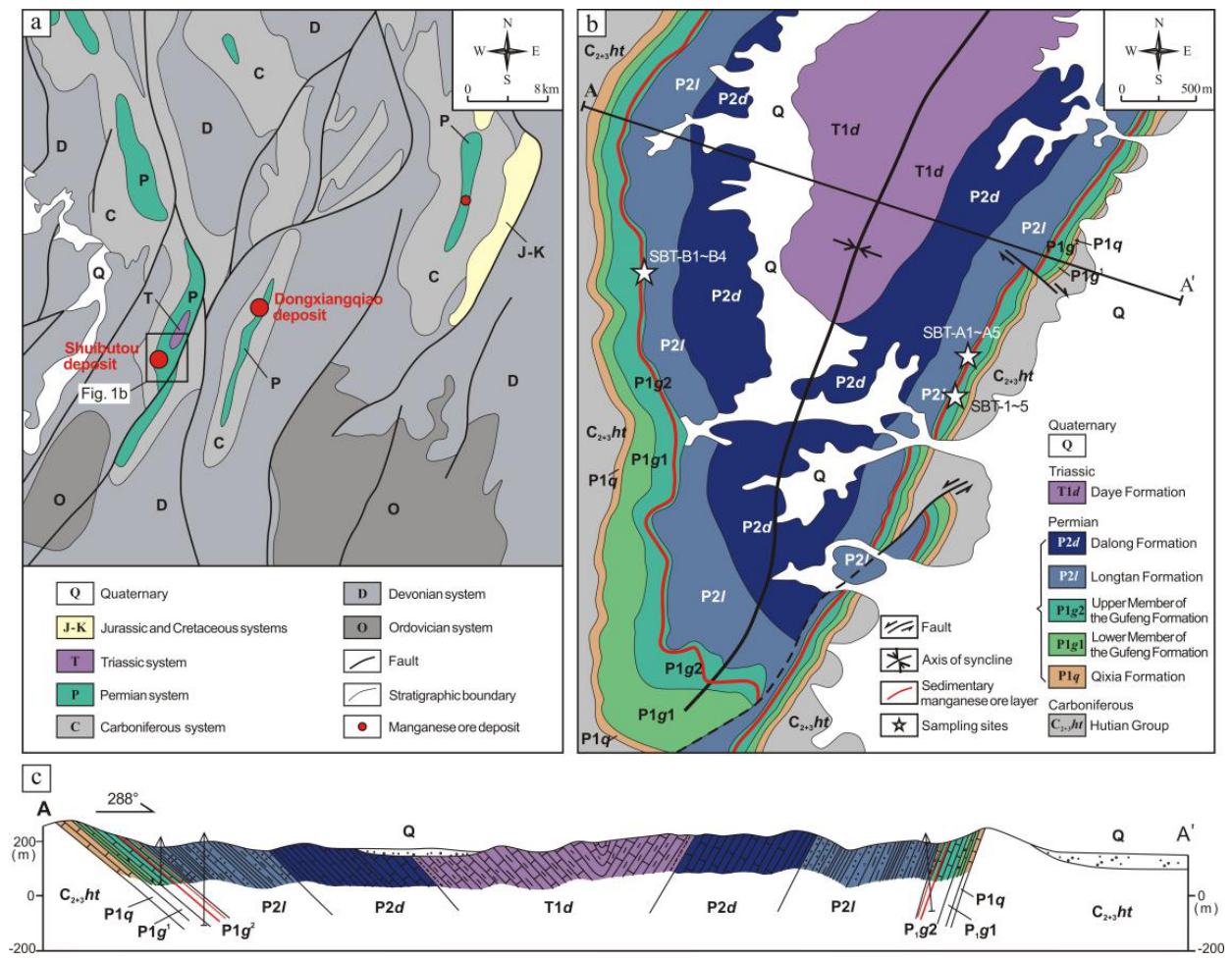
Figure 2.
Integrated stratigraphic column of the Shuibutou mining area, showing the main lithostratigraphic units, the positions of Ore Layers I–III, and their immediate hanging-wall and footwall lithologies.
Figure 2.
Integrated stratigraphic column of the Shuibutou mining area, showing the main lithostratigraphic units, the positions of Ore Layers I–III, and their immediate hanging-wall and footwall lithologies.
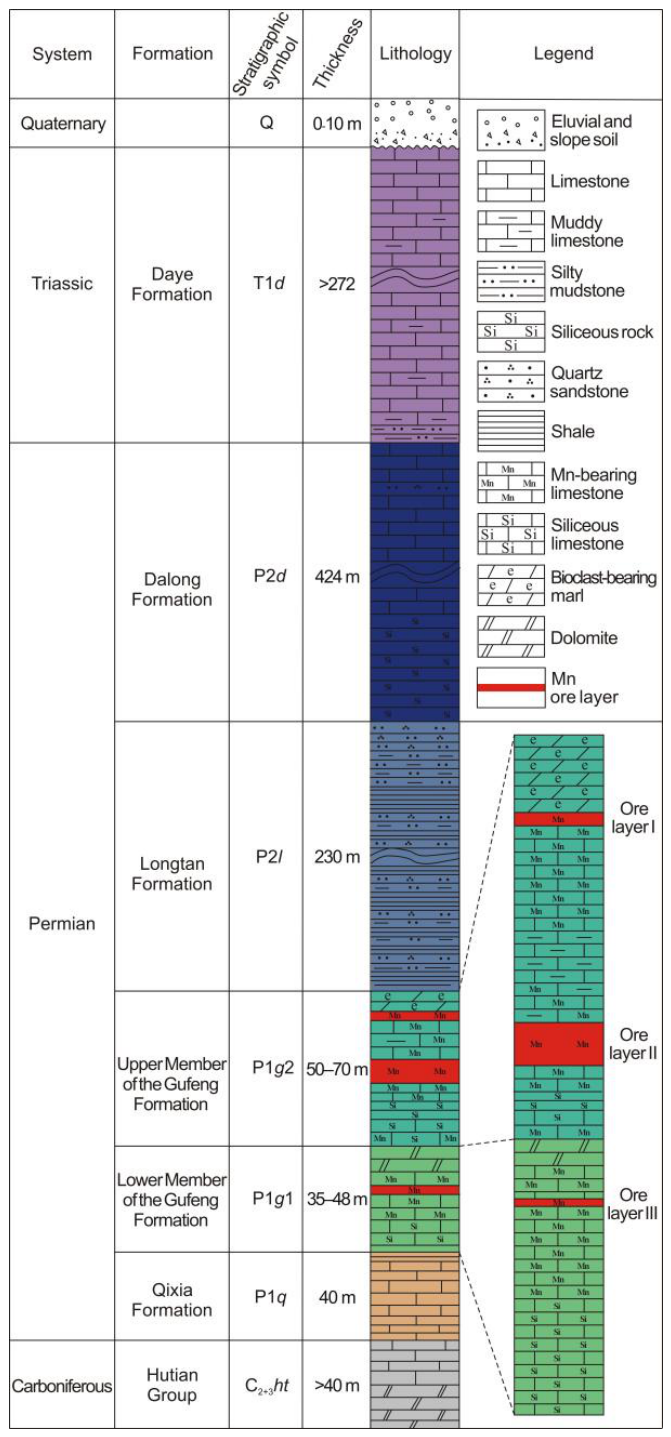
Figure 3.
Major-element correlation diagrams for Mn-rich rocks and wall rocks from the Shuibutou Mn deposit.
Figure 3.
Major-element correlation diagrams for Mn-rich rocks and wall rocks from the Shuibutou Mn deposit.
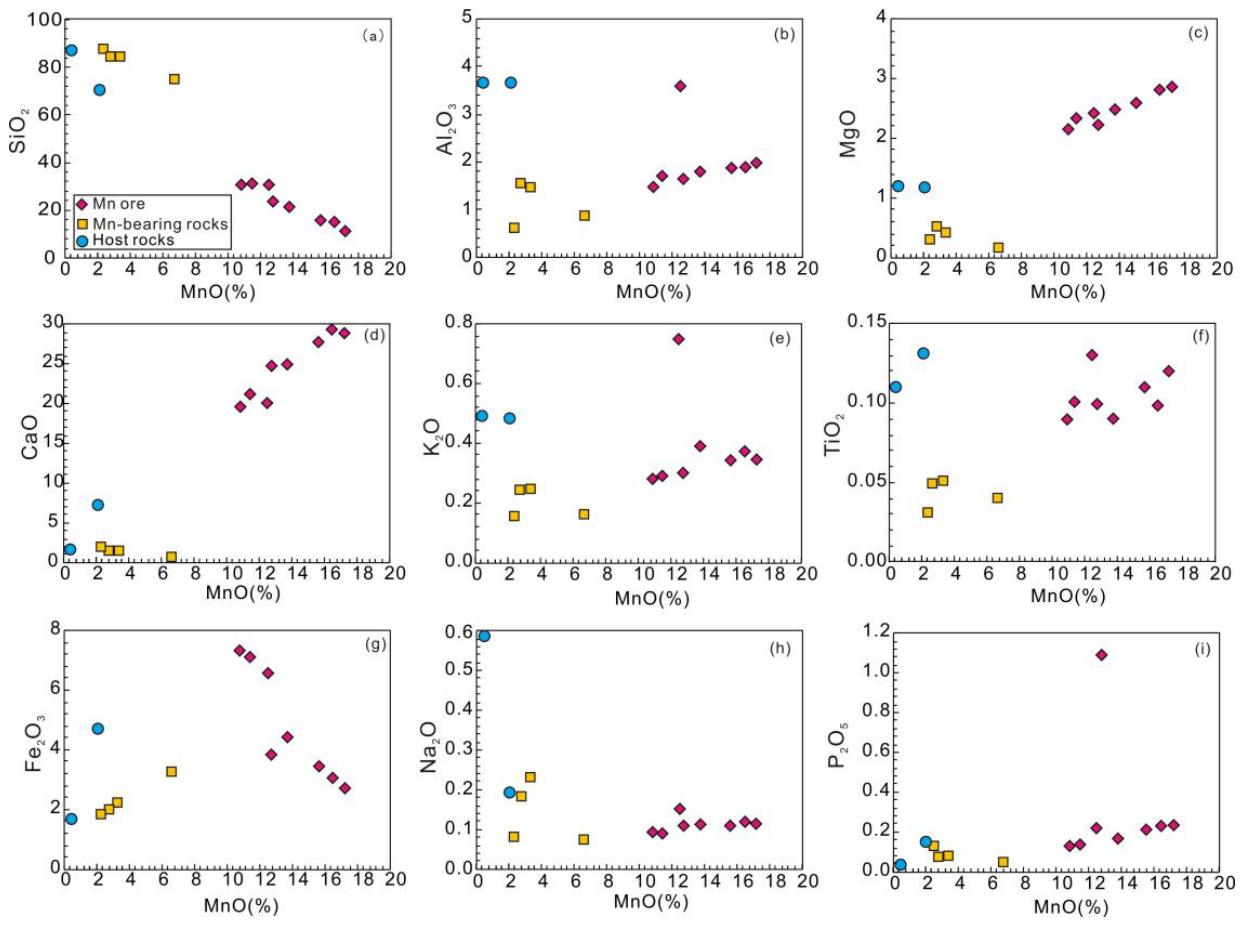
Figure 4.
PAAS-normalized trace-element patterns of (a) the Shuibutou samples and (b) the Dongxiangqiao Mn ores. PAAS: Post-Archean Australian Shale.
Figure 4.
PAAS-normalized trace-element patterns of (a) the Shuibutou samples and (b) the Dongxiangqiao Mn ores. PAAS: Post-Archean Australian Shale.
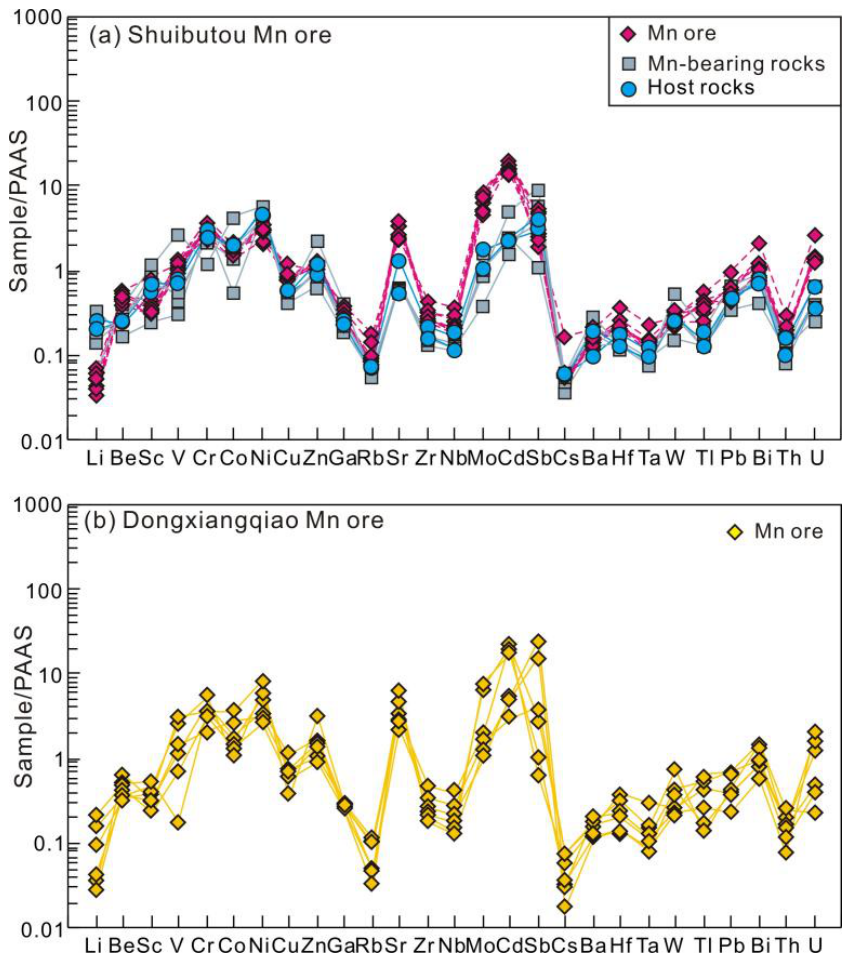
Figure 5.
PAAS-normalized rare earth element and yttrium (REY) patterns and chondrite-normalized rare earth element (REE) patterns of samples from the Shuibutou and Dongxiangqiao Mn deposits. (a) PAAS-normalized REY patterns of the Shuibutou samples; (b) chondrite-normalized REE patterns of the Shuibutou samples; (c) PAAS-normalized REY patterns of the Dongxiangqiao Mn ores; and (d) chondrite-normalized REE patterns of the Dongxiangqiao Mn ores. PAAS normalization values are from McLennan [23], and chondrite normalization values are from Boynton [24].
Figure 5.
PAAS-normalized rare earth element and yttrium (REY) patterns and chondrite-normalized rare earth element (REE) patterns of samples from the Shuibutou and Dongxiangqiao Mn deposits. (a) PAAS-normalized REY patterns of the Shuibutou samples; (b) chondrite-normalized REE patterns of the Shuibutou samples; (c) PAAS-normalized REY patterns of the Dongxiangqiao Mn ores; and (d) chondrite-normalized REE patterns of the Dongxiangqiao Mn ores. PAAS normalization values are from McLennan [23], and chondrite normalization values are from Boynton [24].
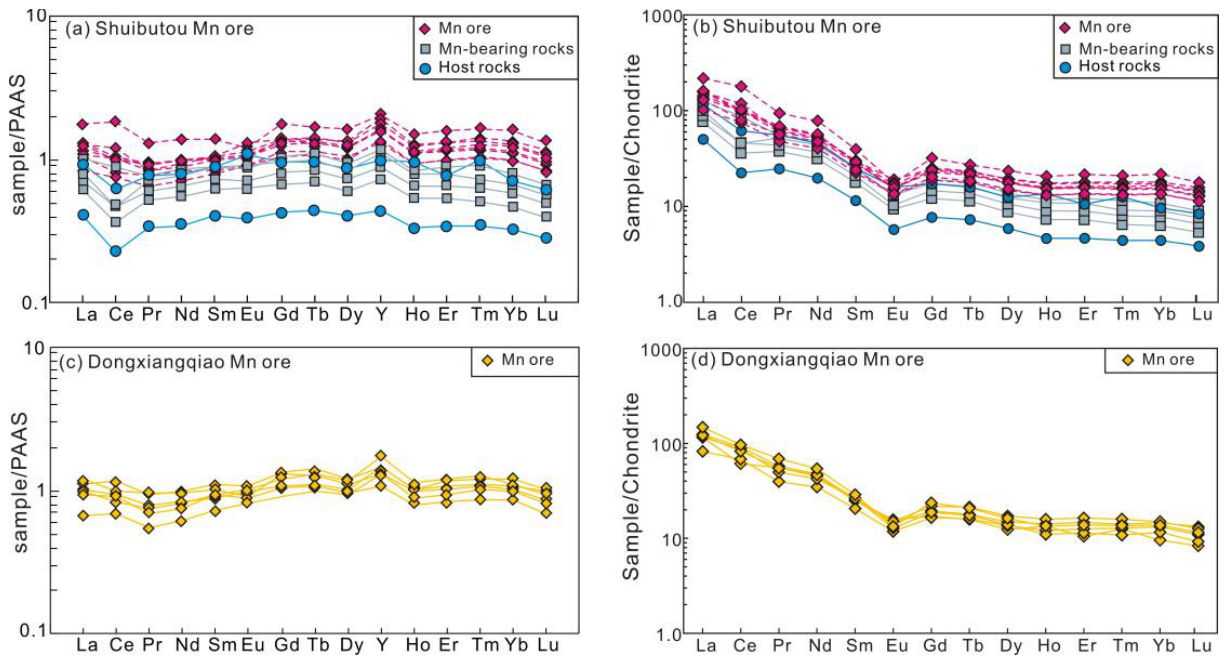
Figure 6.
Petrographic characteristics of manganese ore samples from the Shuibutou deposit. (a) Transmitted-light overview showing abundant rounded to ellipsoidal Mn-calcite grains and aggregates dispersed in a quartz- and clay-rich matrix, together with fossil fragments and pyrite. (b) Transmitted-light photomicrograph showing rounded to ellipsoidal Mn-calcite grains, pale gray to light brown in color, together with an elongate fossil fragment composed of a series of rounded chambers. (c) Reflected-light photomicrograph of the corresponding area, showing clusters of pyrite framboids adjacent to the fossil fragment and distributed among the Mn-calcite grains in the surrounding matrix. (d) Transmitted-light close-up of a rounded Mn-calcite aggregate composed predominantly of microcrystalline Mn-calcite and displaying a heterogeneous granular internal texture. (e) Reflected-light photomicrograph of the corresponding Mn-calcite aggregate, showing abundant pyrite framboids around the margin of the aggregate and in the surrounding matrix, whereas pyrite is relatively sparse within the aggregate. Mn-cal, Mn-calcite; Py, pyrite.
Figure 6.
Petrographic characteristics of manganese ore samples from the Shuibutou deposit. (a) Transmitted-light overview showing abundant rounded to ellipsoidal Mn-calcite grains and aggregates dispersed in a quartz- and clay-rich matrix, together with fossil fragments and pyrite. (b) Transmitted-light photomicrograph showing rounded to ellipsoidal Mn-calcite grains, pale gray to light brown in color, together with an elongate fossil fragment composed of a series of rounded chambers. (c) Reflected-light photomicrograph of the corresponding area, showing clusters of pyrite framboids adjacent to the fossil fragment and distributed among the Mn-calcite grains in the surrounding matrix. (d) Transmitted-light close-up of a rounded Mn-calcite aggregate composed predominantly of microcrystalline Mn-calcite and displaying a heterogeneous granular internal texture. (e) Reflected-light photomicrograph of the corresponding Mn-calcite aggregate, showing abundant pyrite framboids around the margin of the aggregate and in the surrounding matrix, whereas pyrite is relatively sparse within the aggregate. Mn-cal, Mn-calcite; Py, pyrite.
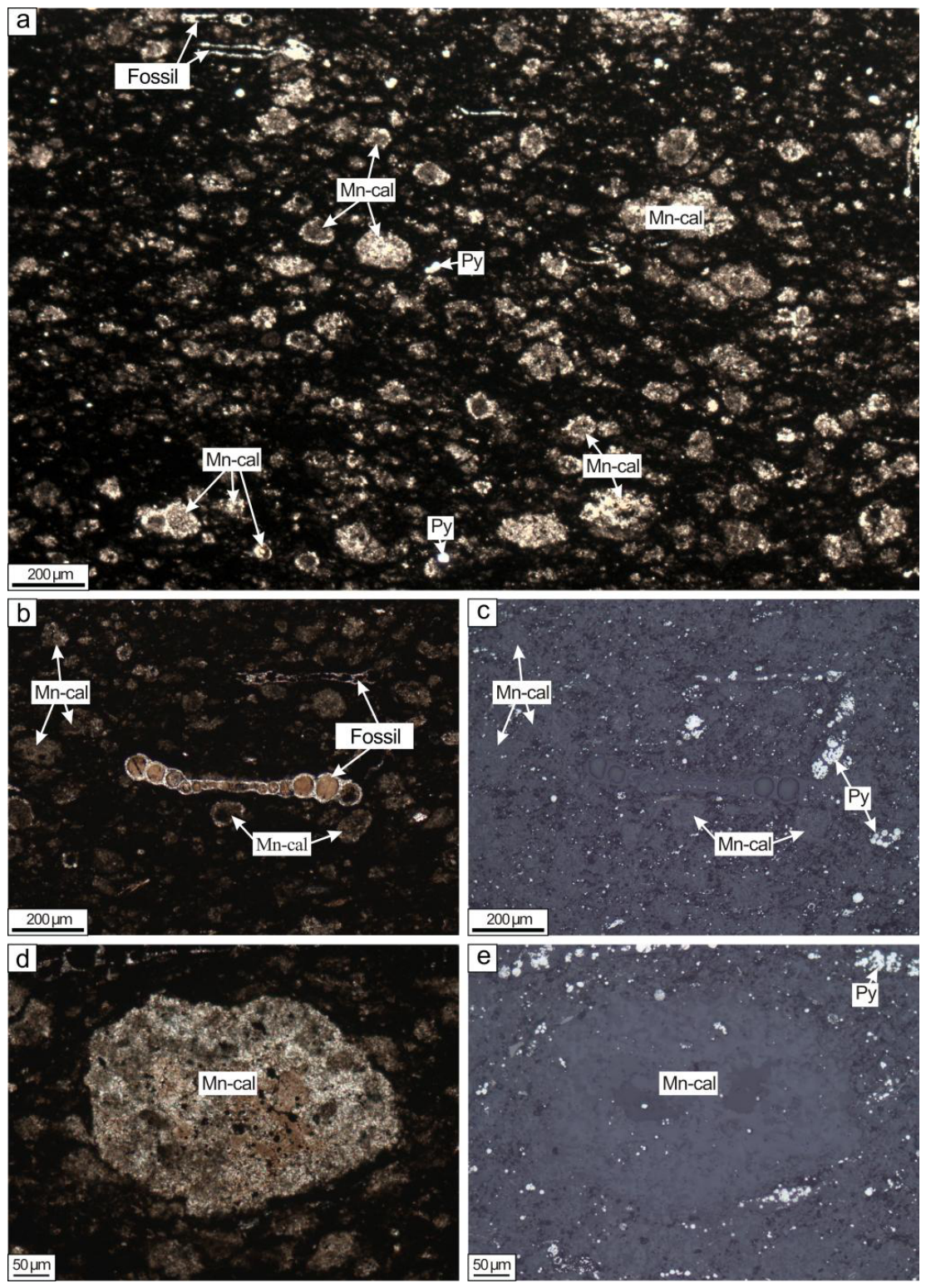
Figure 7.
SEM–BSE images and EDS elemental maps of Mn-rich ore from the Shuibutou deposit. (a) BSE overview showing Mn-calcite, subordinate calcite, and abundant pyrite grains and aggregates in the matrix. The white rectangle marks the area enlarged in (b). (b) Enlarged BSE image showing Mn-calcite associated with calcite, quartz, and abundant pyrite framboids, locally occurring along fractures and intergranular spaces. (c) Composite EDS elemental map of the area shown in (b). (d–i) Individual elemental maps of Mn, Ca, O, Si, Fe, and S, respectively. Mn and Ca are broadly distributed in the carbonate matrix, Si is broadly distributed with local enrichment in quartz, and Fe and S are concentrated in pyrite framboids and aggregates. Mn-cal, Mn-calcite; Cal, calcite; Qz, quartz; Py, pyrite.
Figure 7.
SEM–BSE images and EDS elemental maps of Mn-rich ore from the Shuibutou deposit. (a) BSE overview showing Mn-calcite, subordinate calcite, and abundant pyrite grains and aggregates in the matrix. The white rectangle marks the area enlarged in (b). (b) Enlarged BSE image showing Mn-calcite associated with calcite, quartz, and abundant pyrite framboids, locally occurring along fractures and intergranular spaces. (c) Composite EDS elemental map of the area shown in (b). (d–i) Individual elemental maps of Mn, Ca, O, Si, Fe, and S, respectively. Mn and Ca are broadly distributed in the carbonate matrix, Si is broadly distributed with local enrichment in quartz, and Fe and S are concentrated in pyrite framboids and aggregates. Mn-cal, Mn-calcite; Cal, calcite; Qz, quartz; Py, pyrite.
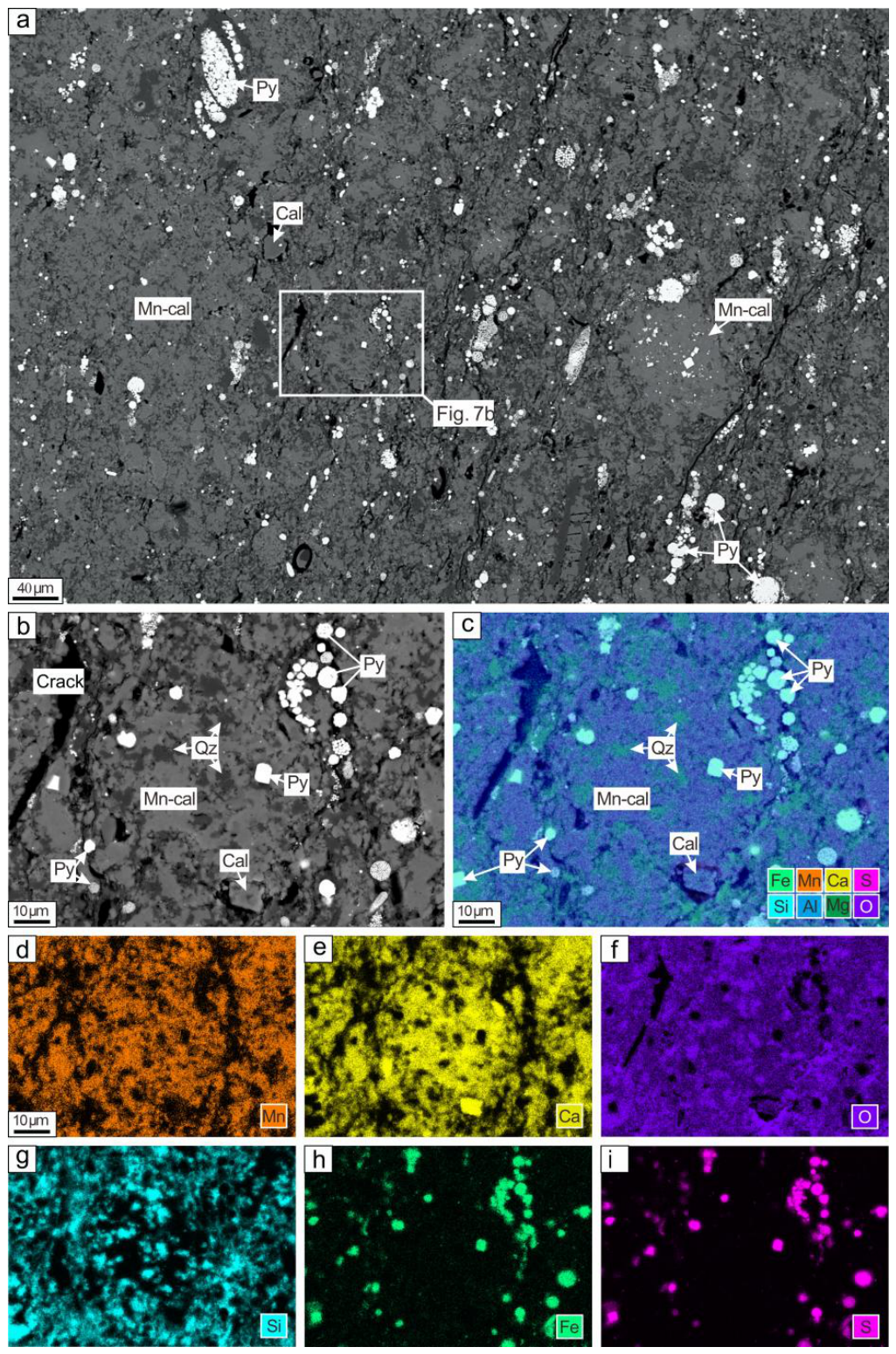
Figure 8.
Redox-sensitive geochemical characteristics of the Shuibutou, Dongxiangqiao, and Changgou deposits: (a) Mo–U co-variation; (b) MoEF–UEF covariation, with redox fields after Algeo and Tribovillard [31]; (c) MnO versus (Ce/Ce*)SN; (d) TOC versus MnO. AUCC, average upper continental crust.
Figure 8.
Redox-sensitive geochemical characteristics of the Shuibutou, Dongxiangqiao, and Changgou deposits: (a) Mo–U co-variation; (b) MoEF–UEF covariation, with redox fields after Algeo and Tribovillard [31]; (c) MnO versus (Ce/Ce*)SN; (d) TOC versus MnO. AUCC, average upper continental crust.
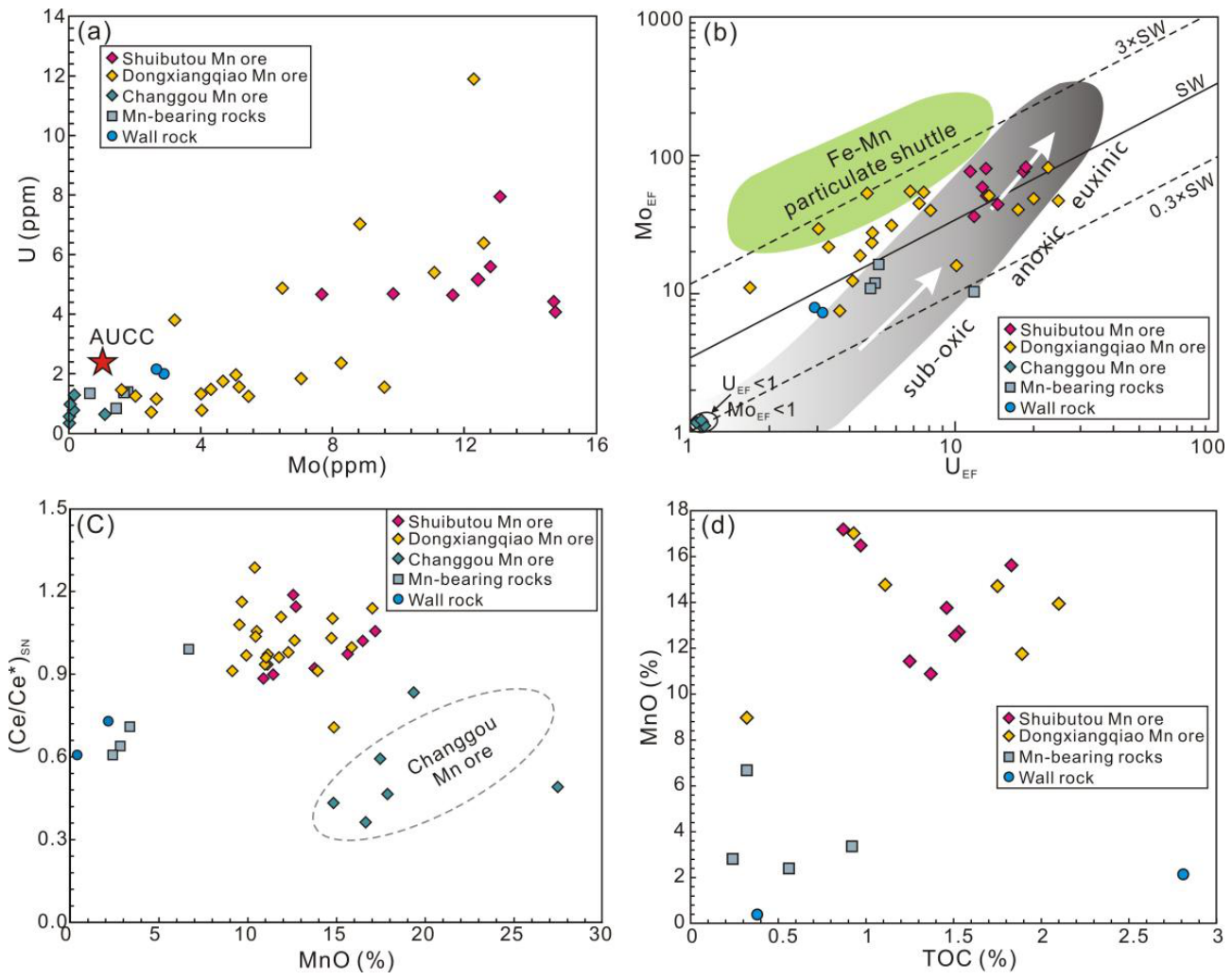
Figure 9.
Carbon and oxygen isotope compositions of Permian Mn-carbonate ores and associated rocks. The reference fields and isotope-evolution vectors are modified after Xu et al. [44]. Comparative data for the Dongxiangqiao, Changgou/Zunyi, and Datangpo-type deposits are from [4,6,7,38].
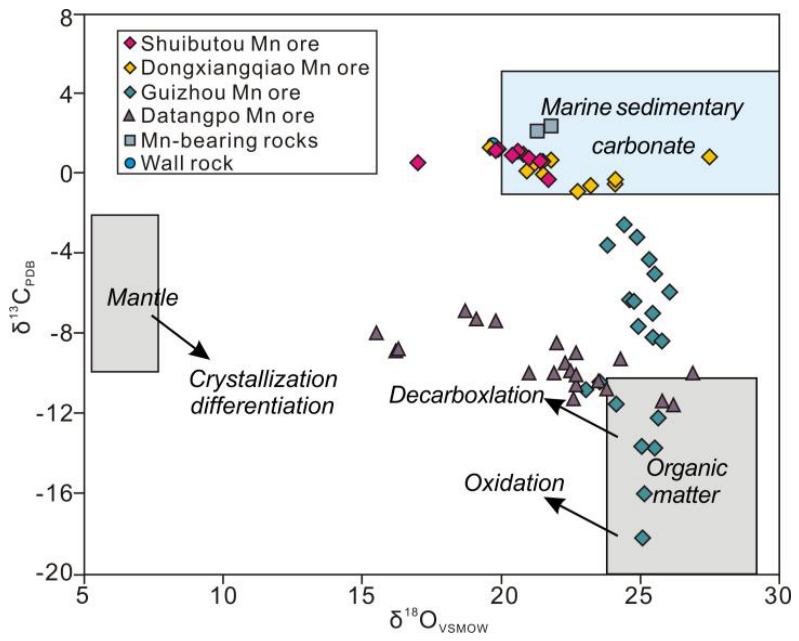
Figure 10.
Geochemical discrimination diagrams used to provide comparative constraints on the possible origin of Mn: (a) Fe/Ti versus Al/(Al + Fe + Mn), after Marchig et al. [50]. The curve represents mixing between East Pacific Rise hydrothermal metalliferous sediments and pelagic sediments, and the values 20, 40, 60, and 80 indicate the approximate percentage of the East Pacific Rise component in the mixture; (b) Co–Ni–Zn, after Choi and Hariya [52] and Toth [53]; (c) Fe–Mn–10 × (Ni + Co + Cu), after Bonatti [56]; (d) logU versus logTh, after Boström [57]. The fields are comparative screening criteria and are not uniquely diagnostic of source.
Figure 10.
Geochemical discrimination diagrams used to provide comparative constraints on the possible origin of Mn: (a) Fe/Ti versus Al/(Al + Fe + Mn), after Marchig et al. [50]. The curve represents mixing between East Pacific Rise hydrothermal metalliferous sediments and pelagic sediments, and the values 20, 40, 60, and 80 indicate the approximate percentage of the East Pacific Rise component in the mixture; (b) Co–Ni–Zn, after Choi and Hariya [52] and Toth [53]; (c) Fe–Mn–10 × (Ni + Co + Cu), after Bonatti [56]; (d) logU versus logTh, after Boström [57]. The fields are comparative screening criteria and are not uniquely diagnostic of source.
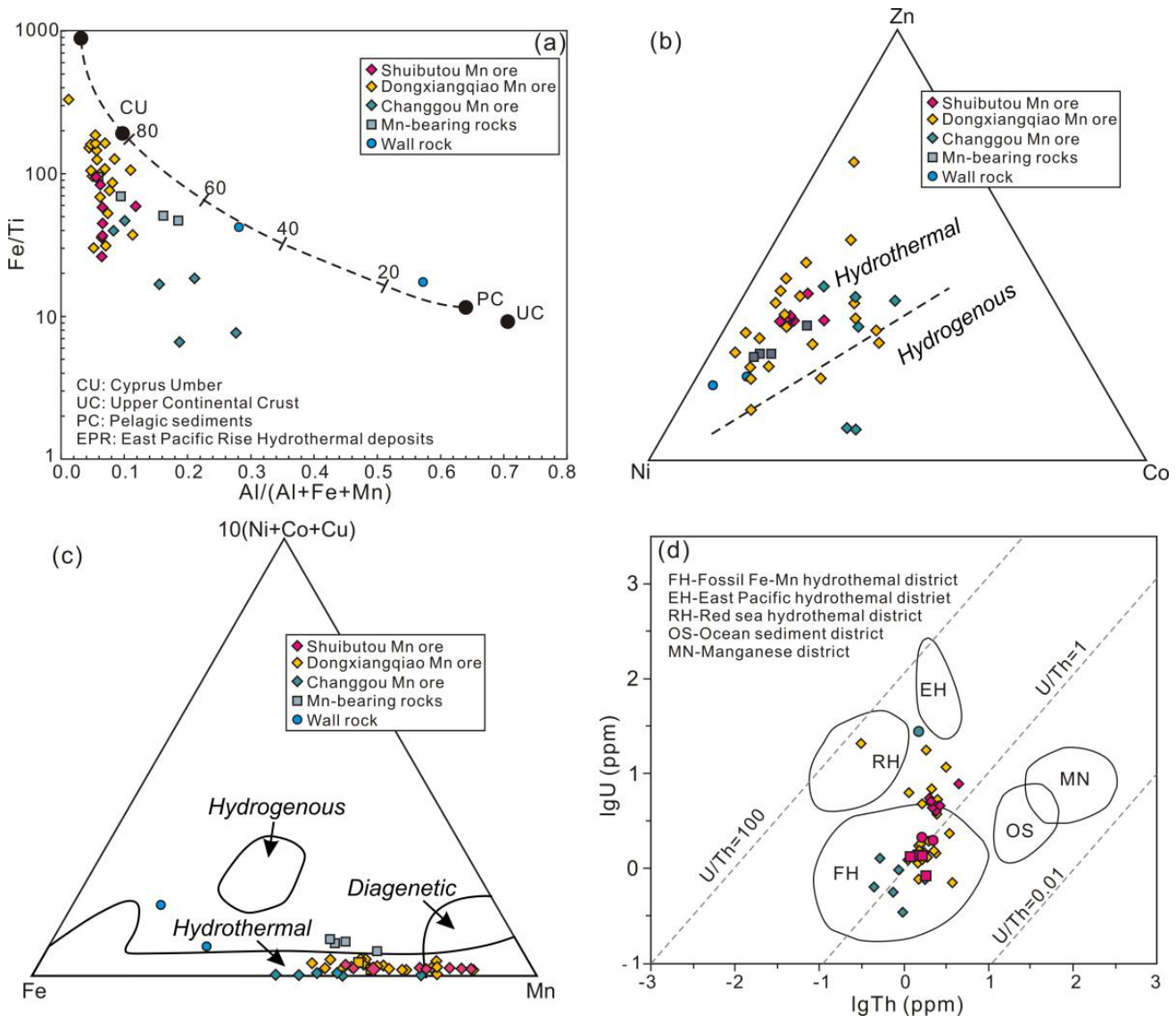
Figure 11.
Whole-rock geochemical discrimination diagrams of the Shuibutou, Dongxiangqiao, and Changgou deposits for different genetic types of Mn deposits, modified after Ehya and Marbouti [54]. (a) (Ce/Ce*)SN versus Nd. (b) Ce versus (Co + Ni + Cu)/1000. (c) Ce versus Zr. (d) (Ce/Ce*)SN versus (Y/Ho)SN. The upper-left pink field represents hydrothermal deposits after Zeng et al. [62], the lower-central pale-pink field represents hydrothermal deposits after Josso et al. [63], the upper-right blue field represents hydrogenetic deposits after Hein et al. [64], the central-right green field represents diagenetic deposits after Baturin [65], and the upper-central pale-yellow field represents the sedimentary-hydrothermal Nikopol deposit after Sasmaz et al. [66]. SN denotes PAAS normalization.
Figure 11.
Whole-rock geochemical discrimination diagrams of the Shuibutou, Dongxiangqiao, and Changgou deposits for different genetic types of Mn deposits, modified after Ehya and Marbouti [54]. (a) (Ce/Ce*)SN versus Nd. (b) Ce versus (Co + Ni + Cu)/1000. (c) Ce versus Zr. (d) (Ce/Ce*)SN versus (Y/Ho)SN. The upper-left pink field represents hydrothermal deposits after Zeng et al. [62], the lower-central pale-pink field represents hydrothermal deposits after Josso et al. [63], the upper-right blue field represents hydrogenetic deposits after Hein et al. [64], the central-right green field represents diagenetic deposits after Baturin [65], and the upper-central pale-yellow field represents the sedimentary-hydrothermal Nikopol deposit after Sasmaz et al. [66]. SN denotes PAAS normalization.
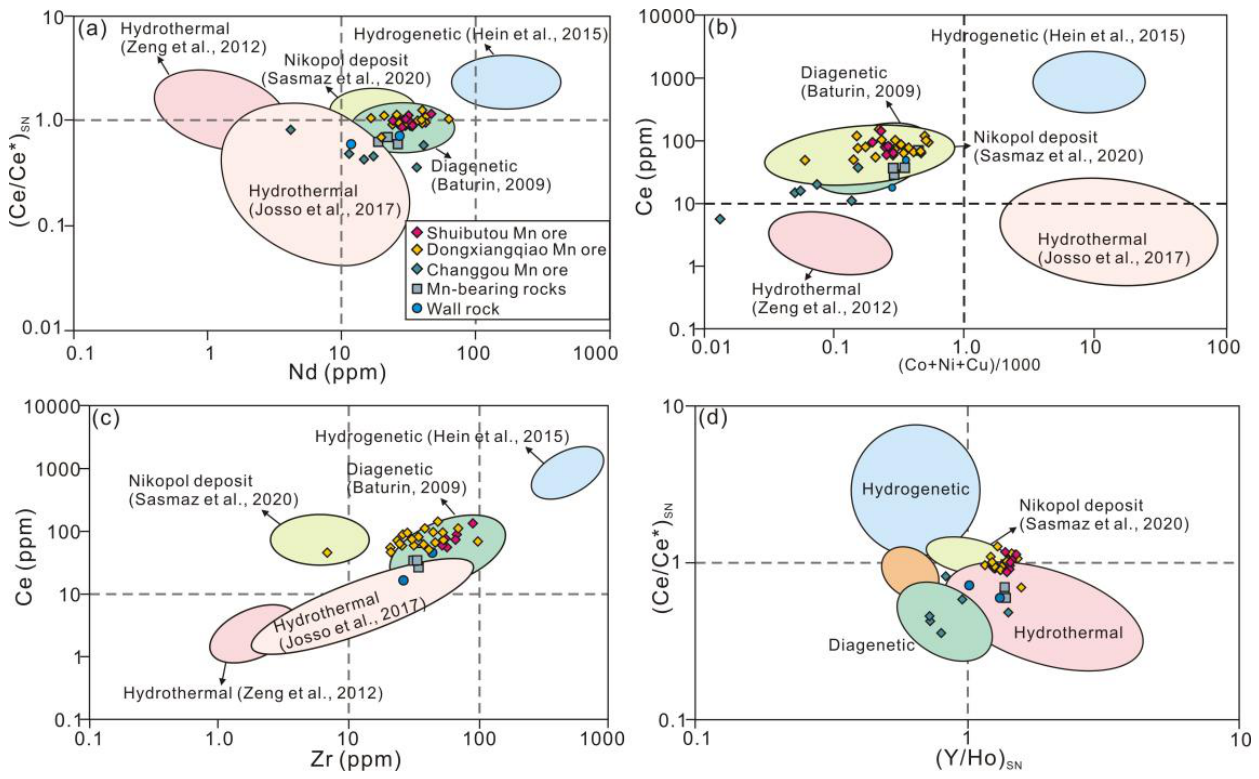
Figure 12.
Working conceptual metallogenic model for the Shuibutou and Dongxiangqiao Mn-carbonate deposits. The model is not to scale, and the depositional-facies framework is modified after Huang et al. [15].
Figure 12.
Working conceptual metallogenic model for the Shuibutou and Dongxiangqiao Mn-carbonate deposits. The model is not to scale, and the depositional-facies framework is modified after Huang et al. [15].
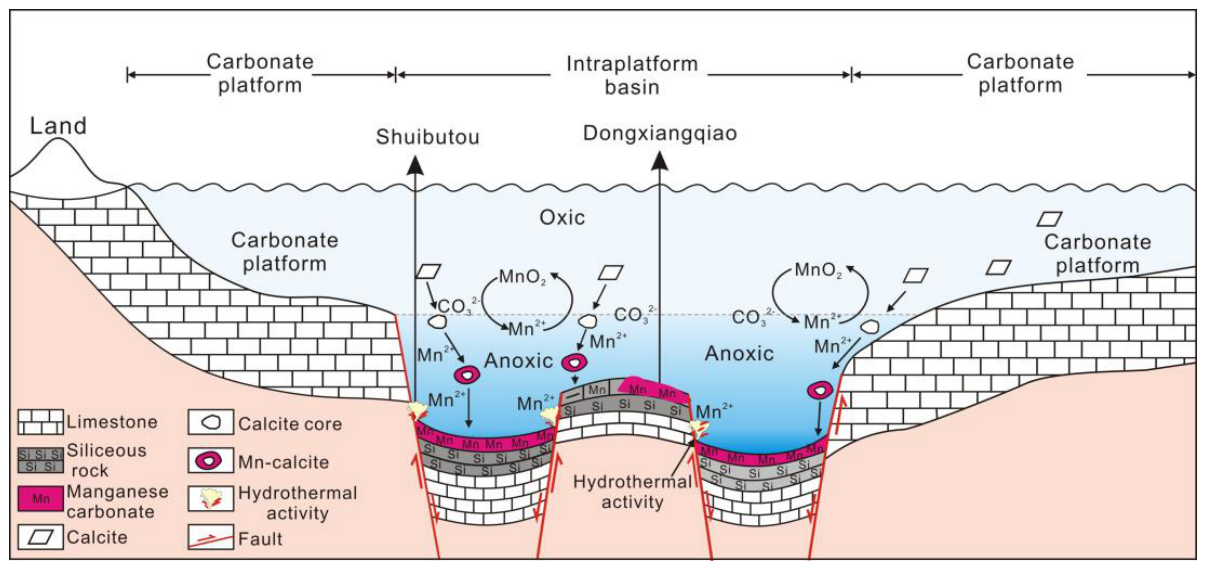

Table 1.
Sampling locations in the Shuibutou mining area.
| Sample No. | Lithology | Sampling location | Formation |
|---|---|---|---|
| SBT-1 | Manganese carbonate | 26°04’4.31”N, 111°17’51.81”E | Gufeng Formation |
| SBT-2 | Manganese carbonate | 26°04’4.56”N, 111°17’52.33”E | Gufeng Formation |
| SBT-3 | Manganese-bearing siliceous limestone | 26°04’9.78”N, 111°17’56.28”E | Gufeng Formation |
| SBT-4 | Manganese-bearing siliceous limestone | 26°04’10.14”N, 111°17’57.04”E | Gufeng Formation |
| SBT-5 | Siliceous limestone | 26°04’10.19”N, 111°17’58.21”E | Gufeng Formation |
| SBT-A1 | Manganese carbonate | 26°04’50.21”N, 111°18’22.78”E | Gufeng Formation |
| SBT-A2 | Manganese carbonate | 26°04’50.44”N, 111°18’22.40”E | Gufeng Formation |
| SBT-A3 | Manganese carbonate | 26°04’50.73”N, 111°18’22.19”E | Gufeng Formation |
| SBT-A4 | Siliceous limestone | 26°04’50.08”N, 111°18’21.33”E | Gufeng Formation |
| SBT-A5 | Calcareous mudstone | 26°04’50.65”N, 111°18’20.51”E | Gufeng Formation |
| SBT-B1 | Manganese carbonate | 26°04’52.89”N, 111°16’30.16”E | Gufeng Formation |
| SBT-B2 | Manganese carbonate | 26°04’52.43”N, 111°16’30.77”E | Gufeng Formation |
| SBT-B3 | Manganese carbonate | 26°04’52.22”N, 111°16’33.34”E | Gufeng Formation |
| SBT-B4 | Siliceous limestone | 26°04’53.50”N, 111°16’35.07”E | Gufeng Formation |
Disclaimer/Publisher’s Note: The statements, opinions and data contained in all publications are solely those of the individual author(s) and contributor(s) and not of MDPI and/or the editor(s). MDPI and/or the editor(s) disclaim responsibility for any injury to people or property resulting from any ideas, methods, instructions or products referred to in the content. |
© 2026 by the authors. Licensee MDPI, Basel, Switzerland. This article is an open access article distributed under the terms and conditions of the Creative Commons Attribution (CC BY) license.
Copyright: This open access article is published under a Creative Commons CC BY 4.0 license, which permit the free download, distribution, and reuse, provided that the author and preprint are cited in any reuse.