

Submitted:
16 August 2026
Posted:
17 August 2026
You are already at the latest version
Abstract
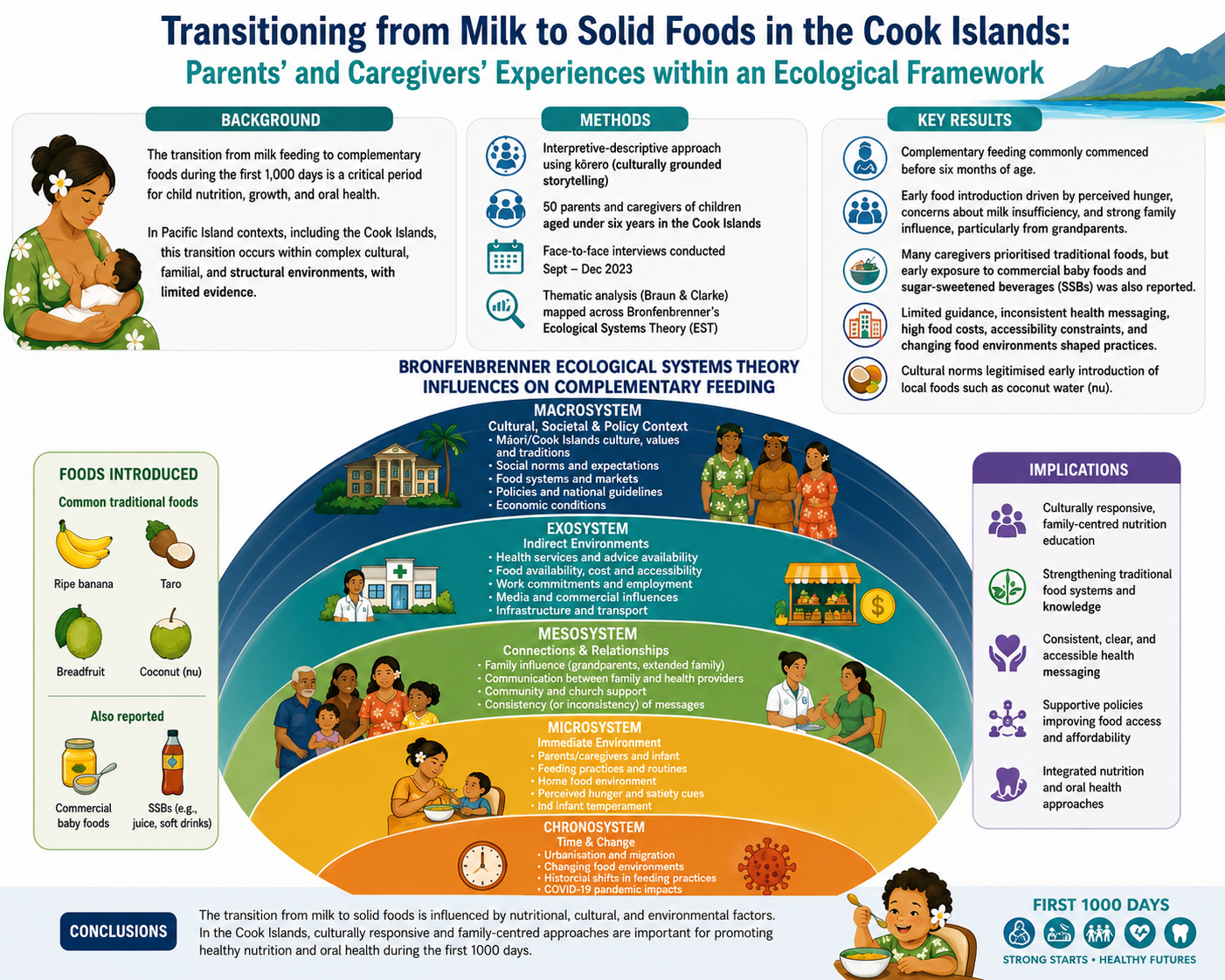
Background: The transition from milk feeding to complementary foods during the first 1000 days is a critical period for child nutrition, growth, and oral health. This study explored Cook Islands Māori parents’ and caregivers’ experiences of transitioning infants from milk to complementary foods, with a focus on their knowledge, practices, and contextual influences, using Bronfenbrenner’s Ecological Systems Theory. Methods: An interpretive-descriptive approach was employed, using kōrero, a culturally grounded qualitative method of storytelling and shared dialogue. Fifty parents and caregivers of children aged under six years in the Cook Islands participated in face-to-face interviews conducted between September and December 2023. Data were thematically analysed following Braun and Clarke’s framework and mapped across the micro, meso, exo, macro, and chronosystem levels of the Bronfenbrenner Ecological System Theory (EST). Results: Complementary feeding commonly commenced before six months of age, and was shaped by interacting influences across family, health system, cultural, environmental, and societal contexts. Perceptions of infant hunger, concerns about insufficient milk intake, and strong family influence, particularly from grandparents, contributed to early introduction of complementary foods. Conclusion: Complementary feeding during the first 1000 days in the Cook Islands is shaped by interconnected nutritional, familial, cultural, health-system, and environmental influences. The transition from milk to solid foods is influenced by nutritional, cultural, and environmental factors. In the Cook Islands, culturally responsive and family-centred approaches are important for promoting healthy nutrition and oral health during the first 1000 days.
Keywords:
complementary feeding
; infant feeding
; first 1000 days
Copyright: This open access article is published under a Creative Commons CC BY 4.0 license, which permit the free download, distribution, and reuse, provided that the author and preprint are cited in any reuse.