

Submitted:
14 August 2026
Posted:
17 August 2026
You are already at the latest version
Abstract
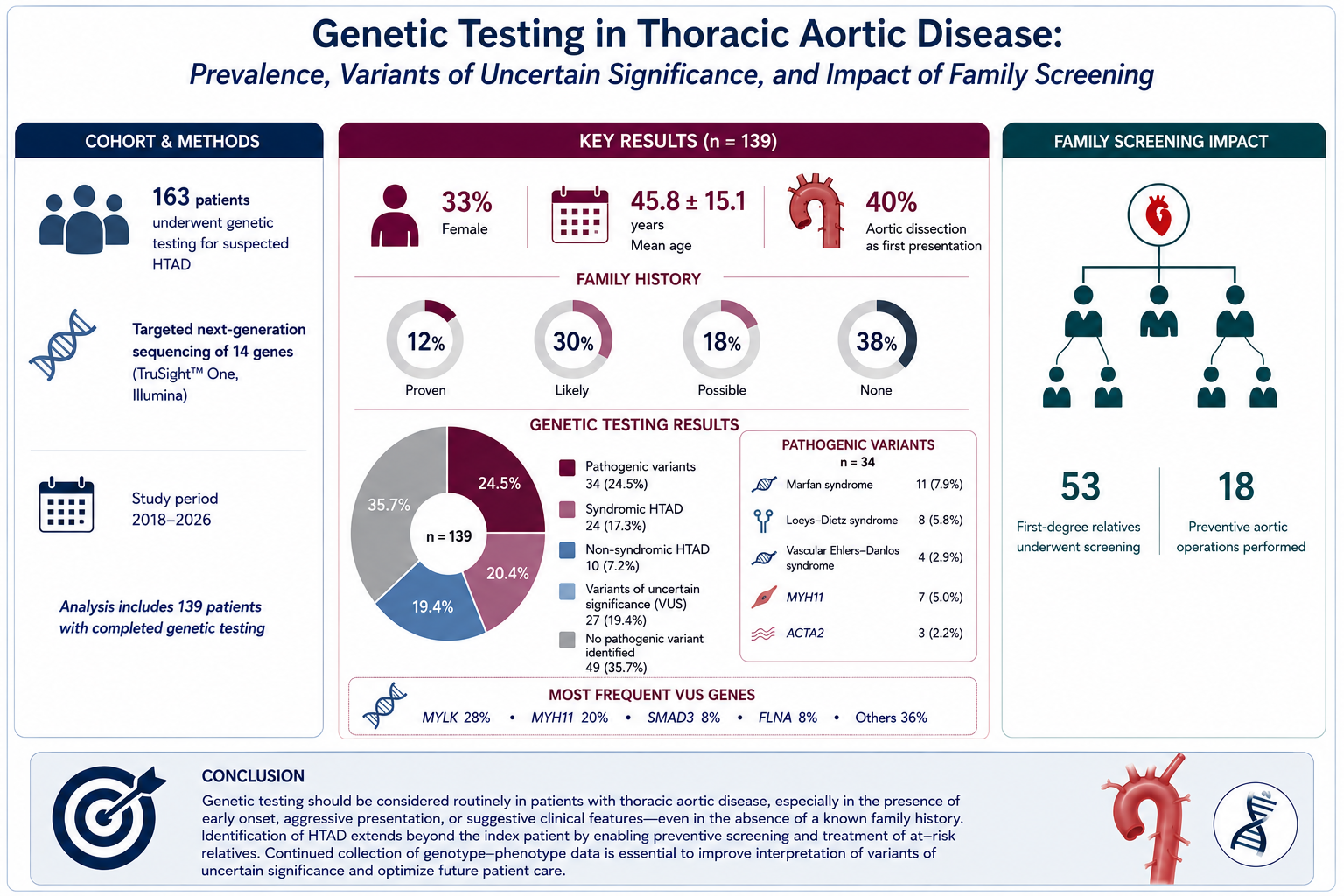
Objective: Heritable thoracic aortic disease (HTAD) is an important cause of thoracic aortic aneurysm and dissection, yet remains underdiagnosed. We aimed to summarize the prevalence of syndromic and non-syndromic HTAD, describe variants of uncertain significance (VUS), and evaluate the impact of family screening in a contemporary cardiothoracic surgical cohort. Methods: Between 2018 and 2026, 163 patients underwent genetic testing for suspected HTAD at our institution. A total of 139 patients with completed genetic testing were included in the analysis. Indications for testing included root aneurysm or acute aortic dissection before the age of 60 years with or without positive family history, aneurysms involving multiple vascular territories, or syndromic features suggestive of a heritable aortopathy. Results: The mean age at testing was 45.8 ± 15.1 years and 33% of patients were female. Aortic dissection represented the initial manifestation of disease in 40% of patients. Positive family history was present in 60% of patients. Genetic alterations were identified in 45% of patients, including pathogenic variants in 25%. Twenty-four patients were diagnosed with syndromic HTAD, most commonly Marfan syndrome, while 10 patients were found to have non-syndromic HTAD. Variants of uncertain significance were detected in 27 patients (20%), predominantly affecting MYLK and MYH11. Following diagnosis, 53 first-degree relatives underwent screening, resulting in 18 prophylactic aortic operations. Conclusion: Cardiac surgeons should be aware of the importance of genetic testing in patients with aortic disease. Beyond the individual patient, the broader goal is to identify at-risk family members and prevent acute aortic syndromes. Continued collection of genotype–phenotype data is essential to improve interpretation of variants of uncertain significance and optimize future patient care.
Keywords:
genetic aortopathy
; aortic dissection
; aortic aneurysm
; genetic testing
- Central Illustration
1. Introduction
Genetic testing is recommended in patients with thoracic aortic disease diagnosed before the age of 60 years, those with a postive family history of thoracic aortic disease, aneurysms in other arterial segments, or syndromic features suggestive of a heritable aortopathy (1). Currently more than 60 genes have been found to be potentially causative of thoracic aortic disease (TAD)(2). According to ClinGen, the following 11 genes have a definitive or strong association with heritable thoracic aortic disease (HTAD): ACTA2, COL3A1, FBN1, LOX, MYH11, MYLK, PRKG1, SMAD 3, TGFB2, TGFBR1 and TGFBR1 (3,4). However, current genetic sequencing identifies potential causative genes in only 20% of patients tested (3). Chen et al. reported that a positive family history of aortic dissection (AD) in a first-degree relative was associated with a 6.56-fold increased risk of AD, after excluding patients with Marfan syndrome and bicuspid aortopathy. The risk was highest among individuals with an affected sibling. The heritability of AD was estimated to be 57% in this study including close to 24.000 patients (5). Familiar aneurysms were found to be more malignant than sporadic aneurysms by the Yale group already over 20 years ago, with an earlier presentation and faster yearly aortic growth (6). The same working group reported that at least 50% of patients suffered from aortic dissection within a five-year window before or after the age at which an affected family member had experienced a dissection (7). Regalado et al. illustrated the complexity of individualized aortic care by demonstrating differences in the risk of aortic events associated with specific mutations in seven rare non-syndromic genes. Their findings highlight the importance of genetic counseling following diagnosis and of interdisciplinary collaboration in the management of patients with heritable aortic disease (8). Taken together, the available evidence highlights the importance of genetic testing in cardiac surgery and the key role of cardiac surgeons as the main treating physicians in identifying patients who may benefit from genetic testing. The aim of our report was to provide real-world insight into the prevalence of heritable thoracic aortic disease (HTAD), the impact of family history, and the role of family screening in contemporary aortic care, based on our single-centre experience.
Patients and methods
Study cohort
Between 2018 and 2026 163 patients underwent genetic testing for hereditary thoracic aortic disease (HTAD) at our centre. Testing was performed by massive parallel sequencing of 14 genes with Nextera Rapid Capture (TruSightTMOne, NextSeq, Illumina; for details on genes tested see Figure 1 (9) and is covered by public national insurance. Testing was performed at our centre if patients suffered from acute aortic dissection or aortic root aneurysm with tricuspid valve at age <60 years, a positive family history in a second- or first-degree family member of TAD or peripheral/ intracrainial aneurysm were evident, if arterial aneurysms were also present in other segments or aneurysm size progression was rapid and in those with aneurysm/ dissection and syndromic features (1,10).
Information on family history was obtained when genetic testing was performed at our outpatient clinic or if missing via telephone interviews.
Family history was defined as followed:
a) proven: pathogenic/likely pathogenic variant in genetic testing or established syndromic diagnosis of a first-degree family member.
b) likely: at least two biologically related family members were affected by thoracic aortic aneurysm or at least one first-degree family member suffered from aortic dissection at a young age, suggesting familial/heritable disease, but no causative genetic variant had been identified.c) possible: suggestive family history or clinical features raising suspicion of heritable disease, e.g. sudden unexplained death at young age of a first degree family member or aneurysms of second degree family members.
All patients diagnosed with HTAD were offered genetic counselling at the institute of human genetics. Genetic counselling, cascade genetic testing, and aortic imaging was recommended for all first-degree relatives of individuals with confirmed HTAD. In addition, patients with a variant of uncertain significance (VUS) received genetic counselling, including a recommendation for aortic imaging of their first-degree relatives. Echocardiographic screening was also recommended for first-degree relatives of patients with a negative genetic test result but a positive family history and aortic events suggestive of hereditary disease (11). Data on family screening after diagnosis was obtained via telephone interviews.
Statistical Analysis
IBM SPSS Statistics Version 24 (IBM Corp., Armonk, N.Y., USA) was used for statistical analysis. Continuous variables were tested for normal distribution using Kolmogorov-Smirnov test first and are either expressed as mean ± standard deviation or median and interquartile range. Categorical variables are shown as frequencies with corresponding percentages.
2. Results
A total of 139 patients with completed genetic testing and available test results were analyzed. Median age was 45.8 ± 15.1 years at timepoint of testing and 33% (n=46) of patients were female. Genetic alterations were identified in 44.9% of patients (n = 61), of whom 24.5% (n = 34) carried a pathogenic variant. For more details see Table 1.
Indications for genetic testing
Aneurysm (aortic root or ascending combined with positive family history) at an age <60 years was the most prevalent reason for testing (49.6%; n=69). Seven percent (n=10) presented with multiple aneurysms at different anatomical locations. Fourty percent (n=55) of patients were tested after surviving an aortic dissection or contained rupture. In 3 patients (2.2%) analysis was performed post-mortem after dissection/ rupture. In one patient reason for testing could not be evaluated retrospectively. Eight percent of patients (n=11) had normal diameters at timepoint of testing and were screened due to highly positive family history / proven family history for HTAD. For more details see Table 2.
Twelve percent (n=16) had a proven family history. In 30.2% of patients (n=42) family history was likely, in 18% (n=25) possible. Fifty-three patients (38.1%) underwent genetic testing despite having no family history, based on clinical features suggestive of HTAD. In three patients details on family history could not be evaluated. More details on family history is displayed in Table 2.
Syndromic hereditary thoracic aortic disease
Over the past 12 years, 24 patients with syndromic HTAD were identified at our cardiothoracic surgery department. Marfan syndrome was the most prevalent diagnosis (n = 11), followed by Loeys–Dietz syndrome (n = 8) and vascular Ehlers–Danlos syndrome (n = 4). One additional patient was diagnosed with Turner syndrome. For more details see Table 1.
Non-syndromic hereditary thoracic aortic disease
A diagnosis of non-syndromic HTAD was established in ten patients. Among patients with non-syndromic HTAD, pathogenic MYH11 variants were identified in seven patients, while three patients carried a pathogenic ACTA2 variant. Specific alterations are displayed in Table 1.
Variants of unclear significance
In our cohort, 19.4% of patients (n = 27) were found to carry a variant of still uncertain significance (VUS). Two patients were found to carry more than one variant of uncertain significance in different HTAD-associated genes, one patients presented 2 VUS of the same gene. Variants of uncertain significance were identified in MYLK (n = 11), FBN1 (Marfan syndrome-associated gene; n = 6), MYH11 (n=6), TGFBR1/TGFBR2 (Loeys–Dietz syndrome-associated genes; n = 3), COL3A1 (vascular Ehlers–Danlos syndrome-associated gene; n = 2), MFAP5 (n = 1), and LOX (n = 1). A detailed overview of the clinical presentation and family history of patients with a variant of uncertain significance is provided in Table 5.

Table 4.
Different variants of unclear significance and their clinical presentation.
| Gene | HGVS Variant | Clinical presentation | Age (sex) | Family members with aneurysms | Family members dissected / died |
|---|---|---|---|---|---|
| MYLK NM_053023.5 |
c.1005_1007delinsTCT p.(Pro336Leu), het | Root aneurysm, operated, surgical correction of coarctation in childhood | 41 (♂) | none | Grandfather sudden aortic death |
| c.1672C>T; p. (ARG558Cys) rs1272395846; het | Root aneurysm, operated | 35 (♂) | Brother same mutation and root aneurysm with tricuspid valve | - | |
| c.3784A>G p.(Thr1262Ala) rs1553788596 het | Type A dissection | 53 (♀) | Lost to screening, none known | Father sudden aortic death with 72y | |
| c.2936C>T p.(Pro979Leu)rs368229473 | Ascending ectasia & BAV (surveillance) | 30 (♀) | none | none | |
| c.1133G>A p.(Arg378His)rs56378658 het | Root aneurysm (surveillance) Pectus excavatum |
64 (♂) | 1 – brother operated (abdominal aorta) | 1 – carotid dissection (mother) | |
| c.2605G>T, p.(Val869Leu) het | Root aneurysm (surveillance) |
42 (♀) | none | none | |
| c.3901C>T p.(Arg1301Cys) het | Type A Dissection | 37 (♂) | none | none | |
| c.3610C>T p. (Arg1204Trp) | Root aneurysm (operated) | 50 (♀) | none | 2- twin brother carotid and vertebral artery dissection; father sudden death at 54 | |
| c.257G>A p.(Arg86Gln) rs138265409 | Root aneurysm + PFO (operated) | 62 (♂) | none | 2- Male cousin died of aortic rupture, another female cousin sudden death at 55 | |
| MYH 11 NM_001040113.2 |
c.2914G>T, p.(ala972Ser), rs113696032 het & c.3322G>A, p.(Asp1108Asn), rs764532365, het (2 VUS) |
Root aneurysm (operated) | 62 (♂) | 3- 3 sisters, all operated | 3- father and brother sudden death age 60; another brother dissected (dead) |
| c.2146C>T (rs567285465, p.Arg716Cys), het & TGFB2 c.272G>A (rs10482721; p.Arg91His) het | Root aneurysm (operated) | 35 (♂) | 2- uncle with root aneurysm | 2- father dissected (died), grandfather sudden death at young age | |
| c.2096C>T (p.A699V) het | Root aneurysm (operated) | 39 (♂) | 2 both sons with root aneurysms (1 operated at age 18 , 1 surveillance) | 1 - grandfather sudden death | |
| c.3225G>C p.(Gln1075His) het | Type A dissection (whole arch; survived) | 51 (♂) | none | none | |
| MFAP 5 NM_0034480 | c.200C>T p.(Pro67Leu) het | Aortic dissection | 43 (♂) | none | none |
| FBN 1 NM_000138.4 |
c.8071G>A p.(Gly2691Ser) het | Aortic dissection (survived), Clipping of ACI aneurysm | 54 (♀) | Neg. for aortic aneurysms, many family members with intracranial family members | none |
| c.7412C>G (rs193922233), het | Root aneurysm (operated) | 50 (♂) | 1 – mother operated | 1 – brother dissected and died | |
| c.6497CA>T; p.Asp2166Val | Type A aortic dissection at age 37; Type B dissection at age 52 | 37 (♂) | none | 1 – father dissected and died | |
| c.6997+3G>Ars1270425478 // LOX NM_002317.7 c.298G>A p.(Ala100Thr) rs762913437) // MYLK NM053025.4 c.2866G>A p.(Val956lle) | Root aneurysm under surveillance | 74 (♂) | none | none | |
| COL3A1 NM000090.3 | c.4048C>A (rs1414355898, p.Leu1350lle), het | Type A dissection | 31 (♂) | 4 – mother and 3 siblings (surveillance) | none |
| c.515A>C, p.(Tyr172Ser), rs771654029, heterozygot | Type B dissection (thoracoabdominal repair), then arch aneurysm (operated) | 45 (♂) | none | none |
ACI= arteria carotis interna; BAV= bicuspid aortic valve; COL3A1= collagen type III alpha 1 chain; FBN1= fibrillin-1; het= heterozygous; LOX= lysyl oxidase; HGVS= Human Genome Variation Society; MFAP5= microfibril-associated protein 5; MYH11= myosin heavy chain 11; MYLK= myosin light chain kinase; PFO= patent foramen ovale; rs= Reference SNP cluster ID; TGFB2= transforming growth factor beta 2; VUS= variant of uncertain significance
Family screening, preventive aortic surgery and follow-up events
Following the recommendations outlined in the methods section, a total of 53 first-degree family members underwent screening in our cohort. Eighteen (34%) of those family members underwent prophylactic aneurysm repair after diagnosis of the index patient. Despite the diagnosis established in their affected relatives, two family members experienced aortic dissection. Unfortunately, 3 family members died an aortic related death. One individual with confirmed vascular Ehlers–Danlos syndrome died following an acute type B aortic dissection. The other, carrying a pathogenic MYH11 variant, survived surgical repair of a non-A-non-B aortic dissection. A cousin of a patient who had undergone aortic root surgery and carried a variant of uncertain significance (VUS) in the MYLK gene died suddenly at the age of 55 years without known previous screening for aortopathy. Furthermore, the daughter of a patient with genetically confirmed Loeys–Dietz syndrome type 3 died from an intracranial hemorrhage despite the absence of vascular dilatation.
1. Discussion
In this single-centre cohort of patients undergoing genetic testing for suspected hereditary thoracic aortic disease (HTAD), genetic alterations were identified in nearly one half of patients, highlighting the substantial contribution of heritable disease to thoracic aortic pathology encountered in cardiothoracic surgical practice. The fact that 40% of patients in our cohort presented with aortic dissection as the initial manifestation of their disease underscores the importance of systematically collecting and reporting data to improve the recognition and management of hereditary thoracic aortic disease. Although a positive family history remains one of the strongest indicators of hereditary thoracic aortic disease, more than one third of patients in our cohort underwent genetic testing despite the absence of a known family history and eighteen patients with disease-associated variants could be identified (2,3). This finding emphasizes that the absence of a positive family history should not preclude consideration of HTAD. As current guidelines recommend, apart from positive family history, early disease onset, aneurysms involving multiple vascular territories, and an aggressive clinical course should raise a suspicion of an underlying heritable aortopathy (1,10).
However, implementation of genetic testing remains dependent on clinical awareness and referral patterns (12). As cardiothoracic surgeons are frequently the first physicians treating patients with aortic aneurysm or dissection, failure to recognize the possibility of an underlying hereditary aortopathy may result in missed diagnoses and an ongoing underestimation of HTAD prevalence.
Our results also demonstrate the clinical impact of identifying patients with HTAD beyond the index patient. Following diagnosis, 53 first-degree relatives underwent screening. Notably, one third of screened relatives underwent preventive aortic surgery after recognition of their increased risk. Therefore, the treating surgeon plays a key role not only in operative management but also in facilitating preventive care for family members.
A relevant finding of our study was the high proportion of patients carrying variants of uncertain significance (VUS), accounting for 20% of the cohort. Interpretation of VUS remains one of the major challenges in contemporary cardiovascular genetics, as these findings currently do not allow definitive risk stratification or predictive testing. However, our cohort demonstrates that many patients with VUS presented with significant clinical manifestations, including familial clustering and adverse aortic events. Several individuals carrying VUS in HTAD-associated genes showed malignant disease courses, suggesting that systematic collection of clinical data and long-term follow-up of these patients are essential. A notable finding of our study was the high prevalence of variants of uncertain significance, particularly in MYLK and MYH11. Several patients experienced aggressive clinical courses, supporting the concept that at least a subset of VUS may represent low-penetrance disease-associated variants rather than truly benign findings (13,14). Holmes et al. demonstrated that pathogenic MYLK variants are associated with an early disease onset and an aggressive clinical course, frequently presenting with acute aortic dissection at relatively small aortic diameters. Whether some currently classified variants of uncertain significance in MYLK may confer a similar, albeit less penetrant, phenotype remains unknown (15). Consequently, systematic collection of genotype–phenotype correlations through multicentre registries and long-term follow-up will be essential to improve variant interpretation and optimize future management of affected families.
Despite the retrospective single-centre design and referral-based genetic testing strategy, our findings provide important real-world insights into the clinical consequences of identifying HTAD and add to current literature (16). Another limitation is that family screening relies on human individual decision-making. Despite standardized recommendations for genetic counselling and cascade screening, not all relatives chose to undergo genetic testing or aortic imaging.
Increased awareness among cardiothoracic surgeons, adherence to current guideline recommendations, and systematic collection of genetic and clinical data—also in patients with VUS—are crucial steps toward improving outcomes in hereditary aortic disease.
- Limitations:
The main limitation of our study is the retrospective and monocentric design. While data on family history and screening was 98% complete, genetic testing of the index patient was performed at the discretion of the treating cardiac surgeon, depending on whether the possibility of an underlying heritable aortic disease was considered. Therefore, the cohort may be subject to selection bias.
3. Conclusion
Cardiac surgeons should be aware of the importance of genetic testing in patients with aortic disease. Beyond the individual patient, the broader goal is to identify at-risk family members and prevent acute aortic syndromes. Data collection is essential to improve our understanding of variants of uncertain significance. Publications on this topic are essential to raise awareness of the role non-syndromic aortopathies and to highlight the importance of screening of at-risk family members.
Author Contributions
Simone Gasser: Conceptualization; Data curation; Formal analysis; Investigation; Writing—original draft. Michael Graber: Writing—review & editing. Nikolaos Bonaros: Investigation; Writing—review & editing; Data curation; Validation. Michael Grimm: Investigation; Writing—review & editing; Data curation; Validation. Julia Dumfarth: Conceptualization; Investigation; Methodology; Project administration; Supervision; Validation; Writing—review & editing.
Funding
This research did not receive any specific grant from funding agencies in the public, commercial, or not-for-profit sectors.
Institutional Review Board Statement
The study was approved by the local ethics committees (UN5106).
Informed Consent Statement
Due to the retrospective nature of the study and the use of anonymized data, the requirement for informed patient consent was waived.
Data Availability Statement
The data underlying this article will be shared on reasonable request to the corresponding author.:
Conflicts of Interest
The authors declare that they have no competing interest.
List Of Abbreviations
| ACTA2 | actin alpha 2, smooth muscle |
| AD | aortic dissection |
| ClinGen | Clinical Genome Resource; |
| COL3A1 | collagen type III alpha 1 chain; |
| DNA | deoxyribonucleic acid; |
| FBN1 | fibrillin-1 |
| HTAD | heritable thoracic aortic disease |
| IBM | International Business Machines |
| LOX | lysyl oxidase |
| MFAP5 | microfibril-associated protein 5 |
| MYH11 | myosin heavy chain 11 |
| MYLK | myosin light chain kinase |
| PRKG1 | protein kinase cGMP-dependent 1 |
| SMAD3 | SMAD family member 3 |
| SPSS | Statistical Package for the Social Sciences |
| TAD | thoracic aortic disease |
| TGFB2 | transforming growth factor beta 2 |
| TGFBR1 | transforming growth factor beta receptor 1 |
| TGFBR2 | transforming growth factor beta receptor 2 |
| VUS | variant of uncertain significance. |
References
- Authors/Task Force Members; Czerny, M.; Grabenwöger, M.; Berger, T.; Aboyans, V.; Della Corte, A.; et al. EACTS/STS Guidelines for Diagnosing and Treating Acute and Chronic Syndromes of the Aortic Organ. Ann. Thorac. Surg. 2024, 118, 5–115. [Google Scholar] [CrossRef] [PubMed]
- Elefteriades, J.A.; Ziganshin, B.A.; Zafar, M.A. Nonsize Criteria for Surgical Intervention on the Ascending Thoracic Aorta. Aorta 2023, 11, 71–86. [Google Scholar] [CrossRef] [PubMed] [PubMed Central]
- Elefteriades, J.A.; Zafar, M.A.; Ziganshin, B.A. Genetics of aortic aneurysm disease: 10 key points for the practitioner. JTCVS Open 2024, 21, 58–63. [Google Scholar] [CrossRef] [PubMed] [PubMed Central]
- Renard, M.; Francis, C.; Ghosh, R.; Scott, A.F.; Witmer, P.D.; Adès, L.C.; et al. Clinical Validity of Genes for Heritable Thoracic Aortic Aneurysm and Dissection. J. Am. Coll. Cardiol. 2018, 72, 605–615. [Google Scholar] [CrossRef] [PubMed] [PubMed Central]
- Chen, S.W.; Kuo, C.F.; Huang, Y.T.; Lin, W.T.; Chien-Chia Wu, V.; Chou, A.H.; et al. Association of Family History With Incidence and Outcomes of Aortic Dissection. J. Am. Coll. Cardiol. 2020, 76, 1181–1192. [Google Scholar] [CrossRef] [PubMed]
- Albornoz, G.; Coady, M.A.; Roberts, M.; Davies, R.R.; Tranquilli, M.; Rizzo, J.A.; et al. Familial thoracic aortic aneurysms and dissections--incidence, modes of inheritance, and phenotypic patterns. Ann. Thorac. Surg. 2006, 82, 1400–1405. [Google Scholar] [CrossRef] [PubMed]
- Chou, A.S.; Ma, W.G.; Mok, S.C.M.; Ziganshin, B.A.; Peterss, S.; Rizzo, J.A.; et al. Do Familial Aortic Dissections Tend to Occur at the Same Age? Ann. Thorac. Surg. 2017, 103, 546–550. [Google Scholar] [CrossRef] [PubMed]
- Regalado, E.S.; Morris, S.A.; Braverman, A.C.; Hostetler, E.M.; De Backer, J.; Li, R.; et al. Comparative Risks of Initial Aortic Events Associated With Genetic Thoracic Aortic Disease. J. Am. Coll. Cardiol. 2022, 80, 857–869. [Google Scholar] [CrossRef] [PubMed]
- Milewicz, D.M.; Guo, D.; Hostetler, E.; Marin, I.; Pinard, A.C.; Cecchi, A.C. Update on the genetic risk for thoracic aortic aneurysms and acute aortic dissections: implications for clinical care. J Cardiovasc Surg (Torino) 2021, 62, 203–210. [Google Scholar] [CrossRef] [PubMed] [PubMed Central]
- Isselbacher, E.M.; Preventza, O.; Hamilton Black, J.; Augoustides, J.G.; Beck, A.W.; Bolen, M.A.; et al. 2022 ACC/AHA Guideline for the Diagnosis and Management of Aortic Disease: A Report of the American Heart Association/American College of Cardiology Joint Committee on Clinical Practice Guidelines. Circulation 2022, 146, e334–e482. [Google Scholar] [CrossRef] [PubMed] [PubMed Central]
- Caruana, M.; Baars, M.J.; Bashiardes, E.; Benke, K.; Björck, E.; Codreanu, A.; et al. HTAD patient pathway: Strategy for diagnostic work-up of patients and families with (suspected) heritable thoracic aortic diseases (HTAD). A statement from the HTAD working group of VASCERN. Eur. J. Med. Genet. 2023, 66, 104673. [Google Scholar] [CrossRef] [PubMed]
- Abbasciano, R.G.; Miksza, J.; Barwell, J.; Shannon, N.; Clift, P.; Proietti, R.; et al. Patient and family perspectives on cascade screening for thoracic aortic disease: a mixed-methods evaluation. Eur J Hum Genet EJHG 2026, 34, 947–955. [Google Scholar] [CrossRef] [PubMed] [PubMed Central]
- Lee, C.; Dankwa, S.; Cupo, M.; Lee, J.; Lei, Y.; Talapaneni, S.; et al. MYLK Variants of Uncertain Significance as Risk Factors for Aortic Dissection. JACC Case Rep. 2026, 109444. [Google Scholar] [CrossRef] [PubMed]
- Atash, A.; Mees, B.M.E.; Cramer, M.J.; Baas, A.F.; Schurgers, L.J.; Doevendans, P.A.; et al. MYH11 variants in thoracic aortic aneurysm pathophysiology: From bench to bedside. Eur J Clin Invest. 2026, 56, e70196. [Google Scholar] [CrossRef] [PubMed] [PubMed Central]
- Holmes, K.W.; Markwardt, S.; Eagle, K.A.; Devereux, R.B.; Weinsaft, J.W.; Asch, F.M.; et al. Cardiovascular Outcomes in Aortopathy: GenTAC Registry of Genetically Triggered Aortic Aneurysms and Related Conditions. J. Am. Coll. Cardiol. 2022, 79, 2069–2081. [Google Scholar] [CrossRef] [PubMed] [PubMed Central]
- Verhagen, J.M.A.; Kempers, M.; Cozijnsen, L.; Bouma, B.J.; Duijnhouwer, A.L.; Post, J.G.; et al. Expert consensus recommendations on the cardiogenetic care for patients with thoracic aortic disease and their first-degree relatives. Int. J. Cardiol. 2018, 258, 243–248. [Google Scholar] [CrossRef] [PubMed]
Figure 1.
illustrates our genetic testing panel used for the evaluation of hereditary thoracic aortic disease.
Figure 1.
illustrates our genetic testing panel used for the evaluation of hereditary thoracic aortic disease.
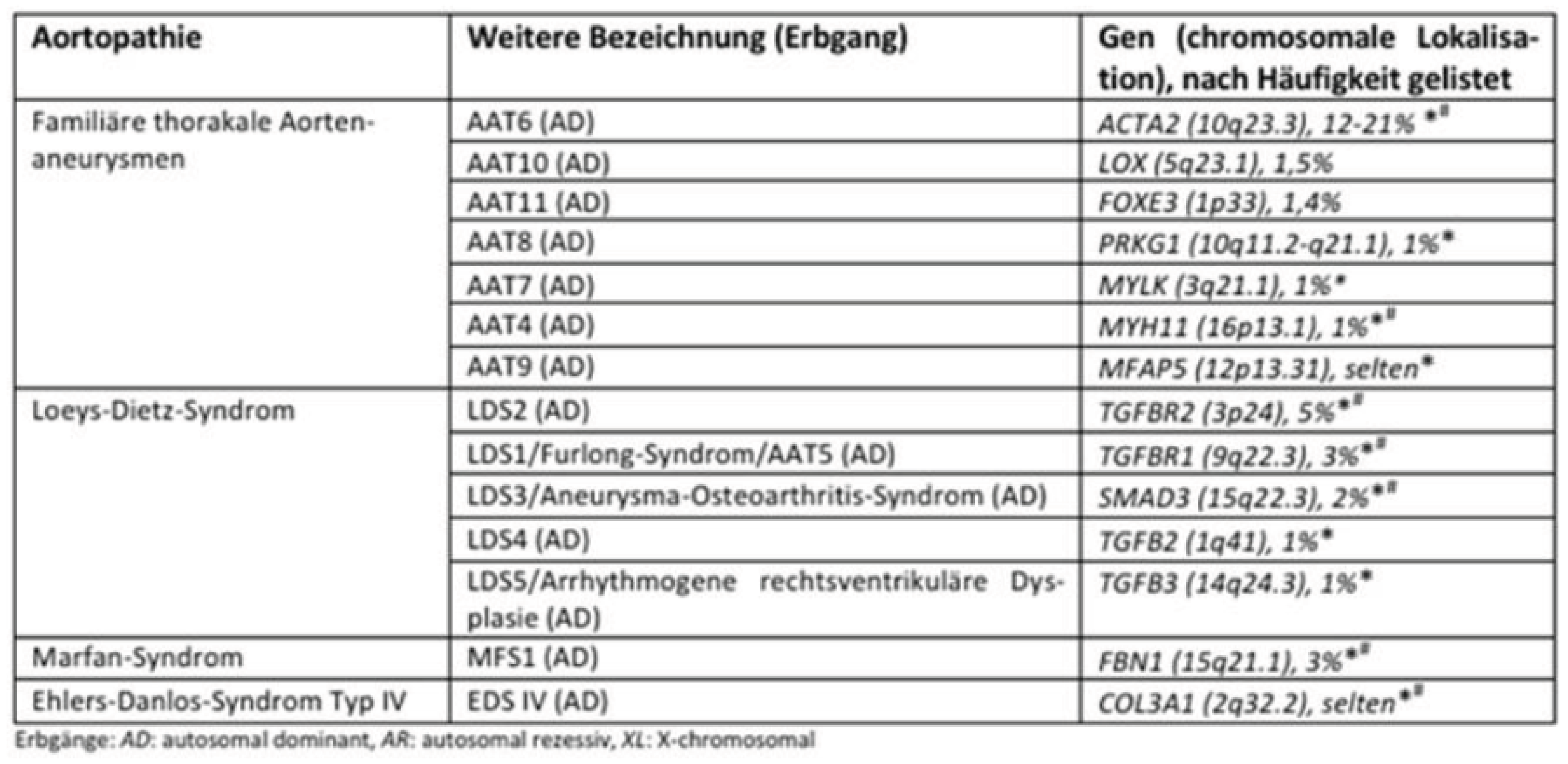
Table 1.
Baseline characteristics, Reason for consultation & Pathogenic variants.
| N = 139 | |
| Female sex | 46 (33) |
| Age (y) | 45.8 ± 15.1 |
| Reason for consultation | |
| Elective aneurysm repair | 49 (35) |
| Type A aortic dissection | 55 (40) |
| Surveillance | 31 (22) |
| Type B aortic dissection | 6 (4) |
| Pathogenic variants | 34 (24) |
| Marfan syndrome | 11 (8) |
| Loeys Dietz syndrome | 8 (6) |
|
5 (4) |
|
1 (1) |
|
1 (1) |
|
1 (1) |
| Vascular Ehlers Dahnlos | 4 (3) |
| MYH 11 | 7 (5) |
| ACTA 2 | 3 (2) |
| Turner syndrome | 1 (1) |
Values are presented as n (%) or mean ±SD; ACTA2= actin alpha 2, smooth muscle; FBN1= fibrillin-1; MYH11= myosin heavy chain 1
Table 2.
Indications for genetic testing (more than one possible) & family history.
| N=139 | |
| Family history suggestive of HTAD | 83 (60) |
| Dissection < 60 years of age | 55 (40) |
| Root aneurysm < 60 years of age | 30 (22) |
| Suspicious phenotype | 23 (17) |
| Multilocular aneurysms |
10 (7) |
| Rapid aortic growth / Extensive aneurysm (other reason absent) | 7 (5) |
|
Family history |
|
| Proven |
16 (12) |
| Likely |
42 (30) |
| Possible |
25 (18) |
Values are presented as n (%); HTAD= hereditary thoracic aortic disease
Disclaimer/Publisher’s Note: The statements, opinions and data contained in all publications are solely those of the individual author(s) and contributor(s) and not of MDPI and/or the editor(s). MDPI and/or the editor(s) disclaim responsibility for any injury to people or property resulting from any ideas, methods, instructions or products referred to in the content. |
© 2026 by the authors. Licensee MDPI, Basel, Switzerland. This article is an open access article distributed under the terms and conditions of the Creative Commons Attribution (CC BY) license (http://creativecommons.org/licenses/by/4.0/).
Copyright: This open access article is published under a Creative Commons CC BY 4.0 license, which permit the free download, distribution, and reuse, provided that the author and preprint are cited in any reuse.