
Submitted:
14 August 2026
Posted:
17 August 2026
You are already at the latest version
Abstract
Background/Objectives. Respiratory syncytial virus (RSV) is an important cause of acute lower respiratory infection in infants. Panama introduced the bivalent prefusion F vaccine (RSVpreF) for administration between 32.0 and 36.6 weeks of gestation in July 2025. In this tropical setting, respiratory viruses are detected throughout the year, with RSV activity increasing during the rainy season. We characterized self-reported maternal and neonatal events and outcomes to generate early post-introduction real-world safety evidence from Central America. Methods. This retrospective descriptive observational study included women aged 18 years or older vaccinated with RSVpreF between 32.0 and 36.6 weeks of gestation from July through December 2025 and recruited from January through July 2026. Structured telephone, virtual, or in-person interviews were used. We calculated absolute and relative frequencies and 95% Wilson confidence intervals (CIs). Results. Of 225 questionnaires obtained, 200 were eligible for analysis. Mean maternal age was 28.1 years (SD 6.4). At least one reaction was reported by 55.5% of participants, mainly local; injection-site pain was most frequent (48.0%). At least one obstetric condition was reported by 17.5%, including hypertensive disorders of pregnancy (12.0%). Preterm birth occurred in 2.0% and low birth weight in 2.5%. No fetal or neonatal deaths, thrombocytopenia, paralysis, facial paralysis, or Guillain–Barré syndrome were reported. Jaundice was the most frequent neonatal morbidity (20.0%). Conclusions. In this cohort, self-reported reactogenicity was mainly local, and no unexpected cluster of events was apparent. Participant selection, retrospective self-report, absence of an unvaccinated comparator, and sample size limit risk estimation and detection of uncommon events. The findings provide early active-pharmacovigilance evidence from Central America and support continued surveillance with clinically verified maternal and neonatal outcomes.
Keywords:
respiratory syncytial virus
; maternal vaccination
; pharmacovigilance
; vaccine safety
; pregnancy
; Panama
1. Introduction
Respiratory syncytial virus (RSV) is the leading viral cause of acute lower respiratory infection (ALRI) and hospitalization among children younger than five years. The most recent global analysis estimated 33 million RSV-associated ALRI episodes and approximately 101,400 attributable deaths in this age group in 2019, more than 95% of which occurred in low- and middle-income countries. Infants younger than six months accounted for an estimated 1.4 million hospital admissions and 45,700 attributable deaths; among infants aged 28 days to six months, approximately one in 28 deaths was attributable to RSV [1].
In Panama, a birth cohort followed from 2014 to 2018 documented a substantial burden of RSV-associated respiratory illness in the first two years of life, with the highest incidence among infants younger than three months and a meaningful proportion of hospital referrals [2]. These local data, together with recent virological surveillance, support the relevance of preventive measures for young infants [3].
The July 2025 introduction of the bivalent prefusion F RSV vaccine (RSVpreF, Abrysvo®, Pfizer Inc.) into Panama’s national immunization schedule represented a substantial change in prevention strategy [4]. Administered as a single dose between 32.0 and 36.6 weeks of gestation, the vaccine induces maternal neutralizing antibodies that are transferred transplacentally and provide passive protection to infants during their first months of life. The phase 3 MATISSE trial showed efficacy of 81.8% against severe RSV-associated lower respiratory tract illness during the first 90 days of life and 69.4% through 180 days [5].
The global policy context has also changed rapidly. The World Health Organization (WHO) recommends that countries introduce either maternal RSVpreF vaccination or the long-acting monoclonal antibody nirsevimab according to local feasibility, cost-effectiveness, and anticipated coverage. The Pan American Health Organization (PAHO) similarly supports maternal RSVpreF vaccination in the third trimester, generally at 32-36 weeks in the Region of the Americas. Maternal immunization protects infants during the first months of life, when the risk of severe RSV disease is highest and no RSV vaccine is licensed for direct infant administration; both organizations emphasize post-introduction surveillance, coverage monitoring, and generation of local effectiveness and safety evidence [6,7].
Real-world effectiveness evidence has confirmed these findings. In Argentina, the first Latin American country to incorporate maternal RSVpreF vaccination into its national immunization calendar, the BERNI study documented high effectiveness against RSV-associated lower respiratory tract disease leading to hospitalization during the 2024 season [8], and an independent multicentre study estimated adjusted effectiveness of 78.7% against RSV hospitalization in infants younger than six months [9].
Safety, however, requires continued surveillance. In MATISSE, the frequency of preterm birth was 5.7% in the vaccinated group and 4.7% with placebo (risk ratio [RR] 1.20; 95% confidence interval [CI]: 0.98-1.46); in analyses by income region, the difference was greater in non-high-income countries (7.0% vs 4.0%) and in South Africa (8.3% vs 4.0%; RR 2.06; 95% CI: 1.21-3.51) [10]. This heterogeneity, together with the need to maximize neonatal benefit while limiting exposure close to preterm delivery, motivated ongoing surveillance and the use of defined administration windows in several regulatory settings.
Panama is among the early Central American adopters of routine maternal RSVpreF vaccination. Its tropical epidemiology is programmatically relevant because respiratory viruses are detected throughout the year and RSV activity generally increases during the rainy season [3,4]. At the time of this study, no published Panamanian real-world safety data were available after RSVpreF vaccination and, to our knowledge, no active pharmacovigilance cohort had been reported from Central America. Locally generated evidence can strengthen transparent risk communication and guide studies with clinical outcome verification and comparison groups. This study describes self-reported events and outcomes after RSVpreF vaccination in pregnant individuals and their newborns recruited at CEVAXIN and VACUNAR sites.
2. Materials and Methods
2.1. Study Design and Setting
We conducted a retrospective descriptive observational active pharmacovigilance study. Reporting follows the Strengthening the Reporting of Observational Studies in Epidemiology (STROBE) recommendations [11]. The study corresponds to protocol EC-CBITPC-238, version 3.0 (Amendment No. 2), sponsored by CEVAXIN.
The study evaluated events and outcomes after maternal administration of RSVpreF (Abrysvo®, Pfizer Inc.) during the first months of national implementation. The vaccination period assessed was July through December 2025, following national introduction in July 2025. Participants could have received the vaccine at public or private facilities throughout Panama; however, recruitment and follow-up were conducted exclusively at CEVAXIN sites and, to a lesser extent, VACUNAR.
2.2. Population and Eligibility Criteria
Potential participants were recruited through consecutive convenience sampling among women attending waiting rooms at CEVAXIN sites and, to a lesser extent, the VACUNAR vaccination centre, from January through July 2026. After agreeing to participate, prior RSVpreF administration was verified from the vaccination card. The analysis included participants vaccinated between 32.0 and 36.6 weeks of gestation at any health facility in Panama from July through December 2025 and aged 18 years or older at vaccination. A complete record of women approached and refusals was unavailable; therefore, the analytic flow begins with questionnaires obtained.
The planned sample of 200 participants was established to estimate frequent proportions with reasonable precision. The 15% value used in the protocol was a planning estimate, was not linked to a specific outcome, and was not derived from MATISSE; with 95% confidence and ±5% absolute precision, it corresponded to a requirement of 196 participants. The sample was not designed for between-group comparisons or to rule out rare adverse events.
2.3. Data Sources and Variables
Data were collected with a structured postvaccination questionnaire and entered into a restricted-access digital database. Interviews were conducted by telephone, virtually, or in person according to participant contact availability. We collected sociodemographic variables, gestational age at vaccination, local and systemic reactogenicity during the seven days after vaccination, obstetric events and adverse events of special interest during the remainder of pregnancy, and perinatal and neonatal outcomes through 28 days of life. Bronchiolitis and RSV infection during the infant’s first six months were explored.
Operational definitions were prespecified in the protocol: self-reported fever was a temperature of 38.0 °C or higher; preterm birth was birth before 37 weeks and very preterm birth before 32 weeks; low birth weight was below 2,500 g and very low birth weight below 1,500 g; macrosomia was 4,000 g or higher; and a low Apgar score was less than 7. The respondent-facing questionnaire used the term ‘high blood pressure during pregnancy’; for analysis, affirmative reports were grouped under ‘hypertensive disorders of pregnancy’, with gestational hypertension and preeclampsia shown as self-reported labels. These outcomes were not verified against the clinical record.
2.4. Data Management and Cleaning
The analytic dataset was constructed through programmatic verification of eligibility criteria and application of reproducible standardization and validation rules. Birth weight, gestational age, and geographic residence were normalized; multiple-response items were disaggregated into binary variables; and missing data were retained as missing without imputation. Technical specifications for these rules remain in the internal data-management record.
2.5. Statistical Analysis
The analysis was descriptive, in accordance with the observational and exploratory study design; no between-group comparisons or power calculations were planned. Quantitative variables are summarized as mean ± standard deviation (SD) and categorical variables as absolute and relative frequencies. We calculated 95% CIs using the Wilson score method, which has better coverage than the Wald interval for proportions near zero and moderate sample sizes [12]. Results by gestational week at vaccination are presented for exploratory purposes only.
2.6. Use of Generative Artificial Intelligence
In accordance with current editorial policies, the authors declare use of generative artificial intelligence (Anthropic Claude, 2025-2026 versions) to assist with drafting parts of the study protocol and manuscript, as well as data cleaning, statistical analysis, and figure generation. All AI-assisted outputs - including the supplementary analysis code, every statistic reported here, and all text sections - were subsequently reviewed, verified against source data, and fully validated by co-author Abigail Esther De Ávila Manzané (A.D.A.). The authors reviewed and edited the outputs and assume full responsibility for the content of this publication.
2.7. Ethical Considerations
The protocol was reviewed and approved by The Panama Clinic Research Ethics Committee (CBI-TPC), accredited by the National Research Bioethics Committee. The study was conducted in accordance with the Declaration of Helsinki, the Belmont Report, the CIOMS Guidelines, and Good Clinical Practice, as well as Law 84 of 14 May 2019 and its Regulations (Executive Decree No. 21 of 23 April 2026), Law 68 of 20 November 2003, and Law 81 of 26 March 2019 on personal data protection.
Because the study was observational, involved minimal risk, and follow-up was conducted by telephone or virtually, the Committee granted a waiver of documented informed consent in accordance with Article 54 of the cited Regulations. The waiver applied to the signature, not to the information process: before any question, interviewers used a Committee-approved standardized script describing the objective, procedures, voluntary and revocable nature of participation, confidential data handling, and contact details for the research team and Committee. Acceptance was recorded in the instrument with date, time, interview modality, and interviewer initials. Each participant received a unique code, and identifiable data were stored separately with restricted access.
3. Results
3.1. Participant Flow and Baseline Characteristics
We obtained 225 questionnaires during recruitment. Of these, 25 (11.1%) did not meet analytic eligibility criteria: 16 because vaccination occurred outside the 32.0–36.6-week window, 8 because age was younger than 18 years, and 1 because birth weight was unavailable. The analytic cohort included 200 participants (88.9%). No record was available for the total number of women approached or those declining participation; therefore, these data cannot estimate participation rate or characterize nonparticipants.
Mean maternal age was 28.1 years (SD 6.4). Participants were predominantly from the metropolitan area: 132 (66.0%) lived in Panama province, 64 (32.0%) in West Panama, and 4 (2.0%) in another province, outside the country, or with unspecified residence. Three quarters were vaccinated in the public subsector (148; 74.0%) and one fifth in the private subsector (40; 20.0%). Baseline characteristics are summarized in Table 1.
3.2. Local and Systemic Reactogenicity
During the seven days after vaccination, 111 participants (55.5%; 95% CI: 48.6–62.2) reported at least one reaction. Local reactions were more frequent than systemic reactions, and injection-site pain was the most frequently reported individual event. Symptom details are presented in Table 2 and Figure 1.
Most participants reported two or fewer symptoms. Almost all events were reported during the first postvaccination week; two participants reported persistence into the second week, one with local pain and the other with fatigue.
3.3. Obstetric Conditions and Adverse Events of Special Interest
Thirty-five participants (17.5%) reported at least one obstetric condition during follow-up. Hypertensive disorders of pregnancy were the most frequently reported conditions (24 participants; 12.0%), disaggregated as gestational hypertension (18; 9.0%) and preeclampsia (11; 5.5%), with overlap in five participants. Preterm uterine contractions (9; 4.5%) and obstetric hemorrhage (4; 2.0%) followed.
All other obstetric conditions and adverse events of special interest were reported infrequently. No thrombocytopenia, paralysis, facial paralysis, or Guillain–Barré syndrome was reported. Detailed results are shown in Table 3.
3.4. Perinatal and Neonatal Outcomes
No fetal deaths or neonatal deaths during the first 28 days of life were reported. Mean gestational age at birth was 38.9 weeks (SD 1.2), and mean birth weight was 3,250 g (SD 447). Preterm birth occurred in four newborns (2.0%), all late preterm; no very preterm births were reported. Low birth weight occurred in five newborns (2.5%), and no very low birth weight cases were reported. Macrosomia was documented in ten newborns (5.0%). The distribution of both outcomes is illustrated in Figure 2.
At least one neonatal morbidity condition was reported for 54 newborns (27.0%; 95% CI: 21.3-33.5). Jaundice was the most frequent (40; 20.0%), followed by respiratory distress (8; 4.0%), neonatal sepsis (7; 3.5%), and hypoglycaemia (3; 1.5%). Neonatal jaundice is commonly observed in the newborn period, but the questionnaire did not distinguish physiologic from pathologic jaundice or verify bilirubin measurements, need for phototherapy, severity, or causal attribution. Two major congenital anomalies (1.0%) were identified: one cleft lip and palate and one cardiac condition reported as ‘heart problems’. Other isolated free-text findings are detailed in Table 4.
Apgar score items had 11.1% missing data, as recorded in the source database. No neonatal deaths were reported. Complete results are presented in Table 4.
3.5. Exploratory Analysis by Gestational Age at Vaccination and Respiratory Outcomes
Descriptive results stratified by gestational week at vaccination are presented in Table 5. Because this analysis was exploratory, without adjustment for confounders or hypothesis testing, numerical differences between strata should not be interpreted as associations or risk comparisons.
As an exploratory analysis outside the study’s main objectives, 18 infants (9.0%) had bronchiolitis during their first six months of life and 2 (1.0%) had documented RSV infection. These data cannot estimate effectiveness because systematic virological surveillance and a comparison group were unavailable.
4. Discussion
4.1. Main Findings
This active pharmacovigilance cohort provides an early real-world description of maternal and neonatal events reported during Panama’s first months of routine RSVpreF implementation. Reactogenicity was dominated by injection-site symptoms, with pain reported by 48.0%; fever was uncommon (2.5%), and symptom persistence into the second week was rare. Four late preterm births and five low-birth-weight newborns were reported, with no fetal deaths, neonatal deaths, thrombocytopenia, paralysis, facial paralysis, or Guillain-Barré syndrome. The principal contribution is post-introduction characterization under routine conditions rather than causal risk estimation.
4.2. Contribution of Panama’s Real-World Evidence
The relevance of these findings extends beyond the descriptive frequencies. Panama is an early Central American adopter of maternal RSVpreF vaccination and has a tropical respiratory-virus ecology in which detection occurs throughout the year, with RSV activity typically increasing during the rainy season [3,4]. This differs from programmes designed around sharply defined winter seasons and creates distinct operational questions for vaccine delivery, counselling, coverage monitoring, and safety surveillance. To our knowledge, this is the first reported active pharmacovigilance cohort of maternal RSVpreF vaccination from Central America.
Local evidence is especially relevant where maternal-vaccine confidence, access, and health-professional recommendation interact. Previous research in Panama documented frequent professional recommendation for Tdap but substantially lower uptake, illustrating that programme integration does not by itself eliminate access and confidence gaps [19]. A transparent local safety baseline can therefore support clinical counselling and public communication while identifying outcomes that require more rigorous follow-up.
4.3. Comparison with MATISSE
The overall pattern of short-duration reactogenicity was compatible with the pivotal trial, but event-specific frequencies should not be described as equivalent. Injection-site pain occurred in 48.0% in Panama and 40.6% among RSVpreF recipients in MATISSE; fever occurred in 2.5% and 2.6%, respectively. In contrast, fatigue (7.0% vs 46.1%), headache (7.5% vs 31.0%), and myalgia or muscle pain (13.5% vs 26.5%) were reported less often in Panama [5]. MATISSE used prospective electronic diaries with standardized severity grading, whereas this cohort used retrospective interviews without a severity scale. Differences in capture, prompting, timing, and selection are therefore more plausible explanations than a true reduction in systemic reactogenicity.
Preterm birth remains the outcome of greatest regulatory interest. MATISSE reported 5.7% in the vaccinated arm and 4.7% with placebo [10], whereas four late preterm births (2.0%) were reported here. The Panamanian proportion cannot be interpreted as lower risk because eligibility required survival of pregnancy to the vaccination window, recruitment occurred after delivery, and no unvaccinated comparator was available. Postintroduction studies in France and the United States have not identified increased preterm-birth risk, although US surveillance continues to evaluate hypertensive disorders and premature rupture of membranes [16,17,18]. Within the present cohort’s limitations, no unexpected cluster or new safety pattern was apparent; uncommon events remain beyond its detection capacity.
4.4. Early Experiences in Latin America
Argentina provides the main regional comparator and was the first Latin American country to include maternal RSVpreF vaccination in its national immunization calendar [20]. In Córdoba, an observational analysis of 21,303 births at 32 weeks or later, including 12,210 vaccinated pregnancies, found no increased adjusted risk of preterm birth or low birth weight [15]. Argentina’s effectiveness studies have also documented protection against RSV hospitalization [8,9]. The Panamanian experience complements this evidence by adding active safety follow-up from Central America and underscores why the region should generate its own evidence rather than rely exclusively on high-income, highly seasonal settings.
4.5. RSVpreF in the Context of Maternal Immunization
RSVpreF enters antenatal care alongside established maternal vaccines against influenza, pertussis (Tdap), and COVID-19. Influenza vaccination has decades of use in pregnancy; large observational evidence supports Tdap safety and its role in preventing severe pertussis in infants too young for primary vaccination; and COVID-19 vaccination has generated extensive safety data from diverse health systems. Across these platforms, transient local and systemic reactions are expected, while large studies and systematic reviews have generally not found increased risks across major adverse pregnancy and birth outcomes, including preterm birth, stillbirth or fetal death, congenital malformations, and small-for-gestational-age birth [21,22,23]. The predominantly local pattern observed here fits this broader maternal-immunization experience, but it does not replace product-specific surveillance of obstetric and neonatal outcomes.
4.6. Implications for WHO, PAHO, and Public Health
WHO and PAHO frameworks support introduction of maternal RSVpreF vaccination according to country context and emphasize post-introduction surveillance, monitoring of coverage and impact, documentation of vaccination status during pregnancy, and generation of local maternal and neonatal safety data [6,7]. This cohort demonstrates a feasible active-follow-up model that can be strengthened through linkage with clinical records and national immunization information systems.
The public-health value is also communicational. Perceived safety strongly influences vaccine acceptance during pregnancy, and locally generated evidence may be more credible to pregnant individuals, clinicians, and national programmes than evidence imported without regional context. A clearly bounded Panamanian safety experience can support counselling, identify surveillance priorities, and reduce uncertainty as other Central American countries consider or expand maternal RSV immunization.
4.7. Strengths and Limitations
Strengths include active follow-up, systematic use of a structured questionnaire, verification of vaccination cards, inclusion of vaccinations delivered in public and private subsectors, and reproducible analysis code. The sample reached the protocol’s precision target for relatively frequent events and offers timely evidence from a setting that remains underrepresented in maternal-vaccine safety research.
Interpretation is limited by convenience recruitment at CEVAXIN and VACUNAR, metropolitan concentration, unavailable counts of women approached or declining participation, retrospective self-report, and absence of clinical adjudication or an unvaccinated comparison group. Recruitment after delivery and eligibility within the 32.0-36.6-week vaccination window introduce selection that is particularly important for preterm-birth interpretation. The questionnaire wording ‘high blood pressure during pregnancy’ may not correspond to a clinically diagnosed hypertensive disorder, and self-reported Apgar scores and neonatal jaundice could not be validated. With 200 participants, the study is not designed to detect uncommon adverse events.
4.8. Future Research Priorities
Priority studies should link nominal immunization records with antenatal, delivery, and neonatal clinical records; include contemporaneous comparison groups and prespecified confounder adjustment; and establish local background rates for preterm birth, low birth weight, hypertensive disorders, stillbirth, and neonatal outcomes. Multicentre recruitment beyond the metropolitan area, accumulated multiyear samples, and standardized severity and causality assessment would improve generalizability and detection of uncommon events. Longer infant follow-up with virological confirmation is needed to evaluate effectiveness alongside safety.
5. Conclusions
Among 200 participants vaccinated during Panama’s initial RSVpreF implementation period, reported reactogenicity was mainly local and short-lived, with no unexpected pattern of maternal, fetal, neonatal, or neurological events. These observations require interpretation within the study’s selection, self-report, verification, comparator, and sample-size limitations.
This study provides one of the first active pharmacovigilance experiences of maternal RSVpreF vaccination in Latin America and, to our knowledge, the first reported from Central America. In a tropical context with year-round respiratory-virus detection and an expanded national administration window, these findings provide regional evidence reinforcing continued monitoring of maternal and neonatal outcomes across gestational ages.
6. Recommendations
For the Expanded Programme on Immunization and health authorities
1. Maintain and strengthen active surveillance of RSVpreF across Panama’s expanded administration window, integrated into nominal Expanded Programme on Immunization records. Because this cohort included vaccinations at 32.0–36.6 weeks, additional comparative evidence is needed across the broader 30–38-week window.
2. Institutionalize an active surveillance system for adverse events following immunization specific to maternal immunization, with structured follow-up through 28 days of neonatal life, integrated into nominal Expanded Programme on Immunization records and not dependent solely on spontaneous reporting.
3. Establish population reference denominators—including national and provincial preterm birth, low birth weight, hypertensive-disorder-of-pregnancy, and perinatal-mortality frequencies—to contextualize outcomes observed among vaccinated individuals, in collaboration with the National Institute of Statistics and Census and the Department of Health Records and Statistics.
4. Include a balanced message on expected reactions in prenatal counselling: local symptoms were the most frequently reported in this cohort and generally occurred during the first week. Counselling should clarify that these data are descriptive and do not replace individual clinical assessment.
For clinical practice
1. Record the vaccination date and exact gestational age at administration in the clinical record so that any subsequent event can be evaluated with precise timing using the World Health Organization causality-assessment algorithm.
2. Maintain obstetric management according to current national protocols. Hypertensive disorders reported in this cohort were not clinically verified and cannot be attributed to the vaccine.
For future research
1. Design a cohort study with an unvaccinated comparison group, or a self-controlled case analysis, to estimate attributable risks rather than frequencies alone, with particular attention to hypertensive disorders of pregnancy.
2. Replace self-reported collection of objectively verifiable outcomes—Apgar score, birth weight, gestational age, sepsis diagnosis, and jaundice requiring phototherapy—with direct extraction from clinical records or cross-verification, and remove items that postpartum individuals cannot answer reliably.
3. Expand recruitment to western and central provinces and Indigenous territories, where baseline perinatal indicators differ from those in the metropolitan area and external validity of the current findings is limited.
4. Extend infant follow-up and incorporate RSV virological confirmation, together with a defined comparison group, so future cohorts can assess effectiveness as well as safety.
5. Achieve an accumulated sample size that allows evaluation of uncommon adverse events. With 200 participants, the upper 95% CI for an unreported event is 1.9%; multiyear and multicentre consolidation of the cohort would reduce this bound.
Supplementary Materials
The following supporting information can be downloaded at the website of this paper posted on Preprints.org: S1_analysis_RSVpreF.R; S2_result_tables.xlsx, results tables workbook; S3_analytic_dataset.csv and S4_full_results.txt.
Author Contributions
Conceptualization, A.L.Q., B.R.P. and J.R.S.G.; methodology, A.L.Q., R.D.S., I.F.C., A.P.A., L.E., B.R.P., L.F., C.G., S.B., E.G., A.E.D.Á. and J.R.S.G.; software, A.E.D.Á.; validation, A.E.D.Á. and J.R.S.G.; formal analysis, A.E.D.Á. and J.R.S.G.; investigation, L.E., L.F., I.F.C., A.P.A., C.G., S.B. and E.G.; resources, R.D.S.; data curation, L.E., L.F. and J.R.S.G.; writing—original draft preparation, A.L.Q., L.E. and J.R.S.G.; writing—review and editing, J.R.S.G, A.L.Q., R.D.S., I.F.C., A.P.A., L.E., B.R.P., L.F., C.G., S.B., E.G., A.E.D.Á. and J.R.S.G.; visualization, A.E.D.Á. and J.R.S.G.; supervision, A.L.Q., B.R.P. and R.D.S.; project administration, A.L.Q. All authors have read and agreed to the published version of the manuscript.
Funding
No external funding was received.
Institutional Review Board Statement
The study was conducted in accordance with the Declaration of Helsinki and was approved on the 09 of December 2025 by The Panama Clinic Research Ethics Committee (CBI-TPC), accredited by the National Research Bioethics Committee (protocol EC-CBITPC-238, version 3.0, Amendment No. 2).
Informed Consent Statement
The requirement for documented informed consent was waived for this minimal-risk observational study under Article 54 of Executive Decree No. 21 of 23 April 2026. Participants received a Committee-approved information script before the interview, and their acceptance was documented in the study instrument.
Data Availability Statement
Fully reproducible analysis code is provided as Supplementary Material. The individual-level dataset is not publicly available because it contains sensitive health information protected under Law 81 of 2019; it may be requested from the corresponding author under a confidentiality agreement and Research Ethics Committee authorization.
Acknowledgments
The authors thank Dr. Geraldine Norte and Dr. Roberto Epifanio (The Fertile Group, Panama City, Panama) for their collaboration in this study.
Conflicts of Interest
A.L.Q. is affiliated with Pediatrics Clinic Panama and CEVAXIN; B.R.P. is affiliated with Pediatrics Clinic Panama; A.D.A. is affiliated with CEVAXIN; and R.D.S. and J.R.S.G. are affiliated with the Endpoints Research Sites Network. CEVAXIN and the Endpoints Research Sites Network are clinical research organizations that conduct vaccine studies sponsored by pharmaceutical companies. These affiliations are academic and institutional in nature; no author received personal financial compensation, honoraria or in-kind support related to this work. No sponsor or employer had any role in the design of the study, in the collection, analysis or interpretation of the data, in the writing of the manuscript, or in the decision to publish the results. The authors declare no other conflicts of interest.
Abbreviations
| The following abbreviations are used in this manuscript | ALRI, acute lower respiratory infection; CI, confidence interval; MINSA, Ministry of Health; RSV, respiratory syncytial virus; RSVpreF, bivalent prefusion F respiratory syncytial virus vaccine; SD, standard deviation. |
References
- Li, Y.; Wang, X.; Blau, D.M.; Caballero, M.T.; Feikin, D.R.; Gill, C.J.; Madhi, S.A.; Omer, S.B.; Simões, E.A.F.; Campbell, H.; et al. Global, regional, and national disease burden estimates of acute lower respiratory infections due to respiratory syncytial virus in children younger than 5 years in 2019: A systematic analysis. Lancet 2022, 399, 2047–2064. [Google Scholar] [CrossRef] [PubMed]
- Azziz-Baumgartner, E.; Duca, L.M.; González, R.; Calvo, C.; Kaydos-Daniels, C.; Olson, N.; MacNeil, A.; Veguilla, V.; Domínguez, R.; Vicari, A.; et al. Incidence of respiratory virus illness and hospitalizations in a Panama and El Salvador birth cohort, 2014-2018. Lancet Reg. Health Am. 2022, 13, 100304. [Google Scholar] [CrossRef] [PubMed]
- Franco, D.; Goya, S.; Martínez, A.; Mas, V.; Moreno, B.; Valdespino, E.; Gaitán, M.; Sáenz, L.; González, C.; Moreno, A.; et al. Genomic insights into respiratory syncytial virus circulation patterns and neutralization by anti-F monoclonal antibodies in Panama (2018-2024). Influenza Other Respir. Viruses 2025, 19, e70173. [Google Scholar] [CrossRef] [PubMed]
- Ministerio de Salud de la República de Panamá. Lanzamiento de la campaña de vacunación contra el Virus Sincitial Respiratorio. 15 July 2025. Available online: https://minsa.gob.pa/noticia/lanzamiento-de-la-campana-de-vacunacion-contra-el-virus-sincitial-respiratorio (accessed on 10 August 2026).
- Kampmann, B.; Madhi, S.A.; Munjal, I.; Simões, E.A.F.; Pahud, B.A.; Llapur, C.; Baker, J.; Pérez Marc, G.; Radley, D.; Shittu, E.; et al. Bivalent prefusion F vaccine in pregnancy to prevent RSV illness in infants. N. Engl. J. Med. 2023, 388, 1451–1464. [Google Scholar] [CrossRef] [PubMed]
- World Health Organization. WHO position paper on immunization to protect infants against respiratory syncytial virus disease, May 2025. Wkly. Epidemiol. Rec. 2025, 100, 193–218. Available online: https://www.who.int/publications/i/item/who-wer-10022-193-218 (accessed on 10 August 2026).
- Pan American Health Organization. Recommendations for the Use of Immunization Products against Respiratory Syncytial Virus (RSV), 2025; PAHO: Washington, DC, USA, 2025; Available online: https://www.paho.org/sites/default/files/2026/01/recommendations-use-immunization-products-against-respiratory-syncytial-virus-rsv.pdf (accessed on 10 August 2026).
- Pérez Marc, G.; Vizzotti, C.; Fell, D.B.; Di Nunzio, L.; Olszevicki, S.; Mankiewicz, S.W.; Braem, V.; Rearte, R.; Atwell, J.E.; Bianchi, A.; et al. Real-world effectiveness of RSVpreF vaccination during pregnancy against RSV-associated lower respiratory tract disease leading to hospitalisation in infants during the 2024 RSV season in Argentina (BERNI study): A multicentre, retrospective, test-negative, case-control study. Lancet Infect. Dis. 2025, 25, 1044–1054. [Google Scholar] [CrossRef] [PubMed]
- Gentile, A.; Juárez, M.D.V.; Lucion, M.F.; Gregorio, G.; López, O.; Fernández, T.; Gioiosa, A.; Lobertti, S.; Pejito, N.; López, L.; et al. Maternal immunization with RSVpreF vaccine: Effectiveness in preventing respiratory syncytial virus-associated hospitalizations in infants under 6 months in Argentina: Multicenter case-control study. Pediatr. Infect. Dis. J. 2025, 44, 988–994. [Google Scholar] [CrossRef] [PubMed]
- Madhi, S.A.; Kampmann, B.; Simões, E.A.F.; Zachariah, P.; Pahud, B.A.; Radley, D.; Sarwar, U.N.; Shittu, E.; Llapur, C.; Pérez Marc, G.; et al. Preterm birth frequency and associated outcomes from the MATISSE maternal trial of the bivalent respiratory syncytial virus prefusion F protein vaccine. Obstet. Gynecol. 2025, 145, 147–156. [Google Scholar] [CrossRef] [PubMed]
- von Elm, E.; Altman, D.G.; Egger, M.; Pocock, S.J.; Gøtzsche, P.C.; Vandenbroucke, J.P.; STROBE Initiative. The Strengthening the Reporting of Observational Studies in Epidemiology (STROBE) statement: Guidelines for reporting observational studies. Lancet 2007, 370, 1453–1457. [Google Scholar] [CrossRef] [PubMed]
- Newcombe, R.G. Two-sided confidence intervals for the single proportion: Comparison of seven methods. Stat. Med. 1998, 17, 857–872. [Google Scholar] [CrossRef]
- R Core Team. R: A Language and Environment for Statistical Computing; R Foundation for Statistical Computing: Vienna, Austria, 2026; Available online: https://www.R-project.org/ (accessed on 8 August 2026).
- Wickham, H.; Averick, M.; Bryan, J.; Chang, W.; D’Agostino McGowan, L.; François, R.; Grolemund, G.; Hayes, A.; Henry, L.; Hester, J.; et al. Welcome to the tidyverse. J. Open Source Softw. 2019, 4, 1686. [Google Scholar] [CrossRef]
- Scruzzi, G.F.; Franchini, C.G.; Giorgetti, A.C.; Fonseca Ingüe, L.; Sarmiento, D.D.; Belfiore, S.M.; Willington, A.P.; Vittori, M.E.; Nieva, S.M.; Klein, G.J. Seguridad de la vacuna contra el virus sincicial respiratorio en gestantes. Medicina (Buenos Aires) 2025, 85, 999–1007. [Google Scholar] [PubMed]
- Gabet, A.; Bertrand, M.; Jabagi, M.-J.; Kolla, E.; Olié, V.; Zureik, M. Maternal and neonatal outcomes after respiratory syncytial virus prefusion F protein vaccination during pregnancy: Analysis from the 2024-2025 immunization campaign in France. Obstet. Gynecol. 2026, 147, 118–126. [Google Scholar] [CrossRef] [PubMed]
- Michnick, A.I.; MacDonald, S.C.; Adimadhyam, S.; Zhang, F.; Cosgrove, A.; Petrone, A.B.; Round, K.E.; Gandhi, S.; Koram, N.; Anastasiou, O.E.; et al. Sequential safety surveillance of RSVpreF vaccination during pregnancy early in the postapproval period. JAMA Netw. Open 2026, 9, e266190. [Google Scholar] [CrossRef] [PubMed]
- DeSilva, M.; Haapala, J.; Kharbanda, E.O.; Vesco, K.K.; Daley, M.F.; Getahun, D.; Raisler, K.; Naleway, A.L.; Jackson, L.A.; Williams, J.T.B.; et al. Association of respiratory syncytial virus vaccination during pregnancy with adverse obstetric and neonatal outcomes. Obstet. Gynecol. advance online publication. 2026. [Google Scholar] [CrossRef] [PubMed]
- McDermid, P.; Blazek, K.; Mougin, N.; Thomson, A.; Seale, H. Attitudes and behaviors of maternal Tdap vaccination in Panama, Peru, and Colombia: An international cross-sectional study. Vaccine 2024, 42, 1698–1703. [Google Scholar] [CrossRef] [PubMed]
- Pan American Health Organization. OPS y Salud realizaron evaluación posterior a la introducción de la vacuna materna contra el virus sincicial respiratorio en Argentina, 2 June 2026. Available online: https://www.paho.org/es/noticias/2-6-2026-ops-salud-realizaron-evaluacion-posterior-introduccion-vacuna-materna-contra (accessed on 10 August 2026).
- McMillan, M.; Porritt, K.; Kralik, D.; Costi, L.; Marshall, H. Influenza vaccination during pregnancy: A systematic review of fetal death, spontaneous abortion, and congenital malformation safety outcomes. Vaccine 2015, 33, 2108–2117. [Google Scholar] [CrossRef] [PubMed]
- Kharbanda, E.O.; Vazquez-Benitez, G.; Lipkind, H.S.; Klein, N.P.; Cheetham, T.C.; Naleway, A.; Omer, S.B.; Hambidge, S.J.; Lee, G.M.; Jackson, M.L.; et al. Evaluation of the association of maternal pertussis vaccination with obstetric events and birth outcomes. JAMA 2014, 312, 1897–1904. [Google Scholar] [CrossRef] [PubMed]
- Ciapponi, A.; Berrueta, M.; Argento, F.J.; Ballivian, J.; Bardach, A.; Brizuela, M.E.; Castellana, N.; Comandé, D.; Gottlieb, S.; Kampmann, B.; et al. Safety and effectiveness of COVID-19 vaccines during pregnancy: A living systematic review and meta-analysis. Drug Saf. 2024, 47, 991–1010. [Google Scholar] [CrossRef] [PubMed]
Figure 1.
Local and systemic reactogenicity during the seven days after RSVpreF vaccination (N = 200). Error bars represent the 95% Wilson confidence interval.
Figure 1.
Local and systemic reactogenicity during the seven days after RSVpreF vaccination (N = 200). Error bars represent the 95% Wilson confidence interval.
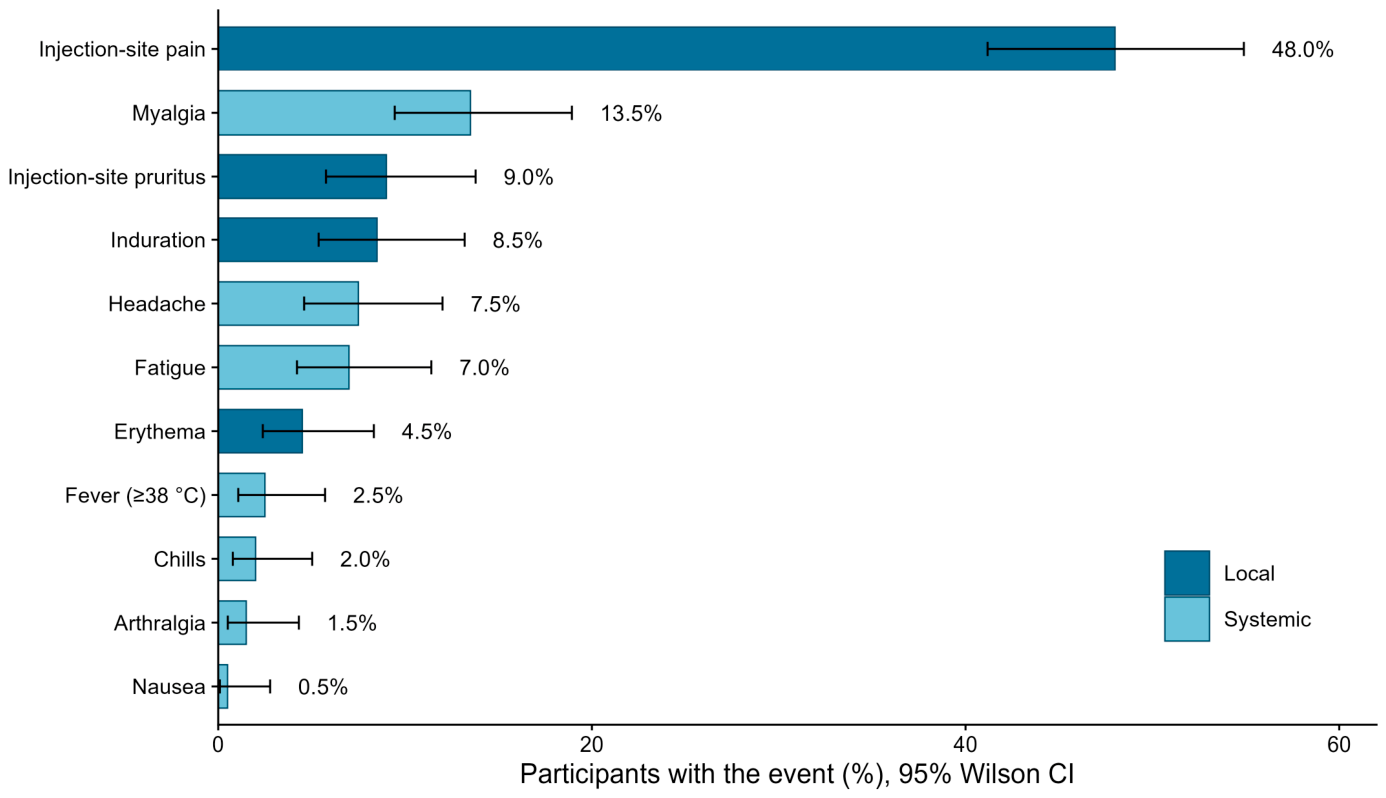
Figure 2.
Distribution of gestational age at birth (Panel A) and birth weight (Panel B) among newborns of mothers vaccinated with RSVpreF (N = 200). Dashed lines indicate thresholds of 37 weeks and 2,500 g.
Figure 2.
Distribution of gestational age at birth (Panel A) and birth weight (Panel B) among newborns of mothers vaccinated with RSVpreF (N = 200). Dashed lines indicate thresholds of 37 weeks and 2,500 g.
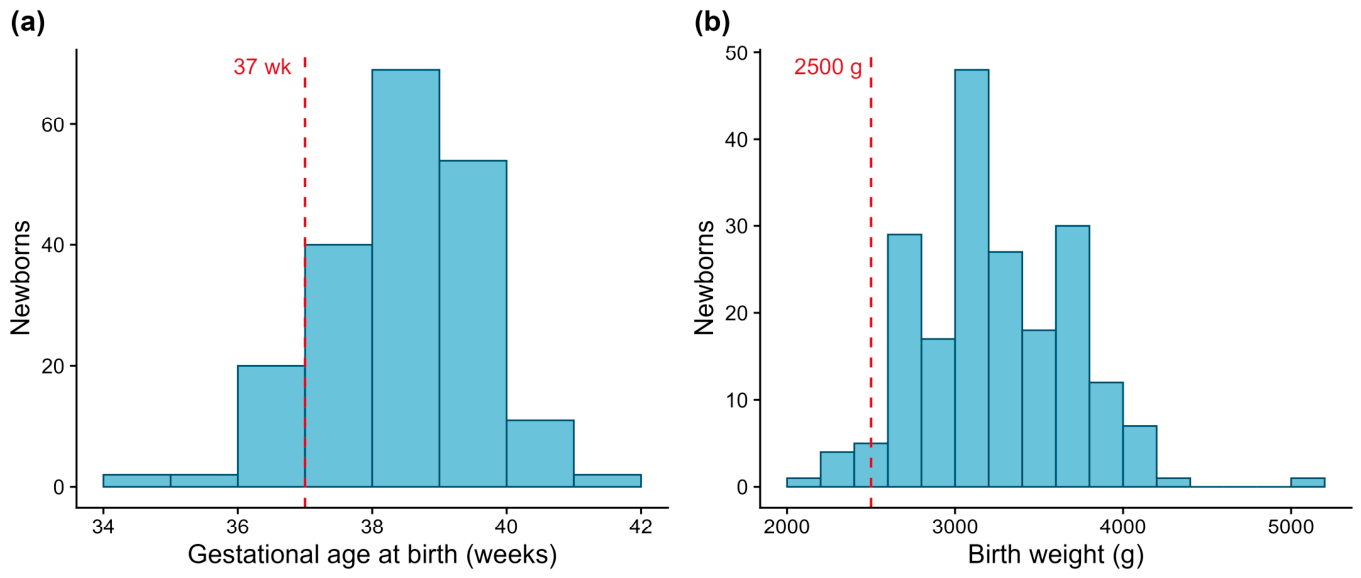

Table 1.
Baseline characteristics of pregnant individuals vaccinated with RSVpreF and their newborns (N = 200), Panama, 2025.
Table 1.
Baseline characteristics of pregnant individuals vaccinated with RSVpreF and their newborns (N = 200), Panama, 2025.
| Characteristic | n (%) or mean ± SD |
| Maternal age, years | 28.1 ± 6.4 |
| Maternal age group | |
| 18–24 years | 68 (34.0) |
| 25–29 years | 53 (26.5) |
| 30–34 years | 40 (20.0) |
| ≥35 years | 39 (19.5) |
| Gestational age at vaccination | |
| 32 weeks | 60 (30.0) |
| 33 weeks | 32 (16.0) |
| 34 weeks | 35 (17.5) |
| 35 weeks | 33 (16.5) |
| 36 weeks | 40 (20.0) |
| Province of residence | |
| Panama | 132 (66.0) |
| West Panama | 64 (32.0) |
| Other province, residence outside Panama, or unspecified | 4 (2.0) |
| Vaccination site subsector | |
| Public (Ministry of Health / Social Security Fund) | 148 (74.0) |
| Private | 40 (20.0) |
| Unclassifiable | 12 (6.0) |
| Gestational age at birth, weeks | 38.9 ± 1.2 |
| Birth weight, g | 3 250 ± 447 |
| Mode of delivery — vaginal | 130 (65.0) |
| Mode of delivery — caesarean | 70 (35.0) |
Note. SD = standard deviation; MINSA = Ministry of Health; CSS = Social Security Fund. Percentages are calculated using N = 200.
Table 2.
Local and systemic reactogenicity during the seven days after RSVpreF vaccination (N = 200), Panama, 2025.
Table 2.
Local and systemic reactogenicity during the seven days after RSVpreF vaccination (N = 200), Panama, 2025.
| Event | n | % | 95% CI |
| Local reactions | |||
| Injection-site pain | 96 | 48.0 | 41.2–54.9 |
| Injection-site pruritus | 18 | 9.0 | 5.8–13.8 |
| Induration | 17 | 8.5 | 5.4–13.2 |
| Erythema | 9 | 4.5 | 2.4–8.3 |
| Systemic reactions | |||
| Myalgia | 27 | 13.5 | 9.5–18.9 |
| Headache | 15 | 7.5 | 4.6–12.0 |
| Fatigue | 14 | 7.0 | 4.2–11.4 |
| Fever (≥38 °C) | 5 | 2.5 | 1.1–5.7 |
| Chills | 4 | 2.0 | 0.8–5.0 |
| Arthralgia | 3 | 1.5 | 0.5–4.3 |
| Nausea | 1 | 0.5 | 0.1–2.8 |
| Overall indicators | |||
| Any local reaction | 103 | 51.5 | 44.6–58.3 |
| Any systemic reaction | 46 | 23.0 | 17.7–29.3 |
| Any reaction | 111 | 55.5 | 48.6–62.2 |
Note. 95% CI = 95% confidence interval estimated with the Wilson method. Categories are not mutually exclusive; one participant may contribute to more than one row.
Table 3.
Obstetric conditions and adverse events of special interest reported after RSVpreF vaccination (N = 200), Panama, 2025.
Table 3.
Obstetric conditions and adverse events of special interest reported after RSVpreF vaccination (N = 200), Panama, 2025.
| Event | n | % | 95% CI |
| Any hypertensive disorder of pregnancy | 24 | 12.0 | 8.2–17.2 |
| Gestational hypertension | 18 | 9.0 | 5.8–13.8 |
| Preeclampsia | 11 | 5.5 | 3.1–9.6 |
| Preterm uterine contractions | 9 | 4.5 | 2.4–8.3 |
| Obstetric hemorrhage | 4 | 2.0 | 0.8–5.0 |
| Oligohydramnios | 2 | 1.0 | 0.3–3.6 |
| Clots or thrombi | 2 | 1.0 | 0.3–3.6 |
| Placental abruption | 1 | 0.5 | 0.1–2.8 |
| Premature rupture of membranes | 1 | 0.5 | 0.1–2.8 |
| Muscle weakness | 1 | 0.5 | 0.1–2.8 |
| Thrombocytopenia | 0 | 0.0 | 0.0–1.9 |
| Paralysis / facial paralysis | 0 | 0.0 | 0.0–1.9 |
| Guillain–Barré syndrome | 0 | 0.0 | 0.0–1.9 |
| Any reported obstetric condition | 35 | 17.5 | 12.9–23.4 |
Note. Categories are not mutually exclusive. The ‘Any hypertensive disorder of pregnancy’ row combines gestational hypertension and preeclampsia, with overlap in five participants. Events are self-reported.
Table 4.
Perinatal outcomes and early neonatal morbidity among newborns of mothers vaccinated with RSVpreF, Panama, 2025.
Table 4.
Perinatal outcomes and early neonatal morbidity among newborns of mothers vaccinated with RSVpreF, Panama, 2025.
| Outcome | n / N | % | 95% CI |
| Mortality | |||
| Fetal death | 0 / 200 | 0.0 | 0.0–1.9 |
| Neonatal death (0–28 days) | 0 / 200 | 0.0 | 0.0–1.9 |
| Birth outcomes | |||
| Preterm birth (<37 weeks) | 4 / 200 | 2.0 | 0.8–5.0 |
| Very preterm birth (<32 weeks) | 0 / 200 | 0.0 | 0.0–1.9 |
| Low birth weight (<2,500 g) | 5 / 200 | 2.5 | 1.1–5.7 |
| Very low birth weight (<1,500 g) | 0 / 200 | 0.0 | 0.0–1.9 |
| Macrosomia (≥4,000 g) | 10 / 200 | 5.0 | 2.7–9.0 |
| Caesarean delivery | 70 / 200 | 35.0 | 28.7–41.8 |
| Apgar score <7 at 1 minuteᵃ | 27 / 155 | 17.4 | 12.3–24.2 |
| Apgar score <7 at 5 minutesᵃ | 25 / 154 | 16.2 | 11.2–22.9 |
| Neonatal morbidity (0–28 days) | |||
| Neonatal jaundice | 40 / 200 | 20.0 | 15.1–26.1 |
| Respiratory distress | 8 / 200 | 4.0 | 2.0–7.7 |
| Neonatal sepsis | 7 / 200 | 3.5 | 1.7–7.1 |
| Neonatal hypoglycaemia | 3 / 200 | 1.5 | 0.5–4.3 |
| Major congenital anomaly | 2 / 200 | 1.0 | 0.3–3.6 |
| Any neonatal morbidity | 54 / 200 | 27.0 | 21.3–33.5 |
Note. ᵃ The denominator is reduced by ‘I do not know’ responses, coded as missing data (45 and 46 cases, respectively). Morbidity categories are not mutually exclusive. Outcomes are self-reported.
Table 5.
Exploratory analysis of reactogenicity and perinatal outcomes by gestational age at vaccination (N = 200).
Table 5.
Exploratory analysis of reactogenicity and perinatal outcomes by gestational age at vaccination (N = 200).
| Gestational week at vaccination | n | Any reaction (%) | Preterm birth (%) | Low birth weight (%) | Mean GA at birth (weeks) | Mean birth weight (g) |
| 32 weeks | 60 | 50.0 | 5.0 | 1.7 | 39.0 | 3 281 |
| 33 weeks | 32 | 53.1 | 3.1 | 3.1 | 38.6 | 3 122 |
| 34 weeks | 35 | 60.0 | 0.0 | 2.9 | 39.1 | 3 289 |
| 35 weeks | 33 | 57.6 | 0.0 | 3.0 | 38.9 | 3 241 |
| 36 weeks | 40 | 60.0 | 0.0 | 2.5 | 39.0 | 3 281 |
Note. GA = gestational age. Percentages were calculated using the number of participants in each stratum. Exploratory analysis without adjustment for confounders or hypothesis testing.
Disclaimer/Publisher’s Note: The statements, opinions and data contained in all publications are solely those of the individual author(s) and contributor(s) and not of MDPI and/or the editor(s). MDPI and/or the editor(s) disclaim responsibility for any injury to people or property resulting from any ideas, methods, instructions or products referred to in the content. |
© 2026 by the authors. Licensee MDPI, Basel, Switzerland. This article is an open access article distributed under the terms and conditions of the Creative Commons Attribution (CC BY) license.
Copyright: This open access article is published under a Creative Commons CC BY 4.0 license, which permit the free download, distribution, and reuse, provided that the author and preprint are cited in any reuse.