

Submitted:
13 August 2026
Posted:
14 August 2026
You are already at the latest version
Abstract
Background/Objectives: Shift work is an essential component of modern occupational systems but represents a major source of chronic circadian disruption associated with adverse gastrointestinal outcomes. The biological pathways underlying these associations remain incompletely integrated across circadian, neuroendocrine, immune, epithelial, and microbial domains. This narrative review aimed to synthesize current evidence linking shift work with gastrointestinal dysfunction and disease and to examine its translational implications for occupational medicine. Methods: A structured literature search was conducted in PubMed/MEDLINE, Scopus, and Web of Science, focusing primarily on studies published between January 2020 and July 2026. Recent original studies, systematic reviews, meta-analyses, and mechanistic and translational investigations were prioritized, while relevant landmark studies were retained. Evidence was synthesized within a seven-stage mechanistic framework spanning occupational exposure, circadian clock disruption, neuroendocrine misalignment, immune dysregulation, intestinal barrier dysfunction, gut microbial and metabolic alterations, and gastrointestinal disease. Results: Current evidence supports a multidirectional pathway in which chronic circadian misalignment disrupts melatonin and cortisol rhythms, autonomic regulation, and innate and adaptive immune homeostasis. Persistent inflammatory signaling and oxidative stress may subsequently impair epithelial tight junction integrity and increase intestinal permeability, thereby promoting microbial translocation and gut dysbiosis. Alterations in microbial metabolites, including short-chain fatty acids, secondary bile acids, and tryptophan derivatives, may further reinforce barrier and immune dysfunction. These interconnected mechanisms provide biological plausibility for the increased burden of disorders of gut–brain interaction, gastroesophageal reflux disease, peptic ulcer disease, and potentially inflammatory bowel disease and colorectal neoplasia among shift workers. Emerging circadian, inflammatory, intestinal barrier, microbiome, and multi-omics biomarkers may enable earlier identification of biologically susceptible individuals. Conclusions: Gastrointestinal consequences of shift work appear to arise from interacting circadian, neuroendocrine, immune, epithelial, and microbial disturbances rather than from isolated mechanisms. Integrating occupational exposure assessment with multidimensional biological profiling may support biomarker-guided surveillance, individualized prevention, and the development of Precision Occupational Medicine for shift workers. Prospective longitudinal and interventional studies are required to validate biomarkers, clarify causal pathways, and determine whether mechanism-based interventions can prevent gastrointestinal disease.
Keywords:
shift work
; circadian disruption
; gastrointestinal disorders
; immune dysregulation
; intestinal barrier
; gut microbiota
; chrononutrition
; biomarkers
; occupational medicine
; precision medicine
1. Introduction
Shift work has become an indispensable component of modern society, ensuring the continuous operation of healthcare systems, manufacturing industries, transportation, emergency services, public safety, and numerous other sectors requiring uninterrupted activity. Approximately one-fifth of the workforce in industrialized countries is engaged in non-standard work schedules, including permanent night shifts, rotating shifts, evening shifts, and irregular work patterns. Although essential for maintaining modern economies, shift work is one of the most prevalent forms of chronic occupational exposure to circadian disruption. Rather than merely an alternative work schedule, it combines recurrent circadian misalignment with nocturnal light exposure, sleep restriction and fragmentation, irregular meal timing, psychosocial stress, fatigue accumulation, and behavioral alterations. Together, these occupational exposures disrupt multiple physiological systems beyond the sleep–wake cycle, including neuroendocrine regulation, metabolism, cardiovascular function, immune homeostasis, and gastrointestinal physiology, thereby increasing susceptibility to chronic diseases among exposed workers [1,2,3,4].
Among the diverse health consequences of shift work, gastrointestinal disorders have emerged as one of the most prevalent yet frequently underestimated occupational health problems. Over the past decade, accumulating epidemiological evidence has consistently shown that rotating and night-shift workers experience significantly higher rates of gastrointestinal symptoms than those on regular daytime schedules. A systematic review and meta-analysis by Chang et al. found a 56% higher overall risk of gastrointestinal disorders among rotating shift workers compared with fixed-day workers, with particularly strong associations for indigestion and peptic ulcer disease (PUD) [3]. More recently, Wang et al. reported significantly increased odds of both irritable bowel syndrome (IBS) and functional dyspepsia among shift workers [5], and subsequent large-scale prospective studies further suggested a dose-dependent relationship between cumulative night-shift exposure and incident IBS [6]. Collectively, these findings indicate that gastrointestinal disorders should be recognized as an important component of occupational morbidity rather than isolated digestive complaints.
Despite growing epidemiological evidence, the biological mechanisms underlying these associations remain incompletely understood. Shift work is increasingly recognized as a systemic biological stressor that can disrupt the temporal coordination between the central circadian pacemaker in the suprachiasmatic nucleus (SCN) and peripheral molecular clocks across multiple organs, including the gastrointestinal tract. In the intestine, circadian regulation extends beyond epithelial cells to resident immune cells, enteric neurons, and the gut microbiota, forming an integrated network that coordinates epithelial renewal, intestinal permeability, mucus secretion, nutrient absorption, gastrointestinal motility, microbial rhythmicity, and mucosal immune tolerance [4,7,8,9]. Consequently, chronic circadian misalignment from occupational shift work can perturb gastrointestinal homeostasis through multiple interconnected biological pathways, not sleep deprivation alone.
One of the most important yet underappreciated mechanisms linking circadian disruption to gastrointestinal disease is the circadian regulation of immune function. Virtually all major innate and adaptive immune-cell populations—including neutrophils, monocytes, macrophages, dendritic cells, natural killer (NK) cells, innate lymphoid cells (ILCs), T and B lymphocytes—exhibit robust circadian oscillations that govern leukocyte trafficking, cytokine secretion, antigen presentation, epithelial surveillance, and immune tolerance [10,11,12,13]. Experimental evidence shows that circadian clock disruption alters inflammatory signaling pathways, promotes oxidative stress, and induces persistent immune activation. Human studies confirm that chronic night-shift work is associated with measurable alterations in immune-cell function, inflammatory biomarkers, and epigenetic regulation of immune-related genes [10,11,12,13,14,15]. At the intestinal level, disruption of clock-controlled immune regulation compromises epithelial barrier integrity, alters mucosal immune homeostasis, and promotes sustained inflammatory responses through mechanisms involving clock genes, cytokine signaling, and T-cell regulation [15,16,17,18,19,20]. Collectively, these findings provide a biologically plausible mechanistic link between occupational chronodisruption and gastrointestinal disease.
Increasing attention has also been directed toward the reciprocal interactions between circadian rhythms and the gut microbiota. The intestinal microbiome exhibits pronounced daily oscillations in microbial composition, metabolite production, and functional activity, synchronized with host feeding behavior and peripheral clock function. Night-shift work, irregular eating, and chronic circadian disruption may alter microbial diversity, reduce the abundance of beneficial metabolite-producing bacteria, impair intestinal barrier integrity, and amplify mucosal inflammation through bidirectional interactions between microbial communities and host immunity [15,21,22]. Although individual components of this pathway have been extensively investigated, they have generally been studied in isolation, resulting in a fragmented understanding of the mechanisms linking occupational shift work to gastrointestinal diseases.
Most previous reviews have examined circadian biology, gastrointestinal disorders, the gut microbiota, or the epidemiology of shift work separately. However, few have integrated occupational exposure, molecular chronobiology, circadian immune regulation, intestinal barrier dysfunction, microbial alterations, and gastrointestinal disease into a single mechanistic framework that explains progression from occupational exposure to clinical outcome. Such an integrated perspective is particularly relevant to occupational medicine, where understanding the biological consequences of chronic shift work may enable earlier identification of susceptible workers, improve risk stratification, and support the development of mechanism-based preventive strategies.
Therefore, this review introduces an integrated mechanistic cascade linking occupational shift exposure → central and peripheral circadian clock disruption → neuroendocrine misalignment → innate and adaptive immune dysregulation → intestinal barrier dysfunction → gut microbial and metabolomic alterations → gastrointestinal disease. It also incorporates the bidirectional interaction between intestinal barrier integrity and the gut microbiota, as well as the parallel contributions of behavioral and psychosocial mediators, including sleep quality, dietary timing, and occupational stress. By critically integrating molecular, immunological, experimental, and epidemiological evidence, this review aims to provide a comprehensive translational framework for understanding gastrointestinal diseases in shift workers and to discuss its implications for occupational health surveillance, biomarker discovery, preventive interventions, and the future development of precision occupational medicine.
The conceptual framework underlying this review is summarized in Figure 1, which illustrates the proposed mechanistic cascade linking occupational shift work to gastrointestinal diseases through circadian disruption, neuroendocrine alterations, immune dysregulation, intestinal barrier dysfunction, and alterations in the gut microbiota.
2. Literature Search Strategy and Review Methodology
2.1. Literature Search and Evidence Synthesis
This narrative review was conducted to provide an up-to-date synthesis of evidence on the biological mechanisms linking occupational shift work and circadian disruption to gastrointestinal dysfunction and disease, with particular emphasis on neuroendocrine regulation, immune homeostasis, intestinal barrier integrity, gut microbiota, and their translational implications for occupational medicine. A structured literature search was performed in PubMed/MEDLINE, Scopus, and Web of Science, focusing primarily on studies published between January 2020 and July 2026.
The search strategy combined Medical Subject Headings (MeSH), where applicable, and free-text keywords related to shift work, night work, rotating shift work, occupational exposure, circadian disruption, circadian misalignment, chronodisruption, sleep disruption, gastrointestinal disorders, irritable bowel syndrome, functional dyspepsia, gastroesophageal reflux disease, peptic ulcer disease, inflammatory bowel disease, colorectal cancer, Helicobacter pylori, gut microbiota, intestinal permeability, epithelial barrier, immune dysregulation, inflammation, cytokines, oxidative stress, melatonin, cortisol, autonomic nervous system (ANS), microbial metabolites, chrononutrition, and occupational health. Relevant combinations of these terms were used to identify studies addressing both mechanistic pathways and clinical gastrointestinal outcomes. Reference lists of relevant original studies, systematic reviews, and meta-analyses were also manually screened to identify additional eligible publications.
Priority was given to recent original research articles, prospective and observational studies, systematic reviews, meta-analyses, and high-quality mechanistic and translational studies published in peer-reviewed journals. Studies involving occupational cohorts and workers exposed to rotating or permanent night shifts were prioritized when available. Experimental and preclinical studies were included when they provided essential mechanistic evidence regarding circadian regulation of neuroendocrine and immune pathways, intestinal epithelial barrier function, or host–microbiota interactions. Landmark studies published before 2020 were retained when they provided fundamental evidence that remains relevant to the current understanding of shift work, circadian biology, occupational health, or gastrointestinal pathophysiology.
Evidence was synthesized narratively using a seven-stage mechanistic framework, progressing from occupational shift exposure through central and peripheral circadian clock disruption, neuroendocrine misalignment, circadian immune dysregulation, intestinal barrier dysfunction, gut microbial dysbiosis, and metabolic remodeling, ultimately culminating in clinically manifest gastrointestinal disease. Particular attention was given to circadian immune dysregulation as a central biological interface connecting systemic chronodisruption with epithelial barrier impairment and microbial alterations. Clinical evidence was critically interpreted alongside experimental findings to distinguish established epidemiological associations from biologically plausible mechanisms that remain insufficiently validated in occupational populations.
The translational component of the review additionally examined emerging approaches relevant to occupational medicine, including individual risk stratification, circadian and inflammatory biomarkers, intestinal barrier markers, microbiome-derived metabolites, chrononutrition, mechanism-based preventive interventions, and multi-omics technologies. These findings were integrated into a conceptual framework for Precision Occupational Medicine, emphasizing the potential transition from conventional exposure- and symptom-based surveillance toward biomarker-informed risk assessment, early identification of biologically susceptible workers, and individualized gastrointestinal disease prevention.
This review was conducted as a narrative review and therefore did not follow the Preferred Reporting Items for Systematic Reviews and Meta-Analyses (PRISMA) statement. No formal meta-analysis, quantitative evidence grading, or systematic risk-of-bias assessment of the included studies was performed.
2.2. Use of Generative Artificial Intelligence
Generative artificial intelligence (GenAI), specifically ChatGPT (OpenAI, GPT-5.6 Sol), was used exclusively to assist in preparing the graphical illustrations in this review (Figure 1 and Figure 2). The authors conceived the scientific concepts, biological mechanisms, figure organization, relationships among the individual components, and the visual content of each figure, and provided detailed, iterative instructions to generate graphical renderings that accurately reflected the evidence synthesized in the manuscript. The AI tool was used solely for visual illustration and graphical rendering and was not used for literature searching, study selection, evidence synthesis, data extraction, data analysis, interpretation of findings, or manuscript writing. All graphical outputs were critically reviewed, scientifically verified, and approved by the authors, who take full responsibility for the scientific accuracy, integrity, and final content of the figures and the manuscript.
3. Mechanistic Framework Linking Shift Work to Gastrointestinal Diseases
3.1. Shift Work as a Multidimensional Occupational Exposure
Shift work has traditionally been classified by work schedule characteristics, including permanent night work, rotating shifts, evening shifts, split shifts, extended working hours, and other forms of non-standard employment. However, this administrative classification does not adequately capture the biological complexity of occupational exposure. Increasing evidence suggests that shift work should be regarded as a multidimensional occupational exposure, in which repeated circadian disruption results from the simultaneous interaction of nocturnal light exposure, recurrent sleep restriction and fragmentation, irregular meal timing, psychosocial stress, prolonged wakefulness, and disruption of normal work–rest cycles, rather than from altered working hours alone [1,23,24,25,26,27,28,29,30,31,32,33,34].
Unlike most occupational hazards, which involve exposure to a single physical, chemical, or biological agent, shift work affects multiple physiological systems simultaneously through interconnected behavioral and environmental pathways. Artificial light at night suppresses nocturnal melatonin secretion and alters circadian entrainment, while irregular sleep–wake schedules impair synchronization between the central circadian pacemaker in the SCN and peripheral molecular clocks throughout the body. Concurrently, irregular eating, chronic fatigue, occupational stress, and repeated desynchronization between endogenous biological rhythms and externally imposed work schedules further amplify neuroendocrine, metabolic, immune, and gastrointestinal disturbances [4,10,14,24,25,31,35].
Importantly, the adverse biological effects of shift work cannot be explained solely by sleep deprivation. Experimental studies have shown that circadian misalignment alone induces measurable changes in endocrine regulation, immune-cell trafficking, inflammatory signaling, and metabolic homeostasis, even when total sleep duration is preserved. Conversely, sleep restriction independently contributes to oxidative stress, impaired immune responses, and gastrointestinal dysfunction. These observations indicate that the health consequences of shift work arise from the combined effects of circadian desynchronization and multiple behavioral co-exposures acting simultaneously, rather than from insufficient sleep alone [11,13,14,24,25,31].
The magnitude of circadian disruption is further influenced by occupational characteristics, including the direction of shift rotation, the frequency of consecutive night shifts, shift duration, recovery periods between shifts, workplace lighting, workload, and organizational factors. Evidence-based recommendations from the Working Time Society and occupational health experts emphasize that forward-rotating schedules, adequate recovery intervals, limiting consecutive night shifts, and optimized workplace lighting may substantially reduce circadian strain and improve worker health and safety [32,33,34]. Nevertheless, substantial interindividual variability remains, as susceptibility to shift work is further modified by chronotype, age, sex, genetic background, lifestyle behaviors, and pre-existing medical conditions [23,31,32,33,34].
Recognizing shift work as a multidimensional occupational exposure provides the conceptual basis for the mechanistic framework proposed in this review. Rather than initiating a single pathogenic pathway, chronic occupational chronodisruption triggers a network of interconnected molecular, neuroendocrine, immunological, epithelial, microbial, and metabolic alterations that progressively increase susceptibility to gastrointestinal disease. Understanding these sequential yet highly interconnected biological events is essential for developing mechanism-based preventive strategies and biomarker-driven approaches in occupational medicine.
3.2. The Proposed Mechanistic Cascade
The relationship between shift work and gastrointestinal disease has traditionally been studied through separate lines of research in occupational epidemiology, circadian biology, immunology, or gastroenterology. Although these studies have substantially advanced our understanding of individual pathogenic mechanisms, they have generally examined isolated components of a much broader biological process. Consequently, the available evidence remains fragmented, making it difficult to explain how a chronic occupational exposure ultimately progresses to clinically manifest gastrointestinal disease.
To address this limitation, we propose an integrated mechanistic cascade linking occupational shift work to gastrointestinal pathology through a sequence of interconnected biological events (Figure 1). Rather than a simple linear model, this framework integrates molecular, cellular, physiological, and clinical evidence into a biologically coherent pathway that extends from the initial occupational exposure to the final disease phenotype. Importantly, each transition within the cascade is supported by multiple levels of evidence—including experimental studies, human observational research, mechanistic investigations, and occupational epidemiological studies—enabling both the strengths and current limitations of available knowledge to be critically evaluated throughout the review.
The cascade begins with occupational shift exposure, characterized by recurrent nocturnal light exposure, irregular work schedules, sleep restriction, circadian misalignment, altered meal timing, and psychosocial stress. These environmental and behavioral factors disrupt synchrony between the central circadian pacemaker in the SCN and peripheral molecular clocks throughout the gastrointestinal tract, immune system, liver, adipose tissue, and other peripheral organs. Circadian desynchronization subsequently propagates through neuroendocrine pathways, leading to altered melatonin secretion, dysregulated cortisol rhythmicity, sympathetic nervous system activation, and impaired enteric nervous system signaling.
Within the proposed framework, immune dysregulation serves as the central biological hub linking circadian disruption to gastrointestinal pathology. Alterations in both innate and adaptive immune responses—including disrupted leukocyte trafficking, activation of inflammatory signaling pathways, oxidative stress, inflammasome activation, impaired regulatory immune mechanisms, and cytokine imbalance—constitute the principal mechanisms by which circadian disruption leads to intestinal tissue injury. Persistent immune activation subsequently promotes intestinal barrier dysfunction by disrupting tight-junction proteins, increasing epithelial permeability, impairing mucus production, and enhancing microbial translocation. These barrier alterations facilitate reciprocal interactions with the gut microbiota, resulting in dysbiosis, altered microbial metabolite production, and further amplification of mucosal inflammation through self-perpetuating feedback mechanisms. Ultimately, these cumulative alterations contribute to the development and progression of disorders of gut–brain interaction, gastroesophageal reflux disease, PUD, inflammatory bowel disease, and colorectal neoplasia.
Importantly, the proposed cascade should not be viewed as a strictly unidirectional process. Multiple bidirectional interactions exist between intestinal barrier integrity and gut microbial composition, and behavioral and psychosocial factors—including sleep quality, dietary habits, occupational stress, physical activity, smoking, alcohol consumption, medication use, and individual susceptibility factors such as chronotype, age, and genetic background—may modify disease progression at virtually every stage of the pathway. Consequently, the cascade should be regarded as a dynamic biological network in which several mechanisms operate simultaneously rather than sequentially.
The conceptual framework in Figure 1 serves as the organizational backbone of this review. Accordingly, each subsequent section critically examines one stage of the proposed cascade, integrating evidence from molecular chronobiology, experimental immunology, microbiome research, clinical gastroenterology, and occupational medicine. It highlights where evidence is well established and where important knowledge gaps remain. This integrative approach aims not only to explain the biological consequences of shift work but also to identify potential biomarkers and intervention targets that may support future precision occupational medicine strategies.
4. Biological Stages of the Shift Work–Gastrointestinal Disease Cascade
The mechanistic framework presented in Figure 1 provides a conceptual model that describes how chronic occupational shift work may progressively lead to gastrointestinal disease through a series of interconnected biological events. Rather than representing independent pathogenic mechanisms, the seven stages of the cascade should be viewed as components of a dynamic biological network in which alterations at one level influence multiple downstream processes and interact through reciprocal feedback mechanisms.
The cascade begins with occupational shift exposure, which introduces repeated circadian disruption through nocturnal light exposure, irregular work schedules, sleep restriction, altered meal timing, and psychosocial stress. These occupational factors disrupt both central and peripheral circadian clocks, resulting in neuroendocrine misalignment that subsequently alters immune homeostasis. Circadian immune dysregulation occupies a central position within the proposed framework, representing the principal biological interface through which occupational chronodisruption translates into intestinal barrier dysfunction, microbial alterations, and, ultimately, clinically manifest gastrointestinal disease. Importantly, behavioral and psychosocial factors—including sleep quality, dietary habits, occupational stress, and lifestyle behaviors—interact with multiple stages of the cascade and may either amplify or attenuate disease progression.
The following sections critically examine each stage of the proposed cascade, integrating evidence from molecular chronobiology, immunology, microbiome research, clinical gastroenterology, and occupational epidemiology. Particular emphasis is placed on identifying biological mechanisms supported by robust experimental and clinical evidence, while highlighting areas where current knowledge remains incomplete and further research is needed.
4.1. Stage 1 – Occupational Shift Exposure: The Initial Biological Trigger
Occupational shift work is the initiating event in the proposed mechanistic cascade, serving as the primary environmental exposure that disrupts normal circadian organization. Unlike acute sleep deprivation or occasional night work, chronic rotating and permanent night-shift schedules expose workers to repeated cycles of circadian misalignment, artificial light at night, irregular eating, prolonged wakefulness, sleep restriction, and psychosocial stress. Collectively, these factors create a persistent state of chronodisruption that affects multiple physiological systems simultaneously and initiates the downstream biological alterations discussed throughout this review [2,3,23,24,25,26,27,28,29,30,31,32,33,34].
From an occupational medicine perspective, the biological consequences of shift work are determined not only by the presence of night work but also by the cumulative characteristics of the work schedule. Several occupational variables—including the frequency of night shifts, the number of consecutive night shifts, rotation direction, shift duration, recovery intervals, workplace lighting, workload, and years of occupational exposure—modulate the magnitude of circadian disruption and, consequently, influence individual health outcomes [24,25,31,32,33,34]. Forward-rotating schedules, limiting consecutive night shifts, providing adequate recovery periods, and optimizing workplace lighting have consistently been associated with improved circadian adaptation and reduced physiological strain, supporting current evidence-based recommendations in occupational health [32,33].
The principal biological consequences of occupational shift exposure stem from the simultaneous disruption of several environmental synchronizers ("zeitgebers") that normally coordinate circadian rhythmicity. Light exposure during the biological night suppresses melatonin secretion and delays circadian phase, whereas irregular feeding schedules uncouple peripheral metabolic clocks from the central pacemaker in the SCN. Sleep restriction and repeated changes in sleep timing further impair hormonal rhythmicity, autonomic regulation, and metabolic homeostasis, while occupational stress sustains activation of the hypothalamic–pituitary–adrenal (HPA) axis and the sympathetic nervous system. Rather than acting independently, these mechanisms reinforce one another, generating a persistent state of internal circadian desynchronization [4,10,14,24,25,31,35].
Epidemiological studies consistently show that this complex occupational exposure is associated with a greater burden of gastrointestinal symptoms. Rotating shift workers experience significantly higher rates of dyspepsia, abdominal pain, altered bowel habits, constipation, diarrhea, gastroesophageal reflux symptoms, and peptic ulcer disease than day workers [2,3,5,6,36]. More recent prospective cohort studies further indicate a dose–response relationship, with increasing cumulative exposure to rotating night-shift work associated with progressively higher risks of developing IBS. This suggests that gastrointestinal dysfunction reflects the cumulative biological effects of chronic circadian disruption rather than isolated episodes of sleep deprivation [6].
Importantly, not all exposed workers develop clinically significant gastrointestinal disease, indicating that occupational exposure alone is insufficient to explain susceptibility to disease. Individual factors—including chronotype, age, sex, genetic background, lifestyle behaviors, psychological resilience, and pre-existing metabolic or inflammatory conditions—modify biological responses to circadian disruption and may partially explain the marked interindividual variability observed in epidemiological studies [23,31,32,33]. This variability strongly suggests that intermediate biological mechanisms, rather than occupational exposure itself, determine disease progression.
Consequently, Stage 1 should be regarded as the initiating environmental trigger that provides the biological conditions necessary for subsequent molecular alterations but does not directly cause gastrointestinal disease. The transition from occupational exposure to pathology depends on the progressive disruption of circadian regulatory mechanisms, marking the next stage of the proposed mechanistic cascade.
The first biological consequence of chronic occupational shift exposure is the progressive loss of synchrony between the central circadian pacemaker and peripheral molecular clocks. Understanding how this temporal misalignment develops is essential to explaining the downstream neuroendocrine, immunological, and gastrointestinal alterations associated with long-term shift work.
4.2. Stage 2 – Central and Peripheral Circadian Clock DisruptionCKD
The first molecular consequence of chronic occupational shift work is the progressive disruption of the circadian timing system, which coordinates nearly every aspect of mammalian physiology. Under physiological conditions, circadian rhythms are orchestrated by the SCN of the anterior hypothalamus, which serves as the master circadian pacemaker, synchronizing peripheral clocks throughout virtually all tissues and organs. This hierarchical organization ensures temporal coordination of endocrine secretion, immune surveillance, metabolic activity, cellular proliferation, and gastrointestinal function in predictable 24-hour oscillations [4,8].
At the molecular level, circadian rhythmicity arises from interconnected transcriptional–translational feedback loops centered on the core clock genes CLOCK, BMAL1 (ARNTL), PERIOD (PER1–PER3), CRYPTOCHROME (CRY1–CRY2), REV-ERBα/β, and RORα/γ. The CLOCK–BMAL1 heterodimer drives transcription of the PER and CRY genes, and their protein products then inhibit their own transcription, producing self-sustained oscillations with approximately 24-hour periodicity. Additional regulatory loops involving REV-ERB and ROR nuclear receptors further stabilize these oscillations and coordinate the rhythmic expression of hundreds of downstream clock-controlled genes involved in inflammation, metabolism, epithelial integrity, and immune regulation [4].
Although the SCN is primarily entrained by the environmental light–dark cycle, peripheral clocks respond to a broader range of physiological synchronizers, including feeding behavior, glucocorticoid secretion, ANS activity, body temperature, physical activity, and microbe-derived metabolites [4,8,9]. Consequently, occupational shift work creates a unique biological condition in which repeated nocturnal light exposure resets the SCN, whereas irregular eating, sleep disruption, and altered behavioral schedules differentially affect peripheral clocks. Rather than producing uniform circadian disruption, shift work therefore induces internal circadian desynchronization, characterized by a progressive loss of synchrony between central and peripheral oscillators.
The gastrointestinal tract is one of the most complex peripheral circadian systems. Functional molecular clocks have been identified in intestinal epithelial cells, Paneth cells, goblet cells, enteric neurons, stromal cells, and resident immune-cell populations. Through coordinated rhythmic gene expression, these peripheral clocks regulate epithelial renewal, intestinal permeability, mucus secretion, antimicrobial peptide production, nutrient absorption, gastrointestinal motility, bile acid metabolism, and mucosal immune surveillance [7,8,9,16,20]. Maintaining temporal synchrony among these biological processes is essential for preserving intestinal homeostasis.
Experimental evidence strongly supports a causal link between local clock disruption and intestinal dysfunction. In murine models, intestinal epithelial-specific deletion of Bmal1 abolishes rhythmic expression of genes involved in antimicrobial defense, epithelial regeneration, and inflammatory regulation, thereby increasing susceptibility to intestinal inflammation [9]. Additional studies have shown that circadian rhythm disturbance alters epithelial transcriptional programs, promotes inflammatory signaling, and modifies host responses to the intestinal microbiota, confirming that disruption of peripheral clock function alone is sufficient to compromise gastrointestinal homeostasis [8,15,20].
Importantly, circadian disruption is no longer viewed as merely a disturbance in sleep timing but as a systems-level disorder affecting multiple interconnected biological pathways. Loss of synchrony between central and peripheral clocks propagates through endocrine, autonomic, metabolic, and immune networks, progressively amplifying biological dysfunction across multiple organs. This concept of internal temporal desynchronization provides the mechanistic basis for understanding why chronic shift work is associated with diverse clinical outcomes beyond gastrointestinal disease, including cardiometabolic disorders, immune dysfunction, and malignancy [24,25,26,27,28,29,30,31,32,33].
Within the proposed mechanistic cascade, disruption of central and peripheral circadian clocks marks the critical transition linking occupational exposure to downstream neuroendocrine alterations. Once temporal coordination between the SCN and peripheral tissues is lost, rhythmic secretion of melatonin and cortisol, autonomic regulation, and neuroimmune communication become progressively dysregulated, initiating the systemic neuroendocrine changes discussed in the following section.
Disruption of the molecular circadian clock is rapidly reflected in altered neuroendocrine signaling. Because melatonin, cortisol, and ANS activity are the principal systemic outputs of the circadian timing system, their dysregulation constitutes the first organism-wide consequence of chronic occupational chronodisruption and provides the biological bridge between molecular clock dysfunction and immune dysregulation.
4.3. Stage 3 – Neuroendocrine Misalignment: Translating Circadian Disruption into Systemic Biological Signals
Following disruption of the central and peripheral circadian clocks, the first organism-wide consequence of chronic shift work is the progressive loss of neuroendocrine rhythmicity. Under physiological conditions, the SCN synchronizes peripheral organs through tightly coordinated oscillations in endocrine secretion, ANS activity, and metabolic signaling. These rhythmic outputs regulate numerous biological processes, including immune surveillance, epithelial regeneration, gastrointestinal motility, nutrient metabolism, and host–microbiota interactions. Consequently, chronic occupational chronodisruption not only alters clock-gene expression but also disrupts the systemic neuroendocrine signals that maintain temporal homeostasis throughout the body [4,10,24,25,31,35].
4.3.1. Melatonin Signaling: The Principal Circadian Endocrine Messenger
Among the endocrine mediators affected by shift work, melatonin represents the best-characterized biological signal linking environmental light exposure to circadian physiology. Synthesized by the pineal gland predominantly during the biological night, melatonin synchronizes peripheral circadian clocks while simultaneously exerting antioxidant, anti-inflammatory, and immunomodulatory effects. Beyond regulating sleep–wake cycles, melatonin influences mitochondrial function, leukocyte activity, cytokine production, epithelial barrier integrity, intestinal motility, and microbial rhythmicity, thereby serving as a major coordinator of gastrointestinal homeostasis [4,10,35].
Exposure to artificial light during nighttime suppresses melatonin synthesis, reduces the amplitude of its circadian rhythm, and delays its nocturnal peak. Findings from the HORMONIT study demonstrated that rotating night-shift workers exhibit significant alterations in melatonin secretion accompanied by changes in sex steroid hormone production, confirming that occupational chronodisruption affects multiple endocrine pathways rather than sleep regulation alone [10,35]. Reduced melatonin availability has also been associated with impaired antioxidant defense, increased oxidative stress, diminished epithelial protection, and enhanced inflammatory activation, suggesting that melatonin deficiency constitutes an important upstream mechanism contributing to gastrointestinal vulnerability [10,14,35].
4.3.2. Dysregulation of the Hypothalamic–Pituitary–Adrenal Axis
In parallel with melatonin suppression, chronic shift work profoundly affects the hypothalamic–pituitary–adrenal axis, another major effector system under circadian control. Physiologically, cortisol secretion follows a robust circadian rhythm, characterized by an early-morning peak followed by a gradual decline throughout the day. This rhythmic glucocorticoid signaling is essential for coordinating immune-cell trafficking, inflammatory responses, energy metabolism, and adaptation to environmental stressors [4,24,25,31].
Circadian misalignment disrupts both the timing and amplitude of cortisol secretion, leading to impaired synchronization between glucocorticoid rhythms and peripheral clock-controlled biological processes. Because glucocorticoids regulate cytokine production, leukocyte migration, epithelial permeability, and inflammatory resolution, persistent alterations in cortisol rhythmicity may contribute directly to chronic low-grade inflammation and impaired mucosal immune homeostasis, even in the absence of overt endocrine disease [4,24,25,31].
4.3.3. Autonomic Nervous System Dysregulation
The ANS constitutes a second major communication pathway through which circadian clocks regulate peripheral organ function. Sympathetic and parasympathetic activity normally exhibits marked circadian oscillations that coordinate gastrointestinal motility, intestinal secretion, mucosal blood flow, epithelial regeneration, and immune cell trafficking. Chronic circadian disruption alters this physiological balance, favoring sustained sympathetic activation together with reduced parasympathetic (vagal) activity.
This autonomic imbalance has important immunological consequences. Increased sympathetic signaling promotes inflammatory activation via adrenergic pathways, whereas reduced vagal activity weakens the cholinergic anti-inflammatory reflex, an essential mechanism that limits excessive cytokine production and maintains intestinal immune tolerance. Consequently, autonomic dysregulation further amplifies the pro-inflammatory environment initiated by circadian disruption while simultaneously impairing gastrointestinal function and epithelial resilience [4,31].
4.3.4. Neuroendocrine–Immune Crosstalk: The Biological Bridge to Immune Dysregulation
The neuroendocrine alterations induced by chronic shift work should not be viewed as isolated hormonal abnormalities but rather as components of an integrated signaling network connecting the circadian timing system with the immune system. Melatonin, glucocorticoids, autonomic innervation, and clock-controlled molecular pathways coordinately regulate immune-cell trafficking, cytokine secretion, antigen presentation, oxidative stress responses, and mucosal immune tolerance. Loss of rhythmicity across these complementary signaling systems progressively transforms physiological immune oscillations into persistent immune activation, thereby creating the biological conditions required for chronic inflammation [4,10,11,12,13,14,35].
Rather than representing an independent pathogenic mechanism, neuroendocrine dysregulation serves as the critical systems-level transition through which molecular circadian disruption translates into widespread physiological dysfunction. Once temporal coordination between endocrine and immune signaling is lost, downstream alterations in innate and adaptive immune responses become progressively self-sustaining, ultimately compromising intestinal barrier integrity and facilitating the development of gastrointestinal disease.
The neuroendocrine disturbances described above provide the principal communication network linking circadian clocks with the immune system. Consequently, persistent disruption of melatonin signaling, glucocorticoid rhythmicity, and autonomic regulation progressively alters both innate and adaptive immune responses, thereby establishing circadian immune dysregulation as the central biological mechanism linking occupational chronodisruption to gastrointestinal disease.
4.4. Stage 4 – Circadian Immune Dysregulation: The Central Biological Hub Connecting Shift Work with Gastrointestinal Disease
Among all biological systems affected by chronic circadian disruption, the immune system occupies a unique position because it integrates neuroendocrine signals originating from the central circadian clock with local tissue responses occurring throughout the gastrointestinal tract. Rather than representing a secondary consequence of shift work, immune dysregulation constitutes the principal biological interface through which occupational chronodisruption is translated into epithelial barrier dysfunction, microbial dysbiosis, and ultimately gastrointestinal disease. Under physiological conditions, immune activity follows robust circadian oscillations that coordinate leukocyte trafficking, cytokine secretion, antigen presentation, epithelial surveillance, and immune tolerance. Disruption of these temporal patterns progressively transforms physiological immune rhythmicity into persistent low-grade inflammation, thereby providing the mechanistic basis for the link between chronic shift work and gastrointestinal pathology [4,10,11,12,13,14,35].
4.4.1. Circadian Regulation of Innate Immunity
The innate immune system represents the first biological compartment affected by circadian disruption because its cellular components exhibit pronounced daily oscillations in both number and functional activity. Neutrophils, monocytes, macrophages, dendritic cells, NK cells, and ILCs are continuously regulated by molecular clock genes and by neuroendocrine mediators, including melatonin, glucocorticoids, and ANS signaling. This temporal regulation optimizes host defense by coordinating immune cell trafficking, pathogen recognition, phagocytosis, cytokine production, and tissue repair in response to predictable circadian fluctuations [4,11,12,13].
Among circulating leukocytes, neutrophils display marked circadian variation in mobilization, endothelial adhesion, and migratory capacity. Monocytes and tissue macrophages similarly exhibit rhythmic inflammatory responsiveness, allowing efficient pathogen clearance while limiting excessive tissue injury. Dendritic cells coordinate circadian antigen presentation and T-cell priming, whereas NK cells demonstrate oscillations in cytotoxic activity that contribute to immune surveillance against infected and transformed cells. Collectively, these oscillatory mechanisms maintain an appropriate balance between antimicrobial defense and immune tolerance, thereby preserving intestinal homeostasis [4,11,13].
Chronic occupational shift work progressively disrupts these physiological immune rhythms. Clinical studies performed in night-shift workers have demonstrated altered circulating inflammatory markers, disturbed leukocyte rhythmicity, and evidence of persistent innate immune activation associated with circadian misalignment and accumulated sleep debt [10,11]. Experimental evidence further indicates that loss of circadian synchronization enhances inflammatory responsiveness through dysregulated cytokine secretion, increased oxidative stress, and impaired resolution of inflammation, thereby favoring chronic low-grade inflammatory states rather than acute protective immune responses [4,11,14].
Within the gastrointestinal tract, disruption of innate immune rhythmicity has particularly important consequences because intestinal macrophages, dendritic cells, and ILCs participate directly in epithelial maintenance, microbial recognition, and regulation of mucosal immune tolerance. Circadian impairment of these resident immune populations compromises intestinal barrier surveillance, facilitates excessive inflammatory activation following microbial stimulation, and increases susceptibility to epithelial injury, thereby establishing the first mechanistic connection between systemic chronodisruption and local intestinal pathology [8,9,15,16,17,18,19,20].
4.4.2. Circadian Regulation of Adaptive Immunity
Circadian regulation extends beyond innate immunity to encompass virtually every aspect of adaptive immune function. Both T- and B-lymphocyte populations display circadian oscillations that regulate lymphocyte recirculation, antigen-specific activation, cytokine secretion, clonal expansion, and immune memory formation. These temporal variations are coordinated by interactions among molecular clock genes, glucocorticoid signaling, sympathetic innervation, and local cytokine networks, ensuring that adaptive immune responses remain synchronized with physiological circadian rhythms [4,12,13].
Particular attention has been directed toward the balance between pro-inflammatory and regulatory T-cell subsets. Experimental studies have demonstrated that circadian disruption alters CD4⁺ T-cell activation, modulates interferon-γ production, and impairs regulatory immune pathways that maintain intestinal immune tolerance [19]. Similarly, alterations in clock-controlled transcriptional pathways influence differentiation of regulatory T cells (Tregs) and pro-inflammatory T helper subsets, thereby shifting the immune balance toward sustained inflammatory activation. Although the precise contribution of individual lymphocyte subsets remains incompletely understood in human shift workers, accumulating experimental evidence strongly supports the concept that chronic circadian disruption favors the loss of adaptive immune homeostasis rather than the isolated activation of individual immune cell populations [4,16,17,18,19,20].
Human studies further support these observations. Epigenetic analyses performed in night-shift workers have identified altered DNA methylation of immune-related genes, suggesting that chronic occupational chronodisruption induces persistent immune reprogramming extending beyond transient inflammatory activation [12]. Together with alterations in circulating inflammatory biomarkers observed in healthcare professionals working night shifts [11,13], these findings indicate that adaptive immune dysregulation represents a sustained biological consequence of repeated circadian misalignment rather than a reversible response to acute sleep deprivation.
From the perspective of gastrointestinal disease, disruption of adaptive immune regulation is particularly relevant, as mucosal immune tolerance depends on tightly coordinated interactions among effector T cells, regulatory lymphocytes, antigen-presenting cells, and intestinal epithelial cells. Loss of this temporal coordination promotes exaggerated immune responses to luminal antigens and commensal microbiota, thereby creating favorable conditions for persistent mucosal inflammation and subsequent epithelial barrier dysfunction [16,17,18,19,20].
Although disruption of innate and adaptive immune-cell rhythmicity provides the cellular basis for circadian immune dysfunction, the persistence of chronic inflammation ultimately depends on the activation of conserved inflammatory molecular pathways. Understanding how circadian disruption modulates these signaling networks is essential for explaining the transition from altered immune homeostasis to sustained intestinal inflammation.
4.4.3. Molecular Mechanisms of Circadian Inflammatory Activation
The cellular alterations described above are accompanied by profound changes in intracellular signaling pathways that regulate inflammatory activation. Circadian clock genes not only determine the timing of immune-cell trafficking but also directly regulate the transcription of numerous genes involved in cytokine production, oxidative stress responses, inflammasome activation, and inflammatory resolution. Consequently, disruption of molecular clock function transforms physiological immune oscillations into sustained pro-inflammatory signaling, thereby promoting chronic low-grade inflammation rather than appropriately regulated host defense [4,15,16,17,18,19,20].
Among the best-characterized mechanisms is the activation of the nuclear factor of kappa light chain-enhancer of activated B cells (NF-κB) signaling pathway. Under physiological conditions, circadian clock components—including BMAL1, REV-ERBα, and ROR nuclear receptors—contribute to temporal regulation of NF-κB activity, limiting excessive inflammatory responses during periods of low immune demand. Chronic circadian disruption weakens these regulatory interactions, resulting in prolonged NF-κB activation and increased transcription of multiple pro-inflammatory mediators, including interleukin (IL)-1β, IL-6, tumor necrosis factor (TNF)-α, interferon (IFN)-γ, and IL-17, all of which play central roles in gastrointestinal inflammation [4,16,17,18,19,20].
A second key mechanism involves activation of the NLRP3 inflammasome, an intracellular multiprotein complex responsible for the maturation and release of IL-1β and IL-18. Experimental evidence suggests that circadian disruption facilitates inflammasome activation through oxidative stress, mitochondrial dysfunction, and altered metabolic signaling, thereby amplifying innate inflammatory responses. Although direct evidence in shift-working populations remains limited, findings from experimental chronobiology and inflammatory bowel disease models strongly support the involvement of inflammasome signaling in the progression from circadian disruption to intestinal inflammation [15,16,17,18,19,20].
Oxidative stress further reinforces this inflammatory cascade. Night-shift workers exhibit reduced antioxidant capacity and elevated oxidative damage biomarkers, indicating that chronic circadian misalignment disrupts redox homeostasis [8]. Excessive production of reactive oxygen species contributes not only to epithelial injury but also to persistent activation of NF-κB, inflammasome signaling, and multiple cytokine networks. Consequently, oxidative stress should be regarded both as a downstream consequence of neuroendocrine disruption and as an active driver of immune dysregulation, creating a self-perpetuating cycle of chronic inflammation [8,15].
Importantly, these molecular pathways do not operate independently. Rather, NF-κB activation, inflammasome signaling, oxidative stress, cytokine production, and clock-gene dysregulation interact continuously through multiple positive feedback mechanisms that progressively stabilize the inflammatory phenotype. This integrated network provides a molecular explanation for how repeated circadian disruption associated with occupational shift work can eventually lead to persistent immune activation despite the absence of acute infection or tissue injury.
4.4.4. Human Evidence of Circadian Immune Dysregulation in Shift Workers
While experimental studies have established the biological plausibility of circadian immune dysregulation, observations in occupational cohorts demonstrate that these mechanisms also operate in real-world shift-working populations. Studies conducted among healthcare professionals, industrial workers, and rotating night-shift employees consistently indicate that chronic occupational chronodisruption is associated with measurable alterations in inflammatory biomarkers, immune cell function, oxidative stress, and epigenetic regulation of immune-related genes [10,11,12,13].
One of the most comprehensive investigations is the HORMONIT study, which demonstrated that rotating night-shift workers exhibit significant alterations in cellular immune responses together with disrupted melatonin secretion and endocrine rhythmicity [10,35]. These findings support the concept that endocrine and immune alterations develop simultaneously as interconnected consequences of chronic circadian disruption rather than as isolated physiological abnormalities.
Additional evidence has been provided by studies of hospital healthcare professionals. Faraut and colleagues demonstrated that night-shift work was associated with inflammatory marker profiles that were closely related to accumulated sleep debt and social jet lag, highlighting the combined contribution of circadian misalignment and behavioral factors to immune dysregulation [11]. Complementary epigenetic analyses by Ferrari et al. further revealed altered DNA methylation of several immune-related genes in night-shift workers, suggesting that repeated circadian disruption may induce persistent molecular reprogramming of immune function rather than transient inflammatory activation [12].
Similarly, Loef and colleagues reported measurable alterations in immune parameters among healthcare workers exposed to shift work, reinforcing the concept that chronic occupational chronodisruption affects both innate and adaptive immunity [13]. Although differences in study populations, exposure assessment, and biomarker selection limit direct comparisons between studies, the overall evidence consistently indicates that long-term shift work is accompanied by sustained disturbances in immune regulation that extend beyond acute responses to sleep deprivation.
Collectively, human observational studies strongly support the mechanistic model proposed in this review. Rather than acting through isolated inflammatory pathways, occupational shift work induces a coordinated pattern of endocrine, epigenetic, oxidative, and immunological alterations that collectively establish a persistent pro-inflammatory state capable of influencing intestinal barrier integrity and gastrointestinal homeostasis.
Persistent activation of inflammatory signaling pathways has important consequences beyond immune-cell function. Continuous cytokine production, oxidative stress, and impaired inflammatory resolution progressively compromise epithelial integrity, thereby providing the mechanistic link between systemic immune dysregulation and intestinal barrier dysfunction, the next stage of the proposed cascade.
4.4.5. From Circadian Immune Dysregulation to Intestinal Barrier Injury
Persistent circadian immune dysregulation has profound consequences for intestinal homeostasis because the gastrointestinal epithelium is continuously exposed to dietary antigens, microbial products, and a highly diverse commensal microbiota. Under physiological conditions, the intestinal barrier maintains a finely regulated equilibrium between effective immune surveillance and controlled immune tolerance. This balance depends on coordinated interactions between epithelial cells, resident innate and adaptive immune populations, mucus-producing goblet cells, antimicrobial peptides secreted by Paneth cells, and tight-junction proteins that preserve epithelial integrity [8,9,15,16,17,18,19,20].
Chronic circadian disruption progressively destabilizes this equilibrium through sustained inflammatory activation. Persistent production of pro-inflammatory cytokines, including IL-1β, IL-6, TNF-α, IFN-γ, and IL-17, together with increased oxidative stress and impaired inflammatory resolution, disrupts epithelial tight-junction complexes, reduces mucus production, impairs epithelial regeneration, and increases intestinal permeability [16,17,18,19,20]. Simultaneously, altered innate immune surveillance compromises the ability of intestinal macrophages, dendritic cells, and innate lymphoid cells to maintain tolerance to commensal microorganisms, thereby facilitating exaggerated inflammatory responses in response to continuous microbial stimulation.
Loss of epithelial integrity further promotes translocation of microbial-associated molecular patterns (MAMPs), including lipopolysaccharide (LPS), peptidoglycans, and bacterial metabolites, into the lamina propria, where they activate resident immune cells through pattern-recognition receptors such as Toll-like receptors (TLRs) and NOD-like receptors (NLRs). This secondary activation amplifies cytokine production, reinforces NF-κB and inflammasome signaling, and establishes a self-perpetuating inflammatory cycle that progressively disconnects physiological immune regulation from circadian control [15,16,17,18,19,20].
Importantly, intestinal barrier dysfunction should not be considered merely a consequence of inflammation but rather an active participant in disease progression. Once epithelial permeability increases, continuous bidirectional interactions between immune activation and microbial translocation perpetuate chronic mucosal inflammation independently of the initial circadian insult. Consequently, intestinal barrier impairment represents the critical transition between systemic circadian immune dysregulation and the development of gut microbial dysbiosis, the next stage in the proposed mechanistic cascade.
To facilitate interpretation of the complex interactions described above, Table 1 summarizes the principal immune-cell populations involved in circadian immune regulation, their physiological functions, the alterations induced by chronic shift work, and their potential implications for gastrointestinal homeostasis.
The persistent inflammatory environment generated by circadian immune dysregulation ultimately converges on the intestinal epithelium. Once epithelial integrity is compromised, increased intestinal permeability and impaired mucosal defense facilitate continuous interactions between host immunity and the gut microbiota, initiating the next stage of the mechanistic cascade—intestinal barrier dysfunction.
4.5. Stage 5 – Intestinal Barrier Dysfunction: The Gateway to Gastrointestinal Disease
The intestinal barrier represents one of the most complex biological interfaces in the human body, separating the host from trillions of microorganisms while simultaneously allowing efficient nutrient absorption and maintaining immune tolerance. Rather than functioning as a passive physical boundary, the intestinal barrier is increasingly recognized as an integrated structural, immunological, and metabolic system comprising epithelial cells, mucus layers, antimicrobial peptides, resident immune cells, tight junction complexes, vascular and neural networks, and the intestinal microbiota. Preservation of this highly coordinated barrier is essential for maintaining gastrointestinal homeostasis and preventing uncontrolled immune activation [8,9,15,16,17,18,19,20].
Structurally, the intestinal barrier consists of several complementary defense layers. The outer mucus layer, produced primarily by goblet cells, limits direct microbial contact with epithelial cells while serving as a reservoir for antimicrobial molecules. Beneath the mucus layer, a continuous monolayer of intestinal epithelial cells forms the principal physical barrier, with selective paracellular permeability regulated by tight junction proteins, including claudins, occludin, junctional adhesion molecules, and zonula occludens (ZO)-1 and ZO-2. Paneth cells contribute to mucosal defense by secreting antimicrobial peptides such as α-defensins and lysozyme, whereas resident immune cells within the lamina propria continuously monitor luminal antigens while preserving tolerance toward commensal microorganisms [8,9,16,17,18,19,20].
Maintenance of epithelial integrity is tightly regulated by circadian rhythms. Functional molecular clocks expressed in intestinal epithelial cells coordinate epithelial proliferation, stem-cell renewal, mucus secretion, tight-junction assembly, nutrient transport, and epithelial repair in response to predictable daily oscillations. Experimental disruption of intestinal clock genes, particularly BMAL1, has been shown to impair epithelial regeneration, alter antimicrobial peptide expression, and increase susceptibility to intestinal inflammation, demonstrating that circadian regulation is fundamental for preserving barrier function [8,9,16,20].
Persistent neuroendocrine and immune dysregulation induced by chronic shift work progressively compromises these protective mechanisms. Sustained production of pro-inflammatory cytokines—including TNF-α, IL-1β, IL-6, IFN-γ, and IL-17—disrupts tight-junction organization, suppresses epithelial regeneration, reduces mucus production, and alters epithelial cell polarity. Simultaneously, oxidative stress and mitochondrial dysfunction further damage epithelial integrity, while impaired mucosal immune tolerance limits the capacity to resolve inflammatory responses. Collectively, these mechanisms transform a selectively permeable epithelial barrier into a chronically inflamed interface characterized by increased permeability and reduced resilience [15,16,17,18,19,20].
The resulting increase in intestinal permeability, commonly referred to as "leaky gut", represents a critical turning point within the proposed mechanistic cascade. Enhanced permeability facilitates translocation of bacterial components—including LPS, peptidoglycans, flagellin, and other MAMPs—across the epithelium into the lamina propria. These molecules activate pattern-recognition receptors such as TLRs and NLRs, triggering additional cytokine production, inflammasome activation, and amplification of mucosal inflammation. Consequently, barrier dysfunction becomes not only a consequence of chronic immune activation but also a powerful driver of persistent inflammatory signaling [15,16,17,18,19,20].
Importantly, intestinal barrier dysfunction should not be regarded as an isolated pathological event. Instead, it represents the biological convergence point at which circadian disruption, neuroendocrine dysregulation, immune activation, oxidative stress, and epithelial injury interact to create a permissive environment for microbial dysbiosis. Once epithelial compartmentalization is compromised, alterations in microbial composition and function become progressively amplified, further reinforcing chronic inflammation through reciprocal host–microbiota interactions. This bidirectional relationship establishes a self-sustaining pathogenic loop that ultimately contributes to the development of multiple gastrointestinal disorders associated with chronic shift work.
Growing evidence also suggests that preserving or restoring epithelial barrier integrity may be an attractive therapeutic target in occupational medicine. Strategies aimed at improving circadian alignment, optimizing meal timing, reducing chronic inflammatory activation, and modulating the gut microbiota may collectively contribute to maintenance of epithelial homeostasis. However, despite encouraging experimental findings, robust clinical evidence supporting barrier-targeted interventions in chronically exposed shift workers remains limited, emphasizing the need for well-designed prospective translational studies.
The intestinal barrier functions at the intersection of circadian biology, mucosal immunology, and gastrointestinal physiology. Table 2 summarizes the principal structural components of the intestinal barrier, their physiological functions, the mechanisms through which chronic shift work impairs their activity, and the resulting gastrointestinal consequences.
Disruption of intestinal barrier integrity profoundly alters the ecological environment of the gut lumen. Increased permeability, persistent inflammation, and altered epithelial function reshape microbial composition, metabolic activity, and host–microbiota interactions, initiating the next stage of the proposed mechanistic cascade—gut microbial dysbiosis and metabolomic alterations.
4.6. Stage 6 – Gut Microbial Dysbiosis and Metabolic Remodeling: Amplification of the Inflammatory Cascade
Following disruption of intestinal barrier integrity, the gut microbiota becomes a principal amplifier of chronic inflammation within the proposed mechanistic cascade. Under physiological conditions, the intestinal microbiota exists in a dynamic symbiotic relationship with the host, contributing to nutrient metabolism, vitamin synthesis, immune maturation, epithelial renewal, colonization resistance, and maintenance of mucosal homeostasis. Rather than functioning as an isolated microbial community, the microbiota constitutes an integral component of the host circadian system, exhibiting pronounced daily oscillations in microbial composition, metabolic activity, and interactions with intestinal epithelial and immune cells [7,8,21,22].
Increasing evidence indicates that circadian rhythms regulate not only host physiology but also the temporal organization of the intestinal microbiome. Feeding behavior, intestinal motility, bile acid secretion, hormonal oscillations, and epithelial nutrient availability collectively generate rhythmic ecological niches that shape microbial composition throughout the day. Consequently, chronic occupational shift work, characterized by nocturnal eating, irregular meal timing, sleep disruption, and circadian misalignment, progressively disrupts these physiological microbial oscillations, leading to reduced microbial rhythmicity, altered taxonomic composition, and impaired metabolic function [21,22].
Unlike acute dietary perturbations, chronic circadian disruption induces long-term ecological remodeling of the intestinal microbiome. Experimental studies consistently demonstrate reductions in microbial diversity, along with alterations affecting bacterial taxa involved in the production of beneficial metabolites, the maintenance of epithelial integrity, and the regulation of immune tolerance. Although individual taxonomic changes vary across studies according to population characteristics, diet, geographical region, and sequencing methodology, the overall evidence consistently supports the view that loss of microbial rhythmicity is a hallmark of circadian disruption rather than isolated changes in individual bacterial species [21,22].
Importantly, the biological consequences of dysbiosis extend far beyond alterations in microbial composition. Increasing attention has shifted toward functional microbial metabolism, as microbial-derived metabolites are critical signaling molecules that regulate epithelial integrity, immune responses, and systemic metabolism. Among these metabolites, short-chain fatty acids (SCFAs)—particularly acetate, propionate, and butyrate—play central roles in maintaining epithelial barrier function by serving as energy substrates for colonocytes, promoting mucus production, strengthening tight-junction integrity, and supporting regulatory immune pathways. Circadian disruption and microbial dysbiosis have been associated with reduced SCFA production, thereby weakening multiple protective mechanisms that preserve intestinal homeostasis [21,22].
Beyond SCFAs, gut microorganisms regulate several additional metabolite classes with important immunological functions. Secondary bile acids participate in metabolic signaling through the farnesoid X receptor and the Takeda G protein receptor 5, thereby influencing epithelial regeneration, inflammatory responses, and microbial ecology. Likewise, microbial metabolism of dietary tryptophan generates indole derivatives that activate the aryl hydrocarbon receptor, thereby contributing to epithelial barrier maintenance, mucosal immune tolerance, and IL-22 production. Circadian disruption may impair these metabolic pathways, thereby further amplifying immune dysregulation and epithelial injury [21,22].
Importantly, dysbiosis should not be regarded merely as a downstream consequence of intestinal barrier dysfunction. Instead, microbial alterations participate in a bidirectional feedback loop in which barrier impairment promotes ecological changes in the microbiota, while dysbiosis further increases epithelial permeability, inflammatory activation, and oxidative stress. This reciprocal interaction progressively transforms physiological host–microbiota symbiosis into a self-sustaining pathogenic ecosystem capable of perpetuating chronic mucosal inflammation independently of the initiating circadian insult [15,16,17,18,19,20,21,22].
From an occupational medicine perspective, the gut microbiota also represents one of the most promising targets for preventive interventions. Optimization of meal timing, dietary modification, circadian realignment, probiotics, prebiotics, postbiotics, and microbiota-directed nutritional strategies have all demonstrated varying degrees of experimental benefit in restoring microbial homeostasis. However, robust clinical evidence specifically addressing chronically exposed shift workers remains scarce, and future longitudinal studies integrating microbiome profiling, metabolomics, and circadian phenotyping will be required before microbiota-based precision interventions can be incorporated into occupational health practice.
The biological consequences of circadian disruption extend beyond microbial composition to include profound alterations in microbial metabolic activity and host–microbiota communication. Table 3 summarizes the principal microbial metabolites involved in intestinal homeostasis, their physiological functions, the effects of chronic shift work, and their potential contribution to gastrointestinal disease.
Collectively, chronic circadian disruption, neuroendocrine imbalance, immune dysregulation, intestinal barrier impairment, and microbial metabolic remodeling converge to establish a persistent pro-inflammatory environment. The cumulative effects of these interconnected biological alterations ultimately manifest as clinically recognizable gastrointestinal disorders, representing the final stage of the proposed mechanistic cascade.
4.7. Stage 7 – Clinical Gastrointestinal Consequences: From Circadian Disruption to Disease
The biological alterations described throughout the preceding stages of the proposed mechanistic cascade ultimately converge to produce clinically recognizable gastrointestinal disorders. Rather than representing isolated disease entities, these conditions should be viewed as the cumulative consequence of chronic occupational chronodisruption acting through interconnected molecular, neuroendocrine, immunological, epithelial, and microbial pathways. Consequently, gastrointestinal disease in shift workers is increasingly recognized as the final clinical expression of long-standing disturbances in circadian homeostasis rather than a direct consequence of sleep deprivation or irregular work schedules alone.
Among the most consistently reported clinical manifestations are disorders of gut–brain interaction (DGBIs), particularly IBS and functional dyspepsia. Recent systematic reviews and meta-analyses have demonstrated significantly higher risks of both conditions among rotating and permanent night-shift workers compared with daytime employees [3,5,6,36]. Multiple mechanisms likely contribute to this increased susceptibility, including altered gastrointestinal motility, impaired visceral sensory regulation, chronic low-grade inflammation, increased intestinal permeability, neuroendocrine dysregulation, and disruption of gut microbial homeostasis. Importantly, increasing epidemiological evidence supports a dose-dependent relationship between cumulative occupational exposure to night-shift work and the subsequent development of IBS, suggesting that prolonged chronodisruption progressively increases disease susceptibility [6].
Gastroesophageal reflux disease represents another frequent gastrointestinal complication associated with shift work. Circadian disruption alters gastric acid secretion, esophageal motility, gastric emptying, and autonomic regulation while simultaneously promoting irregular eating patterns and late-night food intake. Together, these mechanisms increase esophageal acid exposure and contribute to recurrent reflux symptoms frequently reported among healthcare workers, industrial employees, and other occupational groups exposed to rotating shift schedules [2,3].
Substantial evidence also supports an association between shift work and PUD. Beyond the established contribution of H. pylori infection and non-steroidal anti-inflammatory drug use, occupational chronodisruption appears to influence gastric mucosal defense through impaired melatonin secretion, altered autonomic regulation, increased oxidative stress, chronic inflammation, and disruption of epithelial repair mechanisms. Increasing evidence suggests that these biological alterations may potentiate the pathogenic effects of H. pylori, thereby increasing susceptibility to gastroduodenal mucosal injury and upper gastrointestinal bleeding in chronically exposed individuals. Experimental and clinical observations have highlighted the important role of H. pylori in the initiation and progression of hemorrhagic gastroduodenal lesions, particularly when additional mucosal aggressors are present, emphasizing that bacterial infection and host inflammatory responses interact synergistically rather than independently [3,10,14,35,37]. Moreover, H. pylori-associated chronic atrophic gastritis may predispose susceptible individuals to severe upper gastrointestinal complications, including gastric lymphoma and major gastrointestinal bleeding, further illustrating the long-term clinical consequences of persistent gastric inflammation [38]. Comprehensive reviews have also demonstrated that the clinical spectrum of H. pylori infection extends far beyond uncomplicated gastritis, encompassing peptic ulcer disease, gastric malignancies, and therapeutic challenges related to antimicrobial resistance and treatment failure [39].
Increasing attention has recently focused on the relationship between circadian disruption and inflammatory bowel diseases. Although current evidence remains less consistent than for DGBIs, experimental studies strongly support a mechanistic role for circadian clock disruption in promoting epithelial barrier dysfunction, immune activation, and altered host–microbiota interactions. Clinical observations further suggest that circadian misalignment may contribute to disease activity, symptom severity, and relapse frequency in susceptible individuals, although prospective longitudinal studies specifically evaluating occupational shift workers remain limited [16,17,18,19,20].
Beyond inflammatory disorders, chronic circadian disruption has also been implicated in colorectal carcinogenesis. The International Agency for Research on Cancer classified night-shift work involving circadian disruption as probably carcinogenic to humans (Group 2A), highlighting the potential long-term biological consequences of chronic occupational chronodisruption [26]. Experimental evidence indicates that disruption of molecular clock genes, persistent inflammation, oxidative stress, impaired immune surveillance, altered microbial metabolism, and epithelial barrier dysfunction may collectively create a pro-tumorigenic microenvironment. Nevertheless, the current epidemiological evidence linking shift work to colorectal cancer remains heterogeneous, underscoring the need for carefully designed prospective studies that incorporate objective measures of circadian disruption and cumulative occupational exposure [1,26,27,28,29,30,31,32,33,34].
Importantly, gastrointestinal manifestations associated with shift work rarely occur in isolation. Instead, many exposed individuals simultaneously exhibit functional gastrointestinal symptoms, metabolic disturbances, chronic low-grade inflammation, altered sleep quality, psychological stress, and cardiovascular risk factors. This multisystem phenotype further supports the concept that gastrointestinal disorders should be regarded as one component of a broader syndrome of chronic circadian dysregulation rather than isolated organ-specific diseases.
From the perspective of occupational medicine, recognition of gastrointestinal disorders as potential consequences of chronic circadian disruption has important implications for worker health surveillance. Early identification of susceptible individuals, assessment of cumulative shift-work exposure, optimization of work schedules, implementation of chrononutrition strategies, promotion of sleep hygiene, and development of biomarker-based risk stratification approaches may collectively reduce the long-term gastrointestinal burden associated with non-standard work schedules. However, despite growing mechanistic evidence, translating these findings into evidence-based occupational health recommendations remains in its early stages and represents an important priority for future research.

Table 4.
Gastrointestinal disorders associated with chronic shift work and the principal biological mechanisms involved.
Table 4.
Gastrointestinal disorders associated with chronic shift work and the principal biological mechanisms involved.
| Gastrointestinal disorder | Principal mechanisms | Strength of current evidence | Key occupational implications |
| Irritable bowel syndrome |
Circadian disruption, gut–brain axis dysfunction, barrier impairment, dysbiosis |
High (multiple meta-analyses and cohort studies) |
Early recognition and risk assessment in long-term shift workers |
| Functional dyspepsia |
Altered gastric motility, neuroendocrine dysregulation, low-grade inflammation |
Moderate–High | Symptom monitoring and chrononutrition strategies |
| Gastroesophageal reflux disease | Altered gastric emptying, autonomic dysfunction, irregular meal timing |
Moderate | Meal scheduling and sleep hygiene interventions |
| Peptic ulcer disease |
Reduced mucosal protection, melatonin deficiency, oxidative stress, chronic inflammation |
Moderate | Assessment of additional risk factors (H. pylori, NSAID use) |
| Inflammatory bowel disease |
Immune dysregulation, epithelial barrier dysfunction, altered microbiota | Emerging | Monitoring susceptible individuals; further prospective studies needed |
| Colorectal cancer |
Chronic inflammation, oxidative stress, immune surveillance impairment, molecular clock disruption |
Emerging– Moderate |
Long-term surveillance and cumulative exposure assessment |
Major gastrointestinal disorders associated with chronic occupational shift work, their predominant biological mechanisms, the current strength of scientific evidence, and the principal implications for occupational medicine. Overall, the evidence is strongest for disorders of gut–brain interaction, whereas associations with inflammatory bowel disease and colorectal cancer remain biologically plausible but require additional prospective validation.
The mechanistic cascade described throughout this review illustrates how chronic occupational shift work progressively disrupts circadian homeostasis across multiple biological systems. Translating these mechanistic insights into clinical practice now requires identifying reliable biomarkers, effective preventive interventions, and evidence-based occupational health strategies to reduce gastrointestinal morbidity among chronically exposed workers.
5. Translational Implications for Occupational Medicine
5.1. Risk Stratification of Shift Workers: Identifying Individuals at Increased Gastrointestinal Risk
The growing body of evidence linking chronic shift work with gastrointestinal disorders highlights the need to move beyond a "one-size-fits-all" approach toward individualized occupational risk assessment. Although millions of workers worldwide are exposed to rotating or permanent night-shift schedules, only a subset develops clinically significant gastrointestinal disease, indicating considerable interindividual variability in biological susceptibility. This variability reflects the complex interactions among occupational exposure characteristics, intrinsic host factors, lifestyle behaviors, and pre-existing metabolic and inflammatory conditions, rather than differences in work schedules alone [1,6,23,24,25,26,27,28,29,30,31,32,33,34,40,41,42].
Occupational exposure itself represents the first determinant of risk. Increasing epidemiological evidence suggests that cumulative years of shift work, frequency of consecutive night shifts, duration of individual shifts, direction of shift rotation, recovery intervals, and permanent versus rotating schedules all influence the magnitude of circadian disruption and subsequent disease risk [1,6,23,24,25,26,27,28,29,30,31,32,33,34,40,41,42]. Workers exposed to prolonged rotating night-shift work consistently exhibit higher rates of gastrointestinal symptoms than those with intermittent or limited exposure, supporting the concept of a cumulative biological burden.
However, occupational exposure alone cannot fully explain disease susceptibility. Host-related characteristics substantially modify biological responses to circadian disruption. Individual chronotype has emerged as one of the most important determinants of circadian adaptation, with evening chronotypes generally demonstrating greater tolerance to night work than morning chronotypes. Similarly, increasing age is associated with reduced circadian adaptability, while obesity, metabolic syndrome, smoking, chronic psychological stress, sleep disorders, and pre-existing gastrointestinal diseases further amplify susceptibility to chronic inflammatory activation [31,32,33,34,40,43,44,45].
Emerging evidence also suggests that biological rather than chronological measures of circadian disruption may provide more accurate estimates of individual risk. Altered melatonin secretion, disrupted cortisol rhythmicity, inflammatory biomarkers, intestinal permeability markers, and gut microbial alterations collectively reflect the cumulative biological consequences of chronic shift work more accurately than work schedule characteristics alone. Consequently, future occupational risk assessment is likely to evolve from simple exposure-based models toward integrated biological risk stratification incorporating both clinical and molecular parameters.
Taken together, these observations support a transition from population-based occupational surveillance to precision risk stratification, in which individual susceptibility, biological responses, and cumulative occupational exposure are evaluated simultaneously to identify workers at greatest risk of gastrointestinal disease.
Although occupational exposure characteristics provide valuable information regarding individual risk, they do not fully capture the biological consequences of chronic circadian disruption. Integration of objective biomarkers may therefore substantially improve early detection of workers who have already developed subclinical neuroendocrine, immune, epithelial, or microbial alterations before overt gastrointestinal disease becomes clinically apparent.
5.2. Biomarkers for Early Detection: Toward Precision Occupational Surveillance
One of the greatest challenges in occupational medicine is identifying workers who have already developed biological alterations secondary to chronic shift work before clinically overt gastrointestinal disease becomes apparent. Conventional occupational health surveillance primarily relies on medical history, symptom assessment, and routine clinical examination, approaches that are often insufficient to detect early circadian, immunological, or epithelial dysfunction. Growing evidence suggests that integrating molecular biomarkers may substantially improve early risk stratification by identifying subclinical biological disturbances that precede symptomatic disease.
Given the multisystem nature of chronic circadian disruption, no single biomarker is likely to adequately capture the entire spectrum of biological alterations induced by shift work. Instead, a multidimensional biomarker panel integrating circadian, neuroendocrine, immunological, epithelial, microbial, and metabolic markers may provide a more comprehensive assessment of individual biological susceptibility and disease risk.
Among circadian biomarkers, melatonin remains the most extensively investigated indicator of circadian integrity. Reduced nocturnal melatonin secretion and altered dim-light melatonin onset reflect impaired synchronization between environmental light exposure and the central circadian pacemaker. Complementary assessment of cortisol rhythmicity, particularly diurnal cortisol profiles rather than isolated measurements, may further characterize disruption of hypothalamic–pituitary–adrenal axis regulation associated with chronic shift work [10,24,25,35,43].
Immune biomarkers constitute a second major component of biological surveillance. Persistent elevations of CRP, IL-6, TNF-α, IL-1β, and other inflammatory mediators have repeatedly been associated with chronic circadian disruption and may reflect sustained low-grade inflammatory activation before clinical gastrointestinal manifestations become evident. Future studies should also investigate the potential value of immune-cell phenotyping, including circadian alterations in neutrophil trafficking, monocyte activation, NK-cell function, and T-cell subsets, as dynamic indicators of biological adaptation to long-term shift work [11,12,13,14].
Assessment of intestinal barrier integrity represents another promising translational approach. Biomarkers such as zonulin, intestinal fatty acid-binding protein, lipopolysaccharide-binding protein (LBP), and circulating bacterial endotoxin levels have attracted increasing attention as indirect indicators of epithelial permeability and microbial translocation. Although these biomarkers have not yet been validated in occupational cohorts, integrating them into future longitudinal studies may help identify workers in whom circadian immune dysregulation has already progressed to structural impairment of the intestinal barrier.
Growing interest has also focused on the diagnostic potential of the gut microbiome and its metabolites. Rather than relying exclusively on taxonomic profiling, functional assessment of microbial metabolism—including concentrations of SCFAs, secondary bile acids, tryptophan-derived indoles, and other microbial metabolites—may provide a more biologically relevant representation of host–microbiota interactions. Advances in metagenomics, metabolomics, and systems biology are expected to further improve the identification of microbial signatures associated with chronic occupational chronodisruption.
Ultimately, future occupational surveillance is likely to evolve toward multi-omics integration, combining circadian biomarkers, immune phenotyping, intestinal barrier markers, microbiome profiling, metabolomics, and clinical exposure data within predictive analytical models. Such an approach may enable identification of biologically vulnerable workers before irreversible gastrointestinal pathology develops, facilitating personalized preventive interventions rather than reactive disease management.
Although considerable progress has been achieved in identifying candidate biomarkers, several challenges remain before their routine implementation in occupational medicine. Most of the currently available evidence comes from small observational studies with heterogeneous populations, varying exposure definitions, and limited longitudinal follow-up. Consequently, multicentre prospective studies incorporating standardized biomarker panels, repeated biological sampling, and objective assessment of circadian exposure will be essential before biomarker-guided occupational surveillance can be incorporated into routine clinical practice.
The diversity of biological pathways involved in chronic circadian disruption highlights the need for an integrated rather than isolated biomarker strategy. Table 5 summarizes the principal candidate biomarkers by their biological domain, physiological significance, and potential applications in occupational health surveillance.
Identification of biologically susceptible workers represents only the first step toward personalized occupational health management. The ultimate goal is to translate mechanistic knowledge and biomarker-based risk assessment into targeted preventive strategies to reduce the gastrointestinal consequences of chronic shift work.
5.3. Preventive Strategies: From Circadian Alignment to Gastrointestinal Protection
The mechanistic cascade described throughout this review demonstrates that gastrointestinal disorders associated with chronic shift work result from the cumulative interaction of multiple biological pathways rather than from a single pathogenic mechanism. Consequently, preventive strategies should likewise adopt a multidimensional approach targeting circadian alignment, neuroendocrine regulation, immune homeostasis, epithelial barrier integrity, and gut microbial composition simultaneously. Such an integrated strategy represents a major shift from traditional symptom-oriented management toward mechanism-based prevention in occupational medicine.
The first, and arguably most effective, preventive intervention is optimizing work schedule design. Growing evidence indicates that forward-rotating schedules, limiting consecutive night shifts, ensuring adequate recovery intervals between shifts, avoiding excessively prolonged working hours, and reducing cumulative night-shift exposure improve circadian adaptation and reduce physiological strain [32,33,34,40,41,42]. Appropriate management of workplace lighting, including minimizing unnecessary nocturnal light exposure and optimizing light intensity in accordance with circadian principles, may further facilitate circadian entrainment while reducing neuroendocrine disruption.
Lifestyle interventions constitute a second essential component of prevention. Chrononutrition, which emphasizes alignment of food intake with endogenous circadian rhythms, has emerged as a promising strategy for minimizing metabolic and gastrointestinal disturbances associated with shift work. Avoiding large meals during the biological night, maintaining regular meal timing whenever possible, adequate hydration, a balanced dietary composition, regular physical activity, and optimizing sleep duration and quality may collectively reduce circadian misalignment and improve gastrointestinal homeostasis. Although high-quality interventional studies remain limited, current evidence consistently supports the importance of behavioral interventions in comprehensive occupational health programs.
Given the central role of chronic low-grade inflammation within the proposed mechanistic cascade, interventions aimed at preserving immune homeostasis may represent another promising preventive approach. Reduction of occupational stress, optimization of sleep quality, promotion of physical activity, and maintenance of healthy body weight have all been associated with improved inflammatory regulation. Future research should further investigate whether targeted immunological monitoring or biomarker-guided interventions could identify workers who would benefit from intensified preventive strategies before irreversible gastrointestinal pathology develops.
Maintenance of intestinal barrier integrity and gut microbial homeostasis has also emerged as an attractive therapeutic target. Dietary fiber, prebiotics, probiotics, synbiotics, and postbiotics have demonstrated beneficial effects on epithelial barrier function, short-chain fatty acid production, and mucosal immune regulation in experimental and clinical studies. Similarly, nutritional strategies designed to preserve microbial diversity and functional metabolite production may attenuate chronic inflammatory activation associated with circadian disruption. However, evidence from occupational cohorts remains limited, and current recommendations should therefore be interpreted with caution until validated by prospective intervention studies.
Importantly, preventive interventions should increasingly shift from generalized recommendations to personalized occupational health strategies. Individual differences in chronotype, cumulative shift-work exposure, metabolic status, inflammatory profile, sleep quality, and gastrointestinal susceptibility indicate that preventive measures should be adapted to the biological characteristics of each worker rather than uniformly applied across all occupational settings. Such an individualized approach is consistent with the emerging principles of precision occupational medicine and may substantially improve both preventive efficacy and long-term worker health outcomes.
Despite encouraging mechanistic evidence, several important challenges remain. Most preventive interventions have been evaluated in relatively small studies, frequently targeting isolated components of circadian disruption rather than the integrated biological cascade described in this review. Future randomized controlled trials incorporating objective circadian biomarkers, immune phenotyping, microbiome profiling, and longitudinal gastrointestinal outcomes will therefore be essential for establishing evidence-based prevention strategies applicable to routine occupational health practice.
The biological complexity of the proposed shift work–gastrointestinal disease cascade underscores the need for integrated preventive strategies targeting multiple pathogenic mechanisms rather than isolated clinical manifestations. Accordingly, Table 6 summarizes the principal mechanism-based interventions by the stage of the cascade they target, their primary biological mechanisms of action, and their expected contribution to gastrointestinal health among chronically exposed shift workers.
While mechanism-based prevention represents an important advance, effective implementation ultimately requires integration of biological biomarkers, occupational exposure characteristics, and individual susceptibility into personalized clinical decision-making. These concepts form the basis of the emerging field of precision occupational medicine, discussed in the following section.
5.4. Precision Occupational Medicine: Toward Personalized Prevention of Shift Work-Related Gastrointestinal Disorders
The rapid expansion of knowledge regarding circadian biology, immunology, intestinal barrier function, and host–microbiota interactions has fundamentally changed our understanding of gastrointestinal disorders associated with chronic shift work. Rather than considering these conditions as inevitable consequences of non-standard work schedules, accumulating evidence suggests that biological susceptibility varies considerably among exposed individuals. Consequently, future occupational health strategies should move beyond generalized recommendations toward individualized preventive approaches that account for each worker's biological characteristics, occupational exposure, and adaptive capacity.
The concept of Precision Occupational Medicine extends the principles of precision medicine into the occupational setting by integrating environmental exposure assessment with multidimensional biological profiling. In the context of shift work, this approach recognizes that gastrointestinal disease risk is determined not solely by work schedules but by the complex interaction between circadian disruption, neuroendocrine adaptation, immune regulation, intestinal barrier integrity, gut microbial ecology, lifestyle factors, and individual susceptibility. Such a multidimensional framework provides opportunities to identify biologically vulnerable workers before clinically overt disease develops, thereby enabling personalized preventive interventions rather than reactive disease management.
Future occupational surveillance may therefore combine traditional clinical assessment with objective biological characterization. Potential components of this integrated approach include detailed occupational exposure history, cumulative night-shift burden, chronotype assessment, sleep quality evaluation, circadian biomarkers such as melatonin and cortisol rhythmicity, inflammatory profiling, intestinal barrier biomarkers, microbiome-derived metabolites, and multi-omics technologies including metagenomics, metabolomics, transcriptomics, and epigenetic analyses. Integration of these complementary datasets using advanced computational approaches may facilitate identification of distinct biological endotypes associated with differential gastrointestinal susceptibility.
Artificial intelligence and machine-learning algorithms may further enhance this precision framework by integrating complex, multidimensional datasets that conventional statistical approaches cannot handle. Predictive models incorporating occupational exposure variables, circadian biomarkers, inflammatory signatures, microbiome profiles, clinical characteristics, and longitudinal health outcomes may enable individualized risk prediction, early identification of vulnerable workers, and optimization of targeted preventive interventions. Although these technologies remain largely investigational, they represent promising tools for the future development of data-driven occupational health surveillance.
Importantly, implementation of Precision Occupational Medicine requires recognition that occupational health extends beyond disease detection to proactive health preservation. Individualized work scheduling, chronotype-informed shift allocation, biomarker-guided surveillance, personalized nutritional counseling, microbiota-directed interventions, and targeted behavioral modifications could collectively improve worker adaptation while reducing long-term gastrointestinal morbidity. Such personalized preventive strategies may also improve quality of life, reduce absenteeism, enhance productivity, and decrease healthcare costs associated with chronic gastrointestinal disorders.
Despite its considerable promise, several important challenges remain before precision occupational medicine can be routinely implemented. Standardization of biomarker panels, validation of predictive models, establishment of clinically meaningful biological thresholds, cost-effectiveness analyses, and ethical management of sensitive biological data all require further investigation. Moreover, most of the currently available evidence comes from cross-sectional observational studies, underscoring the need for large, multicentre longitudinal cohorts to validate integrated predictive algorithms across diverse occupational settings.
Nevertheless, the convergence of circadian biology, systems immunology, microbiome science, multi-omics technologies, and computational medicine provides an unprecedented opportunity to redefine occupational health practice. Rather than focusing exclusively on the treatment of established disease, future occupational medicine may increasingly emphasize early identification of biological risk, individualized prevention, and continuous monitoring of worker health. Within this evolving paradigm, gastrointestinal disorders associated with chronic shift work may become one of the first clinical areas in which precision occupational medicine can be translated from mechanistic research into practical workplace interventions.
The transition from conventional occupational surveillance to Precision Occupational Medicine requires integration of occupational exposure assessment with multidimensional biological profiling and personalized preventive interventions. Figure 2 illustrates the proposed translational framework linking biological risk stratification to individualized occupational health management in chronically exposed shift workers.
Collectively, the translational framework proposed in this review illustrates how advances in circadian biology, immunology, microbiome science, and systems medicine may reshape the future of occupational health. The following conclusions summarize the principal mechanistic insights and highlight the key research priorities required to translate these emerging concepts into routine occupational practice.
6. Future Perspectives and Research Priorities
Despite increasing recognition of the gastrointestinal consequences of chronic shift work, several important gaps continue to limit translation of mechanistic findings into occupational health practice. Current evidence is derived predominantly from cross-sectional or observational studies, frequently involving heterogeneous occupational populations and inconsistent definitions of shift work. Future research should therefore prioritize large prospective longitudinal cohorts using standardized characterization of shift schedules, including night-shift frequency, rotation direction, consecutive night duties, shift duration, recovery intervals, cumulative years of exposure, and individual chronotype. Such harmonization would substantially improve comparison across studies and facilitate identification of exposure–response relationships.
A second priority is the transition from isolated biomarker measurements toward integrated longitudinal biological profiling. Most available studies have evaluated circadian, inflammatory, metabolic, or microbial alterations separately, despite the interconnected nature of these pathways. Future studies should combine objective measures of circadian alignment, including melatonin and cortisol rhythmicity, with immune phenotyping, inflammatory mediators, intestinal barrier biomarkers, microbiome profiling, and microbial metabolomics. Repeated sampling across different phases of the shift cycle would be particularly valuable, as single time-point measurements may fail to capture biologically meaningful circadian alterations.
The gut microbiome and intestinal barrier represent especially promising but insufficiently characterized areas. Future investigations should move beyond descriptive taxonomic comparisons toward functional assessment using metagenomics, metabolomics, and quantification of microbial-derived metabolites such as SCFA, secondary bile acids, and tryptophan derivatives. Simultaneous assessment of epithelial permeability and microbial translocation may help determine whether microbiome alterations precede barrier dysfunction, result from it, or participate in a bidirectional amplification loop during chronic occupational chronodisruption.
Another important research direction concerns interactions between shift work and established gastrointestinal risk factors. In particular, the relationship between circadian disruption and H. pylori infection warrants further investigation. Rather than considering shift work as a cause of infection, future studies should determine whether chronic circadian and neuroimmune disruption modifies host responses to H. pylori, bacterial persistence, gastric mucosal inflammation, epithelial repair, or susceptibility to peptic ulcer complications. Similar interaction-based approaches should evaluate dietary patterns, obesity, smoking, alcohol consumption, medication exposure, psychological stress, and pre-existing gastrointestinal disease as potential modifiers of individual susceptibility.
Importantly, observational associations must increasingly be complemented by interventional research. Randomized or carefully controlled prospective studies should determine whether optimization of shift rotation, appropriately timed light exposure, chrononutrition, improved sleep scheduling, physical activity, or microbiota-directed interventions can reverse biological abnormalities and reduce gastrointestinal symptoms. Mechanistic endpoints should accompany clinical outcomes to establish whether improvement is mediated through restoration of circadian alignment, attenuation of inflammation, preservation of epithelial barrier integrity, or normalization of microbial function.
Finally, advances in multi-omics technologies and computational modeling offer opportunities to develop predictive models for Precision Occupational Medicine. Integration of occupational exposure characteristics with circadian, immunological, epithelial, microbial, metabolic, and clinical data may enable identification of distinct biological phenotypes and workers at increased gastrointestinal risk. Machine-learning approaches may facilitate this integration, but predictive models will require external validation, assessment of clinical utility, and evaluation of cost-effectiveness before implementation. Ethical considerations regarding biological monitoring, privacy, employment-related discrimination, and appropriate use of individual risk predictions must also accompany technological development.
Ultimately, the major research challenge is no longer simply to establish whether shift work is associated with gastrointestinal disease, but to determine which workers are biologically susceptible, which mechanisms predominate in each individual, when subclinical alterations become clinically relevant, and whether targeted interventions can prevent their progression. Addressing these questions will be essential for translating the mechanistic framework proposed in this review into evidence-based occupational surveillance and personalized gastrointestinal disease prevention.
7. Conclusions
Chronic shift work should be recognized as a major occupational exposure that can disrupt gastrointestinal homeostasis through multiple interconnected biological mechanisms. Rather than acting solely through sleep deprivation, circadian misalignment progressively alters neuroendocrine signaling, immune regulation, intestinal barrier integrity, and gut microbial composition, ultimately increasing susceptibility to a broad spectrum of gastrointestinal disorders. This review proposes an integrated mechanistic cascade linking occupational shift work to gastrointestinal disease, highlighting circadian immune dysregulation as the central biological hub that connects environmental exposure to epithelial dysfunction and microbial dysbiosis. The available evidence suggests that gastrointestinal disorders in shift workers arise from the cumulative interaction of these mechanisms rather than from isolated pathological events. The growing understanding of circadian biology and host–microbiota interactions also provides new opportunities for occupational health practice. Integration of circadian, inflammatory, intestinal barrier, and microbiota-related biomarkers may improve early identification of biologically susceptible workers and support more individualized preventive strategies. Future research should prioritize prospective longitudinal studies incorporating standardized definitions of shift work, objective circadian biomarkers, immune profiling, microbiome analyses, and clinically relevant gastrointestinal outcomes. Validation of integrated biomarker panels and mechanism-based preventive interventions will be essential before these approaches can be incorporated into routine occupational health surveillance. Ultimately, the transition from conventional occupational health surveillance toward Precision Occupational Medicine may enable earlier risk stratification, personalized prevention, and improved gastrointestinal health among chronically exposed shift workers.
Author Contributions
Conceptualization, A.-R.B.C. and D.C.C.; methodology, A.-R.B.C., L.B. and D.C.C.; validation, M.-Z.A. and M.V.B.; resources, I.S., M.-Z.A. and M.V.B.; writing—original draft preparation, I.S., M.-Z.A. and M.V.B.; writing—review and editing, I.S., M.-Z.A. and M.V.B.; supervision, M.-Z.A. and M.V.B.; project administration, L.B. All authors have read and agreed to the published version of the manuscript.
Funding
The Article Processing Charges were funded by the University of Medicine and Pharmacy of Craiova, Romania.
Institutional Review Board Statement
Not applicable.
Informed Consent Statement
Not applicable.
Data Availability Statement
The data used to support the findings of this study are available from the corresponding author upon reasonable request.
Acknowledgments
During the preparation of this manuscript, the authors used ChatGPT (OpenAI, GPT-5.6 Sol) as an AI-assisted tool to generate the graphical renderings of Figures 1 and 2. The scientific concepts, biological mechanisms, organization of the figures, and all iterative revisions were designed and supervised by the authors, while the AI tool was used solely for visual illustration based on detailed author-provided instructions. The authors critically reviewed, verified, and approved all graphical content and take full responsibility for its scientific accuracy and for the content of the manuscript.
Conflicts of Interest
The authors declare no conflicts of interest.
References
- IARC Monographs Vol 124 group. Carcinogenicity of night shift work. Lancet. Oncol. 2019, 20(8), 1058–1059. [Google Scholar] [CrossRef] [PubMed]
- Storz, M. A.; Lombardo, M.; Rizzo, G.; Müller, A.; Lederer, A. K. Bowel Health in U.S. Shift Workers: Insights from a Cross-Sectional Study (NHANES). Int. J. Env. Res. Public Health 2022, 19(6), 3334. [Google Scholar] [CrossRef] [PubMed]
- Chang, W. P.; Peng, Y. X. Differences between fixed day shift workers and rotating shift workers in gastrointestinal problems: a systematic review and meta-analysis. Ind. Health 2021, 59(2), 66–77. [Google Scholar] [CrossRef] [PubMed]
- Fagiani, F.; Di Marino, D.; Romagnoli, A.; Travelli, C.; Voltan, D.; Di Cesare Mannelli, L.; Racchi, M.; Govoni, S.; Lanni, C. Molecular regulations of circadian rhythm and implications for physiology and diseases. Signal Transduct. Target Ther. 2022, 7(1), 41. [Google Scholar] [CrossRef] [PubMed]
- Wang, N.; Liu, X.; Ye, W.; Shi, Z.; Bai, T. Impact of shift work on irritable bowel syndrome and functional dyspepsia: A meta-analysis. Medicine 2022, 101(25), e29211. [Google Scholar] [CrossRef] [PubMed]
- Zhong, Y.; Bai, H.; Zhang, Y.; Yang, X.; Zhang, T.; Liu, X.; Li, Z.; Chen, H.; Lu, M. Association of rotating shift work with incident irritable bowel syndrome: a large population-based prospective cohort study. Front Public Health 2025, 13, 1541122. [Google Scholar] [CrossRef] [PubMed]
- Adeiza; 1. Voigt, R. M.; Forsyth, C. B.; Keshavarzian, A. Circadian rhythms: a regulator of gastrointestinal health and dysfunction. Expert Rev. Gastroenterol. Hepatol. 2019, 13(5), 411–424. [Google Scholar] [CrossRef] [PubMed]
- Butler, T. D.; Downton, P.; Dickson, S. H.; Luengas-Martinez, A.; Simpkins, D. A.; Khoo, I.; Veal, S.; West, A. C.; Adamson, A. D.; Bechtold, D. A.; McLaughlin, J. T.; Gibbs, J. E. Colonic inflammation modulates the intestinal circadian landscape. iScience 2025, 28(8), 113183. [Google Scholar] [CrossRef] [PubMed]
- Niu, Y.; Heddes, M.; Altaha, B.; Birkner, M.; Kleigrewe, K.; Meng, C.; Haller, D.; Kiessling, S. Targeting the intestinal circadian clock by meal timing ameliorates gastrointestinal inflammation. Cell Mol. Immunol. 2024, 21(8), 842–855. [Google Scholar] [CrossRef] [PubMed]
- Harding, B. N.; Aguilar, R.; Espinosa, A.; Castaño-Vinyals, G.; Papantoniou, K.; Navarrete, J. M.; Such Faro, P.; Torrejón, A.; Dobaño, C.; Moncunill, G.; Kogevinas, M. Disruption of cellular immune response among male rotating night shift workers in Spain – The HORMONIT study. Front Immunol. 2022, 13, 776917. [Google Scholar] [CrossRef] [PubMed]
- Faraut, B.; Cordina-Duverger, E.; Aristizabal, G.; Drogou, C.; Gauriau, C.; Sauvet, F.; Lévi, F.; Léger, D.; Guénel, P. Immune disruptions and night shift work in hospital healthcare professionals: The intricate effects of social jet-lag and sleep debt. Front Immunol. 2022, 13, 939829. [Google Scholar] [CrossRef] [PubMed]
- Ferrari, L.; Monti, P.; Favero, C.; Carugno, M.; Tarantini, L.; Maggioni, C.; Bonzini, M.; Pesatori, A. C.; Bollati, V. Association between night shift work and methylation of a subset of immune-related genes. Front Public Health 2023, 10, 1083826. [Google Scholar] [CrossRef] [PubMed]
- Loef, B.; Nanlohy, N. M.; Jacobi, R. H. J.; van de Ven, C.; Mariman, R.; van der Beek, A. J.; Proper, K. I.; van Baarle, D. Immunological effects of shift work in healthcare workers. Sci. Rep. 2019, 9(1), 18220. [Google Scholar] [CrossRef] [PubMed]
- Teixeira, K. R. C.; Dos Santos, C. P.; de Medeiros, L. A.; Mendes, J. A.; Cunha, T. M.; De Angelis, K.; Penha-Silva, N.; de Oliveira, E. P.; Crispim, C. A. Night workers have lower levels of antioxidant defenses and higher levels of oxidative stress damage when compared to day workers. Sci. Rep. 2019, 9(1), 4455. [Google Scholar] [CrossRef] [PubMed]
- Cheng, L.; Wang, X.; Wang, Q.; Yin, K.; Wang, B.; Wu, B.; Xu, P.; Qiu, H.; Ge, W.; Sun, J.; Shi, Q.; Yan, X.; Chen, S. Circadian rhythm disturbance impairs intestinal mucus barrier and immune microenvironment via sebacic acid-mediated gut dysbiosis. Microbiol. Res. 2026, 303, 128375. [Google Scholar] [CrossRef] [PubMed]
- Giebfried, J.; Lorentz, A. Relationship between the Biological Clock and Inflammatory Bowel Disease. Clocks Sleep 2023, 5(2), 260–275. [Google Scholar] [CrossRef] [PubMed]
- Nagao, Y.; Taguchi, A.; Ohta, Y. Circadian Rhythm Dysregulation in Inflammatory Bowel Disease: Mechanisms and Chronotherapeutic Approaches. Int. J. Mol. Sci. 2025, 26(8), 3724. [Google Scholar] [CrossRef] [PubMed]
- Weintraub, Y.; Cohen, S.; Chapnik, N.; Ben-Tov, A.; Yerushalmy-Feler, A.; Dotan, I.; Tauman, R.; Froy, O. Clock Gene Disruption Is an Initial Manifestation of Inflammatory Bowel Diseases. Clin. Gastroenterol. Hepatol. 2020, 18(1), 115–122.e1. [Google Scholar] [CrossRef] [PubMed]
- Ye, Y.; Liu, C.; Wu, R.; Kang, D.; Gao, H.; Lv, H.; Feng, Z.; Shi, Y.; Liu, Z.; Chen, L. Circadian clock component PER2 negatively regulates CD4+ T cell IFN-γ production in ulcerative colitis. Mucosal Immunol. 2024, 17(6), 1161–1173. [Google Scholar] [CrossRef] [PubMed]
- Zhang, C.; Liu, X. Fundamental crosstalk between circadian rhythm and the intestine in the pathogenesis of inflammatory bowel disease. Clin. Res. Hepatol. Gastroenterol. 2023, 47(9), 102214. [Google Scholar] [CrossRef] [PubMed]
- Touitou, Y.; Perlemuter, G.; Touitou, C. Shift work, gut dysbiosis, and circadian misalignment: The combined impact of nighttime light exposure, nutrients, and microbiota rhythmicity. Chronobiol. Int. 2025, 42(10), 1275–1290. [Google Scholar] [CrossRef] [PubMed]
- Grasa-Ciria, D.; Couto, S.; Samatán, E.; Martínez-Jarreta, B.; Cenit, M. D. C.; Iguacel, I. Disrupted Rhythms, Disrupted Microbes: A Systematic Review of Shift Work and Gut Microbiota Alterations. Nutrients 2025, 17(17), 2894. [Google Scholar] [CrossRef] [PubMed]
- Hanif, A.; Okafor, D. K.; Katyal, G.; Kaur, G.; Ashraf, H.; Bodapati, A.; Nath, T. S. Shifting Rhythms: A Systematic Review Exploring the Multifaceted Effects of Shift Work and Circadian Disruption on Employee Cardiovascular Health. Cureus 2024, 16(10), e71003, Correction: Shifting Rhythms: A Systematic Review Exploring the Multifaceted Effects of Shift Work and Circadian Disruption on Employee Cardiovascular Health. Cureus 2025, 17(10), c357. https://doi.org/10.7759/cureus.c357. [Google Scholar] [CrossRef]
- Kecklund, G.; Axelsson, J. Health consequences of shift work and insufficient sleep. BMJ. 2016, 355, i5210. [Google Scholar] [CrossRef] [PubMed]
- Duong-Quy, S.; Nguyen-Thi-Thu, D.; Hoang-Thi-Xuan, H.; Nguyen-Tung, L.; Bui-Ngoc-Phuong, H.; Duy, L. T. T.; Nguyen-Ngoc-Phuong, T.; Tang-Thi-Thao, T.; Nguyen-Duy, T.; Nguyen-Trong, B.; Nguyen-Thi-Hong, L.; Tran-Thi-Doan, T.; Phan-Thanh, T.; Bui-Diem, K.; Tran-Thi-Mong, B.; Tran-Quang, P.; Nguyen-Van, T.; Nguyen-Tuan, A.; Vu-Doan, T.; Pham-Van, T.; …; Martin, F. Prevalence of Insomnia in Healthcare Profession - PIHEP Study: A Large-Scale National Study in Vietnam. Nat. Sci. Sleep 2026, 18, 597038. [Google Scholar] [CrossRef] [PubMed]
- Stevens, R. G.; Hansen, J.; Costa, G.; Haus, E.; Kauppinen, T.; Aronson, K. J.; Castaño-Vinyals, G.; Davis, S.; Frings-Dresen, M. H.; Fritschi, L.; Kogevinas, M.; Kogi, K.; Lie, J. A.; Lowden, A.; Peplonska, B.; Pesch, B.; Pukkala, E.; Schernhammer, E.; Travis, R. C.; Vermeulen, R.; …; Straif, K. Considerations of circadian impact for defining 'shift work' in cancer studies: IARC Working Group Report. Occup. Env. Med. 2011, 68(2), 154–162. [Google Scholar] [CrossRef] [PubMed]
- Cordina-Duverger, E.; Uchai, S.; Tvardik, N.; Billmann, R.; Martin, D.; Trédaniel, J.; Wislez, M.; Blons, H.; Laurent-Puig, P.; Antoine, M.; Guénel, P.; Radoï, L.; Welca Study Group. Sleep Traits, Night Shift Work and Lung Cancer Risk among Women: Results from a Population-Based Case-Control Study in France (The WELCA Study). Int. J. Env. Res. Public Health 2022, 19(23), 16246. [Google Scholar] [CrossRef] [PubMed]
- Hansen, J.; Pedersen, J. E. Night shift work and breast cancer risk - 2023 update of epidemiologic evidence. J. Natl. Cancer Cent. 2024, 5(1), 94–103. [Google Scholar] [CrossRef] [PubMed]
- Nabe-Nielsen, K.; Arup, A. E. S. F.; Sallerup, M.; Harmsen, R.; Ginty, A. S.; Nielsen, M. T.; Jensen, A. R.; Aagaard, A.; Schlünssen, V.; Larsen, A. D.; Garde, A. H. The 1001 nights-cohort - paving the way for future research on working hours, night work, circadian disruption, sleep, and health. Eur. J. Epidemiol. 2025, 40(3), 371–382. [Google Scholar] [CrossRef] [PubMed]
- Vivarelli, S.; Formica, T.; Puliatti, Y.; Spatari, G.; Fenga, C. Night shift work and breast cancer: from etiopathology to precision risk analysis. npj Breast Cancer 2025, 12(1), 7. [Google Scholar] [CrossRef] [PubMed]
- Kervezee, L.; Kosmadopoulos, A.; Boivin, D. B. Metabolic and cardiovascular consequences of shift work: The role of circadian disruption and sleep disturbances. Eur. J. Neurosci. 2020, 51(1), 396–412. [Google Scholar] [CrossRef] [PubMed]
- Moreno, C. R. C.; Marqueze, E. C.; Sargent, C.; Wright, K. P., Jr.; Ferguson, S. A.; Tucker, P. Working Time Society consensus statements: Evidence-based effects of shift work on physical and mental health. Ind. Health 2019, 57(2), 139–157. [Google Scholar] [CrossRef] [PubMed]
- Garde, A. H.; Begtrup, L.; Bjorvatn, B.; Bonde, J. P.; Hansen, J.; Hansen, Å. M.; Härmä, M.; Jensen, M. A.; Kecklund, G.; Kolstad, H. A.; Larsen, A. D.; Lie, J. A.; Moreno, C. R.; Nabe-Nielsen, K.; Sallinen, M. How to schedule night shift work in order to reduce health and safety risks. Scand. J. Work Env. Health 2020, 46(6), 557–569. [Google Scholar] [CrossRef] [PubMed]
- Takahashi, M.; Koda, S. From "shift work that involves circadian disruption" to "night shift work. Ind. Health 2019, 57(5), 555–556. [Google Scholar] [CrossRef] [PubMed]
- Harding, B. N.; Castaño-Vinyals, G.; Palomar-Cros, A.; Papantoniou, K.; Espinosa, A.; Skene, D. J.; Middleton, B.; Gomez-Gomez, A.; Navarrete, J. M.; Such, P.; Torrejón, A.; Kogevinas, M.; Pozo, O. J. Changes in melatonin and sex steroid hormone production among men as a result of rotating night shift work – the HORMONIT study. Scand. J. Work Env. Health 2022, 48(1), 41–51. [Google Scholar] [CrossRef] [PubMed]
- Pérez-Manchón, D.; Lozano-Hernández, C. M.; Mata-González, G.; Arias-Arias, A. J.; Mayoral-Gonzalo, N.; Gómez-de Quero Córdoba, M.; Ruiz-Zaldibar, C. Impact of nursing shift patterns on work-related gastrointestinal disorders: a systematic review and meta-analysis. Front Public Health 2026, 14, 1839569. [Google Scholar] [CrossRef] [PubMed]
- Popa, D. G.; Obleagă, C. V.; Socea, B.; Serban, D.; Ciurea, M. E.; Diaconescu, M.; Vîlcea, I. D.; Meșină, C.; Mirea, C.; Florescu, D. N.; Baleanu, V. D.; Comandasu, M.; Tudosie, M. S.; Tribus, L. C.; Niculescu, B. Role of Helicobacter pylori in the triggering and evolution of hemorrhagic gastro-duodenal lesions. Exp. Ther. Med. 2021, 22(4), 1147. [Google Scholar] [CrossRef] [PubMed]
- Obleagă, C. V.; Vere, C. C.; Pătraşcu, A. M.; Moraru, E.; Crafciuc, A. V.; Foarfă, M. C.; Mogoantă, S. Ş.; Streba, C. T.; Bondari, S.; Paitici, Ş.; Mirea, C. S.; Vîlcea, I. D. Severe upper gastrointestinal bleeding determined by a gastric lymphoma associated with Helicobacter pylori-positive atrophic gastritis. Rom. J. Morphol. Embryol. 2017, 58(2), 611–617. [Google Scholar] [PubMed]
- Obleaga, C.V.; Vere, C.C.; Valcea, I.D.; Ciorbagiu, M.C.; Moraru, E.; Mirea, C.S. Helicobacter pylori: Types of Diseases, Diagnosis, Treatment and Causes of Therapeutic Failure. J. Mind Med. Sci. 2016, 3, 150–161. [Google Scholar] [CrossRef]
- Chang, W.P.; Peng, Y.X. Influence of rotating shifts and fixed night shifts on sleep quality of nurses of different ages: a systematic literature review and meta-analysis. Chronobiol. Int. 2021, 38(10), 1384–1396. [Google Scholar] [CrossRef] [PubMed]
- Manoogian, E. N. C.; Chow, L. S.; Taub, P. R.; Laferrère, B.; Panda, S. Time-restricted eating for the prevention and management of metabolic diseases. Endocr. Rev. 2022, 43(2), 405–436. [Google Scholar] [CrossRef] [PubMed]
- Waage, S.; Pallesen, S.; Bjorvatn, B. Irritable bowel syndrome among Norwegian nurses – associations with insomnia, excessive sleepiness, shift work disorder and shift work schedule. BMC Nurs. 2026, 25(1), 256. [Google Scholar] [CrossRef] [PubMed]
- Dun, A.; Zhao, X.; Jin, X.; Wei, T.; Gao, X.; Wang, Y.; Hou, H. Association Between Night-Shift Work and Cancer Risk: Updated Systematic Review and Meta-Analysis. Front Oncol. 2020, 10, 1006. [Google Scholar] [CrossRef] [PubMed]
- Barber, L. E.; VoPham, T.; White, L. F.; Roy, H. K.; Palmer, J. R.; Bertrand, K. A. Circadian Disruption and Colorectal Cancer Incidence in Black Women. Cancer Epidemiol. Biomark. Prev. 2023, 32(7), 927–935. [Google Scholar] [CrossRef] [PubMed]
- Guo, L.; Li, X. Nurse night shift work and risk of gastrointestinal cancers. Front Public Health 2025, 13, 1532623. [Google Scholar] [CrossRef] [PubMed]
Figure 1.
Integrated mechanistic pathways linking occupational shift work to gastrointestinal diseases through circadian immune dysregulation (Graphical illustration generated with the assistance of ChatGPT (OpenAI, GPT-5.6 Sol) based on detailed author-designed scientific concepts and subsequently reviewed and approved by the authors). Shift work acts as a complex occupational exposure characterized by circadian misalignment, nocturnal light exposure, sleep restriction, irregular meal timing, and psychosocial stress. These factors disrupt central and peripheral circadian clocks, leading to neuroendocrine alterations, circadian immune dysregulation, intestinal barrier dysfunction, gut microbiota alterations, and ultimately gastrointestinal diseases. The lower panel summarizes major host and environmental factors that may modulate these pathways, whereas the right panel highlights their translational relevance for occupational medicine. Solid arrows indicate the proposed sequential mechanistic cascade, whereas the coloured arrows in the key denote the principal biological interactions between circadian disruption, immune dysregulation, intestinal barrier dysfunction, gut microbiota alterations, gastrointestinal disease, and occupational health outcomes. Upward (↑) and downward (↓) arrows indicate increased and decreased biological activity or expression, respectively.
Figure 1.
Integrated mechanistic pathways linking occupational shift work to gastrointestinal diseases through circadian immune dysregulation (Graphical illustration generated with the assistance of ChatGPT (OpenAI, GPT-5.6 Sol) based on detailed author-designed scientific concepts and subsequently reviewed and approved by the authors). Shift work acts as a complex occupational exposure characterized by circadian misalignment, nocturnal light exposure, sleep restriction, irregular meal timing, and psychosocial stress. These factors disrupt central and peripheral circadian clocks, leading to neuroendocrine alterations, circadian immune dysregulation, intestinal barrier dysfunction, gut microbiota alterations, and ultimately gastrointestinal diseases. The lower panel summarizes major host and environmental factors that may modulate these pathways, whereas the right panel highlights their translational relevance for occupational medicine. Solid arrows indicate the proposed sequential mechanistic cascade, whereas the coloured arrows in the key denote the principal biological interactions between circadian disruption, immune dysregulation, intestinal barrier dysfunction, gut microbiota alterations, gastrointestinal disease, and occupational health outcomes. Upward (↑) and downward (↓) arrows indicate increased and decreased biological activity or expression, respectively.
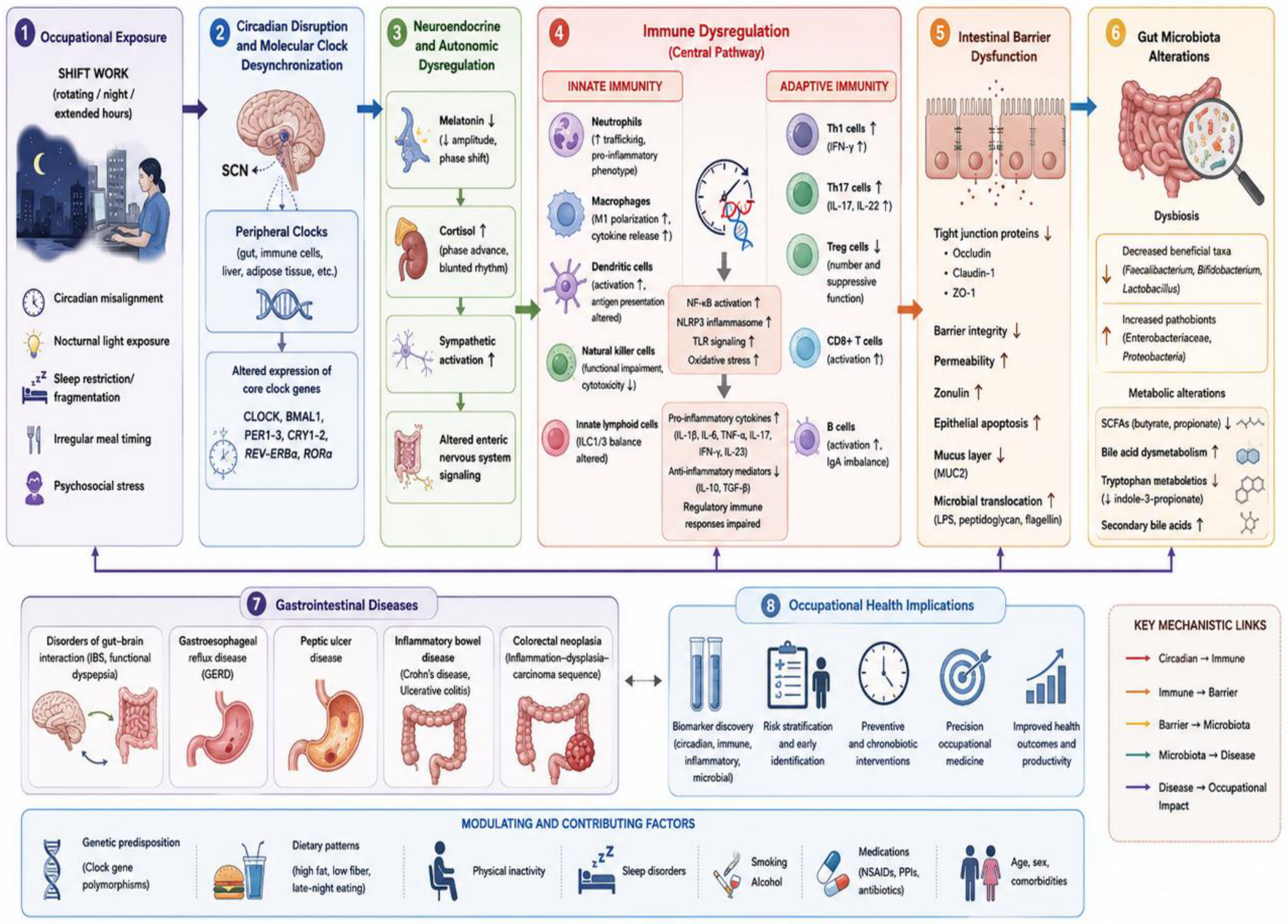
Figure 2.
Conceptual framework for Precision Occupational Medicine in shift workers: from biological risk assessment to personalized gastrointestinal disease prevention (Graphical illustration generated with the assistance of ChatGPT (OpenAI, GPT-5.6 Sol) based on detailed author-designed scientific concepts and subsequently reviewed and approved by the authors). Proposed translational framework illustrating the application of Precision Occupational Medicine to chronic shift workers. Occupational exposure characteristics (shift schedule, cumulative night work, chronotype, lifestyle factors) are integrated with circadian biomarkers, immune profiling, intestinal barrier biomarkers, gut microbiome analysis, and multi-omics technologies to identify biologically susceptible individuals. Artificial intelligence-assisted data integration supports individualized risk prediction and enables personalized preventive strategies, including optimized work schedules, chrononutrition, sleep optimization, microbiota-directed interventions, and biomarker-guided occupational surveillance. The ultimate objective is the early prevention of gastrointestinal disease through individualized occupational health management.
Figure 2.
Conceptual framework for Precision Occupational Medicine in shift workers: from biological risk assessment to personalized gastrointestinal disease prevention (Graphical illustration generated with the assistance of ChatGPT (OpenAI, GPT-5.6 Sol) based on detailed author-designed scientific concepts and subsequently reviewed and approved by the authors). Proposed translational framework illustrating the application of Precision Occupational Medicine to chronic shift workers. Occupational exposure characteristics (shift schedule, cumulative night work, chronotype, lifestyle factors) are integrated with circadian biomarkers, immune profiling, intestinal barrier biomarkers, gut microbiome analysis, and multi-omics technologies to identify biologically susceptible individuals. Artificial intelligence-assisted data integration supports individualized risk prediction and enables personalized preventive strategies, including optimized work schedules, chrononutrition, sleep optimization, microbiota-directed interventions, and biomarker-guided occupational surveillance. The ultimate objective is the early prevention of gastrointestinal disease through individualized occupational health management.
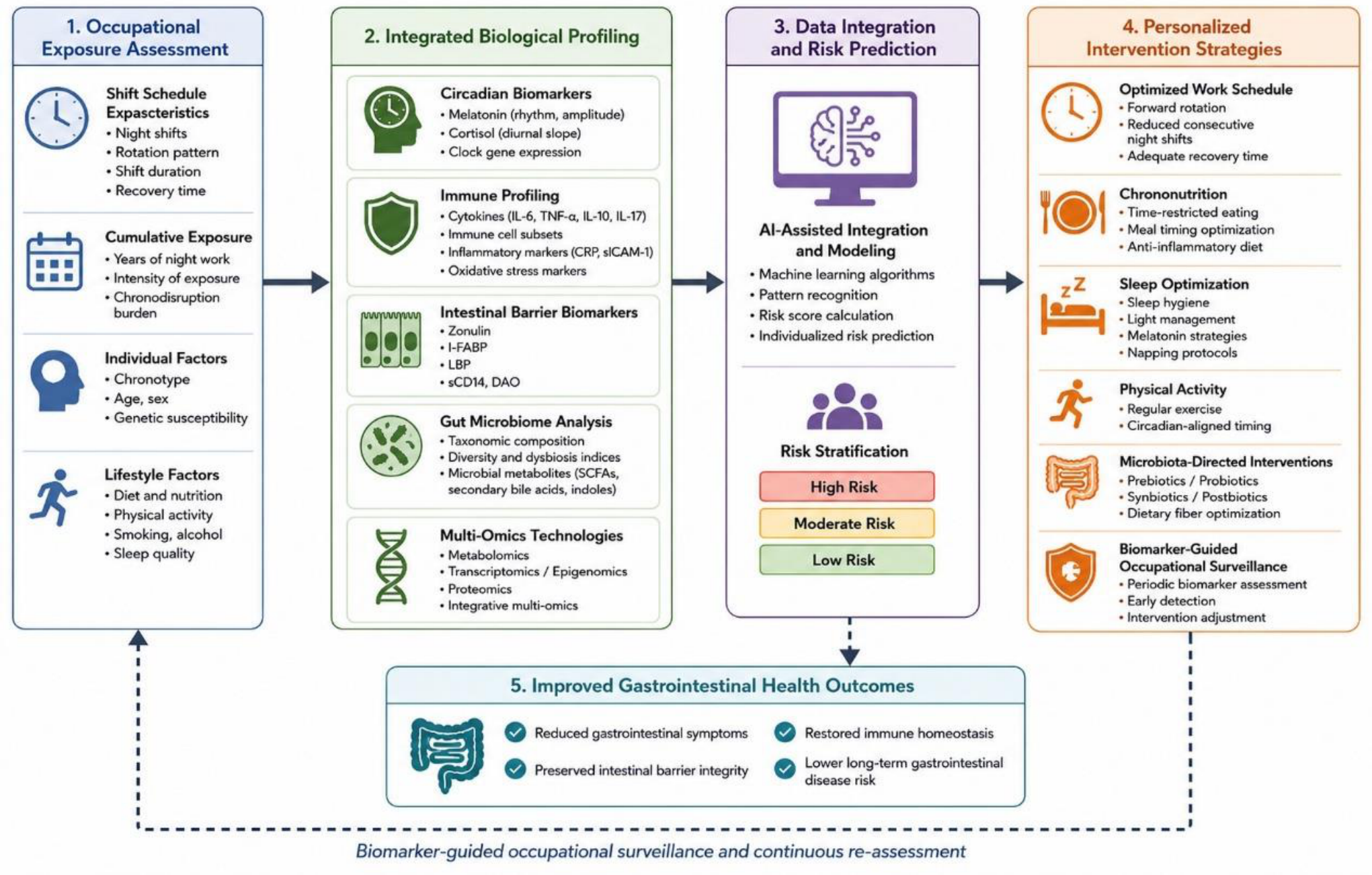
Table 1.
Circadian regulation of immune-cell populations and their alterations in chronic shift workers.
Table 1.
Circadian regulation of immune-cell populations and their alterations in chronic shift workers.
| Immune component | Physiological circadian role | Alterations associated with chronic shift work | Potential gastrointestinal consequences |
| Neutrophils | Circadian trafficking, microbial defense, early inflammatory response |
Altered migration, prolonged activation, increased inflammatory responsiveness | Enhanced epithelial injury and oxidative stress |
| Monocytes / Macrophages | Phagocytosis, tissue repair, maintenance of intestinal immune tolerance |
Increased pro-inflammatory phenotype, impaired inflammatory resolution | Persistent mucosal inflammation and impaired barrier repair |
| Dendritic cells | Circadian antigen presentation and T-cell priming | Dysregulated antigen presentation and immune activation |
Loss of immune tolerance toward luminal antigens |
| Natural killer cells | Circadian cytotoxic activity and immune surveillance |
Reduced cytotoxic function and altered cytokine secretion |
Impaired immune surveillance and chronic inflammatory activation |
| Innate lymphoid cells | Maintenance of epithelial integrity and mucosal defense |
Disturbed epithelial surveillance and cytokine production |
Increased susceptibility to epithelial barrier dysfunction |
| CD4⁺ T lymphocytes |
Coordination of adaptive immune responses |
Altered activation and cytokine production |
Exaggerated mucosal inflammatory responses |
| Regulatory T cells (Tregs) | Maintenance of immune tolerance |
Reduced regulatory activity and impaired immune suppression |
Loss of intestinal immune tolerance |
| T helper 17 cells | Mucosal host defense and epithelial protection |
Excessive pro-inflammatory activation | Chronic intestinal inflammation and epithelial injury |
| B lymphocytes |
Antibody production and mucosal immune protection |
Altered humoral immune responses | Impaired mucosal immune homeostasis |
Summary of the principal innate and adaptive immune-cell populations regulated by circadian rhythms, their physiological functions, alterations associated with chronic occupational shift work, and their potential contribution to gastrointestinal dysfunction. Collectively, these immune alterations provide the mechanistic link between neuroendocrine dysregulation and intestinal barrier impairment within the proposed shift work–gastrointestinal disease cascade.
Table 2.
Structural and functional components of the intestinal barrier affected by chronic shift work.
Table 2.
Structural and functional components of the intestinal barrier affected by chronic shift work.
| Barrier component | Physiological function | Effect of chronic shift work |
Potential gastrointestinal consequence |
| Mucus layer (Goblet cells) | Physical separation of microbiota from epithelium |
Reduced mucus secretion and altered mucus composition |
Increased microbial contact with epithelium |
| Intestinal epithelial cells | Selective permeability and nutrient absorption | Impaired regeneration and epithelial integrity |
Increased intestinal permeability |
| Tight-junction proteins (Claudins, Occludin) |
Regulation of paracellular permeability |
Tight-junction disruption mediated by inflammatory cytokines | "Leaky gut" and microbial translocation |
| Paneth cells | Antimicrobial peptide secretion |
Altered antimicrobial peptide production |
Reduced mucosal defense |
| Resident immune cells | Immune surveillance and tolerance |
Persistent inflammatory activation |
Loss of immune homeostasis |
| Pattern-recognition receptors |
Detection of microbial products |
Chronic overstimulation by translocated microbial components |
Sustained NF-κB and inflammasome activation |
Principal structural and immunological components of the intestinal barrier and the mechanisms through which chronic circadian disruption associated with shift work impairs barrier integrity. Alterations affecting epithelial cells, mucus production, tight-junction proteins, antimicrobial defenses, and mucosal immune surveillance collectively increase intestinal permeability and facilitate the transition toward gut microbial dysbiosis and gastrointestinal disease.
Table 3.
Principal gut microbial metabolites involved in circadian gastrointestinal homeostasis and their alterations during chronic shift work.
Table 3.
Principal gut microbial metabolites involved in circadian gastrointestinal homeostasis and their alterations during chronic shift work.
| Microbial metabolite | Physiological function | Alteration associated with chronic shift work |
Potential gastrointestinal consequence |
| Butyrate | Energy source for colonocytes; maintenance of tight junctions |
Reduced production | Barrier dysfunction and increased permeability |
| Acetate | Regulation of epithelial metabolism and immune responses |
Altered microbial production |
Impaired mucosal homeostasis |
| Propionate | Immune regulation and metabolic signaling |
Decreased availability | Enhanced inflammatory activation |
| Secondary bile acids |
FXR/TGR5 signalling; epithelial regeneration |
Altered bile acid metabolism |
Disturbed epithelial repair and microbial ecology |
| Indole derivatives (Tryptophan metabolites) |
AhR activation; IL-22 production; epithelial protection |
Reduced microbial biotransformation |
Loss of mucosal immune tolerance |
| Lipopolysaccharide | Component of Gram-negative bacteria |
Increased systemic translocation | Persistent TLR-mediated inflammation |
Major microbial-derived metabolites involved in maintaining intestinal barrier integrity, immune regulation, and gastrointestinal homeostasis. Chronic circadian disruption associated with shift work alters microbial metabolic activity, thereby amplifying epithelial dysfunction, immune activation, and chronic inflammation through multiple host–microbiota signaling pathways.
Table 5.
Candidate biomarkers for precision occupational surveillance in chronically exposed shift workers.
Table 5.
Candidate biomarkers for precision occupational surveillance in chronically exposed shift workers.
|
Biological domain |
Candidate biomarkers | Biological significance |
Potential occupational application |
| Circadian rhythm | Melatonin, DLMO, cortisol rhythm | Circadian alignment and neuroendocrine regulation | Early detection of circadian disruption |
| Inflammation | CRP, IL-6, TNF-α, IL-1β | Chronic low-grade inflammation | Identification of subclinical immune activation |
| Immune function |
Neutrophil function, NK-cell activity, T-cell subsets |
Immune competence and circadian immune regulation |
Immune phenotyping of high-risk workers |
| Intestinal barrier |
Zonulin, I-FABP, LBP | Epithelial permeability and microbial translocation | Early detection of barrier dysfunction |
| Microbiota | SCFAs, secondary bile acids, indole metabolites | Host–microbiota metabolic interactions | Functional microbiome assessment |
| Multi-omics | Metabolomics, metagenomics, transcriptomics |
Integrated biological profiling | Precision occupational risk prediction |
Candidate biomarkers that may support future precision occupational surveillance of shift workers. Integration of circadian, immune, epithelial, microbial, and multi-omics biomarkers may enable earlier identification of workers who exhibit biological alterations that precede clinically overt gastrointestinal disease.
Table 6.
Mechanism-based preventive strategies targeting different stages of the shift work–gastrointestinal disease cascade.
Table 6.
Mechanism-based preventive strategies targeting different stages of the shift work–gastrointestinal disease cascade.
| Target stage of the cascade | Preventive strategy | Primary biological target | Expected clinical benefit |
| Occupational exposure |
Forward rotation, reduced consecutive night shifts, adequate recovery periods | Circadian alignment | Reduced biological chronodisruption |
| Circadian regulation |
Optimized workplace lighting, chronobiological scheduling | SCN synchronization and melatonin rhythm |
Improved neuroendocrine homeostasis |
| Neuroendocrine function | Sleep optimization, stress reduction, physical activity |
Melatonin, cortisol, autonomic balance | Reduced physiological stress |
| Immune regulation |
Weight management, exercise, healthy lifestyle | Chronic low-grade inflammation |
Improved immune homeostasis |
| Intestinal barrier | High-fiber diet, nutritional optimization | Tight-junction integrity and epithelial repair | Reduced intestinal permeability |
| Gut microbiota | Prebiotics, probiotics, synbiotics, postbiotics | Microbial diversity and metabolite production |
Restoration of microbial homeostasis |
| Integrated prevention |
Personalized occupational surveillance | Multiple biological pathways | Reduced long-term gastrointestinal risk |
Mechanism-based preventive strategies targeting successive stages of the proposed shift work–gastrointestinal disease cascade. Rather than focusing on isolated interventions, future occupational health programs should integrate circadian, behavioral, immunological, epithelial, and microbiota-directed approaches to reduce gastrointestinal morbidity among chronically exposed shift workers.
Disclaimer/Publisher’s Note: The statements, opinions and data contained in all publications are solely those of the individual author(s) and contributor(s) and not of MDPI and/or the editor(s). MDPI and/or the editor(s) disclaim responsibility for any injury to people or property resulting from any ideas, methods, instructions or products referred to in the content. |
© 2026 by the authors. Licensee MDPI, Basel, Switzerland. This article is an open access article distributed under the terms and conditions of the Creative Commons Attribution (CC BY) license (http://creativecommons.org/licenses/by/4.0/).
Copyright: This open access article is published under a Creative Commons CC BY 4.0 license, which permit the free download, distribution, and reuse, provided that the author and preprint are cited in any reuse.