

Submitted:
11 August 2026
Posted:
12 August 2026
You are already at the latest version
Abstract
Double-J ureteral stents are essential in modern urology but require timely removal or exchange. When retained beyond their intended indwelling period, forgotten stents can progress to severe encrustation, infection, and irreversible renal damage, and this burden falls disproportionately on low- and middle-income countries (LMICs), where fragmented follow-up systems, financial barriers, and limited access to advanced endourological care compound risk. This narrative review critically examines the epidemiology, risk factors, complications, classification systems, imaging evaluation, and management of forgotten double-J stents, with particular emphasis on prevention strategies feasible in LMIC settings, and proposes a structured prevention framework. Reported incidence of forgotten stents ranges from under 1% to over 12%, with prolonged dwell time the strongest predictor of encrustation. Management requires individualized, distal-to-proximal endourological strategies, frequently involving multiple modalities or staged procedures in high-grade disease. Prevention is most effective when treated as an institutional responsibility rather than a matter of patient compliance: structured registries, multichannel reminder systems, and low-cost digital tools such as SMS-based tracking and smartphone registries have demonstrated substantial reductions in forgotten-stent rates, including in LMIC settings. Artificial intelligence shows early promise for follow-up risk prediction and encrustation grading but requires further external validation before clinical adoption. Forgotten double-J stents are a largely preventable patient-safety event rather than a failure of patient compliance alone. We propose the STENT-SAFE framework — Scrutinize the indication, Time-stamp removal, Educate using teach-back, Notify through multiple channels, Track every stent centrally, Safety-net high-risk patients, Act on overdue cases, Finalize only after verification, and Evaluate and audit — as a practical, resource-adaptable model for institutions across the LMIC resource spectrum.
Keywords:
forgotten ureteral stent
; double-J stent
; encrustation
; low- and middle-income countries
; prevention
; STENT-SAFE
Introduction
Double-J ureteral stents are widely used to relieve upper urinary tract obstruction, maintain drainage after endourological procedures, support ureteral healing, and manage urinary leakage. Although clinically valuable, most polymeric stents are temporary devices that require removal or scheduled exchange. Failure to remove a stent within the planned period can result in infection, encrustation, obstruction, fragmentation, renal impairment, and complex surgical intervention.
Terminology remains inconsistent. “Forgotten,” “retained,” “missed,” and “neglected” stents are frequently used interchangeably. A practical definition is a stent unintentionally left beyond the clinician-documented removal or exchange date, or beyond its manufacturer-recommended maximal indwelling period. Published studies have used thresholds ranging from two to twelve months, which complicates comparisons of incidence and outcomes [1].
Forgotten stents are preventable patient-safety events rather than solely failures of patient compliance. In LMICs, inadequate counselling, limited health literacy, out-of-pocket costs, long travel distances, fragmented records, and weak follow-up systems interact to increase risk. Once severe encrustation develops, treatment may require several endoscopic procedures, expensive equipment, prolonged hospitalization, and referral to tertiary centers—resources that are often limited in the settings where prevention is most difficult.
Epidemiology
The true incidence of forgotten ureteral stents is uncertain because definitions, follow-up duration, and denominator reporting vary. Published institutional rates range from approximately 0.9% to 12%, whereas a nationwide Taiwanese study that defined a forgotten stent as remaining for more than six months after ureteroscopic lithotripsy reported a rate of 0.68%. These figures probably underestimate the problem because asymptomatic patients, procedures performed at outside hospitals, and patients who never return are frequently missed [1].
A 2024 systematic review included 147 publications and 1,292 patients. The mean stent dwell time was 33.5 months, ranging from three months to 32 years. Urolithiasis-related procedures accounted for 79.2% of initial stent placements, while patient-related reasons—including poor follow-up, memory lapses, and misconceptions—were reported in 83.9%. Encrustation occurred in 80.8% and urinary tract infection in 40.2% of reported cases. However, the evidence consisted largely of case reports and retrospective series, producing substantial selection and publication bias [1].
Evidence from LMICs illustrates both the burden and preventability of the problem. In a 10-year Indian series of 114 patients, the institutional retained-stent rate fell from 1.1% to 0.5% after implementation of a structured three-step follow-up method. A 2026 Pakistani study of 94 patients found that unawareness, financial constraints, and neglect accounted for 50%, 24.5%, and 11.7% of delays, respectively. Neither study provides a population-level incidence, but both demonstrate the importance of socioeconomic and system-level determinants [2].
Etiology and Risk Factors
The causes of forgotten stents can be divided into patient-related, provider-related, health-system, and clinical factors.
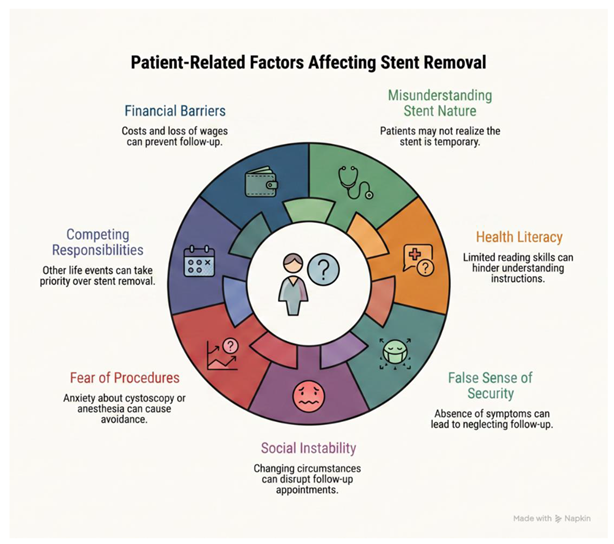
Patient-Related Factors
- ○
- Failure to understand that the stent is temporary
- ○
- Limited health literacy or inability to read written instructions
- ○
- Misconception that the stent is permanent or will dissolve spontaneously
- ○
- Absence of symptoms, creating a false impression that follow-up is unnecessary
- ○
- Fear of cystoscopy, anesthesia, pain, or another operation
- ○
- Changing telephone numbers, migration, homelessness, or social instability
- ○
- Competing illness, pregnancy, or family responsibilities
- ○
- Financial barriers, transportation costs, and loss of daily wages
In the Indian series, poor compliance, unawareness, and the belief that the stent would last for life were the most frequently documented explanations. A Pakistani observational study found that 60.5% of patients did not know that a stent had been inserted [3].
Provider and Health-System Factors
- ○
- Inadequate or hurried counselling
- ○
- Failure to provide a specific removal date
- ○
- Lack of clear ownership for arranging removal
- ○
- Stent insertion during emergency care without definitive follow-up
- ○
- Placement by clinicians outside the urology service
- ○
- Incomplete operative notes or discharge documentation
- ○
- Reliance on paper cards or unmonitored registers
- ○
- Failure to reconcile stents inserted and removed at different hospitals
- ○
- Long surgical waiting lists and limited cystoscopy capacity
- ○
- Absence of escalation procedures for missed appointments
The 2024 systematic review attributed inadequate counselling to physician-related factors in approximately one-quarter of cases, although patient- and provider-related categories frequently overlapped [1].
Clinical and Stent-Related Factors
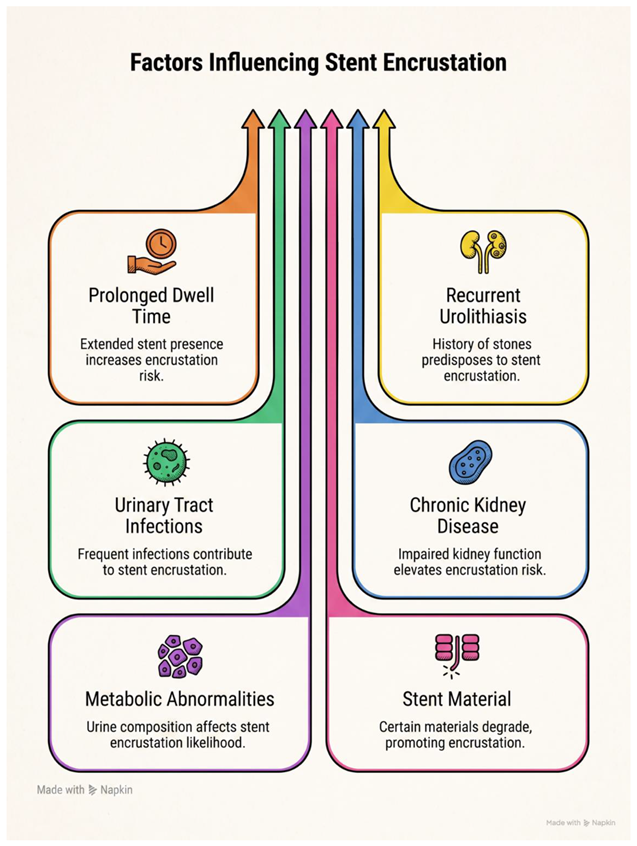
The most important predictor of encrustation and complicated removal is prolonged dwell time. Additional risk factors include:
- ○
- Previous or recurrent urolithiasis
- ○
- Residual stone fragments
- ○
- Recurrent urinary tract infection or bacteriuria
- ○
- Chronic kidney disease
- ○
- Metabolic abnormalities and highly lithogenic urine
- ○
- Pregnancy
- ○
- Congenital urinary tract abnormalities
- ○
- Persistent ureteral obstruction
- ○
- Malignancy requiring long-term drainage
- ○
- Previous rapid stent encrustation
- ○
- Polyurethane or other materials prone to degradation during prolonged use
In the 2026 Pakistani series, stent dwell time exceeding six months and low educational status were independently associated with encrustation. The adjusted odds ratios were 23.39 and 9.72, respectively, although the wide confidence intervals and selected single-center population require cautious interpretation [4].
Complications
Clinical presentation ranges from incidental radiological detection to life-threatening urosepsis. Common symptoms include flank or abdominal pain, urinary frequency and urgency, dysuria, hematuria, fever, and recurrent urinary tract infection. Because some patients tolerate stents well, the absence of symptoms does not indicate safety.
Major complications include:
- ○
- Stent encrustation and associated stone formation
- ○
- Recurrent bacteriuria, pyelonephritis, and urosepsis
In the systematic review, serum creatinine was elevated in 24.8% of patients and in 62.5% of those with bilateral forgotten stents. An Indian series reported permanent loss of renal-unit function requiring nephrectomy in 7.9%. In the 2026 Pakistani cohort, 43.6% had encrustation, 22.3% stone formation, 18.1% fragmentation, and 16% migration. These high rates reflect referral and selection bias but demonstrate the potential severity of delayed removal [1].
Forgotten stents also create considerable financial burdens. Removal of complicated retained stents has been estimated to cost 1.8–21 times more than routine stent removal, with costs increasing as retention duration and procedural complexity increase [1].
Encrustation
Encrustation is the deposition of mineral crystals on the internal or external stent surface. Immediately after placement, urinary proteins and glycoproteins form a conditioning layer. Crystals may then adhere directly or become incorporated into bacterial biofilm. Calcium oxalate is common in non-infected urine, while urease-producing organisms hydrolyze urea to ammonia, increase urinary pH, and promote struvite and calcium-phosphate deposition. Biofilm and mineral deposition can reinforce one another, although encrustation may also occur without bacterial infection [5].
Dwell time is the strongest established risk factor. The commonly cited El-Faqih data demonstrated encrustation in 9.2% of stents removed before six weeks, 47.5% between six and twelve weeks, and 76.3% after twelve weeks. A later study reported rates of 26.8%, 56.9%, and 75.9% across the same periods. These figures should not be interpreted as universal removal deadlines because risk varies by stent material, indication, urine chemistry, infection, and manufacturer specifications. Nevertheless, they show that clinically significant encrustation may develop within a few months—and occasionally within weeks in high-risk patients [6].
Encrustation often begins around the renal and bladder coils, where urinary stasis and turbulent flow favor crystal deposition. It may subsequently extend along the ureteral segment. Severe disease can bind the stent to large renal, ureteral, or bladder calculi, making simple cystoscopic extraction dangerous.
Classification Systems
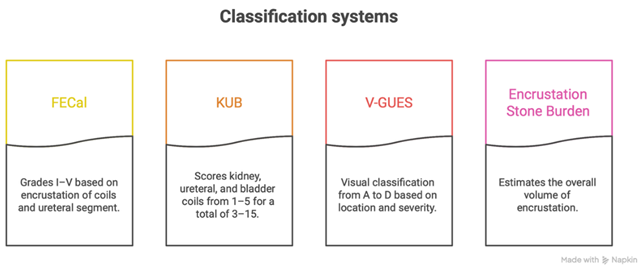
Classification standardises reporting, predicts procedural complexity, and assists in counselling and resource planning.
| System | Main features | Clinical value |
| FECal | Grades I–V. Grade I represents minimal encrustation of one coil; grade II, complete encasement of one coil; grade III, one encased coil with ureteral-segment encrustation; grade IV, encasement of both coils; grade V, bulky encrustation involving both coils and the ureteral segment. | Simple and widely used; higher grades generally require multimodal or staged treatment. |
| KUB | Scores the kidney coil, ureteral segment, and bladder coil separately from 1–5, producing a total score of 3–15. | Provides an anatomical assessment; a total score of at least 9 predicts longer operating time, multiple procedures, and lower stone-free rates. |
| V-GUES | Visual classification from A to D based on location and severity of encrustation. | Helps predict stent-removal and stone-free success; grades C and D frequently require combined retrograde and percutaneous access. |
| EncrustationStone Burden score | Estimates the overall volume of encrustation. | Quantifies burden but may provide less information about anatomical location. |
The original V-GUES study reported successful single-intervention removal in 86.8% overall; types A and B had 100% retrieval, whereas type D was associated with lower retrieval and stone-free rates and a greater need for multiple sessions. A 2025 multicenter comparison suggested that the systems provide complementary information: V-GUES was strongest for predicting stone-free status, FECal for multimodal or multiple-session treatment, and KUB for prolonged operating time [7].
Imaging Evaluation
If resistance is encountered during attempted stent removal, traction should be stopped. Forceful extraction can fracture the stent, avulse the ureter, or cause bleeding. Imaging should be obtained before further intervention.
Plain KUB Radiography
A kidney–ureter–bladder radiograph is inexpensive and widely available. It can identify radiopaque encrustation, large associated stones, stent position, migration, and fragmentation. However, it may underestimate stone burden or fail to demonstrate radiolucent deposits.
Ultrasonography
Ultrasonography detects hydronephrosis, bladder stones, renal calculi, and gross parenchymal changes. It is particularly useful in pregnancy and resource-limited settings but provides limited assessment of ureteral encrustation.
Non-Contrast Computed Tomography
Non-contrast CT is the preferred imaging modality for complex or encrusted stents because it maps the entire stent, defines stone burden, detects fracture and migration, and evaluates the contralateral kidney. It also enables FECal, KUB, or V-GUES grading and operative planning. Where CT availability is limited, a pragmatic approach is to begin with KUB radiography and ultrasound, reserving CT for suspected moderate or severe encrustation [1].
Renal Functional Imaging
DTPA or MAG3 renal scintigraphy should be considered when there is severe hydronephrosis, an atrophic kidney, bilateral disease, a solitary kidney, or suspected loss of renal function. Demonstration of a non-functioning renal unit may alter management toward nephrectomy rather than repeated high-risk reconstructive attempts.
Imaging must be supplemented by serum creatinine, full blood count, urinalysis, and urine culture. Blood cultures and urgent sepsis assessment are required in systemically ill patients.
Management
Management should be individualized according to infection, renal function, stent integrity, encrustation location and burden, available expertise, and the selected classification score.
Initial Stabilization
Patients with fever, sepsis, infected hydronephrosis, or obstructive renal failure require urgent resuscitation, cultures, and antimicrobial treatment. An infected obstructed collecting system should be decompressed—usually by percutaneous nephrostomy—before definitive stent and stone removal. Culture-directed antibiotics are preferable because resistant organisms are common in patients with prolonged stenting [8].
Endourological Treatment
A distal-first strategy is generally preferred:
- Minimal or absent encrustation: Gentle cystoscopic removal may be sufficient.
- Bladder-coil encrustation: Cystolitholapaxy, pneumatic fragmentation, or laser cystolithotripsy is used to free the distal coil.
- Ureteral-segment encrustation: Semirigid ureteroscopy with holmium:YAG or thulium-fiber laser lithotripsy can separate the stent from surrounding deposits. Severely embedded stents may require controlled division and piecemeal retrieval.
- Limited proximal-coil disease: Flexible ureteroscopy and laser lithotripsy may be adequate.
- Large renal-coil or associated renal stone burden:Percutaneous nephrolithotomy is generally preferred.
- Complex multisegment disease: Endoscopic combined intrarenal surgery can provide simultaneous retrograde and percutaneous access.
- Shock-wave lithotripsy: May be used as an adjunct for selected proximal or ureteral encrustations, but is rarely sufficient alone in moderate or severe disease.
- Open or laparoscopic surgery: Reserved for very large stone burdens, anatomical reconstruction, failed endourological treatment, or unavailable endoscopic resources.
- Nephrectomy: Considered for a severely damaged, symptomatic, or infected non-functioning kidney after functional assessment.
In the systematic review, 59% of patients required multiple treatment modalities or sessions. Cystoscopic removal with or without bladder lithotripsy was used in 64.8%, ureteroscopy in 43.4%, PCNL in 31.6%, and shock-wave lithotripsy in 30.4%. Open, laparoscopic, or nephrectomy procedures were necessary in 6.7%[1].
Single-session treatment can be successful in experienced centers, but should not be pursued at the expense of safety. Staging is appropriate when there is sepsis risk, prolonged operating time, major blood loss, poor visibility, high intrarenal pressure, equipment limitations, or severe bilateral disease. After treatment, complete removal of all fragments should be documented and residual stones assessed. If another stent is inserted, a new tracked removal date must be created immediately.
Prevention Strategies
Prevention should target the entire stent pathway rather than relying on patient memory.
Avoid Unnecessary Placement
The first preventive measure is not to insert a stent when it is unlikely to provide benefit. The 2026 European Association of Urology guideline states that a postoperative stent need not be placed after uncomplicated ureteroscopy [9].
Establish Responsibility
The clinician or service inserting the stent should retain responsibility for arranging removal or exchange. Responsibility should not be transferred informally to the patient, another hospital, or an unspecified follow-up clinic.
Provide Effective Education
Counselling should include:
- ○
- Why the stent was inserted
- ○
- That it is temporary
- ○
- The exact planned removal or exchange date
- ○
- Symptoms requiring urgent review
- ○
- Consequences of delayed removal
- ○
- Contact details if an appointment is missed
Instructions should use local languages, pictograms, and teach-back rather than written information alone. A family member or caregiver should be included where appropriate.
Use a Stent Card and Confirmed Appointment
The patient should receive a card recording the insertion date, side, indication, stent type, and removal date. Removal should be booked before discharge rather than left for the patient to arrange later.
Identify High-Risk Patients
Patients with previous missed appointments, low literacy, no stable phone number, financial hardship, migration risk, pregnancy, recurrent infection, chronic kidney disease, stone disease, or previous rapid encrustation need earlier and more intensive follow-up.
Facilitate Removal
Short-term stents with extraction strings may permit outpatient or self-removal in carefully selected patients, reducing the need for cystoscopy. They are unsuitable when premature dislodgement would be dangerous or when prolonged drainage is required [10].
Materials and Coatings
Silicone and specialized coatings may reduce symptoms, bacterial adherence, or encrustation in selected circumstances, but no currently available material eliminates the need for tracking. A 2024 meta-analysis did not demonstrate that stent firmness significantly affected encrustation, illustrating the limitations of relying on device characteristics alone [11].
Digital Health
Digital tracking systems can create a stent episode at insertion, record the planned removal date, generate escalating reminders, and close the episode only after verified removal or exchange.
Effective systems should:
- ○
- Integrate with operative notes, billing, pharmacy, or device barcode systems
- ○
- Require entry of a planned removal or exchange date
- ○
- Alert both the patient and responsible clinical team
- ○
- Produce daily or weekly overdue lists
- ○
- Support SMS, voice calls, and application notifications
- ○
- Record unsuccessful contact attempts
- ○
- Escalate overdue patients to a designated coordinator
- ○
- Permit reconciliation when removal occurs at another facility
In a prospective study, a smartphone tracker reduced mean overdue time from 20 days to 3.5 days and reduced loss to follow-up from 6.9% to zero compared with appointment cards. A 2026 systematic review found that tracking mechanisms reduced lost or delayed stents from baseline rates of 0–13% to approximately 1%, although most systems were institution-specific and high-quality randomized evidence remained limited [12].
Recent evidence from Malaysia is particularly relevant to LMICs. In a multicenter retrospective comparison, 13% of patients managed using a manual registry developed a forgotten stent, compared with none in a smartphone registry group receiving automated SMS reminders. Differences between the non-randomized cohorts mean that the result should be interpreted cautiously, but it supports the feasibility of low-cost digital tracking [13].
Digital health must not replace a functioning follow-up service. Systems that require smartphones, continuous internet access, or high literacy may exclude rural, older, and disadvantaged patients. SMS, interactive voice calls, offline databases, shared-caregiver contacts, and manual backup lists are more appropriate in many LMIC settings. WHO similarly emphasizes that digital interventions must be assessed for feasibility, equity, acceptability, privacy, and resource use and cannot substitute for essential health-system capacity [14].
Artificial Intelligence
Artificial intelligence may contribute in three areas:
- Follow-up risk prediction: Electronic-record models could identify patients likely to miss removal based on previous attendance, distance, socioeconomic variables, indication, and planned dwell time.
- Automated case detection: Natural-language processing could identify stent insertion from operative reports and reconcile removal from subsequent documentation.
- Imaging and operative planning: AI could detect stents, quantify encrustation, calculate KUB or FECal scores, and predict the need for PCNL, combined access, or multiple sessions.
A 2023 bicentric study of 354 patients developed a CT-radiomics model for identifying stent encrustation. The combined model achieved an area under the curve of 0.820 in external validation, with 78.2% accuracy. In 2024, a Mask-RCNN and three-dimensional morphological model evaluated 222 CT examinations, achieving 94.4% stent-segmentation accuracy, 87.3% accuracy for positive versus negative encrustation classification, and an average processing time of 12 seconds [15].
These studies demonstrate technical feasibility, not improved clinical outcomes. Current datasets are relatively small, retrospective, and drawn from a limited number of institutions. CT availability is also restricted in many LMICs. Before implementation, AI systems require external validation across different scanners, populations, stent materials, and disease patterns. AI should augment—not replace—a deterministic registry, clinician review, and patient-navigation system.
Challenges in LMICs
Forgotten stents in LMICs are driven by interconnected structural problems:
- ○
- Limited public awareness and variable health literacy
- ○
- Out-of-pocket payment for transport, imaging, and removal
- ○
- Loss of wages associated with follow-up visits
- ○
- Rural residence and long referral distances
- ○
- Fragmentation between public, private, and charitable facilities
- ○
- Lack of interoperable electronic records or unique patient identifiers
- ○
- High patient volumes and limited urology workforce
- ○
- Long waiting lists for ureteroscopy, PCNL, and cystoscopy
- ○
- Limited access to CT, renal scintigraphy, lasers, flexible ureteroscopes, and disposable equipment
- ○
- Instrument breakdown and maintenance difficulties
- ○
- Changing or shared phone numbers and unreliable network coverage
- ○
- Antimicrobial resistance in chronically colonized stents
- ○
- Inadequate pathways for referral of complex encrusted stents
The literature frequently labels delayed removal as “poor compliance.” This description may obscure underlying causes such as inadequate counselling, unaffordable care, unbooked appointments, or an absent recall system. The 2026 Pakistani study found that half of the patients were unaware of their stent and almost one-quarter cited financial constraints, demonstrating that forgotten stents are often failures of communication and service design [4].
Treatment inequalities are equally important. A high-grade encrusted stent may require flexible ureteroscopy, laser lithotripsy, PCNL, fluoroscopy, experienced anesthesia, intensive care support, and several sessions. When these are unavailable, patients may undergo delayed referral, more invasive surgery, prolonged nephrostomy drainage, or avoidable nephrectomy.
Proposed Prevention Framework
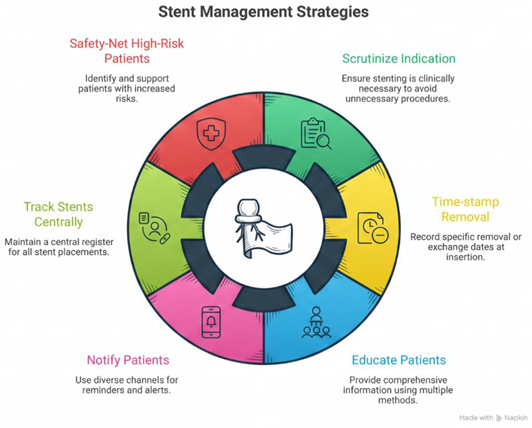
This review proposes the STENT-SAFE framework, designed for both low-resource and digitally enabled institutions.
| Component | Recommended action |
| S — Scrutinize theindication | Avoid routine placement when stenting is not clinically necessary. |
| T — Time-stampremoval | Record a manufacturer- and indication-specific removal or exchange date at insertion. |
| E — Educate usingteach-back | Provide multilingual, verbal, written, and pictorial information; involve a caregiver when appropriate. |
| N — Notify through multiple channels | Use SMS, voice call, application alert, and physical card rather than a single reminder. |
| T — Track everystent centrally | Maintain one institutional register with patient identifiers, side, indication, insertion date, and due date. |
| S — Safety-nethigh-risk patients | Flag financial hardship, low literacy, unstable contact details, previous missed appointments, pregnancy, infection, CKD, and stone disease. |
| A — Act onoverdue cases | Generate weekly overdue lists, telephone patients, contact caregivers, and involve community health workers where available. |
| F — Finalize onlyafter verification | Close the record only when removal or exchange is confirmed by documentation. |
| E — Evaluate and audit | Review forgotten-stent rates, overdue days, failed contacts, and complications at regular clinical-governance meetings. |
Minimum Viable Package for Low-Resource Hospitals
A safe system does not require an expensive application. The minimum package should include:
- ○
- A bound or spreadsheet-based central register
- ○
- A mandatory planned removal date
- ○
- A patient stent card
- ○
- A removal appointment before discharge
- ○
- Weekly review of overdue cases
- ○
- At least two contact numbers
- ○
- SMS or telephone reminders
- ○
- Named staff responsibility for escalation
- ○
- Monthly reconciliation of inserted and removed stents
Enhanced Package
Facilities with greater digital capacity should add automatic registration from operating-theatre or billing data, barcode identification, multilingual SMS and voice reminders, patient dashboards, inter-hospital data exchange, and automated escalation to the responsible urologist.
Complex-Stent Referral Pathway
Regional networks should identify centers capable of flexible ureteroscopy, PCNL, combined intrarenal surgery, renal scintigraphy, and intensive-care support. Standardized referral forms should include CT images, culture results, renal function, dwell time, and FECal, KUB, or V-GUES classification.
Future Directions
Future research should prioritize:
- A standardized definition: Forgotten stents should be defined relative to the documented intended removal date or manufacturer-specific maximal life.
- Population-based LMIC data: Prospective registries need clear denominators, including all inserted stents, not only complicated referrals.
- Implementation trials: Cluster-randomized or stepped-wedge studies should compare cards, SMS systems, smartphone applications, and patient-navigation programs.
- Cost-effectiveness analysis: Prevention costs should be compared with hospitalization, multiple operations, sepsis treatment, and loss of renal function.
- Digital-equity research: Systems should be evaluated in people with low literacy, shared phones, unstable housing, and rural residence.
- Standardized outcome reporting: Studies should report overdue time, encrustation grade, number of sessions, stone- and stent-free rates, complications, renal outcomes, and patient costs.
- Externally validated AI: Models should be tested prospectively across different countries and imaging systems before clinical deployment.
- Improved stent technology: Antimicrobial and anti-encrustation coatings, biodegradable stents, and devices capable of indicating dwell time require further clinical evaluation. Current biodegradable magnesium-based designs remain predominantly experimental or preclinical and cannot yet replace follow-up systems [16].
- Formal guidelines: International urological guidelines should include specific recommendations for forgotten-stent prevention, classification, referral, and management.
- Patient-centered design: Patients and community health workers should participate in developing counselling materials and recall pathways.
Conclusion
Forgotten double-J stents are uncommon but potentially devastating and largely preventable complications. Prolonged dwell time is the central biological driver of encrustation, while inadequate communication, financial barriers, fragmented care, and absent tracking systems are the principal organizational drivers. The burden is especially significant in LMICs because delayed presentation is combined with limited access to imaging and advanced endourological treatment.
Management requires infection control, assessment of renal function, CT-based mapping and classification, and an individualized distal-to-proximal endourological strategy. High-grade cases frequently require ureteroscopy, PCNL, combined access, or staged procedures. Prevention should be treated as an institutional responsibility: every stent must have an owner, a removal date, a tracking record, a multichannel reminder process, and verified closure. Low-cost registers and SMS systems can provide substantial benefit, while digital health and AI should strengthen—not replace—patient education, clinical accountability, and accessible follow-up care.
References
- Wang, X., Ji, Z., Yang, P. et al. Forgotten ureteral stents: a systematic review of literature. BMC Urol 24, 52 (2024). [CrossRef]
- Agrawal M, Gite VA, Sankapal P, et al. Retained ureteral stents, an avoidable source of morbidity: 10 years’ experience from a single tertiary care centre. Pan Afr Med J. 2022;42:68. Published 2022 May 25. [CrossRef]
- Murtaza B, Alvi S. Forgotten Ureteral Stents: An Avoidable Morbidity. J Coll Physicians Surg Pak. 2016;26(3):208-212.
- Shamsher, M., Shinwari, S., Ahmad, I. et al. Forgotten double-J ureteral stents: clinical burden, complications, and predictors of encrustation in a Tertiary Care Center. Afr J Urol 32, 33 (2026). [CrossRef]
- Amado P, Zheng S, Lange D, Carugo D, Waters SL, Obrist D, Burkhard F and Clavica F (2024) The interplay between bacterial biofilms, encrustation, and wall shear stress in ureteral stents: a review across scales. Front. Urol. 3:1335414. [CrossRef]
- El-Faqih SR, Shamsuddin AB, Chakrabarti A, et al. Polyurethane internal ureteral stents in treatment of stone patients: morbidity related to indwelling times. J Urol. 1991;146(6):1487-1491. [CrossRef]
- Manzo BO, Alarcon P, Lozada E, et al. A Novel Visual Grading for Ureteral Encrusted Stent Classification to Help Decide the Endourologic Treatment. Journal of Endourology. 2021;35(9):1314-1319. [CrossRef]
- Juliebø-Jones P, Pietropaolo A, Æsøy MS, et al. Endourological management of encrusted ureteral stents: an up-to-date guide and treatment algorithm on behalf of the European Association of Urology Young Academic Urology Urolithiasis Group. Cent European J Urol. 2021;74(4):571-578. [CrossRef]
- EAU Guidelines. Edn. presented at the EAU Annual Congress London 2026. ISBN 978-94-92671-32-5.
- Dong C, Zheng H, Jiang Y, Chen W. Effects of ureteral stent removal using an extraction string following ureteroscopic lithotripsy: a systematic review and meta-analysis of randomized controlled trials. Front Surg. 2026;13:1718954. Published 2026 Feb 19. [CrossRef]
- Putrantyo II, Warli SM, Siregar GP, Prapiska FF, Kadar DD, Sihombing B. Role of ureteral stent material and coating to prevent ureteral stent related issue: A systematic review and meta analysis. Arch Ital Urol Androl. 2024;96(1):12067. Published 2024 Mar 4. [CrossRef]
- Ulker V, Atalay HA, Cakmak O, Yucel C, Celik O, Kozacioglu Z. Smartphone-based stent tracking application for prevention of forgotten ureteral double-J stents: a prospective study. Int Braz J Urol. 2019;45(2):376-383. [CrossRef]
- Khor V, Somani BK, Sharin MFM, Fahmy O, Lee CKS, Mohd Zainuddin SA, et al. Smartphone application stent registry with automatic short-message service reminders mitigates the issue of forgotten ureteral stents: a multicenter retrospective cohort study in Malaysia: a European Association of Urology Section of Endourology collaboration. Asian J Urol. Published online 2026. [CrossRef]
- World Health Organization. WHO guideline: recommendations on digital interventions for health system strengthening. World Health Organization; 2019. Accessed August 9, 2026.
- Qiu J, Yan M, Wang H, et al. Identifying ureteral stent encrustation using machine learning based on CT radiomics features: a bicentric study. Front Med (Lausanne). 2023;10:1202486. Published 2023 Aug 2. [CrossRef]
- Pacheco, M., D’Elia, F., Nienaber, M. et al. Towards biodegradable Mg-based ureteral stents: a comprehensive in vitro study of two Mg-1Y stent prototypes. npj Mater Degrad 10, 84 (2026). [CrossRef]
Disclaimer/Publisher’s Note: The statements, opinions and data contained in all publications are solely those of the individual author(s) and contributor(s) and not of MDPI and/or the editor(s). MDPI and/or the editor(s) disclaim responsibility for any injury to people or property resulting from any ideas, methods, instructions or products referred to in the content. |
© 2026 by the author. Licensee MDPI, Basel, Switzerland. This article is an open access article distributed under the terms and conditions of the Creative Commons Attribution (CC BY) license.
Copyright: This open access article is published under a Creative Commons CC BY 4.0 license, which permit the free download, distribution, and reuse, provided that the author and preprint are cited in any reuse.