

Submitted:
09 August 2026
Posted:
12 August 2026
You are already at the latest version
Abstract
Background/Objectives: Migrants often experience health inequities resulting from administrative insecurity, precarious employment, and barriers to healthcare access. Although non-metropolitan areas are increasingly important destinations for migrant populations, evidence on their health experiences in these settings remains limited. This study aimed to examine how migrants living in non-metropolitan areas of Spain expe-rience health throughout the migration process and to identify implications for nursing practice and health policy. Methods: A descriptive phenomenological study was con-ducted using Giorgi’s method. Twenty-two adult migrants living in the Spanish prov-inces of Zamora and León participated in semi-structured, in-depth interviews. Data were analyzed following Giorgi’s phenomenological approach, and the study adhered to the Consolidated Criteria for Reporting Qualitative Research (COREQ). Results: Five in-terconnected themes emerged: migration process, health perceptions, social networks, work conditions, and adaptation and integration. The central finding, “Health as Work”, revealed that participants primarily understood health as the ability to work and maintain economic stability rather than as a state of physical or mental well-being. This perspective reflected broader structural vulnerability arising from administrative insecurity, pre-carious employment, and limited social support. Nurses and third-sector organizations were identified as essential in facilitating healthcare navigation, promoting health lit-eracy, and providing psychosocial support. Conclusions: Migrants’ health experiences in non-metropolitan Spain are shaped by structural vulnerability, with employment and legal status strongly influencing health and access to care. Nursing practice should in-tegrate culturally responsive and structurally informed care, while health policies should reduce administrative and employment barriers and strengthen collaboration between healthcare services and community organizations to promote health equity.
Keywords:
migrants
; qualitative research
; structural vulnerability
; health equity
; cultural competence
; nursing
; social determinants of health
1. Introduction
International migration is reshaping health systems worldwide, requiring healthcare services to respond to increasingly diverse populations while addressing persistent health inequities. Migrants frequently encounter barriers to healthcare, employment, housing, and social participation, resulting in poorer health outcomes and additional demands on health systems [1,2,3]. Despite international commitments to Universal Health Coverage and the Sustainable Development Goals (SDGs), inequities related to administrative insecurity, labor precarity, discrimination, and limited access to healthcare remain common among migrant populations [4,5].
Migrants’ health is strongly influenced by the social determinants of health, including employment, legal status, income, education, and access to healthcare [6]. Administrative insecurity, delayed regularization procedures, precarious employment, and difficulties in recognizing professional qualifications may generate cumulative disadvantages that compromise physical and mental health, social integration, and continuity of care [7,8]. These structural conditions challenge health systems’ capacity to provide equitable care, highlighting the need for interventions that address both healthcare delivery and the broader determinants of health [9].
Nurses are central to this response by facilitating healthcare access, promoting health literacy, coordinating care, and advocating for vulnerable populations. Leininger’s Theory of Culture Care Diversity and Universality [10] and Campinha-Bacote’s model of cultural competence [11] provide complementary frameworks for delivering culturally responsive care. Understanding migrants’ lived experiences is essential for designing person-centered, culturally responsive healthcare services that effectively address structural and social barriers to health [12].
Although migrant health has been widely investigated in metropolitan areas, considerably less is known about migrants living in non-metropolitan settings, where healthcare resources, support networks, and opportunities for social integration may differ substantially [13,14]. Most studies have examined healthcare access or specific health outcomes, whereas fewer have explored how migrants themselves understand health and how employment, legal status, social support, and healthcare interact throughout the migration process.
Spain offers a relevant context for addressing this gap. International migration has increasingly expanded towards smaller cities experiencing population ageing and demographic decline, where migrants have become essential to local labor markets and community sustainability [15,16]. In Castilla y León, the foreign-born population reached approximately 9% in 2023 [17]. Provinces such as Zamora and León combine rural depopulation with increasing migration and often have fewer specialized migrant services and less developed support networks than large urban center’s [18,19]. Understanding migrants’ health experiences in these settings is therefore important for designing equitable and context-sensitive healthcare services.
Addressing these challenges is consistent with the United Nations 2030 Agenda, particularly SDGs 3 (Good Health and Well-being), 8 (Decent Work and Economic Growth), 10 (Reduced Inequalities), and 11 (Sustainable Cities and Communities), which promote equitable healthcare, social inclusion, and the reduction of health disparities [4].
This study aimed to explore how migrants living in non-metropolitan areas of Spain experience health and healthcare throughout the integration process and to identify the implications of these experiences for nursing practice, health equity, and health service responsiveness. Qualitative research is particularly suited to capturing migrants’ lived experiences and subjective understandings of health [20]. We expected participants’ narratives to demonstrate that health experiences extend beyond healthcare access and are shaped by the interaction of employment, legal status, social support, and healthcare systems.
2. Materials and Methods
Study Design: A descriptive phenomenological approach based on Giorgi’s method [21], was selected because it allows the systematic exploration of lived experiences while remaining grounded in participants’ descriptions rather than pre-existing theoretical interpretations. This approach was considered appropriate to understand how migrants subjectively experience health, integration, and structural vulnerability within non-metropolitan contexts.
Sample and Setting: The sample comprised 22 participants (17 women, 5 men) residing in Spain. Inclusion criteria included being >18 years old and having >1 year of residency. Recruitment utilized a snowball sampling method, facilitated through face-to-face meetings with representatives from non-governmental organizations collaborating with migrants (Caritas Diocesana, Cruz Roja) [22], and two key immigrant participants who served as gatekeepers. Recruitment continued until thematic and experiential sufficiency was achieved, meaning that no substantially new dimensions of the phenomenon emerged during subsequent interviews. No participants refused participation or dropped out of the study.
Data Collection: Participants were contacted by phone, and upon confirming their acceptance, an individual appointment for the in-person interview was scheduled. Semi-structured in-depth interviews (20–81 minutes) with a guide provided by the author (available as Supplementary Material S1), were conducted by the lead researcher (CVB) between November 2023 and June 2024. The research team consisted of three nursing professionals with experience in transcultural nursing and qualitative methodology. Interviews were conducted in private settings (NGO offices or participants’ homes), with only the participant present, and were audio-recorded while field notes were taken for triangulation. The interview ended with a specific question about the role of the nurse.
Data Analysis: Data management was supported by qualitative software NVivo® to facilitate coding organization and investigator triangulation. The analysis followed Giorgi’s four analytical stages: repeated reading of transcripts to obtain a sense of the whole, identification of meaning units, transformation of participants’ everyday expressions into phenomenologically sensitive language, and synthesis of the essential structure of the phenomenon. The categories, subcategories, and codes were agreed upon by consensus among all research team members. As an example of the analysis procedure an extract of the analysis, with the final set of themes, categories and codes is shown in Table 1.
Rigor and Ethics: The study adhered to the Consolidated Criteria for Reporting Qualitative Research (COREQ) guidelines [23] to enhance transparency and methodological rigor. Throughout the research process, the investigators engaged in continuous reflexivity and phenomenological bracketing to critically examine potential assumptions related to migration, cultural competence, and healthcare access. The research team consisted of three Spanish female nursing researchers with formal expertise in transcultural nursing and qualitative methodology. While this shared professional background provided valuable clinical and contextual insight, the team remained aware of the potential risk of ethnocentric or over-medicalized interpretations.
To minimize interpretive bias, reflexive field notes and analytic memos were systematically maintained during both data collection and analysis. In addition, all interview transcripts were returned to participants for member checking, and all participants confirmed the accuracy and consistency of their statements.
Methodological rigor was further strengthened through investigator triangulation. All transcripts were independently reviewed by the three authors (CVB, EQS, EAD), and the identification of meaning units, codes, subcategories, and themes was achieved through a collaborative consensus process. This iterative analytical dialogue functioned as a corrective mechanism, ensuring that the final interpretive framework remained grounded in participants’ lived experiences and verbatim accounts rather than in the researchers’ pre-existing assumptions.
The study received ethical approval from the University of León Ethics Committee (ETICA-ULE-029-2023). All participants provided written informed consent prior to participation.
3. Results
The participants formed a heterogeneous profile with origins in Latin America (Peru, Bolivia, Ecuador, Colombia, Venezuela, Cuba), Romania, Morocco, Senegal, and Guinea Conakry (Table 2). Most were employed in precarious sectors, including caregiving, cleaning, and hospitality.
The analysis revealed that migrants’ health experiences in non-metropolitan settings were deeply shaped by structural vulnerability, particularly through the interaction between labor precariousness, administrative insecurity, social integration, and access to institutional support networks. Health was frequently perceived not as an independent state of well-being, but as a necessary condition for economic survival and social stability.
Five interconnected categories emerged, encompassing sixteen subcategories and 37 units of meaning. In addition, a separate category concerning “the nursing role” was incorporated following a specific closing interview question designed to explore participants’ awareness and perceptions of nurses’ roles in the healthcare system. This category was analyzed independently from the core phenomenological structure of the study. (Table 3 Categories, subcategories and codes Supplementary Material S2).
Migration Motives and Migration Processes: Migration trajectories constituted the first layer of structural vulnerability. Participants described leaving their countries because of economic hardship, violence, or insecurity and subsequently facing prolonged administrative uncertainty that conditioned their integration and future health experiences.
“In Peru, they started extorting and threatening us with our child. That’s why we decided to emigrate” (P16).
“We’ve just got our work permit now, it was activated on the 30th, but the legal situation is still in process.” (15 months in Spain) (P12).
These early migration experiences established the context in which participants subsequently interpreted their health. Administrative uncertainty and the challenges of settling in a new environment shaped not only their living conditions but also the way they understood health and well-being throughout the migration process.
Health Perceptions (“Health as Work”): Participants consistently understood health through its relationship with work capacity, illustrating how structural vulnerability was embodied in everyday life. Rather than defining health as physical or psychological well-being, they primarily perceived it as the ability to remain economically productive despite precarious living conditions.
Within the “Concept of Health” subcategory, health was consistently equated with the capacity to work (“Health as Work”):
“For me, being healthy means being fine, being able to work, not having any issues that prevent me from doing my job.” (P5)
“To be healthy means to have a job.” (P2)
The “Initial Emotional and Psychological Impact of Migration” was characterized by mixed experiences. Although participants valued free access to healthcare, the first months of migration were frequently associated with stress, uncertainty, and family separation.
“I’m missing something... besides not having my daughter and not having a job.” (P11)
Regarding “Interactions with the Healthcare System,” experiences were generally positive, with only isolated reports of mistreatment. However, participants described psychological distress during the early stages of migration, which later shifted towards work- and family-related concerns. Within the “Health and Work” subcategory, unstable employment, unemployment, and demanding working conditions emerged as major determinants of health.
“You’ve studied to find a job, but then you knock on doors, and none opens. So, you get depressed.” (P5)
“That headache was caused by working night shifts.” (P14)
As participants reflected on the impact of occupational demands and emotional distress, it became evident that their capacity to cope with these challenges depended largely on the availability of social support, leading to the emergence of social networks as a key factor influencing both health experiences and integration.
Social Networks: Within the subcategory “Social Network Support”, evidence highlights the dual role of formal networks (e.g., institutions and religious groups) in fostering integration and cultural continuity, alongside the essential contributions of informal networks such as kin and community.
“Cáritas helped us a lot, especially with food and clothing... My children get help from the school canteen” (P15).
“Difficulties with the social network” some opposing opinions are reflected both with the immediate family, in which gender-based violence from the partner could be observed in some cases, and with their fellow countrymen, who appeared as a source of conflict.
“No, because usually, the emigrant community doesn’t support each other. I mean, that’s a general truth. Anyone who tells you otherwise is lying.” (P14)
Although institutional and interpersonal support could partially buffer the difficulties associated with migration, participants consistently emphasized that employment conditions ultimately determined their opportunities for stability, autonomy, and well-being. Consequently, work emerged as one of the principal expressions of structural vulnerability.
Work Conditions: Occupational vulnerability emerged as one of the strongest expressions of structural vulnerability. Participants described long working hours, job insecurity, and exploitative working conditions, often accepted because of their irregular administrative status and perceived lack of alternatives.
Within the “Discrimination at Work” subcategory, discrimination based on migrant status was reported by only a few participants, although some experiences were particularly severe.
“He threatened to send me back to Romania in a pine box.” (P1)
Regarding “Gender Discrimination,” participants expressed contrasting views. Some men perceived women as having greater employment opportunities due to the high demand for caregiving roles, whereas women emphasized the difficulties of work–life balance and limited access to occupations beyond domestic and care work.
“At that time, I didn’t see it, but later... I think there’s a little more favoritism towards women.” (P5, male)
The “Working Conditions” subcategory highlighted unstable employment and exploitative labor practices as major barriers to health and integration.
“I used to work fifteen hours, fourteen hours, or even more. I’d go from one place to another until 3 or 4 AM.” (P20)
Finally, the “Economic and Job Stability” subcategory reflected participants’ aspirations for secure employment as a pathway to legal regularization, financial independence, and access to stable housing.
The consequences of occupational vulnerability extended beyond economic insecurity. Difficulties in obtaining stable employment and professional recognition influenced participants’ sense of identity, belonging, and long-term integration within the host society.
Adaptation and Integration: Participants described adaptation as a gradual process shaped by cultural adjustment, professional changes, and the search for social belonging. Experiences of social invisibility and identity erosion frequently emerged when previous qualifications were not recognized or when participants were unable to continue their professional careers.
Within the “Cultural Adaptation” subcategory, learning the language, adapting to the climate, and becoming familiar with cultural norms were considered essential for successful integration. The “Work and Professional Integration” subcategory reflected the need to accept jobs below participants’ qualifications or to pursue new training opportunities.
“I haven’t had my studies validated yet... but at least I’ve done some courses, insurance agent courses.” (P18)
These experiences often generated frustration and diminished self-esteem.
“I’m still nobody here. It’s like I don’t even exist in the system.” (P14)
Regarding “Coping Strategies,” participants described resilience, perseverance, and hope for future improvement as their main resources for adaptation.
“I’ve been strong. Yes, without fear. I knew I had to make it happen.” (P2)
The “Integration Depending on Gender” subcategory highlighted additional barriers faced by women, including gender stereotypes, caregiving responsibilities, and experiences of abuse, which further complicated their integration process.
As participants reflected on these challenges, they identified nurses as key facilitators of integration, providing guidance, information, and emotional support during the early stages of settlement.
The Nursing Role: In addition to the phenomenological findings, participants were specifically asked at the end of each interview about their perceptions of nurses’ roles in supporting migrants. Although this category was generated from a targeted interview question rather than emerging inductively from the core analysis, participants consistently identified nurses as trusted professionals who facilitate orientation within an unfamiliar healthcare system. Nurses were perceived as key sources of information, guidance, and emotional support during the early stages of settlement, acting as key facilitators of healthcare navigation and culturally responsive care.
“Because here you don’t know anything. You’re lost about everything. And if you don’t have someone who is there, willing to even just explain things to you... you’ve just arrived.” (P14)
Overall, the findings support an interpretive model (Figure 1) in which migrants’ health experiences are shaped by cumulative structural vulnerability. Migration trajectories initiate a process of administrative precarity that contributes to occupational vulnerability, influences perceptions of health as the capacity to work, and ultimately affects identity, social integration, and healthcare experiences. Social support, particularly from third-sector organizations and nursing professionals, emerged as an important protective factor capable of mitigating these structural challenges.
4. Discussion
This study demonstrates that migrants living in non-metropolitan Spanish cities experience health primarily through the lens of structural vulnerability. Health was closely associated with the ability to work, maintain legal stability, and sustain family responsibilities, revealing how labor precariousness and administrative insecurity function as major social determinants of health. Consistent with previous studies [24], migrants’ health experiences were also linked to their perceived social acceptance and integration within the host society.
Unlike large metropolitan areas, non-metropolitan settings may offer fewer informal migrant networks and less culturally adapted institutional infrastructure, increasing dependence on third-sector organizations for social and healthcare navigation. While migration research has traditionally focused on cities such as Madrid or Barcelona, this study contextualizes migrant health within smaller urban centers such as Zamora and León, which face distinct socioeconomic pressures related to demographic aging and population decline. Participants frequently described migrant networks as fragmented or limited rather than consistently protective, increasing feelings of uncertainty and social isolation during the integration process.
Consequently, formal institutional networks, particularly organizations such as Cáritas Diocesana and the Red Cross, emerged as essential mechanisms for social and structural integration. In these contexts, NGOs not only provided material assistance but also functioned as key mediators for institutional orientation, healthcare navigation, and psychosocial stability during the early stages of migration.
One of the principal findings of this study was the central role of “Health as Work” in participants’ health perceptions. Health was primarily understood as a prerequisite for economic survival rather than as an independent state of well-being. Occupational vulnerability, unstable labor conditions, and irregular administrative status generated significant psychological distress and insecurity. Similar to previous findings [25], access to qualified employment and legally protected working conditions emerged as major challenges. Bureaucratic barriers, including prolonged waiting periods for degree recognition and administrative regularization, acted as structural stressors contributing to professional regression, low self-esteem, and identity erosion.
Mental health difficulties evolved throughout the migration process. Initial stress and anxiety related to adaptation gradually shifted toward distress associated with work instability, family separation, and social relationships, consistent with previous research [26]. Although most participants reported generally positive interactions with healthcare professionals, limited institutional familiarity and administrative uncertainty often complicated healthcare navigation. Access to public healthcare was perceived as especially important, particularly within the framework of Royal Decree-Law 7/2018 [27], which guarantees healthcare access regardless of migratory status in Spain.
These findings reinforce the need for nursing professionals to move beyond exclusively biomedical approaches and incorporate structurally informed and culturally responsive perspectives into migrant care. Participants emphasized the importance of empathy, active listening, clear information, and support in navigating unfamiliar healthcare systems, in line with international recommendations for culturally competent nursing practice [28,29]. In non-metropolitan areas, where nurses may encounter migrant populations less frequently than in large urban centers, cultural competence training and reflective practice become particularly important [30,31].
The findings may also be relevant for other European regions experiencing demographic aging and increasing migration outside major urban centers, where healthcare systems may be insufficiently prepared to address emerging cultural and structural complexities. Policies aimed at improving migrant health should therefore address not only healthcare accessibility but also the structural conditions shaping health inequities, including administrative precarity, employment instability, and barriers to professional recognition.
Study Limitations: This study reflects the experiences of migrants recruited through two NGOs in Zamora and León; therefore, the findings may not be transferable to all migrant populations or urban contexts. Additionally, participants’ precarious work schedules limited opportunities for longitudinal data collection.
5. Conclusions
This study demonstrates that migrants living in non-metropolitan Spain experience health through the interaction of structural vulnerability, labor conditions, administrative status, and social integration. The concept of Health as Work illustrates how health is primarily valued as the capacity to sustain employment and economic stability rather than as a state of well-being. These findings show that migrant health cannot be understood independently of the structural conditions that shape access to employment, healthcare, and social participation.
Comparative studies and intervention research are needed to evaluate how culturally responsive and structurally informed healthcare, including nursing interventions, can reduce structural vulnerability and improve migrant health equity.
Supplementary Materials
The following supporting information can be downloaded at the website of this paper posted on Preprints.org, S1: Semi-Structured Interview Guide; Table S2: Table 3. Categories, subcategories and codes.
Author Contributions
Conceptualization: CVB, EQS, EAD; Writing – original draft: CVB; Methodology: CVB, EQS, EAD; Investigation: CVB; Data curation and formal analysis: CVB, EAD; Supervision: EQS, EAD; Writing – Review & Editing: CVB, EQS, EAD; Validation: EQS, EAD. All authors have read and agreed to the published version of the manuscript.
Funding
This research received no external funding.
Institutional Review Board Statement
This study is a part of a thesis and received ethical approval from the University of León Ethics Committee (ETICA-ULE-029-2023).
Informed Consent Statement
Informed consent was obtained from all subjects involved in the study.
Data Availability Statement
Due to the sensitive and personal nature of the qualitative interviews, the participants did not consent to their full transcripts being made publicly available. Consequently, the data are restricted to protect participant confidentiality and comply with ethical guidelines. Anonymized excerpts may be available from the corresponding author upon reasonable request.
Conflicts of Interest
The authors declare no conflicts of interest.
Acknowledgments
We sincerely thank Cáritas Diocesana (Zamora and León) for helping access to participants and providing their facilities.
References
- World Health Organization. Promoting the Health of Refugees and Migrants; World Health Organization: Geneva, Switzerland, 2023; Available online: https://www.who.int/publications/i/item/9789240067110.
- World Bank. World Development Report 2023: Migrants, Refugees, and Societies; World Bank: Washington, DC, USA, 2023. [Google Scholar] [CrossRef]
- European Commission. Annual Report on Migration and Asylum 2023: Statistical Annex; Publications Office of the European Union: Luxembourg, 2024; Available online: https://data.europa.eu/doi/10.2785/850720.
- United Nations. Transforming Our World: The 2030 Agenda for Sustainable Development; United Nations: New York, NY, USA, 2023; Available online: https://sdgs.un.org/2030agenda.
- McAuliffe, M.; Triandafyllidou, A. (Eds.) World Migration Report 2024; International Organization for Migration: Geneva, Switzerland, 2024; Available online: https://publications.iom.int/books/world-migration-report-2024.
- Wilkinson, R.; Marmot, M. Social Determinants of Health: The Solid Facts, 2nd ed.; World Health Organization Regional Office for Europe: Copenhagen, Denmark, 2003; Available online: https://iris.who.int/handle/10665/326568.
- Gómez, N. del Á.; González, A. V. P.; Valverde, E. M. P. Public Policies Defending Inclusion, Diversity and Gender III; Ediciones Universidad de Salamanca: Salamanca, Spain, 2021. [Google Scholar] [CrossRef]
- Högstedt, D.; Engström, M.; Eriksson, E.; Jansson, I. Nurses’ experiences of a recertification process involving a series of examinations to obtain a nursing license in a new country. J. Adv. Nurs. 2021, 77(12), 4876–4886. [Google Scholar] [CrossRef] [PubMed]
- Clifford, N.; Blanco, N.; Bang, S. H.; Heitkemper, E.; Garcia, A. A. Barriers and facilitators to healthcare for people without documentation status: A systematic integrative literature review. J. Adv. Nurs. 2023, 79(11), 4164–4195. [Google Scholar] [CrossRef] [PubMed]
- Leininger, M. Culture care theory: A major contribution to advance transcultural nursing knowledge and practices. J. Transcult. Nurs. 2002, 13(3), 189–201. [Google Scholar] [CrossRef] [PubMed]
- Campinha-Bacote, J. The process of cultural competence in the delivery of healthcare services: A model of care. J. Transcult. Nurs. 2002, 13(3), 181–184. [Google Scholar] [CrossRef] [PubMed]
- Arias, J. M. V.; Peres, A. M.; Bustamante, C. A.; Serrato, J. T.; Rico, F. M. E. Cultural competence in nursing care for migrants: An integrative review. Int. Nurs. Rev. 2026, 73. [Google Scholar] [CrossRef] [PubMed]
- Camarero, L.; Sampedro, R. Depopulation and transnational rurality: Crisis and rural rootedness in Castile and León. Agric. Econ. Nat. Resour. 2019, 19(1), 59–72. [Google Scholar] [CrossRef]
- Mahé, I. G.; Casas, J. G. Study on the Needs of the Immigrant Population in Spain: Trends and Challenges for Social Inclusion. Executive Report; ACCEM: Madrid, Spain, 2020; Available online: https://www.accem.es/estudio-las-necesidades-la-poblacion-inmigrante-espana-tendencias-retos-la-inclusion-social.
- Bose, P. S. Refugees and the transforming landscapes of small cities in the US. In Displacement, Asylum and the City; Routledge: New York, NY, USA, 2023. [Google Scholar]
- Mahía Casado, R.; Medina Moral, E. Report on the Integration of the Foreign Population in the Spanish Labor Market; Observatorio Español del Racismo y la Xenofobia (OBERAXE), Ministerio de Inclusión, Seguridad Social y Migraciones: Madrid, Spain, 2022; Available online: https://www.inclusion.gob.es/oberaxe/ficheros/documentos/Integraciondelapoblacion.pdf.
- Junta de Castilla y León. Population Census; Junta de Castilla y León: Valladolid, Spain, 2023; Available online: https://estadistica.jcyl.es/web/es/estadisticas-temas/censo-poblacion-anual.html.
- Instituto Nacional de Estadística. Continuous Population Statistics (ECP) on 1 October 2023; Instituto Nacional de Estadística: Madrid, Spain, 2023; Available online: https://www.ine.es/daco/daco42/ecp/ecp0323.pdf.
- Thouez, C. Cities as emergent international actors in the field of migration: Evidence from the lead-up and adoption of the UN Global Compacts on Migration and Refugees. Glob. Gov. 2020, 26(4), 650–672. [Google Scholar] [CrossRef]
- Gregurović, M.; Zapata-Barrero, R.; Yalaz, E. Qualitative research in European migration studies. Migr. I Etn. Teme 2019, 35(3), 315–318. [Google Scholar] [CrossRef]
- Giorgi, A.; Giorgi, B.; Morley, J. The descriptive phenomenological psychological method. In The SAGE Handbook of Qualitative Research in Psychology, 2nd ed.; Willig, C., Rogers, W. S., Eds.; SAGE Publications Ltd.: London, UK, 2017; pp. 176–192. [Google Scholar] [CrossRef]
- Spanish Cooperation. List of NGOs Rated by AECID; Spanish Agency for International Development Cooperation (AECID): Madrid, Spain, 2023; Available online: https://www.cooperacionespanola.es/quienes-somos/actores/ongd/.
- Tong, A.; Sainsbury, P.; Craig, J. Consolidated criteria for reporting qualitative research (COREQ): A 32-item checklist for interviews and focus groups. Int. J. Qual. Health Care 2007, 19(6), 349–357. [Google Scholar] [CrossRef] [PubMed]
- Gagnon, M.; Kansal, N.; Goel, R.; Gastaldo, D. Immigration status as the foundational determinant of health for people without status in Canada: A scoping review. J. Immigr. Minor. Health 2022, 24(4), 1029–1044. [Google Scholar] [CrossRef] [PubMed]
- Villar-Bustos, C.; Quiroga Sánchez, E.; Andina-Díaz, E. Factors that affect the health of immigrants: Qualitative meta-synthesis. Public Health Nurs. 2024, 41(4), 862–882. [Google Scholar] [CrossRef] [PubMed]
- Sönmez, B.; Yıldız Keskin, A.; İspir Demir, Ö.; Emiralioğlu, R.; Güngör, S. Decent work in nursing: Relationship between nursing work environment, job satisfaction, and physical and mental health. Int. Nurs. Rev. 2023, 70(1), 78–88. [Google Scholar] [CrossRef] [PubMed]
- Spain. Real Decreto-ley 7/2018, de 27 de julio, sobre el acceso universal al Sistema Nacional de Salud [Royal Decree-Law 7/2018 of 27 July on Universal Access to the National Health System]. Boletín Oficial del Estado. 2018, No. 183. Available online: https://www.boe.es/eli/es/rdl/2018/07/27/7.
- Sutharson, P. B.; Maaskant, J. M.; Eskes, A. M. The Dutch-translated Cultural Competence Assessment Scale for nurses: Cross-cultural adaptation and validation. Int. J. Nurs. Stud. Adv. 2025, 8, 100303. [Google Scholar] [CrossRef] [PubMed]
- Vázquez-Sánchez, M. Á.; Casals-Vázquez, A.; Sánchez-Ojeda, M. A.; García-Gámez, M.; Papadopoulos, I.; Casals, C. Spanish adaptation and validation of the Cultural Competence Assessment Tool (CCATool) for undergraduate nursing students. Int. Nurs. Rev. 2023, 70(1), 43–49. [Google Scholar] [CrossRef] [PubMed]
- Evgin, D.; Muz, G. Nursing students learning to care for refugee patients: A qualitative study. Int. Nurs. Rev. 2021, 68(3), 341–348. [Google Scholar] [CrossRef] [PubMed]
- Kondo, A.; Wang, C.; Naruse, K. Factors associated with cultural sensitivity and global nursing education among nurse educators: A cross-sectional study. Int. J. Nurs. Stud. Adv. 2025, 8, 100271. [Google Scholar] [CrossRef] [PubMed]
Figure 1.
Conceptual pathway of structural vulnerability shaping migrants’ health experiences in non-metropolitan Spain.
Figure 1.
Conceptual pathway of structural vulnerability shaping migrants’ health experiences in non-metropolitan Spain.
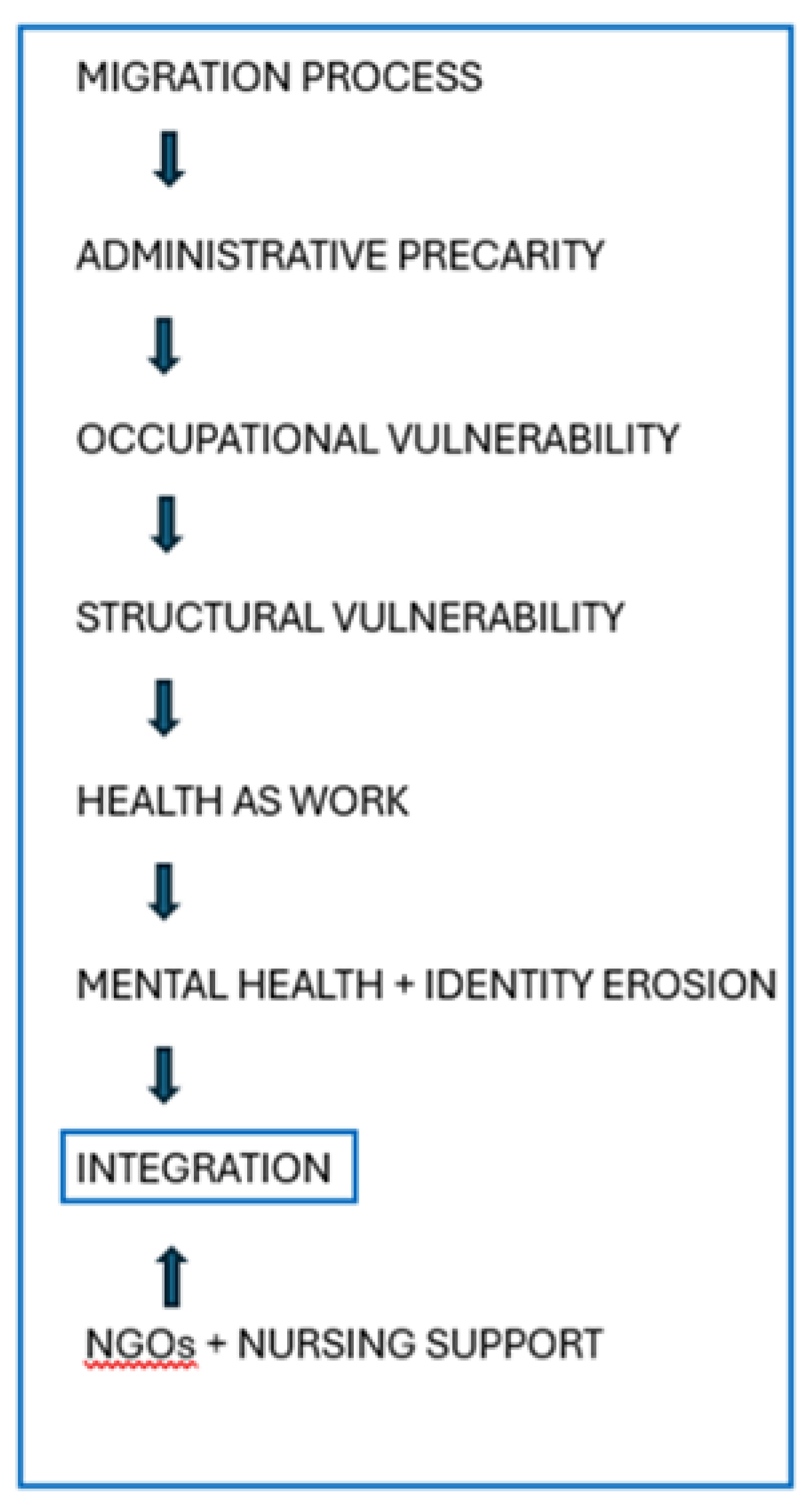

Table 1.
Example of Representative Categories and Verbatims.
| Category | Subcategory | Illustrative Verbatim |
| Migration Motives | Security | “In Peru, they started extorting and threatening us with our child. That’s why we decided to emigrate.” (P16) |
| Health Perceptions | Health as Work | “To be healthy means to have a job... without health you have nothing, no matter how good the job is.” (P5) |
| Social Networks | Institutional Support | “Caritas helped us a lot, especially with food and clothing... My children get help from the school canteen.” (P15) |
| Work Conditions | Precariousness | “I used to work fifteen hours, fourteen hours, or even more. I’d go from one place to another until 3 or 4 AM.” (P20) |
| Adaptation | Loss of Identity | “I’m still nobody here. I don’t even exist in the system.” (P14) |
Table 2.
Sociodemographic Profile of Participants.
| CODE | GENDER | COUNTRY OF ORIGIN | AGE | YEARS IN SPAIN | EDUCATION LEVEL | LEGAL SITUATION |
| P1 | F | Romania | 40 | 17y | University | Legalized |
| P2 | F | Romania | 46 | 21y | High school | Legalized |
| P3 | F | Bolivia | 33 | 14m | University | Legalized |
| P4 | F | Ecuador | 52 | 21y | University | Legalized |
| P5 | M | Ecuador | 52 | 18y | High school | Legalized |
| P6 | F | Cuba | 51 | 23y | University | Legalized |
| P7 | F | Romania | 47 | 17y | High school | Legalized |
| P8 | F | Paraguay | 55 | 18y | High school | Legalized |
| P9 | F | Peru | 48 | 14y | High school | Legalized |
| P10 | F | Cuba | 46 | 23m | High school | Legalized |
| P11 | F | Peru | 46 | 17m | High school | Irregular/in process |
| P12 | F | Peru | 36 | 14m | High school | Irregular/in process |
| P13 | F | Dominican Republic | 39 | 11y | University | Legalized |
| P14 | F | Venezuela | 33 | 18m | University | Irregular/in process |
| P15 | F | Colombia | 48 | 4.5y | High school | Process revision |
| P16 | F | Peru | 31 | 15m | High school | Irregular/ in process |
| P17 | F | Morocco | 34 | 15y | High school | Legalized |
| P18 | M | Venezuela | 41 | 3y | University | Irregular/in process |
| P19 | M | Peru | 42 | 2.5y | High school | Asylum/in process |
| P20 | M | Morocco | 35 | 7.5y | High school | irregular/ in process |
| P21 | M | Guinea | 24 | 2.4y | Basic | Irregular/in process |
| P22 | M | Senegal | 24 | 2y | Basic | Irregular/in process |
Disclaimer/Publisher’s Note: The statements, opinions and data contained in all publications are solely those of the individual author(s) and contributor(s) and not of MDPI and/or the editor(s). MDPI and/or the editor(s) disclaim responsibility for any injury to people or property resulting from any ideas, methods, instructions or products referred to in the content. |
© 2026 by the authors. Licensee MDPI, Basel, Switzerland. This article is an open access article distributed under the terms and conditions of the Creative Commons Attribution (CC BY) license.
Copyright: This open access article is published under a Creative Commons CC BY 4.0 license, which permit the free download, distribution, and reuse, provided that the author and preprint are cited in any reuse.


