
Submitted:
11 August 2026
Posted:
12 August 2026
You are already at the latest version
Abstract
Burn severity alone does not fully explain differences in health-related quality of life (HRQoL) after burn injury. This secondary observational analysis evaluated whether emotional reactivity and emotion-regulation strategies were associated with HRQoL beyond conventional measures of burn severity. Data from 256 adult patients with burn injury treated at the Vietnam National Burn Hospital, Hanoi, Vietnam, from October 2024 to January 2025, were analyzed. Total body surface area (TBSA) and burn depth represented clinical severity. Emotional reactivity was assessed using the Emotion Reactivity Scale (ERS), while cognitive reappraisal and expressive suppression were assessed using the Emotion Regulation Questionnaire–Short Form. Burn-specific HRQoL was measured using the Burn-Specific Health Scale–Brief (BSHS-B), and generic HRQoL using the EQ-5D-5L. Pearson correlations and hierarchical multivariable regression were performed. TBSA was positively associated with ERS (r = 0.30, p < 0.001), whereas burn depth was not significantly associated with ERS (p = 0.18). Higher ERS was associated with poorer BSHS-B Function (r = −0.34), Affect and Relations (r = -0.39), Skin Involvement (r = -0.28), and EQ-5D-5L (r = -0.32) scores (all p < 0.001). Cognitive reappraisal showed positive, whereas expressive suppression showed negative associations with HRQoL. In hierarchical regression, psychosocial variables increased adjusted R² from 0.168 to 0.291 (Δ adjusted R² = 0.123, p < 0.001). These findings indicate that psychosocial characteristics provide additional explanatory information beyond demographic and clinical measures of burn severity and support their consideration in multidimensional assessment and individualized burn rehabilitation.
Keywords:
burn injury
; health-related quality of life
; emotional reactivity
; emotion regulation
; TBSA
; BSHS-B
; EQ-5D-5L
; rehabilitation
1. Introduction
Burn injury is a major traumatic condition with consequences extending beyond acute tissue damage and survival. As survival has improved, the goals of burn care have increasingly expanded toward functional recovery, psychosocial adjustment, and health-related quality of life (HRQoL) [1,2]. Psychosocial adjustment after burn injury encompasses multiple domains, including psychological distress, quality of life, interpersonal functioning, return to work, and adaptation to altered appearance and physical limitations [1]. Consequently, psychosocial assessment and appropriate psychological support are increasingly recognized as important components of comprehensive burn care [3].
HRQoL after burn injury is determined by both injury-related and psychological factors. A systematic review of 32 studies found that burn severity, post-burn depression, post-traumatic stress symptoms, coping, emotional and social support, neuroticism, and employment were associated with HRQoL, indicating that physical injury severity and psychological responses provide complementary information about recovery [2]. However, most previous research has focused on established psychological conditions or broad psychosocial outcomes rather than on more specific dimensions of emotional functioning.
Emotional reactivity may represent one such dimension. It refers to individual differences in the sensitivity, intensity, and persistence of emotional responses and can be assessed using the Emotion Reactivity Scale (ERS), a validated 21-item measure with demonstrated internal consistency and construct-related validity [4]. In the context of burn injury, heightened emotional reactivity may be particularly relevant because patients must adapt to pain, functional impairment, altered appearance, uncertainty about recovery, and disruption of interpersonal and social roles. Nevertheless, the role of emotional reactivity in relation to burn severity and HRQoL has received limited attention.
Emotion regulation provides a complementary perspective on psychosocial adaptation. Cognitive reappraisal and expressive suppression represent distinct strategies for regulating emotional responses and are assessed by the Emotion Regulation Questionnaire–Short Form (ERQ-S) [5]. Although emotion-regulation strategies have been extensively studied in psychological research, their relationships with emotional reactivity and multidimensional HRQoL following burn injury remain insufficiently characterized. In particular, it remains unclear whether these psychosocial characteristics contribute additional explanatory information beyond conventional indicators of burn severity, such as total body surface area (TBSA) and burn depth.
This gap is clinically relevant because patients with comparable anatomical injury may experience substantially different psychosocial outcomes. Routine psychosocial screening has been advocated in burn care because psychological needs may be substantial and are not necessarily reflected by clinical severity alone [3]. Recent evidence from low- and middle-income countries further emphasizes the substantial HRQoL burden among burn survivors and the importance of rehabilitation in settings where access to comprehensive psychosocial services may be limited [6].
Therefore, the present study aimed to examine the relationships between clinical burn severity, emotional reactivity, emotion-regulation strategies, and HRQoL within an integrated biopsychosocial framework. The primary objective was to determine whether emotional reactivity and emotion-regulation strategies were associated with HRQoL after adjustment for relevant demographic and clinical characteristics. The secondary objective was to determine whether these psychosocial variables provided additional explanatory value beyond conventional measures of burn severity.
2. Materials and Methods
2.1. Study Design
This study was designed as a secondary observational analysis of harmonized clinical and psychosocial data from patients with burn injury treated at the Vietnam National Burn Hospital, Hanoi, Vietnam. Guided by a biopsychosocial framework, the analysis examined the relationships among clinical indicators of burn severity, represented by total body surface area (TBSA) and burn depth, psychosocial characteristics, including emotional reactivity and emotion-regulation strategies, and health-related quality of life (HRQoL).
The primary analysis evaluated the associations of emotional reactivity and emotion-regulation strategies with HRQoL after adjustment for relevant demographic and clinical characteristics. The secondary analysis assessed whether psychosocial variables provided additional explanatory value beyond conventional measures of burn severity. Given the observational and secondary nature of the study, all associations were interpreted as non-causal. The conceptual and analytical framework of the study is presented in Figure 1.
2.2. Data Collection
Clinical and psychosocial data were collected using a standardized data-collection protocol. Clinical characteristics were extracted from medical records, while psychosocial information was obtained through structured patient-reported assessments. Participants completed the questionnaires independently or received standardized assistance when necessary.
The study-specific data-collection form was developed by the research team based on the study objectives and relevant validated instruments. The preliminary version was reviewed by a multidisciplinary expert panel for content relevance, clarity, clinical appropriateness, and cultural comprehensibility, followed by pilot testing in 10 eligible burn patients to assess comprehensibility, acceptability, and feasibility. Feedback from both the expert review and pilot assessment was incorporated to refine the wording, sequence, and instructions before finalization and formal data collection.
The finalized assessment incorporated the Emotion Reactivity Scale (ERS) and the Emotion Regulation Questionnaire–Short Form (ERQ-S) as standardized measures of emotional reactivity and emotion-regulation strategies, respectively. The ERS assesses emotional sensitivity, intensity, and persistence, whereas the ERQ-S evaluates cognitive reappraisal and emotional suppression.
2.3. Participants
The analytical cohort consisted of 256 adult patients with burn injury treated at the Vietnam National Burn Hospital, Hanoi, Vietnam, for whom clinical and psychosocial data were available for the present analysis. The source psychosocial dataset was collected from October 2024 to January 2025 and included hospitalized burn patients aged 18–80 years treated at the Adult Burn Department and the Department of Physical Therapy and Rehabilitation.
Patients were eligible if they were aged ≥18 years, had a clinically confirmed burn injury with documented TBSA and burn depth, were sufficiently clinically stable and cognitively able to complete the psychosocial assessment, were able to provide reliable self-reported information, and had sufficient data for the prespecified primary analysis.
Patients were excluded if they were unable to complete the psychosocial assessment because of impaired consciousness or severe clinical instability, were unable to provide reliable self-reported information, declined participation, or had insufficient information for the primary analysis.
2.4. Clinical and Psychosocial Assessment
Emotional reactivity was assessed using the Emotion Reactivity Scale (ERS), a 21-item self-report instrument comprising three dimensions: emotional sensitivity, emotional intensity, and emotional persistence [4]. Higher scores indicate greater emotional reactivity. The total ERS score was prespecified as the primary measure, while its component dimensions were examined in secondary analyses.
Emotion-regulation strategies were assessed using the Emotion Regulation Questionnaire–Short Form (ERQ-S), a six-item instrument comprising two dimensions: cognitive reappraisal and expressive suppression [5]. Higher scores indicate greater use of the corresponding regulatory strategy.
2.5. Health-Related Quality of Life
Health-related quality of life (HRQoL) was assessed using the Burn-Specific Health Scale–Brief (BSHS-B) as the primary burn-specific outcome and the EuroQol five-dimensional five-level questionnaire (EQ-5D-5L) as a secondary generic measure [7,8]. The BSHS-B was used to assess multidimensional burn-related functioning and psychosocial well-being [7]. The EQ-5D-5L assesses mobility, self-care, usual activities, pain/discomfort, and anxiety/depression [8]. The Vietnamese value set was used to derive the EQ-5D-5L health-state index [9].
2.6. Statistical Analysis
Statistical analyses were performed using R statistical software. Continuous variables were summarized as mean ± standard deviation (SD) or median with interquartile range (IQR), as appropriate, while categorical variables were presented as frequencies and percentages.
The relationships among burn severity, emotional reactivity, emotion-regulation strategies, and HRQoL were initially examined using Pearson or Spearman correlation coefficients, according to the distribution of the variables. Differences in psychosocial and HRQoL measures across clinically relevant categories of burn severity were assessed using analysis of variance (ANOVA) or the Kruskal–Wallis test, as appropriate.
The primary analysis used hierarchical multivariable linear regression to evaluate the independent associations of emotional reactivity and emotion-regulation strategies with HRQoL. Three sequential models were prespecified. Model 1 included age and sex; Model 2 additionally incorporated TBSA and burn depth; and Model 3 further included emotional reactivity, cognitive reappraisal, and expressive suppression.
Regression coefficients (β), 95% confidence intervals (CIs), p-values, and adjusted R² were reported. The incremental explanatory contribution of psychosocial variables was assessed by comparing the change in adjusted R² across the sequential models.
The assumptions of linear regression, including linearity, homoscedasticity, normality of residuals, and multicollinearity, were assessed before interpretation. Multicollinearity was evaluated using the variance inflation factor (VIF). Sensitivity analyses were performed using the individual ERS domains and alternative specifications of TBSA were appropriate.
Missing-data patterns were examined before analysis, and the number of observations contributing to each model was reported. Complete-case analysis was used for the primary models when appropriate. All statistical tests were two-sided, with p < 0.05 considered statistically significant.
2.7. Ethical Considerations
The study was conducted in accordance with the principles of the Declaration of Helsinki. The study protocol was reviewed and approved by the Ethics Committee of the Vietnam National Burn Hospital (Approval No. 285, September 2024). Written informed consent was obtained from all participants before enrollment.
All clinical and psychosocial data were handled confidentially. The analytical dataset was de-identified before statistical analysis, and no personally identifiable information was included in the manuscript or supplementary materials.
3. Results
3.1. Participant Characteristics
A total of 256 adult patients with burn injuries met the prespecified eligibility criteria and were included in the final analytical cohort. The demographic and clinical characteristics of the study population are summarized in Table 1.
The cohort had a mean age of 39.8 ± 13.2 years, and 211 patients (82.4%) were male. The median TBSA was 18.0% (IQR, 10.0–32.0%). Regarding burn depth, 124 patients (48.4%) had superficial or superficial partial-thickness burns, whereas 132 patients (51.6%) had deep partial-thickness or full-thickness burns.
The mean total ERS score was 40.1 ± 12.6. For emotion-regulation strategies, the mean scores for cognitive reappraisal and expressive suppression were 15.2 ± 4.2 and 12.8 ± 4.1, respectively.
For HRQoL, the mean scores of the prespecified BSHS-B domains were 68.4 ± 18.7 for Function, 65.7 ± 20.1 for Affect and Relations, and 61.9 ± 22.4 for Skin Involvement. The mean EQ-5D-5L index value was 0.68 ± 0.24.
No inferential comparisons are presented in this section; subsequent analyses examined the prespecified associations between burn severity, psychosocial characteristics, and HRQoL.
3.2. Association of Burn Severity with Emotional Reactivity
Emotional reactivity was positively correlated with TBSA (r = 0.30, p < 0.001). In contrast, burn depth was not significantly associated with emotional reactivity (p = 0.18).
Both emotion-regulation strategies were significantly correlated with emotional reactivity. Cognitive reappraisal showed a positive correlation with ERS (r = 0.28, p < 0.001), while expressive suppression was also positively correlated with ERS (r = 0.25, p < 0.001).
Patients with TBSA ≥30% had significantly higher ERS scores than those with TBSA <30% (44.8 ± 11.9 vs. 38.2 ± 12.4, p < 0.001). ERS scores did not differ significantly according to burn depth. The corresponding correlation coefficients and p values are presented in Table 2.
3.3. Associations of Psychosocial Characteristics with Health-Related Quality of Life
Higher ERS scores were significantly associated with lower scores across the three prespecified BSHS-B domains. ERS was negatively correlated with Function (r = -0.34, p < 0.001), Affect and Relations (r = -0.39, p < 0.001), and Skin Involvement (r = -0.28, p < 0.001).
Cognitive reappraisal was positively correlated with Function (r = 0.21, p = 0.001) and Affect and Relations (r = 0.24, p < 0.001) but was not significantly correlated with Skin Involvement (r = 0.11, p = 0.08). Expressive suppression was negatively correlated with Function (r = -0.18, p = 0.004), Affect and Relations (r = -0.30, p < 0.001), and Skin Involvement (r = -0.17, p = 0.007).
For the generic HRQoL measure, the EQ-5D-5L index was negatively correlated with ERS (r = -0.32, p < 0.001) and expressive suppression (r = -0.21, p = 0.001), whereas cognitive reappraisal was positively correlated with the EQ-5D-5L index (r = 0.19, p = 0.002). The corresponding correlation coefficients and p values are presented in Table 3.
3.4. Hierarchical Regression Analyses
Table 4 presents the results of the hierarchical multivariable regression analysis for the BSHS-B Affect and Relations domain. Model 1, adjusted for age and sex, explained 2.1% of the variance in the outcome (adjusted R² = 0.021). Addition of TBSA and burn depth in Model 2 increased the explained variance to 16.8% (adjusted R² = 0.168; Δ adjusted R² = 0.147, p < 0.001). Further inclusion of emotional reactivity, cognitive reappraisal, and expressive suppression in Model 3 increased the explained variance to 29.1% (adjusted R² = 0.291; Δ adjusted R² = 0.123, p < 0.001).
In Model 3, higher emotional reactivity was associated with lower BSHS-B Affect and Relations scores (β = −0.31, 95% CI: −0.42 to −0.19, p < 0.001). Cognitive reappraisal was positively associated with the outcome (β = 0.17, 95% CI: 0.05 to 0.28, p = 0.006), whereas expressive suppression was negatively associated with the outcome (β = −0.14, 95% CI: −0.26 to −0.02, p = 0.021). TBSA remained negatively associated with BSHS-B Affect and Relations scores (β = −0.18, 95% CI: −0.31 to −0.06, p = 0.004), whereas burn depth was not statistically significant (β = −0.05, 95% CI: −0.16 to 0.06, p = 0.34). The standardized regression coefficients and their 95% CIs for Model 3 are presented in Figure 2.
3.5. Model Diagnostics and Sensitivity Analyses
The hierarchical linear regression models showed no major violations of the assumptions of linearity, homoscedasticity, or normality of residuals. No substantial multicollinearity was identified among the variables included in the models, with variance inflation factors (VIF) values remaining within acceptable limits.
In sensitivity analyses, replacing the total ERS score with its individual domains—emotional sensitivity, emotional intensity, and emotional persistence—yielded estimates with directions of association comparable to those observed in the primary models. Alternative specifications of TBSA produced similar estimates for the associations between psychosocial variables and HRQoL.
4. Discussion
This study provides evidence that psychosocial characteristics contribute to the understanding of HRQoL beyond conventional measures of burn severity. Greater TBSA was associated with higher emotional reactivity, whereas burn depth was not significantly associated with ERS. Emotional reactivity was consistently associated with poorer burn-specific and generic HRQoL, while cognitive reappraisal showed more favorable and expressive suppression less favorable associations. Importantly, adding these psychosocial characteristics increased the explained variance in BSHS-B Affect and Relations from 16.8% to 29.1%. These findings support a biopsychosocial model in which anatomical injury severity and psychological functioning represent complementary dimensions of burn recovery [1,2].
The moderate correlation between TBSA and emotional reactivity (r = 0.30, p < 0.001) suggests that greater physical injury is accompanied by greater emotional burden but also indicates that injury extent alone does not fully account for emotional responses. This is consistent with the systematic review by Spronk et al., in which burn severity was associated with HRQoL in 13 of 18 studies, while psychological and social factors also contributed to outcomes [2]. Prospective studies have similarly shown that HRQoL recovery is influenced by both injury characteristics and individual factors [10,11]. The lack of a significant relationship between burn depth and ERS in the present study further supports the distinction between anatomical severity and psychosocial response rather than indicating that depth is clinically unimportant.
Emotional reactivity showed the most consistent relationship with HRQoL. Its inverse associations with BSHS-B Function (r = −0.34), Affect and Relations (r = −0.39), Skin Involvement (r = −0.28), and EQ-5D-5L (r = −0.32), all p < 0.001, indicate that greater emotional sensitivity and intensity are associated with poorer perceived health across multiple domains. The particularly strong association with Affect and Relations is clinically relevant because psychosocial adjustment after burns encompasses emotional well-being, interpersonal functioning, body image, and social participation [1,3]. Emotional reactivity is a dimensional construct rather than a psychiatric diagnosis [4] and may therefore capture psychosocial vulnerability that is not fully represented by conventional diagnostic categories. Long-term studies have likewise demonstrated persistent relationships between psychological characteristics and quality of life after severe burns [12].
The different associations observed for cognitive reappraisal and expressive suppression provide additional evidence that emotion regulation may be relevant to recovery. Cognitive reappraisal was positively associated with several HRQoL domains, whereas expressive suppression was negatively associated with all assessed outcomes. The stronger inverse association between suppression and Affect and Relations (r = −0.30) suggests that emotion-regulation patterns may be particularly relevant to affective and interpersonal adjustment. Although burn-specific evidence remains limited, broader evidence demonstrates differential relationships between emotion-regulation strategies and mental health [13], while burn research has linked coping styles to quality of life [14]. These findings should remain interpreted as associative, but they suggest that assessment of emotion regulation may complement conventional screening for psychological distress.
The hierarchical analysis provides an important additional contribution. After adjustment for age and sex, TBSA and burn depth increased adjusted R² from 0.021 to 0.168, whereas the addition of ERS, cognitive reappraisal, and expressive suppression increased adjusted R² to 0.291. Thus, psychosocial characteristics explained an additional 12.3% of variance in BSHS-B Affect and Relations. This finding extends previous evidence that clinical severity and psychological response provide complementary information about HRQoL [2]. It also helps explain why patients with comparable anatomical injuries may experience substantially different psychosocial outcomes.
The observed associations may partly reflect broader processes involving body image and social participation. Burn-related scarring and altered appearance can influence self-perception and interpersonal functioning, although the relationship between injury severity and body image is heterogeneous [15,16]. Body-image dissatisfaction has nevertheless been identified as a potential pathway between burn severity and longer-term psychological adjustment [15]. Community participation and peer support are also relevant to recovery, with burn size associated with participation outcomes [17] and peer-support attendance associated with better social interaction [18]. These findings are consistent with the strong relationship between emotional reactivity and the Affect and Relations domain observed in the present study.
Psychosocial consequences of burns may also extend to sexuality, sleep, and occupational reintegration [19,20,21]. Burn stigma has been associated with poorer life satisfaction, while affect, body image, interpersonal relationships, and resilience appear relevant to psychosocial adjustment [22]. Return-to-work outcomes are similarly influenced by both injury-related and psychosocial factors [23]. Together, these findings emphasize that HRQoL after burn injury is multidimensional and cannot be adequately characterized by wound healing or anatomical severity alone.
The clinical implication is that TBSA and burn depth should remain fundamental measures of injury severity but should not be regarded as sufficient proxies for psychosocial burden. Brief assessment of emotional reactivity and emotion-regulation strategies may provide complementary information for identifying patients who require additional psychological or rehabilitative support. This approach is consistent with contemporary multidisciplinary burn rehabilitation [24], including emerging interventions such as transitional tele-rehabilitation [25] and psychological interventions integrated into rehabilitation [26]. Evidence from low- and middle-income countries further highlights the need for accessible rehabilitation addressing the substantial long-term HRQoL burden after burns [6].
Several limitations should be acknowledged. The secondary observational design precludes causal inference, and the directionality between psychosocial characteristics and HRQoL cannot be determined. Self-reported measures may also be affected by response bias, and the single-center setting may limit generalizability. In addition, potentially important determinants such as depression, pain, body image, social support, stigma, and socioeconomic circumstances were not included in the primary model [2,15,22]. Longitudinal studies should therefore determine whether changes in emotional reactivity and emotion regulation precede changes in HRQoL and whether targeted psychosocial interventions can improve these trajectories.
Overall, these findings indicate that burn-related HRQoL is shaped by both the extent of physical injury and psychosocial functioning. Although TBSA was associated with emotional reactivity, the relatively modest association and the absence of a significant relationship with burn depth suggest that anatomical severity alone does not fully capture patients’ psychosocial burden. The consistent associations between emotional reactivity, emotion-regulation strategies, and HRQoL, together with the additional explanatory contribution of psychosocial variables in hierarchical analysis, support a more comprehensive assessment of recovery that extends beyond conventional measures of burn severity. In clinical practice, this perspective may help guide individualized rehabilitation by recognizing emotional and interpersonal needs alongside physical recovery. However, observational design does not permit causal conclusions, and prospective longitudinal studies are needed to determine whether changes in psychosocial functioning precede improvements in HRQoL and whether targeted interventions can influence these trajectories.
5. Conclusions
Psychosocial functioning represents an important dimension of recovery after burn injury and complements conventional measures of physical injury severity. Emotional reactivity and emotion-regulation patterns were associated with patient-reported HRQoL, supporting their consideration in the multidimensional assessment and individualized rehabilitation of burn survivors. Prospective studies are needed to establish the temporal and potentially modifiable nature of these relationships.
Supplementary Materials
The following supporting information can be downloaded at the website of this paper posted on Preprints.org, Table S1: STROBE Checklist for cohort studies.
Author Contributions
conceptualizations, N.T.D. and P.T.M.P.; methodology, N.T.D. and P.T.M.P.; formal analysis, N.T.D. and H.D.M.; investigation, N.T.D., P.T.M.P. and N.T.C.; data curation, N.T.D., P.T.M.P. and N.T.C.; visualization, N.T.D. and H.D.M.; writing—original draft preparation, N.T.D.; writing—review and editing, P.T.M.P., N.T.C. and H.D.M.; supervision, P.T.M.P.; project administration, P.T.M.P. All authors have read and agreed to the published version of the manuscript.
Funding
This research received no external funding.
Institutional Review Board Statement
This study was approved by the Institutional Review Board/Ethics Committee of the Vietnam National Burn Hospital, Hanoi, Vietnam (Approval No. 285, approved in September 2024). The study was conducted in accordance with the principles of the Declaration of Helsinki. Written informed consent was obtained from all participants before inclusion in the study.
Informed Consent Statement
Written informed consent was obtained from all participants before inclusion in the study. All participants were informed about the study objectives, procedures, potential risks, and their right to withdraw from the study at any time without affecting their medical care.
Data Availability Statement
The datasets generated and analyzed during the current study are available from the corresponding author upon reasonable request. The data are not publicly available because they contain potentially identifiable patient information and are subject to institutional ethical restrictions.
Acknowledgments
The authors sincerely thank all patients who participated in this study for their valuable contribution. We also thank the physicians, nurses, rehabilitation specialists, and healthcare staff at the Vietnam National Burn Hospital, Hanoi, Vietnam, for their support in patient care, psychosocial assessments, and clinical data collection.
Conflicts of Interest
The authors declare no competing interests.
References
- Attoe, C.; Pounds-Cornish, E. Psychosocial adjustment following burns: An integrative literature review. Burns 2015, 41, 1375–1384. [Google Scholar] [CrossRef] [PubMed]
- Spronk, I.; Legemate, C.M.; Dokter, J.; van Loey, N.E.E.; van Baar, M.E.; Polinder, S. Predictors of health-related quality of life after burn injuries: A systematic review. Crit. Care 2018, 22, 160. [Google Scholar] [CrossRef] [PubMed]
- Wisely, J.A.; Hoyle, E.; Tarrier, N.; Edwards, J. Where to start? Attempting to meet the psychological needs of burned patients. Burns 2007, 33, 736–746. [Google Scholar] [CrossRef] [PubMed]
- Nock, M.K.; Wedig, M.M.; Holmberg, E.B.; Hooley, J.M. The Emotion Reactivity Scale: Development, evaluation, and relation to self-injurious thoughts and behaviors. Behav. Ther. 2008, 39, 107–116. [Google Scholar] [CrossRef] [PubMed]
- Preece, D.A.; Petrova, K.; Mehta, A.; Gross, J.J. The Emotion Regulation Questionnaire-Short Form (ERQ-S): A 6-item measure of cognitive reappraisal and expressive suppression. J. Affect. Disord. 2023, 340, 855–861. [Google Scholar] [CrossRef] [PubMed]
- Mustehsan, M.A.; Bodla, M.A.; Shehzad, M.M.; Abid, A.; Afzal, S. Health-related quality of life in burn survivors from low- and middle-income countries: A systematic review and targeted comparative analysis of rehabilitation interventions. Burns 2026, 52, 107962. [Google Scholar] [CrossRef] [PubMed]
- Kildal, M.; Andersson, G.; Fugl-Meyer, A.R.; Lannerstam, K.; Gerdin, B. Development of a Brief Version of the Burn Specific Health Scale (BSHS-B). J. Trauma 2001, 51(4), 740–746. [Google Scholar] [CrossRef] [PubMed]
- Herdman, M.; Gudex, C.; Lloyd, A.; Janssen, M.F.; Kind, P.; Parkin, D.; Bonsel, G.; Badia, X. Development and Preliminary Testing of the New Five-Level Version of EQ-5D (EQ-5D-5L). Qual. Life Res. 2011, 20(10), 1727–1736. [Google Scholar] [CrossRef] [PubMed]
- Mai, V.Q.; Sun, S.; Minh, H.V.; Luo, N.; Giang, K.B.; Lindholm, L.; Sahlen, K.G. An EQ-5D-5L Value Set for Vietnam. Qual. Life Res. 2020, 29(7), 1923–1933. [Google Scholar] [CrossRef] [PubMed]
- Van Loey, N.E.; van Beeck, E.F.; Faber, B.W.; van de Schoot, R.; Bremer, M. Health-related quality of life after burns: A prospective multicenter cohort study with 18 months follow-up. J. Trauma Acute Care Surg. 2012, 72, 513–520. [Google Scholar] [CrossRef] [PubMed]
- Wasiak, J.; Lee, S.J.; Paul, E.; Mahar, P.; Pfitzer, B.; Spinks, A.; Cleland, H.; Gabbe, B. Predictors of health status and health-related quality of life 12 months after severe burn. Burns 2014, 40, 568–574. [Google Scholar] [CrossRef] [PubMed]
- Renneberg, B.; Ripper, S.; Schulze, J.; Seehausen, A.; Weiler, M.; Wind, G.; Hartmann, B.; Germann, G.; Liedl, A. Quality of life and predictors of long-term outcome after severe burn injury. J. Behav. Med. 2014, 37, 967–976. [Google Scholar] [CrossRef] [PubMed]
- Hu, T.; Zhang, D.; Wang, J.; Mistry, R.; Ran, G.; Wang, X. Relation between emotion regulation and mental health: A meta-analysis review. Psychol. Rep. 2014, 114, 341–362. [Google Scholar] [CrossRef] [PubMed]
- Rothman, D.J.; Sutter, M.; Perrin, P.B.; LiBrandi, H.; Feldman, M.J. Coping styles and quality of life in adults with burn. Burns 2016, 42, 1105–1110. [Google Scholar] [CrossRef] [PubMed]
- Huang, Y.K.; Su, Y.J. Burn severity and long-term psychosocial adjustment after burn injury: The mediating role of body image dissatisfaction. Burns 2021, 47, 1373–1380. [Google Scholar] [CrossRef] [PubMed]
- Cleary, M.; Kornhaber, R.; Kaji Thapa, D.; West, S.; Visentin, D. A quantitative systematic review assessing the impact of burn injuries on body image. Body Image 2020, 33, 47–65. [Google Scholar] [CrossRef] [PubMed]
- Ryan, C.M.; Shapiro, G.D.; Rencken, C.A.; Griggs, C.L.; Jeng, J.C.; Hickerson, W.L.; Marino, M.; Goverman, J.; Kazis, L.E.; Schneider, J.C.; et al. The impact of burn size on community participation: A Life Impact Burn Recovery Evaluation (LIBRE) study. Ann. Surg. 2022, 276, 1056–1062. [Google Scholar] [CrossRef] [PubMed]
- Grieve, B.; Shapiro, G.D.; Wibbenmeyer, L.; Acton, A.; Lee, A.; Marino, M.; Jette, A.; Schneider, J.C.; Kazis, L.E.; Ryan, C.M.; et al. Long-term social reintegration outcomes for burn survivors with and without peer support attendance: A Life Impact Burn Recovery Evaluation (LIBRE) study. Arch. Phys. Med. Rehabil. 2020, 101, S92–S98. [Google Scholar] [CrossRef] [PubMed]
- Connell, K.M.; Coates, R.; Wood, F.M. Sexuality following burn injuries: A preliminary study. J. Burn Care Res. 2013, 34, e282–e289. [Google Scholar] [CrossRef] [PubMed]
- Lerman, S.F.; Owens, M.A.; Liu, T.; Puthumana, J.; Hultman, C.S.; Caffrey, J.A.; Smith, M.T. Sleep after burn injuries: A systematic review and meta-analysis. Sleep Med. Rev. 2022, 65, 101662. [Google Scholar] [CrossRef] [PubMed]
- Mason, S.T.; Esselman, P.; Fraser, R.; Schomer, K.; Truitt, A.; Johnson, K. Return to work after burn injury: A systematic review. J. Burn Care Res. 2012, 33, 101–109. [Google Scholar] [CrossRef] [PubMed]
- Watson, J.D.; Perrin, P.B. Relations among stigma, quality of life, resilience, and life satisfaction in individuals with burn injuries. Eur. Burn J. 2022, 3, 145–155. [Google Scholar] [CrossRef] [PubMed]
- Al Hanna, R.; Cofré Lizama, L.E.; Amatya, B.; Galea, M.P.; Khan, F. Rehabilitation in adults with burn injury: An overview of systematic reviews. Disabil. Rehabil. 2024, 46, 6266–6287. [Google Scholar] [CrossRef] [PubMed]
- Bayuo, J.; Wong, F.K.Y.; Chung, L.Y.F. Effect of a transitional tele-rehabilitation programme on quality of life of adult burn survivors: A randomised controlled trial. Clin. Rehabil. 2024, 38, 1333–1345. [Google Scholar] [CrossRef] [PubMed]
- Ruan, J.; Huo, T.; Zhang, Y.; Ruan, Q.; Xi, M.; Ru, T.; Liu, S. Effect of Acceptance and Commitment Therapy on psychological wellbeing and physical function in rehabilitation patients after burns: A randomized controlled trial. Burns 2025, 51, 107630. [Google Scholar] [CrossRef] [PubMed]
Figure 1.
Conceptual and analytical framework of the study. Solid arrows represent prespecified associations examined in the study. The dashed pathway denotes the incremental explanatory contribution of psychosocial variables beyond conventional clinical indicators of burn severity assessed using hierarchical regression. Abbreviations: TBSA, total body surface area; ERS, Emotion Reactivity Scale; ERQ-S, Emotion Regulation Questionnaire–Short Form; BSHS-B, Burn-Specific Health Scale–Brief; HRQoL, health-related quality of life; EQ-5D-5L, EuroQol five-dimensional five-level questionnaire.
Figure 1.
Conceptual and analytical framework of the study. Solid arrows represent prespecified associations examined in the study. The dashed pathway denotes the incremental explanatory contribution of psychosocial variables beyond conventional clinical indicators of burn severity assessed using hierarchical regression. Abbreviations: TBSA, total body surface area; ERS, Emotion Reactivity Scale; ERQ-S, Emotion Regulation Questionnaire–Short Form; BSHS-B, Burn-Specific Health Scale–Brief; HRQoL, health-related quality of life; EQ-5D-5L, EuroQol five-dimensional five-level questionnaire.
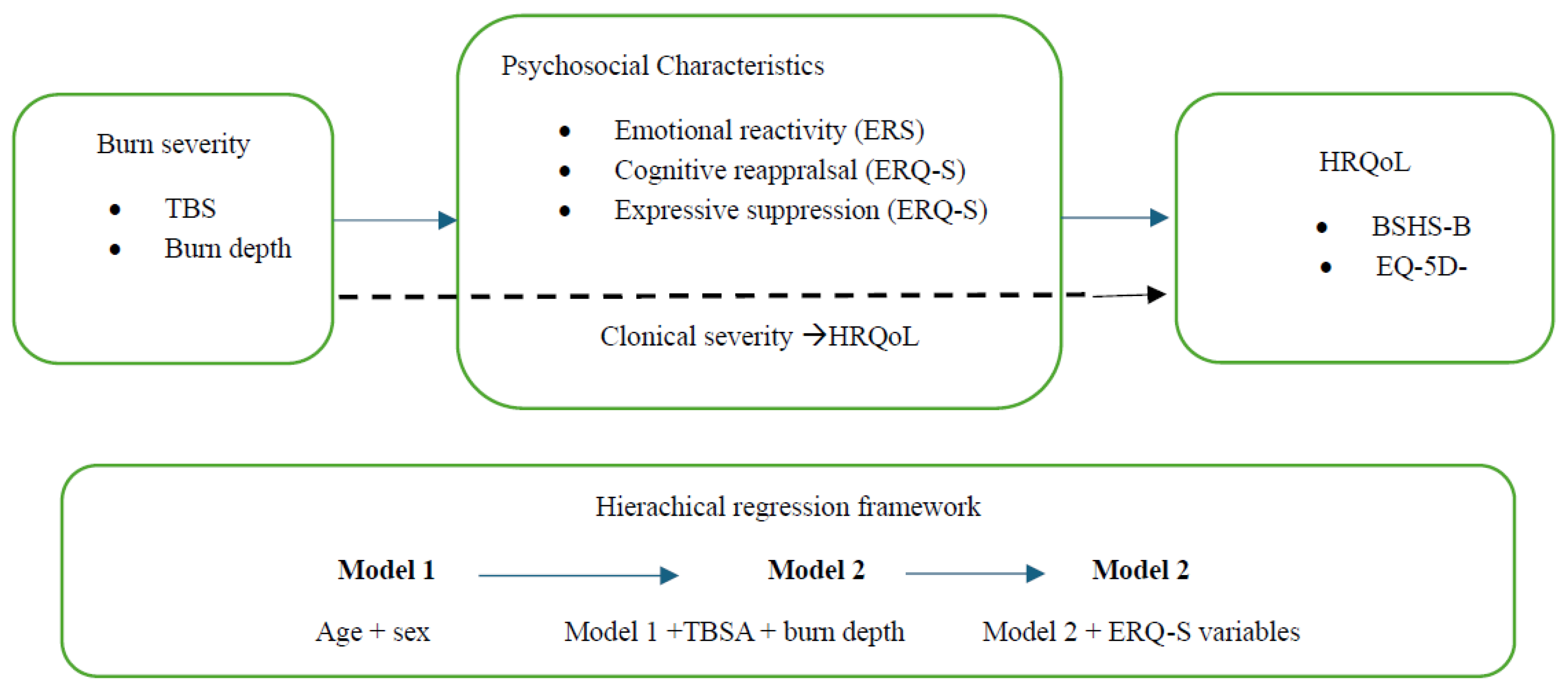
Figure 2.
Forest plot of standardized coefficients (β) from Model 3 (hierarchical regression for BSHS-B Affect and Relations).
Figure 2.
Forest plot of standardized coefficients (β) from Model 3 (hierarchical regression for BSHS-B Affect and Relations).
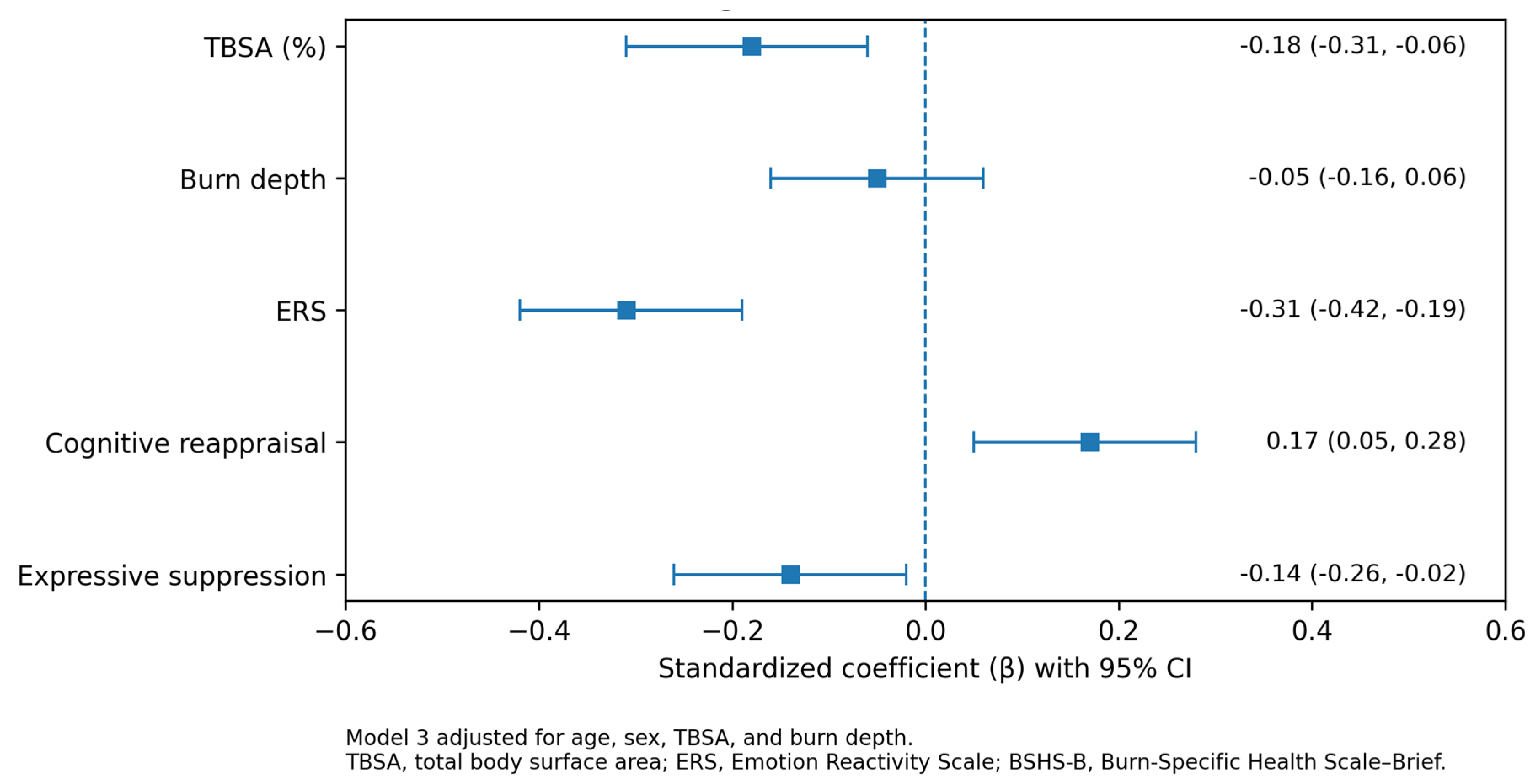

Table 1.
Demographic, clinical, psychosocial, and HRQoL characteristics of the study population (N = 256).
Table 1.
Demographic, clinical, psychosocial, and HRQoL characteristics of the study population (N = 256).
| Variable | Value |
| Demographic characteristics | |
| Age, years | 39.8 ± 13.2 |
| Male sex, n (%) | 211 (82.4) |
| Clinical characteristics | |
| TBSA, %, median (IQR) | 18.0 (10.0–32.0) |
| Superficial/superficial partial-thickness burn, n (%) | 124 (48.4) |
| Deep partial/full-thickness burn, n (%) | 132 (51.6) |
| Psychosocial characteristics | |
| ERS total score | 40.1 ± 12.6 |
| Cognitive reappraisal | 15.2 ± 4.2 |
| Expressive suppression | 12.8 ± 4.1 |
| Burn-specific HRQoL | |
| BSHS-B Function | 68.4 ± 18.7 |
| BSHS-B Affect and Relations | 65.7 ± 20.1 |
| BSHS-B Skin Involvement | 61.9 ± 22.4 |
| Generic HRQoL | |
| EQ-5D-5L index | 0.68 ± 0.24 |
Values are presented as mean ± SD unless otherwise indicated.
Table 2.
Associations of clinical and psychosocial variables with emotional reactivity.
| Variable | Association with ERS | p-value |
| TBSA | r = 0.30 | <0.001 |
| Burn depth | - | 0.18 |
| Cognitive reappraisal | r = 0.28 | <0.001 |
| Expressive suppression | r = 0.25 | <0.001 |
Note: r, Pearson’s correlation coefficient; ERS, Emotion Reactivity Scale; TBSA, total body surface area. p < 0.05 was considered statistically significant.
Table 3.
Associations between psychosocial characteristics and HRQoL.
| Psychosocial variable | BSHS-B Function | BSHS-B Affect and Relations | BSHS-B Skin Involvement | EQ-5D-5L index |
| ERS | -0.34*** | -0.39*** | -0.28*** | -0.32*** |
| Cognitive reappraisal | 0.21** | 0.24*** | 0.11 | 0.19** |
| Expressive suppression | -0.18** | -0.30*** | -0.17** | -0.21** |
Note: Values are Pearson’s correlation coefficients (r). ERS, Emotion Reactivity Scale; BSHS-B, Burn-Specific Health Scale–Brief; EQ-5D-5L, EuroQol five-dimensional five-level questionnaire. p < 0.05 was considered statistically significant. * p < 0.05; ** p < 0.01; *** p < 0.001.
Table 4.
Hierarchical multivariable regression analysis for BSHS-B Affect and Relations.
| Variable | Model 1 β | Model 2 β | Model 3 β | 95% CI | p-value |
| Age | −0.12 | −0.10 | −0.08 | −0.20 to 0.05 | 0.21 |
| Male sex | 0.06 | 0.05 | 0.04 | −0.06 to 0.14 | 0.43 |
| TBSA | — | −0.24*** | −0.18** | −0.31 to −0.06 | 0.004 |
| Burn depth | — | −0.07 | −0.05 | −0.16 to 0.06 | 0.34 |
| ERS | — | — | −0.31*** | −0.42 to −0.19 | <0.001 |
| Cognitive reappraisal | — | — | 0.17** | 0.05 to 0.28 | 0.006 |
| Expressive suppression | — | — | −0.14* | −0.26 to −0.02 | 0.021 |
| Adjusted R² | 0.021 | 0.168 | 0.291 | — | — |
| Δ adjusted R² | — | 0.147 | 0.123 | — | — |
Note: β, standardized regression coefficient; CI, confidence interval; TBSA, total body surface area; ERS, Emotion Reactivity Scale. Model 1 included age and sex; Model 2 additionally included TBSA and burn depth; Model 3 additionally included ERS, cognitive reappraisal, and expressive suppression. p < 0.05 was considered statistically significant. * p < 0.05; ** p < 0.01; *** p < 0.001.
Disclaimer/Publisher’s Note: The statements, opinions and data contained in all publications are solely those of the individual author(s) and contributor(s) and not of MDPI and/or the editor(s). MDPI and/or the editor(s) disclaim responsibility for any injury to people or property resulting from any ideas, methods, instructions or products referred to in the content. |
© 2026 by the authors. Licensee MDPI, Basel, Switzerland. This article is an open access article distributed under the terms and conditions of the Creative Commons Attribution (CC BY) license (http://creativecommons.org/licenses/by/4.0/).
Copyright: This open access article is published under a Creative Commons CC BY 4.0 license, which permit the free download, distribution, and reuse, provided that the author and preprint are cited in any reuse.


