

Submitted:
10 August 2026
Posted:
11 August 2026
You are already at the latest version
Abstract
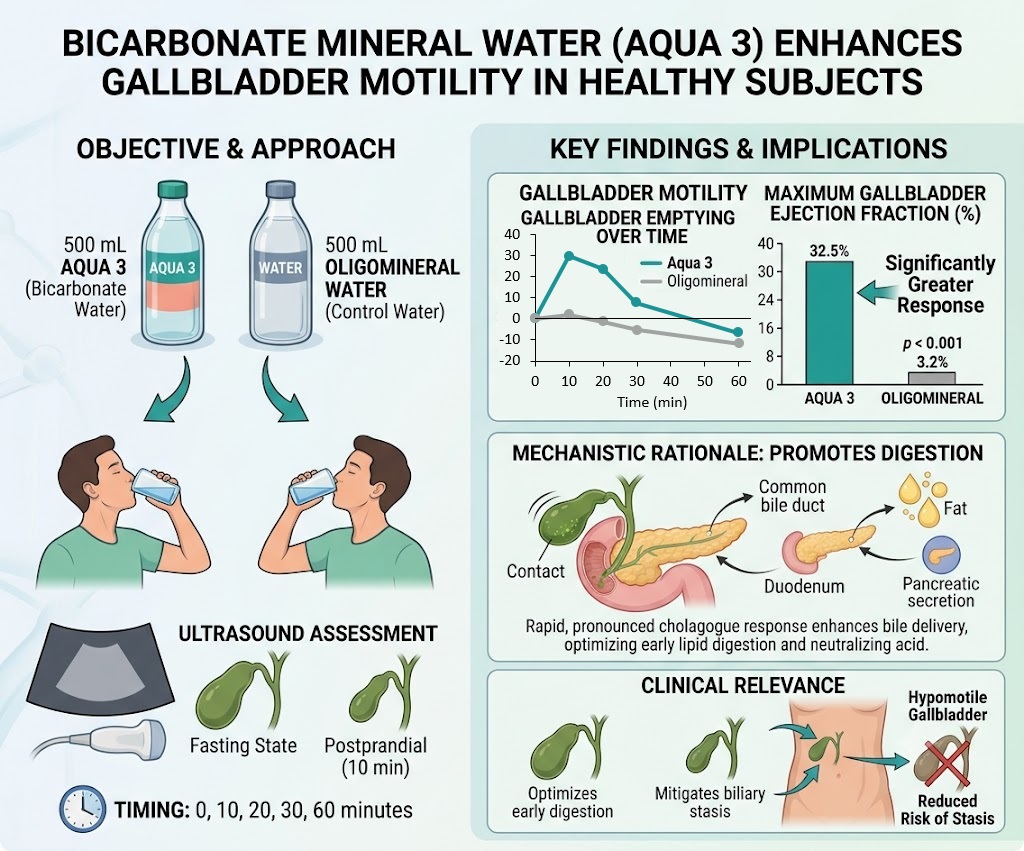
Background: Bicarbonate mineral waters have been reported to modulate biliary dynamics. Prior symptom based data with Aqua 3 suggested digestive benefits, but objective confirmation is still lacking. Aims: To evaluate, the effect of Aqua 3 on gallbladder motility in fasting healthy adults, compared with an oligomineral water. Methods: In this randomized, crossover study, twenty healthy volunteers underwent two ultrasound sessions after an overnight fast and the ingestion of 500 mL of either Aqua 3 (bicarbonate mineral water) or oligomineral water. Gallbladder volume was measured at baseline and after 10, 20, 30, and 60 minutes. Primary endpoint was the maximum ejection fraction. Results: Bicarbonate mineral water induced a rapid increase in ejection fraction: peaking at 10 minutes, persisting at 20 minutes and attenuating by 30 minutes. At 60 minutes, gallbladder refilling exceeded baseline. Oligomineral water produced only modest early emptying at 10 minutes, no significant change at 20 minutes, and progressive refilling thereafter. Throughout the observation period, ejection fraction was significantly higher after bicarbonate than oligomineral water. Maximum ejection fraction was significantly greater with bicarbonate than oligomineral water, occurring most frequently at 10 minutes for both waters. Conclusions: A single 500 mL dose of bicarbonate mineral water elicits a rapid and pronounced cholagogue response, with ejection fraction increases evident within 10 minutes that significantly exceed those observed after oligomineral water, providing a mechanistic rationale for the previously reported digestive benefits of bicarbonate mineral water. These findings may be clinically relevant for optimizing early postprandial digestion and mitigating biliary stasis in hypomotile gallbladders.
Keywords:
carbonated water
; cholagogues and choleretics
; digestion
; gallbladder emptying
; mineral waters
; ultrasonography
1. Introduction
1.1. Mineral Water and Digestion
In a previous study [1], we documented that the intake of a natural bicarbonate mineral water sourced from “Aqua 3” was able to improve upper gastrointestinal symptoms in patients with functional dyspepsia and reflux-related disorders. The results showed a significant reduction across all subscales of the “Patient Assessment of Upper Gastrointestinal Disorders-Symptom Severity Index” (PAGI-SYM) questionnaire used, as well as in the total symptom score, following bicarbonate mineral water. This improvement was accompanied by a parallel decrease in the use of on demand therapies and a marked enhancement in patients’ subjective perception of digestive efficiency.
These beneficial effects were not maintained after switching to an oligomineral water, during which symptoms worsened significantly and antacid use was resumed. Encouraged by these positive results, we decided to carry out a second instrumental, single blind, crossover randomized study aimed at obtaining objective and quantifiable data. The mechanisms through which these positive symptomatic effects are exerted had not been explored.
A regular gallbladder function plays a pivotal role in the digestive process [2] and mineral waters are known to modulate its activity.
The gallbladder stores and subsequently releases bile produced by the liver: proper coordination between gallbladder emptying, relaxation of the sphincter of Oddi, and food transit enables duodenal alkalinization and the micellization processes mediated by bile salts. Bile also facilitates the digestion and absorption of fats and fat-soluble vitamins and stimulates intestinal peristalsis, exerting an antiseptic effect against bacterial flora. Finally, it stimulates the pancreas to release into the duodenum secretions rich in bicarbonates which neutralize the acidity of gastric juice and digestive enzymes, including lipase which breaks down fats, and proteases (which break down proteins). [3,4,5]
Several studies have highlighted the ability of certain mineral waters — particularly bicarbonate, bicarbonate-calcium, and sulfate waters — to positively influence gallbladder emptying and the relaxation of the sphincter of Oddi. [6,7,8,9,10,11,12,13,14] These mineral waters have been shown to exert a cholagogue effect, stimulating gallbladder contraction and increasing bile flow into the intestine. Their effect has been mainly attributed to the presence of anions such as sulfates (SO₄²⁻) and bicarbonates (HCO₃⁻), as well as cations such as magnesium (Mg²⁺) and calcium (Ca²⁺). It has been demonstrated that these elements can stimulate or modulate the activity of certain neurohormonal regulators of the digestive process, such as cholecystokinin (CCK) and gastrin. [15,16,17]
1.2. Objective
The present investigation was aimed at evaluating the effect of bicarbonate mineral water “Aqua 3” on gallbladder motility.
2. Materials and Methods
2.1. Study Design
The study was designed as a randomized, controlled, double-blind, crossover trial. Upon inclusion in the study, volunteers were randomly and equally assigned to one of two intake sequences: BW/OW (bicarbonate mineral water followed by oligomineral water) or OW/BW (oligomineral water followed by bicarbonate water). Therefore, each subject was evaluated on two separate occasions. The bicarbonate mineral water (Aqua 3) was compared with a commercially available low-mineral-content control water (the same used in our preliminary study). The composition of the two waters is shown in Table 1. Both waters were provided in 500 mL bottles (with no labels indicating their composition) and were ingested (within 5 minutes) according to the established randomization.
2.2. Subjects
The study involved 20 Caucasian healthy volunteers who underwent ultrasonographic tests after an overnight fast of at least 8 hours. All participants had been instructed to abstain from medication use and avoid alcohol intake prior to the ultrasound examination. Baseline demographics are shown in Table 2. There were 9 males (45.0%) and 11 females, aged 54.3±16.5 years. Most subjects had a normal weight (14; 70.0%) or were overweight (5; 25.0%), while 1 subject only was underweight (5.0%). No significant differences were observed between the two groups of subjects (P values ranging from 0.238 to 1.000).
2.2.1. Inclusion Criteria
Subjects not affected by organic, endocrine-metabolic, or systemic diseases; individuals who abstain from alcohol or consume it only occasionally.
2.2.2. Exclusion Criteria
History of hepatobiliary diseases, previous surgical interventions (cholecystectomy or biliary or other major gastrointestinal surgeries), pregnancy, use of medications that alter biliary motility (e.g., opioids, antispasmodics, estrogen-progestins, certain antibiotics, etc.) and acute clinical conditions (cholecystitis, jaundice, acute pancreatitis). Obesity was considered an exclusion criterion because gallbladder motility is negatively correlated with body mass index (BMI).
2.3. Ultrasound Measurement of the Gallbladder
The ultrasound (US) examination was repeated twice for each subject on different days after each of the two water intakes. The interval between the two evaluations ranged from 1 to 4 days (2.3±0.9). The time interval was not significantly different between the two groups of subjects (BW/OW: 2.5±1.0; OW/BW: 2.0±0.8; P=0.247).
2.3.1. Gallbladder Volume
Gallbladder volumes were measured through a baseline US conducted before water intake. Once the baseline gallbladder volume was determined, images were acquired again at 10, 20, 30, and 60 minutes after the ingestion of 500 mL of one of the two waters.
Gallbladder kinetics were assessed by considering fasting volume, residual volume, and maximum emptying percentage.
Gallbladder US were performed with the subject in a supine position by an experienced professional (M.C.) with over 15 years of US practice, certified by SIUMB (Italian Society of Ultrasound in Medicine and Biology, Rome, Italy).
Gallbladder volume was calculated using the ellipsoid formula:
Volume (mL) = π / 6 × a × b × c , (1)
where a is the maximum longitudinal diameter, b is the maximum transverse diameter, and c is the maximum anteroposterior diameter (all measured in cm). [18,19,20]
Maximum longitudinal and anteroposterior diameters were measured after visualizing the gallbladder in the longitudinal plane; maximum transverse diameter was measured in the transverse plane. A Toshiba SSA-340A CL ultrasound system (Toshiba Co., Ltd., Kawasaki, Japan), equipped with a 3.5 MHz convex array probe, was used. The transducer was positioned vertically for visualization. The probe, placed just below the costal margin in the epigastric area, was moved laterally along the right costal margin. In this way, the gallbladder typically appears in the right subcostal area along the mid-clavicular line.
If the gallbladder could not be immediately identified, the interlobar fissure was sought ventral to the main right branch of the portal vein in the horizontal subcostal orientation of the transducer. The gallbladder had to be visualized along its full extension. The transducer could then be rotated clockwise into the longitudinal position. During these maneuvers, the gallbladder can usually be visualized longitudinally in one of these positions. Additionally, the gallbladder may be visualized from the intercostal position of the transducer.
2.3.2. Gallbladder Ejection Fraction (EF)
Gallbladder EF at each postprandial time point was calculated as follows:
| EF (%) = ( fasting gallbladder volume − postprandial gallbladder volume ) / fasting gallbladder volume × 100. |
(2) |
2.4. Endpoint
The endpoint of the study was to compare the gallbladder emptying (as evaluated by calculating the maximum gallbladder EF) after bicarbonate mineral water and after oligomineral water.
2.5. Statistical Methods
2.5.1. Sample Size Calculation
The sample size was calculated based on data from a previous randomized, four-way crossover study investigating the effects of a sodium-bicarbonate mineral water versus a low-mineral-content water on gallbladder EF (without a subsequent meal). [24] In that study, the maximum reduction in gallbladder volume occurred 15 minutes post-ingestion of the sodium-bicarbonate water, decreasing from a baseline mean (±SD) of 21±15 mL (CV: 0.71%) to 17±11 mL (CV: 0.65%), which corresponded to an EF of 19%.
Because the SD for the EF was not explicitly reported, it was estimated at 12.9% by averaging the two CV values of the gallbladder volume. Hypothesizing a detectable difference in EF between the bicarbonate and oligomineral water equal to this SD, a sample size of 18 subjects was determined to achieve 90% power in rejecting the null hypothesis with a type I error (alpha) of 1%. Calculations were performed using the PS: Power and Sample Size Calculations software (Version 3.1.2; Department of Biostatistics, Vanderbilt University, Nashville, TN, USA). [25,26] To ensure robustness, the final enrollment was rounded up to 20 subjects.
2.5.2. Statistical Analysis
The mean and standard deviation were reported as descriptive statistics for continuous variables, while absolute and relative frequencies were reported for discrete variables. Nonparametric statistics were applied. Specifically, Fisher’s exact, linear-by-linear association chi-square, and Mann–Whitney U tests were used to compare the two randomly assigned groups for dichotomous, ordinal, and continuous variables, respectively. Additionally, the Wilcoxon matched-pairs signed-rank test was used to detect changes in EF over time compared to baseline values after the intake of the two waters, as well as to compare EF between the two water regimens. All data were managed and analyzed using the IBM SPSS Statistics (Ver. 23 for Windows, IBM Co., Armonk, NY, USA) package. Two-tailed P values of less than 0.05 were considered statistically significant.
2.6. Ethical Issues
The study protocol was approved by the Institutional review board of the “Water Resource Association” (Bologna, Italy). The study protocol conformed to the ethics of the World Medical Association Declaration of Helsinki “Ethical principles for medical research involving human subjects”, adopted by the 18th WMA General Assembly, Helsinki, Finland, June 1964, and amended by the 75th WMA General Assembly, Helsinki, Finland, October 2024. Only subjects who voluntarily signed an informed consent form were included.
3. Results
3.1. Baseline Gallbladder Volume
The baseline gallbladder volume showed no significant difference (P=0.809) between the bicarbonate mineral water session (37.5±18.6 mL; range: 15.1 to 103.7 mL) and the oligomineral water session (37.6±19.1 mL; range: 14.5 to 106.9 mL).
3.2. Gallbladder Ejection Fraction
The time course of gallbladder emptying is illustrated in Figure 1. The peak mean gallbladder emptying rate was observed 10 minutes after bicarbonate mineral water intake (EF: 29.8±15.4%, P<0.001), followed by a progressive reduction (20 min: 23.6±13.2%, P<0.001; 30 min: 7.6±12.8%, P=0.018). At 60 minutes, gallbladder volume significantly exceeded baseline values (EF: -6.6±7.9%, P<0.001).
In contrast, oligomineral water intake induced only modest, though significant, emptying at 10 minutes (EF: 2.1±2.6%, P<0.001). By 20 minutes, gallbladder volume did not differ significantly from baseline (-1.4±6.6%, P=0.445). Subsequently, significant refilling was observed, with volumes significantly exceeding baseline values at 30 minutes (-5.4±5.9%, P=0.002) and 60 minutes (-11.7±8.9%, P<0.001).
During the entire time course of US examination, the values of the EF after bicarbonate mineral water were significantly higher than those observed after oligomineral water (P values ranged between <0.001 and 0.018).
3.3. Maximum Gallbladder EF
The maximum gallbladder EF was significantly higher (P<0.001) after bicarbonate mineral water (32.5±14.7%; range: -0.2% to 62.7%) than after oligomineral water (3.2±2.8%; range: -0.5% to 8.9%) (Figure 2).
In most cases, the maximum EF was reached 10 minutes post-intake (bicarbonate mineral water: 15 subjects, 75.0%; oligomineral water: 12 subjects, 60.0%), followed by 20 minutes (bicarbonate mineral water: 3 subjects, 15.0%; oligomineral water: 6 subjects, 30.0%) and 30 minutes (bicarbonate mineral water: 2 subjects, 10.0%; oligomineral water: 1 subjects, 5.0%). In only one instance (5.0%) the maximum value was reached 60 minutes after oligomineral water intake. The time to reach maximum EF did not differ significantly (P=0.429) between bicarbonate mineral water (13.5±6.7 min) and oligomineral water (16.5±11.8 min).
3.4. Carry-over Effect
The carry-over effect was assessed by comparing all study parameters between the two subject groups (those who received bicarbonate mineral water first followed by oligomineral water, and vice versa; Table 3). No significant differences were found, indicating that the groups were well-balanced and that no carry-over effects occurred.
4. Discussion
The present study demonstrates a significantly greater cholagogue effect of 500 mL of bicarbonate mineral water compared to that exerted by equal volumes of oligomineral water, by ultrasonographically measuring gallbladder volumes over time, during fasting. As recognized since the seventeenth century, the gallbladder plays a fundamental role in digestive functions by allowing storage and concentration of bile excreted from the liver, so that it can "acquire greater strength and digestive power" [27], before being delivered into the small bowel. Under physiological conditions, a large amount of liver-secreted bile is stored and concentrated in the gallbladder during fasting, when the sphincter of Oddi is generally closed. Bile composition is significantly modified during storage by absorption and secretion operated by the gallbladder mucosa and then emptied into the duodenum through the common bile duct through a relaxed sphincter of Oddi, under the hormonal and neuroendocrine stimuli induced by meal ingestion, in order to maximize its essential role in the digestion of lipids [28]. Gallbladder is not simply passively filled during fasting and emptied after feeding, since partial emptying and refilling also occur in association with the late phase II of the interdigestive migrating motor complex in the small bowel, to be sweeped away by the oncoming phase III [29], so that intestinal bile acid concentrations fluctuate during fasting and are maximized after feeding. The main drives of gallbladder contractions are believed to be hormones, with CCK playing the major excitatory role. [30] Extrinsic and intrinsic innervations seem to provide a regulatory support to the endocrine control mechanism. [30,31] CCK secretion from duodenal and jejunal enteroendocrine I cells is primarily stimulated by long chain fatty acids and triglycerides, as well as by proteins, short chain fatty acid, gastric distension, other neuropeptides including gastrin, gastrin-releasing peptide and acetylcholine [13] and several ions including bicarbonates (HCO₃⁻), sulfates (SO₄²⁻) and cations such as magnesium (Mg²⁺) and calcium (Ca²⁺). [17] Bicarbonate waters can also exert an indirect stimulatory effect on CCK through gastrin release induced by alkalinization of gastroduodenal contents.
Lack of sufficient contractility of gallbladder walls both during fasting and after feeding is involved in the determinism of a number of pathological conditions including both pigment and cholesterol gallstones, acute and chronic acalculous cholecystitis, dyspepsia [31] and even duodenal obstruction. [32] Impaired contractility can also be associated with diabetes, obesity, pregnancy, celiac disease, and total parenteral nutrition. [31] Thus, measurement of gallbladder functioning plays a relevant role in health and disease. The gold standard technique for measuring gallbladder emptying is scintigraphy, as described in 1981, [33] but nuclear medicine departments are not readily available and radiation exposure in involved. Ultrasonography is a widely available, sustainable, non-invasive, safe and low-cost tool to assess gallbladder morphological and functional aspects and has, therefore, become the reference technique. [34] It has been used to investigate the effects of different nutrients or direct CCK injections on gallbladder contractions and emptying. [34] Dodds et al. [18] demonstrated high accuracy of the ellipsoid method for determining gallbladder volume, with an inter- and intra-observer variability being reported to be lower than10%.
In the present study bicarbonate water increased gallbladder emptying by approximately 30% in fasting healthy subjects, within 30 minutes from ingestion. This cholagogue effects exerted by bicarbonate water are in keeping with the bulk of previous evidence, [7,8,9,11,14,35,36] although conflicting results have also been published. [37] The timing of the effect reported in the literature, is highly variable probably due to the different protocols adopted. Both the higher gallbladder emptying rate and peak of gallbladder EF in the investigated healthy subjects occurred 10 minutes after ingestion of bicarbonate water and lasted for at least 30 minutes. In keeping with these observations, a significant cholagogue effect had been previously reported to occur within 10 to 20 minutes after ingestion of bicarbonate waters, [7,36] with peak effects ranging from 10 minutes after water ingestion during fasting [7] to 45 [8,9,14] and 60 minutes [36], when water was ingested with a test meal. Similar timing effects of different bicarbonate waters have been interestingly reported in both healthy subjects [7,36] and dyspeptic patients. [7,36] Fasting studies have the advantage of singling out the pure effect of bicarbonate water on gallbladder motility. On the other hand, most digestive symptoms are induced by meal ingestion [38] and postprandial observations bear relevant clinical interest. In this respect it is necessary to keep in mind the capability of postprandial gastric motility to differentiate among the different components of a mixed meal. In fact, gastric emptying of liquids starts first by following a mono-exponential pattern with emptying velocity being proportional to the liquid volume. Emptying of digestible solids has an initial delay (known as lag phase, during which solid particles are broken down into a homogenized mixture) before emptying can start. Undigestible solids (vegetable fibers) are not emptied from the stomach until fasting motility is resumed and they are swept into the duodenum by the first postprandial phase III of the interdigestive migrating motor complex. [29] It is common experience that water is ingested together with the meal ingestion and thus initially mixed with other gastric contents and progressively emptied while emptying of solids has started. Thus, a rapid and sustained stimulatory effect of bicarbonate water on gallbladder emptying likely plays an important role in allowing bile to be available while lipids are delivered into the duodenum. Furthermore, a cholagogue effect during fasting can also play a relevant clinical role such as preventing calculous and acalculous cholecystic diseases. Indeed, beyond investigating a cholagogue effect during fasting of bicarbonate water, our results imply possible clinical implications. A quick and sustained increase if gallbladder EF observed after ingestion of “Aqua 3” suggests a facilitated early phase of digestion with appropriate lipid digestion when delivered into the duodenum [3] and stimulation of pancreatic secretion [4], and ultimately preventing delayed onset of digestive processes.
5. Conclusions
In conclusion, the bicarbonate mineral water evaluated in the present study induces a rapid and sustained stimulation of gallbladder contractility, with a significant increase of EF already measurable 10 minutes after ingestion, that is significantly more pronounced than that exerted by oligominaral water, in fasting healthy individuals. This rapid and sustained effect is potentially useful in the clinical setting to improve early phases of postprandial digestions and preventing gallbladder formation in hypomotile gallbladders. Aqua 3 might represent a support in preventing and treating a variety of digestive diseases.
Supplementary Materials
The following supporting information can be downloaded at the website of this paper posted on Preprints.org. This supplementary file contains: (1) the original raw data in Microsoft Excel format (DataAqua3.xlsx); (2) the syntax files (text file) used for data analysis (AnalysisAqua3.sps using IBM SPSS Statistics) to allow replication of the procedure; and (3) the statistical output printout in Microsoft Excel format (OutputAqua3.xlsx) to allow the verification of all results reported in the paper.
Author Contributions
Conceptualization, A.Z. and G.Z; methodology, A.Z. A.M.M.L.; data curation, A.M.M.L.; writing original draft preparation, A.Z. G.Z.; writing review and editing, A.Z. V.S. G.Z. O.G. A.M.M.L.; ultrasound investigation, M.C.. All authors have read and agreed to the published version of the manuscript.
Funding
The authors declare that GM Servizi S.a.s. (San Lazzaro di Savena, BO, Italy) provided financial support to cover the costs related to the ultrasound examinations, performed as part of the study, and statistical analysis. The authors confirm that this support did not influence the study design, data collection, analysis and interpretation, or the preparation and approval of the manuscript. No other external funding was received for this research.
Institutional Review Board Statement
This study was conducted in accordance with the Declaration of Helsinki. The protocol study was approved by the Institutional Review Board of the “Water Resource Association” (Bologna, Italy; Code DS-1a/2025).
Informed Consent Statement
Written informed consent was obtained from all subjects involved in the study.
Data Availability Statement
The data, together with the statistical analysis files supporting the findings of this study, are available in the supplementary material of this article.
Acknowledgments
The authors thank Carpathian Springs S.A. (Vatra Dornei, Romania) for providing the water necessary for conducting this study.
Conflicts of Interest
The authors declare no conflicts of interest.
Abbreviations
The following abbreviations are used in this manuscript:
| BW/OW | bicarbonate mineral water followed by oligomineral water |
| CCK | cholecystokinin |
| EF | ejection fraction |
| OW/BW | oligomineral water followed by bicarbonate water |
| PAGI-SYM | Patient Assessment of Upper Gastrointestinal Disorders-Symptom Severity Index |
| US | ultrasound |
References
- Zanasi, A.; Pace, F.; Zoli, G.; Abu Issa, A.; Morselli-Labate, A.M. A preliminary study on the benefits of bicarbonate natural mineral water ‘Aqua 3’ on dyspeptic symptoms and digestion. Preprints.org [Preprint] . [CrossRef]
- Turumin, J.L.; Shanturov, V.A.; Thurumina, H.E. The role of the gallbladder in humans. Rev. Gastroenterol. Mex. 2013, 78(3), 177–87. [Google Scholar] [CrossRef] [PubMed]
- Boyer, J.L. Bile formation and secretion. Compr. Physiol. 2013, 3(3), 1035–78. [Google Scholar] [CrossRef] [PubMed]
- Hundt, M.; Basit, H.; John, S. Physiology, bile secretion. In StatPearls [Internet]; StatPearls Publishing: Treasure Island (FL), 2026 Jan. 2022 Sep 26. [Google Scholar] [PubMed]
- Ticho, A.L.; Malhotra, P.; Dudeja, P.K.; Gill, R.K.; Alrefai, W.A. Bile acid receptors and gastrointestinal functions. Liver Res. 2019, 3(1), 31–9. [Google Scholar] [CrossRef] [PubMed]
- Albano, O.; Palasciano, G.; Vinciguerra, V.; et al. Valutazione ecotomografica dell’effetto di un’acqua cloruro-solfato-sodica sulla coliciste. Clin. Ter. 1979, 32, 11–7. [Google Scholar]
- Bellini, M.; Spataro, M.; Costa, F.; Tumino, E.; Ciapparrone, G.; Flandoli, F.; et al. Gallbladder motility following intake of mineral bicarbonate-alkaline water. Ultrasonographic assessment. Minerva Med. 1995, 86(3), 75–80. [Google Scholar] [PubMed]
- Foschi, M.; Arena, U. Effects of drinking Tettuccio di Montecatini mineral waters on gallbladder emptying and functioning hepatic mass. Clin. Ter. 1990, 135(2), 115–20. [Google Scholar] [PubMed]
- Fraioli, A.; Mennuni, G.; Petraccia, L.; Fontana, M.; Nocchi, S.; Grassi, M. Sulphate-bicarbonate mineral waters in the treatment of biliary and digestive tract diseases. Clin. Ter. 2010, 161(2), 163–8. [Google Scholar] [PubMed]
- Albertini, M.C.; Dachà, M.; Teodori, L.; Conti, M.E. Drinking mineral waters: biochemical effects and health implications - the state-of-the-art. Int. J. Env. Health 2007, 1(1), 153–69. [Google Scholar] [CrossRef]
- Coiro, V.; Volpi, R.; Vescovi, P.P. Choleretic and cholagogic effect of sulphuric sulfate water from the springs of Tobiano in cholestasis in alcohol related liver diseases. Clin. Ter. 1997, 148(1-2), 15–22. [Google Scholar] [PubMed]
- Cuomo, R.; Grasso, R.; Sarnelli, G.; Capuano, G.; Nicolai, E.; Nardone, G.; et al. Effects of carbonated water on functional dyspepsia and constipation. Eur. J. Gastroenterol. Hepatol. 2002, 14(9), 991–9. [Google Scholar] [CrossRef] [PubMed]
- Grossi, F.; Fontana, M.; Conti, R.; Mastroianni, S.; Lazzari, S.; Messini, F.; et al. Motility of the gastric antrum and the gallbladder following oral administration of sulfate-bicarbonate. Clin. Ter. 1996, 147(6), 321–6. [Google Scholar] [PubMed]
- Fiorucci, S.; Bosso, R.; Morelli, A. Duodenal osmolality drives gallbladder emptying in humans. Dig. Dis. Sci. 1990, 35(6), 698–704. [Google Scholar] [CrossRef] [PubMed]
- Inoue, K.; Fried, G.M.; Wiener, I.; Sakamoto, T.; Lilja, P.; Greeley, G.H., Jr.; et al. Effect of divalent cations on gastrointestinal hormone release and exocrine pancreatic secretion in dogs. Am. J. Physiol. 1985, 248 1 Pt 1, G28–34. [Google Scholar] [CrossRef] [PubMed]
- Wiener, I.; Khalil, T.; Thompson, J.; Rayford, P.L. Gastrin-CCK family. In Gastrointestinal Endocrinology; Thompson, J.C., Greeley, GH Jr, Rayford, P.L., Townsend, CM Jr, Eds.; Mc Graw-Hill Book Company: New York, 1987; pp. 194–212. ISSN ISBN: 0070644063. [Google Scholar]
- Marx, M.; Gomez, G.; Lonovics, J.; Thompson, J.C. Cholocistikin. In Gastrointestinal Endocrinology; Thompson, J.C., Greeley, GH Jr, Rayford, P.L., Townsend, CM Jr, Eds.; Mc Graw-Hill Book Company: New York, 1987; pp. 213–322. ISSN ISBN: 0070644063. [Google Scholar]
- Dodds, W.J.; Groh, W.J.; Darweesh, R.M.A.; Lawson, T.L.; Kishk, S.M.; Kern, M.K. Sonographic measurement of gallbladder volume. AJR Am. J. Roentgenol. 1985, 145(5), 1009–11. [Google Scholar] [CrossRef] [PubMed]
- Sienz, M.; Ignee, A.; Dietrich, C.F. Reference value in abdominal ultrasaund-biliopancreatic system and spleen. Z. Gastroenterol. 2011, 49(7), 845–70. [Google Scholar] [CrossRef] [PubMed]
- Lucius, C.; Braden, B.; Jenssen, C.; Möller, K.; Sienz, M.; Zervides, C.; et al. Ultrasound of the gallbladder-an update on measurements, reference values, variants and frequent pathologies: a scoping review. Life 2025, 15(6), 941. [Google Scholar] [CrossRef] [PubMed]
- Sari, R.; Balci, M.K.; Coban, E.; Karayalcin, U. Sonographic evaluation of gallbladder volume and ejection fraction in obese women without gallstones. J. Clin. Ultrasound 2003, 31(7), 352–7. [Google Scholar] [CrossRef] [PubMed]
- Everson, G.T.; Braverman, D.Z.; Jhonsom, M.L.; Kern, F., Jr. A critical evaluation of real-time ultrasonography for the study of gallbladder volume and contraction. Gastroenterology 1980, 79(1), 40–6. [Google Scholar] [CrossRef] [PubMed]
- Di Ciaula, A.; Khalil, M.; Portincasa, P. Ultrasonographic assessment of gastric and gallbladder dynamics in human health and disease. Intern Emerg. Med. 2025, 20(4), 965–83. [Google Scholar] [CrossRef] [PubMed]
- Toxqui, L.; Pérez-Granados, A.M.; Blanco-Rojo; Pilar Vaquero, M. A sodium-bicarbonated mineral water reduces gallbladder emptying and postprandial lipaemia: a randomised four-way crossover study. Eur. J. Nutr. 2012, 51(5), 607–14. [Google Scholar] [CrossRef] [PubMed]
- Dupont, W.D. Power calculations for matched case-control studies. Biometrics 1988, 44(4), 1157–68. [Google Scholar] [CrossRef] [PubMed]
- Dupont, W.D.; Plummer, W.D. Power and sample size calculations: A review and computer program; Diemerbroek, I., Ed.; Control Clin Trials: Utrecht; Anatome Corporis Humani, 1990; Volume 11, 2, pp. 116–28. [Google Scholar] [CrossRef] [PubMed]
- Diemerbroek, I. Anatome Corporis Humani; Utrecht, 1672. [Google Scholar]
- Ryan, J.P. Motility of the gallbladder and biliary tree. In Physiology of the Gastrointestinal Tract; Johnson, L.R., Ed.; Raven Press: New York, 1981; pp. 473–94. ISSN ISBN 0890044406. [Google Scholar]
- Kelly, K.A. Motility of the stomach and gastroduodenal junction. In Physiology of the Gastrointestinal Tract; Johnson, L.R., Ed.; Raven Press: New York, 1981; pp. 393–410. ISSN ISBN 0890044406. [Google Scholar]
- Tierney, S.; Pitt, H.A.; Lillemoe, K.D. Physiology and pathophysiology of gallbladder motility. Surg. Clin. North Am. 1993, 73(6), 1267–90. [Google Scholar] [CrossRef] [PubMed]
- Lavoie, B.; Balemba, O.B.; Godfrey, C.; Watson, C.A.; Vassileva, G.; Corvera, C.U.; et al. Hydrophobic bile salts inhibit gallbladder smooth muscle function via stimulation of GPBAR1 receptors and activation of KATP channels. J. Physiol. 2010, 588, 3295–305. [Google Scholar] [CrossRef] [PubMed]
- Bunyaratavej, K.; Trisal, V.; Penney, D.G.; Silapaswan, S. Gallbladder hypokinesia: an unusual cause of duodenal obstruction. Am. Surg. 1998, 64(5), 441–3. [Google Scholar] [PubMed]
- Krishnamurthy, G.T.; Bobba, V.R.; Kingston, E. Radionuclide ejection fraction: a technique for quantitative analysis of motor function of the human gallbladder. Gastroenterology 1981, 80(3), 482–90. [Google Scholar] [CrossRef] [PubMed]
- Portincasa, P.; Colecchia, A.; Di Ciaula, A.; Larocca, A.; Muraca, M.; Palasciano, G.; et al. Standards for diagnosis of gastrointestinal motility disorders. Section: ultrasonography. A position statement from the Gruppo Italiano di Studio Motilita Apparato Digerente. Dig. Liver Dis. 2000, 32(2), 160–72. [Google Scholar] [CrossRef] [PubMed]
- Marchi, S.; Polloni, A.; Bellini, M.; Costa, F.; Tumino, E.; Capria, A.; Maltinti, G. Effect of mineral water on gallbladder contraction. Eur. J. Gastroenterol. Hepatol. 1992, 4(9), 733–6. [Google Scholar]
- Corradini, S.G.; Ferri, F.; Mordenti, M.; Iuliano, L.; Siciliano, M.; Burza, M.A.; et al. Beneficial effect of sulphate-bicarbonate-calcium water on gallstone risk and weight control. World J. Gastroenterol. 2012, 18(9), 930–7. [Google Scholar] [CrossRef] [PubMed]
- Toxqui, L.; Pérez-Granados, A.M.; Blanco-Rojo, R.; Pilar Vaquero, M. A sodium-bicarbonated mineral water reduces gallbladder emptying and postprandial lipaemia. A randomised four-way crossover study. Eur. J. Nutr. 2012, 51(5), 607–14. [Google Scholar] [CrossRef] [PubMed]
- Törnblom, H.; Carbone, F.; Hasler, W.L.; Smout, A.; Suzuki, H.; Tack, J.; et al. Gastroduodenal disorders. Gastroenterology 170(6), 1240–60. [CrossRef] [PubMed]
Figure 1.
Time course of gallbladder ejection fraction observed after intake of 500 mL of either bicarbonate mineral water or oligomineral water in 20 healthy subjects. (Mean±SD). Wilcoxon matched-pairs test: † Comparison with zero. ‡ Comparison between bicarbonate mineral water and oligomineral water.
Figure 1.
Time course of gallbladder ejection fraction observed after intake of 500 mL of either bicarbonate mineral water or oligomineral water in 20 healthy subjects. (Mean±SD). Wilcoxon matched-pairs test: † Comparison with zero. ‡ Comparison between bicarbonate mineral water and oligomineral water.
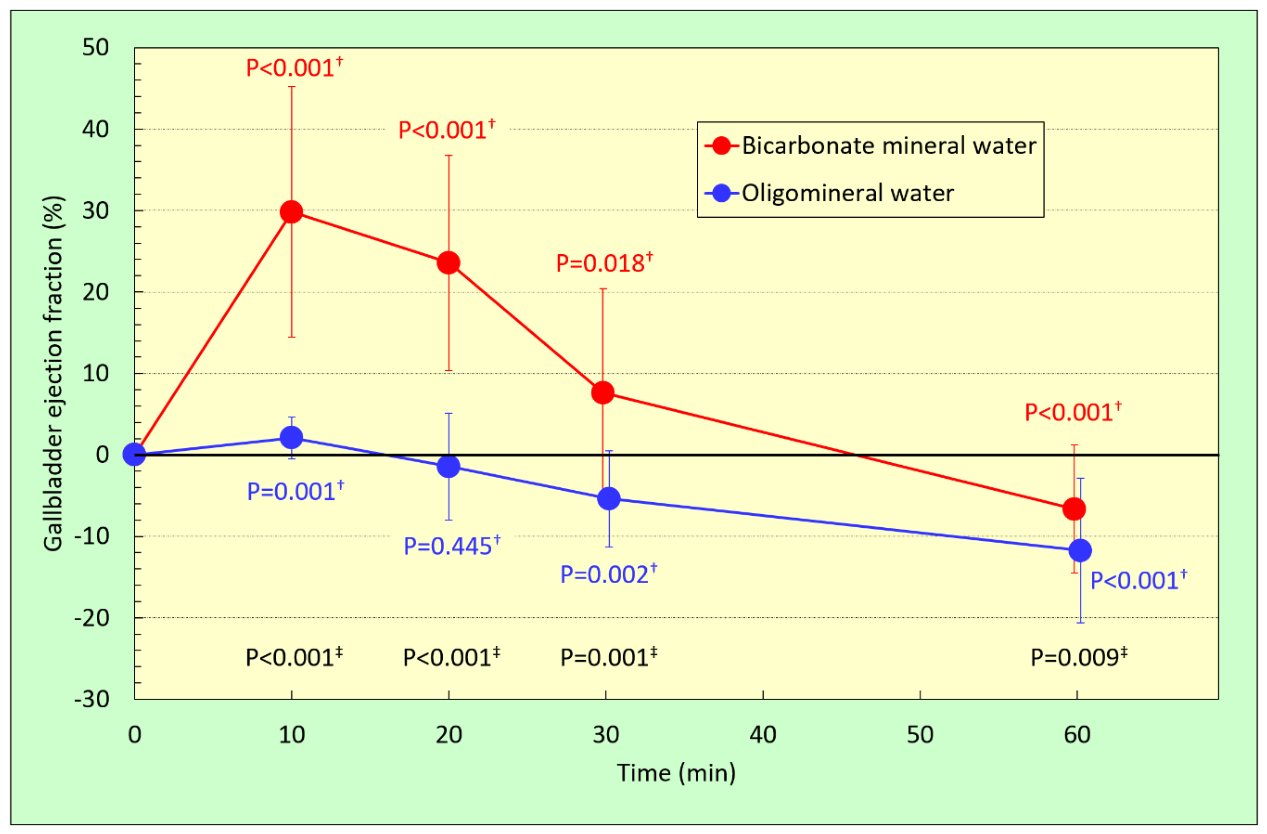
Figure 2.
Individual maximum gallbladder ejection fraction observed after intake of 500 mL of either bicarbonate mineral water or oligomineral water in 20 healthy subjects. (Mean±SD values are also shown). † Wilcoxon matched-pairs test.
Figure 2.
Individual maximum gallbladder ejection fraction observed after intake of 500 mL of either bicarbonate mineral water or oligomineral water in 20 healthy subjects. (Mean±SD values are also shown). † Wilcoxon matched-pairs test.
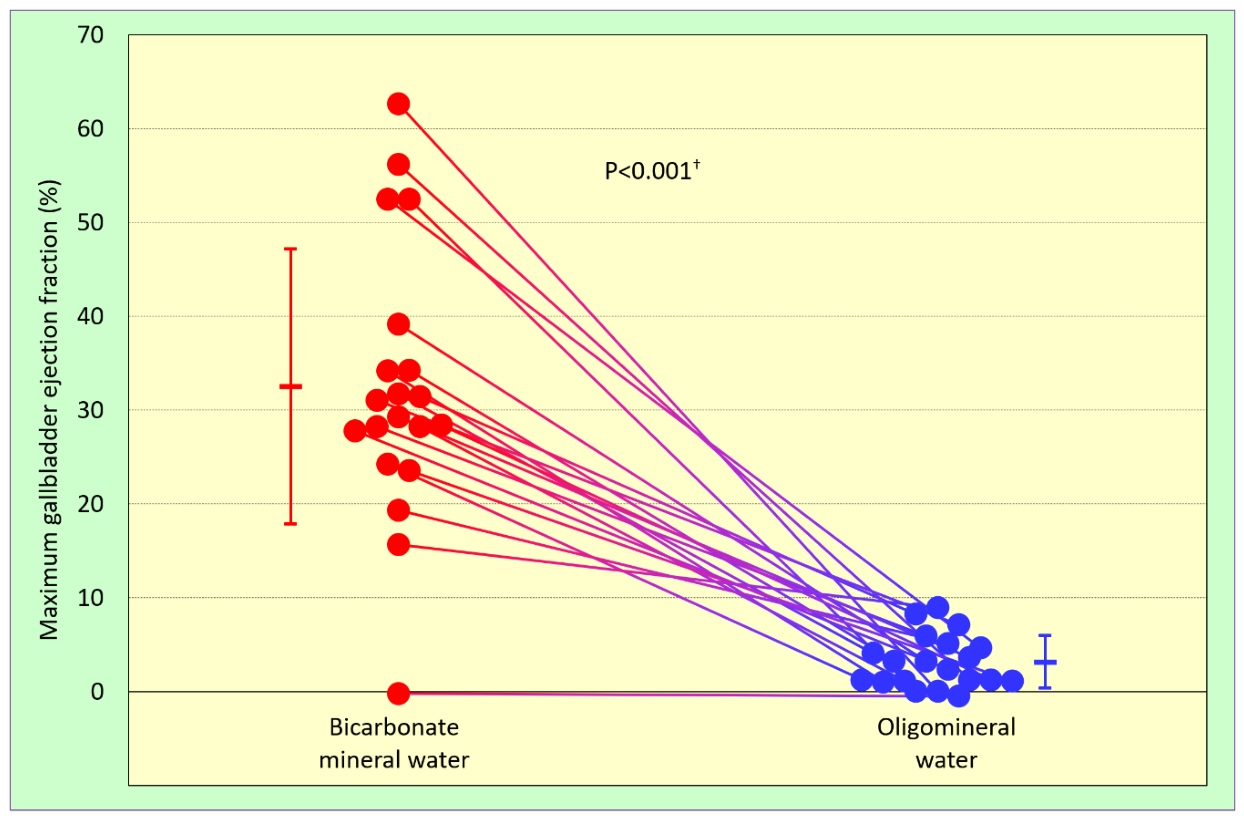

Table 1.
Main chemical–physical characteristics of bicarbonate mineral water (Aqua 3) and oligomineral water.
Table 1.
Main chemical–physical characteristics of bicarbonate mineral water (Aqua 3) and oligomineral water.
| Unit | Bicarbonate mineral water |
Oligomineral water |
|
|---|---|---|---|
| Fixed residual at 180°C | (mg/L) | 672.1 | 132.9 |
| pH at source | (UpH) | 6.1 | 7.8 |
| Free C02 at source | (mg/L) | 821.1 | 3.5 |
| Bicarbonates (HCO3-) | (mg/L) | 781.1 | 134.0 |
| Sulfates | (mg/L) | 7.8 | 1.8 |
| Potassium | (mg/L) | 3.89 | 0.73 |
| Sodium | (mg/L) | 73.0 | 3.9 |
| Calcium | (mg/L) | 158.1 | 35.2 |
| Magnesium | (mg/L) | 34.4 | 5.3 |
| Fluorides | (mg/L) | 0.06 | 0.05 |
| Chlorides | (mg/L) | 6.7 | 1.3 |
| Silica | (mg/L) | N/a† | 16.4 |
| Nitrates (NO3-) | (mg/L) | <0.06 | 3.9 |
| Nitrogens | (mg/L) | <0.02 | N/a† |
† N/a: not available.
Table 2.
Baseline characteristics of the study population (n=20).
| All subjects | Group BW/OW |
Group OW/BW |
P value | |
|---|---|---|---|---|
|
Gender - Males - Females |
9 (45.0%) 11 (55.0%) |
5 (50.0%) 5 (50.0%) |
4 (40.0%) 6 (60.0%) |
1.000 † |
|
Age (years) - Mean±SD - Range |
54.3±16.5 26 to 72 |
56.0±17.0 26 to 72 |
51.8±16.4 29 to 72 |
0.545 ‡ |
|
Weight (kg) - Mean±SD - Range |
68.2±13.4 49 to 90 |
70.7±14.2 49 to 90 |
65.6±12.7 50 to 82 |
0.363 ‡ |
|
Height (cm) - Mean±SD - Range |
172±8 160 to 183 |
174±8 163 to 183 |
170±8 160 to 180 |
0.238 ‡ |
|
BMI (kg/m2) - Mean±SD - Range |
22.9±3.0 17.8 to 27.8 |
23.2±2.9 17.8 to 27.8 |
22.6±3.1 18.8 to 27.0 |
0.880 ‡ |
|
Weight status classes - Underweight (BMI<18.5 kg/m2) - Normal weight (BMI between 18.5 and <25 kg/m2) - Overweight (BMI between 25 and <30 kg/m2) |
1 (5.0%) 14 (70.0%) 5 (25.0%) |
1 (10.0%) 7 (70.0%) 2 (20.0%) |
- 7 (70.0%) 3 (30.0%) |
0.393 § |
BW/OW: bicarbonate mineral water first, then oligomineral water. OW/BW: oligomineral water first, then bicarbonate mineral water. † Fisher Exact test; ‡ Mann-Whitney U test; § Linear-by-linear association chi-square.
Table 3.
Evaluation of the possible carry-over effect made by comparing data between the two groups of subjects with different successions of water intake (n=20).
Table 3.
Evaluation of the possible carry-over effect made by comparing data between the two groups of subjects with different successions of water intake (n=20).
| Group BW/OW |
Group OW/BW |
P value† | |
|---|---|---|---|
|
Basal gallbladder volume (mL) After bicarbonate mineral water After oligomineral water Difference between bicarbonate and oligomineral water |
36.4±11.6 37.2±10.7 -0.9±3.1 |
38.6±24.4 37.9±25.6 0.8±2.8 |
0.650 0.364 0.597 |
|
Basal gallbladder volume (mL) After bicarbonate mineral water After oligomineral water Difference between bicarbonate and oligomineral water |
|||
|
Gallbladder ejection fraction (%) After bicarbonate mineral water: - 10 minutes - 20 minutes - 30 minutes - 60 minutes After oligomineral water: - 10 minutes - 20 minutes - 30 minutes - 60 minutes Difference between bicarbonate and oligomineral water: - 10 minutes - 20 minutes - 30 minutes - 60 minutes |
30.4±10.3 23.3±7.8 7.1±12.3 -4.7±3.6 2.9±2.8 -0.9±7.1 -6.7±3.6 -12.3±4.2 27.5±11.3 24.2±8.7 13.7±11.0 7.6±3.9 |
29.2±19.8 23.8±17.6 8.2±13.9 -8.5±10.5 1.3±2.2 -2.0±6.3 -4.1±7.6 -11.2±12.2 28.0±20.6 25.8±21.0 12.3±14.9 2.6±9.8 |
0.880 0.940 0.496 0.326 0.103 0.597 0.290 0.762 1.000 1.000 0.821 0.151 |
|
Maximum gallbladder ejection fraction (%) After bicarbonate mineral water After oligomineral water Difference between bicarbonate and oligomineral water |
32.9±8.0 3.9±2.6 29.0±8.0 |
32.2±19.7 2.4±2.9 29.8±20.9 |
0.705 0.186 0.940 |
|
Timing of maximum gallbladder ejection fraction (min) After bicarbonate mineral water After oligomineral water Difference between bicarbonate and oligomineral water |
13.0±6.7 12.0±4.2 1.0±7.4 |
14.0±7.0 21.0±15.2 -7.0±17.7 |
0.654 0.056 0.347 |
BW/OW: bicarbonate mineral water first, then oligomineral water; OW/BW: oligomineral water first, then bicarbonate mineral water. † Mann-Whitney U test.
Disclaimer/Publisher’s Note: The statements, opinions and data contained in all publications are solely those of the individual author(s) and contributor(s) and not of MDPI and/or the editor(s). MDPI and/or the editor(s) disclaim responsibility for any injury to people or property resulting from any ideas, methods, instructions or products referred to in the content. |
© 2026 by the authors. Licensee MDPI, Basel, Switzerland. This article is an open access article distributed under the terms and conditions of the Creative Commons Attribution (CC BY) license (http://creativecommons.org/licenses/by/4.0/).
Copyright: This open access article is published under a Creative Commons CC BY 4.0 license, which permit the free download, distribution, and reuse, provided that the author and preprint are cited in any reuse.