

Submitted:
10 August 2026
Posted:
11 August 2026
You are already at the latest version
Abstract
Background: Obesity is a primary driver of functional male hypogonadism, including male obesity-associated secondary hypogonadism (MOSH), for which weight loss remains the first-line intervention. However, the behavioral determinants of eating behavior in this population remain poorly characterized. This exploratory analysis examined whether lower total testosterone (TT) levels were associated with specific domains of the Eating Behavior Phenotype Scale (EFCA). Methods: A cross-sectional analysis was conducted using baseline data from a retrospective outpatient cohort of men with obesity who had available total testosterone measurements. Eating behavior was assessed using the validated 16-item EFCA. Associations were assessed primarily using Spearman’s rank correlation, with Kendall’s tau and leave-one-out analyses performed as sensitivity analyses. Results: Of the analytical sample (n = 10; mean BMI 38.8 kg/m² among the nine participants with available anthropometry), eight participants completed the EFCA. Total testosterone (TT) levels (mean 310.7 ng/dL) did not correlate with the hedonic, compulsive, hyperphagic, or emotional domains. A strong inverse correlation was observed between TT and the disorganized domain (Spearman’s rho = −0.914; p = 0.0015). This association remained significant after Bonferroni correction and was confirmed by Kendall’s tau and leave-one-out sensitivity analyses. Conclusions: Lower TT levels were selectively associated with increased eating disorganization. These hypothesis-generating findings warrant confirmation in prospective studies incorporating comprehensive androgen profiling, including measurements of free testosterone and sex hormone-binding globulin (SHBG).
Keywords:
obesity
; functional hypogonadism
; male obesity-associated secondary hypogonadism
; total testosterone
; eating behavior
; eating disorganization
1. Introduction
Obesity is a complex, multifactorial disease associated with comorbidities that substantially affect health. Among these, functional male hypogonadism is increasingly recognized as a potentially reversible reduction in gonadal function that, unlike organic hypogonadism, arises from conditions that suppress gonadotropin and testosterone concentrations and may improve once the underlying cause is treated [2,5]. In obesity, this condition—male obesity-associated secondary hypogonadism (MOSH)—results from interacting mechanisms including hyperinsulinemia-induced reductions in sex hormone-binding globulin (SHBG), chronic low-grade inflammation, leptin resistance, and disruption of hypothalamic–pituitary–gonadal signaling [3,4]. Although obesity treatment can restore gonadal axis function, the clinical response is heterogeneous, and this variability may be partly driven by distinct behavioral phenotypes, including reward-driven (hedonic) and emotional eating. Whether androgen status is associated with specific eating behavior domains that may influence treatment response remains unknown.
The epidemiological relevance of this condition is increasing alongside the global rise in obesity prevalence. Reported frequencies of functional hypogonadism vary considerably according to diagnostic criteria, testosterone assessment methods, and symptom definitions [5], ranging from approximately 2% to 13% in the general male population and higher among men with obesity and metabolic comorbidities [5,30]. According to the NCD Risk Factor Collaboration, more than 1 billion people worldwide are living with obesity, underscoring the growing number of individuals potentially at risk for obesity-related endocrine complications [7].
From a diagnostic perspective, the Endocrine Society clinical practice guideline [8] and the joint position statement of the Brazilian Society of Endocrinology and Metabolism (SBEM), the Brazilian Society of Urology (SBU), and the Brazilian Association for Sexual Medicine and Health (ABEMSS) [9] recommend diagnosing hypogonadism in men with compatible signs and symptoms of androgen deficiency together with consistently low serum total testosterone (TT), confirmed by at least two fasting morning measurements using reliable assays. In men with obesity, TT requires cautious interpretation, because obesity-related reductions in SHBG may lower TT without necessarily indicating impaired androgen action; assessment of calculated free testosterone is therefore recommended when SHBG is altered, as in obesity and diabetes [5,8]. Once biochemical hypogonadism is confirmed, measurement of luteinizing hormone (LH) and follicle-stimulating hormone (FSH) helps distinguish primary from secondary hypogonadism [1].
MOSH represents a functional form of secondary hypogonadism characterized by obesity-related suppression of the hypothalamic–pituitary–testicular axis and potential reversibility with substantial weight loss [1,5]. Its nosological status remains debated: some authors argue that obesity-related reductions in TT primarily reflect reduced SHBG with preserved free testosterone and normal gonadotropins, describing this state as pseudo-hypogonadism of obesity rather than true hypogonadism [10], whereas others consider MOSH a clinically relevant functional disorder [1,5,11]. Recent Brazilian guidance similarly recognizes MOSH as the most common condition associated with functional hypogonadism [9]. Both perspectives emphasize obesity treatment as the cornerstone of management and the importance of accurate androgen assessment, including SHBG and free testosterone.
Accordingly, initial management targets obesity itself, as weight loss—particularly the reduction of visceral adiposity—can increase testosterone concentrations and improve sexual function, with recovery of gonadal axis function in a substantial proportion of men [1,2,12]. A 2024 meta-analysis including 44 studies (19 low-calorie diet studies, n = 735; 26 bariatric surgery studies, n = 1039; and, one evaluating both approaches) demonstrated pooled increases in TT of approximately 72 ng/dL (2.5 nmol/L; 95% CI 54.7–89.3) after low-calorie diets and 207 ng/dL (7.2 nmol/L; 95% CI 172.8–241.9) after bariatric surgery, accompanied by parallel increases in free testosterone [13]; weight loss of at least 5–10% has been associated with improvements in testosterone concentrations, physical function, libido, and erectile function [1,13]. Testosterone replacement therapy is not routinely recommended in this setting [14,15,16], a position reinforced by the Fifth International Consultation on Sexual Medicine [17], and should be reserved for permanent hypogonadism or persistent symptoms despite appropriate obesity management [8,15].
Excess caloric intake may arise through different mechanisms, including reward-driven eating, emotional eating, compulsive eating, hyperphagia, or disorganized eating patterns [18,19]. The Eating Behavior Phenotype Scale (EFCA, from the original Spanish Escala de Fenótipos de Comportamiento Alimentario), [20,21] validated for Brazilian Portuguese [22], operationalizes these dimensions through a 16-item self-administered instrument comprising a total score and five subscales: hedonic, hyperphagic, compulsive, emotional, and disorganized eating. In a real-world retrospective cohort, anti-obesity medications available in Brazil demonstrated distinct behavioral signatures on the EFCA, with broader effects on the hedonic, emotional, hyperphagic, and compulsive domains but a more heterogeneous response in the disorganized domain [23].
Despite the conceptual convergence between metabolic and reproductive regulation, including shared hypothalamic pathways involving mediators such as leptin and kisspeptin [5,6], eating behavior in men with MOSH remains poorly characterized. Previous studies have explored only isolated aspects: food addiction was evaluated using the Yale Food Addiction Scale in men with MOSH undergoing nutritional intervention and physical activity [1]; there are reports that a specific dietary pattern was associated with low testosterone and hypogonadism (odds ratio 5.72; 95% CI 1.11–29.51) [24]; and there are observed reductions in binge eating in men with metabolic hypogonadism treated with tirzepatide [25]. However, to our knowledge, no published study has evaluated whether androgen status in men with obesity is associated with specific multidimensional eating behavior phenotypes.
Therefore, this study aimed to investigate whether total testosterone levels are associated with specific domains of eating behavior as assessed by the Eating Behavior Phenotype Scale in men with obesity undergoing evaluation for hypogonadism.
2. Materials and Methods
2.1. Study Design and Setting
This was an observational, retrospective, real-world study based on data collected from the outpatient obesity treatment service at Irmandade da Santa Casa de Misericórdia de São Paulo, Brazil. The primary objective was to investigate whether baseline serum total testosterone (TT) concentrations were associated with the total score and specific domains of the Eating Behavior Phenotype Scale (EFCA) in men with obesity.
Data were extracted from medical records and organized in a REDCap database. A CSV file containing demographic, anthropometric, hormonal, and EFCA scores variables was exported from this database. The present analysis was restricted to baseline assessments performed before the initiation of pharmacological treatment and was therefore cross-sectional in nature, although nested within a retrospective clinical cohort.
2.2. Participants and Sample
Men with obesity receiving outpatient care were eligible if baseline total testosterone (TT) measurements were available as part of their clinical evaluation. Ten participants fulfilled these criteria and comprised the analytical sample (n = 10). All eligible male records containing an available baseline TT measurement within the predefined study dataset were included, and no records were excluded during database construction. Eligibility was defined by male sex, the presence of obesity, and the availability of a baseline TT measurement obtained during routine clinical care; no age threshold was applied as an inclusion criterion. Accordingly, one participant aged 17.6 years at assessment met these criteria and was retained in the analytical sample. The influence of this record was assessed within the leave-one-out procedure (Section 3.3).
This was a convenience sample based on the availability of clinical data and laboratory measurements. No a priori sample size calculation was performed because the study was designed as an exploratory, hypothesis-generating analysis. An available-case approach was applied for each outcome, without imputation of missing data; therefore, correlations between TT concentrations and EFCA domains were calculated using complete pairs only. Data completeness and missing data patterns of missing data are reported in the Results section.
2.3. Data Collection and Variables
The following baseline variables were extracted from the database: age (years), weight (kg), height (cm), body mass index (BMI, kg/m²), total testosterone (ng/dL), luteinizing hormone (LH, IU/L), follicle-stimulating hormone (FSH, IU/L), estradiol, and EFCA scores, including the total score and the five behavioral domains (hedonic, hyperphagic, compulsive, emotional and disorganized).
Hormonal measurements were performed as part of routine clinical care. Estradiol was extracted as part of the available hormonal dataset but was not included in the prespecified analyses because it was outside the scope of the primary research question. Sex hormone-binding globulin (SHBG) was not measured in this cohort; consequently, free and bioavailable testosterone could not be calculated, and all analyses were based on total testosterone concentrations obtained during routine clinical care. Current guidelines recommend measuring or calculating free testosterone when conditions that alter SHBG, such as obesity, are present or when total testosterone concentrations are borderline [8,9]. The implications of this limitation are addressed in Section 4.2.
Mean total testosterone was 310.7 ± 129.1 ng/dL (median 339.0; range 79.0–453.0). The observed range illustrates the heterogeneity of androgen concentrations in men with obesity undergoing evaluation for hypogonadism, and overlaps with thresholds proposed by different professional societies for the biochemical evaluation of testosterone deficiency. The Endocrine Society recommends a threshold of 264 ng/dL (9.2 nmol/L) [8], whereas the American Urological Association uses 300 ng/dL (10.4 nmol/L) as a reference value, a cut-off that has been questioned in younger men, in whom higher concentrations may be expected [29]. The European Academy of Andrology, in line with the British Society for Sexual Medicine, considers 350 ng/dL (12.1 nmol/L) a clinically relevant threshold, above which hypogonadism is unlikely [2]. In the Brazilian joint position statement, TT concentrations below 264 ng/dL support the diagnosis of hypogonadism, values above 350 ng/dL typically exclude it, and intermediate concentrations require additional biochemical assessment, including SHBG and calculated free testosterone [9]. The American Association of Clinical Endocrinology does not establish a specific diagnostic threshold but suggests that symptomatic men with total testosterone concentrations below 200 ng/dL may be considered potential candidates for therapy.
The primary exposure variable was total testosterone concentration. The outcome variables were the EFCA total score and the five behavioral domain scores. Demographic and anthropometric variables were used solely to characterize the sample, as the available sample size did not support adjusted multivariable modeling.
2.4. The Eating Behavior Phenotype Scale (EFCA)
The EFCA is a self-administered questionnaire developed to characterize subphenotypes of eating behavior in adults [20,21]. The instrument comprises 16 items assessing beliefs and attitudes related to eating and generates a total score and five subscales representing partially independent behavioral dimensions: hedonic (intake motivated by reward and exposure to palatable foods), emotional (intake triggered by affective states such as anxiety, boredom, loneliness, anger, sadness, or fatigue), compulsive (difficulty stopping intake and consumption of large amounts within a short period), hyperphagic (volume consumed during meals and repetition of portions), and disorganized (irregular eating structure, including omission of meals and prolonged intervals without eating) [20,21,22]. The Brazilian Portuguese version was validated through confirmatory factor analysis and assessment of psychometric properties [22] and was the version used in the present study. The EFCA is designed to characterize eating behavior patterns rather than establish diagnoses of eating disorders, and its application is rapid, low-cost and consistent with the understanding of obesity as a disease of predominantly central origin [23].
2.5. Statistical Analysis
Analyses were performed using RStudio V2024.12.1 Build 563 (Posit, Boston, MA, United States of America). [26] All tests were two-sided, with α = 0.05.
Given the small sample size, continuous variables were described using both mean ± standard deviation and median [interquartile range], together with minimum and maximum values. Robust measures were considered preferred for interpretation. The number of non-missing observations (n) was reported for each variable.
The primary analysis consisted of Spearman’s rank correlation between total testosterone concentrations and the EFCA total score and five behavioral domains. Spearman correlation was selected a priori because it does not require normally distributed data or linear relationships and is less influenced by extreme observations, characteristics considered appropriate for exploratory analyses with a small sample size. Tests were run with the asymptotic approximation because of the presence of ties.
Three sensitivity approaches were prespecified. First, correlations were repeated using Kendall’s tau coefficient, which provides a conservative rank-based measure particularly suitable for small samples with tied observations. Second, because multiple EFCA outcomes were tested against the same exposure variable, p values were adjusted using both Benjamini–Hochberg false discovery rate control [27] and Bonferroni family-wise error rate correction; both approaches were reported as sensitivity analyses. Third, for associations remaining significant after correction, leave-one-out analyses were performed by recalculating the correlation after sequential removal of each participant to assess the influence of individual observations. Because this procedure removed each available record in turn, it also encompassed the participant younger than 18 years, providing the sensitivity analysis for that inclusion.
Confidence intervals for Spearman coefficients were estimated using Fisher’s z transformation and should be interpreted cautiously given the limited sample size.
No multivariable regression models were performed, and no adjustments for age, BMI, LH, or FSH were conducted. This decision was prespecified because the number of complete observations was insufficient to support reliable multivariable modeling, and adjusted estimates would likely be unstable and difficult to interpret. Similarly, no comparisons between groups defined by testosterone thresholds were performed.
3. Results
The analytical database comprised 10 men with obesity and an available baseline total testosterone (TT) measurement (Table 1). Mean age was 42.6 ± 14.0 years and mean body mass index (BMI) was 38.8 ± 7.2 kg/m². All participants with available BMI data fulfill the criteria for obesity (BMI ≥30 kg/m²), with representation across obesity classes I to III. Mean TT concentration was 310.7 ± 129.1 ng/dL (median 339.0; range 79.0–453.0). Mean luteinizing hormone (LH) and follicle-stimulating hormone (FSH) concentrations were 4.0 ± 2.8 IU/L and 5.1 ± 2.8 IU/L, respectively, without evidence of compensatory gonadotropin elevation.
Data completeness was as follows: TT was available for 10/10 participants; weight and BMI for 9/10; and LH, FSH, and all EFCA scores for 8/10 participants. The two participants without EFCA data corresponded to records 4 and 7, with TT concentrations of 295 and 383 ng/dL, respectively. Therefore, the complete TT–EFCA dataset consisted of eight paired observations, which represented the denominator used for all correlation analyses.
3.1. Baseline Distribution of Eating Behavior Phenotypes
Among the eight participants with complete EFCA data, the mean total score was 36.6 ± 11.8. Across the five behavioral domains, the highest mean score was observed for the hedonic domain (10.8 ± 4.2), followed by the emotional, hyperphagic, disorganized, and compulsive domains (Table 1).
The EFCA scores demonstrated substantial interindividual variability. The total score ranged from 21.0 to 59.0, and domain scores across the participants also varied considerably. Individual distributions of the EFCA total score and subscales are presented in Table 1.
3.2. Association Between Total Testosterone and the EFCA Domains
Total testosterone concentrations were not significantly correlated with the EFCA total score (Spearman’s rho = −0.165; p = 0.696) or with the hedonic, compulsive, hyperphagic, or emotional domains (Table 2). Correlation coefficients for the hyperphagic and emotional domains were negative but imprecisely estimated, with confidence intervals crossing zero.
In contrast, a strong inverse correlation was observed between TT concentrations and the disorganized EFCA domain (Spearman’s rho = −0.914; 95% CI −0.99 to −0.47; p = 0.0015). Lower TT concentrations were associated with higher disorganized eating scores. Complete correlation results, including raw and adjusted p values, are presented in Table 2. The association between TT and the disorganized domain is illustrated in Figure 1.
3.3. Sensitivity and Robustness Analyses
The association between total testosterone and the disorganized EFCA domain was evaluated using three prespecified sensitivity approaches.
First, correction for multiple comparisons was performed because multiple EFCA outcomes were assessed against the same predictor. After Benjamini–Hochberg false discovery rate correction, the p value for the disorganized domain remained significant (adjusted p = 0.0089). The Bonferroni correction yielded the same adjusted p value (0.0089), indicating that the association remained significant under a more conservative family-wise error rate approach. No other EFCA domain remained statistically significant after correction (lowest adjusted p value among the remaining domains = 0.758).
Second, the analysis was repeated using Kendall’s tau correlation coefficient. This alternative rank-based method confirmed both the direction and statistical significance of the association between TT and the disorganized domain (tau = −0.828; p = 0.0066), while no significant associations were observed for the remaining EFCA domains (Table 3).
Third, a leave-one-out influence analysis was performed to evaluate the impact of individual observations on the association between TT and the disorganized EFCA domain. Sequential exclusion of each of the 10 available records (which, for the two records lacking EFCA data, left the eight complete pairs unchanged) resulted in Spearman correlation coefficients ranging from −0.869 to −0.954, with corresponding p values ranging from 0.0008 to 0.011. The association remained statistically significant in all re-estimations.
The weakest correlation magnitude was observed after exclusion of participant 3 (rho = −0.869). Exclusion of participants 4 and 7, who lacked EFCA data and therefore were not included in the complete testosterone–EFCA pairs, did not alter the estimate (rho = −0.914; p = 0.0015). Because each of the 10 available records was removed in turn, this procedure necessarily included the youngest participant, whose exclusion likewise left the direction and statistical significance of the association unchanged. Detailed leave-one-out results are presented in Table 4.
4. Discussion
The main finding of this exploratory study was the identification of a selective association between total testosterone (TT) concentrations and a specific dimension of eating behavior. Among men with obesity, TT was not associated with the overall EFCA score or with domains related to hedonic, emotional, hyperphagic, or compulsive eating patterns. Instead, the association was concentrated in the disorganized eating domain, characterized by irregular eating patterns and disrupted meal organization. This pattern suggests that androgen status may be linked to a specific behavioral phenotype rather than to a generalized alteration across all measured dimensions of eating behavior.
The robustness of this finding was evaluated through multiple sensitivity analyses. The association remained statistically significant after correction for multiple comparisons using both Benjamini–Hochberg and Bonferroni approaches, was confirmed using Kendall’s tau as an alternative rank-based estimator, and remained significant in leave-one-out analyses. These convergent results suggest that the observed association was not solely dependent on the choice of statistical method or on a single influential observation. However, these findings should be interpreted within the context of the small sample size and exploratory nature of the study.
4.1. Biological Plausibility and Potential Mechanisms
The disorganized EFCA domain reflects irregular eating patterns, including omission of main meals, prolonged intervals without eating, and lack of a structured eating routine [20,21,22]. Unlike the hedonic or emotional domains, which are more directly related to reward processing and affective regulation, disorganized eating represents a temporal and organizational dimension of food intake.
A potential interpretation of the present findings is that reduced testosterone concentrations in men with obesity may be associated with alterations in eating structure rather than simply increased appetite or reward-driven intake. Symptoms commonly reported in androgen deficiency, including reduced energy, diminished motivation, impaired concentration, and reduced functional performance, overlap conceptually with behaviors that may contribute to irregular meal patterns [8]. Therefore, one hypothesis generated by these data is that lower androgen status may influence aspects of behavioral organization related to food intake. This hypothesis, however, cannot be tested within the present cross-sectional design, and the directionality of this association remains uncertain.
A shared biological substrate between metabolic regulation, reproductive function, and eating behavior is plausible. Obesity-related alterations in leptin signaling, hypothalamic inflammation, insulin resistance, and disruption of hypothalamic–pituitary–testicular axis regulation have all been implicated in obesity-associated reductions in testosterone concentrations [5,6]. Importantly, hypothalamic pathways involved in gonadotropin regulation also participate in the control of appetite and meal timing. Therefore, alterations in hypothalamic function could theoretically contribute simultaneously to changes in androgen regulation and eating behavior. Nevertheless, whether eating disorganization is a consequence of altered androgen status, a contributor to obesity-related hormonal dysfunction, or part of a bidirectional interaction remains unknown.
The potential clinical relevance of this observation emerges when considering the context of previous findings obtained using the same behavioral instrument. In a real-world retrospective cohort of 66 individuals with an early response to anti-obesity pharmacotherapy, medications available in Brazil demonstrated different behavioral signatures according to EFCA domains, with more consistent effects on hedonic, emotional, hyperphagic, and compulsive dimensions, whereas the response of the disorganized domain appeared more heterogeneous [23]. If confirmed in larger cohorts, the present findings raise the possibility that men with obesity and reduced testosterone concentrations may exhibit a behavioral profile requiring additional attention beyond pharmacological weight management alone.
This interpretation should be considered within the established therapeutic framework for obesity-associated functional hypogonadism. Weight loss remains the cornerstone intervention, as reduction of adiposity—particularly visceral fat—is associated with improvements in TT, free testosterone, SHBG, gonadotropin concentrations, and symptoms related to androgen deficiency [2,9,12,32,33]. Lifestyle interventions, including caloric restriction and regular physical activity, as well as anti-obesity pharmacotherapy and bariatric surgery, have demonstrated the ability to improve obesity-related hormonal abnormalities [12,31,34]. Testosterone replacement therapy is not recommended as routine treatment for obesity-associated functional hypogonadism and should be considered only in selected individuals with persistent symptoms and confirmed biochemical deficiency despite appropriate management of the underlying condition [14,15].
Recent evidence also suggests that incretin-based therapies may influence both metabolic and reproductive outcomes. In men with obesity and metabolic hypogonadism, tirzepatide combined with lifestyle intervention resulted in greater weight loss, increased endogenous testosterone concentrations, improved erectile function, and reduced binge eating compared with alternative approaches [25]. However, whether improvements in eating behavior contribute to hormonal recovery, or whether both outcomes reflect broader metabolic improvement, remains to be established.
4.2. Limitations
The findings of this study should be interpreted within well-defined boundaries. The analysis was exploratory and based on eight complete TT–EFCA pairs; confidence intervals were correspondingly wide, and the absence of significant associations in the remaining EFCA domains reflects limited statistical power rather than evidence of no effect. The cross-sectional, retrospective design precludes causal inference and cannot establish whether altered testosterone concentrations precede changes in eating behavior or result from obesity-related behavioral patterns, and residual confounding by unmeasured variables—including age, obesity severity, comorbidities, sleep quality, psychological factors, and medication use—cannot be excluded. Within these constraints, the observed association proved stable: it survived correction for multiple comparisons, was reproduced with an alternative rank-based estimator, and persisted across leave-one-out analyses, in which removal of any single participant yielded Spearman coefficients between −0.869 and −0.954 (all p < 0.05). Robustness to these checks, however, does not ensure accuracy of magnitude: statistically significant effects estimated from very small samples are prone to overestimation, and the observed coefficient should therefore be regarded as an upper bound rather than a precise estimate of the underlying association.
Hormonal characterization was based on data available from routine clinical care and was necessarily incomplete. Only a baseline TT measurement was available, whereas guidelines recommend confirmation with repeated morning measurements on separate days [8], and neither SHBG nor calculated free testosterone was obtained. This is particularly relevant here: the median TT of the sample (339.0 ng/dL) fell within the 264–350 ng/dL range for which current recommendations specifically require SHBG and calculated free testosterone, because obesity-related reductions in SHBG may lower TT without indicating impaired androgen action [4,8,9]. The study therefore cannot distinguish between confirmed functional hypogonadism from obesity-related reductions in TT driven by altered SHBG and, because androgen deficiency symptoms were not systematically assessed, a syndromic diagnosis of MOSH could not be established. The hormonal profile observed—reduced or borderline TT without compensatory gonadotropin elevation—is compatible with the pattern described in obesity-associated secondary hypogonadism [1,30], but remains descriptive. Accordingly, the findings apply to men with obesity across a range of TT concentrations rather than to a formally diagnosed MOSH cohort.
Two participants lacked EFCA data, reducing the number of complete pairs. Missing data were not concentrated among those with the lowest TT concentrations, although selection bias cannot be formally excluded. One participant was 17.6 years old at assessment. Because eligibility was defined by male sex, obesity, and the availability of a clinical TT measurement rather than by an age threshold, this individual was retained; as the leave-one-out procedure removed every record in turn, his exclusion is covered by those analyses and left the association unchanged.
These constraints are balanced by several methodological strengths: a validated, multidimensional instrument for eating behavior assessment; statistical approaches selected a priori for a small sample; convergent sensitivity analyses; and transparent reporting of missing data. Rather than providing definitive evidence, the study offers a specific and testable hypothesis: that lower testosterone concentrations in men with obesity are associated with a distinct pattern of eating disorganization. Confirming it will require prospective studies with larger samples, repeated hormonal measurements including SHBG and free testosterone, systematic symptom evaluation, and longitudinal behavioral characterization.
5. Conclusions
In this exploratory retrospective analysis of men with obesity, lower total testosterone concentrations were selectively associated with higher scores in the disorganized eating domain assessed by the EFCA, whereas no significant associations were observed with the hedonic, hyperphagic, compulsive, or emotional eating domains. The association remained statistically significant after Bonferroni correction, was confirmed using an alternative rank-based estimator, and remained consistent across leave-one-out sensitivity analyses. Considering that the disorganized domain has shown heterogeneous and potentially limited responsiveness to anti-obesity pharmacotherapy in previous real-world data [23], and that obesity treatment remains the recommended first-line approach for obesity-associated functional hypogonadism [2,9,12], these findings support the hypothesis that eating disorganization may represent a behavioral domain linking androgen status and obesity management outcomes in men. Further prospective studies with comprehensive androgen profiling, including free testosterone and sex hormone-binding globulin, as well as longitudinal assessment of eating behavior, are required to determine the clinical relevance of this association.
Author Contributions
Conceptualization, C.M.Ro, C.M.Ri., R.J.P.-W. and A.H.S.; methodology, C.M.Ri., R.J.P.-W., and A.H.S.; software, R.J.P.-W.; formal analysis, C.M.Ri. and R.J.P.-W.; writing—original draft preparation, C.M.Ro. and C.M.Ri.; writing—review and editing, C.M.Ri and R.J.P.-W.; supervision, A.H.S., N.M.S. and J.E.N.S. All authors have read and agreed to the published version of the manuscript.
Funding
This research received no external funding.
Institutional Review Board Statement
The study protocol was approved by the Santa Casa de Misericórdia de São Paulo Ethics Committee, approval number 87515425.2.0000.5479, Date 12 April 2025. As this was a secondary analysis of routinely collected clinical data, informed consent was obtained in accordance with local regulations and the Declaration of Helsinki.
Informed Consent Statement
Informed consent was obtained from all subjects involved in the study.
Data Availability Statement
Research data is stored in Santa Casa de Misericórdia de São Paulo REDCap server (https://redcap.fcmsantacasasp.edu.br/).
Conflicts of Interest
The authors declare no conflicts of interest.
Acknowledgments
The authors acknowledge all Endocrinology residents from Santa Casa de Misericórdia de São Paulo for their tireless work and support, and all the patients who gladly accepted providing their information for science development.
Abbreviations
The following abbreviations are used in this manuscript:
| MOSH | male obesity-associated hypogonadism |
| TT | total testosterone |
| EFCA | Eating Behavior Phenotype Scale |
| LH | luteinizing hormone |
| FSH | follicle-stimulant hormone |
| SHBG | sex hormone-binding globulin |
| BMI | body-mass index |
References
- De Lorenzo, A.; Noce, A.; Moriconi, E.; Rampello, T.; Marrone, G.; Di Daniele, N.; et al. MOSH syndrome (Male Obesity Secondary Hypogonadism): clinical assessment and possible therapeutic approaches. Nutrients 2018, 10, 474. [Google Scholar] [CrossRef] [PubMed]
- Corona, G.; Goulis, D.G.; Huhtaniemi, I.; Zitzmann, M.; Toppari, J.; Forti, G.; et al. European Academy of Andrology (EAA) guidelines on investigation, treatment and monitoring of functional hypogonadism in males. Andrology 2020, 8, 970–87. [Google Scholar] [CrossRef] [PubMed]
- Glass, A.R.; Swerdloff, R.S.; Bray, G.A.; Dahms, W.T.; Atkinson, R.L. Low serum testosterone and sex-hormone-binding-globulin in massively obese men. J. Clin. Endocrinol. Metab. 1977, 45, 1211–9. [Google Scholar] [CrossRef] [PubMed]
- Vermeulen, A. Decreased androgen levels and obesity in men. Ann. Med. 1996, 28, 13–5. [Google Scholar] [CrossRef] [PubMed]
- Fernandez, C.J.; Chacko, E.C.; Pappachan, J.M. Male obesity-related secondary hypogonadism—pathophysiology, clinical implications and management. Eur. Endocrinol. 2019, 15, 83–90. [Google Scholar] [CrossRef] [PubMed]
- Isidori, A.M.; Caprio, M.; Strollo, F.; Moretti, C.; Frajese, G.; Isidori, A.; et al. Leptin and androgens in male obesity: evidence for leptin contribution to reduced androgen levels. J. Clin. Endocrinol. Metab. 1999, 84, 3673–80. [Google Scholar] [CrossRef]
- NCD Risk Factor Collaboration (NCD-RisC). Worldwide trends in underweight and obesity from 1990 to 2022: a pooled analysis of 3663 population-representative studies with 222 million children, adolescents, and adults. Lancet 2024, 403, 1027–1050. [Google Scholar] [CrossRef] [PubMed]
- Bhasin, S.; Brito, J.P.; Cunningham, G.R.; Hayes, F.J.; Hodis, H.N.; Matsumoto, A.M.; et al. Testosterone therapy in men with hypogonadism: an Endocrine Society clinical practice guideline. J. Clin. Endocrinol. Metab. 2018, 103, 1715–44. [Google Scholar] [CrossRef] [PubMed]
- Hohl, A.; Lopes, L.; Ronsoni, M.F.; Miranda, E.P.; Fighera, T.M.; Facio, F.N.; Marchesan, L.B.; Torres, L.O. Care of patients with male hypogonadism: a joint position statement from the Brazilian Society of Endocrinology and Metabolism (SBEM), the Brazilian Society of Urology (SBU), and the Brazilian Association for Sexual Medicine and Health (ABEMSS). Int. Braz. J. Urol. 2026, 52, e20250610. [Google Scholar] [CrossRef] [PubMed]
- Muir, C.A.; Wittert, G.A.; Handelsman, D.J. Approach to the patient: low testosterone concentrations in men with obesity. J. Clin. Endocrinol. Metab. 2025, 110, e3125–30. [Google Scholar] [CrossRef] [PubMed]
- Muir, C.A.; Wittert, G.A.; Handelsman, D.J. Response to letter to the editor from Mauvais-Jarvis and Dhindsa: “Approach to the patient: low testosterone concentrations in men with obesity”. J. Clin. Endocrinol. Metab. 2025, 110, e3547–8. [Google Scholar] [CrossRef] [PubMed]
- Corona, G.; Rastrelli, G.; Monami, M.; Saad, F.; Luconi, M.; Lucchese, M.; et al. Body weight loss reverts obesity-associated hypogonadotropic hypogonadism: a systematic review and meta-analysis. Eur. J. Endocrinol. 2013, 168, 829–43. [Google Scholar] [CrossRef] [PubMed]
- Ken-Dror, G.; Fluck, D.; Fry, C.H.; Han, T.S. Meta-analysis and construction of simple-to-use nomograms for approximating testosterone levels gained from weight loss in obese men. Andrology 2024, 12, 297–315. [Google Scholar] [PubMed]
- Corona, G.; Giagulli, V.A.; Maseroli, E.; Vignozzi, L.; Aversa, A.; Zitzmann, M.; et al. Therapy of endocrine disease: testosterone supplementation and body composition: results from a meta-analysis study. Eur. J. Endocrinol. 2016, 174, R99–116. [Google Scholar] [CrossRef] [PubMed]
- Corona, G.; Rastrelli, G.; Morelli, A.; Sarchielli, E.; Cipriani, S.; Vignozzi, L.; et al. Treatment of functional hypogonadism besides pharmacological substitution. World J. Mens. Health 2020, 38, 256–70. [Google Scholar] [CrossRef] [PubMed]
- Corona, G.; Rastrelli, G.; Di Pasquale, G.; Sforza, A.; Mannucci, E.; Maggi, M. Testosterone and cardiovascular risk: meta-analysis of interventional studies. J. Sex. Med. 2018, 15, 820–38. [Google Scholar] [CrossRef] [PubMed]
- Khera, M.; Torres, L.O.; Grober, E.D.; Morgentaler, A.; Miner, M.; Jones, T.H.; et al. Male hypogonadism: recommendations from the Fifth International Consultation on Sexual Medicine (ICSM 2024). Sex. Med. Rev. 2025, 13, 548–73. [Google Scholar] [CrossRef] [PubMed]
- Acosta, A.; Camilleri, M.; Abu Dayyeh, B.; Calderon, G.; Gonzalez, D.; McRae, A.; et al. Selection of antiobesity medications based on phenotypes enhances weight loss: a pragmatic trial in an obesity clinic. Obesity 2021, 29, 662–71. [Google Scholar] [CrossRef] [PubMed]
- Bouhlal, S.; McBride, C.M.; Trivedi, N.S.; Agurs-Collins, T.; Persky, S. Identifying eating behavior phenotypes and their correlates: a novel direction toward improving weight management interventions. Appetite 2017, 111, 142–50. [Google Scholar] [CrossRef] [PubMed]
- Anger, V.E.; Formoso, J.; Katz, M.T. Escala de fenotipos de comportamiento alimentario (EFCA): análisis factorial confirmatorio y propiedades psicométricas. Nutr. Hosp. 2022, 39, 405–10. [Google Scholar] [PubMed]
- Anger, V.; Formoso, J.; Katz, M. Fenotipos de comportamiento alimentario: diseño de una nueva escala multidimensional (EFCA). Actual. Nutr. 2020, 21, 73–9. [Google Scholar]
- Pineda-Wieselberg, R.J.; Soares, A.H.; Napoli, T.F.; Anger, V.E.; Formoso, J.; Sarto, M.L.L.; et al. Validation for Brazilian Portuguese of the Eating Behavior Phenotypes Scale (EFCA): confirmatory factor analysis and psychometric properties. Arch. Endocrinol. Metab. 2025, 69, e240404. [Google Scholar] [CrossRef] [PubMed]
- Pineda-Wieselberg, R.J.; Soares, A.H.; Napoli, T.F.; Scalissi, N.M.; Salles, J.E.N. Toward precision obesity pharmacotherapy: using the Eating Behavior Phenotype Scale (EFCA) in real-world clinical practice. Nutrients 2026, 18, 1419. [Google Scholar] [CrossRef] [PubMed]
- Hu, T.Y.; Chen, Y.C.; Lin, P.; Shih, C.K.; Bai, C.H.; Yuan, K.C.; Lee, S.Y.; Chang, J.S. Testosterone-associated dietary pattern predicts low testosterone levels and hypogonadism. Nutrients 2018, 10, 1786. [Google Scholar] [CrossRef] [PubMed]
- La Vignera, S.; Cannarella, R.; Garofalo, V.; Crafa, A.; Barbagallo, F.; Condorelli, R.A.; et al. Short-term impact of tirzepatide on metabolic hypogonadism and body composition in patients with obesity: a controlled pilot study. Reprod. Biol. Endocrinol. 2025, 23, 92. [Google Scholar] [CrossRef] [PubMed]
- R Core Team. R: A Language and Environment for Statistical Computing; R Foundation for Statistical Computing: Vienna, Austria, 2024. [Google Scholar]
- Benjamini, Y.; Hochberg, Y. Controlling the false discovery rate: a practical and powerful approach to multiple testing. J. R. Stat. Soc. Ser. B Stat. Methodol. 1995, 57, 289–300. [Google Scholar] [CrossRef]
- Bonett, D.G.; Wright, T.A. Sample size requirements for estimating Pearson, Kendall and Spearman correlations. Psychometrika 2000, 65, 23–8. [Google Scholar] [CrossRef]
- Zhu, A.; Andino, J.; Daignault-Newton, S.; Chopra, Z.; Sarma, A.; Dupree, J.M. What is a normal testosterone level for young men? Rethinking the 300 ng/dL cutoff for testosterone deficiency in men 20–44 years old. J. Urol. 2022, 208, 1295–302. [Google Scholar] [CrossRef] [PubMed]
- Saboor Aftab, S.A.; Kumar, S.; Barber, T.M. The role of obesity and type 2 diabetes mellitus in the development of male obesity-associated secondary hypogonadism. Clin. Endocrinol. (Oxf.) 2013, 78, 330–7. [Google Scholar] [CrossRef] [PubMed]
- Kumagai, H.; Yoshikawa, T.; Zempo-Miyaki, A.; Myoenzono, K.; Tsujimoto, T.; Tanaka, K.; et al. Vigorous physical activity is associated with regular aerobic exercise-induced increased serum testosterone levels in overweight/obese men. Horm. Metab. Res. 2018, 50, 73–9. [Google Scholar] [CrossRef] [PubMed]
- Pepe, R.B.; Fujiwara, C.T.H.; Beyruti, M. (Coords.) Posicionamento sobre o Tratamento Nutricional do Sobrepeso e da Obesidade: Departamento de Nutrição da ABESO, 1st ed.; ABESO: São Paulo, Brazil, 2022.
- Hakonsen, L.B.; Thulstrup, A.M.; Aggerholm, A.S.; Olsen, J.; Bonde, J.P.; Andersen, C.Y.; et al. Does weight loss improve semen quality and reproductive hormones? Results from a cohort of severely obese men. Reprod. Health 2011, 8, 24. [Google Scholar] [CrossRef] [PubMed]
- Miñambres, I.; Sardà, H.; Urgell, E.; Genua, I.; Ramos, A.; Fernández-Ananin, S.; et al. Obesity surgery improves hypogonadism and sexual function in men without effects in sperm quality. J. Clin. Med. 2022, 11, 5126. [Google Scholar] [CrossRef] [PubMed]
Figure 1.
Exploratory association between total testosterone and the disorganized EFCA domain in men with obesity and complete data (n = 8), with linear fit line and participant identification. EFCA: Eating Behavior Phenotype Scale. Numbers identify each participant in the analytical database; records 4 and 7, without an EFCA, are not part of the complete pairs. Participants 6 and 8 have close testosterone values (425 and 430 ng/dL) and an identical score, overlapping in the plot.
Figure 1.
Exploratory association between total testosterone and the disorganized EFCA domain in men with obesity and complete data (n = 8), with linear fit line and participant identification. EFCA: Eating Behavior Phenotype Scale. Numbers identify each participant in the analytical database; records 4 and 7, without an EFCA, are not part of the complete pairs. Participants 6 and 8 have close testosterone values (425 and 430 ng/dL) and an identical score, overlapping in the plot.
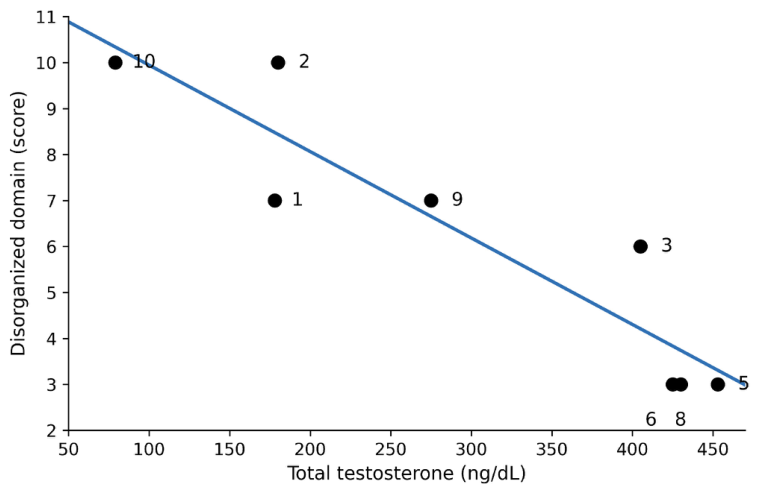

Table 1.
Baseline demographic, anthropometric, hormonal and phenotypic characteristics of the men with obesity (n = 10).
Table 1.
Baseline demographic, anthropometric, hormonal and phenotypic characteristics of the men with obesity (n = 10).
| Variable | n | Mean ± SD | Median [IQR] | Min–Max |
| Age, years | 10 | 42.6 ± 14.0 | 44.8 [36.1–50.7] | 17.6–61.9 |
| Weight, kg | 9 | 121.5 ± 24.6 | 121.9 [108.7–137.0] | 89.4–163.0 |
| BMI, kg/m² | 9 | 38.8 ± 7.2 | 36.4 [34.5–44.4] | 30.4–50.9 |
| Total testosterone, ng/dL | 10 | 310.7 ± 129.1 | 339.0 [208.0–419.5] | 79.0–453.0 |
| LH, IU/L | 8 | 4.0 ± 2.8 | 3.5 [2.5–5.0] | 0.1–9.0 |
| FSH, IU/L | 8 | 5.1 ± 2.8 | 5.9 [3.2–7.6] | 0.4–7.7 |
| EFCA total score | 8 | 36.6 ± 11.8 | 33.0 [32.8–37.0] | 21.0–59.0 |
| Hedonic | 8 | 10.8 ± 4.2 | 8.5 [8.0–15.2] | 6.0–16.0 |
| Hyperphagic | 8 | 6.5 ± 3.6 | 5.5 [4.0–7.2] | 3.0–13.0 |
| Compulsive | 8 | 5.8 ± 3.2 | 5.5 [3.0–7.8] | 2.0–10.0 |
| Emotional | 8 | 7.5 ± 2.8 | 6.5 [6.0–8.0] | 5.0–14.0 |
| Disorganized | 8 | 6.1 ± 2.9 | 6.5 [3.0–7.8] | 3.0–10.0 |
SD: standard deviation; EFCA: Eating Behavior Phenotype Scale; FSH: follicle-stimulating hormone; IQR: interquartile range; BMI: body mass index; LH: luteinizing hormone. Hedonic, hyperphagic, compulsive, emotional and disorganized correspond to the five EFCA subscales. Mean height was 176.9 ± 10.4 cm (n = 9). The n values reflect available-case analysis, without imputation.
Table 2.
Spearman correlations between total testosterone and the Eating Behavior Phenotype Scale scores (n = 8 complete pairs).
Table 2.
Spearman correlations between total testosterone and the Eating Behavior Phenotype Scale scores (n = 8 complete pairs).
| Outcome (EFCA) | n | rho | 95% CI | p | p (BH) | p (Bonf.) |
| Total score | 8 | −0.165 | −0.78 to 0.61 | 0.696 | 0.862 | 1.000 |
| Disorganized | 8 | −0.914 | −0.99 to −0.47 | 0.0015 | 0.0089 | 0.0089 |
| Emotional | 8 | −0.417 | −0.88 to 0.44 | 0.304 | 0.758 | 1.000 |
| Hyperphagic | 8 | −0.361 | −0.86 to 0.48 | 0.379 | 0.758 | 1.000 |
| Compulsive | 8 | 0.085 | −0.66 to 0.75 | 0.842 | 0.862 | 1.000 |
| Hedonic | 8 | −0.074 | −0.74 to 0.67 | 0.862 | 0.862 | 1.000 |
BH: Benjamini–Hochberg; Bonf.: Bonferroni; EFCA: Eating Behavior Phenotype Scale; CI: confidence interval. The total score is presented in the first row; the five domains are ordered by raw p value. Confidence intervals were computed a posteriori by the Fisher z transformation with the Bonett–Wright standard error [28] and should be interpreted as approximations, given the sample size. p values were obtained by asymptotic approximation, because of the presence of ties.
Table 3.
Sensitivity analysis: Kendall correlations between total testosterone and the EFCA scores (n = 8).
Table 3.
Sensitivity analysis: Kendall correlations between total testosterone and the EFCA scores (n = 8).
| Outcome (EFCA) | n | tau | p |
| Total score | 8 | −0.161 | 0.595 |
| Hedonic | 8 | −0.077 | 0.797 |
| Hyperphagic | 8 | −0.296 | 0.315 |
| Compulsive | 8 | 0.113 | 0.704 |
| Emotional | 8 | −0.231 | 0.441 |
| Disorganized | 8 | −0.828 | 0.0066 |
Table 4.
Leave-one-out analysis of the correlation between total testosterone and the disorganized EFCA domain.
Table 4.
Leave-one-out analysis of the correlation between total testosterone and the disorganized EFCA domain.
| Record removed | Remaining n | rho | p |
| 1 | 7 | −0.954 | 0.00084 |
| 2 | 7 | −0.954 | 0.00084 |
| 3 | 7 | −0.869 | 0.011 |
| 4 (no EFCA) | 8 | −0.914 | 0.0015 |
| 5 | 7 | −0.899 | 0.0058 |
| 6 | 7 | −0.899 | 0.0058 |
| 7 (no EFCA) | 8 | −0.914 | 0.0015 |
| 8 | 7 | −0.899 | 0.0058 |
| 9 | 7 | −0.898 | 0.0060 |
| 10 | 7 | −0.898 | 0.0060 |
EFCA: Eating Behavior Phenotype Scale. The remaining n stays at 8 when the removed record had no EFCA and therefore did not belong to the complete pairs.
Disclaimer/Publisher’s Note: The statements, opinions and data contained in all publications are solely those of the individual author(s) and contributor(s) and not of MDPI and/or the editor(s). MDPI and/or the editor(s) disclaim responsibility for any injury to people or property resulting from any ideas, methods, instructions or products referred to in the content. |
© 2026 by the authors. Licensee MDPI, Basel, Switzerland. This article is an open access article distributed under the terms and conditions of the Creative Commons Attribution (CC BY) license (http://creativecommons.org/licenses/by/4.0/).
Copyright: This open access article is published under a Creative Commons CC BY 4.0 license, which permit the free download, distribution, and reuse, provided that the author and preprint are cited in any reuse.