

Submitted:
10 August 2026
Posted:
10 August 2026
You are already at the latest version
Abstract
The emergence of resistance in Enterobacterales to commonly used antibiotics, particularly the pandemic spread of Extended Spectrum Beta-Lactamase (ESBL)-producing Escherichia coli (ESBLEC) and Klebsiella pneumoniae (ESBLKP), poses a significant public health challenge. Infections caused by these organisms severely restrict treatment options, yet global data on intestinal carriage of ESBLEC and ESBLKP remain limited. Malaysia, a middle-income country in Southeast Asia, has seen a large influx of economic migrants from Indonesia, Bangladesh, and Nepal since the early 2000s. ESBLEC and ESBLKP prevalence rates in these countries rank among the highest in WHO regions, and Malaysia has reported increasing rates of isolation in parallel with rising migration. This article reviews studies on prevalence of ESBLEC and ESBLKP in Malaysia, Indonesia, Bangladesh, and Nepal from the time of their first reported isolation, together with information on economic migration patterns into Malaysia. We propose potential internal and external modes of intestinal ESBL transmission, and highlight initiatives for intervention to monitor the spread of ESBLs across borders in slowing its pandemic dissemination.
Keywords:
extended-spectrum beta-lactamase (ESBL)-producing Escherichia coli
; extended-spectrum beta-lactamase (ESBL)-producing Klebsiella pneumoniae (ESBLKP)
; antimicrobial resistance (AMR)
; economic migrants
; intestinal ESBL carriage
1. Introduction
Economic migration fulfils expertise and labour requirements of a country by individuals from another. A positive impact of migration is the exchange of knowledge, culture and trade between the peoples of different countries. On the other hand, migration has also been integral to the global dissemination of microorganisms, including pathogens that are associated with antimicrobial resistance (AMR), a global health priority identified as one of the top 10 public health threats by the World Health Organization (WHO) [1]. Recent estimates project deaths from AMR to rise from 700,000 to 10 million annually by 2050, costing about USD 100 billion in healthcare resources, surpassing diseases such as cancer [2,3].
Extended-Spectrum Beta-Lactamase (ESBL)-producing Escherichia coli (ESBLEC) and Klebsiella pneumoniae (ESBLKP) are categorized as “critical” priority AMR pathogens [4] whose infections increase morbidity and mortality rates and are in urgent need of innovative next-generation antibiotics [5]. While susceptible E. coli and K. pneumoniae can be eliminated by cephalosporins (beta-lactam group of antibiotics), excessive and inappropriate use of beta-lactams in human healthcare, agriculture and veterinary practices has led to production (and later, mutation) of ESBL enzymes in these bacteria, enabling the inactivation of even newly developed beta-lactams [5,6,7]. To add to the complexity of ESBL resistance, rapid ESBL pathogen transmission and global dissemination occurs due to horizontal gene transfer (HGT) of plasmid-borne ESBL genetic determinants. Moreover, as E. coli and K. pneumoniae are normal flora of the gut, individuals may silently harbour these ESBL pathogens in their gut, facilitating inadvertent forward transmission into the environment [8].
Human travel facilitates transboundary transmission of AMR pathogens such as ESBLEC and ESBLKP. While there have been reports of travel-acquired ESBL-producing pathogens [9], investigation on ESBL silent carriage in economic migrants and its effects on native communities remain limited. Migrants may have limited access to healthcare, live in crowded conditions, or encounter healthcare systems that use antibiotics differently. Recognizing this, the WHO Global Research Priorities for Antimicrobial Resistance in Human Health have highlighted the importance of studying bacterial resistance in migrant populations [10].
Malaysia, a country located in Southeast Asia, has been a destination for economic migration since the 1990s. The country continues to receive a high number of economic migrant workers each year, particularly from Indonesia, Bangladesh, and Nepal [11]. In our recent investigation, we identified high rates of ESBLEC and ESBLKP silent carriage amongst economic migrant communities living in Klang Valley, Malaysia [12]. Furthermore, strains of these bacteria were found to be resistant to 4th-generation cephalosporins and fluroquinolones, with sequence types associated with ESBL pandemic clones [13,14]. We sought to have a better understanding of possible migration-associated dissemination of ESBLEC and ESBLKP to the local population of Malaysia. To this end, we reviewed the available literature, beginning from first reports of the bacteria in the country, together with reports of labour migration from Indonesia, Bangladesh and Nepal into the country.
2. ESBLEC and ESBLKP in Malaysia
The global prevalence of ESBL-producing bacteria varies significantly, with substantially higher rates observed in developing countries compared to developed regions. Regional stratification revealed a pooled prevalence of 15% in Europe (95% CI: 10–21%) and a markedly higher incidence of 31% in Asia (95% CI: 4–69%) (8). Country-level meta-analyses further underscore this disparity, reporting ESBL-producing bacterial prevalence rates in Indonesia to be 46% [9], 21% in Bangladesh [10] and 29% in Nepal [11]. In Malaysia, one of the earliest reports of locally isolated ESBL-producing bacteria described increasing incidences (only single digit prevalence at the time) of ceftazidime-resistant K. pneumoniae from 1976 until 1994 in a paediatric ward in University of Malaya, Kuala Lumpur in 1990 [15,16].
2.1. Antibiotic Susceptibility Profiles
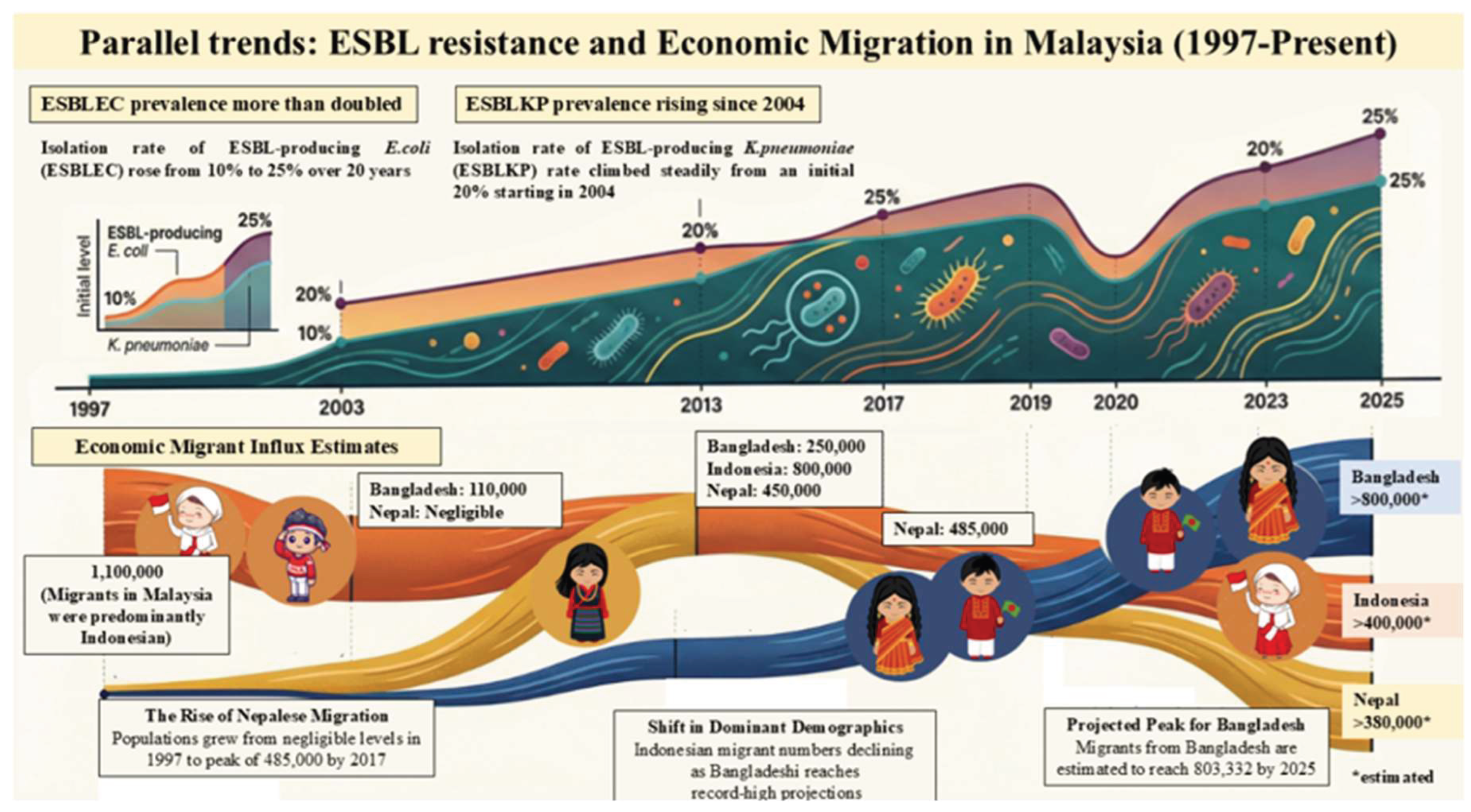
AMR trends of bacteria isolated from hospital settings (hospital-associated, HA) in Malaysia are reported in the National Surveillance of Antibiotic Resistance (NSAR) [17] released by the Ministry of Health (MOH) Malaysia. An increasing trend of HA ESBLEC and ESBLKP infections has been observed in Malaysia since the initiation of the NSAR in 2003 with only a slight decline between 2019 and 2020, (possibly due to the impact of the COVID-19 pandemic) [17]. Following the identification of the CTX-M ESBL genotype in E. coli strains from several Malaysian hospitals in 2004 [18], isolation rates of ESBLEC and ESBLKP have increased steadily over the next 20 years, from approximately 10% to 25% for ESBLEC, and 20% to 25% for ESBLKP. Incidentally, this increment coincides with the influx of economic migrants due to the country’s burgeoning economic development [19].
MOH started testing ESBL pathogens for carbapenem resistance in 2015 and detected increasing resistance. Data published in 2012 showed ESBLEC imipenem and meropenem resistance ranging from 0.5% to 1.0%, together with resistance to other antibiotics such as amikacin (0.9%–2.6%) and ciprofloxacin (24.9%–30.0%) [17]. Meanwhile, ESBLKP resistance to carbapenems was even higher at 1.7% to 4.9%. ESBLKP resistance to other antibiotics was also notable, including amikacin (1.8%–3.3%), gentamicin (8.5%–9.9%), ciprofloxacin (11.6%–19.9%), and co-trimoxazole (24.9%–25.5%) [17].
2.2. ESBL Genotypes
Several gene families code for ESBL enzymes. These include the more commonly isolated blaTEM, blaSHV and blaCTX-M, while blaOXA, blaPER, blaVEB, blaGES, blaTLA, blaBES were less commonly detected. As many hospitals are not equipped with a polymerase chain reaction (PCR) cycler, ESBL genotyping is not routinely performed for diagnostics in Malaysia and only reported in academic publications. One of the earliest publications on ESBL genotyping in Malaysia reported on blaTEM and blaSHV genotypes in ESBLEC isolated from a single centre between 1998 and 2000 [20]. In studies conducted on several hospitals in the country from 2004 to 2010, blaTEM continued to be the dominant ESBL gene family in ESBLEC [21]; nonetheless, the blaCTX-M gene family was disseminated widely amongst Malaysian ESBL-producing strains from 2010 onwards [22,23,24,25]. A study by Ngoi et al. [26], revealed that in recent years, isolated ESBLEC primarily harboured blaTEM (56%) and blaCTX-M-1 (37%), whereas ESBLKP were predominantly positive for blaSHV (94%), followed by blaCTX-M variants (80%) and blaTEM (57%). In addition, most isolates carried more than one ESBL gene. Moreover, during the early phase of the “CTX-M pandemic” in Malaysia, blaCTX-M were predominantly associated with E. coli strains [18,25,27], while blaSHV predominantly associated with K. pneumoniae strains [28].
Studies on community- (CA) and livestock- (LA) associated ESBLEC and ESBLKP remains limited, probably due to challenges in obtaining rectal swabs or stool samples from healthy individuals, and lower awareness of the relationship between AMR and One Health prior to the launch of the “Tricycle Protocol” by WHO [29] for integrated ESBLEC multisectoral surveillance in humans, animals and the environment. In 2025, we reported a 25.9% prevalence of ESBLEC carriage in Indonesian, Bangladeshi and Nepali migrant communities working in the Klang Valley [12]. Meanwhile, anecdotal reports on LA ESBLEC and ESBLKP in poultry and swine farms [30,31,32,33], however, the actual prevalence of ESBL-producing pathogens carriage in livestock remains to be investigated. With the advent of genome sequencing, high-risk pandemic clones of ESBL-producing strains from Sequence Types (STs) 11, 131, 155 [34,35,36] were identified in Malaysia. Nevertheless, further genome sequencing projects are expected to provide clearer delineation of ESBLEC and ESBLKP dissemination in hospital, community and even livestock.
3. ESBLEC and ESBLKP in Indonesia, Bangladesh and Nepal
According to a 2019 report, about 2.18 of 14.7 million (14.8%) workers in Malaysia were economic migrants, making the country one of the largest importers of human labour in East Asia [37]. The import of foreign labour started at the turn of the millennium, following Malaysia’s recovery from the 1997-1998 Asian financial crisis and experienced steady economic growth. To meet the demands for labour, Indonesian workers started arriving in Malaysia in 2000, followed by Bangladeshis in 2007, and Nepalis in 2017 [38,39,40]. Not surprisingly, the rise in ESBLEC and ESBLKP cases in Malaysia coincided with the increasing influx of economic migrants from these countries (Figure 1). Prior to this, high prevalence of ESBL cased has already been reported in Indonesia, Bangladesh, and Nepal [41].
3.1. Indonesia
Indonesia, a lower-middle-income country in Southeast Asia, is home to approximately 274 million people, making it the fourth most populous country globally. A meta-analysis carried out on ESBL studies published from 2008 until 2024 reported the highest prevalence (63.99%) in Sumatra instead of the most populated Java island [42]. Hospital and community prevalence were comparable (47.13% and 47.26%, respectively) as was ESBLEC prevalence (57.84%) compared to ESBLKP (51.03%). National data from 2000 to 2015 show large increases in the use of broad-spectrum penicillin (2.6-fold), fluoroquinolones (7.1-fold), and cephalosporins (5.1-fold) [43]. Several hospital-based studies have reported high ESBL rates in E. coli and K. pneumoniae, with resistance to 4th-generation cephalosporins. Community studies echo these concerns, with ESBL carriage detected in over 75% of school children and 56% of medical students [44,45].
The data presented above also highlighted early dominance of the blaCTX-M gene family in the country, where the earliest investigation on ESBL in the country was carried out in Surabaya in 2005 and identified blaCTX-M-15 as the most prevalent ESBL gene in both ESBLEC (94.5%) and ESBLKP (55.6%) [46]. This study prompted a retrospective investigation of fecal ESBLEC and ESBLKP carriage collected from 2001-2002 in Java from newly-discharged patients, where carriage was found to be positive for 9.5% (95 out of 999 patients), compared to 0.6% (6 out of 998) of who were already colonised prior to hospital admission [47]. Intriguingly, at that time (2001 - 2002), 47.1% of ESBLEC and 45.7% of ESBLKP were already noted to carry the blaCTX-M-15 gene, even though the prevailing hypothesis was that this gene family only reached prominence after the first decade of the millennium [48]. Furthermore, the ESBL-producing strains in that study were genetically diverse, signalling the possibility of Indonesia as the source for early and accelerated dispersion of global ESBLEC and ESBLKP clones.
blaCTX-M-15 continued to dominate in Indonesia post-2010 [49] and this dominance was also reported in paediatric patients [50] and medical students. Interestingly, numerous ESBL genotyping studies were conducted on samples of animal and environmental origin, where cats [51], chicken [52,53] and river water culture samples [54] were positive for blaCTX-M. Conversely, in livestock (such as cattle [55] and swine [56] and hospital wastewater [57], blaTEM was found to be more dominant. Nonetheless, in a more recent report, blaCTX-M-55 has begun to dominate amongst healthy individuals, farmers and the poultry industry managed by these farmers in Lombok [58].
3.2. Bangladesh
With a population exceeding 173 million, Bangladesh is one of the most densely populated countries in the world. Its healthcare system faces significant challenges in meeting the rising demand for medical services. In addition, over-the-counter availability of antibiotics and the common practice of self-medication are major contributors to antibiotic misuse. A recent survey reported that approximately 50% of antibiotics in the country were dispensed without a prescription, highlighting weak regulatory enforcement and the need for stronger antimicrobial stewardship efforts [59].
In the earliest ESBL report from Bangladesh published in 2004, 43.2% and 39.5% of E. coli and K. pneumoniae, respectively, were identified as ESBLEC and ESBLKP over a 10-month period in a hospital in Dhaka [60]. Around the same period, ESBL-producing strains were not yet identified in poultry farms [61]; nonetheless, wild birds such as pigeons [62], gulls, storks [63] and house crows [64] have been identified as potential carriers of ESBLEC, mostly carrying blaCTX-M-15. Concerningly, ESBLEC was also detected in Dhaka household water supplies [65], surface water [66] and aquatic environments [63], where most of the bacteria were positive for blaCTX-M-15. Similar to Indonesia, these observations point towards the early occurrence and dominance of blaCTX-M-15 in Bangladesh compared to other countries. It also shows the contributing role of the environment and WASH (Water, Sanitation, and Hygiene) factors in the dissemination of ESBL in Bangladesh, in addition to regulatory and stewardship concerns.
More recently, ESBLEC and ESBLKP isolation rates of both HA and CA strains within different regions (Dhaka, Mymensingh, Rajshahi, Cox Bazar) in Bangladesh have continued to hover around 30 – 40%, making the prevalence rate higher than other countries in the world [67,68,69,70]. Molecular analyses indicated that blaCTX-M is the predominant ESBL gene in both E. coli and K. pneumoniae, followed by blaTEM, blaSHV, and blaOXA [70,71,72,73]. Researchers also started detecting high prevalence (approximately > 30%) of ESBL gene families in food produce, such as cow’s milk [74,75,76], fish and seafood [77], beef [78] and particularly, in poultry [61,68,79,80,81,82], even though findings were negative in earlier studies. Inadequacy in WASH initiatives have led to sustained, probable multi-directional transmission [83,84] of ESBLEC and ESBLKP in humans, animals [85,86] and the environment, with detection reported in surface and wastewater [87,88,89,90,91,92], pets [93,94] and also inanimate surfaces such as household floors [95] and banknotes [96]. Worryingly, many of these isolates are identified as carbapenemase producers [97,98,99]. In addition, ESBLEC and ESBLKP colonization of healthy infants [100,101] is also now common in the country. Genome sequencing of ESBLECs from Bangladesh identified the dominance of the global pandemic clone ST131 [102,103,104]; co-circulation of other major high-risk clones ST405 and ST648 was also reported [105]. For ESBLKP, multidrug-resistant and hypervirulent ESBLKP clones ST11, ST14, ST15, ST307, ST231 and ST147 have been identified.
3.3. Nepal
Nepal is a country with a population of more than 29 million. Two-thirds of the country’s healthcare burden is attributed to infectious diseases, which has led to a high rate of antibiotic usage. The most commonly dispensed antibiotics include 3rd-generation cephalosporins such as cefixime and cefpodoxime [106]. Similar to the situation in Bangladesh, a matter of concern is that self-medication [107,108] with antibiotics is common in Nepal, due to the availability of these drugs being sold over the counter without a prescription. This inadvertently leads to increased antimicrobial selection pressure and emergence of AMR pathogens [109].
The National Public Health Laboratory of Nepal published one of the earliest reports [110] about ESBL-producing pathogens in the country. In the report, > 40% bacterial strains isolated between April 2009 and January 2010 from different clinical samples were found to be ESBL-positive, with ESBLEC being the most prevalent species. Subsequent studies by individual hospitals in Kathmandu reported seemingly lower prevalence of ESBLEC and ESBLKP at approximately 15% [111,112]; however, these clinical studies represented only the tip of the iceberg, as reports described silent carriage of ESBLEC and ESBLKP in healthy outpatients [113] from various parts of the country at ~ 30%, with the rate of ESBLEC isolates higher than ESBLKP. A prevalence of 10 – 30% ESBL carriage was also reported amongst healthy students [114,115] in Kathmandu. Interestingly, at the time, the blaTEM gene family was most prevalent, followed by blaCTX-M [114,115,116].
Awareness about One Health transmission of ESBL genes led to a study on farmers, livestock and their immediate environment carried out in rural Pokhara [117], which identified ESBL positivity of more than 50%, with fecal carriage in human subjects approaching 80%. In addition, the ESBLEC Tricycle Surveillance Project [118] pioneered in 2019 in Kathmandu reported ESBLEC prevalence as the highest in wastewater (91%), followed by clinical samples (blood-stream infections) (49%), food (specifically, poultry) (38.6%) and community fecal silent carriage (15%). Interestingly, both studies identified blaCTX-M as the dominant gene family, together with the dominance of ST131 ESBLEC clones in the samples, with ST2179 (mostly in poultry) and ST155 reported to be clones of emerging importance [117,119]. Indeed, similar to Bangladesh, ST131 appeared to be the dominant ESBLEC clone current circulating in Nepal [117,119,120,121], while ST4 and ST11 are the dominant ESBLKP clones in Nepal [122].
4. Cross-Border Transmission of ESBL into the Malaysian Community
International travel is frequently associated with the dissemination of ESBL-producing pathogens [9]. Returning travellers and recent migrants from South Asia and Southeast Asia often showed colonization rates above 20–40% [123]; reports confirmed the presence of blaCTX-M-15, blaCTX-M-3, blaCTX-M-55, blaCTX-M-14, and blaCTX-M-27 carrying strains after traveling to countries in South Asia [124,125]. Nonetheless, the possible role of ESBL dissemination played by economic migrant carriers originating from high prevalence countries remained to be investigated.
From 1997 to 2007, the migrant population in Malaysia increased from 627,246 to 1,914,049 [126]. During this decade, Indonesians accounted for approximately 60% of the migrant population, followed by Nepalese at 10%, with the remainder comprising nationals from countries such as Vietnam and Bangladesh. According to reports from 2023, the total economic migrant population in Malaysia now exceeds 3 million, with Indonesians (40%), Bangladeshis (17%) and Nepalis (22%) as the majority [127]. Undocumented migrants may also contribute substantially to the figure. This influx of migrants coincided with a rise in clinical isolation of ESBLEC and ESBLKP in Malaysia [17]. Incidentally, the rise of blaCTX-M-bearing strains in Malaysia [21,46,72] as well as similarities in dominant circulating ESBLEC (ST131) [21] and ESBLKP (ST23) [23,128] clones, were firstly reported in Indonesia, Bangladesh and Nepal and then only in Malaysia. This suggests possible ESBLEC and ESBLKP forward transmission from the migrants’ country of origin to Malaysia. Nonetheless, this hypothesis remains to be confirmed via genome comparison analysis of historical isolates from all four countries.
Key contributors to higher burden of ESBL infections and silent intestinal carriage amongst local citizens in Indonesia, Bangladesh, and Nepal compared to other countries include easy access of antibiotics without the need for prescriptions, widespread self-medication, failure to complete prescribed antibiotic courses, physician overprescribing, and the indiscriminate use of antibiotics in agriculture and veterinary practices [129]. In addition, in the context of ESBLEC and ESBLKP, lack of adequate WASH infrastructure and hygiene awareness facilitates the spread and carriage of these pathogens [130]. Medical examination of economic migrants prior entry into Malaysia is limited to screens for tuberculosis, HIV, Hepatitis B and C, syphilis, malaria and filariasis [131,132]; screening for ESBLEC and ESBLKP is not included, (despite its high prevalence in many migrants’ country of origin and being classified as WHO critical priority AMR pathogens).
Once ESBLEC- and ESBLKP-carrying economic migrants reach Malaysia, forward transmission can occur in two ways: internally amongst the migrant community [133], and forward external transmission [134] upon the local Malaysian community. Migrant workers often live in crowded accommodations and may have limited access to proper sanitary amenities. Construction workers, for example are placed in crowded complexes known as “rumah kongsi” without proper toilets and sometimes, without running water. This encourages the spread of ESBLEC and ESBLKP intestinal carriage amongst individuals living in close proximity in the same quarters, and after construction projects have been completed, can lead to sustained carriage by these individuals to their new workplaces [135,136].
Beyond the borders of internal ESBL transmission amongst migrants living and working in the same space, forward external transmission to local populations might occur, as indicated by ESBL-positive intestinal carriage in travellers upon returning from high burden areas [9,124,137,138]. The Bangladeshi workforce plays a significant role in the European restaurant industry; they are also integral to the food and beverage industry in Malaysia [139,140,141,142]. Coincidentally, our recent study demonstrated that this migrant community had the highest prevalence in ESBLEC carriage [12]. Indonesian migrant workers are involved in pink-collar industries such as care-giving and janitorial services; we discovered highly homologous strains between patients in hospital wards and hospital janitors (manuscript in preparation). As knowledge and awareness about the risks of AMR and the transmission of AMR pathogens are limited in migrant communities (Dr. Wei-Wen Chong, personal communication), the risks of un-intentional forward transmission of these pathogens, including ESBLEC and ESBLKP, are compelling.
Figure 2.
Probable ESBL cross-border transmissions pathways in Malaysia.
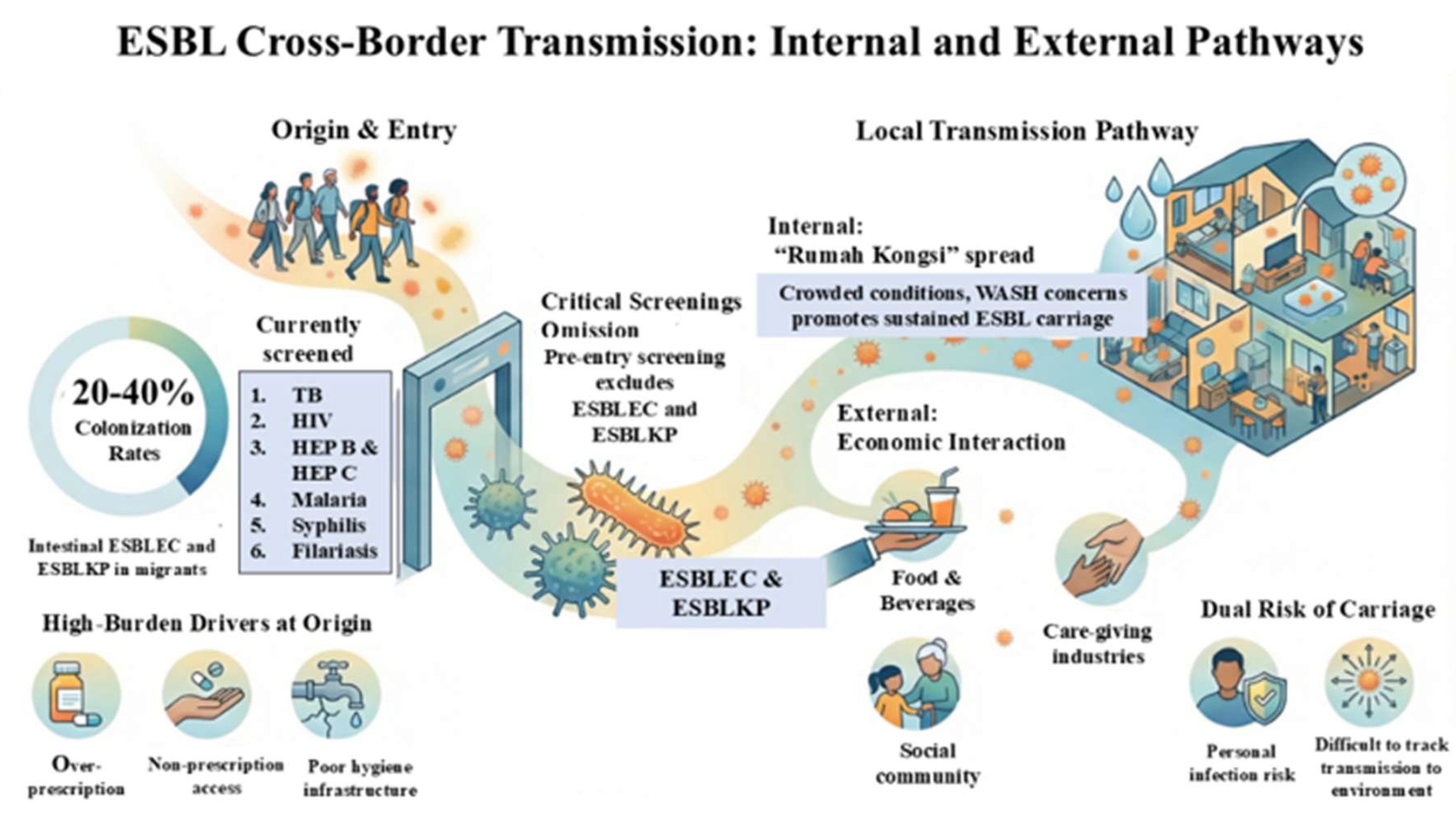
The risks of ESBL intestinal carriage are two-fold: the host has increased risk of ESBL infections, and difficult-to-track forward transmission of the ESBL pathogens to others and the environment. ESBL infections have limited treatment options; mortality rates in patients treated with cephalosporins range from 42% to 100% [143], while treatment with carbapenems further increase selection for resistant strains. For migrants in Malaysia, access to healthcare services remains limited due to financial constraints [144]. Non-medical costs, such as loss of wages from time-off work and transportation expenses, costly medical bills leading to loss of work permit renewals, language barriers and communication gaps, further complicates treatment of migrant workers should they be infected with ESBL pathogens [144,145].
5. Preventive Strategies and Intervention
Collaboration between countries is essential to monitor cross-border ESBLEC and ESBLKP transmission. Educational seminars on AMR and the implementation of pre-departure screening for carriage of AMR pathogens in economic migrants originating from high burden countries is strongly recommended [146,147]. These initiatives are important for AMR surveillance and to track pathogen transmission. Once economic migrants start working in host countries such as Malaysia, carriage screening can be included into test panels required for renewal of work permits. In the event of a positive screen, interventions such as health and hygiene refresher courses (provided in a migrant’s native language) are recommended. In addition, the presence of ESBL strains would serve as an indicator for the Human Resource and Home Ministries to investigate housing and sanitation conditions provided by the employers, where environmental detection of these pathogens and tailored infection control strategies can be implemented. This approach encourages compliance via removal of potential bias and discrimination towards the migrant community, and shifts the responsibility towards the employers to ensure they fulfil their responsibility in providing suitable housing with adequate amenities for the foreign workforce. Culturally sensitive healthcare delivery and equitable access to diagnostics and treatment services for the migrant community (e.g., vaccine coverage provided by the Malaysian government for all documented and undocumented economic migrants during the COVID-19 pandemic) [148,149] should also be given due consideration by host countries for their migrant workforce, as these initiatives will be crucial in monitoring the spread of ESBL-producing pathogens.
6. Conclusions
Economic migration plays an important role in globalisation and also influences the socioeconomic, political, and cultural elements of the host country [150]. In addition, migration also impacts nation-wide public health of the host country, and may bring about changes in global health, especially in the case of infectious diseases and cross-border transmission of AMR pathogens. Global dissemination of ESBL-producing pathogens via economic migration, including into countries like Malaysia, might have contributed to the increasing prevalence of ESBLEC and ESBLKP in the country. While infection control and antimicrobial stewardship are key prevention strategies in hospitals, cross-border dissemination of ESBL resistance through migration requires coordinated efforts between migrant origin and host countries. Harmonizing surveillance in both host and origin countries, access to universal healthcare and implementation of culturally sensitive educational programs will contribute towards the monitoring of ESBL dissemination and reduce their prevalence in the long term.
Author Contributions
Conceptualization, M.A.M.H; S.N; A.A.P; S.C.T. and H.M.N.; methodology, M.A.M.H; S.C.T. and H.M.N; software, M.A.M.H. and H.M.N; validation, M.A.M.H; S.N. and H.M.N.; formal analysis, M.A.M.H. and H.M.N.; investigation, M.A.M.H. and H.M.N.; resources, M.A.M.H. and H.M.N.; data curation, M.A.M.H. and H.M.N.; writing—original draft preparation, M.A.M.H. and H.M.N.; writing—review and editing, M.A.M.H.; S.N.; A.A.P.; S.C.T.; N.A.M.A. and H.M.N.; visualization, M.A.M.H. and H.M.N.; supervision, N.A.M.A. and H.M.N.; project administration, H.M.N.; funding acquisition, H.M.N. All authors have read and agreed to the published version of the manuscript.
Funding
This work was funded by the Transdisciplinary Research Grant Scheme (grant number TRGS/1/2022/UKM/02/8/1) awarded by The Ministry of Higher Education, Malaysia.
Institutional Review Board Statement
Not Applicable
Informed Consent Statement
Not Applicable
Data Availability Statement
Not Applicable
Acknowledgments
Not Applicable
Conflicts of Interest
The authors declare no conflicts of interest.
References
- World Health Organization. Antimicrobial Resistance. 2023. Available online: https://www.who.int/news-room/fact-sheets/detail/antimicrobial-resistance (accessed on 26 July 2026).
- Adebisi, Y.A.; Ogunkola, I.O. The Global Antimicrobial Resistance Response Effort Must Not Exclude Marginalised Populations. Trop. Med. Health 2023, 51. [Google Scholar] [CrossRef] [PubMed]
- Pulingam, T.; Parumasivam, T.; Gazzali, A. M.; Sulaiman, A. M.; Chee, J. Y.; Lakshmanan, M.; Chin, C. F.; Sudesh, K. Antimicrobial Resistance: Prevalence, Economic Burden, Mechanisms of Resistance and Strategies to Overcome. Eur. J. Pharm. Sci. 2022, 170, 106103. [Google Scholar] [CrossRef] [PubMed]
- Sati, H.; Carrara, E.; Savoldi, A.; Hansen, P.; Garlasco, J.; Campagnaro, E.; Boccia, S.; Castillo-Polo, J. A.; Magrini, E.; Garcia-Vello, P.; Wool, E.; Gigante, V.; Duffy, E.; Cassini, A.; Huttner, B.; Pardo, P. R.; Naghavi, M.; Mirzayev, F.; Zignol, M.; Cameron, A.; Tacconelli, E.; Aboderin, A.; Al Ghoribi, M.; Al-Salman, J.; Amir, A.; Apisarnthanarak, A.; Blaser, M.; El-Sharif, A.; Essack, S.; Harbarth, S.; Huang, X.; Kapoor, G.; Knight, G.; Muhwa, J. C.; Monnet, D. L.; Ousassa, T.; Sacsaquispe, R.; Severin, J.; Sugai, M.; Taneja, N.; Nyaruhirira, A. U. The WHO Bacterial Priority Pathogens List 2024: A Prioritisation Study to Guide Research, Development, and Public Health Strategies against Antimicrobial Resistance. Lancet Infect. Dis. 2025, 2025, 1033–1043. [Google Scholar] [CrossRef] [PubMed]
- Pana, Z. D.; Zaoutis, T. Treatment of Extended-Spectrum Β-Lactamase-Producing Enterobacteriaceae (ESBLs) Infections: What Have We Learned Until Now? F1000Research 2018, 7, 1347. [Google Scholar] [CrossRef] [PubMed]
- Drawz, S. M.; Bonomo, R. A. Three Decades of Beta-Lactamase Inhibitors. Clin. Microbiol. Rev. 2010, 23, 160–201. [Google Scholar] [CrossRef] [PubMed]
- Pitout, J. D.; Laupland, K. B. Extended-Spectrum Β-Lactamase-Producing Enterobacteriaceae: An Emerging Public-Health Concern. Lancet Infect. Dis. 2008, 8, 159–166. [Google Scholar] [CrossRef] [PubMed]
- Woerther, P.-L.; Burdet, C.; Chachaty, E.; Andremont, A. Trends in Human Fecal Carriage of Extended-Spectrum Β-Lactamases in the Community: Toward the Globalization of CTX-M. Clin. Microbiol. Rev. 2013, 26, 744–758. [Google Scholar] [CrossRef] [PubMed]
- Woerther, P.-L.; Andremont, A.; Kantele, A. Travel-Acquired ESBL-Producing Enterobacteriaceae: Impact of Colonization at Individual and Community Level. J. Travel Med. 2017, 24 (suppl_1), S29–S34. [Google Scholar] [CrossRef]
- Jakovljevic, M.; Al ahdab, S.; Jurisevic, M.; Mouselli, S. Antibiotic Resistance in Syria: A Local Problem Turns into a Global Threat. Front. Public Health 2018, 6. [Google Scholar] [CrossRef] [PubMed]
- Kementerian Sumber Manusia. Statistik Pekerjaan dan Perburuhan Siri 31 Bil. 1/2022 Mac: 9. 2022. Available online: https://share.google/13wivZ4pMevVVpwKD. (accessed on 26 July 2026).
- Mat Husin, M. A.; Pereira, A. A.; Seelan, T.; Ramli, R.; da Cunha Camargo, I. L. B.; Nathan, S.; Neoh, H. Preliminary Screening of ESBL-Producing Escherichia Coli and Klebsiella Pneumoniae Carriage Among Migrant Communities in Klang Valley, Malaysia. Travel Med. Infect. Dis. 2025, 2025, 102894–102894. [Google Scholar] [CrossRef] [PubMed]
- Adamu, S.; Ali, M. B.; Desa, M. N. M.; Neoh, H.; Masri, S. N.; Joseph, N.; Jamaluddin, T. Z. M. T. Whole-Genome Sequencing of Extended Spectrum Beta Lactamases (ESBLs)-Producing Klebsiella Pneumoniae (Kp) Isolates from Selected Hospitals in Malaysia. BMC Genom. 2025, 26. [Google Scholar] [CrossRef] [PubMed]
- Damianos, A.; Tsitsos, A.; Economou, V.; Gioula, G.; Haidich, A.-B. Systematic Review and Meta-Analysis of the Occurrence of ESBL-Producing Escherichia Coli and Salmonella Spp. In Foods of Animal Origin in Europe. Food Control 2024, 171, 111127. [Google Scholar] [CrossRef]
- Ariffin, H. Septicaemia in Paediatric Cancer Patients: A 5-Year Surveillance Study in University Hospital, Kuala Lumpur, Malaysia. J. Trop. Pediatr. 1997, 43, 279–281. [Google Scholar] [CrossRef] [PubMed]
- Ariffin, H.; Navaratnam, P.; Mohamed, M.; Arasu, A.; Ariffin Abdullah, W.; Lee Lee, C.; Hai Peng, L. Ceftazidime-Resistant Klebsiella Pneumoniae Bloodstream Infection in Children with Febrile Neutropenia. Int. J. Infect. Dis. 2000, 4, 21–25. [Google Scholar] [CrossRef] [PubMed]
- National Antibiotic Surveillance Report; Bacteriology Unit; Infectious Disease Research Centre; Institute for Medical Research. National Antibiotic Resistance Surveillance Report 2024. Ministry of Health Malaysia. 2024. Available online: https://imr.nih.gov.my/MyOHAR/index.php/site/archive_rpt. (accessed on 26 July 2026).
- Lim, K.-T.; Yasin, R.; Yeo, C.-C.; Puthucheary, S.; Thong, K.-L. Characterization of Multidrug Resistant ESBL-Producing Escherichia Coli Isolates from Hospitals in Malaysia. J. Biomed. Biotechnol. 2009, 2009 (August 5), 165637. [Google Scholar] [CrossRef] [PubMed]
- Malaysia Economic Monitor, December 2015 - Immigrant Labor. World Bank. 2015. Available online: https://www.worldbank.org/en/country/malaysia/publication/malaysia-economic-monitor-december-2015-immigrant-labour. (accessed on 26 July 2026).
- Subramaniam, G.; Palasubramaniam, S.; Navaratnam, P. SHV-5 Extended-Spectrum Beta-Lactamases in Clinical Isolates of Escherichia Coli in Malaysia. Indian J. Med. Microbiol. 2006, 24, 205–207. [Google Scholar] [CrossRef]
- Ho, W. S.; Balan, G.; Puthucheary, S.; Kong, B. H.; Lim, K. T.; Tan, L. K.; Koh, X. P.; Yeo, C. C.; Thong, K. L. Prevalence and Characterization of Multidrug-Resistant and Extended-Spectrum Beta-Lactamase-Producing Escherichia Coli from Pediatric Wards of a Malaysian Hospital. Microb. Drug Resist. 2012, 18, 408–416. [Google Scholar] [CrossRef] [PubMed]
- Fazlul, M.K.K.; Y, F.; A, N.; MA, R.; Nazmul, M.H.M. Detection of CTX-M-Type ESBLs from Escherichia Coli Clinical Isolates from a Tertiary Hospital, Malaysia. Baghdad Sci. J. 2019, 16. [Google Scholar] [CrossRef]
- Mobasseri, G.; Thong, K. L.; Rajasekaram, G.; Teh, C. S. J. Molecular Characterization of Extended-Spectrum Β-Lactamase-Producing Klebsiella Pneumoniae from a Malaysian Hospital. Braz. J. Microbiol. 2019, 51, 189–195. [Google Scholar] [CrossRef] [PubMed]
- Mohd Helmi, U.; Mohd Desa, M. N.; Taib, N. M.; Tengku Jamaluddin, T. Z. M.; Masri, S. N. Multiple Ambler Class a ESBL Genes Among Klebsiella Pneumoniae Isolates in a Malaysian District Hospital. Trop. Biomed. 2016, 33, 109–119. [Google Scholar] [PubMed]
- Othman, S. N.; Hussin, S.; Ramli, R.; Rahman, M. Detection of CTX-M-Type ESBLs Escherichia Coli at Universiti Kebangsaan Malaysia Medical Centre. Bangladesh J. Med. Sci. 2016, 15, 257–261. [Google Scholar] [CrossRef]
- Ngoi, S.T.; Chong, C.W.; Ponnampalavanar, S.; Soo Nee Tang; Idris, N.; Jabar, K.A.; Gregory, M. D.; Husain, T.; Shuan, C. Genetic Mechanisms and Correlated Risk Factors of Antimicrobial-Resistant Eskapee Pathogens Isolated in a Tertiary Hospital in Malaysia. Antimicrob. Resist Infect. Control 2021, 10. [Google Scholar] [CrossRef] [PubMed]
- Sekawi, Z.; Yusof, R.; Shamsudin, M. N. Extended-Spectrum SS-Lactamases-Producing Escherichia Coli from a Tertiary Hospital in Malaysia: Emergence of CTX-M-Type Beta-Lactamases Variati. Res. J. Microbiol. 2008, 3, 489–493. [Google Scholar] [CrossRef]
- Lim, K. T.; Yeo, C. C.; Md Yasin, R.; Balan, G.; Thong, K. L. Characterization of Multidrug-Resistant and Extended-Spectrum Β-Lactamase-Producing Klebsiella Pneumoniae Strains from Malaysian Hospitals. J. Med. Microbiol. 2009, 58, 1463–1469. [Google Scholar] [CrossRef] [PubMed]
- World Health Organization. WHO integrated global surveillance on ESBL-producing E. coli using a “One Health” approach: implementation and opportunities. 2021. Available online: https://www.who.int/publications/i/item/9789240021402 (accessed on 26 July 2026).
- Lemlem, M.; Aklilu, E.; Mohammed, M. J.; Kamaruzzaman, F.; Zakaria, Z.; Harun, A.; Devan, S.S. Molecular Detection and Antimicrobial Resistance Profiles of Extended-Spectrum Beta-Lactamase (ESBL) Producing Escherichia Coli in Broiler Chicken Farms in Malaysia. PLoS ONE 2023, 18, e0285743–e0285743. [Google Scholar] [CrossRef] [PubMed]
- Mobasseri, G.; Thong, K. L.; Ju Teh, C. S. Genomic Analysis Revealing the Resistance Mechanisms of Extended-Spectrum β-Lactamase-Producing Klebsiella Pneumoniae Isolated from Pig and Humans in Malaysia. Int. Microbiol. 2021, 24, 243–250. [Google Scholar] [CrossRef] [PubMed]
- Mobasseri, G.; Teh, C. S. J.; Ooi, P. T.; Thong, K. L. The Emergence of Colistin-Resistant Klebsiella Pneumoniae Strains from Swine in Malaysia. J. Glob. Antimicrob. Resist. 2019, 17, 227–232. [Google Scholar] [CrossRef] [PubMed]
- Tan, H.-S.; Yan, P.; Agustie, H. A.; Loh, H.-S.; Rayamajhi, N.; Fang, C.-M. Characterisation of ESBL/AmpC-Producing Enterobacteriaceae Isolated from Poultry Farms in Peninsular Malaysia. Lett. Appl. Microbiol. 2023, 76, ovac044. [Google Scholar] [CrossRef] [PubMed]
- Byarugaba, D. K.; Erima, B.; Wokorach, G.; Alafi, S.; Kibuuka, H.; Mworozi, E.; Musinguzi, A. K.; Kiyengo, J.; Najjuka, F.; Wabwire-Mangen, F. Resistome and Virulome of High-Risk Pandemic Clones of Multidrug-Resistant Extra-Intestinal Pathogenic Escherichia Coli (ExPEC) Isolated from Tertiary Healthcare Settings in Uganda. PLoS ONE 2023, 18, e0294424–e0294424. [Google Scholar] [CrossRef] [PubMed]
- Lobato, A. R. F.; Alves, S. I. A.; Ramos, R. T. J.; Rodrigues, Y. C.; Brasiliense, D. M. Genomic Analysis of Klebsiella Pneumoniae High-Risk Clone ST11 Co-Harbouring MCR-1.27 And KPC-2 Recovered at a Paediatric Oncologic Hospital in the Brazilian Amazon Region. J. Glob. Antimicrob. Resist. 2023, 33, 279–282. [Google Scholar] [CrossRef] [PubMed]
- Sano, E.; Esposito, F.; Fontana, H.; Fuga, B.; Cardenas-Arias, A.; Moura, Q.; Cardoso, B.; Costa, G. C. V.; Bosqueiro, T. C. M.; Sinhorini, J. A.; de Masi, E.; Aires, C. C.; Lincopan, N. One Health Clones of Multidrug-Resistant Escherichia Coli Carried by Synanthropic Animals in Brazil. One Health 2023, 16(Dec 21), 100476. [Google Scholar] [CrossRef] [PubMed]
- Anderson, B.; Khadka, U.; Ruhs, M. Demand for Migrant Workers: Institutional System Effects beyond National Borders. J. Ethn. Migr. Stud. 2023, 50, 1–24. [Google Scholar] [CrossRef]
- Department of Statistics Malaysia (DOSM). International migration statistics Malaysia 2025. 2025. Available online: https://www.dosm.gov.my/portal-main/release-content/international-migration-statistics-malaysia-2025. (accessed on 26 July 2026).
- Ministry of Home Affairs (MOHA). Edisi Khas IPSOM 2021 (No. 2): The security implications of the employment of foreign workers holding Visit Pass (Temporary Employment) in Peninsular Malaysia. MOHA: Putrajaya, 2021. Available online: https://www.moha.gov.my/utama/images/Maklumat%20Bahagian/Ipsom/Edisi%20Khas%20Tahun%202021/edisi_khas_num_2.pdf. (accessed on 26 July 2026).
- International Organization for Migration (IOM). Assessment of causes and contributing factors to migrant workers becoming undocumented in Malaysia; IOM: Geneva, Aug 2023; Available online: https://www.iom.int/sites/g/files/tmzbdl486/files/documents/2023-08/english_undocumented-migrant-workers-report.pdf (accessed on 26 July 2026).
- Sidjabat, H. E.; Paterson, D. L. Multidrug-Resistant Escherichia Coli in Asia: Epidemiology and Management. Expert Rev. Anti-Infect. Ther. 2015, 13, 575–591. [Google Scholar] [CrossRef] [PubMed]
- Kadariswantiningsih, I. N.; Rampengan, D. D.; Ramadhan, R. N.; Idrisova, A.; Idrisov, B.; Empitu, M. A. Antibiotic Resistance in Indonesia: A Systematic Review and Meta-Analysis of Extended-Spectrum Beta-Lactamase-Producing Bacteria (2008–2024). Trop. Med. Amp Int. Health 2025, 30. [Google Scholar] [CrossRef] [PubMed]
- Limato, R.; Lazarus, G.; Dernison, P.; Mudia, M.; Alamanda, M.; Nelwan, E. J.; Sinto, R.; Karuniawati, A.; van Doorn, H. R.; Hamers, R. L. Optimizing Antibiotic Use in Indonesia: A Systematic Review and Evidence Synthesis to Inform Opportunities for Intervention. Lancet Reg. Health-Southeast Asia 2022, 2. [Google Scholar] [CrossRef] [PubMed]
- Hamid, F.; Munawir, M.; Amaruddin, A. I.; Kusuma Hapsari, B.; Sultan, A. R.; Amiruddin, D. Prevalence of Fecal Carriage of Extended-Spectrum β-Lactamase-Producing Enterobacteriaceae among School Children in South Sulawesi, Indonesia. Arch. Clin. Infect. Dis. 2020, 15. [Google Scholar] [CrossRef]
- Rosantia, S.; Higa, T.; Yagi, N.; Tokunaga, T.; Higa, S.; Yakabi, Y.; Shirakawa, T.; Kuntaman, K.; Hirai, I. Characterization of CTX-M-Type-Extended-Spectrum Beta-Lactamase (ESBL)-Producing Enterobacteriaceae Isolated from Indonesian Undergraduate Medical Students of a University in Surabaya, Indonesia. J. Infect. Chemother. 2020, 26, 575–581. [Google Scholar] [CrossRef] [PubMed]
- Severin, J. A.; Mertaniasih, N. M.; Kuntaman, K.; Lestari, E. S.; Purwanta, M.; Lemmens-Den Toom, N.; Duerink, D. O.; Hadi, U.; van Belkum, A.; Verbrugh, H. A.; Goessens, W. H. Molecular Characterization of Extended-Spectrum Beta-Lactamases in Clinical Escherichia Coli and Klebsiella Pneumoniae Isolates from Surabaya, Indonesia. J. Antimicrob. Chemother. 2010, 65, 465–469. [Google Scholar] [CrossRef] [PubMed]
- Severin, J. A.; Lestari, E. S.; Kloezen, W.; Lemmens-den Toom, N.; Mertaniasih, N. M.; Kuntaman, K.; Purwanta, M.; Offra Duerink, D.; Hadi, U.; van Belkum, A.; Verbrugh, H. A.; Goessens, W. H. Faecal Carriage of Extended-Spectrum Β-Lactamase-Producing Enterobacteriaceae Among Humans in Java, Indonesia, In 2001–2002. Trop. Med. Int. Health 2012, 17, 455–461. [Google Scholar] [CrossRef] [PubMed]
- Cantón, R.; González-Alba, J. M.; Galán, J. C. CTX-M Enzymes: Origin and Diffusion. Front. Microbiol. 2012, 3. [Google Scholar] [CrossRef] [PubMed]
- Yamasaki, S.; Shigemura, K.; Osawa, K.; Kitagawa, K.; Ishii, A.; Kuntaman, K.; Shirakawa, T.; Miyara, T.; Fujisawa, M. Genetic Analysis of ESBL-Producing Klebsiella Pneumoniae Isolated from UTI Patients in Indonesia. J. Infect. Chemother. 2021, 27, 55–61. [Google Scholar] [CrossRef] [PubMed]
- Bagus Wasito, E.; Shigemura, K.; Osawa, K.; Fardah, A.; Kanaida, A.; Raharjo, D.; Kuntaman, K.; Hadi, U.; Harijono, S.; Marto Sudarmo, S.; Nakamura, T.; Shibayama, K.; Fujisawa, M.; Shirakawa, T. Antibiotic Susceptibilities and Genetic Characteristics of Extended-Spectrum Beta-Lactamase-Producing Escherichia Coli Isolates from Stools of Pediatric Diarrhea Patients in Surabaya, Indonesia. Jpn. J. Infect. Dis. 2017, 70, 378–382. [Google Scholar] [CrossRef] [PubMed]
- Farizqi, M. T. I.; Effendi, M. H.; Adikara, R. T. S.; Yudaniayanti, I. S.; Putra, G. D. S.; Khairullah, A. R.; Kurniawan, S. C.; Silaen, O. S. M.; Ramadhani, S.; Millannia, S. K.; Kaben, S. E.; Waruwu, Y. K. K. Detection of Extended-Spectrum β-Lactamase-Producing Escherichia Coli Genes Isolated from Cat Rectal Swabs at Surabaya Veterinary Hospital, Indonesia. Vet. World 2023, 16, 1917–1925. [Google Scholar] [CrossRef] [PubMed]
- Faridah, H.D.; Wibisono, F.M.; Wibisono, F.J.; Nisa, N.; Fatimah, F.; Effendi, M. H.; Ugbo, E. N.; Khairullah, A.R.; Kurniawan, S. C.; Sahat, O. Prevalence of the blaCTX-M and blaTEM Genes among Extended-Spectrum Beta Lactamase–Producing Escherichia Coli Isolated from Broiler Chickens in Indonesia. J. Vet. Res. 2023, 67, 179–186. [Google Scholar] [CrossRef] [PubMed]
- Hayati, M.; Indrawati, A.; Mayasari, N. L. P. I.; Istiyaningsih, I.; Atikah, N. Molecular Detection of Extended-Spectrum β-Lactamase-Producing Klebsiella Pneumoniae Isolates of Chicken Origin from East Java, Indonesia. Vet. World 2019, 12, 578–583. [Google Scholar] [CrossRef] [PubMed]
- Nomoto, R.; Osawa, K.; Kinoshita, S.; Kitagawa, K.; Nakanishi, N.; Sarassari, R.; Raharjo, D.; Fujisawa, M.; Kuntaman, K.; Shirakawa, T. Metagenome and Resistome Analysis of Beta-Lactam-Resistant Bacteria Isolated from River Waters in Surabaya, Indonesia. Microorganisms 2024, 12, 199–199. [Google Scholar] [CrossRef] [PubMed]
- Widodo, A.; Lamid, M.; Effendi, M. H.; Tyasningsih, W.; Raharjo, D.; Khairullah, A. R.; Kurniawan, S. C.; Yustinasari, L. R.; Riwu, K. H. P.; Silaen, O. S. M. Molecular Identification of blaTEM and blaCTX-M Genes in Multidrug-Resistant Escherichia Coli Found in Milk Samples from Dairy Cattle Farms in Tulungagung, Indonesia. J. Vet. Res. 2023, 67, 381–388. [Google Scholar] [CrossRef] [PubMed]
- Effendi, M.; Hartadi, E.; Witaningrum, A.; Permatasari, D.; Ugbo, E. Molecular Identification of blaTEM Gene of Extended-Spectrum Beta-Lactamase-Producing Escherichia Coli from Healthy Pigs in Malang District, East Java, Indonesia. J. Adv. Vet. Anim. Res. 2022, 9, 447. [Google Scholar] [CrossRef] [PubMed]
- Santosaningsih, D.; Putri Fadriyana, A.; David, N.; Ratridewi, I. Prevalence and Abundance of Beta-Lactam Resistance Genes in Hospital Wastewater and Enterobacterales Wastewater Isolates. Trop. Med. Infect. Dis. 2023, 8, 193–193. [Google Scholar] [CrossRef] [PubMed]
- Wardoyo, E. H.; Sugawara, Y.; Nakano, S.; Zuo, H.; Elahi, S.; Arai, C.; Kondo, K.; Kuntaman, K.; Sugai, M. Genomic Characterization of Extended-Spectrum β-Lactamase-Producing Escherichia Coli Spread among Chickens and Healthy Residents in Lombok, Indonesia. Appl. Environ. Microbiol. 2025, 91. [Google Scholar] [CrossRef] [PubMed]
- Islam, Md. A.; Akhtar, Z.; Hassan, Md. Z.; Chowdhury, S.; Rashid, Md. M.; Aleem, M. A.; Ghosh, P. K.; Mah-E-Muneer, S.; Parveen, S.; Ahmmed, Md. K.; Ahmed, Md. S.; Basher, A. K.; Palit, A.; Biswas, M. A. A. J.; Khan, Z.; Islam, K.; Debnath, N.; Rahman, M.; Chowdhury, F. Pattern of Antibiotic Dispensing at Pharmacies According to the WHO Access, Watch, Reserve (AWaRe) Classification in Bangladesh. Antibiotics 2022, 11, 247. [Google Scholar] [CrossRef] [PubMed]
- Rahman, M. M.; Haq, J. A.; Hossain, M. A.; Sultana, R.; Islam, F.; Islam, A. H. M. S. Prevalence of Extended-Spectrum Beta-Lactamase-Producing Escherichia Coli and Klebsiella Pneumoniae in an Urban Hospital in Dhaka, Bangladesh. Int. J. Antimicrob. Agents 2004, 24, 508–510. [Google Scholar] [CrossRef] [PubMed]
- Hasan, B.; Faruque, R.; Drobni, M.; Waldenström, J.; Sadique, A.; Ahmed, K. U.; Islam, Z.; Parvez, M. B. H.; Olsen, B.; Alam, M. High Prevalence of Antibiotic Resistance in Pathogenic Escherichia Coli from Large- and Small-Scale Poultry Farms in Bangladesh. Avian Dis. 2011, 55, 689–692. [Google Scholar] [CrossRef] [PubMed]
- Hasan, B.; Islam, K.; Ahsan, M.; Hossain, Z.; Rashid, M.; Talukder, B.; Ahmed, K. U.; Olsen, B.; Abul Kashem, M. Fecal Carriage of Multi-Drug Resistant and Extended Spectrum Β-Lactamases Producing E. Coli in Household Pigeons, Bangladesh. Vet. Microbiol. 2014, 168, 221–224. [Google Scholar] [CrossRef] [PubMed]
- Rashid, M.; Rakib, M. M.; Hasan, B. Antimicrobial-Resistant and ESBL-Producing Escherichia Coli in Different Ecological Niches in Bangladesh. Infect. Ecol. Epidemiol. 2015, 5, 26712. [Google Scholar] [CrossRef] [PubMed]
- Hasan, B.; Olsen, B.; Alam, A.; Akter, L.; Melhus, Å. Dissemination of the Multidrug-Resistant Extended-Spectrum β-Lactamase-Producing Escherichia Coli O25b-ST131 Clone and the Role of House Crow (Corvus Splendens) Foraging on Hospital Waste in Bangladesh. Clin. Microbiol. Infect. 2015, 21, 1000.e1–1000.e4. [Google Scholar] [CrossRef] [PubMed]
- Talukdar, P. K.; Rahman, M.; Rahman, M.; Nabi, A.; Islam, Z.; Hoque, M. M.; Endtz, H. P.; Islam, M. A. Antimicrobial Resistance, Virulence Factors and Genetic Diversity of Escherichia Coli Isolates from Household Water Supply in Dhaka, Bangladesh. PLoS ONE 2013, 8, e61090. [Google Scholar] [CrossRef] [PubMed]
- Haque, A.; Yoshizumi, A.; Saga, T.; Ishii, Y.; Tateda, K. ESBL-Producing Enterobacteriaceae in Environmental Water in Dhaka, Bangladesh. J. Infect. Chemother. 2014, 20, 735–737. [Google Scholar] [CrossRef] [PubMed]
- Ng, R. W. Y.; Yang, L.; Lau, S. H.; Hawkey, P.; Ip, M. Global Prevalence of Human Intestinal Carriage of ESBL-Producing E. Coli during and after the Covid-19 Pandemic. JAC Antimicrob. Resist. 2025, 7, dlaf001. [Google Scholar] [CrossRef] [PubMed]
- Islam, Md. S.; Rahman, A. M. M. T.; Hassan, J.; Rahman, Md. T. Extended-Spectrum Beta-Lactamase in Escherichia Coli Isolated from Humans, Animals, and Environments in Bangladesh: A One Health Perspective Systematic Review and Meta-Analysis. One Health 2023, 16, 100526. [Google Scholar] [CrossRef] [PubMed]
- Khan, E. R.; Aung, M. S.; Paul, S. K.; Ahmed, S.; Haque, N.; Ahamed, F.; Sarkar, S. R.; Roy, S.; Rahman, M. M.; Mahmud, M. C.; Hossain, M. A.; Urushibara, N.; Kawaguchiya, M.; Sumi, A.; Kobayashi, N. Prevalence and Molecular Epidemiology of Clinical Isolates of Escherichia Coli and Klebsiella Pneumoniae Harboring Extended-Spectrum Beta-Lactamase and Carbapenemase Genes in Bangladesh. Microb. Drug Resist. 2018, 24, 1568–1579. [Google Scholar] [CrossRef] [PubMed]
- Mazumder, R.; Abdullah, A.; Ahmed, D.; Hussain, A. High Prevalence of blaCTX-M-15 Gene among Extended-Spectrum β-Lactamase-Producing Escherichia Coli Isolates Causing Extraintestinal Infections in Bangladesh. Antibiotics 2020, 9, 796. [Google Scholar] [CrossRef] [PubMed]
- Khaleque, M.; Akter, S.; Mondal, D. K.; Akhter, H.; Khan, S. I.; Begum, A. Molecular Characterization of Extended-Spectrum Βeta-Lactamase Producing Bacteria Isolated from Urinary Tract Infected Patients, Bangladesh. Trop. Biomed. 2017, 34, 512–523. [Google Scholar] [PubMed]
- Begum, N.; Shamsuzzaman, S. M. Emergence of CTX-M-15 Producing E. Coli O25b-ST131 Clone in a Tertiary Care Hospital of Bangladesh. Malays. J. Pathol. 2016, 38, 241–249. [Google Scholar] [PubMed]
- Yasmin, T.; Hossain, M. A.; Paul, S. K.; Mowla, G.; Sultana, S. Prevalence of CTX-M Beta-Lactamases among Gram Negative Bacteria in a Tertiary Care Hospital in Bangladesh. Ibrahim Med. Coll. J. 2016, 9, 26–30. [Google Scholar] [CrossRef]
- Nahar, A.; Islam, A.A.; Islam, M.N.; Khan, M.K.; Khan, M.S.; Rahman, A.A.; Alam, Md. M. Molecular Characterization and Antibiotic Resistance Profile of ESBL-Producing Escherichia Coli Isolated from Healthy Cow Raw Milk in Smallholder Dairy Farms in Bangladesh. Vet. World 2023, 16, 1333–1339. [Google Scholar] [CrossRef] [PubMed]
- Al Emon, A.; Hossain, H.; Rahman, S.; Rahman, Md. A.; Tanni, F.Y.; Asha, M.N.; Akter, H.; Hossain, Md. M.; Islam, Md. R.; Rahman, Md. M. Prevalence, Antimicrobial Susceptibility Profiles and Resistant Gene Identification of Bovine Subclinical Mastitis Pathogens in Bangladesh. Heliyon 2024, 10, e34567–e34567. [Google Scholar] [CrossRef] [PubMed]
- Mim, Z. T.; Nath, C.; Al Sattar, A.; Rashid, R.; Abir, M. H.; Khan, S. A.; Kalam, M. A.; Shano, S.; Cobbold, R.; Alawneh, J. I.; Hassan, M. M. Epidemiology and Molecular Characterisation of Multidrug-Resistant Escherichia Coli Isolated from Cow Milk. Vet. Sci. 2024, 11, 609. [Google Scholar] [CrossRef] [PubMed]
- Firdous, Z.; Islam, M. S.; Ullah, M. A.; Rana, M. L.; Ferdous, F. B.; Rahman, A.-M. M. T.; Hassan, J.; Rahman, M. T. Detection and Characterization of Extended-Spectrum Beta-Lactamase-Producing Escherichia Coli in Raw Seafood from the Coastal Area of Bangladesh. MicrobiologyOpen 2025, 14, e70023. [Google Scholar] [CrossRef] [PubMed]
- Liza, N. A.; Hossain, H.; Rahman, S.; Al Naser, J.; Lasker, R. M.; Rahman, A.; Haque, M. A.; Al Mamun, M.; Hossain, M. M.; Rahman, M. M. Molecular Epidemiology and Antimicrobial Resistance of Extended-Spectrum Βeta-Lactamase (ESBL)-Producing Klebsiella Pneumoniae in Retail Cattle Meat. Vet. Med. Int. 2024, 2024. [Google Scholar] [CrossRef] [PubMed]
- Hasan, B.; Swedberg, G. Molecular Characterization of Clinically Relevant Extended-Spectrum β-Lactamases blaCTX-M-15-Producing Enterobacteriaceae Isolated from Free-Range Chicken from Households in Bangladesh. Microb. Drug Resist. 2022, 28, 780–786. [Google Scholar] [CrossRef] [PubMed]
- Tanni, F. Y.; Rahman Chowdhury, Md. S.; Hossain, H.; Faysal, Md. A.; Rahman, Md. A.; Al Emon, A.; Asha, M. N.; Hossain, Md. M.; Rahman, Md. M. Prevalence and Antimicrobial Resistance of Extended Spectrum Beta-Lactamase (ESBL) Producing Klebsiella Spp. In Poultry Meat. Heliyon 2025, 11, e41748. [Google Scholar] [CrossRef] [PubMed]
- Adnan Munim, M.; Das, S. C.; Hossain, M. M.; Hami, I.; Topu, M.G.; Das Gupta, S. Multi-Drug Resistant (MDR) Gram-Negative Pathogenic Bacteria Isolated from Poultry in the Noakhali Region of Bangladesh. PLoS ONE 2024, 19, e0292638–e0292638. [Google Scholar] [CrossRef] [PubMed]
- Amin, M. B.; Hoque, K. I.; Sraboni, A. S.; Bhuiyan, O. F.; Happy, T. T.; Alam, M.; Mondal, D.; Islam, M. A. Extended Spectrum Βeta-Lactamase-Producing Enterobacterales in Live and Dead Birds from Rural Poultry Farms and Urban Live Bird Markets of Bangladesh. Front. Microbiol. 2025, 16. [Google Scholar] [CrossRef] [PubMed]
- Flatgard, B. M.; Williams, A. D.; Badrul Amin, M.; Hobman, J. L.; Stekel, D. J.; Rousham, E. K.; Aminul Islam, M. Tracking Antimicrobial Resistance Transmission in Urban and Rural Communities in Bangladesh: A One Health Study of Genomic Diversity of ESBL-Producing and Carbapenem-Resistant Escherichia Coli. Microbiol. Spectr. 2024, 12. [Google Scholar] [CrossRef] [PubMed]
- Rousham, E. K.; Asaduzzaman, M.; Mozmader, T. I. M. A. U.; Amin, M. B.; Rahman, M.; Hossain, M. I.; Islam, Md. R.; Mahmud, Z. H.; Unicomb, L.; Islam, M. A. Human Colonization with Extended-Spectrum Beta-Lactamase-Producing E. Coli in Relation to Animal and Environmental Exposures in Bangladesh: An Observational One Health Study. Environ. Health Perspect. 2021, 129, 037001. [Google Scholar] [CrossRef] [PubMed]
- Rahaman, A.; Mimi, A.; Antor, Md. T. H.; Bakhtiyar, Z.; Hasan, M. A. E.; Fahim, N. A. I.; Jany, D. A.; Rahman, Md. T. Prevalence of Extended-Spectrum Beta-Lactamase-Producing Enterobacteriaceae Isolated from Animals in Bangladesh: A Systematic Review and Meta-Analysis. One Health 2025, 21, 101237. [Google Scholar] [CrossRef] [PubMed]
- Islam, Md. S.; Sobur, Md. A.; Rahman, S.; Ballah, F. M.; Ievy, S.; Siddique, M. P.; Rahman, M.; Kafi, Md. A.; Rahman, Md. T. Detection of blaTEM, blaCTX-M, blaCMY, and blaSHV Genes Among Extended-Spectrum Beta-Lactamase-Producing Escherichia Coli Isolated from Migratory Birds Travelling to Bangladesh. Microb. Ecol. 2021, 83, 942–950. [Google Scholar] [CrossRef] [PubMed]
- McInnes, R. S.; uz-Zaman, M. H.; Alam, I. T.; Ho, S. F. S.; Moran, R. A.; Clemens, J. D.; Islam, M. S.; van Schaik, W. Metagenome-Wide Analysis of Rural and Urban Surface Waters and Sediments in Bangladesh Identifies Human Waste as a Driver of Antibiotic Resistance. mSystems 2021, 6. [Google Scholar] [CrossRef] [PubMed]
- Hossain, Md. S.; Ali, S.; Hossain, M.; Uddin, S. Z.; Moniruzzaman, M.; Islam, M. R.; Shohael, A. M.; Islam, Md. S.; Ananya, T. H.; Rahman, Md. M.; Rahman, M. A.; Worth, M.; Mondal, D.; Mahmud, Z. H. ESBL Producing Escherichia Coli in Faecal Sludge Treatment Plants: An Invisible Threat to Public Health in Rohingya Camps, Cox’S Bazar, Bangladesh. Front. Public Health 2021, 9. [Google Scholar] [CrossRef] [PubMed]
- Ahmad Zahra, M.; Tasnim Toma, T.; Nasreen, S.; Zarin, Z. T. R.; Khan, Z. T. S. E.; Haque, F. K. M. Characterizing the Co-Existence of Metallo-Β-Lactamase-Producing and Extended-Spectrum Β-Lactamase-Producing Escherichia Coli and Klebsiella Pneumoniae Isolates in Community Wastewater Samples of Dhaka, Bangladesh. J. Water Health 2025, 23, 461–476. [Google Scholar] [CrossRef] [PubMed]
- Hossain, Md. S.; Chowdhury, A. I. A.; Islam, M. R.; Kirtunia, R.; Abedin, Md. F.; Alam, M. A. U.; Shampa; Murshed, S. B.; Sakib, M. S.; Alam, S.; Mondal, M. S.; Mahmud, Z. H. Multidrug-Resistant ESBL E. Coli in Urban Surface Waters and Public Health Implications: A Case Study from Goranchatbari, Dhaka. Heliyon 2025, 11, e42219. [Google Scholar] [CrossRef] [PubMed]
- Asaduzzaman, M.; Rousham, E.; Unicomb, L.; Islam, Md. R.; Amin, M. B.; Rahman, M.; Hossain, M. I.; Mahmud, Z. H.; Szegner, M.; Wood, P.; Islam, M. A. Spatiotemporal Distribution of Antimicrobial Resistant Organisms in Different Water Environments in Urban and Rural Settings of Bangladesh. Sci. Total Environ. 2022, 831, 154890. [Google Scholar] [CrossRef] [PubMed]
- Mahmud, Z. H.; Shirazi, F. F.; Hossainey, M. R. H.; Islam, M. I.; Ahmed, M. A.; Nafiz, T. N.; Imran, K. M.; Sultana, J.; Islam, M. S.; Islam, M. A.; Islam, M. S. Presence of Virulence Factors and Antibiotic Resistance Among Escherichia Coli Strains Isolated from Human Pit Sludge. J. Infect. Dev. Ctries. 2019, 13, 195–203. [Google Scholar] [CrossRef] [PubMed]
- Das, S.; Kabir, A.; Shaker Chouhan, C.; Ahosanul Haque Shahid, Md.; Habib, T.; Rahman, M.; Nazmul Hussain Nazir, K. Domestic Cats Are Potential Reservoirs of Multidrug-Resistant Human Enteropathogenic E. Coli Strains in Bangladesh. Saudi J. Biol. Sci. 2023, 30, 103786. [Google Scholar] [CrossRef] [PubMed]
- Rahman, M. H.; Siddique, A. B.; Hossain, A.; Soheb, A.; Hossain, S.; Ahmed, S. Prevalence and Molecular Characterization of Multi-Drug and Extreme Drug Resistant Escherichia Coli in Companion Animals in Bangladesh. Sci. Rep. 2025, 15. [Google Scholar] [CrossRef] [PubMed]
- Tabassum, T.; Hossain, Md. S.; Ercumen, A.; Benjamin-Chung, J.; Abedin, Md. F.; Rahman, M.; Jahan, F.; Haque, M.; Mahmud, Z.H. Isolation and Characterization of Cefotaxime Resistant Escherichia Coli from Household Floors in Rural Bangladesh. Heliyon 2024, 10, e34367–e34367. [Google Scholar] [CrossRef] [PubMed]
- Ali, M. Z.; Srinivasan, S.; Akter, S. CTX-M-127 with I176F Mutations Found in Bacteria Isolates from Bangladeshi Circulating Banknotes. Sci. Rep. 2024, 14. [Google Scholar] [CrossRef] [PubMed]
- Nisa, T. T.; Sugawara, Y.; Hamaguchi, S.; Takeuchi, D.; Abe, R.; Kuroda, E.; Morita, M.; Zuo, H.; Ueda, A.; Nishi, I.; Hossain, N.; Hasan, M. M.; Siddiqee, M. H.; Nakatani, D.; Nakata, K.; Akeda, Y. Genomic Characterization of Carbapenemase-Producing Enterobacterales from Dhaka Food Markets Unveils the Spread of High-Risk Antimicrobial-Resistant Clones and Plasmids Co-Carrying BlaNDM and Mcr-1.1. JAC-Antimicrob. Resist. 2024, 6, dlae124. [Google Scholar] [CrossRef] [PubMed]
- Das, S. K.; Ara, N.; Biswas, S. M.; Sheikh, A. Prevalance of Carbapenemase Production Among Clinical Gram-Negative Isolates in Bangladesh: A Comprehensive Study Using Disc Potentiation Test (DPT) Method; 2024. [Google Scholar] [CrossRef]
- Kar, S.; Kawser, Z.; Sridhar, S.; Mukta, S. A.; Hasan, N.; Siddik, A. B.; Habib, M. T.; Slater, D. M.; Earl, A. M.; Worby, C. J.; Azad, K.; Shamsuzzaman, S. M.; Tanni, N. N.; Khan, R. T.; Moonmoon, M.; Qadri, F.; Harris, J. B.; LaRocque, R. C. High Prevalence of Carbapenem-Resistant Klebsiella Pneumoniae in Fecal and Water Samples in Dhaka, Bangladesh. Open Forum Infect. Dis. 2024, 11, ofae612. [Google Scholar] [CrossRef] [PubMed]
- Amin, M. B.; Hoque, K. I.; Roy, S.; Saha, S. R.; Islam, Md. R.; Julian, T. R.; Islam, M. A. Identifying the Sources of Intestinal Colonization with Extended-Spectrum β-Lactamase-Producing Escherichia Coli in Healthy Infants in the Community. Front. Microbiol. 2022, 13. [Google Scholar] [CrossRef] [PubMed]
- Islam, M.A.; Amin, M. B.; Roy, S.; Asaduzzaman, M.; Maeda, M.R.; Navab-Daneshmand, T.; Mattioli, M. C.; Kile, M. L.; Levy, K.; Julian, T. R. Fecal Colonization with Multidrug-Resistant E. Coli Among Healthy Infants in Rural Bangladesh. Front Microbiol. 2019, 10. [Google Scholar] [CrossRef] [PubMed]
- Rogers, B. A.; Sidjabat, H. E.; Paterson, D. L. Escherichia Coli O25b-ST131: A Pandemic, Multiresistant, Community-Associated Strain. J. Antimicrob. Chemother. 2010, 66, 1–14. [Google Scholar] [CrossRef] [PubMed]
- Ranjan, A.; Shaik, S.; Nandanwar, N.; Hussain, A.; Tiwari, S. K.; Semmler, T.; Jadhav, S.; Wieler, L. H.; Alam, M.; Colwell, R. R.; Ahmed, N. Comparative Genomics of Escherichia Coli Isolated from Skin and Soft Tissue and Other Extraintestinal Infections. mBio 2017, 8. [Google Scholar] [CrossRef] [PubMed]
- Jain, P.; Bepari, A. K.; Sen, P. K.; Rafe, T.; Imtiaz, R.; Hossain, M.; Reza, H. M. High Prevalence of Multiple Antibiotic Resistance in Clinical E. Coli Isolates from Bangladesh and Prediction of Molecular Resistance Determinants Using WGS of an XDR Isolate. Sci. Rep. 2021, 11, 22859. [Google Scholar] [CrossRef] [PubMed]
- Mazumder, R.; Hussain, A.; Abdullah, A.; Islam, Md. N.; Sadique, Md. T.; Muniruzzaman, S. M.; Tabassum, A.; Halim, F.; Akter, N.; Ahmed, D.; Mondal, D. International High-Risk Clones Among Extended-Spectrum β-Lactamase–Producing Escherichia Coli in Dhaka, Bangladesh. Front. Microbiol. 2021, 12. [Google Scholar] [CrossRef] [PubMed]
- Ghimire, K.; Raj Banjara, M.; Marasini, B. P.; Gyanwali, P.; Poudel, S.; Khatri, E.; Dhimal, M. Antibiotics Prescription, Dispensing Practices and Antibiotic Resistance Pattern in Common Pathogens in Nepal: A Narrative Review. Microbiol. Insights 2023, 16, 117863612311672. [Google Scholar] [CrossRef] [PubMed]
- Sharma, M.; Khadka, A.; Kaundinnyayana, S.; Das, P. Self-Medication of Antibiotics Among Medical and Nursing Students in a Medical College of Kathmandu. J. Inst. Med. Nepal 2026, 47. [Google Scholar] [CrossRef]
- Ghimire, P.; Pant, P.; Khatiwada, S.; Ranjit, S.; Malla, S.; Pandey, S. Self-Medication Practice in Kathmandu Metropolitan City: A Cross-Sectional Study. SAGE Open Med. 2023, 11, 205031212311589. [Google Scholar] [CrossRef] [PubMed]
- Sachdev, C.; Anjankar, A.; Agrawal, J. Self-Medication with Antibiotics: An Element Increasing Resistance. Cureus 2022, 14. [Google Scholar] [CrossRef] [PubMed]
- Poudyal, S.; Bhatta, D. R.; Shakya, G.; Upadhyaya, B.; Dumre, S. P.; Buda, G.; Kandel, B. P. Extended Spectrum Â-Lactamase Producing Multidrug Resistant Clinical Bacterial Isolates at National Public Health Laboratory, Nepal. Nepal Med. Coll. J. NMCJ 2011, 13, 34–38. [Google Scholar] [PubMed]
- Chander, A.; Shrestha, C. D. Prevalence of Extended Spectrum Beta Lactamase Producing Escherichia Coli and Klebsiella Pneumoniae Urinary Isolates in a Tertiary Care Hospital in Kathmandu, Nepal. BMC Res. Notes 2013, 6. [Google Scholar] [CrossRef] [PubMed]
- Parajuli, N. P.; Parajuli, H.; Pandit, R.; Shakya, J.; Khanal, P. R. Evaluating the Trends of Bloodstream Infections Among Pediatric and Adult Patients at a Teaching Hospital of Kathmandu, Nepal: Role of Drug Resistant Pathogens. Can. J. Infect. Dis. Med. Microbiol. 2017, 8763135. [Google Scholar] [CrossRef] [PubMed]
- Mandal, D. K.; Sah, S. K.; Mishra, S. K.; Sharma, S.; Kattel, H. P.; Pandit, S.; Yadav, P. K.; Laghu, U.; Lama, R.; Sah, N. P.; Sherchand, J. B.; Parajuli, K.; Bastola, A.; Pun, S. B.; Rijal, B. P.; Pokharel, B. M. Carriage of Extended-Spectrum-Β-Lactamase- and AmpC-Β-Lactamase-Producing Enterobacteriaceae (Esbl-Pe) in Healthy Community and Outpatient Department (OPD) Patients in Nepal. Can. J. Infect. Dis. Med. Microbiol. 2020, 2020, 1–9. [Google Scholar] [CrossRef] [PubMed]
- Sapkota, B.; Yadav, S. K.; Dhungana, G.; Ansari, S.; Mishra, S. K. Intestinal Carriage of Extended-Spectrum Β-Lactamase- (ESBL-) Possessing Escherichia Coli and Klebsiella Species Among Nepalese Health Science and Non-Health Science Students. Can. J. Infect. Dis. Med. Microbiol. 2021, 2021, 4767429. [Google Scholar] [CrossRef] [PubMed]
- Maharjan, A.; Bhetwal, A.; Shakya, S.; Satyal, D.; Shah, S.; Joshi, G.; Khanal, P. R.; Parajuli, N. P. Ugly Bugs in Healthy Guts! Carriage of Multidrug-Resistant and ESBL-Producing Commensal Enterobacteriaceae in the Intestine of Healthy Nepalese Adults. Infect. Drug Resist. 2018, Volume 11, 547–554. [Google Scholar] [CrossRef] [PubMed]
- Chaudhary, M.; Jadhav, I.; Banjara, M. R. Molecular Detection of Plasmid Mediated blaTEM, blaCTX−M,and blaSHV Genes in Extended Spectrum β-Lactamase (ESBL) Escherichia Coli from Clinical Samples. Ann. Clin. Microbiol. Antimicrob. 2023, 22. [Google Scholar] [CrossRef] [PubMed]
- Subramanya, S. H.; Bairy, I.; Metok, Y.; Baral, B. P.; Gautam, D.; Nayak, N. Detection and Characterization of ESBL-Producing Enterobacteriaceae from the Gut of Subsistence Farmers, Their Livestock, and the Surrounding Environment in Rural Nepal. Sci. Rep. 2021, 11. [Google Scholar] [CrossRef] [PubMed]
- Acharya, J.; Jha, R.; Gompo, T. R.; Chapagain, S.; Shrestha, L.; Rijal, N.; Shrestha, A.; Koirala, P.; Subedi, S.; Tamang, B.; Kattel, H. P.; Khaniya, B.; Shrestha, B.; Karki, A.; Adhikari, R. P.; Kayastha, S.; Pradhan, P.; Shrestha, S. D.; Raghubanshi, B. R.; Tuladhar, H.; Kansakar, P.; Shrestha, S.; Shrestha, P.; Shrestha, B.; Soares Magalhaes, R. J.; Kakkar, M.; Govindakarnavar, A.; Gocotano, A.; Samuel, R. Prevalence of Extended-Spectrum Beta-Lactamase (ESBL)–Producing Escherichia Coli in Humans, Food, and Environment in Kathmandu, Nepal: Findings from ESBL E. Coli Tricycle Project. Int. J. Microbiol. 2024, 2024. [Google Scholar] [CrossRef] [PubMed]
- Baines, S.; Judd, L. M.; Howden, B. Extended Spectrum Beta-Lactamase Producing Escherichia Coli and Antimicrobial Resistance Gene Sharing at the Interface of Human, Poultry and Environment: Results of ESBL Tricycle Surveillance in Kathmandu, Nepal. One Health Outlook 2025, 7. [Google Scholar] [CrossRef] [PubMed]
- Miyoshi-Akiyama, T.; Sherchan, J. B.; Doi, Y.; Nagamatsu, M.; Sherchand, J. B.; Tandukar, S.; Ohmagari, N.; Kirikae, T.; Ohara, H.; Hayakawa, K. Comparative Genome Analysis of Extended-Spectrum-β-Lactamase-Producing Escherichia Coli Sequence Type 131 Strains from Nepal and Japan. mSphere 2016, 1. [Google Scholar] [CrossRef] [PubMed]
- Sherchan, J.B.; Hayakawa, K.; Miyoshi-Akiyama, Tohru; Ohmagari, Norio; Kirikae, Teruo; Nagamatsu, M.; Tojo, M.; Ohara, H.; Sherchand, J. B.; Tandukar, S. Clinical Epidemiology and Molecular Analysis of Extended-Spectrum-β-Lactamase-Producing Escherichia Coli in Nepal: Characteristics of Sequence Types 131 And 648. Antimicrob. Agents Chemother. 2015, 59, 3424–3432. [Google Scholar] [CrossRef] [PubMed]
- Wyres, K. L.; Nguyen, T. N. T.; Lam, M. M. C.; Judd, L. M.; van Vinh Chau, N.; Dance, D. A. B.; Ip, M.; Karkey, A.; Ling, C. L.; Miliya, T.; Newton, P. N.; Lan, N. P. H.; Sengduangphachanh, A.; Turner, P.; Veeraraghavan, B.; Vinh, P. V.; Vongsouvath, M.; Thomson, N. R.; Baker, S.; Holt, K. E. Genomic Surveillance for Hypervirulence and Multi-Drug Resistance in Invasive Klebsiella Pneumoniae from South and Southeast Asia. Genome Med. 2020, 12. [Google Scholar] [CrossRef] [PubMed]
- Zhang, S.; Yang, J.; Abbas, M.; Yang, Q.; Li, Q.; Liu, M.; Zhu, D.; Wang, M.; Tian, B.; Cheng, A. Threats Across Boundaries: The Spread of ESBL-Positive Enterobacteriaceae Bacteria and Its Challenge to the “One Health” Concept. Front. Microbiol. 2025, 16. [Google Scholar] [CrossRef] [PubMed]
- Mizuno, Y.; Miura, Y.; Yamaguchi, T.; Matsumoto, T. Extended-Spectrum Β-Lactamase-Producing Enterobacteriaceae Colonisation in Long-Term Overseas Business Travellers. Travel Med. Infect. Dis. 2016, 14, 561–567. [Google Scholar] [CrossRef] [PubMed]
- Nakayama, T.; Kumeda, Y.; Kawahara, R.; Yamamoto, Y. Quantification and Long-Term Carriage Study of Human Extended-Spectrum/AmpC Β-Lactamase-Producing Escherichia Coli After International Travel to Vietnam. J. Glob. Antimicrob. Resist. 2020, 21, 229–234. [Google Scholar] [CrossRef] [PubMed]
- Kassim, A. Recent Trends in Transnational Population Inflows into Malaysia: Policy, Issues and Challenges. Malays. J. Econ. Stud. 2017, 51, 9–28. [Google Scholar]
- International Organization for Migration. Malaysia. 2023. Available online: https://www.iom.int/countries/malaysia (accessed on 14 July 2026).
- Das, S.; Pandey, A. K.; Morris, D. E.; Anderson, R.; Lim, V.; Wie, C. C.; Yap, I. K. S.; Alattraqchi, A. G.; Simin, H.; Abdullah, R.; Yeo, C. C.; Clarke, S. C.; Cleary, D. W. Respiratory Carriage of Hypervirulent Klebsiella Pneumoniae by Indigenous Populations of Malaysia. BMC Genom. 2024, 25. [Google Scholar] [CrossRef] [PubMed]
- Husna, A.; Rahman, M. M.; Badruzzaman, A. T. M.; Sikder, M. H.; Islam, M. R.; Rahman, M. T.; Alam, J.; Ashour, H. M. Extended-Spectrum β-Lactamases (ESBL): Challenges and Opportunities. Biomedicines 2023, 11, 2937. [Google Scholar] [CrossRef] [PubMed]
- Nabi, M. H.; Hashem Rupa, F.; Jahan, I.; Hasan, N.; Naz, F.; Masud, I.; Delwer, M.; Hossian, M. Water, Sanitation, and Hygiene (WASH) Factors and the Incidence of Communicable Diseases in Urban Bangladesh: Evidence from Municipal Areas. PLoS Neglected Trop. Dis. 2025, 19, e0013329–e0013329. [Google Scholar] [CrossRef] [PubMed]
- Jayakumar, G. Pre-employment medical examination of migrant workers: ethical and legal issues. Med. J. Malays. 2006, 61, 516–8. [Google Scholar]
- RESZON. Improving healthcare screening for foreign workers and refugees in Malaysia. 2024. Available online: https://reszonics.com/improving-healthcare-screening-for-foreign-workers-and-refugees-in-malaysia/ (accessed on 17 July 2026).
- Haverkate, M. R.; Platteel, T. N.; Fluit, A. C.; Cohen Stuart, J. W.; Leverstein-van Hall, M. A.; Thijsen, S. F. T.; Scharringa, J.; Kloosterman, R. C.; Bonten, M. J. M.; Bootsma, M. C. J. Quantifying Within-Household Transmission of Extended-Spectrum Β-Lactamase-Producing Bacteria. Clin. Microbiol. Infect. 2017, 23, 46.e1–46.e7. [Google Scholar] [CrossRef] [PubMed]
- Adler, A.; Gniadkowski, M.; Baraniak, A.; Izdebski, R.; Fiett, J.; Hryniewicz, W.; Malhotra-Kumar, S.; Goossens, H.; Lammens, C.; Lerman, Y.; Kazma, M.; Kotlovsky, T.; Carmeli, Y.; MOSAR. Transmission Dynamics of ESBL-Producing Escherichia Coli Clones in Rehabilitation Wards at a Tertiary Care Centre. Clin. Microbiol. Infect. 2012, 18, E497–E505. [Google Scholar] [CrossRef] [PubMed]
- Ae, R.; Sasahara, T.; Yoshimura, A.; Kosami, K.; Hatakeyama, S.; Sasaki, K.; Kimura, Y.; Akine, D.; Ogawa, M.; Hamabata, K.; Cui, L. Prolonged Carriage of ESBL-Producing Enterobacterales and Potential Cross-Transmission Among Residents in Geriatric Long-Term Care Facilities. Sci. Rep. 2021, 11. [Google Scholar] [CrossRef] [PubMed]
- van Duijkeren, E.; Wielders, C. C. H.; Dierikx, C. M.; van Hoek, A. H. A. M.; Hengeveld, P.; Veenman, C.; Florijn, A.; Lotterman, A.; Smit, L. A. M.; van Dissel, J. T.; Maassen, C. B. M.; de Greeff, S. C. Long-Term Carriage of Extended-Spectrum β-Lactamase-Producing Escherichia Coli and Klebsiella Pneumoniae in the General Population in the Netherlands. Clin. Infect. Dis. 2018, 66, 1368–1376. [Google Scholar] [CrossRef] [PubMed]
- ÖstholmBalkhed, Å.; Tärnberg, M.; Nilsson, M.; Nilsson, L. E.; Hanberger, H.; Hällgren, A. Duration of Travel-Associated Faecal Colonisation with ESBL-Producing Enterobacteriaceae - a One Year Follow-Up Study. PLoS ONE 2018, 13, e0205504. [Google Scholar] [CrossRef] [PubMed]
- Meurs, L.; Lempp, F. S.; Lippmann, N.; Trawinski, H.; Rodloff, A. C.; Eckardt, M.; Klingeberg, A.; Eckmanns, T.; Walter, J.; Lübbert, C.; Sin, M. A.; Antão, E.-M.; Behnke, M.; Bleidorn, J.; Boklage, E.; Eckmanns, T.; Forstner, C.; Gastmeier, P.; Gensichen, J.; Gropmann, A.; Hagel, S.; Hanke, R.; Hanke, W.; Klingeberg, A.; Klimmek, L.; Kraft, U.; Kramer, T.; Lehmkuhl, M.; Ludwig, N.; Lübke-Becker, A.; Makarewicz, O.; Moeser, A.; Petruschke, I.; Pletz, M. W.; Remschmidt, C.; Salm, F.; Schmücker, K.; Schneider, S.; Schröder, C.; Schwab, F.; Trebbe, J.; Vincze, S.; Vollmar, H. C.; Walter, J.; Weis, S.; Wetzker, W.; Wieler, L. H. Intestinal Colonization with Extended-Spectrum Beta-Lactamase Producing Enterobacterales (Esbl-Pe) During Long Distance Travel: A Cohort Study in a German Travel Clinic (2016–2017). Travel Med. Infect. Dis. 2020, 33, 101521. [Google Scholar] [CrossRef] [PubMed]
- YUSOFF, N. N.; HAMEDANI, S. S.; MAT DELI, M.; ALI, M. H.; CHE ABD RAHMAN, M. R. Migrant Food Handlers’ Impacts on Food Quality and Safety in Malaysia Food Service Industry. Int. J. Econ. Manag. 2022, 16, 237–255. [Google Scholar] [CrossRef]
- UNHCR Malaysia. Bangladeshi family cooks up success in Hungary . 2023. Available online: https://www.unhcr.org/my/news/stories/bangladeshi-family-cooks-success-hungary-any-language (accessed on 17 July 2026).
- Kanunjna, A.D. Bangladeshi migrants in Romania: from regular to undocumented. 2022. Available online: https://www.infomigrants.net/fr/post/44274 (accessed on 17 July 2026).
- Journalism fund Europe. Exploited Bangladeshis fuel Sicily’s food revolution. 2022. Available online: https://www.journalismfund.eu/exploited-bangladeshi-migrants. (accessed on 17 July 2026).
- Colodner, R. Extended-Spectrum Beta-Lactamases: A Challenge for Clinical Microbiologists and Infection Control Specialists. Am. J. Infect. Control 2005, 33, 104–107. [Google Scholar] [CrossRef] [PubMed]
- Loganathan, T.; Rui, D.; Ng, C.-W.; Pocock, N. S. Breaking Down the Barriers: Understanding Migrant Workers’ Access to Healthcare in Malaysia. PLoS ONE 2019, 14, e0218669. [Google Scholar] [CrossRef] [PubMed]
- Derose, K. P.; Escarce, J. J.; Lurie, N. Immigrants and Health Care: Sources of Vulnerability. Health Aff. 2007, 26, 1258–1268. [Google Scholar] [CrossRef] [PubMed]
- Arieti, F.; Savoldi, A.; Babu Rejendran, N.; Sibani, M.; Tebon, M.; Pezzani, M. D.; Gorska, A.; Wozniak, T. M.; Tacconelli, E. The Antimicrobial Resistance Travel Tool, an Interactive Evidence-Based Educational Tool to Limit Antimicrobial Resistance Spread. J. Travel Med. 2022, 29, taac045. [Google Scholar] [CrossRef] [PubMed]
- Chukwudile, B.; Pan, D.; Silva, L.; Gogoi, M.; Al-Oraibi, A.; Bird, P.; George, N.; Thompson, H. A.; Baggaley, R. F.; Hargreaves, S.; Pareek, M.; Nellums, L. B. Antimicrobial Resistance Among Migrants in Europe: A Systematic Review and Meta-Analysis – Update from 2017 To 2023. eClinicalMedicine 2024, 75, 102801. [Google Scholar] [CrossRef] [PubMed]
- Loganathan, T.; Zaini, A. Z.; Majid, H. A. Exploring the Barriers and Facilities Migrants Face in Accessing Covid-19 Vaccines in Malaysia: A Qualitative Study. PLoS ONE 2025, 20, e0326045. [Google Scholar] [CrossRef] [PubMed]
- Refugee Malaysia. COVID-19 vaccination available at selected government and private clinics. 2021. Available online: https://refugeemalaysia.org/covid-19-vaccination-available-at-selected-government-and-private-clinics/ (accessed on 17 July 2026).
- Castelli, F.; Sulis, G. Migration and Infectious Diseases. Clin. Microbiol. Infect. 2017, 23, 283–289. [Google Scholar] [CrossRef] [PubMed]
Figure 1.
Rising ESBLEC and ESBLKP prevalence in Malaysia over the same period as economic migration from Indonesia, Nepal and particularly, Bangladesh.
Figure 1.
Rising ESBLEC and ESBLKP prevalence in Malaysia over the same period as economic migration from Indonesia, Nepal and particularly, Bangladesh.
Disclaimer/Publisher’s Note: The statements, opinions and data contained in all publications are solely those of the individual author(s) and contributor(s) and not of MDPI and/or the editor(s). MDPI and/or the editor(s) disclaim responsibility for any injury to people or property resulting from any ideas, methods, instructions or products referred to in the content. |
© 2026 by the authors. Licensee MDPI, Basel, Switzerland. This article is an open access article distributed under the terms and conditions of the Creative Commons Attribution (CC BY) license (http://creativecommons.org/licenses/by/4.0/).
Copyright: This open access article is published under a Creative Commons CC BY 4.0 license, which permit the free download, distribution, and reuse, provided that the author and preprint are cited in any reuse.