

Submitted:
08 August 2026
Posted:
10 August 2026
You are already at the latest version
Abstract
Mark Burgin's work spanned mathematics, computer science, and information theory with occasional articles in variety of fields, including philosophy and engineering. This study reconstructs his publication record and co-authorship network from verifiable bibliographic sources. An itemized bibliography maintained by the International Society for the Study of Information, the DBLP computer-science bibliography, and OpenAlex bibliographic catalogue were retrieved on 8 August 2026. The source layer contains 1,281 records. After identity screening, title and identifier matching, version control, author-name normalization, and deduplication, 837 canonical records remained; 805 were included in the core metrics. The core bibliography spans 1973-2025, contains 447 co-authored and 358 sole-authored records, and identifies 160 normalized co-authors. Pagination was available for 668 records (83.0%), yielding 16,890 known pages. 3 included records published posthumously were results of collaborations started together with Mark Burgin during his last years. For each co-author the dataset reports unique joint publications, known joint pages and coverage, first and last joint-publication years, inclusive joint-publication span, distinct publication years, publications per span-year, median known pages, distinct recorded venues and publication-type counts. Rankings are separate, unweighted, and reproducible from the retained publication-level data.The complete reference corpus underlying the calculations comprises all 805 included publications and is reproduced in Appendix C. Each reference is linked by a stable publication ID to the canonical and source-record tables retained with the preprint.
Keywords:
Mark Burgin
; bibliography
; bibliometrics
; information theory
; general theory of information
; computer science
; mathematics
; co-authorship
; collaboration network
; scholarly communication
1. Introduction
A publication record is most useful when every aggregate value can be traced to the records from which it was calculated. This requirement is especially important for a long publication history spanning books, journal articles, conference papers, chapters, abstracts, reports, encyclopedia entries, and preprints. Counts alone can conceal substantial differences in the length and temporal pattern of joint work.
The purpose of this reconstruction is documentary: to establish a bibliography for Mark Burgin and to derive co-publication statistics from it. Page counts are retained as a separate quantity rather than combined with publication counts in a synthetic score. Joint-publication span and the number of distinct publication years are also kept separate. No measure is weighted by publication type, venue, authorship position, citations, or an external platform ranking.
The resulting archive consists of a reader-oriented manuscript and workbook together with publication-level, source-level, author-link, ranking, type-distribution, and quality-control tables. Appendix C is the full reference list for the 805 publications on which the analysis is based; the same records and every ranking remain available in machine-readable supplementary data.
2. Materials and Methods
2.1. Sources and Dataset Freeze
Three complementary sources were used. The itemized IS4SI profile bibliography supplied broad historical coverage, including older, regional, and non-English items [1]. DBLP supplied structured computer-science records and stable keys [2,3]. OpenAlex supplied structured work and author identifiers and supported cross-source discovery [4,5]. All retrieved source records and snapshots were frozen together on 8 August 2026.

Table 1.
Bibliographic source layer.
| Source | Records | Principal role | Retained provenance |
|---|---|---|---|
| IS4SI itemized bibliography | 774 | Historical and non-indexed coverage | Section and item number; raw citation |
| DBLP | 154 | Structured computer-science metadata | DBLP key; title; year; pages; authors |
| OpenAlex | 353 | Discovery and cross-source matching | Work ID; DOI; authors; venue; pagination |
Source counts are raw retained records, not unique publications.
The focus was the work of UCLA-affiliated Professor Mark Burgin represented by DBLP pid b/MarkBurgin and OpenAlex author A5109006861. The 47 clusters initially found through OpenAlex received a record-level audit. Twenty-two independently attributable publications were admitted to the core. Twenty-five records were excluded with an explicit reason, such as duplicate manifestations, component chapters of an authored monograph, a pre-publication version, aggregate or review metadata that did not establish authorship, and same-name authors working in unrelated fields. All candidate and source rows remain retained.
2.2. Record Normalization and Author Identity
Each source record retained its raw citation, source identifier, source URL, retrieval date, parsed title, year, venue, type, author string, DOI or external identifier, page expression, parsed page count, and parsing flags. Titles were normalized for matching by case-folding, punctuation removal, whitespace normalization, and a small set of documented typographic corrections. The original form remained unchanged in the source layer.
Author names were normalized without deleting the source form. Full names from linked DBLP or OpenAlex records were preferred; otherwise the most specific documented initials were retained. Diacritics were preserved. Obvious spelling variants were consolidated through a documented alias table and a final near-match audit. Similar surnames with conflicting initials were kept separate. The final audit consolidated the source variants Mikkililineni/Mikkilineni, Sadovski/Sadovskii with identical initials, and Paul Zellweger/H. Paul Zellweger.
2.3. Deduplication and Version Control
Records were linked in descending order of specificity: normalized DOI equality; stable DBLP or OpenAlex identifiers; exact normalized title with compatible year; and conservative cross-source title similarity with compatible year, type, and authorship. Fuzzy links remained reviewable through method and quality fields. Source rows describing the same artifact were collapsed into one canonical record. A preprint clearly corresponding to a later formal publication was retained as a source manifestation but excluded from the core metrics. Six IS4SI conference-program abstracts were likewise retained in the audit layer but excluded because their formal Proceedings versions were already present, sometimes under expanded titles. Separately published abstracts, translations, editions, encyclopedia entries, and other distinct artifacts remained separate.
2.4. Publication Types and Pages
Publication types were descriptive and unweighted: journal article, conference paper, abstract, extended abstract when explicitly identified, book chapter, book, edited book, editorial item, encyclopedia entry, technical report, preprint, and other. An inclusive page count was calculated as end minus start plus one. Discontinuous ranges were summed, explicit stated lengths were accepted, and explicit book lengths were retained. Article numbers were not treated as pages unless a separate source stated the length. Missing pagination was stored as null, never as zero.
For a co-author, known joint pages equal the sum of the page counts of joint publications with usable pagination. If a multi-authored publication has p pages, p contributes to the known-page total of each co-author on that publication. Every page total is accompanied by the number and percentage of joint publications for which pages were known.
2.5. Publication Dates and Posthumous Records
Mark Burgin died on 18 February 2023 [6]. A publication released after that date remains part of the bibliographic record when the publisher identifies Burgin as an author, but it is marked as a posthumous publication. Three included records meet this definition: A Systematic Approach to Autonomous Agents (2024) [7], Symmetric Instruction Machines and Symmetric Turing Machines (2025) [8], and the book-chapter version of Relational Structure of Conceptual Spaces (2025) [9]. These are publication dates, not evidence of active collaboration after death.
When an exact publisher date was available it was retained with its basis. Otherwise the recorded bibliographic year remains the temporal field. The co-author statistics therefore use the terms first and last joint-publication year and joint-publication span. They do not claim to measure the start, end, continuity, or duration of interpersonal research activity.
2.6. Joint-Publication Metrics and Rankings
Table 2.
Co-author metrics and separate ranking directions.
| Metric | Definition | Ranking |
|---|---|---|
| Unique joint publications | Number of included canonical publications shared with Mark Burgin | Descending |
| Known joint pages | Sum of known inclusive page counts across joint publications | Descending |
| First joint-publication year | Earliest recorded year of a joint publication | Ascending |
| Last joint-publication year | Latest recorded year of a joint publication | Descending |
| Joint-publication span | Last publication year - first publication year + 1 | Descending |
| Distinct publication years | Number of years containing at least one joint publication | Descending |
| Publications per span-year | Joint publications divided by inclusive joint-publication span | Descending |
| Median known pages | Median page count among joint publications with known pages | Descending |
| Distinct recorded venues | Number of distinct non-empty preferred venue strings | Descending |
Ties use competition ranking: tied values receive the same rank and the next rank is skipped.
The collaboration network is centered on Mark Burgin. Each normalized co-author forms one node linked to the focal author; the publication-author bridge preserves the publication memberships needed to reconstruct multi-author relations. Publication-type counts were calculated separately for every co-author. No composite index was calculated.
2.7. Reproducibility
The frozen package contains the canonical publication table, all source records, the publication-author bridge, co-author summaries, nine complete ranking tables, co-author publication-type counts, the overall type distribution, quality-control flags, source snapshots, a workbook, and SHA-256 checksums. Every value in the manuscript tables is generated from these files.
2.8. AI-Assisted Tools Disclosure
OpenAI Codex, an AI-assisted coding and writing system, was used to support structured bibliographic-metadata retrieval, record parsing and normalization, the identification of candidate duplicates and author-name variants, deterministic calculations, consistency checks, manuscript drafting, and document formatting. The system itself was not treated as a bibliographic source. Source records, matching rules, adjudication fields, scripts, and publication-level outputs are retained so that its work can be checked independently. The author defined the scope, inclusion principles, metrics, and interpretive limits and remains responsible for final verification of the dataset, analysis, and manuscript.
3. Results
3.1. Reconstruction Outcome
Table 3.
Reconstruction summary.
| Measure | Value |
|---|---|
| Raw source records retained | 1,281 |
| Canonical publication records | 837 |
| Included in core metrics | 805 |
| Excluded canonical records | 32 (25 identity/bibliographic adjudications; 6 conference-abstract versions; 1 pre-publication version) |
| Included posthumous publications | 3 |
| Core records with single-source documentation | 538 |
| Core records with a DOI | 231 |
| Core records with a recorded year | 805 (1973-2025) |
| Core records with usable pagination | 668 (83.0%) |
| Known page sum across core records | 16,890 |
| Sole-authored records | 358 |
| Co-authored records | 447 |
| Distinct normalized co-authors | 160 |
| Co-author-publication incidences | 551 |
The known-page sum is coverage-limited and is not an estimate for missing records.
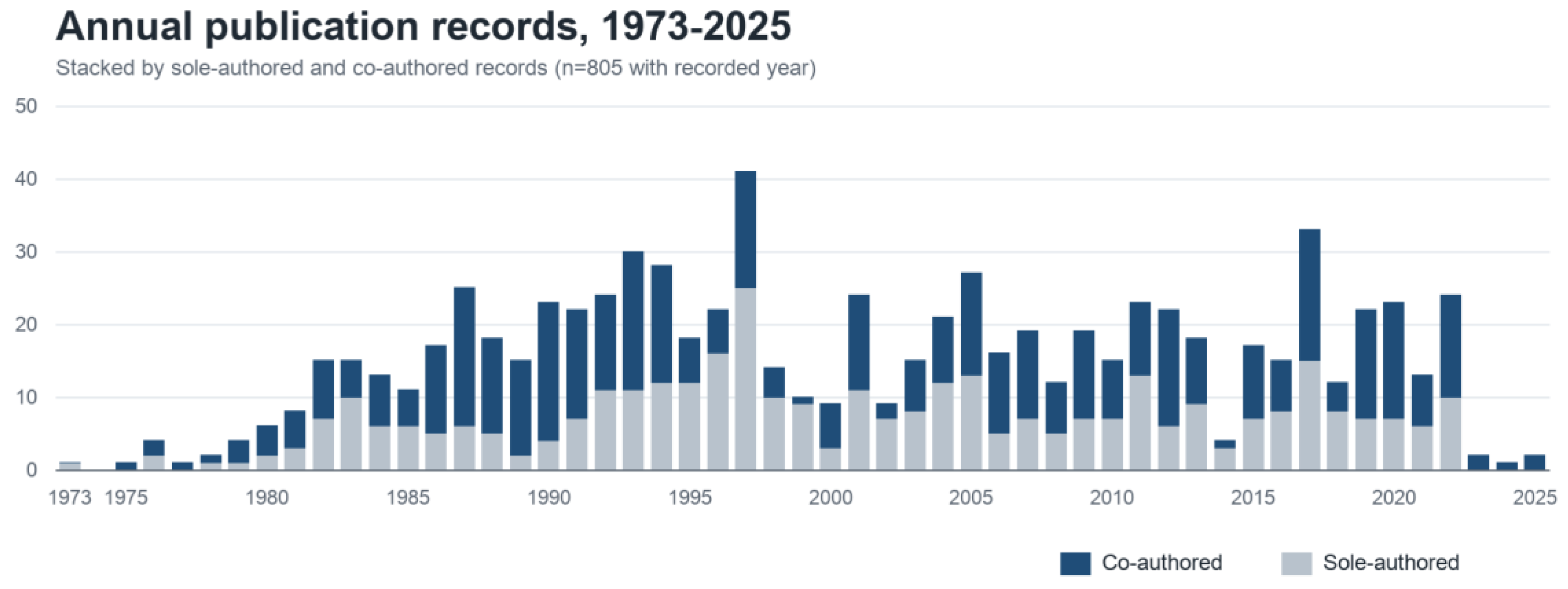
The core dataset contains 805 records. Of these, 447 (55.5%) include at least one co-author and 358 (44.5%) list Mark Burgin alone. All included records have a recorded publication year.
Figure 1.
Annual publication records by co-authorship status. n=805; all included records have a recorded year. Counts are unweighted bibliographic artifacts; posthumous releases are counted in their publication year.
Figure 1.
Annual publication records by co-authorship status. n=805; all included records have a recorded year. Counts are unweighted bibliographic artifacts; posthumous releases are counted in their publication year.
3.2. Publication Types and Pagination
Table 4.
Publication-type distribution and page-data coverage.
| Publication type | Count | % core | Page-known | Coverage | Known pages | Co-authored |
|---|---|---|---|---|---|---|
| journal article | 264 | 32.8% | 241 | 91.3% | 3,381 | 133 |
| conference paper | 205 | 25.5% | 185 | 90.2% | 1,142 | 143 |
| abstract | 131 | 16.3% | 82 | 62.6% | 155 | 58 |
| book chapter | 107 | 13.3% | 99 | 92.5% | 1,693 | 71 |
| preprint | 32 | 4.0% | 19 | 59.4% | 444 | 10 |
| book | 28 | 3.5% | 14 | 50.0% | 6,362 | 11 |
| encyclopedia entry | 15 | 1.9% | 15 | 100.0% | 29 | 2 |
| edited book | 9 | 1.1% | 7 | 77.8% | 3,434 | 8 |
| editorial item | 8 | 1.0% | 3 | 37.5% | 14 | 5 |
| other | 3 | 0.4% | 0 | 0.0% | 0 | 3 |
| technical report | 3 | 0.4% | 3 | 100.0% | 236 | 3 |
Book and edited-book page totals are explicit full-volume lengths when documented. Article numbers are excluded from page counts.
Journal articles (264; 32.8%) and conference papers (205; 25.5%) together account for 469 records. The core also contains 131 abstracts and 107 book chapters. Pagination coverage is 83.0% overall but differs by type; the missing values remain explicit in the supplement.
3.3. Collaboration Network
The focal-author network contains 160 normalized co-authors and 551 co-author-publication incidences across 447 co-authored records. 90 co-authors (56.2%) occur in one joint publication, while 24 occur in five or more. The following tables show the twenty largest unique-publication counts without combining them with any other metric.
Table 5.
Co-authors ranked by unique joint publications (top 20).
| Rank | Co-author | Joint pubs. | Known pages | Page-known | Coverage |
|---|---|---|---|---|---|
| 1 | Vladimir Kuznetsov | 80 | 1,607 | 75 | 93.8% |
| 2 | Narayan C. Debnath | 32 | 180 | 30 | 93.8% |
| 3 | Gordana Dodig-Crnković | 31 | 1,979 | 19 | 61.3% |
| 4 | Rao Mikkilineni | 23 | 145 | 13 | 56.5% |
| 5 | Eugene Eberbach | 19 | 265 | 18 | 94.7% |
| 6 | Chelovsky, Yu.A. | 14 | 48 | 11 | 78.6% |
| 7 | Damon Shing-Min Liu | 13 | 282 | 12 | 92.3% |
| 8 | Walter J. Karplus | 13 | 282 | 12 | 92.3% |
| 9 | E. S. Burgina | 10 | 25 | 3 | 30.0% |
| 10 | Yu. M. Borodyanskii | 10 | 58 | 9 | 90.0% |
| 11 | Kavunenko, L.F. | 9 | 24 | 8 | 88.9% |
| 12 | Wolfgang Hofkirchner | 9 | 1,136 | 7 | 77.8% |
| 13 | José María Díaz Nafría | 8 | 301 | 7 | 87.5% |
| 14 | Stepenko, G.V. | 8 | 45 | 8 | 100.0% |
| 15 | Marc L. Smith | 7 | 151 | 6 | 85.7% |
| 16 | Parfenzeva, N.A. | 7 | 15 | 6 | 85.7% |
| 17 | Allen Klinger | 6 | 80 | 6 | 100.0% |
| 18 | Arkadiy Dantsker | 6 | 36 | 4 | 66.7% |
| 19 | Oktay Duman | 6 | 67 | 5 | 83.3% |
| 20 | Cristian S. Calude | 5 | 556 | 5 | 100.0% |
Known pages are reported separately from publication count. Coverage is the share of that co-author’s joint publications with usable pagination.
Table 6.
Joint-publication-year profile of the same top-20 publication-count group.
| Co-author | First pub. | Last pub. | Pub. span | Pub. years | Pubs./span yr. | Venues |
|---|---|---|---|---|---|---|
| Vladimir Kuznetsov | 1984 | 2001 | 18 | 13 | 4.44 | 75 |
| Narayan C. Debnath | 2003 | 2013 | 11 | 10 | 2.91 | 14 |
| Gordana Dodig-Crnković | 2009 | 2024 | 16 | 10 | 1.94 | 19 |
| Rao Mikkilineni | 2014 | 2022 | 9 | 9 | 2.56 | 17 |
| Eugene Eberbach | 2006 | 2020 | 15 | 10 | 1.27 | 16 |
| Chelovsky, Yu.A. | 1982 | 1990 | 9 | 5 | 1.56 | 13 |
| Damon Shing-Min Liu | 2000 | 2001 | 2 | 2 | 6.50 | 12 |
| Walter J. Karplus | 2000 | 2001 | 2 | 2 | 6.50 | 12 |
| E. S. Burgina | 1980 | 1983 | 4 | 4 | 2.50 | 4 |
| Yu. M. Borodyanskii | 1991 | 1995 | 5 | 5 | 2 | 9 |
| Kavunenko, L.F. | 1993 | 1996 | 4 | 3 | 2.25 | 9 |
| Wolfgang Hofkirchner | 2015 | 2019 | 5 | 3 | 1.80 | 4 |
| José María Díaz Nafría | 2011 | 2025 | 15 | 5 | 0.53 | 5 |
| Stepenko, G.V. | 1986 | 1998 | 13 | 5 | 0.62 | 8 |
| Marc L. Smith | 2006 | 2010 | 5 | 4 | 1.40 | 5 |
| Parfenzeva, N.A. | 1996 | 1997 | 2 | 2 | 3.50 | 4 |
| Allen Klinger | 2003 | 2018 | 16 | 5 | 0.38 | 5 |
| Arkadiy Dantsker | 1993 | 2022 | 30 | 5 | 0.20 | 5 |
| Oktay Duman | 2008 | 2011 | 4 | 4 | 1.50 | 5 |
| Cristian S. Calude | 2007 | 2017 | 11 | 4 | 0.45 | 4 |
Publication span is inclusive. Publication years counts distinct years containing at least one joint publication. A posthumous release year does not imply activity after death. Venues are distinct preferred venue strings.
Table 7.
Publication-type distribution for the ten largest joint-publication counts.
| Co-author | Journal | Conf. | Abstract | Chapter | Book/ed. | Preprint | Other |
|---|---|---|---|---|---|---|---|
| Vladimir Kuznetsov | 18 | 23 | 6 | 29 | 4 | 0 | 0 |
| Narayan C. Debnath | 3 | 28 | 1 | 0 | 0 | 0 | 0 |
| Gordana Dodig-Crnković | 10 | 4 | 2 | 5 | 4 | 2 | 4 |
| Rao Mikkilineni | 10 | 7 | 2 | 0 | 0 | 3 | 1 |
| Eugene Eberbach | 11 | 5 | 1 | 2 | 0 | 0 | 0 |
| Chelovsky, Yu.A. | 3 | 6 | 1 | 4 | 0 | 0 | 0 |
| Damon Shing-Min Liu | 2 | 8 | 1 | 0 | 0 | 0 | 2 |
| Walter J. Karplus | 2 | 8 | 1 | 0 | 0 | 0 | 2 |
| E. S. Burgina | 2 | 0 | 8 | 0 | 0 | 0 | 0 |
| Yu. M. Borodyanskii | 5 | 1 | 3 | 1 | 0 | 0 | 0 |
Other combines editorial items, encyclopedia entries, technical reports, and records classified as other. Complete per-co-author distributions are in Supplement S6.
3.4. Separate Metric Rankings
A co-author’s position differs across publication count, known page volume, joint-publication span, publication-year coverage, rate, median length, and venue count. These dimensions are therefore not merged. Appendix A reports ranks 1-5 for every metric, retaining all ties. Supplement S5 contains the complete ranking of all co-authors for each metric, and Supplement S4 contains the underlying values, page-coverage fields, and posthumous joint-publication counts.

4. Scope and Limitations
- The IS4SI bibliography is extensive but contains inconsistent punctuation, incomplete years or pages, and occasional category or spelling variation. Single-source records are documented as such rather than promoted to multi-source verification.
- DBLP and OpenAlex do not cover all older, non-English, regional, book, abstract, or encyclopedia material. Index absence is therefore not treated as evidence of non-publication.
- 0 included records lack a year and 137 lack usable pagination. Page totals and page-based rankings are explicitly coverage-limited.
- 3 records were published after Burgin’s death on 18 February 2023. Their publication years extend the bibliographic record but are not interpreted as years of active collaboration.
- Books and edited books contribute their documented full length to a co-author’s known joint pages. This is a bibliographic page measure and does not allocate pages among editors or authors.
- Distinct venues are counts of preferred recorded venue strings. They are not a fully authority-controlled journal or conference series registry.
- The network is centered on one focal author. It describes documented co-publication relations and does not measure contribution, intellectual proximity, influence, or interpersonal ties.
- The dataset is frozen at 8 August 2026.
5. Data Availability
The section headed Data sources and methodological references identifies the bibliographic services, methods literature, memorial record, and publisher records cited in the methods. Appendix C is the complete analytic reference corpus: it reproduces every one of the 805 publications counted or classified in the analysis and links each entry to its stable publication ID. Appendix D lists every excluded canonical candidate and its exclusion reason. The preprint package also includes the complete canonical table (Supplement S1), raw source records (S2), publication-author bridge (S3), co-author metric table (S4), nine full ranking tables (S5), per-co-author publication-type distributions (S6), the overall type distribution (S7), quality-control records (S8), the reader-oriented workbook (S9), the reconstruction protocol (S10), the dataset manifest (S11), and the source snapshots. File-level SHA-256 checksums are included in the package manifest. These files are the authoritative basis for reproducing every table and appendix entry.
6. Conclusion
The reconstruction establishes a frozen, publication-level archive of 805 included bibliographic records and a co-publication table for 160 normalized co-authors. Counts, known pages, publication types, joint-publication dates, inclusive publication spans, distinct publication years, rates, median lengths, posthumous-release counts, and recorded venue counts remain separate descriptive measures. The full analytic reference list in Appendix C and the retained source layer support checking and later correction without requiring an interpretive or composite assessment.
Appendix A. Separate Rankings
Table A1 gives ranks 1-5 for all nine metrics. Every tied value within these rank positions is retained, so some metric blocks contain more than five names. Rankings are not combined. The complete 160-name ranking for each metric is supplied in S5_coauthor_rankings.csv.
Table A1.
Ranks 1-5 for each joint-publication metric, with all ties retained.
| Metric | Rank | Co-author | Value |
|---|---|---|---|
| Unique joint publications | 1 | Vladimir Kuznetsov | 80 |
| Unique joint publications | 2 | Narayan C. Debnath | 32 |
| Unique joint publications | 3 | Gordana Dodig-Crnković | 31 |
| Unique joint publications | 4 | Rao Mikkilineni | 23 |
| Unique joint publications | 5 | Eugene Eberbach | 19 |
| Known joint pages | 1 | Gordana Dodig-Crnković | 1,979 |
| Known joint pages | 2 | Vladimir Kuznetsov | 1,607 |
| Known joint pages | 3 | Wolfgang Hofkirchner | 1,136 |
| Known joint pages | 4 | Marek Czachor | 960 |
| Known joint pages | 5 | William M. Seaman | 606 |
| Earliest joint-publication year | 1 | Karasik, A.Yu. | 1975 |
| Earliest joint-publication year | 2 | Belkov, M.S. | 1977 |
| Earliest joint-publication year | 2 | Bratalskii, E.A. | 1977 |
| Earliest joint-publication year | 4 | Kharlamov, M.A. | 1978 |
| Earliest joint-publication year | 5 | Gabovich, E.Ya. | 1979 |
| Most recent joint-publication year | 1 | José María Díaz Nafría | 2025 |
| Most recent joint-publication year | 1 | Marcin J. Schroeder | 2025 |
| Most recent joint-publication year | 3 | Gordana Dodig-Crnković | 2024 |
| Most recent joint-publication year | 4 | Felix M. Lev | 2023 |
| Most recent joint-publication year | 4 | Otto E. Rössler | 2023 |
| Most recent joint-publication year | 4 | William M. Seaman | 2023 |
| Inclusive joint-publication span | 1 | Arkadiy Dantsker | 30 |
| Inclusive joint-publication span | 2 | H. Paul Zellweger | 18 |
| Inclusive joint-publication span | 2 | Vladimir Kuznetsov | 18 |
| Inclusive joint-publication span | 4 | Allen Klinger | 16 |
| Inclusive joint-publication span | 4 | Gordana Dodig-Crnković | 16.00 |
| Distinct publication years | 1 | Vladimir Kuznetsov | 13.00 |
| Distinct publication years | 2 | Eugene Eberbach | 10.00 |
| Distinct publication years | 2 | Gordana Dodig-Crnković | 10.00 |
| Distinct publication years | 2 | Narayan C. Debnath | 10.00 |
| Distinct publication years | 5 | Rao Mikkilineni | 9.00 |
| Publications per span-year | 1 | Damon Shing-Min Liu | 6.50 |
| Publications per span-year | 1 | Walter J. Karplus | 6.50 |
| Publications per span-year | 3 | Vladimir Kuznetsov | 4.44 |
| Publications per span-year | 4 | Parfenzeva, N.A. | 3.50 |
| Publications per span-year | 5 | Andrew Adamatzky | 3.00 |
| Publications per span-year | 5 | Gladkova, V.I. | 3.00 |
| Publications per span-year | 5 | Malitstskii, B.A. | 3.00 |
| Median known pages | 1 | Marek Czachor | 960 |
| Median known pages | 2 | Otto E. Rössler | 600 |
| Median known pages | 3 | William M. Seaman | 303 |
| Median known pages | 4 | Alemany, F.S. | 222 |
| Median known pages | 4 | Campos-Havidich, M. | 222 |
| Median known pages | 4 | Gejman, R. | 222 |
| Median known pages | 4 | Juan Miguel Aguado | 222 |
| Median known pages | 4 | Macarro, R. | 222 |
| Median known pages | 4 | Morato, J. | 222 |
| Distinct recorded venues | 1 | Vladimir Kuznetsov | 75 |
| Distinct recorded venues | 2 | Gordana Dodig-Crnković | 19 |
| Distinct recorded venues | 3 | Rao Mikkilineni | 17 |
| Distinct recorded venues | 4 | Eugene Eberbach | 16 |
| Distinct recorded venues | 5 | Narayan C. Debnath | 14 |
First year is ranked ascending; last year and all other metrics are ranked descending. Page metrics remain coverage-limited.
Appendix B. Supplementary File Map
Table A2.
Supplementary data inventory.
| ID | File | Purpose |
|---|---|---|
| S1 | publications.csv | Canonical bibliography with inclusion status and provenance |
| S2 | source_records.csv | Raw citations, parsed fields, canonical links, and source URLs |
| S3 | publication_authors.csv | Normalized/source author forms and publication memberships |
| S4 | coauthors.csv | Complete co-author metrics and page coverage |
| S5 | coauthor_rankings.csv | Nine complete separate rankings |
| S6 | coauthor_publication_types.csv | Publication-type counts for every co-author |
| S7 | publication_type_distribution.csv | Overall publication-type distribution |
| S8 | quality_control.csv | Documentation, parsing, conflict, and missing-data flags |
| S9 | mark_burgin_bibliography.xlsx | Reader-oriented workbook with audit tables |
| S10 | methods.md | Full reconstruction protocol |
| S11 | dataset_manifest.json | Counts, source URLs, hashes, and freeze metadata |
Source snapshots are supplied in a separate folder within the preprint package.
Appendix C. Full Reference List for the Analyzed Publication Corpus
This is the complete list of references on which the bibliometric calculations are based: all 805 publications included in the analytic corpus. Entries are ordered by recorded publication year and then title. The bracketed publication ID is the stable key joining an entry to Supplement S1 and, through its source-record IDs, to the raw citations and source URLs in Supplement S2. Missing venues, dates, or pagination remain absent rather than inferred.

1973
[MB-0034] Mark Burgin (1973). The Block-Scheme Language as a Programming Language. Problems of Radio-Electronics. journal article. pp. 39-58. sources: IS4SI.
1975
[MB-0035] Mark Burgin; Karasik, A.Yu. (1975). A Study of an Abstract Model of Computers. Programming. journal article. pp. 72-82. sources: IS4SI.
1976
[MB-0038] Mark Burgin; Karasik, A.Yu. (1976). On Construction of Matrix Operators. Problems of Radio-Electronics. journal article. pp. 9-25. sources: IS4SI.
[MB-0036] Mark Burgin; Karasik, A.Yu. (1976). Operators of a Multidimensional Structured Model of Parallel Computations. Automatics and Telemechanics. journal article. pp. 179-185. sources: IS4SI.
[MB-0037] Mark Burgin (1976). Recursion Operator and Representability of Functions in the Block-Scheme Language. Programming. journal article. pp. 13-23. sources: IS4SI.
[MB-0560] Mark Burgin (1976). Some Tendencies in Programming Languages Development. All-Union conference “Computers-76”, 1. abstract. pp. 99-100. sources: IS4SI.
1977
[MB-0039] Belkov, M.S.; Bratalskii, E.A.; Mark Burgin (1977). The Language of Package Design of Logical Units. Problems of Radio-Electronics. journal article. pp. 58-71. sources: IS4SI.
1978
[MB-0250] Mark Burgin; Kharlamov, M.A. (1978). Connections Between Relations and their Applications in Computer Science. Problems of information theory and practice,” Moscow. book chapter. pp. 84-93. sources: IS4SI.
[MB-0040] Mark Burgin (1978). Variables in the Block-Scheme Language. Programming. journal article. pp. 3-11. sources: IS4SI.
1979
[MB-0355] Mark Burgin; Gabovich, E.Ya. (1979). On automation of the Pacific fishery information retrieval and processing. Proceedings of the XIV Pacific Science Congress, Khabarovsk. conference paper. pp. 26-29. sources: IS4SI.
[MB-0251] Mark Burgin; Kharlamov, M.A. (1979). Preclosures and closures of relations. Problems of Optimal Algorithm Realization”, Kiev. book chapter. pp. 19-35. sources: IS4SI.
[MB-0561] Mark Burgin (1979). Structures of operators in a multidimensional structured model. All-Union seminar on synthesis and planning of complex structures, Moscow. abstract. pp. 57-58. sources: IS4SI.
[MB-0041] Mark Burgin; Bratalskii, E.A.; Belkov, M.S. (1979). The language PDL for the large system design automation. Programming. journal article. pp. 80-90. sources: IS4SI.
1980
[MB-0565] Mark Burgin; E. S. Burgina (1980). Derivations and partitions in formal languages. Abstracts of papers presented to the American Mathematical Society. abstract. sources: IS4SI.
[MB-0564] Mark Burgin; E. S. Burgina (1980). Domination in formal languages. Abstracts of papers presented to the American Mathematical Society. abstract. sources: IS4SI.
[MB-0042] Mark Burgin (1980). Functional equivalence of operators and parallel computations. Programming. journal article. pp. 3-16. sources: IS4SI.
[MB-0563] Mark Burgin; E. S. Burgina (1980). Multi-valued partitions in formal languages. Abstracts of papers presented to the American Mathematical Society. abstract. sources: IS4SI.
[MB-0562] Mark Burgin (1980). Some properties of E-machines. Abstracts of papers presented to the American Mathematical Society. abstract. sources: IS4SI.
[MB-0252] Mark Burgin; Slyusar, V.I. (1980). Structured organization of frames for knowledge base construction. Knowledge representation in Artificial Intelligence Systems,” Moscow. book chapter. pp. 21-24. sources: IS4SI.
1981
[MB-0566] Mark Burgin (1981). Decision problems for linear W -algebras. Burgin, M. Decision problems for linear W-algebras, Abstracts of papers presented to the American Mathematical Society. abstract. sources: IS4SI.
[MB-0567] Mark Burgin; E. S. Burgina (1981). Decision problems for multi-valued partitions. Abstracts of papers presented to the American Mathematical Society. abstract. sources: IS4SI.
[MB-0570] Mark Burgin (1981). Duality in the theory of computations. Abstracts of papers presented to the American Mathematical Society. abstract. sources: IS4SI.
[MB-0571] Mark Burgin (1981). Duality theorem for computable functions. Abstracts of papers presented to the American Mathematical Society. abstract. sources: IS4SI.
[MB-0568] Mark Burgin; E. S. Burgina (1981). Parallel partitions and their time complexity. Abstracts of papers presented to the American Mathematical Society. abstract. sources: IS4SI.
[MB-0572] Mark Burgin; Zak, Yu.A. (1981). Principles of construction of computer graphic in Computer Aided Design. Seminar on automated design, Ryazan. abstract. pp. 9-11. sources: IS4SI.
[MB-0569] Mark Burgin; E. S. Burgina (1981). Representation of linear languages by parallel partitions. Abstracts of papers presented to the American Mathematical Society. abstract. sources: IS4SI.
[MB-0033] Mark Burgin; Drapatski, M.Ya.; Kizner, Z.I.; Lokshina, I. (1981). Ye Applicability of mathematical methods of fishery capacity estimation. Burgin, M.S., Drapatski, M.Ya., Kizner, Z.I., and Lokshina, I.Ye. Applicability of mathematical methods of fishery capacity estimation, IFO, Moscow. book. sources: IS4SI.
1982
[MB-0574] Mark Burgin (1982). A correspondence between abstract complexity of computations and size measures of machines. Abstracts of papers presented to the American Mathematical Society. abstract. sources: IS4SI.
[MB-0044] Mark Burgin (1982). Complexity of parallel algorithms and computations. Notices of the Academy of Sciences of the USSR. journal article. pp. 268-274. sources: IS4SI.
[MB-0577] Mark Burgin; E. S. Burgina (1982). Computational complexity of processes defined by parallel partitions. VI All-Union conference on mathematical logic, Tbilisi. abstract. p. 26. sources: IS4SI.
[MB-0576] Mark Burgin (1982). Direct and inverse algorithmic problems. Abstracts of papers presented to the American Mathematical Society. abstract. sources: IS4SI.
[MB-0573] Mark Burgin (1982). Dual measures for abstract complexities. Abstracts of papers presented to the American Mathematical Society. abstract. sources: IS4SI.
[MB-0254] Mark Burgin; Chelovsky, Yu.A. (1982). Estimation of dynamic program characteristics. Dialogical mode in planning,” Kiev. book chapter. sources: IS4SI.
[MB-0043] Mark Burgin (1982). Generalized Kolmogorov complexity and duality in the theory of computations. Notices of the Academy of Sciences of the USSR. journal article. pp. 19-23. sources: IS4SI.
[MB-0050] Mark Burgin; E. S. Burgina (1982). Information retrieval and many-valued partitions in languages. Cybernetics and Systems Analysis. journal article. pp. 30-42. doi:10.1007/bf01078048. sources: IS4SI; OpenAlex.
[MB-0047] Mark Burgin; Chelovsky, Yu.A. (1982). Multidimensional structural analysis of FORTRAN programs. Control Systems and Machines. journal article. pp. 38-39. sources: IS4SI.
[MB-0049] Mark Burgin; E. S. Burgina (1982). Partitions in Languages and Parallel Computations. Programming. journal article. pp. 10-20. sources: IS4SI.
[MB-0046] Mark Burgin; Zak, Yu.A. (1982). Principles of automated system design. Control Systems and Machines. journal article. pp. 82-89. sources: IS4SI.
[MB-0045] Mark Burgin; Zak, Yu.A. (1982). Problems of functioning of graphic design computer systems. Mechanization and automation of control. journal article. pp. 32-36. sources: IS4SI.
[MB-0048] Mark Burgin (1982). Products of operators of multidimensional structured model of systems. Math. Soc. Sci.. journal article. pp. 335-343. doi:10.1016/0165-4896(82)90028-2. sources: DBLP; IS4SI.
[MB-0253] Mark Burgin; Chelovsky, Yu.A. (1982). Quantitative estimations of the program quality. Information retrieval systems and systems of data base management systems,” Kishinev. book chapter. pp. 6-8. sources: IS4SI.
[MB-0575] Mark Burgin (1982). Some properties of GK-complexities of computation. Abstracts of papers presented to the American Mathematical Society. abstract. sources: IS4SI.
1983
[MB-0051] Mark Burgin (1983). Composition of operators in a multidimensional structured model of parallel computations and systems. Cybernetics. journal article. pp. 38-46. sources: IS4SI.
[MB-0054] Mark Burgin; Gabovich, E.Ya. (1983). Equivalence among optimization problems on matrix sets. DAMATH: Discrete Applied Mathematics and Combinatorial Operations Research and Computer Science. journal article. pp. 13-24. sources: IS4SI.
[MB-0256] Mark Burgin (1983). Extensions of Relations. Mathematical Linguistics and the Theory of Algorithms,” Kalinin. book chapter. pp. 5-12. sources: IS4SI.
[MB-0585] Mark Burgin; Sadovskii, L.E. (1983). Formal models of systems with variable structures. XXXVIII All-Union Session for anniversary celebration of radio invention, pt.2, Moscow. abstract. pp. 85-86. sources: IS4SI.
[MB-0580] Mark Burgin (1983). General Measures for Algorithms. Abstracts of papers presented to the American Mathematical Society. abstract. sources: IS4SI.
[MB-0579] Mark Burgin (1983). Generalized Speed-Up Theorem for Abstract Complexity Measures. Abstracts of papers presented to the American Mathematical Society. abstract. sources: IS4SI.
[MB-0053] Mark Burgin (1983). Inductive Turing machines. Notices of the Academy of Sciences of the USSR. journal article. pp. 1289-1293. sources: IS4SI.
[MB-0581] Mark Burgin (1983). Limit Turing Machines. Abstracts of papers presented to the American Mathematical Society. abstract. sources: IS4SI.
[MB-0052] Mark Burgin (1983). Multiple computations and Kolmogorov complexity for such processes. Notices of the Academy of Sciences of the USSR. journal article. pp. 793-797. sources: IS4SI.
[MB-0583] Mark Burgin (1983). On a conjecture of S. Kleene. Abstracts of papers presented to the American Mathematical Society. abstract. sources: IS4SI.
[MB-0257] Mark Burgin; Kharlamov, M.A. (1983). Operators of closure for relations and binary operations. Operation research and Automated Control Systems,” Kiev. book chapter. pp. 20-29. sources: IS4SI.
[MB-0255] Mark Burgin; Bratalskii, E.A.; Belkov, M.S. (1983). Problems of multi-access memory organization. Automated control systems,” Kharkov. book chapter. pp. 79-85. sources: IS4SI.
[MB-0578] Mark Burgin; E. S. Burgina (1983). Real-time string matching by parallel partitions. Abstracts of papers presented to the American Mathematical Society. abstract. sources: IS4SI.
[MB-0584] Mark Burgin (1983). Recursive relations for dual complexity measures. Applications of methods of mathematical logic,” Tallinn. abstract. pp. 126-127. sources: IS4SI.
[MB-0582] Mark Burgin (1983). Universality for Inductive Turing Machines. Abstracts of papers presented to the American Mathematical Society. abstract. sources: IS4SI.
1984
[MB-0056] Mark Burgin (1984). Complexity measures on systems of parallel algorithms. Programming. journal article. pp. 17-28. sources: IS4SI.
[MB-0587] Mark Burgin (1984). Computations of sets defined by formulas in arithmetic. Abstracts of papers presented to the American Mathematical Society. abstract. sources: IS4SI.
[MB-0055] Mark Burgin (1984). Inductive Turing machines with multiple heads and Kolmogorov algorithms. Notices of the Academy of Sciences of the USSR. journal article. pp. 280-284. sources: IS4SI.
[MB-0586] Mark Burgin (1984). Multilimit Turing machines. Abstracts of papers presented to the American Mathematical Society. abstract. sources: IS4SI.
[MB-0589] Mark Burgin (1984). Named Sets and Information Representation. VII All-Union conference on mathematical logic, Novosibirsk. abstract. p. 25. sources: IS4SI.
[MB-0058] Mark Burgin; Chelovsky, Yu.A. (1984). Optimization Methods for Software Design. Operation research and automated control systems”, Kiev. journal article. pp. 102-108. sources: IS4SI.
[MB-0259] Mark Burgin; Sadovskii, L.E.; Arshinov, M.N. (1984). Problems of purpose determination in models of organizations and transport systems. Mathematical methods of transport problem solving,” Moscow. book chapter. pp. 3-15. sources: IS4SI.
[MB-0356] Mark Burgin; Chelovsky, Yu.A. (1984). Program Quality Estimation Based on Structural Characteristics. Proceedings of the International Conference “Software”, Kalinin. conference paper. pp. 79-81. sources: IS4SI.
[MB-0258] Mark Burgin; Chelovsky, Yu.A. (1984). Quality of the Automated Control System Software. Perspectives of the Automated Control System Development,” Kiev. book chapter. pp. 58-66. sources: IS4SI.
[MB-0057] Mark Burgin; Zak, Yu.A. (1984). Structure-parametric description of graphic objects. Control Systems and Machines. journal article. pp. 80-85. sources: IS4SI.
[MB-0357] Mark Burgin; Chelovsky, Yu.A. (1984). System reconstruction of scientific theories and named set theory. Theory, Methodology and Practice of Systems Research,” Moscow. conference paper. pp. 129-132. sources: IS4SI.
[MB-0588] Mark Burgin (1984). Systems and Properties. Abstracts of papers presented to the American Mathematical Society. abstract. sources: IS4SI.
[MB-0301] Mark Burgin; Vladimir Kuznetsov (1984). The Structure-Nominative Direction in Methodology of Science ( 1984-1991 ). Burgin, M.S. and Kuznetsov, V.I. The Structure-Nominative Direction in Methodology of Science (. book chapter. pp. 111-130. sources: IS4SI.
1985
[MB-0262] Mark Burgin (1985). Abstract theory of properties. Non-classical Logics,” Moscow. book chapter. pp. 109-118. sources: IS4SI.
[MB-0591] Mark Burgin (1985). Algorithmic problems for limit Turing machines. Abstracts of papers presented to the American Mathematical Society. abstract. sources: IS4SI.
[MB-0059] Mark Burgin (1985). Algorithms and algorithmic problems. Programming. journal article. pp. 3-14. sources: IS4SI.
[MB-0260] Mark Burgin (1985). Computational Complexity Measures and Quality of Programs. Reliability and quality of software,” Kiev. book chapter. pp. 28-30. sources: IS4SI.
[MB-0261] Mark Burgin; Sadovskii, L.E. (1985). Formal models of systems with variable structures. Problems of system techniques,” Leningrad. book chapter. pp. 117-121. sources: IS4SI.
[MB-0263] Mark Burgin; Vladimir Kuznetsov (1985). Functional extensions of scientific theories. Nonclassical Logics,” Moscow. book chapter. pp. 119-127. sources: IS4SI.
[MB-0592] Mark Burgin (1985). Limit computations and computational potential of inductive Turing machines. All-Union conference in applied logic, Novosibirsk. abstract. pp. 30-32. sources: IS4SI.
[MB-0358] Mark Burgin; Vladimir Kuznetsov (1985). Multilevel social determinacy of scientific knowledge systems development. Social determinacy of cognition,” Tallin. conference paper. pp. 63-67. sources: IS4SI.
[MB-0590] Mark Burgin (1985). Numerical analysis and real number algorithms. Abstracts of papers presented to the American Mathematical Society. abstract. sources: IS4SI.
[MB-0264] Mark Burgin; Vladimir Kuznetsov (1985). Rationality principles and the problem of their modeling. Methodological aspects of scientific research,” Kiev. book chapter. pp. 3-17. sources: IS4SI.
[MB-0265] Mark Burgin; Vladimir Kuznetsov (1985). System analysis of scientific theory based on the named set idea. Systems research.. book chapter. pp. 136-160. sources: IS4SI.
1986
[MB-0737] Mark Burgin (1986). Catastrophe Theory. Philosophical Dictionary,” Kiev. encyclopedia entry. p. 268. sources: IS4SI.
[MB-0267] Mark Burgin; Stepenko, G.V. (1986). Computer literacy as a base for technical creative work perfection. Directions of technical creative work perfection and learning of informatics,” Ternopol. book chapter. pp. 199-201. sources: IS4SI.
[MB-0364] Mark Burgin; Vladimir Kuznetsov (1986). Concept modeling in historical aspects. Philosophical Problems of Logic and Science,” pt. 2, Moscow. conference paper. pp. 85-88. sources: IS4SI.
[MB-0738] Mark Burgin (1986). Constructive Logic. Philosophical Dictionary,” Kiev. encyclopedia entry. pp. 304-305. sources: IS4SI.
[MB-0739] Mark Burgin (1986). Continuum. Philosophical Dictionary,” Kiev. encyclopedia entry. p. 306. sources: IS4SI.
[MB-0359] Mark Burgin; Chelovsky, Yu.A. (1986). Evolution of theoretical aspects understanding in methodology of science. Problems of history and methodology of science,” pt.2, Moscow. conference paper. pp. 89-92. sources: IS4SI.
[MB-0363] Mashtabey, V.Ya.; Mark Burgin; Lebed, V.V. (1986). Expert system “Sale Market”. Expert Systems”, Moscow. conference paper. pp. 126-129. sources: IS4SI.
[MB-0362] Mark Burgin; Vladimir Kuznetsov (1986). Heuristics and Heuristic Aspects in a Scientific Theory. Proceedings of the V Seminar on Problems of Creativity: Methodology and Theory, Simferopol. conference paper. pp. 100-103. sources: IS4SI.
[MB-0594] Mark Burgin; Vladimir Kuznetsov (1986). Named Sets in the Analysis of Scientific Cognition. Logic of Scientific Cognition,” Kiev. abstract. pp. 11-12. sources: IS4SI.
[MB-0269] Mark Burgin (1986). Quantifiers in the Theory of Properties. Nonstandard Semantics of Non-classical Logics,” Moscow. book chapter. pp. 99-107. sources: IS4SI.
[MB-0360] Mark Burgin; Chelovsky, Yu.A. (1986). Quantum properties and structures representing them. Modern philosophical problems of quantum physics,” Kharkov. conference paper. sources: IS4SI.
[MB-0270] Mark Burgin (1986). Relations between functionally equivalent operators of parallel information processing. Models and Systems of Information Processing,” Kiev. book chapter. pp. 20-27. sources: IS4SI.
[MB-0268] Mark Burgin; Vladimir Kuznetsov (1986). Structure-nominative analysis of mathematical theories. Modern Mathematics,” Moscow. book chapter. pp. 273-286. sources: IS4SI.
[MB-0593] Mark Burgin; Vladimir Kuznetsov (1986). Structures of Concepts in Scientific Theories. VIII All-Union Conference on Mathematical Logic, Moscow. abstract. p. 25. sources: IS4SI.
[MB-0271] Mark Burgin; Bratalskii, E.A. (1986). The principle of asymptotic homogeneity in complex system modeling. Operation Research and Automated Control Systems,” Kiev. book chapter. pp. 115-122. sources: IS4SI.
[MB-0361] Mark Burgin; Chelovsky, Yu.A. (1986). The structure-nominative reconstruction of a physical theory. Modern philosophical problems of quantum physics,” Kharkov. conference paper. sources: IS4SI.
[MB-0266] Mark Burgin; Vladimir Kuznetsov (1986). Types of Symmetries in Physical Theories. Group-Theoretical Methods in Physics,” 2, Moscow. book chapter. pp. 362-371. sources: IS4SI.
1987
[MB-0596] Mark Burgin; Sadovskii, L.E. (1987). Algebraic structures in models of organizational systems. XIX All-Union Algebraic Conference, Lvov. abstract. p. 45. sources: IS4SI.
[MB-0280] Mark Burgin (1987). An Algorithmic Approach to the Function Definition. Formation of Computer Literacy,” Kiev. book chapter. pp. 68-74. sources: IS4SI.
[MB-0600] Mark Burgin; Mashtabey, V.Ya.; Lebed, V.V. (1987). Automated system “Sale Market” in export production management. Economic problems of research, design, and production,” Dnepropetrovsk. abstract. pp. 170-171. sources: IS4SI.
[MB-0601] Mark Burgin; Chelovsky, Yu.A. (1987). Evaluation of Software Quality. Methods of Software Reliability Analysis Based on Fuzzy Logic,” Kiev. abstract. p. 69. sources: IS4SI.
[MB-0595] Mark Burgin (1987). f-alternation or a new class of super-recursive algorithms. Abstracts of papers presented to the American Mathematical Society. abstract. sources: IS4SI.
[MB-0272] Mark Burgin (1987). Functor semantics in categories of named sets. Rationality, Reasoning, Communication,” Kiev. book chapter. pp. 183-198. sources: IS4SI.
[MB-0275] Mark Burgin; Vladimir Kuznetsov (1987). Heuristic procedures in scientific theories. Intuition, Logic, Creativity,” Moscow. book chapter. sources: IS4SI.
[MB-0599] Mark Burgin; Vladimir Kuznetsov (1987). Heuristicallity in Scientific Theories. Man-Creativity-Computer,” pt. 2, Moscow. abstract. pp. 88-91. sources: IS4SI.
[MB-0032] Mark Burgin (1987). Informatics as a Science and Problems of its Teaching. Academy of Pedagogical Sciences, Moscow. book. sources: IS4SI.
[MB-0366] Mark Burgin; Vladimir Kuznetsov (1987). Knowledge representation in expert systems. Proceedings of the II International Conference “Software”, Kalinin. conference paper. pp. 151-154. sources: IS4SI.
[MB-0365] Mark Burgin; Chelovsky, Yu.A. (1987). Methods of program quality evaluation. Proceedings of the II International Conference “Software”, Kalinin. conference paper. pp. 40-42. sources: IS4SI.
[MB-0368] Mark Burgin; Vladimir Kuznetsov (1987). Models, laws, and principles in physical theories. VIII International Congress on Logic, Methodology and Philosophy of Science, Moscow. conference paper. pp. 67-69. sources: IS4SI.
[MB-0277] Mark Burgin; Vladimir Kuznetsov (1987). Operational aspects of scientific theory. Rationality, Reasoning, Communication,” Kiev. book chapter. sources: IS4SI.
[MB-0278] Mark Burgin; Vladimir Kuznetsov (1987). Problems as components of the problem-heuristic subsystem of a scientific theory. Scientific Knowledge: logic, concepts, and structure,” Novosibirsk. book chapter. pp. 52-83. sources: IS4SI.
[MB-0279] Mark Burgin; Vladimir Kuznetsov (1987). Problems in structures of scientific theories. Nonclassical Logics and Propositional Attitudes,” Moscow. book chapter. pp. 101-109. sources: IS4SI.
[MB-0062] Mark Burgin (1987). Problems of Information Sciences Teaching. Informatics and Education. journal article. pp. 17-19. sources: IS4SI.
[MB-0598] Mark Burgin; Povyakel, N.I. (1987). Programmable components of creativity. Man-Creativity Computer,” pt. 2, Moscow. abstract. pp. 70-71. sources: IS4SI.
[MB-0369] Mark Burgin; Vladimir Kuznetsov (1987). Scientific theory and its axiology. VIII International Congress on Logic, Methodology and Philosophy of Science, Moscow. conference paper. pp. 116-118. sources: IS4SI.
[MB-0061] Mark Burgin; Vladimir Kuznetsov (1987). Scientific theory and its logic-linguistic subsystem. Philosophical Sciences. journal article. pp. 36-45. sources: IS4SI.
[MB-0060] Mark Burgin; Vladimir Kuznetsov (1987). Scientific theory and its subsystems. Philosophical Thought. journal article. pp. 34-46. sources: IS4SI.
[MB-0597] Mark Burgin; Vladimir Kuznetsov (1987). Semiotic models and their structures. Psychological theory and practice,” Novosibirsk. abstract. pp. 109-110. sources: IS4SI.
[MB-0273] Mark Burgin; Chelovsky, Yu.A. (1987). Software quality evaluation and management problems. Software of Integrated Automated Control Systems,” Kiev. book chapter. pp. 64-69. sources: IS4SI.
[MB-0276] Mark Burgin; Vladimir Kuznetsov (1987). The model aspect of evolution of geometry. Methodological analysis of mathematical theories,” Moscow. book chapter. pp. 205-213. sources: IS4SI.
[MB-0367] Mark Burgin (1987). The notion of algorithm and the Church-Turing thesis. Proceedings of the VIII International Congress on logic, methodology and philosophy of science, Moscow. conference paper. pp. 138-140. sources: IS4SI.
[MB-0274] Mark Burgin; Vladimir Kuznetsov; Stepenko, G.V. (1987). The notion of data in computer science and programming. Formation of Computer Literacy,” Kiev. book chapter. pp. 92-98. sources: IS4SI.
1988
[MB-0372] Mashtabey, V.Ya.; Mark Burgin; Lebed, V.V. (1988). Automated Data Processing System and Prognosis of Export Utilities Results. Marketing: theory, methodology, practice,” Moscow, v. 17. conference paper. pp. 91-94. sources: IS4SI.
[MB-0063] Mark Burgin; Stepenko, G.V. (1988). Computer Literacy in a Secondary School. Soviet School. journal article. pp. 63-72. sources: IS4SI.
[MB-0376] Mark Burgin; Stepenko, G.V. (1988). Computer Programs as a Tool for Creativity Development in Education. Creativity and Pedagogy,” pt.2, Moscow. conference paper. pp. 42-44. sources: IS4SI.
[MB-0373] Mark Burgin; Vladimir Kuznetsov (1988). Concepts in cognitive systems and their structure-nominative models. Theory of cognition and logic”, Works of soviet scientists to the XVIII International Congress of Philosophy (Brighton. conference paper. pp. 52-58. sources: IS4SI.
[MB-0605] Mark Burgin (1988). Decision making systems in scientific research. Infware and software of Computer Aided Design,” Moscow. abstract. pp. 31-32. sources: IS4SI.
[MB-0603] Mark Burgin; Vladimir Kuznetsov (1988). Definitions in practice and theory of programming. II All-Union Conference on Applied Logic, Novosibirsk. abstract. pp. 35-37. sources: IS4SI.
[MB-0370] Mark Burgin; Vladimir Kuznetsov (1988). Informal and formal analysis of concepts. Berichte des 12 International Wittgenstein Symposium,” Wien. conference paper. pp. 163-166. sources: IS4SI.
[MB-0064] Mark Burgin; Stepenko, G.V. (1988). Informatics in Language Teaching: Software for Teaching and Learning. Ukrainian Language and Literature at School. journal article. pp. 66-70. sources: IS4SI.
[MB-0281] Mark Burgin (1988). Initial Stages of Problem Solving. Methods of mathematics and physics teaching,” Kiev. book chapter. pp. 77-84. sources: IS4SI.
[MB-0377] Mark Burgin (1988). Levels of Creativity and Pedagogical Problems. Creativity and Pedagogy,” pt. 3, Moscow. conference paper. pp. 59-61. sources: IS4SI.
[MB-0602] Mark Burgin (1988). Limit computations and Turing machines. II All-Union Conference on Applied Logic, Novosibirsk. abstract. pp. 32-34. sources: IS4SI.
[MB-0282] Mark Burgin; Vladimir Kuznetsov (1988). On system-mathematical modeling of mathematics development. Philosophical problems of modern science”, Kiev. book chapter. pp. 47-54. sources: IS4SI.
[MB-0375] Mark Burgin; Dmitrik, I.S. (1988). Pedagogical Technology as a Base for Pedagogical Creativity. Creativity and Pedagogy,” pt. 2, Moscow. conference paper. pp. 19-21. sources: IS4SI.
[MB-0604] Mark Burgin; Povyakel, N.I. (1988). Programmable and Reflexive Components of Creativity. Activity: philosophical and psychological aspects,” Simferopol. abstract. pp. 37-38. sources: IS4SI.
[MB-0606] Mark Burgin (1988). Scientific knowledge development as a synergetic process. Selforganization in nature and society,” Leningrad. abstract. pp. 6-8. sources: IS4SI.
[MB-0374] Mark Burgin; Stepenko, G.V. (1988). Teacher in the Information World. Problems of postgraduate education perfection,” Grodno. conference paper. pp. 18-20. sources: IS4SI.
[MB-0065] Mark Burgin; В.Г. Кузнецoв (1988). The structure-nominative reconstruction of scientific knowledge. PhilPapers (PhilPapers Foundation). journal article. sources: IS4SI; OpenAlex.
[MB-0371] Mark Burgin; Vladimir Kuznetsov (1988). Theoreticity, constructivity, and other properties of scientific theory elements. Preprints of Soviet Scientists for the XVIII World Philosophical Congress (Brighton. conference paper. pp. 46-52. sources: IS4SI.
1989
[MB-0381] Mark Burgin; Kostyukevich, D.Ya.; Finn, A.Z. (1989). Computer simulation of a physical process in educational environment. Computers in school, Novosibirsk. conference paper. pp. 133-134. sources: IS4SI.
[MB-0379] Mark Burgin; Vladimir Kuznetsov (1989). Creative work of inventor and knowledge systems. Human factor in scientific progress acceleration,” Novosibirsk. conference paper. pp. 211-214. sources: IS4SI.
[MB-0382] Mark Burgin; Kostyukevich, D.Ya.; Finn, A.Z. (1989). Didactical aspects of computers application in practical work in physics training at school. Computers in school, Novosibirsk. conference paper. pp. 144-146. sources: IS4SI.
[MB-0378] Mark Burgin (1989). Intellectual activity in creative work. Forms of knowledge representation and creative thinking, Novosibirsk. conference paper. pp. 53-56. sources: IS4SI.
[MB-0384] Mark Burgin (1989). Knowledge in Intelligent Systems. Proceedings of the Conference on Intelligent Management Systems, Varna. conference paper. pp. 281-286. sources: IS4SI.
[MB-0383] Mark Burgin; Vladimir Kuznetsov (1989). Logical and Structural Principles of Knowledge. Proceedings of the Conference on Intelligent Management Systems, Varna. conference paper. pp. 266-272. sources: IS4SI.
[MB-0284] Mark Burgin; V. P. Gladun (1989). Mathematical Foundations of Semantic Networks Theory. MFDBS. conference paper. pp. 117-135. doi:10.1007/3-540-51251-9_9. sources: DBLP; IS4SI; OpenAlex.
[MB-0286] Mark Burgin; Vladimir Kuznetsov (1989). Methodological models of scientific knowledge. Methodological Consciousness in Modern Science, Kiev. book chapter. pp. 199-308. sources: IS4SI.
[MB-0285] Mark Burgin; Vladimir Kuznetsov (1989). Named set theory as the tool for logic-methodological analysis. Methodological Consciousness in Modern Science”, Kiev. book chapter. pp. 135-171. sources: IS4SI.
[MB-0283] Mark Burgin; Vladimir Kuznetsov (1989). Scientific cognitive systems and the problem of their modeling. Methodological Consciousness in Modern Science, Kiev. book chapter. pp. 123-135. sources: IS4SI.
[MB-0380] Mark Burgin; Vladimir Kuznetsov (1989). The Heuristic Component of a Scientific Knowledge System. Proceedings of the VI Seminar on Creativity Problems, Simferopol. conference paper. pp. 83-85. sources: IS4SI.
[MB-0031] Mashtabey, V.Ya.; Mark Burgin; Lebed, V.V. (1989). The Problem of the Version Selection on the Base of Efficiency Estimation. Institute of Foreign Economy, Kiev. book. sources: IS4SI.
[MB-0607] Mark Burgin; Marchenko, A.B. (1989). The Role of Evaluation in Scientific Creativity. Creativity as a philosophical problem,” Kiev. abstract. pp. 41-43. sources: IS4SI.
[MB-0066] Mark Burgin; Vladimir Kuznetsov; Dmitrik, I.S. (1989). The structure-nominative analysis of pedagogical theories. Soviet Pedagogy. journal article. pp. 59-64. sources: IS4SI.
[MB-0287] Mark Burgin; Vladimir Kuznetsov (1989). Theoretic-structural foundations of unity of social and scientific cognition. Social Cognition: Principles, Forms and Functions, Kiev. book chapter. pp. 90-107. sources: IS4SI.
1990
[MB-0293] Mark Burgin (1990). Abstract Theory of Properties and Sociological Scaling. Expert Evaluation in Sociological Studies,” Kiev. book chapter. pp. 243-264. sources: IS4SI.
[MB-0388] Mark Burgin; Marchenko, A.B. (1990). Axiology in scientific creativity. Monistic Tradition and Modernity”, Kazan. conference paper. pp. 109-112. sources: IS4SI.
[MB-0069] Mark Burgin; Kostyukevich, D.Ya.; Finn, A.Z. (1990). Computer modeling in the course of mechanics in school. Methods of teaching of mathematics and physics, Kiev. journal article. pp. 114-119. sources: IS4SI.
[MB-0389] Mark Burgin (1990). Creative Potential of Personality and its Development. Problems of creativity psychology, “ Grodno. conference paper. pp. 65-68. sources: IS4SI.
[MB-0073] Mark Burgin; Chelovsky, Yu.A. (1990). Decision Making Systems and their Software. Operations Research and Automated Control Systems, Kiev, No. 36. journal article. pp. 82-87. sources: IS4SI.
[MB-0290] Mark Burgin; V. P. Gladun (1990). Elements of the Mathematical Theory of Semantic Networks. Knowledge-Dialog-Decision,” Kiev. book chapter. pp. 173-184. sources: IS4SI.
[MB-0072] Mark Burgin (1990). Generalized kolmogorov complexity and other dual complexity measures. Cybernetics and Systems Analysis. journal article. pp. 21-29. doi:10.1007/bf01068189. sources: IS4SI; OpenAlex.
[MB-0387] Mark Burgin; Vladimir Kuznetsov (1990). Laws in the social theory structure. Assimilation and conceptual design of intellectual systems, Moscow. conference paper. pp. 116-119. sources: IS4SI.
[MB-0289] Mark Burgin; Vladimir Kuznetsov (1990). Levels of Theoreticity in Scientific Cognition. Introduction. Studies on Logic of Scientific Cognition”, Moscow. book chapter. pp. 31-42. sources: IS4SI.
[MB-0608] Mark Burgin (1990). Logic of Intelligent Systems. All-Union Conference “Artificial Intelligence - 90”, Minsk. abstract. pp. 121-123. sources: IS4SI.
[MB-0391] Mark Burgin; V. P. Gladun (1990). Mathematical Modeling of Knowledge Representation Structures in Artificial Intelligence Systems. Methodology of Mathematical Modeling,” Sofia. conference paper. pp. 317-319. sources: IS4SI.
[MB-0291] Mark Burgin; Vladimir Kuznetsov (1990). Mathematical Modeling of Scientific Concept Formation and Development. Knowledge-Dialog-Decision,” Kiev. book chapter. pp. 185-201. sources: IS4SI.
[MB-0292] Mark Burgin; V. P. Gladun (1990). Mathematical models of semantic networks based on the named sets. Decision Support Systems,” Budapest. book chapter. pp. 81-96. sources: IS4SI.
[MB-0392] Mark Burgin; Vladimir Kuznetsov (1990). Methodology of Science and History of Science. XIII International Symposium on science about science and scientific prediction, pt.1, Kiev. conference paper. pp. 12-16. sources: IS4SI.
[MB-0068] Mark Burgin; Vladimir Kuznetsov (1990). New dimensions of scientific theory. Visnik of the Academy of Sciences of Ukraine. journal article. pp. 26-30. sources: IS4SI.
[MB-0393] В.Г. Кузнецoв; Mark Burgin (1990). On Structural Unity of Mathematical and Physical Theories. Dialnet (Universidad de la Rioja). journal article. pp. 19-22. sources: IS4SI; OpenAlex.
[MB-0288] Mark Burgin; Vladimir Kuznetsov (1990). On the system peculiarities of physical theory. Science: System Features and Dynamics, Moscow. book chapter. pp. 154-167. sources: IS4SI.
[MB-0070] Vladimir Kuznetsov; Mark Burgin; Gudkov, M.A. (1990). On transformation principles of social sciences. Visnik of the Academy of Sciences of Ukraine. journal article. pp. 7-14. sources: IS4SI.
[MB-0067] Mark Burgin; Vladimir Kuznetsov (1990). Relations between laws and principles in scientific theory. Philosophical Sciences, No. 1. journal article. pp. 44-52. sources: IS4SI.
[MB-0390] Mark Burgin; Vladimir Kuznetsov (1990). Scientific creativity and its regularities (an example of scientific concepts development). Intelligent Systems and Creativity, pt.2, Novosibirsk. conference paper. pp. 82-85. sources: IS4SI.
[MB-0385] Mark Burgin; Vladimir Kuznetsov (1990). Scientific Knowledge and the Expert System “NT-1”. III International Conference “Software”, pt.4, Tver. conference paper. pp. 22-25. sources: IS4SI.
[MB-0071] Mark Burgin; Vladimir Kuznetsov (1990). The Structure of the Theoretical Level of Modern Science. Science of Science and Informatics, No. 34. journal article. pp. 48-54. sources: IS4SI.
[MB-0386] Mark Burgin; Vladimir Kuznetsov (1990). The Structure-nominative Analysis of Scientific Theories and its Heuristic Possibilities. Assimilation and conceptual design of intellectual systems, Moscow. conference paper. pp. 5-8. sources: IS4SI.
1991
[MB-0298] Mark Burgin; Markov, K. (1991). A formal definition of materialization. Mathematics and Education in Mathematics”, Sofia. book chapter. pp. 175-179. sources: IS4SI.
[MB-0030] Mark Burgin (1991). Axiological Aspects of Scientific Theories. Naukova Dumka, Kiev. book. 183 p.. sources: IS4SI.
[MB-0394] Mark Burgin; Neishtadt, L.A. (1991). Communication culture as a premise for intellectual systems development. Problems of organizational systems intellectual development,” Novosibirsk. conference paper. pp. 158-160. sources: IS4SI.
[MB-0398] Mark Burgin; Vladimir Kuznetsov (1991). Conceptual analysis of scientific activity. Problems of human activity optimization and organization, pt.1, Novosibirsk. conference paper. pp. 275-279. sources: IS4SI.
[MB-0296] Mark Burgin (1991). Dual complexity measures and expert system functioning. Problem solving in intelligent computer media,” Kiev. book chapter. pp. 118-126. sources: IS4SI.
[MB-0609] Mark Burgin; Vladimir Kuznetsov (1991). Feedback Structure in Intelligent Systems. People in Intelligent Systems,” Novosibirsk. abstract. pp. 220-222. sources: IS4SI.
[MB-0079] Mark Burgin; Yu. M. Borodyanskii (1991). Infinite Processes and Super-recursive Algorithms. Notices of the Academy of Sciences of the USSR. journal article. pp. 876-879. sources: IS4SI.
[MB-0075] Mark Burgin (1991). Logical Methods in Artificial Intelligent Systems. Vestnik of the Computer Science Society, No. 2. journal article. pp. 66-78. sources: IS4SI.
[MB-0397] Mark Burgin; Vladimir Kuznetsov (1991). Methodology of science as a base for science management. Problems of organizational system intellectual development, Novosibirsk. conference paper. pp. 23-26. sources: IS4SI.
[MB-0610] Mark Burgin (1991). Multilevel reflexive Turing machines. Abstracts of papers presented to the American Mathematical Society. abstract. sources: IS4SI.
[MB-0401] Mark Burgin (1991). Named Sets in the Semantic Network Theory. Knowledge - Dialog - Decision,” Leningrad. conference paper. pp. 43-47. sources: IS4SI.
[MB-0395] Mark Burgin; Pichurin, V.V. (1991). Personality determinants diagnostics in intellectual progress. Problems of organizational systems intellectual development”, Novosibirsk. conference paper. pp. 321-324. sources: IS4SI.
[MB-0399] Mark Burgin; Vladimir Kuznetsov (1991). Reflection as a necessary condition of human inclusion in intelligent systems. Problems of effective human inclusion in intelligent systems”, Novosibirsk. conference paper. pp. 262-264. sources: IS4SI.
[MB-0396] Mark Burgin; Vladimir Kuznetsov (1991). Science as an Organization. Problems of organizational systems intellectual development, Novosibirsk. conference paper. pp. 177-180. sources: IS4SI.
[MB-0295] Mark Burgin; Vladimir Kuznetsov (1991). Scientific knowledge in the expert system “NT-1”. Software”, Tver. book chapter. pp. 77-82. sources: IS4SI.
[MB-0074] Mark Burgin (1991). Selection of Optimization Criteria in the Dynamic Approach of Mathematical Standardization Theory. Electronic devices, No. 1. journal article. pp. 62-67. sources: IS4SI.
[MB-0299] Mark Burgin; Vladimir Kuznetsov (1991). System Analysis of the Problem aspects of Scientific Theory. Systems Research. book chapter. pp. 162-183. sources: IS4SI.
[MB-0294] Mark Burgin; Vladimir Kuznetsov (1991). System Organization of Data and Knowledge Bases. Data and Knowledge Bases in Automated Systems,” Kiev. book chapter. pp. 149-157. sources: IS4SI.
[MB-0400] Mark Burgin; Stognii, A.A. (1991). Technological approach to human activity. Problems of human activity optimization and organization,” pt.2, Novosibirsk. conference paper. pp. 227-231. sources: IS4SI.
[MB-0077] Mark Burgin; Vladimir Kuznetsov (1991). The structure and development of mathematical theories. Project Euclid (Cornell University). journal article. pp. 3-28. sources: IS4SI; OpenAlex.
[MB-0297] Mark Burgin; Gorsky, D.P. (1991). Towards the construction of a general theory of concept. The Opened Curtain”, Oulder-San Francisco-Oxford. book chapter. pp. 167-195. sources: IS4SI.
[MB-0076] Mark Burgin (1991). What is the Surrounding World Built of (The Ontological Aspect). Philosophical and Sociological Thought. journal article. pp. 54-67. sources: IS4SI.
1992
[MB-0303] Mark Burgin (1992). Complexity measures in the axiomatic theory of algorithms. Methods of design of applied intelligent program systems,” Kiev. book chapter. pp. 60-67. sources: IS4SI.
[MB-0783] Mark Burgin; Vladimir Kuznetsov (1992). Fuzzy sets as named sets. Fuzzy Sets and Systems. journal article. pp. 189-192. doi:10.1016/0165-0114(92)90131-m. sources: OpenAlex.
[MB-0085] Mark Burgin (1992). Infinite in finite or metaphysics and dialectics of scientific abstractions. Philosophical and Sociological Thought. journal article. pp. 21-32. sources: IS4SI.
[MB-0078] Mark Burgin; Vladimir Kuznetsov (1992). Model Part of a Scientific Theory. EPISTEMOLOGIA. journal article. pp. 41-64. sources: IS4SI; OpenAlex.
[MB-0306] Mark Burgin (1992). Named sets as a mathematical apparatus for a data structure representation. Problem solving on mathematical models of object domains,” Kiev. book chapter. pp. 13-21. sources: IS4SI.
[MB-0613] Mark Burgin (1992). New Logical Tools for Thinking Simulation and Artificial Intelligence. International Conference on Bionic Modeling, S.-Petersburg. abstract. pp. 371-372. sources: IS4SI.
[MB-0304] Mark Burgin; Vladimir Kuznetsov (1992). Nomological Structures Modeling in Intelligent Systems. Intelligent Systems and Methodology”, Novosibirsk. book chapter. pp. 116-133. sources: IS4SI.
[MB-0611] Mark Burgin (1992). Object-oriented approach to logical representation of knowledge. Object-oriented programming,” Minsk. abstract. pp. 29-30. sources: IS4SI.
[MB-0082] Vladimir Kuznetsov; Mark Burgin (1992). On problems of control and self-organization in science. Visnik of the Academy of Sciences of Ukraine, No. 12. journal article. pp. 80-85. sources: IS4SI.
[MB-0081] Mark Burgin (1992). On the concept of a multiset in cybernetics. Cybernetics and System Analysis. journal article. pp. 165-167. sources: IS4SI.
[MB-0614] Mark Burgin; Yu. M. Borodyanskii (1992). Operations in spaces of alphabet operators. XI International conference on mathematical logic, Kazan. abstract. p. 29. sources: IS4SI.
[MB-0402] Mark Burgin; Yu. M. Borodyanskii (1992). Procedural models of human-database interaction. II International conference “Knowledge-Dialogue-Decision”, Kaliningrad. conference paper. pp. 4-18. sources: IS4SI.
[MB-0300] Mark Burgin; Vladimir Kuznetsov (1992). Reflection of knowledge and cognition. Philosophy of reflexive thinking, Novosibirsk. book chapter. sources: IS4SI.
[MB-0302] Mark Burgin (1992). Reflexive Calculi and Logic of Expert Systems. Creative processes modeling by means of knowledge bases, Sofia. book chapter. pp. 139-160. sources: IS4SI.
[MB-0087] Mark Burgin; Vladimir Kuznetsov (1992). Scientific Theory and its Model-Representing Subsystem. Problems of Methodology. journal article. pp. 34-45. sources: IS4SI.
[MB-0612] Mark Burgin; Neishtadt, L.A. (1992). Structured psychological models of man-computer communication. International Conference on Bionic Modeling, S.-Petersburg. abstract. pp. 157-158. sources: IS4SI.
[MB-0083] Mark Burgin (1992). System Approach to the Concept of Time. Philosophical and Sociological Thought. journal article. pp. 160-163. sources: IS4SI.
[MB-0615] Mark Burgin (1992). System functioning and technological processes. Abstracts of papers presented to the American Mathematical Society. abstract. sources: IS4SI.
[MB-0305] Mark Burgin (1992). The structure of innovation processes and innovation characteristics. Intellectual development of organizations”, Novosibirsk. book chapter. pp. 137-150. sources: IS4SI.
[MB-0029] Mark Burgin; Vladimir Kuznetsov (1992). The Structure-Nominative Analysis of Theoretical Knowledge ( Ideas, Results and Perspectives ). Burgin, M.S. and Kuznetsov, V.I. The Structure-Nominative Analysis of Theoretical Knowledge (Ideas, Results and Perspectives), Proceedings of the Institute of Philosophy, Kiev. book. sources: IS4SI.
[MB-0086] Mark Burgin; Vladimir Kuznetsov (1992). The Structure-Nominative Reconstruction and Intelligibility of Cognition. Epistemologia, v. XV, No. 2. journal article. pp. 219-238. sources: IS4SI.
[MB-0028] Vladimir Kuznetsov; Mark Burgin (1992). The World of Theories and Power of Mind. Ukraina P.C., Kiev. book. 231 p.. sources: IS4SI.
[MB-0084] Mark Burgin; Alexandr Šostak (1992). Towards the theory of continuity defect and continuity measure for mappings of metric spaces. Matematika” Acta Univ. Latv., No. 576, Riga. journal article. pp. 45-62. sources: IS4SI.
[MB-0080] Mark Burgin (1992). Universal limit Turing machines. Notices of the Russian Academy of Sciences. journal article. pp. 654-658. sources: IS4SI.
1993
[MB-0617] Mark Burgin (1993). A Creationist Theory of Concept. XIX World Congress of Philosophy, Abstracts, v.1, Moscow. abstract. p. 151. sources: IS4SI.
[MB-0310] Mark Burgin; Vladimir Kuznetsov (1993). A formal aesthetic for scientific discourse. Anglo-Ukrainian Studies of Scientific Discourse, Reason and Rhetoric, The Edwin Mellen Press, New York. book chapter. pp. 69-93. sources: IS4SI.
[MB-0096] Mark Burgin (1993). A Methodological Analysis of the Concept “Transformation”. Transformacje, No. 3-4 (5-6). journal article. pp. 88-92. sources: IS4SI.
[MB-0092] Yu. M. Borodyanskii; Mark Burgin (1993). Alphabet operators and algorithms. Cybernetics and Systems Analysis. journal article. pp. 338-349. doi:10.1007/bf01125539. sources: IS4SI; OpenAlex.
[MB-0093] Mark Burgin (1993). Analogy and Argumentation in Artificial Intelligence Systems. Vychislitelnyye Systemy (Logical Methods in Computer Science), No. 148. journal article. pp. 82-93. sources: IS4SI.
[MB-0616] Mark Burgin; Arkadiy Dantsker (1993). Application of Hypernumbers for Filter Choice. Problems of Industrial Ecology,” Moscow. abstract. p. 31. sources: IS4SI.
[MB-0405] Mark Burgin; Kavunenko, L.F. (1993). Conceptual foundations of S&T potential evaluation processes. Proceedings of the International Congress on System Science and System Engineering,” Beijing. conference paper. pp. 133-135. sources: IS4SI.
[MB-0309] Mark Burgin; Tkachenko, O.I. (1993). Data and knowledge in software systems. Intelligent Instrumental Programming Tools,” Kiev. book chapter. pp. 72-80. sources: IS4SI.
[MB-0623] Mark Burgin; Kavunenko, L.F. (1993). Ecological situation evaluation and critical ecological situations. Natural Resources in Ukraine,” Krivoy-Rog. abstract. pp. 8-9. sources: IS4SI.
[MB-0403] Mark Burgin (1993). Fuzzy continuous functions in object classification. 1st European Congress on fuzzy and intelligent technologies, Proceedings, Aachen. conference paper. pp. 1189-1195. sources: IS4SI.
[MB-0095] Mark Burgin (1993). Information triads. Philosophical and Sociological Thought. journal article. pp. 243-246. sources: IS4SI.
[MB-0621] Mark Burgin; Kavunenko, L.F. (1993). Methodological foundations of the assessment of impact on water resources. Diachronic Climatic Impact on Water Resources,” Greece. abstract. p. 41. sources: IS4SI.
[MB-0027] Mark Burgin; Vladimir Kuznetsov (1993). Nomological Structures in Scientific Theories. Naukova Dumka, Kiev. book. 221 p.. sources: IS4SI.
[MB-0407] Mark Burgin; Vladimir Kuznetsov (1993). On methodological analysis of sociological theories. Die Verschmelzung der untersuchungsbereiche: Formen des Dialogs zwischen Kulturwissenschaft und Wissenschaftstheorie, Frankfurt am Main. conference paper. pp. 49-61. sources: IS4SI.
[MB-0088] Mark Burgin (1993). On the way to the “Absolute”: Triad is the most fundamental structure in human society. Visnik of the Academy of Science of Ukraine. journal article. pp. 29-35. sources: IS4SI.
[MB-0619] Mark Burgin; Yu. M. Borodyanskii (1993). Problems of Modeling of Trans-recursive Procedures. Engineering of programming tools,” Kiev. abstract. pp. 13-15. sources: IS4SI.
[MB-0308] Mark Burgin (1993). Procedures of sociological measurement. Catastrophe, Chaos, and Self-Organization in Social Systems” Koblenz. book chapter. pp. 125-129. sources: IS4SI.
[MB-0091] Mark Burgin; Vladimir Kuznetsov (1993). Properties in science and their modelling. Quality & Quantity. journal article. pp. 371-382. doi:10.1007/bf01102499. sources: IS4SI; OpenAlex.
[MB-0094] Mark Burgin (1993). Reflexive Turing Machines and Calculi. Vychislitelnyye Systemy (Logical Methods in Computer Science), No. 148. journal article. pp. 94-116, 175-176. sources: IS4SI.
[MB-0625] Mark Burgin; Malitstskii, B.A. (1993). Regulation and self-organization versus control and determination in science. Development of science and transformations in society,” Kiev. abstract. p. 7. sources: IS4SI.
[MB-0090] Mark Burgin; Vladimir Kuznetsov (1993). Significance of scientific laws and “beauty” of scientific theory. Science and Science of Science. journal article. pp. 48-54. sources: IS4SI.
[MB-0307] Yu. M. Borodyanskii; Mark Burgin (1993). Social processes and limit computations. Catastrophe, Chaos, and Self-Organization in Social Systems,” Koblenz. book chapter. pp. 117-123. sources: IS4SI.
[MB-0618] Mark Burgin (1993). Software engineering and complexity of algorithms. Engineering of programming tools,” Kiev. abstract. pp. 16-17. sources: IS4SI.
[MB-0406] Mark Burgin; Malitstskii, B.A. (1993). System analysis of the organizational level of science. Proceedings of the International Congress on System Science and System Engineering,” Beijing. conference paper. sources: IS4SI.
[MB-0620] Mark Burgin; Malitstskii, B.A. (1993). System analysis of the organizational level of science. Proceedings of the International Congress on System Science and System Engineering,” Beijing. abstract. sources: IS4SI.
[MB-0800] Mark Burgin; Vladimir Kuznetsov (1993). The Axiological Aspects of Scientific Theories. journal article. sources: OpenAlex.
[MB-0624] Mark Burgin; Kavunenko, L.F. (1993). The conceptual base for science & technology evaluation. Development of science and Transformations in society,” Kiev. abstract. p. 37. sources: IS4SI.
[MB-0622] Mark Burgin (1993). Time complexity of the reflexive Turing machines. Abstracts of papers presented to the American Mathematical Society. abstract. sources: IS4SI.
[MB-0089] Mark Burgin (1993). Triad as a Fundamental Structure in Human Culture. Studia Culturologia. journal article. pp. 51-63. sources: IS4SI; OpenAlex.
[MB-0404] Mark Burgin; Vladimir Kuznetsov (1993). Types of fuzzy nomological structures. 1st European Congress on fuzzy and intelligent technologies, Proceedings, Aachen. conference paper. pp. 1625-1631. sources: IS4SI.
1994
[MB-0408] Mark Burgin; Kavunenko, L.F. (1994). A two-sided cooperation of scientists from Ukraine and China. Ukraine-China: ways of cooperation (Conference Proceedings), Kiev. conference paper. pp. 74-81. sources: IS4SI.
[MB-0314] Mark Burgin; Burgina, L.A. (1994). Communication in Culture and Culture of Communication. Education and Culture”, Novosibirsk. book chapter. pp. 154-167. sources: IS4SI.
[MB-0412] Mark Burgin; Kavunenko, L.F. (1994). Conceptual Problems of Evaluation in Science. Reports of the International Symposium “Development of Science and Transformations in Society”, Kiev. conference paper. pp. 34-38. sources: IS4SI.
[MB-0311] Mark Burgin; Vladimir Kuznetsov (1994). Directions and stages of evolution of biosphere and knowsphere. Academician V.I.Vernadsky’s Readings” (Collection of scientific papers), Kiev. book chapter. pp. 131-140. sources: IS4SI.
[MB-0627] Mark Burgin (1994). Efficiency of Super-recursive Algorithms. Abstracts of papers presented to the American Mathematical Society. abstract. sources: IS4SI.
[MB-0097] Mark Burgin (1994). Evaluation of Scientific Activity in the Dynamic Information Theory. Science and Science of Science. journal article. pp. 124-131. sources: IS4SI.
[MB-0630] Mark Burgin (1994). Evaluation of Scientific Activity in the Dynamic Information Theory. Science and Science of Science. abstract. pp. 124-131. sources: IS4SI.
[MB-0104] Mark Burgin (1994). Fundamental Base of the Theory of Triads. Idea. journal article. pp. 32-45. sources: IS4SI.
[MB-0793] Mark Burgin; Alexandr Šostak (1994). Fuzzification of the theory of continuous functions. Fuzzy Sets and Systems. journal article. pp. 71-81. doi:10.1016/0165-0114(94)90073-6. sources: OpenAlex.
[MB-0410] Mark Burgin (1994). Fuzzy terminological systems. 2nd European Congress on Intelligent Technologies and Soft Computing, Proceedings, Aachen. conference paper. pp. 984-988. sources: IS4SI.
[MB-0631] Mark Burgin; Kavunenko, L.F. (1994). Indices in science of science as a tool for harmonization of interaction of science and environment. Transactions of the International Symposium “Development of Science and Technology: Social-economic Reasonability and Ecological Safety”, Kiev. abstract. pp. 177-178. sources: IS4SI.
[MB-0026] Mark Burgin; Vladimir Kuznetsov (1994). Introduction to the Modern Exact Methodology of Science. International Science Foundation, Moscow. book. 303 p.. sources: IS4SI.
[MB-0103] Mark Burgin (1994). Is Informatics Needed as a Science? C ontrol Systems and Machines. Burgin, M. Is Informatics Needed as a Science? Control Systems and Machines. journal article. pp. 22-25. sources: IS4SI.
[MB-0105] Mark Burgin (1994). Is it Possible that Mathematics Gives new Knowledge about Reality. Philosophical and Sociological Thought. journal article. pp. 240-249. sources: IS4SI.
[MB-0312] Mark Burgin; Vladimir Kuznetsov (1994). Knowledge Representation in Intelligent Systems. Intellect, man, and computer,” Novosibirsk. book chapter. pp. 35-56. sources: IS4SI.
[MB-0025] Mark Burgin; Kavunenko, L.F. (1994). Measurement and Evaluation in Science. STEPS, Kiev. book. sources: IS4SI.
[MB-0628] Mark Burgin (1994). Methodological Foundations of Evaluation in Science. Transactions of the International Symposium “Development of Science and Technology: social-economic reasonability and ecological safety”, Kiev. abstract. pp. 110-111. sources: IS4SI.
[MB-0100] Mark Burgin; Yu. M. Borodyanskii (1994). Operations and compositions in transrecursive operators. Cybernetics and Systems Analysis. journal article. pp. 3-11. doi:10.1007/bf02366556. sources: IS4SI; OpenAlex.
[MB-0098] Mark Burgin; Yu. M. Borodyanskii (1994). Operations and Compositions of Transrecursive Operators. Notices of the Russian Academy of Science. journal article. sources: IS4SI.
[MB-0099] Mark Burgin; Yu. M. Borodyanskii (1994). Problems of Artificial Intelligence and Transrecursive Operators. Visnik of the National Academy of Sciences of Ukraine. journal article. pp. 29-34. sources: IS4SI.
[MB-0411] Mark Burgin (1994). Problems of Organization in Science. Reports of the International Symposium “Development of Science and Transformations in Society”, Kiev. conference paper. pp. 28-33. sources: IS4SI.
[MB-0629] Mark Burgin (1994). Properties of Scientific Knowledge and their Evaluation. Transactions of the International Symposium “Development of Science and Technology: Social-economic Reasonability and Ecological Safety”, Kiev. abstract. pp. 172-173. sources: IS4SI.
[MB-0313] Mark Burgin; Stepenko, G.V. (1994). Psychological Base of Giftedness in Studies of Western Researchers. Modern Problems of Theory and Practice of Schools and Pedagogy”, Kiev. book chapter. pp. 52-60. sources: IS4SI.
[MB-0102] Ball, G.A.; Mark Burgin (1994). Psychological influence analysis and its pedagogical aspects. Voprosy Psyhologii. journal article. pp. 56-66. sources: IS4SI.
[MB-0106] Mark Burgin; Vladimir Kuznetsov (1994). Scientific problems and questions from a logical point of view. Synth.. journal article. pp. 1-28. doi:10.1007/bf01063918. sources: DBLP; IS4SI; OpenAlex.
[MB-0409] Mark Burgin; Korenoj, A.A. (1994). Scientometrics as a Scientific Field. Transactions of the International Symposium “Development of Science and Technology: Socio-Economic Reasonability and Ecological Safety”, Kiev. conference paper. pp. 24-25. sources: IS4SI.
[MB-0101] Mark Burgin (1994). Structural traits of psychoanalysis. Visnik of the National Academy of Sciences of Ukraine. journal article. pp. 45-50. sources: IS4SI.
[MB-0626] Mark Burgin (1994). The Energy-Information Duality. Abstracts of papers presented to the American Mathematical Society. abstract. sources: IS4SI.
1995
[MB-0110] Mark Burgin; Arkadiy Dantsker (1995). A method of solving operator equations by means of the theory of hypernumbers. Doklady of the National Academy of Sciences of Ukraine. journal article. pp. 27-30. sources: IS4SI.
[MB-0108] Mark Burgin (1995). Ahead of Time or Unknown Sensations. Visnik of the National Academy of Science of Ukraine. journal article. pp. 97-101. sources: IS4SI.
[MB-0113] Mark Burgin (1995). Algorithmic Approach in the Dynamic Information Theory. Notices of the Russian Academy of Sciences. journal article. pp. 7-10. sources: IS4SI.
[MB-0414] Mark Burgin (1995). Diagnostics of social and political conflicts. Conflicts in society: diagnostics and prevention, Kiev. conference paper. pp. 174-179. sources: IS4SI.
[MB-0632] Mark Burgin; Solovjov, V.P. (1995). Dynamic criteria of human health. International Congress “Foundations of ecology and spiritual health of a human being”, Crimea. abstract. p. 49. sources: IS4SI.
[MB-0319] Mark Burgin (1995). Information Measurement in Information Retrieval Systems. Library and Bibliographic Classifications and Information Retrieval Systems,” Kiev. book chapter. pp. 24-25. sources: IS4SI.
[MB-0315] Mark Burgin (1995). Intellectual activity and pupils development. Psychological Foundations of Education Humanization, Rivne. book chapter. pp. 30-36. sources: IS4SI.
[MB-0111] Mark Burgin; Korenoj, A.A. (1995). Little Scientometrics, Big Scientometrics … System Analysis. Science and Science of Science. journal article. pp. 5-12. sources: IS4SI.
[MB-0633] Mark Burgin (1995). Logical Tools for Inconsistent Knowledge Bases. Abstracts of the III International Congress on Industrial and Applied Mathematics, Hamburg. abstract. p. 245. sources: IS4SI.
[MB-0115] Mark Burgin (1995). Logical Tools for Inconsistent Knowledge Systems. Information: Theories & Applications. journal article. pp. 13-19. sources: IS4SI.
[MB-0109] Mark Burgin (1995). Mistakes and misconceptions as engines of progress in science. Visnik of the National Academy of Science of Ukraine. journal article. pp. 64-70. sources: IS4SI.
[MB-0634] Mark Burgin; Yu. M. Borodyanskii (1995). Modeling of Intellectual Database Performance. Abstracts of the III International Congress on Industrial and Applied Mathematics, Hamburg. abstract. p. 246. sources: IS4SI.
[MB-0107] Mark Burgin (1995). Named Sets as a Basic Tool in Epistemology. EPISTEMOLOGIA. journal article. pp. 87-110. sources: IS4SI; OpenAlex.
[MB-0770] Mark Burgin (1995). Neoclassical analysis: Fuzzy continuity and convergence. Fuzzy Sets Syst.. journal article. pp. 291-299. doi:10.1016/0165-0114(95)00064-r. sources: DBLP; OpenAlex.
[MB-0114] Mark Burgin; Korenoj, A.A. (1995). Social Science and the Structure of Infometrics and Scientometrics. Science and Science of Science. journal article. pp. 5-12. sources: IS4SI.
[MB-0413] Mark Burgin (1995). System Organization of Reflection. Reflection, Education and Intellectual Innovations,” Novosibirsk. conference paper. pp. 220-224. sources: IS4SI.
[MB-0112] Mark Burgin (1995). The Phenomenon of Knowledge. Philosophical and Sociological Thought. journal article. pp. 41-63. sources: IS4SI.
[MB-0320] Mark Burgin; Vladimir Kuznetsov (1995). Theoretic-nomological structures of sociological knowledge. Social regularities and their action, Kiev. book chapter. pp. 142-154. sources: IS4SI.
1996
[MB-0415] Mark Burgin; Burgina, L.A. (1996). Businessmen Training in Communication. Psychological Support of Business, Odessa. conference paper. sources: IS4SI.
[MB-0641] Mark Burgin (1996). Cognitive Computer Graphics as a Tool for Creative Thinking. Visual Thinking and Creativity,” Odessa. abstract. pp. 42-43. sources: IS4SI.
[MB-0644] Mark Burgin; Lapenko, L.A. (1996). Decision Making in Science and Fuzzy Sets. Market about Market in Science,” Novosibirsk, pt.1. abstract. pp. 65-67. sources: IS4SI.
[MB-0416] Mark Burgin (1996). Dependencies in Sets of Fuzzy Properties and System Modeling. Proceedings of the 4th European Congress on Intelligent Technologies and Soft Computing, Aachen, Germany. conference paper. pp. 55 - 59. sources: IS4SI.
[MB-0637] Mark Burgin (1996). Extended Information Algebra: Actions. Abstracts of papers presented to the American Mathematical Society. abstract. sources: IS4SI.
[MB-0119] Mark Burgin (1996). Flow-charts in programming: arguments pro et contra. Control Systems and Machines, No. 4-5. journal article. pp. 19-29. sources: IS4SI.
[MB-0635] Mark Burgin (1996). Functionally Equivalent Technologies. Abstracts of papers presented to the American Mathematical Society. abstract. sources: IS4SI.
[MB-0117] Mark Burgin (1996). Information and Information Operations. Librarian Reports. journal article. pp. 7-8. sources: IS4SI.
[MB-0116] Mark Burgin (1996). Information as a Natural and Technological Phenomenon. Informatization and new technologies. journal article. pp. 2-5. sources: IS4SI.
[MB-0640] Mark Burgin (1996). Information Criteria of Acquisition of Materials for the Scientific Library. Strategy of Acquisition of the Scientific Library”, Kiev. abstract. pp. 38-40. sources: IS4SI.
[MB-0636] Mark Burgin (1996). Information Needs and Resources. Information Resources: Creation, integration and usage,” Kiev. abstract. pp. 24-28. sources: IS4SI.
[MB-0638] Mark Burgin (1996). Inner Information Algebras of the type A. Abstracts of papers presented to the American Mathematical Society. abstract. sources: IS4SI.
[MB-0118] Mark Burgin; Shmidskii, Y. (1996). Is it Possible to Compute Non-computable or why Programmers Need the Theory of Algorithms. Computers & Software. journal article. pp. 4-8. sources: IS4SI.
[MB-0645] Mark Burgin (1996). Methodological Analysis of Evaluation and Assessment in Science. Market about Market in Science, Novosibirsk”, pt.2. abstract. sources: IS4SI.
[MB-0121] Mark Burgin (1996). Methodological Analysis of Informatization. Informatization and new technologies. journal article. pp. 4-6. sources: IS4SI.
[MB-0639] Mark Burgin; Kavunenko, L.F. (1996). Methodological problems of statistical data collection in ecology. Problems of theory and practice of statistics,” Minsk. abstract. pp. 238-239. sources: IS4SI.
[MB-0643] Mark Burgin; Parfenzeva, N.A. (1996). Scientific terminology and statistical indices. Problems of Ukrainian scientific and technical terminology,” Lviv. abstract. pp. 117-118. sources: IS4SI.
[MB-0316] Mark Burgin (1996). Static and Dynamic Approach to Person’s Intelligence. Ukrainian Psychology: Modern Potential, Kiev. book chapter. pp. 154-159. sources: IS4SI.
[MB-0642] Mark Burgin; Karpov, V.; Parfenzeva, N.A. (1996). Statistical and economical terminology as an important factor of integration of Ukraine into the European economy. Problems of Ukrainian scientific and technical terminology”, Lviv. abstract. pp. 125. sources: IS4SI.
[MB-0024] Mark Burgin (1996). The Structural Level of Nature: Achievement of an Absolute. Znannya, Kiev. book. sources: IS4SI.
[MB-0122] Mark Burgin (1996). Triad as a Way to mutual understanding. Philosophical and Sociological Thought. journal article. pp. 232-237. sources: IS4SI.
[MB-0120] Mark Burgin (1996). What is the Cost of Information. Information and Market. journal article. pp. 35-36. sources: IS4SI.
1997
[MB-0125] Mark Burgin (1997). A Technological Approach to the System Science-Industry-Consumption. Science and Science of Science. journal article. pp. 73-88. sources: IS4SI.
[MB-0742] Mark Burgin (1997). Conflict. Politological Encyclopedic Dictionary, Kyiv. encyclopedia entry. pp. 173-174. sources: IS4SI.
[MB-0424] Mark Burgin (1997). Conflicts in a Political Environment: Evaluation and Diagnostics. Urgent Problems of the State Power Reform, Kyiv. conference paper. sources: IS4SI.
[MB-0646] Mark Burgin (1997). Conflicts in a Political Environment: Evaluation and Diagnostics. Actual Problems of the State Power Reform,” Kyiv. abstract. pp. 261-263. sources: IS4SI.
[MB-0318] Mark Burgin (1997). Conflicts in Pedagogical Systems: a Methodological Analysis. Conflicts in Pedagogical Systems, Vinnitsa. book chapter. 4 p.. sources: IS4SI.
[MB-0417] Mark Burgin; Glushchenko, V.A. (1997). Decision Making Based on Function Fluctuation Measurement. 5th European Congress on Intelligent Technologies and Soft Computing, Proceedings, Aachen, Germany. conference paper. pp. 1666-1670. sources: IS4SI.
[MB-0423] Mark Burgin (1997). Duality between Information and Energy. Creation, integration, utilization of information resources for innovative development,” Kiev. conference paper. pp. 101-103. sources: IS4SI.
[MB-0128] Mark Burgin (1997). Empirical Foundations of the Theory of Triads. Reports of the International Convent of the Trinitarian Knowledge, No. 1. journal article. pp. 119-127. sources: IS4SI.
[MB-0020] Mark Burgin (1997). Fundamental Structures of Knowledge and Information: Achievement of an Absolute. Ukrainian Academy of Information Sciences, Kiev. book. sources: IS4SI.
[MB-0651] Mark Burgin; Bondarovskaya, V.M. (1997). Impact of Information Representation on Efficiency of Human-Computer Interaction. 7th International Conference on Human-Computer Interaction, San Francisco. abstract. p. 106. sources: IS4SI.
[MB-0123] Mark Burgin (1997). Infological System as a Generalization of Thesaurus. Librarian Reports. journal article. pp. 11-13. sources: IS4SI.
[MB-0743] Mark Burgin (1997). Information. Politological Encyclopedic Dictionary, Kyiv. encyclopedia entry. pp. 147-148. sources: IS4SI.
[MB-0126] Mark Burgin (1997). Information Algebras. Control Systems and Machines, No. 6. journal article. pp. 5-16. sources: IS4SI.
[MB-0647] Mark Burgin (1997). Information Measures of Algorithms. Abstracts of papers presented to the American Mathematical Society. abstract. sources: IS4SI.
[MB-0650] Mark Burgin (1997). Knowledge Visualization as a Tool for Creative Thinking. 7th International Conference on Human-Computer Interaction, San Francisco. abstract. p. 63. sources: IS4SI.
[MB-0649] Mark Burgin (1997). Logical Systems for Information Management. 7th International Conference on Human-Computer Interaction, San Francisco. abstract. p. 62. sources: IS4SI.
[MB-0323] Mark Burgin (1997). Logical Varieties and Covarieties. Methodological and Theoretical Problems of Mathematics and Information Science,” Ukrainian Academy of Information Sciences, Kiev. book chapter. pp. 18-34. sources: IS4SI.
[MB-0648] Mark Burgin; Valkman, Yu.R. (1997). Logical Varieties in Dynamic Objects Design and Control. The 1st International Conference on Problems of Dynamic Objects Logic-Linguistic Control, S.-Petersburg. abstract. sources: IS4SI.
[MB-0022] Mark Burgin; Parfenzeva, N.A.; Gladkova, V.I. (1997). Mathematical Models of Classifications in Statistics. Kyiv, Institute of Statistics. book. sources: IS4SI.
[MB-0321] Mark Burgin (1997). Mathematical Theory of Technology. Methodological and Theoretical Problems of Mathematics and Informatics (Computer Science),” Ukrainian Academy of Information Sciences, Kiev. book chapter. pp. 91-100. sources: IS4SI.
[MB-0419] Mark Burgin (1997). Measure Elaboration for Ecological Safety. Transactions of the International Symposium “Science and Technology in Conditions of Economy Reforms”, Kiev. conference paper. pp. 133-134. sources: IS4SI.
[MB-0655] Mark Burgin (1997). Measure Elaboration for Ecological Safety. Transactions of the International Symposium “Science and Technology in Conditions of Economy Reforms”, Kiev. abstract. pp. 133-134. sources: IS4SI.
[MB-0023] Mark Burgin (1997). Methodological and Theoretical Problems of Mathematics, Information Sciences and Computer Science. Ukrainian Academy of Information Sciences, Kiev. edited book. sources: IS4SI.
[MB-0322] Mark Burgin; Chunihin, A.Yu. (1997). Named Sets in the Analysis of Uncertainty. Methodological and Theoretical Problems of Mathematics and Informatics (Computer Science), Ukrainian Academy of Information Sciences, Kiev. book chapter. pp. 72-85. sources: IS4SI.
[MB-0422] Mark Burgin; Parfenzeva, N.A.; Gladkova, V.I. (1997). New Information Technologies of Modeling, Elaboration, and Maintenance of Classifications in Statistics. Creation, integration, utilization of information resources for innovative development,” Kiev. conference paper. pp. 41-43. sources: IS4SI.
[MB-0653] Mark Burgin; Parfenzeva, N.A.; Gladkova, V.I. (1997). New Information Technologies of Modeling, Elaboration, and Maintenance of Classifications in Statistics. Creation, integration, utilization of information resources for innovative development,” Kiev. abstract. pp. 41-43. sources: IS4SI.
[MB-0657] Mark Burgin; Avsenev, E.V. (1997). On the Problems of Self-Control in Science. Transactions of the International Symposium “Science and Technology in Conditions of Economy Reforms”, Kiev. abstract. pp. 39-40. sources: IS4SI.
[MB-0418] Mark Burgin (1997). Optimization of the Scientific Library Catalogues Content. Problems of Scientific Library Catalogues Improvement,” Kyiv. conference paper. pp. 73-75. sources: IS4SI.
[MB-0021] Solovyev, V.P.; Mark Burgin (1997). Principles of Elaboration of the Automated Ecological Monitoring System for Water Resources of Ukraine. Sevastopol. book. sources: IS4SI.
[MB-0420] Mark Burgin; Valkman, Yu.R. (1997). Principles of Scientific Library Catalogues Intellectualization. Problems of Scientific Library Catalogues Improvement”, Kyiv. conference paper. pp. 97-99. sources: IS4SI.
[MB-0421] Mark Burgin; Parfenzeva, N.A. (1997). Problems of Collecting and Utilization of Information in Statistics. Creation, integration, utilization of information resources for innovative development,” Kiev. conference paper. pp. 8-10. sources: IS4SI.
[MB-0652] Mark Burgin; Parfenzeva, N.A. (1997). Problems of Collecting and Utilization of Information in Statistics. Creation, integration, utilization of information resources for innovative development,” Kiev. abstract. pp. 8-10. sources: IS4SI.
[MB-0654] Mark Burgin; Lapenko, L.O. (1997). Problems of Expert Selection for Evaluation of Innovation Projects. Transactions of the International Symposium “Science and Technology in Conditions of Economy Reforms”, Kiev. abstract. pp. 59-60. sources: IS4SI.
[MB-0656] Mark Burgin; Solovyev, V.P. (1997). Sociogenic Safety and Reliability: A Methodological Analysis. Transactions of the International Symposium “Science and Technology in Conditions of Economy Reforms”, Kiev. abstract. pp. 136-137. sources: IS4SI.
[MB-0317] Mark Burgin; Ball, G.A. (1997). Strategies of Psychological Influence in Conflict Situations in Pedagogical Systems. Conflicts in Pedagogical Systems, Vinnitsa. book chapter. 3 p.. sources: IS4SI.
[MB-0658] Mark Burgin (1997). Tasks of Social Environment Formation for Innovative Development. Transactions of the International Symposium “Science and Technology in Conditions of Economy Reforms”, Kiev. abstract. p. 112. sources: IS4SI.
[MB-0425] Mark Burgin (1997). Techno-Ecology and Problems of Education. Intellectual Innovations in Society and Development of Education,” Novosibirsk. conference paper. pp. 175-178. sources: IS4SI.
[MB-0740] Mark Burgin (1997). Theory of Catastrophes. Politological Encyclopedic Dictionary, Kyiv. encyclopedia entry. p. 152. sources: IS4SI.
[MB-0741] Mark Burgin (1997). Theory of Games. Politological Encyclopedic Dictionary, Kyiv. encyclopedia entry. p. 129. sources: IS4SI.
[MB-0124] Mark Burgin (1997). Time as a Factor of Science Development. Science and Science of Science. journal article. pp. 45-59. sources: IS4SI.
[MB-0127] Mark Burgin; Gabovich, A.M. (1997). Why a Discovery was not made. Visnik of the National Academy of Science of Ukraine. journal article. pp. 55-60. sources: IS4SI.
1998
[MB-0427] Mark Burgin; Glushchenko, V.A. (1998). Composition Decision Making in Fuzzy Conditions. 6th European Congress on Intelligent Technologies and Soft Computing (EUFIT), Proceedings, v. 1, Aachen. conference paper. sources: IS4SI.
[MB-0426] Mark Burgin (1998). Fuzzy Logical Structures as a Tool for Multivariate Decision Making. 6th European Congress on Intelligent Technologies and Soft Computing (EUFIT), Proceedings, v. 2, Aachen. conference paper. pp. 1116-1120. sources: IS4SI.
[MB-0325] Mark Burgin; Milov, Yu. (1998). Grammatical Aspects of Language in the Context of the Existential Triad Concept. On the Nature and Essence of Mathematics, Appendix, Ukrainian Academy of Information Sciences, Kiev. book chapter. pp. 136-142. sources: IS4SI.
[MB-0133] Mark Burgin (1998). Information and Transformation. Transformation. journal article. sources: IS4SI.
[MB-0019] Mark Burgin (1998). Intellectual Components of Creativity. International Academy “Man in Aerospace Systems”, Kiev. book. sources: IS4SI.
[MB-0131] Mark Burgin (1998). Intellectual Development: Unity of Theory and Practice. The Road of Education. journal article. pp. 6-10. sources: IS4SI.
[MB-0428] Mark Burgin (1998). Interaction of Cultures in the Named Set Context. Language and Culture”, v.1, Kiev. conference paper. pp. 35-40. sources: IS4SI.
[MB-0429] Mark Burgin (1998). Literary Styles: Goal, Means, and Result. Language and Culture”, v.1, Kiev. conference paper. pp. 40-42. sources: IS4SI.
[MB-0130] Mark Burgin; Denijel Rotbart (1998). Metaphor as an exact concept in the theory of properties. Theoria. journal article. sources: IS4SI; OpenAlex.
[MB-0129] Mark Burgin (1998). Mirrors, or a Reflection of Culture. Movies-Theater, No. 2. journal article. p. 39. sources: IS4SI.
[MB-0132] Mark Burgin; Stepenko, G.V. (1998). Models in Systems of Control in Education. The Road of Education. journal article. pp. 28-32. sources: IS4SI.
[MB-0324] Mark Burgin (1998). Paraconsistent Logics and Logical Varieties. On the Nature and Essence of Mathematics, Appendix,” Ukrainian Academy of Information Sciences, Kiev. book chapter. pp. 109-112. sources: IS4SI.
[MB-0659] Mark Burgin (1998). Stability of Technological Operators. Abstracts of papers presented to the American Mathematical Society. abstract. p. 553. sources: IS4SI.
[MB-0430] Mark Burgin (1998). The Structure of Culture in Modern Society. Culture as a Living Whole”, Odessa. conference paper. pp. 26-28. sources: IS4SI.
1999
[MB-0664] Mark Burgin (1999). A New Paradigm for Computation and its Application to Global Networks, Huge Databases, and Embedded Systems. Data-Link, ACM. abstract. pp. 1-2. sources: IS4SI.
[MB-0660] Mark Burgin (1999). Algorithmic Problems for Super-Recursive Algorithms. Bulletin of Symbolic Logic. abstract. p. 409. sources: IS4SI.
[MB-0018] Mark Burgin (1999). Classical Eastern Philosophy: The Key Structures of Buddhism. Kiev, International Solomon University. book. sources: IS4SI.
[MB-0134] Mark Burgin; Milov, Yu. (1999). Existential Triad: A Structural Analysis of the Whole. Totalogy. journal article. sources: IS4SI.
[MB-0769] Mark Burgin (1999). General approach to continuity measures. Fuzzy Sets Syst.. journal article. pp. 225-231. doi:10.1016/s0165-0114(98)00321-2. sources: DBLP; OpenAlex.
[MB-0662] Mark Burgin (1999). Information Efficiency of Energy Generation. Abstracts of papers presented to the American Mathematical Society. abstract. p. 419. sources: IS4SI.
[MB-0661] Mark Burgin (1999). Information Efficiency of Energy Utilization. Abstracts of papers presented to the American Mathematical Society. abstract. p. 232. sources: IS4SI.
[MB-0663] Mark Burgin (1999). Mathematical Models of Technological Processes. GAMM 99, Abstracts, Universite de Metz, Metz, France. abstract. sources: IS4SI.
[MB-0431] Mark Burgin (1999). Super-recursive Algorithms as a Tool for High Performance Computing. Proceedings of the High Performance Computing Symposium,” San Diego. conference paper. pp. 224-228. sources: IS4SI.
[MB-0785] Mark Burgin (1999). Technology in education. conference paper. pp. 12A9/26-12A9/29. doi:10.1109/fie.1999.839300. sources: OpenAlex.
2000
[MB-0667] Mark Burgin; Shapley, L. (2000). Axiomatic Representation of the Enhanced Banzhaf Power Index. 11th International Conference on Game Theory”, Book of Abstracts, Stony Brook. abstract. pp. 17-18. sources: IS4SI.
[MB-0433] Mark Burgin; Walter J. Karplus; Damon Shing-Min Liu (2000). Branching Simulation and Prediction. Proceedings of the Business and Industry Simulation Symposium,” SCS, Washington. conference paper. pp. 47-52. sources: IS4SI.
[MB-0435] Damon Shing-Min Liu; Mark Burgin; Walter J. Karplus (2000). Computer Support System for Aneurysm Treatment. CBMS. conference paper. pp. 13-18. doi:10.1109/cbms.2000.856865. sources: DBLP; IS4SI; OpenAlex.
[MB-0697] Mark Burgin; Shapley, L. (2000). Enhanced Banzhaf Power Index and its Mathematical Properties. Department of Economics and Mathematics, University of California, Los Angeles, Report W - 797. technical report. 33 p.. sources: IS4SI.
[MB-0432] Mark Burgin; Westman, J. (2000). Fuzzy Calculus Approach to Computer Simulation: An Application to Control Problems. Proceedings of the Business and Industry Simulation Symposium,” Washington. conference paper. pp. 41-46. sources: IS4SI.
[MB-0666] Mark Burgin; Damon Shing-Min Liu; Walter J. Karplus (2000). Medical Systems and Visualization of the Process Dynamics. 1st SIAM Conference on Computational Science and Engineering, Washington. abstract. p. 62. sources: IS4SI.
[MB-0768] Mark Burgin (2000). Theory of fuzzy limits. Fuzzy Sets Syst.. journal article. pp. 433-443. doi:10.1016/s0165-0114(98)00338-8. sources: DBLP; OpenAlex.
[MB-0434] Mark Burgin (2000). Theory of Super-recursive Algorithms as a Source of a New Paradigm for Computer Simulation. Proceedings of the Business and Industry Simulation Symposium,” Washington. conference paper. pp. 70-75. sources: IS4SI.
[MB-0665] Mark Burgin (2000). Topological Computations. Bulletin of Symbolic Logic. abstract. pp. 392-393. sources: IS4SI.
2001
[MB-0440] Mark Burgin; Damon Shing-Min Liu; Walter J. Karplus (2001). Biology, Psychology, and Methodology for Computer Simulation. Proceedings of the Business and Industry Simulation Symposium,” SCS, Seattle, Washington. conference paper. pp. 119-123. sources: IS4SI.
[MB-0437] Mark Burgin; Damon Shing-Min Liu; Walter J. Karplus (2001). Branching computation for visualization in medical systems. CATA. conference paper. pp. 481-484. sources: DBLP; IS4SI.
[MB-0699] Mark Burgin; Damon Shing-Min Liu; Walter J. Karplus (2001). Computer Simulation: Theories and Models. UCLA, Computer Science Department, Report CSD - 010011, Los Angeles, July. technical report. 95 p.. sources: IS4SI.
[MB-0701] Mark Burgin (2001). Diophantine and Non-Diophantine Arithmetics: Operations with Numbers in Science and Everyday Life. arXiv (Cornell University). preprint. 27 p.. doi:10.48550/arxiv.math/0108149. sources: IS4SI; OpenAlex.
[MB-0703] Mark Burgin; Walter J. Karplus; Damon Shing-Min Liu (2001). Distributed Computing for Localized and Multilayer Visualizations. CoRR. journal article. 21 p.. doi:10.48550/arxiv.cs/0111022. sources: DBLP; IS4SI; OpenAlex.
[MB-0017] Mark Burgin (2001). Entertainment and Information. UCMA, Los Angeles. book. sources: IS4SI.
[MB-0668] Mark Burgin (2001). Fixed Points for Algorithmic Classes. Bulletin of Symbolic Logic. abstract. p. 162. sources: IS4SI.
[MB-0137] Mark Burgin (2001). How We Know What Technology Can Do. Commun. ACM. journal article. pp. 82-88. doi:10.1145/384150.384166. sources: DBLP; IS4SI; OpenAlex.
[MB-0135] Mark Burgin (2001). Information in the Context of Education. The Journal of Interdisciplinary Studies, v. 14, Fall. journal article. pp. 155-166. sources: IS4SI.
[MB-0795] Mark Burgin; Irving Simon (2001). INFORMATION, ENERGY, AND EVOLUTION. CogPrints (University of Southampton). preprint. sources: OpenAlex.
[MB-0438] Damon Shing-Min Liu; Mark Burgin; Walter J. Karplus; Daniel J. Valentino (2001). Large - Scale Flow Field Visualization in Medical Systems. Liu, D., Burgin, M., Karplus, W. and Valentino, D.J. Large-Scale Flow Field Visualization in Medical Systems, in Proceedings of the 16th ACM Symposium on Applied Computing, Las Vegas. conference paper. pp. 68-72. sources: IS4SI.
[MB-0138] Damon Shing-Min Liu; Mark Burgin; Walter J. Karplus; Daniel J. Valentino (2001). Large-scale flow field visualization for aneurysm treatment. SAC. conference paper. pp. 68-72. doi:10.1145/372202.372277. sources: DBLP; IS4SI; OpenAlex.
[MB-0700] Mark Burgin (2001). Mathematical Models for Artificial Intelligence. SSRN Electronic Journal. preprint. 15 p.. sources: IS4SI; OpenAlex.
[MB-0439] Mark Burgin (2001). Mathematical Models for Computer Simulation. Proceedings of the Business and Industry Simulation Symposium,” SCS, Seattle, Washington. conference paper. pp. 111-118. sources: IS4SI.
[MB-0669] Mark Burgin (2001). Mathematical Theory of Technology: Rigid and Soft Technologies. abstract. p. 128. sources: IS4SI.
[MB-0136] Mark Burgin; Vladimir Kuznetsov (2001). Methodological Models of Cognitive Systems. Methodological Problems of Science of Science, Dobrov Center, Kyiv. journal article. pp. 227-250. sources: IS4SI.
[MB-0702] Mark Burgin; Walter J. Karplus; Damon Shing-Min Liu (2001). Multivariant Branching Prediction, Reflection, and Retrospection. CoRR. journal article. 16 p.. doi:10.48550/arxiv.cs/0110048. sources: DBLP; IS4SI; OpenAlex.
[MB-0670] Mark Burgin; Shapley, L. (2001). Optimization Principle for Coalition Formation in Political Games. 12th International Conference on Game Theory”, Book of Abstracts, Stony Brook. abstract. p. 14. sources: IS4SI.
[MB-0442] Mark Burgin; Damon Shing-Min Liu; Walter J. Karplus (2001). Parallel Processing for Branching Simulation. PP. conference paper. sources: DBLP; IS4SI.
[MB-0704] Mark Burgin (2001). Representation of Uncertainty for Limit Processes. CoRR. journal article. 8 p.. doi:10.48550/arxiv.cs/0112008. sources: DBLP; IS4SI; OpenAlex.
[MB-0441] Mark Burgin; Damon Shing-Min Liu; Walter J. Karplus (2001). The Problem of Time Scales in Computer Visualization. International Conference on Computational Science (2). conference paper. pp. 728-737. doi:10.1007/3-540-45718-6_78. sources: DBLP; IS4SI; OpenAlex.
[MB-0436] Mark Burgin (2001). Topological algorithms. CATA. conference paper. pp. 61-64. sources: DBLP; IS4SI.
[MB-0139] Mark Burgin (2001). Uncertainty and Imprecision in Analytical Context: Fuzzy Limits and Fuzzy Derivatives. Int. J. Uncertain. Fuzziness Knowl. Based Syst.. journal article. pp. 563-585. doi:10.1016/s0218-4885(01)00106-x. sources: DBLP; IS4SI; OpenAlex.
[MB-0698] Mark Burgin; Damon Shing-Min Liu; Walter J. Karplus (2001). Visualization in Human-Computer Interaction. UCLA, Computer Science Department, Report CSD - 010010, Los Angeles, July. technical report. 108 p.. sources: IS4SI.
2002
[MB-0446] Mark Burgin; Greibach, S.A. (2002). Abstract Automata as a Tool for Developing Simulation Software. Proceedings of the Business and Industry Simulation Symposium,” Society for Modeling and Simulation International, San Diego, California. conference paper. pp. 176-180. sources: IS4SI.
[MB-0706] Mark Burgin (2002). Elements of the System Theory of Time. arXiv (Cornell University). preprint. 21 p.. doi:10.48550/arxiv.physics/0207055. sources: IS4SI; OpenAlex.
[MB-0444] Mark Burgin (2002). Knowledge and Data in Computer Systems. CATA. conference paper. pp. 307-310. doi:10.1242/jeb.199.5.1029. sources: DBLP; IS4SI; OpenAlex.
[MB-0443] Mark Burgin; Rex E. Gantenbein (2002). Knowledge Discovery, Information Retrieval, and Data Mining. CATA. conference paper. pp. 55-58. sources: DBLP; IS4SI; OpenAlex.
[MB-0445] Mark Burgin (2002). Mathematical Models for Simulating Technological Processes. Proceedings of the Business and Industry Simulation Symposium,” Society for Modeling and Simulation International, San Diego, California. conference paper. pp. 165-168. sources: IS4SI.
[MB-0448] Mark Burgin (2002). The Essence of Information: A Multifaceted Image of Information. Electronic Conference on Foundations of information Science (FIS. conference paper. 21 p.. sources: IS4SI.
[MB-0447] Mark Burgin (2002). The Essence of Information: Paradoxes. Contradictions, and Solutions, Electronic Conference on Foundations of information Science (FIS. conference paper. 43 p.. sources: IS4SI.
[MB-0705] Mark Burgin (2002). The Rise and Fall of the Church-Turing Thesis. CoRR. journal article. 29 p.. doi:10.48550/arxiv.cs/0207055. sources: DBLP; IS4SI; OpenAlex.
[MB-0140] Mark Burgin (2002). Theory of hypernumbers and extrafunctions: Functional spaces and differentiation. Discrete Dynamics in Nature and Society. journal article. pp. 201-212. doi:10.1080/1026022021000001472. sources: IS4SI; OpenAlex.
2003
[MB-0450] Mark Burgin (2003). Cluster Computers and Grid Automata. CATA. conference paper. pp. 106-109. sources: DBLP; IS4SI; OpenAlex.
[MB-0451] Mark Burgin; Narayan C. Debnath (2003). Complexity of Algorithms and Software Metrics. CATA. conference paper. pp. 259-262. sources: DBLP; IS4SI; OpenAlex.
[MB-0454] Mark Burgin; Narayan C. Debnath (2003). Complexity of Program Design and Utilization. Proceedings of the International Conference on Computer Science, Software Engineering, Information Technology, e-Business, and Applications (CSITeA’03),” Rio de Janeiro, Brazil. conference paper. pp. 543-547. sources: IS4SI.
[MB-0671] Mark Burgin (2003). Descriptive Complexity in Classes of Inductive Turing Machines. Abstracts of papers presented to the American Mathematical Society. abstract. p. 482. sources: IS4SI.
[MB-0449] Mark Burgin (2003). From Neural Networks to Grid Automata. Modelling and Simulation. conference paper. pp. 307-312. sources: DBLP; IS4SI; OpenAlex.
[MB-0455] Mark Burgin; Rybalov, A. (2003). Fuzzy Logical Varieties as Models of Thinking, Emotions, and Will. Proceedings of the 10th IFSA World Congress,” Istanbul, Turkey. conference paper. pp. 31-34. sources: IS4SI.
[MB-0457] Mark Burgin; Narayan C. Debnath (2003). Hardship of Program Utilization and User-Friendly Software. CAINE. conference paper. pp. 314-317. sources: DBLP; IS4SI; OpenAlex.
[MB-0141] Mark Burgin (2003). Information Theory: a Multifaceted Model of Information. Entropy. journal article. pp. 146-160. doi:10.3390/e5020146. sources: DBLP; IS4SI; OpenAlex.
[MB-0142] Mark Burgin (2003). Information: Problems. Paradoxes, and Solutions, TripleC, v. 1, No.1. journal article. pp. 53-70. sources: IS4SI.
[MB-0775] Mark Burgin (2003). Information: Problems, Paradoxes, and Solutions. tripleC Communication Capitalism & Critique Open Access Journal for a Global Sustainable Information Society. journal article. pp. 53-70. doi:10.31269/triplec.v1i1.5. publication date 2003. sources: OpenAlex.
[MB-0672] Mark Burgin; Allen Klinger (2003). Learning in the Limit and Experience of Generations. Abstracts of papers presented to the American Mathematical Society. abstract. p. 484. sources: IS4SI.
[MB-0453] Mark Burgin (2003). Levels of System Functioning Description: From Algorithm to Program to Technology. Proceedings of the Business and Industry Simulation Symposium,” Society for Modeling and Simulation International, Orlando, Florida. conference paper. pp. 3-7. sources: IS4SI.
[MB-0143] Mark Burgin (2003). Nonlinear phenomena in spaces of algorithms. Int. J. Comput. Math.. journal article. pp. 1449-1476. doi:10.1080/00207160310001606034. sources: DBLP; IS4SI; OpenAlex.
[MB-0452] Narayan C. Debnath; Mark Burgin (2003). Software Metrics from the Algorithmic Perspective. CATA. conference paper. pp. 279-282. sources: DBLP; IS4SI; OpenAlex.
[MB-0456] Mark Burgin; Tandon, A. (2003). Software Verification in Algebraic Setting. Proceedings of the 7th IASTED International Conference on Software Engineering and Applications”, Marina Del Rey, California. conference paper. pp. 499-504. sources: IS4SI.
2004
[MB-0458] Narayan C. Debnath; Joshua Wilson; Joseph Cropper; Mark Burgin; Hamid R. Abachi (2004). A Test Case Generator for Three-variable Functions: Object-Oriented Design and Implementation. CATA. conference paper. pp. 113-117. sources: DBLP; IS4SI; OpenAlex.
[MB-0463] Mark Burgin (2004). Age of people and aging problem. Proceedings of the 26th Annual Conference of Engineering in Medicine and Biology Society, IEEE EMBS, San Francisco, California. conference paper. pp. 655-658. doi:10.1109/iembs.2004.1403243. sources: IS4SI; OpenAlex.
[MB-0147] Mark Burgin (2004). Algorithmic complexity of recursive and inductive algorithms. Theor. Comput. Sci.. journal article. pp. 31-60. doi:10.1016/j.tcs.2003.12.003. sources: DBLP; IS4SI; OpenAlex.
[MB-0466] N. Dobnath; Wenying Feng; Mark Burgin; Joshua Wilson; Joseph Cropper (2004). An Autotester for the Modified Nextdate Function Reusing a Test Case Generator. IRI. conference paper. pp. 121-126. doi:10.1109/iri.2004.1431447. sources: DBLP; IS4SI; OpenAlex.
[MB-0707] Mark Burgin (2004). Axiomatic Theory of Algorithms: Computability and Decidability in Algorithmic Classes. arXiv (Cornell University). preprint. 27 p.. doi:10.48550/arxiv.math/0409142. sources: IS4SI; OpenAlex.
[MB-0144] Mark Burgin (2004). Data, Information. and Knowledge, Information, v. 7, No.1. journal article. pp. 47-57. sources: IS4SI.
[MB-0148] Mark Burgin; Allen Klinger (2004). Experience, generations, and limits in machine learning. Theor. Comput. Sci.. journal article. pp. 71-91. doi:10.1016/j.tcs.2003.12.005. sources: DBLP; IS4SI; OpenAlex.
[MB-0146] Mark Burgin (2004). Fuzzy Optimization Of Real Functions. Int. J. Uncertain. Fuzziness Knowl. Based Syst.. journal article. pp. 471-498. doi:10.1142/s021848850400293x. sources: DBLP; IS4SI; OpenAlex.
[MB-0708] Mark Burgin (2004). Hardware-Oriented Group Solutions for Hard Problems. CoRR. journal article. 10 p.. doi:10.48550/arxiv.cs/0410037. sources: DBLP; IS4SI; OpenAlex.
[MB-0787] Mark Burgin (2004). Hyperfunctionals and Generalized Distributions. Lecture notes in pure and applied mathematics. book chapter. pp. 81-119. doi:10.1201/9780203913574.ch4. sources: OpenAlex.
[MB-0461] Maurice J. Ades; Mark Burgin; DeShane, L.M. (2004). Individual, Group, and Interactive Optimization in a Form of Genetic Algorithms. Proceedings of the Business and Industry Simulation Symposium,” Society for Modeling and Simulation International, Arlington, Virginia. conference paper. pp. 182-186. sources: IS4SI.
[MB-0464] Mark Burgin (2004). Logical tools for program integration and interoperability. IASTED Conf. on Software Engineering and Applications. conference paper. pp. 743-748. doi:10.1016/j.carbpol.2020.116366. sources: DBLP; IS4SI; OpenAlex.
[MB-0459] Mark Burgin; Narayan C. Debnath (2004). Measuring Software Maintenance. CATA. conference paper. pp. 118-121. sources: DBLP; IS4SI; OpenAlex.
[MB-0820] Mark Burgin (2004). Named Set Theory Axiomatization: T Theory. SSRN Electronic Journal. preprint. sources: OpenAlex.
[MB-0462] Mark Burgin (2004). Optimization Calculus. Proceedings of the Business and Industry Simulation Symposium,” Society for Modeling and Simulation International, Arlington, Virginia. conference paper. pp. 193-198. sources: IS4SI.
[MB-0776] Mark Burgin; James Ralston (2004). PDE and Extrafunctions. Rocky Mountain Journal of Mathematics. journal article. pp. 849-867. doi:10.1216/rmjm/1181069831. sources: OpenAlex.
[MB-0149] Mark Burgin (2004). Put More Science in Computer Science. Communications of the ACM, v. 47, No. 12. journal article. p. 13. sources: IS4SI.
[MB-0465] Mark Burgin; Haesun K. Lee; Narayan C. Debnath (2004). Software Technological Roles, Usability, and Reusability. IRI. conference paper. pp. 210-214. doi:10.1109/iri.2004.1431462. sources: DBLP; IS4SI; OpenAlex.
[MB-0145] Mark Burgin; Allen Klinger (2004). Three aspects of super-recursive algorithms and hypercomputation or finding black swans. Theor. Comput. Sci.. journal article. pp. 1-11. doi:10.1016/j.tcs.2003.12.001. sources: DBLP; IS4SI; OpenAlex.
[MB-0460] Mark Burgin; Eggert, P. (2004). Types of Software Systems and Structural Features of Programming and Simulation Languages. Proceedings of the Business and Industry Simulation Symposium,” Society for Modeling and Simulation International, Arlington, Virginia. conference paper. pp. 177-181. sources: IS4SI.
[MB-0796] Mark Burgin (2004). Unified Foundations of Mathematics. arXiv (Cornell University). preprint. 39 p.. doi:10.48550/arxiv.math/0403186. sources: OpenAlex.
2005
[MB-0475] Narayan C. Debnath; Haesun K. Lee; Mark Burgin; Eric Thiemann (2005). A testing and analysis tool for certain 3-variable functions. IRI. conference paper. pp. 560-565. doi:10.1109/iri-05.2005.1506533. sources: DBLP; IS4SI; OpenAlex.
[MB-0471] Mark Burgin; H. Paul Zellweger (2005). A Unified Apporach to Data Representation. FCS. conference paper. pp. 3-9. sources: DBLP; IS4SI.
[MB-0674] Mark Burgin; Chaitin, G.J. (2005). Algorithmic complexity and inductive decidability. Abstracts of papers presented to the American Mathematical Society. abstract. p. 460. sources: IS4SI.
[MB-0767] Mark Burgin; Martin Kalina (2005). Calculus versus topology: comprehension versus abstraction. Fuzzy Sets Syst.. journal article. pp. 413-414. doi:10.1016/j.fss.2004.06.002. sources: DBLP; OpenAlex.
[MB-0709] Mark Burgin (2005). Comparing Algorithmic Complexity of Recursive and Inductive Algorithms. preprint. 39 p.. sources: IS4SI.
[MB-0150] Mark Burgin; Narayan C. Debnath (2005). Complexity measures for software engineering. J. Comput. Methods Sci. Eng.. journal article. pp. 127-143. doi:10.3233/jcm-2005-5s110. sources: DBLP; IS4SI; OpenAlex.
[MB-0676] Mark Burgin; Narayan C. Debnath (2005). Complexity of algorithms and program quality. Abstracts of papers presented to the American Mathematical Society. abstract. p. 496. sources: IS4SI.
[MB-0673] Mark Burgin (2005). Complexity of grammars with prohibition. Abstracts of papers presented to the American Mathematical Society. abstract. pp. 459-460. sources: IS4SI.
[MB-0675] Mark Burgin (2005). Complexity of problems and duality of measures. Abstracts of papers presented to the American Mathematical Society. abstract. p. 496. sources: IS4SI.
[MB-0766] Mark Burgin; Martin Kalina (2005). Fuzzy conditional convergence and nearness relations. Fuzzy Sets Syst.. journal article. pp. 383-398. doi:10.1016/j.fss.2004.02.007. sources: DBLP; OpenAlex.
[MB-0803] Mark Burgin (2005). Fuzzy Continuity in Scalable Topology. arXiv (Cornell University). preprint. 30 p.. doi:10.48550/arxiv.math/0512627. sources: OpenAlex.
[MB-0477] Mark Burgin; Narayan C. Debnath (2005). Fuzzy Set Based Software Measurement and Estimation. CAINE. conference paper. pp. 304-309. sources: DBLP; IS4SI; OpenAlex.
[MB-0468] Mark Burgin (2005). Grammars with Prohibition and Human-Computer Interaction. Proceedings of the Business and Industry Simulation Symposium, Society for Modeling and Simulation International, San Diego, California. conference paper. pp. 143-147. sources: IS4SI.
[MB-0469] Maurice J. Ades; Mark Burgin (2005). Homologies and Power of Genetic Algorithms and Genetic Programming. Proceedings of the Business and Industry Simulation Symposium,” Society for Modeling and Simulation International, San Diego, California. conference paper. pp. 148-152. sources: IS4SI.
[MB-0476] Mark Burgin; Maurice E. Cohen; Donna L. Hudson (2005). Intelligent Agent Technique in Age Related Measurements. CAINE. conference paper. pp. 129-134. sources: DBLP; IS4SI; OpenAlex.
[MB-0473] Mark Burgin (2005). Is Information Some Kind of Data. Proceedings of the Third Conference on the Foundations of Information Science (FIS. journal article. pp. 1-31. sources: IS4SI; OpenAlex.
[MB-0474] Narayan C. Debnath; María Alejandra Barrera; Mark Burgin; Joshua Wilson; Joseph Cropper (2005). Java Autotester for the Triangle Function. IASSE. conference paper. pp. 190-195. sources: DBLP; IS4SI; OpenAlex.
[MB-0805] Mark Burgin (2005). Juraj Hromkovic Design and Analysis of Randomized Algorithms: Introduction to Design Paradigms. Series: Texts in Theoretical Computer Science. An EATCS Series. Springer (2005). ISBN 3-540-23949-9. £30.50/€39.95/$49.95. 274 pp. Hardbound.. The Computer Journal. editorial item. pp. 249-250. doi:10.1093/comjnl/bxh148. sources: OpenAlex.
[MB-0710] Mark Burgin; Allen Klinger (2005). Knowledge. Experience, Generations, and Limits in Machine Learning. preprint. 30 p.. sources: IS4SI.
[MB-0711] Mark Burgin (2005). Mathematical Models in Schema Theory. CoRR. journal article. 57 p.. doi:10.48550/arxiv.cs/0512099. sources: DBLP; IS4SI; OpenAlex.
[MB-0326] Mark Burgin (2005). Measuring Power of Algorithms, Programs, and Automata. Artificial Intelligence and Computer Science”, Nova Science Publishers, New York. book chapter. pp. 1-61. sources: IS4SI.
[MB-0467] Mark Burgin; Narayan C. Debnath (2005). Quality of Software That Does Not Exist. CATA. conference paper. pp. 441-446. sources: DBLP; IS4SI; OpenAlex.
[MB-0151] Mark Burgin (2005). Recurrent Points of Fuzzy Dynamical Systems. Journal of Dynamical Systems and Geometric Theories. journal article. pp. 1-14. doi:10.1080/1726037x.2005.10698484. sources: IS4SI; OpenAlex.
[MB-0470] Mark Burgin; Kugel, P. (2005). Simulation Software Creation by End User. Proceedings of the Business and Industry Simulation Symposium,” Society for Modeling and Simulation International, San Diego, California. conference paper. pp. 148-152. sources: IS4SI.
[MB-0016] Mark Burgin (2005). Super-Recursive Algorithms. Springer. book. pp. 1-261. doi:10.1007/b138114. sources: DBLP; IS4SI; OpenAlex.
[MB-0472] Mark Burgin (2005). Superrecursive Hierarchies of Algorithmic Problems. FCS. conference paper. pp. 31-37. sources: DBLP; IS4SI.
[MB-0152] Mark Burgin (2005). Topology in nonlinear extensions of hypernumbers. Discrete Dynamics in Nature and Society. journal article. pp. 145-170. doi:10.1155/ddns.2005.145. sources: IS4SI; OpenAlex.
2006
[MB-0485] Narayan C. Debnath; Jesse R. Haakenson; Mark Burgin; Joyati C. Debnath (2006). A Detailed UML Design of a Software Testing Tool. SEDE. conference paper. pp. 86-91. sources: DBLP; IS4SI; OpenAlex.
[MB-0482] Mark Burgin (2006). Algorithmic Control in Concurrent Computations. FCS. conference paper. pp. 17-23. sources: DBLP; IS4SI; OpenAlex.
[MB-0489] Narayan C. Debnath; Joyati C. Debnath; Mark Burgin; Joshua Wilson; Joseph Cropper (2006). An autotester for the modified commission function. CAINE. conference paper. pp. 289-294. sources: DBLP; IS4SI; OpenAlex.
[MB-0488] Mark Burgin; Marc L. Smith (2006). Compositions of Concurrent Processes. CPA. conference paper. pp. 281-296. doi:10.1002/alz.14253. sources: DBLP; IS4SI; OpenAlex.
[MB-0486] Mark Burgin; Narayan C. Debnath (2006). Correctness as a Relative Gradual Software Property. SEDE. conference paper. pp. 112-115. sources: DBLP; IS4SI; OpenAlex.
[MB-0712] Mark Burgin; Eugene Eberbach (2006). Evolutionary Optimization in an Algorithmic Setting. CoRR. journal article. 33 p.. doi:10.48550/arxiv.cs/0611077. sources: DBLP; IS4SI; OpenAlex.
[MB-0481] Mark Burgin; Marc L. Smith (2006). From Sequential Processes to Grid Computation. FCS. conference paper. pp. 10-16. sources: DBLP; IS4SI; OpenAlex.
[MB-0798] Mark Burgin (2006). Fuzzy Limits of Functions. arXiv (Cornell University). preprint. doi:10.48550/arxiv.math/0612676. sources: OpenAlex.
[MB-0487] Mark Burgin; Narayan C. Debnath; Joyati C. Debnath (2006). Fuzzyness And Imprecision In Software Engineering. Proceedings of the World Automation Congress. conference paper. 6 p.. doi:10.1109/wac.2006.376021. sources: IS4SI; OpenAlex.
[MB-0808] Mark Burgin (2006). KIMIZ DALKIR Knowledge Management in Theory and Practice. Butterworth Heinemann (2005). ISBN 0-7506-7864-x. 44.95/$49.95/ 29.99. 368 pp. Hardbound.. The Computer Journal. editorial item. pp. 501-503. doi:10.1093/comjnl/bxl012. sources: OpenAlex.
[MB-0480] Mark Burgin (2006). Mathematical Schema Theory for Modeling in Business and Industry. Proceedings of the. conference paper. pp. 229-234. sources: IS4SI.
[MB-0479] Maurice J. Ades; Mark Burgin (2006). Multilevel Hierarchical Genetic Algorithms. Proceedings of the. conference paper. pp. 223-228. sources: IS4SI.
[MB-0483] Mark Burgin; Anshul Taldon (2006). Naming and its Regularities in Distributed Environments. FCS. conference paper. pp. 31-40. doi:10.1016/j.carpath.2011.11.006. sources: DBLP; IS4SI; OpenAlex.
[MB-0484] Mark Burgin (2006). Operational and Program Schemas. SEDE. conference paper. pp. 74-78. doi:10.3390/medicina59010118. sources: DBLP; IS4SI; OpenAlex.
[MB-0478] Mark Burgin; Narayan C. Debnath (2006). Software Correctness. CATA. conference paper. pp. 259-264. sources: DBLP; IS4SI.
[MB-0153] Mark Burgin; John H. Schumann (2006). Three levels of the symbolosphere. Semiotica. journal article. pp. 185-202. doi:10.1515/sem.2006.045. sources: IS4SI; OpenAlex.
2007
[MB-0491] Narayan C. Debnath; Nripendra Rai; Joyati C. Debnath; Mark Burgin (2007). A Prototype Validation Experiment on Software Metrics using an Automated Tool. CATA. conference paper. pp. 408-413. sources: DBLP; IS4SI; OpenAlex.
[MB-0496] Mark Burgin; Marc L. Smith (2007). A Unifying Model of Concurrent Processes. FCS. conference paper. pp. 321-327. sources: DBLP; IS4SI; OpenAlex.
[MB-0678] Mark Burgin; Marc L. Smith (2007). Algebras of Actions in Concurrent Processes. Concurrent Systems Engineering Series, IOS Press, Amsterdam. abstract. p. 505. sources: IS4SI.
[MB-0765] Mark Burgin; Marc L. Smith (2007). Algebras of Actions in Concurrent Processes. CPA. conference paper. sources: DBLP; OpenAlex.
[MB-0154] Mark Burgin (2007). Algorithmic complexity as a criterion of unsolvability. Theor. Comput. Sci.. journal article. pp. 244-259. doi:10.1016/j.tcs.2007.04.011. sources: DBLP; IS4SI; OpenAlex.
[MB-0499] Narayan C. Debnath; Clay R. Smith; Tom Noll; Haesun K. Lee; Ilhyun Lee; Mark Burgin (2007). An Automated Test Generation and Execution System. CAINE. conference paper. pp. 162-167. sources: DBLP; IS4SI; OpenAlex.
[MB-0492] Mark Burgin; Narayan C. Debnath (2007). Correctness in a Computational Process. CATA. conference paper. pp. 414-419. sources: DBLP; IS4SI; OpenAlex.
[MB-0494] Mark Burgin; Narayan C. Debnath; Haesun K. Lee (2007). Correctness in the software life cycle. SEDE. conference paper. pp. 26-31. sources: DBLP; IS4SI; OpenAlex.
[MB-0495] Eugene Eberbach; Mark Burgin (2007). Evolution of evolution: Self-constructing Evolutionary Turing Machine case study. IEEE Congress on Evolutionary Computation. conference paper. pp. 4599-4605. doi:10.1109/cec.2007.4425074. sources: DBLP; IS4SI; OpenAlex.
[MB-0490] Maurice J. Ades; Mark Burgin (2007). Evolutionary processes in modeling and simulation. SpringSim (3). conference paper. pp. 133-138. doi:10.5555/1404803.1404833. sources: DBLP; IS4SI; OpenAlex.
[MB-0677] Mark Burgin (2007). From Cellular Automata to Grid Automata. NKS. abstract. sources: IS4SI.
[MB-0497] Mark Burgin (2007). Interactive Hypercomputation. FCS. conference paper. pp. 328-336. sources: DBLP; IS4SI.
[MB-0714] Mark Burgin (2007). Languages, Algorithms, Procedures, Calculi, and Metalogic. arXiv (Cornell University). preprint. 31 p.. doi:10.48550/arxiv.math/0701121. sources: IS4SI; OpenAlex.
[MB-0679] Mark Burgin (2007). Numerical analysis, limit computations, and neoclassical analysis. Abstracts of Lectures: 4th International Conference of Applied Mathematics and Computing, Plovdiv, Bulgaria, August 12-18. abstract. p. 66. sources: IS4SI.
[MB-0764] Mark Burgin; Cristian S. Calude (2007). Preface. Theor. Comput. Sci.. journal article. pp. 111-114. doi:10.1016/j.tcs.2007.04.018. sources: DBLP; OpenAlex.
[MB-0713] Mark Burgin (2007). Superrecursive Features of Interactive Computation. CoRR. journal article. 16 p.. doi:10.48550/arxiv.0710.1455. sources: DBLP; IS4SI; OpenAlex.
[MB-0498] Mark Burgin; Narayan C. Debnath (2007). Testing in the Software Life Cycle. CAINE. conference paper. pp. 156-161. sources: DBLP; IS4SI; OpenAlex.
[MB-0493] Eugene Eberbach; Mark Burgin (2007). Theoretical Framework for Cooperation and Competition in Evolutionary Computation. ICSOFT (PL/DPS/KE/MUSE). conference paper. pp. 229-234. sources: DBLP; IS4SI.
[MB-0155] Mark Burgin (2007). Universality, Reducibility, and Completeness. MCU. conference paper. pp. 24-38. doi:10.1007/978-3-540-74593-8_3. sources: DBLP; IS4SI; OpenAlex.
2008
[MB-0716] Mark Burgin (2008). Algorithmic Problem Complexity. CoRR. journal article. 53 p.. doi:10.48550/arxiv.0807.0672. sources: DBLP; IS4SI; OpenAlex.
[MB-0159] Mark Burgin (2008). Cellular Engineering. Complex Syst.. journal article. pp. 103-129. doi:10.25088/complexsystems.18.1.103. sources: DBLP; IS4SI; OpenAlex.
[MB-0715] Mark Burgin; Marc L. Smith (2008). Concurrent Composition and Algebras of Events, Actions, and Processes. CoRR. journal article. 69 p.. doi:10.48550/arxiv.0803.3099. sources: DBLP; IS4SI; OpenAlex.
[MB-0158] Mark Burgin; Eugene Eberbach (2008). Cooperative combinatorial optimization: Evolutionary computation case study. Biosyst.. journal article. pp. 34-50. doi:10.1016/j.biosystems.2007.06.003. sources: DBLP; IS4SI; OpenAlex.
[MB-0717] Mark Burgin (2008). Foundations of Information Theory. CoRR. journal article. 53 p.. doi:10.48550/arxiv.0808.0768. sources: DBLP; IS4SI; OpenAlex.
[MB-0801] Mark Burgin; Oktay Duman (2008). Fuzzy Statistical Limits. arXiv (Cornell University). preprint. doi:10.48550/arxiv.0803.4019. sources: OpenAlex.
[MB-0501] Mark Burgin; Narayan C. Debnath (2008). How to Measure Testing Results. SEDE. conference paper. pp. 36-41. sources: DBLP; IS4SI; OpenAlex.
[MB-0160] Mark Burgin (2008). Many Faces of Integration and their Mathematical Reflections. Integration: Mathematical Theory and Applications, v. 1, No. 1. journal article. sources: IS4SI.
[MB-0156] Mark Burgin; Oktay Duman (2008). Properties of fuzzy statistical limits. J. Intell. Fuzzy Syst.. journal article. pp. 385-392. doi:10.3233/ifs-2008-00408. sources: DBLP; IS4SI; OpenAlex.
[MB-0157] Mark Burgin; Oktay Duman (2008). Statistical Fuzzy Convergence. Int. J. Uncertain. Fuzziness Knowl. Based Syst.. journal article. pp. 879-902. doi:10.1142/s0218488508005674. sources: DBLP; IS4SI; OpenAlex.
[MB-0502] Mark Burgin (2008). Structural Organization of Temporal Databases. SEDE. conference paper. pp. 68-73. sources: DBLP; IS4SI; OpenAlex.
[MB-0500] Mark Burgin; Sultan Aljahdali (2008). Testing: Organization and Evaluation. CATA. conference paper. pp. 203-208. sources: DBLP; IS4SI; OpenAlex.
2009
[MB-0718] Mark Burgin; Gordana Dodig-Crnković (2009). A Systematic Approach to Artificial Agents. CoRR. journal article. 8 p.. doi:10.48550/arxiv.0902.3513. sources: DBLP; IS4SI; OpenAlex.
[MB-0507] Mark Burgin; Allen Klinger (2009). AI, granular computing, and automata with structured memory. Proceedings of the 8th WSEAS International Conference on Data Networks, Communications, Computers” (DNCOCO’09), Baltimore, Maryland, USA, November. journal article. pp. 48-53. sources: IS4SI; OpenAlex.
[MB-0763] Mark Burgin; Masud H. Chowdhury; Chan H. Ham; Simone A. Ludwig; Weilian Su; Sumanth Yenduri (2009). CSIE 2009, 2009 WRI World Congress on Computer Science and Information Engineering, March 31 - April 2, 2009, Los Angeles, California, USA, 7 Volumes. CSIE. edited book. sources: DBLP.
[MB-0506] Eugene Eberbach; Mark Burgin (2009). Evolutionary automata as foundation of evolutionary computation: Larry Fogel was right. IEEE Congress on Evolutionary Computation. conference paper. pp. 2149-2156. doi:10.1109/cec.2009.4983207. sources: DBLP; IS4SI; OpenAlex.
[MB-0719] Mark Burgin (2009). Extended Probabilities: Mathematical Foundations. arXiv (Cornell University). preprint. 18 p.. doi:10.48550/arxiv.0912.4767. sources: IS4SI; OpenAlex.
[MB-0503] Mark Burgin (2009). From Craft to Engineering: Software Development and Schema Theory. CSIE (7). conference paper. pp. 787-791. doi:10.1109/csie.2009.397. sources: DBLP; IS4SI; OpenAlex.
[MB-0761] Mark Burgin; Oktay Duman (2009). Fuzzy approximate continuity. J. Intell. Fuzzy Syst.. journal article. pp. 225-233. doi:10.3233/ifs-2009-0445. sources: DBLP; OpenAlex.
[MB-0508] Mark Burgin (2009). Grid automata as a tool for network design. Proceedings of the 8th WSEAS International Conference on Data Networks, Communications, Computers” (DNCOCO’09), Baltimore, Maryland, USA, November. journal article. pp. 147 - 151. sources: IS4SI; OpenAlex.
[MB-0509] Mark Burgin (2009). Mathematical theory of information technology. Proceedings of the 8th WSEAS International Conference on Data Networks, Communications, Computers” (DNCOCO’09), Baltimore, Maryland, USA, November. journal article. pp. 42 - 47. sources: IS4SI; OpenAlex.
[MB-0162] Mark Burgin; Narayan C. Debnath; Haesun K. Lee (2009). Measuring testing as a distributed component of the software life cycle. J. Comput. Methods Sci. Eng.. journal article. pp. 211-223. doi:10.3233/jcm-2009-0249. sources: DBLP; IS4SI; OpenAlex.
[MB-0505] Mark Burgin; Maurice J. Ades (2009). Monte Carlo methods and super-recursive algorithms. SpringSim. conference paper. pp. 289-294. sources: DBLP; IS4SI.
[MB-0327] Mark Burgin; Eugene Eberbach (2009). On Foundations of Evolutionary Computation. IGI Global eBooks. book chapter. pp. 342-360. doi:10.4018/978-1-60566-310-4.ch016. sources: IS4SI; OpenAlex.
[MB-0511] Mark Burgin; Krinik, A.C. (2009). Probabilities and Hyperprobabilities. 8th Annual International Conference on Statistics, Mathematics and Related Fields. conference paper. pp. 351-367. sources: IS4SI.
[MB-0510] Mark Burgin (2009). Robustness of information systems and technologies. Proceedings of the 8th WSEAS International Conference on Data Networks, Communications, Computers” (DNCOCO’09), Baltimore, Maryland, USA, November. journal article. pp. 67 - 72. sources: IS4SI; OpenAlex.
[MB-0512] Mark Burgin (2009). Structures in mathematics and beyond. 8th Annual International Conference on Statistics, Mathematics and Related Fields. conference paper. pp. 449-469. sources: IS4SI.
[MB-0762] Mark Burgin; Narayan C. Debnath (2009). Super-Recursive Algorithms in Testing Distributed Systems. CATA. conference paper. pp. 209-214. sources: DBLP; OpenAlex.
[MB-0504] Mark Burgin; Narayan C. Debnath (2009). Superrecursive Algorithms in Testing Distributed Systems. Proceedings of the ISCA 24th International Conference “Computers and their Applications” (CATA-. conference paper. pp. 209-214. sources: IS4SI.
[MB-0014] Mark Burgin (2009). Theory of Information - Fundamentality, Diversity and Unification. World Scientific. book. pp. 1-688. doi:10.1142/7048. sources: DBLP; IS4SI; OpenAlex.
[MB-0161] Mark Burgin; Eugene Eberbach (2009). Universality for Turing Machines, Inductive Turing Machines and Evolutionary Algorithms. Fundam. Informaticae. journal article. pp. 53-77. doi:10.3233/fi-2009-0033. sources: DBLP; IS4SI; OpenAlex.
2010
[MB-0328] Mark Burgin; Marc L. Smith (2010). A THEORETICAL MODEL FOR GRID, CLUSTER AND INTERNET COMPUTING. WORLD SCIENTIFIC eBooks. book chapter. pp. 485 - 535. doi:10.1142/9789812839442_0017. sources: IS4SI; OpenAlex.
[MB-0163] Mark Burgin (2010). Algorithmic Complexity of Computational Problems. International Journal of Computing & Information Technology. journal article. pp. 149-187. sources: IS4SI.
[MB-0779] Mark Burgin; Oktay Duman (2010). Approximations by linear operators in spaces of fuzzy continuous functions. Positivity. journal article. pp. 57-72. doi:10.1007/s11117-009-0041-4. sources: OpenAlex.
[MB-0515] Mark Burgin; Eugene Eberbach (2010). Bounded and periodic evolutionary machines. IEEE Congress on Evolutionary Computation. conference paper. pp. 1-8. doi:10.1109/cec.2010.5586271. sources: DBLP; IS4SI; OpenAlex.
[MB-0799] Mark Burgin (2010). Continuity in Discrete Sets. arXiv (Cornell University). preprint. doi:10.48550/arxiv.1002.0036. sources: OpenAlex.
[MB-0164] Mark Burgin (2010). Information Operators in Categorical Information Spaces. Inf.. journal article. pp. 119-152. doi:10.3390/info1020119. sources: DBLP; IS4SI; OpenAlex.
[MB-0516] Mark Burgin; Narayan C. Debnath (2010). Intelligent testing systems. World Automation Congress. journal article. pp. 1-6. sources: IS4SI; OpenAlex.
[MB-0720] Mark Burgin (2010). Interpretations of Negative Probabilities. arXiv (Cornell University). preprint. 17 p.. doi:10.48550/arxiv.1008.1287. sources: IS4SI; OpenAlex.
[MB-0165] Mark Burgin; Krinik, A.C. (2010). Introduction to Conditional Hyperprobabilities. Integration: Mathematical Theory and Applications, v. 2, No. 3. journal article. pp. 285 - 304. sources: IS4SI.
[MB-0794] Mark Burgin (2010). Introduction to Projective Arithmetics. arXiv (Cornell University). preprint. 21 p.. doi:10.48550/arxiv.1010.3287. sources: OpenAlex.
[MB-0514] Mark Burgin (2010). Mathematical Schema Theory for Network Design. CATA. conference paper. pp. 157-161. sources: DBLP; IS4SI; OpenAlex.
[MB-0013] Mark Burgin (2010). Measuring Power of Algorithms, Programs and Automata. Computer Programs, and Information Automata, Nova Science Publishers, New York. book. 347 p.. sources: IS4SI; OpenAlex.
[MB-0166] Mark Burgin; Meissner, G. (2010). Negative Probabilities in Modeling Random Financial Processes. Integration: Mathematical Theory and Applications, v. 2, No. 3. journal article. pp. 305 - 322. sources: IS4SI.
[MB-0167] Mark Burgin; Krinik, A.C. (2010). Probability and other Integral Characteristics of Random Phenomena. Integration: Mathematical Theory and Applications, v. 2, No. 3. journal article. sources: IS4SI.
[MB-0513] Mark Burgin; Narayan C. Debnath (2010). Reusability as Design of Second-Level Algorithms. CATA. conference paper. pp. 147-152. sources: DBLP; IS4SI; OpenAlex.
2011
[MB-0171] Ainhoa Serna Nocedal; Jon Kepa Gerrikagoitia Arrien; Mark Burgin (2011). A mathematical model for managing XML data. Int. J. Metadata Semant. Ontologies. journal article. pp. 56-73. doi:10.1504/ijmso.2011.042490. sources: DBLP; IS4SI; OpenAlex.
[MB-0747] Mark Burgin (2011). Algorithmic Information. Glossarium - BITri: Interdisciplinary Glossary of Concepts, Metaphors, Theories and Problems Concerning Information. encyclopedia entry. pp. 17. sources: IS4SI.
[MB-0748] Mark Burgin; José María Díaz Nafría (2011). Algorithmic Information Theory. Glossarium - BITri: Interdisciplinary Glossary of Concepts, Metaphors, Theories and Problems Concerning Information. encyclopedia entry. pp. 17 - 20. sources: IS4SI.
[MB-0760] Mark Burgin; Oktay Duman (2011). Approximate Fuzzy Continuity of Functions. Int. J. Fuzzy Syst. Appl.. journal article. pp. 37-46. doi:10.4018/ijfsa.2011100103. sources: DBLP; OpenAlex.
[MB-0749] Mark Burgin (2011). Axiomatics for Algorithmic Information. Glossarium - BITri: Interdisciplinary Glossary of Concepts, Metaphors, Theories and Problems Concerning Information. encyclopedia entry. pp. 25 - 27. sources: IS4SI.
[MB-0802] Mark Burgin (2011). Differentiation in Bundles with a Hyperspace Base. arXiv (Cornell University). preprint. 27 p.. doi:10.48550/arxiv.1112.3421. sources: OpenAlex.
[MB-0173] Mark Burgin (2011). Epistemic Information in Stratified M-Spaces. Inf.. journal article. pp. 697-726. doi:10.3390/info2040697. sources: DBLP; IS4SI; OpenAlex.
[MB-0830] Gordana Dodig-Crnković; Mark Burgin (2011). FRONT MATTER. Information and Computation. editorial item. doi:10.1142/9789814295482_fmatter. sources: OpenAlex.
[MB-0744] Mark Burgin; José María Díaz Nafría (2011). General Theory of Information. Glossarium - BITri: Interdisciplinary Glossary of Concepts, Metaphors, Theories and Problems Concerning Information. encyclopedia entry. pp. 99 - 100. sources: IS4SI.
[MB-0012] Gordana Dodig-Crnković; Mark Burgin (2011). Information and Computation. World Scientific, New York/London/Singapore. edited book. 528 p.. sources: IS4SI.
[MB-0329] Mark Burgin; Gordana Dodig-Crnković (2011). Information and Computation - Omnipresent and Pervasive. Chalmers Research (Chalmers University of Technology). book chapter. sources: IS4SI; OpenAlex.
[MB-0169] Joseph E. Brenner; Mark Burgin (2011). INFORMATION AS A NATURAL AND SOCIAL OPERATOR. Information: Theories & Applications. journal article. pp. 33 - 49. sources: IS4SI; OpenAlex.
[MB-0330] Mark Burgin (2011). INFORMATION DYNAMICS IN A CATEGORICAL SETTING. Information and Computation. book chapter. pp. 35 - 78. doi:10.1142/9789814295482_0002. sources: IS4SI; OpenAlex.
[MB-0168] Mark Burgin (2011). INFORMATION IN THE STRUCTURE OF THE WORLD. Information: Theories & Applications. journal article. pp. 16 - 32. sources: IS4SI; OpenAlex.
[MB-0172] Mark Burgin (2011). Information: Concept Clarification and Theoretical Representation. tripleC Communication Capitalism & Critique Open Access Journal for a Global Sustainable Information Society. journal article. pp. 347-357. doi:10.31269/triplec.v9i2.284. sources: IS4SI; OpenAlex.
[MB-0722] Mark Burgin (2011). Information: Mystery Solving. FIS mail-archive. preprint. 3 p.. sources: IS4SI.
[MB-0750] Mark Burgin (2011). Kolmogorov Complexity. Glossarium - BITri: Interdisciplinary Glossary of Concepts, Metaphors, Theories and Problems Concerning Information. encyclopedia entry. pp. 158 - 160. sources: IS4SI.
[MB-0721] Mark Burgin; Kees; Mestdagh, de Vey (2011). Logical Varieties in Normative Reasoning. CoRR. journal article. 15 p.. doi:10.48550/arxiv.1104.1466. sources: DBLP; IS4SI; OpenAlex.
[MB-0746] Mark Burgin (2011). Mathematical Stratum of the GTI. Glossarium - BITri: Interdisciplinary Glossary of Concepts, Metaphors, Theories and Problems Concerning Information. encyclopedia entry. pp. 165. sources: IS4SI.
[MB-0745] Mark Burgin (2011). Principles of the General Theory of Information. Glossarium - BITri: Interdisciplinary Glossary of Concepts, Metaphors, Theories and Problems Concerning Information. encyclopedia entry. pp. 179 - 180. sources: IS4SI.
[MB-0751] Mark Burgin (2011). Super-recursive Kolmogorov Complexity. Glossarium - BITri: Interdisciplinary Glossary of Concepts, Metaphors, Theories and Problems Concerning Information. encyclopedia entry. pp. 205 - 207. sources: IS4SI.
[MB-0170] Mark Burgin; Kees de Vey Mestdagh (2011). The Representation of Inconsistent Knowledge in Advanced Knowledge Based Systems. KES (2). conference paper. pp. 524-537. doi:10.1007/978-3-642-23863-5_54. sources: DBLP; IS4SI; OpenAlex.
[MB-0011] Mark Burgin (2011). Theory of Named Sets. Nova Science Publishers, New York. book. 681 p.. sources: IS4SI.
2012
[MB-0176] Mark Burgin (2012). A SYSTEM APPROACH TO INFORMATION STRUCTURING IN THE CONTEXT OF SOCIAL INTERACTION. Information: Theories & Applications. journal article. pp. 3 - 13. sources: IS4SI; OpenAlex.
[MB-0182] Mark Burgin; Narayan C. Debnath (2012). A System Approach to Software Measurement. Proceedings of the ISCA 27th International Conference “Computers and their Applications” (CATA-. conference paper. sources: IS4SI.
[MB-0187] Gordana Dodig-Crnković; Mark Burgin (2012). Axiomatic Tools versus Constructive approach to Unconventional Algorithms. CoRR. journal article. pp. 100-105. doi:10.48550/arxiv.1207.1034. sources: DBLP; IS4SI; OpenAlex.
[MB-0183] Peter Wegner; Eugene Eberbach; Mark Burgin (2012). Computational Completeness of Interaction Machines and Turing Machines. Turing-100. conference paper. pp. 405-414. doi:10.29007/39jj. sources: DBLP; IS4SI; OpenAlex.
[MB-0177] Mark Burgin (2012). Decidability and Universality in the Axiomatic Theory of Computability and Algorithms. Int. J. Found. Comput. Sci.. journal article. pp. 1465-1480. doi:10.1142/s012905411240059x. sources: DBLP; IS4SI; OpenAlex.
[MB-0175] Mark Burgin; Eugene Eberbach (2012). Evolutionary Automata: Expressiveness and Convergence of Evolutionary Computation. Comput. J.. journal article. pp. 1023-1029. doi:10.1093/comjnl/bxr099. sources: DBLP; IS4SI; OpenAlex.
[MB-0190] Mark Burgin; Eugene Eberbach (2012). Evolutionary Computation and Processes of Life. (Ubiquity Symposium Opening Statement), Ubiquity, August. journal article. 12 p.. sources: IS4SI.
[MB-0333] Mark Burgin; Gordana Dodig-Crnković (2012). From the Closed Classical Algorithmic Universe to an Open World of Algorithmic Constellations. CoRR. journal article. pp. 241-254. doi:10.1007/978-3-642-37225-4_16. sources: DBLP; IS4SI; OpenAlex.
[MB-0188] Mark Burgin; Gordana Dodig-Crnković (2012). From the Closed Universe to an Open World. Proceedings of Symposium on Natural Computing/Unconventional Computing and its Philosophical Significance, AISB/IACAP World Congress. journal article. pp. 106-110. sources: IS4SI; OpenAlex.
[MB-0759] Satoshi Endo; Geoff Pegman; Mark Burgin; Tarek Toumi; Alan M. Wing (2012). Haptics in Between-Person Object Transfer. EuroHaptics (1). conference paper. pp. 103-111. doi:10.1007/978-3-642-31401-8_10. sources: DBLP; OpenAlex.
[MB-0186] Mark Burgin; Krinik, A.C. (2012). Hyperexpectations and random variables without expectations. Integration: Mathematical Theory and Applications, v. 3, No. 3. journal article. pp. 245-267. sources: IS4SI.
[MB-0778] Mark Burgin (2012). Hypernumbers and Extrafunctions. SpringerBriefs in mathematics. book. doi:10.1007/978-1-4419-9875-0. sources: OpenAlex.
[MB-0185] Mark Burgin (2012). Integrating random properties and the concept of probability. Integration: Mathematical Theory and Applications, v. 3, No. 2. journal article. pp. 137 - 181. sources: IS4SI.
[MB-0179] Mark Burgin (2012). Integration in Bundles with a Hyperspace Base: Definite Integration. Integration: Mathematical Theory and Applications, v. 3, No. 1. journal article. pp. 1-54. sources: IS4SI.
[MB-0184] Mark Burgin; Narayan C. Debnath (2012). Interplay of Logical Verification and Performance Testing in Software Assurance. Proceedings of the 21st International Conference on Software Engineering and Data Engineering (SEDE-. conference paper. sources: IS4SI.
[MB-0180] Mark Burgin; Günter Meißner (2012). Larger than One Probabilities in Mathematical and Practical Finance. Review of Economics and Finance. journal article. pp. 1-13. sources: IS4SI; OpenAlex.
[MB-0189] Mark Burgin; Arkadiy Dantsker; Esterhuysen, K. (2012). Lithium Battery Temperature Prediction. Integration: Mathematical Theory and Applications, 3, No. 4. journal article. pp. 319 - 331. sources: IS4SI.
[MB-0835] Mark Burgin; Joseph E. Brenner (2012). Natural Operators, Social Operators and Symbolic Operators. viXra. preprint. sources: OpenAlex.
[MB-0178] Mark Burgin; Günter Meißner (2012). Negative Probabilities in Financial Modeling. Wilmott. journal article. pp. 60 - 65. doi:10.1002/wilm.10093. sources: IS4SI; OpenAlex.
[MB-0181] Mark Burgin; Bidyut Gupta (2012). Second-Level Algorithms, Superrecursivity, and Recovery Problem in Distributed Systems. Theory Comput. Syst.. journal article. pp. 694-705. doi:10.1007/s00224-011-9369-9. sources: DBLP; IS4SI; OpenAlex.
[MB-0010] Mark Burgin (2012). Structural reality. Nova Science Publishers, New York. book. 183 p.. sources: IS4SI.
[MB-0191] Gordana Dodig-Crnković; Mark Burgin (2012). Unconventional Algorithms: Complementarity of Axiomatics and Construction. Entropy. journal article. pp. 2066-2080. doi:10.3390/e14112066. sources: DBLP; IS4SI; OpenAlex.
2013
[MB-0723] Mark Burgin (2013). Basic Classes of Grammars with Prohibition. CoRR. journal article. 15 p.. doi:10.48550/arxiv.1302.5181. sources: DBLP; IS4SI; OpenAlex.
[MB-0332] Mark Burgin (2013). Computational Technosphere and Cellular Engineering. Emergence, complexity and computation. book chapter. pp. 113 - 124. doi:10.1007/978-3-642-35482-3_10. sources: IS4SI; OpenAlex.
[MB-0521] Mark Burgin (2013). Convergence without Limits. Recent Advances in Mathematics, Proceedings of the 19th WSEAS American Conference on Applied Mathematics (AMERICAN-MATH’13), Cambridge, MA, USA, January-February. conference paper. pp. 58 - 62. sources: IS4SI.
[MB-0192] Mark Burgin (2013). Evolutionary Information Theory. Inf.. journal article. pp. 124-168. doi:10.3390/info4020124. sources: DBLP; IS4SI; OpenAlex.
[MB-0837] Mark Burgin (2013). EVOLUTIONARY THINKING AND CHANGES OF THE TIME SCALE IN REPRESENTATIONS OF THE WORLD. viXra. preprint. sources: OpenAlex.
[MB-0724] Mark Burgin; Eugene Eberbach (2013). Evolutionary Turing in the Context of Evolutionary Machines. CoRR. journal article. 15 p.. doi:10.48550/arxiv.1304.3762. sources: DBLP; IS4SI; OpenAlex.
[MB-0756] Mark Burgin (2013). Fuzzy Continuity of Almost Linear Operators. Int. J. Fuzzy Syst. Appl.. journal article. pp. 40-50. doi:10.4018/ijfsa.2013010103. sources: DBLP; OpenAlex.
[MB-0520] Mark Burgin (2013). Fuzzy Optimization with Constraints. Recent Advances in Mathematics, Proceedings of the 19th WSEAS American Conference on Applied Mathematics (AMERICAN-MATH’13), Cambridge, MA, USA, January-February. conference paper. pp. 52 - 57. sources: IS4SI.
[MB-0193] Mark Burgin; Cristian S. Calude; Elena Calude (2013). Inductive Complexity Measures for Mathematical Problems. Int. J. Found. Comput. Sci.. journal article. pp. 487-500. doi:10.1142/s0129054113500160. sources: DBLP; IS4SI; OpenAlex.
[MB-0517] Mark Burgin; Narayan C. Debnath (2013). Layers of Software Architecture. Proceedings of the ISCA 28th International Conference on Computers and their Applications (CATA-. conference paper. pp. 179-184. sources: IS4SI.
[MB-0726] Mark Burgin (2013). Negative probability in the framework of combined probability. arXiv (Cornell University). preprint. 28 p.. doi:10.48550/arxiv.1306.1166. sources: IS4SI; OpenAlex.
[MB-0519] Mark Burgin (2013). Neoclassical Analysis as a Tool for Optimization. Recent Advances in Mathematics, Proceedings of the 19th WSEAS American Conference on Applied Mathematics (AMERICAN-MATH’13), Cambridge, MA, USA, January-February. conference paper. pp. 16 - 17, 46 - 51. sources: IS4SI.
[MB-0194] Mark Burgin; Eugene Eberbach (2013). Perspectives and reality of evolutionary computation. Ubiquity, v.. journal article. pp. 1-12. sources: IS4SI.
[MB-0331] Mark Burgin; Eugene Eberbach (2013). Recursively Generated Evolutionary Turing Machines and Evolutionary Automata. Artificial Intelligence, Evolutionary Computing and Metaheuristics. book chapter. pp. 201-230. doi:10.1007/978-3-642-29694-9_9. sources: DBLP; IS4SI; OpenAlex.
[MB-0518] Mark Burgin; Gordana Dodig-Crnković (2013). The Nature of Computation and The Development of Computational Models. Proceedings of the International Conference “Computability in Europe. journal article. pp. 21-29. sources: IS4SI; OpenAlex.
[MB-0758] Mark Burgin; Gordana Dodig-Crnković (2013). Typologies of Computation and Computational Models. CoRR. journal article. doi:10.48550/arxiv.1312.2447. sources: DBLP; OpenAlex.
[MB-0725] Mark Burgin; Gordana Dodig-Crnković (2013). Typologies of Computation viewed through the Prism of Computational Models. Preprint in Computer Science, GL/LO. 1312.2447. preprint. 24 p.. sources: IS4SI.
[MB-0757] Mark Burgin; Eugene Eberbach (2013). Ubiquity symposium: Evolutionary computation and the processes of life: perspectives and reality of evolutionary computation: closing statement. Ubiquity. journal article. pp. 5:1-5:12. doi:10.1145/2555235.2555240. sources: DBLP; OpenAlex.
2014
[MB-0195] Mark Burgin (2014). Functioning of Inductive Turing Machines. Int. J. Unconv. Comput.. journal article. pp. 19-35. sources: DBLP; IS4SI; OpenAlex.
[MB-0197] Mark Burgin (2014). Periodic Turing Machines. Journal of Computer Technology & Applications (JoCTA), v. 5, No. 3. journal article. pp. 6 - 18. sources: IS4SI.
[MB-0522] Mark Burgin; Rao Mikkilineni (2014). Semantic Network Organization Based on Distributed Intelligent Managed Elements. Proceedings of the Sixth International Conference on Advances in Future Internet (AFIN. journal article. pp. 1-7. sources: IS4SI; OpenAlex.
[MB-0196] Mark Burgin (2014). Weighted E-Spaces and Epistemic Information Operators. Inf.. journal article. pp. 357-388. doi:10.3390/info5020357. sources: DBLP; IS4SI; OpenAlex.
2015
[MB-0525] Mark Burgin; Gordana Dodig-Crnković (2015). A Taxonomy of Computation and Information Architecture. ECSA Workshops. conference paper. pp. 7:1-7:8. doi:10.1145/2797433.2797440. sources: DBLP; IS4SI; OpenAlex.
[MB-0524] Gordana Dodig-Crnković; Mark Burgin (2015). Computation as Information Transformation. ISIS Summit Vienna. conference paper. 4 p.. doi:10.3390/isis-summit-vienna-2015-t9.2005. sources: IS4SI; OpenAlex.
[MB-0680] Mark Burgin; Gordana Dodig-Crnković (2015). Computation as Information Transformation. IS4IS Summit Vienna. abstract. 1 p.. sources: IS4SI.
[MB-0201] Mark Burgin; Cornelis N. J. de Vey Mestdagh (2015). Consistent structuring of inconsistent knowledge. J. Intell. Inf. Syst.. journal article. pp. 5-28. doi:10.1007/s10844-013-0270-7. sources: DBLP; IS4SI; OpenAlex.
[MB-0810] Mark Burgin; Wolfgang Hofkirchner (2015). Datafication and the Seductive Power of Uncertainty -A Critical Exploration of Big Data Enthusiasm. journal article. sources: OpenAlex.
[MB-0523] Mark Burgin; Rao Mikkilineni; Giovanni Morana (2015). From Personal Computers to Personal Computing Networks: A New Paradigm for Computation. Proceedings of the International Conference on Future Computational Technologies and Applications, Nice, France, ThinkMind, March 22-27. conference paper. pp. 24-30. sources: IS4SI.
[MB-0200] Mark Burgin (2015). Grammars with Exclusion. Journal of Computer Technology & Applications. journal article. pp. 56 - 66. sources: IS4SI; OpenAlex.
[MB-0335] Mark Burgin; Krinik, A.C. (2015). Hyperexpectation in Axiomatic and Constructive Settings. Functional Analysis and Probability (M. Burgin, Ed), Chapter 12, Nova Science Publishers, New York. book chapter. pp. 259 - 288. sources: IS4SI.
[MB-0198] Mark Burgin (2015). Inductive Cellular Automata. International Journal of Data Structures and Algorithms, v. 1, No 1. journal article. pp. 1 - 9. sources: IS4SI.
[MB-0681] Mark Burgin (2015). Information as an Omnipresent Relative Phenomenon. IS4IS Summit Vienna. abstract. 3 p.. sources: IS4SI.
[MB-0527] Rao Mikkilineni; Giovanni Morana; Mark Burgin (2015). Oracles in Software Networks: A New Scientific and Technological Approach to Designing Self-Managing Distributed Computing Processes. ECSA Workshops. conference paper. pp. 11:1-11:8. doi:10.1145/2797433.2797444. sources: DBLP; IS4SI; OpenAlex.
[MB-0336] Mark Burgin (2015). Picturesque Diversity of Probability. Functional Analysis and Probability (M. Burgin, Ed), Chapter 14, Nova Science Publishers, New York. book chapter. pp. 301 - 354. sources: IS4SI.
[MB-0199] Mark Burgin (2015). Properties of Stabilizing Computations. Theory and Applications of Mathematics & Computer Science, v. 5, No. 1. journal article. pp. 71 - 93. sources: IS4SI.
[MB-0337] Mark Burgin; Arkadiy Dantsker (2015). Real-Time Inverse Modeling of Control Systems Using Hypernumbers. Functional Analysis and Probability (M. Burgin, Ed), Chapter 17, Nova Science Publishers, New York. book chapter. pp. 439 - 456. sources: IS4SI.
[MB-0334] Cornelis N. J. de Vey Mestdagh; Mark Burgin (2015). Reasoning and Decision Making in an Inconsistent World. KES-IDT. conference paper. pp. 411-437. doi:10.1007/978-3-319-19857-6_36. sources: DBLP; IS4SI; OpenAlex.
[MB-0526] Mark Burgin (2015). Super-recursive Algorithms and Modes of Computation. ECSA Workshops. conference paper. pp. 10:1-10:5. doi:10.1145/2797433.2797443. sources: DBLP; IS4SI; OpenAlex.
[MB-0015] Mark Burgin (2015). 信息论-本质·多样性·统一 ( Theory of Information: Essence & Unified Diversity; Chinese translation of Theory of Information: Fundamentality. Burgin, M. 信息论-本质·多样性·统一 (Theory of Information: Essence & Unified Diversity; Chinese translation of Theory of Information: Fundamentality, Diversity and Unification) Intellectual Property Publishing House, Beijing, China. book. sources: IS4SI.
2016
[MB-0528] Mark Burgin; Rao Mikkilineni (2016). Agent Technology, Superrecursive Algorithms, and DNa as a Tool for Distributed Clouds and Grids. WETICE. conference paper. pp. 89-94. doi:10.1109/wetice.2016.28. sources: DBLP; IS4SI; OpenAlex.
[MB-0343] Mark Burgin (2016). An Introduction to Symmetric Inflated Probabilities. QI. conference paper. pp. 206-223. doi:10.1007/978-3-319-52289-0_17. sources: DBLP; IS4SI; OpenAlex.
[MB-0208] Mark Burgin (2016). Axiomatizing negative probability. Journal of Advanced Research in Applied Mathematics and Statistics, v. 1, No. 1. journal article. pp. 1 - 17. sources: IS4SI.
[MB-0824] Mark Burgin; Cristian S. Calude (2016). BACK MATTER. editorial item. pp. 381-389. doi:10.1142/9789813109032_bmatter. sources: OpenAlex.
[MB-0205] Mark Burgin; Günter Meißner (2016). Extended Correlations in Finance. Journal of Mathematical Finance. journal article. pp. 178-188. doi:10.4236/jmf.2016.61017. sources: IS4SI; OpenAlex.
[MB-0009] José María Díaz Nafría; Alemany, F.S.; Juan Miguel Aguado; Gordana Dodig-Crnković; Mark Burgin; Campos-Havidich, M.; Gejman, R.; Morato, J.; Macarro, R.; Blanca Rodríguez Bravo (2016). Glossarium - BITri: Interdisciplinary Elucidation of Concepts, Metaphors, Theories and Problems Concerning INFORMATION. 2nd edition, UPSE-BITrum, Universidad Estatal Peninsula de Santa Elena, Santa Elena, Ecuador. edited book. 222 p.. sources: IS4SI.
[MB-0338] Mark Burgin (2016). Inductive Complexity and Shannon Entropy. WORLD SCIENTIFIC eBooks. book chapter. pp. 16 - 32. doi:10.1142/9789813109032_0002. sources: IS4SI; OpenAlex.
[MB-0203] Mark Burgin (2016). Inductively Computable Hierarchies and Inductive Algorithmic Complexity. Global Journal of Computer Science and Technology. journal article. pp. 35 - 45. sources: IS4SI; OpenAlex.
[MB-0202] Mark Burgin (2016). Inductively computable sets and functions. Journal of Computer Technology & Applications (JoCTA), v. 7, No. 1. journal article. pp. 12 - 22. sources: IS4SI.
[MB-0008] Mark Burgin; Cristian S. Calude (2016). Information and Complexity. World Scientific, New York/London/Singapore. edited book. 504 p.. sources: IS4SI.
[MB-0204] Mark Burgin; Rao Mikkilineni; Giovanni Morana (2016). Intelligent organisation of semantic networks, DIME network architecture and grid automata. Int. J. Embed. Syst.. journal article. pp. 352-366. doi:10.1504/ijes.2016.077796. sources: DBLP; IS4SI; OpenAlex.
[MB-0207] Mark Burgin; Eugene Eberbach (2016). Modeling evolution by evolutionary machines: A new perspective on computational theory and practice. Theory and Applications of Mathematics & Computer Science, v. 6, No. 2. journal article. pp. 170 - 186. sources: IS4SI.
[MB-0206] Mark Burgin (2016). On the power of oracles in the context of hierarchical intelligence. Journal of Artificial Intelligence Research & Advances, 3, No. 2. journal article. pp. 6 - 17. sources: IS4SI.
[MB-0209] Mark Burgin (2016). Probability Theory in Relational Structures. Journal of Advanced Research in Applied Mathematics and Statistics, v. 1, No. 3&4. journal article. pp. 19 - 29. sources: IS4SI.
[MB-0007] Mark Burgin (2016). Theory of Knowledge - Structures and Processes. Theory of Knowledge. book. pp. 1-964. doi:10.1142/8893. sources: DBLP; IS4SI; OpenAlex.
2017
[MB-0218] Andrew Adamatzky; Selim G. Akl; Mark Burgin; Cristian S. Calude; José Félix Costa; Mohammad Mahdi Dehshibi; Yukio-Pegio Gunji (2017). -P., Konkoli, Z., MacLennan, B., Marchal, B., Margenstern, M., Martínez, G. J., Mayne, R., Morita, K., Schumann, A., Sergeyev, Y. D., Sirakoulis, G.Ch., Stepney, S., Svozil, K. and Zenil, H East-West paths to unconventional computing. Adamatzky, A., Akl, S., Burgin, M., Calude, C.S., Costa, J.F., Dehshibi, M.M., Gunji, Y.-P., Konkoli, Z., MacLennan, B., Marchal, B., Margenstern, M., Martínez, G. J., Mayne, R., Morita, K., Schumann, A., Sergeyev, Y. D., Sirakoulis, G.Ch., Stepney, S., Svozil, K. and Zenil, H. East-West paths to unconventional computing, Progress in Biophysics and Molecular Biology, v. 131. journal article. pp. 469-493. sources: IS4SI.
[MB-0210] Mark Burgin; Günter Meißner (2017). 1 + 1 = 3: Synergy Arithmetic in Economics. Applied Mathematics. journal article. pp. 133 - 144. doi:10.4236/am.2017.82011. sources: IS4SI; OpenAlex.
[MB-0216] Mark Burgin (2017). Actors, Agents and Oracles in the Context of Artificial Intelligence. Journal of Artificial Intelligence Research & Advances, 4, No. 3. journal article. pp. 17-25. sources: IS4SI; OpenAlex.
[MB-0530] Mark Burgin (2017). Bidirectional Named Sets as Structural Models of Interpersonal Communication. Proceedings. conference paper. 6 p.. doi:10.3390/is4si-2017-03916. sources: IS4SI; OpenAlex.
[MB-0339] Mark Burgin (2017). Decreasing Complexity in Inductive Computations. Emergence, complexity and computation. book chapter. pp. 183-203. doi:10.1007/978-3-319-33924-5_8. sources: IS4SI; OpenAlex.
[MB-0217] Mark Burgin (2017). Distributed computing and agent technology. International Journal of Distributed Computing and Technology, v. 3, No. 2. journal article. pp. 30 - 40. sources: IS4SI.
[MB-0827] Mark Burgin; Wolfgang Hofkirchner (2017). FRONT-MATTER. other. doi:10.1142/9789813109001_fmatter. sources: OpenAlex.
[MB-0220] Mark Burgin (2017). Ideas of Plato in the Context of Contemporary Science and Mathematics. Athens Journal of Humanities and Arts. journal article. pp. 161 - 182. doi:10.30958/ajha.4.3.1. sources: IS4SI; OpenAlex.
[MB-0341] Mark Burgin (2017). Inaccessible Information and the Mathematical Theory of Oracles. WORLD SCIENTIFIC eBooks. book chapter. pp. 59 - 114. doi:10.1142/9789813109001_0003. sources: IS4SI; OpenAlex.
[MB-0006] Mark Burgin; Wolfgang Hofkirchner (2017). Information Studies and the Quest for Transdisciplinarity. WORLD SCIENTIFIC eBooks. edited book. 556 p.. doi:10.1142/10016. sources: IS4SI; OpenAlex.
[MB-0729] Mark Burgin; Gordana Dodig-Crnković (2017). Information Taxonomy. Proceedings of the “Digitalisation for a Sustainable Society: Embodied, Embedded, Networked, Empowered through Information, Computation & Cognition!”, 12-16 June. preprint. sources: IS4SI.
[MB-0786] Mark Burgin; Wolfgang Hofkirchner (2017). Introduction: Omnipresence of Information as the Incentive for Transdisciplinarity. WORLD SCIENTIFIC eBooks. book chapter. pp. 1-7. doi:10.1142/9789813109001_0001. sources: OpenAlex.
[MB-0815] Mark Burgin; Wolfgang Hofkirchner (2017). Introduction: Sociology of Information Processes and the Development of Society. WORLD SCIENTIFIC eBooks. book chapter. pp. 1-7. doi:10.1142/9789813108974_0001. sources: OpenAlex.
[MB-0533] Mark Burgin; Rao Mikkilineni; Samir Mittal (2017). Knowledge Processing as Structure Transformation. Proceedings. conference paper. 5 p.. doi:10.3390/is4si-2017-03988. sources: IS4SI; OpenAlex.
[MB-0728] Mark Burgin (2017). Mathematical Knowledge and the Role of an Observer: Ontological and epistemological aspects. arXiv (Cornell University). preprint. 15 p.. doi:10.48550/arxiv.1709.06884. sources: IS4SI; OpenAlex.
[MB-0212] Mark Burgin (2017). Metalogic in the context of logical varieties. International Journal of Pure Mathematics, v. 4. journal article. pp. 64 - 78. sources: IS4SI.
[MB-0342] Mark Burgin; Wolfgang Hofkirchner (2017). Omnipresence of Information as the Incentive for Transdisciplinarity. Information Studies and the Quest for Transdisciplinarity: Unity through Diversity, World Scientific, New York/London/Singapore. book chapter. pp. 1 - 7. sources: IS4SI.
[MB-0221] Mark Burgin; Joseph E. Brenner (2017). Operators in Nature, Science, Technology, and Society: Mathematical, Logical, and Philosophical Issues. Philosophies. journal article. 28 p.. doi:10.3390/philosophies2030021. sources: IS4SI; OpenAlex.
[MB-0532] Mark Burgin (2017). Principles of General Ecology. Proceedings. conference paper. 4 p.. doi:10.3390/is4si-2017-03996. sources: IS4SI; OpenAlex.
[MB-0535] Mark Burgin (2017). Problems in the System of Scientific Knowledge. Proceedings. conference paper. 5 p.. doi:10.3390/is4si-2017-03947. sources: IS4SI; OpenAlex.
[MB-0534] Mark Burgin; Gordana Dodig-Crnković (2017). Prolegomena to Information Taxonomy. Proceedings. conference paper. 4 p.. doi:10.3390/is4si-2017-04035. sources: IS4SI; OpenAlex.
[MB-0727] Mark Burgin (2017). Scaling Qualitative Probability. arXiv (Cornell University). preprint. 21 p.. doi:10.48550/arxiv.1702.08504. sources: IS4SI; OpenAlex.
[MB-0340] Mark Burgin; Wolfgang Hofkirchner (2017). Sociology of Information Processes and the Development of Society. The Future Information Society: Social and Technological Problems, World Scientific, New York/London/Singapore. book chapter. pp. 1 - 7. sources: IS4SI.
[MB-0215] Mark Burgin; Rainer Feistel (2017). Structural and Symbolic Information in the Context of the General Theory of Information. Inf.. journal article. doi:10.3390/info8040139. sources: DBLP; IS4SI; OpenAlex.
[MB-0213] Mark Burgin; Andrew Adamatzky (2017). Structural machines and slime mould computation. Int. J. Gen. Syst.. journal article. pp. 201-224. doi:10.1080/03081079.2017.1300585. sources: DBLP; IS4SI.
[MB-0214] Mark Burgin; Andrew Adamatzky (2017). Structural Machines as a Mathematical Model of Biological and Chemical Computers. Theory and Applications of Mathematics & Computer Science, v. 7, No. 2. journal article. pp. 1 - 30. sources: IS4SI.
[MB-0531] Mark Burgin; Rainer Feistel (2017). Structures and Structural Information. Proceedings. conference paper. 5 p.. doi:10.3390/is4si-2017-04036. sources: IS4SI; OpenAlex.
[MB-0219] Mark Burgin (2017). Swarm Superintelligence and Actor Systems. International Journal of Swarm Intelligence and Evolutionary Computation. journal article. doi:10.4172/2090-4908.1000167. sources: IS4SI; OpenAlex.
[MB-0536] Mark Burgin (2017). Symposium Theoretical Information Studies (Gothenburg. Sweden, 12-16 June. conference paper. 3 p.. sources: IS4SI.
[MB-0730] Mark Burgin (2017). Systems, Actors and Agents: Operation in a multicomponent environment. CoRR. journal article. 28 p.. doi:10.48550/arxiv.1711.08319. sources: DBLP; IS4SI; OpenAlex.
[MB-0005] Wolfgang Hofkirchner; Mark Burgin (2017). The Future Information Society. WORLD SCIENTIFIC eBooks. edited book. 537 p.. doi:10.1142/10015. sources: IS4SI; OpenAlex.
[MB-0529] Mark Burgin (2017). The General Theory of Information as a Unifying Factor for Information Studies: The Noble Eight-Fold Path. Proceedings. conference paper. 6 p.. doi:10.3390/is4si-2017-04044. sources: IS4SI; OpenAlex.
[MB-0211] Mark Burgin; Günter Meißner (2017). Why so negative on negative volatilities. International Journal of Statistics and Applied Mathematics. journal article. pp. 116-124. sources: IS4SI; OpenAlex.
2018
[MB-0346] Mark Burgin (2018). Analytical Linguistics and Formal Grammars: Contributions of Solomon Marcus and Their Further Developments. WORLD SCIENTIFIC eBooks. book chapter. pp. 183-192. doi:10.1142/9789813237315_0010. sources: IS4SI; OpenAlex.
[MB-0227] Mark Burgin; Rao Mikkilineni (2018). Cloud computing based on agent technology, super-recursive algorithms and DNA. Int. J. Grid Util. Comput.. journal article. pp. 193-204. doi:10.1504/ijguc.2018.10012799. sources: DBLP; IS4SI; OpenAlex.
[MB-0226] Mark Burgin; Annette Grathoff (2018). Concurrent systems and time synchronization. Int. J. Gen. Syst.. journal article. pp. 313-328. doi:10.1080/03081079.2018.1425298. sources: DBLP; IS4SI; OpenAlex.
[MB-0228] Mark Burgin (2018). Inductive computations, anytime algorithms and emotions. International Journal of Algorithms Design and Analysis, 4, No. 1. journal article. pp. 47-57. sources: IS4SI.
[MB-0345] Mark Burgin (2018). Inductive Turing Machines. Unconventional Computing (Adamatzky, A.; Ed), A volume in the Encyclopedia of Complexity and Systems Science, Springer, Berlin/Heidelberg. book chapter. pp. 675-688. doi:10.1007/978-1-4939-6883-1_682. sources: IS4SI; OpenAlex.
[MB-0223] Mark Burgin; Yixin Zhong (2018). Information Ecology in the Context of General Ecology. Inf.. journal article. doi:10.3390/info9030057. sources: DBLP; IS4SI; OpenAlex.
[MB-0225] Mark Burgin (2018). Mathematical Analysis of the Concept equality. Research and Reports on Mathematics, v.2, No. 2. journal article. pp. 1-8. sources: IS4SI; OpenAlex.
[MB-0817] Mark Burgin (2018). Mathematics as an Interconnected Whole. viXra. preprint. sources: OpenAlex.
[MB-0222] Mark Burgin (2018). Platonic Triangles and Fundamental Triads as the Basic Elements of the World. Athens Journal of Humanities and Arts. journal article. pp. 29 - 44. doi:10.30958/ajha.5.1.2. sources: IS4SI; OpenAlex.
[MB-0731] Mark Burgin; Allen Klinger (2018). Representation, Reconstruction and Recognition of 3D Objects. EasyChair Preprint No. 10, March 8. preprint. 11 p.. sources: IS4SI.
[MB-0224] Mark Burgin (2018). Symmetric Hyperprobabilities. UPI Journal of Mathematics and Biostatistics (UPI-JMB), v.1, No. 2. journal article. 15 p.. sources: IS4SI.
[MB-0229] Mark Burgin (2018). Triadic Structures in Interpersonal Communication. Inf.. journal article. doi:10.3390/info9110283. sources: DBLP; IS4SI; OpenAlex.
2019
[MB-0539] Mark Burgin; Paolo Rocchi (2019). Ample Probability in Cognition. ICCI*CC. conference paper. pp. 62-65. doi:10.1109/iccicc46617.2019.9146027. sources: DBLP; IS4SI; OpenAlex.
[MB-0828] Gordana Dodig-Crnković; Mark Burgin (2019). BACK MATTER. editorial item. doi:10.1142/9789813277526_bmatter. sources: OpenAlex.
[MB-0233] Mark Burgin; Paolo Rocchi (2019). Basic Concepts of the Theory of Ample Probability. UPI Journal of Mathematics and Biostatistics (UPI-JMB), v.2, No. 1. journal article. 28 p.. sources: IS4SI.
[MB-0232] Mark Burgin; Eugene Eberbach; Rao Mikkilineni (2019). Cloud Computing and Cloud Automata as A New Paradigm for Computation. Computer Reviews Journal, v. 4. journal article. pp. 113-134. sources: IS4SI; OpenAlex.
[MB-0687] Mark Burgin; Eugene Eberbach; Rao Mikkilineni (2019). Cloud Computing as a Step to a Higher-Order AI. Presentations at the “IS4SI Summit Berkeley. abstract. sources: IS4SI.
[MB-0688] Mark Burgin; Gordana Dodig-Crnković (2019). Computing devices as information operators. Abstract Booklet for IS4SI. abstract. sources: IS4SI.
[MB-0347] Mark Burgin (2019). Evaluation of Information in the Context of Decision-Making. Information Quality in Information Fusion and Decision Making. book chapter. pp. 279-293. doi:10.1007/978-3-030-03643-0_13. sources: DBLP; IS4SI; OpenAlex.
[MB-0537] José María Díaz Nafría; Teresa Guarda; Mark Burgin; Wolfgang Hofkirchner; Rainer E. Zimmermann; Gerhard Chroust; Simone Belli (2019). glossaLAB: Co-creating Interdisciplinary Knowledge. ICAI. conference paper. pp. 423-437. doi:10.1007/978-3-030-32475-9_31. sources: DBLP; IS4SI; OpenAlex.
[MB-0683] Mark Burgin; de Vey Mestdagh, C.N.J. (2019). Information components of legal processes and their complexity. Presentations at the “IS4SI Summit Berkeley. abstract. sources: IS4SI.
[MB-0344] Mark Burgin (2019). Information-Oriented Analysis of Discovery and Invention in Mathematics. WORLD SCIENTIFIC eBooks. book chapter. pp. 171 - 199. doi:10.1142/9789813277526_0010. sources: IS4SI; OpenAlex.
[MB-0538] Mark Burgin; José María Díaz Nafría (2019). Introduction to the Mathematical Theory of Knowledge Conceptualization: Conceptual Systems and Structures. ICAI. conference paper. pp. 469-482. doi:10.1007/978-3-030-32475-9_34. sources: DBLP; IS4SI; OpenAlex.
[MB-0818] Gordana Dodig-Crnković; Mark Burgin (2019). Introduction: The Study of Information in the Context of Knowledge Ecology. WORLD SCIENTIFIC eBooks. book chapter. doi:10.1142/9789813277526_0001. sources: OpenAlex.
[MB-0349] José María Díaz Nafría; Mark Burgin; Blanca Rodríguez Bravo (2019). Knowledge Structures and Conceptual Networks for Evaluation of Knowledge Integration. WORLD SCIENTIFIC eBooks. book chapter. pp. 457 - 489. doi:10.1142/9789813277526_0021. sources: IS4SI; OpenAlex.
[MB-0231] Mark Burgin (2019). Mental Energy in the Context of the General Theory of Information. Open Access Biostatistics & Bioinformatics. journal article. pp. 1 - 8. doi:10.31031/oabb.2019.02.000540. sources: IS4SI; OpenAlex.
[MB-0230] Mark Burgin; Yixin Zhong (2019). Methodology of Information Ecology in the Context of Modern Science. Philosophical Analysis, v. 10, No. 1. journal article. pp. 119-136. sources: IS4SI.
[MB-0234] Mark Burgin (2019). On Weak Projectivity in Arithmetic. European Journal of Pure and Applied Mathematics. journal article. pp. 1787-1810. doi:10.29020/nybg.ejpam.v12i4.3545. sources: IS4SI; OpenAlex.
[MB-0004] Gordana Dodig-Crnković; Mark Burgin (2019). Philosophy and Methodology of Information. WORLD SCIENTIFIC eBooks. edited book. 576 p.. doi:10.1142/11190. sources: IS4SI; OpenAlex.
[MB-0682] Mark Burgin (2019). Potential and Impact Information. Presentations at the “IS4SI Summit Berkeley. abstract. sources: IS4SI.
[MB-0685] Mark Burgin (2019). Processing information by symmetric inductive machines. Presentations at the “IS4SI Summit Berkeley. abstract. sources: IS4SI.
[MB-0684] Mark Burgin (2019). Prolegomena to superintelligence. Presentations at the “IS4SI Summit Berkeley. abstract. sources: IS4SI.
[MB-0686] Rao Mikkilineni; Mark Burgin (2019). Structural Machines as Unconventional Knowledge Processors. Presentations at the “IS4SI Summit Berkeley. abstract. sources: IS4SI.
[MB-0348] Gordana Dodig-Crnković; Mark Burgin (2019). The Study of Information in the Context of Knowledge Ecology. Philosophy and Methodology of Information: The Study of Information in the Transdisciplinary Perspective, World Scientific, New York/London/Singapore. book chapter. sources: IS4SI.
2020
[MB-0239] Mark Burgin; Jaime F. Cárdenas-García (2020). A Dialogue Concerning the Essence and Role of Information in the World System. Inf.. journal article. doi:10.3390/info11090406. sources: DBLP; IS4SI; OpenAlex.
[MB-0350] Mark Burgin; Gordana Dodig-Crnković (2020). A Multiscale Taxonomy of Information in the World. WORLD SCIENTIFIC eBooks. book chapter. pp. 3-27. doi:10.1142/9789813277496_0002. sources: IS4SI; OpenAlex.
[MB-0235] Paolo Rocchi; Mark Burgin (2020). An Essay on the Prerequisites for the Probability Theory. Advances in Pure Mathematics. journal article. 20 p.. doi:10.4236/apm.2020.1012042. sources: IS4SI; OpenAlex.
[MB-0240] Mark Burgin; Rao Mikkilineni; Vidya Phalke (2020). Autopoietic Computing Systems and Triadic Automata: The Theory and Practice. Advances in Computer and Communication. journal article. pp. 16-35. doi:10.26855/acc.2020.12.003. sources: IS4SI; OpenAlex.
[MB-0545] Mark Burgin; Kees de Vey Mestdagh (2020). Complexity of Legal Processes and Systems. Proceedings. conference paper. 5 p.. doi:10.3390/proceedings47010017. sources: IS4SI; OpenAlex.
[MB-0547] Mark Burgin (2020). Conference Theoretical Information Studies Berkeley 2019. Proceedings. conference paper. 5 p.. doi:10.3390/proceedings47010002. sources: IS4SI; OpenAlex.
[MB-0541] Mark Burgin (2020). Discerning Potential and Impact Information. Proceedings. conference paper. 5 p.. doi:10.3390/proceedings47010004. sources: IS4SI; OpenAlex.
[MB-0236] Mark Burgin (2020). Elements of the Theory of Nested Named Sets. Journal Plus Education. journal article. pp. 46 - 70. sources: IS4SI; OpenAlex.
[MB-0829] Mark Burgin; Gordana Dodig-Crnković (2020). FRONT MATTER. editorial item. doi:10.1142/9789813277496_fmatter. sources: OpenAlex.
[MB-0352] Mark Burgin (2020). Information Processing by Structural Machines. WORLD SCIENTIFIC eBooks. book chapter. pp. 323-371. doi:10.1142/9789813277496_0015. sources: IS4SI; OpenAlex.
[MB-0542] Mark Burgin (2020). Information Processing by Symmetric Inductive Turing Machines. Proceedings. journal article. 2 p.. doi:10.3390/proceedings47010028. sources: IS4SI; OpenAlex.
[MB-0825] Mark Burgin; Gordana Dodig-Crnković (2020). Introduction. WORLD SCIENTIFIC eBooks. book chapter. doi:10.1142/9789813277496_0001. sources: OpenAlex.
[MB-0789] Marcin J. Schroeder; Gordana Dodig-Crnković; Mark Burgin (2020). IS4SI SUMMIT Berkeley 2019. Proceedings. other. doi:10.3390/proceedings2020047001. sources: OpenAlex.
[MB-0546] Mark Burgin; Gordana Dodig-Crnković (2020). Modeling Computing Devices and Processes by Information Operators. Proceedings. conference paper. 5 p.. doi:10.3390/proceedings47010018. sources: IS4SI; OpenAlex.
[MB-0002] Mark Burgin; Marek Czachor (2020). Non-Diophantine Arithmetics in Mathematics, Physics and Psychology. WORLD SCIENTIFIC eBooks. book. 960 p.. doi:10.1142/11665. sources: IS4SI; OpenAlex.
[MB-0540] Mark Burgin (2020). Problem-Oriented Foundations of Intelligence in the Context of Superintelligence. Proceedings. journal article. 2 p.. doi:10.3390/proceedings47010021. sources: IS4SI; OpenAlex.
[MB-0543] Mark Burgin; Eugene Eberbach; Rao Mikkilineni (2020). Processing Information in the Clouds. Proceedings. journal article. 5 p.. doi:10.3390/proceedings47010025. sources: IS4SI; OpenAlex.
[MB-0238] Mark Burgin; Gordana Dodig-Crnković (2020). Prolegomena to an Operator Theory of Computation. Inf.. journal article. doi:10.3390/info11070349. sources: DBLP; IS4SI; OpenAlex.
[MB-0548] Gordana Dodig-Crnković; Mark Burgin (2020). Recent Books Delineating the Emergent Academic Filed of the Study of Information. Proceedings. journal article. 4 p.. doi:10.3390/proceedings47010006. sources: IS4SI; OpenAlex.
[MB-0544] Rao Mikkilineni; Mark Burgin (2020). Structural Machines as Unconventional Knowledge Processors. Proceedings. conference paper. 6 p.. doi:10.3390/proceedings47010026. sources: IS4SI; OpenAlex.
[MB-0351] Rafael Capurro; Mark Burgin (2020). The Structure of the World, Unity of Nature and the Problem of Time. WORLD SCIENTIFIC eBooks. book chapter. pp. 139-176. doi:10.1142/9789813277496_0008. sources: IS4SI; OpenAlex.
[MB-0003] Mark Burgin; Gordana Dodig-Crnković (2020). Theoretical Information Studies. WORLD SCIENTIFIC eBooks. edited book. 511 p.. doi:10.1142/11191. sources: IS4SI; OpenAlex.
[MB-0237] Mark Burgin (2020). Triadic Automata and Machines as Information Transformers. Inf.. journal article. doi:10.3390/info11020102. sources: DBLP; IS4SI; OpenAlex.
2021
[MB-0735] Rao Mikkilineni; Mark Burgin (2021). Autopoietic Machines with Structural Information Processing. Preprints.org. preprint. doi:10.20944/preprints202111.0418.v1. sources: IS4SI; OpenAlex.
[MB-0732] Mark Burgin; Rao Mikkilineni (2021). From Data Processing to Knowledge Processing: Operation with Schemas in Autopoietic Machines. Preprints.org. preprint. doi:10.20944/preprints202101.0144.v1. sources: IS4SI; OpenAlex.
[MB-0242] Mark Burgin; Rao Mikkilineni (2021). From data Processing to Knowledge Processing: Working with Operational Schemas by Autopoietic Machines. Big Data Cogn. Comput.. journal article. doi:10.3390/bdcc5010013. sources: DBLP; IS4SI; OpenAlex.
[MB-0734] Mark Burgin; Rao Mikkilineni (2021). From Symbolic Computation to Super-Symbolic Computation. EasyChair Preprint no. 6559, September 8. preprint. sources: IS4SI.
[MB-0241] Mark Burgin (2021). Induction versus Deduction in Science, Computing, Literature and Art. LINKs-series, Special Edition 1, Unconventional Computing. journal article. pp. 40-43. sources: IS4SI.
[MB-0245] Mark Burgin (2021). Inductive Turing Machines of Higher Orders: Computability, Acceptability and Decidability. Research & Reviews: Discrete Mathematical Structures, v. 8, No. 2. journal article. sources: IS4SI.
[MB-0821] Mark Burgin (2021). Introduction to Hyperspaces. International Journal of Pure Mathematics. journal article. pp. 36-42. doi:10.46300/91019.2020.7.5. sources: OpenAlex.
[MB-0689] Mark Burgin (2021). Materialization and Idealization of Information. The Book of Abstracts, International Conference “Theoretical and Foundational Problems in Information Studies. abstract. sources: IS4SI.
[MB-0244] Mark Burgin (2021). Modelling distributive computation by selective machines. Int. J. Parallel Emergent Distributed Syst.. journal article. pp. 395-411. doi:10.1080/17445760.2021.1934837. sources: DBLP; IS4SI; OpenAlex.
[MB-0354] Mark Burgin; H. Paul Zellweger (2021). Nested Named Sets in Information Retrieval. Transactions on computational science and computational intelligence. book chapter. pp. 451-467. doi:10.1007/978-3-030-71704-9_30. sources: IS4SI; OpenAlex.
[MB-0733] Mark Burgin; Rao Mikkilineni (2021). On the Autopoietic and Cognitive Behavior. EasyChair Preprint no. 6261, August 9. journal article. sources: IS4SI; OpenAlex.
[MB-0353] Mark Burgin (2021). Symmetric Automata and Computations. WORLD SCIENTIFIC eBooks. book chapter. pp. 405-444. doi:10.1142/9789811235726_0013. sources: IS4SI; OpenAlex.
[MB-0696] Mark Burgin; K. Rajagopalan (2021). Validation and correction of information by computing automata. 13th International Workshop on Natural Computing (IWNC). abstract. sources: IS4SI.
2022
[MB-0822] Marcin J. Schroeder; Mark Burgin (2022). 2021 Summit of the International Society for the Study of Information (IS4SI). editorial item. doi:10.3390/proceedings2022081001. sources: OpenAlex.
[MB-0790] Mark Burgin (2022). Conference Theoretical and Foundational Problems in Information Studies. editorial item. doi:10.3390/proceedings2022081032. sources: OpenAlex.
[MB-0791] Rao Mikkilineni; Mark Burgin (2022). Designing New Forms of Digital Autopoietic Machines. other. doi:10.3390/proceedings2022081059. sources: OpenAlex.
[MB-0754] Mark Burgin (2022). Evolution of logic as an information processing mechanism in advanced biological systems. Biosyst.. journal article. doi:10.1016/j.biosystems.2022.104758. sources: DBLP; OpenAlex.
[MB-0559] Mark Burgin; Rao Mikkilineni (2022). General Theory of Information Paves the Way to a Secure, Service-Oriented Internet Connecting People, Things, and Businesses. IIAI-AAI. conference paper. pp. 144-149. doi:10.1109/iiaiaai55812.2022.00037. sources: DBLP; IS4SI; OpenAlex.
[MB-0001] Mark Burgin (2022). History of Numbers and Arithmetic: An Information Perspective. World Scientific, New York/London/Singapore. book. 368 p.. sources: IS4SI.
[MB-0243] Mark Burgin; William M. Seaman (2022). In the Circle of Sense and Nonsense: Through a Mathematical Model of Meaning. Leonardo. journal article. pp. 18-23. doi:10.1162/leon_a_02063. sources: IS4SI; OpenAlex.
[MB-0556] Mark Burgin; K. Rajagopalan (2022). Information Processing by Selective Machines. Proceedings. conference paper. doi:10.3390/proceedings2022081122. sources: IS4SI; OpenAlex.
[MB-0755] Mark Burgin; Rao Mikkilineni (2022). Is Information Physical and Does It Have Mass?. Inf.. journal article. doi:10.3390/info13110540. sources: DBLP; OpenAlex.
[MB-0248] Mark Burgin (2022). Languages generated by an abstract automaton and Jaina logic. Innovations in Android and IOS Application, v. 2, No. 1. journal article. pp. 1 - 18. sources: IS4SI.
[MB-0551] Arkadiy Dantsker; Mark Burgin (2022). Monitoring Thermal Conditions and Finding Sources of Overheating. Proceedings. conference paper. doi:10.3390/proceedings2022081038. sources: IS4SI; OpenAlex.
[MB-0550] Mark Burgin; H. Paul Zellweger (2022). Named Sets as an Efficient Tool for Modeling Data Relationships in Database Models. Proceedings. conference paper. doi:10.3390/proceedings2022081051. sources: IS4SI; OpenAlex.
[MB-0736] Mark Burgin (2022). New Languages of Abstract Automata. EasyChair Preprint no. 7718, April. preprint. sources: IS4SI.
[MB-0246] Mark Burgin; Matan Shtepel (2022). On totalisation of computable functions in a distributive environment. Int. J. Parallel Emergent Distributed Syst.. journal article. pp. 273-291. doi:10.1080/17445760.2021.2016754. sources: DBLP; IS4SI; OpenAlex.
[MB-0247] Mark Burgin (2022). Operations with Nested Named Sets as a Tool for Artificial Intelligence. Big Data Cogn. Comput.. journal article. doi:10.3390/bdcc6020037. sources: DBLP; IS4SI; OpenAlex.
[MB-0555] Mark Burgin (2022). Physical Facets of Information, Information Materialization or the Grand Illusion. Proceedings. conference paper. doi:10.3390/proceedings2022081076. sources: IS4SI; OpenAlex.
[MB-0557] Mark Burgin; Arkadiy Dantsker (2022). Pollution Information Acquisition and Discovering Pollution Sources. Proceedings. conference paper. doi:10.3390/proceedings2022081074. sources: IS4SI; OpenAlex.
[MB-0552] Mark Burgin; José María Díaz Nafría (2022). Relational Structure of Conceptual Spaces. Proceedings. conference paper. doi:10.3390/proceedings2022081033. sources: IS4SI; OpenAlex.
[MB-0249] Mark Burgin; Rao Mikkilineni (2022). Seven Layers of Computation: Methodological Analysis and Mathematical Modeling. Filozofia i Nauka. journal article. pp. 6 - 31. doi:10.37240/fin.2022.10.zs.1. sources: IS4SI; OpenAlex.
[MB-0549] Mark Burgin (2022). Structural Connections: Algorithms as Rituals and Rituals as Algorithms. Proceedings. conference paper. doi:10.3390/proceedings2022081003. sources: IS4SI; OpenAlex.
[MB-0554] Mark Burgin; Rao Mikkilineni (2022). Symbiotic Information Processing and Technological Progress. Proceedings. conference paper. doi:10.3390/proceedings2022081084. sources: IS4SI; OpenAlex.
[MB-0558] Mark Burgin (2022). Three Approaches to Artificial Intelligence. Proceedings. conference paper. doi:10.3390/proceedings2022081147. sources: IS4SI; OpenAlex.
[MB-0753] Mark Burgin (2022). Trilogy of Numbers and Arithmetic - Book 1: History of Numbers and Arithmetic: An Information Perspective. Trilogy of Numbers and Arithmetic, Book 1. book. pp. 1-372. doi:10.1142/12273. sources: DBLP; OpenAlex.
[MB-0553] Mark Burgin; H. Roman Krzanowski (2022). World Structuration and Ontological Information. Proceedings. conference paper. doi:10.3390/proceedings2022081093. sources: IS4SI; OpenAlex.
2023
[MB-0792] Mark Burgin; Felix M. Lev (2023). An Approach to Building Quantum Field Theory Based on Non-Diophantine Arithmetics. Foundations of Science. journal article. pp. 325-350. doi:10.1007/s10699-022-09881-x. publication date 2023-01-10. sources: OpenAlex.
[MB-0752] William M. Seaman; Otto E. Rössler; Mark Burgin (2023). Chaos, Information, and the Future of Physics - The Seaman-Rössler Dialogue with Information Perspectives by Burgin and Seaman. Chaos, Information, and the Future of Physics. book. pp. 1-600. doi:10.1142/13280. publication date 2022-11-30. sources: DBLP; OpenAlex.
2024
[MB-0774] Gordana Dodig-Crnković; Mark Burgin (2024). A Systematic Approach to Autonomous Agents. Philosophies. journal article. 10 p.. doi:10.3390/philosophies9020044. publication date 2024-03-27. sources: OpenAlex. [posthumous publication]
2025
[MB-0777] Mark Burgin; José María Díaz Nafría (2025). Relational Structure of Conceptual Spaces. WORLD SCIENTIFIC eBooks. book chapter. pp. 287-297. doi:10.1142/9789811294921_0010. publication date 2025-05-28. sources: OpenAlex. [posthumous publication]
[MB-0833] Mark Burgin; Marcin J. Schroeder (2025). Symmetric Instruction Machines and Symmetric Turing Machines. Philosophies. journal article. 16 p.. doi:10.3390/philosophies10010016. publication date 2025-01-27. sources: OpenAlex. [posthumous publication]
Appendix D. Excluded Canonical Records
The following 32 canonical records are retained for audit but excluded from all core metrics and from Appendix C. The stated reasons distinguish duplicate or component manifestations, pre-publication versions, metadata that does not establish authorship, and same-name authors outside the focal identity.
[MB-0819] Book-Review - Automated Data Retrieval in Astronomy (1983). Exclusion: same-name identity unresolved; no independent focal-author link located. Sources: OpenAlex.
[MB-0784] Concept of multiset in cybernetics (1992). Exclusion: duplicate bibliographic manifestation of MB-0081. Sources: OpenAlex.
[MB-0804] REVIEWS-Super-recursive algorithms (2007). Exclusion: review metadata treats the reviewed book author as an article author. Sources: OpenAlex.
[MB-0772] Institution-independent Model Theory (2008). Exclusion: aggregate book-level authorship metadata; focal chapter authorship not established. Sources: OpenAlex.
[MB-0782] Association pemetrexed-cisplatine en première ligne dans le mésothéliome pleural malin non opérable (2009). Exclusion: same-name clinical-medicine author; not the focal Mark Burgin. Sources: OpenAlex.
[MB-0807] Plenary lecture 3: mathematical theory of information technology (2009). Exclusion: duplicate bibliographic manifestation of MB-0509. Sources: OpenAlex.
[MB-0771] Theory of Information: Fundamentality, Diversity and Unification (2009). Exclusion: duplicate bibliographic manifestation of MB-0014. Sources: OpenAlex.
[MB-0174] Inductive Complexity Measures for Mathematical Problems (2011). Exclusion: pre-publication version of MB-0193. Sources: IS4SI.
[MB-0780] Conclusion: New Opportunities (2012). Exclusion: component chapter of authored monograph MB-0777. Sources: OpenAlex.
[MB-0806] EThRE ou ne pas en être : quelle est la réponse à nos questions ? (2012). Exclusion: same-name clinical-medicine author; not the focal Mark Burgin. Sources: OpenAlex.
[MB-0831] Extrafunctions (2012). Exclusion: component chapter of authored monograph MB-0777. Sources: OpenAlex.
[MB-0809] How to Differentiate Any Real Function (2012). Exclusion: component chapter of authored monograph MB-0777. Sources: OpenAlex.
[MB-0811] How to Integrate Any Real Function (2012). Exclusion: component chapter of authored monograph MB-0777. Sources: OpenAlex.
[MB-0826] Hypernumbers (2012). Exclusion: component chapter of authored monograph MB-0777. Sources: OpenAlex.
[MB-0814] Hypernumbers and extrafunctions: extending the classical calculus / Mark Burgin (2012). Exclusion: catalog duplicate of authored monograph MB-0777. Sources: OpenAlex.
[MB-0781] Introduction: How Mathematicians Solve “Unsolvable” Problems (2012). Exclusion: component chapter of authored monograph MB-0777. Sources: OpenAlex.
[MB-0812] Anticoagulants oraux directs chez la personne âgée, point de vue de l’anesthésiste-réanimateur Direct Oral Anticoagulants for Elderly Patients, from an Intensive Care-Anaesthetist’s Perspective (2015). Exclusion: same-name clinical-medicine author; not the focal Mark Burgin. Sources: OpenAlex.
[MB-0836] Anticoagulants oraux directs chez la personne âgée, point de vue de l’anesthésiste-réanimateur (2015). Exclusion: same-name clinical-medicine author; not the focal Mark Burgin. Sources: OpenAlex.
[MB-0813] Eric Kyriakos Sclavos (1973-2016) (2016). Exclusion: same-name medical-imaging author; not the focal Mark Burgin. Sources: OpenAlex.
[MB-0773] East-West paths to unconventional computing (2017). Exclusion: duplicate bibliographic manifestation of MB-0218. Sources: OpenAlex.
[MB-0797] Inductive Turing Machines (2017). Exclusion: duplicate bibliographic manifestation of MB-0345. Sources: OpenAlex.
[MB-0788] Information Studies and the Quest for Transdisciplinarity (2017). Exclusion: duplicate bibliographic manifestation of MB-0006. Sources: OpenAlex.
[MB-0816] Symposium Theoretical Information Studies (2017). Exclusion: duplicate bibliographic manifestation of MB-0536. Sources: OpenAlex.
[MB-0823] Non-Diophantine arithmetic as the mathematical foundation for quantum field theory (2021). Exclusion: pre-publication version of MB-0791. Sources: OpenAlex.
[MB-0834] IMPROVED ACOUSTICS FOR SEMI-ENCLOSED SPACES IN THE PROXIMITY OF RESIDENTIAL BUILDINGS (2023). Exclusion: same-name acoustics author; not the focal Mark Burgin. Sources: OpenAlex.
[MB-0832] HOLLYWOOD NIGHTCLUB ROMFORD - A CASE STUDY IN NOISE CONTROL (2024). Exclusion: same-name acoustics author; not the focal Mark Burgin. Sources: OpenAlex.
[MB-0692] Designing a New Class of Digital Autopoietic Machines (year not recorded). Exclusion: IS4SI conference extended-abstract manifestation of MB-0791 (Designing New Forms of Digital Autopoietic Machines); excluded to prevent duplicate publication counting. Sources: IS4SI.
[MB-0693] Levels of Ontological Information (year not recorded). Exclusion: IS4SI conference extended-abstract manifestation of MB-0553 (World Structuration and Ontological Information); excluded to prevent duplicate publication counting. Sources: IS4SI.
[MB-0694] Modeling data relationships with named sets (year not recorded). Exclusion: IS4SI conference extended-abstract manifestation of MB-0550 (Named Sets as an Efficient Tool for Modeling Data Relationships in Database Models); excluded to prevent duplicate publication counting. Sources: IS4SI.
[MB-0695] Monitoring Thermal Conditions (year not recorded). Exclusion: IS4SI conference extended-abstract manifestation of MB-0551 (Monitoring Thermal Conditions and Finding Sources of Overheating); excluded to prevent duplicate publication counting. Sources: IS4SI.
[MB-0691] Pollution information acquisition (year not recorded). Exclusion: IS4SI conference extended-abstract manifestation of MB-0557 (Pollution Information Acquisition and Discovering Pollution Sources); excluded to prevent duplicate publication counting. Sources: IS4SI.
[MB-0690] Relations in conceptual spaces (year not recorded). Exclusion: IS4SI conference extended-abstract manifestation of MB-0552 (Relational Structure of Conceptual Spaces); excluded to prevent duplicate publication counting. Sources: IS4SI.
References
- International Society for the Study of Information. Mark Burgin - Scientific Publications. Available online: https://is4si.org/mark-burgin/ (accessed on 8 August 2026).
- Ley, M. DBLP - Some Lessons Learned. Proc. VLDB Endow. 2009, 2, 1493–1500. [Google Scholar] [CrossRef]
- DBLP. Mark Burgin author record (pid b/MarkBurgin). Accessed. (accessed on 8 August 2026). [CrossRef]
- Priem, J.; Piwowar, H.; Orr, R. OpenAlex: A fully-open index of scholarly works, authors, venues, institutions, and concepts. arXiv 2022, arXiv:2205.01833. [Google Scholar]
- OpenAlex. Mark Burgin author record (A5109006861). Accessed. (accessed on 8 August 2026).
- International Society for the Study of Information. In memory of dear friends we lost - Mark Burgin. Accessed. (accessed on 8 August 2026).
- Dodig-Crnkovic, G.; Burgin, M. A Systematic Approach to Autonomous Agents. Philosophies 2024, 9(2), 44. [Google Scholar] [CrossRef]
- Burgin, M.; Schroeder, M.J. Symmetric Instruction Machines and Symmetric Turing Machines. Philosophies 2025, 10, 16. [Google Scholar] [CrossRef]
- Burgin, M.; Díaz-Nafría, J. M. Relational Structure of Conceptual Spaces. Underst. Inf. Its Role As A Tool. 2025, 287–297. [Google Scholar] [CrossRef]
Disclaimer/Publisher’s Note: The statements, opinions and data contained in all publications are solely those of the individual author(s) and contributor(s) and not of MDPI and/or the editor(s). MDPI and/or the editor(s) disclaim responsibility for any injury to people or property resulting from any ideas, methods, instructions or products referred to in the content. |
© 2026 by the authors. Licensee MDPI, Basel, Switzerland. This article is an open access article distributed under the terms and conditions of the Creative Commons Attribution (CC BY) license (http://creativecommons.org/licenses/by/4.0/).
Copyright: This open access article is published under a Creative Commons CC BY 4.0 license, which permit the free download, distribution, and reuse, provided that the author and preprint are cited in any reuse.