

Submitted:
06 August 2026
Posted:
10 August 2026
You are already at the latest version
Abstract
Search is undergoing a structural shift from ranked retrieval and static retrieval-augmented generation (RAG) to agentic information seeking. Large language models (LLMs) now plan queries, browse pages, inspect evidence, maintain state, and synthesize answers or reports whose credibility depends on traceable external support. The resulting literature is fast-growing but difficult to compare. Web agents, search agents, agentic RAG systems, deep research agents, and multimodal browsing agents often reuse similar planners, retrievers, memories, verifiers, and writers, yet operate under different task regimes, evidence environments, output artifacts, tool budgets, and judging protocols. This survey argues that LLM-based search agents should be compared through a Search-Agent Comparison Contract that jointly specifies the task regime, evidence environment, evidence unit, control policy, output artifact, and evaluation contract. Using this lens, we delimit the field against traditional information retrieval, static RAG, generic LLM agents, and graphical user interface (GUI) agents. We then organize representative systems through comparison fields and executable workflow components, synthesize learning recipes from prompting and trajectory distillation to reinforcement learning, process rewards, verifier-guided search, test-time scaling, and multimodal orchestration, and consolidate benchmarks spanning BrowseComp-style browsing, GAIA/HLE-style assistant and frontier-reasoning tasks, long-form deep research, multimodal evidence-grounded search, and domain-specific settings. The central thesis is that progress should be measured not only by final-answer accuracy, but also by evidence quality, citation faithfulness, live-versus-frozen reproducibility, leakage control, cost, and artifact reporting. By synthesizing more than 400 works, this survey provides a reference map and a methodological foundation for building trustworthy search agents as accountable evidence-acquisition infrastructure.
Keywords:
LLM agent
; search agent
; agentic RAG
1. Introduction
Search is entering an agentic phase in which retrieval is no longer only a ranking operation or a context-supply step. For decades, information retrieval followed a familiar pattern: users entered a query, the system ranked relevant documents, and users were left to read, verify, and synthesize the results themselves. Retrieval-augmented generation (RAG) incorporates external documents into the generation process, enabling language models to produce responses grounded in retrieved evidence [1,2,3]. In most existing RAG systems, however, the overall workflow remains relatively simple, where relevant passages are first retrieved, incorporated into the prompt, and then used to generate the final response. This abstraction is insufficient for tasks where the answer is not contained in one obvious passage, where sources disagree, where the useful evidence is distributed across pages, papers, images, tables, or videos, or where the output must be a traceable report rather than a short response.
The emerging alternative is to treat search as a sequential decision problem. A model must decide what to look for, which tool or environment to query, how to reformulate a failed query, what evidence to retain, when to branch or stop, and how to connect evidence to claims in the final answer. Early browser-assisted question-answering (QA) systems such as WebGPT connected language models to web evidence and human preference signals [4]. ReAct made interleaved reasoning and acting a reusable agent pattern [5], while Toolformer and related tool-learning work showed that language models could be taught to invoke external APIs [6]. These threads now converge in systems that do not merely retrieve context for a large language model (LLM), but deploy the LLM as the controller of an information-seeking loop.
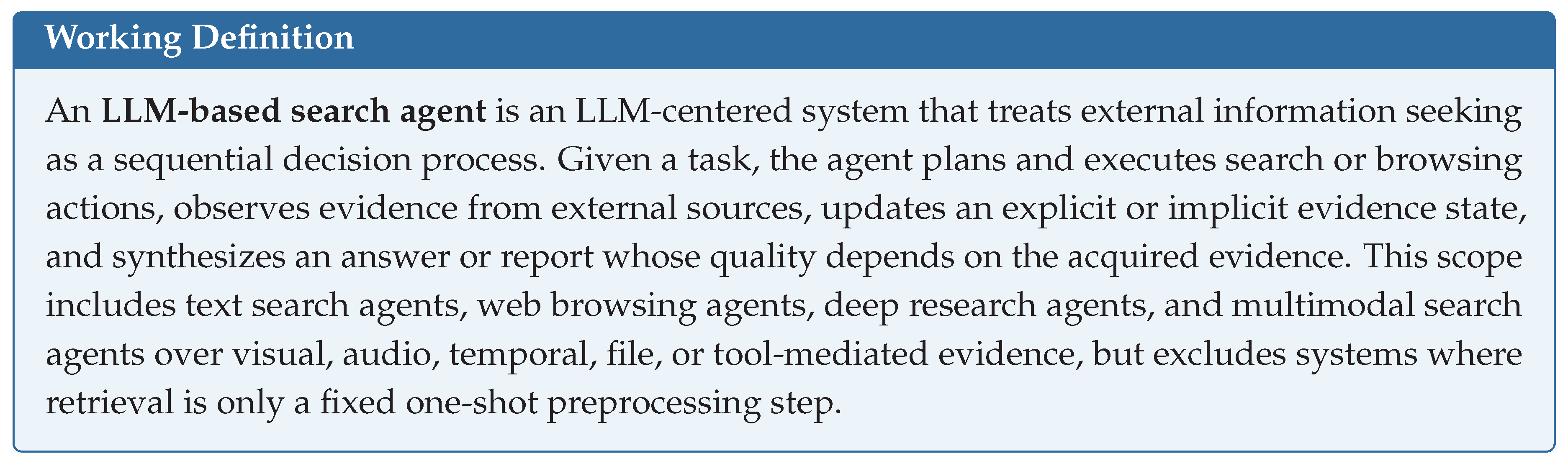
This definition deliberately places the boundary at evidence-seeking control. It is broader than traditional information retrieval, because the system is judged not only by ranking quality but also by planning, tool use, memory, synthesis, and evidence attribution. Compared with the broader LLM-agent literature, our scope is restricted to search agents, whose core functionality lies in acquiring, evaluating, and integrating external information. As a result, system performance depends not only on the final answer but also on the quality of the supporting evidence. It is also different from static RAG, because the agent may adapt its queries, inspect intermediate results, and revise its state before producing the final answer. This perspective is consistent with recent agentic information retrieval framings that view retrieval as an interactive process rather than a single ranking operation [7].
The practical importance of this shift is now visible across both research benchmarks and deployed systems. BrowseComp-style tasks stress persistent short-answer browsing over hard-to-find facts [8,9,10]. GAIA-style assistant benchmarks and Humanity’s Last Exam (HLE) expose the boundary between reasoning, tool use, and evidence discovery [11,12]. Deep research systems aim to produce long-form, cited reports by decomposing questions, searching many sources, and synthesizing evidence over extended horizons [13,14,15,16]. Multimodal benchmarks further expand the unit of evidence from paragraphs and URLs to crops, charts, screenshots, timestamps, files, and tool outputs [17,18,19]. We begin with four overview figures that provide different perspectives on the field. Figure 1 outlines the conceptual evolution of LLM-based search agents, Figure 2 presents the taxonomy used in this survey, Figure 3 summarizes the overall research landscape, and Figure 4 traces the development of representative methods, benchmarks, and real-world systems.
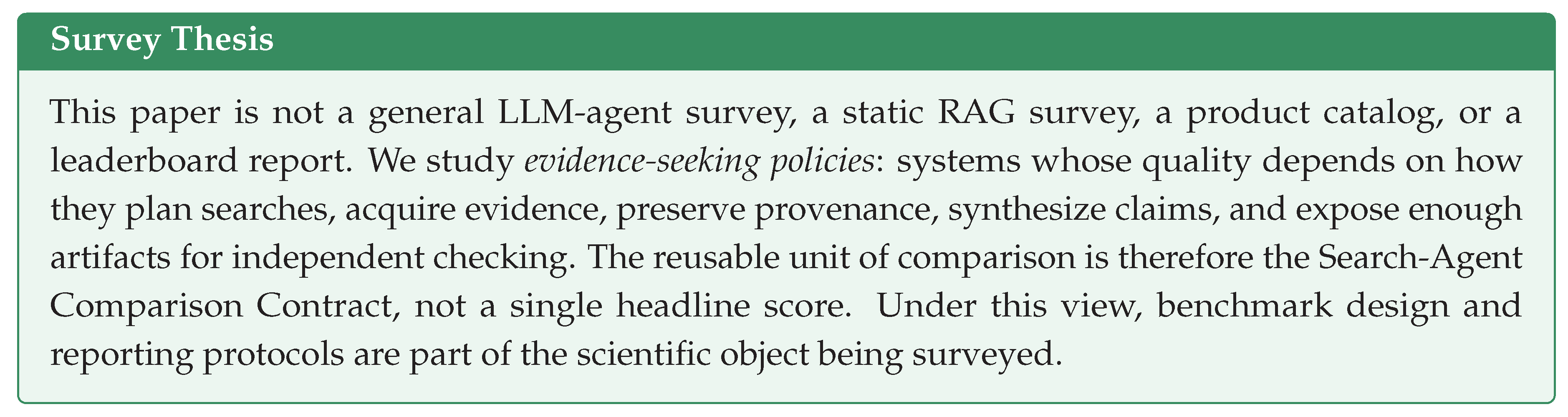
Figure 2 gives the organizational structure used throughout the paper. The taxonomy is not merely a visual table of contents. It also emphasizes that search methods should be interpreted in the context of their evaluation setting, where the information environment and evidence collection process play a central role. We call this lens the Search-Agent Comparison Contract. A result is comparable only when the task regime, evidence environment, evidence unit, control policy, output artifact, and evaluation contract are specified together. A search-reinforcement learning (RL) method trained on short-answer browsing, a report-writing deep research agent, and a multimodal agent using visual, temporal, file, or audio tools may all use planning and retrieval, but they should not be compared under a single undifferentiated score. The survey therefore moves from scope and comparison fields to benchmarks and protocols before turning to methods, learning recipes, system families, applications, and evaluation diagnostics. Section 2 makes this lens explicit in Figure 5, which serves as the paper’s single six-field comparison contract.
Why a New Taxonomy Is Needed.
The literature has grown faster than its terminology. The phrases web agent, search agent, deep search, deep research, agentic RAG, and research agent are often used for systems with very different assumptions. Some operate over frozen corpora, others over live web search APIs or browser sandboxes. Some return exact short answers, while others write multi-section reports. Some are prompt-and-harness systems, whereas others are trained through supervised trajectories, reinforcement learning (RL), process rewards, or test-time scaling. Evaluation protocols also differ substantially across benchmarks. Some focus on the correctness of the final answer, whereas others assess report quality, task completion, or the reliability of evidence collected from the live web. Without an explicit taxonomy, the field risks comparing systems across incompatible environments and rewarding agents that verify memorized answers instead of discovering external evidence.
This risk is not only terminological. Search-agent leaderboards can be distorted by hidden search budgets, personalized live-web rankings, stale snapshots, proprietary browser wrappers, unreported tool permissions, or citations that point to topically related but non-supporting sources. A report can be fluent while missing decisive evidence. A short answer can be correct while its search trace is irrelevant, and a multimodal result can appear grounded while relying on text shortcuts rather than the required visual, temporal, file, or tool evidence. The recurring failure is that the reported score is detached from the conditions under which evidence was acquired. For this reason, we discuss benchmark settings and evaluation protocols before reviewing individual methods, since the interpretation of a method depends heavily on the conditions under which it is tested.
Relation to Existing Surveys.
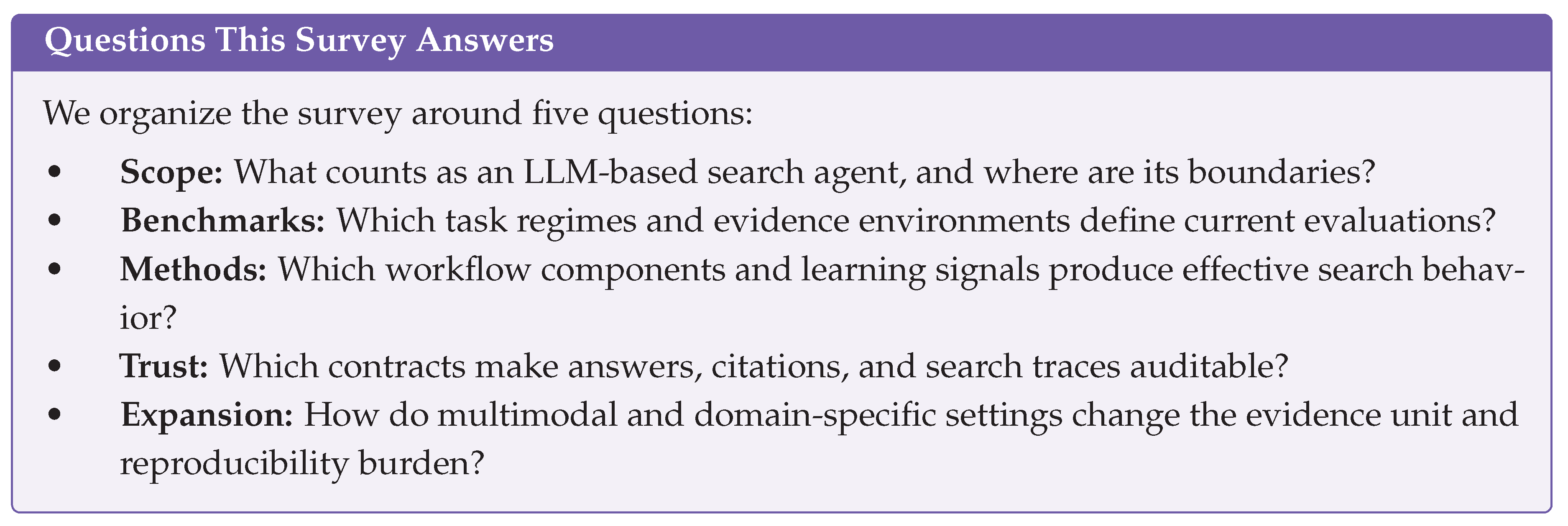
Several recent surveys study adjacent areas, including RAG, LLM agents, deep search, and autonomous deep research [20,21,22]. This survey takes a complementary stance. Rather than treating search agents only as a method family or product trend, we place evaluation contracts and reproducibility at the center of the landscape. Short-answer, assistant, and report-style benchmarks such as BrowseComp, GAIA, HLE, and Deep Research Bench answer different scientific questions because they fix different task regimes, evidence environments, and output forms [8,11,12,23,24]. Multimodal benchmarks such as VideoDR and OmniGAIA further broaden the scope of search-agent evaluation by requiring models to gather and reason over visual, temporal, and tool-generated information in addition to textual evidence [18,19]. This survey is intended for both researchers developing new search-agent methods and those studying benchmark design and evaluation.
Contributions.
The resulting survey is organized around four contributions.
- Boundary and Terminology. We define LLM-based search agents as evidence-seeking control systems and distinguish them from static RAG, generic LLM agents, GUI agents, browsing agents, deep research agents, and multimodal search agents.
- Comparison Contract. We introduce a six-field contract: task regime, evidence environment, evidence unit, control policy, output artifact, and evaluation contract, that makes method and benchmark claims comparable under explicit assumptions.
- Method Synthesis. We organize representative systems by the decisions they own: planning, searching, browsing, memory, verification, writing, harness logging, orchestration, training signal, and test-time scaling.
- Evaluation Perspective. We consolidate benchmark and reporting practice around citation faithfulness, process diagnostics, live-versus-frozen reproducibility, search-time contamination, cost, release artifacts, and domain-specific evidence rules.
Organization.
The remainder of the survey follows the taxonomy in Figure 2. Section 2, Section 3 and Section 4 establish the conceptual frame: terminology, comparison fields, and the historical movement from web search to deep research. Section 5 and Section 6 then analyze benchmark regimes and protocol contracts, because the benchmark defines what counts as valid search, valid evidence, and valid output. Section 7Section 8 synthesize workflow components and learning recipes as implementations of the contract’s control-policy and evidence-unit fields. Section 9 connects system families to applications, risk surfaces, evaluation dimensions, and failure diagnosis. Section 10 turns the same contract into a future-research agenda before the conclusion.
2. Conceptual Scope and Terminology
A survey of search agents needs a boundary before it needs a catalog. The phrase search agent is easy to overextend: a chatbot that occasionally calls a search API is not necessarily a search agent, just as a RAG pipeline is not necessarily an agent. Building on the working definition in Section 1, this section turns the boundary into operational inclusion criteria.
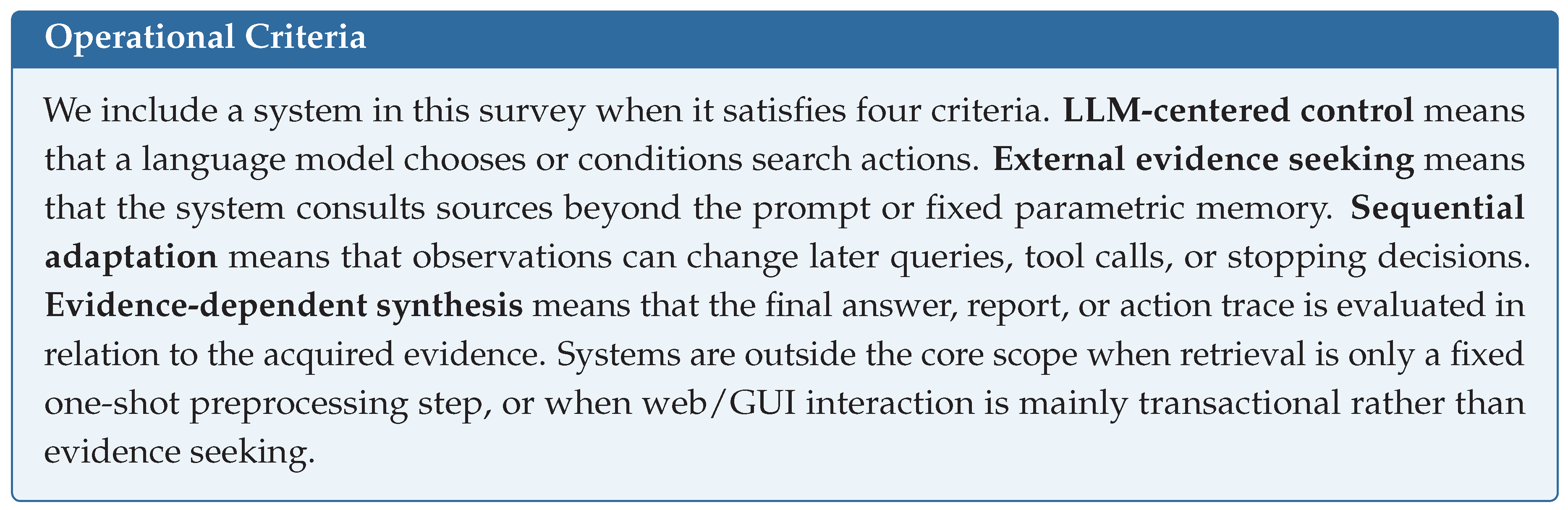
These criteria have three implications. First, search is an action, not just a static context-construction step. Second, the agent’s state matters: past observations, failed queries, source credibility, and task decomposition influence future actions. Third, the final answer should be evaluated jointly with its evidence trail, not only as text.
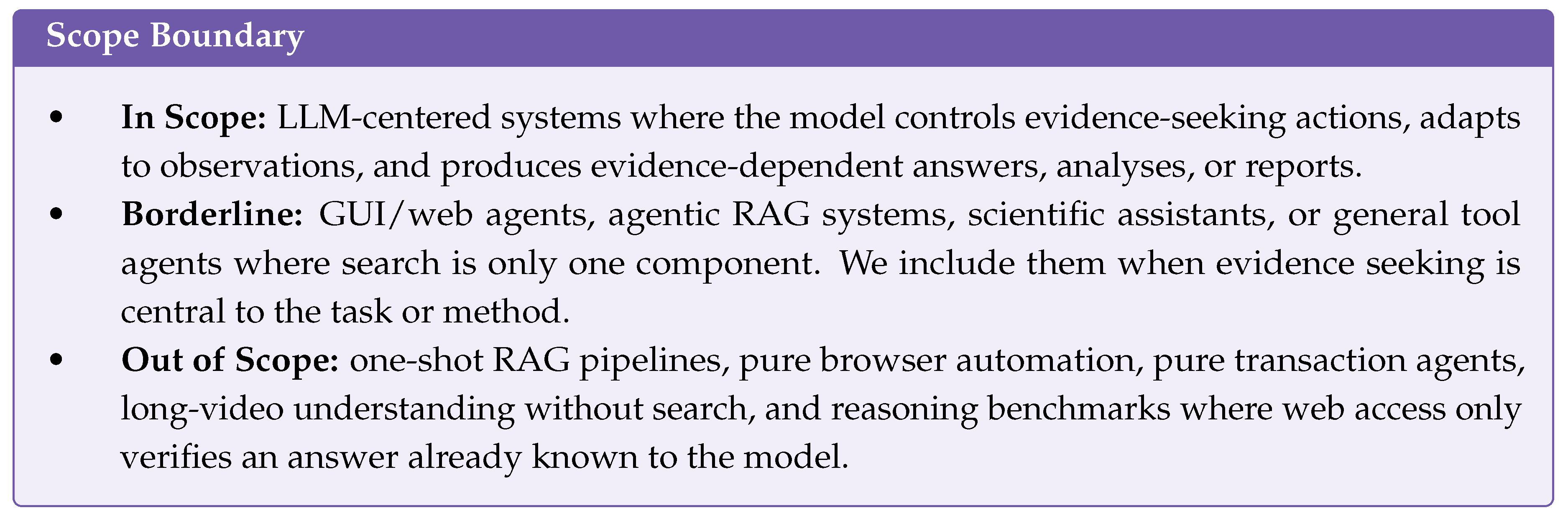
Several neighboring literatures inform this definition without being identical to the target of this survey. Deep-research surveys and resource collections map the emerging product and benchmark landscape [25,26,27]. RAG surveys and frameworks such as Open-RAG, Auto-RAG, and RALLE study retrieval-augmented reasoning and evaluation under more retrieval-centric assumptions [28,29,30,31]. XRAG, Long2RAG, and InstructRAG further emphasize compression, long-context retrieval, and instruction-following retrieval behavior [32,33,34]. Search agents build upon these research directions, but differ in one important aspect. They must continuously decide what information to retrieve next based on the evidence gathered so far.
Six-Field Reading Frame.
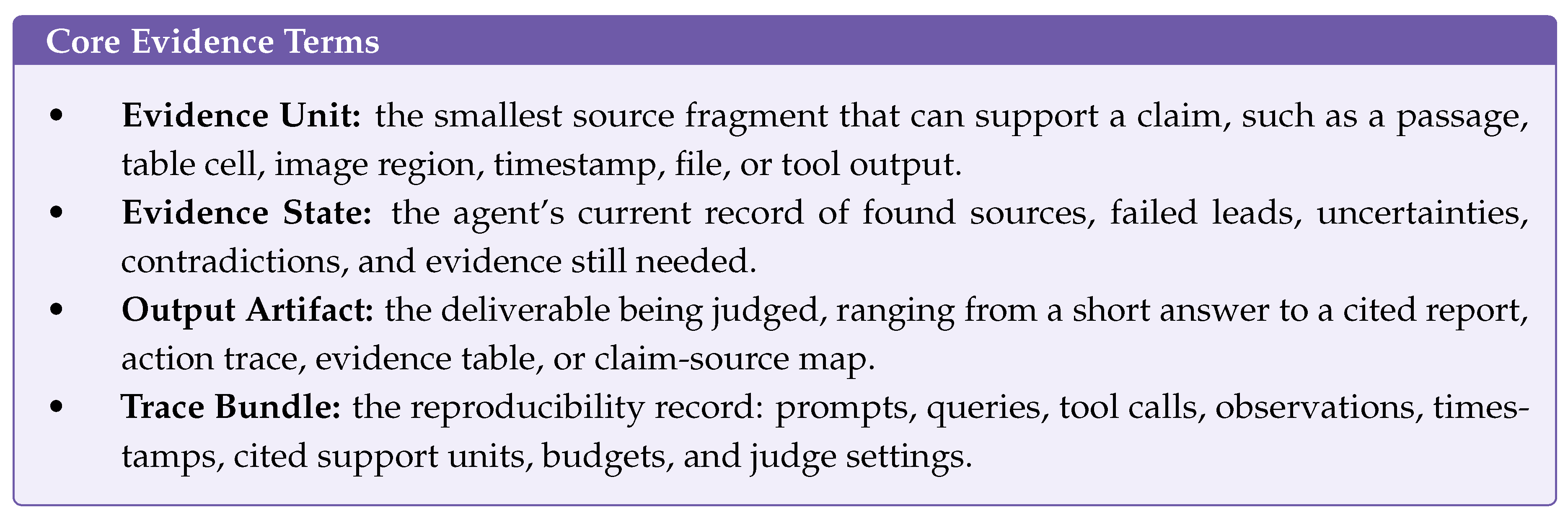
We read each system through six reportable fields: task regime, evidence environment, evidence unit, control policy, output artifact, and evaluation contract. This avoids forcing a system into a single label such as “web agent” or “deep research agent” when its real contribution may be a training signal, benchmark protocol, memory representation, multimodal evidence unit, or orchestration harness. Figure 5 turns this reading frame into the paper’s comparison contract before the terminology ladder in Table 1 fixes the names used throughout the survey. Evidence state and modality are analyzed through the evidence unit, while benchmark-facing output and judging assumptions are made explicit as output-artifact and evaluation-contract fields.
2.1. A Terminology Ladder
Table 1 gives the terminology used throughout this paper. The categories are not mutually exclusive, but instead form a ladder of increasing autonomy, environmental complexity, and output ambition.
Deep Search and Deep Research.
Throughout this survey, deep search refers to search tasks that require iterative exploration of information beyond a single retrieval step. Models are expected to refine queries, gather evidence from multiple sources, resolve inconsistencies, and determine when enough evidence has been collected. Deep research, in contrast, places greater emphasis on synthesizing the collected evidence into a structured output, such as a cited report, an evidence table, or a claim-supported summary. The distinction depends on the primary objective of the task rather than the length of the response. A short-answer task may still involve deep search, while a long report is not necessarily an instance of deep research if it relies only on shallow retrieval.
2.2. Boundaries
Traditional Information Retrieval (IR).
Classical information retrieval focuses on indexing, matching, ranking, and evaluation of documents. Search agents inherit these tools, but introduce model-mediated planning, iterative interaction, and answer synthesis. Recent agentic IR framing makes this shift explicit by treating retrieval as an interactive decision process rather than a one-shot ranking problem [7]. Search agents should therefore be evaluated both as retrieval systems and as sequential decision-making systems.
Generic LLM Agents.
Search agents belong to the broader family of LLM agents, which have been studied in a wide range of domains, including software engineering, robotics, graphical user interfaces (GUIs), games, and multi-agent systems. Compared with these general-purpose agents, search agents focus specifically on acquiring, verifying, and organizing external information to support downstream reasoning. Many techniques developed for generic LLM agents are directly relevant to search agents. Representative examples include AutoGen, OWL, AgentOrchestra, as well as recent studies on multi-agent collaboration, communication strategies, and agent safety [35,36,37,38,39,40]. Throughout this survey, we discuss these methods when they provide useful insights into planning, memory, tool use, or multi-agent coordination. Our primary focus, however, remains methods whose central objective is information seeking and evidence-grounded reasoning.
GUI Agents and Web Agents.
GUI agents execute actions in software interfaces, often targeting task completion. Web browsing agents overlap with GUI agents when they click, scroll, and fill forms, but search agents may also operate through APIs, static corpora, archived web snapshots, or document stores. This survey includes GUI-style web navigation when the objective is information seeking, but excludes pure transaction or control tasks unless they illuminate search behavior. Data science, software, and productivity agents sit on the same boundary. Spider2-V evaluates multimodal agents for data science and engineering workflows [41]. UniDebugger and self-evolving software collaboration systems use multi-agent structures for debugging or development [42,43]. Paper-to-poster or presentation agents produce artifacts from documents rather than evidence-grounded answers [44,45]. These works are adjacent because they share tools and orchestration patterns, but they are included only when they clarify search-agent design.
Frontier Reasoning Benchmarks.
Benchmarks such as GAIA [11] and Humanity’s Last Exam [12] are important stress tests for reasoning and tool use, but they are not identical to search benchmarks. GAIA-style tasks often require evidence discovery and therefore sit near the boundary of this survey. HLE, by contrast, is better treated as a frontier reasoning and calibration stress test unless the evaluation protocol explicitly requires search. Search-specific benchmarks should require evidence discovery rather than merely allowing web verification, and search-enabled runs on public benchmarks must guard against search-time contamination [46,47]. The same caveat applies to olympiad, formal-math, SAT, theorem-proving, and combinatorial-optimization benchmarks [48,49,50,51,52]. These tasks can stress planning and reasoning, and some agents may use search-like tools to solve them, but they become search-agent benchmarks only when evidence discovery, tool selection, or source-grounded synthesis is part of the protocol. These boundaries are intentionally conservative. They help keep the discussion focused on settings where search plays a central role in obtaining and validating external evidence, rather than serving only as an auxiliary component. The next section turns this boundary into a comparison contract. Once the field is bounded by evidence-seeking control, systems can be compared by how they specify tasks, environments, evidence units, policies, artifacts, and evaluation rules rather than by isolated model scores.
3. Design Axes and Comparison Contract
A taxonomy is useful only if it changes how results are read. This section expands the taxonomy used throughout the survey and formalizes the Search-Agent Comparison Contract introduced in the introduction. The purpose is not to force every system into a single box, but to make comparisons easier when systems differ in task regime, evidence access, support granularity, policy ownership, output form, and judging assumptions. The design dimensions below explain how concrete systems instantiate the six contract fields used repeatedly in the benchmark, method, and reporting sections.
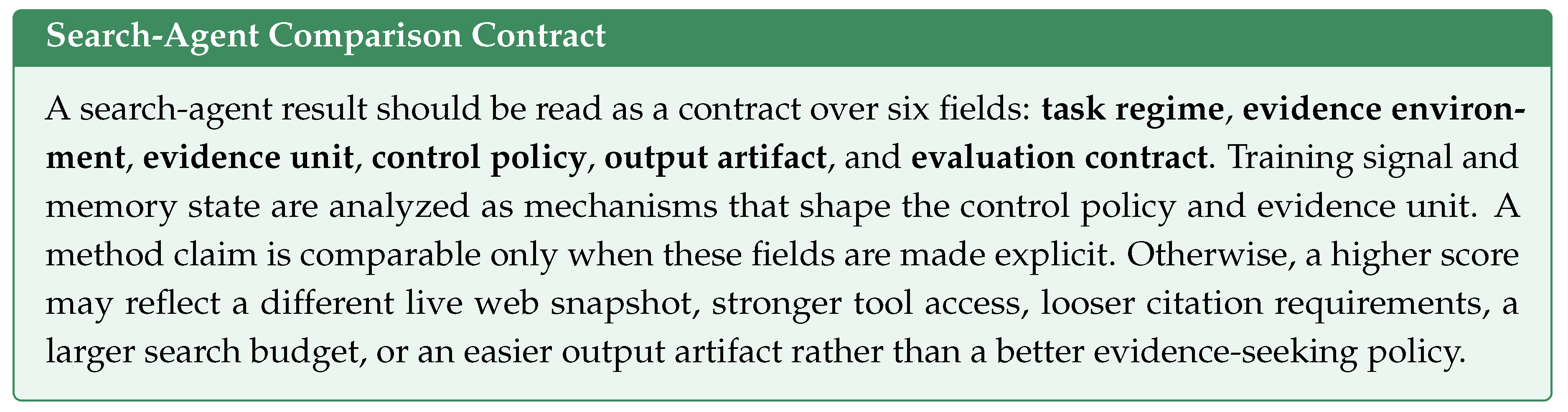
Table 2 gives the compact version of this framework. The rest of the paper repeatedly instantiates these fields. Benchmark sections define the task, environment, output artifact, and evaluation contract. Method sections explain how control policies acquire and organize evidence units, while application sections show how domains change admissible evidence and escalation rules.
3.1. Task Intent
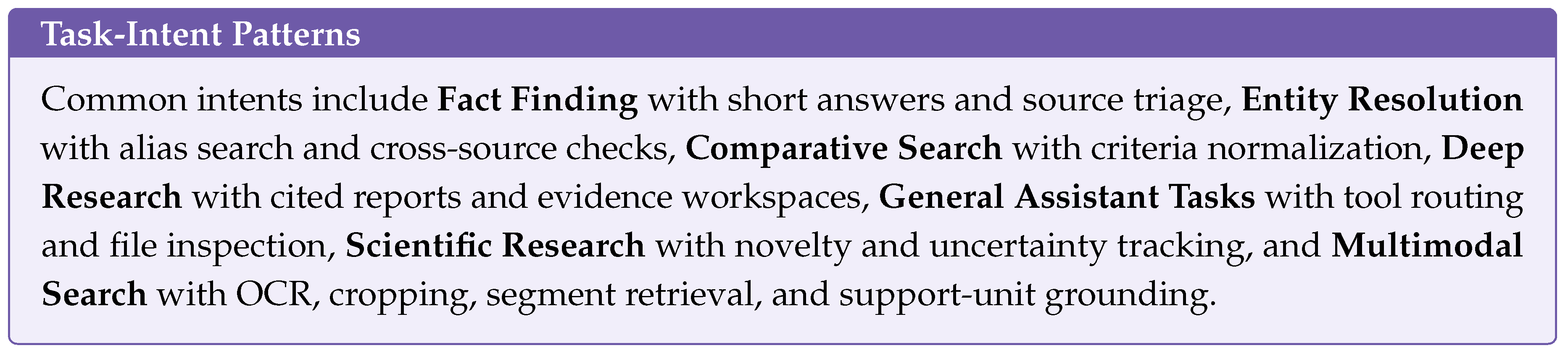
The first axis is the user’s information need. The useful split is not by topic, but by the artifact and failure mode that the task creates. Distributed-evidence QA and hard factual browsing ask whether the agent can discover one decisive fact or relation [8,9,10,53,54]. Tool-using assistant tasks add file, calculation, and tool-routing dependencies to a compact answer contract [11,12,55,56]. Report-oriented deep research makes coverage and synthesis the judged object [23,24,57,58,59], while multimodal search makes support-unit selection itself part of the task [60,61,62,63,64]. The intent label therefore predicts what can go wrong: missing a fact, missing a tool step, missing coverage, or missing the correct support unit.
3.2. Evidence Environment
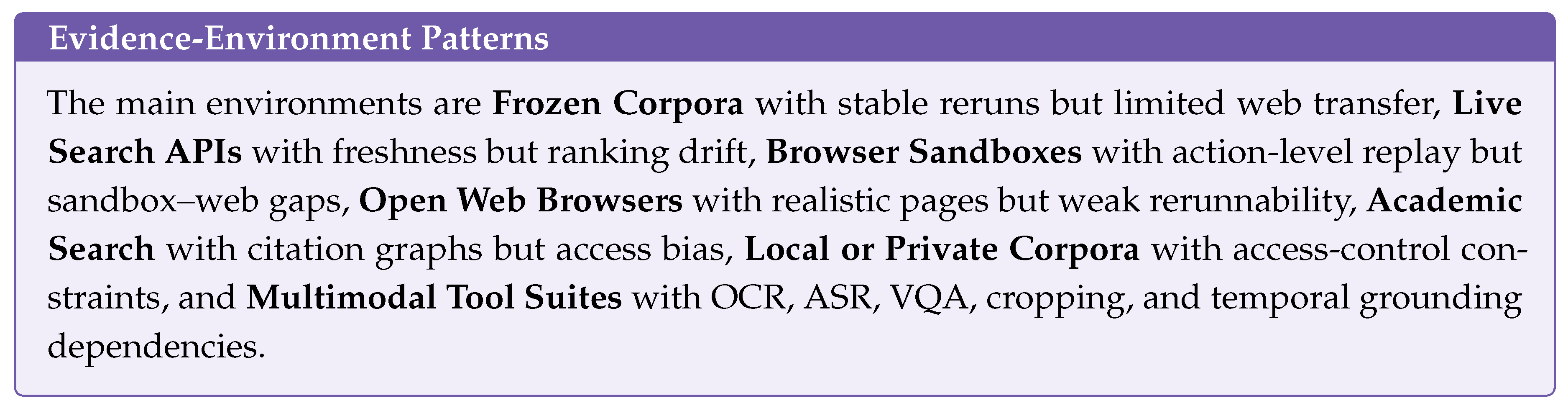
The environment determines what the agent can observe and what can be reproduced. Frozen-corpus regimes isolate retrieval and reasoning because the index, retriever, and context-selection policy can be fixed [1,65,66,67,68]. Browser regimes move the scientific object from ranked passages to page interaction, forms, screenshots, and stateful observations [69,70,71,72,73,74,75]. Live or semi-live regimes test robustness to freshness, ranking drift, and intrinsic-knowledge leakage [10,76,77,78]. These regimes answer different questions: a frozen-corpus gain is usually not the same claim as a browser-action gain or a live-web robustness gain.
3.3. Control Policy
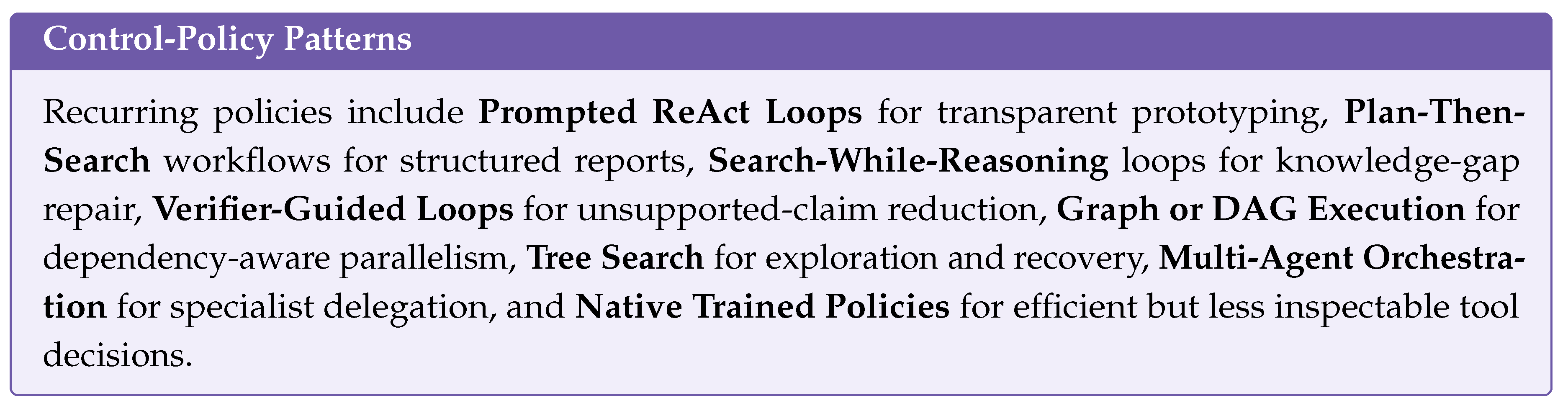
Search agents can also be categorized according to how the search process is controlled. Many early systems rely on an external framework, where prompts, tool interfaces, and predefined agent roles explicitly organize the interaction between planning, retrieval, and response generation [4,5,79,80,81]. More recent approaches instead learn the search policy itself, allowing the model to decide when to search, how to formulate queries, and how to incorporate newly retrieved evidence during reasoning [82,83,84,85,86,87,88]. Another line of work adopts hierarchical or multi-agent architectures, where a coordinator distributes subtasks to different search modules or specialist agents and integrates their results into a unified solution [89,90,91,92,93,94,95]. These designs represent different choices in balancing controllability, learning capability, and system scalability.
3.4. Evidence State and Memory
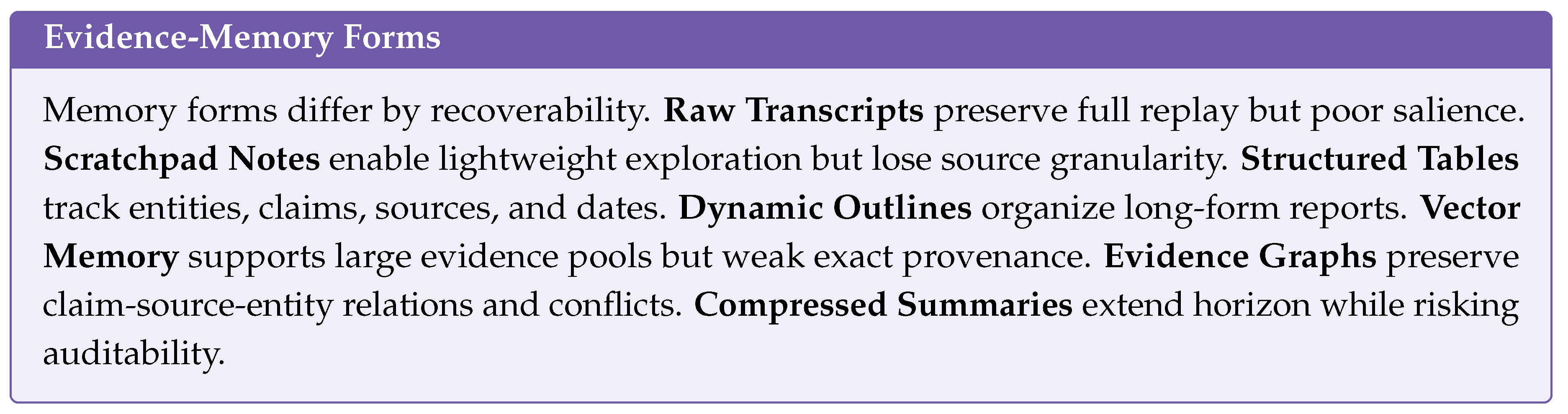
Memory is not just a way to fit more pages into context. It is the agent’s epistemic state: what has been found, what is uncertain, what is contradicted, and what still needs to be checked. Search-agent memory methods differ by what they preserve. Compression-oriented systems preserve long-horizon interaction under context pressure [96,97,98,99,100]. Graph or relation-aware memories preserve claim/entity/source relations that flat scratchpads tend to lose [90,101,102,103,104,105]. Agentic-RAG memories connect stored state to query construction, chunk compression, passage utility, and answer correctness [106,107,108,109,110]. The search-specific question is whether memory remains auditable after it becomes useful.
3.5. Modality and Grounding
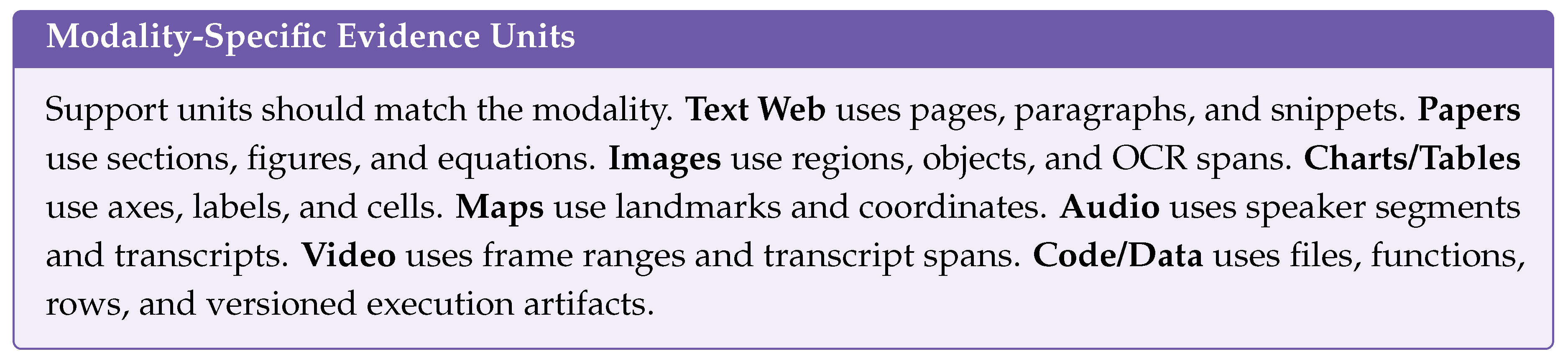
The modality of the search target has a direct impact on how evidence is retrieved and verified. Traditional text-based search mainly relies on textual passages, whereas multimodal search often requires grounding information in image regions, screenshots, charts, OCR results, video frames, or temporal segments. Early work primarily focused on enabling web agents to perceive and interact with visual web interfaces [72,73,74]. More recent studies have extended search beyond text by allowing models to retrieve and integrate evidence from multiple modalities, including images, videos, documents, and web pages [60,111,112,113,114,115,116,117]. Building on these capabilities, multimodal research agents further combine search, tool use, and evidence synthesis to support more complex research-oriented tasks [118,119,120,121]. The same trend can also be observed in domain-specific applications. Search agents have been developed for maps, charts, tables, scientific collections, medical images, and structured documents, where relevant evidence often corresponds to much finer-grained objects than an entire document [61,122,123,124,125,126]. As a result, evaluating multimodal search agents increasingly requires fine-grained grounding, since document-level citations alone are often insufficient to verify claims supported by image regions, table cells, timestamps, or other localized evidence.
3.6. Training Signal
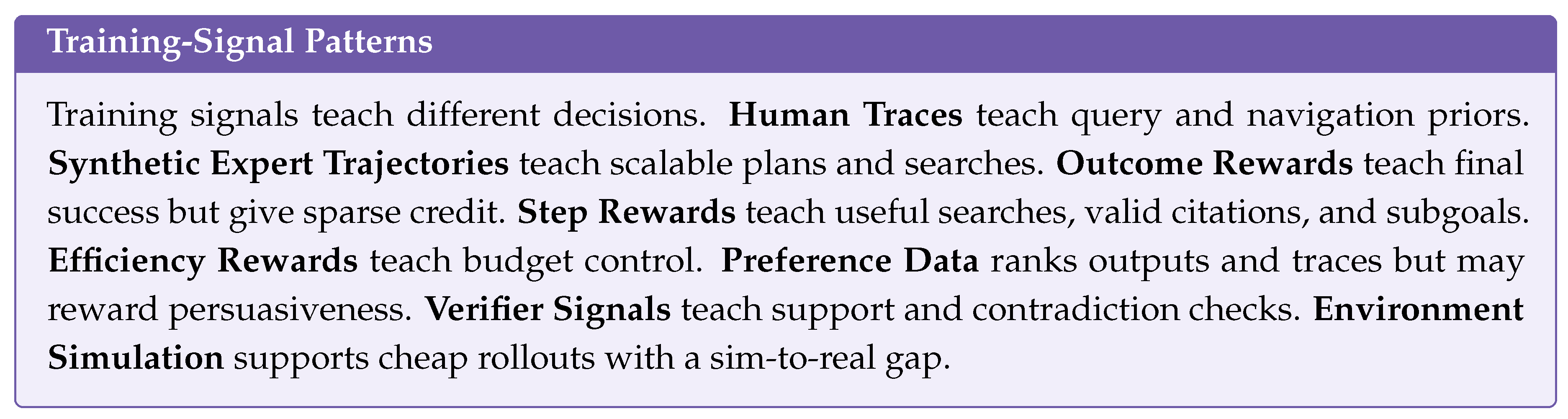
Training search agents requires supervision over actions, observations, and final outputs. The bottleneck is not only collecting enough trajectories. It is collecting trajectories whose actions were actually necessary. Current recipes are best compared by the decision that receives credit. Outcome-only search RL rewards final success [82,127]. Process and step rewards supervise useful intermediate decisions [84,128,129,130,131]. Verifier or verifiable-reward methods connect rewards to support and ranking quality [132,133,134,135,136,137,138,139]. Efficiency-aware policies make search cost part of the objective [92,140,141,142,143,144]. Weak trajectories teach agents to search after the answer is known, overuse tools, or write post-hoc rationales, so the important comparison is which search decision receives credit.
Contract Fields as Experimental Commitments.
The contract fields should be understood as coupled experimental commitments rather than simple metadata. They jointly determine what counts as valid evidence, meaningful search behavior, and reliable evaluation. For example, live-web report generation requires timestamped sources, page snapshots, source diversity, and claim-level citations; multimodal short-answer tasks require fine-grained evidence localization; and trained browser policies require action-level replay and leakage audits. Therefore, fair comparisons should keep the task regime, evidence environment, evidence unit, output artifact, and evaluation contract fixed when isolating control-policy differences. If multiple fields change at once, the result should be treated as a new experimental regime rather than a direct leaderboard improvement, preventing gains from stronger backends, larger budgets, easier outputs, or hidden assumptions from being mistaken for better evidence-seeking policies.
4. From Web Search to Deep Research
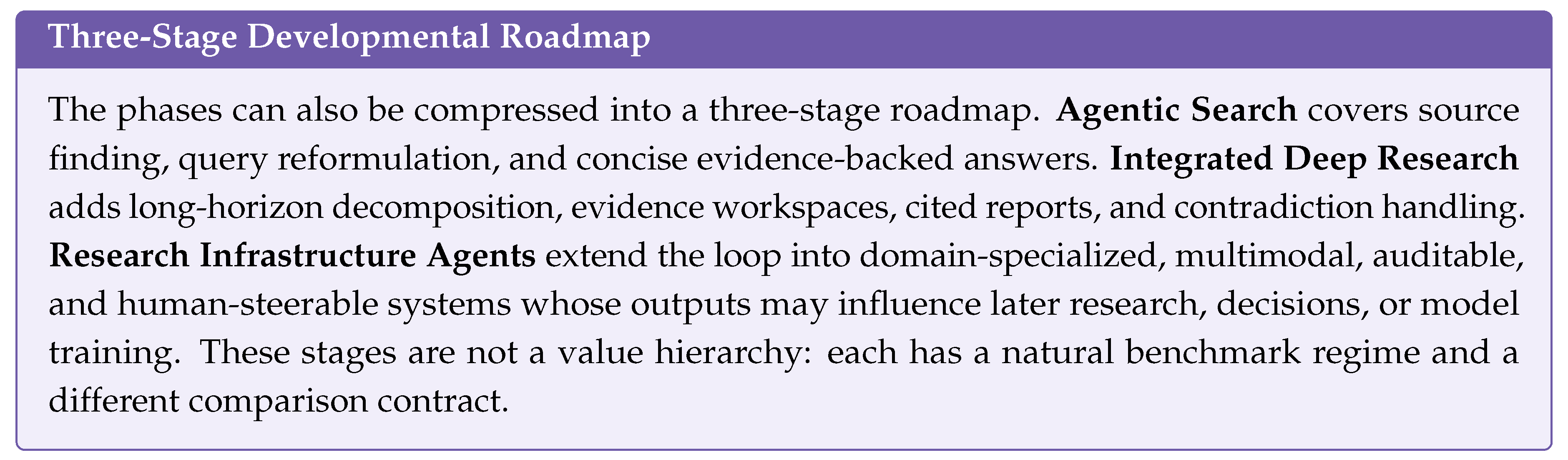
The history of LLM-based search agents is best read not as a linear race toward stronger models, but as a sequence of expanding evidence contracts. Each stage increases either the agent’s autonomy, the complexity of the environment, the richness of the evidence, or the ambition of the output. The work-level evolutionary tree introduced early in Figure 4 should be read as the visual companion to this section. Unlike the compact timeline in Figure 1, this tree highlights concrete papers and institutional short labels, making visible how browser-assisted QA, web-agent evaluation, Tongyi-style trained web agents, search-RL methods, multimodal search, and deployed deep research systems developed in parallel.
Table 3 gives a compact reading guide for the section. The point of the chronology is not that later stages replace earlier ones. Rather, the field repeatedly reuses earlier control motifs under harder contracts. Browser-assisted QA introduces source-backed answer writing, ReAct-style systems turn querying process into an action in a reasoning loop, and web-agent benchmarks expose navigation and observation. GAIA-style tasks couple search with tool use, BrowseComp-style tasks stress persistence, deep research raises the output unit to a report, and multimodal search changes the evidence unit itself.
Read through the Search-Agent Comparison Contract in Figure 5, each phase modifies at least one field that makes results comparable. WebGPT changed the output artifact by attaching answers to sources. ReAct-style methods changed the control policy by making search conditional on reasoning state. Web-agent benchmarks changed the environment from a retriever to an interface. Deep research changed the artifact from a response to an evidence-bearing report. Multimodal search changed the support unit. The historical story therefore doubles as a warning against flat leaderboards: later systems are often solving a different contract, not simply achieving a higher score on the same one.
4.1. Browser-Assisted Question Answering
WebGPT is a natural starting point because it connected a language model to a browser-like environment and trained it with human feedback to answer long-form questions with citations [4]. It already contained many themes that remain central today: search query formulation, webpage inspection, evidence selection, answer writing, and human preference over source-backed answers. The control unit was still a relatively simple query–read–write loop, but the evaluation unit had already moved beyond answer text: a good response needed a plausible connection between the final claim and the cited source.
Source-Backed Answering.
The introduction of browser-assisted question answering shifted the focus from generating correct answers to using retrieved evidence effectively. In these systems, answer quality depends not only on whether relevant information is retrieved, but also on whether the retrieved evidence is accurately incorporated into the final response. As a result, evaluation increasingly considers both the quality of the generated answer and its consistency with the supporting sources. This trend has become even more pronounced in recent deep research systems, which typically involve multiple search iterations, intermediate summaries, and evidence collected from many sources before producing a final report. Consequently, the relationship between retrieved evidence and the generated output has become an important aspect of search-agent evaluation.
4.2. Reasoning-Action Interleaving
ReAct provided a general pattern for interleaving natural-language reasoning with external actions [5]. In search settings, this matters because a search query is rarely final. The agent may discover that a query is underspecified, that a source contradicts another source, or that an intermediate hypothesis should be abandoned. Self-RAG, IRCoT, Active RAG, RAT, DRAGIN, and PlanRAG extended this broader idea to retrieval-triggering, plan-then-retrieve workflows, and stepwise retrieval during reasoning [145,146,147,148,149,150]. These works are not always autonomous agents, but they supply the control motifs later used by search agents.
Reasoning-State Retrieval.
A key difference from conventional RAG is that retrieval is no longer performed only once before generation. Instead, search becomes part of the reasoning process, allowing the model to issue new queries, invoke tools, and gather additional evidence whenever the current information is insufficient. Retrieved observations can confirm an intermediate conclusion, reveal conflicting evidence, or motivate further exploration, making retrieval and reasoning tightly coupled throughout the search process. This idea has also influenced recent reinforcement learning approaches for search agents, where the objective is to learn when to search, what information to retrieve, and how retrieved evidence should guide subsequent reasoning, rather than relying solely on manually designed prompting strategies.
4.3. Web Traversal and Browsing
Mind2Web and WebArena moved evaluation closer to real websites by asking agents to navigate complex pages and execute multi-step web tasks [70,71]. WebWalker then made systematic web traversal itself a target capability [151]. These settings expose limitations absent from static RAG: pages change, relevant information is buried, links can be misleading, observations are partial, and the agent’s next action depends on the current page state.
Action-Trace Browsing.
For search agents, web traversal contributes two ideas. First, the evidence environment is not only a ranked list. It can be an interface with menus, forms, search boxes, pagination, scripts, and hidden content. Second, reproducibility now depends on action traces. A model may fail because it asked the wrong query, clicked the wrong link, misread a page, or stopped too early. This is why later benchmark protocols must specify browser state, date, tools, and allowed actions rather than only the question and answer. The evaluation contract consequently expands from source relevance to action-level path validity.
4.4. General Assistant Search
GAIA occupies a bridge position between web-agent benchmarks and general assistant evaluation: many tasks require reasoning, web search, file handling, and tool use, but the final answer is still compact enough for reliable grading [11]. This made it a common early target for search-enabled agents such as WebDancer and later tool-general agents such as DeepAgent [87,152]. Newer GAIA-style benchmarks push this bridge in two directions. GISA emphasizes realistic information-seeking queries, multiple answer formats, live subsets, and human search trajectories [153]. GAIA2 moves toward dynamic and asynchronous environments with action-level verification [55].
Tool-Evidence Coupling.
The emergence of assistant-oriented search benchmarks has further expanded the role of external tools in search agents. Solving these tasks often requires combining web search with other capabilities, such as document parsing, table understanding, numerical computation, or code execution, before producing a final answer. Consequently, retrieval alone is no longer sufficient, and overall performance depends on how effectively different tools are integrated throughout the reasoning process. Benchmarks such as GAIA reflect this trend by evaluating not only whether an agent retrieves relevant information, but also whether it can coordinate multiple tools and maintain a coherent reasoning process across intermediate steps. At the same time, these benchmarks highlight an important evaluation challenge, since a correct answer does not necessarily indicate whether it was derived from newly acquired evidence or from the model’s internal knowledge supplemented by limited external verification.
4.5. Hard Browsing and Deep Search
BrowseComp crystallized a different kind of challenge: hard-to-find, entangled facts with short, verifiable answers [8]. It is not primarily a report benchmark. It tests whether an agent can persistently find information that is difficult even when the answer is concise. BrowseComp-Plus and LiveBrowseComp later pushed on fairness, transparency, live evaluation, and intrinsic-knowledge dependence [9,10]. InfoDeepSeek and WideSearch further emphasize large-scale, difficult information seeking where answerability depends on search depth and query strategy rather than ordinary recall [77,154].
Necessary Evidence Discovery.
Recent browsing benchmarks place greater emphasis on the difficulty of information acquisition than on the format of the final response. Some tasks require extensive search before a concise answer can be produced, whereas others involve generating longer outputs from relatively limited evidence. This shift has encouraged research on search policies, including query reformulation, adaptive exploration, and stopping strategies, rather than focusing solely on answer generation. These benchmarks have also drawn attention to search-time contamination. If the required information is already memorized by the model or can be obtained from leaked solution pages, benchmark performance no longer reflects the agent’s ability to discover new evidence. To mitigate this issue, several recent benchmarks adopt live-web or hidden-test settings to better evaluate real search capability.
4.6. Deep Research and Report Synthesis
Deep research systems extend the target from answer finding to research-like synthesis. Deep Research Bench, DeepResearch Bench, and DeepResearchGym evaluate different parts of this space: web research over frozen or controlled environments, long-form expert-level reports, and reproducible sandboxed evaluation [23,24,57]. The key challenge becomes not just locating evidence, but organizing it into a coherent argument with defensible citations. The Tongyi WebAgent line is best read as a full-stack recipe rather than as a list of isolated systems. The recipe starts by turning web traversal itself into a measurable capability through WebWalker and WebWalkerQA [151]. It then builds search-necessary data and policies through WebDancer, WebShaper, WebExplorer, and WebSailor [87,88,155,156]. The line extends the loop into research workspaces, outlines, and reports through WebResearcher and WebWeaver [157,158], and finally packages the stack as Tongyi DeepResearch [159]. The paradigm shift is from using a search tool to training an evidence-seeking model family whose data, policy, memory, and report artifact are co-designed.
Report-Level Synthesis.
Recent deep research systems extend search beyond answering individual questions by emphasizing long-form knowledge synthesis. Instead of retrieving a small number of supporting documents, these systems must identify relevant subtopics, collect evidence from multiple sources, resolve inconsistencies, and organize the resulting information into a coherent report with appropriate citations. As a result, report generation becomes closely coupled with the underlying search process rather than serving as a separate post-processing step. This shift has also influenced benchmark design. Recent evaluations increasingly consider source coverage, citation quality, factual consistency, and report organization in addition to final-answer correctness. Systems such as QUEST, Dr. Zero, and SearchSwarm reflect this trend by explicitly modeling long-horizon research workflows instead of treating search as a standalone retrieval component [95,160,161].
4.7. Multimodal Evidence Expansion
As search agents are increasingly applied to real-world information seeking, relevant evidence is no longer limited to textual documents. Web pages frequently contain charts, screenshots, tables, maps, product images, videos, and other multimodal content, requiring agents to retrieve, interpret, and integrate information across different modalities. Existing work has explored this problem from several complementary perspectives. One line of research extends web browsing to multimodal environments, where the evidence required to answer a question is primarily visual rather than textual, as demonstrated by WebWatcher, MM-BrowseComp, and BrowseComp- [17,112,162]. Another direction focuses on representing and updating multimodal evidence during reasoning, allowing visual and textual observations to be jointly incorporated into the search process, as exemplified by Struct-Searcher [104]. More recent systems further combine multiple modalities with specialized tools and expert agents, enabling coordinated reasoning over images, audio, videos, documents, and web resources in frameworks such as OmniGAIA and Orchestra-o1 [19,94]. Together, these developments have gradually expanded search agents from text-oriented retrieval systems to general-purpose research assistants capable of reasoning over heterogeneous information sources.
Support-Unit Grounding.
Video understanding provides a representative example of the challenges introduced by multimodal evidence. Unlike static images or text documents, videos contain temporally distributed information, making relevant evidence both more expensive to locate and more difficult to ground precisely. VideoDR formulates this problem as open-web agentic video reasoning, where an agent must combine video understanding with external search instead of reasoning solely from a given video [18]. These settings also require finer-grained evidence grounding. Depending on the task, supporting evidence may correspond to a video clip, an individual frame, a transcript segment, a visual event, or an external web page. Consequently, evaluating multimodal search agents increasingly relies on support-level grounding rather than document-level citations alone.
5. Benchmark Regimes and Datasets
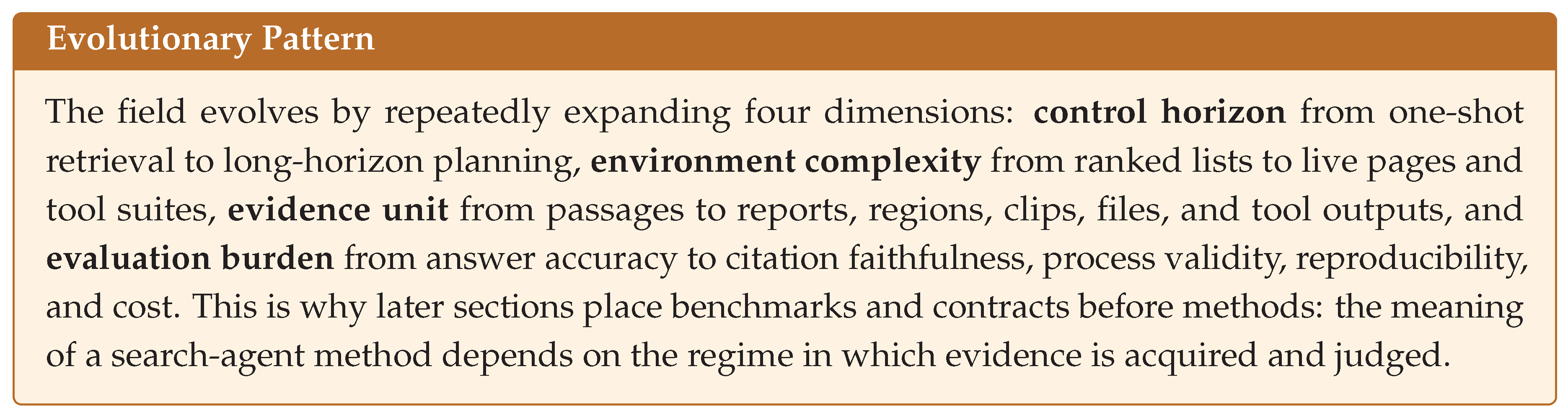
Benchmarks play a central role in shaping how progress in search-agent research is measured. Before reviewing individual methods, we first examine the task settings, information environments, modalities, and output formats that determine how benchmark results should be interpreted. Different benchmark families emphasize different capabilities. BrowseComp focuses on concise answers obtained through targeted evidence discovery, GAIA combines search with external tools, deep research benchmarks evaluate long-form reports supported by citations, and multimodal benchmarks extend evidence acquisition beyond text. The current benchmark landscape can be organized along four dimensions, including output format, environment, modality, and evaluation granularity. Figure 6 compares representative benchmarks according to their reproducibility settings and expected output complexity. Figure 7 further distinguishes them by the types of evidence that must be retrieved, grounded, cited, and evaluated.
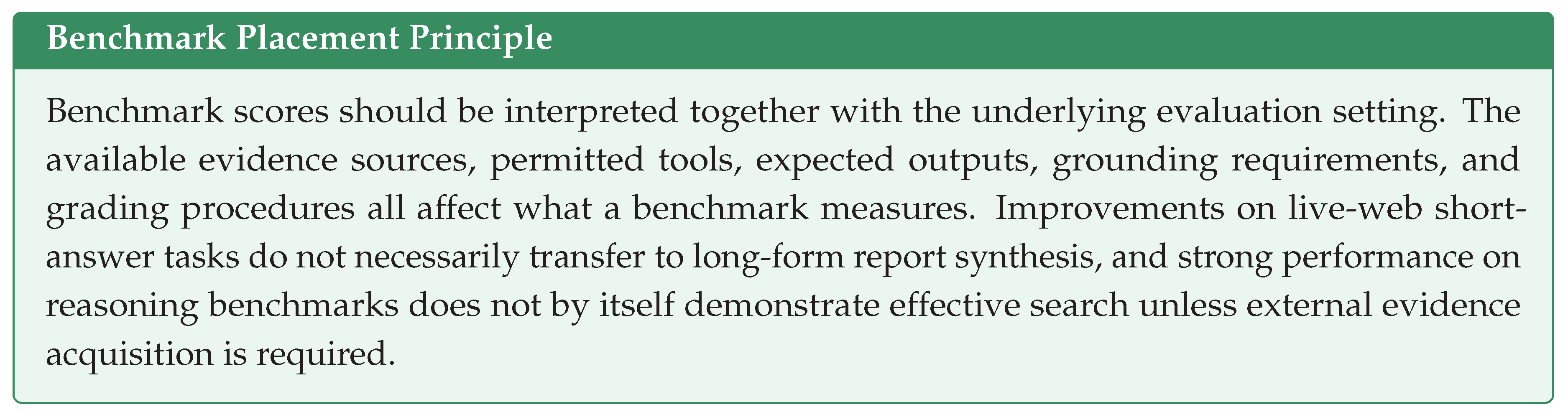
Each benchmark family captures a different aspect of search-agent capability. Short-answer browsing benchmarks primarily test targeted information discovery, but provide limited evidence about report-level synthesis. GAIA-style tasks emphasize tool coordination and multi-step problem solving, although successful completion does not always require substantial search. HLE-style benchmarks focus on expert reasoning and calibration, but may place less emphasis on external evidence acquisition. Long-form deep research benchmarks evaluate source coverage, organization, and citation support, while often overlooking computational cost and deployment efficiency. Multimodal search benchmarks test grounding and tool routing across different evidence types, but require careful controls to rule out text-only shortcuts. Domain-specific benchmarks introduce constraints on source admissibility, reliability, and freshness, although their findings may not generalize across domains.
5.1. Text-Only Short-Answer Browsing
Text-only browsing benchmarks evaluate whether search agents can locate the information needed to answer concise factual questions on the open web. BrowseComp is one of the most widely used benchmarks in this category, consisting of challenging web-browsing tasks with short, easily verifiable answers [8]. Although the expected output is brief, solving many questions requires persistent exploration, multi-hop search, and careful verification across multiple sources. BrowseComp-Plus provides a more controlled evaluation setting, making it easier to analyze the interaction between retrieval and reasoning [9]. LiveBrowseComp further reduces reliance on memorized knowledge by constructing questions from recently emerging information, encouraging agents to retrieve fresh evidence instead of validating existing hypotheses [10]. Related benchmarks, including InfoDeepSeek and WideSearch, broaden the scope from targeted fact retrieval to more open-ended information seeking and comprehensive evidence collection [77,154]. Another line of work considers search tasks in which the primary challenge lies in formulating effective queries rather than locating hidden information. Tip-of-the-Tongue browsing benchmarks simulate situations where users can only recall incomplete or ambiguous clues, requiring agents to progressively refine search queries and verify candidate answers [163]. Compared with BrowseComp-style benchmarks, these tasks place greater emphasis on query formulation under uncertainty. Several recent benchmarks further extend this evaluation setting. EvoBrowseComp focuses on evolving knowledge, DailyReport evaluates open-ended daily information seeking, SGR-Bench studies retrieval under state-dependent reasoning, and the cross-lingual version of BrowseComp-Plus examines whether search agents generalize across languages and multilingual web resources [164,165,166,167]. Together, these benchmarks cover a broader range of practical search scenarios involving temporal changes, multilingual retrieval, adaptive search, and evolving information needs. Despite these extensions, the primary objective of this benchmark family remains targeted evidence discovery for concise answers. They provide an effective evaluation of persistent search, query reformulation, and factual verification, but offer limited assessment of capabilities required for deep research, such as large-scale evidence synthesis, report organization, uncertainty analysis, and fine-grained citation support.
5.2. GAIA-Style General Assistant Benchmarks
GAIA is not a pure web-search benchmark, but it is central to this survey because it operationalizes a practical assistant setting where reasoning, web browsing, file handling, and tool use are often jointly required [11]. This makes it a useful bridge between browser-agent evaluation and deep research evaluation. GISA sharpens the information-seeking side by using real human-crafted queries, multiple answer formats, live subsets, and human search trajectories [153]. GAIA2 stresses dynamic and asynchronous environments with action-level verification [55]. General AgentBench and related test-time-scaling studies then ask whether more search, planning, or tool calls reliably improves general-agent success across search, coding, reasoning, and tool-use tasks [168]. This family also overlaps with web-agent reliability benchmarks, which ask whether agents can act safely and consistently when the environment is an actual website rather than a passage collection. ST-WebAgentBench evaluates safety and trustworthiness in web-agent tasks, WAREX studies reliability failures on existing web-agent benchmarks, Level-Navi Agent focuses on Chinese web search navigation, Odysseys benchmarks realistic long-horizon web tasks, and Mind2Web 2 turns agentic search into an agent-as-a-judge evaluation problem [169,170,171,172,173]. These benchmarks are useful counterweights to short-answer browsing scores: a system that finds facts quickly may still be unreliable when forms, dynamic pages, user constraints, or unsafe actions are part of the task contract. The diagnostic caveat is that GAIA-style success is not automatically search success. Some tasks can be solved by parametric knowledge, arithmetic, file parsing, or tool execution after only shallow retrieval. To use these suites as search-agent evidence, papers should report whether external evidence was necessary, which tool calls produced decisive observations, and whether the same answer is reachable in a closed-book or no-search variant.
5.3. Frontier Reasoning and HLE
Humanity’s Last Exam (HLE) is primarily designed to evaluate frontier-level reasoning across a broad range of scientific and expert domains [12]. Although it is not specifically intended as a search benchmark, it has become increasingly relevant to search-agent research. Many recent deep research systems target HLE-style problems as downstream evaluation tasks, particularly in scientific reasoning settings, as illustrated by systems such as SciResearcher [174]. The growing use of web-enabled agents also introduces additional evaluation challenges. When agents are allowed to access the public web while solving publicly available benchmark questions, retrieved content may contain benchmark-related information or leaked solutions, making it difficult to distinguish genuine evidence acquisition from search-time contamination [46,47]. Consequently, the interpretation of HLE results depends strongly on the evaluation protocol. When external search is disabled, HLE primarily evaluates reasoning ability and model calibration. When search is permitted, additional evaluation procedures, including trajectory inspection, source freshness verification, and contamination analysis, become important for determining whether benchmark performance reflects effective evidence discovery rather than memorized knowledge or retrieval shortcuts.
5.4. Long-Form Deep Research
Recent deep research benchmarks extend evaluation beyond question answering by assessing an agent’s ability to conduct long-horizon information gathering and synthesize the collected evidence into comprehensive reports. Existing benchmarks differ in their evaluation settings and objectives. Deep Research Bench and DeepResearchGym provide controlled or reproducible research environments for evaluating complete search workflows [24,57]. DeepResearch Bench and DeepResearch Bench II place greater emphasis on the quality of generated reports through increasingly detailed expert evaluation protocols [23,58]. Other benchmarks, including LiveResearchBench, Characterizing Deep Research, and ResearcherBench, focus on more realistic research scenarios involving live web search, large-scale evidence collection, and frontier scientific questions [175,176,177]. Compared with traditional search benchmarks, these datasets evaluate not only the correctness of the final output but also the completeness, organization, citation quality, and reliability of the supporting evidence. Several benchmarks further emphasize the research workflow itself. Benchmarks for deep information synthesis, total-recall question answering, report-oriented deep research, AutoResearchBench, MLGym, and MLE-bench evaluate an agent’s ability to discover relevant sources, organize supporting evidence, identify missing information, and produce reports that can be reviewed by human experts [178,179,180,181,182,183]. These benchmarks therefore place greater emphasis on the quality of the overall research process rather than on answer generation alone. Recent studies have also highlighted the importance of document ranking in deep research workflows. The quality of a generated report depends not only on whether relevant sources are retrieved, but also on how candidate evidence is prioritized before synthesis [184]. Consequently, report-oriented benchmarks provide an opportunity to analyze failures originating from retrieval, ranking, evidence organization, or report generation. Another recent trend is the development of domain-specific deep research benchmarks covering personalized workflows, scientific research, financial analysis, and evidence-based scientific summarization [185,186,187,188,189]. Compared with earlier benchmarks, these tasks place greater emphasis on evaluating complete research workflows under realistic application settings. Despite these advances, evaluating long-form research remains challenging because report quality depends on multiple factors and often requires expert judgment. Well-organized reports may still overlook important evidence, provide incomplete citation support, or fail to discuss contradictory findings. For this reason, recent benchmark design has increasingly moved toward evaluating multiple aspects of report quality, including evidence discovery, claim support, report organization, and uncertainty handling, instead of relying on a single overall score.
5.5. Multimodal Evidence Benchmarks
The growing use of multimodal information on the web has driven the development of search benchmarks beyond text-only settings. Recent benchmarks require agents to retrieve, interpret, and integrate evidence from images, charts, maps, videos, documents, and other visual content. Early work, including MMSearch and MMSearch-Plus, focused on multimodal retrieval by combining iterative search with evidence verification across textual and visual sources [60,111]. More recent benchmarks, such as WebWatcher, MM-BrowseComp, VisBrowseBench, and BrowseComp-, extend this setting to multimodal web browsing, where agents must interact with visually rich web pages, perform cross-modal reasoning, and complete complex search workflows [17,112,162,190]. Other work, including Struct-Searcher and MMINA, further investigates how multimodal evidence can be explicitly represented and updated throughout the reasoning process [104,191]. As multimodal search has continued to evolve, benchmark design has diversified in several directions. Retrieval-oriented benchmarks evaluate whether agents can locate relevant evidence from multimodal resources, including geographic information, visual search, multi-hop image retrieval, interleaved language-vision interaction, and multimodal fact verification [61,62,192,193,194]. Another group of benchmarks focuses on the complete search process, evaluating how agents coordinate perception, retrieval, tool use, and reasoning across visually grounded search and multimodal research tasks [195,196,197,198,199,200,201]. These benchmarks require evidence to be grounded at a much finer granularity than traditional document retrieval, where supporting information may correspond to image regions, OCR spans, chart cells, map locations, timestamps, files, or tool outputs. Video understanding and multimodal research assistants further extend this evaluation setting. VideoDR studies open-web agentic video reasoning, requiring agents to combine video understanding with external search rather than relying only on the provided video [18]. OmniGAIA broadens the evaluation to image, audio, video, language, and external tools, while Orchestra-o1 uses the benchmark to evaluate modality-aware orchestration and learned task delegation across heterogeneous specialist agents [19,94]. Together, these benchmarks illustrate a broader trend toward evaluating search agents that reason over multiple modalities instead of text alone. Despite this progress, evaluating multimodal search remains challenging. In many benchmark settings, questions can still be answered from surrounding text, captions, page titles, or memorized knowledge without inspecting the intended visual or temporal evidence. Consequently, recent benchmark design increasingly emphasizes modality necessity, fine-grained evidence grounding, and ablation studies that remove text-only shortcuts to verify that the required multimodal evidence is genuinely used.
5.6. Consolidated Benchmark Landscape
Table 4 should be read horizontally and vertically. Horizontally, each row states a benchmark’s reusable resources, evidence regime, and expected output form. Vertically, the category rows separate benchmark families that should not be collapsed into one leaderboard: short-answer browsing, GAIA-style assistance, long-form deep research, multimodal search, and domain-specific reporting. The table also reveals three structural imbalances. First, short-answer browsing and GAIA-style tasks are easier to score, so they are often overused as proxies for search competence. Second, long-form and domain-specific research benchmarks better match deployed deep research, but they depend on expensive rubrics and citation audits. Third, multimodal search benchmarks are growing quickly, yet their evaluation remains fragile unless the support unit is defined below the page level. A balanced evaluation suite should therefore combine at least one exact-answer benchmark, one report-style benchmark, one live or freshness-sensitive slice, and one evidence-unit grounding test when multimodal evidence is involved.
5.7. Domain-Specific Deep Research
Domain-specific benchmarks examine whether search agents can operate under the evidence requirements of particular application areas. In shopping research, agents must account for product specifications, price, availability, and user preferences, as illustrated by DeepShop [205]. Medical benchmarks impose stricter requirements on factual accuracy, uncertainty, safety, and expert validation, as in MedBrowseComp [206]. Financial benchmarks such as FinDeepResearch evaluate long-form analysis grounded in company filings, market information, and quantitative evidence [204]. Similar concerns arise in scientific research, forecasting, personalization, and planning. Scientific benchmarks assess literature retrieval, equation discovery, and evidence synthesis [181,203,209,210]. Forecasting benchmarks evaluate whether agents can form forward-looking judgments before the outcome is known [211,212]. Personalized and planning benchmarks further require agents to select and organize evidence according to user-specific constraints and long-term objectives [213,214]. In each case, benchmark performance depends on whether the agent can adapt its search process to the sources, assumptions, and evaluation standards of the target domain. Legal and industrial benchmarks place additional emphasis on temporal validity and source provenance. Legal search tasks may require agents to distinguish between rules and facts that were valid at different points in time, while industrial and physical-science benchmarks often depend on document versions, authoritative sources, and expert-oriented evaluation criteria [186,188,215]. A clear benchmark specification should therefore identify the permitted source types, the relevant time period, and the expertise required for evaluation. Results from general-purpose search benchmarks do not necessarily transfer to medicine, law, finance, or enterprise applications. Reliable evaluation in these areas requires explicit assumptions about source authority, information freshness, privacy, and expert review. Domain-specific benchmarks should therefore be interpreted within the particular task and evaluation setting for which they were designed.
6. Benchmark Protocols and Evaluation Contracts
Benchmark performance is meaningful only when the evaluation protocol is clearly specified. In search-agent research, a benchmark includes not only a collection of tasks but also the experimental setting under which those tasks are evaluated. The available information sources, permitted tools, resource budgets, evidence requirements, and evaluation procedures all influence what a benchmark measures. As a result, two benchmarks with similar questions may evaluate substantially different capabilities if they differ in search environment, tool availability, output requirements, or grading criteria. This section summarizes the major protocol components that should be considered when comparing search-agent benchmarks. Table 5 provides a unified view of these protocol dimensions, including task setting, search environment, tool access, computational budget, evidence requirements, evaluation protocol, and result reproducibility. Together, these factors provide the context needed to interpret benchmark results and to compare different search-agent systems fairly.
6.1. Task and Output Contracts
The task contract specifies what the user asks and what the agent must return. Short-answer tasks such as BrowseComp favor precise entity or fact discovery [8]. GAIA-style tasks favor compact answers but often require web search, files, tools, and calculation [11,55,153]. Deep research tasks require a cited report, which makes coverage, organization, and source support part of the answer [23,24,175]. Multimodal tasks add grounded evidence units such as image regions, OCR spans, chart cells, timestamps, or tool outputs [17,18,162]. A clear output contract prevents leaderboard confusion. A system optimized for short answers may look weak on report-style tasks because it does not synthesize broad coverage. A report generator may look strong in human preference while failing exact-answer benchmarks. A multimodal agent may only be meaningful when visual evidence is necessary rather than merely available. Benchmarks should therefore state whether they reward exactness, breadth, source diversity, report quality, action completion, or cross-modal grounding. For example, BrowseComp scores the discovery of a concise fact, DeepResearch Bench scores a research artifact, and MM-BrowseComp asks whether the answer is grounded in multimodal evidence rather than in page text alone.
6.2. Environment Contracts
The environment contract determines what can be reproduced. A frozen corpus fixes documents and retrieval results, which improves comparison but may understate live-web difficulty. A live web setting measures freshness and practical robustness but introduces ranking drift, page changes, personalization, region effects, and access variability. A browser sandbox exposes navigation and page-state challenges. A multimodal tool suite exposes OCR, image search, VQA, video parsing, and code execution, but the exact tool versions become part of the benchmark. Hybrid protocols are often strongest. A frozen slice can support stable comparison, a live slice can test freshness, and a hidden or private slice can reduce contamination. A trace release can make successes and failures auditable. DeepResearchGym, LiveResearchBench, LiveBrowseComp, BrowseComp-Plus, GAIA2, and Deep Research Comparator illustrate different attempts to balance realism and reproducibility [9,10,55,57,175,216]. The practical reading is benchmark-specific: LiveBrowseComp should be interpreted with run dates and provider settings, DeepResearchGym with sandbox configuration, and GAIA2 with action-state verification.
6.3. Tool and Budget Contracts
The tool contract defines the action space. A search API, a browser, a PDF reader, OCR, image search, video parsing, code execution, and file tools produce different behaviors even with the same model. Tool access also changes the meaning of model comparison: a system with a stronger search backend may beat another system without better search policy. For this reason, methods should be evaluated under equal-tool baselines whenever possible. The budget contract is equally important. Search agents scale with queries, page visits, tokens, wall-clock time, retries, and parallel workers. A deep research system with unlimited browsing can find more sources but may be too expensive to deploy. An efficiency-aware system such as SlimSearcher is meaningful only when accuracy and cost are reported together [140]. Parallel systems such as Flash-Searcher or ParallelMuse should report wall-clock speedup, branch utility, and aggregation failures, not only final accuracy [92,93]. Thus, a GAIA score without tool-call counts, a BrowseComp score without query/page budgets, or a deep-research score without report-generation cost is only a partial result.
6.4. Evidence and Citation Contracts
The required form of supporting evidence varies across search benchmarks. In text-based tasks, references to web pages or supporting passages are often sufficient. Scientific benchmarks may require citations to specific papers, sections, figures, or equations, whereas multimodal benchmarks frequently rely on finer-grained evidence such as image regions, OCR spans, chart cells, map locations, timestamps, video segments, or tool outputs. Clearly defining the expected evidence unit is therefore essential for consistent and reproducible evaluation. Recent work has also shown that the presence of citations alone is not sufficient to establish evidence quality. Citations may refer to documents that are only loosely related to the reported claim, contain outdated information, or fail to support the specific statement for which they are cited. Consequently, deep research benchmarks increasingly evaluate citation quality at the claim level by considering source relevance, evidence localization, attribution accuracy, and contradiction detection [217,218,219,220,221]. These considerations are particularly important for long-form report generation and multimodal search, where supporting evidence often corresponds to localized regions, timestamps, table entries, or other fine-grained information rather than entire documents.
6.5. Judging and Release Contracts
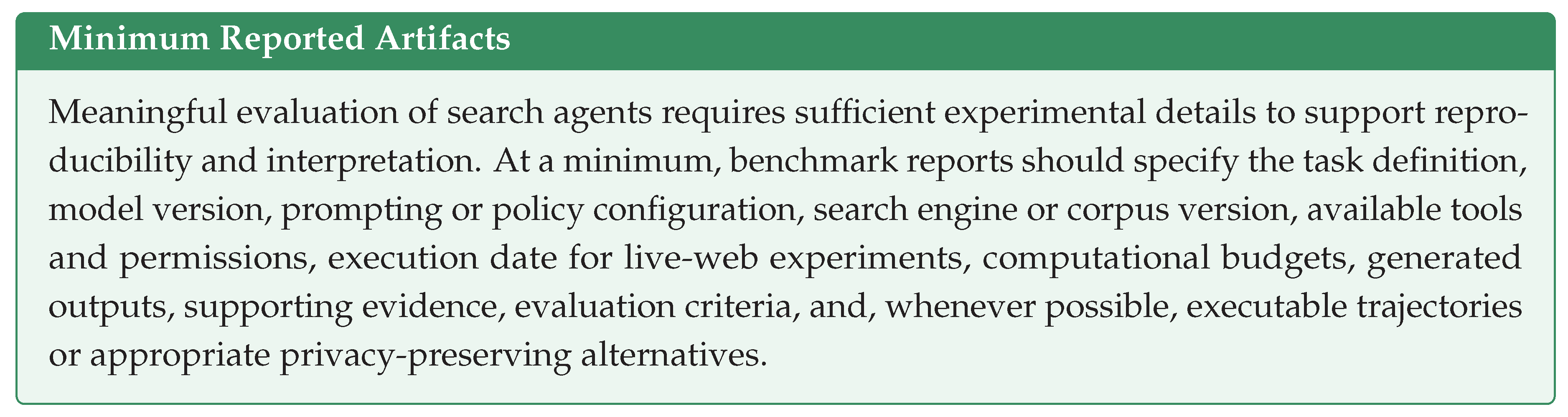
The judge contract defines how success is measured. Exact match is useful for short answers but hides process failures. Rubric judging captures report quality but may reward fluent unsupported writing. LLM judges scale but can be biased by style and citation density. Human comparison is useful for helpfulness but expensive and inconsistent. A strong benchmark should therefore publish judge prompts, rubric definitions, calibration examples, and inter-annotator agreement when human judgments are used. The release contract defines what others can inspect. For static datasets, item IDs and splits may be sufficient. For live-web search agents, a meaningful release should include task prompts, model versions, search provider settings, timestamps, URLs, page hashes, snippets, screenshots, tool calls, final answers, and judge outputs. When privacy or licensing prevents full trace release, the paper should state what was withheld and provide a privacy-preserving substitute. Without release artifacts, search-agent results are difficult to reproduce and difficult to trust. The minimum standard should scale with benchmark volatility: frozen corpora need versioned IDs and retrieval logs, live-web runs need timestamped observations, and browser or multimodal settings need action traces plus support-unit evidence.
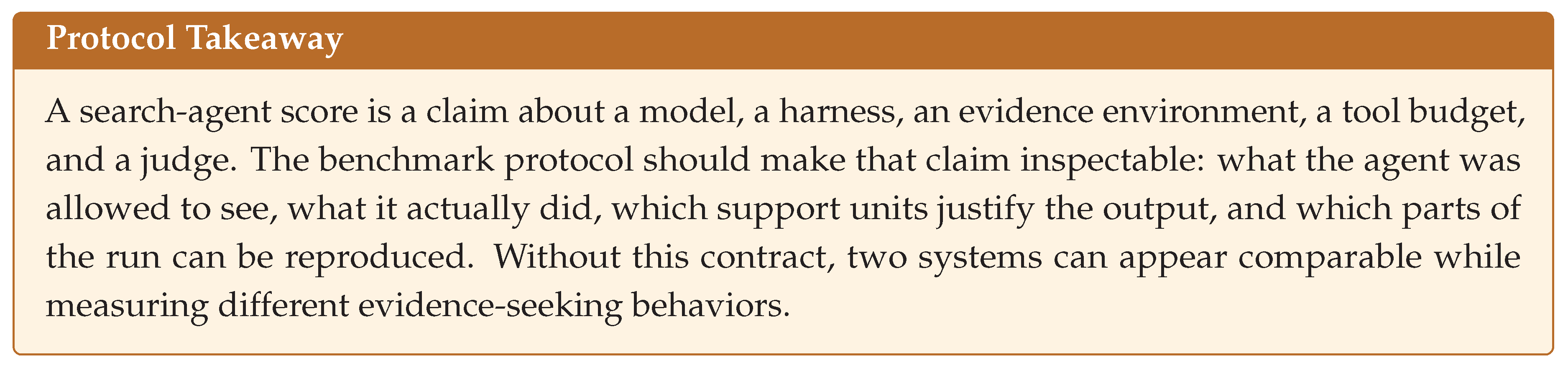
Taken together, these contracts turn benchmark reporting into a reproducibility standard. A new search-agent benchmark or method should state its output contract, environment contract, tool and budget contract, evidence contract, judge contract, and release contract. If one of these fields is omitted, the missing field should be treated as an experimental limitation rather than a harmless implementation detail.
7. Workflow Taxonomy: Components and Harnesses
Methods are easiest to compare when workflow components are treated as responsibility boundaries. Although systems differ widely in implementation, most LLM-based search agents can be described by a small set of recurring components. This section begins the methods branch of the taxonomy: after the benchmark and protocol layer defines what behavior is being measured, we now identify the executable workflow that produces that behavior. In the Search-Agent Comparison Contract, these components implement the control policy, maintain the evidence unit, and produce the output artifact. Figure 8 shows the workflow from user inputs to subquestion planning, evidence acquisition, memory-centered summarization, verification, and final answer or report writing.
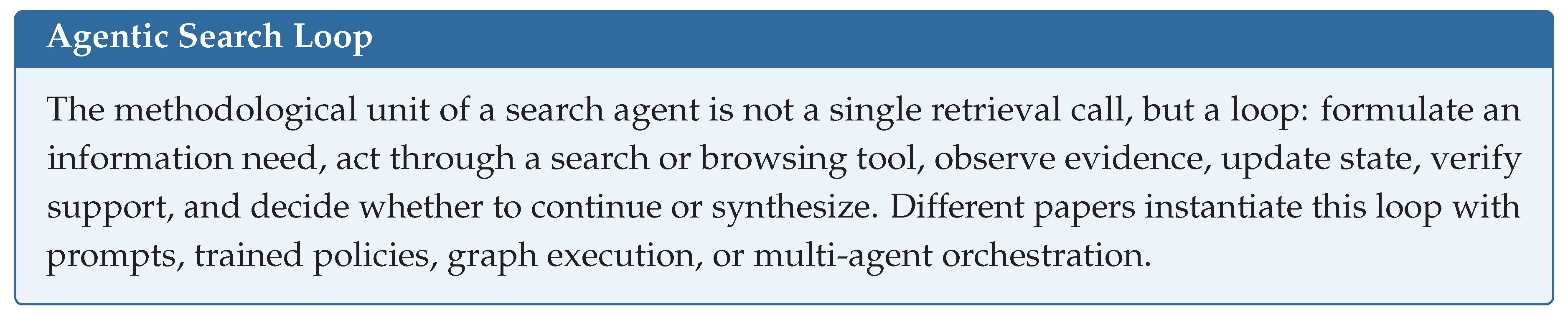
Different workflow components play distinct roles in modern search agents. Planning modules decompose complex tasks into manageable subgoals, search modules retrieve and update external evidence, and memory modules maintain intermediate information together with its provenance. Verification modules examine the consistency and reliability of the collected evidence, while writing modules synthesize the final output. Additional components, such as execution frameworks and orchestration modules, are responsible for coordinating multiple reasoning branches, managing tool interactions, and ensuring reproducible execution.
Many recent search-agent systems differ not in the set of components they include, but in how these responsibilities are implemented and coordinated. Recent work has increasingly shifted decision making from manually designed prompting strategies to learned policies, from single-agent execution to collaborative multi-agent architectures, and from implicit reasoning traces to explicit evidence representations that can be inspected and evaluated.
7.1. Planner and Query Decomposer
The planning module translates a user request into a set of searchable subproblems. For simple factual questions, this may involve generating a small number of precise queries. More complex research tasks often require an evolving outline, a sequence of intermediate goals, or a set of competing hypotheses. Existing systems adopt sequential, parallel, tree-structured, and graph-based planning strategies. Flash-Searcher, for example, converts an initially sequential workflow into a dynamic directed acyclic graph, allowing independent subtasks to be executed in parallel while preserving their logical dependencies [92]. Parallel planning can reduce latency, but it performs poorly when important dependencies are not known in advance. Sequential planning is easier to revise as new evidence becomes available, although it often requires more interaction steps. Tree- and graph-based approaches support broader exploration, but introduce additional challenges for coordination, evaluation, and credit assignment.
Query Planning and Branch Control.
Recent work has made the planning process more explicit and structured. WebThinker and WebCoT organize reasoning around evidence collected from the web [222,223]. LASER introduces a structured search protocol together with a context register for managing long-horizon interactions [224]. MASK separates multi-agent search from knowledge optimization, while ManuSearch provides an open multi-agent workflow with visible intermediate states [225,226]. In these systems, planning extends beyond question decomposition to include the evidence required for each subproblem, the dependencies among branches, and the conditions for merging or terminating them. Planning has also become a direct target of methodological study. Plan Before Search examines the value of constructing a plan before issuing search queries [227]. Other approaches draw on classical AI planning and AND/OR trees to organize web-based problem solving [228,229]. WebUncertainty uses uncertainty estimates to guide planning and reasoning, while ScaffoldAgent learns dynamic outlines for open-ended research tasks [230,231]. Together, these studies broaden the role of the planner from selecting the next query to organizing the search process over an extended horizon. Planner evaluation can therefore consider the coverage of relevant subgoals, the accuracy of inferred dependencies, the treatment of unsuccessful branches, and the clarity of the evidence requirements associated with each subproblem.
7.2. Searcher, Retriever, and Browser
Search agents interact with a wide range of information sources, including web search engines, local document collections, vector databases, academic search systems, browser environments, code execution tools, and multimodal resources. Different retrieval substrates lead to different system capabilities. Systems operating on fixed corpora provide reproducible evaluation settings, whereas live web search enables access to up-to-date information but introduces additional challenges for reproducibility and benchmark consistency.
Retrieval Substrate and Source Choice.
Recent work has explored retrieval from several complementary perspectives. AgentIR and UIS-Digger extend retrieval beyond conventional indexed corpora by investigating deep-research retrieval and information discovery from partially indexed or previously unseen resources [232,233]. Another line of work integrates retrieval more tightly with reasoning. Methods such as MCTS-RAG, AirRAG, DeepRAG, and RAG-STAR combine retrieval with iterative reasoning, verification, or tree search so that evidence collection evolves throughout the inference process [234,235,236,237]. Other approaches focus on improving query generation and document ranking. RQ-RAG, DMQR-RAG, and DynamicRAG optimize query rewriting, multi-query retrieval, and reranking under changing information requirements [238,239,240]. Compared with conventional retrieval-augmented generation, search agents further treat retrieval as a sequential decision process in which the agent determines when additional search is required, which sources to consult, and how newly retrieved evidence should influence subsequent reasoning. Several studies also investigate how retrieved evidence should modify the reasoning process itself. Evidence retroactivity and credibility-aware attention mechanisms allow newly retrieved information to revise or suppress unsupported intermediate conclusions [241,242]. Similar mechanisms are increasingly adopted in search agents, where newly discovered evidence may invalidate previous reasoning and require subsequent search decisions to be revised. Agentic RAG provides an important connection between retrieval and search agents. Recent surveys and comparative studies argue that retrieval, planning, reasoning, and reflection should be tightly integrated instead of being organized as a single retrieve-then-generate pipeline [243,244,245]. Multi-agent retrieval systems, human-in-the-loop retrieval, and domain-specific retrieval frameworks further demonstrate that evidence acquisition can be distributed across multiple specialized components responsible for query generation, document ranking, verification, and domain reasoning [246,247,248,249]. Recent retrieval-oriented studies have also examined the assumptions underlying search backends. Lexical retrieval, direct corpus interaction, novelty-aware retrieval, and systematic component ablations investigate how different retrieval substrates influence overall search-agent performance [250,251,252,253]. These analyses provide a more transparent understanding of retrieval systems and reduce reliance on commercial web search APIs as opaque components within the search pipeline. Overall, the effectiveness of the search module depends not only on retrieving more documents, but also on retrieving diverse and informative evidence that meaningfully changes the agent’s subsequent reasoning process.
7.3. Evidence Memory
Long-horizon search creates context pressure. Agents need to store facts, URLs, quotes, screenshots, failed leads, source reliability judgments, and unresolved questions. Memory can be a raw transcript, a scratchpad, a structured table, a vector store, a graph, or an evolving report. Systems such as WebResearcher and WebWeaver explicitly attack context suffocation by periodically consolidating evidence into workspaces or outlines [157,158]. Struct-Searcher pushes this idea toward multimodal structural memory by maintaining an evolving graph whose nodes and edges can be revised when visual and textual evidence conflict [104].
Provenance-Preserving Memory.
The memory literature helps clarify what a search-agent memory should preserve. Coarse-to-Fine Grounded Memory, MEM1, hierarchical memory, A-Mem, Retriever-and-Memory, and ComoRAG all study how long-horizon agents can store, retrieve, compress, and revise task-relevant context [254,255,256,257,258,259]. For search agents, however, memory is not only a recall cache. It is an evidence ledger: every compressed note should retain enough provenance to recover the original source, support span, timestamp, or visual region. Otherwise memory improves latency while weakening auditability. Context selection is a related but distinct mechanism. PACMS treats submodular context selection as a pluggable engine for LLM agents, while stale-observation masking studies when hiding old observations helps search agents and when it harms them [260,261]. A search-agent memory module should therefore decide both what to keep and what to expose to the model at each step. The diagnostic test for memory is provenance recovery: after compression or retrieval, a reader should still be able to recover which source, timestamp, region, or branch supports each retained note.
7.4. Verifier, Ranker, and Filter
Search tools return noisy evidence. Verifiers judge whether a source answers a subquestion, whether a claim is supported, and whether a trajectory should continue. Verification can be rule-based when answers are short, LLM-based when reports are open-ended, or agentic when a separate verifier searches again. Marco DeepResearch emphasizes verification-driven data and trajectory construction [262], reflecting a broader trend: verification is becoming a first-class training and inference module.
Claim-Level Verification.
Verification modules are closely related to the broader literature on factuality assessment and fact checking. One line of research improves generation by incorporating iterative retrieval or evidence-guided refinement during reasoning, as demonstrated by ReaRAG, CofCA, and ATM [263,264,265]. Another line of work develops benchmarks for evaluating hallucination, dynamic factuality, real-world fact checking, and multimodal factual verification, including HalluLens, FactBench, RealFactBench, and MFC-Bench [194,266,267,268]. These studies provide several useful insights for search agents. Effective verification requires more than identifying relevant documents. The verifier must determine whether retrieved evidence directly supports a claim, detect outdated or contradictory information, and distinguish genuinely supporting evidence from documents that are only topically related. As search agents increasingly generate long-form reports supported by multiple sources, claim-level verification has become an essential component for maintaining factual consistency throughout the reasoning process. The effectiveness of a verification module can therefore be evaluated not only by its ability to confirm correct evidence, but also by its ability to reject unsupported claims, stale information, and inconsistent reasoning before the final response is generated.
7.5. Writer and Synthesizer
The final stage of a search agent converts collected evidence into an answer or a structured report. The required output varies across tasks. Short-answer benchmarks typically expect concise factual responses, whereas deep research systems must organize evidence into coherent reports, integrate information from multiple sources, discuss uncertainty, and provide appropriate citations. Recent systems therefore increasingly separate evidence collection from report generation, allowing retrieval and synthesis to be optimized independently.
Evidence-to-Report Synthesis.
Long-form research agents have placed increasing emphasis on evidence-driven report generation. Systems such as SurveyGen, Multimodal DeepResearcher, DeepScholar-Bench, DEER, and ReportBench treat research reports as structured outputs composed of claims, supporting evidence, and citations rather than as extended free-form text [203,207,208,269,270]. Many of these systems explicitly organize intermediate information through outlines, claim inventories, evidence mappings, or uncertainty annotations before producing the final report. Such intermediate representations improve transparency and make it easier to identify missing evidence, conflicting sources, or unsupported conclusions. Accordingly, evaluating report generation increasingly extends beyond writing quality alone. Recent work also considers whether major claims can be traced back to supporting evidence and whether statements without sufficient evidence are clearly identified as hypotheses or inferences.
7.6. Harness and Trace Logger
The harness is often invisible in model-centric descriptions, but it determines what can be reproduced. A strong harness records search queries, timestamps, retrieval engine versions, observations, model settings, tool calls, and final outputs. Without this trace record, live-web results are hard to audit and citation failures are hard to diagnose.
Trace Logging and Reproducibility.
Harness design also determines the gap between benchmark success and deployment. BrowserGym, WebArena, VisualWebArena, WebLINX, Mind2Web, ST-WebAgentBench, and WAREX show that browser traces, action spaces, screenshots, tool versions, and failure taxonomies must be part of the experimental object [69,70,71,74,75,169,170]. A search-agent paper should therefore specify whether it evaluates a model, a prompt, a tool stack, a browser wrapper, a search provider, or a complete deployed system. The harness is the unit of reproducibility: without tool manifests and traces, method comparisons collapse into comparisons of hidden infrastructure.
7.7. Orchestration and Parallel Execution
As search agents evolve from single-agent browsing systems to long-horizon research assistants, coordinating multiple search processes has become an increasingly important component of system design. Although parallel execution can improve efficiency, the effectiveness of the overall system also depends on how intermediate results are allocated, coordinated, and integrated across different reasoning branches. Existing systems adopt different strategies for orchestrating this process. Flash-Searcher organizes search using a dependency-aware directed acyclic graph, allowing independent subtasks to execute concurrently while preserving their logical dependencies [92]. Orchestra-o1 coordinates specialized multimodal agents through a learned orchestration policy that dynamically assigns subtasks according to their modality and capability [94]. SearchSwarm focuses on long-horizon collaborative research, where a central controller distributes context to specialized agents and incrementally integrates summarized results into a shared research state [95]. These approaches highlight that efficient parallel execution alone is insufficient for complex search tasks. The quality of the final result also depends on how evidence from multiple branches is coordinated, merged, and incorporated into subsequent reasoning.
Delegation and Branch Merging.
Recent orchestration systems refine the same branch-ownership problem along different axes: context routing, auditable recursive search, real-world long-horizon research, and high-difficulty trajectory construction [271,272,273,274]. Their common test is whether branch outputs can be merged without losing provenance, duplicating work, or importing unsupported local conclusions into the global report. Orchestration should therefore be evaluated by branch utility, merge consistency, and whether delegated work preserves enough context to be independently audited.
Viewed through the Search-Agent Comparison Contract, this section assigns method claims to concrete responsibility boundaries: planners change the control policy, searchers and browsers change the evidence environment, memory changes the evidence state, verifiers change the evidence contract, writers change the output artifact, and harnesses change reproducibility. A method paper is most informative when it names the component it improves and releases the artifact that makes the improvement auditable.
7.8. Representative System Patterns
Table 6 summarizes representative search-agent systems together with their primary architectural characteristics. Because these systems are evaluated under different benchmarks, tool configurations, and experimental settings, the table is intended to highlight design patterns rather than provide a direct performance comparison. Viewed from this perspective, different systems emphasize different aspects of the search pipeline. Some focus on improving planning, retrieval, or verification, whereas others introduce new orchestration strategies, evidence representations, or multi-agent coordination mechanisms. Their contributions are therefore best understood in terms of the search components they improve and the evaluation settings under which those improvements are demonstrated.
8. Learning Recipes and Optimization
The rapid progress of search agents has been accompanied by equally rapid advances in training and post-training strategies. Early systems relied primarily on carefully designed prompts and manually constructed workflows, whereas recent methods increasingly learn search behavior directly through supervised fine-tuning, reinforcement learning, preference optimization, or trajectory distillation. As a result, components such as planning, retrieval, verification, memory management, and tool use are no longer implemented solely through prompting, but are progressively incorporated into the model itself through training. This section reviews representative training strategies for search agents and summarizes how recent work supervises different stages of the search process. Table 7 provides an overview of representative training recipes, while inference-time workflows and test-time optimization methods are discussed separately in Section 7 and the test-time scaling section.
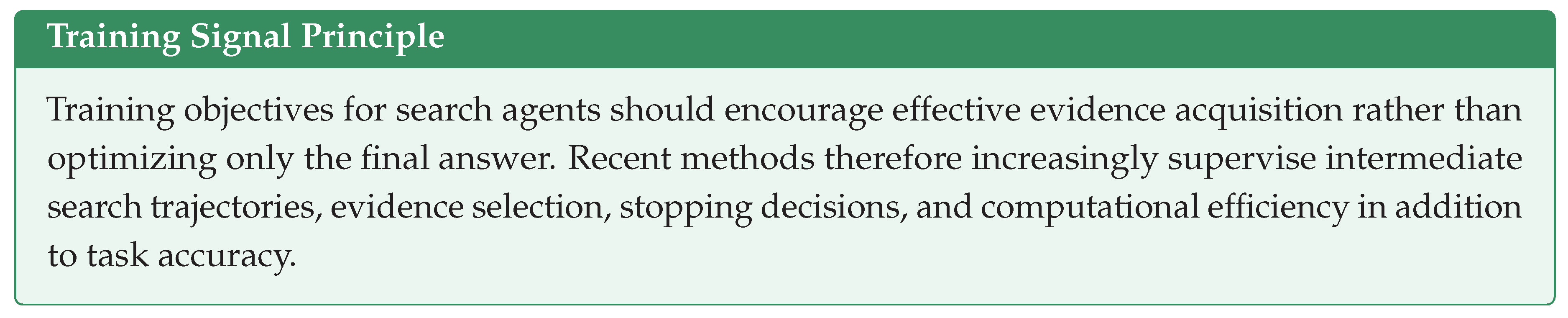
Existing training methods differ primarily in the stage of the search process they supervise. Prompt-based systems rely on manually designed workflows, trajectory distillation learns action sequences from expert demonstrations, verifier-oriented methods improve evidence assessment, and reinforcement learning optimizes sequential search behavior, including query generation, search timing, and stopping decisions. More recent work also introduces efficiency-aware objectives that explicitly balance search quality against computational cost. These approaches are largely complementary, and many recent search agents combine multiple training signals, including trajectory supervision, verifier feedback, outcome rewards, and efficiency constraints, to improve overall search performance.
Training-Recipe Anatomy.
Training recipes for search agents differ along several important dimensions, including the source of training tasks, the origin of action trajectories, the form of evidence supervision, the optimization objective, the learning algorithm, the execution environment, and the evaluation setting. These design choices determine not only how a model is trained, but also which aspects of search behavior are ultimately improved. This perspective also helps explain why training strategies cannot be compared solely by their names. Supervised fine-tuning may learn from expert browsing trajectories, distilled agent rollouts, or report-writing demonstrations based on pre-collected evidence. Preference optimization can rank complete reports, intermediate search decisions, or citation quality. Reinforcement learning has been applied to optimize answer correctness, evidence quality, search efficiency, tool use, and computational cost, while test-time scaling methods allocate additional computation through deeper reasoning, expanded search, parallel exploration, or stronger verification. Consequently, training results should always be interpreted together with the target behavior being optimized and the benchmark setting under which they are evaluated.
When Training Signals Help.
Imitation helps when high-quality traces reveal how to search. Verifier data helps when the main risk is unsupported evidence, RL helps when the agent must learn search timing, stopping, or tool choice under delayed rewards, and cost-aware objectives help when correctness can be achieved only by over-browsing. Test-time scaling helps when additional branches can be merged without losing provenance.
Training Claim Standard.
A training paper should make four fields explicit. Behavior Target names the search decision being optimized. Evidence Signal names the source, support unit, verifier, or reward that supervises it. Rollout Environment names the corpus, web, browser, or tool setting where the policy acts. Isolation Evidence names the ablation showing that gains come from better evidence seeking rather than a stronger retriever, larger budget, easier judge, or hidden harness change.
RAG-to-Agent Transfer.
Recent advances in agentic RAG provide an important foundation for training search agents. Methods based on retrieval-aware reasoning investigate when external information should be retrieved and how newly acquired evidence should be incorporated into the reasoning process [108,145,146,147,148,149]. Other work extends this idea to multi-agent retrieval, interactive retrieval, and joint optimization of retrievers and reasoning modules, enabling more effective coordination between evidence acquisition and downstream generation [109,110,285,286]. Search agents build upon these developments while operating in substantially more complex environments. Instead of interacting only with a fixed retrieval corpus, they may access live search engines, web pages, browser environments, documents, screenshots, and external tools. Consequently, training increasingly focuses on learning complete evidence-seeking behaviors that integrate retrieval, tool use, and sequential decision making throughout the search process.
Retrieval-Signal Transfer.
Retrieval-augmented reasoning also provides supervision primitives. Planning and revision signals teach recovery when one context is insufficient [287,288,289,290]. Evidence-structure signals reveal supporting facts and long-form discovery paths [291,292,293,294]. Query, reranking, or preference signals shape which evidence should be selected [295,296,297,298]. Search-agent training can be read as moving these signals from a fixed retrieval pipeline into an action policy that decides which uncertainty to reduce next.
8.1. Prompted and Harness-Engineered Workflows
Harness Baselines.
Prompted search agents are still important because they expose the workflow assumptions that later training tries to internalize. A typical harness includes a planner prompt, a search tool, a browser or reader, a note-taking memory, and a final writer. The strengths are interpretability and fast iteration, while the weaknesses are high latency, brittle control, and dependence on proprietary model capabilities. This family includes three harness paradigms. Decomposition-first systems make human-style deep search plans explicit [79]. Research-question and survey-generation systems turn decomposition into document-level artifacts [269,299]. Open deep-research studios emphasize configurable tool stacks, agent graphs, or human intervention [81,300,301,302,303]. These systems are not merely baselines. They reveal which parts of search behavior can be obtained from a strong model plus an explicit workflow, and which parts require parameter training or repeated interaction with an environment.
8.2. Synthetic Trajectory Construction
Task and Trajectory Synthesis.
Search-agent training needs trajectories, not just final answers. Recent synthesis work differs mainly in how it creates search necessity. Some recipes formalize information-seeking data and staged web-agent training [87,155]. Others evolve long-horizon tasks through exploration, query mutation, graph topology, or evidence dispersion [156,275]. Deep-research recipes add rubric trees or proposer–solver loops so that fact seeking, citation grounding, and report synthesis become verifiable training targets [160,161]. The key data problem is not only scale but validity: trajectories should contain useful actions, faithful observations, and recoverable reasoning, rather than polished explanations retrofitted after the answer is known.
Synthetic Branch Diversity.
Recent work has expanded the diversity of synthetic training trajectories beyond simply increasing their scale. Online curricula and multi-turn reinforcement learning expose models to progressively more complex search behaviors [304,305]. Dynamic and distributed multi-agent rollouts introduce multiple reasoning branches similar to those encountered in GAIA-style tasks [306,307]. Other approaches employ asynchronous long-horizon rollouts, Monte Carlo tree search, or masked search objectives to encourage persistent exploration and broader coverage of the search space [132,308,309]. Collectively, these methods increase the diversity of intermediate decisions, search failures, evidence sources, and alternative reasoning paths available during training. Recent studies have also investigated the characteristics of high-quality search trajectories. Informative high-difficulty demonstrations, graph-pruned web-agent traces, world-model environments, and analyses of exploration quality examine how different trajectory properties influence downstream search performance [274,310,311,312]. These studies suggest that effective training data should expose meaningful uncertainty, alternative search branches, and recoverable evidence throughout the search process rather than containing only successful final trajectories.
Trajectory Validity Checks.
Synthetic search data should be audited along four dimensions. Necessity checks whether the task truly requires external evidence. Observability checks whether decisive evidence appears in the trace rather than only in the final answer. Recoverability checks whether an evaluator can recover the source or support unit behind each training signal. Non-leakage checks whether the task, source page, or rubric has contaminated the benchmark used for evaluation. Without these checks, larger trajectory corpora can train faster post-hoc rationalization rather than better search behavior.
8.3. Reasoning-Search Interleaving and Reinforcement Learning
Search-RL Decision Boundary.
RL is attractive because search is naturally sequential, but recent work optimizes different decision boundaries. Gap-triggered search teaches a reasoning model to invoke external evidence when its chain exposes knowledge insufficiency, as in Search-o1 [85]. Stepwise search RL trains the model to interleave reasoning and real-time retrieval, as in Search-R1 and R1-Searcher [82,83]. Interactive web RL moves the rollout into multi-turn web environments, as in WebAgent-R1 and DeepResearcher [86,277]. Across these variants, rewards may reflect answer correctness, format adherence, tool success, evidence usefulness, or efficiency. The hard parts remain sparse credit, non-stationary observations, expensive rollouts, and long-trace attribution. The common lesson is that search-RL claims should report the learned decision boundary, not only the final benchmark score: when did the policy search, when did it stop, which evidence changed the answer, and how often did extra search create unsupported confidence?
Reward Granularity.
Reward granularity determines which part of the loop learns. Outcome rewards make final correctness visible but hide the search decision that caused it. Process rewards expose intermediate reasoning and search behavior, as studied by ReasonRAG, RAG-Gym, and StepSearch [128,129,130]. Retrieval-utility rewards move credit into the evidence stack itself, including multi-turn retriever training, joint reasoning-ranker optimization, and adaptive query reformulation in Agentic-R, CoSearch, QAgent, and ACQO [110,313,314,315]. This line is especially important because it turns the retriever, ranker, query generator, and reasoning policy into a coupled optimization target rather than a fixed backend plus a prompted user. The newest reward-design papers make this diagnosis explicit for search agents. They study retrieval protocol choices, group-relative contribution credit, pivot-based attribution, long-context trajectory rewards, web-agent process reward models, and evidence-tree rubric supervision [316,317,318,319,320,321]. Their common message is that answer-only rewards are too coarse for long-horizon search because they cannot distinguish a useful query, a lucky snippet, a false branch, and a citation-supporting observation.
Offline Search Substrates.
Another branch reduces dependence on external search engines during training by replacing the live web with a controllable search substrate. ZeroSearch and SSRL instantiate the clearest form: train search behavior offline, then test whether it transfers back to online inference [322,323]. R-Search, SE-Search, CORE, UR2, and Rank-R1 broaden the substrate with multi-reward search, memory purification, compression, reasoning-retrieval unification, and ranking RL [107,137,138,324,325]. The benefit is reproducibility and cost control. The risk is simulator overfitting if offline evidence does not induce the same failure modes as live search. Contemporaneous RAG-optimization methods supply the same ingredients at smaller scope. They study search-conditioned reasoning, search-and-refine loops, controlled retrieval actions, unsupervised information refinement, and factual-knowledge-boundary detection when model memory and external evidence disagree [326,327,328,329,330,331]. These methods are not always full web agents, but they provide reusable signals for search timing, retrieval gating, query reformulation, and evidence-aware refinement.
8.4. Efficiency-Aware Search Policies
Accuracy-Cost Trade-Off.
Recent search-agent training methods have increasingly considered computational efficiency alongside task performance. Earlier systems often emphasized answer accuracy without explicitly controlling search cost, leading to unnecessarily long trajectories, redundant tool usage, and excessive browsing. SlimSearcher addresses this issue by selecting supervised training trajectories along an accuracy-cost Pareto frontier and introducing adaptive reward gating during reinforcement learning to balance correctness and efficiency [140]. Related work has explored complementary directions. WebLeaper encourages information-rich search behavior, while ReSum compresses long interaction histories to support continued reasoning under limited context windows [96,279]. Together, these methods improve the practicality of deploying search agents under realistic constraints on latency, token usage, context length, and web access. Efficiency has also become an explicit objective in search policy design. SRSA and AI-SearchPlanner formulate search as a multi-objective optimization problem that jointly considers search quality and computational cost [141,142]. BrowseConf estimates search confidence to determine whether additional browsing is necessary [143]. Flash-Searcher, ParallelMuse, and SMTL further improve efficiency through structured parallel execution, enabling independent evidence collection to proceed concurrently while reserving additional reasoning for branches with insufficient or conflicting evidence [92,93,144]. These developments have motivated increasing interest in evaluating search agents under multiple computational budgets rather than reporting performance at a single operating point.
8.5. Tool-General and Native Agent Training
Native Tool Policy.
Search is increasingly learned as part of a broader tool-use policy rather than as an isolated capability. General-purpose agents must coordinate search with tool selection, action execution, memory management, and task delegation. DeepAgent optimizes tool-use decisions while compressing long interaction histories through memory folding [152]. SearchSwarm focuses on long-horizon delegation, training a central agent to divide research tasks, provide relevant context to specialist agents, and incorporate their summarized findings into the ongoing process [95]. Scaling Agents via Continual Pre-training introduces agentic data during pre-training so that planning, search, and tool use depend less on manually designed prompting strategies [280]. These approaches move toward models in which search, memory, delegation, tool routing, and evidence synthesis are learned within a unified agent policy. This direction also draws on the broader literature on tool learning and general-purpose agents. Tool-learning methods investigate how language models acquire and improve decisions about when and how to invoke external tools [6,136,332,333]. Agent benchmarks and optimization methods extend the scope to long-horizon trajectories, multi-agent coordination, and reward design [131,334,335,336,337,338]. Search tasks provide a particularly useful setting for studying these capabilities because retrieved sources and interaction traces make it possible to examine whether tool use contributes relevant evidence to the final output.
8.6. Multimodal Deep Search Training
Modality-Aware Routing.
Multimodal search agents add two coupled training targets: deciding what non-text evidence to inspect, and deciding when external search is needed to interpret that evidence. The literature separates into three paradigms. Visual-textual search policies train long-horizon search over image and text evidence, as in Vision-DeepResearch and VSearcher [115,116]. Tool-specialized multimodal agents combine visual grounding, code or web tools, expert routing, and failure-aware rewards, as in MM-DeepResearch, DeepEyes-V2, and OpenSearch-VL [117,118,282]. Inference-time structure focuses on managing multimodal state and context without necessarily changing model weights, as in Struct-Searcher and LMM-Searcher [104,276]. The shared lesson is that multimodal training must optimize evidence routing and support-unit preservation, not only visual answer accuracy. The same pattern appears in visual-document RAG, reranking, and temporal search. Visual-document and medical-image methods stress retrieval over image-heavy sources [125,126,339,340], while image-search and temporal-selection benchmarks stress when to retrieve, invoke visual tools, verify a region or timestamp, and stop searching [121,190,341,342]. These works also explain why multimodal search should not be treated as a separate top-level field from search agents: it is the same evidence-seeking control problem with a different evidence unit.
8.7. Test-Time Scaling
Inference-Time Branching.
Search agents can improve their performance at inference time by allocating additional computation to either reasoning or information acquisition. Reasoning-oriented approaches increase the number of candidate reasoning paths or planning strategies, whereas search-oriented approaches expand the search process through additional queries, broader exploration, or multiple search branches. WebSailor demonstrates that scalable reinforcement learning together with specialized training data can substantially improve performance on challenging information-seeking tasks [88]. ParallelMuse explores multiple subtasks concurrently to improve evidence coverage during deep information seeking [93]. Flash-Searcher adopts a dependency-aware graph representation that enables parallel execution while preserving logical relationships among subtasks [92]. Although these methods increase search capacity, recent studies have also shown that retrieving more information does not necessarily improve factual consistency unless the additional evidence is carefully verified [219]. For this reason, evaluating test-time scaling requires considering both effectiveness and computational cost. Rather than reporting a single performance number, recent work increasingly examines how answer quality, evidence support, and computational cost change as additional reasoning or search resources are allocated.
False-Positive Controls.
Interpreting improvements in search-agent performance requires careful control of potential confounding factors. Performance gains may arise from stronger base models, increased search budgets, changes in retrieval systems, more permissive evaluation procedures, or contamination in synthetic training data rather than from improvements in the search policy itself. Consequently, many recent studies include controlled comparisons using identical tools, fixed computational budgets, closed-book or no-search settings, retrieval-system ablations, and trace-level evidence analysis. These experimental controls make it easier to attribute observed improvements to the intended methodological contribution instead of unrelated differences in the evaluation setting.
8.8. Toward Native Search-Trained Models
Native Search Policy.
Recent technical reports and research systems indicate a gradual transition from prompt-driven search workflows to models that learn search behavior as part of their native policy [159]. Instead of relying solely on external orchestration, these models integrate agent-oriented pre-training, supervised trajectory learning, reinforcement learning, verifier supervision, and tool-aware reasoning into a unified training pipeline. QUEST explores synthetic-task training for general-purpose deep research [160], while Dr. Zero investigates self-evolving curricula that reduce dependence on manually constructed datasets [161]. Orchestra-o1 and SearchSwarm further extend this direction by learning task delegation across multimodal specialists or long-horizon research agents [94,95]. Together, these systems illustrate several possible directions for learning search behavior, ranging from single-model policies to collaborative multi-agent architectures. Another emerging direction explores self-improving training frameworks. MetaResearcher and Hybrid Open-Ended Tri-Evolution combine self-reflection, automatically generated environments, and the co-evolution of tasks, agents, and evaluators to improve research capabilities without relying exclusively on static datasets [343,344]. As these training paradigms become increasingly autonomous, reliable evaluation becomes correspondingly more important, particularly with respect to held-out live benchmarks and mechanisms for detecting potential data leakage.
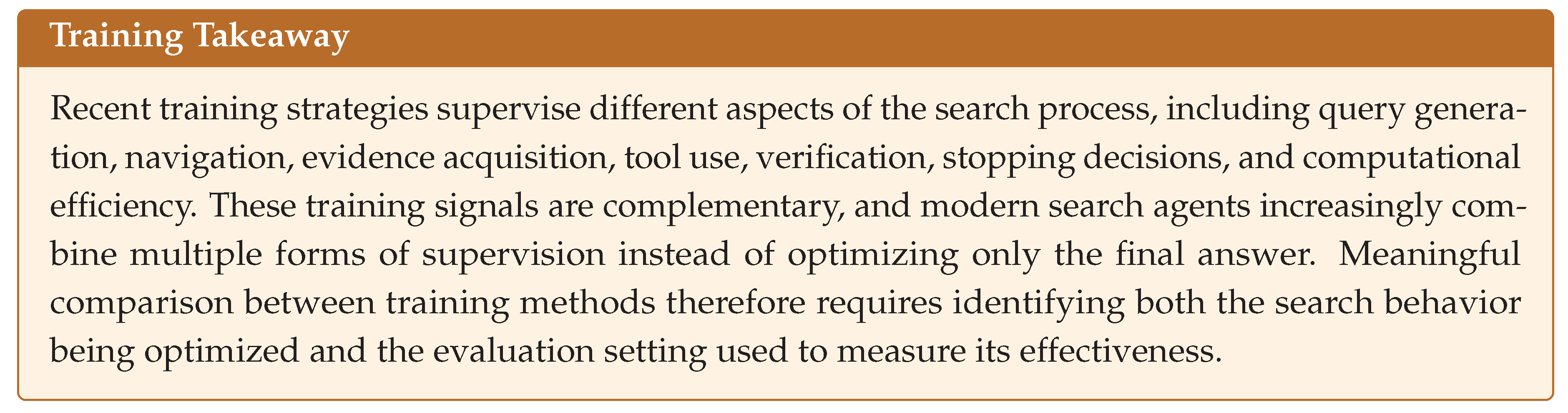
9. System Families, Applications, and Evaluation
After reviewing benchmark design, system architecture, and training strategies, we next examine representative families of search-agent systems. Instead of organizing the literature chronologically, we group existing methods according to their overall system design, highlighting how planning, retrieval, memory, verification, tool use, and orchestration are integrated into complete search pipelines. Table 8 summarizes the major system families together with representative methods, typical benchmark settings, and their primary characteristics. Application scenarios are discussed alongside these system families because deployment requirements strongly influence system design. Different domains impose different constraints on information sources, evidence quality, citation requirements, data freshness, privacy, and acceptable failure modes. For example, medical, financial, and scientific research agents may adopt similar architectures while operating under substantially different evidence requirements and evaluation protocols. Understanding search-agent systems therefore requires considering their architecture, target application, and evaluation setting together rather than in isolation.
9.1. Family Map and Benchmark Fit
The table is intentionally compact. The same families also cover open deep-research harnesses such as OpenManus and LangChain ODR, reasoning-search variants such as RAG-R1 and SmartSearch, efficiency-oriented systems such as S3, and graph-memory variants such as GraphRAG [345,346,347,348,349,350]. The main reading of Table 8 is that no family is universally best: each family has a natural benchmark fit and a characteristic hidden failure mode that a fair comparison must expose. In contract terms, the family names a recurring control policy, the benchmark fit names the evaluation contract, and the risk column identifies the field most likely to be underreported: hidden tool settings, lost provenance, weak citations, support-unit ambiguity, or domain mismatch.
9.2. Search Loops and Trained Policies
Prompt-based search workflows remain an important baseline for evaluating search agents because they demonstrate how far a language model can be extended through external tools without additional training. Recent work has increasingly explored learned search policies, including Search-R1, WebDancer, WebSailor, and WebAgent-R1, where search behavior is optimized through supervised learning or reinforcement learning rather than relying exclusively on manually designed prompting strategies [82,86,87,88]. Improvements reported by these systems may arise from multiple factors, including search timing, query generation, reward design, and the overall search framework, making comparisons across methods particularly sensitive to the underlying evaluation setting. Prompt-based and learned search systems also differ in their degree of transparency. Prompt-driven workflows expose intermediate prompts, tool interactions, and reasoning traces, making system behavior easier to inspect and analyze. In contrast, learned policies can optimize search behavior more directly by adapting query generation, stopping decisions, and evidence utilization, although their internal decision process is often less interpretable. For this reason, many recent studies complement final benchmark scores with additional analyses of search trajectories, including query statistics, visited pages, verification outcomes, unsuccessful search branches, and computational cost.
9.3. Deep Research Artifacts
Recent deep research systems extend search beyond answer generation by emphasizing long-form knowledge synthesis supported by external evidence. Instead of producing a single response, these systems are expected to identify relevant subtopics, collect evidence from multiple sources, assess source credibility, organize supporting claims, and provide appropriate citations. Representative systems illustrate different approaches to this problem. QUEST explores synthetic-task training for general-purpose deep research [160], Dr. Zero investigates self-evolving curricula without relying on manually constructed datasets [161], and SearchSwarm studies long-horizon research through coordinated multi-agent collaboration [95]. Evaluating these systems therefore requires considering source coverage, citation quality, evidence diversity, uncertainty handling, and computational efficiency in addition to the quality of the final report. These systems also highlight an important distinction between search-oriented and research-oriented agents. Search tasks often require identifying a small amount of decisive evidence, whereas deep research involves selecting relevant subproblems, collecting sufficiently broad evidence, and organizing the resulting information into a coherent research report. As a result, many recent systems explicitly maintain intermediate research artifacts, including outlines, evidence tables, source inventories, claim-to-citation mappings, and uncertainty annotations before producing the final document. Such intermediate representations improve transparency and make it easier to identify missing evidence, conflicting sources, or unsupported conclusions. Accordingly, evaluation of deep research systems increasingly extends beyond the final report itself to include the quality and completeness of the supporting research artifacts and their associated evidence.
9.4. Multimodal and Heterogeneous Evidence
Multimodal search agents add perception and routing decisions to the search loop. A visual or temporal benchmark is meaningful only when non-text evidence is necessary. Otherwise, an agent can bypass the intended skill through snippets or page text. MMSearch, MMSearch-Plus, MM-BrowseComp, VDR-Bench, VideoDR, OmniGAIA, and MMDeepResearch-Bench expose different support units, including regions, OCR spans, charts, timestamps, frame ranges, files, and tool outputs [17,18,19,60,63,64,111]. The evaluation should identify the support unit, not only the source URL. The family-level question is whether the agent uses modality because the task requires it or because the benchmark permits it. A strong multimodal search paper should report modality necessity, tool routing, support localization, and whether the answer can be recovered from text-only shortcuts. This is especially important for chart, map, screenshot, video, and document tasks, where the evidence may be a visual relation or timestamp rather than a webpage paragraph. The takeaway is that multimodal search is validated only when the required support unit is localized and text-only shortcuts are ruled out.
9.5. Applications and Risk Surface
Applications concentrate in scientific literature review, market and competitive analysis, legal and policy research, medical information seeking, financial due diligence, software engineering investigation, shopping comparison, travel planning, and education. The same agentic workflow that is useful for exploratory research becomes risky when users rely on stale sources, weak citations, or hidden uncertainty. We therefore treat application domains as protocol modifiers in the Search-Agent Comparison Contract: they change which sources are admissible, how fresh evidence must be, which support unit is acceptable, and when a system should abstain or escalate. Table 9 summarizes these domain evidence contracts. A domain evidence contract specifies the source hierarchy, temporal validity rule, support unit, privacy boundary, and escalation condition under which a search-agent answer may be trusted. Domain transfer is therefore not only a change of topic. It is a change of evidence law. The domain should therefore be read as a protocol modifier, not as a deployment afterthought. It changes the source hierarchy, temporal validity window, privacy boundary, allowed uncertainty language, and escalation rule. A method that looks strong on open-web report writing may be inappropriate for medicine if it cannot distinguish guideline authority from general webpages, or for finance if it cannot bind claims to dated filings and market events. This is the main lesson from domain-specific benchmarks: the domain does not simply make a task harder. It changes what counts as admissible evidence.
Science and Engineering.
Scientific and engineering applications are especially close to deep research because the agent must search, compare, and synthesize evolving technical evidence. One paradigm is scholarly search: paper discovery, literature synthesis, and academic source ranking become explicit search-agent tasks [351,352]. A second paradigm extends the evidence base to ML experiments, scientific equations, code synthesis, open-web data collection, manufacturing scale-up, and large-system code or commit history [181,182,183,210,353,354,355,356,357]. The admissible source set is therefore broader than papers alone: datasets, code repositories, experiment logs, benchmark cards, and negative results may all become evidence. The support unit should be a paper section, dataset version, code commit, equation, or experimental artifact rather than a generic URL. A scientific search agent is credible only when its synthesis can be traced back to versioned evidence that another researcher could inspect or reproduce.
Medicine and Clinical Search.
Medical, radiology, and dermatology agentic-RAG systems must privilege guidelines, trials, records, and expert review over general webpages [358,359,360]. The clinical evidence contract is hierarchical: a guideline, trial, structured record, or specialist note carries a different status from a blog post or summary page. Freshness also means more than recency, because standards of care, contraindications, and local policy can change at different rates. Evaluation should therefore include source-class audits, guideline-version checks, uncertainty language, and clinician escalation behavior. The unacceptable failure is not merely an incorrect answer, but an answer that appears grounded while using an inadmissible or outdated source. A medical search agent should be evaluated as a triage and evidence-navigation system, not as an autonomous clinical decision maker.
Finance, Law, and Policy.
Financial agents must bind claims to dated filings, price timestamps, market events, and disclosure regimes, while legal and policy agents must respect jurisdiction, versioned statutes, case holdings, and citation precision [204,215]. These domains make temporal validity part of the answer: a correct claim at one date can be wrong after a filing update, court decision, market event, or policy revision. The support unit is therefore not just a page, but a filing line, statute clause, case holding, memo paragraph, or dated price observation. A domain-ready search agent should report the date of evidence, the governing jurisdiction or market, the source hierarchy, and the conditions under which the answer should be reviewed by a human expert. The unacceptable failure is to collapse dated, jurisdictional, or disclosure-limited evidence into a timeless recommendation.
Personalized and Enterprise Search.
Search agents are increasingly applied to personalized, enterprise, recommender, IoT, climate-finance, and cyber-range scenarios, where much of the relevant information resides in private or access-controlled environments rather than on the public web [248,249,361,362,363]. Depending on the application, evidence may originate from internal documents, user profiles, proprietary databases, system logs, live sensor streams, or permission-restricted support tickets. Consequently, search agents must not only retrieve relevant information but also respect access permissions and organizational security policies throughout the search process. These deployment settings introduce additional requirements for both system design and evaluation. Search agents should correctly distinguish between public and private information, prevent unauthorized access to restricted resources, and avoid exposing sensitive information through generated outputs or intermediate reasoning traces. As a result, evaluation protocols for personalized and enterprise search increasingly consider permission-aware retrieval, privacy-preserving execution, trace sanitization, and access control in addition to traditional retrieval and reasoning performance.
Consumer, Education, and Planning Tasks.
Shopping, travel, education, and exploratory planning look lower-stakes than medicine or finance, but they expose another evidence-contract issue: user preferences and availability change the definition of correctness. A product recommendation depends on current listings, prices, reviews, availability, location, and user constraints. A learning recommendation depends on the learner’s background and calibration. A travel plan depends on time, budget, policy, and local disruptions [205,213,214]. In these settings, the support unit is often a listing, review, schedule, tutorial, or rubric rather than a general webpage. Evaluation should therefore test preference fit, bias control, availability, and whether the agent distinguishes stable facts from user-specific assumptions.
Product and Platform Reports.
Recent commercial platforms further illustrate how search-agent technologies are being integrated into complete user-facing systems. Products such as OpenAI Deep Research, Google Deep Research, Perplexity Deep Research, H2O.ai DeepResearch, Skywork DeepResearch, Jina DeepResearch, and Anthropic Research combine web search, tool use, evidence synthesis, user interaction, and safety mechanisms within a unified workflow [364,365,366,367,368,369,370]. These technical reports provide valuable insights into practical deployment, including system latency, interaction design, and operational safety. At the same time, direct comparison with academic systems remains challenging because many implementation details, such as model versions, prompting strategies, and search backends, are not publicly available. The deployment of search agents also introduces a broader range of risks than conventional LLMs. In addition to generation errors, system performance depends on the quality of external information sources, browser interactions, retrieval pipelines, and citation mechanisms. Incorrect or outdated evidence, compromised web content, unintended information disclosure, or misleading citations may all affect the reliability of the final output.
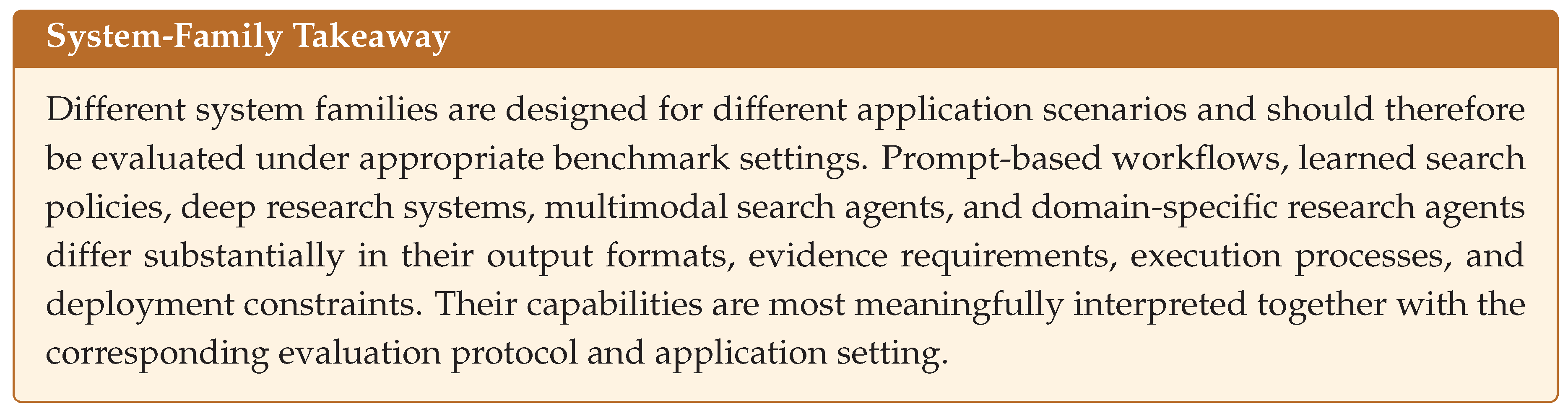
The next section examines how these differences are reflected in evaluation. We review the metrics, diagnostic analyses, and failure modes that have been developed to assess search-agent behavior under different benchmark settings and application scenarios.
9.6. Evaluation Dimensions
Evaluating search agents requires considering both the quality of the final output and the process by which supporting evidence is obtained. Final-answer accuracy alone cannot distinguish whether a correct response is produced through effective evidence acquisition, memorized knowledge, benchmark leakage, or excessive search. Likewise, failures may originate from planning, retrieval, perception, verification, memory management, or report generation. Table 10 summarizes the major evaluation dimensions discussed in this section, with an emphasis on the types of errors that different evaluation protocols are designed to reveal.
Answer and Evidence.
Answer-level metrics remain the primary evaluation criterion for many search benchmarks, but they provide only limited information about the quality of the underlying evidence. Recent benchmarks and evaluation frameworks, including LiveBrowseComp, FRAMES, and RAGChecker, distinguish answer correctness from retrieval quality, factual consistency, and reasoning performance [10,371,372]. Long-form research benchmarks further evaluate whether individual claims are supported by appropriate evidence. Existing work on FactScore, AIS, ProxyQA, long-form factuality, and citation verification demonstrates that documents may be correctly cited while failing to support the specific claims they accompany [217,218,219,220,373,374]. Factuality evaluation has also expanded to include hallucination detection, calibration, contradiction analysis, and uncertainty estimation. HalluLens, FactBench, RealFactBench, CofCA, and related studies investigate whether models recognize unsupported, conflicting, or uncertain evidence before generating conclusions [264,266,267,268,375]. Additional work on conflicting evidence, summary factuality, and citation generation further shows that errors may arise during retrieval, evidence aggregation, or report generation rather than from retrieval alone [376,377,378,379]. These observations have motivated increasingly fine-grained evaluation at the level of individual claims and supporting evidence.
Process and Environment.
Process-oriented evaluation examines how search agents reach their final answers. Existing benchmarks evaluate different aspects of the search process, including subgoal completion, evidence discovery, recovery from unsuccessful search branches, and search efficiency. BrowseComp-, GAIA2, Characterizing Deep Research, and Deep Research Comparator illustrate this trend by incorporating trajectory-level analyses for browsing, assistant tasks, and long-form research [55,162,176,216]. Live-web benchmarks introduce additional challenges because search results, indexed pages, and online discussions change over time, making evaluation sensitive to execution date, search provider, geographic region, and benchmark contamination [46,47,380]. Recent work has also expanded evaluation to system reliability and agent behavior. Benchmarks such as ST-WebAgentBench, WAREX, Search Arena, xBench, and FutureX investigate robustness under realistic web environments, professional tasks, and forward-looking scenarios [76,169,170,211,381]. Other studies evaluate the consistency between planning, actions, and outcomes, while trace-level analysis provides increasingly detailed diagnoses of planning failures, retrieval errors, verification mistakes, and report-generation problems [320,382,383,384,385,386,387,388].
Multimodal and Domain Evaluation.
Multimodal benchmarks require evaluation at a finer level of evidence granularity than text-only tasks. Depending on the benchmark, supporting evidence may correspond to image regions, OCR spans, chart cells, timestamps, transcript segments, or outputs from external tools. VDR-Bench, MM-BrowseComp, VideoDR, and OmniGAIA explicitly incorporate these grounding requirements into their evaluation protocols [17,18,19,63]. Domain-specific benchmarks further introduce specialized evidence standards for applications such as medicine, finance, shopping, and scientific literature search [204,205,206,209]. Recent multimodal evaluation frameworks also examine whether agents rely on the intended evidence modality. Benchmarks such as MMSearch, MMSearch-Plus, InterLV-Search, Vision Search Assistant, MIRAGE, GeoBrowse, and MFC-Bench evaluate different combinations of visual grounding, multimodal retrieval, geographic reasoning, and fact verification [60,61,62,111,192,193,194]. Other work extends evaluation to operational safety under untrusted information sources by studying source reliability, retrieval robustness, and provenance-aware verification [389,390,391]. Together, these studies indicate that evidence grounding should be evaluated at the same level of granularity at which the evidence is consumed, rather than only at the document level.
9.7. Failure-Mode Diagnosis
Table 11 summarizes the failure modes that are commonly discussed in the search-agent literature and provides a unified view of the factors that may influence benchmark performance. These failure categories are useful for both interpreting experimental results and designing more informative ablation studies. Search-agent performance is affected not only by the underlying model, but also by the retrieval environment, available tools, computational budget, search trajectories, and evaluation protocol. Consequently, improvements reported on a benchmark may arise from stronger search backends, larger resource budgets, favorable live-web conditions, or benchmark contamination rather than from improvements in the search strategy itself. Recent work has therefore placed increasing emphasis on reporting diagnostic analyses together with benchmark scores, making it easier to identify the source of observed performance gains and to compare systems under consistent experimental settings.
10. Challenges and Future Directions
Despite the rapid progress of LLM-based search agents, many fundamental challenges remain. Future research is likely to extend beyond improving model capability alone and instead focus on more reliable, efficient, and trustworthy evidence acquisition under increasingly complex search environments. These challenges include long-horizon reasoning, multimodal evidence integration, changing web content, domain-specific requirements, and efficient deployment under practical resource constraints. The remainder of this section reviews several representative research directions that have emerged from recent work. Table 12 provides an overview of these topics before the detailed discussion. Rather than representing independent research problems, these directions collectively highlight the remaining limitations of current search-agent systems and the opportunities for future development in system design, training, evaluation, and deployment.
10.1. Native Search-Trained Models
Current Bottleneck.
Most deployed search agents still wrap a general chat model inside a search harness. This keeps tool contracts and traces inspectable, but it also leaves the model weak at deciding when to search, how to reformulate queries, when evidence is sufficient, and when a citation does not actually support a claim. Moving all search competence into the model is not a complete solution either: a native policy may become efficient while making its evidence decisions harder to audit.
What Recent Work Suggests.
Recent systems point to three routes toward native search competence. The first route trains search policies directly for web or deep-research behavior [86,159,275]. The second route gives models broader tool-general action priors, so search becomes one tool decision among many [152]. The third route scales long-horizon delegation or self-evolution, using synthetic curricula and subagent coordination to make research behavior trainable [95,160,161]. Empirical and reward-design studies sharpen the same conclusion by moving the unit of learning from final-answer reward to search timing, query quality, source utility, and redundant-tool penalties [392,393,394,395,396,397]. The research frontier is therefore the learned decision boundary between internal reasoning and external evidence acquisition.
Research Agenda.
A strong native model should internalize search decisions without hiding the audit trail. The model should learn search timing, query reformulation, evidence comparison, and citation-aware writing, while the harness preserves tool schemas, evidence logs, verifier outputs, and delegation traces. Training objectives should reward useful queries, source diversity, claim-source support, contradiction detection, calibrated abstention, and budget discipline. A future native search model should therefore be evaluated not only by accuracy, but also by whether its evidence decisions remain externally inspectable.
10.2. Scalable Curricula and Environments
Current Bottleneck.
Search-agent training is constrained by sparse rewards, expensive rollouts, unstable web states, and synthetic tasks that often fail to require genuine search. Increasing hop count alone is insufficient: a task may require search because the answer is recent, ambiguous, visually grounded, domain-specific, distributed across sources, or contradicted by stale pages.
What Recent Work Suggests.
Recent studies have increasingly explored curriculum design for training search agents. Search-oriented curricula explicitly vary factors such as evidence distribution, task structure, tool availability, and search environments to expose agents to progressively more challenging information-seeking scenarios [155,156,160,275,398,399]. Related work on general-purpose agent environments, workplace tasks, and browser-based benchmarks extends this idea by introducing realistic workflows, access permissions, and adversarial web environments into the training process [169,170,307,334,335,398,400,401]. Together, these studies suggest that curriculum design for search agents should consider not only task complexity, but also the diversity of search environments and the conditions under which external evidence becomes necessary.
Research Agenda.
A useful curriculum should control why search is necessary, not only how many steps it takes. Future curricula should vary freshness, source conflict, entity ambiguity, visual necessity, domain expertise, and output form. Training environments should combine frozen corpora, replayable browser traces, synthetic search engines, multimodal tools, domain tools, adversarial pages, and small live-web slices under one reporting format. The goal is not to replace live evaluation, but to make training scalable while preserving a final test of real-world transfer.
10.3. Reliable Long-Horizon Memory
Current Bottleneck.
Deep research agents must remember more than facts. They must remember which leads failed, which sources conflict, which claims are unsupported, and which evidence should be revisited. Long context alone does not solve this problem, because a long transcript can still lose salience, provenance, and uncertainty.
What Recent Work Suggests.
Memory work separates into three design problems. Compact-state memory studies temporal updating and storage for long-running agents [255,256,257,402]. Retriever-linked memory connects stored context to reasoning utility and learned retrieval behavior [98,99,100,258]. Context-folding and multimodal memory extend horizons but can hide original evidence unless logs are preserved [403,404,405,406]. The open problem is therefore not memory size alone, but recoverable memory.
Research Agenda.
Long-horizon memory should be useful to the agent and recoverable by an auditor. Search-agent memory should separate model-facing summaries from evaluator-facing artifacts. The model may operate on a compact workspace, but the benchmark should preserve URLs, page hashes, screenshots, spans, timestamps, and action traces. Future memory benchmarks should test both utility and recoverability: can the agent use memory to continue the search, and can an auditor recover the source trail behind each memory item?
10.4. Cross-Modal Grounding
Current Bottleneck.
Multimodal search requires the agent to decide when visual, audio, file, or temporal evidence is necessary and then cite the correct support unit. A URL-level citation is often too coarse: a claim may depend on a screenshot crop, OCR span, chart cell, frame range, transcript segment, or tool output.
What Recent Work Suggests.
Recent work indicates that multimodal search is increasingly shifting from a perception problem to a search and reasoning problem. Visual browsing systems, explicit multimodal evidence representations, and modality-aware orchestration all require agents to determine which source of evidence should be examined before perception models are applied [19,94,104,112,162]. General-purpose multimodal models provide the underlying perception capabilities [407,408], while recent benchmarks for visual search, multimodal retrieval-augmented generation, temporal reasoning, charts, and document understanding demonstrate that retrieval, perception, and reasoning errors often interact throughout the search process [121,122,126,192,339,340,341,409]. These developments suggest that future multimodal search systems will require more precise selection and grounding of evidence units, in addition to improvements in perception accuracy.
Research Agenda.
Grounding should move from source-level citation to support-unit verification. Multimodal benchmarks should define support units explicitly and include negative cases where visual evidence is unnecessary, OCR is misleading, chart axes change the interpretation, or an image result is only a near-duplicate. Future reports should state whether the correct image, crop, OCR span, chart cell, timestamp, or transcript segment was selected, not merely whether the final answer was correct.
10.5. Budgeted Test-Time Scaling
Current Bottleneck.
More search can improve recall, but it also increases latency, monetary cost, exposure to untrusted webpages, and the chance of absorbing stale or contaminated evidence. Single-score leaderboards hide whether a system improves because it searches better or simply spends more.
What Recent Work Suggests.
Confidence-guided and parallel test-time scaling methods such as BrowseConf, ParallelMuse, and Flash-Searcher show that continuation policies, dependency-aware branching, and evidence-quality checks can reduce waste while preserving coverage [92,93,143]. These methods shift the question from “can the agent search more?” to “can the agent allocate search compute to the branch where evidence is most valuable?”
Research Agenda.
Scaling should be reported as a trade-off curve, not a single score. Search-agent papers should report query count, page visits, token usage, wall-clock time, parallel workers, verifier calls, citation support, and final accuracy together. Stopping rules should ask not only whether the answer is known, but whether the evidence is recent enough, diverse enough, trustworthy enough, and worth the additional cost. Budgeted scaling should therefore be treated as an evaluation contract, not only an inference trick.
10.6. Citation-Aware Training
Current Bottleneck.
Final-answer accuracy does not guarantee correct source use. A source may be topically relevant but not support the claim. A table may support a number only after unit conversion, a video may support a statement only during a short interval, and a report may hide uncertainty behind fluent prose.
What Recent Work Suggests.
The benchmark and training sections show a growing reliance on verifiers, process rewards, citation checks, and report rubrics. Yet citation support is still often evaluated coarsely. A page-level or URL-level citation can reward topical retrieval while missing claim-level entailment, contradiction, or partial support.
Research Agenda.
Citation-aware training should optimize claim support, not citation appearance. Training data should contain atomic claims, support units, unsupported negatives, and partially supported examples. Citation-aware rewards should cover evidence discovery, claim-source alignment, contradiction detection, and calibrated abstention. Verifier models can scale supervision, but their bias must be measured so they do not reward topical similarity in place of support. A mature search agent should be able to say not only what it believes, but which evidence supports each claim and where uncertainty remains.
10.7. Continual and Self-Evolving Search Agents
Current Bottleneck.
The web changes, benchmarks leak, and user needs drift. Agents that store traces or self-improve from their own outputs risk contaminating future evaluations, absorbing source poisoning, or becoming more confident without becoming more correct.
What Recent Work Suggests.
EvolveSearch and Dr. Zero point toward iterative self-evolution, proposer–solver task generation, and training without human-curated search data [161,410]. These systems suggest that search agents may eventually generate curricula, refine strategies, and discover missing evidence patterns. They also make the safety problem sharper: self-evolution requires external validation.
Research Agenda.
Self-evolving search agents need provenance boundaries before they need more self-generated data. Continual search agents should separate episodic user memory, public web evidence, benchmark data, and training data. Each memory item should record when it was created, which sources supported it, whether it has expired, and whether it came from a benchmark or user interaction. Self-generated tasks and strategies should be filtered by held-out benchmarks, source-support checks, and human review in high-stakes domains. The goal is self-improvement with provenance, not self-reinforcing confidence.
10.8. Human-Agent Co-Research
Current Bottleneck.
Many high-value research tasks cannot be safely reduced to one-shot autonomous reports. Users need to inspect outlines, pin sources, reject weak evidence, redirect a search branch, and request stronger support for uncertain claims. Current autonomous interfaces often hide this interactive evidence work.
What Recent Work Suggests.
Human-agent search is useful when user intent, permissions, or source judgment must remain visible. Interactive browser, personalized web, planning, and human-in-the-retrieval systems make the user part of the search contract rather than only the query source [214,247,363,411]. Collaboration and multi-agent studies add the corresponding caution: more agents or humans can improve coverage, but they also introduce coordination failures, over-competition, and accountability gaps [412,413,414,415,416,417,418].
Research Agenda.
The strongest deep research agents may become shared-control workspaces rather than autonomous answer machines. Interfaces should expose branch plans, source provenance, uncertainty, disputed claims, and editable report structure. Evaluation should include editability, recoverability from user corrections, source inspection, and accountability for each agent branch. The mature form of search agents is therefore not unaccountable automation, but shared control over evidence whose claims, sources, and uncertainties remain inspectable.
11. Conclusion
LLM-based search agents have rapidly evolved from prompt-based web assistants into systems capable of planning, iterative information seeking, tool use, and long-horizon evidence synthesis. Along with this evolution, the research landscape has expanded from web browsing and question answering to multimodal search, deep research, scientific discovery, and domain-specific applications. This survey reviewed recent progress from the perspectives of benchmarks, system architectures, training strategies, evaluation protocols, and representative application domains, providing a unified overview of the rapidly growing literature.
A recurring observation throughout the literature is that search agents cannot be evaluated solely by the quality of their final answers. The availability of external information, the search environment, the form of supporting evidence, and the evaluation protocol all influence how benchmark results should be interpreted. Recent benchmarks and evaluation methods have therefore moved beyond answer accuracy to consider evidence quality, citation faithfulness, reasoning traces, computational efficiency, and robustness under realistic deployment settings. At the same time, advances in model training, retrieval, planning, verification, and orchestration increasingly reflect different design choices rather than a single dominant system architecture.
Despite the remarkable progress achieved in recent years, many challenges remain open. Future search agents will need to operate reliably over dynamic information sources, heterogeneous modalities, long reasoning horizons, and specialized application domains while remaining efficient, interpretable, and trustworthy. Continued progress will depend not only on stronger foundation models, but also on better benchmarks, richer training environments, and more rigorous evaluation methodologies that accurately measure evidence acquisition and its contribution to downstream reasoning. We hope this survey provides a useful reference for future research and contributes to the development of more capable, reliable, and practically useful LLM-based search agents.
References
- Lewis, P.; Perez, E.; Piktus, A.; Petroni, F.; Karpukhin, V.; Goyal, N.; Küttler, H.; Lewis, M.; Yih, W.t.; Rocktäschel, T.; et al. Retrieval-augmented generation for knowledge-intensive nlp tasks. Adv. Neural Inf. Process. Syst. 2020, 33, 9459–9474. [Google Scholar]
- Fan, W.; Ding, Y.; Ning, L.; Wang, S.; Li, H.; Yin, D.; Chua, T.S.; Li, Q. A survey on rag meeting llms: Towards retrieval-augmented large language models. In Proceedings of the Proceedings of the 30th ACM SIGKDD conference on knowledge discovery and data mining, 2024; pp. 6491–6501. [Google Scholar]
- Gao, Y.; Xiong, Y.; Gao, X.; Jia, K.; Pan, J.; Bi, Y.; Dai, Y.; Sun, J.; Wang, M.; Wang, H. Retrieval-augmented generation for large language models: A survey. arXiv 2023, arXiv:2312.10997. [Google Scholar]
- Nakano, R.; Hilton, J.; Balaji, S.; Wu, J.; Ouyang, L.; Kim, C.; Hesse, C.; Jain, S.; Kosaraju, V.; Saunders, W.; et al. Webgpt: Browser-assisted question-answering with human feedback. arXiv 2021, arXiv:2112.09332. [Google Scholar]
- Yao, S.; Zhao, J.; Yu, D.; Du, N.; Shafran, I.; Narasimhan, K.; Cao, Y. React: Synergizing reasoning and acting in language models. arXiv 2022, arXiv:2210.03629. [Google Scholar]
- Schick, T.; Dwivedi-Yu, J.; Dessì, R.; Raileanu, R.; Lomeli, M.; Hambro, E.; Zettlemoyer, L.; Cancedda, N.; Scialom, T. Toolformer: Language models can teach themselves to use tools. Adv. Neural Inf. Process. Syst. 2023, 36, 68539–68551. [Google Scholar] [CrossRef]
- Zhang, W.; Liao, J.; Li, N.; Du, K.; Lin, J. Agentic information retrieval. arXiv 2024, arXiv:2410.09713. [Google Scholar]
- Wei, J.; Sun, Z.; Papay, S.; McKinney, S.; Han, J.; Fulford, I.; Chung, H.W.; Passos, A.T.; Fedus, W.; Glaese, A. Browsecomp: A simple yet challenging benchmark for browsing agents. arXiv 2025, arXiv:2504.12516. [Google Scholar]
- Chen, Z.; Ma, X.; Zhuang, S.; Nie, P.; Zou, K.; Liu, A.; Green, J.; Patel, K.; Meng, R.; Su, M.; et al. Browsecomp-plus: A more fair and transparent evaluation benchmark of deep-research agent. arXiv 2025, arXiv:2508.06600. [Google Scholar]
- Fan, H.; Wang, X.; Chu, Z.; Wang, Q.; Wang, Z.; Liu, M.; Qin, B.; et al. LiveBrowseComp: Are Search Agents Searching, or Just Verifying What They Already Know? arXiv 2026, arXiv:2605.28721. [Google Scholar]
- Mialon, G.; Fourrier, C.; Wolf, T.; LeCun, Y.; Scialom, T. Gaia: a benchmark for general ai assistants. Proc. Int. Conf. Learn. Represent. 2024, Vol. 2024, 9025–9049. [Google Scholar]
- Phan, L.; Gatti, A.; Han, Z.; Li, N.; Hu, J.; Zhang, H.; Zhang, C.B.C.; Shaaban, M.; Ling, J.; Shi, S.; et al. Humanity’s last exam. arXiv 2025, arXiv:2501.14249. [Google Scholar]
- OpenAI. Introducing Deep Research. 2025. Available online: https://openai.com/index/introducing-deep-research/.
- OpenAI. Deep Research System Card. Technical report;Technical report; OpenAI, 2025.
- Google. Gemini Deep Research. 2025. Available online: https://gemini.google/overview/deep-research/.
- Perplexity, A.I. Introducing Perplexity Deep Research. 2025. Available online: https://www.perplexity.ai/hub/blog/introducing-perplexity-deep-research.
- Li, S.; Bu, X.; Wang, W.; Liu, J.; Dong, J.; He, H.; Lu, H.; Zhang, H.; Jing, C.; Li, Z.; et al. Mm-browsecomp: A comprehensive benchmark for multimodal browsing agents. arXiv 2025, arXiv:2508.13186. [Google Scholar]
- Liu, C.; Yu, X.; Chang, Z.; Huang, Z.; Zhang, S.; Lian, H.; Dang, J.; Xu, R.; Hu, S.; Hou, J.; et al. Watching, reasoning, and searching: A video deep research benchmark on open web for agentic video reasoning. arXiv 2026, arXiv:2601.06943. [Google Scholar]
- Li, X.; Jiao, W.; Jin, J.; Wang, S.; Dong, G.; Jin, J.; Wang, H.; Wang, Y.; Wen, J.R.; Lu, Y.; et al. Omnigaia: Towards native omni-modal ai agents. arXiv 2026, arXiv:2602.22897. [Google Scholar]
- Xi, Y.; Lin, J.; Xiao, Y.; Zhou, Z.; Shan, R.; Gao, T.; Zhu, J.; Liu, W.; Yu, Y.; Zhang, W. A survey of llm-based deep search agents: Paradigm, optimization, evaluation, and challenges. arXiv 2025, arXiv:2508.05668. [Google Scholar]
- Zhang, W.; Li, X.; Zhang, Y.; Jia, P.; Wang, Y.; Guo, H.; Liu, Y.; Zhao, X. Deep research: A survey of autonomous research agents. arXiv 2025, arXiv:2508.12752. [Google Scholar]
- Zhang, W.; Li, Y.; Bei, Y.; Luo, J.; Wan, G.; Yang, L.; Xie, C.; Yang, Y.; Huang, W.C.; Miao, C.; et al. From web search towards agentic deep research: Incentivizing search with reasoning agents. arXiv 2025, arXiv:2506.18959. [Google Scholar]
- Du, M.; Xu, B.; Zhu, C.; Wang, X.; Mao, Z. Deepresearch bench: A comprehensive benchmark for deep research agents. arXiv 2025, arXiv:2506.11763. [Google Scholar]
- Bosse, N.I.; Evans, J.; Gambee, R.G.; Hnyk, D.; Mühlbacher, P.; Phillips, L.; Schwarz, D.; Wildman, J.; et al. Deep research bench: Evaluating ai web research agents. arXiv 2025, arXiv:2506.06287. [Google Scholar]
- Huang, Y.; Chen, Y.; Zhang, H.; Li, K.; Zhou, H.; Fang, M.; Yang, L.; Li, X.; Shang, L.; Xu, S.; et al. Deep research agents: A systematic examination and roadmap. arXiv 2025, arXiv:2506.18096. [Google Scholar]
- Xu, R.; Peng, J. A comprehensive survey of deep research: Systems, methodologies, and applications. arXiv 2025, arXiv:2506.12594. [Google Scholar]
- Zhang, W. (Ed.) Awesome Agentic Deep Research Resources; 2025; Available online: https://github.com/DavidZWZ/Awesome-Deep-Research (accessed on 2025-08-27).
- Oche, A.J.; Folashade, A.G.; Ghosal, T.; Biswas, A. A systematic review of key retrieval-augmented generation (rag) systems: Progress, gaps, and future directions. arXiv 2025, arXiv:2507.18910. [Google Scholar]
- Islam, S.B.; Rahman, M.A.; Hossain, K.T.; Hoque, E.; Joty, S.; Parvez, M.R. Open-RAG: Enhanced retrieval augmented reasoning with open-source large language models. Proc. Find. Assoc. Comput. Linguist. EMNLP 2024, 2024, 14231–14244. [Google Scholar] [CrossRef]
- Yu, T.; Zhang, S.; Feng, Y. Auto-rag: Autonomous retrieval-augmented generation for large language models. arXiv 2024, arXiv:2411.19443. [Google Scholar]
- Hoshi, Y.; Miyashita, D.; Ng, Y.; Tatsuno, K.; Morioka, Y.; Torii, O.; Deguchi, J. Ralle: A framework for developing and evaluating retrieval-augmented large language models. In Proceedings of the Proceedings of the 2023 Conference on Empirical Methods in Natural Language Processing: System Demonstrations, 2023; pp. 52–69. [Google Scholar]
- Cheng, X.; Wang, X.; Zhang, X.; Ge, T.; Chen, S.Q.; Wei, F.; Zhang, H.; Zhao, D. xrag: Extreme context compression for retrieval-augmented generation with one token. Adv. Neural Inf. Process. Syst. 2024, 37, 109487–109516. [Google Scholar] [CrossRef]
- Qi, Z.; Xu, R.; Guo, Z.; Wang, C.; Zhang, H.; Xu, W. Long2rag: Evaluating long-context & long-form retrieval-augmented generation with key point recall. Proc. Find. Assoc. Comput. Linguist. EMNLP 2024, 2024, 4852–4872. [Google Scholar] [CrossRef]
- Wei, Z.; Chen, W.L.; Meng, Y. InstructRAG: Instructing retrieval-augmented generation via self-synthesized rationales. Proc. Int. Conf. Learn. Represent. 2025, Vol. 2025, 82731–82754. [Google Scholar]
- Wu, Q.; Bansal, G.; Zhang, J.; Wu, Y.; Li, B.; Zhu, E.; Jiang, L.; Zhang, X.; Zhang, S.; Liu, J.; et al. Autogen: Enabling next-gen llm applications via multi-agent conversation. arXiv 2023, arXiv:2308.08155. [Google Scholar]
- Hu, M.; Zhou, Y.; Fan, W.; Nie, Y.; Ye, Z.; Xia, B.; Sun, T.; Jin, Z.; Li, Y.; Zhang, Z.; et al. Owl: Optimized workforce learning for general multi-agent assistance in real-world task automation. Adv. Neural Inf. Process. Syst. 2026, 38, 50859–50906. [Google Scholar]
- Zhang, W.; Zeng, L.; Xiao, Y.; Li, Y.; Cui, C.; Zhao, Y.; Hu, R.; Liu, Y.; Zhou, Y.; An, B. AgentOrchestra: Orchestrating Multi-Agent Intelligence with the Tool-Environment-Agent (TEA) Protocol. arXiv 2025, arXiv:2506.12508. [Google Scholar]
- Tran, K.T.; Dao, D.; Nguyen, M.D.; Pham, Q.V.; O’Sullivan, B.; Nguyen, H.D. Multi-agent collaboration mechanisms: A survey of llms. arXiv 2025, arXiv:2501.06322. [Google Scholar]
- Shen, X.; Liu, Y.; Dai, Y.; Wang, Y.; Miao, R.; Tan, Y.; Pan, S.; Wang, X. Understanding the information propagation effects of communication topologies in llm-based multi-agent systems. In Proceedings of the Proceedings of the 2025 Conference on Empirical Methods in Natural Language Processing, 2025; pp. 12358–12372. [Google Scholar]
- Reid, A.; O’Callaghan, S.; Carroll, L.; Caetano, T. Risk analysis techniques for governed llm-based multi-agent systems. arXiv 2025, arXiv:2508.05687. [Google Scholar]
- Cao, R.; Lei, F.; Wu, H.; Chen, J.; Fu, Y.; Gao, H.; Xiong, X.; Zhang, H.; Mao, Y.; Hu, W.; et al. Spider2-v: How far are multimodal agents from automating data science and engineering workflows? Adv. Neural Inf. Process. Syst. 2024, 37, 107703–107744. [Google Scholar] [CrossRef]
- Lee, C.; Xia, C.S.; Yang, L.; Huang, J.t.; Zhu, Z.; Zhang, L.; Lyu, M.R. Unidebugger: Hierarchical multi-agent framework for unified software debugging. In Proceedings of the Proceedings of the 2025 Conference on Empirical Methods in Natural Language Processing, 2025; pp. 18248–18277. [Google Scholar]
- Hu, Y.; Cai, Y.; Du, Y.; Zhu, X.; Liu, X.; Yu, Z.; Hou, Y.; Tang, S.; Chen, S. Self-evolving multi-agent collaboration networks for software development. Proc. Int. Conf. Learn. Represent. 2025, Vol. 2025, 23007–23039. [Google Scholar]
- Zhang, Z.; Zhang, X.; Wei, J.; Xu, Y.; You, C. Postergen: Aesthetic-aware paper-to-poster generation via multi-agent llms. arXiv 2025, arXiv:2508.17188. [Google Scholar]
- Shi, J.; Zhang, Z.; Wu, B.; Liang, Y.; Fang, M.; Chen, L.; Zhao, Y. Presentagent: Multimodal agent for presentation video generation. In Proceedings of the Proceedings of the 2025 Conference on Empirical Methods in Natural Language Processing: System Demonstrations, 2025; pp. 760–773. [Google Scholar]
- Han, Z.; Mankikar, M.; Michael, J.; Wang, Z. Search-time data contamination. arXiv 2025, arXiv:2508.13180. [Google Scholar]
- Wang, Y.; Zhang, X.; Yao, K.; Zeng, Z.; Song, K.; Lin, J.; Shen, Z. Search-Time Contamination in Deep Research Agents: Measuring Performance Inflation in Public Benchmark Evaluation. arXiv 2026, arXiv:2606.05241. [Google Scholar]
- He, C.; Luo, R.; Bai, Y.; Hu, S.; Thai, Z.; Shen, J.; Hu, J.; Han, X.; Huang, Y.; Zhang, Y.; et al. Olympiadbench: A challenging benchmark for promoting agi with olympiad-level bilingual multimodal scientific problems. Proceedings of the Proceedings of the 62nd Annual Meeting of the Association for Computational Linguistics 2024, Volume 1, 3828–3850. [Google Scholar] [CrossRef]
- Yu, Z.; Peng, R.; Ding, K.; Li, Y.; Peng, Z.; Liu, M.; Zhang, Y.; Yuan, Z.; Xin, H.; Huang, W.; et al. Formalmath: Benchmarking formal mathematical reasoning of large language models. arXiv 2025, arXiv:2505.02735. [Google Scholar]
- Wei, A.; Wu, Y.; Wan, Y.; Suresh, T.; Tan, H.; Zhou, Z.; Koyejo, S.; Wang, K.; Aiken, A. Satbench: Benchmarking llms’ logical reasoning via automated puzzle generation from sat formulas. In Proceedings of the Proceedings of the 2025 Conference on Empirical Methods in Natural Language Processing, 2025; pp. 33820–33837. [Google Scholar]
- Zhang, Z.; Xu, J.; He, Z.; Liang, T.; Liu, Q.; Li, Y.; Song, L.; Liang, Z.; Zhang, Z.; Wang, R.; et al. Deeptheorem: Advancing llm reasoning for theorem proving through natural language and reinforcement learning. arXiv 2025, arXiv:2505.23754. [Google Scholar]
- Sun, W.; Lu, M.; Ling, Z.; Liu, K.; Yao, X.; Yang, Y.; Chen, J. Scaling long-horizon llm agent via context-folding. arXiv 2025, arXiv:2510.11967. [Google Scholar]
- Zhu, A.; Hwang, A.; Dugan, L.; Callison-Burch, C. FanOutQA: A multi-hop, multi-document question answering benchmark for large language models. Proceedings of the Proceedings of the 62nd Annual Meeting of the Association for Computational Linguistics 2024, Volume 2, 18–37. [Google Scholar] [CrossRef]
- Tang, Y.; Yang, Y. Multihop-rag: Benchmarking retrieval-augmented generation for multi-hop queries. arXiv 2024, arXiv:2401.15391. [Google Scholar]
- Froger, R.; Andrews, P.; Bettini, M.; Budhiraja, A.; Cabral, R.S.; Do, V.; Garreau, E.; Gaya, J.B.; Laurençon, H.; Lecanu, M.; et al. Gaia2: Benchmarking LLM agents on dynamic and asynchronous environments. arXiv 2026, arXiv:2602.11964. [Google Scholar]
- Yoran, O.; Amouyal, S.J.; Malaviya, C.; Bogin, B.; Press, O.; Berant, J. Assistantbench: Can web agents solve realistic and time-consuming tasks? In Proceedings of the Proceedings of the 2024 Conference on Empirical Methods in Natural Language Processing, 2024; pp. 8938–8968. [Google Scholar]
- Coelho, J.; Ning, J.; He, J.; Mao, K.; Paladugu, A.; Setlur, P.; Jin, J.; Callan, J.; Magalhães, J.; Martins, B.; et al. Deepresearchgym: A free, transparent, and reproducible evaluation sandbox for deep research. arXiv 2025, arXiv:2505.19253. [Google Scholar]
- Li, R.; Du, M.; Xu, B.; Zhu, C.; Wang, X.; Mao, Z. DeepResearch Bench II: Diagnosing Deep Research Agents via Rubrics from Expert Report. arXiv 2026, arXiv:2601.08536. [Google Scholar]
- Wu, T.; Wang, Y.; Ma, X.; He, X.; Wang, S.; Yin, D.; Zhao, X. Deepresearch-9k: A challenging benchmark dataset of deep-research agent. arXiv 2026, arXiv:2603.01152. [Google Scholar]
- Jiang, D.; Zhang, R.; Guo, Z.; Wu, Y.; Lei, J.; Qiu, P.; Lu, P.; Chen, Z.; Fu, C.; Song, G.; et al. Mmsearch: Benchmarking the potential of large models as multi-modal search engines. arXiv 2024, arXiv:2409.12959. [Google Scholar]
- Geng, X.; Xiao, Y.; Zhang, Y.; Wang, H.; Liu, X.; Min, R.; Fang, T.; Fung, Y.R. GeoBrowse: A Geolocation Benchmark for Agentic Tool Use with Expert-Annotated Reasoning Traces. arXiv 2026, arXiv:2604.04017. [Google Scholar]
- Dongre, V.; Gui, C.; Garg, S.; Nayyeri, H.; Tur, G.; Hakkani-Tür, D.; Adve, V.S. MIRAGE: A benchmark for multimodal information-seeking and reasoning in agricultural expert-guided conversations. arXiv 2025, arXiv:2506.20100. [Google Scholar]
- Zeng, Y.; Huang, W.; Fang, Z.; Chen, S.; Shen, Y.; Cai, Y.; Wang, X.; Yin, Z.; Chen, L.; Chen, Z.; et al. Vision-deepresearch benchmark: Rethinking visual and textual search for multimodal large language models. arXiv 2026, arXiv:2602.02185. [Google Scholar]
- Huang, P.; Zhong, Z.; Wan, Z.; Zhou, D.; Alam, S.; Wang, X.; Li, Z.; Dou, Z.; Zhu, L.; Xiong, J.; et al. MMDeepResearch-Bench: A Benchmark for Multimodal Deep Research Agents. arXiv 2026, arXiv:2601.12346. [Google Scholar]
- Shao, Z.; Gong, Y.; Shen, Y.; Huang, M.; Duan, N.; Chen, W. Enhancing retrieval-augmented large language models with iterative retrieval-generation synergy. In Proceedings of the Findings of the Association for Computational Linguistics: EMNLP 2023, 2023; pp. 9248–9274. [Google Scholar]
- Yu, Y.; Ping, W.; Liu, Z.; Wang, B.; You, J.; Zhang, C.; Shoeybi, M.; Catanzaro, B. Rankrag: Unifying context ranking with retrieval-augmented generation in llms. Adv. Neural Inf. Process. Syst. 2024, 37, 121156–121184. [Google Scholar] [CrossRef]
- Jeong, S.; Baek, J.; Cho, S.; Hwang, S.J.; Park, J.C. Adaptive-rag: Learning to adapt retrieval-augmented large language models through question complexity. Proceedings of the Proceedings of the 2024 Conference of the North American Chapter of the Association for Computational Linguistics: Human Language Technologies 2024, Volume 1, 7036–7050. [Google Scholar] [CrossRef]
- Ma, X.; Gong, Y.; He, P.; Zhao, H.; Duan, N. Query rewriting in retrieval-augmented large language models. In Proceedings of the Proceedings of the 2023 Conference on Empirical Methods in Natural Language Processing, 2023; pp. 5303–5315. [Google Scholar]
- Chezelles, D.; Le Sellier, T.; Shayegan, S.O.; Jang, L.K.; Lù, X.H.; Yoran, O.; Kong, D.; Xu, F.F.; Reddy, S.; Cappart, Q.; et al. The browsergym ecosystem for web agent research. arXiv 2024, arXiv:2412.05467. [Google Scholar]
- Zhou, S.; Xu, F.F.; Zhu, H.; Zhou, X.; Lo, R.; Sridhar, A.; Cheng, X.; Ou, T.; Bisk, Y.; Fried, D.; et al. Webarena: A realistic web environment for building autonomous agents. Proc. Int. Conf. Learn. Represent. 2024, Vol. 2024, 15585–15606. [Google Scholar]
- Deng, X.; Gu, Y.; Zheng, B.; Chen, S.; Stevens, S.; Wang, B.; Sun, H.; Su, Y. Mind2web: Towards a generalist agent for the web. Adv. Neural Inf. Process. Syst. 2023, 36, 28091–28114. [Google Scholar] [CrossRef]
- He, H.; Yao, W.; Ma, K.; Yu, W.; Dai, Y.; Zhang, H.; Lan, Z.; Yu, D. Webvoyager: Building an end-to-end web agent with large multimodal models. Proceedings of the Proceedings of the 62nd Annual Meeting of the Association for Computational Linguistics 2024, Volume 1, 6864–6890. [Google Scholar] [CrossRef]
- Zheng, B.; Gou, B.; Kil, J.; Sun, H.; Su, Y. Gpt-4v (ision) is a generalist web agent, if grounded. arXiv 2024, arXiv:2401.01614. [Google Scholar]
- Koh, J.Y.; Lo, R.; Jang, L.; Duvvur, V.; Lim, M.; Huang, P.Y.; Neubig, G.; Zhou, S.; Salakhutdinov, R.; Fried, D. Visualwebarena: Evaluating multimodal agents on realistic visual web tasks. Proceedings of the Proceedings of the 62nd Annual Meeting of the Association for Computational Linguistics 2024, Volume 1, 881–905. [Google Scholar] [CrossRef]
- Lù, X.H.; Kasner, Z.; Reddy, S. Weblinx: Real-world website navigation with multi-turn dialogue. arXiv 2024, arXiv:2402.05930. [Google Scholar]
- Miroyan, M.; Wu, T.H.; King, L.; Li, T.; Pan, J.; Hu, X.; Chiang, W.L.; Angelopoulos, A.N.; Darrell, T.; Norouzi, N.; et al. Search arena: Analyzing search-augmented llms. arXiv 2025, arXiv:2506.05334. [Google Scholar]
- Wong, R.; Wang, J.; Zhao, J.; Chen, L.; Gao, Y.; Zhang, L.; Zhou, X.; Wang, Z.; Xiang, K.; Zhang, G.; et al. Widesearch: Benchmarking agentic broad info-seeking. arXiv 2025, arXiv:2508.07999. [Google Scholar]
- Hu, T.; Zhao, Y.; Zhang, C.; Cohan, A.; Zhao, C. SAGE: Benchmarking and Improving Retrieval for Deep Research Agents. arXiv 2026, arXiv:2602.05975. [Google Scholar]
- Chen, Z.; Liu, K.; Wang, Q.; Liu, J.; Zhang, W.; Chen, K.; Zhao, F. Mindsearch: Mimicking human minds elicits deep ai searcher. Proc. Int. Conf. Learn. Represent. 2025, Vol. 2025, 90007–90029. [Google Scholar]
- Yu, T.; Zhang, Z.; Lyu, Z.; Gong, J.; Yi, H.; Wang, X.; Zhou, Y.; Yang, J.; Nie, P.; Huang, Y.; et al. BrowserAgent: Building Web Agents with Human-Inspired Web Browsing Actions. arXiv 2025, arXiv:2510.10666. [Google Scholar]
- Roucher, A.; et al. Open-Source DeepResearch: Freeing Our Search Agents. 2025. Available online: https://huggingface.co/blog/open-deep-research (accessed on 2025-07-01).
- Jin, B.; Zeng, H.; Yue, Z.; Yoon, J.; Arik, S.; Wang, D.; Zamani, H.; Han, J. Search-r1: Training llms to reason and leverage search engines with reinforcement learning. arXiv 2025, arXiv:2503.09516. [Google Scholar]
- Song, H.; Jiang, J.; Min, Y.; Chen, J.; Chen, Z.; Zhao, W.X.; Fang, L.; Wen, J.R. R1-searcher: Incentivizing the search capability in llms via reinforcement learning. arXiv 2025, arXiv:2503.05592. [Google Scholar]
- Song, H.; Jiang, J.; Tian, W.; Chen, Z.; Wu, Y.; Zhao, J.; Min, Y.; Zhao, W.X.; Fang, L.; Wen, J.R. R1-searcher++: Incentivizing the dynamic knowledge acquisition of llms via reinforcement learning. arXiv 2025, arXiv:2505.17005. [Google Scholar]
- Li, X.; Dong, G.; Jin, J.; Zhang, Y.; Zhou, Y.; Zhu, Y.; Zhang, P.; Dou, Z. Search-o1: Agentic search-enhanced large reasoning models. In Proceedings of the Proceedings of the 2025 Conference on Empirical Methods in Natural Language Processing, 2025; pp. 5420–5438. [Google Scholar]
- Wei, Z.; Yao, W.; Liu, Y.; Zhang, W.; Lu, Q.; Qiu, L.; Yu, C.; Xu, P.; Zhang, C.; Yin, B.; et al. Webagent-r1: Training web agents via end-to-end multi-turn reinforcement learning. In Proceedings of the Proceedings of the 2025 Conference on Empirical Methods in Natural Language Processing, 2025; pp. 7920–7939. [Google Scholar]
- Wu, J.; Li, B.; Fang, R.; Yin, W.; Zhang, L.; Wang, Z.; Tao, Z.; Zhang, D.C.; Xi, Z.; Tang, R.; et al. Webdancer: Towards autonomous information seeking agency. Adv. Neural Inf. Process. Syst. 2026, 38, 120957–120985. [Google Scholar]
- Li, K.; Zhang, Z.; Yin, H.; Zhang, L.; Ou, L.; Wu, J.; Yin, W.; Li, B.; Tao, Z.; Wang, X.; et al. Websailor: Navigating super-human reasoning for web agent. arXiv 2025, arXiv:2507.02592. [Google Scholar]
- Tan, J.; Dou, Z.; Yu, Y.; Cheng, J.; Liu, L.; Xie, J.; Wen, J. Hiersearch: A hierarchical enterprise deep search framework integrating local and web searches. Proc. Proc. AAAI Conf. Artif. Intell. 2026, Vol. 40, 19380–19388. [Google Scholar] [CrossRef]
- Lu, R.; Hou, Z.; Wang, Z.; Zhang, H.; Liu, X.; Li, Y.; Feng, S.; Tang, J.; Dong, Y. Deepdive: Advancing deep search agents with knowledge graphs and multi-turn rl. arXiv 2025, arXiv:2509.10446. [Google Scholar]
- Hao, C.; Feng, W.; Zhang, Y.; Wang, H. Dynasearcher: Dynamic knowledge graph augmented search agent via multi-reward reinforcement learning. arXiv 2025, arXiv:2507.17365. [Google Scholar]
- Qin, T.; Chen, Q.; Wang, S.; Xing, H.; Zhu, K.; Zhu, H.; Shi, D.; Liu, X.; Zhang, G.; Liu, J.; et al. Flash-searcher: Fast and effective web agents via dag-based parallel execution. arXiv 2025, arXiv:2509.25301. [Google Scholar]
- Li, B.; Zhang, D.; Wu, J.; Yin, W.; Tao, Z.; Zhao, Y.; Zhang, L.; Shen, H.; Fang, R.; Xie, P.; et al. Parallelmuse: Agentic parallel thinking for deep information seeking. arXiv 2025, arXiv:2510.24698. [Google Scholar]
- Zhang, F.; Zhang, V.; Qian, S.; Li, H.; Wu, H.; Wu, J.; Zhou, D.; Zhu, Z.; Lian, Z.; Wang, X.; et al. Orchestra-o1: Omnimodal Agent Orchestration. arXiv 2026, arXiv:2606.13707. [Google Scholar]
- Ning, P.; Chen, Q.; Tao, K.; Tang, X.; Wang, T.; Cao, Q.; Kong, X.; Wen, Z.; Zhang, Z.; Zhou, J. SearchSwarm: Towards Delegation Intelligence in Agentic LLMs for Long-Horizon Deep Research. arXiv 2026, arXiv:2606.09730. [Google Scholar]
- Wu, X.; Li, K.; Zhao, Y.; Zhang, L.; Ou, L.; Yin, H.; Zhang, Z.; Yu, X.; Zhang, D.; Jiang, Y.; et al. Resum: Unlocking long-horizon search intelligence via context summarization. arXiv 2025, arXiv:2509.13313. [Google Scholar]
- Yan, S.; Yang, X.; Huang, Z.; Nie, E.; Ding, Z.; Li, Z.; Ma, X.; Bi, J.; Kersting, K.; Pan, J.Z.; et al. Memory-r1: Enhancing large language model agents to manage and utilize memories via reinforcement learning. Proceedings of the Proceedings of the 64th Annual Meeting of the Association for Computational Linguistics 2026, Volume 1, 12805–12825. [Google Scholar] [CrossRef]
- Yu, H.; Chen, T.; Feng, J.; Chen, J.; Dai, W.; Yu, Q.; Zhang, Y.Q.; Ma, W.Y.; Liu, J.; Wang, M.; et al. Memagent: Reshaping long-context llm with multi-conv rl-based memory agent. arXiv 2025, arXiv:2507.02259. [Google Scholar]
- Wang, Y.; Chen, X. Mirix: Multi-agent memory system for llm-based agents. arXiv 2025, arXiv:2507.07957. [Google Scholar]
- Zhang, Z.; Dai, Q.; Li, R.; Bo, X.; Chen, X.; Dong, Z. Learn to memorize: Optimizing llm-based agents with adaptive memory framework. arXiv 2025, arXiv:2508.16629. [Google Scholar]
- Anokhin, P.; Semenov, N.; Sorokin, A.; Evseev, D.; Kravchenko, A.; Burtsev, M.; Burnaev, E. Arigraph: Learning knowledge graph world models with episodic memory for llm agents. arXiv 2024, arXiv:2407.04363. [Google Scholar]
- Gutiérrez, B.J.; Shu, Y.; Gu, Y.; Yasunaga, M.; Su, Y. Hipporag: Neurobiologically inspired long-term memory for large language models. Adv. Neural Inf. Process. Syst. 2024, 37, 59532–59569. [Google Scholar] [CrossRef]
- Luo, H.; Chen, G.; Lin, Q.; Guo, Y.; Xu, F.; Kuang, Z.; Song, M.; Wu, X.; Zhu, Y.; Tuan, L.A.; et al. Graph-r1: Towards agentic graphrag framework via end-to-end reinforcement learning. arXiv 2025, arXiv:2507.21892. [Google Scholar]
- Zhang, F.; Zhang, V.; Qian, S.; Li, H.; Lian, Z.; Wu, H.; Gao, Y.; Geng, X.; Wang, X.; Heng, P.A. Struct-Searcher: Agentic Structural Thinking Advances Multimodal Deep Information Seeking. arXiv 2026, arXiv:2606.07689. [Google Scholar]
- Yu, X.; Feng, C.; Mei, L.; Chen, C. M3-Searcher: Modular Multimodal Information Seeking Agency with Retrieval-Oriented Reasoning. arXiv 2026, arXiv:2601.09278. [Google Scholar]
- Zhang, C.; Wang, Y.; Xu, D.; Zhang, H.; Lyu, Y.; Chen, Y.; Liu, S.; Xu, T.; Zhao, X.; Gao, Y.; et al. TeaRAG: A Token-Efficient Agentic Retrieval-Augmented Generation Framework. ACM Transactions on Information Systems, 2025. [Google Scholar]
- Cui, Z.; Weng, Y.; Tang, X.; Liu, P.; Li, S.; He, B.; Chen, J.; Zhang, Y.; He, X.; Ma, C. CORE-RAG: Lossless Compression for Retrieval-Augmented LLMs via Reinforcement Learning. arXiv 2025, arXiv:2508.19282. [Google Scholar]
- Verma, P.; Midigeshi, S.P.; Sinha, G.; Solin, A.; Natarajan, N.; Sharma, A. Plan* rag: Efficient test-time planning for retrieval augmented generation. arXiv 2024, arXiv:2410.20753. [Google Scholar]
- Nguyen, T.; Chin, P.; Tai, Y.W. Ma-rag: Multi-agent retrieval-augmented generation via collaborative chain-of-thought reasoning. arXiv 2025, arXiv:2505.20096. [Google Scholar]
- Liu, W.; Ma, X.; Zhu, Y.; Li, Y.; Shi, D.; Yin, D.; Dou, Z. Agentic-R: Learning to Retrieve for Agentic Search. arXiv 2026, arXiv:2601.11888. [Google Scholar]
- Tao, X.; Teng, Y.; Su, X.; Fu, X.; Wu, J.; Tao, C.; Liu, Z.; Bai, H.; Liu, R.; Kong, L. Mmsearch-plus: A simple yet challenging benchmark for multimodal browsing agents. arXiv E-Prints 2025, arXiv–2508. [Google Scholar]
- Geng, X.; Xia, P.; Zhang, Z.; Wang, X.; Wang, Q.; Ding, R.; Wang, C.; Wu, J.; Zhao, Y.; Li, K.; et al. Webwatcher: Breaking new frontier of vision-language deep research agent. arXiv 2025, arXiv:2508.05748. [Google Scholar]
- Wu, J.; Deng, Z.; Li, W.; Liu, Y.; You, B.; Li, B.; Ma, Z.; Liu, Z. Mmsearch-r1: Incentivizing lmms to search. arXiv 2025, arXiv:2506.20670. [Google Scholar]
- Narayan, K.; Xu, Y.; Cao, T.; Nerella, K.; Patel, V.M.; Shiee, N.; Grasch, P.; Jia, C.; Yang, Y.; Gan, Z. Deepmmsearch-r1: Empowering multimodal llms in multimodal web search. arXiv 2025, arXiv:2510.12801. [Google Scholar]
- Huang, W.; Zeng, Y.; Wang, Q.; Fang, Z.; Cao, S.; Chu, Z.; Yin, Q.; Chen, S.; Yin, Z.; Chen, L.; et al. Vision-deepresearch: Incentivizing deepresearch capability in multimodal large language models. arXiv 2026, arXiv:2601.22060. [Google Scholar]
- Zhang, R.; Sun, Q.; Song, C.; Qi, Y.; Zheng, Z. VSearcher: Long-horizon multimodal search agent via reinforcement learning. arXiv 2026, arXiv:2603.02795. [Google Scholar]
- Chen, S.; Feng, K.; Chen, H.; Huang, W.; Dai, D.; Shou, Q.; Lin, Y.; Yue, X.; Gao, S.; Pang, T. Opensearch-vl: An open recipe for frontier multimodal search agents. arXiv 2026, arXiv:2605.05185. [Google Scholar]
- Yao, H.; Yin, Q.; Yang, M.; Zhao, Z.; Wang, Y.; Luo, H.; Zhang, J.; Huang, J. Mm-deepresearch: A simple and effective multimodal agentic search baseline. arXiv 2026, arXiv:2603.01050. [Google Scholar]
- Peng, X.; Qin, C.; Yan, A.; Yang, X.; Chen, Z.; Xu, R.; Wu, C.S. MTA-Agent: An open recipe for multimodal deep search agents. arXiv 2026, arXiv:2604.06376. [Google Scholar]
- Liu, Y.; Liu, Y.; Tian, L.; Zhou, X.; Yao, J.; Wang, Y.; Xie, W. POINTS-Seeker: Towards Training a Multimodal Agentic Search Model from Scratch. arXiv 2026, arXiv:2604.14029. [Google Scholar]
- Deng, C.; Deng, M.; Wu, J.; Zeng, D.; Wang, T.; Xie, Q.; Huang, J.; Ma, S.; Zhang, C.; Wang, Z.; et al. DeepImageSearch: Benchmarking Multimodal Agents for Context-Aware Image Retrieval in Visual Histories. arXiv 2026, arXiv:2602.10809. [Google Scholar]
- Zhu, Z.; Jia, M.; Zhang, Z.; Li, L.; Jiang, M. MultiChartQA: Benchmarking vision-language models on multi-chart problems. Proceedings of the Proceedings of the 2025 Conference of the Nations of the Americas Chapter of the Association for Computational Linguistics: Human Language Technologies 2025, Volume 1, 11341–11359. [Google Scholar] [CrossRef]
- Chernyshevich, M. Core intelligence at semeval-2025 task 8: Multi-hop llm agent for tabular question answering. In Proceedings of the Proceedings of the 19th International Workshop on Semantic Evaluation (SemEval-2025), 2025; pp. 1313–1317. [Google Scholar]
- Schneider, F.; Ahmadi, N.B.; Ahmadi, N.B.; Vogel, I.; Semmann, M.; Biemann, C. Collex–a multimodal agentic rag system enabling interactive exploration of scientific collections. In Proceedings of the Proceedings of the 1st Workshop on Multimodal Augmented Generation via Multimodal Retrieval (MAGMaR 2025), 2025; pp. 18–39. [Google Scholar]
- Zhang, W.; Guo, J.; Zhang, H.; Zhang, P.; Chen, J.; Zhang, S.; Zhang, Z.; Yi, Y.; Bu, H. Patho-AgenticRAG: towards multimodal agentic retrieval-augmented generation for pathology VLMs via reinforcement learning. Proc. Proc. AAAI Conf. Artif. Intell. 2026, Vol. 40, 29921–29929. [Google Scholar] [CrossRef]
- Wang, Q.; Ding, R.; Chen, Z.; Wu, W.; Wang, S.; Xie, P.; Zhao, F. Vidorag: Visual document retrieval-augmented generation via dynamic iterative reasoning agents. In Proceedings of the Proceedings of the 2025 Conference on Empirical Methods in Natural Language Processing, 2025; pp. 9124–9145. [Google Scholar]
- Jiang, P.; Lin, J.; Cao, L.; Tian, R.; Kang, S.; Wang, Z.; Sun, J.; Han, J. Deepretrieval: Hacking real search engines and retrievers with large language models via reinforcement learning. arXiv 2025, arXiv:2503.00223. [Google Scholar]
- Xiong, G.; Jin, Q.; Wang, X.; Fang, Y.; Liu, H.; Yang, Y.; Chen, F.; Song, Z.; Wang, D.; Zhang, M.; et al. Rag-gym: Optimizing reasoning and search agents with process supervision. arXiv E-Prints 2025, arXiv–2502. [Google Scholar]
- Zhang, W.; Li, X.; Dong, K.; Wang, Y.; Jia, P.; Li, X.; Zhang, Y.; Xu, D.; Du, Z.; Guo, H.; et al. Process vs. outcome reward: Which is better for agentic rag reinforcement learning. Adv. Neural Inf. Process. Syst. 2026, 38, 58701–58729. [Google Scholar]
- Wang, Z.; Zheng, X.; An, K.; Ouyang, C.; Cai, J.; Wang, Y.; Wu, Y. Stepsearch: Igniting llms search ability via step-wise proximal policy optimization. arXiv 2025, arXiv:2505.15107. [Google Scholar]
- Lù, X.H.; Kazemnejad, A.; Meade, N.; Patel, A.; Shin, D.; Zambrano, A.; Stańczak, K.; Shaw, P.; Pal, C.J.; Reddy, S. Agentrewardbench: Evaluating automatic evaluations of web agent trajectories. arXiv 2025, arXiv:2504.08942. [Google Scholar]
- Wu, F.; Xuan, W.; Qi, H.; Lu, X.; Tu, A.; Li, L.E.; Choi, Y. DeepSearch: Overcome the Bottleneck of Reinforcement Learning with Verifiable Rewards via Monte Carlo Tree Search. arXiv 2025, arXiv:2509.25454. [Google Scholar]
- Zhang, Z.; Chen, Z.; Li, M.; Tu, Z.; Li, X. Rlvmr: Reinforcement learning with verifiable meta-reasoning rewards for robust long-horizon agents. arXiv 2025, arXiv:2507.22844. [Google Scholar]
- Yu, Q.; Zhang, Z.; Zhu, R.; Yuan, Y.; Zuo, X.; Yue, Y.; Dai, W.; Fan, T.; Liu, G.; Liu, L.; et al. Dapo: An open-source llm reinforcement learning system at scale. Adv. Neural Inf. Process. Syst. 2026, 38, 113222–113244. [Google Scholar]
- Guo, D.; Yang, D.; Zhang, H.; Song, J.; Wang, P.; Zhu, Q.; Xu, R.; Zhang, R.; Ma, S.; Bi, X.; et al. Deepseek-r1: Incentivizing reasoning capability in llms via reinforcement learning. arXiv 2025, arXiv:2501.12948. [Google Scholar]
- Dong, G.; Chen, Y.; Li, X.; Jin, J.; Qian, H.; Zhu, Y.; Mao, H.; Zhou, G.; Dou, Z.; Wen, J.R. Tool-star: Empowering llm-brained multi-tool reasoner via reinforcement learning. arXiv 2025, arXiv:2505.16410. [Google Scholar]
- Zhuang, S.; Ma, X.; Koopman, B.; Lin, J.; Zuccon, G. Rank-r1: Enhancing reasoning in llm-based document rerankers via reinforcement learning. arXiv 2025, arXiv:2503.06034. [Google Scholar]
- Li, W.; Xiang, B.; Wang, X.; Ren, J.; Wang, A.; Gou, Z.; Ma, W.; Liu, Y. Ur2: Unify rag and reasoning through reinforcement learning. Proceedings of the Proceedings of the 64th Annual Meeting of the Association for Computational Linguistics 2026, Volume 1, 12712–12751. [Google Scholar] [CrossRef]
- Zhu, S.; Jiang, Y.; Sang, H.; Tang, S.; Song, Q.; He, B.; Jain, R.; Wang, Z.; Geramifard, A. Planner-r1: Reward shaping enables efficient agentic rl with smaller llms. arXiv 2025, arXiv:2509.25779. [Google Scholar]
- Xie, Z.; Wang, J.; Yang, D.; Feng, J.; Shen, Y.; Wang, J.; Gu, J. SlimSearcher: Training Efficiency-Aware Web Agents via Adaptive Reward Gating. arXiv 2026, arXiv:2606.07074. [Google Scholar]
- Mei, L.; Yang, Z.; Yu, X.; Zhang, H.; Chen, C. Ai-searchplanner: Modular agentic search via pareto-optimal multi-objective reinforcement learning. arXiv 2025, arXiv:2508.20368. [Google Scholar]
- Wang, Y.; Xu, H. SRSA: A Cost-Efficient Strategy-Router Search Agent for Real-world Human-Machine Interactions. In Proceedings of the 2024 IEEE International Conference on Data Mining Workshops (ICDMW); IEEE, 2024; pp. 307–316. [Google Scholar]
- Ou, L.; Li, K.; Yin, H.; Zhang, L.; Zhang, Z.; Wu, X.; Ye, R.; Qiao, Z.; Jiang, Y.; Xie, P.; et al. Browseconf: Confidence-guided test-time scaling for web agents. In Proceedings of the Findings of the Association for Computational Linguistics: ACL 2026, 2026; pp. 446–465. [Google Scholar]
- Chen, Q.; Qin, T.; Zhu, K.; Wang, Q.; Yu, C.; Xu, S.; Wu, J.; Zhang, J.; Liu, X.; Gui, X.; et al. Search more, think less: Rethinking long-horizon agentic search for efficiency and generalization. arXiv 2026, arXiv:2602.22675. [Google Scholar]
- Asai, A.; Wu, Z.; Wang, Y.; Sil, A.; Hajishirzi, H. Self-rag: Learning to retrieve, generate, and critique through self-reflection. Proc. Int. Conf. Learn. Represent. 2024, Vol. 2024, 9112–9141. [Google Scholar]
- Trivedi, H.; Balasubramanian, N.; Khot, T.; Sabharwal, A. Interleaving retrieval with chain-of-thought reasoning for knowledge-intensive multi-step questions. Proceedings of the Proceedings of the 61st annual meeting of the association for computational linguistics 2023, volume 1, 10014–10037. [Google Scholar] [CrossRef]
- Jiang, Z.; Xu, F.F.; Gao, L.; Sun, Z.; Liu, Q.; Dwivedi-Yu, J.; Yang, Y.; Callan, J.; Neubig, G. Active retrieval augmented generation. In Proceedings of the Proceedings of the 2023 conference on empirical methods in natural language processing, 2023; pp. 7969–7992. [Google Scholar]
- Wang, Z.; Liu, A.; Lin, H.; Li, J.; Ma, X.; Liang, Y. Rat: Retrieval augmented thoughts elicit context-aware reasoning in long-horizon generation. arXiv 2024, arXiv:2403.05313. [Google Scholar]
- Su, W.; Tang, Y.; Ai, Q.; Wu, Z.; Liu, Y. Dragin: Dynamic retrieval augmented generation based on the real-time information needs of large language models. Proceedings of the Proceedings of the 62nd Annual Meeting of the Association for Computational Linguistics 2024, Volume 1, 12991–13013. [Google Scholar] [CrossRef]
- Lee, M.; An, S.; Kim, M.S. PlanRAG: A plan-then-retrieval augmented generation for generative large language models as decision makers. Proceedings of the Proceedings of the 2024 Conference of the North American Chapter of the Association for Computational Linguistics: Human Language Technologies 2024, Volume 1, 6537–6555. [Google Scholar] [CrossRef]
- Wu, J.; Yin, W.; Jiang, Y.; Wang, Z.; Xi, Z.; Fang, R.; Zhang, L.; He, Y.; Zhou, D.; Xie, P.; et al. Webwalker: Benchmarking llms in web traversal. Proceedings of the Proceedings of the 63rd Annual Meeting of the Association for Computational Linguistics 2025, Volume 1, 10290–10305. [Google Scholar] [CrossRef]
- Li, X.; Jiao, W.; Jin, J.; Dong, G.; Jin, J.; Wang, Y.; Wang, H.; Zhu, Y.; Wen, J.R.; Lu, Y.; et al. Deepagent: A general reasoning agent with scalable toolsets. In Proceedings of the Proceedings of the ACM Web Conference 2026, 2026; pp. 2219–2230. [Google Scholar]
- Zhu, Y.; Zhang, X.; Zhang, M.; Jin, J.; Zhang, L.; Song, X.; Zhao, K.; Zeng, W.; Tang, R.; Li, H.; et al. GISA: A benchmark for general information-seeking assistant. arXiv 2026, arXiv:2602.08543. [Google Scholar]
- Xi, Y.; Lin, J.; Zhu, M.; Xiao, Y.; Ou, Z.; Liu, J.; Wan, T.; Chen, B.; Liu, W.; Wang, Y.; et al. InfoDeepSeek: Benchmarking Agentic Information Seeking for Retrieval-Augmented Generation. arXiv 2025, arXiv:2505.15872. [Google Scholar]
- Tao, Z.; Wu, J.; Yin, W.; Zhang, J.; Li, B.; Shen, H.; Li, K.; Zhang, L.; Wang, X.; Jiang, Y.; et al. Webshaper: Agentically data synthesizing via information-seeking formalization. arXiv 2025, arXiv:2507.15061. [Google Scholar]
- Liu, J.; Li, Y.; Zhang, C.; Li, J.; Chen, A.; Ji, K.; Cheng, W.; Wu, Z.; Du, C.; Xu, Q.; et al. Webexplorer: Explore and evolve for training long-horizon web agents. arXiv 2025, arXiv:2509.06501. [Google Scholar]
- Qiao, Z.; Chen, G.; Chen, X.; Yu, D.; Yin, W.; Wang, X.; Zhang, Z.; Li, B.; Yin, H.; Li, K.; et al. Webresearcher: Unleashing unbounded reasoning capability in long-horizon agents. arXiv 2025, arXiv:2509.13309. [Google Scholar]
- Li, Z.; Guan, X.; Zhang, B.; Huang, S.; Zhou, H.; Lai, S.; Yan, M.; Jiang, Y.; Xie, P.; Huang, F.; et al. Webweaver: Structuring web-scale evidence with dynamic outlines for open-ended deep research. arXiv 2025, arXiv:2509.13312. [Google Scholar]
- Team, T.D.; Li, B.; Zhang, B.; Zhang, D.; Huang, F.; Li, G.; Chen, G.; Yin, H.; Wu, J.; Zhou, J.; et al. Tongyi deepresearch technical report. arXiv 2025, arXiv:2510.24701. [Google Scholar]
- Xie, J.; Lin, T.; Wang, Z.; Ning, Y.; Yao, Y.; Xue, T.; Zhang, Z.; Li, Z.; Zhang, K.; Wu, Y.; et al. QUEST: Training Frontier Deep Research Agents with Fully Synthetic Tasks. arXiv 2026, arXiv:2605.24218. [Google Scholar]
- Yue, Z.; Upasani, K.; Yang, X.; Ge, S.; Nie, S.; Mao, Y.; Liu, Z.; Wang, D. Dr. Zero: Self-Evolving Search Agents without Training Data. arXiv 2026, arXiv:2601.07055. [Google Scholar]
- Zhang, H.; Zhou, J.; Li, B.; Zhou, B.; Shan, Y.; Lu, H.; Cao, Z.; Chen, J.; Han, Y.; Sheng, Z.; et al. BrowseComp-V3: A Visual, Vertical, and Verifiable Benchmark for Multimodal Browsing Agents. arXiv 2026, arXiv:2602.12876. [Google Scholar]
- Sky, C.W.; Deshpande, D.G.; Muresan, S.; Kannappan, A.; Qian, R. Browsing lost unformed recollections: A benchmark for tip-of-the-tongue search and reasoning. Proceedings of the Proceedings of the 63rd Annual Meeting of the Association for Computational Linguistics 2025, Volume 1, 8317–8331. [Google Scholar] [CrossRef]
- Wang, Y.; Wang, J.; Huang, L.; Zeng, X.; Meng, F. EvoBrowseComp: Benchmarking Search Agents on Evolving Knowledge. arXiv 2026, arXiv:2606.13120. [Google Scholar]
- Han, J.; Liu, W.; Zhu, M.; Wang, Y.; Wang, Z.; Qiu, L.; Cao, X.; Cai, X.; Fu, Z.; Zhang, L.; et al. DailyReport: An Open-ended Benchmark for Evaluating Search Agents on Daily Search Tasks. arXiv 2026, arXiv:2606.12871. [Google Scholar]
- Li, N.; Shen, H.; Liu, M.; Han, Y.; Shi, Z.; Xie, S.; Ma, Y. SGR-Bench: Benchmarking Search Agents on State-Gated Retrieval. arXiv 2026, arXiv:2605.22219. [Google Scholar]
- Lu, Y.; Zeng, Q.; Qi, H.; Yu, P.; Zhao, F.; Yang, R.; Yanaka, H.; Yokoya, N.; Xuan, W. Beyond Monolingual Deep Research: Evaluating Agents and Retrievers with Cross-Lingual BrowseComp-Plus. arXiv 2026, arXiv:2606.15345. [Google Scholar]
- Li, X.; Ming, R.; Setlur, P.; Paladugu, A.; Tang, A.; Kang, H.; Shao, S.; Jin, R.; Xiong, C. Benchmark test-time scaling of general llm agents. arXiv 2026, arXiv:2602.18998. [Google Scholar]
- Levy, I.; Wiesel, B.; Marreed, S.; Oved, A.; Yaeli, A.; Mashkif, N.; Shlomov, S. St-webagentbench: A benchmark for evaluating safety and trustworthiness in web agents. arXiv 2024, arXiv:2410.06703. [Google Scholar]
- Kara, S.; Faisal, F.; Nath, S. WAREX: Web Agent Reliability Evaluation on Existing Benchmarks. arXiv 2025, arXiv:2510.03285. [Google Scholar]
- Hu, C.; Xie, S.; Wang, B.; Chen, B.; Cong, X.; Zhang, J. Level-navi agent: A framework and benchmark for chinese web search agents. arXiv 2024, arXiv:2502.15690. [Google Scholar]
- Jang, L.K.; Koh, J.Y.; Fried, D.; Salakhutdinov, R. Odysseys: Benchmarking web agents on realistic long horizon tasks. arXiv 2026, arXiv:2604.24964. [Google Scholar]
- Gou, B.; Huang, Z.; Ning, Y.; Gu, Y.; Lin, M.; Qi, W.; Kopanev, A.; Yu, B.; Jimenez Gutierrez, B.; Shu, Y.; et al. Mind2web 2: Evaluating agentic search with agent-as-a-judge. Adv. Neural Inf. Process. Syst. 2026, 38. [Google Scholar]
- Zheng, T.; Wang, R.; Li, X.; Tam, K.K.W.; Nam, N.N.K.H.; Fan, W.; Song, Y.; Fang, T. SciResearcher: Scaling Deep Research Agents for Frontier Scientific Reasoning. arXiv 2026, arXiv:2605.01489. [Google Scholar]
- Wang, J.; Ming, Y.; Dulepet, R.; Chen, Q.; Xu, A.; Ke, Z.; Sala, F.; Albarghouthi, A.; Xiong, C.; Joty, S. Liveresearchbench: A live benchmark for user-centric deep research in the wild. arXiv 2025, arXiv:2510.14240. [Google Scholar]
- Java, A.; Khandelwal, A.; Midigeshi, S.; Halfaker, A.; Deshpande, A.; Goyal, N.; Gupta, A.; Natarajan, N.; Sharma, A. Characterizing deep research: A benchmark and formal definition. arXiv 2025, arXiv:2508.04183. [Google Scholar]
- Xu, T.; Lu, P.; Ye, L.; Hu, X.; Liu, P. Researcherbench: Evaluating deep ai research systems on the frontiers of scientific inquiry. arXiv 2025, arXiv:2507.16280. [Google Scholar]
- Paul, D.; Murphy, D.; Gritta, M.; Cardenas, R.; Prokhorov, V.; Bolliger, L.S.; Toker, A.; Miles, R.; Oncescu, A.M.; Sivakumar, J.A.; et al. A Benchmark for Deep Information Synthesis. arXiv 2026, arXiv:2602.21143. [Google Scholar]
- Rafiee, M.; Soudani, H.; Abbasiantaeb, Z.; Aliannejadi, M.; Hasibi, F.; Zamani, H. Total Recall QA: A Verifiable Evaluation Suite for Deep Research Agents. arXiv 2026, arXiv:2603.18516. [Google Scholar]
- Fan, T.; Niu, X.; Zheng, Y.; Zhang, F.; Huang, C.; Chen, B.; Lin, J.; Huang, C. Understanding deepresearch via reports. arXiv 2025, arXiv:2510.07861. [Google Scholar]
- Xiong, L.; Luo, K.; Xia, Z.; Zhang, W.; Yao, J.G.; Liu, Z.; Shao, J.; Chen, J.; Qian, H.; Yang, X.; et al. AutoResearchBench: Benchmarking AI Agents on Complex Scientific Literature Discovery. arXiv 2026, arXiv:2604.25256. [Google Scholar]
- Nathani, D.; Madaan, L.; Roberts, N.; Bashlykov, N.; Menon, A.; Moens, V.; Budhiraja, A.; Magka, D.; Vorotilov, V.; Chaurasia, G.; et al. Mlgym: A new framework and benchmark for advancing ai research agents. arXiv 2025, arXiv:2502.14499. [Google Scholar]
- Toledo, E.; Hambardzumyan, K.; Josifoski, M.; Hazra, R.; Baldwin, N.; Audran-Reiss, A.; Kuchnik, M.; Magka, D.; Jiang, M.; Lupidi, A.; et al. Ai research agents for machine learning: Search, exploration, and generalization in mle-bench. Adv. Neural Inf. Process. Syst. 2026, 38, 35309–35348. [Google Scholar]
- Meng, C.; Ou, L.; MacAvaney, S.; Dalton, J. Revisiting Text Ranking in Deep Research. arXiv 2026, arXiv:2602.21456. [Google Scholar]
- Khondaker, M.T.I.; Li, R.; Abdul-Mageed, M.; Lakshmanan, L.V.; Laradji, I.H. DRFLOW: A Deep Research Benchmark for Personalized Workflow Prediction. arXiv 2026, arXiv:2606.18191. [Google Scholar]
- Jiang, Y.; Yang, T.; Cui, T.; Wan, J.; Wang, Y.; Wang, W.; Liu, Z.; Peng, C.; Luo, B.; Gao, M.; et al. Deep Research in Physical Sciences: A Multi-Agent Framework and Comprehensive Benchmark. arXiv 2026, arXiv:2606.18648. [Google Scholar]
- Liu, Y.; Xiong, D. MASS: Deep Research for Social Sciences with Memory-Augmented Social Simulation. Proc. Find. Assoc. Comput. Linguist. ACL 2026, 2026, 19739–19758. [Google Scholar] [CrossRef]
- Li, W.; Tang, Z.; He, Y.; Wang, C.; Feng, L.; Sun, X.; Liu, D.; Wen, Z.; Wei, H.; Wang, J.; et al. ICBCBench: An Industry Consortium Benchmark for Financial Deep Research. arXiv 2026, arXiv:2606.17458. [Google Scholar]
- Jung, H.; Diniz, P.V.; Roveda, J.R.C.; da Silva, A.F.; Jung, H.; Tsai, E.; Korolova, A.; Ribeiro, M.H. Can AI Agents Synthesize Scientific Conclusions? arXiv 2026, arXiv:2606.11337. [Google Scholar]
- Zhang, Z.; Su, J.; Zhou, Z.; Miao, C.; Hong, Y.; Wu, Q.; Liu, Y.; Wu, F.; Tian, Y.; Liang, Y.; et al. VisBrowse-Bench: Benchmarking Visual-Native Search for Multimodal Browsing Agents. arXiv 2026, arXiv:2603.16289. [Google Scholar]
- Tian, S.; Zhang, Z.; Chen, L.Y.; Liu, Z. Mmina: Benchmarking multihop multimodal internet agents. Proc. Find. Assoc. Comput. Linguist. ACL 2025, 2025, 13682–13697. [Google Scholar] [CrossRef]
- Zhang, Z.; Zhang, Y.; Ding, X.; Yue, X. Vision search assistant: Empower vision-language models as multimodal search engines. arXiv 2024, arXiv:2410.21220. [Google Scholar]
- Hou, B.; Gu, J.; Guo, J.; Dang, R.; Leng, S.; Li, X.; Song, X.; Yang, J. InterLV-Search: Benchmarking Interleaved Multimodal Agentic Search. arXiv 2026, arXiv:2605.07510. [Google Scholar]
- Wang, S.; Lin, H.; Luo, Z.; Ye, Z.; Chen, G.; Ma, J. Mfc-bench: Benchmarking multimodal fact-checking with large vision-language models. arXiv 2024, arXiv:2406.11288. [Google Scholar]
- Zhang, Z.; Miao, C.; Su, J.; Zhou, Z.; Zhang, C.; Wang, X.; Liu, R.; Zheng, K.; Cai, J.; Zhang, B.; et al. Visual-Seeker: Towards Visual-Native Multimodal Agentic Search via Active Visual Reasoning. arXiv 2026, arXiv:2606.15231. [Google Scholar]
- Yan, W.; Wang, S.; Zhou, H.; Chen, Y.; Shao, K.; Xie, Y.; Zhang, Z. ProMMSearchAgent: A Generalizable Multimodal Search Agent Trained with Process-Oriented Rewards. arXiv 2026, arXiv:2604.20486. [Google Scholar]
- Wang, S.; Yan, W.; Zhou, H.; Chen, Y.; Shao, K.; Zhang, Z.; Xie, Y. DR-MMSearchAgent: Deepening Reasoning in Multimodal Search Agents. arXiv 2026, arXiv:2604.19264. [Google Scholar]
- Ye, F.; Dong, K.; Zhifei, X.; Hu, Y.; Yin, Y.; Huang, S.; Dong, S.; Zhang, C.; Bao, J.; Yan, S. Deep-Reporter: Deep Research for Grounded Multimodal Long-Form Generation. Proceedings of the Proceedings of the 64th Annual Meeting of the Association for Computational Linguistics 2026, Volume 1, 41137–41177. [Google Scholar] [CrossRef]
- Lyu, K.; Yuan, Z.; He, J.; Yan, Q.; Su, X.; Hu, N.; Liu, Y.; Hao, C.; Qin, S.; Hu, L.; et al. Photocraft: Agentic reasoning with hierarchical self-evolving memory for deep image search. arXiv 2026, arXiv:2606.03099. [Google Scholar]
- Dong, C.; Yue, C.; He, H.; Tang, F.; Zhou, S.K.; Wang, X.; Chai, J.; Yin, G.; et al. TAPO: Tool-Aware Policy Optimization via Credit Transfer for Multimodal Search Agents. arXiv 2026, arXiv:2606.05784. [Google Scholar]
- Zhang, Y.; Hu, L.; Sun, H.; Wang, P.; Wei, Y.; Yin, S.; Pei, J.; Shen, W.; Xia, P.; Peng, Y.; et al. Skywork-R1V4: Toward Agentic Multimodal Intelligence through Interleaved Thinking with Images and DeepResearch. arXiv 2025, arXiv:2512.02395. [Google Scholar]
- Zhou, P.; Leon, B.; Ying, X.; Zhang, C.; Shao, Y.; Ye, Q.; Chong, D.; Jin, Z.; Xie, C.; Cao, M.; et al. Browsecomp-zh: Benchmarking web browsing ability of large language models in chinese. arXiv 2025, arXiv:2504.19314. [Google Scholar]
- Patel, L.; Arabzadeh, N.; Gupta, H.; Sundar, A.; Stoica, I.; Zaharia, M.; Guestrin, C. Deepscholar-bench: A live benchmark and automated evaluation for generative research synthesis. arXiv 2025, arXiv:2508.20033. [Google Scholar]
- Zhu, F.; Ng, X.Y.; Liu, Z.; Liu, C.; Zeng, X.; Wang, C.; Tan, T.; Yao, X.; Shao, P.; Xu, M.; et al. Findeepresearch: Evaluating deep research agents in rigorous financial analysis. arXiv 2025, arXiv:2510.13936. [Google Scholar]
- Lyu, Y.; Zhang, X.; Yan, L.; de Rijke, M.; Ren, Z.; Chen, X. Deepshop: A benchmark for deep research shopping agents. arXiv 2025, arXiv:2506.02839. [Google Scholar]
- Chen, S.; Moreira, P.; Xiao, Y.; Schmidgall, S.; Warner, J.; Aerts, H.; Hartvigsen, T.; Gallifant, J.; Bitterman, D.S. Medbrowsecomp: Benchmarking medical deep research and computer use. arXiv 2025, arXiv:2505.14963. [Google Scholar]
- Han, J.; Kim, H.; Lee, C.; Lee, D.; Park, M.H.; Song, H.; Jungkyu Choi, S.; Lee, M.; Lee, H. Deer: A comprehensive and reliable benchmark for deep-research expert reports. arXiv E-Prints 2025, arXiv–2512. [Google Scholar]
- Li, M.; Zeng, Y.; Cheng, Z.; Ma, C.; Jia, K. Reportbench: Evaluating deep research agents via academic survey tasks. arXiv 2025, arXiv:2508.15804. [Google Scholar]
- Zhou, J.; Li, W.; Liao, Y.; Zhang, N.; Miao, T.; Qi, Z.; Wu, Y.; Yang, T. Scholarsearch: Benchmarking scholar searching ability of llms. arXiv 2025, arXiv:2506.13784. [Google Scholar]
- Shojaee, P.; Nguyen, N.H.; Meidani, K.; Farimani, A.B.; Doan, K.D.; Reddy, C.K. Llm-srbench: A new benchmark for scientific equation discovery with large language models. arXiv 2025, arXiv:2504.10415. [Google Scholar]
- Zeng, Z.; Liu, J.; Chen, S.; He, T.; Liao, Y.; Tian, Y.; Wang, J.; Wang, Z.; Yang, Y.; Yin, L.; et al. Futurex: An advanced live benchmark for llm agents in future prediction. arXiv 2025, arXiv:2508.11987. [Google Scholar]
- Liu, Y.; Wei, X.; Shi, L.; Li, X.; Zhang, B.; Dhillon, P.S.; Mei, Q. Exante: A benchmark for ex-ante inference in large language models. Proceedings of the Proceedings of the 19th Conference of the European Chapter of the Association for Computational Linguistics 2026, Volume 1, 1551–1571. [Google Scholar] [CrossRef]
- Zhao, Z.; Vania, C.; Kayal, S.; Khan, N.; Cohen, S.B.; Yilmaz, E. Personalens: A benchmark for personalization evaluation in conversational ai assistants. Proc. Find. Assoc. Comput. Linguist. ACL 2025, 2025, 18023–18055. [Google Scholar] [CrossRef]
- Yang, D.; Lu, C.; Wang, Q.; Ma, X.; Gao, Y.; Hu, Y.; Zhao, H. Plan your travel and travel with your plan: Wide-horizon planning and evaluation via llm. arXiv E-Prints 2025, arXiv–2506. [Google Scholar]
- Fan, W.; Zhou, Y.; Zhang, M.; Weng, Y.; Hu, Y.; Zheng, T.; Xu, B.; Li, C.; Yang, J.; Li, H.; et al. Can LLMs Time Travel? Enhancing Temporal Consistency in Legal Agentic Search through Reinforcement Learning. arXiv 2026, arXiv:2605.25920. [Google Scholar]
- Chandrahasan, P.; Jin, J.; Zhang, Z.; Wang, T.; Tang, A.; Mo, L.; Ziyadi, M.; FR Ribeiro, L.; Qiu, Z.; Dreyer, M.; et al. Deep research comparator: A platform for fine-grained human annotations of deep research agents. In Proceedings of the Companion Proceedings of the ACM Web Conference 2026, 2026; pp. 120–123. [Google Scholar]
- Rashkin, H.; Nikolaev, V.; Lamm, M.; Aroyo, L.; Collins, M.; Das, D.; Petrov, S.; Tomar, G.S.; Turc, I.; Reitter, D. Measuring attribution in natural language generation models. Comput. Linguist. 2023, 49, 777–840. [Google Scholar] [CrossRef]
- Min, S.; Krishna, K.; Lyu, X.; Lewis, M.; Yih, W.t.; Koh, P.; Iyyer, M.; Zettlemoyer, L.; Hajishirzi, H. Factscore: Fine-grained atomic evaluation of factual precision in long form text generation. In Proceedings of the Proceedings of the 2023 Conference on Empirical Methods in Natural Language Processing, 2023; pp. 12076–12100. [Google Scholar]
- Onweller, H.; Lumer, E.; Huber, A.; Ramchandani, P.; Subbiah, V.K.; Feld, C. Cited but Not Verified: Parsing and Evaluating Source Attribution in LLM Deep Research Agents. arXiv 2026, arXiv:2605.06635. [Google Scholar]
- Seo, Y.; Jeong, W.; Kim, E.; Jang, H.; Lee, D. Verified Misguidance: Measuring Structural Citation Failures in Search-Augmented LLMs. arXiv 2026, arXiv:2605.28565. [Google Scholar]
- Cattan, A.; Jacovi, A.; Ram, O.; Herzig, J.; Aharoni, R.; Goldshtein, S.; Ofek, E.; Szpektor, I.; Caciularu, A. Dragged into conflicts: Detecting and addressing conflicting sources in search-augmented llms. arXiv 2025, arXiv:2506.08500. [Google Scholar]
- Li, X.; Jin, J.; Dong, G.; Qian, H.; Wu, Y.; Wen, J.R.; Zhu, Y.; Dou, Z. Webthinker: Empowering large reasoning models with deep research capability. Adv. Neural Inf. Process. Syst. 2026, 38, 120091–120131. [Google Scholar]
- Hu, M.; Fang, T.; Zhang, J.; Ma, J.; Zhang, Z.; Zhou, J.; Zhang, H.; Mi, H.; Yu, D.; King, I. Webcot: Enhancing web agent reasoning by reconstructing chain-of-thought in reflection, branching, and rollback. arXiv 2025, 7. arXiv:2505.20013.
- Wang, S.; Xia, Q.; Wang, V.; Dou, Z.; et al. Laser: Governing Long-Horizon Agentic Search via Structured Protocol and Context Register. arXiv 2025, arXiv:2512.20458. [Google Scholar]
- Chen, Y.; Yan, L.; Yang, Z.; Zhang, E.; Zhao, J.; Wang, S.; Yin, D.; Mao, J. Beyond Monolithic Architectures: A Multi-Agent Search and Knowledge Optimization Framework for Agentic Search. arXiv 2026, arXiv:2601.04703. [Google Scholar]
- Huang, L.; Liu, Y.; Jiang, J.; Zhang, R.; Yan, J.; Li, J.; Zhao, W.X. Manusearch: Democratizing deep search in large language models with a transparent and open multi-agent framework. arXiv 2025, arXiv:2505.18105. [Google Scholar]
- Qian, Z.; Liang, Z.; Ma, Y.; Chen, B.; Dai, H.; Ji, J.; Lei, C.; Ou, W.; Sun, X.; Hou, Q. Plan Before Search: Search Agents Need Plan, 2026. arXiv arXiv:cs.
- Shahnovsky, O.; Dror, R. AI Planning Framework for LLM-Based Web Agents. arXiv 2026, arXiv:2603.12710. [Google Scholar]
- Lobo, E.; Chen, X.; Meng, J.; Xi, N.; Jiao, Y.; Agarwal, C.; Zick, Y.; Gao, Y. STRUCTUREDAGENT: Planning with AND/OR Trees for Long-Horizon Web Tasks. arXiv 2026, arXiv:2603.05294. [Google Scholar]
- Zhang, L.; Sun, Y.; Hu, J.; Ma, H.; Yang, Y.; Liu, K.; Shi, Z.; Wang, M. WebUncertainty: Dual-Level Uncertainty Driven Planning and Reasoning For Autonomous Web Agent. Proc. Find. Assoc. Comput. Linguist. ACL 2026, 2026, 13072–13082. [Google Scholar] [CrossRef]
- Yang, Z.; Jiang, X.; Xiao, Y.; Zhang, R.; Fang, Y.; Wan, X.; Song, Z.; Liu, Y.; Huang, Y.; Chu, X.; et al. ScaffoldAgent: Utility-Guided Dynamic Outline Optimization for Open-Ended Deep Research. arXiv 2026, arXiv:2606.20122. [Google Scholar]
- Chen, Z.; Ma, X.; Zhuang, S.; Lin, J.; Asai, A.; Zhong, V. Agentir: Reasoning-aware retrieval for deep research agents. arXiv 2026, arXiv:2603.04384. [Google Scholar]
- Liu, C.; Kuang, C.; Zhuang, T.; Cheng, Y.; Zhou, H.; Li, X.; Shang, L. UIS-Digger: Towards Comprehensive Research Agent Systems for Real-world Unindexed Information Seeking. arXiv 2026, arXiv:2603.08117. [Google Scholar]
- Hu, Y.; Zhao, Y.; Zhao, C.; Cohan, A. Mcts-rag: Enhancing retrieval-augmented generation with monte carlo tree search. arXiv 2025, arXiv:2503.20757. [Google Scholar]
- Feng, W.; Hao, C.; Zhang, Y.; Song, J.; Wang, H. Airrag: Activating intrinsic reasoning for retrieval augmented generation via tree-based search. arXiv E-Prints 2025, arXiv–2501. [Google Scholar]
- Guan, X.; Zeng, J.; Meng, F.; Xin, C.; Lu, Y.; Lin, H.; Han, X.; Sun, L.; Zhou, J. Deeprag: Thinking to retrieve step by step for large language models. arXiv 2025, arXiv:2502.01142. [Google Scholar]
- Jiang, J.; Chen, J.; Li, J.; Ren, R.; Wang, S.; Zhao, W.X.; Song, Y.; Zhang, T. Rag-star: Enhancing deliberative reasoning with retrieval augmented verification and refinement. Proceedings of the Proceedings of the 2025 Conference of the Nations of the Americas Chapter of the Association for Computational Linguistics: Human Language Technologies 2025, Volume 1, 7064–7074. [Google Scholar] [CrossRef]
- Chan, C.M.; Xu, C.; Yuan, R.; Luo, H.; Xue, W.; Guo, Y.; Fu, J. Rq-rag: Learning to refine queries for retrieval augmented generation. arXiv 2024, arXiv:2404.00610. [Google Scholar]
- Li, Z.; Wang, J.; Jiang, Z.; Mao, H.; Chen, Z.; Du, J.; Zhang, Y.; Zhang, F.; Zhang, D.; Liu, Y. Dmqr-rag: Diverse multi-query rewriting for rag. arXiv 2024, arXiv:2411.13154. [Google Scholar]
- Sun, J.; Zhong, X.; Zhou, S.; Han, J. Dynamicrag: Leveraging outputs of large language model as feedback for dynamic reranking in retrieval-augmented generation. Adv. Neural Inf. Process. Syst. 2026, 38, 168661–168692. [Google Scholar]
- Xiao, L.; Dai, W.; Chen, S.; Qin, B.; Shi, C.; Jing, H.; Guo, T. Retrieval-augmented generation by evidence retroactivity in LLMs. arXiv 2025, arXiv:2501.05475. [Google Scholar]
- Deng, B.; Wang, W.; Zhu, F.; Wang, Q.; Feng, F. Cram: Credibility-aware attention modification in llms for combating misinformation in rag. Proc. Proc. AAAI Conf. Artif. Intell. 2025, Vol. 39, 23760–23768. [Google Scholar] [CrossRef]
- Singh, A.; Ehtesham, A.; Kumar, S.; Khoei, T.T.; Vasilakos, A.V. Agentic retrieval-augmented generation: A survey on agentic rag. arXiv 2025, arXiv:2501.09136. [Google Scholar]
- Neha, F.; Bhati, D. Traditional rag vs. agentic rag: A comparative study of retrieval-augmented systems. Authorea Prepr. 2025. [Google Scholar] [CrossRef]
- Liang, J.; Lin, H.; Wu, Y.; Zhao, R.; Li, Z.; et al. Reasoning rag via system 1 or system 2: A survey on reasoning agentic retrieval-augmented generation for industry challenges. In Proceedings of the Proceedings of the 14th International Joint Conference on Natural Language Processing and the 4th Conference of the Asia-Pacific Chapter of the Association for Computational Linguistics, 2025; pp. 1954–1966. [Google Scholar]
- Chen, Y.; Yan, L.; Sun, W.; Ma, X.; Zhang, Y.; Wang, S.; Yin, D.; Yang, Y.; Mao, J. Improving retrieval-augmented generation through multi-agent reinforcement learning. Adv. Neural Inf. Process. Syst. 2026, 38, 121336–121367. [Google Scholar]
- Xu, X.; Zhang, D.; Liu, Q.; Lu, Q.; Zhu, L. Agentic RAG with Human-in-the-Retrieval. In Proceedings of the 2025 IEEE 22nd International Conference on Software Architecture Companion (ICSA-C); IEEE, 2025; pp. 498–502. [Google Scholar]
- Maragheh, R.Y.; Vadla, P.; Gupta, P.; Zhao, K.; Inan, A.; Yao, K.; Xu, J.; Kanumala, P.; Cho, J.; Kumar, S. Arag: Agentic retrieval augmented generation for personalized recommendation. arXiv 2025, arXiv:2506.21931. [Google Scholar]
- Ravuru, C.; Sakhinana, S.S.; Runkana, V. Agentic retrieval-augmented generation for time series analysis. arXiv 2024, arXiv:2408.14484. [Google Scholar]
- Hsu, T.H.; Yang, J.H.; Lin, J. Rethinking Agentic Search with Pi-Serini: Is Lexical Retrieval Sufficient? arXiv 2026, arXiv:2605.10848. [Google Scholar]
- Salemi, A.; Zeng, C.; Nijasure, A.; Chung, J.H.; Rahimi, R.; Diaz, F.; Zamani, H. GrepSeek: Training Search Agents for Direct Corpus Interaction. arXiv 2026, arXiv:2605.29307. [Google Scholar]
- Han, S.T. Novelty-Aware Agentic Retrieval: Comparing Research Contributions Through Structured Multi-Step Reasoning. arXiv 2026, arXiv:2606.22151. [Google Scholar]
- Shaikh, S. Dissecting Agentic RAG: A Component Ablation for Multi-Hop QA with a Local 7B Model. arXiv 2026, arXiv:2606.21553. [Google Scholar]
- Yang, W.; Xiao, J.; Zhang, H.; Zhang, Q.; Wang, Y.; Xu, B. Coarse-to-fine grounded memory for llm agent planning. arXiv 2025, arXiv:2508.15305. [Google Scholar]
- Zhou, Z.; Qu, A.; Wu, Z.; Kim, S.; Prakash, A.; Rus, D.; Zhao, J.; Low, B.K.H.; Liang, P.P. Mem1: Learning to synergize memory and reasoning for efficient long-horizon agents. arXiv 2025, arXiv:2506.15841. [Google Scholar]
- Sun, H.; Zeng, S. Hierarchical memory for high-efficiency long-term reasoning in llm agents. arXiv 2025, arXiv:2507.22925. [Google Scholar]
- Xu, W.; Liang, Z.; Mei, K.; Gao, H.; Tan, J.; Zhang, Y. A-mem: Agentic memory for llm agents. Adv. Neural Inf. Process. Syst. 2026, 38, 17577–17604. [Google Scholar]
- Wang, R.; Zha, D.; Yu, S.; Zhao, Q.; Chen, Y.; Wang, Y.; Wang, S.; Yan, Y.; Liu, Z.; Han, X.; et al. Retriever-and-memory: Towards adaptive note-enhanced retrieval-augmented generation. arXiv 2024, arXiv:2410.08821. [Google Scholar]
- Wang, J.; Zhao, R.; Wei, W.; Wang, Y.; Yu, M.; Zhou, J.; Xu, J.; Xu, L. Comorag: A cognitive-inspired memory-organized rag for stateful long narrative reasoning. Proc. Proc. AAAI Conf. Artif. Intell. 2026, Vol. 40, 33557–33565. [Google Scholar] [CrossRef]
- Ghulyani, M.; Singh, A.; Bharadwaj, K.; Nath, A.; Goswami, S. PACMS: Submodular Context Selection as a Pluggable Engine for LLM Agents. arXiv 2026, arXiv:2606.20047. [Google Scholar]
- Zhang, H.; Xu, Q.; Li, Z.; Zhang, L.; Jiang, P.; Zhang, Y.; McAuley, J. Masking Stale Observations Helps Search Agents–Until It Doesn’t: A Regime Map and Its Mechanism. arXiv 2026, arXiv:2606.00408. [Google Scholar]
- Zhu, B.; Jia, Q.; Lan, T.; Ren, J.; Gu, F.; Jiang, F.; Wang, L.; Xu, Z.; Luo, W. Marco deepresearch: Unlocking efficient deep research agents via verification-centric design. arXiv 2026, arXiv:2603.28376. [Google Scholar]
- Lee, Z.; Cao, S.; Liu, J.; Zhang, J.; Liu, W.; Che, X.; Hou, L.; Li, J. Rearag: Knowledge-guided reasoning enhances factuality of large reasoning models with iterative retrieval augmented generation. arXiv 2025, arXiv:2503.21729. [Google Scholar]
- Wu, J.; Yang, L.; Wang, Z.; Okumura, M.; Zhang, Y. Cofca: A step-wise counterfactual multi-hop qa benchmark. Proc. Int. Conf. Learn. Represent. 2025, Vol. 2025, 14631–14649. [Google Scholar]
- Zhu, J.; Yan, L.; Shi, H.; Yin, D.; Sha, L. Atm: Adversarial tuning multi-agent system makes a robust retrieval-augmented generator. In Proceedings of the Proceedings of the 2024 Conference on Empirical Methods in Natural Language Processing, 2024; pp. 10902–10919. [Google Scholar]
- Bang, Y.; Ji, Z.; Schelten, A.; Hartshorn, A.; Fowler, T.; Zhang, C.; Cancedda, N.; Fung, P. Hallulens: Llm hallucination benchmark. Proceedings of the Proceedings of the 63rd Annual Meeting of the Association for Computational Linguistics 2025, Volume 1, 24128–24156. [Google Scholar] [CrossRef]
- Bayat, F.F.; Zhang, L.; Munir, S.; Wang, L. Factbench: A dynamic benchmark for in-the-wild language model factuality evaluation. Proceedings of the Proceedings of the 63rd Annual Meeting of the Association for Computational Linguistics 2025, Volume 1, 33090–33110. [Google Scholar] [CrossRef]
- Yang, S.; Dai, Y.; Wang, G.; Zheng, X.; Xu, J.; Li, J.; Ying, Z.; Wang, W.; Ngai, E.C. Realfactbench: A benchmark for evaluating large language models in real-world fact-checking. In Proceedings of the Proceedings of the 33rd ACM International Conference on Multimedia, 2025; pp. 13435–13441. [Google Scholar]
- Bao, T.; Nayeem, M.T.; Rafiei, D.; Zhang, C. Surveygen: Quality-aware scientific survey generation with large language models. In Proceedings of the Proceedings of the 2025 Conference on Empirical Methods in Natural Language Processing, 2025; pp. 2712–2736. [Google Scholar]
- Yang, Z.; Pan, B.; Wang, H.; Wang, Y.; Liu, X.; Weng, L.; Feng, Y.; Feng, H.; Zhu, M.; Zhang, B.; et al. Multimodal deepresearcher: Generating text-chart interleaved reports from scratch with agentic framework. Proc. Proc. AAAI Conf. Artif. Intell. 2026, Vol. 40, 34368–34377. [Google Scholar] [CrossRef]
- Feng, Z.; Su, L.; Zhang, Z.; Wang, X.; Zhang, X.; Wang, X.; Fang, R.; Zhang, Q.; Li, B.; Cai, S.; et al. AgentSwing: Adaptive Parallel Context Management Routing for Long-Horizon Web Agents. arXiv 2026, arXiv:2603.27490. [Google Scholar]
- Yan, L.; Xu, C.; Zhao, Y.; Li, W.; Chen, Q.; Wu, J.; Song, W.; Li, X.; Shi, W.; Chen, Y.; et al. DuMate-DeepResearch: An Auditable Multi-Agent System with Recursive Search and Rubric-Grounded Reasoning. arXiv 2026, arXiv:2606.07299. [Google Scholar]
- Dong, Y.; Xiao, X.; Dong, L.; Jin, X.; Li, Z.; Zhang, H.; Wang, D.; Xu, N. S1-DeepResearch: Beyond Search, Toward Real-World Long-Horizon Research Agents. arXiv 2026, arXiv:2606.15367. [Google Scholar]
- Du, Y.; Ye, R.; Tang, S.; Huang, K.; Zhu, X.; Cai, Y.; Chen, S. OpenSeeker-v2: Pushing the Limits of Search Agents with Informative and High-Difficulty Trajectories. arXiv 2026, arXiv:2605.04036. [Google Scholar]
- Chu, Z.; Wang, X.; Hong, J.; Fan, H.; Huang, Y.; Yang, Y.; Xu, G.; Zhao, C.; Xiang, C.; Hu, S.; et al. Redsearcher: A scalable and cost-efficient framework for long-horizon search agents. arXiv 2026, arXiv:2602.14234. [Google Scholar]
- Du, Y.; Liu, Z.; Peng, J.; Wu, J.; Li, J.; Li, J.; Zhao, W.X.; Wen, J.R. Towards Long-horizon Agentic Multimodal Search. arXiv 2026, arXiv:2604.12890. [Google Scholar]
- Zheng, Y.; Fu, D.; Hu, X.; Cai, X.; Ye, L.; Lu, P.; Liu, P. Deepresearcher: Scaling deep research via reinforcement learning in real-world environments. In Proceedings of the Proceedings of the 2025 Conference on Empirical Methods in Natural Language Processing, 2025; pp. 414–431. [Google Scholar]
- Li, K.; Zhang, Z.; Yin, H.; Ye, R.; Zhao, Y.; Zhang, L.; Ou, L.; Zhang, D.; Wu, X.; Wu, J.; et al. Websailor-v2: Bridging the chasm to proprietary agents via synthetic data and scalable reinforcement learning. arXiv 2025, arXiv:2509.13305. [Google Scholar]
- Tao, Z.; Shen, H.; Li, B.; Yin, W.; Wu, J.; Li, K.; Zhang, Z.; Yin, H.; Ye, R.; Zhang, L.; et al. Webleaper: Empowering efficiency and efficacy in webagent via enabling info-rich seeking. arXiv 2025, arXiv:2510.24697. [Google Scholar]
- Su, L.; Zhang, Z.; Li, G.; Chen, Z.; Wang, C.; Song, M.; Wang, X.; Li, K.; Wu, J.; Chen, X.; et al. Scaling agents via continual pre-training. arXiv 2025, arXiv:2509.13310. [Google Scholar]
- Yao, Y.; Zhu, H.; Wang, P.; Ren, J.; Yang, X.; Chen, Q.; Li, X.; Shi, D.; Li, J.; Wang, Q.; et al. O-Researcher: An Open Ended Deep Research Model via Multi-Agent Distillation and Agentic RL. arXiv 2026, arXiv:2601.03743. [Google Scholar]
- Hong, J.; Zhao, C.; Zhu, C.; Lu, W.; Xu, G.; Yu, X. Deepeyesv2: Toward agentic multimodal model. arXiv 2025, arXiv:2511.05271. [Google Scholar]
- Li, G.; Chen, J.; Xu, Y.; Zhang, X.; Lu, Y. HyperEyes: Dual-Grained Efficiency-Aware Reinforcement Learning for Parallel Multimodal Search Agents. arXiv 2026, arXiv:2605.07177. [Google Scholar]
- Huang, S.; Guo, H.; Dong, G.; Li, C.; Lu, J.; Geng, X.; Su, Z.; Li, Z.; Chen, S.; Wang, H.; et al. Towards On-Policy Data Evolution for Visual-Native Multimodal Deep Search Agents. arXiv 2026, arXiv:2605.10832. [Google Scholar]
- Chen, Y.; Zhang, E.; Yan, L.; Wang, S.; Huang, J.; Yin, D.; Mao, J. Mao-arag: Multi-agent orchestration for adaptive retrieval-augmented generation. arXiv 2025, arXiv:2508.01005. [Google Scholar]
- Hui, Y.; Chen, C.; Fu, Z.; Liu, Y.; Ye, J.; Zhang, H. Interact-RAG: Reason and Interact with the Corpus, Beyond Black-Box Retrieval. arXiv 2025, arXiv:2510.27566. [Google Scholar]
- Zhang, X.; Wang, M.; Yang, X.; Wang, D.; Feng, S.; Zhang, Y. Hierarchical retrieval-augmented generation model with rethink for multi-hop question answering. arXiv 2024, arXiv:2408.11875. [Google Scholar]
- Shi, Z.; Zhang, S.; Sun, W.; Gao, S.; Ren, P.; Chen, Z.; Ren, Z. Generate-then-ground in retrieval-augmented generation for multi-hop question answering. Proceedings of the Proceedings of the 62nd Annual Meeting of the Association for Computational Linguistics 2024, Volume 1, 7339–7353. [Google Scholar] [CrossRef]
- Tran, H.; Yao, Z.; Yang, Z.; Wang, J.; Zhang, Y.; Han, S.; Ouyang, F.; Yu, H. RARE: Retrieval-augmented reasoning enhancement for large language models. Proceedings of the Proceedings of the 63rd Annual Meeting of the Association for Computational Linguistics 2025, Volume 1, 18305–18330. [Google Scholar] [CrossRef] [PubMed]
- Zhou, Y.; Liu, Z.; Jin, J.; Nie, J.Y.; Dou, Z. Metacognitive retrieval-augmented large language models. In Proceedings of the Proceedings of the ACM Web Conference 2024, 2024; pp. 1453–1463. [Google Scholar]
- Wang, J.; Chen, M.; Hu, B.; Yang, D.; Liu, Z.; Shen, Y.; Wei, P.; Zhang, Z.; Gu, J.; Zhou, J.; et al. Learning to plan for retrieval-augmented large language models from knowledge graphs. Proc. Find. Assoc. Comput. Linguist. EMNLP 2024, 2024, 7813–7835. [Google Scholar] [CrossRef]
- Jin, J.; Zhu, Y.; Zhou, Y.; Dou, Z. Bider: Bridging knowledge inconsistency for efficient retrieval-augmented llms via key supporting evidence. Proc. Find. Assoc. Comput. Linguist. ACL 2024, 2024, 750–761. [Google Scholar] [CrossRef]
- Zhang, N.; Zhang, C.; Tan, Z.; Yang, X.; Deng, W.; Wang, W. Credible plan-driven rag method for multi-hop question answering. arXiv 2025, arXiv:2504.16787. [Google Scholar]
- Gu, H.; Li, D.; Dong, K.; Zhang, H.; Lv, H.; Wang, H.; Lian, D.; Liu, Y.; Chen, E. Rapid: Efficient retrieval-augmented long text generation with writing planning and information discovery. Proc. Find. Assoc. Comput. Linguist. ACL 2025, 2025, 16742–16763. [Google Scholar] [CrossRef]
- Mao, S.; Jiang, Y.; Chen, B.; Li, X.; Wang, P.; Wang, X.; Xie, P.; Huang, F.; Chen, H.; Zhang, N. RaFe: Ranking feedback improves query rewriting for RAG. Proc. Find. Assoc. Comput. Linguist. EMNLP 2024, 2024, 884–901. [Google Scholar] [CrossRef]
- Hayashi, K.; Kamigaito, H.; Kouda, S.; Watanabe, T. Iterkey: Iterative keyword generation with llms for enhanced retrieval augmented generation. arXiv 2025, arXiv:2505.08450. [Google Scholar]
- Gong, P.; Zhu, F.; Yin, Y.; Dai, C.; Zhang, C.; Zheng, K.; Bao, W.; Mao, J.; Zhang, Y. Cardrewriter: Leveraging knowledge cards for long-tail query rewriting on short-video platforms. In Proceedings of the Proceedings of the ACM Web Conference 2026, 2026; pp. 8029–8040. [Google Scholar]
- Dong, G.; Zhu, Y.; Zhang, C.; Wang, Z.; Wen, J.R.; Dou, Z. Understand what LLM needs: Dual preference alignment for retrieval-augmented generation. Proc. Proc. ACM Web Conf. 2025, 2025, 4206–4225. [Google Scholar] [CrossRef]
- Rosset, C.; Chung, H.L.; Qin, G.; Chau, E.C.; Feng, Z.; Awadallah, A.; Neville, J.; Rao, N. Researchy questions: A dataset of multi-perspective, decompositional questions for llm web agents. arXiv 2024, arXiv:2402.17896. [Google Scholar]
- MiroMindAI. MiroFlow: Open-source agent framework for Deep Research. 2025. Available online: https://github.com/MiroMindAI/MiroFlow (accessed on 2025-08-27).
- Yang, L.; Weng, Y. ResearStudio: A Human-intervenable Framework for Building Controllable Deep Research Agents. In Proceedings of the Proceedings of the 2025 Conference on Empirical Methods in Natural Language Processing: System Demonstrations, 2025; pp. 896–905. [Google Scholar]
- Tang, J.; Fan, T.; Huang, C. Autoagent: A fully-automated and zero-code framework for llm agents. In Proceedings of the Findings of the Association for Computational Linguistics: ACL 2026, 2026; pp. 42924–42974. [Google Scholar]
- Team, M. MiroMind Research Agent v0.1. 2025. Available online: https://www.miromind.ai/blog/miromind-research-agent (accessed on 2025-08-27).
- Qi, Z.; Liu, X.; Iong, I.L.; Lai, H.; Sun, X.; Sun, J.; Yang, X.; Yang, Y.; Yao, S.; Xu, W.; et al. Webrl: Training llm web agents via self-evolving online curriculum reinforcement learning. Proc. Int. Conf. Learn. Represent. 2025, Vol. 2025, 79791–79821. [Google Scholar]
- Wang, Z.; Wang, K.; Wang, Q.; Zhang, P.; Li, L.; Yang, Z.; Jin, X.; Yu, K.; Nguyen, M.N.; Liu, L.; et al. Ragen: Understanding self-evolution in llm agents via multi-turn reinforcement learning. arXiv 2025, arXiv:2504.20073. [Google Scholar]
- Xie, Z.; Wu, Q.; Yu, C.; Zhuang, C.; Gu, J. Profile-Aware Maneuvering: A Dynamic Multi-Agent System for Robust GAIA Problem Solving by AWorld. arXiv 2025, arXiv:2508.09889. [Google Scholar]
- Yu, C.; Lu, S.; Zhuang, C.; Wang, D.; Wu, Q.; Li, Z.; Gan, R.; Wang, C.; Hou, S.; Huang, G.; et al. Aworld: Orchestrating the training recipe for agentic ai. arXiv 2025, arXiv:2508.20404. [Google Scholar]
- Gao, J.; Fu, W.; Xie, M.; Xu, S.; He, C.; Mei, Z.; Zhu, B.; Wu, Y. Beyond ten turns: Unlocking long-horizon agentic search with large-scale asynchronous rl. arXiv 2025, arXiv:2508.07976. [Google Scholar]
- Wu, W.; Guan, X.; Huang, S.; Jiang, Y.; Xie, P.; Huang, F.; Cao, J.; Zhao, H.; Zhou, J. Masksearch: A universal pre-training framework to enhance agentic search capability. arXiv 2025, arXiv:2505.20285. [Google Scholar]
- Wang, J.; Xie, Z.; Yang, D.; Feng, J.; Shen, Y.; Sun, D.; Long, M.; Jiao, Y.; Tan, Z.; Wang, J.; et al. WebClipper: Efficient Evolution of Web Agents with Graph-based Trajectory Pruning. Proceedings of the Proceedings of the 64th Annual Meeting of the Association for Computational Linguistics 2026, Volume 1, 21646–21666. [Google Scholar] [CrossRef]
- Xiao, Z.; Tu, J.; Zou, C.; Zuo, Y.; Li, Z.; Wang, P.; Yu, B.; Huang, F.; Lin, J.; Liu, Z. Webworld: A large-scale world model for web agent training. arXiv 2026, arXiv:2602.14721. [Google Scholar]
- Hao, C.; Feng, W.; Jiang, G.; Quan, G.; Liu, G.; Zhang, Y. Beyond Stochastic Exploration: What Makes Training Data Valuable for Agentic Search. In Proceedings of the Findings of the Association for Computational Linguistics: ACL 2026, 2026; pp. 3241–3255. [Google Scholar]
- Zeng, H.; Collins, L.; Kumar, B.; Shah, N.; Zamani, H. CoSearch: Joint Training of Reasoning and Document Ranking via Reinforcement Learning for Agentic Search. arXiv 2026, arXiv:2604.17555. [Google Scholar]
- Jiang, Y.; Shen, L.; Niu, L.; Zhao, S.; Su, W.; Zheng, B. Qagent: A modular search agent with interactive query understanding. arXiv 2025, arXiv:2510.08383. [Google Scholar]
- Wen, W.; Deng, S.; Wei, T.; Chen, K.; Qiao, R.; Sun, X. When should I search more: Adaptive Complex Query Optimization with Reinforcement Learning. arXiv 2026, arXiv:2601.21208. [Google Scholar]
- Zhao, Y.; Ding, Z.; Wu, J.; Wang, Z.; Li, X. Retrieval, Reward, and Training Protocols: What Matters in Training Search Agents? arXiv 2026, arXiv:2605.27881. [Google Scholar]
- Wang, J.; Xi, Z.; Yang, Y.; Luo, H.; Dou, S.; Gui, T.; Zhang, Q. Enhancing LLM-based Search Agents via Contribution Weighted Group Relative Policy Optimization. Proceedings of the Proceedings of the 64th Annual Meeting of the Association for Computational Linguistics 2026, Volume 1, 31704–31718. [Google Scholar] [CrossRef]
- Liu, D.; Niu, Y.; Wang, Q.; Xiao, H.; Li, J. PiCA: Pivot-Based Credit Assignment for Search Agentic Reinforcement Learning. arXiv 2026, arXiv:2605.09287. [Google Scholar]
- Lin, N.; Zhang, J.; Hou, L.; Li, J. LongTraceRL: Learning Long-Context Reasoning from Search Agent Trajectories with Rubric Rewards. arXiv 2026, arXiv:2605.31584. [Google Scholar]
- Zhang, Y.; Tang, S.; Li, Z.; Han, Z.; Tresp, V. WebArbiter: A Principle-Guided Reasoning Process Reward Model for Web Agents. arXiv 2026, arXiv:2601.21872. [Google Scholar]
- Zhu, M.; Wei, C.; Xu, J.; Cheng, Y.; Chen, Z.; He, J. DEEPRUBRIC: Evidence-Tree Rubric Supervision for Efficient Reinforcement Learning of Deep Research Agents. arXiv 2026, arXiv:2606.17029. [Google Scholar]
- Sun, H.; Qiao, Z.; Guo, J.; Fan, X.; Hou, Y.; Jiang, Y.; Xie, P.; Zhang, Y.; Huang, F.; Zhou, J. Zerosearch: Incentivize the search capability of llms without searching. arXiv 2025, arXiv:2505.04588. [Google Scholar]
- Fan, Y.; Zhang, K.; Zhou, H.; Zuo, Y.; Chen, Y.; Fu, Y.; Long, X.; Zhu, X.; Jiang, C.; Zhang, Y.; et al. SSRL: Self-Search Reinforcement Learning. arXiv 2025, arXiv:2508.10874. [Google Scholar]
- Zhao, Q.; Wang, R.; Xu, D.; Zha, D.; Bowen, M.; Wang, Z.; Jia, S.; Liu, L.; Wang, X. R-search: Empowering llm reasoning with search via multi-reward reinforcement learning. Proc. Find. Assoc. Comput. Linguist. ACL 2026, 2026, 38030–38046. [Google Scholar] [CrossRef]
- Li, J.; Jin, Y.; Liu, D.; Ding, H.; Wu, J.; Chen, D.; Shen, Y.; Qin, Y.; Tai, Y.; Wang, C.; et al. Se-search: Self-evolving search agent via memory and dense reward. arXiv 2026, arXiv:2603.03293. [Google Scholar]
- Chen, M.; Sun, L.; Li, T.; Sun, H.; Zhu, C.; Wang, H.; Pan, J.; Zhang, W.; Chen, H.; Yang, F.; et al. Learning to reason with search for llms via reinforcement learning. Adv. Neural Inf. Process. Syst. 2026, 38, 85287–85307. [Google Scholar]
- Shi, Y.; Li, S.; Wu, C.; Liu, Z.; Fang, J.; Cai, H.; Zhang, A.; Wang, X. Search and refine during think: Autonomous retrieval-augmented reasoning of llms. arXiv E-Prints 2025, arXiv–2505. [Google Scholar]
- Li, C.; Liu, J.; Chen, Y.; Zhou, Q.; Meta, K. KunLunBaizeRAG: Reinforcement Learning Driven Inference Performance Leap for Large Language Models. arXiv 2025, arXiv:2506.19466. [Google Scholar]
- Huanshuo, L.; Zhang, H.; Guo, Z.; Wang, J.; Dong, K.; Li, X.; Lee, Y.Q.; Zhang, C.; Liu, Y. Ctrla: Adaptive retrieval-augmented generation via inherent control. Proc. Find. Assoc. Comput. Linguist. ACL 2025, 2025, 12592–12618. [Google Scholar] [CrossRef]
- Xu, S.; Pang, L.; Yu, M.; Meng, F.; Shen, H.; Cheng, X.; Zhou, J. Unsupervised information refinement training of large language models for retrieval-augmented generation. Proceedings of the Proceedings of the 62nd Annual Meeting of the Association for Computational Linguistics 2024, Volume 1, 133–145. [Google Scholar] [CrossRef]
- Ren, R.; Wang, Y.; Qu, Y.; Zhao, W.X.; Liu, J.; Wu, H.; Wen, J.R.; Wang, H. Investigating the factual knowledge boundary of large language models with retrieval augmentation. In Proceedings of the Proceedings of the 31st International Conference on Computational Linguistics, 2025; pp. 3697–3715. [Google Scholar]
- Chen, B.; Shu, C.; Shareghi, E.; Collier, N.; Narasimhan, K.; Yao, S. Fireact: Toward language agent fine-tuning. arXiv 2023, arXiv:2310.05915. [Google Scholar]
- Shi, Z.; Gao, S.; Yan, L.; Feng, Y.; Chen, X.; Chen, Z.; Yin, D.; Verberne, S.; Ren, Z. Tool learning in the wild: Empowering language models as automatic tool agents. Proc. Proc. ACM Web Conf. 2025, 2025, 2222–2237. [Google Scholar] [CrossRef]
- Xi, Z.; Ding, Y.; Chen, W.; Hong, B.; Guo, H.; Wang, J.; Yang, D.; Liao, C.; Guo, X.; He, W.; et al. AgentGym: Evolving Large Language Model-Based Agents across Diverse Environments. arXiv 2024, arXiv:2406.04151. [Google Scholar]
- Liu, X.; Yu, H.; Zhang, H.; Xu, Y.; Lei, X.; Lai, H.; Gu, Y.; Ding, H.; Men, K.; Yang, K.; et al. Agentbench: Evaluating llms as agents. Proc. Int. Conf. Learn. Represent. 2024, Vol. 2024, 52989–53046. [Google Scholar]
- Li, W.; Lin, J.; Jiang, Z.; Cao, J.; Liu, X.; Zhang, J.; Huang, Z.; Chen, Q.; Sun, W.; Wang, Q.; et al. Chain-of-agents: End-to-end agent foundation models via multi-agent distillation and agentic rl. arXiv 2025, arXiv:2508.13167. [Google Scholar]
- Liu, Y.; Liu, Y.; Yuan, F.; Cao, C.; Sun, Y.; Peng, K.; Chen, W.; Li, J.; Ma, Z. OPERA: A Reinforcement Learning–Enhanced Orchestrated Planner-Executor Architecture for Reasoning-Oriented Multi-Hop Retrieval. Proc. Proc. AAAI Conf. Artif. Intell. 2026, Vol. 40, 32258–32266. [Google Scholar] [CrossRef]
- Dong, G.; Bao, L.; Wang, Z.; Zhao, K.; Li, X.; Jin, J.; Yang, J.; Mao, H.; Zhang, F.; Gai, K.; et al. Agentic entropy-balanced policy optimization. arXiv 2025, arXiv:2510.14545. [Google Scholar]
- Wang, Q.; Ding, R.; Zeng, Y.; Chen, Z.; Chen, L.; Wang, S.; Xie, P.; Huang, F.; Zhao, F. Vrag-rl: Empower vision-perception-based rag for visually rich information understanding via iterative reasoning with reinforcement learning. Adv. Neural Inf. Process. Syst. 2026, 38, 57133–57160. [Google Scholar]
- Xu, M.; Dong, J.; Hou, J.; Wang, Z.; Li, S.; Gao, Z.; Zhong, R.; Cai, H. Mm-r5: Multimodal reasoning-enhanced reranker via reinforcement learning for document retrieval. arXiv 2025, arXiv:2506.12364. [Google Scholar]
- Mao, L.; Dai, H.; Sun, X.; Liang, Z.; Chen, B.; Lei, C.; Ou, W. SVFSearch: A Multimodal Knowledge-Intensive Benchmark for Short-Video Frame Search in the Gaming Vertical Domain. arXiv 2026, arXiv:2605.17946. [Google Scholar]
- Pan, J.; Zhang, Q.; Zhang, R.; Lu, M.; Wan, X.; Zhang, Y.; Liu, C.; She, Q. TimeSearch-R: Adaptive Temporal Search for Long-Form Video Understanding via Self-Verification Reinforcement Learning. arXiv 2025, arXiv:2511.05489. [Google Scholar]
- Yu, W.; Liu, S.; Yu, M.; Wang, J.; Zheng, Z.; Deng, H.; Li, B. MetaResearcher: Scaling Deep Research via Self-Reflective Reinforcement Learning in Adversarial Virtual Environments. arXiv 2026, arXiv:2606.19893. [Google Scholar]
- Piao, H.; Liu, C.; Chen, M.; Shu, Y.; Li, D.; Wei, Y.; Dai, B. Hybrid Open-Ended Tri-Evolution Makes Better Deep Researcher. arXiv 2026, arXiv:2606.13710. [Google Scholar]
- OpenManus. OpenManus: An Open Multi-Agent Research Framework. 2025. Available online: https://openmanus.github.io/ (accessed on 2025-11-13).
- Team, L. Open Deep Research. 2025. Available online: https://blog.langchain.com/open-deep-research/.
- Tan, Z.; Huang, J.; Wu, Q.; Zhang, H.; Zhuang, C.; Gu, J. Rag-r1: Incentivizing the search and reasoning capabilities of llms through multi-query parallelism. Proc. Proc. AAAI Conf. Artif. Intell. 2026, Vol. 40, 33187–33195. [Google Scholar] [CrossRef]
- Wen, T.; Dong, G.; Dou, Z. SmartSearch: Process Reward-Guided Query Refinement for Search Agents. arXiv 2026, arXiv:2601.04888. [Google Scholar]
- Jiang, P.; Xu, X.; Lin, J.; Xiao, J.; Wang, Z.; Sun, J.; Han, J. s3: You don’t need that much data to train a search agent via rl. In Proceedings of the Proceedings of the 2025 Conference on Empirical Methods in Natural Language Processing, 2025; pp. 21610–21628. [Google Scholar]
- Gao, X.; Zhang, Z.; Xie, M.; Liu, T.; Fu, Y. Graph of ai ideas: Leveraging knowledge graphs and llms for ai research idea generation. arXiv E-Prints 2025, arXiv–2503. [Google Scholar]
- Asai, A.; He, J.; Shao, R.; Shi, W.; Singh, A.; Chang, J.C.; Lo, K.; Soldaini, L.; Feldman, S.; D’arcy, M.; et al. Openscholar: Synthesizing scientific literature with retrieval-augmented lms. arXiv 2024, arXiv:2411.14199. [Google Scholar]
- He, Y.; Huang, G.; Feng, P.; Lin, Y.; Zhang, Y.; Li, H.; et al. Pasa: An llm agent for comprehensive academic paper search. Proceedings of the Proceedings of the 63rd Annual Meeting of the Association for Computational Linguistics 2025, Volume 1, 11663–11679. [Google Scholar] [CrossRef]
- Brett, D.; Myatt, A. Patience is all you need! an agentic system for performing scientific literature review. arXiv 2025, arXiv:2504.08752. [Google Scholar]
- Bhattarai, M.; Cordova, M.; Vu, M.; Santos, J.; Boureima, I.; O’Malley, D. ARCS: Agentic Retrieval-Augmented Code Synthesis with Iterative Refinement. arXiv 2025, arXiv:2504.20434. [Google Scholar]
- Ma, T.; Qian, Y.; Zhang, Z.; Wang, Z.; Qian, X.; Bai, F.; Ding, Y.; Luo, X.; Zhang, S.; Murugesan, K.; et al. Autodata: A multi-agent system for open web data collection. Adv. Neural Inf. Process. Syst. 2026, 38, 173416–173448. [Google Scholar]
- Srinivas, S.S.; Das, A.; Gupta, S.; Runkana, V. Accelerating manufacturing scale-up from material discovery using agentic web navigation and retrieval-augmented ai for process engineering schematics design. arXiv 2024, arXiv:2412.05937. [Google Scholar]
- Singh, R.; Joel, S.; Mehrotra, A.; Wadhwa, N.; Bairi, R.B.; Kanade, A.; Natarajan, N. Code researcher: Deep research agent for large systems code and commit history. arXiv 2025, arXiv:2506.11060. [Google Scholar]
- Chen, Y.; Sun, P.; Li, X.; Chu, X. Mrd-rag: enhancing medical diagnosis with multi-round retrieval-augmented generation. arXiv E-Prints 2025, arXiv–2504. [Google Scholar]
- Thakrar, K.; Basavatia, S.; Daftardar, A. Cultivating Multimodal Intelligence: Interpretive Reasoning and Agentic RAG Approaches to Dermatological Diagnosis. arXiv E-Prints arXiv–2507. 2025. [Google Scholar]
- Vaghefi, S.; Hachcham, A.; Grasso, V.; Msemo, N.; Colesanti-Senni, C.; Leippold, M. AI for climate finance: Agentic retrieval and multi-step reasoning for early warning system investments. Proceedings of the Proceedings of the 19th Conference of the European Chapter of the Association for Computational Linguistics 2026, Volume 3, 492–511. [Google Scholar] [CrossRef]
- Elewah, A.; Elgazzar, K. Agentic search engine for real-time iot data. arXiv 2025, arXiv:2503.12255. [Google Scholar]
- Lupinacci, M.; Blefari, F.; Romeo, F.; Pironti, F.A.; Furfaro, A. ARCeR: an Agentic RAG for the Automated Definition of Cyber Ranges. In Proceedings of the International Conference on Availability, Reliability and Security, 2025; Springer; pp. 23–40. [Google Scholar]
- Cai, H.; Li, Y.; Wang, W.; Zhu, F.; Shen, X.; Li, W.; Chua, T.S. Large language models empowered personalized web agents. Proc. Proc. ACM Web Conf. 2025, 2025, 198–215. [Google Scholar] [CrossRef]
- OpenAI. Deep Research. 2025. Available online: https://openai.com/index/introducing-deep-research/.
- Google. Deep research is now available on Gemini 2.5 Pro Experimental. 2025. Available online: https://blog.google/products/gemini/deep-research-gemini-2-5-pro-experimental/.
- AI, P. Perplexity Deep Research. Product blog, 2025. Available online: https://perplexity.ai/hub/blog/introducing-perplexity-deep-research.
- H2O.ai. H2O.ai Deep Research Product page. 2025. Available online: https://h2o.ai/.
- AI, S. Skywork-DeepResearch. 2025. Available online: https://github.com/SkyworkAI/Skywork-DeepResearch.
- Jina, A.I. node-DeepResearch. 2025. Available online: https://github.com/jina-ai/node-DeepResearch (accessed on 2025-07-01).
- Team, A.E. How we built our multi-agent research system. 2025. Available online: https://www.anthropic.com/engineering/built-multi-agent-research-system (accessed on 2025-08-27).
- Krishna, S.; Krishna, K.; Mohananey, A.; Schwarcz, S.; Stambler, A.; Upadhyay, S.; Faruqui, M. Fact, fetch, and reason: A unified evaluation of retrieval-augmented generation. Proceedings of the Proceedings of the 2025 Conference of the Nations of the Americas Chapter of the Association for Computational Linguistics: Human Language Technologies 2025, Volume 1, 4745–4759. [Google Scholar] [CrossRef]
- Ru, D.; Qiu, L.; Hu, X.; Zhang, T.; Shi, P.; Chang, S.; Jiayang, C.; Wang, C.; Sun, S.; Li, H.; et al. Ragchecker: A fine-grained framework for diagnosing retrieval-augmented generation. Adv. Neural Inf. Process. Syst. 2024, 37, 21999–22027. [Google Scholar] [CrossRef]
- Tan, H.; Guo, Z.; Shi, Z.; Xu, L.; Liu, Z.; Feng, Y.; Li, X.; Wang, Y.; Shang, L.; Liu, Q.; et al. Proxyqa: An alternative framework for evaluating long-form text generation with large language models. Proceedings of the Proceedings of the 62nd Annual Meeting of the Association for Computational Linguistics 2024, Volume 1, 6806–6827. [Google Scholar] [CrossRef]
- Wei, J.; Yang, C.; Song, X.; Lu, Y.; Hu, N.; Huang, J.; Tran, D.; Peng, D.; Liu, R.; Huang, D.; et al. Long-form factuality in large language models. Adv. Neural Inf. Process. Syst. 2024, 37, 80756–80827. [Google Scholar] [CrossRef]
- Xiong, M.; Hu, Z.; Lu, X.; Li, Y.; Fu, J.; He, J.; Hooi, B. Can llms express their uncertainty? an empirical evaluation of confidence elicitation in llms. Proc. Int. Conf. Learn. Represent. 2024, Vol. 2024, 23650–23678. [Google Scholar]
- Li, J.; Chen, J.; Ren, R.; Cheng, X.; Zhao, W.X.; Nie, J.Y.; Wen, J.R. The dawn after the dark: An empirical study on factuality hallucination in large language models. Proceedings of the Proceedings of the 62nd Annual Meeting of the Association for Computational Linguistics 2024, Volume 1, 10879–10899. [Google Scholar] [CrossRef]
- Trinh, T.; Nguyen, M.; Hy, T.S. Towards robust fact-checking: A multi-agent system with advanced evidence retrieval. arXiv 2025, arXiv:2506.17878. [Google Scholar]
- Li, A.; Yu, L. Summary Factual Inconsistency Detection Based on LLMs Enhanced by Universal Information Extraction. Proc. Find. Assoc. Comput. Linguist. ACL 2025, 2025, 25450–25465. [Google Scholar] [CrossRef]
- Gao, T.; Yen, H.; Yu, J.; Chen, D. Enabling Large Language Models to Generate Text with Citations. In Proceedings of the Proceedings of the 2023 Conference on Empirical Methods in Natural Language Processing, 2023. [Google Scholar]
- Zhang, Y.; McKeown, K.; Muresan, S. Livenewsbench: Evaluating llm web search capabilities with freshly curated news. arXiv 2026, arXiv:2602.13543. [Google Scholar]
- Chen, K.; Ren, Y.; Liu, Y.; Hu, X.; Tian, H.; Xie, T.; Liu, F.; Zhang, H.; Liu, H.; Gong, Y.; et al. xbench: Tracking agents productivity scaling with profession-aligned real-world evaluations. arXiv 2025, arXiv:2506.13651. [Google Scholar]
- Jia, A.S.; Huang, D.; Vytla, N.; Yoo, S.W.W.; Choudhury, N.; Sen, S.; Mitchell, J.C.; Datta, A. What Is Your Agent’s GPA? A Framework for Evaluating Agent Goal-Plan-Action Alignment. arXiv 2025, arXiv:2510.08847. [Google Scholar]
- Froger, R.; Andrews, P.; Bettini, M.; Budhiraja, A.; Cabral, R.S.; Do, V.; Garreau, E.; Gaya, J.B.; Laurençon, H.; Lecanu, M.; et al. Are: Scaling up agent environments and evaluations. arXiv 2025, arXiv:2509.17158. [Google Scholar]
- Dong, J.; Guo, S.; Wang, H.; Chen, X.; Liu, Z.; Zhang, T.; Xu, K.; Huang, M.; Qiu, H. SafeSearch: Automated Red-Teaming of LLM-Based Search Agents. In Proceedings of the Forty-third International Conference on Machine Learning.
- Zhu, J.; Zhu, M.; Rui, R.; Shan, R.; Zheng, C.; Chen, B.; Xi, Y.; Lin, J.; Liu, W.; Tang, R.; et al. Evolutionary Perspectives on the Evaluation of LLM-Based AI Agents: A Comprehensive Survey. arXiv 2025, arXiv:2506.11102. [Google Scholar]
- Sabharwal, R.; Wang, H.; Storkey, A.; Pan, J.Z. Multi-Turn Evaluation of Deep Research Agents Under Process-Level Feedback. arXiv 2026, arXiv:2606.09748. [Google Scholar]
- Zhang, Y.; Nam, D. HANSEL: Extracting Breadcrumbs from Web Agent Trajectories for Interactive Verification. arXiv 2026, arXiv:2606.18671. [Google Scholar]
- Sogani, A.; Rui, B.; Vaidyanathan, S.; Agarwal, R.; Yan, M.; Venkataraman, S. When Web Agents Finish but Still Fail: Reproducible Triggers and Trace Diagnostics for Parallel Web Exploration. arXiv 2026, arXiv:2606.20724. [Google Scholar]
- Chen, Y.; Ren, Z.; Laakom, F.; Li, Y.; Guo, D.; Schmidhuber, J. How Much Can We Trust LLM Search Agents? Measuring Endorsement Vulnerability to Web Content Manipulation. arXiv 2026, arXiv:2606.16821. [Google Scholar]
- Opoku, J.; Banahene, D. ToolChain-CRC: Conformal Risk Control for Agentic AI Under Retrieval and Tool-Use Drift. arXiv 2026, arXiv:2606.18467. [Google Scholar]
- Alvarez, A.; Rajan, S.; Mugel, S.; Orús, R. ProvenanceGuard: Source-Aware Factuality Verification for MCP-Based LLM Agents. arXiv 2026, arXiv:2606.18037. [Google Scholar]
- Jin, B.; Yoon, J.; Kargupta, P.; Arik, S.O.; Han, J. An empirical study on reinforcement learning for reasoning-search interleaved llm agents. arXiv 2025, arXiv:2505.15117. [Google Scholar]
- Shi, Z.; Yan, L.; Yin, D.; Verberne, S.; Rijke, M.; Ren, Z. Iterative self-incentivization empowers large language models as agentic searchers. Adv. Neural Inf. Process. Syst. 2026, 38, 135679–135726. [Google Scholar]
- Wu, P.; Zhang, M.; Zhang, X.; Du, X.; Chen, Z. Search Wisely: Mitigating Sub-optimal Agentic Searches By Reducing Uncertainty. In Proceedings of the Proceedings of the 2025 Conference on Empirical Methods in Natural Language Processing, 2025; pp. 19734–19745. [Google Scholar]
- Huang, Z.; Yuan, X.; Ju, Y.; Zhao, J.; Liu, K. Reinforced internal-external knowledge synergistic reasoning for efficient adaptive search agent. arXiv 2025, arXiv:2505.07596. [Google Scholar]
- Wu, J.; Zhu, J.; Liu, Y. Agentic reasoning: Reasoning llms with tools for the deep research. arXiv 2025, arXiv:2502.04644. [Google Scholar]
- Wang, P.; Ma, R.; Zhang, B.; Chen, X.; He, Z.; Luo, K.; Lv, Q.; Jiang, Q.; Xie, Z.; Wang, S.; et al. Rlver: Reinforcement learning with verifiable emotion rewards for empathetic agents. arXiv 2025, arXiv:2507.03112. [Google Scholar]
- Chen, X.; Qiao, Z.; Chen, G.; Su, L.; Zhang, Z.; Wang, X.; Xie, P.; Huang, F.; Zhou, J.; Jiang, Y. AgentFrontier: Expanding the Capability Frontier of LLM Agents with ZPD-Guided Data Synthesis. arXiv 2025, arXiv:2510.24695. [Google Scholar]
- Fang, R.; Cai, S.; Li, B.; Wu, J.; Li, G.; Yin, W.; Wang, X.; Wang, X.; Su, L.; Zhang, Z.; et al. Towards general agentic intelligence via environment scaling. Proc. Find. Assoc. Comput. Linguist. ACL 2026, 2026, 17610–17621. [Google Scholar] [CrossRef]
- Drouin, A.; Gasse, M.; Caccia, M.; Laradji, I.H.; Del Verme, M.; Marty, T.; Boisvert, L.; Thakkar, M.; Cappart, Q.; Vazquez, D.; et al. Workarena: How capable are web agents at solving common knowledge work tasks? arXiv 2024, arXiv:2403.07718. [Google Scholar]
- Boisvert, L.; Thakkar, M.; Gasse, M.; Caccia, M.; De Chezelles, T.L.; Cappart, Q.; Chapados, N.; Lacoste, A.; Drouin, A. Workarena++: Towards compositional planning and reasoning-based common knowledge work tasks. Adv. Neural Inf. Process. Syst. 2024, 37, 5996–6051. [Google Scholar] [CrossRef]
- Zhang, Z.; Dai, Q.; Bo, X.; Ma, C.; Li, R.; Chen, X.; Zhu, J.; Dong, Z.; Wen, J.R. A survey on the memory mechanism of large language model-based agents. ACM Trans. Inf. Syst. 2025, 43, 1–47. [Google Scholar] [CrossRef]
- Sun, W.; Lu, M.; Ling, Z.; Liu, K.; Yao, X.; Yang, Y.; Chen, J. Scaling Long-Horizon LLM Agent via Context-Folding. arXiv 2025, arXiv:2510.11967. [Google Scholar]
- Wan, G.; Ling, M.; Ren, X.; Han, R.; Li, S.; Zhang, Z. Compass: Enhancing agent long-horizon reasoning with evolving context. Proceedings of the Proceedings of the 64th Annual Meeting of the Association for Computational Linguistics 2026, Volume 1, 3360–3380. [Google Scholar] [CrossRef]
- Long, L.; He, Y.; Ye, W.; Pan, Y.; Lin, Y.; Li, H.; Zhao, J.; Li, W. Seeing, listening, remembering, and reasoning: A multimodal agent with long-term memory. arXiv 2025, arXiv:2508.09736. [Google Scholar]
- Zhu, X.; Chen, Y.; Tian, H.; Tao, C.; Su, W.; Yang, C.; Huang, G.; Li, B.; Lu, L.; Wang, X.; et al. Ghost in the minecraft: Generally capable agents for open-world environments via large language models with text-based knowledge and memory. arXiv 2023, arXiv:2305.17144. [Google Scholar]
- Zhu, D.; Chen, J.; Shen, X.; Li, X.; Elhoseiny, M. MiniGPT-4: Enhancing Vision-Language Understanding with Advanced Large Language Models, 2023. arXiv arXiv:cs.
- Li, Y.; Jiang, S.; Hu, B.; Wang, L.; Zhong, W.; Luo, W.; Ma, L.; Zhang, M. Uni-moe: Scaling unified multimodal llms with mixture of experts. IEEE Transactions on Pattern Analysis and Machine Intelligence, 2025. [Google Scholar]
- Elahi, S.H.; Zyngier, D. One Prompt to Rule Them All: Automated Curve and Image Retrieval from PDFs and Websites with Agentic Multimodal RAG. Proc. World Environ. Water Resour. Congr. 2025, 2025, 158–170. [Google Scholar] [CrossRef]
- Zhang, D.; Zhao, Y.; Wu, J.; Li, B.; Yin, W.; Zhang, L.; Jiang, Y.; Li, Y.; Tu, K.; Xie, P.; et al. EvolveSearch: An Iterative Self-Evolving Search Agent. arXiv 2025, arXiv:2505.22501. [Google Scholar]
- OpenAI. Operator: A Research Preview Agent That Uses Its Own Browser to Perform Tasks Research preview of the Operator agent capable of navigating web pages, clicking, typing and scrolling. 2025. Available online: https://openai.com/index/introducing-operator/.
- Li, H.; Chong, Y.; Stepputtis, S.; Campbell, J.P.; Hughes, D.; Lewis, C.; Sycara, K. Theory of Mind for Multi-Agent Collaboration via Large Language Models. In Proceedings of the Proceedings of the 2023 Conference on Empirical Methods in Natural Language Processing, 2023; pp. 180–192. [Google Scholar]
- Tang, S.; Pang, X.; Liu, Z.; Tang, B.; Ye, R.; Jin, T.; Dong, X.; Wang, Y.; Chen, S. Synthesizing post-training data for llms through multi-agent simulation. arXiv 2024, arXiv:2410.14251. [Google Scholar]
- Huang, J.t.; Zhou, J.; Jin, T.; Zhou, X.; Chen, Z.; Wang, W.; Yuan, Y.; Lyu, M.R.; Sap, M. On the resilience of llm-based multi-agent collaboration with faulty agents. In Proceedings of the The Fourty-second International Conference on Machine Learning, 2025. [Google Scholar]
- Ma, X.; Ma, R.; Chen, X.; Shi, Z.; Wang, M.; Huang, J.t.; Yang, Q.; Wang, W.; Ye, F.; Jiang, Q.; et al. The Hunger Game Debate: On the Emergence of Over-Competition in Multi-Agent Systems. arXiv 2025, arXiv:2509.26126. [Google Scholar]
- Sen, P.; Jakkaraju, S.M. Modeling AI-Human Collaboration as a Multi-Agent Adaptation. arXiv 2026, arXiv:cs. [Google Scholar]
- Zhang, G.; Niu, L.; Fang, J.; Wang, K.; Bai, L.; Wang, X. Multi-agent architecture search via agentic supernet. arXiv 2025, arXiv:2502.04180. [Google Scholar]
- Zhou, X.; Huang, H.; Liao, L. Debate, Reflect, and Distill: Multi-Agent Feedback with Tree-Structured Preference Optimization for Efficient Language Model Enhancement. arXiv 2025, arXiv:2506.03541. [Google Scholar]
Figure 1.
A compact view of the field’s evolution. The central transition is from search as a passive retrieval step to search as an agentic, evidence-seeking control loop.
Figure 1.
A compact view of the field’s evolution. The central transition is from search as a passive retrieval step to search as an agentic, evidence-seeking control loop.
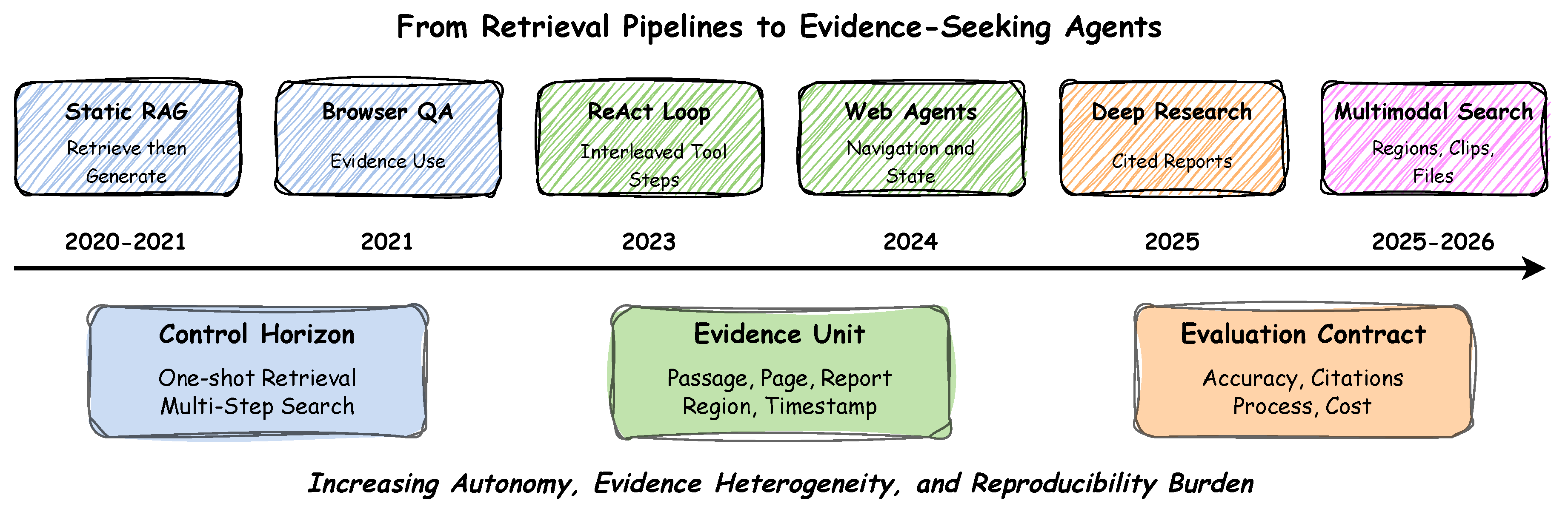
Figure 2.
Primary taxonomy and organizational structure of the survey. The taxonomy connects task regimes, evidence environments, agent workflows, learning recipes, evaluation contracts, and application domains.
Figure 2.
Primary taxonomy and organizational structure of the survey. The taxonomy connects task regimes, evidence environments, agent workflows, learning recipes, evaluation contracts, and application domains.
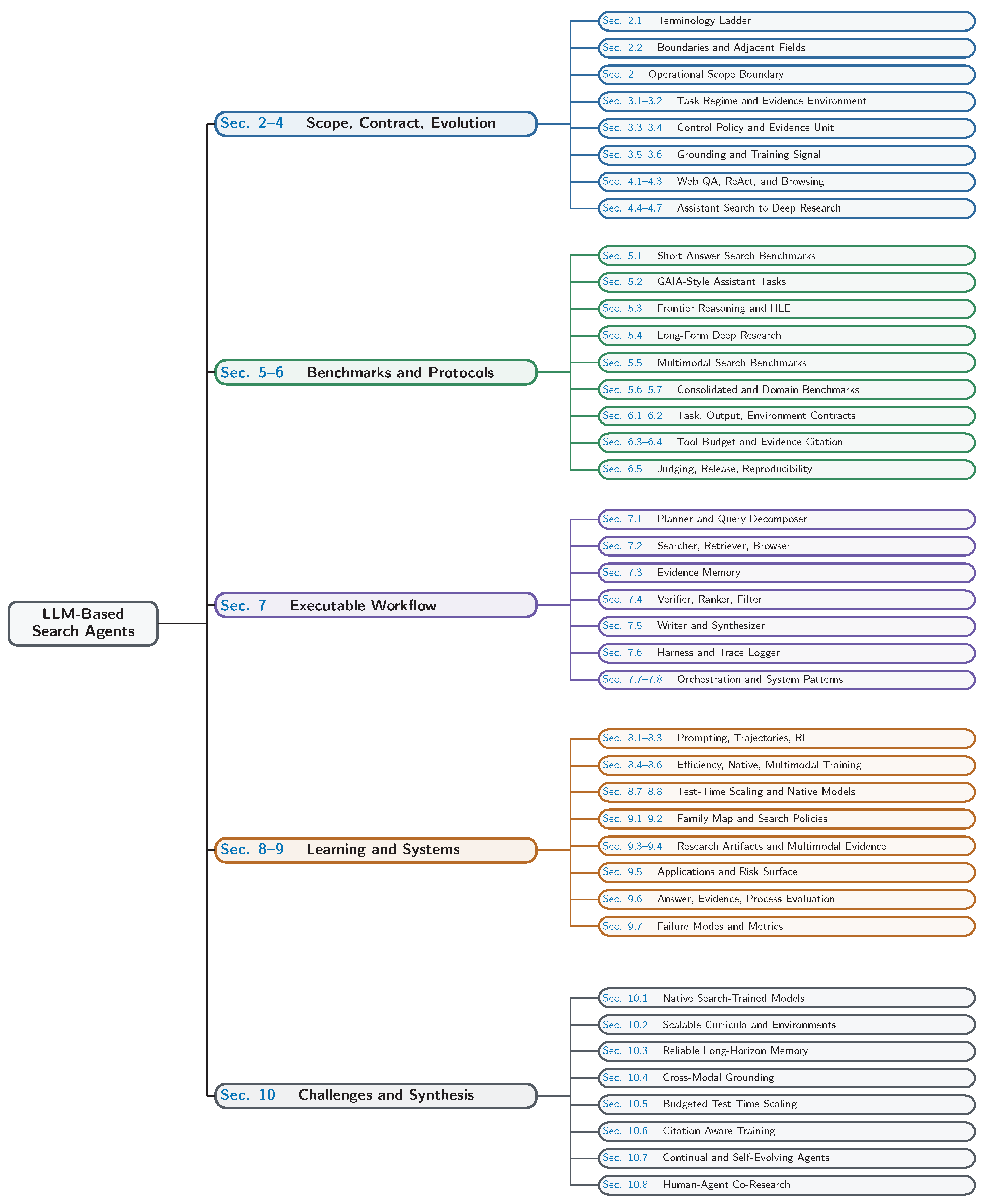
Figure 3.
Landscape overview of LLM-based search agents. The fan-shaped map organizes the field from inner search-agent paradigms to middle-layer capabilities and outer representative implementations, spanning benchmarks, interaction settings, workflows, training recipes, multimodal evidence, and assessment protocols.
Figure 3.
Landscape overview of LLM-based search agents. The fan-shaped map organizes the field from inner search-agent paradigms to middle-layer capabilities and outer representative implementations, spanning benchmarks, interaction settings, workflows, training recipes, multimodal evidence, and assessment protocols.
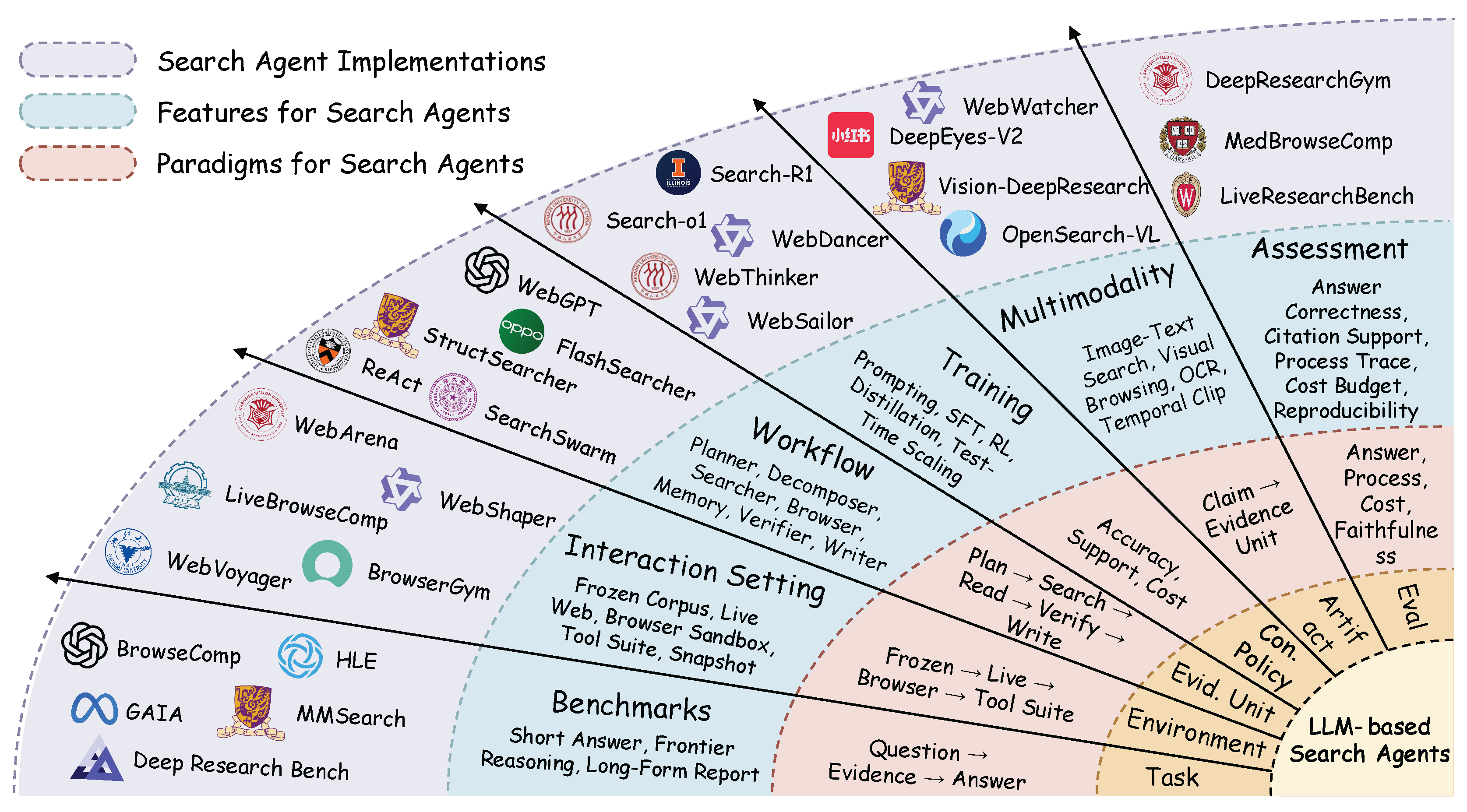
Figure 4.
Evolutionary tree of representative LLM-based search-agent works. Leaves denote concrete papers, benchmarks, systems, or product reports, annotated with compact lead-institution or organization labels rather than full affiliation lists.
Figure 4.
Evolutionary tree of representative LLM-based search-agent works. Leaves denote concrete papers, benchmarks, systems, or product reports, annotated with compact lead-institution or organization labels rather than full affiliation lists.
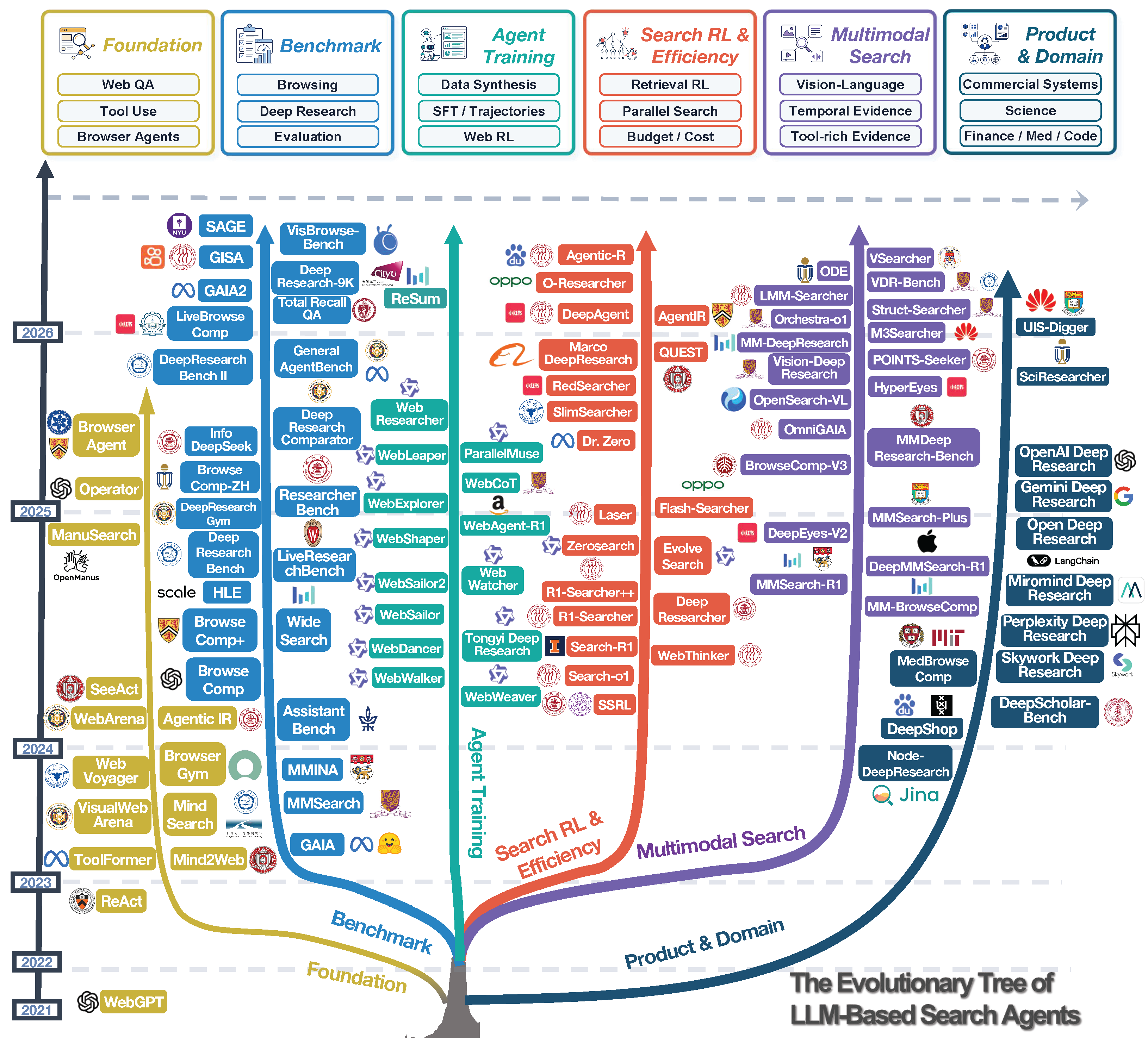
Figure 5.
A comparison contract for LLM-based search agents. A reported result is interpretable only when the task regime, evidence environment, evidence unit, control policy, output artifact, and evaluation contract are specified together.
Figure 5.
A comparison contract for LLM-based search agents. A reported result is interpretable only when the task regime, evidence environment, evidence unit, control policy, output artifact, and evaluation contract are specified together.
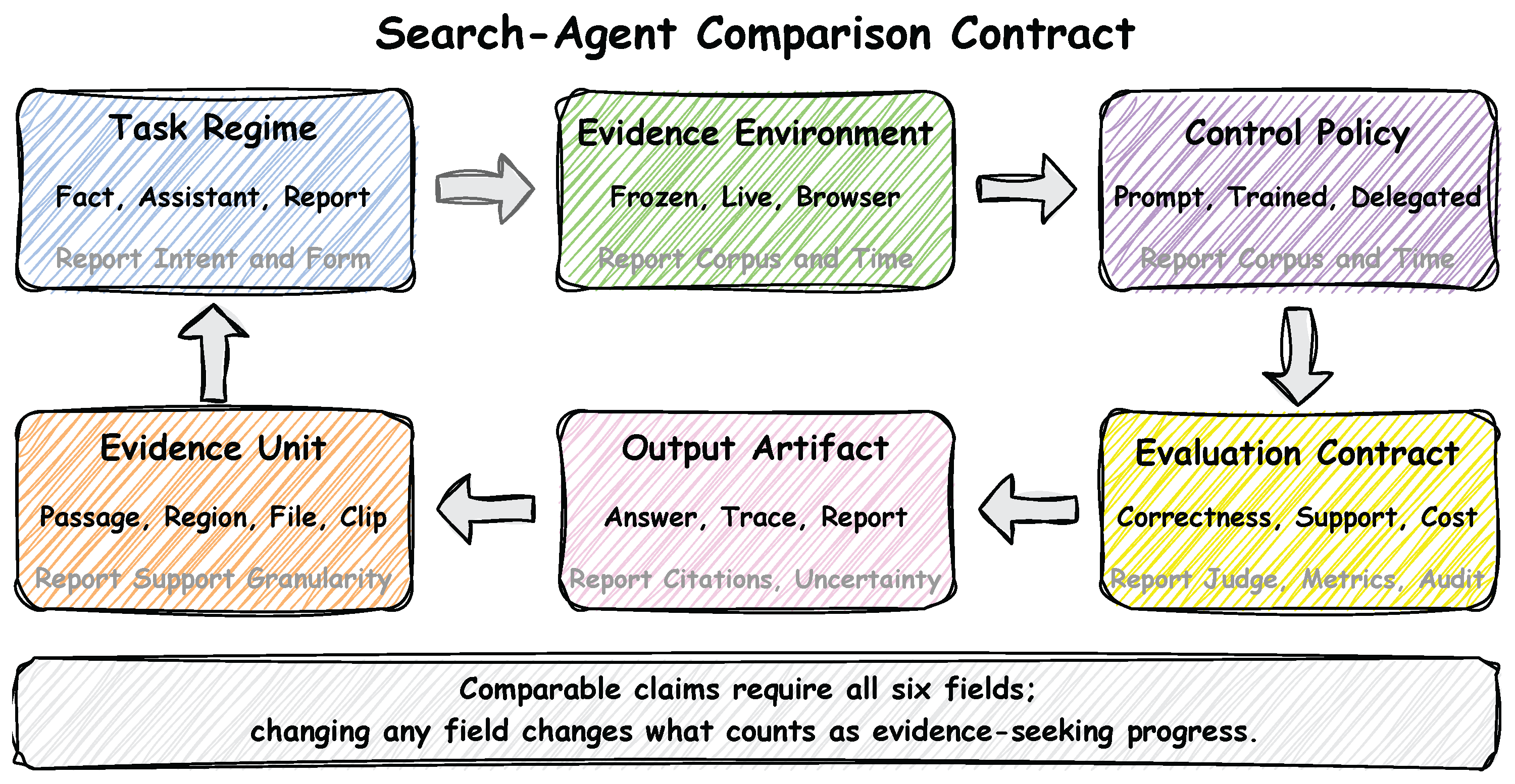
Figure 6.
A qualitative benchmark map. Horizontal position indicates the evidence environment and reproducibility regime, while vertical position indicates the output artifact that must be evaluated.
Figure 6.
A qualitative benchmark map. Horizontal position indicates the evidence environment and reproducibility regime, while vertical position indicates the output artifact that must be evaluated.
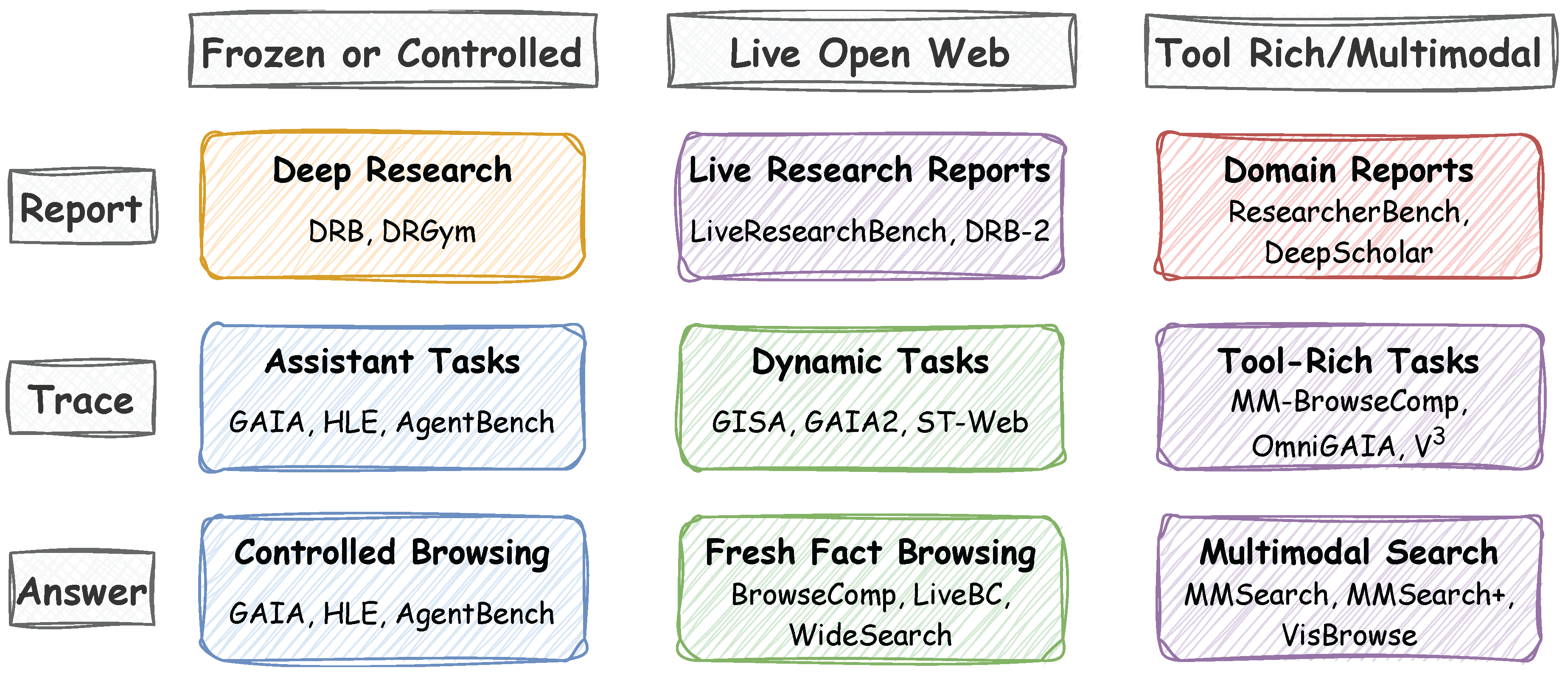
Figure 7.
Evidence-unit grounding requirements across modalities. Each modality changes the support unit that should be cited, the grounding check that makes the citation meaningful, and the failure signal that should be reported.
Figure 7.
Evidence-unit grounding requirements across modalities. Each modality changes the support unit that should be cited, the grounding check that makes the citation meaningful, and the failure signal that should be reported.
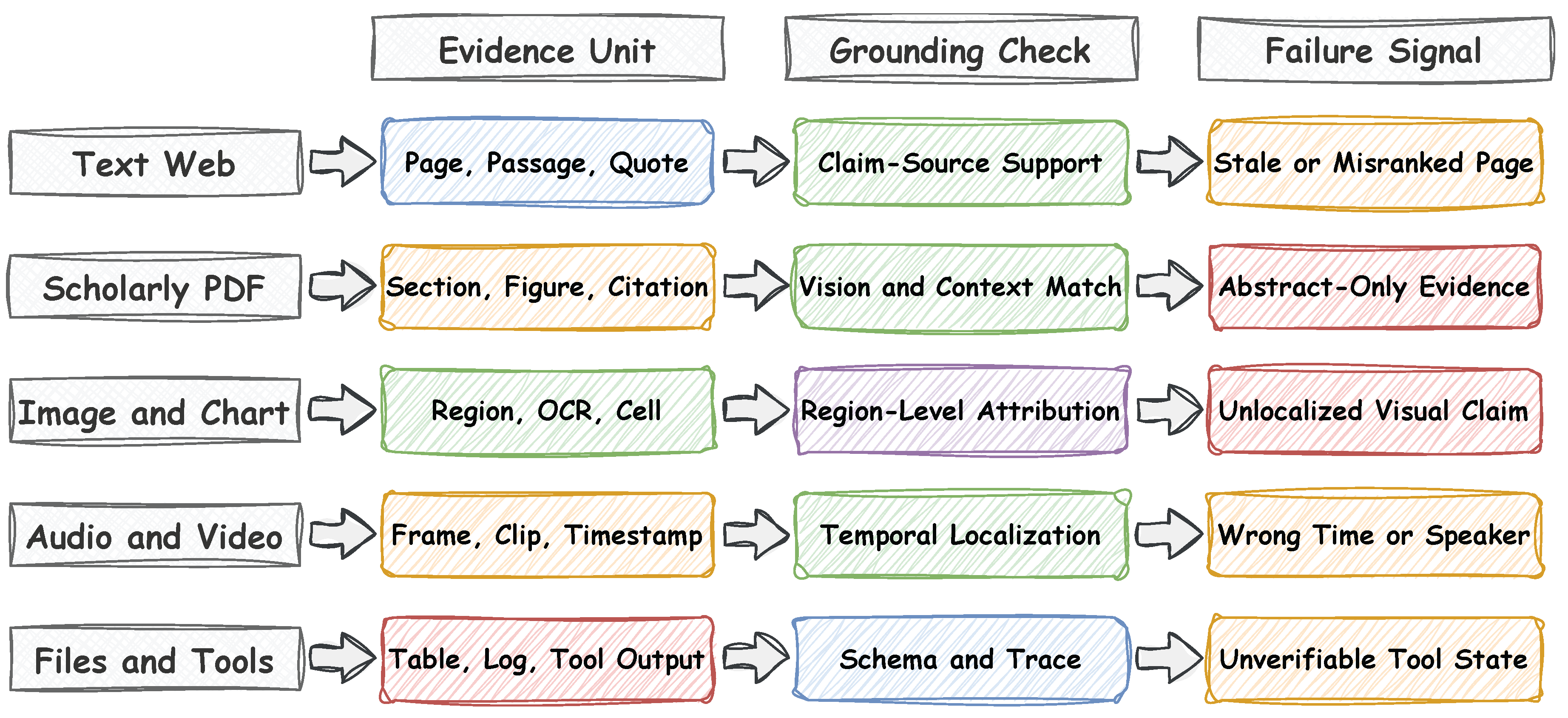
Figure 8.
A canonical LLM-based search-agent workflow. User requests are decomposed into subquestions, routed through search APIs or browsers, summarized into memory and evidence state, checked by verifiers and rubrics, and written as an answer or report.
Figure 8.
A canonical LLM-based search-agent workflow. User requests are decomposed into subquestions, routed through search APIs or browsers, summarized into memory and evidence state, checked by verifiers and rubrics, and written as an answer or report.


Table 1.
Working Terminology for LLM-Based Search Agents.
| Term | Core Requirement | Typical Output and Evaluation |
|---|---|---|
| Static RAG | Fixed Retrieval Context | Short Answer; Recall / Accuracy / Faithfulness |
| Agentic RAG | LLM-Controlled Retrieval Timing | Multi-Step Answer; Process Diagnostics |
| Search Agent | Sequential External Search | Answer or Analysis; Evidence Quality |
| Browsing Agent | Web Page and Form Interaction | Task Completion; Source Localization |
| Deep Research Agent | Long-Horizon Evidence Integration | Cited Report; Coverage / Citation Faithfulness |
| Multimodal Search Agent | Multimodal or Tool-Mediated Evidence | Grounded Answer; Cross-Modal Quality |
Table 2.
Framework-at-a-glance for the Search-Agent Comparison Contract.
| Contract Field | System Dimension | Method Implication | Evaluation Implication |
|---|---|---|---|
| Task Regime | Task Intent | Search Need | Output Target |
| Evidence Environment | Corpus / Web / Browser / Tool | Source Access | Reproducibility |
| Evidence Unit | State and Modality | Support Granularity | Localization |
| Control Policy | Planner / Browser / Orchestrator | Decision Ownership | Traceability |
| Output Artifact | Answer / Report / Action Trace | Synthesis Form | Rubric Fit |
| Evaluation Contract | Metric / Judge / Release | Reporting Bundle | Comparability |
Table 3.
Evolutionary phases of LLM-based search agents. Each phase changes the control unit, evidence unit, or evaluation contract that later methods inherit.
Table 3.
Evolutionary phases of LLM-based search agents. Each phase changes the control unit, evidence unit, or evaluation contract that later methods inherit.
| Phase | Control Unit | Evidence Unit | Evaluation Shift |
|---|---|---|---|
| Browser-Assisted QA | Query–Read–Write Loop | Web Passage | Source-Backed Answer |
| Reasoning–Action Interleaving | Thought–Action Step | Retrieved Context | Stepwise Evidence Use |
| Web Traversal | Browser Action Trace | Page State / Link Path | Task Completion and Navigation |
| Assistant Search | Tool-Using Assistant Policy | Web / File / Tool Output | Compact Answer with Tool Evidence |
| Hard Browsing | Persistent Search Policy | Hard-to-Find Fact | Verifiable Short Answer |
| Deep Research | Planner–Searcher–Writer Workflow | Source Set and Notes | Cited Report and Coverage |
| Multimodal Evidence | Modality-Aware Tool Router | Region / Chart / Clip / File | Grounded Cross-Modal Support |
Table 4.
A consolidated benchmark landscape for LLM-based search agents.
Table 5.
Benchmark protocol contracts for LLM-based search agents.
| Contract Field | Typical Choices | Main Threat | Audit Artifact |
|---|---|---|---|
| Task and Output | Short Answer / Report / Multimodal Answer | Score Mismatch | Manifest / Schema / Rubric |
| Environment | Corpus / Live Web / Browser / Tool Suite | Drift / Leakage / Sandbox Gap | Version / Date / Hash |
| Tool and Budget | Search API / Browser / OCR-VQA / Code | Hidden Compute / Tool Gap | Tool List / Budget Log |
| Evidence and Citation | URL / Passage / Region / Timestamp | Unsupported Citation | Evidence Bundle / Entailment |
| Judge and Release | Exact Match / Rubric / LLM Judge / Human | Judge Bias / Weak Replay | Prompt / Label / Trace |
Table 6.
Representative LLM-based search-agent systems and resources.
Table 7.
Work-level training and post-training recipes for LLM-based search agents.
Table 8.
Major system families, suitable evaluation settings, and recurring risks.
| Family | Examples | Evaluation Fit | Main Risk |
|---|---|---|---|
| Prompted Loops | WebGPT; ReAct; Deep Research | BrowseComp; GAIA | Hidden Settings |
| Search Policies | Search-o1; Search-R1; Agentic-R | BrowseComp; InfoDeepSeek | Memory Bias |
| Web-Agent Training | WebDancer; WebSailor; WebWeaver | GAIA; WebWalkerQA | Trace Opacity |
| Deep Research | QUEST; Dr. Zero; SearchSwarm | DR Bench; ReportBench | Weak Citations |
| Efficient Search | SlimSearcher; Flash-Searcher; S3 | Cost Curves; Branch Utility | Search Overuse |
| Memory Systems | ReSum; Struct-Searcher; DeepDive | Long-Horizon Tasks | Lost Provenance |
| Multimodal Search | WebWatcher; OpenSearch-VL; VDR | MMSearch; OmniGAIA | Evidence Unit |
| Domain Research | MedBrowseComp; DeepShop; OpenScholar | Expert Rubrics | Domain Mismatch |
Table 9.
Domain evidence contracts for LLM-based search agents.
| Domain | Admissible Sources | Freshness Window | Support Unit | Escalation Rule |
|---|---|---|---|---|
| Science | Papers / Data / Code | Versioned Literature | Paper Section / Dataset / Code | Expert Review |
| Medicine | Guidelines / Trials / Records | Standard of Care | Guideline Clause / Trial Result | Clinician Escalation |
| Finance | Filings / News / Prices | Event-Time Validity | Filing Line / Price Timestamp | Dated Caveat |
| Law / Policy | Statutes / Cases / Rules | Jurisdiction and Date | Statute Clause / Case Holding | Legal Review |
| Software | Repositories / Issues / Tests | Commit-Level Version | File / Function / Test Log | Executable Check |
| Shopping | Listings / Reviews / Prices | Availability Window | Listing / Review / Price | Bias Disclosure |
| Education | Curricula / Examples / Assessments | Learner Context | Concept / Exercise / Rubric | Calibration Check |
| Enterprise | Internal Docs / Logs / Web | Permissioned Snapshot | Document / Ticket / Log | Access Review |
Table 10.
Evaluation dimensions for LLM-based search agents.
| Dimension | Example Measures | Diagnostic Target |
|---|---|---|
| Final Answer | Exact Match; F1; Numeric Tolerance; Rubric Score | Task Correctness |
| Evidence Recall | Source Recall; Claim Coverage; Source Diversity | Evidence Coverage |
| Citation Faithfulness | Link Validity; Source Relevance; Entailment; Span Match | Citation Support |
| Process Quality | Useful Queries; Recovery; Subgoal Coverage; Redundancy Rate | Trace Purposefulness |
| Efficiency | Tool Calls; Page Visits; Tokens; Latency; Cost | Practical Budget |
| Freshness and Leakage | Recent Sources; Page Hashes; Contamination Audit | Discovery Validity |
| Modality Grounding | Region Support; OCR Correctness; Table Cells; Timestamps | Granular Grounding |
| Robustness and Safety | Conflict Handling; Injection Resistance; Unsafe Actions | Adversarial Reliability |
Table 11.
Recurring failure modes and diagnostics for search-agent evaluation.
| Failure Mode | Typical Symptom | Useful Diagnostic |
|---|---|---|
| Memory Verification | Answer Before Search | Closed-Book Delta; Freshness Slice |
| Over-Searching | Cost without Support Gain | Accuracy-Cost Frontier; Redundant Queries |
| Under-Searching | Missing Critical Evidence | Claim-Source Support; Evidence Review |
| Citation Laundering | Topical but Unsupported Citation | Sentence Attribution; Source-Span Audit |
| Source Conflict Blindness | Collapsed Conflicting Sources | Contradiction Set; Uncertainty Rubric |
| Context Suffocation | Forgotten Earlier Evidence | Memory Ablation; Provenance Recovery |
| Wrong Evidence Unit | Wrong Region/OCR/Cell/Timestamp | Region/OCR/Cell/Timestamp Check |
| Aggregation Error | Inconsistent Parallel Branches | Branch Scoring; Synthesis Audit |
Table 12.
Future agenda map for LLM-based search agents.
| Future Direction | Current Bottleneck | Evidence of Progress |
|---|---|---|
| Native Search-Trained Models | Search Timing, Trace Opacity | Inspectable Query, Citation Decisions |
| Scalable Curricula and Environments | Synthetic Tasks Without Real Search Need | Controlled Freshness, Conflict, Domain Variables |
| Reliable Long-Horizon Memory | Context Growth, Lost Provenance | Recoverable Source, Timestamp, Branch Ledgers |
| Cross-Modal Grounding | URL-Level Support for Non-Text Evidence | Region, OCR, Cell, Timestamp Verification |
| Budgeted Test-Time Scaling | Hidden Compute, Over-Browsing | Accuracy-Cost-Support Curves |
| Citation-Aware Training | Topical Citations Without Entailment | Claim-Level Support Rewards |
| Continual and Self-Evolving Agents | Leakage, Source Poisoning | Provenance-Bounded Self-Improvement |
| Human-Agent Co-Research | Hidden Autonomy, Weak Control | Editable Plans, Branches, Evidence Maps |
Disclaimer/Publisher’s Note: The statements, opinions and data contained in all publications are solely those of the individual author(s) and contributor(s) and not of MDPI and/or the editor(s). MDPI and/or the editor(s) disclaim responsibility for any injury to people or property resulting from any ideas, methods, instructions or products referred to in the content. |
© 2026 by the authors. Licensee MDPI, Basel, Switzerland. This article is an open access article distributed under the terms and conditions of the Creative Commons Attribution (CC BY) license (http://creativecommons.org/licenses/by/4.0/).
Copyright: This open access article is published under a Creative Commons CC BY 4.0 license, which permit the free download, distribution, and reuse, provided that the author and preprint are cited in any reuse.