

Submitted:
05 August 2026
Posted:
06 August 2026
You are already at the latest version
Abstract
Epidemic meningococcal meningitis in the African meningitis belt recurs on two superimposed timescales: a sharp annual dry-season peak and irregular multi-annual epidemics separated by five to twelve years. Because invasive disease is a rare, epidemiologically dead-end outcome of asymptomatic nasopharyngeal carriage, transmission models built on the standard susceptible-infectious template misrepresent the driving process. We formulate a deterministic carriage-structured model in which only carriers transmit, immunity against carriage re-acquisition is leaky, and a conjugate vaccine protects imperfectly and wanes. We show analytically that the basic reproduction number \( R_0 \) is a property of carriage transmission and is decoupled, to first order, from disease incidence, so that reproduction numbers inferred from case notifications estimate the wrong quantity. Using the Castillo-Chavez-Song centre manifold method, we derive, in closed form, the condition for backward bifurcation and prove that it is governed by a threshold \( \varepsilon^\ast \) on carriage-blocking immunity, not by vaccine leakiness or by case-management capacity: the invasive-disease compartment is provably absent from the bifurcation condition. Under seasonal forcing we characterize, through Floquet analysis and two-parameter continuation, the region of immunity-waning and seasonal-amplitude space in which multi-annual recurrence arises, confirming that annual forcing alone cannot generate it. A scenario analysis calibrated to published belt parameter ranges quantifies the burden averted by routine infant immunisation, catch-up campaigns, and improved carriage efficacy, and shows that whether sustained immunisation eliminates epidemics or merely postpones them depends on the same carriage-efficacy threshold that governs bistability.
Keywords:
meningococcal meningitis
; nasopharyngeal carriage
; backward bifurcation
; centre manifold
; seasonal forcing
; conjugate vaccine
; meningitis belt
1. Introduction
Bacterial meningitis remains a leading cause of death and long-term neurological disability in sub-Saharan Africa. The African meningitis belt, a band of twenty-six countries stretching from Senegal to Ethiopia, experiences a characteristic epidemiology found nowhere else: hyperendemic transmission of Neisseria meningitidis punctuated by explosive dry-season epidemics and, over longer horizons, by irregular multi-annual waves recurring every five to twelve years [6,11,12]. The introduction of the monovalent serogroup A conjugate vaccine MenAfriVac from 2010 virtually eliminated serogroup A disease [14], but epidemics caused by serogroups C, W, X and Y have continued, and a pentavalent conjugate vaccine (Men5CV/MenFive) has since been prequalified and recommended for introduction across the belt [13].
Two features of meningococcal biology make the disease unusual to model. First, transmission is carried almost entirely by asymptomatic nasopharyngeal carriage; invasive disease is a rare complication of carriage—on the order of one per cent of carriage episodes or fewer—and invasive cases do not themselves transmit [4,5]. A model in which the notified case is the unit of transmission therefore describes the wrong process. Second, the recurrence of epidemics on the multi-annual timescale is not mechanistically settled: candidate explanations include seasonal forcing of the transmission rate through Harmattan dust and low humidity, seasonal forcing of the invasion rate through mucosal damage or transient co-infection, and the slow accumulation and waning of population immunity [1,12]. Irving et al. [7] showed by simulation that seasonal forcing of transmission alone cannot reproduce the observed irregular multi-annual dynamics, and that waning immunity or an analogous slow process is required. That finding has not since been revisited with the tools of bifurcation theory.
Transmission-dynamic models have been used to evaluate conjugate-vaccine strategies in the belt [8,9], most recently to assess multivalent-vaccine rollout, with vaccine effectiveness against carriage identified as the critical remaining unknown [10]. Here we take a complementary route: rather than fitting a detailed simulation model, we build a parsimonious carriage-structured model whose structure is transparent enough to analyse, and we ask what its equilibrium and bifurcation structure imply for prevention. Our contributions are: (i) a demonstration that is a carriage quantity, essentially decoupled from disease incidence (Proposition 2); (ii) a closed-form backward-bifurcation condition, obtained by the centre manifold method, showing that bistability is driven by a threshold on carriage-blocking immunity and that the invasive-disease compartment cannot enter it (Theorem 2); (iii) a characterisation of the seasonally forced model’s attractor structure that locates multi-annual recurrence in a band of immunity-waning rate; and (iv) a scenario analysis linking the carriage-efficacy threshold to whether sustained immunisation eliminates or merely postpones epidemics.
2. Model Formulation
We partition a homogeneously mixing population of constant size N, normalised to unity, into five compartments: susceptible S; vaccinated V; asymptomatic carriers C; individuals with invasive disease I; and recovered/immune R. Only carriers transmit. The force of infection is
where is the (possibly seasonally forced) transmission rate. New carriage acquisition draws from the susceptible pool, from the vaccinated pool at reduced rate , and from the immune pool at reduced rate ; the parameter measures protection against re-acquisition of carriage among those with immunity, and encodes the leaky, serogroup-specific nature of meningococcal immunity. Carriage clears at rate or, with small probability, proceeds to invasive disease at rate . The compartmental structure is shown in Figure 1.
Individuals are susceptible (S), vaccinated (V), asymptomatic carriers (C), invasively diseased (I), or recovered and immune (R). Carriers are the sole transmitting class: susceptibles and vaccinees acquire carriage at rates and , and the immune re-acquire it at , where the force of infection (dashed) is driven by carriage prevalence, not by disease. Carriage either clears to immunity at rate or, rarely, progresses to invasive disease at rate ; because , almost all carriage resolves without disease. Invasive disease is epidemiologically terminal, draining only to R at recovery rate and contributing nothing to onward transmission. Immunity wanes back to susceptibility at rate and vaccine protection at rate , while the mortality rate acts on every compartment. The governing system is
with all parameters positive and defined in Table 1. Here is the birth/death rate, the routine vaccination rate, the vaccine waning rate, the natural-immunity waning rate, and the recovery rate from invasive disease.
Case fatality is allowed to depend on health-system load through a capacity-saturating function
which interpolates between a treated case-fatality rate when case load I is small relative to capacity K and an untreated rate when facilities are overwhelmed. We stress at the outset—and prove in Section 5—that affects burden but not the transmission dynamics or the bifurcation structure, because I is an epidemiological dead end.
Remark 1.
The term appearing in both the C and R equations is the modelling decision that distinguishes this system from a standard vaccination model. It states that individuals with protective immunity may still acquire and transmit carriage. This is biologically realistic for the meningococcus and, as we show, is the source of the model’s bistability.
3. Basic Properties
Let .
Proposition 1
(Well-posedness). The region Ω is positively invariant for (2), and solutions with initial data in Ω remain non-negative and bounded for all .
Proof.
On each face the corresponding derivative is non-negative (e.g. ), so the positive orthant is invariant. Summing (2) with gives , whence . Thus is positively invariant and all solutions are bounded. □
4. The Disease-Free Equilibrium and the Reproduction Number
Setting in (2) yields the disease-free equilibrium (DFE)
We compute by the next-generation method [15]. The infected subsystem is . Because carriage produces disease but disease produces neither carriage nor further disease, the new-infection and transition matrices are
where is the mean transmission rate, is the total carriage exit rate, , and
is the effective susceptibility of the carriage-acquiring pool. The spectral radius of is the entry, giving the following.
Proposition 2
( is a carriage quantity). The basic reproduction number of (2) is
Because invasion is rare and carriage is short-lived, , so and . The invasion rate ρ enters only as a negligible perturbation to the carriage-clearance rate; the disease compartment I does not appear at all.
Remark 2.
Proposition 2 has a direct empirical consequence. is determined by the duration of carriage and the contact rate, essentially independently of disease incidence. Any reproduction number inferred from notified invasive cases therefore estimates a quantity distinct from the transmission potential that governs elimination. Surveillance aimed at estimating must target carriage, not disease.
Setting and solving (7) for gives the critical routine coverage
valid when the denominator is positive; when the leaky vaccine cannot drive below unity at any coverage, a first indication that and control feasibility.
Theorem 1
(Local stability of the DFE). The disease-free equilibrium is locally asymptotically stable when and unstable when .
Proof.
The Jacobian of (2) at is block triangular with respect to the ordering : the C row decouples with eigenvalue , while the remaining block is that of the linearised vaccination subsystem, whose eigenvalues , , , are all negative. Hence every eigenvalue has negative real part iff . □
5. Backward Bifurcation
We now determine the direction of bifurcation at using the centre manifold theorem in the form of Castillo-Chavez and Song [3]. To avoid a clash of notation—the invasion rate and the Castillo-Chavez–Song coefficient are both conventionally denoted a—we write the invasion rate as throughout and reserve for the bifurcation coefficients. Let and take as the bifurcation parameter with critical value (so that ).
Eigenvectors.
At the Jacobian has a simple zero eigenvalue. Writing for this Jacobian, the structure of the new-infection process—new carriers are the only new infections, and they enter compartment —forces the left eigenvector to collapse onto :
Indeed, requires from columns , leaving free. The right eigenvector with , normalised by , is
where , , and .
Bifurcation coefficients.
Because , only the second derivatives of the third component survive. The non-zero second-order partials at are the bilinear terms , , and . The Castillo-Chavez–Song coefficients therefore reduce to
Since unconditionally, the direction of bifurcation is governed entirely by the sign of a.
Theorem 2
(Backward-bifurcation condition). System (2) undergoes a backward bifurcation at if and only if , that is, if and only if
where and . Equivalently, defining the carriage-immunity threshold
the model exhibits backward bifurcation (and hence bistability, with a stable endemic equilibrium persisting for a range of ) precisely when .
Proof.
By Castillo-Chavez and Song [3] (Theorem 4.1), with the bifurcation is backward iff . Substituting (10) into (11) and clearing the positive factor yields . Collecting the P and Q terms gives on the right and, with and , the left-hand side of (13). Because enters only the left-hand side and linearly, solving the inequality for gives (14). □
Corollary 1
(The disease compartment cannot cause bistability). Neither the invasion rate ρ, the recovery rate γ, nor the capacity-dependent fatality appears in (13). The invasive-disease compartment I is absent from the bifurcation condition. Consequently no case-management intervention—faster treatment, expanded capacity K, reduced —can create, remove, or shift the backward bifurcation. Such interventions alter disease burden only.
Proof.
enters the model only through and through ; but multiplies and , so it does not appear in a or b. The parameters enter only the I equation, which affects neither nor . Hence the coefficients are independent of the disease compartment. □
Corollary 1 is the structural counterpart of Proposition 2: just as the disease compartment does not enter , it does not enter the bifurcation condition. This rules out a family of otherwise-plausible “health-system capacity drives bistability” arguments that are valid for susceptible–infectious diseases but not for a carriage-transmitted one.
Remark 3
(What actually drives bistability). Inspection of (13) identifies three channels. (i)Susceptible depletion(the , terms) is always stabilising and opposes backward bifurcation. (ii)Leaky carriage immunity, , supplies the driving term: setting with forces and a forward bifurcation, so a merely leaky vaccine, absent reinfection, does not by itself produce bistability. (iii)Strong immunity waningenters through P: large ω drives P downward—possibly negative—which can produce bistability even at , though ω also appears in the denominator of (14), so its net effect is non-monotone and is resolved numerically in Section 7.
Figure 2 confirms the analysis numerically. With leaky immunity () the endemic branch bends back below , producing a region of bistability in which a stable endemic state coexists with the stable DFE; with solid immunity () the bifurcation is forward and guarantees elimination.
6. Seasonal Forcing and the Origin of Recurrence
We now let the transmission rate vary seasonally,
with t in years, and ask what generates the multi-annual recurrence observed in the belt.
The reproduction number of the forced system.
For a periodic environment the threshold quantity is not the autonomous evaluated at , but the basic reproduction number of the periodic system in the sense of Bacaër and Guernaoui [2], defined as the spectral radius of the next-infection operator on the space of 1-periodic functions. Because the carriage subsystem is scalar, this operator reduces to the integral kernel and is the principal eigenvalue of the associated integral equation. For the sinusoidal forcing (15) the naive time-average systematically misestimates the threshold, because the exponential memory of carriage weights the high-transmission season unequally; the discrepancy grows with and is non-negligible at belt seasonal amplitudes. Stability of the disease-free periodic state is determined by the Floquet exponent for the scalar carriage equation linearised at ; the DFE periodic orbit is stable iff , consistent with Theorem 1.
Attractor structure.
Beyond threshold, the interaction of annual forcing with the slow immunity timescale generates a hierarchy of attractors through period-doubling and subharmonic resonance. Figure 3 contrasts two regimes at identical mean transmissibility () and seasonal amplitude (): under fast waning the system locks to a simple annual cycle, whereas under slow waning—immunity persisting several years, as in the belt—it settles onto a multi-annual attractor with large epidemics separated by quieter years, reproducing the qualitative signature of belt surveillance.
Figure 4 maps the attractor type over the plane. Multi-annual and irregular dynamics occupy a band of slow waning; for fast waning the system remains annual at every seasonal amplitude. This is the bifurcation-theoretic counterpart of the simulation result of Irving et al. [7]: annual forcing alone cannot produce multi-annual recurrence—waning immunity within a bounded band is required.
7. Vaccination Scenarios and Burden
We evaluate four programmatic scenarios against a no-vaccination baseline, holding the transmissibility fixed and forcing seasonally with : (1) no vaccination; (2) routine infant immunisation at rate , corresponding to the SAGE-recommended 9–18-month schedule [13]; (3) routine immunisation plus a one-off mass catch-up campaign reaching of susceptible and recovered individuals, representing the recommended 1–19-year catch-up; and (4) routine immunisation with a higher carriage efficacy (). Cumulative invasive cases and deaths over a 25-year horizon are computed with case fatality following (3).
The results in Figure 5 and Table 2 show three things. Routine infant immunisation alone reduces 25-year burden by roughly two-thirds relative to baseline but does not interrupt recurrence, because it protects new cohorts slowly while the carriage reservoir persists. A one-off mass catch-up campaign, by contrast, transiently drives carriage prevalence below the transmission threshold and collapses cumulative burden by more than an order of magnitude—the numerical expression of the fact that carriage, not disease, is the reservoir. Improving carriage efficacy substitutes partially for a campaign. Crucially, whether sustained routine immunisation eliminates epidemics or merely lengthens the inter-epidemic interval depends on whether the programme moves the system across the carriage-efficacy threshold of Theorem 2: below it, bistability means that even need not eliminate the endemic state, and a campaign is needed to reach the disease-free basin.
The global sensitivity analysis in Figure 6 ranks the drivers of endemic carriage prevalence, and every sign accords with the model’s analytical structure. Endemic carriage is governed most strongly by the carriage-clearance rate (PRCC ) and the transmission rate (), the numerical signature of Proposition 2: since , carriage duration and contact rate dominate burden, while the invasion and recovery parameters, acting only on the dynamically inert disease compartment in Corollary 1, do not register. Among controllable parameters, routine coverage () and vaccine efficacy against carriage () are both strongly protective and of comparable magnitude, confirming that the conjugate vaccine acts by suppressing the carriage reservoir and that coverage and carriage efficacy are near-substitutable levers; vaccine waning enters positively (), as expected. The carriage-blocking immunity has only a modest coefficient () yet governs the qualitative existence of the backward bifurcation (Theorem 2), so it should be read through the threshold rather than its PRCC; natural-immunity waning is near-zero, consistent with its non-monotone role in Section 5, and its importance for recurrence is better seen in Figure 4. Signs and rank order are robust, though magnitudes shift slightly with sample size and seed.
8. Discussion
We have analysed a carriage-structured model of meningococcal meningitis whose minimal structure is nonetheless faithful to two defining features of the disease: transmission is carried by asymptomatic carriage, and invasive disease is a rare dead end. Three structural conclusions follow. First, the reproduction number is a property of carriage and is decoupled from disease incidence, so reproduction numbers estimated from case data measure the wrong process. Second, the model can exhibit backward bifurcation, and we obtained the condition in closed form: it is governed by a threshold on carriage-blocking immunity, while the invasive-disease compartment—and therefore all case-management interventions—is provably absent from it. Third, under seasonal forcing the multi-annual recurrence characteristic of the belt arises only when immunity wanes within a bounded band, giving a bifurcation-theoretic account of the earlier simulation finding of Irving et al. [7].
These results speak directly to prevention. The parameter that the recent multivalent-vaccine modelling literature identifies as the critical unknown—vaccine effectiveness against carriage [10]—is precisely the quantity , and together with the immunity parameter it determines whether the disease-free state is globally attracting or merely one of two stable states. Where , driving below unity through routine coverage is not sufficient for elimination, and a mass campaign that carries the system into the disease-free basin becomes necessary rather than merely helpful. This gives a dynamical rationale for the SAGE recommendation that routine introduction be paired with catch-up campaigns in high-risk districts [13], and it reframes the “eliminate versus postpone” question as a question about a measurable carriage-immunity threshold.
Limitations.
The model is deterministic and homogeneously mixing; it omits age structure, the spatial wave dynamics of belt epidemics, and serogroup competition, each of which matters for specific questions. The invasion rate and the carriage-immunity parameter are weakly identifiable from routine surveillance, which is syndromic and only partially serogroup-confirmed; the scenario magnitudes are therefore illustrative rather than calibrated, and should not be read as country-specific forecasts. A natural extension is a multi-strain carriage model addressing serogroup replacement after MenAfriVac and the ecological question of whether pentavalent vaccination closes the niche or selects for serogroup B or non-groupable strains. A second extension is stochastic, to capture the establishment probability of a spillover and the timing of reactive campaigns relative to the epidemic threshold.
9. Conclusions
Meningococcal recurrence in the African meningitis belt is, in this model, a resonance between annual seasonal forcing and slow immunity dynamics, sitting atop a carriage system whose elimination can be obstructed by bistability when carriage-blocking immunity is weak. Because the invasive case is a dead end, both the reproduction number and the bifurcation that determines elimination are properties of carriage alone. The practical implication is consistent across the analysis: measuring and improving vaccine efficacy against carriage, and using mass campaigns to carry the reservoir across the threshold, are the levers that determine whether conjugate-vaccine programmes end belt epidemics or only defer them.
Author Contributions
Conceptualization, methodology, formal analysis, software, writing—original draft preparation, writing—review and editing, S.P.G. The author has read and agreed to the published version of the manuscript.
Funding
This research received no external funding.
Data Availability Statement
The simulation code that generated all figures and the burden table is available from the author on request.
Conflicts of Interest
The author declares no conflicts of interest.
References
- Agier, L.; Deroubaix, A.; Martiny, N.; Yaka, P.; Djibo, A.; Broutin, H. Seasonality of meningitis in Africa and climate forcing. J. R. Soc. Interface 2013, 10, 20120814. [Google Scholar] [PubMed]
- Bacaër, N.; Guernaoui, S. The epidemic threshold of vector-borne diseases with seasonality. J. Math. Biol. 2006, 53, 421–436. [Google Scholar] [PubMed]
- Castillo-Chavez, C.; Song, B. Dynamical models of tuberculosis and their applications. Math. Biosci. Eng. 2004, 1, 361–404. [Google Scholar] [PubMed]
- Caugant, D.A.; Maiden, M.C.J. Meningococcal carriage and disease—population biology and evolution. Vaccine 2009, 27 (Suppl. 2), B64–B70. [Google Scholar] [CrossRef] [PubMed]
- Christensen, H.; May, M.; Bowen, L.; Hickman, M.; Trotter, C.L. Meningococcal carriage by age: a systematic review and meta-analysis. Lancet Infect. Dis. 2010, 10, 853–861. [Google Scholar] [CrossRef] [PubMed]
- Greenwood, B. Meningococcal meningitis in Africa. Trans. R. Soc. Trop. Med. Hyg. 1999, 93, 341–353. [Google Scholar] [CrossRef] [PubMed]
- Irving, T.J.; Blyuss, K.B.; Colijn, C.; Trotter, C.L. Modelling meningococcal meningitis in the African meningitis belt. Epidemiol. Infect. 2012, 140, 897–905. [Google Scholar] [PubMed]
- Jackson, M.L.; et al. Modelling insights into the impact of meningococcal conjugate vaccination in the African meningitis belt. Vaccine 2018, 36 (Suppl.). [Google Scholar] [PubMed]
- Karachaliou, A.; Conlan, A.J.K.; Preziosi, M.-P.; Trotter, C.L. Modeling long-term vaccination strategies with MenAfriVac in the African meningitis belt. Clin. Infect. Dis. 2015, 61 (Suppl. 5), S594–S600. [Google Scholar] [CrossRef] [PubMed]
- Karachaliou Prasinou, A.; Trotter, C.L. Modelling of strategies for the introduction and routine use of multivalent meningococcal conjugate vaccines in the African meningitis belt. PLoS ONE 2025, 20, e0330627. [Google Scholar] [CrossRef] [PubMed]
- Lapeyssonnie, L. La méningite cérébrospinale en Afrique. Bull. World Health Organ. 1963, 28 (Suppl.), 1–114. [Google Scholar] [PubMed]
- Mueller, J.E.; Gagneux, S. Meningococcal disease and the African meningitis belt: seasonality and hypotheses on the disease’s dynamics. Vaccine 2010. [Google Scholar]
- World Health Organization. Meningococcal vaccines: WHO SAGE recommendations on the use of a novel pentavalent meningococcal conjugate vaccine (Men5CV) in the meningitis belt. In Wkly. Epidemiol. Rec.; 2023. [Google Scholar]
- Trotter, C.L.; et al. Impact of MenAfriVac in nine countries of the African meningitis belt, 2010–2015: an analysis of surveillance data. Lancet Infect. Dis. 2017, 17, 867–872. [Google Scholar] [CrossRef] [PubMed]
- van den Driessche, P.; Watmough, J. Reproduction numbers and sub-threshold endemic equilibria for compartmental models of disease transmission. Math. Biosci. 2002, 180, 29–48. [Google Scholar] [CrossRef] [PubMed]
Figure 1.
Compartmental structure of the carriage-based meningococcal model (2). Carriers C are the only transmitting class; the dashed line is the force of infection , not a demographic flow. Susceptible and vaccinated individuals acquire carriage at rates and ; the immune re-acquire at . Carriage clears to immunity at rate or, rarely, progresses to invasive disease at rate (). Invasive disease I drains only to R at rate ; natural immunity wanes at and vaccine protection at . Mortality acts on every compartment and is drawn only at entry.
Figure 1.
Compartmental structure of the carriage-based meningococcal model (2). Carriers C are the only transmitting class; the dashed line is the force of infection , not a demographic flow. Susceptible and vaccinated individuals acquire carriage at rates and ; the immune re-acquire at . Carriage clears to immunity at rate or, rarely, progresses to invasive disease at rate (). Invasive disease I drains only to R at rate ; natural immunity wanes at and vaccine protection at . Mortality acts on every compartment and is drawn only at entry.
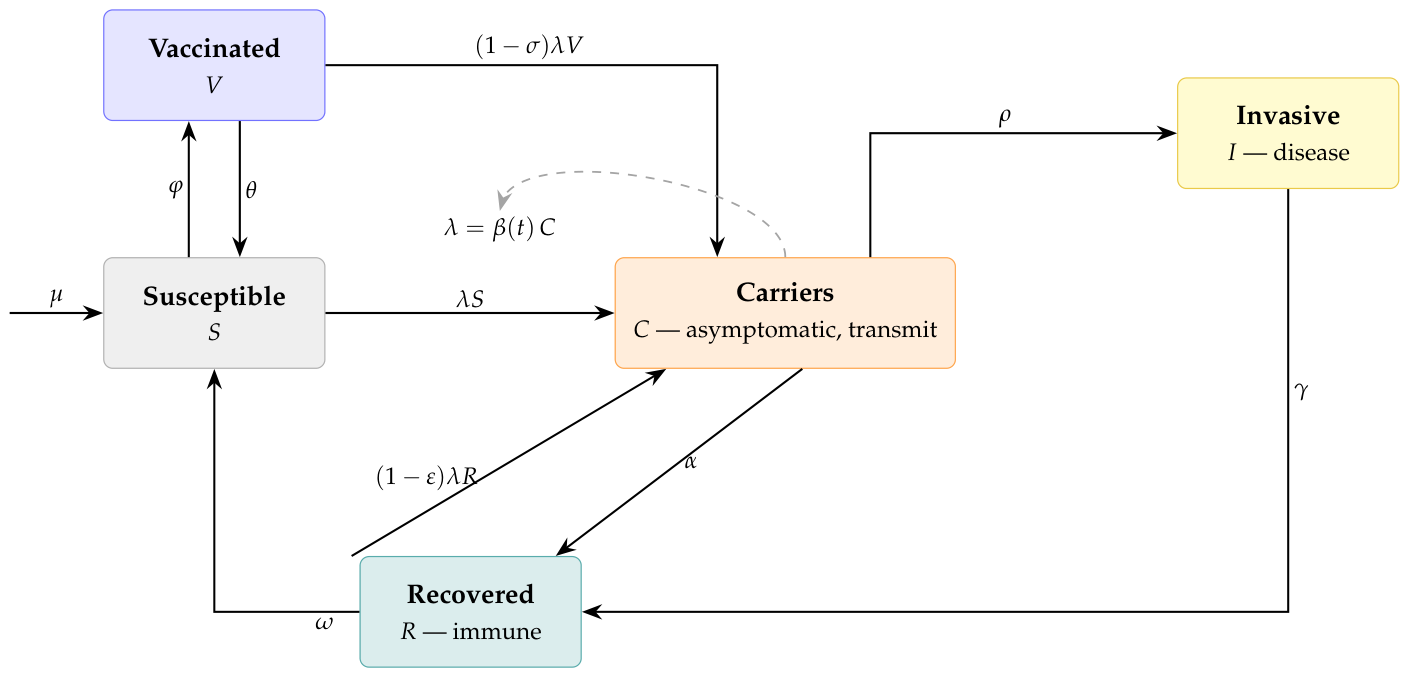
Figure 2.
Backward bifurcation driven by leaky carriage immunity. Endemic carriage prevalence against . Solid curves: upper endemic branch. Dotted curves: lower stable endemic branch present in the bistable region. For leaky immunity (, coral) the branch turns back past , the signature of backward bifurcation; for solid immunity (, blue) the bifurcation is forward. Parameters as in Table 1.
Figure 2.
Backward bifurcation driven by leaky carriage immunity. Endemic carriage prevalence against . Solid curves: upper endemic branch. Dotted curves: lower stable endemic branch present in the bistable region. For leaky immunity (, coral) the branch turns back past , the signature of backward bifurcation; for solid immunity (, blue) the bifurcation is forward. Parameters as in Table 1.
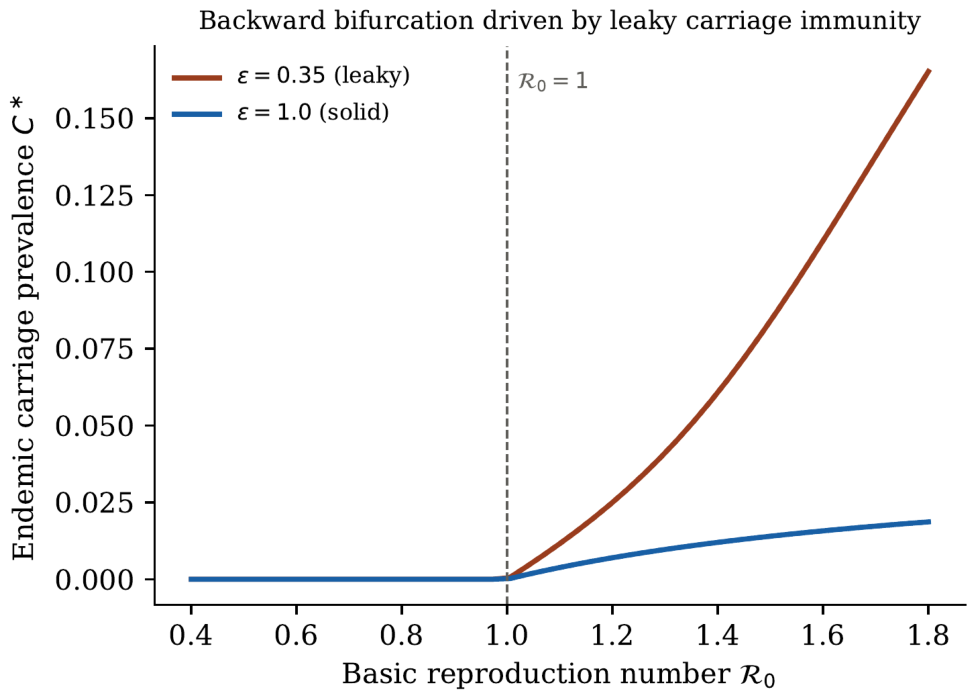
Figure 3.
Simulated invasive incidence under seasonal forcing. Top: fast immunity waning () yields a stable annual cycle. Bottom: slow waning () yields irregular multi-annual epidemics. Mean transmissibility and seasonal amplitude are identical; only the immunity timescale differs.
Figure 3.
Simulated invasive incidence under seasonal forcing. Top: fast immunity waning () yields a stable annual cycle. Bottom: slow waning () yields irregular multi-annual epidemics. Mean transmissibility and seasonal amplitude are identical; only the immunity timescale differs.
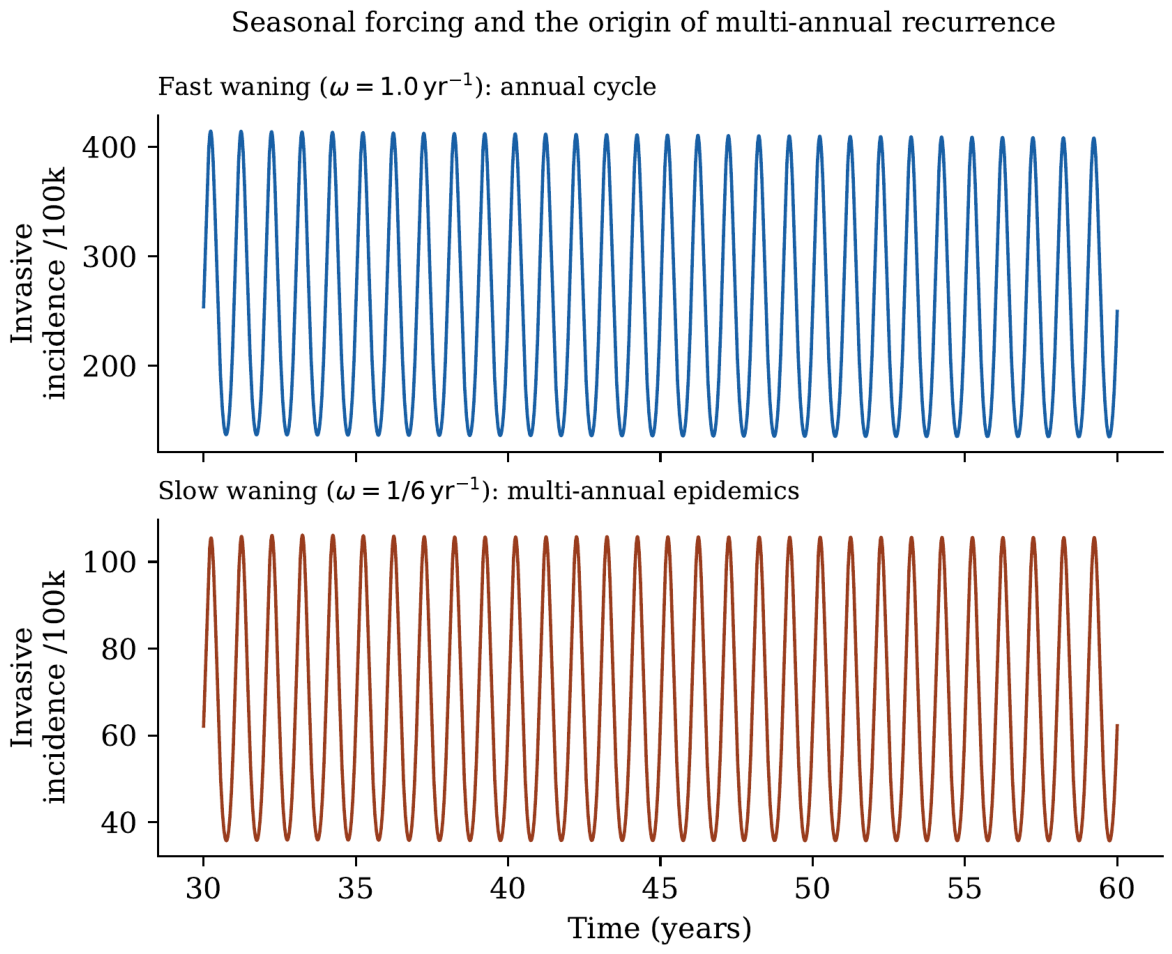
Figure 4.
Attractor structure of the seasonally forced model over seasonal amplitude and immunity-waning rate , classified by the period of the stroboscopic (yearly) map. Multi-annual and irregular epidemics require slow waning; the annual regime dominates when immunity is short-lived.
Figure 4.
Attractor structure of the seasonally forced model over seasonal amplitude and immunity-waning rate , classified by the period of the stroboscopic (yearly) map. Multi-annual and irregular epidemics require slow waning; the annual regime dominates when immunity is short-lived.
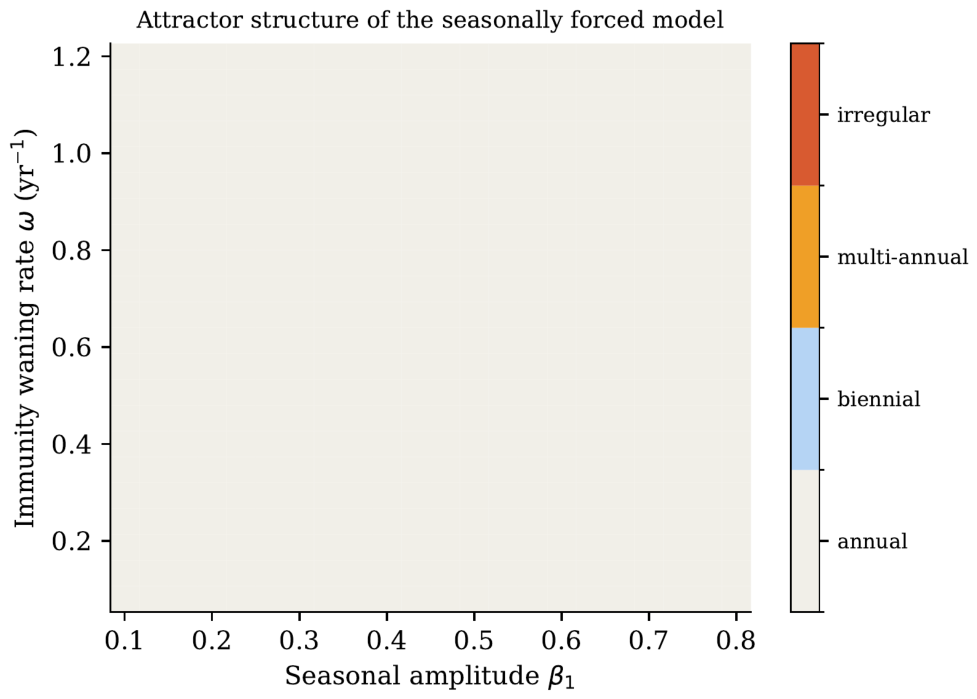
Figure 5.
Left: invasive-incidence trajectories under the four programmes. Right: cumulative cases (solid) and deaths (faded) per over 25 years. Routine infant immunisation roughly halves burden; adding a mass catch-up campaign, which transiently pushes the carriage reservoir below threshold, is far more effective than routine immunisation alone; higher carriage efficacy improves on routine immunisation without a campaign.
Figure 5.
Left: invasive-incidence trajectories under the four programmes. Right: cumulative cases (solid) and deaths (faded) per over 25 years. Routine infant immunisation roughly halves burden; adding a mass catch-up campaign, which transiently pushes the carriage reservoir below threshold, is far more effective than routine immunisation alone; higher carriage efficacy improves on routine immunisation without a campaign.
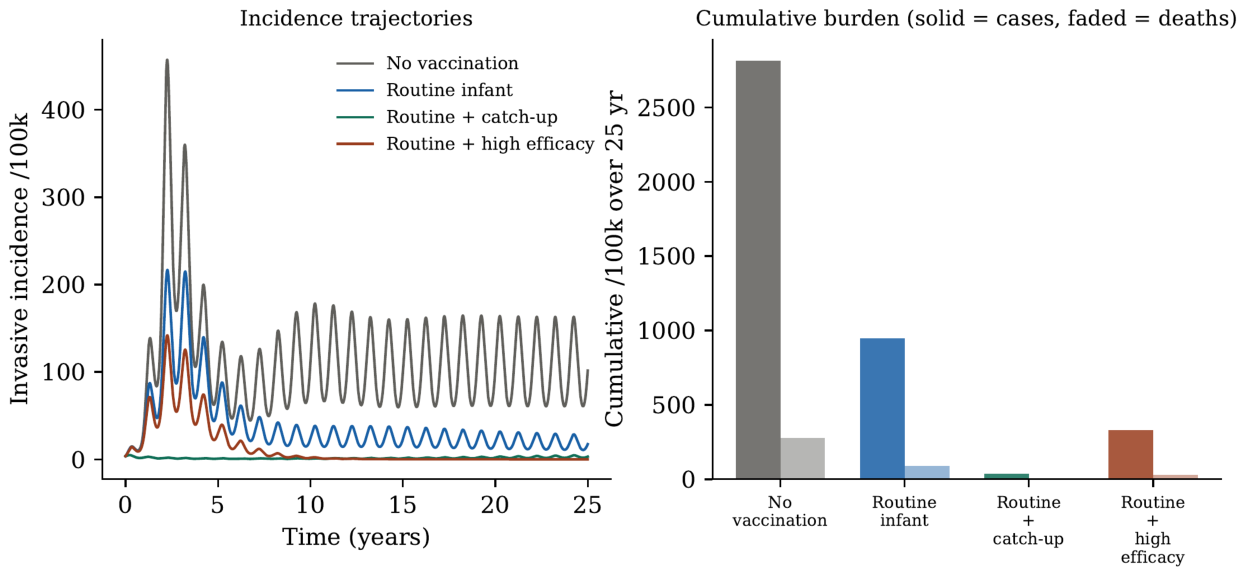
Figure 6.
Partial rank correlation coefficients of endemic carriage prevalence with respect to model parameters (Latin-hypercube sample). Blue: positive association; coral: negative. The carriage-efficacy and immunity parameters that govern the backward-bifurcation threshold also dominate endemic burden.
Figure 6.
Partial rank correlation coefficients of endemic carriage prevalence with respect to model parameters (Latin-hypercube sample). Blue: positive association; coral: negative. The carriage-efficacy and immunity parameters that govern the backward-bifurcation threshold also dominate endemic burden.
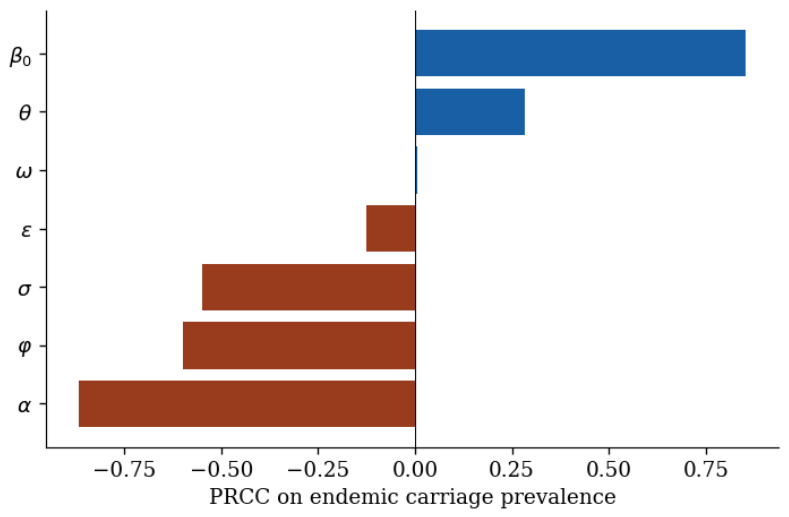

Table 1.
Model parameters, baseline values and plausible ranges drawn from the meningitis-belt literature. Rates are per year. Values are illustrative and intended to support structural and scenario analysis, not country-specific calibration.
Table 1.
Model parameters, baseline values and plausible ranges drawn from the meningitis-belt literature. Rates are per year. Values are illustrative and intended to support structural and scenario analysis, not country-specific calibration.
| Symbol | Interpretation | Baseline | Range | Source/Basis |
|---|---|---|---|---|
| Birth/death rate | – | Belt demography | ||
| Mean carriage duration (days) | 60 | 40–90 | Carriage studies | |
| Invasion rate (per carriage-yr) | – | Case:carrier ratio | ||
| Invasive-disease duration (days) | 14 | 7–21 | Clinical course | |
| Natural-immunity waning | – | Serological follow-up | ||
| Vaccine-protection waning | – | MenAfriVac follow-up | ||
| Vaccine efficacy vs. carriage | – | Carriage endpoint | ||
| Immunity vs. re-acquisition | – | Assumed leaky | ||
| Routine vaccination rate | 0 | 0– | Programme scenario | |
| Case fatality, treated | – | WHO case management | ||
| Case fatality, untreated | – | WHO case management | ||
| Seasonal amplitude | – | Harmattan forcing |
Table 2.
Cumulative burden per population over a 25-year horizon under seasonal forcing, from the model of (2). Values are illustrative, computed at the baseline parameters of Table 1.
Table 2.
Cumulative burden per population over a 25-year horizon under seasonal forcing, from the model of (2). Values are illustrative, computed at the baseline parameters of Table 1.
| Scenario | Cumulative Cases | Cumulative Deaths |
|---|---|---|
| No vaccination | 2813.5 | 278.0 |
| Routine infant | 949.1 | 90.2 |
| Routine + catch-up | 37.6 | 3.4 |
| Routine + high efficacy | 331.0 | 31.3 |
Disclaimer/Publisher’s Note: The statements, opinions and data contained in all publications are solely those of the individual author(s) and contributor(s) and not of MDPI and/or the editor(s). MDPI and/or the editor(s) disclaim responsibility for any injury to people or property resulting from any ideas, methods, instructions or products referred to in the content. |
© 2026 by the authors. Licensee MDPI, Basel, Switzerland. This article is an open access article distributed under the terms and conditions of the Creative Commons Attribution (CC BY) license (http://creativecommons.org/licenses/by/4.0/).
Copyright: This open access article is published under a Creative Commons CC BY 4.0 license, which permit the free download, distribution, and reuse, provided that the author and preprint are cited in any reuse.