

Submitted:
05 August 2026
Posted:
05 August 2026
You are already at the latest version
Abstract
Background: Hypoalbuminemia is a common complication after burn injury, exacerbated by surgical debridement, and contributes to edema, delayed healing, infection, and mortality. NovoSorb® Biodegradable Temporizing Matrix (BTM) is a dermal substitute that may reduce protein loss from open wounds. Objective: To evaluate the effect of BTM on serum albumin levels compared with conventional split-thickness skin grafting. Method: This retrospective review included burn patients (TBSA ≥10%, length of stay >30 days) admitted between 2020–2025 who underwent debridement followed by BTM or skin grafting. Serial albumin levels were analyzed as weekly means. Result: Baseline characteristics were comparable between BTM (n=14) and non-BTM (n=16) groups. Albumin decreased in both groups at week 1. From week 3 onward, albumin levels rose only in the BTM group, with significant intergroup differences at weeks 5–7 (p < 0.05 to p < 0.01), but not at week 8. Conclusion: BTM application was associated with faster albumin recovery compared with conventional methods. This is the first study to suggest that a dermal substitute may positively influence systemic albumin dynamics in burn patients, highlighting its potential role in reducing protein loss and supporting metabolic recovery.
Keywords:
major burns
; albumin
; hypoalbuminaemia
; dermal matrix
1. Introduction
Hypoalbuminemia is one of the earliest and most important complications following a major burn. This is mainly due mainly triggering of a severe inflammatory cascade leading to enhanced capillary permeability and extensive plasma protein leakage into the interstitial space [1,2]. It is further aggravated by surgical debridement and grafting, where patients are left with even larger raw surfaces, leading to further albumin loss. Albumin is vital in preserving oncotic pressure, delivering antioxidants, and regulating inflammation [1]. As a result, patients with hypoalbuminemia suffer from interstitial oedema, delayed wound healing, and multi-organ dysfunction. Research suggests that carefully timed albumin therapy, especially after the first 24 hours, may support hemodynamic stability and reduce total fluid requirements [3]. However, albumin replacement therapy has historically been controversial due to its high cost, potential for allergic reactions, and concerns about intravascular leakage and therefore, its efficacy.
NovoSorb® Biodegradable Temporizing matrix (BTM) is a synthetic polyurethane dermal substitute that has been used to temporarily cover large burns wounds [4]. It is a bilaminar structure composed of an open-cell foam scaffold that allows for ingrowth of neodermis that is covered by a non-biodegradable temporary sealing membrane. This study hypothesizes that BTM may be able to seal the burns wounds thus preventing albumin loss whilst the patient undergoes staged operations and physiologically recovers from their major burns.
In this study, we aimed to evaluate the effect of covering debrided burn wounds with BTM on serum albumin levels, compared with conventional split-thickness skin grafting.
2. Materials and Methods
A retrospective cohort study was conducted on patients admitted to the Burn Units of Prince of Wales Hospital between January 2020 and December 2025. Eligible patients were those who sustained burns covering ≥10% of total body surface area (TBSA), had a hospital length of stay exceeding 30 days, and underwent surgical debridement of burn wounds followed by either application of BTM or split-thickness skin grafting (non-BTM group). Demographic data, mechanism of injury, percentage TBSA burned, time from injury to surgical intervention, and serial serum albumin levels were extracted from medical records. Serum albumin levels were analysed as mean values per post-injury week for each patient group.
The data were expressed in mean ± standard deviation (SD). All data were subjected to t-test or two-way ANOVA using GraphPad Prism 5. Bonferroni tests were applied as post-hoc comparison for two-way ANOVA. The p value less than 0.05 was considered as statistically significant.
3. Results
This section may be divided by subheadings. It should provide a concise and precise description of the experimental results, their interpretation, and the experimental conclusions that can be drawn.
3.1. Patient Baseline Characteristics
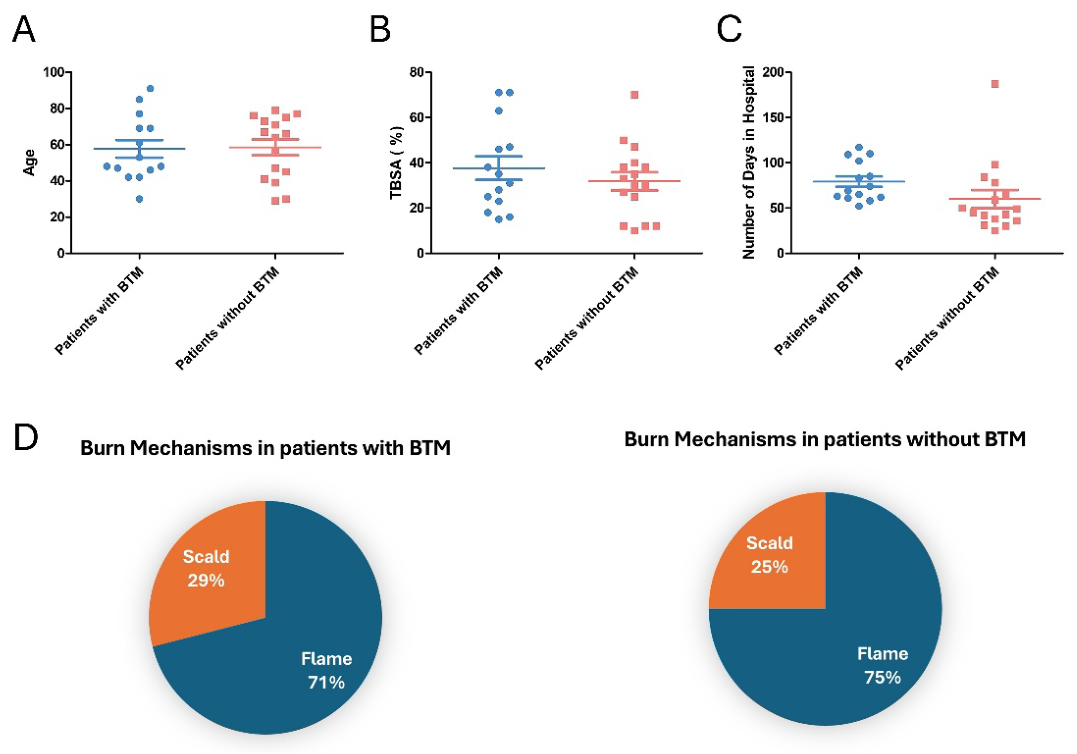
A total of 30 patients were included in the study, with 14 in the BTM group and 16 in the non BTM group. They are homogeneous. In the BTM group, there were 5 females and 9 males, compared to 9 females and 7 males in the non BTM group. Baseline characteristics were comparable between the BTM and non-BTM groups. The mean age was 57.7 years (95% CI: 48.3–67.1) in the BTM group and 58.5 years (95% CI: 50.0–67.0) in the non-BTM group (p = 0.90). Mean TBSA burned was 38% (95% CI: 28%–47%) in the BTM group and 32% (95% CI: 24%–40%) in the non-BTM group (p = 0.38). Mean length of hospital stay was 79.3 days (95% CI: 67.8–90.8) in the BTM group and 60.0 days (95% CI: 40.5–79.5) in the non-BTM group (p = 0.12). Burn mechanism was also similar between groups: flame burns occurred in 71% of BTM patients and 75% of non-BTM patients, while scald burns accounted for 29% and 25%, respectively. Among BTM patients, the mean time from admission to BTM application was 10.0 days (95% CI: 6.4–13.6) (A-1D) (Table 1, Table 2 and Table 3).
Figure 1.
Comparison of baseline characteristics between the BTM (n=14) and non BTM (n=16) groups. (A) Age (years), (B) TBSA (%), (C) Length of hospital stay (days), (D) Burn mechanism (flame vs. scald). No significant differences were found between groups (p > 0.05 for all). Data are shown as mean ± SD or percentages.
Figure 1.
Comparison of baseline characteristics between the BTM (n=14) and non BTM (n=16) groups. (A) Age (years), (B) TBSA (%), (C) Length of hospital stay (days), (D) Burn mechanism (flame vs. scald). No significant differences were found between groups (p > 0.05 for all). Data are shown as mean ± SD or percentages.
3.2. Mean Serum Albumin Levels
Serum albumin levels were compared weekly. At baseline (admission), mean albumin levels did not differ significantly between the two groups. One week post admission, both groups exhibited a marked decrease in albumin levels. From week 3 onward, mean albumin levels began to increase only in the BTM group. Statistically significant differences between the groups were observed from week 5 to week 7 (week 5: p < 0.05; week 6: p < 0.01; week 7: p < 0.05). No statistical difference was observed at week 8 (Figure 2).
4. Discussion
Albumin is the most prevalent serum protein produced by the liver. It is essential for regulating oxidative stress and immunological responses, buffering pH, delivering hormones and medications, and preserving oncotic pressure. Excessive loss and decreased synthesis are the two mechanisms that produce a severe and protracted hypoalbuminemic condition.
Within hours of a severe burn, the vascular endothelium's integrity is weakened, leading to significant albumin loss from burn wound exudation and vascular leakage [5]. Termed Capillary leak syndrome is a defining characteristic of burn shock caused by a systemic inflammatory response to major burns injuries. Pro-inflammatory cytokines such tumour necrosis factor-alpha (TNF-α), interleukin-1 (IL-1), interleukin-6 (IL-6), and vasoactive mediators such as histamine and bradykinin are said to be responsible for this phenomenon [1]. The persistence of capillary dysfunction in the early post-burn phase was highlighted by Zdolsek et al., who clinically showed that albumin escape rates were abnormally increased for several hours even after 20% human albumin was administered to burned individuals [5]. This leakage persists for up to 24 to 36 hours following injury, or until capillary integrity was restored [6]. Exudative loss is correlated with wound surface exposure, TBSA, and burn depth. These losses may be exacerbated by open wound management techniques and postponements of early excision and grafting [7].
As the liver gives priority to producing acute-phase proteins during times of stress, hepatic synthesis of albumin is also simultaneously downregulated. There is a diversion of amino acids and energy away from albumin synthesis toward the synthesis of acute-phase reactants (such as fibrinogen and C-reactive protein) [2].
Clinically, hypoalbuminemia is more than just a biochemical anomaly. Abdominal compartment syndrome, cerebral oedema, and pulmonary oedema can result from the uncontrolled fluid migration into the interstitial and third spaces caused by the reduced oncotic pressure [8,9]. Transport of oxygen and nutrients to damaged tissues is also hampered which increases patient’s sensitivity to wound infections, slows tissue granulation and healing and ultimately, extends the inflammatory state. Additionally, albumin is essential for the transport of trace elements including zinc, which are necessary for healthy leukocyte function. Albumin binds to and neutralize reactive oxygen and nitrogen species, giving it vital antioxidant qualities [8]. Finally, and most significantly, albumin levels are a reliable indicator of prognosis. Serum albumin values below 30g/L on admission results in increased risk of sepsis, delayed wound healing, longer ventilatory support, and an increased risk of death [10]. Its depletion is even more evident in paediatric and geriatric populations, and it is frequently associated with longer intensive care unit hospitalizations and increased in-hospital mortality in these vulnerable populations [11].
Given that there is a need to prevent rapid loss of albumin, the solution is to replace it intravenously. However, it is well known that colloids, including albumin, tend to migrate from the intravascular to interstitial space due to capillary leak. This further aggravates the oedema in a vicious cycle [6]. A consistent mortality benefit has not been shown by Cochrane studies, and issues with cost, availability, and possible side effects including changes in coagulation have not been adequately addressed [5,12]. Furthermore, long-term albumin supplementation has not resulted in better clinical outcomes such as shorter ICU stay or faster wound healing in large-scale randomized trials [10,13]. In recent years, a more sophisticated, phase-specific strategy has been to use by administrating human albumin 12 to 24 hours post injury rather than at the immediate acute phase of 8-12 hours. Meta-analysis of this technique has shown promise, with decreased overall fluid needs, reduced compartment syndrome and mortality rates [6,14]. Even with these possible advantages, routine prolonged albumin use is still debatable.
Other than replacing albumin intravenously, albumin levels can be improved by dietary means and reduction of the inflammatory response. Early enteral nutrition started 6–12 hours after an injury maintains the integrity of the gut, lowers systemic inflammation, and indirectly lessens albumin loss and protein catabolism [15]. Promising outcomes have been observed from nutritional therapies, especially the administration of trace minerals like copper, zinc, and selenium. These are essential for maintaining endothelium integrity, regulating the immune system, and bolstering antioxidant defense. High-dose combination therapy with these micronutrients has been shown in clinical studies to dramatically increase antioxidant capacity, decrease the frequency of grafting surgeries, and shorten intensive care unit hospitalizations [16,17]. Other emerging techniques include functional nutrients such as glutamine, arginine, omega-3 fatty acids, and coenzyme Q10 supplementation [18,19]. Other pre-clinical studies include examination of methods to target the inflammatory cascade, such as corticosteroids, IL-6 blockers, or TNF-α [20].
Surgically, definitive coverage of the wounds by skin grafts has been shown to improve albumin level, albeit slowly [21]. However, debridement of the burns itself prior to grafting results in a further drop in albumin level [22]. Confounding this is the evidence that shows low levels of albumin are associated with reduced graft take [23].
Dermal matrices have been used extensively in burns to temporize the wound when there is lack of donor sites for skin grafts. Studies in the literature show dermal matrices can be used effectively to manage full thickness burns with good functional and aesthetic outcomes [24,25]. However, dermal matrices are notorious for their risks of infection, with one study having to stop their study due to the high infection rate associated with the use of Integra® (Integra Artificial Skin, Integra Life Sciences, Plainsboro, NJ) in patients with major burns [26]. Integra is made from a combination of bovine collagen with cross linked glycosaminoglycans, and it is thought that the biological component is what increases its risk of infection. BTM is different from other dermal matrices in that it lacks a biological component and is completely synthetic in composition. Systematic reviews have shown that the infection rate in over 800 patients who used BTM averaged 10% in complex wounds [27]. BTM has also been used successfully in infected and contaminated wounds [28,29]. Its uptake rate in burns can be as high as over 88% compared to skin graft take rate of 82% [25]. The second stage skin graft take has been shown in systematic review to be over 98.9% in nine studies of 511 wounds. Integra®, which consists of has reported graft take rates between 90% and 93% [30]. There has been no study, thus far, examining the effects of dermal matrices on albumin level. This is the first study of its kind. We have shown in our case matched patients that there is a significant difference in albumin level in patients with major burns between weeks 5 and 7 post injuries. BTM application averaged 10 days post injury, which can be reflected in the beginning of the divergence of albumin level between patients who had BTM coverage and those who did not. Also, the albumin levels in patients who did not have BTM stabilized, the albumin levels in patients with BTM continued to elevate. This supports our theory that dermal matrices can improve albumin level and therefore the patient recovery.
Of note, there was no significant difference in the length of hospital stay of the patients who had BTM compared to those who did not. There is a myriad of variables that is associated with length of stay in hospital after a burn's injury. These include socio-economic reasons, discharge destination, concurrent medical issues that cannot be compared.
Nevertheless, several limitations of this study should be acknowledged. First, the relatively small sample size in each cohort may limit the statistical power of our analysis and the generalizability of our findings. Second, the absence of case-matched pairing between the two cohorts introduces the potential for selection bias, as baseline differences between groups may have influenced the observed outcomes. Third, our analysis did not adjust for a number of clinically relevant factors, such as patient age, baseline nutritional status, and the concomitant use of albumin, all of which could plausibly affect the measured parameters. Fourth, we did not perform a comprehensive correlation analysis to evaluate the relationships between BTM and other potential confounding variables, which may have provided additional insight into the underlying associations. Furthermore, the serum albumin levels of the patients remained below 30 g/L at the predefined cutoff time point, suggesting that persistent hypoalbuminemia may have continued to influence patient physiology beyond the observation window. Consequently, a longer period of follow-up would be valuable to capture more definitive clinical endpoints, such as overall mortality and total length of hospital stay, which could offer a more complete assessment of long-term prognosis and treatment efficacy. These limitations should be taken into consideration when interpreting our results, and they collectively highlight important directions for improvement in future investigations.
5. Conclusions
In conclusion, our study has shown that the use of BTM dermal matrix in major burns has improved the albumin level in burns patients. Further studies are required to validate these findings and to examine whether this has any long-term benefits for burns care.
Author Contributions
Conceptualization, W.C.J. Ting, T.W. Chiu; methodology, H. Ma, A.K. Arslan; software, H. Ma; validation, W.C.J. Ting, L.Y.R. Cheung, and H. Ma.; formal analysis, H. Ma; investigation, L.Y.R. Cheung, J.F.M. Kam; data curation, L.Y.R. Cheung; writing—original draft preparation, W.C.J. Ting, L.Y.R. Cheung; writing—review and editing, H. Ma, T.W. Chiu; visualization, H. Ma; supervision, W.C.J. Ting, T.W. Chiu; project administration, W.C.J. Ting. All authors have read and agreed to the published version of the manuscript.
Funding
This research received no external funding.
Institutional Review Board Statement
The study was conducted in accordance with the Declaration of Helsinki, and approved by the Institutional Review Board of Joint Chinese University of Hong Kong-New Territories East Cluster Clinical Research Ethics Committee (Ref. No. 2026.309, approved on approved on 12 Jun 2026).
Informed Consent Statement
Patient consent was waived due to the retrospective nature of the study. All patient data have been de-identified.
Data Availability Statement
The data presented in this study are available on request from the corresponding author due to ethical reasons.
Conflicts of Interest
The authors declare no conflicts of interest.
Abbreviations
The following abbreviations are used in this manuscript:
| BTM | Biodegradable Temporizing matrix |
| TBSA | Total body surface area |
| SD | Standard deviation |
| TNF-α | Tumour necrosis factor-alpha |
| IL-1 | Interleukin-1 |
| IL-6 | Interleukin-6 |
References
- Jeschke, M.G.; Chinkes, D.L.; Finnerty, C.C.; Kulp, G.; Suman, O.E.; Norbury, W.B.; Branski, L.K.; Gauglitz, G.G.; Mlcak, R.P.; Herndon, D.N.M. Pathophysiologic Response to Severe Burn Injury. Ann. Surg. 2008, 248, 387–401. [Google Scholar] [CrossRef]
- Herndon, D.N.; Tompkins, R.G. Support of the metabolic response to burn injury. Lancet 2004, 363, 1895–1902. [Google Scholar] [CrossRef] [PubMed]
- Sakr, Y.; Nierhaus, A.; Schumacher, U.; et al. Albumin Replacement Therapy in Septic Shock: A Randomized Clinical Trial. JAMA Netw. Open 2026, 9, e2559297. [Google Scholar] [CrossRef] [PubMed]
- Jou, C.; Chepla, K.J. Novosorb Biodegradable Temporizing Matrix for Reconstruction of Complex Upper-Extremity Wounds. J. Hand Surg. Glob. Online 2024, 6, 614–618. [Google Scholar] [CrossRef] [PubMed]
- Zdolsek, M.; Hahn, R.G.; Sjöberg, F.; Zdolsek, J.H. Plasma volume expansion and capillary leakage of 20% albumin in burned patients and volunteers. Crit. Care 2020, 24, 1–9. [Google Scholar] [CrossRef] [PubMed]
- Pham, T.N.; Cancio, L.C.; Gibran, N.S. American Burn Association Practice Guidelines Burn Shock Resuscitation. J. Burn. Care Res. 2008, 29, 257–266. [Google Scholar] [CrossRef] [PubMed]
- Cancio, L.C.; Chávez, S.; Alvarado-Ortega, M.; Barillo, D.J.; Walker, S.C.; McManus, A.T.; Goodwin, C.W. Predicting Increased Fluid Requirements During the Resuscitation of Thermally Injured Patients. 2004, 56, 404–414. [Google Scholar] [CrossRef] [PubMed]
- Quinlan, G. J.; Martin, G. S.; Evans, T. W. Albumin: biochemical properties and therapeutic potential. Hepatology 2005, 41, 1211–1219. [Google Scholar] [PubMed]
- O’mara, M.; Slater, H.; Goldfarb, I.W.; Caushaj, P.F. A Prospective, Randomized Evaluation of Intra-abdominal Pressures with Crystalloid and Colloid Resuscitation in Burn Patients. 2005, 58, 1011–1018. [Google Scholar] [CrossRef] [PubMed]
- Melinyshyn, A.; Callum, J.; Jeschke, M. C.; Cartotto, R. Albumin supplementation for hypoalbuminemia following burns: unnecessary and costly! J. Burn Care Res. 2013, 34, 8–17. [Google Scholar] [CrossRef] [PubMed]
- Abedi, F.; Zarei, B.; Elyasi, S. Albumin: a comprehensive review and practical guideline for clinical use. Eur. J. Clin. Pharmacol. 2024, 80, 1151–1169. [Google Scholar] [CrossRef] [PubMed]
- Cochrane Injuries Group Albumin Reviewers. Human albumin administration in critically ill patients: systematic review of randomised controlled trials. BMJ 1998, 317, 235–240. [CrossRef] [PubMed]
- Chen, Y.-F.; Ma, H.; Perng, C.-K.; Liao, W.-C.; Shih, Y.-C.; Lin, C.-H.; Chen, M.-C.; Hsiao, F.-Y.; Wang, T.-H. Albumin supplementation may have limited effects on prolonged hypoalbuminemia in major burn patients: An outcome and prognostic factor analysis. J. Chin. Med. Assoc. 2019, 83, 206–210. [Google Scholar] [CrossRef] [PubMed]
- Navickis, R. J.; Greenhalgh, D. G.; Wilkes, M. M. Albumin in Burn Shock Resuscitation: A Meta-Analysis of Controlled Clinical Studies. J. Burn Care Res. 2016, 37, e268–e278. [Google Scholar] [CrossRef] [PubMed]
- Clark, A.; Imran, J.; Madni, T.; Wolf, S.E. Nutrition and metabolism in burn patients. Burn. Trauma 2017, 5, 11. [Google Scholar] [CrossRef] [PubMed]
- Żwierełło, W.; Styburski, D.; Maruszewska, A.; Piorun, K.; Skórka-Majewicz, M.; Czerwińska, M.; Maciejewska, D.; Baranowska-Bosiacka, I.; Krajewski, A.; Gutowska, I. Bioelements in the treatment of burn injuries – The complex review of metabolism and supplementation (copper, selenium, zinc, iron, manganese, chromium and magnesium). J. Trace Elem. Med. Biol. 2020, 62, 126616. [Google Scholar] [CrossRef] [PubMed]
- Berger, M.M.; Binnert, C.; Chiolero, R.L.; Taylor, W.; Raffoul, W.; Cayeux, M.-C.; Benathan, M.; Shenkin, A.; Tappy, L. Trace element supplementation after major burns increases burned skin trace element concentrations and modulates local protein metabolism but not whole-body substrate metabolism. Am. J. Clin. Nutr. 2007, 85, 1301–1306. [Google Scholar] [CrossRef] [PubMed]
- De-Souza, D.A.; Greene, L.J. Pharmacological Nutrition After Burn Injury. J. Nutr. 1998, 128, 797–803. [Google Scholar] [CrossRef] [PubMed]
- Kiani, Z.; Khorsand, N.; Beigi, F.; Askari, G.; Sharma, M.; Bagherniya, M. Coenzyme Q10 supplementation in burn patients: a double-blind placebo-controlled randomized clinical trial. Trials 2024, 25, 1–10. [Google Scholar] [CrossRef] [PubMed]
- Chen, Z. Y.; Hu, S. Q.; Liu, D. W.; Zhang, H. Y.; Guo, G. H.; Mao, Y. G. Zhonghua Shao Shang Yu Chuang Mian Xiu Fu Za Zhi 2023, 39, 391–395. [PubMed]
- Kazemzadeh, J.; Parizad, N.; Safaie, M. The relationship between serum albumin level with burn severity and total body surface area before and after skin graft surgery in burn patients. 2025, 38, 25–30. [Google Scholar] [PubMed]
- Soedjana, H.; Bowo, S.A.; Putri, N.M.; Davita, T.R. Serum albumin level difference in burn injury after tangential excision: A prospective cohort study. Ann. Med. Surg. 2020, 52, 1–4. [Google Scholar] [CrossRef] [PubMed]
- Soedjana, H.; Lukman, K.; Harianti, S. Relationship Between Serum Albumin Levels And The Outcome Of Split-Thickness Skin Graft In Burn Injury Patients. 2021, 34, 157–162. [Google Scholar] [PubMed]
- Hicks, K.E.; Huynh, M.N.; Jeschke, M.; Malic, C. Dermal regenerative matrix use in burn patients: A systematic review. J. Plast. Reconstr. Aesthetic Surg. 2019, 72, 1741–1751. [Google Scholar] [CrossRef] [PubMed]
- Lo, C.H.; Brown, J.N.; Dantzer, E.J.; Maitz, P.K.; Vandervord, J.G.; Wagstaff, M.J.; Barker, T.M.; Cleland, H. Wound healing and dermal regeneration in severe burn patients treated with NovoSorb® Biodegradable Temporising Matrix: A prospective clinical study. Burns 2022, 48, 529–538. [Google Scholar] [CrossRef] [PubMed]
- Peck, M.D.; Kessler, M.; Meyer, A.A.; Morris, P.A.B. A Trial of the Effectiveness of Artificial Dermis in the Treatment of Patients with Burns Greater Than 45% Total Body Surface Area. 2002, 52, 971–978. [Google Scholar] [CrossRef] [PubMed]
- Fruergaard, O.; Ørholt, M.; Lang, C.L.; Drejøe, J.B.; Herly, M.; Vester-Glowinski, P.; Jensen, D.H. A systematic review of the Novosorb® Biodegradable Temporizing Matrix in the treatment of complex wounds. Burn. Open 2024, 9. [Google Scholar] [CrossRef]
- Cheng, C.; Kwiecien, G.J.; Rowe, D.J.; Gatherwright, J.R.; Chepla, K.J. Reconstruction of Chronic Wounds Secondary to Injectable Drug Use with a Biodegradable Temporizing Matrix. Plast. Reconstr. Surg.-Glob. Open 2021, 9, e3678–e3678. [Google Scholar] [CrossRef] [PubMed]
- Wilson, S.; Muscat, E.; Smith, O.; Noakes, A.; Wearn, C. Biodegradable Temporizing Matrix (BTM) resilience to wound infection: A consecutive case series. JPRAS Open 2025, 48, 95–105. [Google Scholar] [CrossRef] [PubMed]
- Lane, G.; Fitzpatrick, N.J.; Kastritsi, O.; Matzakanis, G.; Braimah, F.; Nordin, M.N.M.; Asaju, A.; Aziz, F.T.; Rahman, S.; Rollett, R. Biodegradable Temporising matrix in the reconstruction of complex wounds: A systematic review and meta-analysis. Int. Wound J. 2024, 21, e70025. [Google Scholar] [CrossRef] [PubMed]
Figure 2.
Comparison of weekly mean serum albumin levels between BTM (n=14) and non BTM (n=16) groups from admission to week 8.
Figure 2.
Comparison of weekly mean serum albumin levels between BTM (n=14) and non BTM (n=16) groups from admission to week 8.
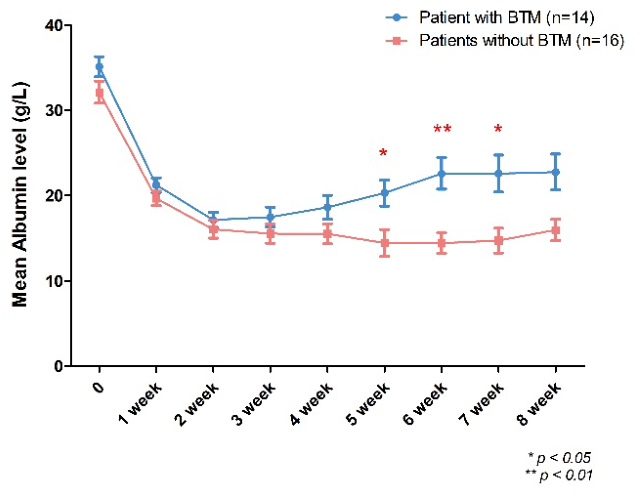

Table 1.
Information of patients with BTM.
| Patient No. | Treatment | Gender | Age | TBSA (%) | Days in Hospital | BTM Day (post admission) | Mechanisms |
|---|---|---|---|---|---|---|---|
| 1 | BTM | F | 85 | 28% | 83 | D11 | Scald |
| 2 | BTM | F | 46 | 47% | 110 | D5 | Flame |
| 3 | BTM | F | 42 | 25% | 62 | D5 | Flame |
| 4 | BTM | F | 91 | 15% | 117 | D10 | Scald |
| 5 | BTM | F | 47 | 18% | 58 | D31 | Flame |
| 6 | BTM | M | 77 | 35% | 85 | D11 | Scald |
| 7 | BTM | M | 69 | 63% | 74 | D6 | Flame |
| 8 | BTM | M | 61 | 38% | 69 | D6/12 | Flame |
| 9 | BTM | M | 48 | 46% | 109 | D3/26 | Flame |
| 10 | BTM | M | 48 | 16% | 61 | D11 | Scald |
| 11 | BTM | M | 53 | 71% | 65 | D4/8 | Flame |
| 12 | BTM | M | 69 | 31% | 102 | D6 | Flame |
| 13 | BTM | M | 42 | 23% | 63 | D13 | Flame |
| 14 | BTM | M | 30 | 71% | 52 | D2 | Flame |
Table 2.
Information of patients without BTM.
| Patient No. | Treatment | Gender | Age | TBSA (%) | Days in Hospital | Mechanisms |
|---|---|---|---|---|---|---|
| 1 | skin graft | F | 67 | 12% | 25 | Flame |
| 2 | skin graft | F | 47 | 12% | 42 | Flame |
| 3 | skin graft | F | 73 | 10% | 36 | Flame |
| 4 | skin graft | F | 77 | 38% | 65 | Scald |
| 5 | skin graft | F | 75 | 30% | 187 | Scald |
| 6 | skin graft | F | 66 | 27% | 30 | Scald |
| 7 | skin graft | F | 76 | 12% | 31 | Scald |
| 8 | skin graft | F | 45 | 33% | 84 | Flame |
| 9 | skin graft | F | 41 | 47% | 50 | Flame |
| 10 | skin graft | M | 39 | 25% | 49 | Flame |
| 11 | skin graft | M | 79 | 38% | 45 | Flame |
| 12 | skin graft | M | 71 | 35% | 98 | Flame |
| 13 | skin graft | M | 29 | 70% | 38 | Flame |
| 14 | skin graft | M | 64 | 30% | 43 | Flame |
| 15 | skin graft | M | 57 | 40% | 78 | Flame |
| 16 | skin graft | M | 30 | 50% | 59 | Flame |
Table 3.
Comparison of baseline characteristics in BTM and non-BTM patients.
| Characteristics | BTM (n=14) | Non-BTM (n=16) | P value |
|---|---|---|---|
| Age (years), mean (95% CI) | 57.7 ± 18.0 (48.3–67.1) | 58.5 ± 17.4 (50.0–67.0) | 0.9 |
| TBSA (%), mean (95% CI) | 38 ± 19 (28–47) | 32 ± 16 (24–40) | 0.38 |
| Length of hospital stay (days), mean (95% CI) | 79.3 ± 21.9 (67.8–90.8) | 60.0 ± 39.7 (40.5–79.5) | 0.12 |
| Burn mechanism, n (%) | |||
| Flame | 10 (71) | 12 (75) | — |
| Scald | 4 (29) | 4 (25) | — |
| Time from admission to BTM application (days), mean (95%CI) | 10.0 ± 7.8 (6.4–13.6) | — | — |
Disclaimer/Publisher’s Note: The statements, opinions and data contained in all publications are solely those of the individual author(s) and contributor(s) and not of MDPI and/or the editor(s). MDPI and/or the editor(s) disclaim responsibility for any injury to people or property resulting from any ideas, methods, instructions or products referred to in the content. |
© 2026 by the authors. Licensee MDPI, Basel, Switzerland. This article is an open access article distributed under the terms and conditions of the Creative Commons Attribution (CC BY) license (http://creativecommons.org/licenses/by/4.0/).
Copyright: This open access article is published under a Creative Commons CC BY 4.0 license, which permit the free download, distribution, and reuse, provided that the author and preprint are cited in any reuse.


