

Submitted:
04 August 2026
Posted:
05 August 2026
You are already at the latest version
Abstract
Background: Accreditation has become a central mechanism for strengthening healthcare quality systems globally. However, despite the proliferation of accreditation programs, limited empirical literature describes structured methodologies for developing national accreditation standards, particularly in low- and middle-income countries (LMICs). Objective: To describe and analyze the systemic methodology employed by the General Authority for Healthcare Accreditation and Regulation (GAHAR) in Egypt for the development and revision of accreditation standards, and to examine the role of hospital participation in this process. Approach: A descriptive policy analysis was conducted outlining GAHAR’s structured framework for standards development. The process includes stakeholder needs assessment, multidisciplinary drafting committees, external expert review, field testing, pilot surveys assessing inter-rater reliability, editorial harmonization, formal approval mechanisms, and continuous post-publication feedback integration. Key Findings: GAHAR’s methodology aligns with recognized international accreditation paradigms, including committee-based drafting, evidence-informed review, structured pilot validation, and iterative refinement. The inclusion of healthcare facilities and frontline professionals enhances contextual relevance, feasibility, and system ownership. Conclusion: A structured, participatory, and evidence-informed approach to accreditation standards development strengthens national quality governance frameworks. Hospital engagement is not merely consultative but foundational to ensuring implementable, contextually appropriate, and sustainable accreditation systems within LMIC settings.
Keywords:
healthcare quality
; healthcare accreditation standards
; Egyptian accreditation standards
; healthcare accreditation standards development process
; accreditation standards development
Introduction
While health outcomes in low- and middle-income countries (LMICs) have improved in recent decades, a new paradigm is emerging that emphasizes not only expansion of access to healthcare services but also the consistent delivery of high-quality care. Elevating public expectations and redefining health system goals are now critical to achieving better health outcomes, improving system performance, and generating greater social and economic value within national healthcare systems [1].
Egypt, classified as a lower-middle-income country [2], initiated its formal healthcare quality improvement journey several years ago as part of broader health sector reform and governance strengthening initiatives. This commitment was codified in the 2014 Egyptian Constitution, Article 18, which guarantees every citizen the right to health care services conforming to defined quality standards [3]. This constitutional mandate necessitated that healthcare facilities pursue structured quality assurance mechanisms, including accreditation. The requirement was further solidified by the 2018 Universal Health Coverage (UHC) law, which established a dedicated regulatory body, the General Authority for Healthcare Accreditation and Regulation (GAHAR), to oversee accreditation processes and standard development within a nationally unified framework [4].
Healthcare Quality and Accreditation
Healthcare quality has been defined by numerous global institutions through complementary theoretical and operational frameworks. The Institute of Medicine (IOM) conceptualizes it as “the degree to which health care services for individuals and populations increase the likelihood of the desired health outcomes and are consistent with current professional knowledge” [5]. Similarly, the World Health Organization (WHO) emphasizes that quality necessitates effective, safe, and people-centered care, and that services must also be timely, equitable, integrated, and efficient in order to achieve comprehensive system improvement [6]. Together, these definitions underscore that healthcare quality is multidimensional and requires structured governance mechanisms to translate principles into measurable practice.
Within this framework, healthcare quality is commonly assessed via the Donabedian model, which categorizes measures into structural, process, and outcome domains [6]. Accreditation systems are designed to operationalize these domains through comprehensive standards and measurable elements that guide institutional performance. As defined by the International Society for Quality in Health Care (ISQua), accreditation is a formal process involving organizational self-assessment and external peer review against established standards, with the aim of driving continuous systemic improvement and strengthening organizational accountability [7].
Accreditation Standards Development
Accreditation standard development varies significantly among international organizations, with each employing distinct frameworks, governance structures, and methodological approaches aimed at promoting optimal care quality. This process typically entails systematic review of scientific evidence, integration of clinical practice guidelines, benchmarking against international best practices, and consultation with relevant stakeholders [8]. The methodological rigor applied during standards development directly influences the clarity, feasibility, and impact of accreditation systems.
The evolution of formal accreditation can be traced to 1917, when the American College of Surgeons (ACS) introduced a set of “minimum standards” that laid the foundation for modern hospital accreditation systems and formalized the concept of structured quality oversight [8]. Contemporary approaches reflect more sophisticated and participatory governance models. For instance, The Joint Commission develops standards through collaboration among healthcare experts, consumers, and government agencies, emphasizing patient safety priorities, evidence-based practice, and structured revision cycles before formal approval and publication [9].
Similarly, structured methodologies guide other accrediting bodies. Temos employs a four-phase iterative cycle based on the “Plan–Do–Check–Act” principles to ensure continuous review and refinement of its standards framework [10]. The Rwanda Agency for Accreditation and Quality Health Care (RAAQH) operates through a Standards Development Committee authorized to modify standards in alignment with International Society for Quality in Health Care (ISQua) principles, national regulatory requirements, and stakeholder consultation mechanisms [11].
Likewise, the Health Standards Organization (HSO) relies on Technical Committees to identify emerging needs, develop draft standards, seek consensus through structured review processes, and conduct public consultation before final approval and dissemination. Periodic evaluation and revision cycles are embedded within the governance structure to ensure sustained relevance and responsiveness to healthcare system changes [12].
The development and revision of accreditation standards are therefore governed by defined and rigorous processes that incorporate transparent rating methodologies, structured evaluation criteria, and documented feedback integration mechanisms to ensure consistent assessment of achievement [13]. However, despite the existence of these structured international approaches, there remains a notable gap in the empirical literature. Specifically, no studies have systematically examined best practices for developing standards, determining optimal process models, establishing effective wording or structural design, or identifying which types of standards are most likely to translate into measurable improvements in clinical practice [14].
GAHAR Accreditation Standards Development
The standard development process is initiated by identifying the need for a new or revised standard through structured surveys distributed to relevant stakeholders, including healthcare facilities, the Ministry of Health and Population , subject matter experts, healthcare professionals, and international organizations[15]. This structured needs assessment process aligns with the governance framework established under the Universal Health Coverage law and reflects national regulatory priorities in healthcare quality and patient safety. Continuous environmental scanning further supports responsiveness to evolving healthcare delivery challenges and emerging quality improvement priorities.
Subsequently, the Standards Research and Development Department forms a multidisciplinary Standards Writing Committee composed of selected healthcare professionals, subject matter experts, and representatives from relevant institutions. The committee undertakes initial draft development based on evidence synthesis, benchmarking against international standards, and stakeholder input. This is followed by an external expert review phase, during which the draft is circulated to national and international subject matter experts to solicit specialized feedback, consistent with internationally recognized accreditation development practices.
A structured field testing and pilot survey phase is then conducted in two stages to validate feasibility and reliability. The first stage assesses applicability, feasibility, and internal consistency within selected healthcare facilities representing different service levels. The second stage involves pilot surveys conducted by GAHAR-accredited surveyors to evaluate inter-rater reliability, scoring feasibility, clarity of measurable elements, and overall operational workability. These validation mechanisms align with recognized accreditation governance principles emphasizing reliability, transparency, and standardization.
Editorial checking follows, involving rigorous review for grammar, spelling, formatting, structural consistency, and terminological alignment across the standards document. Final approval and publication are executed through formal dissemination mechanisms aligned with national accreditation governance requirements and regulatory oversight structures . Maintenance and evolution of standards are facilitated through continuous stakeholder feedback mechanisms [16], allowing for structured revision cycles and sustained alignment with healthcare system developments, consistent with structured accreditation development models described in the literature.
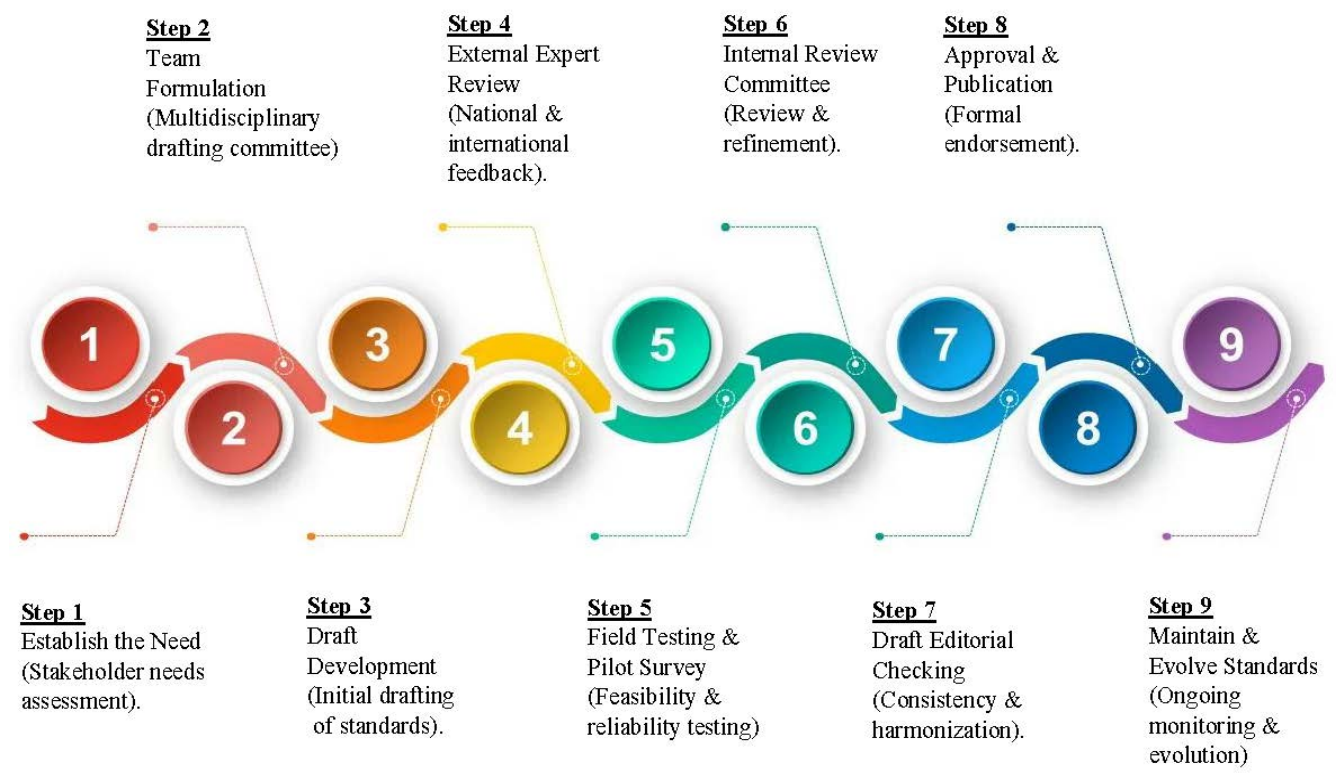
The overall process is methodically structured and conceptualized in fifteen distinct steps [17], consolidated for clarity into nine primary stages illustrated in Figure 1. This consolidation reflects internationally recognized structured development methodologies while preserving contextual adaptability within the Egyptian national regulatory framework.
The model illustrates a cyclical governance structure beginning with identification of need and stakeholder engagement, progressing through drafting, expert review, validation, approval, and publication, and culminating in maintenance and continuous evolution. The feedback loop emphasizes the iterative nature of standards refinement and sustained quality improvement.
Conclusions
The methodology for accreditation standards development employed by the General Authority for Healthcare Accreditation and Regulation (GAHAR) reflects a comprehensive, structured, and systematically governed approach that aligns with established international best practices in accreditation governance. The process integrates multidisciplinary drafting, structured external expert review, validation through field testing and pilot reliability assessment, and continuous stakeholder engagement within a defined legislative and regulatory framework.
By embedding iterative refinement mechanisms and participatory governance within its development structure, GAHAR’s framework enhances the credibility, contextual relevance, and operational feasibility of national accreditation standards. This structured and evidence-informed model contributes to strengthening healthcare quality governance and supports sustained advancement of patient safety and institutional performance within the Egyptian healthcare system.
Author Contributions
A.K. (Abdelkarim kamel), N.A. (Nailah Amin) A.K and N.A. wrote the main manuscript text, N.A. prepared the figure. All authors reviewed the manuscript.
Funding
I Declare that this manuscript did not receive any funding.
Institutional Review Board Statement
Not applicable.
Informed Consent Statement
Not applicable.
Data Availability Statement
No datasets were generated or analyzed during the current study.
Acknowledgments
Not applicable.
Conflicts of Interest
Not applicable.
Abbreviations
| LMICs | low- and middle-income countries |
| GAHAR | General Authority for Healthcare Accreditation and Regulation |
| UHC | Universal Health Coverage |
| IOM | Institute of Medicine |
| WHO | World Health Organization |
| ISQua | International Society for Quality in Health Care |
| ACS | American College of Surgeons |
| RAAQH | Rwanda Agency for Accreditation and Quality Health Care |
| HSO | Health Standards Organization |
References
- Kruk ME, Gage AD, Arsenault C, Jordan K, Leslie HH, Roder-DeWan S et al. (2018) High-quality health systems in the Sustainable Development Goals era: time for a revolution. Lancet Glob Health 6(11):e1196–e1252. [CrossRef]
- World Bank. (2025) Data for Egypt, Arab Rep., Lower middle income. World Bank Data. Available from: https://data.worldbank.org/?locations=EG-XN.
- Constitution of the Arab Republic of Egypt. (2014) Arab Law Q 28:251–271.
- World Bank. (2025) Supporting Egypt’s Universal Health Insurance System. World Bank Projects. Available from: https://projects.worldbank.org/en/projects-operations/procurement-detail/OP00356094.
- Agency for Healthcare Research and Quality. (2025) Understanding quality measurement. AHRQ. Available from: https://www.ahrq.gov/patient-safety/quality-resources/tools/chtoolbx/understand/index.html.
- Agency for Healthcare Research and Quality. (2025) Types of health care quality measures. AHRQ. Available from: https://www.ahrq.gov/talkingquality/measures/types.html.
- Fortune T, O’Connor E, Donaldson B. (2015) Guidance on designing healthcare external evaluation programmes including accreditation. Int Soc Qual Health Care 1–84.
- Russell TA, Ko C. (2023) History and role of quality accreditation. Clin Colon Rectal Surg 36(4):279–284. [CrossRef]
- Joint Commission International. (2025) Standards. Available from: https://www.jointcommission.org/en/standards.
- Temos International GmbH. (2025) Temos standards. Available from: https://temos-worldwide.com/about-us/temos-standards.
- Rwanda Agency for Accreditation and Quality Health Care. (2025) Health care standards development. Available from: https://raaqh.org.rw/health-care-standards-development/.
- Health Standards Organization. (2025) The 7 steps of the standards development process. Available from: https://healthstandards.org/general-updates/the-7-steps-of-the-standards-development-process/.
- Guidelines and principles for the development of health and social care standards. (n.d.).
- Greenfield D, Pawsey M, Hinchcliff R, Moldovan M, Braithwaite J. (2012) The standard of healthcare accreditation standards: a review of empirical research underpinning their development and impact. BMC Health Serv Res 12:329. [CrossRef]
- General Authority for Healthcare Accreditation and Regulation (2026). Available from: https://www.gahar.gov.eg/page/p/.
- General Authority for Healthcare Accreditation and Regulation (2026). Available from: https://www.gahar.gov.eg/page/p/.
- General Authority for Healthcare Accreditation and Regulation (2026). Available from: https://www.gahar.gov.eg/page/p/standards-development-process-1.
- General Authority for Healthcare Accreditation and Regulation (2025). Available from: https://gahar.gov.eg/page/p/standards-development-process-1.
Figure 1.
Consolidated framework for accreditation standards development adopted by the General Authority for Healthcare Accreditation and Regulation (GAHAR) [18].
Figure 1.
Consolidated framework for accreditation standards development adopted by the General Authority for Healthcare Accreditation and Regulation (GAHAR) [18].
Disclaimer/Publisher’s Note: The statements, opinions and data contained in all publications are solely those of the individual author(s) and contributor(s) and not of MDPI and/or the editor(s). MDPI and/or the editor(s) disclaim responsibility for any injury to people or property resulting from any ideas, methods, instructions or products referred to in the content. |
© 2026 by the authors. Licensee MDPI, Basel, Switzerland. This article is an open access article distributed under the terms and conditions of the Creative Commons Attribution (CC BY) license (http://creativecommons.org/licenses/by/4.0/).
Copyright: This open access article is published under a Creative Commons CC BY 4.0 license, which permit the free download, distribution, and reuse, provided that the author and preprint are cited in any reuse.


