
Submitted:
01 August 2026
Posted:
04 August 2026
You are already at the latest version
Abstract
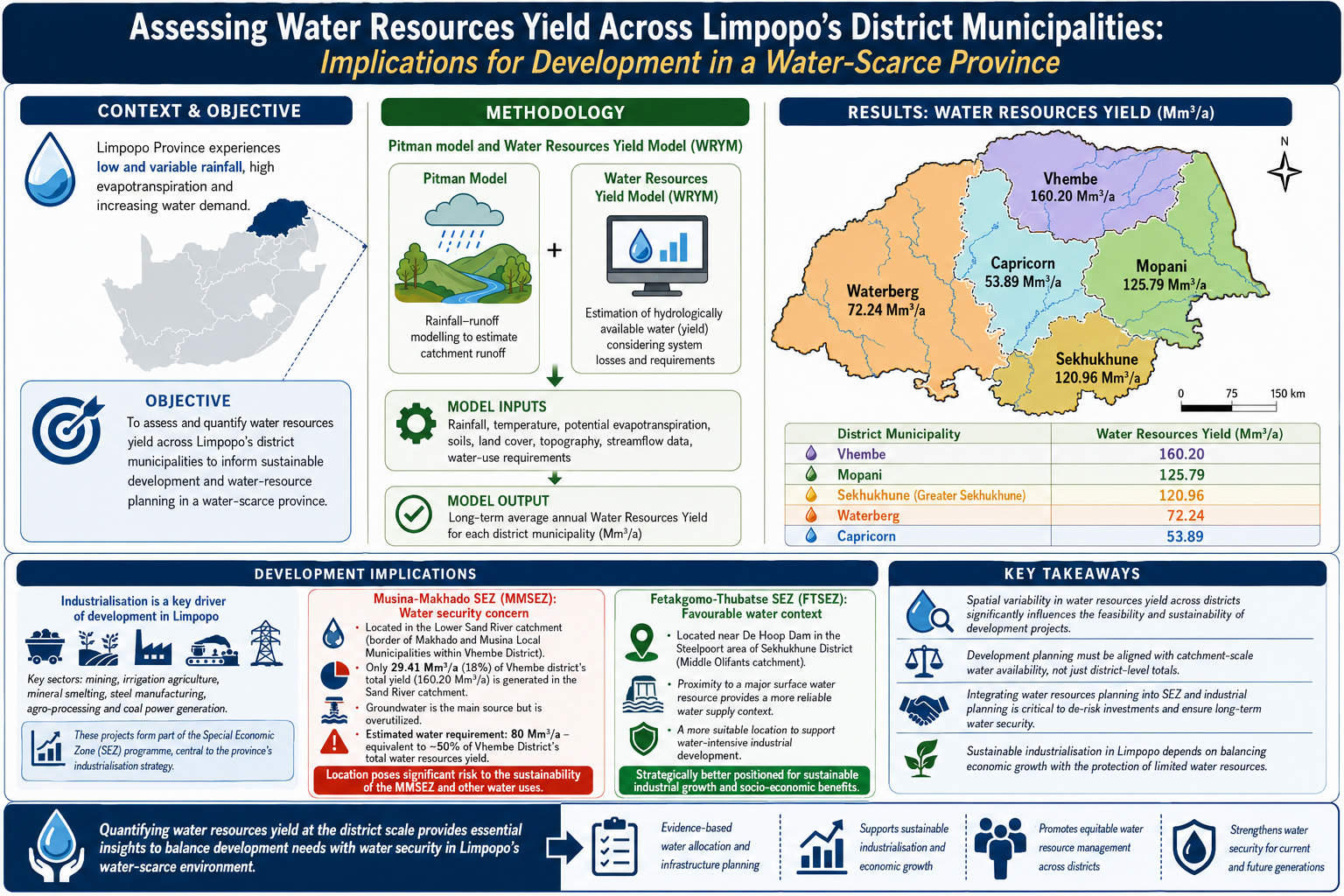
The water unavailability crisis in South Africa significantly contributes to socio-economic challenges affecting some of its underdeveloped former homeland areas. Limpopo province, which is predominantly rural, is nuanced by these challenges. The province is characterised by limited surface and groundwater resources, unevenly distributed, already overallocated and overused with limited scope for further development. At the same time, the province desperately needs high impact development to improve the socio-economic conditions of its communities. Water is the key resource required for those development initiatives to materialize. This study evaluates the water resources yield across the Limpopo District Municipalities. The mapping of the province’s water yield patterns across the five districts provides an insight into the extent of its water challenges and the cascading effects of this on developmental potentials of the province. The Pitman and Water Resources Yield Models were employed to achieve this. The total historical firm yield was estimated at 160.20, 39.84, 72.24, 125.79 and 120.96 Mm3/a for Vhembe, Capricorn, Waterberg, Mopani and Sekhukhune districts respectively. This study provides an insight into approaches that could be deployed by the districts to determine local water resources availability to support planned developmental projects while ensuring sustainable provision of water services to their communities.
Keywords:
water resources yield
; water availability
; Water Resources Yield Model
; pitman model
; Limpopo districts
; South Africa
Copyright: This open access article is published under a Creative Commons CC BY 4.0 license, which permit the free download, distribution, and reuse, provided that the author and preprint are cited in any reuse.


