
Submitted:
04 August 2026
Posted:
04 August 2026
You are already at the latest version
Abstract
Background: Hematologic abnormalities are common in people living with human immunodeficiency virus (HIV) and may reflect underlying infectious, neoplastic, or inflammatory processes involving the bone marrow. In patients with advanced HIV infection, these abnormalities frequently prompt bone marrow evaluation, particularly in the presence of fever of unknown origin or unexplained cytopenias. However, data describing the etiologic spectrum of bone marrow disease in resource-limited settings remain limited. In Latin America, where approximately 2.5 million people are living with HIV [1], late diagnosis and limited access to diagnostic infrastructure remain significant barriers. Yet, contemporary data on the etiologic spectrum of bone marrow involvement in this region are scarce. Aim: To describe the etiologic distribution, histopathological findings, and clinical characteristics of infiltrative bone marrow disease among adults living with HIV who underwent bone marrow evaluation at a tertiary referral center in Venezuela. Methods: We conducted a descriptive cross-sectional study with retrospective and prospective case inclusion among adults with confirmed HIV infection who underwent bone marrow aspiration and/or biopsy for suspected infiltrative disease between January 2019 and April 2024. Clinical, laboratory, histopathological, microbiological, and molecular data were collected. Descriptive analyses and exploratory comparisons were performed. Continuous variables were compared using the Mann-Whitney U test, and categorical variables were analyzed using chi-square or Fisher's exact test, as appropriate. Results: A total of 42 patients were included; 60% were male, and the median age was 39 years (IQR: 31.75–50.0). At presentation, 67% were newly diagnosed with HIV, and 79% were antiretroviral therapy naïve. Severe immunosuppression was common, with a median CD4+ T-cell count of 98.5 cells/mm³. Bone marrow histopathology most frequently demonstrated granulomatous inflammation and hypocellularity (each 38%). Infectious etiologies were identified in 85% of cases, with Histoplasma capsulatum (49%) and Mycobacterium tuberculosis (39%) being the most common pathogens among those tested. Malignancies accounted for 16% of evaluable biopsies. Denominators varied across analyses because not all patients had complete microbiological or histopathological data available. This study provides one of the few contemporary datasets on bone marrow pathology in HIV in Latin America. Conclusions: In this biopsy-selected cohort of adults with advanced HIV infection, infectious etiologies, particularly histoplasmosis and tuberculosis, were the predominant causes of infiltrative bone marrow disease. Bone marrow evaluation provided clinically relevant diagnostic information in patients with fevers of unknown origin and cytopenias when noninvasive investigations were inconclusive. These findings highlight the need for earlier HIV diagnosis, timely initiation of antiretroviral therapy, and improved access to microbiological and molecular diagnostic tools in resource-limited settings. Evidence contributes to the limited body of evidence on bone marrow pathology in people living with HIV in Latin America. It may inform diagnostic and public health strategies in similar resource-limited settings.
Keywords:
HIV
; AIDS
; bone marrow biopsy
; infiltrative bone marrow disease
; opportunistic infections
1. Introduction
More than four decades have passed since the emergence of the acquired immunodeficiency syndrome (AIDS) pandemic, first described in the early 1980s [2]. From its initial recognition, AIDS was characterized by profound cellular immunosuppression and a high burden of opportunistic infections and malignancies in the absence of effective treatment [3]. The introduction and scale-up of combination antiretroviral therapy (ART) transformed the natural history of human immunodeficiency virus (HIV) infection, substantially reducing AIDS-defining illnesses and mortality in many settings [4]. Nevertheless, HIV continues to pose a major public health challenge in low- and middle-income countries, where access to early diagnosis and sustained ART remains inconsistent, and late presentation with advanced disease is still frequent. In Latin America, an estimated 2.5 million people are living with HIV, and Venezuela represents a setting where health system constraints, treatment interruptions, and social determinants of health continue to affect timely diagnosis and continuity of care.
At the University Hospital of Caracas, a major national referral center, large numbers of patients with HIV are evaluated each year, including many with newly diagnosed infection and severe immunosuppression. Institutional data indicate that a substantial proportion of hospitalized patients present with systemic complications, including AIDS-defining malignancies and suspected infiltrative bone marrow disorders, reflecting a clinical scenario that still resembles the pre-ART era in terms of disease severity. In this context, infiltrative bone marrow diseases represent a critical diagnostic challenge. Bone marrow involvement may arise from infectious, neoplastic, or inflammatory processes with overlapping clinical and laboratory features [5]. Common infectious causes include Mycobacterium tuberculosis, Histoplasma capsulatum, cytomegalovirus, and Parvovirus B19, while neoplastic causes include HIV-associated lymphomas and leukemias [6,7]. Clinically, these conditions often manifest as fever of unknown origin, cytopenias, hepatosplenomegaly, or a combination of these; in such scenarios, bone marrow aspiration and biopsy are key diagnostic tools when non-invasive investigations are inconclusive [8,9]
In the contemporary ART era, the diagnostic yield and etiologic spectrum of bone marrow abnormalities in people living with HIV vary across regions, shaped by local epidemiology and access to diagnostic resources. In one of the largest series to date, Wang et al. [7] reported that infectious etiologies accounted for 64% of bone marrow abnormalities in HIV-positive patients with suspected infiltrative disease, with tuberculosis being the most frequent diagnosis. Disseminated histoplasmosis is another major cause of bone marrow involvement in endemic areas. Yet its true burden has historically been under-recognized due to under-reporting and limited access to rapid diagnostics [10,11,12]. Other viral infections, including cytomegalovirus and Parvovirus B19, may also contribute to bone marrow dysfunction, but frequently remain undiagnosed in resource-constrained settings where molecular testing is not routinely available [13]. Emerging evidence suggests that disseminated histoplasmosis may equal or exceed tuberculosis as a cause of mortality among people with advanced HIV in parts of Latin America. Nevertheless, limited access to Histoplasma antigen testing and molecular diagnostics continues to delay diagnosis and treatment.
Malignancies are an additional leading cause of morbidity and mortality among people living with HIV, even in the ART era, with non-Hodgkin lymphoma, Kaposi sarcoma, and leukemias among the most frequent cancers [5,14,15]. As survival improves with ART, the cumulative risk of malignancy increases, further emphasizing the importance of comprehensive diagnostic evaluation, including bone marrow assessment when clinically indicated [16,17]. Despite the recognized clinical importance of bone marrow involvement in advanced HIV, contemporary data describing the etiologic spectrum and histopathological characteristics of infiltrative bone marrow disease in Venezuela are lacking. This knowledge gap limits optimization of diagnostic strategies and resource allocation in a health system under prolonged strain. Therefore, this study aimed to describe the etiologic distribution, histopathological patterns, and clinical characteristics of infiltrative bone marrow disease among adults living with HIV who underwent bone marrow evaluation at the University Hospital of Caracas. To our knowledge, this is among the first contemporary studies from Venezuela describing the etiologic spectrum of infiltrative bone marrow disease among adults living with HIV using integrated histopathological and microbiological diagnostic methods.
2. Methods
2.1. Study Design
We conducted a retrospective-prospective cross-sectional design. The study aimed to characterize the etiologic distribution, clinical features, and bone marrow findings among adult patients living with HIV who underwent bone marrow evaluation for suspected infiltrative diseases. Data were collected from January 2019 to April 2024. For all included patients, clinical, laboratory, microbiological, and histopathological variables were analyzed at a single time point corresponding to the bone marrow aspiration and/or biopsy (index evaluation).
2.2. Setting
The study was conducted at the University Hospital of Caracas. This tertiary care referral center provides specialized services in Internal Medicine, Hematology, and Infectious Diseases and receives patients from Caracas and other regions of Venezuela. The University Hospital of Caracas (Hospital Universitario de Caracas) is a national tertiary-care referral center affiliated with the Central University of Venezuela and located within the Ciudad Universitaria de Caracas. It serves as a major referral facility for patients from Caracas and other regions of the country. The retrospective component included patients evaluated between January 2019 and December 2022 whose medical records were available for review. The prospective component included consecutive patients evaluated between January 2023 and April 2024. For retrospective cases, data were obtained through systematic review of paper-based and electronic medical records. For prospective cases, data were collected in real time during clinical care using a standardized data collection form designed for this study. All variables were recorded at the time of bone marrow evaluation, which was defined as the reference point for the cross-sectional analysis.
2.3. Participants and Sample Size
Eligible participants were adults aged ≥18 years with confirmed HIV infection who underwent bone marrow aspiration, bone marrow biopsy, or both due to clinical suspicion of infiltrative bone marrow disease (Figure 1). Clinical suspicion was defined by the presence of one or more of the following:
- fever of unknown origin (≥38 °C for ≥2 weeks without identified cause),
- unexplained cytopenia affecting one or more hematopoietic lineages,
- hepatosplenomegaly, or
- Clinical suspicion of hematologic malignancy.
These clinical criteria were established a priori and applied consistently for both the retrospective and prospective components of the study, in accordance with published indications for bone marrow evaluation in patients with advanced HIV infection [8,9].
For the retrospective component, participants were identified through a structured search of institutional medical records using predefined keywords (“HIV,” “AIDS,” “bone marrow,” “lymphoma,” “leukemia”), followed by manual eligibility verification. Two investigators independently verified eligibility, and discrepancies were resolved by consensus. For the prospective component, consecutive patients who met the inclusion criteria were recruited during evaluation by clinicians from the Internal Medicine, Hematology, and Infectious Diseases services. Patients were excluded if they:
- were younger than 18 years,
- did not have a bone marrow specimen available for analysis,
- had incomplete records lacking key variables (demographics, HIV status, or bone marrow results), or
- had samples that were not processed or yielded non-interpretable results.non-interpretable results were defined as specimens that were insufficient in cellularity, severely affected by crush artifact, or inadequate in size to permit reliable histopathological assessment, as determined by the reviewing pathologist.
The sample size was determined by the number of eligible patients identified during the study period. Fifty-three records were initially identified, and seven patients were included prospectively. After applying inclusion and exclusion criteria, 42 patients were included in the final analysis. No formal sample size calculation was performed, as the study was descriptive and aimed to include all available cases. All consecutive patients who met the criteria during the study period were included.
2.4. Variables and Definitions
The primary outcome was the etiologic classification of infiltrative bone marrow disease. Etiologies were categorized as:
- Infectious, based on identification of pathogens by culture, histopathology, or molecular methods
- Neoplastic, based on histopathological diagnosis of malignancy
- Non-specific/inconclusive, when no definitive etiology could be established
Histoplasmosis was defined by identification of Histoplasma capsulatum in bone marrow culture and/or compatible histopathological findings (intracellular yeasts with special stains). Tuberculosis was defined by positive mycobacterial culture and/or histological evidence of granulomatous inflammation with compatible staining. Special stains included Ziehl-Neelsen (ZN) for acid-fast bacilli, periodic acid-Schiff (PAS), and Gomori methenamine silver (GMS) for fungal organisms, applied according to institutional protocols and clinical indication [18]. Collected variables included:
- Demographic variables: age, sex
- HIV-related variables: CD4+ T-cell count (cells/mm3), HIV viral load (copies/mL), time since diagnosis, and antiretroviral therapy (ART) status at presentation
- Clinical variables: fever, weight loss, constitutional symptoms, hepatosplenomegaly
- Laboratory variables: hemoglobin (g/dL), leukocyte count (cells/mm3), platelet count (cells/m3³), lactate dehydrogenase (LDH, IU/mL)
- Bone marrow findings: cellularity (hypocellular, normocellular, hypercellular), presence of granulomas, malignant infiltration
- Microbiological and molecular results: fungal, bacterial, and mycobacterial cultures; PCR for cytomegalovirus and Parvovirus B19 when available
Advanced HIV infection was defined as a CD4+ T-cell count <200 cells/mm3. This threshold is consistent with the World Health Organization definition of advanced HIV disease [19,20] and was used throughout the analysis to classify immunosuppression status. ART-naïve status was defined as no prior exposure to antiretroviral therapy at the time of bone marrow evaluation. The etiological diagnosis was based on the integration of clinical, histopathological, and microbiological findings.
2.5. Data Sources and Measurement
Data for retrospective cases were extracted using a standardized abstraction form developed before data collection. Data extraction was performed by trained investigators and reviewed for consistency. A second investigator independently reviewed a random 20% subset of abstract records to verify the accuracy and consistency of data extraction. For prospective cases, clinical and laboratory data were recorded at the time of evaluation using the same standardized form to ensure comparability. Bone marrow aspirates and biopsies were obtained according to institutional protocols. Histopathological analysis included routine hematoxylin and eosin staining, with additional special stains (e.g., Ziehl-Neelsen for acid-fast bacilli, periodic acid–Schiff [PAS], and Gomori methenamine silver [GMS]) performed when indicated. Special stains routinely performed included Ziehl-Neelsen for acid-fast bacilli, periodic acid-Schiff (PAS), and Gomori methenamine silver (GMS) for fungal identification. Additional stains were applied at the pathologist’s discretion based on morphological findings.
Experienced pathologists performed histopathological interpretation in accordance with institutional protocols. Interobserver agreement was not assessed. Microbiological evaluation included cultures for bacteria, fungi, and mycobacteria using available laboratory resources. Fungal cultures were performed on Sabouraud dextrose agar at 25-30 °C. Mycobacterial cultures were performed using Löwenstein-Jensen solid medium. Bacterial cultures were processed on standard blood agar and MacConkey agar plates. Molecular testing (PCR) for cytomegalovirus and Parvovirus B19 was performed selectively in cases where testing was clinically indicated and financially accessible. These tests were conducted either at institutional laboratories or external reference laboratories. Histopathological and microbiological analyses were performed at the laboratories of the University Hospital of Caracas. Molecular testing was conducted either at the institutional laboratory or, when not locally available, at external reference laboratories in Caracas. Due to resource limitations, not all patients underwent the full panel of diagnostic tests.
2.6. Bias Assessment
Selection bias is inherent, as only patients undergoing bone marrow evaluation were included, representing a subset with more severe or unexplained disease. Information bias may have occurred in retrospective data due to incomplete documentation. To reduce this, standardized data extraction forms and predefined variable definitions were used. Diagnostic misclassification bias is possible because not all patients had access to the same diagnostic tests, particularly molecular assays and specialized cultures. No imputation due to small sample and exploratory design.
2.7. Quantitative Variables
Continuous variables were analyzed either as continuous measures or categorized using clinically relevant thresholds. These included:
- CD4+ T-cell count (<200 vs ≥200 cells/mm3)
- Hemoglobin (anemia defined according to WHO criteria)
- LDH (>600 IU/mL as clinically relevant threshold)
Categorization was used to facilitate clinical interpretation.
2.8. Statistical Methods
Statistical analyses were performed using IBM SPSS Statistics version 26.0 (IBM Corp., Armonk, NY, USA). Continuous variables were summarized as medians and interquartile ranges due to non-normality. Normality of continuous variables was assessed using the Shapiro-Wilk test, which indicated non-normality for most variables, justifying the use of nonparametric methods. Categorical variables were summarized as frequencies and percentages. Exploratory comparisons between groups (e.g., by etiologic category) were conducted using the Mann–Whitney U test for continuous variables and chi-square or Fisher’s exact test for categorical variables, as appropriate. A two-sided p-value <0.05 was considered statistically significant. Analyses were conducted using complete-case analysis, and missing data were not imputed. The proportion of missing data varied across variables, ranging from 0% for demographic and HIV-related data to approximately 14% for certain laboratory parameters (e.g., LDH). Missing data patterns are reported alongside results where applicable. Comparative analyses were considered exploratory. The study was not designed to detect differences between subgroups. No adjustment was made for multiple comparisons, as this was not part of the study’s objectives.
2.9. Ethical Considerations
The study was approved by the Bioethics Committee of the University Hospital of Caracas (Approval No. 40). Written informed consent was obtained from participants in the prospective component. For the retrospective component, the requirement for informed consent was waived because anonymized data previously collected were used. All data were anonymized before analysis, and access to the database was restricted to study investigators. The study was conducted in accordance with the Declaration of Helsinki and applicable national regulations.The study was conducted in compliance with the Código de Deontología Médica of the Federación Médica Venezolana, the Normas de Buena Práctica Clínica established by the Venezuelan Ministry of Health, and applicable provisions of the Ley del Ejercicio de la Medicina. All procedures were performed in accordance with the ethical standards of the Declaration of Helsinki [21].
3. Results
3.1. Study Population and Baseline Characteristics
Using an integrated approach combining bone marrow findings, microbiological testing, and clinical assessment, all patients were assigned a final etiologic diagnosis. A total of 42 patients living with HIV who underwent bone marrow evaluation for suspected infiltrative bone marrow disease were included in the analysis. Each patient was classified under a single diagnostic etiology. Most participants were male, accounting for 59% (25/42) of the sample. The median age was 39 years (interquartile range [IQR]: 31.75–50.0). At the time of presentation, 66.67% of patients (28/42) were newly diagnosed with HIV and had not yet initiated antiretroviral therapy. Overall, 79% (33/42) of patients were antiretroviral therapy (ART)-naïve at the time of bone marrow evaluation.Of note, while 67% of patients were newly diagnosed with HIV at the time of bone marrow evaluation, the proportion of ART-naïve patients was higher (79%), as this group also included patients who had been previously diagnosed but had not yet initiated or had lost access to antiretroviral therapy, a pattern consistent with the well-documented disruptions in ART supply in Venezuela during the study period [22,23]. Baseline sociodemographic characteristics, HIV-related clinical status, and treatment exposure are summarized in Figure 1. Quantitative variables are presented as the median and interquartile ranges. Denominators vary across analyses because not all patients had complete histopathological, microbiological, molecular, or laboratory data available. A supplementary table detailing the proportion of missing data for each variable is available upon request from the corresponding author.
3.2. Indications for Bone Marrow Evaluation
The primary clinical indications for bone marrow aspiration and/or biopsy were fever of unknown origin and unexplained cytopenias involving one or more hematologic lineages. Among patients with complete hematologic data, pancytopenia was observed at 42.11% (16/38).Four patients had incomplete hematologic panels at the time of evaluation due to limited laboratory availability during the study period; therefore, pancytopenia could be assessed only in those with simultaneous hemoglobin, leukocyte, and platelet counts (n = 38). Other indications included suspected hematologic malignancy and the presence of systemic symptoms such as weight loss and hepatosplenomegaly. Among the 42 patients, fever of unknown origin was the primary indication in 71.43% (30/42), unexplained cytopenias in 64.29% (27/42), suspected hematologic malignancy in 19.05% (8/42), and hepatosplenomegaly in 45.24% (19/42); these indications were not mutually exclusive. These indications were consistent with the predefined criteria for suspected infiltrative bone marrow disease described in the Methods section.
3.3. Bone Marrow Histopathological Findings
Bone marrow biopsy results are summarized in Table 1 and Table 2. A total of 37 patients had evaluable histopathological samples. Five patients did not have evaluable histopathological samples: three underwent bone marrow aspiration only, without biopsy, and two had specimens deemed non-interpretable due to insufficient tissue or crush artifact. The most frequent histopathological findings were hypocellular bone marrow and granulomatous inflammation; each was identified in 37.84% (14/37) of evaluable biopsies. Granulomas associated with hypocellularity were identified in 2.70% (1/37) of cases. Hypercellular marrow was observed in 5.41% (2/37) of patients. Normocellular marrow was observed in 16.22% (6/37) of patients. The remaining cases were classified as hypocellular (37.84%), granulomatous (37.84%), or hypercellular (5.41%), with one case (2.70%) showing combined granulomatous inflammation and hypocellularity. Malignant hematologic disorders were identified in a subset of patients, including non-Hodgkin lymphoma in 8.11% (3/37), Hodgkin lymphoma in 5.41% (2/37), and chronic myeloid leukemia in 2.70% (1/37). Overall, bone marrow involvement by malignancy was present in 16.22% (6/37) of patients with evaluable biopsies. No cases of concurrent infectious and neoplastic bone marrow infiltration were identified. Each case was classified into a single predominant etiological category based on the integrated diagnostic findings.
3.4. Microbiological and Molecular Findings
Microbiological cultures and molecular testing complemented histopathological evaluation and contributed to etiologic diagnosis in most cases. Histoplasma capsulatum was isolated from bone marrow cultures in 48.57% (17/35) of patients with available fungal cultures, while Mycobacterium tuberculosis was identified in 39.39% (13/33) of patients with mycobacterial studies performed. The proportion of patients with Histoplasma-positive cultures was 48.6% (95% CI: 32.0–65.4%), whereas Mycobacterium tuberculosis was identified in 39.4% (95% CI: 22.9–57.9%) of tested patients. All bacterial cultures were negative. A total of 35 bacterial cultures were performed; all were negative. Polymerase chain reaction (PCR) testing for cytomegalovirus was performed in 3 patients and was positive in 66.67% (2/3). PCR testing for Parvovirus B19 was not performed due to limited availability of molecular diagnostic resources. When histopathological, microbiological, and molecular findings were integrated, an infectious etiology of infiltrative bone marrow disease was identified in 85.71% (36/42) of patients.Of the remaining six patients without an identified infectious etiology, six (14.29%) had malignant hematologic disorders identified on biopsy (non-Hodgkin lymphoma, Hodgkin lymphoma, or chronic myeloid leukemia). No cases were classified as non-specific or inconclusive in this cohort.
3.5. Hematologic and Biochemical Characteristics
Baseline hematologic and biochemical parameters are summarized in Table 2. Patients presented with significant cytopenias. The median leukocyte count was 3,320 cells/mm3 (IQR: 2,177.5–6,005), the median hemoglobin level was 8.25 g/dL (IQR: 6.65–9.60), and the median platelet count was 96,500 cells/m3³ (IQR: 39,500–194,250). Markers of advanced HIV infection were also observed. The median CD4+ T-cell count was 98.5 cells/3m³ (IQR: 48.25–120.5), and the median HIV viral load was 119,100 RNA copies/mL (IQR: 1,310–550,000). CD4+ T-cell count data were available for 38 of 42 patients (90.48%), and HIV viral load data were available for 34 of 42 patients (80.95%). Lactate dehydrogenase (LDH) levels were elevated, with a median value of 761 IU/mL (IQR: 376.75–2,008.5). LDH values greater than 600 IU/mL were observed in 52.78% (19/36) of patients with available data. LDH data were available for 36 of 42 patients (85.71%); the remaining six patients did not have LDH measured at the time of bone marrow evaluation due to reagent unavailability at the institutional laboratory.
3.6. Exploratory Comparative Analyses
Exploratory analyses comparing patients according to etiological categories (malignancy vs non-malignancy, histoplasmosis vs no histoplasmosis, and tuberculosis vs no tuberculosis) are presented in Table 3. Comparisons included age, CD4+ T-cell count, HIV viral load, leukocyte count, hemoglobin level, hematocrit, platelet count, and LDH levels. Using the Mann-Whitney U test, no statistically significant differences were observed between groups for any of the evaluated variables (all p-values >0.05). These findings suggest substantial overlaps in clinical and laboratory characteristics across different etiologic categories of infiltrative bone marrow disease in this cohort. For categorical variables, chi-square or Fisher’s exact test was used as appropriate. No statistically significant associations were found between etiologic categories and categorical clinical variables in these exploratory analyses.
3.7. Antiretroviral Therapy Exposure
At the time of diagnosis of infiltrative bone marrow disease, 79% (33/42) of patients were ART-naïve, while 21% (9/42) were receiving antiretroviral therapy. Antiretroviral regimens used before presentation are summarized in Table 4 and include a heterogeneous range of combinations. This variability reflects differences in timing of HIV diagnosis, treatment access, and national antiretroviral drug availability in the years preceding the study period.Notably, Venezuela experienced progressively worsening antiretroviral drug shortages between 2016 and 2019, reaching complete stock-out by March 2018, affecting over 80,000 people living with HIV nationally [22,24]. Due to the heterogeneity of treatment regimens and the limited sample size, stratified analyses by ART regimen were not performed. The high proportion of ART-naïve patients highlights the frequency of late HIV diagnosis and delayed treatment initiation in this cohort.
4. Discussion
In this study of people living with HIV who underwent bone marrow evaluation for suspected infiltrative disease, the study population was predominantly young and male, with nearly 60% of participants being men and a median age of 39 years. This demographic distribution is consistent with previous studies evaluating bone marrow pathology in HIV-infected populations, including the cohort described by Wang et al. [7], as well as other series from both high- and middle-income settings. Male predominance has been consistently reported in HIV cohorts and may reflect underlying epidemiological patterns of HIV transmission, as well as differences in healthcare access and health-seeking behaviors [25,26]. In Venezuela, and despite the feminization of HIV, we observe this distribution since transmission patterns persist, being more frequent among MSM, and in the third and fourth decades of life, in which individuals may underestimate their vulnerability to HIV acquisition. This study provides contemporary evidence from a resource-limited setting where infectious etiologies predominate.
A key finding of this study was the high proportion of patients presenting without prior exposure to antiretroviral therapy: 67% were newly diagnosed and 79% ART-naïve at the time of bone marrow evaluation. This observation is consistent with findings from Wang et al. [7], Giraldo-Bahamón et al. [27], and Cáceres et al. [28], all of whom reported a high frequency of late presenters among patients undergoing invasive diagnostic procedures. Late diagnosis of HIV infection remains a major challenge in resource-limited settings. It is strongly associated with advanced immunosuppression, increased susceptibility to opportunistic infections, and the need for invasive diagnostic approaches. In this context, bone marrow involvement may represent a late manifestation of uncontrolled infection or malignancy. The high frequency of advanced HIV presentation suggests ongoing barriers to early diagnosis and linkage to care. In Venezuela, these barriers have been compounded by prolonged disruptions to healthcare infrastructure, the migration of healthcare professionals, interruptions in antiretroviral drug availability, and limited access to specialized diagnostic testing. These factors may partially explain the large proportion of ART-naïve patients and the high burden of opportunistic infections observed in this study [22,23].
From a histopathological perspective, granulomatous inflammation and hypocellular bone marrow were the most frequent findings, each present in 37.84% of cases. These findings are consistent with prior reports, particularly those from regions with high burdens of infectious diseases. Wang et al. [7] reported granulomatous inflammation as a dominant feature in patients with bone marrow involvement, particularly in association with tuberculosis. Similarly, studies by Hajiabdolbaghi et al. [8] and Dhawle et al. [29] have described hypocellularity as a common pattern in HIV-associated bone marrow disease, reflecting both direct viral effects and secondary suppression due to opportunistic infections. These overlapping histopathological patterns highlight the limited specificity of bone marrow morphology alone and underscore the importance of integrating histological, microbiological, and clinical data to establish a definitive diagnosis. Medullary hypocellularity is a paradoxical yet frequent finding with marked immunosuppression and is explained by the pathophysiological process of “gelatinous transformation,” as in our patients. The predominance of histoplasmosis over tuberculosis in this cohort is particularly noteworthy. This finding deserves particular attention because multiple studies from Latin America suggest that disseminated histoplasmosis remains underdiagnosed and may contribute to mortality at rates comparable to or exceeding tuberculosis among people with advanced HIV. The predominance of histoplasmosis observed in our cohort likely reflects both the endemicity of Histoplasma capsulatum in northern South America and the advanced immunosuppression of the study population. The absence of routinely available Histoplasma antigen testing in Venezuela may mean that the true burden of disease remains even higher than observed in this study [11,30,31]. While tuberculosis remains a leading opportunistic infection among people with advanced HIV worldwide, Histoplasma capsulatum may represent an underestimated cause of disseminated infection in endemic regions of Latin America.
Clinically, the main indications for bone marrow evaluation in this cohort were fever of unknown origin and cytopenias, which is consistent with established indications reported in the literature [8]. In many patients, noninvasive diagnostic approaches had failed to identify an etiology before bone marrow examination, underscoring the role of invasive diagnostic procedures in complex cases. In our setting, lactate dehydrogenase (LDH) is frequently used as a supportive marker to raise suspicion for disseminated histoplasmosis, particularly when values exceed 600 IU/mL. The median LDH observed in this study (761 IU/mL) is comparable to values reported by Carballo et al. [32] in patients with disseminated histoplasmosis. However, LDH is a nonspecific marker and may also be elevated in other conditions, including malignancy and hemolysis.
In exploratory analyses, no statistically significant differences were observed between patients with different etiologic diagnoses, including malignancy, histoplasmosis, and tuberculosis. These findings suggest substantial overlaps in clinical and laboratory characteristics among etiologic groups, complicating clinical differentiation without definitive diagnostic testing. While some trends were observed in variables such as viral load, leukocyte count, hemoglobin, and LDH, these did not reach statistical significance, likely due to the limited sample size and the substantial clinical overlap among histoplasmosis, tuberculosis, and malignant bone marrow infiltration in patients with advanced HIV disease. These results partially contrast with those reported by Hajiabdolbaghi et al. [8], who identified stronger associations between certain laboratory parameters and malignancy. However, differences in study design, sample size, and population characteristics may explain these discrepancies.
The predominance of infectious etiologies in this cohort, particularly histoplasmosis and tuberculosis, is consistent with regional epidemiology and with prior studies conducted in similar settings. In this study, infectious causes accounted for most cases, highlighting the continued burden of opportunistic infections in patients with advanced HIV infection in Venezuela. These findings are aligned with reports from Latin America, where histoplasmosis has emerged as a leading opportunistic infection among patients with AIDS, often underdiagnosed due to limited access to rapid diagnostic tools [10,11]. Tuberculosis also remains a major contributor to morbidity in this population and frequently presents extrapulmonary involvement, including bone marrow infiltration. Bone marrow tuberculosis represents a severe form of extrapulmonary TB, resulting from the hematogenous dissemination of Mycobacterium tuberculosis. Histopathological examination frequently reveals caseating or non-caseating granulomas that disrupt the normal hematopoietic architecture, underscoring the need for early bone marrow biopsies in individuals with suspected disseminated disease to reduce the high mortality associated with this condition [33].
From a clinical perspective, bone marrow aspiration and biopsy appear particularly valuable among patients with advanced HIV presenting with persistent fever, pancytopenia, hepatosplenomegaly, elevated LDH levels, or nondiagnostic noninvasive investigations. In such settings, bone marrow examination may substantially shorten time to diagnosis and treatment initiation [8,34]. An additional relevant finding was the high frequency of thrombocytopenia compared with other cytopenias. This contrasts with some studies, such as Wang et al. [7], which reported anemia as the predominant abnormality, but is consistent with findings from Hajiabdolbaghi et al. [8]. Differences in hematologic patterns may reflect variations in disease stage, underlying etiologies, or regional epidemiology. Importantly, the presence of cytopenias across multiple lineages reinforces the need for comprehensive evaluation, including bone marrow examination, in patients with advanced HIV and unexplained hematologic abnormalities. Overall, these findings emphasize that in settings where late HIV presentation remains common, bone marrow evaluation continues to play a critical role in the diagnostic work-up of patients with suspected disseminated disease. The high prevalence of infectious etiologies and the overlap of clinical and laboratory features across diagnostic categories highlight the limitations of relying solely on noninvasive methods in this population. The findings of this study are broadly consistent with reports from Colombia, French Guiana, and Brazil, where histoplasmosis has emerged as a leading opportunistic infection among people with advanced HIV. Together, these studies suggest that clinicians practicing in endemic regions should maintain a high index of suspicion for disseminated histoplasmosis when evaluating unexplained cytopenias, prolonged fever, and suspected bone marrow infiltration [10,28,30].
4.1. Implications for Policy, Practice, and Research
These findings have important implications for clinical practice and public health policy in resource-limited settings. First, they underscore the need to strengthen early HIV diagnosis and linkage to care to reduce the burden of advanced disease and its complications. Second, they highlight the importance of maintaining access to invasive diagnostic procedures, including bone marrow aspiration and biopsy, particularly in tertiary care centers managing complex cases. From a diagnostic perspective, improving access to microbiological and molecular testing, especially for fungal infections such as histoplasmosis, should be a priority. The limited availability of these diagnostic tools likely contributes to underdiagnosis and delayed treatment initiation. At the policy level, healthcare systems should consider allocating resources to improve diagnostic infrastructure for both infectious and hematologic diseases. While this study focused on HIV-associated conditions, infiltrative bone marrow diseases are also relevant in the general population, including malignancies and other infectious diseases such as visceral leishmaniasis, which may affect bone marrow function. In Latin America, Visceral leishmaniasis (VL) behaves as a major opportunistic infection in individuals with HIV, where severe immunosuppression facilitates the dissemination of the parasite to the mononuclear phagocytic system. Lindoso et al. [35]. Future research should focus on larger, multicenter studies to better characterize the epidemiology of bone marrow disease in people living with HIV in Latin America, as well as on evaluating the diagnostic yield and cost-effectiveness of different diagnostic strategies in resource-constrained settings.
4.2. Limitations and Strengths
This study has several limitations. First, the relatively small sample size (n=42) limited statistical power, particularly for comparisons across etiologic subgroups; therefore, nonsignificant findings should be interpreted cautiously. Second, this was a single-center, biopsy-selected cohort that included only patients with sufficiently severe or unexplained manifestations to undergo bone marrow evaluation. Selection and referral biases are therefore likely, and the findings may not be generalizable to all people living with HIV in Venezuela or to patients managed in less specialized settings. Third, the combined retrospective–prospective design may have introduced heterogeneity in data completeness. The retrospective component was particularly vulnerable to incomplete documentation, missing laboratory values, and information bias, although standardized definitions and abstraction procedures improved consistency. Fourth, diagnostic testing was not uniform. Molecular assays, specialized cultures, and certain microbiological investigations were selectively performed based on clinical indication, availability, and affordability. This may have led to underdiagnosis or etiologic misclassification, especially for viral infections, mixed infections, and less common opportunistic pathogens. Assigning each patient a single predominant etiology may also have obscured concurrent conditions. The absence of Histoplasma antigen testing and other contemporary fungal diagnostic tests may have influenced the etiologic classification. Despite these limitations, the study has important strengths. It provides contemporary data from Venezuela, where evidence on HIV-associated infiltrative bone marrow disease remains scarce. Integrating clinical, histopathological, microbiological, and molecular findings enabled a comprehensive diagnostic assessment. Moreover, the study reflects real-world practice and the constraints faced in a resource-limited tertiary-care setting. The inclusion of both retrospective and prospective cases provided a broader representation of patients evaluated during five years. Because this study was conducted at a national referral center, referral bias may have resulted in an overrepresentation of patients with advanced disease and complex diagnostic presentations.
5. Conclusions
In this biopsy-selected cohort of adults living with HIV at a tertiary referral center in Venezuela, infiltrative bone marrow disease was predominantly associated with infectious etiologies, particularly histoplasmosis and tuberculosis. These findings reflect the high burden of advanced HIV infection and opportunistic diseases in this setting. The diagnostic evaluation of these patients remains complex, as clinical and laboratory features overlap substantially across different etiologies. In this context, bone marrow aspiration and biopsy provided clinically relevant diagnostic information, particularly in patients presenting with fever of unknown origin and unexplained cytopenias when noninvasive investigations were inconclusive. In this cohort, bone marrow evaluation yielded a definitive etiologic diagnosis in 85.71% of cases when integrating histopathological, microbiological, and molecular findings, a diagnostic yield consistent with or higher than the 26.7-54% range reported in comparable studies [8,34]. The high proportion of patients without prior antiretroviral therapy highlights the ongoing challenge of late HIV diagnosis and delayed treatment initiation, which contributes to the persistence of severe and disseminated disease manifestations. These findings underscore the need to strengthen early HIV detection strategies, improve timely access to antiretroviral therapy, and expand the availability of microbiological and molecular diagnostic tools in resource-limited settings. Enhancing diagnostic capacity may facilitate earlier identification of opportunistic infections and malignancies, ultimately improving clinical outcomes in this vulnerable population. In HIV-positive patients with suspected infiltrative disease, bone marrow examination should not be considered merely complementary, as it can provide crucial diagnostic information and may even be the only way to identify the etiology in some cases. Along these lines, Gupta et al. [36] demonstrated that bone marrow infiltration was frequent in HIV-associated Hodgkin lymphoma and highlighted the importance of bone marrow examination within the diagnostic approach.
Author Contributions
L.M.S.A.: Conceptualization, Methodology, Writing—Original Draft, Writing—Review and Editing, Visualization, Supervision, Project administration; H.F.S.: Methodology, Writing—Original Draft, Writing—Review and Editing, Visualization, Supervision. A.J.R.M.: Methodology, Writing—Original Draft, Writing—Review and Editing, Visualization, Supervision. All authors have read and agreed to the published version of the manuscript.
Funding
The current article processing charges (publication fees) were funded by The University of Texas Health Science Center at Houston, Houston, Texas, United States of America (granted to Higinio Fernández-Sánchez).
Institutional Review Board Statement
The study was approved by the Bioethics Committee of the University Hospital of Caracas (Approval No. 40). Written informed consent was obtained from participants in the prospective component. The study was conducted in accordance with the Declaration of Helsinki and applicable national regulations. The study was conducted in compliance with the Código de Deontología Médica of the Federación Médica Venezolana, the Normas de Buena Práctica Clínica established by the Venezuelan Ministry of Health, and applicable provisions of the Ley del Ejercicio de la Medicina. All procedures were performed in accordance with the ethical standards of the Declaration of Helsinki [21].
Informed Consent Statement
For the retrospective component, the requirement for informed consent was waived because anonymized data previously collected were used. All data were anonymized before analysis, and access to the database was restricted to study investigators.
Acknowledgments
This article has been registered in the Research Proposal Registration of the Coordination of Scientific Integrity and Surveillance of Universidad Cientifica del Sur, Lima, Peru.:
References
- UNAIDS. Latin America—2024 Global AIDS Update: The Urgency of Now. Available online: https://www.unaids.org/sites/default/files/media_asset/2024-unaids-global-aids-update-latin-america_en.pdf (accessed on 3 August 2026).
- Fee, E.; Brown, T.M. Michael S. Gottlieb and the identification of AIDS. Am. J. Public Health 2006, 96, 982–983. [Google Scholar] [CrossRef]
- Bento, D.; Nguyen, A.D. HIV-1-associated opportunistic infections. In StatPearls; StatPearls Publishing: Treasure Island, FL, USA, 2026; Available online: https://www.ncbi.nlm.nih.gov/books/NBK539787/ (accessed on 3 August 2026).
- Tchounga, B.; Ekouevi, D.K.; Balestre, E.; Dabis, F. Mortality and survival patterns of people living with HIV-2. Curr. Opin. HIV AIDS 2016, 11, 537–544. [Google Scholar] [CrossRef] [PubMed]
- Ji, Y.; Lu, H. Malignancies in HIV-infected and AIDS patients. Adv. Exp. Med. Biol. 2017, 1018, 167–179. [Google Scholar] [CrossRef] [PubMed]
- Bisetegn, H.; Ebrahim, H. The prevalence of thrombocytopenia and leucopenia among people living with HIV/AIDS in Ethiopia: A systematic review and meta-analysis. PLoS ONE 2021, 16, e0257630. [Google Scholar] [CrossRef] [PubMed]
- Wang, Y.; Tang, X.; Yuan, J.; Wu, S.; Chen, G.; Zhang, M.; Wang, M.; Zhang, W.; He, J. Bone marrow granulomas in a high tuberculosis prevalence setting. Medicine 2018, 97, e9726. [Google Scholar] [CrossRef] [PubMed]
- Hajiabdolbaghi, M.; Ataeinia, B.; Ghadimi, F.; SeyedAlinaghi, S.; Badie, B.M.; Dadras, O.; Rasoolinejad, M. Bone marrow aspiration/biopsy in the evaluation of fever of unknown origin in patients with AIDS. Infect. Disord. Drug Targets 2021, 21, 394–398. [Google Scholar] [CrossRef] [PubMed]
- GeSIDA. División de Control de VIH, ITS, Hepatitis Virales y Tuberculosis. Documento de consenso de GeSIDA/División de Control de VIH, ITS, Hepatitis Virales y Tuberculosis del Ministerio de Sanidad respecto al tratamiento antirretroviral en adultos infectados por el virus de la inmunodeficiencia humana (actualización enero 2023); Grupo de Estudio del SIDA-SEIMC and Ministerio de Sanidad: Madrid, Spain, 2023. [Google Scholar]
- Pasqualotto, A.C.; Lana, D.D.; Godoy, C.S.M.; Leitão, T.D.M.J.S.; Bay, M.B.; Damasceno, L.S.; Soares, R.B.A.; Kist, R.; Silva, L.R.; Wiltgen, D.; et al. Single high dose of liposomal amphotericin B in human immunodeficiency virus/AIDS-related disseminated histoplasmosis: A randomized trial. Clin. Infect. Dis. 2023, 77, 1126–1132. [Google Scholar] [CrossRef] [PubMed]
- Gómez, B.L. Histoplasmosis: Desafíos diagnósticos. Rev. Méd. Univ. Antioq. 2019, 28, 85–88. Available online: http://www.scielo.org.co/scielo.php?script=sci_arttext&pid=S2462-85222019000200085 (accessed on 3 August 2026). [CrossRef]
- Centers for Disease Control and Prevention. Facts and Stats about Histoplasmosis. Available online: https://www.cdc.gov/histoplasmosis/php/statistics/index.html (accessed on 3 August 2026).
- Perello, R.; Vergara, A.; Monclus, E.; Jimenez, S.; Montero, M.; Saubi, N.; Moreno, A.; Eto, Y.; Inciarte, A.; Mallolas, J.; et al. Cytomegalovirus infection in HIV-infected patients in the era of combination antiretroviral therapy. BMC Infect. Dis. 2019, 19, 1030. [Google Scholar] [CrossRef] [PubMed]
- Álvarez-Guevara, D.; Cuervo-Maldonado, S.; Sánchez, R.; Gómez-Rincón, J.; Ramírez, N. Prevalence of defining malignancies in adult patients with HIV/AIDS in the National Cancer Institute of Colombia, 2007–2014. Rev. Fac. Med. 2017, 65, 397–402. [Google Scholar] [CrossRef]
- Meijide, H.; Mena, A.; Pernas, B.; Castro, A.; López, S.; Vázquez, P.; Bello, L.; Baliñas, J.; Rodríguez-Martínez, G.; Pedreira, J.D. Neoplasias en pacientes con infección por VIH: Estudio descriptivo de 129 casos en el período 1993–2010. Rev. Chil. Infectol. 2013, 30, 156–161. [Google Scholar] [CrossRef] [PubMed]
- Trickey, A.; May, M.T.; Vehreschild, J.-J.; Obel, N.; Gill, M.J.; Crane, H.M.; Boesecke, C.; Hellkvist, A.; Samji, H.; Cavassini, M.; et al. Survival of HIV-positive patients starting antiretroviral therapy between 1996 and 2013: A collaborative analysis of cohort studies. Lancet HIV 2017, 4, e349–e356. [Google Scholar] [CrossRef] [PubMed]
- García-Abellán, J.; Del Río, L.; García, J.A.; Padilla, S.; Vivancos, M.J.; Del Romero, J.; Asensi, V.; Hernando, A.; García-Fraile, L.; Masiá, M.; et al. Risk of cancer in HIV-infected patients in Spain, 2004–2015: The CoRIS cohort study. Enferm. Infecc. Microbiol. Clin. (Engl. Ed.) 2019, 37, 502–508. [Google Scholar] [CrossRef]
- Guarner, J.; Brandt, M.E. Histopathologic diagnosis of fungal infections in the 21st century. Clin. Microbiol. Rev. 2011, 24, 247–280. [Google Scholar] [CrossRef] [PubMed]
- World Health Organization. Guidelines for Managing Advanced HIV Disease and Rapid Initiation of Antiretroviral Therapy; World Health Organization: Geneva, Switzerland, 2017; Available online: https://www.who.int/publications/i/item/9789241550062 (accessed on 3 August 2026).
- World Health Organization. WHO Guidelines on the Management of Advanced HIV Disease; World Health Organization: Geneva, Switzerland, 2025; Available online: https://www.ncbi.nlm.nih.gov/books/NBK620051/ (accessed on 3 August 2026).
- World Medical Association. World Medical Association Declaration of Helsinki: Ethical principles for medical research involving human subjects. JAMA 2013, 310, 2191–2194. [Google Scholar] [CrossRef] [PubMed]
- Page, K.R.; Doocy, S.; Reyna Ganteaume, F.; Castro, J.S.; Spiegel, P.; Beyrer, C. Venezuela’s public health crisis: A regional emergency. Lancet 2019, 393, 1254–1260. [Google Scholar] [CrossRef] [PubMed]
- Daniels, J.P.; Restrepo, A.M.; Vergara, A.; Tobón, A.M. HIV treatment disruption and viral suppression among Venezuelan immigrants living with HIV in Miami. AIDS Behav. 2025. [Google Scholar] [CrossRef]
- PANCAP. Antiretroviral Shortage Reaches 100% in Venezuela. Available online: https://pancap.org/pancap-releases/antiretroviral-shortage-reaches-100-in-venezuela/ (accessed on 3 August 2026).
- Centers for Disease Control and Prevention. HIV and Gay and Bisexual Men. Available online: https://www.cdc.gov/vitalsigns/hivgaybimen/index.html (accessed on 3 August 2026).
- Gümüş, M.; Ergenç, H.; Ergenç, Ö.; Bulut, İ. Evaluation of bone marrow aspiration and biopsy findings in patients with HIV/AIDS: A single-center experience. J. Infect. Dev. Ctries. 2022, 16, 1622–1628. [Google Scholar] [CrossRef]
- Giraldo-Bahamón, G.; Ramírez-Ramos, C.F.; Motta-Quimbaya, O.Y.; Rivera-Marín, J.D.; Areiza-Paramo, J.D.; Serrano-Valderrama, S.R.; Vargas-Plazas, H.I.; Salinas-Cortés, D.F. Evaluación de la médula ósea en pacientes citopénicos infectados con el virus de la inmunodeficiencia humana tipo 1 en hospital colombiano del tercer nivel. CES Med. 2019, 33, 165–174. [Google Scholar] [CrossRef]
- Cáceres, D.H.; Gómez, B.L.; Restrepo, Á.; Tobón, Á.M. Histoplasmosis y sida: Factores de riesgo clínicos y de laboratorio asociados al pronóstico de la enfermedad. Infectio 2012, 16, 44–50. [Google Scholar] [CrossRef]
- Dhawle, M.; Rathi, V.; Hiwale, B. Study of bone marrow findings in human immunodeficiency virus (HIV)-positive patients in a tertiary care hospital. Cardiovasc. Hematol. Disord. Drug Targets 2025, 26. [Google Scholar] [CrossRef] [PubMed]
- Nacher, M.; Adenis, A.; Mc Donald, S.; Do Socorro Mendonca Gomes, M.; Singh, S.; Lopes Lima, I.; Malcher Leite, R.; Hermelijn, S.; Wongsokarijo, M.; Van Eer, M.; et al. Disseminated histoplasmosis in HIV-infected patients in South America: A neglected killer continues on its rampage. PLoS Negl. Trop. Dis. 2013, 7, e2319. [Google Scholar] [CrossRef] [PubMed]
- Adenis, A.A.; Valdes, A.; Cropet, C.; McCotter, O.Z.; Derado, G.; Couppié, P.; Chiller, T.; Nacher, M. Burden of HIV-associated histoplasmosis compared with tuberculosis in Latin America: A modelling study. Lancet Infect. Dis. 2018, 18, 1150–1159. [Google Scholar] [CrossRef] [PubMed]
- Carballo, M.; et al. Disseminated histoplasmosis in patients with acquired immunodeficiency syndrome: Usefulness of lactate dehydrogenase in its diagnosis. 2005, 23, 75–77. [Google Scholar]
- Flores, V.; Trullas, M.F.; Jajati, M.; Sívori, M. Tuberculosis extrapulmonar: Presentación atípica de compromiso de la médula ósea. Rev. Am. Med. Respir. 2024, 24, 43–47. Available online: https://www.ramr.org/articulos/volumen_24_numero_1/casos_clinicos/casos_clinicos_tuberculosis_extrapulmonar_presentacion_atipica_de_compromiso_de_la_medula_osea.pdf (accessed on 3 August 2026).
- Mootsikapun, P.; Faksri, K.; Kaewsri, S.; Lawanna, S.; Siriworawit, R.; Wongsa, A.; Sanpool, O. Predictive model for diagnostic yield of bone marrow examination in HIV-infected patients with fever of unknown origin. AIDS 2024, 38, 195–202. [Google Scholar] [CrossRef] [PubMed]
- Lindoso, J.A.L.; Moreira, C.H.V.; Cunha, M.A.; Queiroz, I.T. Visceral leishmaniasis and HIV coinfection: Widespread Leishmania inflammation and immune deficiency. Lancet Infect. Dis. 2018, 18, e144–e155. [Google Scholar] [CrossRef]
- Gupta, R.K.; Marks, M.; Edwards, S.G.; Smith, K.; Fletcher, K.; Lee, S.-M.; et al. A declining CD4 count and diagnosis of HIV-associated Hodgkin lymphoma: Do prior clinical symptoms and laboratory abnormalities aid diagnosis? PLoS ONE 2014, 9, e87442. [Google Scholar] [CrossRef] [PubMed]
Figure 1.
Patient enrollment and diagnostic flow.
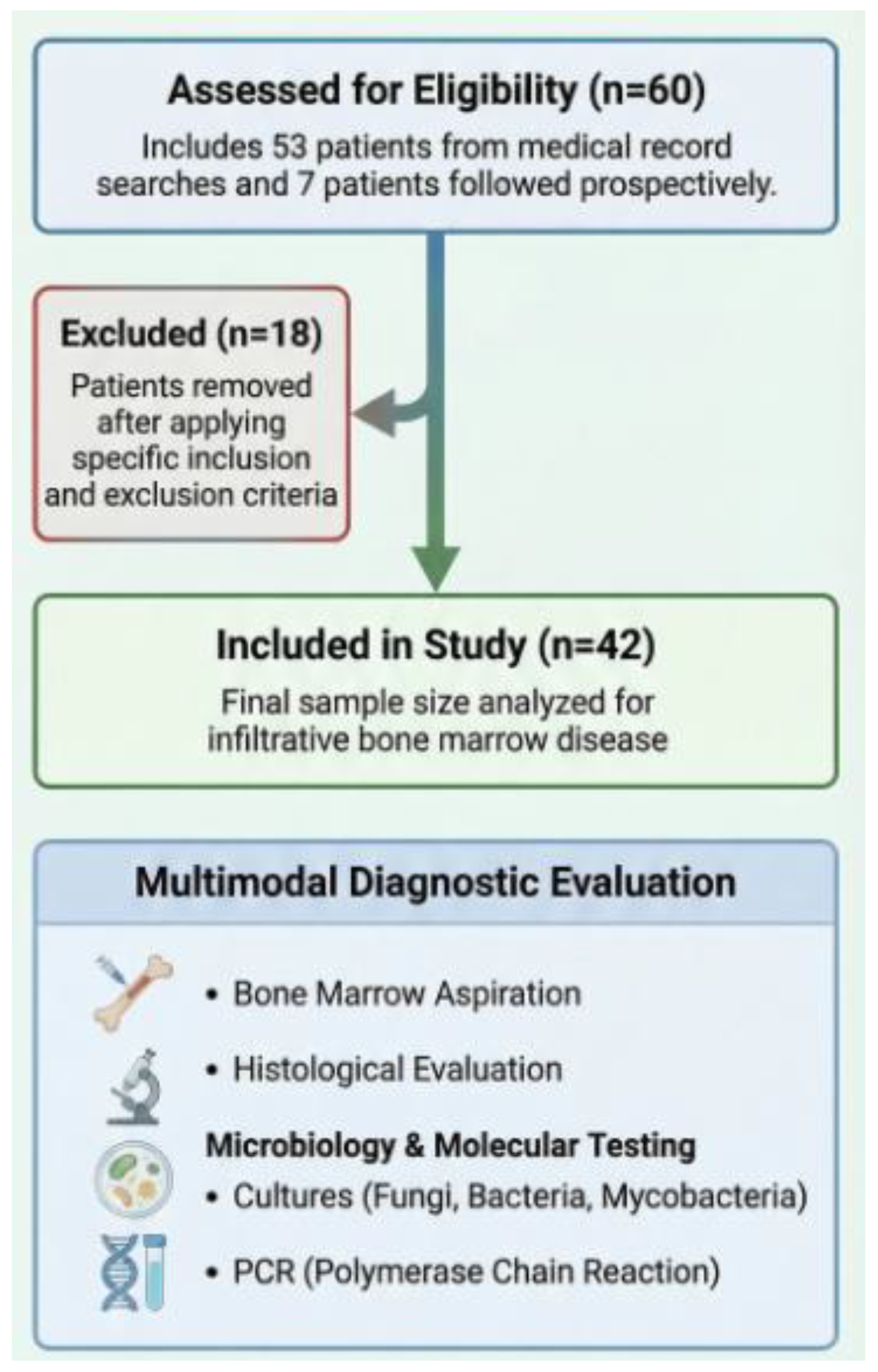

Table 1.
Completeness of selected diagnostic and laboratory variables in 42 adults living with HIV who underwent bone marrow evaluation for suspected infiltrative bone marrow disease.
Table 1.
Completeness of selected diagnostic and laboratory variables in 42 adults living with HIV who underwent bone marrow evaluation for suspected infiltrative bone marrow disease.
| Variable | Available, n (%) | Missed/Not done, n (%) |
|---|---|---|
| CD4+ T-cell count (cells/mm3) | 38 (90.5) | 4 (9.5) |
| HIV viral load (RNA copies/mL) | 34 (81.0) | 8 (19.0) |
| LDH (IU/mL) | 36 (85.7) | 6 (14.3) |
| Bone marrow histopathology | 37 (88.1) | 5 (11.9) |
| Fungal culture (Histoplasma capsulatum) | 35 (83.3) | 7 (16.7) |
| Mycobacterial culture (M. tuberculosis) | 33 (78.6) | 9 (21.4) |
| Bacterial culture | 35 (83.3) | 7 (16.7) |
| CMV PCR | 3 (7.1) | 39 (92.9) |
LDH: lactate dehydrogenase; CMV: cytomegalovirus. Percentages are calculated using the total study population as the denominator (N = 42). Missing data include tests that were not performed or were unavailable at the time of bone marrow evaluation.
Table 2.
Diagnostic yield of bone marrow histopathology, microbiological cultures, and molecular testing in 42 adults living with HIV and suspected infiltrative bone marrow disease.
Table 2.
Diagnostic yield of bone marrow histopathology, microbiological cultures, and molecular testing in 42 adults living with HIV and suspected infiltrative bone marrow disease.
| Diagnostic modality | Tested, n | Positive n (% of tested) | Contributed to final etiologic diagnosis n (% of 42) |
|---|---|---|---|
| Bone marrow histopathology (any abnormal finding) | 37 | 37 (100.0) | 42 (100.0) |
| Histology compatible with malignancy | 37 | 6 (16.2) | 6 (14.3) |
| Histology suggests an infectious etiology ** | 37 | 31 (83.8) *** | 31 (73.8) |
| Fungal culture (Histoplasma capsulatum) | 35 | 17 (48.6) | 17 (40.5) |
| Mycobacterial culture (Mycobacterium tuberculosis) | 33 | 13 (39.4) | 13 (31.0) |
| Bacterial culture | 35 | 0 (0.0) | 0 (0.0) |
| CMV PCR | 3 | 2 (66.7) | 2 (4.8) |
| Integrated diagnostic approach (any modality positive) | 42 | 42 (100.0) | 42 (100.0) |
* All 42 patients were assigned a single predominant etiologic category (infectious or malignant) based on integrated clinical, histopathological, and microbiological findings, even when bone marrow histology was normocellular or hypocellular without specific features. ** Histology suggestive of infectious etiology includes granulomatous inflammation, granulomas with hypocellularity, or other patterns interpreted as compatible with infection in the clinical context. *** The value shown for “Histology suggestive of infectious etiology” reflects the subset of evaluable biopsies with patterns consistent with infection; the exact number and percentage may be refined based on the final pathology review if you decide to reclassify borderline cases.
Disclaimer/Publisher’s Note: The statements, opinions and data contained in all publications are solely those of the individual author(s) and contributor(s) and not of MDPI and/or the editor(s). MDPI and/or the editor(s) disclaim responsibility for any injury to people or property resulting from any ideas, methods, instructions or products referred to in the content. |
© 2026 by the authors. Licensee MDPI, Basel, Switzerland. This article is an open access article distributed under the terms and conditions of the Creative Commons Attribution (CC BY) license (http://creativecommons.org/licenses/by/4.0/).
Copyright: This open access article is published under a Creative Commons CC BY 4.0 license, which permit the free download, distribution, and reuse, provided that the author and preprint are cited in any reuse.


