

Submitted:
03 August 2026
Posted:
04 August 2026
You are already at the latest version
Abstract
Background/Objectives: Systemic corticosteroids remain pivotal in the management of moderate-to-severe inflammatory and autoimmune dermatoses, yet contemporary Indian data linking prescribing behaviour with patient-reported outcomes, adverse drug reaction (ADR) profiling and guideline concordance are sparse. We evaluated prescription patterns, effectiveness, quality of life, ADRs, adherence and concordance with the Indian Council of Medical Research (ICMR) Standard Treatment Workflows (STW) 2022. Methods: In a six-month prospective observational study at a Western Indian tertiary-care teaching hospital, adult (≥18 years) dermatology outpatients started on any systemic corticosteroid were reviewed at baseline and day 30. Disease-specific severity indices (PDAI, BPDAI, CLASI, EASI, LPSI, SALT, SCORAD, VASI) and the Dermatology Life Quality Index (DLQI) captured effectiveness; ADRs were graded per episode using the WHO–UMC causality scale; adherence was measured with the 5-item Medication Adherence Report Scale (MARS-5). Results: Of 82 patients enrolled (mean age 42.4 ± 14.9 years; 58.54% female), 76 (92.68%) completed follow-up. Eczematous dermatitis (23.17%), immunobullous disorders (21.95%) and papulosquamous disorders (12.20%) predominated. Oral Prednisolone accounted for 63.41% of prescriptions, and 80.49% carried a documented taper. Improvement occurred in 56/76 (73.68%), and mean DLQI fell by 9.62 points (57.06%; p < 0.001), with disease-specific severity indices showing mean reductions ranging from 20.42% (VASI, vitiligo) to 59.08% (SCORAD, atopic dermatitis). ADRs affected 11/82 patients (13.41%) across 14 episodes, of which 71.43% were mild. High adherence (MARS-5 = 25) was reported by 76.32%. Overall ICMR STW 2022 concordance was 67.80% (40/59); recurring deviations were drug selection (8/59; discoid lupus erythematosus, moderate eczema, urticaria), missing baseline random blood glucose documentation (12/59, 20.34%), non-concordant tapering regimens (9/59, 15.25%) and dose non-concordance (8/59, 13.56%). Conclusions: Systemic corticosteroid prescribing was broadly consistent with ICMR STW 2022, with satisfactory tapering documentation, encouraging short-term efficacy, an acceptable ADR profile and high self-reported adherence. Deviations clustered in three actionable areas — drug selection in discoid lupus erythematosus, moderate eczema and urticaria; dose- and taper-regimen concordance; and pre-treatment metabolic screening (random blood glucose) — providing concrete targets for departmental educational intervention. Larger multicentre studies with longer follow-up are warranted.
Keywords:
systemic corticosteroids
; autoimmune disorders
; prednisolone
; medication adherence
; quality of life
1. Introduction
Glucocorticoids are among the most extensively prescribed immunomodulatory drugs in contemporary practice. Acting through both genomic and non-genomic pathways, they exert broad anti-inflammatory and immunosuppressive effects that make them indispensable in moderate-to-severe inflammatory, autoimmune and bullous dermatoses [1]. They anchor initial therapy in pemphigus vulgaris and bullous pemphigoid [2,3], cutaneous lupus [4], severe lichen planus [5], vitiligo [6], alopecia areata [7] and antihistamine-refractory chronic spontaneous urticaria [8]. Their prolonged use, however, carries dose- and duration-dependent hazards — osteoporosis, glucose intolerance, hypothalamic–pituitary–adrenal (HPA)-axis suppression, infection, hypertension and gastrointestinal bleeding [9] — that constrain long-term prescribing.
In India, the ready over-the-counter availability of potent topical corticosteroids has fuelled widespread misuse and the now well-documented topical steroid-damaged face epidemic [10,11,12]. By contrast, comparatively little is known about how systemic corticosteroids are used in day-to-day Indian dermatology practice. Prescribing audits have been reported [13,14,15], but prospective studies that combine patient-reported quality-of-life impact with validated severity indices, formal ADR causality assessment and guideline concordance remain uncommon.
The ICMR Standard Treatment Workflows (STW) for dermatology, released in 2022 [16], offer condition-specific algorithms tailored to Indian practice, yet their real-world uptake has seldom been examined prospectively. The present study pairs an ICMR concordance audit with internationally validated patient-centred instruments — the Dermatology Life Quality Index (DLQI) [17,18], the 5-item Medication Adherence Report Scale (MARS-5) [19,20] and WHO pharmacovigilance methodology [21] — to characterise the prescription pattern of systemic corticosteroids in adult dermatology outpatients along with their indications, drug selection, dosage regimens, duration of therapy, effectiveness and safety. The primary objective was to characterise the prescribing pattern of systemic corticosteroids — including indications, drug selection, dose, route and duration — in adult dermatology outpatients at a tertiary-care teaching hospital. The secondary objectives were: (i) to assess therapeutic effectiveness using validated disease-specific severity indices (clinical improvement defined as ≥50% reduction from baseline) at day 30; (ii) to evaluate the safety profile through ADR documentation and WHO–UMC causality assessment; (iii) to quantify the impact of systemic corticosteroid therapy on health-related quality of life using the DLQI; (iv) to audit physician adherence to the ICMR STW 2022 dermatology workflow; and (v) to measure patient adherence to systemic corticosteroid therapy using the MARS-5.
2. Materials and Methods
2.1. Study Design and Setting
This prospective observational study was conducted in the Department of Dermatology of a tertiary-care teaching hospital in Western India. Eligible patients were recruited consecutively from the dermatology outpatient clinic over a six-month period and followed for 30 days from the day systemic corticosteroid therapy was initiated. The study was conducted in accordance with the Declaration of Helsinki and approved by the Institutional Ethics Committee of Smt. N.H.L. Municipal Medical College, Ahmedabad, Gujarat, India (protocol code 25/114; date of approval 9 October 2025). Written informed consent was obtained from every participant prior to enrolment. The study is reported in accordance with the STROBE (Strengthening the Reporting of Observational Studies in Epidemiology) statement.
Prior to enrolment, the study’s purpose, procedures, potential risks and benefits, the voluntary nature of participation, the right to withdraw at any time without affecting routine dermatological care, and the measures adopted to maintain confidentiality of personal and clinical data were explained to each participant by the investigator in a language the participant understood (English, Hindi or Gujarati). A written informed consent form, approved by the Institutional Review Board, was signed by every participant before any study-related procedure was undertaken. Consent covered both participation in the study and publication of anonymised, aggregated findings; no individually identifiable images of patients are included in this manuscript.
2.2. Study Population
Inclusion criteria: Adults (≥18 years) with a confirmed dermatological diagnosis who were prescribed any systemic corticosteroid by the treating dermatologist and provided written informed consent.
Exclusion criteria: Pregnant or lactating women; patients receiving systemic corticosteroids for a non-dermatological indication; those with documented uncontrolled diabetes mellitus, uncontrolled hypertension or active tuberculosis; and individuals unable or unwilling to provide informed consent.
2.3. Sample Size
Consecutive enrolment of all eligible patients during the six-month recruitment window determined the sample size, yielding 82 patients who met the inclusion criteria. No formal a priori power calculation was performed; the cohort was a convenience sample defined by the recruitment window, and the resulting sample size is acknowledged as a limitation.
2.4. Data Collection
A structured case-record form was used to capture demographics, comorbidities, dermatological diagnosis, prescription details (drug, dose, route, frequency, duration and tapering plan) and clinical findings. Diagnoses were consolidated into nine pragmatic categories, defined according to whether a corresponding ICMR STW 2022 workflow was available. Each participant was assessed at baseline (day 0) and again at day 30.
2.5. Outcome Measures
Clinical severity was assessed with disease-specific validated indices: PDAI [22] for pemphigus; BPDAI [23] for bullous pemphigoid; CLASI [24] for cutaneous lupus; EASI [25] and SCORAD [26] for eczematous disorders; SALT [27] for alopecia areata; VASI [28] for vitiligo; and LPSI [29] for lichen planus.
Quality of life was measured with the DLQI [17,18] at baseline and day 30 (a 10-item questionnaire scored 0–30, with higher values indicating greater impairment).
Clinical outcome at day 30 was defined using the disease-specific severity score wherever a validated index applied — improvement as a ≥50% reduction from baseline, stable disease as any change of less than 50%, and worsening as any increase in score, appearance of new lesions or treatment failure requiring escalation. For conditions lacking a validated severity index, physician clinical judgement categorised outcomes as improved, stable or worsened.
Adverse drug reactions were recorded at every visit; each episode was graded for causality using the WHO–UMC scale [30,31] and for severity as mild, moderate or severe. The action taken (therapy continued, dose modified, symptomatic treatment or discontinuation) was captured at the patient level.
Medication adherence was measured with the MARS-5 [19,20] (score range 5–25); a total of 25 was classified as high adherence and any score below 25 as low. Reasons for low adherence were elicited through open-ended questioning, and only spontaneously reported reasons were tabulated.
Post-hoc DLQI domain analysis: For every follow-up completer, the absolute reduction in each of the six DLQI subscales was calculated, and the subscale showing the largest absolute change was designated that patient’s principal domain of improvement. This patient-level analysis was performed post-hoc and is reported descriptively.
Tapering-schedule definitions were operationally defined at two levels. A prescription was recorded as having a “documented taper” whenever the prescriber specified any step-down schedule (dose reduction over defined intervals) at initiation, irrespective of pace. A prescription was classified as an “STW-concordant taper” only when the step-size and total taper duration fell within the range recommended by the ICMR STW 2022 workflow for the relevant indication; tapers that were documented but faster, slower or of different total duration than the STW recommendation were classified as documented-but-non-concordant. This distinction is preserved throughout the Results and Discussion.
ICMR concordance was determined by comparing each prescription against the corresponding ICMR STW 2022 workflow [16]. Conditions not covered by the STW — lichen planus, pityriasis rosea, pityriasis capitis, cutaneous small-vessel vasculitis, leprosy [32], Behçet’s disease, en coup de sabre and certain drug-induced reactions — were excluded from the concordance denominator.
2.6. Statistical Analysis
Data were entered into Microsoft Excel and analysed with IBM SPSS Statistics, version 26. Continuous variables are presented as mean ± SD and categorical variables as frequencies and percentages, with 95% Wilson-score confidence intervals (CIs) reported for the key proportions. The paired t-test compared pre- and post-treatment severity scores and DLQI values. Because each of the eight disease-specific severity indices applies to a distinct condition and the subgroup analyses are exploratory, no correction for multiple comparisons was applied. Between-group continuous comparisons used the independent (Student’s) t-test, with the Shapiro–Wilk test for normality, Levene’s test for equality of variances and Cohen’s d as the effect size; between-group categorical comparisons used Fisher’s exact test. A post-hoc Spearman rank correlation examined the association between total MARS-5 score and DLQI improvement (baseline minus day 30 DLQI), both overall and separately within each disease category, with disease category used only as a stratification variable; these stratified analyses were exploratory and unadjusted for multiple comparisons. A two-sided p < 0.05 was considered statistically significant.
3. Results
The flow of patients through screening, enrolment, follow-up and inclusion in the outcome, adherence and ICMR concordance analyses is presented in Figure 1.
3.1. Patient Demographics and Baseline Characteristics
A total of 82 patients were enrolled; 76 (92.68%) completed day 30 follow-up and 6 (7.32%) were lost to follow-up. Mean age was 42.4 ± 14.9 years (range 18–74), 48 (58.54%) were female and 52 (63.41%) resided in urban areas. Hypertension was documented in 10 patients (12.20%), diabetes mellitus in 8 (9.76%) and thyroid disorder and dyslipidaemia in 3 each (3.66%); overlap was present, and 61 patients (74.39%) had none of the four documented comorbidities. Prior systemic corticosteroid exposure was reported by 22 patients (26.83%). Baseline characteristics are summarised in Table 1.
3.2. Disease Spectrum
Patients were assigned to nine disease categories defined by ICMR STW 2022 workflow availability. Eczematous dermatitis (19 patients, 23.17%), immunobullous disorders (18, 21.95%) and papulosquamous disorders (10, 12.20%) were the three commonest categories; the full distribution is shown in Figure 2.
3.3. Prescription Pattern
Prednisolone was the leading agent prescribed (52/82, 63.41%), followed by Dexamethasone (9/82, 10.98%), Betamethasone (8/82, 9.76%), Methylprednisolone (7/82, 8.54%; 6 as intravenous pulse and 1 as oral pulse) and Hydrocortisone (6/82, 7.32%). The oral route dominated (70/82, 85.37%), with intravenous therapy accounting for 12/82 prescriptions (14.63%).
Doses in the medium Prednisolone-equivalent range (0.5–1 mg/kg/day) were most frequent (35 patients, 42.68%), followed by low-dose regimens (<0.5 mg/kg/day; 18, 21.95%), pulse or mini-pulse regimens (15, 18.29%) and high-dose regimens (>1 mg/kg/day; 14, 17.07%). Treatment duration was most often 4–8 weeks (28/82, 34.15%), and a tapering schedule was documented in 66 of 82 prescriptions (80.49%; 95% CI 70.6–87.6%).
3.4. Clinical Outcome at Day 30
Among the 76 follow-up completers, 56 (73.68%; 95% CI 62.8–82.3%) improved — defined as a ≥50% reduction where a disease-specific severity index was available and by physician assessment otherwise — while 16 (21.05%) remained stable and 4 (5.26%) worsened. Mean DLQI fell from 16.86 ± 4.67 at baseline to 7.24 ± 3.41 at day 30, a reduction of 9.62 points (paired t-test, p < 0.001) that comfortably exceeds the ~4-point minimal clinically important difference. Every disease-specific severity index improved significantly from baseline (paired t-test; full p-values in Table 2).
3.5. DLQI Domain-Wise Improvement
In a post-hoc patient-level review of the 76 follow-up completers, the DLQI subscale showing each patient’s largest absolute reduction was identified as their principal domain of improvement. Symptoms and Feelings led the ranking (15 patients, 19.74%), followed by Work and School (14, 18.42%), Personal Relationships (14, 18.42%), Leisure (12, 15.79%), Daily Activities (11, 14.47%) and Treatment (10, 13.16%). This analysis describes how often each domain surfaced as the leading contributor to a patient’s DLQI improvement.
3.6. Adverse Drug Reactions
Adverse drug reactions occurred in 11 of 82 patients (13.41%; 95% CI 7.7–22.4%) across 14 episodes. Weight gain (3 patients, 3.66%), hyperglycaemia (2, 2.44%) and dyspepsia or gastritis (2, 2.44%) were the commonest events; Cushingoid features, hypertension, acneiform eruption, insomnia, infection and mood disturbance were each reported once (1.22%), while menstrual irregularity affected 1 of the 48 female patients (2.08%). Per-episode WHO–UMC causality was probable in 9 (64.29%) and possible in 5 (35.71%); severity was mild in 10 (71.43%), moderate in 3 (21.43%) and severe in 1 (7.14%) — the single severe event being an infection that required hospitalisation. At the patient level, treatment was continued in 8 of 11 patients (72.73%), the dose was modified in 2 (18.18%) and therapy was discontinued in 1 (9.09%). The incidence of ADRs did not differ significantly across dose categories (Fisher’s exact test p = 0.213) or disease categories (p = 0.901); however, both comparisons were under-powered given the small number of events.
3.7. Patient-Reported Adherence (MARS-5)
The MARS-5 was completed by the 76 follow-up completers; 58 (76.32%; 95% CI 65.6–84.5%) reported high adherence (score = 25) and 18 (23.68%) reported low adherence (score < 25). Among the 18 low-adherence patients, the spontaneously reported reasons were fear of adverse effects (8/18, 44.44%), symptomatic improvement prompting self-discontinuation (5/18, 27.78%), forgetting doses (3/18, 16.67%) and financial constraints (2/18, 11.11%).
3.8. Effect of Adherence on DLQI Improvement
Substantial day 30 DLQI improvement was observed in both adherence groups. Mean improvement measured 8.97 ± 8.10 points in the high-adherence group (n = 58) and 11.72 ± 7.69 points in the low-adherence group (n = 18); the between-group difference (high − low) was −2.76 points (95% CI −7.06 to 1.55), which did not reach statistical significance (independent t-test, p = 0.206). The numerically larger improvement in the low-adherence group is most plausibly attributable to reverse causation — early symptomatic relief itself prompting some patients to reduce dosing (self-discontinuation on perceived improvement being the second most frequent reason for low adherence; see Section 3.7) — and to the higher baseline DLQI in this group (18.06 ± 4.43 vs. 16.48 ± 4.72), which afforded greater scope for absolute reduction. This finding should not be construed as evidence that incomplete adherence is safe, particularly given that 30 days is too short a window to detect relapse. Detailed comparisons are shown in Table 3.
A post-hoc Spearman analysis revealed a weak inverse correlation between MARS-5 score and DLQI improvement overall (ρ = −0.169, p = 0.145) that was not statistically significant. Interpretation is further constrained by a ceiling effect: 76.32% of patients scored the maximum MARS-5 of 25, substantially reducing rank variability. No disease-category-specific correlation reached statistical significance. The vascular-disorder subgroup could not be analysed because all three patients had identical MARS-5 scores, and the infective subgroup contained only two patients, so a meaningful p-value could not be estimated. These exploratory findings are presented in Table 4 and should be interpreted cautiously given the small subgroup sizes.
3.9. ICMR Standard Treatment Workflow Concordance
Of the 82 prescriptions, 59 (71.95%) were for conditions covered by the ICMR STW 2022 dermatology workflow; the remaining 23 — lichen planus (n = 8), drug-induced reactions (n = 6: BFDE 1, DIMR 1, DRESS 4), cutaneous small-vessel vasculitis (n = 3), Type-2 lepra reaction (n = 2), Behçet’s disease (n = 1), en coup de sabre (n = 1), pityriasis rosea (n = 1) and pityriasis capitis (n = 1) — fell outside the workflow and were excluded from the concordance analysis. Among the 59 evaluable prescriptions, 40 (67.80%; 95% CI 55.1–78.3%) were fully concordant with all core ICMR STW prescribing parameters, while 19 (32.20%) deviated on at least one parameter, with substantial overlap across categories: drug selection (n = 8), dose (n = 8), non-concordant taper regimen (n = 9) and missing baseline random blood glucose documentation (n = 12). Drug-selection non-concordance (8/59, 13.56%) spanned three condition categories: discoid lupus erythematosus (n = 5), moderate eczema (n = 2) and urticaria (n = 1); the clinical rationale and STW-recommended alternatives are addressed in the Discussion. Concordance by component is presented in Table 5.
4. Discussion
4.1. Prescribing Patterns in Context
The predominance of oral Prednisolone (63.41%) in our cohort mirrors earlier Indian corticosteroid-prescribing audits [13,14,15] and is in keeping with the chronic course of most dermatological indications and Prednisolone’s suitability for graded taper. It is encouraging that a documented tapering schedule accompanied 80.49% of prescriptions, pointing to prescriber awareness of HPA-axis suppression risk. Intravenous pulse Methylprednisolone, reserved for severe immunobullous disease, was consistent with international consensus recommendations [2,3].
4.2. Clinical Outcomes and Quality of Life
The day 30 clinical improvement rate of 73.68% is in line with previously reported Indian and international short-term outcomes for systemic corticosteroids in inflammatory dermatoses [2,4,8], and the 9.62-point DLQI reduction reflects a clinically meaningful gain [17,18]. Every disease-specific severity index improved significantly from baseline, with mean percentage reductions ranging from 20.42% (VASI, vitiligo) to 59.08% (SCORAD, atopic dermatitis); immunobullous, papulosquamous and eczematous conditions all achieved clinically meaningful improvements of approximately 48–57% (PDAI 54.99%, BPDAI 48.53%, CLASI 54.38%, EASI 56.88%, LPSI 52.11%, SALT 48.00%). The comparatively modest VASI reduction (28.30 → 22.52; 20.42%, p = 0.022) is expected given the protracted timecourse of vitiligo repigmentation, with additional improvement anticipated over subsequent months [6].
4.3. Domain-Wise Quality-of-Life Improvement
Symptoms and Feelings was most often the principal domain of improvement (15/76; 19.74%), followed by Work and School and Personal Relationships (14/76 each; 18.42%) — a pattern with a coherent clinical logic. Symptoms and Feelings captures itch, soreness, pain and embarrassment, precisely the sensory and affective burden that the direct anti-inflammatory action of systemic corticosteroids relieves most rapidly. Improvement in work, schooling and interpersonal functioning typically follows as a downstream benefit of symptomatic relief. The Treatment domain — reflecting the inconvenience and disruption of therapy itself — led in the fewest patients (10/76; 13.16%), consistent with the real-world burden of tapering, laboratory monitoring and adverse-effect concerns. Because each patient was assigned to a single principal domain, the analysis constitutes a descriptive ranking rather than a quantification of each domain’s contribution to the 9.62-point total DLQI improvement; even so, the ranking accords with the established role of systemic corticosteroids in delivering rapid relief of the most distressing features of inflammatory dermatoses.
4.4. Safety Profile
The patient-level ADR rate of 13.41% falls within published estimates for short-term systemic corticosteroid exposure (typically 10–20%) [9] and is substantially lower than rates seen with prolonged use. The leading ADRs — weight gain, hyperglycaemia and dyspepsia — reproduce the pattern reported internationally [9]. Ten of the 14 episodes (71.43%) were mild, 3 (21.43%) moderate and 1 (7.14%) severe; the single severe event (infection requiring hospitalisation) was managed successfully with antimicrobials and with no fatalities. The WHO–UMC causality distribution (probable in 9/14, possible in 5/14) lends confidence to the ADR attributions [21,30,31]. A longer follow-up interval would be needed to detect long-term toxicities such as osteoporosis and cataract, which cannot be captured within 30 days.
4.5. Adherence Behaviour
The high level of self-reported adherence (76.32% scoring MARS-5 = 25) suggests that most patients appreciated the importance of completing their systemic corticosteroid course. The leading reason for non-adherence — fear of adverse effects (8/18, 44.44%) — echoes international research on corticosteroid-related illness perception [10,11] and points to a clear counselling target. Premature self-discontinuation on perceived improvement (5/18, 27.78%) and financial constraints (2/18, 11.11%) are recurring themes in Indian outpatient practice. Together, these findings argue for structured patient education at the point of corticosteroid initiation, addressing (i) the expected timeline of benefit, (ii) the importance of completing the taper schedule and (iii) the dose-dependent and largely reversible nature of most ADRs.
4.6. Effect of Adherence on Quality-of-Life Improvement
Low MARS-5 adherence was not linked to poorer 30-day DLQI improvement; the mean improvement was, if anything, numerically greater in the low-adherence group (11.72 vs. 8.97 points), although the difference (−2.76 points; 95% CI −7.06 to 1.55; p = 0.206) was not statistically significant and the effect size was small (Cohen’s d = −0.34). Consistent with this, the overall Spearman correlation between MARS-5 score and DLQI improvement was weak and non-significant (ρ = −0.169, p = 0.145), and none of the disease-category-specific correlations reached significance; interpretation is further constrained by the MARS-5 ceiling effect (76.32% of patients scored 25/25), which markedly attenuates rank variability and the discriminating power of the correlation. Four factors plausibly account for this trend, none of which supports the view that low adherence is benign. First, as noted in Section 4.5, symptomatic improvement prompting self-reduction was the leading reason for low adherence; in these patients DLQI improvement preceded the drop in adherence, a form of reverse causality. Second, the low-adherence group had a higher baseline DLQI (18.06 vs. 16.48), leaving greater room for absolute reduction through regression to the mean. Third, with only 18 patients in the low-adherence group the analysis was clearly under-powered — the 95% CI extends from a 7-point disadvantage to a 1.6-point advantage for high adherence, so a clinically meaningful effect cannot be excluded. Fourth, 30 days of follow-up is too brief to capture relapse, the outcome most likely to follow premature dose reduction in immunobullous and connective-tissue disorders. The clinical implication is not to abandon counselling but to sharpen it: patients should be told explicitly that early symptomatic improvement is not disease remission, and that completing the taper is essential to prevent relapse even when quality of life has substantially improved.
4.7. ICMR Concordance and Drug-Selection Deviations
Prescriptions deviating from the ICMR STW 2022 parameters concentrated in four recurring domains that together define a clear educational agenda. Drug-selection non-concordance (8/59; 13.56%) clustered around three clinically distinct patterns. The most consequential was the use of systemic corticosteroids in five DLE patients despite the ICMR STW 2022 recommendation of Hydroxychloroquine 5 mg/kg/day plus topical corticosteroids as first-line therapy [16] — a position aligned with broader international guidance that positions antimalarials as the cornerstone of first-line systemic therapy for cutaneous lupus, with systemic corticosteroids reserved for antimalarial failure [4]. At our centre this pattern may reflect the rapid symptomatic relief provided by systemic corticosteroids, the 4–8 week lead-time required for Hydroxychloroquine to take effect or unfamiliarity with the STW recommendation. Two further deviations involved moderate eczema managed outside the topical/step-up first-line pathway (severe eczema cases genuinely warranting systemic corticosteroids were not counted as deviations), and one involved a urticaria patient treated outside the STW antihistamine-led algorithm. Beyond drug selection, three additional patterns of non-concordance merit attention. First, baseline random blood glucose was not documented in 12 of the 59 evaluable prescriptions (20.34%), the single largest gap in the audit. Given that hyperglycaemia is among the earliest and most predictable metabolic effects of systemic corticosteroids — and was the second most frequent ADR in this cohort — routine pre-treatment RBG documentation is both easy to implement and clinically meaningful, and its absence in one in five prescriptions represents a low-cost, high-yield target for correction. Second, tapering regimens were not concordant with the STW recommendation in 9 of 59 prescriptions (15.25%), even though a taper of some form was documented in 80.49% of the full cohort. This dissociation between “any taper” (which was generally present) and “STW-concordant taper” (which was less consistently achieved) suggests that residual variability lies in the specifics of taper design — pace, step-size and total duration — rather than in the principle of tapering itself. Third, dose non-concordance occurred in 8 of 59 prescriptions (13.56%), with dose choices falling outside the Prednisolone-equivalent range specified by the STW for the relevant indication. Taken together, these deviations — drug selection, missing baseline RBG, non-concordant taper regimen and dose non-concordance — delineate a focused set of departmental educational priorities: Hydroxychloroquine-first for DLE, topical-led step-up therapy for moderate eczema and high-dose antihistamine-first pathways for urticaria (reserving systemic corticosteroids for refractory or severe acute presentations); routine documentation of baseline random blood glucose to complement the already comprehensively recorded baseline blood pressure and weight; and closer alignment of taper pace and dose selection with the condition-specific ranges recommended in the STW.
5. Strengths and Limitations
Strengths. This is the first prospective Indian dermatology study to combine an ICMR STW 2022 concordance audit with patient-reported outcomes (DLQI, MARS-5), validated disease-specific severity indices, and formal WHO–UMC causality assessment, which is the novelty of the study in an Indian setting.
The study has made good use of several validated tools like DLQI, MARS-5, and several disease severity indices, which increases the scientific credibility of the study. This paper has a practical impact for clinicians, who will actually learn where prescribing deviates from guidelines. Follow-up retention high at 92.68%, and the study captured both encouraging signals (short-term efficacy, tapering practice, low ADR rate, high adherence) and actionable gaps (drug-selection deviations, missing baseline metabolic screening and taper-regimen non-concordance).
Limitations. Sample size is the largest weakness of the study, with 82 patients, out of which 76 completed follow-ups. This study is also a single tertiary care center pilot study; further studies with a larger sample size and a longer follow-up are the future plan of the authors. Another limitation which the authors want to acknowledge is a shorter 30-day follow-up with respect to the use of systemic corticosteroids, where complications can arise at 3 months, 6 months, and 1 year. Further long-term safety studies are also planned in the future. The authors acknowledge that several subgroup analyses on such tiny samples could reduce the meaningfulness of the study.
6. Conclusions
Systemic corticosteroids were used across a wide spectrum of dermatological conditions at our tertiary-care centre, with oral Prednisolone predominating (63.41%) and a tapering schedule documented in 80.49% of prescriptions — both encouraging indicators of rational prescribing. Short-term outcomes were favourable: 73.68% of patients improved at day 30, and mean DLQI improved by 9.62 points. ADRs occurred in 11 of 82 patients (13.41%) across 14 episodes, of which 10 (71.43%) were mild, and the single severe event resolved without sequelae. Self-reported adherence was high (76.32%), with fear of ADRs identified as the leading reason for non-adherence. Concordance with the ICMR STW 2022 stood at 67.80% among covered prescriptions, and the residual gaps clustered around a small and coherent set of areas: drug-selection deviations (8/59, 13.56%) in DLE, moderate eczema and urticaria; missing baseline random blood glucose documentation (12/59, 20.34%); non-concordant taper regimens (9/59, 15.25%); and dose non-concordance (8/59, 13.56%). Together, these findings define a focused and actionable educational agenda — spanning first-line drug selection in the three flagged conditions, baseline metabolic screening prior to corticosteroid initiation, and closer alignment of dose- and taper-regimen choices with STW recommendations. Larger multicentre studies with longer follow-up are needed to confirm long-term safety, generalisability and guideline-drift patterns in Indian dermatology.
Author Contributions
Conceptualization, P.R.D. and S.D.M.; methodology, P.R.D., P.A., S.D.M. and R.C.; formal analysis, P.R.D. and S.D.M.; investigation, P.R.D. and P.A.; resources, R.C.; data curation, P.R.D.; writing—original draft preparation, P.R.D. and S.D.M.; writing—review and editing, P.R.D., P.A., S.D.M. and R.C.; visualization, P.R.D.; supervision, S.D.M. and R.C.; project administration, S.D.M. All authors have read and agreed to the published version of the manuscript.
Funding
This research received no external funding.
Institutional Review Board Statement
The study was conducted in accordance with the Declaration of Helsinki and approved by the Institutional Review Board (Ethics Committee) of Smt. N.H.L. Municipal Medical College, Ahmedabad, Gujarat, India (protocol code 25/114; date of approval: 9 October 2025). Since Smt. N.H.L. Municipal Medical College and Sardar Vallabhbhai Patel Institute of Medical Sciences and Research are affiliated institutions, a single institutional ethics approval covered patient enrolment at the dermatology outpatient department of SVPIMSR.
Informed Consent Statement
Written informed consent was obtained from all subjects involved in the study prior to enrolment. Written informed consent for publication of the aggregated, anonymised study findings was also obtained from every participant at the time of enrolment. No individually identifiable images of patients are included in this manuscript.
Data Availability Statement
The data supporting the findings of this study are not publicly available due to [privacy/ethical/legal restrictions] but can be made available from the corresponding author upon reasonable request and subject to institutional approvals.
Conflicts of Interest
The authors declare no conflicts of interest.
Abbreviations
The following abbreviations are used in this manuscript:
| ACD | Allergic Contact Dermatitis |
| AD | Atopic Dermatitis |
| ABCD | Airborne Contact Dermatitis |
| ADR | Adverse Drug Reaction |
| BFDE | Bullous Fixed Drug Eruption |
| BP | Blood Pressure |
| BPDAI | Bullous Pemphigoid Disease Area Index |
| CI | Confidence Interval |
| CLASI | Cutaneous Lupus Erythematosus Disease Area and Severity Index |
| CSU | Chronic Spontaneous Urticaria |
| DH | Dermatitis Herpetiformis |
| DIMR | Drug-Induced Morbilliform Rash |
| DLE | Discoid Lupus Erythematosus |
| DLQI | Dermatology Life Quality Index |
| DRESS | Drug Reaction with Eosinophilia and Systemic Symptoms |
| EASI | Eczema Area and Severity Index |
| HPA | Hypothalamic–Pituitary–Adrenal |
| ICD | Irritant Contact Dermatitis |
| ICMR | Indian Council of Medical Research |
| IQR | Interquartile Range |
| LP | Lichen Planus |
| LPSI | Lichen Planus Severity Index |
| MARS-5 | 5-item Medication Adherence Report Scale |
| PDAI | Pemphigus Disease Area Index |
| PR | Pityriasis Rosea |
| PV | Pemphigus Vulgaris |
| RBG | Random Blood Glucose |
| SALT | Severity of Alopecia Tool |
| SCORAD | SCORing Atopic Dermatitis |
| SD | Standard Deviation |
| SLE | Systemic Lupus Erythematosus |
| STW | Standard Treatment Workflow |
| SVPIMSR | Sardar Vallabhbhai Patel Institute of Medical Sciences and Research |
| VASI | Vitiligo Area Scoring Index |
| WHO–UMC | World Health Organization – Uppsala Monitoring Centre |
References
- Cain, D.W.; Cidlowski, J.A. Immune regulation by glucocorticoids. Nat. Rev. Immunol. 2017, 17, 233–247. [Google Scholar] [CrossRef] [PubMed]
- Joly, P.; Horvath, B.; Patsatsi, A.; Uzun, S.; Bech, R.; Beissert, S.; et al. Updated S2K guidelines on the management of pemphigus vulgaris and foliaceus initiated by the European Academy of Dermatology and Venereology (EADV). J. Eur. Acad. Dermatol. Venereol. 2020, 34, 1900–1913. [Google Scholar] [CrossRef] [PubMed]
- Murrell, D.F.; Peña, S.; Joly, P.; Marinovic, B.; Hashimoto, T.; Diaz, L.A.; et al. Diagnosis and management of pemphigus: recommendations of an international panel of experts. J. Am. Acad. Dermatol. 2020, 82, 575–585.e1. [Google Scholar] [CrossRef] [PubMed]
- Fairley, J.L.; Oon, S.; Saracino, A.M.; Nikpour, M. Management of cutaneous manifestations of lupus erythematosus: a systematic review. Semin. Arthritis Rheum. 2020, 50, 95–127. [Google Scholar] [CrossRef] [PubMed]
- Atzmony, L.; Reiter, O.; Hodak, E.; Gdalevich, M.; Mimouni, D. Treatments for cutaneous lichen planus: a systematic review and meta-analysis. Am. J. Clin. Dermatol. 2016, 17, 11–22. [Google Scholar] [CrossRef] [PubMed]
- Rodrigues, M.; Ezzedine, K.; Hamzavi, I.; Pandya, A.G.; Harris, J.E.; Vitiligo Working Group. New discoveries in the pathogenesis and classification of vitiligo. J. Am. Acad. Dermatol. 2017, 77, 1–13. [Google Scholar] [CrossRef] [PubMed]
- Bernhardt, J.; Wenzel, J. Update on pulse corticosteroid therapy for the management of alopecia areata: a systematic review. JEADV Clin. Pract. 2024, 3, 350–360. [Google Scholar] [CrossRef]
- Zuberbier, T.; Aberer, W.; Asero, R.; Abdul Latiff, A.H.; Baker, D.; Ballmer-Weber, B.; et al. The EAACI/GA²LEN/EDF/WAO guideline for the definition, classification, diagnosis and management of urticaria. Allergy 2018, 73, 1393–1414. [Google Scholar] [CrossRef] [PubMed]
- Rice, J.B.; White, A.G.; Scarpati, L.M.; Wan, G.; Nelson, W.W. Long-term systemic corticosteroid exposure: a systematic literature review. Clin. Ther. 2017, 39, 2216–2229. [Google Scholar] [CrossRef] [PubMed]
- Sinha, A.; Kar, S.; Yadav, N.; Madke, B. Prevalence of topical steroid misuse among rural masses. Indian J. Dermatol. 2016, 61, 119. [Google Scholar] [CrossRef] [PubMed]
- Lahiri, K.; Coondoo, A. Topical steroid damaged/dependent face (TSDF): an entity of cutaneous pharmacodependence. Indian J. Dermatol. 2016, 61, 265–272. [Google Scholar] [CrossRef] [PubMed]
- Manchanda, K.; Mohanty, S.; Rohatgi, P.C. Misuse of topical corticosteroids over face: a clinical study. Indian Dermatol. Online J. 2017, 8, 186–191. [Google Scholar] [CrossRef] [PubMed]
- Mukherjee, S.; Era, N.; Banerjee, G.; Tripathi, S.K. Assessment of corticosteroid utilization pattern among dermatology outpatients in a tertiary care teaching hospital in Eastern India. Int. J. Green Pharm. 2016, 10, S178–S182. [Google Scholar]
- Adhikari, K.; Bezbaruah, B.K. Evaluation of prescription pattern of steroid in dermatology OPD of tertiary health care institution and study of adverse effects with steroids use. Int. J. Curr. Res. 2017, 9, 48419–48422. [Google Scholar]
- Wahane, P.A.; Jagtap, R.; Ghongane, B. Evaluation of corticosteroid use pattern in steroid-responsive dermatological conditions. Int. J. Med. Res. Health Sci. 2016, 5, 82–86. [Google Scholar] [CrossRef]
- Indian Council of Medical Research; Department of Health Research; Ministry of Health and Family Welfare; Government of India. Standard Treatment Workflows of India, 2022 Edition, Vol. III; ICMR: New Delhi, India, 2022. [Google Scholar]
- Vyas, J.; Johns, J.R.; Ali, F.M.; Singh, R.K.; Ingram, J.R.; Salek, S.; et al. A systematic review of 207 studies describing validation aspects of the Dermatology Life Quality Index (DLQI). Acta Derm. Venereol. 2024, 104, adv41120. [Google Scholar] [CrossRef] [PubMed]
- Vyas, J.; Johns, J.R.; Abdelrazik, Y.; Ali, F.M.; Ingram, J.R.; Salek, S.; et al. The Dermatology Life Quality Index (DLQI) used as the benchmark in validation of 101 quality-of-life instruments: a systematic review. J. Eur. Acad. Dermatol. Venereol. 2025, 39, 631–679. [Google Scholar] [CrossRef] [PubMed]
- Chan, A.H.Y.; Horne, R.; Hankins, M.; Chisari, C. The Medication Adherence Report Scale: a measurement tool for eliciting patients’ reports of nonadherence. Br. J. Clin. Pharmacol. 2020, 86, 1281–1288. [Google Scholar] [CrossRef] [PubMed]
- Tommelein, E.; Mehuys, E.; Van Tongelen, I.; Brusselle, G.; Boussery, K. Accuracy of the Medication Adherence Report Scale (MARS-5) as a quantitative measure of adherence to inhalation medication in patients with COPD. Ann. Pharmacother. 2014, 48, 589–595. [Google Scholar] [CrossRef] [PubMed]
- World Health Organization. WHO Pharmacovigilance Indicators: A Practical Manual for the Assessment of Pharmacovigilance Systems; WHO: Geneva, Switzerland, 2015; Available online: https://www.who.int/publications/i/item/9789241508254 (accessed on 3 July 2026).
- Boulard, C.; Duvert Lehembre, S.; Picard-Dahan, C.; Kern, J.S.; Zambruno, G.; Feliciani, C.; et al. Calculation of cut-off values based on the Autoimmune Bullous Skin Disorder Intensity Score (ABSIS) and Pemphigus Disease Area Index (PDAI) pemphigus scoring systems for defining moderate, significant and extensive types of pemphigus. Br. J. Dermatol. 2016, 175, 142–149. [Google Scholar] [CrossRef] [PubMed]
- Murrell, D.F.; Daniel, B.S.; Joly, P.; Borradori, L.; Amagai, M.; Hashimoto, T.; et al. Definitions and outcome measures for bullous pemphigoid: recommendations by an international panel of experts. J. Am. Acad. Dermatol. 2012, 66, 479–485. [Google Scholar] [CrossRef] [PubMed]
- Klein, R.S.; Morganroth, P.A.; Werth, V.P. Cutaneous lupus and the Cutaneous Lupus Erythematosus Disease Area and Severity Index instrument. Rheum. Dis. Clin. N. Am. 2010, 36, 33–51. [Google Scholar] [CrossRef] [PubMed]
- Hanifin, J.M.; Baghoomian, W.; Grinich, E.; Leshem, Y.A.; Jacobson, M.; Simpson, E.L. The Eczema Area and Severity Index — a practical guide. Dermatitis 2022, 33, 187–192. [Google Scholar] [CrossRef] [PubMed]
- Chopra, R.; Vakharia, P.P.; Sacotte, R.; Patel, N.; Immaneni, S.; White, T.; et al. Severity strata for Eczema Area and Severity Index (EASI), modified EASI, Scoring Atopic Dermatitis (SCORAD), objective SCORAD, Atopic Dermatitis Severity Index and body surface area in adolescents and adults with atopic dermatitis. Br. J. Dermatol. 2017, 177, 1316–1321. [Google Scholar] [CrossRef] [PubMed]
- King, B.A.; Senna, M.M.; Ohyama, M.; Tosti, A.; Sinclair, R.D.; Ball, S.; et al. Defining severity in alopecia areata: current perspectives and a multidimensional framework. Dermatol. Ther. (Heidelb.) 2022, 12, 825–834. [Google Scholar] [CrossRef] [PubMed]
- Komen, L.; da Graça, V.; Wolkerstorfer, A.; de Rie, M.A.; Terwee, C.B.; van der Veen, J.P. Vitiligo Area Scoring Index and Vitiligo European Task Force assessment: reliable and responsive instruments to measure the degree of depigmentation in vitiligo. Br. J. Dermatol. 2015, 172, 437–443. [Google Scholar] [CrossRef] [PubMed]
- Kaur, H.; Nikam, B.P.; Jamale, V.P.; Kale, M.S. Lichen Planus Severity Index: a new, valid scoring system to assess the severity of cutaneous lichen planus. Indian J. Dermatol. Venereol. Leprol. 2020, 86, 169–175. [Google Scholar] [CrossRef] [PubMed]
- Sharma, R.; Dogra, D.; Dogra, N.; Gupta, A.K.; Goyal, V. Comparison of WHO–UMC and Naranjo scales for causality assessment of reported adverse drug reactions. Indian J. Pharmacol. 2024, 56, 117–123. [Google Scholar]
- Acharya, L.D.; Rau, N.R.; Udupa, N.; Rajan, M.S.; Vijayanarayana, K. Agreement between WHO–UMC causality scale and the Naranjo algorithm for causality assessment of adverse drug reactions. J. Fam. Med. Prim. Care 2022, 11, 4254–4260. [Google Scholar] [CrossRef] [PubMed]
- Maymone, M.B.C.; Venkatesh, S.; Laughter, M.; Abdat, R.; Hugh, J.; Dacso, M.M.; et al. Leprosy: treatment and management of complications. J. Am. Acad. Dermatol. 2020, 83, 17–30. [Google Scholar] [CrossRef] [PubMed]
Figure 1.
Flow diagram of study enrolment, follow-up and inclusion in analyses. DLQI = Dermatology Life Quality Index; MARS-5 = 5-item Medication Adherence Report Scale; ICMR STW = Indian Council of Medical Research Standard Treatment Workflow.
Figure 1.
Flow diagram of study enrolment, follow-up and inclusion in analyses. DLQI = Dermatology Life Quality Index; MARS-5 = 5-item Medication Adherence Report Scale; ICMR STW = Indian Council of Medical Research Standard Treatment Workflow.
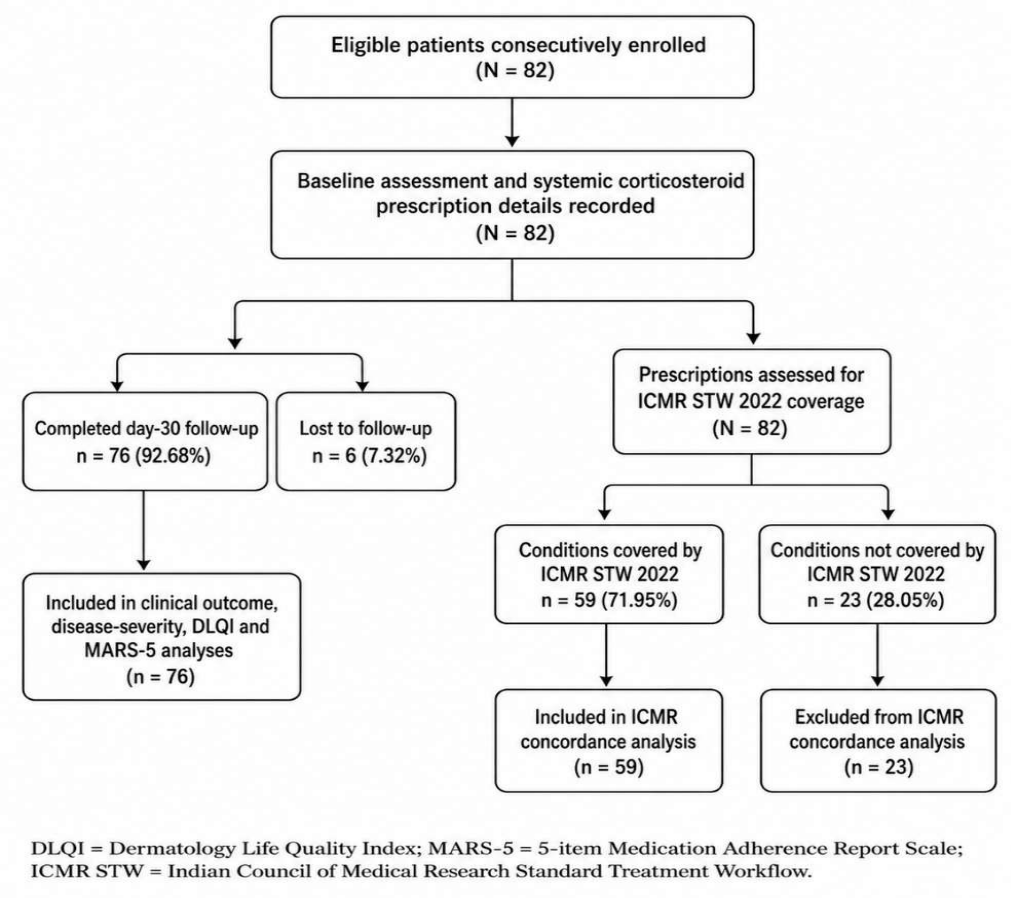
Figure 2.
Distribution of dermatological diagnoses by disease category (N = 82 patients). The nine pragmatic categories were defined based on the availability of an Indian Council of Medical Research – Standard Treatment Workflow (STW) 2022 for each condition. The value at the end of each bar indicates the number of patients (n) in that category.
Figure 2.
Distribution of dermatological diagnoses by disease category (N = 82 patients). The nine pragmatic categories were defined based on the availability of an Indian Council of Medical Research – Standard Treatment Workflow (STW) 2022 for each condition. The value at the end of each bar indicates the number of patients (n) in that category.
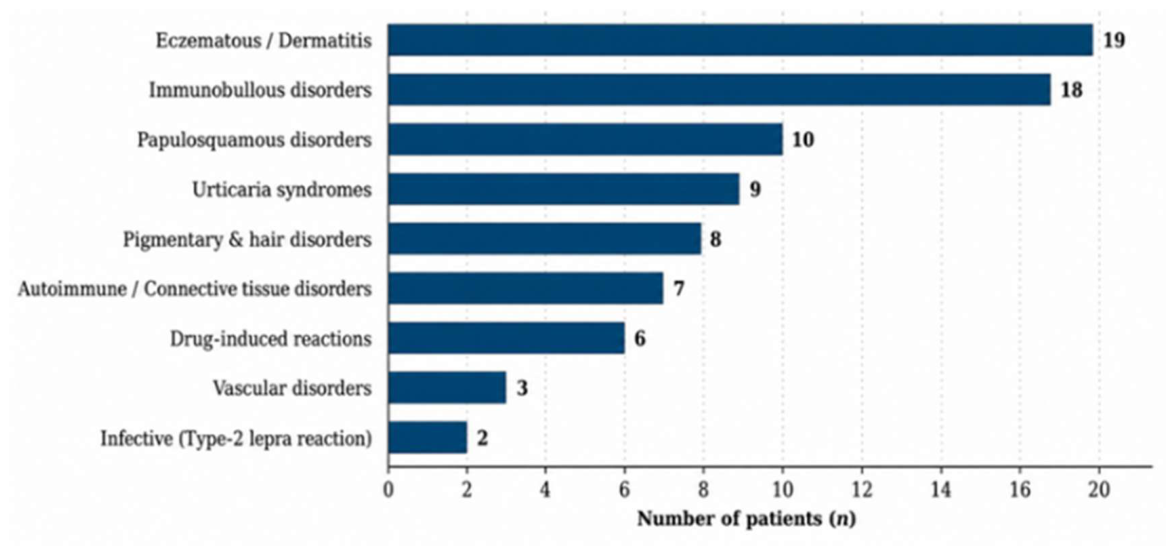

Table 1.
Baseline demographic and clinical characteristics of enrolled patients (N = 82).
| Variable | Category | n | % |
|---|---|---|---|
| Age (years) | 18–30 | 18 | 21.95 |
| 31–45 | 28 | 34.15 | |
| 46–60 | 24 | 29.27 | |
| >60 | 12 | 14.63 | |
| Age, mean ± SD (years) | 42.4 ± 14.9 | — | — |
| Sex | Female | 48 | 58.54 |
| Male | 34 | 41.46 | |
| Residence | Urban | 52 | 63.41 |
| Rural | 30 | 36.59 | |
| Comorbidities * | Hypertension | 10 | 12.20 |
| Diabetes mellitus | 8 | 9.76 | |
| Thyroid disorder | 3 | 3.66 | |
| Dyslipidaemia | 3 | 3.66 | |
| None of the above | 61 | 74.39 | |
| Prior systemic steroid use | Yes | 22 | 26.83 |
| No | 60 | 73.17 |
* Comorbidity categories are not mutually exclusive; some patients had more than one comorbidity, so the individual rows may sum to more than the number of patients with at least one comorbidity. The “None of the above” row refers to patients with none of the four documented comorbidities. SD = standard deviation.
Table 2.
Change in condition-specific severity scores and Dermatology Life Quality Index (DLQI) from baseline to day 30 follow-up.
Table 2.
Change in condition-specific severity scores and Dermatology Life Quality Index (DLQI) from baseline to day 30 follow-up.
| Score | Condition | n | Baseline (mean ± SD) |
Day 30 (mean ± SD) |
Improvement (%) | p-value * |
|---|---|---|---|---|---|---|
| PDAI | Pemphigus vulgaris | 6 | 45.17 ± 8.40 | 20.33 ± 4.92 | 54.99 | <0.001 |
| BPDAI | Bullous pemphigoid | 5 | 40.80 ± 8.60 | 21.00 ± 6.90 | 48.53 | <0.001 |
| CLASI | DLE (discoid lupus erythematosus) | 5 | 18.50 ± 5.10 | 8.44 ± 2.81 | 54.38 | 0.001 |
| EASI | Eczema (excluding atopic dermatitis) | 5 | 21.80 ± 1.92 | 9.40 ± 1.31 | 56.88 | 0.001 |
| LPSI | Lichen planus | 8 | 14.20 ± 3.60 | 6.80 ± 2.12 | 52.11 | <0.001 |
| VASI | Vitiligo vulgaris | 5 | 28.30 ± 6.90 | 22.52 ± 4.70 | 20.42 | 0.022 |
| SCORAD | Atopic dermatitis | 3 | 52.30 ± 7.10 | 21.40 ± 5.80 | 59.08 | 0.005 |
| SALT | Alopecia areata | 3 | 42.50 ± 12.80 | 22.10 ± 9.15 | 48.00 | 0.042 |
| DLQI | Day 30 completers | 76 | 16.86 ± 4.67 | 7.24 ± 3.41 | 57.06 | <0.001 |
* Paired t-test. No adjustment for multiple comparisons was applied across the eight condition-specific indices, as each pertains to a distinct disease category. Small-subgroup interpretive caveats are addressed in the Limitations. PDAI = Pemphigus Disease Area Index; BPDAI = Bullous Pemphigoid Disease Area Index; CLASI = Cutaneous Lupus Erythematosus Disease Area and Severity Index; EASI = Eczema Area and Severity Index; LPSI = Lichen Planus Severity Index; VASI = Vitiligo Area Scoring Index; SCORAD = SCORing Atopic Dermatitis; SALT = Severity of Alopecia Tool; DLQI = Dermatology Life Quality Index; SD = standard deviation.
Table 3.
Comparison of DLQI scores and DLQI improvement between high- and low-MARS-5-adherence groups (N = 76 follow-up completers).
Table 3.
Comparison of DLQI scores and DLQI improvement between high- and low-MARS-5-adherence groups (N = 76 follow-up completers).
| Variable | High adherence (MARS-5 = 25) n = 58 |
Low adherence (MARS-5 < 25) n = 18 |
p-value * |
|---|---|---|---|
| Baseline DLQI (mean ± SD) | 16.48 ± 4.72 | 18.06 ± 4.43 | — |
| Day 30 DLQI (mean ± SD) | 7.52 ± 3.42 | 6.33 ± 3.31 | — |
| DLQI improvement (mean ± SD) | 8.97 ± 8.10 | 11.72 ± 7.69 | 0.206 |
| Median DLQI improvement (IQR) | 8.0 (3.00–14.75) | 12.5 (5.25–18.50) | — |
| Mean difference (high − low) | −2.76 | — | — |
| 95% CI for mean difference | −7.06 to 1.55 | — | — |
| Cohen's d (effect size) | −0.34 (small) | — | — |
| Shapiro–Wilk normality (W, p) | W = 0.985, p = 0.701 | W = 0.965, p = 0.705 | — |
* Independent (Student’s) t-test, two-sided; assumptions of normality (Shapiro–Wilk) and homogeneity of variances (Levene’s test) were satisfied in both groups. DLQI = Dermatology Life Quality Index; MARS-5 = 5-item Medication Adherence Report Scale; SD = standard deviation; IQR = interquartile range; CI = confidence interval.
Table 4.
Spearman correlation between MARS-5 score and DLQI improvement, overall and by disease category (N = 76 follow-up completers).
Table 4.
Spearman correlation between MARS-5 score and DLQI improvement, overall and by disease category (N = 76 follow-up completers).
| Analysis group | n | Spearman ρ | p-value |
|---|---|---|---|
| Overall | 76 | −0.169 | 0.145 |
| Eczematous dermatitis | 18 | −0.322 | 0.192 |
| Immunobullous disorders | 17 | −0.022 | 0.932 |
| Papulosquamous disorders | 9 | 0.274 | 0.476 |
| Urticaria syndromes | 8 | −0.405 | 0.319 |
| Pigmentary & hair disorders | 8 | −0.417 | 0.304 |
| Autoimmune / connective tissue disorders | 7 | 0.618 | 0.139 |
| Drug-induced reactions | 4 | −0.816 | 0.184 |
| Vascular disorders | 3 | NE | NE |
| Infective | 2 | −1.000 | NE |
Spearman rank correlation was calculated between total MARS-5 score and DLQI improvement (baseline DLQI − day 30 DLQI). Disease category was used for stratification only. NE = not estimable. Correlation was not estimated for vascular disorders because all participants had identical MARS-5 scores, or for infective disorders because the subgroup included only two participants. All analyses were exploratory and unadjusted for multiple comparisons.
Table 5.
Physician adherence to components of rational prescribing per ICMR Standard Treatment Workflow 2022.
Table 5.
Physician adherence to components of rational prescribing per ICMR Standard Treatment Workflow 2022.
| Component of rational prescribing (ICMR STW 2022) | Adherent n (%) |
|---|---|
| Indication explicitly covered by ICMR STW 2022 dermatology workflow (denominator: 82 prescriptions) | 59 (71.95%) |
| Appropriate corticosteroid drug per ICMR STW 2022 (denominator: 59 covered) | 51 (86.44%) |
| Appropriate dose (Prednisolone-equivalent within ICMR STW 2022 range; denominator: 59 covered) | 51 (86.44%) |
| Tapering regimen concordant with ICMR STW 2022 (denominator: 59 covered) | 50 (84.75%) |
| Baseline blood pressure documented (denominator: 59 covered) | 59 (100.00%) |
| Baseline weight documented (denominator: 59 covered) | 59 (100.00%) |
| Baseline random blood glucose (RBG) documented (denominator: 59 covered) | 47 (79.66%) |
| Counselling on ADRs documented (general prescribing indicator; denominator: 82) | 70 (85.37%) |
| Generic name used in prescription (general prescribing indicator; denominator: 82) | 68 (82.93%) |
| Overall concordance with all core ICMR STW parameters (appropriate drug, dose, taper-regimen concordance and all three components of baseline monitoring [BP, weight, RBG]; denominator: 59) | 40 (67.80%) |
Denominators are indicated per row. General prescribing indicators (counselling on ADRs, generic-name use) are reported descriptively across all 82 prescriptions and do not contribute to the overall concordance calculation. Details of drug-selection, tapering and dose non-concordance are provided in Section 3.9 and Section 4.7. ICMR STW = Indian Council of Medical Research – Standard Treatment Workflow; ADR = adverse drug reaction; DLE = discoid lupus erythematosus; BP = blood pressure; RBG = random blood glucose.
Disclaimer/Publisher’s Note: The statements, opinions and data contained in all publications are solely those of the individual author(s) and contributor(s) and not of MDPI and/or the editor(s). MDPI and/or the editor(s) disclaim responsibility for any injury to people or property resulting from any ideas, methods, instructions or products referred to in the content. |
© 2026 by the authors. Licensee MDPI, Basel, Switzerland. This article is an open access article distributed under the terms and conditions of the Creative Commons Attribution (CC BY) license (http://creativecommons.org/licenses/by/4.0/).
Copyright: This open access article is published under a Creative Commons CC BY 4.0 license, which permit the free download, distribution, and reuse, provided that the author and preprint are cited in any reuse.