

Submitted:
01 August 2026
Posted:
04 August 2026
You are already at the latest version
Abstract
Digital markets create value through platform ecosystems that integrate complementary technologies, resources, and organizational capabilities. Existing research explains platform governance, ecosystem orchestration, and collaborative value creation but provides limited explanation of the organizational processes that establish strategic relationships and support ecosystem expansion. This study develops a conceptual architecture of ecosystem coordination from a business development perspective. A conceptual theory development approach integrates digital ecosystem research with business development research, while an analytical model provides a formal representation of the structural relationships among business development capability, ecosystem coordination, ecosystem expansion, and collective value creation. The proposed conceptual architecture comprises four complementary components: opportunity identification, partner evaluation, strategic alignment, and resource mobilization. Integration of these components supports strategic relationship development, ecosystem coordination, ecosystem expansion, and collective value creation. Illustrative applications across cloud computing, digital commerce, and artificial intelligence ecosystems illustrate the applicability of the proposed conceptual architecture. Findings establish a business development perspective for explaining ecosystem coordination in digital markets, extend digital ecosystem research through recognition of strategic relationship development as an essential organizational process preceding ecosystem coordination and ecosystem expansion, and provide a conceptual foundation for future empirical research.
Keywords:
ecosystem coordination
; strategic relationship development
; digital markets
; electronic commerce
; platform ecosystems
; business development
1. Introduction
Digital markets have transformed competition from interactions among individual firms to collaboration across platform ecosystems [1,2]. Platform owners, technology providers, software developers, service partners, and customers contribute complementary technologies, resources, and capabilities that support collective innovation [3,4,5]. Innovation and commercial success require integration of these complementary capabilities into coherent value creation processes [6,7]. Ecosystem coordination determines how organizations integrate complementary capabilities, coordinate collaborative activities, expand ecosystem participation, and generate collective value [8,9].
Expansion of platform ecosystems creates new organizational challenges as participating organizations increase, technological innovation accelerates, and interdependence among complementary resources strengthens [10,11,12]. Organizations must coordinate relationships across diverse technological domains while adapting to continuous ecosystem evolution [13,14,15]. These conditions increase the organizational importance of strategic relationship development by extending coordination requirements beyond governance of established ecosystem relationships [16,17,18].
Digital ecosystem research has established several complementary explanations of ecosystem performance [19,20]. Platform governance defines participation rules, technical standards, and decision rights that regulate ecosystem interactions [21,22]. Ecosystem orchestration coordinates complementary resources, partner activities, and innovation across participating organizations [23,24]. Network effects explain growth in ecosystem participation [25,26]. Complementor research explains how specialized participants strengthen ecosystem capability and value creation [27,28]. These perspectives explain coordination within established ecosystems, whereas relationship development remains outside their principal analytical focus.
Ecosystem expansion presents a distinct organizational challenge [29,30]. Organizations identify collaboration opportunities, evaluate complementary partners, and establish strategic relationships [31,32,33]. They align organizational objectives and mobilize complementary resources to support ecosystem development [34,35]. These activities determine ecosystem composition and establish the structural foundation for ecosystem coordination [36]. Governance regulates ecosystem participation, whereas orchestration coordinates established ecosystem relationships [37,38]. Relationship development establishes the structural foundation for ecosystem expansion, yet digital ecosystem research gives limited attention to the organizational process that connects these activities with ecosystem coordination.
Business development provides an organizational perspective for conceptualizing ecosystem coordination [39,40]. Management research conceptualizes business development through opportunity identification, partnership development, strategic alignment, capability integration, and resource mobilization [41,42,43]. These activities create strategic relationships, connect complementary organizations, expand ecosystem participation, and strengthen collaborative value creation [44,45]. Business development explains the organizational process through which firms establish ecosystem relationships and create the structural conditions that support ecosystem coordination and ecosystem expansion.
This study develops a conceptual architecture of ecosystem coordination from a business development perspective by integrating two complementary but largely independent research streams. Digital ecosystem research has established substantial knowledge regarding governance, orchestration, and ecosystem coordination, whereas business development research explains the organizational processes through which firms identify opportunities, establish strategic relationships, align complementary objectives, and mobilize resources. Integrating these complementary perspectives extends current understanding of ecosystem coordination by incorporating the developmental mechanisms that support ecosystem expansion. An analytical model formalizes these structural relationships and provides a foundation for future empirical research [46,47].
Three contributions emerge from this study. First, the study establishes a business development perspective for explaining ecosystem coordination in digital markets and extends existing digital ecosystem research by recognizing strategic relationship development as an essential organizational process preceding ecosystem coordination and ecosystem expansion. Second, the proposed conceptual architecture explains how opportunity identification, partner evaluation, strategic alignment, and resource mobilization form the organizational foundation for ecosystem coordination, ecosystem expansion, and collective value creation. Third, the analytical model formalizes the structural relationships specified in the proposed conceptual architecture and provides a foundation for future empirical research.
2. Literature Review
2.1. Digital Markets and Platform Ecosystems
Digital markets organize economic exchange through digital platforms that connect multiple groups of participants [4,10,22]. Platform owners, technology providers, application developers, service partners, merchants, and customers contribute complementary resources that support technological innovation and commercial activity [3,6,24]. Coordinated interaction among these participants generates economic value beyond the capabilities of individual firms [5,7,24]. This organizational structure has shifted management research from firm-centered competition toward ecosystem-based competition, where complementary capabilities, ecosystem coordination, and value creation shape market performance [2,5,20]. Complementary asset integration provides the structural foundation for platform ecosystems and enables participating organizations to create products and services beyond the capabilities of individual firms [6,35].
Research has established several theoretical perspectives that explain ecosystem performance [19,29]. Network effects increase platform attractiveness as participation expands [25,26], complementary innovation broadens products and services available to users [15,36], platform governance establishes participation rules and decision rights [11,21], and ecosystem orchestration coordinates resource integration across organizational boundaries [23,38]. These perspectives provide a strong theoretical basis for explaining ecosystem coordination, collective value creation, and competitive advantage within established platform ecosystems [27,28].
Platform ecosystem expansion introduces a complementary organizational challenge beyond coordination within established ecosystems [30,39]. Organizations identify prospective partners, evaluate strategic compatibility, negotiate collaborative arrangements, align complementary resources, and establish new interorganizational relationships that extend ecosystem boundaries [31,35,40]. Governance and orchestration explain coordination across existing ecosystem relationships, whereas relationship development explains how new ecosystem relationships emerge [17,23,40]. These perspectives extend existing understanding of ecosystem coordination by recognizing relationship formation as an essential component of ecosystem development.
2.2. Ecosystem Coordination in Digital Markets
Ecosystem coordination refers to the processes through which organizations align complementary resources, activities, and strategic objectives to support collective value creation within digital ecosystems [9,23,29]. Coordination enables independent firms to integrate specialized capabilities into products and services that satisfy customer needs [35,45]. Platform owners, complementors, technology providers, and service partners contribute distinct resources, while coordinated interaction integrates these complementary capabilities into collective innovation and market value [27,28,30].
Research explains ecosystem coordination through platform governance and ecosystem orchestration [11,21,24]. Platform governance establishes participation rules, allocates decision rights, defines technical standards, and regulates interactions among ecosystem participants [21,22]. Governance reduces uncertainty, strengthens compatibility, and supports stable collaboration across diverse organizations [17,25]. Ecosystem orchestration complements this perspective through partner engagement, resource integration, knowledge sharing, and collaborative value creation across organizational boundaries [8,38]. These perspectives explain coordination, innovation, and value creation within established platform ecosystems [20,24].
Platform ecosystem expansion introduces a complementary coordination process centered on relationship formation [39,40]. Organizations identify prospective partners, evaluate strategic compatibility, establish collaborative relationships, align complementary resources, and extend ecosystem boundaries through strategic relationship development [33,35,41]. Governance and orchestration explain coordination across established ecosystem relationships, whereas relationship formation explains how organizations create new ecosystem relationships that support ecosystem expansion [17,23,45]. Incorporating relationship formation broadens the analytical scope of ecosystem coordination beyond governance and orchestration.
2.3. Business Development as a Perspective on Ecosystem Coordination
Business development has gained increasing attention as organizations pursue strategic partnerships, market expansion, innovation, and organizational development [39,40,41]. Management research associates business development with opportunity identification, relationship development, resource mobilization, and strategic collaboration that support long-term organizational objectives [42,43]. Existing studies commonly describe business development as an organizational capability that facilitates creation of strategic relationships and complementary resources [48,49]. From the perspective adopted in this study, business development provides an organizational lens for understanding how firms create future opportunities through strategic relationship development.
This organizational capability integrates market knowledge, technological expertise, financial evaluation, and organizational coordination into a coherent organizational process for strategic relationship development [42,45]. This process enables firms to identify prospective opportunities, evaluate strategic compatibility, negotiate collaborative arrangements, mobilize complementary resources, and establish strategic relationships that support future development [31,33,34]. Relationship development occupies a central position because organizations establish alliances, commercial partnerships, technology collaborations, licensing agreements, and other cooperative arrangements that provide access to complementary resources and new market opportunities [44,49]. Business development extends beyond alliance management because partner identification, opportunity evaluation, and strategic alignment precede formal collaboration and establish the conditions for subsequent ecosystem coordination [31,32].
Viewed from an ecosystem perspective, business development complements digital ecosystem research by explaining how organizations create strategic relationships that extend ecosystem boundaries [22,42]. Digital ecosystem studies explain governance, orchestration, and value creation within established ecosystems, whereas business development explains the organizational processes that initiate new ecosystem relationships [24,40]. Ecosystem coordination therefore encompasses both relationship formation and coordination among established ecosystem participants.
Existing business development research consistently describes strategic relationship development through four recurring organizational functions: opportunity identification, partner evaluation, strategic alignment, and resource mobilization [32,39,41,42]. Opportunity identification recognizes prospective collaboration opportunities, partner evaluation assesses strategic compatibility, strategic alignment establishes shared organizational objectives, and resource mobilization secures the resources required for collaborative development [34,44,45]. Strategic relationship development comprises these four recurring organizational functions that support ecosystem coordination and ecosystem expansion.
Business development capability represents the higher-order organizational capability examined in this study [48,49]. Strategic relationship development constitutes the organizational process through which this capability influences ecosystem coordination. Opportunity identification, partner evaluation, strategic alignment, and resource mobilization form four complementary functions within this process. Their integration enables organizations to establish relationships that support ecosystem coordination and expansion.
2.4. Theoretical Gap and Research Positioning
Digital ecosystem research and business development research provide complementary explanations of interorganizational collaboration [27,48]. Digital ecosystem studies explain how platform governance, ecosystem orchestration, and complementary resource integration support ecosystem coordination, innovation, and value creation within established platform ecosystems [11,38]. Business development research explains how organizations identify strategic opportunities, establish partnerships, mobilize complementary resources, and develop strategic relationships that support organizational development [41,49]. Each perspective explains a distinct dimension of ecosystem development and contributes an essential perspective for understanding ecosystem coordination.
Relationship formation connects these two research streams. Platform governance and ecosystem orchestration explain coordination across established ecosystem relationships, whereas business development explains how organizations create strategic relationships through opportunity identification, partner evaluation, strategic alignment, and resource mobilization [22,23,40,48]. Ecosystem coordination therefore encompasses both relationship formation and coordination among established participants. Integrating these complementary perspectives provides the conceptual basis for the proposed conceptual architecture of ecosystem coordination.
Table 1 compares the principal analytical focus of digital ecosystem research and business development research. The comparison highlights their complementary analytical perspectives and clarifies the positioning of the proposed conceptual architecture.
Table 1 demonstrates that digital ecosystem research and business development research address complementary stages of ecosystem development. Digital ecosystem research explains coordination within established ecosystems, whereas business development research explains creation of strategic relationships that expand ecosystem boundaries. Their complementary perspectives position the proposed conceptual architecture of ecosystem coordination within the existing literature.
3. Methodological Orientation
3.1. Research Design
This study adopts a conceptual theory development approach to develop a conceptual architecture of ecosystem coordination from a business development perspective. Conceptual theory development generates new conceptual explanations through systematic integration of established knowledge rather than collection of primary empirical evidence [46,47]. This approach suits the present research because digital ecosystem research and business development research provide complementary perspectives on interorganizational collaboration. The study develops a conceptual architecture that integrates these complementary perspectives to explain ecosystem coordination, ecosystem expansion, and value creation, while supporting analytical formalization through an analytical model.
Development of the conceptual architecture constitutes the principal objective of the study. The research emphasizes conceptual synthesis, analytical reasoning, and logical consistency rather than empirical verification. This design establishes explicit conceptual relationships among strategic relationship development, ecosystem coordination, ecosystem expansion, and value creation, thereby providing a coherent basis for analytical representation and future empirical research.
3.2. Conceptual Development Process
Development of the conceptual architecture follows a structured process of conceptual analysis and integration. The first stage identifies the principal constructs that define the proposed conceptual architecture, including digital markets, ecosystem coordination, strategic relationship development, ecosystem expansion, and value creation. Clear conceptual definitions establish a common theoretical vocabulary and ensure internal consistency across the conceptual architecture.
The second stage examines the logical relationships among these constructs through comparative analysis of digital ecosystem research and business development research. This analysis identifies complementary conceptual mechanisms that explain relationship formation, ecosystem coordination, and ecosystem expansion. Integration of these mechanisms establishes a coherent conceptual structure that connects strategic relationship development with ecosystem coordination and ecosystem expansion.
The final stage synthesizes these conceptual elements into the proposed conceptual architecture. Analytical propositions derive from the conceptual architecture and specify the relationships among the principal constructs. The resulting conceptual architecture satisfies the requirements of conceptual theory development through conceptual clarity, logical consistency, and explanatory coherence [50,51].
3.3. Analytical Modeling Strategy
Analytical modeling complements conceptual theory development by expressing conceptual relationships in a precise and transparent form. Formal representation defines constructs, specifies assumptions, and clarifies the logical relationships among strategic relationship development, ecosystem coordination, ecosystem expansion, and value creation. Analytical modeling therefore strengthens theoretical rigor by reducing conceptual ambiguity and improving internal consistency.
The analytical model developed in this study provides a formal representation of the proposed conceptual architecture rather than statistical estimation or mathematical optimization. Strategic relationship development, ecosystem coordination, ecosystem expansion, and value creation constitute the principal analytical constructs, while the structural relationships among these constructs provide the basis for theoretical analysis under different organizational conditions.
Analytical representation identifies constructs suitable for operationalization and hypothesis development, thereby establishing a foundation for future empirical research. Researchers may examine the proposed conceptual architecture through quantitative, qualitative, or mixed methods across diverse digital markets and platform ecosystems.
3.4. Scope and Boundary Conditions
The proposed conceptual architecture explains ecosystem coordination in digital markets where organizational value depends upon collaboration among independent organizations that contribute complementary resources and capabilities. Digital platforms, software ecosystems, cloud ecosystems, electronic marketplaces, and technology partnership networks represent appropriate contexts because ecosystem expansion depends upon intentional development of strategic relationships.
The conceptual architecture focuses on interorganizational ecosystem development rather than coordination within established organizational structures. Procurement activities, internal organizational coordination, and conventional supply chain management address different organizational objectives and operate under different theoretical assumptions. The proposed conceptual architecture therefore explains ecosystem expansion through relationship formation and coordination across organizational boundaries.
Recognition of these boundary conditions defines the explanatory scope of the proposed conceptual architecture and clarifies its relationship with existing research on digital ecosystems and business development. The proposed conceptual architecture explains the organizational mechanisms underlying ecosystem coordination and ecosystem expansion rather than the dynamic evolution of digital ecosystems. These theoretical boundaries establish a consistent basis for the conceptual architecture and its analytical representation.
4. Conceptual Architecture of Ecosystem Coordination
4.1. Theoretical Conceptualization
Business development provides an organizational perspective for conceptualizing ecosystem coordination in digital markets. Organizations identify complementary partners, establish strategic relationships, align organizational objectives, and mobilize complementary resources to create conditions for interorganizational collaboration. These activities precede platform governance and ecosystem orchestration because strategic relationships constitute the organizational basis for ecosystem coordination. Business development therefore explains how organizations create the relational conditions that support ecosystem coordination, ecosystem expansion, and value creation.
The conceptual architecture developed in this study comprises four complementary components: opportunity identification, partner evaluation, strategic alignment, and resource mobilization. These components explain how organizations establish ecosystem relationships, coordinate complementary resources, and expand ecosystem boundaries through purposeful relationship development. Ecosystem coordination encompasses both relationship formation and coordination across established ecosystem relationships. Integration of these complementary components provides a coherent conceptual architecture that connects business development research with digital ecosystem research to explain ecosystem coordination and ecosystem expansion.
4.2. Core Components of the Conceptual Architecture
Conceptual synthesis of the business development literature identified four recurring organizational functions associated with strategic relationship development: opportunity identification, partner evaluation, strategic alignment, and resource mobilization. These recurring functions constitute the four complementary components of the proposed conceptual architecture. Together, they explain how organizations establish ecosystem relationships, coordinate complementary resources, and expand ecosystem boundaries through purposeful relationship development. Ecosystem coordination encompasses both relationship formation and coordination across established ecosystem relationships. Integration of these four complementary components provides a coherent conceptual architecture that connects business development research with digital ecosystem research to explain ecosystem coordination and ecosystem expansion.
Opportunity identification and partner evaluation establish the structural foundation for ecosystem formation. Organizations recognize collaboration opportunities and evaluate prospective participants according to complementary capabilities and strategic compatibility. Strategic compatibility strengthens ecosystem development because participating organizations contribute complementary resources while pursuing compatible organizational objectives. Opportunity identification expands the range of prospective ecosystem relationships, whereas partner evaluation determines the strategic quality of ecosystem participation. These complementary components shape the composition and development potential of expanding digital ecosystems.
Strategic alignment and resource mobilization transform ecosystem relationships into coordinated organizational action. Strategic alignment establishes shared organizational direction that guides collaboration among ecosystem participants, whereas resource mobilization converts strategic commitment into financial, technological, and managerial support for ecosystem development. Coordinated resource commitment enables participating organizations to implement collaborative initiatives and strengthen ecosystem integration. Integration of these complementary components explains how organizations coordinate ecosystem expansion and increase collective value creation in digital markets.
Table 2 summarizes the organizational role, coordination function, and expected contribution of each component of the proposed conceptual architecture. The comparison highlights the complementary contribution of the four components to ecosystem coordination and ecosystem expansion.
Table 2 demonstrates that the proposed conceptual architecture extends beyond a collection of independent organizational activities. Opportunity identification initiates ecosystem development through recognition of complementary opportunities. Partner evaluation establishes strategic compatibility among prospective participants. Strategic alignment creates coordinated organizational direction, whereas resource mobilization transforms strategic commitment into collaborative implementation. Integration of these four complementary components explains ecosystem coordination, ecosystem expansion, and value creation in digital markets.
4.3. Ecosystem Coordination Process
The proposed conceptual architecture explains ecosystem coordination as a sequence of organizational activities that connects opportunity identification with ecosystem expansion. Opportunity identification recognizes collaboration opportunities that require complementary organizational resources and capabilities. Partner evaluation follows through assessment of strategic compatibility among prospective participants because ecosystem development depends upon complementary relationships rather than simple resource availability.
Strategic relationship development establishes the structural foundation of ecosystem coordination. Organizations negotiate collaborative arrangements, define shared objectives, and allocate complementary responsibilities that support coordinated organizational action. Strategic alignment and resource mobilization transform relationship development into operational collaboration through commitment of financial resources, technological assets, managerial attention, and organizational support.
Ecosystem coordination supports ecosystem expansion through creation of new strategic relationships that strengthen ecosystem diversity and collective capability. Additional participants contribute complementary knowledge, technologies, and commercial opportunities that increase ecosystem value. This coordinated process explains how digital ecosystems expand through purposeful relationship development and coordinated organizational action.
4.4. Integrated Conceptual Architecture
The proposed conceptual architecture positions strategic relationship development as the organizational process that connects ecosystem coordination with ecosystem expansion. Opportunity identification, partner evaluation, strategic alignment, and resource mobilization provide complementary organizational functions that establish strategic relationships, coordinate complementary resources, and support collective value creation. Integration of these complementary components provides a coherent explanation of ecosystem coordination and ecosystem expansion in digital markets.
Strategic relationship development creates ecosystem relationships that governance and orchestration subsequently coordinate, while existing platform governance shapes the conditions for relationship formation. This process explains how organizations create connections that expand ecosystem structure. Participation requirements, technical standards, and decision rights established through platform governance influence partner selection and coordination. Ecosystem orchestration integrates complementary activities within collaborative arrangements. These perspectives explain distinct but connected dimensions of ecosystem development.
Integration of business development research with digital ecosystem research places relationship formation at the center of ecosystem coordination and ecosystem expansion. The resulting conceptual relationships establish a coherent conceptual structure suitable for formal analytical representation.
Figure 1 summarizes the proposed conceptual architecture. Business development capability supports ecosystem coordination through strategic relationship development, while ecosystem coordination supports ecosystem expansion and collective value creation.
Integration of business development research and digital ecosystem research explains ecosystem coordination through the complementary roles of relationship formation, governance, and orchestration. The proposed conceptual architecture provides an integrated explanation of ecosystem coordination, ecosystem expansion, and value creation in digital markets.
5. Analytical Model
5.1. Model Assumptions
The analytical model provides a formal representation of the proposed conceptual architecture of ecosystem coordination. Ecosystem coordination constitutes the central organizational mechanism that supports ecosystem expansion and collective value creation in digital markets. Strategic relationship development arises through opportunity identification, partner evaluation, strategic alignment, and resource mobilization, thereby establishing the organizational conditions required for ecosystem coordination.
Three assumptions define the analytical structure.
Assumption 1. Organizations pursue ecosystem expansion through intentional development of strategic relationships.
Assumption 2. Complementary capabilities remain distributed across independent organizations and require ecosystem coordination to generate collective value.
Assumption 3. Stronger business development capability strengthens ecosystem coordination through strategic relationship development.
These assumptions define the logical structure of the analytical model. Formal representation clarifies the structural relationships among the principal constructs and establishes a foundation for comparative analysis and future empirical research.
5.2. Model Development
The analytical model represents the structural relationships among business development capability, ecosystem coordination, ecosystem expansion, and collective value creation. Strategic relationship development provides the organizational process through which business development capability supports ecosystem coordination. Three equations define the analytical structure.
Business development capability determines the effectiveness of ecosystem coordination. Equation (1) represents this relationship:
where:
Ecosystem Coordination
Business Development Capability
Business development capability supports ecosystem coordination through strategic relationship development. Opportunity identification recognizes collaboration opportunities, partner evaluation assesses strategic compatibility, strategic alignment establishes shared direction, and resource mobilization secures the commitments required for implementation. Integration of these functions enables organizations to create relationships that support coordinated ecosystem activity.
Positive first-order derivatives indicate that stronger business development capability strengthens ecosystem coordination, whereas negative second-order derivatives indicate diminishing marginal contributions. Marginal contributions decline as demands on managerial attention, relationship management, and organizational integration constrain coordination capacity.
Ecosystem expansion depends upon ecosystem coordination together with platform support that facilitates collaborative development. Equation (2) represents this relationship:
where:
Ecosystem Expansion
Platform Support
Platform support represents technological infrastructure, governance arrangements, application interfaces, and institutional resources that facilitate collaboration among ecosystem participants. Stronger ecosystem coordination increases the capacity of organizations to expand ecosystem relationships under supportive platform conditions.
Positive cross-partial derivatives indicate that platform support strengthens the contribution of ecosystem coordination to ecosystem expansion.
Collective value creation follows ecosystem expansion through integration of complementary organizational capabilities. Equation (3) represents this relationship:
where:
Value Creation
Complementary Resource Integration
Complementary resource integration captures the extent to which participating organizations integrate technological, commercial, and organizational capabilities into complementary resources that support collective value creation.
Positive cross-partial derivatives indicate that complementary resource integration strengthens the contribution of ecosystem expansion to collective value creation.
The three equations explain ecosystem development through sequential relationships among business development capability, ecosystem coordination, ecosystem expansion, and value creation.
5.3. Comparative Analysis
The analytical model yields several theoretical implications. Stronger business development capability strengthens ecosystem coordination through strategic relationship development. Organizations identify suitable collaboration opportunities, evaluate complementary partners, establish shared objectives, and mobilize complementary resources through this organizational process. Improved ecosystem coordination supports ecosystem expansion through creation of complementary interorganizational relationships. Ecosystem coordination therefore emerges from integration of complementary organizational functions rather than improvement in any individual organizational activity.
Platform support influences ecosystem expansion by facilitating ecosystem coordination. Digital infrastructure, standardized interfaces, governance arrangements, and institutional support create conditions that strengthen collaboration across ecosystem participants. These supportive conditions enhance the contribution of ecosystem coordination to ecosystem expansion by increasing organizational capacity for collaborative development. Ecosystem expansion therefore reflects the complementary contribution of ecosystem coordination and platform support.
Complementary resource integration determines the contribution of ecosystem expansion to collective value creation. Expansion of ecosystem relationships creates opportunities for collaborative value creation through participation of complementary organizations. Integration of complementary knowledge, technologies, and commercial capabilities transforms ecosystem relationships into collective organizational value. Collective value creation therefore depends upon coordinated integration of complementary organizational capabilities generated through ecosystem expansion.
5.4. Theoretical Interpretation
By identifying strategic relationship development as the process that connects business development capability with ecosystem coordination, the analytical model extends digital ecosystem research. Existing platform governance shapes participation conditions, while strategic relationship development creates ecosystem relationships for governance and orchestration. Four organizational functions explain relationship formation: opportunity identification, partner evaluation, strategic alignment, and resource mobilization.
Strategic relationship development occupies a central position because it provides the organizational foundation for ecosystem coordination and ecosystem expansion. Opportunity identification, partner evaluation, strategic alignment, and resource mobilization function as complementary components of the proposed conceptual architecture rather than independent managerial activities. Ecosystem coordination emerges through integration of these complementary components and provides the organizational basis for ecosystem expansion and collective value creation.
Formal representation clarifies the structural relationships among the principal constructs and strengthens consistency across the proposed conceptual architecture. The analytical model improves theoretical transparency, supports development of testable propositions, and provides a coherent analytical foundation for future empirical research.
5.5. Theoretical Propositions
The analytical model establishes a sequence of theoretical relationships that connects business development capability, ecosystem coordination, ecosystem expansion, and collective value creation. Strategic relationship development provides the organizational process that connects business development capability with ecosystem coordination. These relationships provide a foundation for propositions that guide future empirical research.
Proposition 1. Stronger business development capability strengthens ecosystem coordination through strategic relationship development.
The first proposition follows from Equation (1), which positions business development capability as an antecedent of ecosystem coordination. Strategic relationship development transmits this effect through opportunity identification, partner evaluation, strategic alignment, and resource mobilization. These functions reduce opportunity uncertainty, partner incompatibility, goal conflict, and resource constraints, thereby creating the relational conditions required for ecosystem coordination.
Proposition 2. Stronger ecosystem coordination strengthens ecosystem expansion, and platform support enhances this relationship.
Equation (2) indicates that ecosystem expansion depends upon ecosystem coordination together with platform support. Effective ecosystem coordination enables organizations to establish complementary relationships, whereas platform support provides technological and institutional conditions that facilitate collaborative ecosystem development.
Proposition 3. Ecosystem expansion strengthens collective value creation through complementary resource integration.
Equation (3) explains collective value creation as a function of ecosystem expansion and complementary resource integration. Ecosystem expansion increases opportunities for collaborative value creation, whereas complementary resource integration transforms ecosystem relationships into collective organizational value.
Proposition 4. Business development capability contributes to collective value creation through the sequential process of ecosystem coordination and ecosystem expansion.
The three equations explain ecosystem development as an integrated organizational process. Business development capability initiates ecosystem coordination through strategic relationship development. Ecosystem coordination supports ecosystem expansion, while complementary resource integration converts ecosystem expansion into collective value creation. This sequence constitutes the principal analytical implication of the proposed conceptual architecture.
6. Theoretical Applications
Digital ecosystems differ in technological architecture, market structure, and participant composition, yet each depends upon ecosystem coordination among organizations that contribute complementary resources and capabilities. Cloud computing ecosystems, digital commerce ecosystems, and artificial intelligence ecosystems represent three major forms of digital markets that illustrate diverse organizational contexts for ecosystem development. Ecosystem expansion within these environments depends upon continuous development of strategic relationships. The proposed conceptual architecture explains this process through opportunity identification, partner evaluation, strategic alignment, and resource mobilization that strengthen ecosystem coordination and support collective value creation across diverse digital market environments.
6.1. Cloud Computing Ecosystem
Cloud computing ecosystems connect cloud infrastructure providers, software developers, system integrators, consulting firms, cybersecurity providers, and enterprise customers through digital platforms that support complementary service development. Ecosystem expansion depends upon continuous development of strategic relationships that introduce complementary technologies, specialized expertise, and industry-specific solutions. Strategic relationship development strengthens ecosystem coordination by identifying collaboration opportunities, selecting compatible partners, aligning organizational objectives, and mobilizing complementary resources for technological collaboration.
Opportunity identification recognizes emerging technological requirements and industry demand that create opportunities for ecosystem expansion. Partner evaluation selects organizations that contribute complementary technological capabilities and compatible strategic objectives. Strategic alignment establishes shared commercial direction that guides collaborative service development, whereas resource mobilization secures technical resources, financial commitment, certification programs, and partner support that sustain ecosystem participation. Integration of these complementary components strengthens ecosystem coordination and expands the range of services available within the cloud computing ecosystem.
Cloud computing ecosystems reveal why strategic relationship development constitutes a necessary antecedent of ecosystem coordination. Platform infrastructure provides technical connectivity, but effective coordination still depends upon identification of complementary opportunities, assessment of partner capabilities, alignment of service objectives, and commitment of technical and organizational resources. Partner evaluation carries particular importance because unsuitable technological or commercial partners can weaken interoperability, service quality, and ecosystem reliability. The cloud computing context therefore illustrates Proposition 1 by showing how business development capability supports ecosystem coordination through strategic relationship development.
6.2. Digital Commerce Ecosystem
Digital commerce ecosystems connect merchants, payment service providers, logistics companies, marketing agencies, software developers, and technology partners through digital platforms that support commercial exchange and service integration. Ecosystem expansion depends upon continuous expansion of complementary services that strengthen merchant capability and customer value. Strategic relationship development enables coordination among complementary commercial participants by identifying ecosystem opportunities, establishing compatible partnerships, aligning strategic objectives, and securing organizational commitment.
Platform support strengthens ecosystem expansion by providing application programming interfaces, technical standards, partner programs, and commercial infrastructure that facilitate collaboration among ecosystem participants. Strategic alignment establishes common commercial objectives that coordinate participation across organizations with complementary capabilities, whereas resource mobilization secures technological, financial, and managerial commitment that enables collaborative service development and sustained ecosystem growth. Integration of these complementary components strengthens ecosystem coordination and expands the range of complementary services available through the digital commerce ecosystem.
Digital commerce ecosystems demonstrate the complementary roles of ecosystem coordination and platform support. Ecosystem coordination aligns merchants, payment providers, logistics firms, and technology partners toward shared commercial objectives. Platform support provides interfaces, technical standards, partner programs, and transaction infrastructure that enable coordinated ecosystem activities at scale. Strong ecosystem coordination without adequate platform support constrains ecosystem expansion, whereas extensive platform support without strategic relationship development fragments ecosystem participation. The digital commerce context supports Proposition 2 by demonstrating that platform support strengthens the contribution of ecosystem coordination to ecosystem expansion.
6.3. Artificial Intelligence Ecosystem
Artificial intelligence ecosystems connect model developers, cloud service providers, hardware manufacturers, software firms, research institutions, data providers, and enterprise users through complementary technological capabilities that support innovation and commercial application. Ecosystem expansion depends upon continuous development of strategic relationships that combine specialized knowledge, computational resources, and application expertise. Strategic relationship development integrates complementary technological capabilities by identifying collaboration opportunities, assembling suitable partners, aligning technological objectives, and mobilizing specialized resources for ecosystem innovation.
Complementary resource integration occupies a central position in artificial intelligence ecosystems because participating organizations contribute distinct technological assets that create greater value through coordinated development. Strategic alignment establishes shared technological and commercial objectives, whereas resource mobilization secures computing infrastructure, development resources, technical expertise, and organizational commitment that support collaborative innovation. Integration of complementary resources expands ecosystem functionality and strengthens organizational capacity to develop artificial intelligence applications across multiple industries.
Artificial intelligence ecosystems demonstrate the contribution of complementary resource integration to collective value creation. Additional participants contribute models, data, computing capacity, technical expertise, and application knowledge that expand ecosystem capability. Complementary resource integration transforms these resources into coordinated development and commercialization processes that generate collaborative innovation and collective value. Resource integration strengthens the contribution of ecosystem expansion by converting complementary organizational capabilities into functional innovation. The artificial intelligence context supports Proposition 3 by demonstrating that complementary resource integration strengthens the contribution of ecosystem expansion to collective value creation.
6.4. Cross-Application Interpretation
The three applications reveal a consistent organizational pattern across different forms of digital ecosystems. Strategic relationship development initiates ecosystem development through opportunity identification, partner evaluation, strategic alignment, and resource mobilization. Ecosystem coordination supports ecosystem expansion, whereas complementary resource integration transforms ecosystem expansion into collective value creation. This organizational sequence remains consistent across cloud computing, digital commerce, and artificial intelligence ecosystems.
Cloud computing ecosystems emphasize development of complementary technological partnerships that broaden ecosystem capacity. Digital commerce ecosystems emphasize coordination of commercial participants that strengthen platform services and customer value. Artificial intelligence ecosystems emphasize integration of complementary knowledge, computational resources, and technological expertise that support innovation. Each ecosystem reflects distinct technological characteristics, whereas the organizational logic of ecosystem development remains consistent across all three applications.
The applications illustrate the applicability of the proposed conceptual architecture across representative digital market environments. Strategic relationship development provides the organizational foundation for ecosystem coordination, ecosystem coordination supports ecosystem expansion, and ecosystem expansion contributes to collective value creation through complementary resource integration. These applications illustrate the theoretical propositions derived from the analytical model and demonstrate their explanatory relevance across diverse forms of digital ecosystems.
Table 3 compares the principal coordination challenges, emphasized business development functions, and primary propositions across the three digital ecosystem applications. The comparison highlights the explanatory scope of the proposed conceptual architecture under different organizational conditions.
Table 3 summarizes the distinct coordination priorities across the three digital ecosystem applications and illustrates the applicability of the proposed conceptual architecture under different organizational conditions. Each application incorporates all four business development functions, although the table highlights the function that receives the greatest emphasis in each context. Proposition 4 applies to the complete sequence across all three applications.
7. Discussion
7.1. Rethinking Ecosystem Coordination Through a Business Development Perspective
Digital ecosystem research has established strong theoretical foundations for explaining platform governance, ecosystem orchestration, and collaborative value creation. Existing perspectives concentrate upon coordination across established ecosystem relationships. The present study extends this line of inquiry by developing a conceptual architecture that explains how strategic relationship development establishes the organizational conditions required for ecosystem coordination, governance, and ecosystem orchestration. Ecosystem coordination thus becomes the organizational mechanism that supports ecosystem expansion through purposeful relationship development.
Strategic relationship development explains ecosystem formation through opportunity identification, partner evaluation, strategic alignment, and resource mobilization. These complementary components establish the structural conditions that enable ecosystem coordination and collective value creation. Existing platform governance shapes relationship formation, while governance and ecosystem orchestration sustain coordination within established relationships. Recognition of these connected functions clarifies the complementary roles of relationship formation, governance, and orchestration across ecosystem development.
This perspective broadens current understanding of digital markets by positioning strategic relationship development as a central organizational process within ecosystem expansion. Digital ecosystems evolve through continuous development of complementary organizational relationships supported by digital infrastructure. The proposed conceptual architecture provides a coherent explanation of how relationship formation supports ecosystem coordination, ecosystem expansion, and collective value creation.
7.2. Relationship with Existing Theory
The proposed conceptual architecture complements platform governance theory by explaining ecosystem formation as the organizational process that precedes ecosystem coordination. Platform governance research explains participation rules, decision rights, and coordinated interaction across established ecosystem relationships. Strategic relationship development explains opportunity identification, partner evaluation, strategic alignment, and resource mobilization that establish the organizational conditions required for governance. Integration of these complementary perspectives provides a coherent explanation of ecosystem development through relationship formation, ecosystem coordination, and platform governance.
Ecosystem orchestration research addresses a complementary dimension of ecosystem development. Ecosystem orchestration explains integration of complementary organizational resources and coordinated value creation across interorganizational networks. Strategic relationship development explains how organizations identify collaboration opportunities, establish strategic relationships, and assemble complementary ecosystem participants. Relationship formation provides the organizational foundation that enables subsequent orchestration and collaborative value creation.
Dynamic capabilities and network research provide complementary theoretical perspectives for interpreting ecosystem development. Resource reconfiguration explains organizational adaptation, whereas interorganizational relationships explain value creation. The proposed conceptual architecture integrates these perspectives by explaining ecosystem coordination through strategic relationship development and subsequent coordination of complementary organizational resources.
7.3. Contributions to Digital Market Research
Digital market and electronic commerce research benefits from incorporation of a business development perspective for explaining ecosystem coordination. Existing ecosystem research explains coordination through platform governance, ecosystem orchestration, and collaborative value creation within established ecosystems. Recognition of strategic relationship development as an essential organizational process preceding ecosystem coordination and ecosystem expansion extends this body of research. Business development explains how firms create ecosystem relationships that support subsequent coordination, ecosystem expansion, and collective value creation in digital markets.
Building upon this perspective, the proposed conceptual architecture explains ecosystem coordination through four complementary organizational components: opportunity identification, partner evaluation, strategic alignment, and resource mobilization. Integration of these components establishes the organizational foundation for strategic relationship development, ecosystem coordination, ecosystem expansion, and collective value creation. The proposed conceptual architecture complements platform governance and ecosystem orchestration by providing a coherent organizational explanation of ecosystem development.
The analytical model strengthens the proposed conceptual architecture by specifying the structural relationships among business development capability, ecosystem coordination, ecosystem expansion, and collective value creation. Strategic relationship development explains how business development capability supports ecosystem coordination. This analytical structure improves conceptual clarity, supports the development of testable propositions, and provides a coherent foundation for future empirical research across diverse digital market environments.
7.4. Managerial Implications
Platform owners should recognize strategic relationship development as a critical organizational process that supports ecosystem coordination and ecosystem expansion. Investment in opportunity identification, partner evaluation, strategic alignment, and resource mobilization strengthens organizational capacity to establish complementary ecosystem relationships and increase platform value.
Managers responsible for digital ecosystems should evaluate prospective partners according to strategic complementarity and technological capability. Successful ecosystem expansion depends upon shared strategic objectives, complementary organizational resources, and sustained resource commitment. These organizational conditions strengthen ecosystem coordination and support long-term ecosystem development.
Organizations participating in digital markets should establish systematic processes for opportunity identification, partner evaluation, strategic alignment, and resource mobilization. Structured relationship development, effective coordination mechanisms, and sustained resource commitment expand ecosystem relationships and strengthen collective value creation across digital platforms.
7.5. Limitations and Future Research
The proposed conceptual architecture requires empirical examination across different forms of digital markets. Future research can evaluate the proposed constructs through quantitative analysis, qualitative investigation, and mixed-method research across multiple digital market environments.
The analytical model adopts a simplified representation of ecosystem coordination to strengthen conceptual clarity and analytical transparency. Ecosystem heterogeneity, institutional environments, competitive dynamics, and technological uncertainty provide opportunities to extend the analytical model and refine understanding of ecosystem coordination.
The three applications illustrate the applicability of the proposed conceptual architecture across representative forms of digital ecosystems. Longitudinal investigation, comparative case analysis, and empirical examination of platform ecosystems can evaluate the proposed propositions and examine strategic relationship development, ecosystem coordination, ecosystem expansion, and collective value creation across diverse digital market environments.
8. Conclusions
Digital markets depend upon collaboration among organizations that contribute complementary resources, technologies, and capabilities. Existing research has established substantial knowledge regarding platform governance, ecosystem orchestration, and collaborative value creation. Limited attention has focused on the organizational processes that establish strategic relationships and create the conditions required for ecosystem coordination and ecosystem expansion. This study addresses that gap by developing a conceptual architecture of ecosystem coordination from a business development perspective.
The proposed conceptual architecture explains ecosystem coordination through four complementary components: opportunity identification, partner evaluation, strategic alignment, and resource mobilization. Integration of these components constitutes strategic relationship development, which supports ecosystem coordination, ecosystem expansion, and collective value creation. The analytical model provides a formal representation of these structural relationships, whereas the illustrative applications illustrate the applicability of the proposed conceptual architecture across representative forms of digital ecosystems.
This research extends digital market and electronic commerce research by introducing a business development perspective for explaining ecosystem coordination. Recognition of strategic relationship development as an essential organizational process broadens current understanding of ecosystem formation, coordination, and expansion. Formal representation of the proposed structural relationships establishes a foundation for future empirical research. These contributions strengthen theoretical understanding of ecosystem coordination, technological innovation, and collective value creation in digital markets.
Author Contributions
The author solely conceived the study and completed the conceptualization, methodology, formal analysis, investigation, data curation, writing of the original draft, review and editing, visualization, project administration, and all other aspects of the manuscript.
Funding
This research received no external funding.
Institutional Review Board Statement
Not applicable.
Informed Consent Statement
Not applicable.
Data Availability Statement
No new data were created or analyzed in this study. Data sharing is not applicable to this article.
Acknowledgments
The author used artificial intelligence tools for language polishing and remains fully responsible for the content.
Conflicts of Interest
The author declares no conflict of interest.
References
- Moore, J.F. Predators and prey: A new ecology of competition. Harv. Bus. Rev. 1993, 71, 75–86.
- Adner, R. Ecosystem as structure: An actionable construct for strategy. J. Manag. 2017, 43, 39–58. [CrossRef]
- Iansiti, M.; Levien, R. Strategy as ecology. Harv. Bus. Rev. 2004, 82, 68–81.
- Tiwana, A. Platform Ecosystems: Aligning Architecture, Governance, and Strategy; Morgan Kaufmann: Waltham, MA, USA, 2014.
- Jacobides, M.G.; Cennamo, C.; Gawer, A. Towards a theory of ecosystems. Strateg. Manag. J. 2018, 39, 2255–2276. [CrossRef]
- Adner, R.; Kapoor, R. Value creation in innovation ecosystems: How the structure of technological interdependence affects firm performance in new technology generations. Strateg. Manag. J. 2010, 31, 306–333. [CrossRef]
- Kapoor, R. Ecosystems: Broadening the locus of value creation. J. Organ. Des. 2018, 7, 1–16. [CrossRef]
- Dhanaraj, C.; Parkhe, A. Orchestrating innovation networks. Acad. Manag. Rev. 2006, 31, 659–669. [CrossRef]
- Gulati, R.; Puranam, P.; Tushman, M. Meta-organization design: Rethinking design in interorganizational and community contexts. Strateg. Manag. J. 2012, 33, 571–586. [CrossRef]
- Gawer, A.; Cusumano, M.A. Industry platforms and ecosystem innovation. J. Prod. Innov. Manag. 2014, 31, 417–433. [CrossRef]
- Wareham, J.; Fox, P.B.; Cano Giner, J.L. Technology ecosystem governance. Organ. Sci. 2014, 25, 1195–1215. [CrossRef]
- Cenamor, J.; Parida, V.; Wincent, J. How entrepreneurial SMEs compete through digital platforms: The roles of digital platform capability, network capability and ambidexterity. J. Bus. Res. 2019, 100, 196–206. [CrossRef]
- Järvi, K.; Kortelainen, S. Taking stock of empirical research on business ecosystems: A literature review. Int. J. Bus. Syst. Res. 2017, 11, 215–228. [CrossRef]
- de Vasconcelos Gomes, L.A.; Facin, A.L.F.; Salerno, M.S.; Ikenami, R.K. Unpacking the innovation ecosystem construct: Evolution, gaps and trends. Technol. Forecast. Soc. Chang. 2018, 136, 30–48. [CrossRef]
- Hannah, D.P.; Eisenhardt, K.M. How firms navigate cooperation and competition in nascent ecosystems. Strateg. Manag. J. 2018, 39, 3163–3192. [CrossRef]
- Grandori, A.; Soda, G. Inter-firm networks: Antecedents, mechanisms and forms. Organ. Stud. 1995, 16, 183–214. [CrossRef]
- Provan, K.G.; Kenis, P. Modes of network governance: Structure, management, and effectiveness. J. Public Adm. Res. Theory 2008, 18, 229–252. [CrossRef]
- Davis, J.P.; Eisenhardt, K.M.; Bingham, C.B. Optimal structure, market dynamism, and the strategy of simple rules. Adm. Sci. Q. 2009, 54, 413–452. [CrossRef]
- Bogers, M.; Sims, J.; West, J. What is an ecosystem? Incorporating 25 years of ecosystem research. Acad. Manag. Proc. 2019, 2019, 11080. [CrossRef]
- Oh, D.S.; Phillips, F.; Park, S.; Lee, E. Innovation ecosystems: A critical examination. Technovation 2016, 54, 1–6. [CrossRef]
- Boudreau, K.J. Open platform strategies and innovation: Granting access vs. devolving control. Manag. Sci. 2010, 56, 1849–1872. [CrossRef]
- Hein, A.; Schreieck, M.; Riasanow, T.; Setzke, D.S.; Wiesche, M.; Böhm, M.; Krcmar, H. Digital platform ecosystems. Electron. Mark. 2020, 30, 87–98. [CrossRef]
- Hurmelinna-Laukkanen, P.; Möller, K.; Nätti, S. Orchestrating innovation networks: Alignment and orchestration profile approach. J. Bus. Res. 2022, 140, 170–188. [CrossRef]
- Ritala, P.; Agouridas, V.; Assimakopoulos, D.; Gies, O. Value creation and capture mechanisms in innovation ecosystems: A comparative case study. Int. J. Technol. Manag. 2013, 63, 244–267. [CrossRef]
- Katz, M.L.; Shapiro, C. Network externalities, competition, and compatibility. Am. Econ. Rev. 1985, 75, 424–440.
- Parker, G.G.; Van Alstyne, M.W.; Choudary, S.P. Platform Revolution: How Networked Markets Are Transforming the Economy and How to Make Them Work for You; W.W. Norton & Company: New York, NY, USA, 2016.
- McIntyre, D.P.; Srinivasan, A. Networks, platforms, and strategy: Emerging views and next steps. Strateg. Manag. J. 2017, 38, 141–160. [CrossRef]
- Cennamo, C. Competing in digital markets: A platform-based perspective. Acad. Manag. Perspect. 2021, 35, 265–291. [CrossRef]
- Aarikka-Stenroos, L.; Ritala, P. Network management in the era of ecosystems: Systematic review and management framework. Ind. Mark. Manag. 2017, 67, 23–36. [CrossRef]
- Scaringella, L.; Radziwon, A. Innovation, entrepreneurial, knowledge, and business ecosystems: Old wine in new bottles? Technol. Forecast. Soc. Chang. 2018, 136, 59–87. [CrossRef]
- Doz, Y.L. The evolution of cooperation in strategic alliances: Initial conditions or learning processes. Strateg. Manag. J. 1996, 17(Suppl. S1), 55–83. [CrossRef]
- Kale, P.; Singh, H. Managing strategic alliances: What do we know now, and where do we go from here? Acad. Manag. Perspect. 2009, 23, 45–62. [CrossRef]
- Ring, P.S.; Van de Ven, A.H. Developmental processes of cooperative interorganizational relationships. Acad. Manag. Rev. 1994, 19, 90–118. [CrossRef]
- Das, T.K.; Teng, B.S. A resource-based theory of strategic alliances. J. Manag. 2000, 26, 31–61. [CrossRef]
- Lavie, D. The competitive advantage of interconnected firms: An extension of the resource-based view. Acad. Manag. Rev. 2006, 31, 638–658. [CrossRef]
- Adomavicius, G.; Bockstedt, J.C.; Gupta, A.; Kauffman, R.J. Making sense of technology trends in the information technology landscape: A design science approach. MIS Q. 2008, 32, 779–809. [CrossRef]
- Muegge, S. Platforms, communities, and business ecosystems: Lessons learned about technology entrepreneurship in an interconnected world. Technol. Innov. Manag. Rev. 2013, 3, 5–15. [CrossRef]
- Williamson, P.J.; De Meyer, A. Ecosystem advantage: How to successfully harness the power of partners. Calif. Manag. Rev. 2012, 55, 24–46. [CrossRef]
- Achtenhagen, L.; Ekberg, S.; Melander, A. Fostering growth through business development: Core activities and challenges for micro-firm entrepreneurs. J. Manag. Organ. 2017, 23, 167–185. [CrossRef]
- Davis, C.H.; Sun, E. Business development capabilities in information technology SMEs in a regional economy: An exploratory study. J. Technol. Transf. 2006, 31, 145–161. [CrossRef]
- Bröring, S.; Herzog, P. Organising new business development: Open innovation at Degussa. Eur. J. Innov. Manag. 2008, 11, 330–348. [CrossRef]
- Burgers, J.H.; Van den Bosch, F.A.J.; Volberda, H.W. Why new business development projects fail: Coping with the differences of technological versus market knowledge. Long Range Plan. 2008, 41, 55–73. [CrossRef]
- Wei, Y.M.; Lin, H.M. Revisiting business development: A review, reconceptualization, and proposed framework. Cogent Bus. Manag. 2024, 11, 2351475. [CrossRef]
- Schreiner, M.; Kale, P.; Corsten, D. What really is alliance management capability and how does it impact alliance outcomes and success? Strateg. Manag. J. 2009, 30, 1395–1419. [CrossRef]
- Lorenzoni, G.; Lipparini, A. The leveraging of interfirm relationships as a distinctive organizational capability: A longitudinal study. Strateg. Manag. J. 1999, 20, 317–338. [CrossRef]
- Whetten, D.A. What constitutes a theoretical contribution? Acad. Manag. Rev. 1989, 14, 490–495. [CrossRef]
- Jaakkola, E. Designing conceptual articles: Four approaches. AMS Rev. 2020, 10, 18–26. [CrossRef]
- Wei, Y.M.; Lin, H.M. Scrutinizing business development research: Dynamic retrospective analysis and conceptual evolution. Adm. Sci. 2024, 14, 81. [CrossRef]
- Voeth, M.; Poelzl, J.; Eidhoff, A.T. It’s all about growth: An empirical status report of business development. Int. J. Entrep. Innov. Manag. 2018, 22, 4–32. [CrossRef]
- MacInnis, D.J. A framework for conceptual contributions in marketing. J. Mark. 2011, 75, 136–154. [CrossRef]
- Gilson, L.L.; Goldberg, C.B. Editors’ comment: So, what is a conceptual paper? Group Organ. Manag. 2015, 40, 127–130. [CrossRef]
Figure 1.
Proposed Conceptual Architecture of Ecosystem Coordination from a Business Development Perspective.
Figure 1.
Proposed Conceptual Architecture of Ecosystem Coordination from a Business Development Perspective.
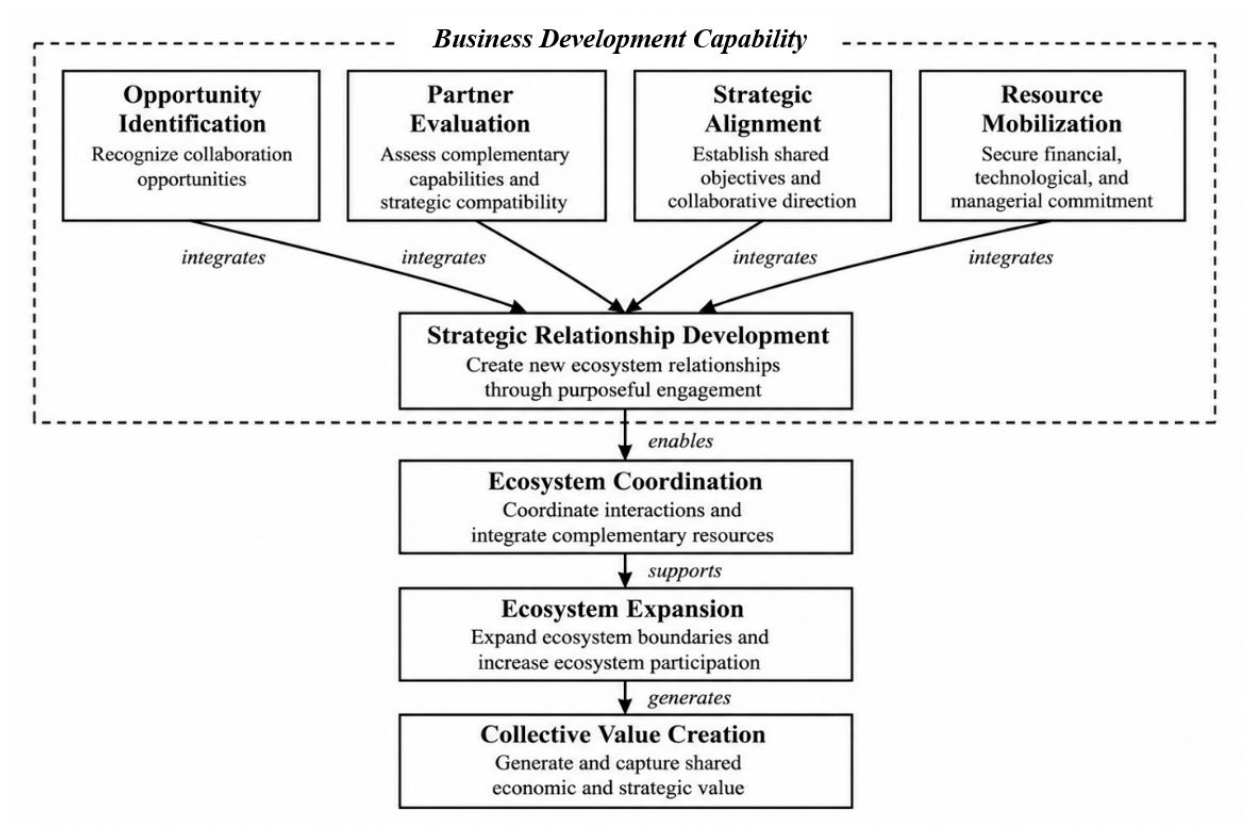

Table 1.
Complementary Perspectives on Ecosystem Coordination and Their Integration into the Proposed Conceptual Architecture.
Table 1.
Complementary Perspectives on Ecosystem Coordination and Their Integration into the Proposed Conceptual Architecture.
| Analytical Dimension | Digital Ecosystem Perspective | Business Development Perspective | Proposed Conceptual Architecture |
|---|---|---|---|
| Primary focus | Ecosystem coordination | Strategic relationship development | Ecosystem coordination and expansion |
| Primary explanation | Coordination within established ecosystems | Creation of new strategic relationships | Integration of relationship formation and ecosystem coordination |
| Key organizational processes | Platform governance; Ecosystem orchestration | Opportunity identification; Partner evaluation; Strategic alignment; Resource mobilization | Relationship formation integrated with ecosystem coordination |
| Unit of analysis | Established platform ecosystems | Strategic relationship development | Interorganizational ecosystem development |
| Core objective | Coordination among ecosystem participants | Creation of strategic relationships | Ecosystem expansion through coordinated relationship development |
| Primary outcome | Innovation and value creation | Organizational development | Ecosystem expansion and collective value creation |
| Analytical emphasis | Coordination across existing ecosystem relationships | Relationship formation preceding ecosystem participation | Conceptual architecture of ecosystem coordination |
Table 2.
Core Components of the Proposed Conceptual Architecture of Ecosystem Coordination.
| Architecture Component | Organizational Function | Contribution to Ecosystem Coordination | Contribution to Ecosystem Expansion |
|---|---|---|---|
| Opportunity Identification | Identifies emerging technological, commercial, and strategic opportunities | Recognizes opportunities for new ecosystem relationships | Expands the range of prospective ecosystem participants |
| Partner Evaluation | Assesses complementary capabilities and strategic compatibility | Selects compatible organizations for ecosystem participation | Improves the quality and sustainability of ecosystem relationships |
| Strategic Alignment | Aligns organizational objectives and collaborative direction | Establishes coordinated action among ecosystem participants | Strengthens long term collaborative development |
| Resource Mobilization | Secures financial, technological, and managerial commitment | Supports implementation of coordinated ecosystem activities | Enables ecosystem expansion and collective value creation |
Table 3.
Comparative Analysis of Business Development Functions across Digital Ecosystems.
| Digital Ecosystem | Primary Coordination Challenge | Emphasized Business Development Function | Primary Proposition Illustrated |
|---|---|---|---|
| Cloud Computing | Technological complementarity | Partner Evaluation | Proposition 1 |
| Digital Commerce | Ecosystem coordination | Strategic Alignment | Proposition 2 |
| Artificial Intelligence | Complementary resource integration | Resource Mobilization | Proposition 3 |
Disclaimer/Publisher’s Note: The statements, opinions and data contained in all publications are solely those of the individual author(s) and contributor(s) and not of MDPI and/or the editor(s). MDPI and/or the editor(s) disclaim responsibility for any injury to people or property resulting from any ideas, methods, instructions or products referred to in the content. |
© 2026 by the authors. Licensee MDPI, Basel, Switzerland. This article is an open access article distributed under the terms and conditions of the Creative Commons Attribution (CC BY) license (http://creativecommons.org/licenses/by/4.0/).
Copyright: This open access article is published under a Creative Commons CC BY 4.0 license, which permit the free download, distribution, and reuse, provided that the author and preprint are cited in any reuse.


