

Submitted:
31 July 2026
Posted:
03 August 2026
You are already at the latest version
Abstract
Background/Objectives: Dental caries is the most prevalent chronic disease of childhood, and untreated caries in the primary dentition affects an estimated 514 million children worldwide. Children are the principal target of oral health outreach, through school dental screening, community camps, and charitable events for children with special healthcare needs, yet these programmes are evaluated largely by what is most visible: the number of children examined and the photographs disseminated. This measurement substitution dissociates activity from impact, so that children are screened but not treated, counted but not cared for. The objective was to determine what works, for whom, in what contexts, and through what mechanisms in converting children’s oral health screening contacts into sustained care. Methods: A realist synthesis was conducted and reported in accordance with the RAMESES publication standards. An initial programme theory was developed and refined through purposive iterative searching, appraisal of relevance and rigour, and the extraction of Context, Mechanism and Outcome (CMO) configurations across diverse literature. Results: Eight configurations were derived, six enabling and two antagonist, organised around three thematic constellations, Prevent, Promote and Promulgate, and navigated by a compass of competency-based education. The refined theory holds that the intervention is not the camp, but the configuration of conditions that allows it to convert into care for the child. Conclusions: Children’s oral health outreach should be evaluated as a multi-level, health-systems configuration rather than a discrete event; competency-based education is the generative lever that reorients practice from optics to outcomes.
Keywords:
realist review
; RAMESES
; children’s oral health
; school dental screening
; special care dentistry
; dental public health
; referral completion
; competency-based education
; health equity
1. Introduction
1.1. Rationale: Children, Camps and a Realist Question
Dental caries is the most prevalent chronic disease of childhood, and untreated caries in the primary dentition affects an estimated 514 million children worldwide, a burden that falls disproportionately on low- and middle-income countries and on the poorest children within every country [1,2]. In much of the world, the dominant response has been outreach: school dental screening, anganwadi and community oral health camps, mobile dental units, and charitable events directed at vulnerable groups. Children are the principal beneficiaries of this activity, and school screening in particular is the archetypal children’s programme. The evaluation of that activity, however, has been troubled by a paradox. Where impact has been measured, it has usually been measured as activity, that is, the number of children screened and the number of camps held. Where genuine outcomes have been measured, namely referral completion, treatment received, and behavioural change, the picture is sobering. A rural Indian study documented substantial non-attendance after camp-based screening, driven by awareness, distance, affordability and competing demands rather than refusal [3]. A 2022 Cochrane review concluded that the evidence that school dental screening improves attendance is of very low certainty, and that improvement in oral health following screening remains unproven [4]. Dental care is, in parallel, the single most prevalent unmet health need reported for children in high-income settings, which shows that the gap between detection and care is not confined to resource-poor systems [5].
The realist approach, developed by Pawson and Tilley for complex social interventions [6,7], reframes the question from does it work? to what works, for whom, in what contexts, and through what mechanisms? Its unit of analysis is the Context, Mechanism and Outcome configuration. That orientation suits children’s oral health outreach, which is a complex intervention mediated by families, schools, institutions and the education of the workforce; which is rich in heterogeneous evidence that conventional hierarchies handle poorly; and whose central question is no longer whether outreach happens but under what conditions it converts into care for a child.
1.2. The Special Care Continuum and the Vulnerable-Child Optics Paradox
A specific and instructive population sits at the heart of this problem. Nearly one in five children has a special healthcare need, defined as a physical, developmental, behavioural, sensory, cognitive or emotional condition that requires health intervention beyond that generally required [8]. For these children, oral disease is more common, self-care is harder, and access to skilled dental services is more limited; dental care is the most frequently cited unmet health need for children with special healthcare needs, and the more severe the condition, the greater the unmet need [8,9,10]. Special care dentistry, the field concerned with people whose disability or medical or social circumstance affects oral health or its delivery, therefore represents a continuum of need that runs from mild to profound.
Precisely because these children are visibly vulnerable, they are highly sought after as the subject of outreach. A camp at a special school, an orphanage or a disability institution is compassionate, photogenic and attractive to sponsors and corporate social responsibility programmes. The optics are excellent. The difficulty is that the population is, almost by definition, one that cannot advocate for its own follow-up, and the sustained outcome, whether the child’s caries was actually treated, whether behaviour guidance was actually established, whether recall actually happened, is rarely measured and often absent. We name this recurring pattern the vulnerable-child optics paradox: the more a population serves the image of the giver, the less its members’ own outcomes tend to be verified. Realist reviews of oral care for people with intellectual disabilities and for people with mental disorders confirm that sustained oral health in these groups depends on carer-mediated, relationship-based mechanisms rather than one-off contact [11,12,13], which one-day charitable camps are structurally unable to provide.
1.3. The Optics to Outcomes Inversion, and the Aim of This Synthesis
Across all of these settings, children’s oral health programmes have inverted the proper relationship between visibility and impact: visibility ought to be the consequence of impact, not its substitute. The photograph should record what was achieved, yet it increasingly produces what is claimed. Two forces converge. The first is a set of sustained roadblocks, namely documented deficits in the paediatric workforce, financing, referral, surveillance and curriculum. The second is a set of emerging distortions, namely the cultural pressures of the social media era, in which the appearance of impact has become a currency parallel to impact itself.
This is, to our knowledge, the first realist synthesis devoted to the optics to outcomes conversion problem in children’s oral health outreach. It extends a small but growing realist tradition in oral health, which has so far addressed carer-led hygiene for people with intellectual disabilities [11,12], oral health for people with mental disorders [13], oral health for older people in residential aged care [14], and teledentistry implementation [15]. It organises its findings around an integrated framework, the Constellation of Care, built on three commitments: Prevent (acting on shared risks before disease takes hold in the child), Promote (closing the loop between screening and sustained care), and Promulgate (letting impact, evidence and mentorship, rather than the photograph, be the visible record of the work). Throughout, general community camps and satellite outpatient services that serve all ages, including adults, are retained as the broader context within which children’s outreach sits, while the analytic emphasis remains on the child.
2. Materials and Methods
2.1. Methodological Orientation
This synthesis used realist methodology as articulated by Pawson and colleagues [6,7] and was reported per the RAMESES publication standards for realist syntheses [16]. The realist orientation rests on three commitments: outcomes are produced by mechanisms triggered in contexts (the CMO configuration); the goal is to develop and refine theory rather than to estimate an average effect; and evidence is appraised on relevance and rigour rather than on methodological hierarchy alone. The RAMESES II reporting standards informed the framing of mechanisms as resource plus reasoning [17].
2.2. Scope and Changes During Conduct
The scope was defined as community-based, time-limited oral health outreach reaching children in low- and middle-income settings, with primary emphasis on India, on school screening, and on the special care continuum, and with general community camps and satellite outpatient services retained as broader context. During iterative searching the scope was widened twice to support theory development: first, to incorporate competency-based dental education, including training in paediatric and special care dentistry, as a substantive generative mechanism rather than an external factor; and second, to incorporate the institutional pressures associated with social media era reporting. Both expansions are characteristic of realist practice and are documented here per RAMESES transparency requirements.
2.3. Initial Programme Theory
An initial programme theory was developed before formal searching, drawing on the author’s experience in dental public health and a scoping read of canonical sources (Pawson and Tilley [7]; Penchansky and Thomas [18]; Sheiham and Watt [19]; Saurman [20]; Singh and colleagues [3]; the Cochrane school-screening review [4]; and the WHO Global Oral Health Status Report [2]). It held that children’s camps and school screening produce sustained care when referral is specific and navigated through a caregiver or school; when all access dimensions, including affirmation, are met; when risk counselling reaches the family; when practitioners are CBE trained in paediatric and special care dentistry; when a feedback loop closes; and when institutional culture rewards verification over visibility. The theory was then exposed to the literature and iteratively refined.
2.4. Searching Processes
Searches were purposive and iterative, in four overlapping phases. Phase 1 scoped the field. Phase 2 sought documents addressing components of the initial theory: access frameworks, the common risk factor approach, competency-based and community-based dental education, screening cascades, referral completion, and the oral health of children with special healthcare needs. Phase 3 retrieved policy and grey literature, including WHO documents (the 2021 resolution WHA74.5, the 2022 Global Strategy WHA75.11, the 2023 Global Oral Health Action Plan WHA76.9, the 2022 Status Report, the 2024 consolidated Strategy and Action Plan, and the 2024 Bangkok Declaration), the Lancet 2019 oral health series, and Government of India sources on universal health coverage and the Viksit Bharat 2047 vision. Phase 4 tracked citations until no new configurations emerged. Databases included PubMed and MEDLINE, Embase, the Cochrane Library, Web of Science, CINAHL and Google Scholar. No date limits were imposed; languages were restricted to English.
2.5. Selection, Appraisal, Extraction and Analysis
Documents were appraised on relevance (contribution to theory) and rigour (credibility of inference) rather than on a fixed hierarchy [16]. Quantitative studies, qualitative inquiries, policy documents, programme reports and conceptual articles were all admitted. From each retained document, bibliographic details, study type, setting, population, outcomes and, critically, any inference about how, why or under what conditions the intervention worked or failed were extracted and tagged provisionally to candidate configurations. Analysis clustered the extracted material into candidate CMOs, refined them through juxtaposition, reconciliation, adjudication and consolidation across documents [7], treated discordance as a clue to a missing contextual condition rather than a reason to abandon a configuration, and reintegrated the consolidated CMOs into a refined programme theory. The five cross-cutting modifiers emerged through this process.
3. Results
3.1. Document Flow and Cross-Cutting Modifiers
The iterative search identified a large background corpus, of which the 36 documents cited here were retained as the principal contributors to programme theory, spanning realist methodology, access theory, the common risk factor approach, empirical studies of screening and referral, the paediatric caries burden, the oral health of children with special healthcare needs, competency-based and community-based dental education, workforce and financing analyses, and WHO and Government of India policy. Five macro-level modifiers, invoked repeatedly across the corpus, calibrate the activation of every mechanism: the paediatric skill mix of the workforce; the financing model; school and caregiver mediation; the reporting and visibility culture; and the receiving paediatric care system. The workforce modifier is sharp: country income status and urbanisation, more than absolute numbers, predict where dentists actually deliver care, with maldistribution identified as the central challenge for lower-income countries [21], and qualitative inquiry with Indian public health dentists frames this as a distribution rather than a shortage problem, locating the discontinuity between detection and definitive care as structural [22].
3.2. The Eight CMO Configurations
The synthesis yielded eight configurations, six enabling and two antagonist, summarised in Figure 1 and narrated below.
3.2.1. CMO 1: Caregiver-Navigated Referral from School Screening (Promote)
Where school screening detects caries and the clinic is reachable but unfamiliar to the family, providing a named clinic, a date, and a teacher or caregiver who carries the referral home activates reduced cognitive load and increased caregiver self-efficacy: the referral acquires a face and a date. The outcome is referral completion far higher than a generic slip achieves, and a flatter gradient across income groups, consistent with Singh and colleagues’ finding that non-attendance was driven by operational uncertainty rather than refusal [3].
3.2.2. CMO 2: Teacher, Anganwadi Worker or Caregiver as Trust Bridge (Promote)
For marginalised or special-needs children whose families hold low trust in the health system, a familiar adult who shares language, culture and social position and who accompanies the child and family to care activates the transfer of trust from a known figure to an unfamiliar facility, easing fear and stigma. The outcome is the largest completion gains among the most disadvantaged children, so that the access gradient narrows. This is supported by qualitative inquiry into the Indian landscape [22] and by the social accountability tradition in dental education [23,24].
3.2.3. CMO 3: Risk-Factor Counselling Reaching the Child and Family (Prevent)
Where the contact is designed with time to counsel the child and caregiver on sugar, diet, hygiene, fluoride and the early uptake of tobacco or areca, dental trust generalises to general-health advice and the visit becomes a portal to lifelong prevention across shared noncommunicable-disease risks. The outcome is healthier habits formed early and a higher impact per contact than disease-specific approaches achieve, drawing on the common risk factor approach [19,25] and its later social-determinants articulation [26], and aligning with the WHO strategy’s primary-care integration objective [27].
3.2.4. CMO 4: CBE Workforce in Paediatric and Special Care Dentistry (Compass)
Where graduates have trained under competency-based curricula with paediatric, special care and community immersion, assessed on outcomes, longitudinal exposure to outcome-based feedback internalises outcome-orientation as a professional norm and builds the behaviour-guidance skills that young and disabled children require. The outcome is the design of programmes around outcome-cascade indicators, competent care for children with special needs, and propagation of the model to the next cohort through mentorship. Community-based dental education is associated with gains in student confidence, cultural competence, professional identity and readiness for population-oriented practice [23,24,28]. CBE is positioned here not as one component among others but as the generative mechanism by which the other enabling configurations come reliably to be activated.
3.2.5. CMO 5: Closed Feedback Loop with Schools and Caregivers (Promulgate)
Where recall, follow-up and school or primary-care partnership are designed in before the camp is held, the programme becomes a learning system: the team perceives evidence of its own impact, which sustains motivation against volunteer fatigue; the school community perceives continuity rather than visitation, which sustains trust; and the institution acquires longitudinal child data of analytic value. The outcome is sustained engagement across school years, reduced volunteer fatigue, and community ownership, the elements that constitute genuine sustainability rather than mere repetition.
3.2.6. CMO 6: Affirmation and Behaviour Guidance for the Child (Promote)
Where the encounter respects the child’s dignity, sensory needs, language and fear, and includes the caregiver, the child feels safe rather than processed, and the family returns rather than avoids. The outcome is higher acceptance of care, sustained recall, and trust that survives to the next visit, an outcome that is decisive for children with autism, intellectual and developmental disability, or dental anxiety. Affirmation is grounded in the Penchansky and Thomas access framework [18] as extended by Saurman’s addition of awareness as a sixth dimension [20], with affirmation proposed here as a seventh, and it is the everyday clinical expression of the carer-mediated mechanisms that realist reviews identify as central to special care [11,12].
3.2.7. CMO 7: The Vulnerable-Child Optics Paradox (Antagonist)
Where feedback arrives principally through visibility channels, and where the population is photogenic yet unable to advocate for its own follow-up, as with camps at special schools, orphanages and disability institutions, the reward of visible compassion is internalised as a proxy for impact and the child’s follow-up becomes nobody’s responsibility. The outcome is well-publicised camps that deliver little sustained care, in which the most vulnerable children are visited, photographed and left where they were. This is the antagonist that the special care continuum makes most visible, and it is why one-off charitable events, however well-intentioned, cannot substitute for a relationship [11,13].
3.2.8. CMO 8: Detection Without Destination, the Receiving-System Void (Antagonist)
Where school screening occurs in settings in which paediatric dental care is absent, distant, unaffordable, or not equipped for young or disabled children, the absence of a destination is the operative condition, and the caregiver’s reasoning is a local cost-benefit calculation: attendance is futile or unaffordable, and trust in screening erodes. The structural condition is common across rural India and under out-of-pocket-dominant financing [2]. The outcome is high caries yield with very low completion, the classic school-screening finding [4], alongside iatrogenic mistrust that may degrade the next encounter and a disparity that is thereby sustained [3], a burden that falls hardest on children with special healthcare needs, of whom a large share need dental services but cannot obtain them [10].
3.3. The Refined Programme Theory
Children’s camps and school screening produce sustained care when CBE-trained clinicians (CMO 4) deliver caregiver-navigated referrals (CMO 1) supported by teachers and community workers (CMO 2), counsel the family on shared risks (CMO 3) within affirming, child-friendly encounters (CMO 6), and close a feedback loop with schools (CMO 5). They fail when the paediatric receiving system is absent (CMO 8), or when vulnerable children are used for optics rather than served (CMO 7).
The intervention is not the camp; it is the configuration of conditions that allows the camp to convert into care for the child.
Three corollaries follow. First, no single configuration is sufficient: their effects are configurational, and the absence of CMO 4 reliably attenuates the activation of CMOs 1 to 3, 5 and 6. Second, the antagonist configurations operate regardless of whether enabling configurations are present, because they sit closer to institutional and structural roots. Third, the cross-cutting modifiers calibrate every configuration, so that a pattern performing well under one financing model or curricular paradigm may not transfer to another.
3.4. The Constellation of Care: Organising the Synthesis
The eight configurations are organised conceptually into three thematic constellations navigated by a central compass of competency-based education (Figure 2). Prevent gathers the upstream stars (Detect, Common Risk, Family Literacy, Equity, Six-A Audit); Promote gathers the conversion stars that close the screening-to-care loop (Navigate, Treat, Behaviour, Interdisciplinary, Affirmation); and Promulgate gathers the downstream stars that make impact the visible record (Evidence, Advocacy, Scale, Mentorship, Sustain). The compass’s four cardinal points, Knowledge, Skills, Attitudes and Advocacy, are the CBE domains that orient movement through every star. An explicit optics threshold separates the visible sky of impact from the submerged reef of sustained roadblocks and emerging distortions, including the paediatric workforce gap, the school follow-up gap, neglected special care, and the vulnerable-child optics that this synthesis foregrounds. The SDGs form an interconnected web threaded across all three constellations.
4. Discussion
4.1. What Works, for Which Children, Why, and in What Conditions
Children’s camps and school screening work, in the meaningful sense of producing sustained care, not because they are camps but because, in particular configurations, they activate the causal architecture by which detection converts into care. They work most decisively for socially marginalised children, and for children with special healthcare needs, when CMO 2 (trusted navigator) and CMO 6 (affirmation and behaviour guidance) operate; they work because trust earned in the encounter generalises to navigation of unfamiliar systems and to acceptance of broader health advice by the family; and they work under conditions that include a paediatric receiving system to which referral can terminate, a workforce educated to value outcome over activity, and an institutional culture that does not reward the photograph over the child.
4.2. The Special Care Continuum, from Charity to Continuity
The special care continuum sharpens every argument in this synthesis. Children with special healthcare needs carry a heavier oral-disease burden, face steeper access barriers, and report dental care as their most prevalent unmet health need, with unmet need rising as the severity of the condition rises [5,8,9,10]. They are also, for the same reasons that make them vulnerable, the population most sought after for outreach whose value is chiefly optical. The vulnerable-child optics paradox (CMO 7) is therefore not a marginal case but a lens that reveals the general failure with unusual clarity: an event that maximises the image of compassion while minimising the labour of follow-up. The corrective is not to stop serving these children but to change what counts as service. Realist and empirical work in intellectual disability, mental disorder and residential care converges on a single message: oral health in these groups is produced by continuous, carer-mediated, relationship-based care, not by episodic contact [11,12,13,14], which is exactly the continuity that CMO 5 (closed feedback loop) and CMO 6 (affirmation) are designed to supply.
4.3. The Competency-Based Education Imperative
Among the eight configurations, CMO 4 is the only one whose activation generationally reorients the field. Curricular reform is the slowest and most determinative lever in any health system: slow because it acts on cohorts, determinative because it shapes the assumptions a generation carries into practice. The community-based dental education literature documents that explicit, outcome-based, community-immersed education produces graduates measurably different in professional disposition from those trained under legacy curricula [23,24,28]. Three integration points are tractable: redesigning community and school postings so that students are assessed on referral completion rather than camps conducted; embedding paediatric behaviour guidance and access-dimension auditing as assessed clinical competencies, with explicit training in special care dentistry; and requiring postgraduate research to report the referral-completion rate of any programme studied. This is the mechanism by which Promulgate ceases to be a slogan and becomes a curricular outcome.
4.4. The SDG Web: Never a Badge, Always a Weave
The goals of the 2030 Agenda are explicitly integrated and indivisible [29]. Children’s oral health touches at least eight of them directly, and programmes structured by the configurations identified here engage them as a web rather than a list (Figure 3, Panel A). A single school session that activates CMO 3 on sugar and hygiene contributes simultaneously to SDG 3 (health), SDG 4 (education through literacy) and SDG 12 (responsible consumption); a female-navigator referral for a disabled child under CMO 2 engages SDG 5 (gender), SDG 10 (reduced inequalities) and SDG 17 (partnerships); and a closed feedback loop with a school under CMO 5 engages SDG 11 (sustainable communities). Reporting that articulates the weave, rather than badging the single goal claimed, disciplines design and resists the SDG tokenism documented as an emerging distortion [30].
4.5. The Policy Ascent: WHO 2030, the Right to Oral Health, and Viksit Bharat 2047
The framework is positioned within the prevailing policy architecture (Figure 3, Panel B). At the global level, the 2021 resolution (WHA74.5) recognised oral health as a priority within the noncommunicable-disease agenda; the 2022 Global Strategy (WHA75.11) set the vision of universal health coverage for oral health by 2030; the 2023 Action Plan (WHA76.9), consolidated in 2024, translated this into six objectives, eleven targets and one hundred actions; and in 2024 the WHO recognised the right to oral health and Member States adopted the Bangkok Declaration, No Health Without Oral Health [27,31,32,33]. The overarching 2030 target is that 80% of the global population be entitled to essential oral-health services, with a 10% relative reduction in the main oral diseases, aligned with SDG target 3.8. For children, this recognition of a right to oral health is more than rhetorical: it reframes the untreated caries of half a billion children as a matter of entitlement rather than charity, and it places the burden of proof on programmes to show that a child was served, not merely seen.
At the national level, India’s Viksit Bharat 2047 vision, the aspiration to become a developed nation by the centenary of independence, positions universal health coverage as a foundational pillar, advanced through the Ayushman Bharat Pradhan Mantri Jan Arogya Yojana and the network of Ayushman Arogya Mandirs that deliver primary care at the grassroots [34,35]. Yet two features of this landscape map onto the antagonist configurations of this synthesis. First, oral health, and children’s oral health in particular, remains largely outside the publicly financed benefit package, and out-of-pocket payment continues to push tens of millions into poverty each year [35], which is the financing face of CMO 8. Second, the receiving-system void that disables outreach is precisely what primary-care integration through Arogya Mandirs is intended to fill; where that integration omits paediatric dental care, referral continues to terminate in absence. The Constellation of Care engages this scheme directly: CMO 8 names the gap that integration must close, CMO 7 names the reporting culture that national programmes must resist, and CMO 4 is the human-resource engine common to the WHO 2030 target and the Viksit Bharat 2047 vision alike. As the Bangkok Declaration holds, there is no health without oral health [33], and, as the national vision holds, only a healthy nation can be a developed nation.
4.5A. Beyond National Income: Health-System Capacity, Utilisation, and the Outreach-to-Care Continuum
A further insight emerging from this synthesis is that the success or failure of children’s oral health outreach cannot be adequately explained by a country’s economic status alone. Conventional narratives frequently position low- and middle-income countries (LMICs) as resource-constrained systems and high-income countries (HICs) as models of comprehensive healthcare delivery. The evidence synthesised here suggests a more nuanced reality. The decisive determinant is not national wealth per se, but the ability of a health system to activate and sustain the mechanisms that convert screening into definitive care, prevention into behavioural change, and outreach into measurable health outcomes.
Many LMICs, including India and several Southeast Asian nations, continue to face a disproportionately high burden of childhood oral disease, driven by demographic pressures, socioeconomic inequalities, workforce maldistribution, and substantial unmet treatment needs [1,21]. Yet these same settings have progressively invested in expansive community-based public health infrastructure through school health programmes, anganwadi services, frontline health workers, mobile dental units, primary healthcare reforms, and large-scale governmental outreach initiatives. Such platforms create repeated opportunities to engage children and families who might otherwise remain outside formal healthcare systems. The critical challenge, therefore, is no longer the absence of outreach, but ensuring that these encounters culminate in completed referrals, timely treatment, sustained preventive behaviours, and longitudinal follow-up. Within the present synthesis, this distinction separates programmes that merely demonstrate activity from those that genuinely demonstrate impact.
Conversely, high-income countries illustrate that financial prosperity and advanced healthcare infrastructure do not automatically guarantee equitable oral healthcare access or successful care pathways. Despite comparatively greater workforce density, specialist availability, and insurance coverage, dental care remains among the most frequently reported unmet healthcare needs for children, particularly those with special healthcare needs and socially disadvantaged populations [5,9,10]. In these settings, discontinuities often arise from fragmented service delivery, inadequate integration between screening and treatment services, workforce maldistribution, prolonged waiting times, insurance limitations, and failures of care coordination. Consequently, the antagonist configuration of Detection without Destination (CMO 8) transcends economic classification; it represents a systems-level failure that emerges whenever outreach identifies disease without ensuring an accessible, acceptable, affordable, and appropriate pathway to definitive care.
Viewed through a realist lens, these observations reaffirm that health-system performance is fundamentally configurational rather than economic. Resource availability undoubtedly shapes context, but resources alone do not trigger successful outcomes. Instead, outcomes emerge when contextual conditions activate mechanisms such as trusted community navigation, caregiver engagement, competency-based professional education, child-centred communication, and closed feedback loops that collectively sustain the continuum from detection to treatment. Wealth may increase the availability of services, but only effective integration determines whether those services translate into improved health.
This perspective also reframes how outreach programmes should be evaluated. In countries where governments have invested substantially in community outreach and preventive health infrastructure, the emphasis should progressively shift from measuring programme reach to measuring programme utilisation and outcome verification. The number of camps organised, children screened, or awareness sessions conducted represents only the beginning of the care pathway. The more meaningful indicators are referral completion, treatment initiation, treatment completion, behavioural maintenance, recall attendance, and sustained improvements in oral health status. These outcome-oriented metrics align directly with the philosophy underpinning the Prevent, Promote, Promulgate framework, wherein prevention is realised through upstream risk reduction, promotion is fulfilled by successfully navigating children into definitive care, and promulgation reflects the dissemination of verified impact rather than the visibility of programme activity.
Ultimately, the Constellation of Care should be understood as a health-systems framework rather than a resource-dependent model. Its effectiveness is not determined by whether a country is classified as low-, middle-, or high-income, but by how consistently its policies, workforce, educational systems, communities, and healthcare institutions function together to transform outreach encounters into completed care and lasting improvements in children’s oral health. This interpretation reinforces the central proposition of the present synthesis: the intervention is never the camp itself, but the configuration of conditions that allows every outreach contact to become a sustained health outcome for the child.
Table 1 operationalises this shift into an outcome-cascade indicator framework, contrasting, at each stage of the care pathway, the optics indicator that is typically counted with the verifiable outcome indicator that should replace it, together with an illustrative verification method and benchmark.
4.6. Comparison with Previous Literature
This synthesis locates the Singh and colleagues finding of camp non-compliance [3] as the canonical demonstration of CMO 8; situates the Cochrane review’s very-low-certainty finding [4] within a causal architecture in which screening is not the unit of causation, the configuration is; and extends the Penchansky and Thomas and Saurman access tradition [18,20] by proposing affirmation as a distinct access dimension for children. It is consonant with the Lancet 2019 series’ diagnosis of the global neglect of oral health [36], with the workforce analysis identifying maldistribution as the central challenge for lower-income countries [21], and with the paediatric and special care literature on the unmet needs of children generally and children with special healthcare needs in particular [1,8,9,10].
4.7. Strengths and Limitations
Strengths. The synthesis follows the RAMESES standards [16], is the first realist synthesis of the optics to outcomes problem in children’s oral health, draws on empirical, qualitative, conceptual and policy literature, articulates a causal account testable by prospective realist evaluation, and integrates antagonist mechanisms that conventional reviews leave as contextual nuisance.
Limitations. The synthesis was conducted by a single research team without formal stakeholder consultation. Its geographic emphasis is Indian and South Asian, and the configurations should be validated against other settings before generalisation. Realist synthesis produces theory rather than effect estimates, so the configurations are to be tested by prospective realist evaluation [17] rather than treated as confirmed causal claims. The literature on the antagonist configurations is thinner than that on the enabling ones, which is itself an artefact of the optics culture under critique.
4.8. Implications Across Levels
- Practice (the contact). Operationalise CMOs 1 to 3 and 6: name the clinic and date; send a teacher or caregiver navigator with the child; deliver risk-factor counselling to child and family as default; conduct every encounter with attention to the child’s dignity, sensory needs and fear; and replace the tally with a named child register.
- Programme. Operationalise CMO 5: design recall and follow-up before the camp is held; partner with schools, anganwadis and primary care; and report the outcome cascade (screened, referred, treated, sustained), not the headcount.
- Education. Operationalise CMO 4: reorient community and school postings, paediatric and special care teaching, and postgraduate research around outcome verification; make behaviour guidance and access-dimension auditing assessed competencies.
- Policy. Neutralise CMOs 7 and 8: require outcome cascades in accreditation and sponsor templates; integrate paediatric dental care into primary care and Arogya Mandirs so that referral has a destination; and align programme evidence with the WHO Global Strategy [27,31], the 2024 recognition of the right to oral health [33], and the Viksit Bharat 2047 agenda [34].
5. Conclusions
Children’s oral health programmes have for too long optimised for what the camera can see. This realist synthesis argues that they should optimise instead for what the child can feel, namely a completed treatment, a reduced risk, a sustained change, and it offers a causal account, expressed as eight configurations and organised as the Constellation of Care, of when and why this conversion succeeds or fails. It relocates the intervention from the camp to the configuration of conditions that allows the camp to convert into care for the child, and it identifies competency-based education, in paediatric and special care dentistry, as the generative mechanism by which this configuration becomes the default rather than the exception. The special care continuum shows the stakes most plainly: the children most useful for a photograph are the children most in need of a relationship. The proposition is therefore simple and demanding in equal measure, that a programme should be judged not by which child was seen, but by which child got better, and by whom the next constellation is taught.
Author Contributions
Conceptualization, V.K. and P.J.; methodology, V.K., P.J. and Z.B.; validation, Z.B., R.S. and R.G.; formal analysis, V.K.; investigation, V.K., I.M. and R.G.; resources, P.J., R.S. and I.M.; data curation, V.K. and I.M.; writing of the original draft, V.K.; writing, review and editing, P.J., Z.B., R.S., I.M. and R.G.; visualization, V.K. and R.G.; supervision, P.J. and Z.B.; project administration, V.K. and P.J. All authors have read and agreed to the published version of the manuscript.
Funding
This research received no external funding.
Institutional Review Board Statement
Not applicable. This study is a synthesis of previously published literature and did not involve human participants or animals.
Informed Consent Statement
Not applicable.
Data Availability Statement
No new data were created in this study. The extraction matrix and the full list of included documents are available from the corresponding authors on reasonable request.
Conflicts of Interest
The authors declare no conflicts of interest.
References
- Chen, X.; Jia, L.; Wang, Q.; et al. Global, regional, and national burden of caries in primary teeth from 1990 to 2021: Results from the Global Burden of Disease Study 2021. BMC Oral Health 2025, 25, 1381. [Google Scholar] [CrossRef] [PubMed]
- World Health Organization. Global Oral Health Status Report: Towards Universal Health Coverage for Oral Health by 2030; World Health Organization: Geneva, Switzerland, 2022. [Google Scholar]
- Singh, V.; Parashari, A.; Ahmed, S.; Mittal, T.; Grewal, H. Reasons for non-compliance of patients to attend referral hospital after screening for oral pre-cancer lesions through camp approach in rural population of India. Ann. Med. Health Sci. Res. 2013, 3 (Suppl. 1), S54–S55. [Google Scholar] [CrossRef] [PubMed]
- Arora, A.; Kumbargere Nagraj, S.; Khattri, S.; Ismail, N.M.; Eachempati, P. School dental screening programmes for oral health. Cochrane Database Syst. Rev. 2022, 7, CD012595. [Google Scholar] [PubMed]
- Lewis, C.W. Dental care and children with special health care needs: A population-based perspective. Acad. Pediatr. 2009, 9, 420–426. [Google Scholar] [CrossRef] [PubMed]
- Pawson, R.; Greenhalgh, T.; Harvey, G.; Walshe, K. Realist review: A new method of systematic review designed for complex policy interventions. J. Health Serv. Res. Policy 2005, 10 (Suppl. 1), 21–34. [Google Scholar] [CrossRef] [PubMed]
- Pawson, R.; Tilley, N. Realistic Evaluation; Sage: London, UK, 1997. [Google Scholar]
- American Academy of Pediatric Dentistry. Management of dental patients with special health care needs. In The Reference Manual of Pediatric Dentistry; American Academy of Pediatric Dentistry: Chicago, IL, USA, 2023. [Google Scholar]
- Nelson, L.P.; Getzin, A.; Graham, D.; Zhou, J.; Wagle, E.M.; McQuiston, J.; et al. Unmet dental needs and barriers to care for children with significant special health care needs. Pediatr. Dent. 2011, 33, 29–36. [Google Scholar] [PubMed]
- Chi, D.L. Oral health for US children with special health care needs. Pediatr. Clin. North Am. 2018, 65, 981–993. [Google Scholar] [CrossRef] [PubMed]
- Waldron, C.; Mac Giolla Phadraig, C.; Nunn, J. What is it about carer-led oral hygiene interventions for people with intellectual disabilities that work and why? A realist review. Community Dent. Oral Epidemiol. 2020, 48, 522–532. [Google Scholar] [CrossRef] [PubMed]
- Mac Giolla Phadraig, C.; Asimakopoulou, K.; Faulks, D.; Van Harten, M.; Ledger, L.; Spencer, A.; et al. Using realist methods for intervention development to fill a methodological gap: A case study showing the development of an oral hygiene intervention for people with intellectual developmental disabilities. Community Dent. Oral Epidemiol. 2023. [Google Scholar] [CrossRef] [PubMed]
- Kenny, A.; Dickson-Swift, V.; Gussy, M.; Kidd, S.; Cox, D.; Masood, M.; et al. Oral health interventions for people living with mental disorders: Protocol for a realist systematic review. Int. J. Ment. Health Syst. 2020, 14, 24. [Google Scholar] [CrossRef] [PubMed]
- Kenny, A.; Dickson-Swift, V.; Chan, C.K.Y.; Masood, M. Oral health interventions for older people in residential aged care facilities: A protocol for a realist systematic review. BMJ Open 2021, 11, e044342. [Google Scholar] [CrossRef] [PubMed]
- Arunagiri, K.P.; Allison, P.J.; Talla, P.K. Implementation strategies to enhance teledentistry adoption in dental care settings: A realist review protocol. Int. J. Qual. Methods 2025, 24. [Google Scholar] [CrossRef]
- Wong, G.; Greenhalgh, T.; Westhorp, G.; Buckingham, J.; Pawson, R. RAMESES publication standards: Realist syntheses. BMC Med. 2013, 11, 21. [Google Scholar] [CrossRef] [PubMed]
- Wong, G.; Westhorp, G.; Manzano, A.; Greenhalgh, J.; Jagosh, J.; Greenhalgh, T. RAMESES II reporting standards for realist evaluations. BMC Med. 2016, 14, 96. [Google Scholar] [CrossRef] [PubMed]
- Penchansky, R.; Thomas, J.W. The concept of access: Definition and relationship to consumer satisfaction. Med. Care 1981, 19, 127–140. [Google Scholar] [PubMed]
- Sheiham, A.; Watt, R.G. The common risk factor approach: A rational basis for promoting oral health. Community Dent. Oral Epidemiol. 2000, 28, 399–406. [Google Scholar] [CrossRef] [PubMed]
- Saurman, E. Improving access: Modifying Penchansky and Thomas's theory of access. J. Health Serv. Res. Policy 2016, 21, 36–39. [Google Scholar] [CrossRef] [PubMed]
- Gallagher, J.E.; Mattos Savage, G.C.; Crummey, S.C.; Sabbah, W.; Makino, Y.; Varenne, B. Health workforce for oral health inequity: Opportunity for action. PLoS ONE 2024, 19, e0292549. [Google Scholar] [CrossRef] [PubMed]
- Dasson Bajaj, P.; Shenoy, R.; Davda, L.; Mala, K.; Bajaj, G.; Rao, A.; et al. Unpacking the oral healthcare landscape in India: A qualitative inquiry into strengths, shortfalls, and future directions through the lens of public health dentists. Int. J. Environ. Res. Public Health 2025, 22, 1741. [Google Scholar] [CrossRef] [PubMed]
- Sunil, S.; Chen, J.; Ali, K.; Fink, T.; Du, X. In which ways does community-based dental education facilitate development of professional identity in undergraduate curricula? A scoping review. Eur. J. Dent. Educ. 2025, 29, 433–450. [Google Scholar] [CrossRef] [PubMed]
- Elsheli, J.; Patrick, A.; Stokes, C. Community-based education programmes in the context of dental education: A scoping review. Eur. J. Dent. Educ. 2024, 28, 576–590. [Google Scholar] [CrossRef] [PubMed]
- Watt, R.G. Strategies and approaches in oral disease prevention and health promotion. Bull. World Health Organ. 2005, 83, 711–718. [Google Scholar] [PubMed]
- Watt, R.G.; Sheiham, A. Integrating the common risk factor approach into a social determinants framework. Community Dent. Oral Epidemiol. 2012, 40, 289–296. [Google Scholar] [CrossRef] [PubMed]
- World Health Organization. Global Strategy and Action Plan on Oral Health 2023–2030; World Health Organization: Geneva, Switzerland, 2024. [Google Scholar]
- Frenk, J.; Chen, L.; Bhutta, Z.A.; Cohen, J.; Crisp, N.; Evans, T.; et al. Health professionals for a new century: Transforming education to strengthen health systems in an interdependent world. Lancet 2010, 376, 1923–1958. [Google Scholar] [CrossRef] [PubMed]
- United Nations. Transforming Our World: The 2030 Agenda for Sustainable Development (A/RES/70/1); United Nations: New York, NY, USA, 2015. [Google Scholar]
- Petersen, P.E.; Baez, R.J.; Ogawa, H. Global application of oral disease prevention and health promotion as measured 10 years after the 2007 World Health Assembly statement on oral health. Community Dent. Oral Epidemiol. 2020, 48, 338–348. [Google Scholar] [CrossRef] [PubMed]
- Seventy-Fifth World Health Assembly. Global Strategy on Oral Health (Resolution WHA75.11); World Health Organization: Geneva, Switzerland, 2022. [Google Scholar]
- Seventy-Sixth World Health Assembly. Global Oral Health Action Plan 2023–2030 (Resolution WHA76.9); World Health Organization: Geneva, Switzerland, 2023. [Google Scholar]
- World Health Organization. Bangkok Declaration: No Health Without Oral Health; World Health Organization: Geneva, Switzerland, 2024. [Google Scholar]
- Government of India, NITI Aayog. Viksit Bharat @2047: Vision for a Developed India; Government of India: New Delhi, India, 2024. [Google Scholar]
- Angell, B.J.; Prinja, S.; Gupt, A.; Jha, V.; Jan, S. The Ayushman Bharat Pradhan Mantri Jan Arogya Yojana and the path to universal health coverage in India: Overcoming the challenges of stewardship and governance. PLoS Med. 2019, 16, e1002759. [Google Scholar] [CrossRef] [PubMed]
- Peres, M.A.; Macpherson, L.M.D.; Weyant, R.J.; Daly, B.; Venturelli, R.; Mathur, M.R.; et al. Oral diseases: A global public health challenge. Lancet 2019, 394, 249–260. [Google Scholar] [CrossRef] [PubMed]
Figure 1.
Context, Mechanism and Outcome configuration framework for children’s oral health outreach. The Initial Programme Theory and cross-cutting modifiers frame eight configurations, six enabling (CMO 1 to 6) and two antagonist (CMO 7 and 8). The Refined Programme Theory integrates them: the intervention is not the camp; it is the configuration of conditions that allows the camp to convert into care for the child.
Figure 1.
Context, Mechanism and Outcome configuration framework for children’s oral health outreach. The Initial Programme Theory and cross-cutting modifiers frame eight configurations, six enabling (CMO 1 to 6) and two antagonist (CMO 7 and 8). The Refined Programme Theory integrates them: the intervention is not the camp; it is the configuration of conditions that allows the camp to convert into care for the child.
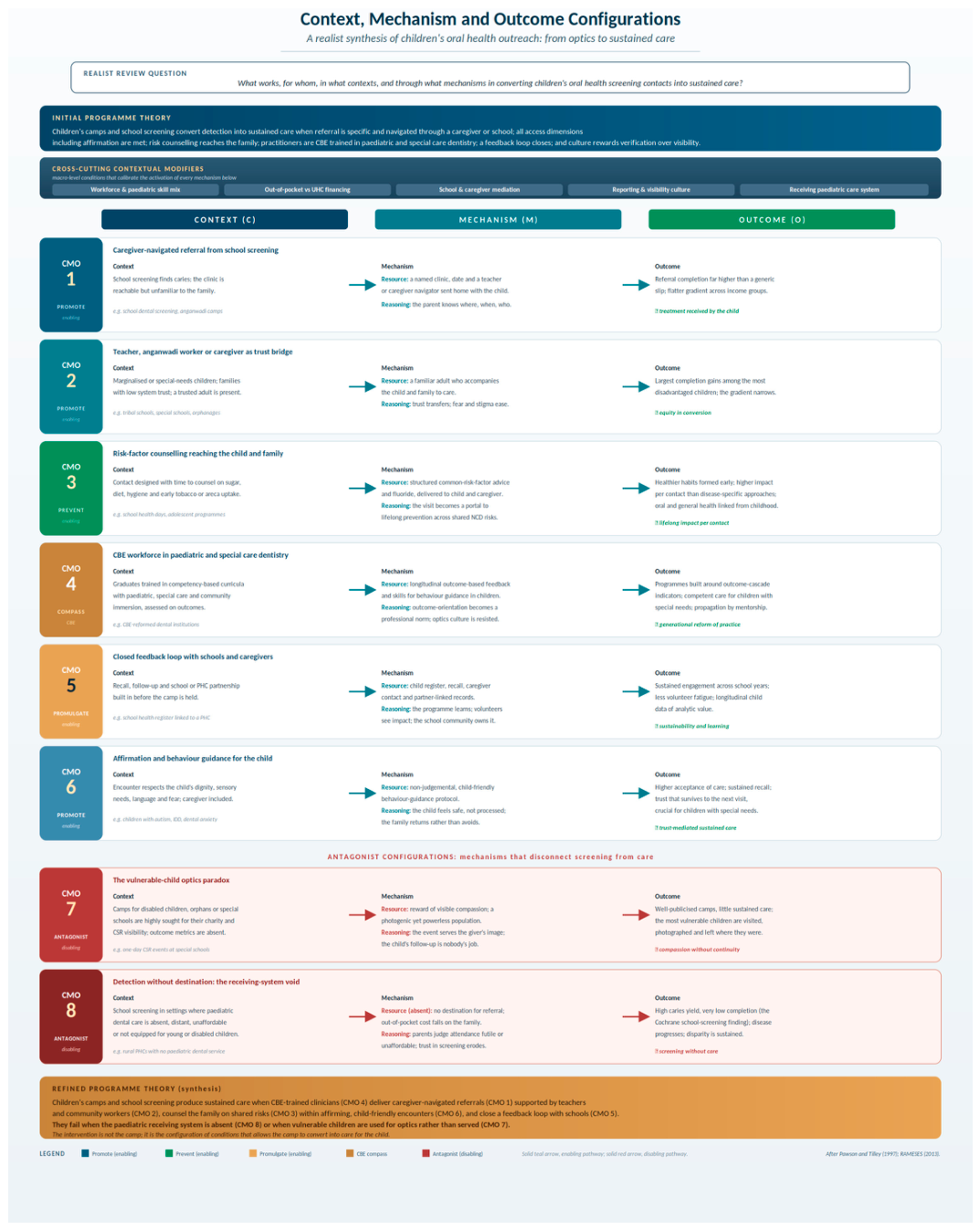
Figure 2.
The Constellation of Care. Three thematic constellations, Prevent (left), Promulgate (right) and Promote (bottom), are navigated by a central compass of competency-based education whose cardinal axes are the four CBE domains. Dotted lines are framework linkages and solid lines are action pathways; the shaded band marks light earned through impact. The optics threshold separates the visible surface of impact from the submerged reef of antagonist context, where the wreck of the one-day charity camp lies.
Figure 2.
The Constellation of Care. Three thematic constellations, Prevent (left), Promulgate (right) and Promote (bottom), are navigated by a central compass of competency-based education whose cardinal axes are the four CBE domains. Dotted lines are framework linkages and solid lines are action pathways; the shaded band marks light earned through impact. The optics threshold separates the visible surface of impact from the submerged reef of antagonist context, where the wreck of the one-day charity camp lies.
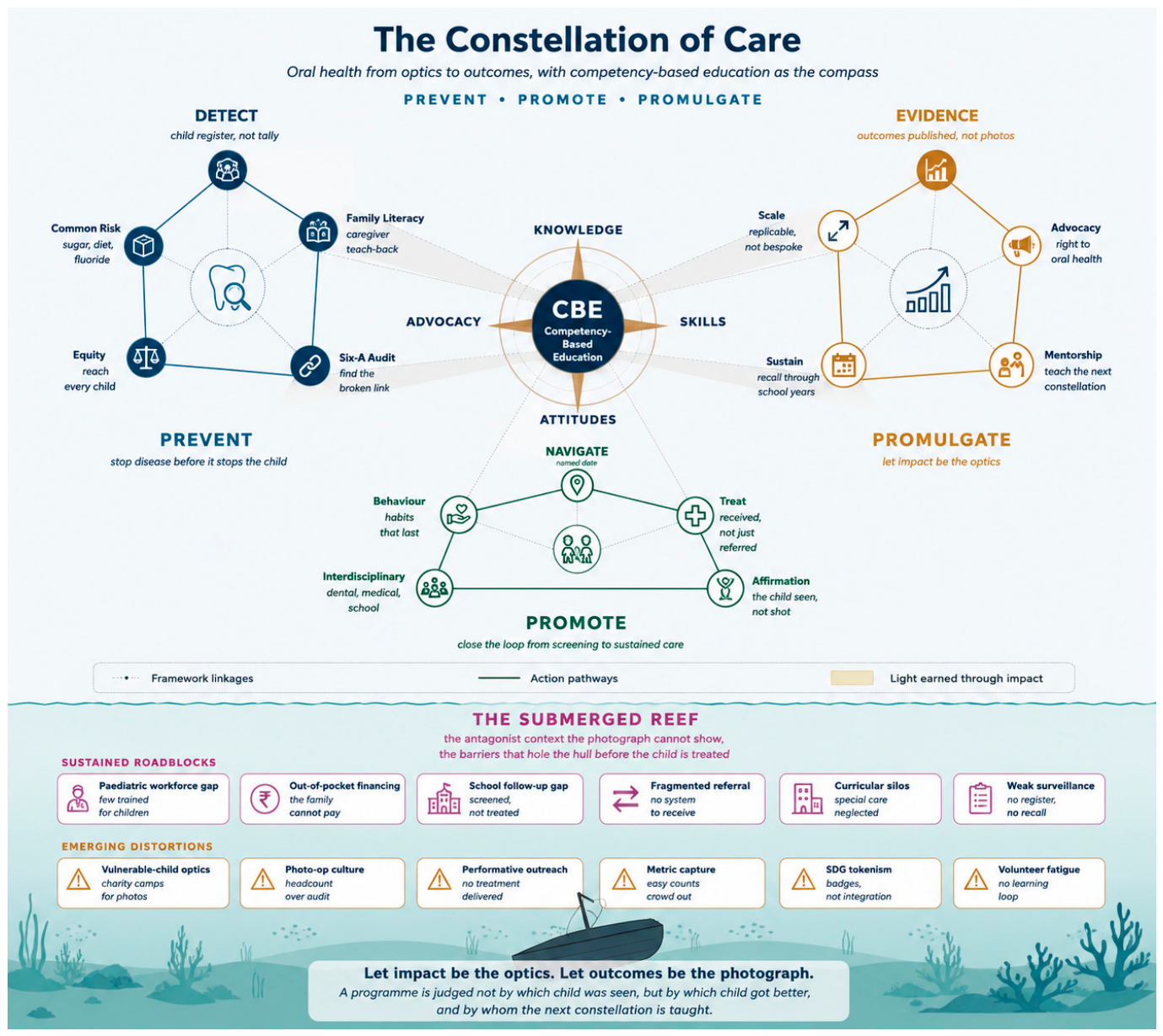
Figure 3.
The Sustainable Development web and the policy ascent for children’s oral health. Panel A: children’s oral health within universal health coverage as an interconnected SDG node. Panel B: the ascent from the 2021 World Health Assembly resolution through the 2022 Global Strategy and the 2024 recognition of the right to oral health to the WHO 2030 target and India’s Viksit Bharat 2047 vision. Panel C: key action points arranged by horizon and by the Prevent, Promote, Promulgate sequence.
Figure 3.
The Sustainable Development web and the policy ascent for children’s oral health. Panel A: children’s oral health within universal health coverage as an interconnected SDG node. Panel B: the ascent from the 2021 World Health Assembly resolution through the 2022 Global Strategy and the 2024 recognition of the right to oral health to the WHO 2030 target and India’s Viksit Bharat 2047 vision. Panel C: key action points arranged by horizon and by the Prevent, Promote, Promulgate sequence.
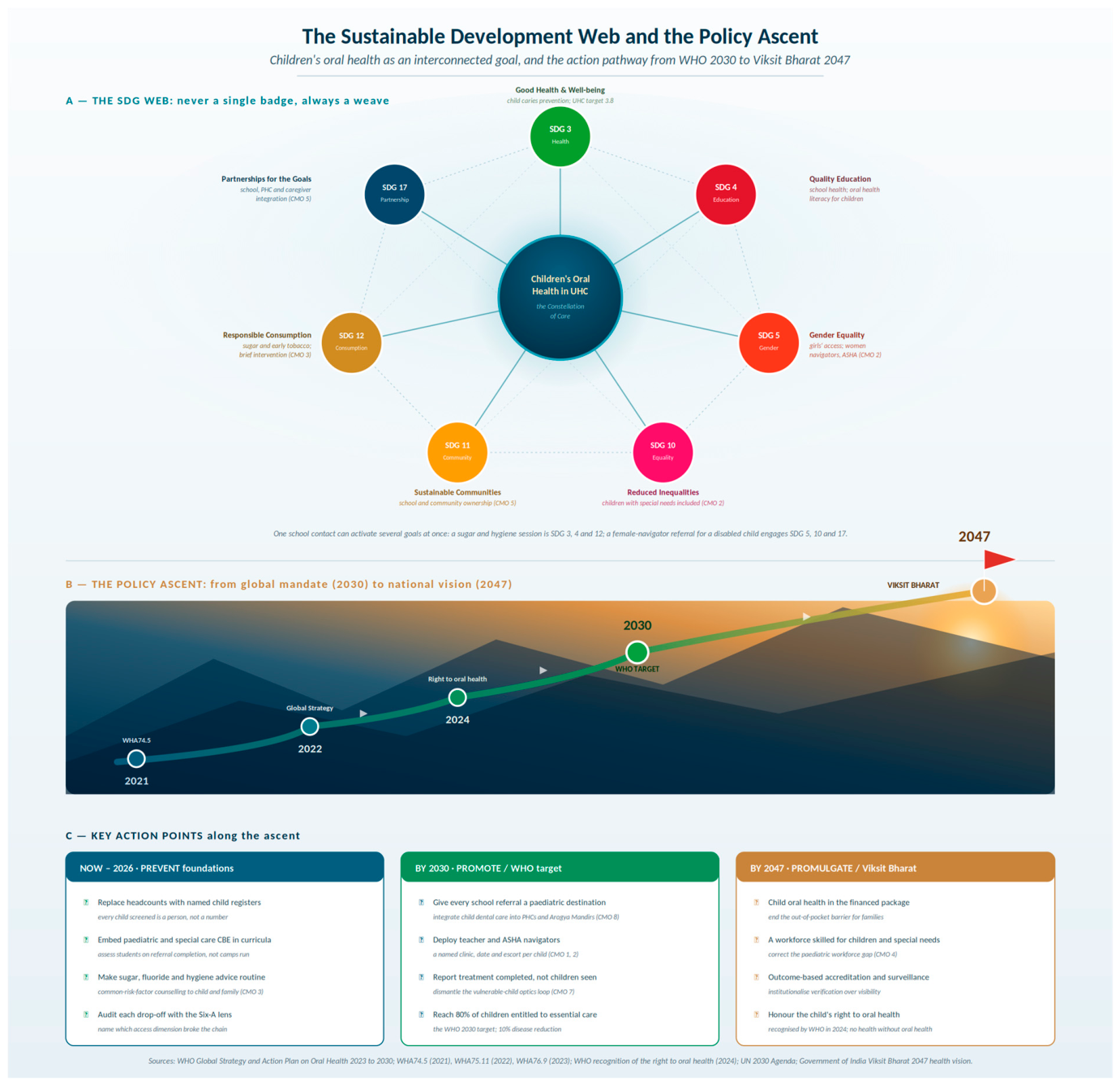

Table 1.
From optics to outcomes: an outcome-cascade indicator framework for children’s oral health outreach, with illustrative verification methods and benchmarks.
Table 1.
From optics to outcomes: an outcome-cascade indicator framework for children’s oral health outreach, with illustrative verification methods and benchmarks.
| Care-pathway stage | Optics indicator (typically counted) | Outcome indicator (to be verified) | Verification method or data source | Illustrative target | Configuration and domain |
|---|---|---|---|---|---|
| Reach and mobilisation | Camps held; children screened; awareness sessions delivered | Proportion of eligible children reached; reach among the poorest and special-needs children | School and anganwadi rolls as denominator; disaggregated attendance register | ≥ 80% of enrolled children reached; no subgroup below 70% | CMO 2; Prevent, Promote |
| Detection and risk assessment | Children examined; aggregate caries prevalence reported | Named child register with individual caries status and caries-risk category | WHO oral-health assessment form completed per child; risk categorised | 100% of examined children entered in a recallable register | CMO 1; Prevent |
| Caregiver-navigated referral | Referral slips issued | Referral completion rate; the child reached a named facility | Two-way referral card matched to facility attendance record | ≥ 60% referral completion (against the low rates reported for camps) | CMO 1, 2, 8; Promote |
| Definitive treatment | Treatment reported as provided at the camp | Treatment initiation and completion; time to definitive care | Treatment log linked to the child register; date of completion recorded | ≥ 80% of detected treatment needs completed within three months | CMO 4, 8; Promote |
| Prevention and behaviour change | Oral-hygiene talks delivered; leaflets distributed | Caregiver teach-back achieved; behaviour maintained at follow-up | Teach-back checklist; plaque and diet indicators recorded at recall | ≥ 70% of caregivers demonstrate correct technique at follow-up | CMO 3, 6; Prevent, Promote |
| Continuity, recall and follow-up | Repeat camp conducted | Recall attendance; longitudinal change in oral-health status | Scheduled recall through school or PHC; repeat examination at defined intervals | ≥ 75% recall attendance sustained across a school year | CMO 5; Promulgate |
| Equity and the special care continuum | Charity camp at a special school or orphanage photographed | Individual sustained-care plan for each child with special healthcare needs; unmet-need gap closed | Individual care plan; unmet-need audit disaggregated by disability and disadvantage | Unmet-need gap for CSHCN no wider than for peers | CMO 2, 6, 7; Promote |
| Dissemination and learning | Photographs, press coverage and social-media reach | Outcome cascade published; programme theory refined and taught to the next cohort | Public outcome report; CMO-based evaluation; documented mentee cohort | Full cascade, from screened to sustained, reported each programme cycle | CMO 5; Promulgate |
CMO, the Context, Mechanism and Outcome configuration (Figure 1); CSHCN, children with special healthcare needs; PHC, primary health centre. Optics indicators record activity and visibility, whereas outcome indicators verify that a child received and sustained care. Targets are illustrative benchmarks for programme design, not established standards.
Disclaimer/Publisher’s Note: The statements, opinions and data contained in all publications are solely those of the individual author(s) and contributor(s) and not of MDPI and/or the editor(s). MDPI and/or the editor(s) disclaim responsibility for any injury to people or property resulting from any ideas, methods, instructions or products referred to in the content. |
© 2026 by the authors. Licensee MDPI, Basel, Switzerland. This article is an open access article distributed under the terms and conditions of the Creative Commons Attribution (CC BY) license.
Copyright: This open access article is published under a Creative Commons CC BY 4.0 license, which permit the free download, distribution, and reuse, provided that the author and preprint are cited in any reuse.


