

Submitted:
31 July 2026
Posted:
03 August 2026
You are already at the latest version
Abstract
Per- and polyfluoroalkyl substances (PFAS) are a large class of persistent synthetic chemicals of global concern because of their widespread environmental occurrence, bioaccumulation potential, and adverse human health effects. Although numerous reviews have addressed individual aspects of PFAS chemistry, toxicity, exposure, or regulation, integrated evaluations encompassing exposure pathways, toxicological mechanisms, biomonitoring, epidemiology, and health-risk assessment remain limited. This structured narrative review critically synthesises peer-reviewed literature and authoritative reports from international regulatory organisations to provide a comprehensive assessment of legacy and emerging PFAS. The review examines major exposure pathways, toxicokinetics, molecular mechanisms of toxicity, biomonitoring approaches, epidemiological evidence, and advances in human health-risk assessment. Particular emphasis is placed on well-characterised legacy PFAS, especially perfluorooctane sulphonate (PFOS) and perfluorooctanoic acid (PFOA), while recognising the limited evidence available for many emerging alternatives. Current evidence identifies drinking water and dietary intake as the dominant exposure pathways and consistently associates PFOS, PFOA, perfluorohexane sulphonate, and related compounds with endocrine, immune, metabolic, developmental, and cardiovascular effects. These findings support a shift from single-compound assessments towards cumulative risk assessment frameworks encompassing both legacy and emerging PFAS. Important uncertainties remain regarding chronic low-dose exposure, mixture toxicity, replacement PFAS, and long-term health outcomes, highlighting the need for longitudinal biomonitoring, advanced exposure assessment, and internationally harmonised regulatory strategies to strengthen evidence-based public health protection.
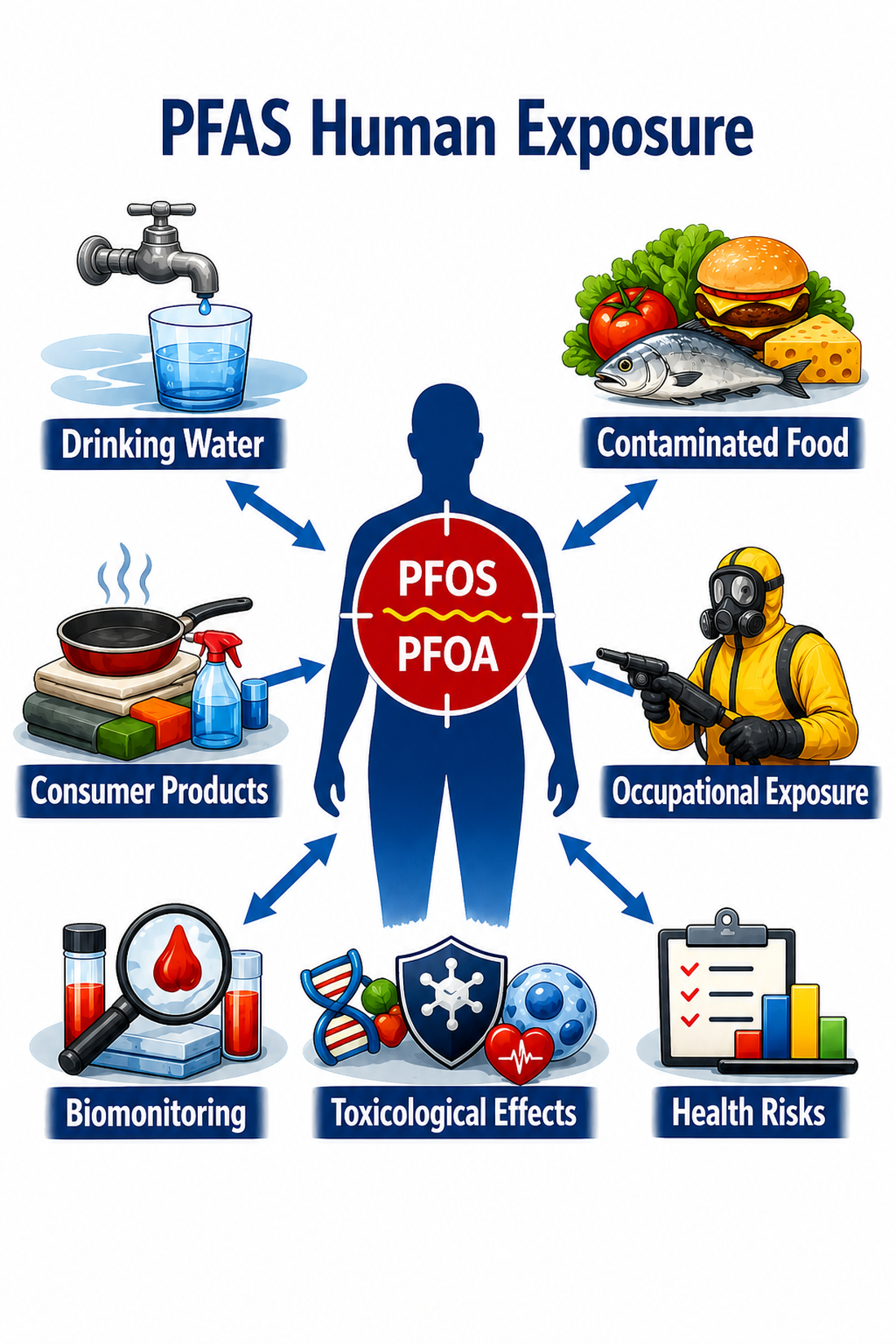
Keywords:
per- and polyfluoroalkyl substances (PFAS)
; human exposure
; biomonitoring
; toxicological mechanisms
; health-risk assessment
1. Introduction
1.1. Background and Global Significance of PFAS
Per- and polyfluoroalkyl substances (PFAS) comprise a large and diverse class of synthetic organofluorine chemicals characterised by highly fluorinated carbon chains. The Organisation for Economic Co-operation and Development (OECD) defines PFAS as fluorinated substances containing at least one fully fluorinated methyl (-CF3) or methylene (-CF2-) carbon atom, encompassing thousands of structurally diverse polymeric and non-polymeric compounds [1]. Owing to the exceptional strength of the carbon-fluorine bond, PFAS exhibit remarkable thermal and chemical stability, resistance to degradation, and surfactant properties, making them indispensable in numerous industrial and consumer applications [2,3]. This diverse chemical class includes perfluoroalkyl acids (PFAAs), perfluoroalkane sulphonates, fluorotelomer-based substances, fluoropolymers, and many emerging alternatives developed to replace legacy PFAS [2,3].
Growing evidence of the environmental persistence, bioaccumulation potential, and adverse health effects of legacy PFAS, particularly perfluorooctanoic acid (PFOA), perfluorooctane sulphonate (PFOS), perfluorohexane sulphonate (PFHxS), and perfluorononanoic acid (PFNA), has prompted international regulatory restrictions and accelerated the development of replacement PFAS, including hexafluoropropylene oxide dimer acid (HFPO-DA, GenX), 4,8-dioxa-3H-perfluorononanoic acid (ADONA), chlorinated polyfluoroether sulphonate (F-53B), and short-chain PFAS [2,3,4,5,6,7,8]. Although these alternatives were introduced to reduce bioaccumulation while maintaining industrial performance, increasing evidence indicates that many remain environmentally persistent, with important uncertainties regarding their toxicity, environmental fate, transformation products, and long-term human health effects [5,6,7,8]. Figure 1 summarises the evolution of PFAS chemistry from legacy compounds to emerging alternatives while highlighting key research priorities, including PFAS transformation, toxicity mechanisms, and human exposure and health risks. Collectively, these priorities support improved exposure assessment, evidence-based risk assessment, and globally harmonised regulatory frameworks for both legacy and emerging PFAS [8,9,10,11,12].
Since their commercial introduction in the 1950s, PFAS have been widely used in industrial and consumer products because of their exceptional water-, grease-, stain-, and heat-resistant properties [10,11]. Their extensive production and use have resulted in widespread environmental contamination, with PFAS now detected in environmental and human matrices worldwide [9]. Figure 2 presents an integrated exposure network linking industrial sources and environmental contamination with human exposure pathways, internal dose, biomonitoring, health outcomes, risk assessment, and regulatory management. This framework demonstrates how exposure science, biomonitoring, toxicology, epidemiology, and risk assessment collectively support evidence-based strategies to reduce human exposure and improve management of legacy and emerging PFAS, while providing context for the biological processes (Figure 3) and comparative exposure pathways (Figure 4).
The global scale of PFAS contamination has made these substances a major environmental and public health concern. PFAS have been detected in remote regions, urban environments, and drinking-water supplies worldwide, demonstrating their persistence and long-range environmental transport [9]. Increasing evidence linking PFAS exposure to adverse health effects has accelerated efforts to regulate PFAS as a chemical class rather than individual compounds [8,12]. Figure 2 presents an integrated conceptual framework that synthesises current understanding of the continuum from industrial sources and environmental distribution through human exposure, internal dose, biomonitoring, adverse health outcomes, risk assessment, and regulatory decision-making.
1.2. Persistence, Mobility, and Bioaccumulation
PFAS are often termed “forever chemicals” because their strong carbon-fluorine bonds confer exceptional resistance to degradation, resulting in long-term environmental persistence [6,13]. Despite the development of replacement PFAS, many remain persistent and highly mobile, contaminating water, air, soils, and areas surrounding industrial facilities, landfills, and firefighting sites, highlighting the need for site-specific environmental monitoring and exposure assessment [9,14,15,16,17,18]. Toxicokinetics vary among PFAS subclasses. PFAAs, including PFOS, PFOA, PFHxS, and PFNA, persist because of protein binding and renal tubular reabsorption, whereas polyfluorinated precursors are transformed into persistent terminal PFAAs. Toxicokinetic variability influences internal body burdens and biomonitoring concentrations [19,20,21]. Table 1 summarises the principal determinants of PFAS absorption, distribution, and elimination.
PFAS bioaccumulate in aquatic and terrestrial organisms, promoting trophic transfer and human exposure [14]. Their protein-binding properties prolong biological half-lives, while long-chain and mobile replacement PFAS sustain persistent human body burdens and public health concerns [8].
1.2.1. Human Biomonitoring Levels and Population Variability
Human biomonitoring studies consistently demonstrate widespread PFAS exposure, with serum and plasma remaining the preferred matrices for assessing cumulative internal exposure [21]. Large-scale programmes, including NHANES, HBM4EU, and national studies, report declining legacy PFAS following regulatory restrictions, but continued detection of PFHxS, PFNA, short-chain PFAS, and ether-based alternatives indicates persistent exposure to emerging PFAS [22,23]. PFAS subclasses differ in persistence, bioaccumulation, toxicokinetics, and toxicity, with long-chain PFAS generally showing greater bioaccumulation than short-chain and replacement PFAS [6,8,13,14,21,24]. Table 2 summarises representative biomonitoring studies.
1.3. Objectives and Scope of the Review
This review synthesises current knowledge on PFAS exposure and associated human health risks, focusing on major exposure pathways, toxicokinetics, and toxicity mechanisms, including endocrine disruption, immunotoxicity, oxidative stress, inflammatory responses, and receptor-mediated effects. Advances in biomonitoring, analytical techniques, toxicology, epidemiology, and regulatory science have strengthened health-risk assessment while highlighting challenges related to mixture toxicity, cumulative exposure, emerging PFAS, and scientific uncertainty [21]. Figure 3 presents an integrated human health framework linking environmental contamination, exposure, toxicokinetics, health effects, biomonitoring, risk assessment, and policy development.
1.4. Novelty and Contribution of This Review
Although previous PFAS reviews have addressed environmental occurrence, analytical methods, toxicology, epidemiology, or regulation, few have integrated these topics within a unified framework linking environmental contamination, human exposure, toxicokinetics, molecular toxicity, biomonitoring, epidemiology, and health-risk assessment. This review addresses that gap through an interdisciplinary synthesis, while Table 3 compares recent reviews and highlights its novel evidence-based framework [8,21,30].
This review examines how evidence from environmental exposure, toxicokinetics, mechanistic toxicology, biomonitoring, epidemiology, and health-risk assessment can be integrated to improve understanding of the risks posed by legacy and emerging PFAS. It critically synthesises evidence across the exposure-to-disease continuum, identifies current strengths, limitations, and uncertainties, and supports evidence-based risk assessment through an integrated framework [8,18,21,30,31]. The review also evaluates emerging PFAS, including GenX, ADONA, F-53B, and short-chain PFAS, highlighting their occurrence, persistence, toxicological profiles, regulatory challenges, and knowledge gaps [5,6,12]. Table 4 compares representative legacy and emerging PFAS, illustrating differences in persistence, bioaccumulation, toxicological evidence, regulatory status, and remaining research needs.
Unlike many previous reviews, this review distinguishes cumulative exposure, cumulative (mixture) toxicity, and combined exposure with other environmental contaminants, strengthening PFAS exposure assessment and risk characterisation under real-world conditions [12,30,32]. It identifies research priorities, including vulnerable populations, occupational exposure, emerging replacement PFAS, chronic low-dose exposure, transformation products, mixture toxicity, and harmonised biomonitoring methodologies [31,32,33,34]. The review further integrates advances in exposomics, high-resolution mass spectrometry, PBPK modelling, effect-based monitoring, machine learning, and artificial intelligence to improve PFAS detection, biomonitoring, exposure assessment, and evidence-based risk assessment [30,31,35,36,37].
1.5. Literature Search Strategy
This review is based on a comprehensive literature search of Web of Science, Scopus, PubMed, ScienceDirect, and Google Scholar, incorporating recent publications and seminal studies. Search terms included PFAS exposure, toxicokinetics, biomonitoring, epidemiology, toxicological mechanisms, risk assessment, exposomics, PBPK modelling, high-resolution mass spectrometry, and emerging PFAS. High-quality original studies, systematic reviews, meta-analyses, and regulatory reports were critically synthesised within an integrated framework linking environmental contamination, human exposure, toxicokinetics, molecular toxicity, biomonitoring, and health-risk assessment, with conclusions reflecting the strengths and limitations of each evidence type.
2. Environmental Sources and Occurrence of PFAS
PFAS are globally distributed across atmospheric, aquatic, terrestrial, and biological environments, with concentrations varying according to emission sources, land use, industrial activities, hydrology, and regulatory controls [15]. Understanding their environmental occurrence is essential for identifying exposure sources and informing effective risk management.
2.1. Industrial Sources
Industrial activities remain the primary source of PFAS contamination because of their extensive use in fluoropolymer production, aqueous film-forming foams (AFFFs), textile treatment, food-contact materials, and electronics manufacturing [38]. Fluoropolymer facilities have caused persistent soil and water contamination through historical emissions [39], while AFFF use has created contamination hotspots at military bases, airports, and firefighting training sites [10]. Textile manufacture, PFAS-treated consumer products, food packaging, and expanding semiconductor production continue to contribute to environmental releases and human exposure [10,40,41]. Historically, contamination was dominated by point sources involving PFOS and PFOA [4]. Although regulatory restrictions have reduced legacy PFAS emissions, increasing use of short-chain PFAS and fluorinated alternatives has shifted contamination toward diffuse sources, including wastewater, landfill leachates, biosolids, consumer products, and recycling processes, complicating environmental monitoring, exposure assessment, and regulatory management.
2.2. Environmental Release Pathways
Following production and use, PFAS are released through multiple environmental pathways. Wastewater discharges from industrial, municipal, and contaminated sources remain major contributors because conventional treatment processes remove PFAS inefficiently, allowing their release into receiving waters [42]. Landfill leachates contaminate groundwater and surface waters [43], while atmospheric transport of volatile PFAS precursors facilitates global distribution, including remote regions [44]. PFAS also accumulate in sewage sludge and biosolids, contaminating soils, crops, livestock, and the food chain following land application [45]. Conventional wastewater treatment plants are largely ineffective because PFAS resist degradation. Some long-chain PFAS adsorb to sludge, whereas short-chain PFAS and emerging alternatives remain in the aqueous phase and precursor transformation generates persistent terminal perfluoroalkyl acids [46,47,48]. These limitations highlight the need for advanced PFAS destruction technologies to reduce environmental emissions and human exposure.
2.3. Environmental Distribution
The persistence and mobility of PFAS have resulted in their widespread distribution across environmental compartments. Surface waters receive PFAS from industrial discharges, wastewater effluents, landfill leachates, stormwater runoff, and groundwater inputs, while contaminated groundwater remains an important secondary source to rivers and drinking-water supplies [49,50]. Consequently, drinking water represents a major human exposure pathway, particularly near industrial facilities, airports, military bases, and wastewater treatment plants [21]. PFAS also accumulate in soils and sediments through atmospheric deposition, biosolid application, irrigation, and industrial releases, while atmospheric transport of volatile precursors facilitates global contamination, including remote regions [44,51]. The relative contribution of exposure pathways varies according to contamination sources, geography, occupation, lifestyle, and dietary habits [9,10,11]. Figure 4 summarises the major human exposure pathways and their relative importance, highlighting drinking water as the predominant route in highly contaminated settings, followed by diet, indoor environments, occupational exposure, maternal transfer, and consumer products. This integrated overview supports prioritisation of exposure assessment, biomonitoring, and evidence-based risk management strategies.
The interconnected environmental distribution of PFAS promotes transfer among water, soil, air, and food chains, increasing human exposure through multiple pathways. Consequently, effective PFAS risk management requires integrated source control rather than remediation of individual environmental media. Understanding these transport processes is essential for predicting exposure patterns, designing biomonitoring programmes, and prioritising regulatory interventions to reduce cumulative human exposure.
2.4. Linking Environmental Fate to Human Exposure
The environmental fate of PFAS determines the magnitude, duration, and pathways of human exposure. Their persistence, mobility, and resistance to degradation promote redistribution across aquatic, terrestrial, and atmospheric compartments, resulting in exposure through drinking water, food, and atmospheric transport. Wastewater treatment plants, landfill leachates, and biosolid application further sustain environmental contamination [52]. Environmental monitoring reveals marked spatial variability, with elevated PFAS concentrations near industrial facilities, wastewater discharges, landfill leachates, and historical AFFF sites [15]. Similar variability occurs in groundwater because of differences in contamination sources, hydrogeology, and remediation status, highlighting the need for site-specific monitoring, exposure assessment, and risk management [27,53,54].
3. Human Exposure Pathways
Human exposure to PFAS occurs through multiple environmental and occupational pathways, with contaminated drinking water and food representing the principal routes for the general population. Indoor environments, consumer products, occupational activities, and maternal transfer provide additional exposure, although their relative importance varies geographically and among populations [21,32,55]. Drinking water is a major exposure source, particularly near fluorochemical manufacturing facilities, military bases, airports, firefighting sites, and wastewater treatment plants, where PFAS persistence and mobility result in contamination of surface water and groundwater [44,56]. Private wells are especially vulnerable because of limited monitoring and treatment, and biomonitoring studies consistently associate drinking-water contamination with elevated human serum PFAS concentrations [21,55]. PFAS concentrations vary widely according to contamination source and location, highlighting the need for routine monitoring and effective treatment [15,29,57,58]. Dietary exposure arises through contaminated water, soils, sediments, food-contact materials, and bioaccumulation in aquatic food webs [21,38]. Seafood and freshwater fish generally contain the highest PFAS concentrations, while meat, dairy products, eggs, cereals, fruits, and vegetables also contribute to cumulative exposure [27,29,57,59,60,61]. Indoor dust and air further contribute, particularly among infants and young children, reinforcing the importance of integrated exposure assessment and health-risk evaluation [32,40,62,63].
Occupational exposure often results in higher PFAS body burdens than those of the general population through manufacturing, firefighting, waste management, and remediation activities [56]. Firefighters, fluorochemical workers, and wastewater and landfill personnel consistently exhibit elevated exposure because of contact with contaminated materials and waste streams [32,44,55]. Maternal transfer across the placenta and through breast milk increases PFAS exposure during critical developmental stages, making infants and young children particularly susceptible because of their developing physiology and limited elimination capacity [32,33,34]. Table 5 summarises the principal PFAS exposure pathways, at-risk populations, relative contributions, and representative supporting literature.
Although contaminated drinking water and food remain the dominant PFAS exposure routes, their relative importance varies with geography, occupation, age, socioeconomic status, and contamination source. Exposure assessment should therefore adopt a cumulative life-course perspective that considers multiple environmental pathways [21,29]. Human exposure through water, food, indoor environments, consumer products, and occupational activities leads to bioaccumulation and maternal transfer. Figure 5 illustrates the relationships among exposure pathways, biological susceptibility, health outcomes, and biomonitoring across developmental stages, supporting evidence-based exposure assessment and risk management.
Human PFAS body burden reflects cumulative exposure from multiple environmental and lifestyle pathways. Drinking water predominates in highly contaminated communities, whereas dietary intake is the principal source for many populations. Indoor dust and consumer products contribute to chronic low-level exposure, particularly among infants and young children, while occupational activities may result in substantially elevated exposure. Maternal transfer through the placenta and breast milk further increases exposure during critical developmental stages [29,60]. Table 6 summarises representative PFAS concentrations reported in major environmental media and exposure sources, illustrating the spatial variability and magnitude of contamination that underpin human exposure across different environmental compartments.
4. Toxicokinetics of PFAS
Toxicokinetics describes the absorption, distribution, metabolism, and elimination of chemicals within biological systems and provides a mechanistic framework for understanding PFAS bioaccumulation, biomonitoring data, and health risks. Unlike many environmental contaminants, PFAS are characterised by high environmental persistence, strong binding to proteins, limited metabolic transformation, and prolonged biological half-lives in humans. These characteristics contribute to their widespread detection in human blood and tissues and underlie concerns regarding chronic exposure and long-term health effects [8,21,30].
4.1. Absorption
Human PFAS exposure occurs mainly via ingestion of contaminated drinking water and food, though inhalation and dermal contact contribute under certain environmental and occupational conditions. Oral exposure yields high gastrointestinal absorption, enabling rapid systemic entry. Toxicokinetic studies show PFOA, PFOS, and related compounds are efficiently absorbed orally and via inhalation of aerosols and dust [18,30]. Dermal absorption is less efficient but relevant for handling PFAS materials or foams. The extent of absorption varies with molecular structure, chain length, and functional-group chemistry, with long-chain PFAS exhibiting greater bioaccumulation potential [8].
4.2. Distribution
Following absorption, PFAS circulate in the bloodstream and preferentially bind serum proteins, particularly albumin, rather than accumulating in adipose tissue like many persistent organic pollutants [8,21,30,67]. Consequently, they distribute mainly to protein-rich tissues, including blood, liver, kidneys, lungs, placenta, cord blood, and breast milk, facilitating prenatal and postnatal transfer. Their distribution is regulated by plasma proteins, phospholipids, and membrane transporters that influence tissue uptake and retention [31]. This distinctive protein-binding behaviour underlies the prolonged biological half-lives of PFAS and explains why serum remains the preferred biomonitoring matrix for assessing internal exposure and toxicokinetics [21,67].
4.3. Metabolism
A key feature of many PFAS is resistance to metabolic degradation. PFAAs, including PFOA, PFOS, PFHxS, and PFNA, remain metabolically stable due to strong carbon-fluorine bonds, undergoing little biotransformation and being excreted largely unchanged [21,30]. In contrast, polyfluoroalkyl precursors can transform into terminal PFAAs via environmental and biological processes. Fluorotelomer alcohols and related precursors metabolically convert to PFOA and other persistent products, sustaining human exposure even as direct legacy PFAS exposure declines [8,21].
4.4. Elimination and Biological Half-Lives
PFAS elimination occurs through urinary excretion, biliary secretion, faecal elimination, menstruation, pregnancy, and lactation, but extensive renal tubular reabsorption limits clearance and prolongs biological half-lives [8,35]. Systematic reviews report average human half-lives of 1.5-5.1 years for PFOA, 3.4-5.7 years for PFOS, and 2.8-8.5 years for PFHxS, contributing to persistent serum detection and bioaccumulation [36,37]. Toxicokinetics vary with carbon-chain length and functional group, influencing persistence, tissue distribution, and health risks [26,67]. Long-chain PFAS exhibit strong protein binding and prolonged elimination, whereas GenX shows lower bioaccumulation and faster elimination despite increasing environmental occurrence and evidence of hepatic, renal, and developmental toxicity [68]. Table 7 compares toxicokinetic characteristics of representative legacy and emerging PFAS.
4.5. Factors Influencing PFAS Toxicokinetics
Several biological and physicochemical factors influence PFAS toxicokinetics and contribute to variability in internal exposure levels among individuals. These factors affect the absorption, distribution, retention, and elimination of PFAS, thereby influencing serum concentrations, tissue accumulation, and biological half-lives. Consequently, individuals exposed to similar environmental concentrations of PFAS may exhibit markedly different body burdens and susceptibility to adverse health effects due to differences in physiological characteristics and chemical-specific properties [30].
Age
Age influences PFAS toxicokinetics through differences in physiology, exposure patterns, and elimination capacity. Infants and children often experience higher exposure relative to body weight and may exhibit different distribution and elimination patterns compared with adults. Prenatal and early-life exposures are particularly important because developmental processes may alter PFAS disposition and susceptibility to adverse effects [8,30].
Sex
Sex-related differences in PFAS toxicokinetics have been widely reported. Women generally exhibit lower serum concentrations and faster elimination rates than men because menstruation, pregnancy, and lactation provide additional elimination pathways. Human studies have demonstrated more rapid elimination of PFOS and PFHxS among females than males [37].
Genetics
Genetic variability influences the expression and function of transport proteins involved in PFAS uptake, distribution, and elimination. Variations in renal transporter activity may contribute to differences in serum concentrations, elimination rates, and susceptibility to PFAS accumulation among individuals [31,35].
PFAS Chain Length
PFAS toxicokinetics depend strongly on chain length, with long-chain compounds showing greater protein binding, tissue retention, bioaccumulation, and persistence than short-chain analogues [8,30]. PFAS are absorbed through multiple pathways, distributed via blood, minimally metabolised, and transferred maternally through the placenta and breast milk. Figure 6 summarises absorption, distribution, metabolism, elimination, and maternal transfer processes, highlighting biological and physicochemical factors influencing exposure [8,31].
Species Differences and Implications for PBPK Modelling
PFAS toxicokinetics are strongly influenced by carbon-chain length and physicochemical properties, with long-chain PFAS exhibiting greater protein binding, tissue retention, bioaccumulation, and biological persistence than short-chain analogues [8,30]. Following exposure through drinking water, food, indoor dust, consumer products, or occupational activities, PFAS are efficiently absorbed and transported via the bloodstream to protein-rich tissues, particularly the liver, kidneys, and blood, where they accumulate because of their high affinity for serum proteins. Unlike many environmental contaminants, most PFAS undergo minimal metabolic transformation, resulting in slow elimination and prolonged body burdens. Maternal transfer across the placenta and through breast milk further contributes to fetal and infant exposure during sensitive developmental stages. Toxicokinetic processes ultimately determine internal exposure, persistence, and bioaccumulation, thereby influencing potential adverse health outcomes.
Collectively, the toxicokinetic characteristics of PFAS distinguish them from many conventional environmental contaminants. Their high gastrointestinal absorption, extensive protein binding, limited biotransformation, and prolonged biological half-lives result in persistent internal exposure even after external exposure has declined [30,67]. These properties complicate interpretation of biomonitoring data and demonstrate why serum PFAS concentrations reflect cumulative body burden rather than only recent exposure. Integrating toxicokinetic knowledge with biomonitoring and epidemiological evidence is therefore essential for accurate exposure reconstruction and evidence-based risk assessment.
5. Toxicity and Related Mechanisms of PFAS
The adverse health effects associated with PFAS exposure arise from complex interactions between these compounds and multiple molecular, cellular, and physiological pathways. Although toxicological responses vary among PFAS classes, substantial evidence indicates that PFAS can disrupt cellular homeostasis through oxidative stress, inflammation, endocrine perturbation, mitochondrial dysfunction, receptor-mediated signalling, immune dysregulation, and carcinogenic processes. The persistence and bioaccumulative nature of PFAS further contribute to chronic biological effects by sustaining long-term exposure at the tissue and cellular levels [21,30].
5.1. Molecular and Cellular Mechanisms
PFAS toxicological effects arise from molecular and cellular interactions disrupting physiological processes. Exposure induces oxidative stress, inflammation, endocrine perturbations, and metabolic alterations, impairing organ and tissue function. These mechanisms link PFAS exposure to biological responses and disease development, providing a mechanistic foundation for human health-risk assessment and regulatory evaluation [8].
Oxidative Stress
Oxidative stress is a principal mechanism of PFAS toxicity, with experimental studies showing increased reactive oxygen species production, oxidative damage, and impaired antioxidant defences in multiple organs [8,70]. Long-chain PFAS, particularly PFOS and PFOA, induce oxidative stress largely through PPARα activation, promoting lipid dysregulation and inflammation, whereas the mechanisms underlying emerging PFAS such as GenX remain less clearly understood [71]. PFAS-induced oxidative stress is also associated with lipid peroxidation, altered glutathione metabolism, reduced antioxidant enzyme activity, mitochondrial dysfunction, DNA damage, and chronic inflammation, contributing to metabolic, cardiovascular, and immune disorders [72]. However, many mechanistic findings derive from high-dose experimental models, emphasising the need for environmentally relevant human studies [70,72].
Inflammation
Inflammatory responses constitute another important mechanism underlying PFAS toxicity. Experimental studies have demonstrated that PFAS exposure can activate pro-inflammatory signalling pathways and stimulate the production of cytokines such as interleukin-6 (IL-6), tumour necrosis factor-alpha (TNF-α), and interleukin-1β (IL-1β). Chronic activation of inflammatory pathways may contribute to hepatic injury, metabolic disorders, cardiovascular disease, and immune dysfunction [8,72]. Oxidative stress and inflammation frequently occur simultaneously, creating a self-reinforcing cycle that amplifies cellular damage and promotes chronic disease development. Consequently, inflammation is increasingly recognised as a central component of PFAS-mediated toxicity [8].
Endocrine Disruption
PFAS are recognised endocrine-disrupting chemicals that interfere with hormone synthesis, metabolism, and receptor signalling, affecting thyroid, reproductive, glucocorticoid, and sex steroid pathways [8,32]. Numerous studies associate PFAS exposure with altered thyroxine (T4), triiodothyronine (T3), and thyroid-stimulating hormone (TSH) concentrations, although findings remain inconsistent [73]. Variability in study design, PFAS mixtures, exposure levels, age, and sex may explain these differences, highlighting the need for harmonised longitudinal studies to clarify causal relationships [3,32,73].
Mitochondrial Dysfunction
Mitochondria represent important cellular targets of PFAS toxicity. Experimental investigations have demonstrated that PFAS can impair mitochondrial respiration, alter membrane potential, disrupt energy metabolism, and increase mitochondrial ROS production. These effects may reduce cellular energy production and contribute to apoptosis, metabolic dysregulation, and tissue injury [8,70]. Mitochondrial dysfunction is increasingly recognised as a key mechanistic link between PFAS exposure and adverse outcomes involving the liver, cardiovascular system, nervous system, and endocrine organs.
5.2. Receptor-Mediated Toxicity
In addition to inducing oxidative stress and cellular dysfunction, PFAS can exert toxic effects through interactions with specific cellular receptors that regulate metabolic, endocrine, and developmental processes. Receptor-mediated mechanisms are considered central to PFAS toxicity because they influence the expression of genes involved in lipid metabolism, energy homeostasis, inflammation, and xenobiotic responses. Among these pathways, activation of peroxisome proliferator-activated receptors and interactions with other nuclear receptors have received particular attention due to their roles in mediating many of the adverse biological effects associated with PFAS exposure [71,74].
5.3. Peroxisome Proliferator-Activated Receptor Activation
Activation of PPARs, particularly PPAR-α, is one of the most extensively studied mechanisms of PFAS toxicity. Many PFAS compounds can bind to and activate PPARs, thereby altering the expression of genes involved in lipid metabolism, fatty-acid oxidation, glucose regulation, and energy homeostasis [8,71]. PPAR activation has been linked to hepatomegaly, alterations in lipid metabolism, peroxisome proliferation, and metabolic disturbances observed in animal studies [74]. Although species-specific differences exist, PPAR-mediated signalling remains a central pathway in PFAS toxicology and risk assessment.
Nuclear Receptor Interactions
In addition to PPARs, PFAS can interact with several other nuclear receptors, including constitutive androstane receptor, pregnane X receptor, liver X receptor, and farnesoid X receptor. These interactions may influence xenobiotic metabolism, lipid regulation, bile-acid homeostasis, endocrine signalling, and inflammatory responses [75]. The ability of PFAS to simultaneously affect multiple receptor systems highlights the complexity of their toxicological effects and may explain the broad spectrum of adverse outcomes reported in epidemiological studies.
5.4. Immunotoxicity Mechanisms
Immunotoxicity is among the most consistently reported adverse effects of PFAS exposure, disrupting innate and adaptive immune responses, impairing immune function, and increasing disease susceptibility [29,73]. The strongest human evidence demonstrates reduced vaccine-induced antibody responses, particularly in children exposed to PFOS and PFOA, whereas evidence for emerging PFAS remains limited [29,73,76]. PFAS exposure has also been associated with altered cytokine production, impaired B- and T-cell function, reduced immune surveillance, and increased susceptibility to infections [76]. Although mechanistic studies support these associations, many are based on high-dose experimental models. Consequently, reduced vaccine antibody responses remain the most reliable indicator of PFAS immunotoxicity, while additional research is needed to clarify other immune endpoints, particularly for emerging PFAS. Table 8 summarises the principal immunotoxic endpoints and their relevance to human health.
5.5. Genotoxicity and Carcinogenic Mechanisms
The genotoxic and carcinogenic potential of PFAS remains an active area of investigation. Although most PFAS are not direct DNA-reactive mutagens, they may promote carcinogenesis through oxidative stress, chronic inflammation, epigenetic alterations, receptor-mediated signalling, and disrupted cellular proliferation [30,77]. The International Agency for Research on Cancer (IARC) classifies PFOA as carcinogenic to humans (Group 1) and PFOS as possibly carcinogenic (Group 2B). Epidemiological evidence consistently links PFAS exposure with kidney and testicular cancers, although evidence for other malignancies remains less consistent [29,73,77].
5.6. Combined Toxicity of PFAS and Co-Existing Environmental Contaminants
Humans are routinely exposed to PFAS alongside heavy metals, pesticides, pharmaceuticals, microplastics, bisphenol A (BPA), phthalates, and other persistent pollutants, highlighting the importance of mixture-based risk assessment [55,78]. Experimental studies show that co-exposure may produce additive, synergistic, or antagonistic effects, enhancing oxidative stress, inflammation, endocrine disruption, mitochondrial dysfunction, and hepatic and renal toxicity [8,78]. Interactions with microplastics may increase PFAS bioavailability, while co-exposure with BPA and phthalates may amplify hormonal and reproductive effects [79,80]. Table 9 summarises representative studies describing the combined toxicological effects of PFAS with co-existing environmental contaminants.
5.7. Evidence from Subchronic and Chronic Animal Studies
Subchronic and chronic animal studies have been central to understanding PFAS toxicity and informing human health risk assessment. Repeated exposure consistently produces dose-dependent effects across multiple organ systems, particularly the liver, causing hepatocellular hypertrophy, altered lipid metabolism, steatosis, and increased liver weight [30,67]. Chronic exposure has also been linked to immunosuppression, endocrine disruption, developmental and reproductive toxicity, renal alterations, metabolic disturbances, thyroid dysfunction, and increased tumour incidence in rodents exposed to PFOS and PFOA, although species differences require careful interpretation [29,30]. These studies provide essential dose-response data for deriving health-based guidance values and linking molecular mechanisms, including oxidative stress, PPAR activation, mitochondrial dysfunction, inflammation, and endocrine disruption, to adverse outcomes, thereby strengthening PFAS hazard identification and human health risk assessment [29,81].
5.8. Comparison of Toxicological Profiles of Legacy and Emerging PFAS
The phase-out of legacy PFAS has accelerated the use of alternatives such as GenX, ADONA, and F-53B, which generally exhibit lower bioaccumulation and faster elimination but remain toxicologically relevant [82,83]. Legacy PFAS, particularly PFOS and PFOA, are associated with prolonged biological half-lives, high bioaccumulation, hepatotoxicity, endocrine disruption, immunotoxicity, developmental toxicity, metabolic disorders, and selected cancers [30,67]. Replacement PFAS activate similar molecular pathways, including oxidative stress, PPAR signalling, mitochondrial dysfunction, inflammation, and lipid dysregulation [30,57,82,84]. Consequently, reduced persistence does not necessarily indicate lower toxicity, highlighting the need for continued toxicological evaluation, human biomonitoring, epidemiological studies, and risk assessment. Table 10 compares the persistence, bioaccumulation, toxicokinetic behaviour, toxicological mechanisms, target organs, and human health evidence for representative legacy and emerging PFAS.
PFAS induce epigenetic modifications, alter gene expression, and disrupt DNA repair, contributing to carcinogenic risk [86]. Their toxicity involves oxidative stress, endocrine disruption, PPAR activation, mitochondrial dysfunction, and immune dysregulation, leading to cellular and organ dysfunction. Figure 7 illustrates the principal molecular pathways linking PFAS exposure to adverse health outcomes, including cancer, cardiovascular, metabolic, developmental, reproductive, and immune disorders [8].
Interactions Between Molecular Toxicity Pathways
PFAS toxicity arises through interconnected molecular pathways involving oxidative stress, PPAR activation, mitochondrial dysfunction, endocrine disruption, and immune dysregulation, collectively driving cellular injury, chronic inflammation, organ toxicity, and disease progression [87,88]. These interactions contribute to cardiovascular disease, cancer, metabolic disorders, immune dysfunction, and developmental toxicity, strengthening biomonitoring interpretation and health-risk assessment [75,87,88,89]. Most mechanistic evidence derives from PFOS and PFOA using in vitro and animal models, whereas epidemiological studies assess chronic low-dose exposure to PFAS mixtures without establishing direct mechanisms [30,88]. Evidence for PFHxS, PFNA, GenX, ADONA, and F-53B remains limited. Table 11 summarises representative molecular mechanisms and their relevance to human exposure scenarios.
PFAS toxicity is mediated through multiple interacting molecular pathways rather than a single mechanism. Although PPARα activation is well characterised, species differences limit extrapolation of rodent findings to humans, and evidence for PFHxS, PFNA, GenX, ADONA, F-53B, and other emerging PFAS remains limited. Oxidative stress, mitochondrial dysfunction, endocrine disruption, inflammatory signalling, immune dysregulation, and epigenetic alterations also contribute substantially to toxicity. Future studies using environmentally relevant exposures and human-relevant models are essential to improving compound-specific human health risk assessment.
6. Biomonitoring of PFAS Exposure
Human biomonitoring has become an essential component of PFAS exposure assessment, providing direct measurements of PFAS concentrations in biological samples and enabling the evaluation of population-level exposure trends. Because PFAS are persistent, bioaccumulative, and widely distributed in the environment, biomonitoring data play a critical role in identifying exposure sources, assessing temporal and spatial trends, evaluating vulnerable populations, and informing risk assessment and regulatory decision-making. Over the past two decades, advances in analytical chemistry and large-scale monitoring programs have substantially improved understanding of PFAS exposure patterns worldwide [21,90,91].
6.1. Human Biomonitoring Programs
Human biomonitoring programs provide critical information on PFAS exposure levels within populations by measuring concentrations of these substances in biological samples. These programs enable the identification of exposure trends, vulnerable populations, and geographical differences in PFAS contamination, while also supporting epidemiological research and regulatory decision-making. Over the past two decades, national and international biomonitoring initiatives have generated valuable datasets that have significantly improved understanding of PFAS exposure patterns and associated public health concerns [32,91,92].
National Health and Nutrition Examination Survey
The National Health and Nutrition Examination Survey (NHANES), coordinated by the U.S. Centers for Disease Control and Prevention (CDC), represents one of the most comprehensive PFAS biomonitoring programs globally. Since the late 1990s, NHANES has monitored PFAS concentrations in representative samples of the U.S. population, providing valuable information on exposure trends, demographic differences, and the effectiveness of regulatory interventions. NHANES data have documented declining concentrations of several legacy PFAS, including PFOS and PFOA, following production phase-outs and regulatory restrictions, while also highlighting continued exposure to emerging PFAS compounds [92,93,94].
European Biomonitoring Initiatives
Europe has established several coordinated biomonitoring programs to assess PFAS exposure across member states. The Human Biomonitoring for Europe (HBM4EU) initiative has played a central role in harmonising biomonitoring methodologies, generating comparable exposure data, and supporting chemical risk assessment across Europe. Studies conducted under HBM4EU have identified widespread PFAS exposure among European populations and have contributed significantly to regulatory discussions concerning PFAS restrictions under the Registration, Evaluation, Authorisation and Restriction of Chemicals (REACH) framework [90,91].
Global Monitoring Programs
Beyond North America and Europe, PFAS biomonitoring programs have expanded across Asia, Australia, South America, and Africa. International organisations, including the World Health Organisation (WHO), the United Nations Environment Programme (UNEP), and the OECD, have supported efforts to improve global monitoring and data harmonisation. These initiatives have revealed substantial geographical variability in PFAS exposure patterns, reflecting differences in industrial activities, regulatory frameworks, environmental contamination, and consumer-product use [3,32].
6.2. Biological Matrices
Selection of an appropriate biological matrix is fundamental to PFAS biomonitoring because different matrices reflect distinct exposure windows and toxicokinetic processes. Serum remains the reference matrix because of strong PFAS protein binding, providing a reliable measure of cumulative exposure and body burden [30,92]. Plasma yields comparable results and is widely used in clinical and epidemiological studies [94]. Urine is more suitable for monitoring short-chain PFAS than long-chain PFAS because of extensive renal reabsorption [30,35]. Breast milk and cord blood provide valuable indicators of maternal, fetal, and infant exposure [8,32,95]. Table 12 summarises the principal biological matrices, their applications, advantages, and limitations.
The suitability of PFAS biomarkers depends on exposure scenario, toxicokinetics, and monitoring objectives. Serum and plasma remain the preferred matrices because strong protein binding makes them reliable indicators of cumulative internal exposure and supports epidemiological studies and regulatory assessments [8,21]. Whole blood provides comparable information in some biomonitoring programmes [91]. Urine is primarily useful for short-chain PFAS and rapidly eliminated replacement compounds, but is less suitable for long-chain PFAS due to slow renal elimination [21]. Breast milk and placental tissue assess maternal and early-life exposure [33,42], whereas hair remains limited by analytical uncertainties [92]. Combining complementary matrices strengthens exposure characterisation, toxicokinetic interpretation, and human health-risk assessment.
6.3. Analytical Approaches
Accurate PFAS quantification is essential for biomonitoring and exposure assessment. Advances in analytical chemistry have improved detection of trace PFAS in complex biological matrices, with liquid chromatography-tandem mass spectrometry (LC-MS/MS) and high-resolution mass spectrometry (HRMS) serving as the principal techniques for targeted and non-targeted analyses, respectively [3,96]. LC-MS/MS is the gold standard because of its high sensitivity, selectivity, and quantitative accuracy and is routinely used for the determination of legacy and emerging PFAS in biomonitoring and regulatory laboratories [92]. HRMS complements targeted analyses by identifying previously unknown PFAS, transformation products, and emerging replacement compounds, expanding understanding of PFAS diversity and environmental occurrence [3,96].
6.4. Biomonitoring Challenges
Despite significant advances, PFAS biomonitoring remains challenged by the chemical diversity of thousands of PFAS, with current analytical methods targeting only a small proportion of known compounds, potentially underestimating total exposure [3,96]. Additional limitations include non-standardised analytical protocols, variable detection limits, limited reference materials, and uncertainties surrounding emerging PFAS, low-level exposures, mixtures, and cumulative effects [57,90]. Differences in biological matrices and population characteristics further complicate study comparisons. Because no single biomonitoring matrix fully represents PFAS exposure, integrated use of serum, blood, urine, breast milk, cord blood, placental tissue, and hair, together with exposomic approaches and longitudinal sampling, is essential for improving exposure assessment and human health-risk evaluation.
7. Human Health Effects of PFAS Exposure
Evidence linking PFAS exposure to adverse health outcomes derives primarily from epidemiological studies, supported by mechanistic investigations, animal experiments, biomonitoring data, and systematic reviews. Because of their persistence, bioaccumulation, and prolonged biological half-lives, PFAS have been associated with carcinogenicity, endocrine disruption, metabolic disorders, reproductive toxicity, immune dysfunction, cardiovascular disease, and neurological effects, although evidence varies among compounds and health endpoints [30,57]. Table 13 summarises representative epidemiological studies, comparing populations, exposure assessment methods, study design, confounding control, and key health outcomes to provide an integrated overview of current evidence.
7.1. Cancer Risks
Cancer is among the most significant health concerns associated with PFAS exposure. Epidemiological, toxicological, and mechanistic evidence indicates that long-term exposure, particularly to PFOA, may increase cancer risk through oxidative stress, chronic inflammation, immune dysregulation, endocrine disruption, and altered cellular signalling [77,97]. The strongest evidence concerns kidney and testicular cancers, with studies of contaminated communities and occupationally exposed populations reporting positive associations between elevated PFOA exposure and increased risks of renal cell carcinoma and testicular tumours [77,97]. Proposed mechanisms include oxidative damage, impaired DNA repair, and disrupted reproductive signalling. Evidence linking PFAS to prostate, breast, thyroid, liver, pancreatic, and ovarian cancers remains less consistent. Reflecting growing concern, IARC classified PFOA as carcinogenic to humans (Group 1) and PFOS as possibly carcinogenic to humans (Group 2B) [77].
7.2. Endocrine and Metabolic Effects
Endocrine and metabolic disturbances are among the most frequently reported health effects of PFAS exposure. By disrupting hormone synthesis, transport, receptor signalling, and metabolic regulation, PFAS have been associated with thyroid dysfunction, obesity, and diabetes [73,98]. Epidemiological studies report altered concentrations of thyroxine (T4), triiodothyronine (T3), and thyroid-stimulating hormone (TSH), raising concerns because thyroid hormones regulate growth, metabolism, and neurodevelopment [8,73]. Increasing evidence also links prenatal and childhood PFAS exposure with higher body mass index, altered adiposity, and metabolic dysfunction, likely through disruption of lipid metabolism and endocrine signalling [8,98]. Although findings remain inconsistent, PFAS exposure has additionally been associated with impaired glucose regulation, insulin resistance, and type 2 diabetes through mechanisms involving oxidative stress, inflammation, endocrine disruption, and altered lipid and glucose metabolism [99].
7.3. Reproductive and Developmental Toxicity
Reproductive and developmental toxicity is among the most extensively investigated effects of PFAS exposure. Because PFAS cross the placenta and accumulate in maternal, fetal, and infant tissues, they have been associated with reduced fertility, adverse pregnancy outcomes, impaired fetal growth, and developmental disturbances, highlighting the vulnerability of pregnant women and early-life stages [100]. Human and experimental studies link PFAS exposure to altered reproductive hormones, reduced semen quality, delayed time-to-pregnancy, and endocrine-mediated reproductive dysfunction [8,57]. Maternal exposure has also been associated with gestational hypertension, preeclampsia, and impaired placental function [30,32]. Meta-analyses further demonstrate inverse associations between maternal PFAS concentrations and infant birth weight, with additional effects on neurodevelopment, immune function, and metabolism [8,101].
7.4. Immune System Effects
The immune system is among the most sensitive targets of PFAS toxicity, with epidemiological and experimental evidence demonstrating adverse effects at environmentally relevant exposure levels [29,73]. The strongest evidence concerns reduced vaccine-induced antibody responses, a sensitive indicator of immune function that has informed regulatory health-risk assessments [29,102]. PFAS exposure has also been associated with broader immune dysfunction, including altered cytokine production, impaired B-cell and T-cell activity, reduced immune surveillance, and increased susceptibility to infections, indicating disruption of both innate and adaptive immune responses [29,73].
7.5. Cardiovascular Effects
Cardiovascular effects associated with PFAS exposure have received increasing attention in recent years. Epidemiological studies have reported associations between PFAS exposure and elevated serum cholesterol, dyslipidaemia, hypertension, atherosclerosis, and cardiovascular disease risk. Although causal relationships remain under investigation, proposed mechanisms include oxidative stress, inflammation, endothelial dysfunction, and altered lipid metabolism [8,57]. PFAS-induced disruptions in lipid homeostasis may be particularly important because elevated cholesterol concentrations have been among the most consistently observed clinical findings in exposed populations [103]. Continued research is needed to clarify the long-term cardiovascular implications of chronic PFAS exposure.
7.6. Hepatic and Renal Effects
Evidence linking PFAS exposure to neurological and other emerging health outcomes varies considerably among endpoints. The strongest epidemiological evidence relates to prenatal and early-life exposure to legacy PFAS, particularly PFOS and PFOA, which has been associated with neurodevelopmental and cognitive effects [30,106]. Evidence for adult neurological disorders, respiratory disease, bone metabolism, gut microbiota alterations, and ageing remains comparatively limited and is derived mainly from experimental and observational studies [32,93]. Overall, PFAS exposure has been associated with carcinogenic, endocrine, metabolic, reproductive, immunological, cardiovascular, hepatic, renal, and neurological effects through diverse biological mechanisms. Table 14 summarises the major health effects, supporting evidence, proposed mechanisms, and representative references.
8. Artificial Intelligence, Machine Learning, and Next-Generation Biomonitoring
8.1. Emerging Role of Artificial Intelligence in PFAS Exposure Science
The rapid growth of environmental monitoring and biomonitoring has generated complex PFAS datasets that challenge conventional statistical methods. Artificial intelligence (AI) and machine learning (ML) enhance PFAS exposure science by identifying contamination sources, predicting exposure, supporting biomonitoring interpretation, and strengthening risk assessment [107,108,109]. They detect hidden patterns, model nonlinear relationships, and integrate environmental, toxicological, biomonitoring, and epidemiological data to improve evidence-based decision-making [107,108,109,110].
8.2. Machine Learning Algorithms for PFAS Exposure Prediction
ML algorithms have become valuable tools for predicting PFAS exposure and environmental contamination. Random Forest identifies contamination sources, predicts PFAS concentrations, and evaluates environmental drivers [110,111,112]. Extreme Gradient Boosting (XGBoost) accurately predicts contamination hotspots and PFAS occurrence [96,111,112]. Deep learning approaches, including artificial neural networks and convolutional neural networks, enable non-target PFAS screening, exposure prediction, and analysis of complex environment-health relationships [109,112,113].
8.3. Chemometrics and Spectroscopy for Intelligent PFAS Biomonitoring
Advances in analytical chemistry have integrated spectroscopy, chemometrics, and machine learning (ML) for rapid PFAS detection and biomonitoring. High-resolution mass spectrometry, fluorescence, vibrational spectroscopy, and chromatographic fingerprinting generate multidimensional datasets analysed using chemometric methods [114,115]. Principal component analysis, partial least squares, support vector machines, and Random Forest improve source apportionment, exposure prediction, and environmental surveillance [109,116].
8.4. Integration of PBPK Modelling and Artificial Intelligence
PBPK models simulate PFAS absorption, distribution, metabolism, and elimination, providing a mechanistic link between external exposure and internal dose [117]. Integration of PBPK models with AI and ML improves exposure reconstruction, prediction of tissue concentrations and biological half-lives, and uncertainty analysis, supporting assessment of pregnant women, infants, occupationally exposed populations, and chronic low-dose exposure scenarios [21,82].
8.5. Integration of Multi-Omics and Artificial Intelligence
High-throughput omics technologies, including genomics, transcriptomics, proteomics, metabolomics, lipidomics, and epigenomics, have transformed mechanistic toxicology by enabling comprehensive characterisation of molecular responses following PFAS exposure [118]. ML algorithms facilitate integration of these multidimensional datasets with environmental monitoring, biomonitoring, and epidemiological information, thereby enabling systems-level understanding of PFAS toxicity. Such approaches improve identification of biomarkers of exposure, biological effect, and susceptibility while supporting precision environmental health research [119].
8.6. Challenges and Future Opportunities
Despite their promise, AI-driven biomonitoring remains constrained by limited high-quality datasets, lack of standardised analytical protocols, uncertainty in model interpretability, and methodological variability [108,109]. Future research should prioritise explainable artificial intelligence (XAI), integration of exposomics with machine learning, harmonised biomonitoring databases, validation across diverse populations, and AI-supported regulatory decision-making to improve PFAS exposure prediction, biomonitoring interpretation, and health-risk assessment [107,110].
8.7. Critical Evaluation of Conflicting Epidemiological Evidence
Although substantial epidemiological evidence links PFAS exposure with adverse health outcomes, inconsistencies remain for cardiovascular disease, dyslipidaemia, immune dysfunction, thyroid disorders, kidney disease, reduced birth weight, and cancer [27,35,86]. These differences primarily reflect variation in PFAS congeners, exposure levels, study populations, and methodologies rather than an absence of biological effects [27,29,86]. Interpretation is further complicated by biomonitoring methods, confounding factors, co-exposures, and interindividual differences in toxicokinetics [8,35,86]. Mechanistic evidence consistently supports oxidative stress, endocrine disruption, mitochondrial dysfunction, immune dysregulation, and PPAR activation, strengthening biological plausibility [8,86]. Future longitudinal studies integrating repeated biomonitoring, exposomics, PBPK modelling, and mixture-based risk assessment are needed to strengthen causal inference [27,54,86].
8.8. Strengths and Limitations of Epidemiological Evidence
Epidemiological studies provide strong evidence linking PFAS exposure with adverse health outcomes because they evaluate chronic real-world exposure in susceptible populations. Large cohort studies, contaminated-community investigations, and national biomonitoring programmes have associated PFAS exposure with immune dysfunction, dyslipidaemia, reduced vaccine responses, reproductive and developmental effects, thyroid dysfunction, and increased risks of kidney and testicular cancers, informing international hazard evaluations and regulatory guidelines [30,57]. However, interpretation remains complicated by mixed PFAS exposures, exposure misclassification, analytical and population variability, confounding factors, reverse causation, and limited evidence for emerging PFAS [29,30,32]. Future research should integrate prospective cohorts, repeated biomonitoring, PBPK modelling, exposomics, and mixture-based assessments to strengthen causal inference and human health-risk assessment.
9. Health Risk Assessment Frameworks
Health risk assessment provides a systematic framework for evaluating PFAS health effects despite their diverse physicochemical properties, toxicological profiles, and exposure pathways. Contemporary frameworks comprise hazard identification, dose-response assessment, exposure assessment, and risk characterisation [32,58]. Hazard identification integrates epidemiological, toxicological, mechanistic, and biomonitoring evidence linking PFAS exposure with cancer, endocrine disruption, immune dysfunction, reproductive and developmental toxicity, cardiovascular disease, and metabolic disorders [30,57]. IARC has classified PFOA and PFOS as Group 1 and Group 2B carcinogens, respectively [77].
9.1. Dose-Response Assessment
Dose-response assessment evaluates relationships between PFAS exposure and adverse health outcomes by identifying critical endpoints and deriving health-based guidance values [29,58]. Because human exposure typically involves PFAS mixtures, cumulative risk assessment has become central to regulatory decision-making. Current evidence supports additive toxicity as the predominant interaction model, with shared mechanisms including PPARα activation, immunotoxicity, and lipid metabolism disruption [29,32]. Dose addition (DA), the hazard index (HI), relative potency factor (RPF), and component-based approaches (CBAs) are widely used to estimate cumulative toxicity despite limitations related to additive assumptions, emerging PFAS, and transformation products [90,120]. Table 15 summarises the principal PFAS mixture risk-assessment approaches.
Although Table 15 summarises the current regulatory landscape, PFAS regulation continues to evolve rapidly. The U.S. Environmental Protection Agency (EPA) has established enforceable drinking-water standards while advancing regulations for additional PFAS, mixtures, reporting requirements, hazardous substance designations, and class-based management strategies [58]. Ongoing scientific, policy, and legal developments continue to shape the U.S. regulatory framework.
9.2. Exposure Assessment
Exposure assessment quantifies PFAS exposure through drinking water, food, indoor dust, consumer products, occupational activities, and environmental media. Biomonitoring of serum, plasma, breast milk, cord blood, and other biological matrices provides direct measures of internal exposure and body burden [21,92]. Modern frameworks integrate environmental monitoring, geographic information systems, and PBPK models to improve long-term exposure estimates, particularly for vulnerable populations, including infants, children, pregnant women, and workers [32,57].
9.3. Risk Characterisation
Risk characterisation integrates information obtained from hazard identification, dose-response assessment, and exposure assessment to estimate the likelihood and magnitude of adverse health effects. The objective is to determine whether current or projected exposures exceed health-based thresholds and to identify populations at elevated risk [29,58]. Substantial uncertainties, including incomplete toxicological data for many PFAS compounds, variability in human susceptibility, long biological half-lives, mixture effects, and evolving analytical capabilities, complicate risk characterisation for PFAS. Consequently, many regulatory agencies have adopted a precautionary approach in establishing PFAS guidelines and regulatory standards [3,32].
9.4. Current Regulatory Thresholds
Growing evidence linking PFAS exposure to adverse health outcomes has driven the development of drinking-water standards worldwide, although regulatory thresholds differ because of variations in toxicological assessments, regulatory philosophies, analytical capabilities, and approaches to cumulative exposure [29,32,58]. The U.S. EPA has established enforceable standards for PFOA, PFOS, selected PFAS, and mixtures using a hazard-index approach [58]. The European Union, Canada, and Australia have also adopted PFAS drinking-water guidelines, while Asia-Pacific countries continue strengthening monitoring and management despite less harmonised regulatory frameworks [32,122,123,124]. Table 16 compares current international PFAS drinking-water values, regulatory status, and management approaches, highlighting continuing global differences in risk-assessment methodologies and regulated compounds [57].
Although Table 15 summarises the current regulatory landscape, PFAS regulation continues to evolve, particularly in the United States. The U.S. EPA has established enforceable drinking-water standards while advancing regulations for additional PFAS, mixtures, reporting requirements, hazardous substance designations, and class-based management strategies [58]. Ongoing administrative reviews, judicial proceedings, and policy developments continue to refine implementation, compliance, and future regulatory actions, reflecting an adaptive framework that responds to emerging scientific evidence, technological advances, and regulatory priorities.
Drinking-water guideline values are the most widely used benchmarks for PFAS risk management but represent only one component of comprehensive health-risk assessment. Regulatory agencies increasingly integrate dietary guidance values, biomonitoring-based guidance values, serum concentration thresholds, occupational exposure assessments, and cumulative exposure evaluations. The European Food Safety Agency (EFSA) established a group tolerable weekly intake for four legacy PFAS based on reduced vaccine antibody responses, while HBM4EU developed guidance values for interpreting human biomonitoring data [29]. Emerging approaches also incorporate Tissue Residue Guidelines (TRGs) and Environmental Quality Standards for biota (EQSbiota) to strengthen ecological risk assessment and protect wildlife and human populations from chronic exposure [125].
9.5. Comparative Evaluation of International Regulatory Approaches and Health-Based Evidence
International regulatory agencies recognise PFAS as major public health contaminants, although guideline values and risk-assessment approaches differ because of variations in toxicological evidence, exposure assumptions, uncertainty factors, analytical capabilities, and regulatory philosophies. The U.S. EPA has adopted stringent drinking-water standards and a hazard-index approach for PFAS mixtures [58], while the European Union increasingly supports class-based regulation [122] and Health Canada applies group-based drinking-water guidelines [123]. The World Health Organisation advocates additional toxicological, epidemiological, and exposure evidence before broader harmonised guidelines are established [27]. The transition toward class-based regulation reflects shared PFAS properties and the need to integrate mechanistic toxicology, biomonitoring, PBPK modelling, and exposomics into evidence-based public health protection [24,29].
10. Emerging Challenges in PFAS Risk Assessment
Despite major advances in understanding PFAS occurrence, exposure, toxicology, and health effects, significant challenges remain in accurately assessing their risks. Traditional risk-assessment frameworks are often inadequate for addressing PFAS diversity, replacement compounds, mixture effects, cumulative exposures, and vulnerable populations [29,32]. Although short-chain PFAS generally exhibit lower bioaccumulation than legacy PFAS, their persistence, mobility, and limited toxicological data raise concerns regarding chronic exposure [24]. Replacement PFAS, including GenX and PFECAs, may exhibit persistence and toxicity comparable to legacy compounds, while data gaps hinder regulatory assessment [82,126]. Comprehensive risk assessment requires integration of environmental monitoring, biomonitoring, toxicokinetic modelling, and exposure reconstruction to evaluate cumulative exposure across multiple pathways [21,32,57,126]. Scientific uncertainties and vulnerable populations further complicate risk characterisation [8,30,32,57,126]. Future research should prioritise emerging PFAS, chronic low-dose exposure, mixture toxicity, and susceptible populations. Table 17 summarises key evidence gaps and research priorities.
Despite substantial progress, PFAS health-risk assessment remains constrained by the diversity of compounds, limited data for emerging PFAS, and reliance on read-across approaches. Real-world exposure to complex PFAS mixtures across multiple pathways challenges conventional single-compound assessments and may underestimate cumulative effects. Advances in high-resolution mass spectrometry, non-target screening, exposomics, PBPK modelling, machine learning, artificial intelligence, biomonitoring, epidemiology, and mechanistic toxicology offer opportunities to improve integrated, class-based risk assessment addressing mixture toxicity, cumulative exposure, and international harmonisation.
11. Future Directions
Future PFAS research should prioritise longitudinal cohort studies to characterise chronic low-dose exposure during sensitive life stages and strengthen causal inference for developmental, metabolic, immune, reproductive, and neurological outcomes. Mechanistic studies should investigate emerging PFAS, including short-chain compounds, GenX, and ADONA, using integrated in vitro, in vivo, and biomonitoring approaches to improve understanding of toxicity and toxicokinetics. Future work should also evaluate realistic PFAS mixtures to strengthen cumulative risk assessment and support class-based regulation. Integration of biomonitoring, PBPK modelling, and exposomics will improve exposure reconstruction, while international harmonisation of analytical methods, biomonitoring protocols, and health-based guidance values will enhance global surveillance, comparability, and evidence-based regulatory decision-making.
12. Research Gaps and Future Perspectives
Future PFAS research should prioritise emerging replacement compounds, mixture toxicity, chronic low-dose exposure, and vulnerable populations. Advances in exposomics, biomonitoring, PBPK modelling, artificial intelligence, machine learning, and multi-omics technologies will improve exposure characterisation and health-risk assessment. Future studies should evaluate realistic PFAS mixtures, develop validated biomarkers, and strengthen epidemiological evidence. International harmonisation of analytical methods, biomonitoring protocols, toxicity reference values, and regulatory frameworks will improve data comparability, global surveillance, and evidence-based protection against legacy and emerging PFAS contamination.
13. Limitations of This Review
This review has several limitations. Its broad scope required selective synthesis of the rapidly expanding PFAS literature rather than exhaustive coverage of all compounds and studies. Conclusions depend on the quality and availability of published evidence, which remain greater for legacy than emerging PFAS. Human biomonitoring and epidemiological data are geographically imbalanced, particularly in Africa, South America, and many low- and middle-income countries. Furthermore, PFAS regulations, analytical methods, and health-based guideline values continue to evolve. As a structured narrative review, it did not include systematic review, meta-analysis, or evidence-grading methodologies.
14. Conclusions
This structured narrative review synthesises current evidence on PFAS human exposure pathways, toxicokinetics, toxicological mechanisms, biomonitoring, epidemiology, and health-risk assessment. Drinking water and dietary intake remain the principal exposure pathways for most populations, while occupational settings, indoor environments, consumer products, and maternal transfer contribute under specific exposure scenarios. The strongest toxicological and epidemiological evidence concerns legacy PFAS, particularly PFOS, PFOA, PFHxS, and, to a lesser extent, PFNA. These compounds are characterised by environmental persistence, prolonged biological half-lives, protein binding, bioaccumulation, and associations with immune, endocrine, metabolic, developmental, and cardiovascular effects. Mechanistic evidence similarly focuses on oxidative stress, immunotoxicity, endocrine disruption, mitochondrial dysfunction, and receptor-mediated pathways, whereas evidence for emerging replacement PFAS remains comparatively limited.
Current evidence indicates that susceptibility to PFAS exposure varies across the life course, with prenatal development, infancy, childhood, pregnancy, and occupational settings representing critical exposure windows. However, evidence differs among populations and health outcomes, requiring further longitudinal studies to clarify causal relationships and inter-individual variability. Despite advances in biomonitoring, exposure assessment, toxicology, and regulatory science, uncertainties remain regarding chronic low-dose exposure, emerging PFAS, transformation products, mixture toxicity, and long-term health effects. Integrating longitudinal epidemiology, mechanistic toxicology, biomonitoring, PBPK modelling, and harmonised exposure assessment will strengthen future health-risk assessment and evidence-informed regulatory decision-making.
Acknowledgments
The authors thank the University of Johannesburg for academic support, colleagues for their contributions to PFAS research, and regulatory agencies and international organisations for advancing global understanding, policy development, and the management of PFAS contamination.
Author Contributions
Conceptualisation, T.I. and C.Z.; literature search and critical literature synthesis, T.I.; writing-original draft preparation, T.I.; visualisation, T.I.; writing-review and editing, J.R. and C.Z.; supervision, J.R. and C.Z.; project administration, C.Z.; funding acquisition, not applicable. All authors have read and agreed to the published version of the manuscript.
Conflicts of Interest Statement
The authors confirm no known financial interests or personal ties exist that may have affected this manuscript.
Data Availability Statement
No original datasets were created or analysed for this study. All content in this review is derived from publicly accessible scientific publications and regulatory documents referenced within the manuscript.
Funding
This research received no external funding .
Informed Consent Statement
Not applicable.
Institutional Review Board Statement
Not applicable.
Use of GenAI and AI-Assisted Technologies Statement
During the preparation and revision of this manuscript, the authors used generative artificial intelligence (GenAI) tools solely for language editing, text refinement, content organisation, and readability improvement. AI was not used to generate, analyse, or interpret scientific data or findings, nor to replace the authors’ scientific judgement. All scientific information, regulatory content, and references were independently verified against sources. The authors critically reviewed all AI-assisted content, accept full responsibility for the manuscript, and confirm that its conclusions reflect their own scientific interpretation.
Figure provenance
Figure 1, Figure 2, Figure 3, Figure 4, Figure 5, Figure 6 and Figure 7 were developed specifically for this review from the cited scientific literature. Where AI-assisted technologies supported figure design or visual presentation, all scientific content, terminology, annotations, and interpretations were independently developed, critically evaluated, manually revised, and verified by the authors against the referenced literature. The authors accept full responsibility for the scientific accuracy and integrity of all figures.
Abbreviations
The manuscript utilises the following abbreviations for consistency.
| AFFF | Aqueous Film-Forming Foam |
| CDC | Centers for Disease Control and Prevention |
| DNA | Deoxyribonucleic Acid |
| EFSA | European Food Safety Authority |
| EU | European Union |
| HBM4EU | Human Biomonitoring for Europe |
| HFPO-DA | Hexafluoropropylene Oxide Dimer Acid |
| HRMS | High-Resolution Mass Spectrometry |
| IARC | International Agency for Research on Cancer |
| IL-1β | Interleukin-1 Beta |
| IL-6 | Interleukin-6 |
| LC-MS/MS | Liquid Chromatography-Tandem Mass Spectrometry |
| NHANES | National Health and Nutrition Examination Survey |
| NHMRC | National Health and Medical Research Council |
| OECD | Organisation for Economic Co-operation and Development |
| PBPK | Physiologically Based Pharmacokinetic |
| PFAAs | Perfluoroalkyl Acids |
| PFAS | Per- and Polyfluoroalkyl Substances |
| PFECA | Perfluoroether Carboxylic Acid |
| PFHxS | Perfluorohexane Sulphonate |
| PFNA | Perfluorononanoic Acid |
| PFOA | Perfluorooctanoic Acid |
| PFOS | Perfluorooctane Sulphonate |
| PFSA | Perfluoroalkane Sulphonic Acid |
| PPAR | Peroxisome Proliferator-Activated Receptor |
| PPAR-α | Peroxisome Proliferator-Activated Receptor Alpha |
| PTFE | Polytetrafluoroethylene |
| REACH | Registration, Evaluation, Authorisation and Restriction of Chemicals |
| ROS | Reactive Oxygen Species |
| T3 | Triiodothyronine |
| T4 | Thyroxine |
| TNF-α | Tumour Necrosis Factor Alpha |
| TSH | Thyroid-Stimulating Hormone |
| UNEP | United Nations Environment Programme |
| WHO | World Health Organisation |
References
- Organisation for Economic Co-operation and Development (OECD). Reconciling Terminology of the Universe of Per- and Polyfluoroalkyl Substances: Recommendations and Practical Guidance; Series on Risk Management No. 61; OECD Publishing: Paris, France, 2021; Available online: https://www.oecd.org/en/publications/reconciling-terminology-of-the-universe-of-per-and-polyfluoroalkyl.
- Buck, R.C.; Franklin, J.; Berger, U.; Conder, J.M.; Cousins, I.T.; De Voogt, P.; Jensen, A.A.; Kannan, K.; Mabury, S.A.; Van Leeuwen, S.P. Perfluoroalkyl and polyfluoroalkyl substances in the environment: terminology, classification, and origins. Integr. Environ. Assess. Manag. 2011, 7, 513–541. [Google Scholar] [CrossRef]
- Wang, Z.; Buser, A.M.; Cousins, I.T.; Demattio, S.; Drost, W.; Johansson, O.; Ohno, K.; Patlewicz, G.; Richard, A.M.; Walker, G.W.; White, G.S. A new OECD definition for per-and polyfluoroalkyl substances. Environ. Sci. Technol. 2021, 55, 15575–15578. [Google Scholar] [CrossRef] [PubMed]
- Backe, W.J.; Day, T.C.; Field, J.A. Zwitterionic, cationic, and anionic fluorinated chemicals in aqueous film-forming foam formulations and groundwater from US military bases by nonaqueous large-volume injection HPLC-MS/MS. Environ. Sci. Technol. 2013, 47, 5226–5234. [Google Scholar] [CrossRef] [PubMed]
- Gebbink, W.A.; van Leeuwen, S.P. Environmental contamination and human exposure to PFASs near a fluorochemical production plant: Review of historic and current PFOA and GenX contamination in the Netherlands. Environ. Int. 2020, 137, 105583. [Google Scholar] [CrossRef] [PubMed]
- Brunn, H.; Arnold, G.; Körner, W.; Rippen, G.; Steinhäuser, K.G.; Valentin, I. PFAS: forever chemicals-persistent, bioaccumulative and mobile. Reviewing the status and the need for their phase-out and remediation of contaminated sites. Environ. Sci. Eur. 2023, 35, 1–50. [Google Scholar] [CrossRef]
- Henry, B.J.; Carlin, J.P.; Hammerschmidt, J.A.; Buck, R.C.; Buxton, L.W.; Fiedler, H.; Seed, J.; Hernandez, O. A critical review of the application of polymer of low concern and regulatory criteria to fluoropolymers. Integr. Environ. Assess. Manag. 2018, 14, 316–334. [Google Scholar] [CrossRef] [PubMed]
- Fenton, S.E.; Ducatman, A.; Boobis, A.; DeWitt, J.C.; Lau, C.; Ng, C.; Smith, J.S.; Roberts, S.M. Per-and polyfluoroalkyl substance toxicity and human health review: Current state of knowledge and strategies for informing future research. Environ. Toxicol. Chem. 2021, 40, 606–630. [Google Scholar] [CrossRef] [PubMed]
- Evich, M.G.; Davis, M.J.; McCord, J.P.; Acrey, B.; Awkerman, J.A.; Knappe, D.R.; Lindstrom, A.B.; Speth, T.F.; Tebes-Stevens, C.; Strynar, M.J.; Wang, Z. Per-and polyfluoroalkyl substances in the environment. Science 2022, 375, 6580. [Google Scholar] [CrossRef] [PubMed]
- NIEHS. Perfluoroalkyl and Polyfluoroalkyl Substances (PFAS) . National Institute of Environmental Health Sciences. 2026. Available online: https://www.niehs.nih.gov/health/topics/agents/pfc (accessed on 09 June 2026).
- OECD. Per- and Poly-Fluorinated Chemicals (PFAS). . Organisation for Economic Co-operation and Development. 2025. Available online: https://www.oecd.org/en/topics/sub-issues/risk-management-risk-reduction-and-sustainable-chemistry/per-and-poly-fluorinated-chemicals.html (accessed on 09 June 2026).
- Schymanski, E.L.; Zhang, J.; Thiessen, P.A.; Chirsir, P.; Kondic, T.; Bolton, E.E. Per-and polyfluoroalkyl substances (PFAS) in PubChem: 7 million and growing. Environ. Sci. Technol. 2023, 57, 16918–16928. [Google Scholar] [CrossRef] [PubMed]
- U.S. EPA. Our Current Understanding of the Human Health and Environmental Risks of PFAS . 2026. Available online: https://www.epa.gov/pfas/our-current-understanding-human-health-and-environmental-risks-pfas (accessed on 10 June 2026).
- Hasan, M.M.; Habib, A.; Alam, M.J.; Islam, S.; Halim, E. Industrial applications, environmental fate, human exposure, and health effects of PFAS. Pollutants 2025, 5, 43. [Google Scholar] [CrossRef]
- Kurwadkar, S.; Dane, J.; Kanel, S.R.; Nadagouda, M.N.; Cawdrey, R.W.; Ambade, B.; Struckhoff, G.C.; Wilkin, R. Per- and polyfluoroalkyl substances in water and wastewater: A critical review of their global occurrence and distribution . Sci. Total Environ. 2022, 809, 151003. [Google Scholar] [CrossRef] [PubMed]
- Hua, Z.L.; Gao, C.; Guo, P.; Li, X.Q.; Gu, L. Decades-long distribution of per-and polyfluoroalkyl substances (PFASs) in global surface waters: Spatiotemporal variability and future trends. J. Hazard. Mater. 2026, 142720. [Google Scholar] [CrossRef] [PubMed]
- Interstate Technology; Regulatory Council (ITRC). PFAS: Technical and Regulatory Guidance Document and Fact Sheets, 2nd ed.; Interstate Technology & Regulatory Council: Washington, DC, 2023; Available online: https://pfas-1.itrcweb.org/ (accessed on 19 July 2026).
- Gustafsson, Å.; Wang, B.; Gerde, P.; Bergman, Å.; Yeung, L.W. Bioavailability of inhaled or ingested PFOA adsorbed to house dust. Environ. Sci. Pollut. Res. 2022, 29(52), 78698–78710. [Google Scholar] [CrossRef] [PubMed]
- Weaver, Y.M.; Ehresman, D. J.; Butenhoff, J.L.; Hagenbuch, B. Roles of rat and human organic anion transporter 1 and 3 in perfluorooctanoate and perfluorooctanesulfonate renal tubular transport. Toxicol. Sci. 2010, 113(2), 305–314. [Google Scholar] [CrossRef] [PubMed]
- Benskin, J.P.; De Silva, A.O.; Martin, J.W. Isomer profiling of perfluorinated substances as a tool for source tracking: a review of early findings and future applications. Rev. Environ. Contam. Toxicol. 2010, 208, 111–160. [Google Scholar] [CrossRef] [PubMed]
- Sunderland, E.M.; Hu, X.C.; Dassuncao, C.; Tokranov, A.K.; Wagner, C.C.; Allen, J.G. A review of the pathways of human exposure to poly-and perfluoroalkyl substances (PFASs) and present understanding of health effects. J. Expo. Sci. Environ. Epidemiol. 2019, 29, 131–147. [Google Scholar] [CrossRef] [PubMed]
- Centers for Disease Control and Prevention (CDC). Fourth National Report on Human Exposure to Environmental Chemicals, Updated Tables, March 2021; U.S. Department of Health and Human Services: Atlanta, GA, USA, 2021; Available online: https://www.cdc.gov/exposurereport/ (accessed on 18 July 2026).
- Ganzleben, C.; Antignac, J.-P.; Barouki, R.; Castaño, A.; Fiddicke, U.; Klánová, J.; Lebret, E.; Olea, N.; Sarigiannis, D.; Schoeters, G.R.; Sepai, O. Human Biomonitoring as a Tool to Support Chemicals Policy in Europe: The HBM4EU Initiative. Int. J. Hyg. Environ. Health 2017, 220, 94–97. [Google Scholar] [CrossRef] [PubMed]
- Cousins, I.T.; Goldenman, G.; Herzke, D.; Lohmann, R.; Miller, M.; Ng, C.A.; Patton, S.; Scheringer, M.; Trier, X.; Vierke, L.; Wang, Z. The concept of essential use for determining when uses of PFASs can be phased out. Environ. Sci. Process. Impacts 2019, 21, 1803–1815. [Google Scholar] [CrossRef] [PubMed]
- Frisbee, S.J.; Brooks, A.P.; Maher, A.; Flensborg, P.; Arnold, S.; Fletcher, T.; Steenland, K.; Shankar, A.; Knox, S.S.; Pollard, C.; et al. The C8 Health Project: Design, Methods, and Participants. Environ. Health Perspect. 2009, 117, 1873–1882. [Google Scholar] [CrossRef] [PubMed]
- Olsen, G.W.; Burris, J.M.; Ehresman, D.J.; Froehlich, J.W.; Seacat, A.M.; Butenhoff, J.L.; Zobel, L.R. Half-Life of Serum Elimination of Perfluorooctanesulfonate, Perfluorohexanesulfonate, and Perfluorooctanoate in Retired Fluorochemical Production Workers. Environ. Health Perspect. 2007, 115, 1298–1305. [Google Scholar] [CrossRef] [PubMed]
- World Health Organization (WHO). PFOS and PFOA in Drinking-Water: Background Document for Development of WHO Guidelines for Drinking-Water Quality; World Health Organization: Geneva, Switzerland, 2025; Available online: https://www.who.int/teams/environment-climate-change-and-health/water-sanitation-and-health/chemical-hazards-in-drinking-water/per-and-polyfluoroalkyl-substances (accessed on 18 July 2026).
- Becker, K.; Conrad, A.; Kirsch, N.; Kolossa-Gehring, M.; Schulz, C.; Seiwert, M.; Seifert, B. German Environmental Survey (GerES): human biomonitoring as a tool to identify exposure pathways. Int. J. Hyg. Environ. Health 2007, 210, 267–269. [Google Scholar] [CrossRef] [PubMed]
- EFSA Panel on Contaminants in the Food Chain (EFSA CONTAM Panel); Schrenk, D.; Bignami, M.; Bodin, L.; Chipman, J.K.; del Mazo, J.; Grasl-Kraupp, B.; Hogstrand, C.; Hoogenboom, L.; Leblanc, J.C.; Nebbia, C.S. Risk to human health related to the presence of perfluoroalkyl substances in food. Efsa J. 2020, 18, e06223. [Google Scholar] [CrossRef] [PubMed]
- Agency for Toxic Substances and Disease Registry (ATSDR). Toxicological Profile for Perfluoroalkyls. U.S. Department of Health and Human Services, Atlanta, GA, USA. 2021. Available online: https://www.atsdr.cdc.gov/toxprofiles/tp200.pdf (accessed on 11 June 2026).
- Fischer, F.C.; Thackray, C.; Ferguson, N.; Chicoine, C.; Skende, O.; Hu, Z.; Zhu, Y.; Slitt, A.; Sunderland, E.M. Understanding mechanisms of PFAS absorption, distribution, and elimination using a physiologically based toxicokinetic model. Environ. Sci. Technol. 2025, 59, 13240–13250. [Google Scholar] [CrossRef] [PubMed]
- World Health Organization (WHO). Assessing the Occurrence and Human Health Risks of Per- and Polyfluoroalkyl Substances (PFAS); World Health Organization: Geneva, Switzerland, 2025; Available online: https://www.who.int/activities/assessing-the-occurrence-and-human-health-risk-of-per--and-polyfluoroalkyl-substances (accessed on 11 June 2026).
- González, N.; Domingo, J.L. PFC/PFAS concentrations in human milk and infant exposure through lactation: a comprehensive review of the scientific literature. Arch. Toxicol. 2025, 99, 1843–1864. [Google Scholar] [CrossRef] [PubMed]
- Knox, B.; Güil-Oumrait, N.; Basagaña, X.; Cserbik, D.; Dadvand, P.; Foraster, M.; Galmes, T.; Gascon, M.; Gómez-Roig, M.D.; Gómez-Herrera, L.; Haug, L.S. Prenatal exposure to per-and polyfluoroalkyl substances, fetoplacental hemodynamics, and fetal growth. Environ. Int. 2024, 193, 109090. [Google Scholar] [CrossRef] [PubMed]
- Choi, H.J.; Lim, W.; Huh, D.A.; Kim, L.; Park, K.; Lee, J.; Hwang, S.H.; Moon, K.W. Associations of per-and polyfluoroalkyl substances exposure with kidney function in the Korean general population. Ecotoxicol. Environ. Saf. 2025, 307, 119462. [Google Scholar] [CrossRef] [PubMed]
- Rosato, I.; Bonato, T.; Fletcher, T.; Batzella, E.; Canova, C. Estimation of per-and polyfluoroalkyl substances (PFAS) half-lives in human studies: a systematic review and meta-analysis. Environ. Res. 2024, 242, 117743. [Google Scholar] [CrossRef] [PubMed]
- Li, Y.; Fletcher, T.; Mucs, D.; Scott, K.; Lindh, C.H.; Tallving, P.; Jakobsson, K. Half-lives of PFOS, PFHxS and PFOA after end of exposure to contaminated drinking water. Occup. Environ. Med. 2018, 75, 46–51. [Google Scholar] [CrossRef] [PubMed]
- Dobrzyńska, E.; Wasilewski, P.; Pośniak, M. Per-and Polyfluoroalkyl Substances (PFASs): A comprehensive review of environmental distribution, health impacts, and regulatory landscape. Appl. Sci. 2025, 15, 11884. [Google Scholar] [CrossRef]
- Dams, R.; Ameduri, B. Essential Per-and Polyfluoroalkyl Substances (PFAS) in Our Society of the Future. Molecules 2025, 30, 3220. [Google Scholar] [CrossRef] [PubMed]
- Yang, Y.; Wang, J.; Tang, S.; Qiu, J.; Luo, Y.; Yang, C.; Lai, X.; Wang, Q.; Cao, H. Per-and polyfluoroalkyl substances (PFAS) in consumer products: An overview of the occurrence, migration, and exposure assessment. Molecules 2025, 30, 994. [Google Scholar] [CrossRef] [PubMed]
- Elgamal, M.; Mahmoud, A.; Wei, G.Y.; Brooks, D.; Hills, G. Modeling PFAS in Semiconductor Manufacturing to Quantify Trade-offs in Energy Efficiency and Environmental Impact of Computing Systems. arXiv 2025, arXiv:2505.06727. [Google Scholar] [CrossRef]
- Liu, J.; Charbonnet, J.A. A Critical Review of PFAS Analysis, Occurrence, and Fate in Wastewater Treatment Plants. Environ. Sci. Technol. 2025, 59, 25492–25517. [Google Scholar] [CrossRef] [PubMed]
- Hasnine, M.T.; Rout, P.R.; Yuan, Q. Forever chemicals (PFAS) in landfill leachate: Insights into fate, transport, and treatment strategies. Desalin. Water Treat. 2025, 101565. [Google Scholar] [CrossRef]
- U.S. Environmental Protection Agency (EPA). PFAS Explained; U.S. Environmental Protection Agency: Washington, DC, USA, 2025; Available online: https://www.epa.gov/pfas/pfas-explained (accessed on 11 June 2026).
- Saliu, T.D.; Sauvé, S. A review of per-and polyfluoroalkyl substances in biosolids: geographical distribution and regulations. Front. Environ. Chem. 2024, 5, 1383185. [Google Scholar] [CrossRef]
- Ross, I.; McDonough, J.; Miles, J.; Storch, P.; Thelakkat Kochunarayanan, P.; Kalve, E.; Hurst, J.; Dasgupta, S. S.; Burdick, J. A review of emerging technologies for remediation of PFASs. Remediat. 2018, 28, 101–126. [Google Scholar] [CrossRef]
- Rahman, M.F.; Peldszus, S.; Anderson, W.B. Behaviour and fate of perfluoroalkyl and polyfluoroalkyl substances (PFASs) in drinking water treatment: A review. Water Res. 2014, 50, 318–340. [Google Scholar] [CrossRef] [PubMed]
- Gallen, C.; Eaglesham, G.; Drage, D.; Nguyen, T.H.; Mueller, J.F. A mass estimate of perfluoroalkyl substance (PFAS) release from Australian wastewater treatment plants. Chemosphere 2018, 208, 975–983. [Google Scholar] [CrossRef] [PubMed]
- Pétré, M.A.; Genereux, D.P.; Koropeckyj-Cox, L.; Knappe, D.R.; Duboscq, S.; Gilmore, T.E.; Hopkins, Z.R. Per-and polyfluoroalkyl substance (PFAS) transport from groundwater to streams near a PFAS manufacturing facility in North Carolina, USA. Environ. Sci. Technol. 2021, 55, 5848–5856. [Google Scholar] [CrossRef] [PubMed]
- Lyu, X.; Xiao, F.; Shen, C.; Chen, J.; Park, C.M.; Sun, Y.; Flury, M.; Wang, D. Per-and polyfluoroalkyl substances (PFAS) in subsurface environments: occurrence, fate, transport, and research prospect. Rev. Geophys. 2022, 60, e2021RG000765. [Google Scholar] [CrossRef]
- Ehsan, M.N.; Riza, M.; Pervez, M.N.; Li, C.W.; Zorpas, A.A.; Naddeo, V. PFAS contamination in soil and sediment: Contribution of sources and environmental impacts on soil biota. Case Stud. Chem. Environ. Eng. 2024, 9, 100643. [Google Scholar] [CrossRef]
- Lenka, S.P.; Kah, M.; Padhye, L.P. A review of the occurrence, transformation, and removal of poly-and perfluoroalkyl substances (PFAS) in wastewater treatment plants. Water Res. 2021, 199, 117187. [Google Scholar] [CrossRef] [PubMed]
- Ahrens, L. Polyfluoroalkyl compounds in the aquatic environment: A review of their occurrence and fate. J. Environ. Monit. 2011, 13, 20–31. [Google Scholar] [CrossRef] [PubMed]
- Organisation for Economic Co-operation and Development (OECD). Summary report on the new comprehensive global database of Per- and Polyfluoroalkyl Substances (PFASs); OECD Publishing: Paris, France, 2018; Available online: https://www.oecd.org/en/publications/summary-report-on-the-new-comprehensive-global-database-of-per-and-polyfluoroalkyl-substances-pfass_1a14ad6c-en.html (accessed on 11 July 2026).
- De Silva, A.O.; Armitage, J.M.; Bruton, T.A.; Dassuncao, C.; Heiger-Bernays, W.; Hu, X.C.; Kärrman, A.; Kelly, B.; Ng, C.; Robuck, A.; Sun, M. PFAS exposure pathways for humans and wildlife: a synthesis of current knowledge and key gaps in understanding. Environ. Toxicol. Chem. 2021, 40, 631–657. [Google Scholar] [CrossRef] [PubMed]
- Zahra, Z.; Song, M.; Habib, Z.; Ikram, S. Advances in per-and polyfluoroalkyl substances (PFAS) detection and removal techniques from drinking water, their limitations, and future outlooks. Emerg. Contam. 2025, 11, 100434. [Google Scholar] [CrossRef]
- National Academies of Sciences; Engineering; and Medicine. Guidance on PFAS Exposure, Testing, and Clinical Follow-Up; National Academies Press, Washington, DC, USA, 2022; Available online: https://www.nationalacademies.org/read/26156 (accessed on 11 June 2026).
- U.S. Environmental Protection Agency. Final PFAS National Primary Drinking Water Regulation . Fed. Regist. 2024, Vol. 89(No. 82), 32532–32628. Available online: https://www.epa.gov/sdwa/pfas (accessed on 12 June 2026).
- Lindstrom, A.B.; Strynar, M.J.; Libelo, E.L. Polyfluorinated compounds: Past, present, and future. Environ. Sci. Technol. 2011, 45, 7954–7961. [Google Scholar] [CrossRef] [PubMed]
- Domingo, J.L.; Nadal, M. Human exposure to per-and polyfluoroalkyl substances (PFAS) through drinking water: A review of the recent scientific literature. Environ. Res. 2019, 177, 108648. [Google Scholar] [CrossRef] [PubMed]
- Phelps, D.W.; Parkinson, L.V.; Boucher, J.M.; Muncke, J.; Geueke, B. Per-and polyfluoroalkyl substances in food packaging: migration, toxicity, and management strategies. Environ. Sci. Technol. 2024, 58, 5670–5684. [Google Scholar] [CrossRef] [PubMed]
- DeLuca, N.M.; Minucci, J.M.; Mullikin, A.; Slover, R.; Hubal, E.A.C. Human exposure pathways to poly-and perfluoroalkyl substances (PFAS) from indoor media: A systematic review. Environ. Int. 2022, 162, 107149. [Google Scholar] [CrossRef] [PubMed]
- Shoeib, M.; Harner, T.M.; Webster, G.; Lee, S.C. Indoor sources of poly-and perfluorinated compounds (PFCS) in Vancouver, Canada: implications for human exposure. Environ. Sci. Technol. 2011, 45(19), 7999–8005. [Google Scholar] [CrossRef] [PubMed]
- Christensen, B.T.; Calkins, M.M. Occupational exposure to per-and polyfluoroalkyl substances: a scope review of the literature from 1980-2021. J. Expo. Sci. Environ. Epidemiol. 2023, 33(5), 673–686. [Google Scholar] [CrossRef]
- Mazumder, N.U.S.; Hossain, M.T.; Jahura, F.T.; Girase, A.; Hall, A.S.; Lu, J.; Ormond, R.B. Firefighters’ exposure to per-and polyfluoroalkyl substances (PFAS) as an occupational hazard: A review. Front. Mater. 2023, 10, 1143411. [Google Scholar] [CrossRef] [PubMed]
- Agency for Toxic Substances and Disease Registry (ATSDR). Human Exposure: PFAS Information for Clinicians. U.S. Department of Health and Human Services, Atlanta, GA, USA. 2024. Available online: https://www.atsdr.cdc.gov/pfas/hcp/clinical-overview/human-exposure.html (accessed on 11 June 2026).
- Lau, C.; Anitole, K.; Hodes, C.; Lai, D.; Pfahles-Hutchens, A.; Seed, J. Perfluoroalkyl acids: A review of monitoring and toxicological findings. Toxicol. Sci. 2007, 99, 366–394. [Google Scholar] [CrossRef] [PubMed]
- Peng, J.; Jiang, W.; Long, Z.; Cui, Y.; Zhu, G.; Liu, R.; Kong, D.; Yu, W.; Li, Y.; Hai, C. Absorption and Tissue Distribution of Environmental Pollutant HFPO-DA, and Its Effect on Hepatic Lipid Metabolism Reprogramming in Mice. Toxics 2025, 13(10), 850. [Google Scholar] [CrossRef] [PubMed]
- Loccisano, A.E.; Campbell, J.L., Jr.; Andersen, M.E.; Clewell, H.J., III. Evaluation and prediction of pharmacokinetics of PFOA and PFOS in the monkey and human using a PBPK model. Regul. Toxicol. Pharmacol. 2011, 59, 157–175. [Google Scholar] [CrossRef] [PubMed]
- Ma, J.; Gao, G.; Meng, B.; Wei, X.; Zhao, L.; Ge, Z. Toxicological Effects and Health Impacts of Per-and Polyfluoroalkyl Substances (PFAS) in Humans. Toxics 2026, 14, 374. [Google Scholar] [CrossRef] [PubMed]
- Rosen, M.B.; Das, K.P.; Rooney, J.; Abbott, B.; Lau, C.; Corton, J.C. PPARα-independent transcriptional targets of perfluoroalkyl acids revealed by transcript profiling. Toxicology 2017, 387, 95–107. [Google Scholar] [CrossRef] [PubMed]
- Dragon, J.; Hoaglund, M.; Badireddy, A.R.; Nielsen, G.; Schlezinger, J.; Shukla, A. Perfluoroalkyl substances (PFAS) affect inflammation in lung cells and tissues. Int. J. Mol. Sci. 2023, 24, 8539. [Google Scholar] [CrossRef] [PubMed]
- DeWitt, J.C.; Peden-Adams, M.M.; Keller, J.M.; Germolec, D.R. Immunotoxicity of perfluorinated compounds: recent developments. Toxicol. Pathol. 2012, 40, 300–311. [Google Scholar] [CrossRef] [PubMed]
- Holden, P.R.; Tugwood, J.D. Peroxisome proliferator-activated receptor alpha: role in rodent liver cancer and species differences. J. Mol. Endocrinol. 1999, 22, 1–8. [Google Scholar] [CrossRef] [PubMed]
- Behr, A.C.; Plinsch, C.; Braeuning, A.; Buhrke, T. Activation of human nuclear receptors by perfluoroalkylated substances (PFAS). Toxicol. In Vitr. 2020, 62, 104700. [Google Scholar] [CrossRef] [PubMed]
- Zhang, L.; Louie, A.; Rigutto, G.; Guo, H.; Zhao, Y.; Ahn, S.; Dahlberg, S.; Sholinbeck, M.; Smith, M.T. A systematic evidence map of chronic inflammation and immunosuppression related to per-and polyfluoroalkyl substance (PFAS) exposure. Environ. Res. 2023, 220, 115188. [Google Scholar] [CrossRef] [PubMed]
- IARC (International Agency for Research on Cancer). Perfluorooctanoic Acid (PFOA) and Perfluorooctane Sulfonic Acid (PFOS). IARC Monographs on the Identification of Carcinogenic Hazards to Humans. In Lyon, France; 2023; Volume 135. Available online: https://www.ncbi.nlm.nih.gov/books/NBK614282/ (accessed on 12 June 2026).
- Goodrum, P.E.; Anderson, J.K.; Luz, A.L.; Ansell, G.K. Application of a framework for grouping and mixtures toxicity assessment of PFAS: a closer examination of dose-additivity approaches. Toxicol. Sci. 2021, 179, 262–278. [Google Scholar] [CrossRef] [PubMed]
- Brenckman, C.M.; Borgaonkar, A.D.; Pennock, W.H., III; Meegoda, J.N. Combined Environmental Impacts and Toxicological Interactions of Per-and Polyfluoroalkyl Substances (PFAS) and Microplastics (MPs). Environments 2026, 13, 38. [Google Scholar] [CrossRef]
- Di Credico, A.; Gaggi, G.; Bucci, I.; Ghinassi, B.; Di Baldassarre, A. The effects of combined exposure to bisphenols and perfluoroalkyls on human perinatal stem cells and the potential Implications for health outcomes. Int. J. Mol. Sci. 2023, 24, 15018. [Google Scholar] [CrossRef] [PubMed]
- Environmental Protection Agency (EPA). EPA 822-R-24-010; Human Health Toxicity Assessment for Perfluorooctanoic Acid (PFOA) and Related Salts. U.S. Environmental Protection Agency: Washington, DC, USA, 2024. Available online: https://www.epa.gov/sdwa/human-health-toxicity-assessment-perfluorooctanoic-acid-pfoa (accessed on 19 July 2026).
- Wang, Z.; DeWitt, J.C.; Higgins, C.P.; Cousins, I.T. A never-ending story of per- and polyfluoroalkyl substances (PFASs)? Environ. Sci. Technol. 2017, 51, 2508–2518. [Google Scholar] [CrossRef] [PubMed]
- Cousins, I.T.; Goldenman, G.; Herzke, D.; Lohmann, R.; Miller, M.; Ng, C.A.; Patton, S.; Scheringer, M.; Trier, X.; Vierke, L.; Wang, Z.; DeWitt, J.C. The concept of essential use for determining when uses of PFAS can be phased out. Environ. Sci. Process. Impacts 2019, 21, 1803–1815. [Google Scholar] [CrossRef] [PubMed]
- Gannon, S.A.; Fasano, W.J.; Mawn, M.P.; Nabb, D.L.; Buck, R.C.; Buxton, L.W.; Jepson, G.W.; Frame, S.R. Absorption, distribution, metabolism, excretion, and kinetics of 2, 3, 3, 3-tetrafluoro-2-(heptafluoropropoxy) propanoic acid ammonium salt following a single dose in rat, mouse, and cynomolgus monkey. Toxicology 2016, 340, 1–9. [Google Scholar] [CrossRef] [PubMed]
- U.S. Environmental Protection Agency (EPA). Human Health Toxicity Values for Hexafluoropropylene Oxide (HFPO) Dimer Acid and Its Ammonium Salt (CASRN 13252-13-6 and CASRN 62037-80-3), Also Known as “GenX Chemicals”; EPA-822-R-21-010. Office of Water, Health and Ecological Criteria Division: Washington, DC, USA, 2021. Available online: https://www.epa.gov/chemical-research/human-health-toxicity-assessments-genx-chemicals (accessed on 12 July 2026).
- Abdulkadir, A.; Kandel, S.; Lewis, N.; D’Auvergne, O.; Rosby, R.; Hossain, E. Epigenetic Consequences of in Utero PFAS Exposure: Implications for Development and Long-Term Health. Int. J. Environ. Res. Public Health 2025, 22, 917. [Google Scholar] [CrossRef] [PubMed]
- Li, S.; Qin, S.; Zeng, H.; Chou, W.; Oudin, A.; Kanninen, K.M.; Jalava, P.; Dong, G.; Zeng, X. Adverse outcome pathway for the neurotoxicity of per- and polyfluoroalkyl substances: A systematic review. Environ. Expo. Health 2024, 3, 476–493. [Google Scholar] [CrossRef] [PubMed]
- Ehrlich, V.; Bil, W.; Vandebriel, R.; Granum, B.; Luijten, M.; Lindeman, B.; Grandjean, P.; Kaiser, A.M.; Hauzenberger, I.; Hartmann, C.; Gundacker, C. Consideration of pathways for immunotoxicity of per-and polyfluoroalkyl substances (PFAS). Environ. Health 2023, 22, 19. [Google Scholar] [CrossRef] [PubMed]
- Chen, L.; Xie, Y.; Li, M.; Mortimer, M.; Li, F.; Guo, L.H. Toxicological mechanisms of emerging per-/poly-fluoroalkyl substances: Focusing on transcriptional activity and gene expression disruption. Toxicology 2023, 494, 153566. [Google Scholar] [CrossRef] [PubMed]
- Bil, W.; Govarts, E.; Zeilmaker, M.J.; Woutersen, M.; Bessems, J.; Ma, Y.; Thomsen, C.; Haug, L.S.; Lignell, S.; Gyllenhammar, I.; Murinova, L.P. Approaches to mixture risk assessment of PFASs in the European population based on human hazard and biomonitoring data. Int. Int. J. Hyg. Environ. Heal.> 2023, 247, 114071. [Google Scholar] [CrossRef] [PubMed]
- Li, A.; Oh, J.; Mir, S.A.; Seow, W.J.; Yusri, H.; Lim, C.G.Y.; Sin, V.; Aung, K.T.; Choi, H.; Cazenave-Gassiot, A.; Liu, M.H. Dietary intakes association with plasma per-and polyfluoroalkyl substances (PFAS) concentrations: a cross-sectional human biomonitoring study in Singapore. J. Hazard. Mater. 2026, 142473. [Google Scholar] [CrossRef] [PubMed]
- CDC (Centers for Disease Control and Prevention). Fourth national report on human exposure to environmental chemicals: updated tables, January 2019, Volume one. National Centre for Environmental Health (U.S.). Division of Laboratory Sciences, Atlanta, GA, USA. 2019. Available online: https://stacks.cdc.gov/view/cdc/75822 (accessed on 12 June 2026).
- Khalil, N.; Chen, A.; Lee, M.; Czerwinski, S.A.; Ebert, J.R.; DeWitt, J.C.; Kannan, K. Association of perfluoroalkyl substances, bone mineral density, and osteoporosis in the US population in NHANES 2009-2010. Environ. Health Perspect. 2015, 124, 81. [Google Scholar] [CrossRef] [PubMed]
- Calafat, A.M.; Kato, K.; Hubbard, K.; Jia, T.; Botelho, J.C.; Wong, L.Y. Legacy and alternative per-and polyfluoroalkyl substances in the US general population: Paired serum-urine data from the 2013-2014 National Health and Nutrition Examination Survey. Environ. Int. 2019, 131, 105048. [Google Scholar] [CrossRef] [PubMed]
- Gützkow, K.B.; Haug, L.S.; Thomsen, C.; Sabaredzovic, A.; Becher, G.; Brunborg, G. Placental transfer of perfluorinated compounds is selective-a Norwegian Mother and Child sub-cohort study. Int. J. Hyg. Environ. Health 2012, 215, 216–219. [Google Scholar] [CrossRef] [PubMed]
- Schymanski, E.L.; Singer, H.P.; Longrée, P.; Loos, M.; Ruff, M.; Stravs, M.A.; Ripollés Vidal, C.; Hollender, J. Strategies to characterize polar organic contamination in wastewater: exploring the capability of high-resolution mass spectrometry. Environ. Sci. Technol. 2014, 48, 1811–1818. [Google Scholar] [CrossRef] [PubMed]
- Barry, V.; Winquist, A.; Steenland, K. Perfluorooctanoic acid (PFOA) exposures and incident cancers among adults living near a chemical plant. Environ. Health Perspect. 2013, 121, 1313. [Google Scholar] [CrossRef] [PubMed]
- Zweigle, J.; Bugsel, B.; Zwiener, C. Efficient PFAS prioritization in non-target HRMS data: systematic evaluation of the novel MD/Cm/C approach. Anal. Bioanal. Chem. 2023, 415, 1791. [Google Scholar] [CrossRef] [PubMed]
- Heindel, J.J.; Blumberg, B.; Cave, M.; Machtinger, R.; Mantovani, A.; Mendez, M.A.; Nadal, A.; Palanza, P.; Panzica, G.; Sargis, R.; Vandenberg, L.N. Metabolism disrupting chemicals and metabolic disorders. Reprod. Toxicol. 2017, 68, 3–33. [Google Scholar] [CrossRef] [PubMed]
- Wu, Y.; Bao, J.; Liu, Y.; Wang, X.; Qu, W. A review on per-and polyfluoroalkyl substances in pregnant women: maternal exposure, placental transfer, and relevant model simulation. Toxics 2023, 11, 430. [Google Scholar] [CrossRef] [PubMed]
- Johnson, P.I.; Sutton, P.; Atchley, D.S.; Koustas, E.; Lam, J.; Sen, S.; Robinson, K.A.; Axelrad, D.A.; Woodruff, T.J. The Navigation Guide: evidence-based medicine meets environmental health: systematic review of human evidence for PFOA effects on fetal growth. Environ. Health Perspect. 2014, 122, 1028. [Google Scholar] [CrossRef] [PubMed]
- Grandjean, P.; Andersen, E.W.; Budtz-Jørgensen, E.; Nielsen, F.; Mølbak, K.; Weihe, P.; Heilmann, C. Serum vaccine antibody concentrations in children exposed to perfluorinated compounds. Jama 2012, 307, 391–397. [Google Scholar] [CrossRef] [PubMed]
- Ferguson, E.J.; Tessmann, J.W.; Zaytseva, Y.Y. Impact of PFAS exposure on lipid metabolic pathways: mechanisms and implications in carcinogenesis. Front. Toxicol. 2026, 8, 1768277. [Google Scholar] [CrossRef] [PubMed]
- Lin, P.I.D.; Cardenas, A.; Hauser, R.; Gold, D.R.; Kleinman, K.P.; Hivert, M.F.; Calafat, A.M.; Webster, T.F.; Horton, E.S.; Oken, E. Per-and polyfluoroalkyl substances and kidney function: Follow-up results from the Diabetes Prevention Program trial. Environ. Int. 2021, 148, 106375. [Google Scholar] [CrossRef] [PubMed]
- Park, Y.T.; Chung, E.Y.; Chae, C.H.; Lee, Y.H. Association between serum perfluoroalkyl substances concentrations and non-alcoholic fatty liver disease among Korean adults: a cross-sectional study using the National Environmental Health Survey cycle 4. Ann. Occup. Environ. Med. 2024, 36, e10. [Google Scholar] [CrossRef] [PubMed]
- Grandjean, P.; Budtz-Jørgensen, E. Immunotoxicity of perfluorinated alkylates: calculation of benchmark doses based on serum concentrations in children. Environ. Health 2013, 12, 35. [Google Scholar] [CrossRef] [PubMed]
- Beam, A.L.; Kohane, I.S. Big data and machine learning in health care. Jama 2018, 319, 1317–1318. [Google Scholar] [CrossRef] [PubMed]
- Topol, E.J. High-performance medicine: the convergence of human and artificial intelligence. Nat. Med. 2019, 25, 44–56. [Google Scholar] [CrossRef] [PubMed]
- Rudin, C. Stop explaining black box machine learning models for high stakes decisions and use interpretable models instead. Nat. Mach. Intell. 2019, 1, 206–215. [Google Scholar] [CrossRef] [PubMed]
- 110; Hastie, T.; Tibshirani, R.; Friedman, J. The elements of statistical learning. In Springer; 2009; pp. 1–764. Available online: https://hastie.su.domains/ElemStatLearn/ (accessed on 07 July 2026).
- Chen, T.; Guestrin, C. Xgboost: A scalable tree boosting system. In Proceedings of the 22nd acm sigkdd international conference on knowledge discovery and data mining, 2016; pp. 785–794. [Google Scholar] [CrossRef]
- Breiman, L. Random forests. Mach. Learn. 2001, 45, 5–32. [Google Scholar] [CrossRef]
- Hollender, J.; Van Bavel, B.; Dulio, V.; Farmen, E.; Furtmann, K.; Koschorreck, J.; Kunkel, U.; Krauss, M.; Munthe, J.; Schlabach, M.; Slobodnik, J. High resolution mass spectrometry-based non-target screening can support regulatory environmental monitoring and chemicals management. Environ. Sci. Eur. 2019, 31, 1–11. [Google Scholar] [CrossRef]
- Karakoltzidis, A.; Karakitsios, S.P.; Gabriel, C.; Sarigiannis, D.A. Integrated PBPK modelling for PFOA exposure and risk assessment. Environm. Res. 2025, 282, 121947. [Google Scholar] [CrossRef] [PubMed]
- Hasin, Y.; Seldin, M.; Lusis, A. Multi-omics approaches to disease. Genome Biol. 2017, 18, 83. [Google Scholar] [CrossRef] [PubMed]
- Karczewski, K.J.; Snyder, M.P. Integrative omics for health and disease. Nat. Rev. Genet. 2018, 19, 299–310. [Google Scholar] [CrossRef] [PubMed]
- Wild, C.P. The exposome: from concept to utility. Int. J. Epidemiol. 2012, 41, 24–32. [Google Scholar] [CrossRef]
- Zhan, J.; MacFarlane, G.R.; Chen, H.; Wu, H.; Ji, C. Integrating omics into biomarker-based strategies for enhanced marine pollution biomonitoring. Ecotoxicol. Environ. Saf. 2026, 310, 119832. [Google Scholar] [CrossRef] [PubMed]
- Meng, L.; Zhou, B.; Liu, H.; Chen, Y.; Yuan, R.; Chen, Z.; Luo, S.; Chen, H. Advancing toxicity studies of per- and polyfluoroalkyl substances (PFASs) through machine learning: Models, mechanisms, and future directions. Sci. Total Environ. 2024, 946, 174201. [Google Scholar] [CrossRef] [PubMed]
- EFSA Scientific Committee. Guidance on harmonised methodologies for human health, animal health and ecological risk assessment of combined exposure to multiple chemicals. EFSA J. 2019, 17, e05634. [Google Scholar] [CrossRef] [PubMed]
- Olker, J.H.; Elonen, C.M.; Pilli, A.; Anderson, A.; Kinziger, B.; Erickson, S.; Skopinski, M.; Pomplun, A.; LaLone, C.A.; Russom, C.L.; Hoff, D. The ECOTOXicology Knowledgebase: A Curated Database of Ecologically Relevant Toxicity Tests to Support Environmental Research and Risk Assessment. Environ. Toxicol. Chem. 2022, 41, 1520–1539. [Google Scholar] [CrossRef] [PubMed]
- European Commission. Drinking Water Directive: Monitoring and Limit Values for PFAS in Drinking Water; Brussels, Belgium, European Commission, 2026; Available online: https://ec.europa.eu/environment/water/drinking/index_en.htm (accessed on 12 June 2026).
- Health Canada. Objective for Canadian Drinking Water Quality: Per- and Polyfluoroalkyl Substances (PFAS) . Health Canada; Ottawa, Canada, 2024. Available online: https://www.canada.ca/en/health-canada/services/publications/healthy-living/objective-drinking-water-quality-per-polyfluoroalkyl-substances.html (accessed on 12 June 2026).
- NHMRC; 2025 NHMRC (National Health and Medical Research Council). Australian Drinking Water Guidelines: PFAS Fact Sheet Update. Canberra, Australia. 2025. Available online: https://www.nhmrc.gov.au/about-us/news-centre/updated-australian-drinking-water-guidelines (accessed on 12 June 2026).
- European Commission. Directive (EU) 2024/3019 of the European Parliament and of the Council amending Directive 2000/60/EC, Directive 2006/118/EC and Directive 2008/105/EC as regards water pollution by certain priority substances . Official Journal of the European Union. 2024. Available online: https://eur-lex.europa.eu/legal-content/EN/TXT/PDF/?uri=CELEX:32024L3019 (accessed on 21 July 2026).
- Sharma, B.M.; Cousins, I.T.; Arp, H.P.H.; Scheringer, M. Global disparities in the regulation of PFASs: The risk of shifting the PFAS pollution burden to developing countries. Environ. Sci. Technol. 2026, 60, 8266–8278. [Google Scholar] [CrossRef] [PubMed]
Figure 1.
Simplified hierarchical classification of representative per- and polyfluoroalkyl substances (PFAS) based on the OECD classification framework. The figure illustrates major polymeric and non-polymeric PFAS subclasses and representative examples and is not intended to represent the complete structural diversity of the PFAS class. Abbreviations: PFAS, per- and polyfluoroalkyl substances; PFOA, perfluorooctanoic acid; PFOS, perfluorooctane sulphonate; PFHxS, perfluorohexane sulphonate; PFNA, perfluorononanoic acid; HFPO-DA, hexafluoropropylene oxide dimer acid (commercially known as GenX); ADONA, 4,8-dioxa-3H-perfluorononanoic acid; F-53B, chlorinated polyfluoroether sulphonate.
Figure 1.
Simplified hierarchical classification of representative per- and polyfluoroalkyl substances (PFAS) based on the OECD classification framework. The figure illustrates major polymeric and non-polymeric PFAS subclasses and representative examples and is not intended to represent the complete structural diversity of the PFAS class. Abbreviations: PFAS, per- and polyfluoroalkyl substances; PFOA, perfluorooctanoic acid; PFOS, perfluorooctane sulphonate; PFHxS, perfluorohexane sulphonate; PFNA, perfluorononanoic acid; HFPO-DA, hexafluoropropylene oxide dimer acid (commercially known as GenX); ADONA, 4,8-dioxa-3H-perfluorononanoic acid; F-53B, chlorinated polyfluoroether sulphonate.
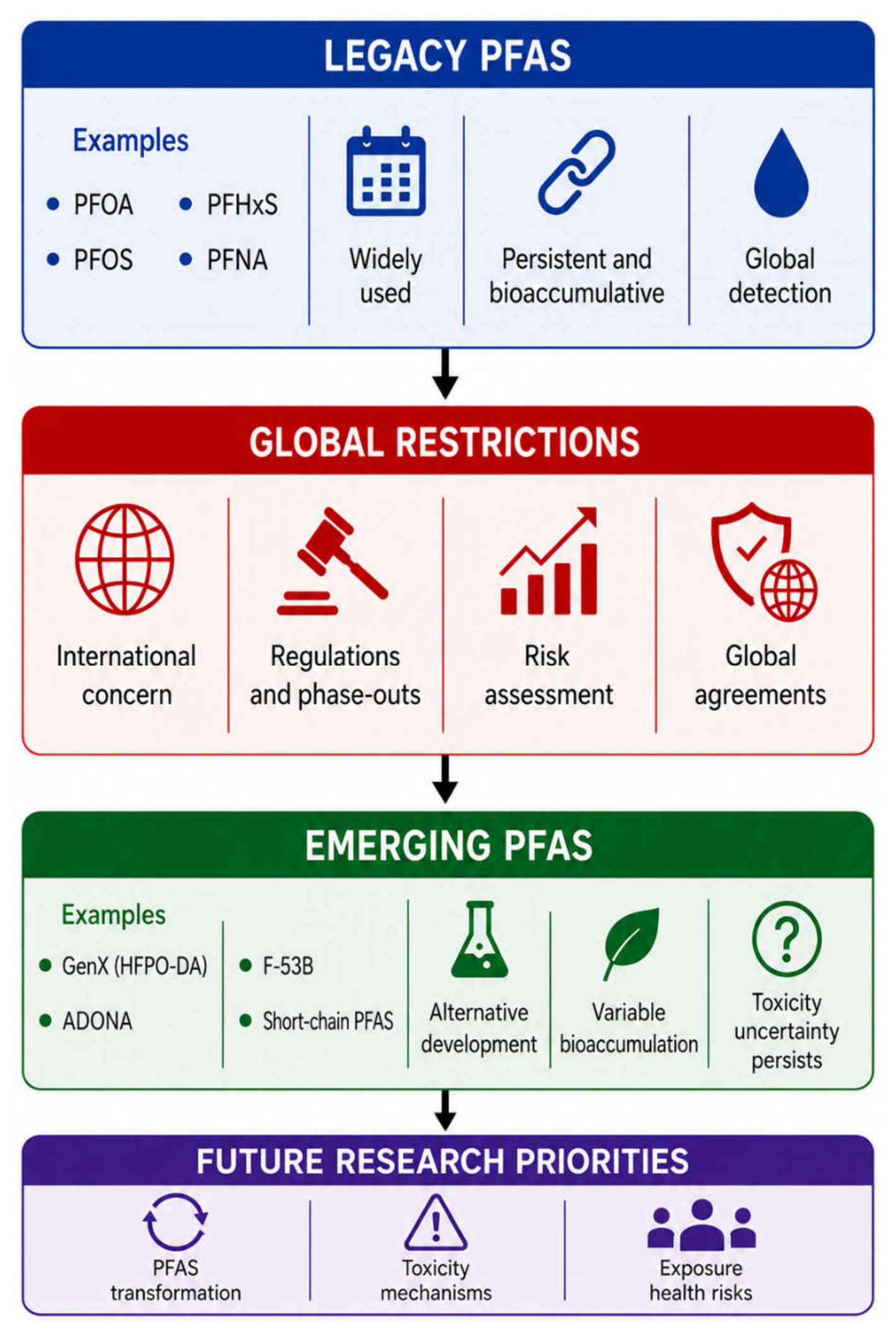
Figure 2.
Integrated conceptual framework illustrating the continuum from PFAS environmental contamination to human health risk assessment and regulatory action. The framework synthesises the interconnected processes linking industrial PFAS sources, environmental distribution, human exposure pathways, internal dose, biomonitoring, adverse health outcomes, risk assessment, and regulatory decision-making.
Figure 2.
Integrated conceptual framework illustrating the continuum from PFAS environmental contamination to human health risk assessment and regulatory action. The framework synthesises the interconnected processes linking industrial PFAS sources, environmental distribution, human exposure pathways, internal dose, biomonitoring, adverse health outcomes, risk assessment, and regulatory decision-making.
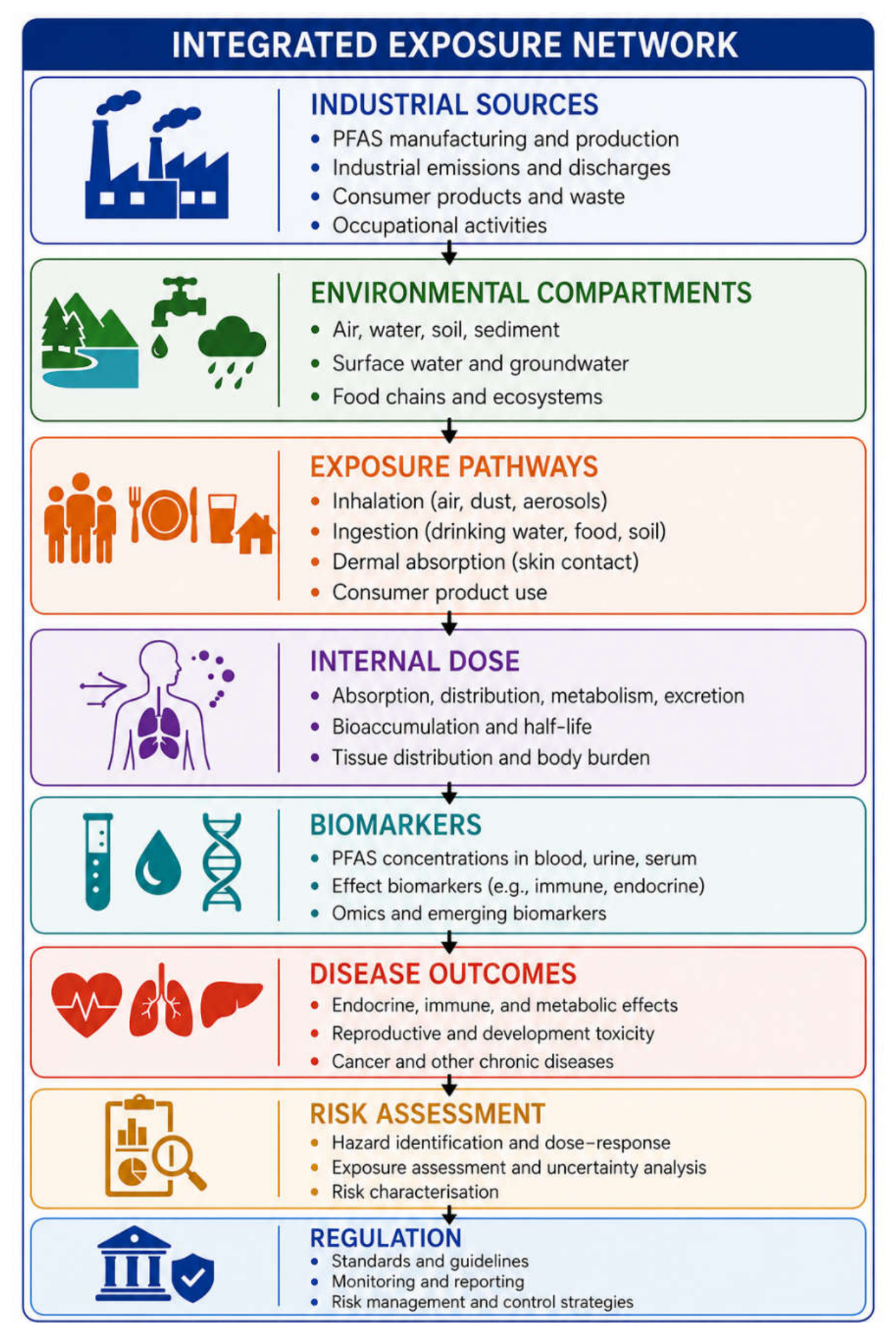
Figure 3.
Integrated framework linking PFAS environmental contamination, human exposure, toxicokinetic processes, biological responses, and evidence-based policy development. Environmental contamination generates multiple exposure pathways that produce internal exposure, initiating molecular and cellular toxicity mechanisms.
Figure 3.
Integrated framework linking PFAS environmental contamination, human exposure, toxicokinetic processes, biological responses, and evidence-based policy development. Environmental contamination generates multiple exposure pathways that produce internal exposure, initiating molecular and cellular toxicity mechanisms.
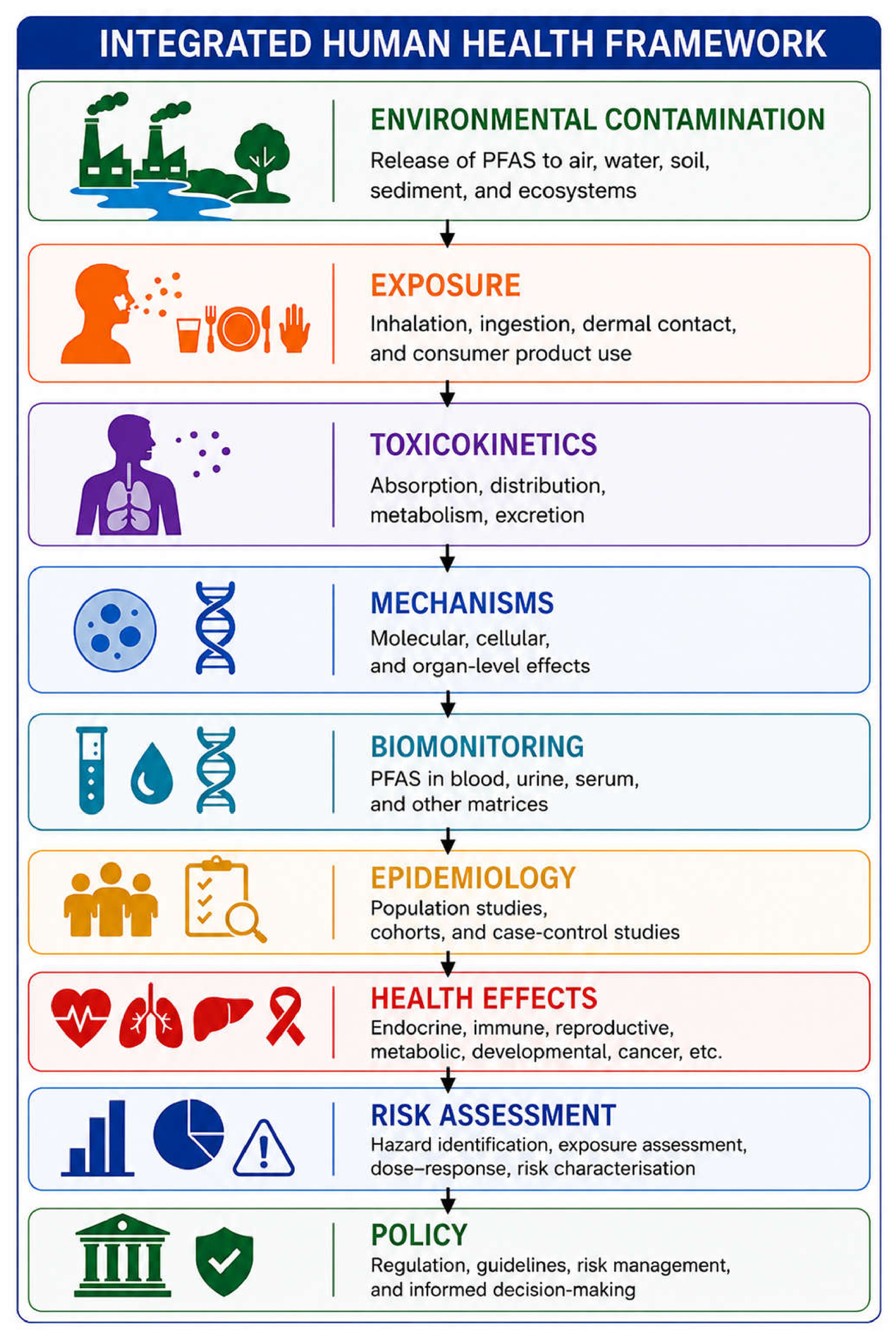
Figure 4.
Relative importance of the principal human PFAS exposure pathways. Drinking water is the dominant exposure route in contaminated communities, followed by dietary intake. Indoor exposure is of moderate importance, whereas occupational exposure, consumer products, and maternal transfer are more significant for specific populations. Relative importance varies with PFAS type, geography, population characteristics, and contamination scenario.
Figure 4.
Relative importance of the principal human PFAS exposure pathways. Drinking water is the dominant exposure route in contaminated communities, followed by dietary intake. Indoor exposure is of moderate importance, whereas occupational exposure, consumer products, and maternal transfer are more significant for specific populations. Relative importance varies with PFAS type, geography, population characteristics, and contamination scenario.
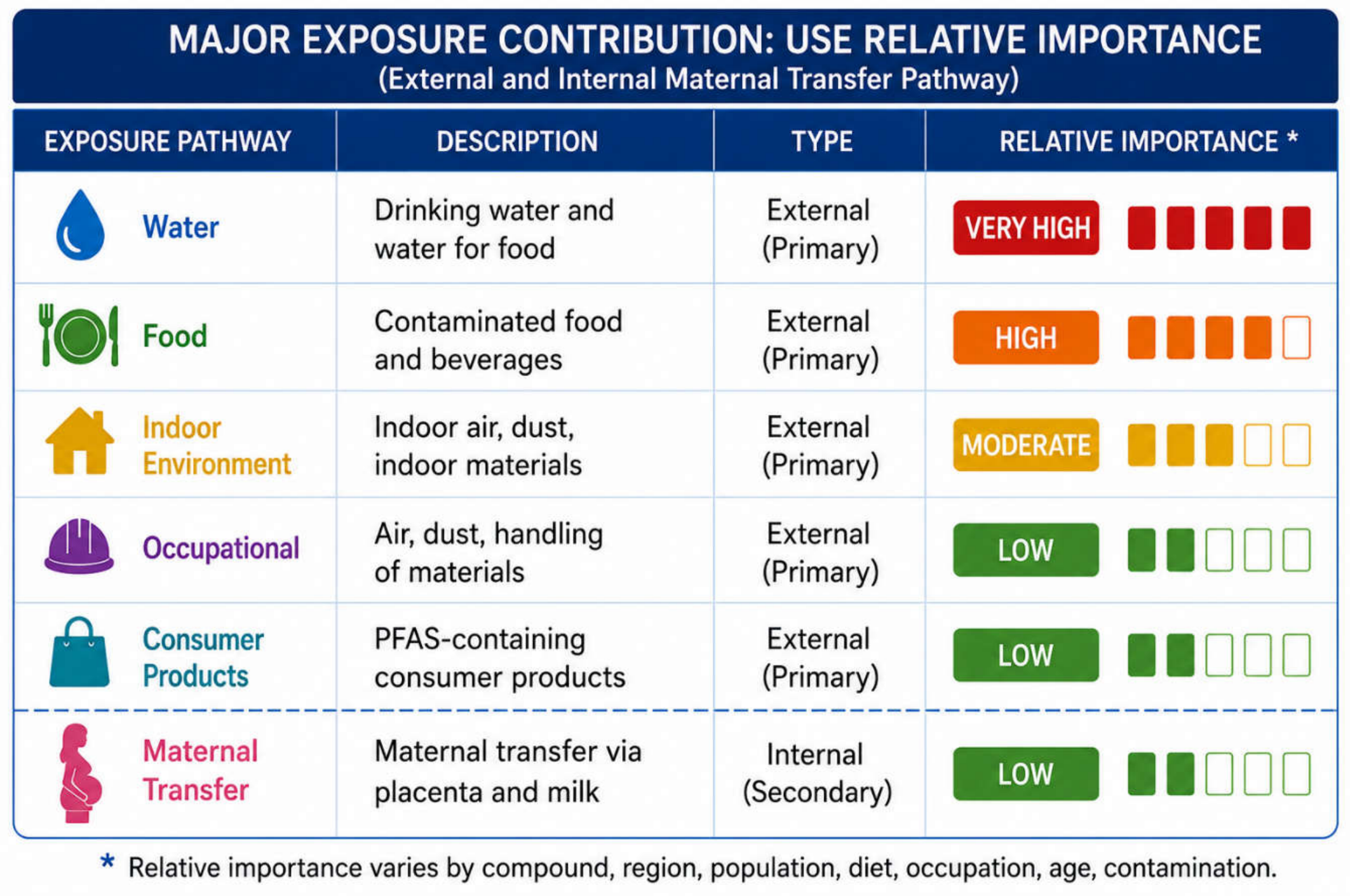
Figure 5.
Life-course framework illustrating major PFAS exposure pathways, principal health outcomes, and commonly used biomarkers across different stages of human development. Human exposure to PFAS begins during prenatal development through placental transfer and continues throughout life via dietary intake, drinking water, indoor environments, consumer products, and occupational activities.
Figure 5.
Life-course framework illustrating major PFAS exposure pathways, principal health outcomes, and commonly used biomarkers across different stages of human development. Human exposure to PFAS begins during prenatal development through placental transfer and continues throughout life via dietary intake, drinking water, indoor environments, consumer products, and occupational activities.
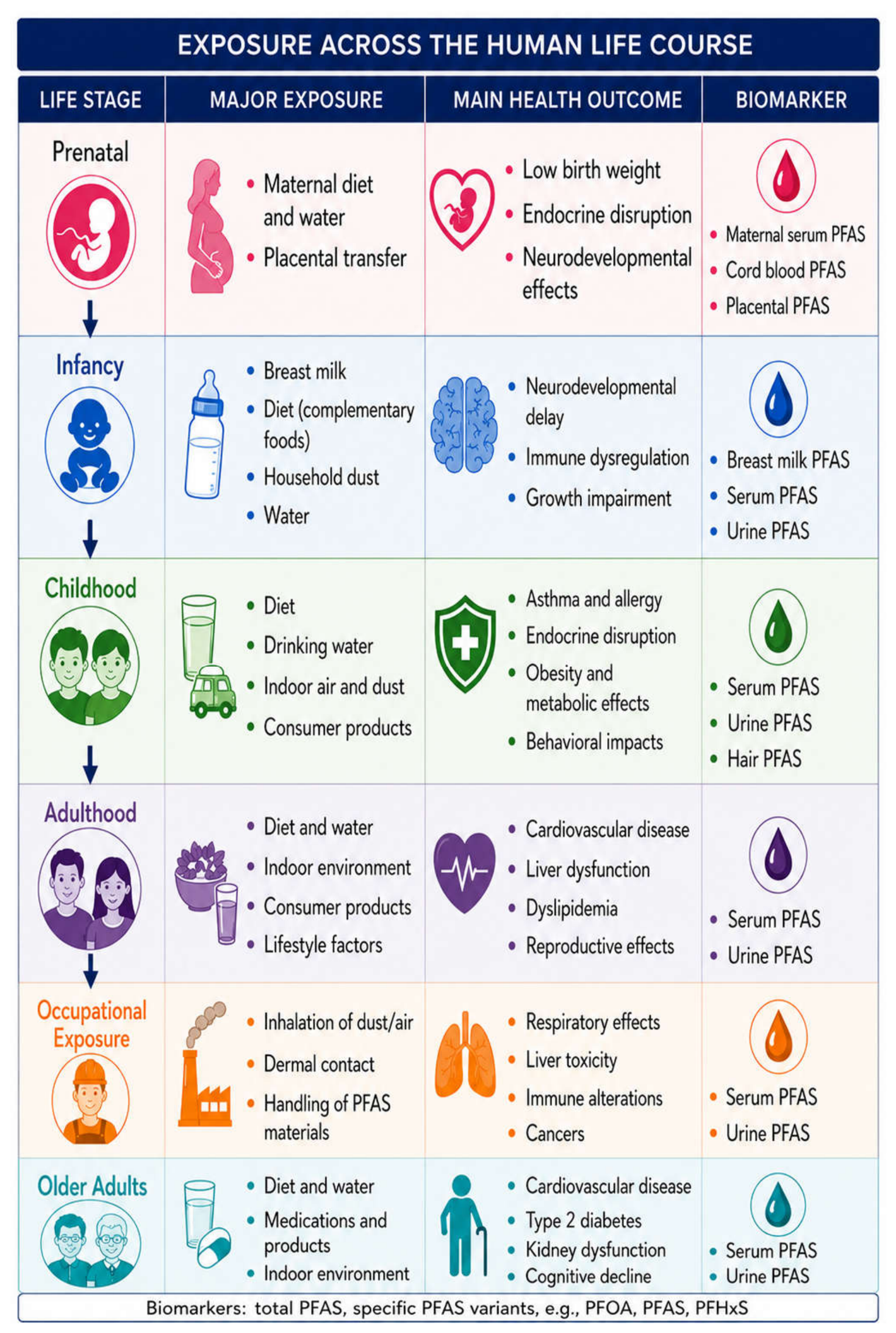
Figure 6.
Integrated toxicokinetic-biomonitoring framework for PFAS, illustrating the progression from external exposure through internal distribution, target organs, maternal transfer pathways, biomonitoring matrices, and health interpretation. The framework links major exposure sources with toxicokinetic processes, including absorption, systemic distribution, hepatic accumulation, renal handling, placental transfer, and secretion into breast milk.
Figure 6.
Integrated toxicokinetic-biomonitoring framework for PFAS, illustrating the progression from external exposure through internal distribution, target organs, maternal transfer pathways, biomonitoring matrices, and health interpretation. The framework links major exposure sources with toxicokinetic processes, including absorption, systemic distribution, hepatic accumulation, renal handling, placental transfer, and secretion into breast milk.
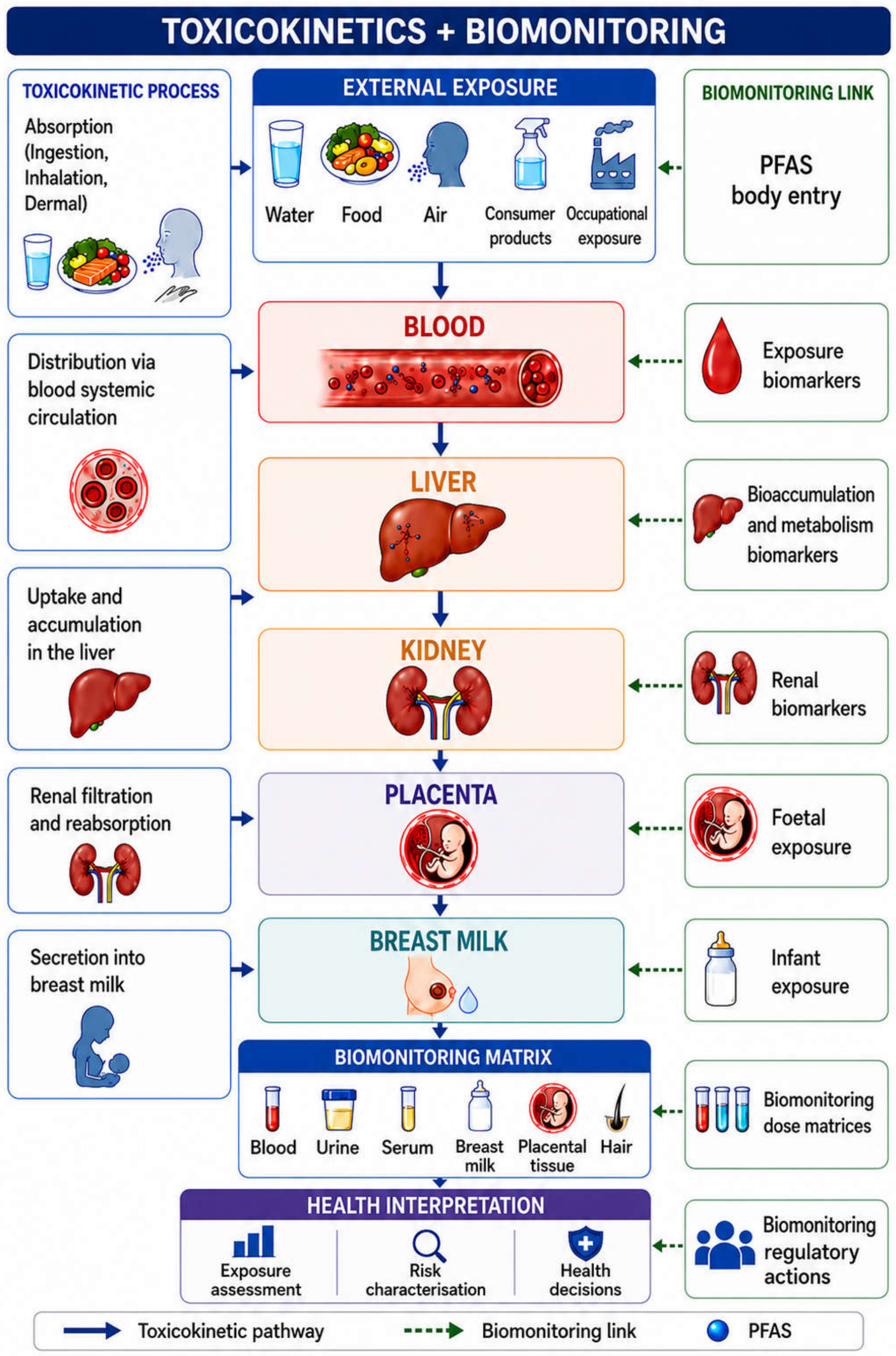
Figure 7.
Integrated conceptual framework of the molecular mechanisms underlying PFAS toxicity. Following exposure through drinking water, food, inhalation, and dermal contact, PFAS initiate multiple interconnected molecular mechanisms, including oxidative stress, endocrine disruption, peroxisome proliferator-activated receptor activation, mitochondrial dysfunction, and immune dysregulation. These processes contribute to cellular damage, including DNA damage, protein alteration, lipid peroxidation, cell death, and inflammation, ultimately resulting in organ toxicity affecting the liver, kidney, lungs, brain, heart, and reproductive system.
Figure 7.
Integrated conceptual framework of the molecular mechanisms underlying PFAS toxicity. Following exposure through drinking water, food, inhalation, and dermal contact, PFAS initiate multiple interconnected molecular mechanisms, including oxidative stress, endocrine disruption, peroxisome proliferator-activated receptor activation, mitochondrial dysfunction, and immune dysregulation. These processes contribute to cellular damage, including DNA damage, protein alteration, lipid peroxidation, cell death, and inflammation, ultimately resulting in organ toxicity affecting the liver, kidney, lungs, brain, heart, and reproductive system.
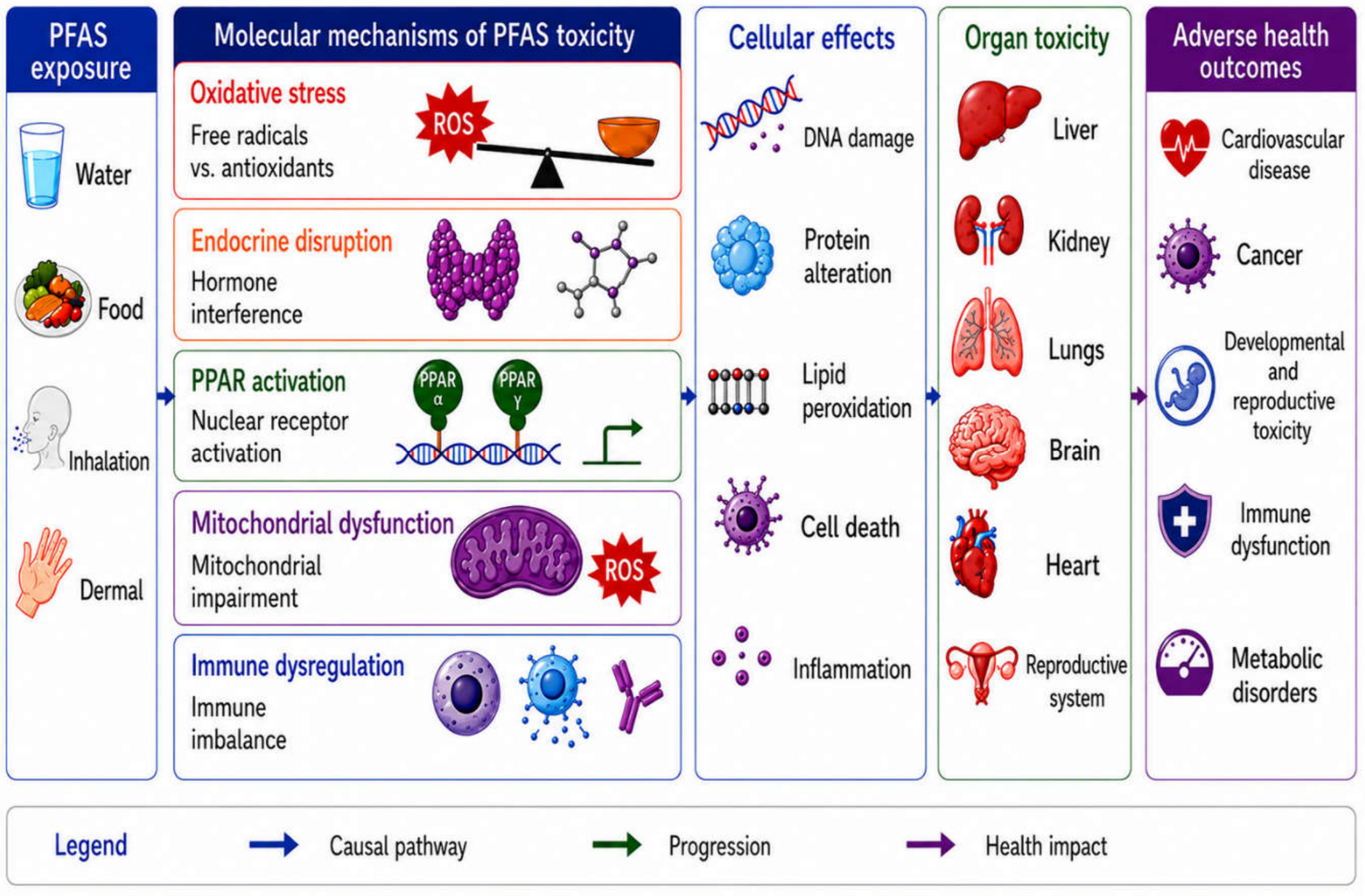

Table 1.
Major determinants influencing inter-individual variability in PFAS toxicokinetics.
| Determinant | Influence on PFAS toxicokinetics |
|---|---|
| Age | Alters renal clearance and body burden |
| Sex | Differences in elimination through menstruation, pregnancy, and lactation |
| Pregnancy | Placental transfer and haemodynamic changes |
| Lactation | Elimination through breast milk |
| Renal function | Reduced filtration and clearance increase serum PFAS |
| Renal transporter activity | OAT1/OAT3, OATPs, URAT1 regulate tubular reabsorption |
| Albumin binding | Strong protein binding prolongs biological half-life |
| Isomer profile | Linear and branched isomers differ in distribution and elimination |
| Exposure history | Historical and cumulative exposure influence body burden |
| PFAS subclass | Compound-specific persistence and elimination vary substantially |
Abbreviations: PFAS, per- and polyfluoroalkyl substances; OAT1, organic anion transporter 1; OAT3, organic anion transporter 3; OATPs, organic anion transporting polypeptides; URAT1, urate transporter 1.
Table 2.
Representative PFAS concentrations reported in human biomonitoring studies across different populations.
Table 2.
Representative PFAS concentrations reported in human biomonitoring studies across different populations.
| Population | Typical PFOS/PFOA concentrations |
Matrix | Major exposure source |
Trend | Representative References |
|---|---|---|---|---|---|
| General population |
Low ng mL⁻¹ | Serum/plasma | Diet, drinking water | Declining legacy PFAS | [22,23] |
| Contaminated communities |
Several-fold higher | Serum | Drinking-water contamination | Variable | [25] |
| Occupational workers | Highest reported concentrations | Serum | Manufacturing, firefighting | Exposure-dependent | [21,26] |
| Pregnant women | Generally lower than workers but detectable | Maternal serum, cord blood | Environmental exposure | Persistent transfer | [27,28] |
| Children | Detectable serum concentrations | Serum | Dust, diet, maternal transfer | Age-dependent | [23,29] |
Abbreviations: PFOS, perfluorooctane sulphonate; PFOA, perfluorooctanoic acid; ng mL-1, nanograms per millilitre; PFAS, per- and polyfluoroalkyl substances.
Table 3.
Comparison of representative recent review articles on per- and polyfluoroalkyl substances (PFAS) and the unique contribution of the present review.
Table 3.
Comparison of representative recent review articles on per- and polyfluoroalkyl substances (PFAS) and the unique contribution of the present review.
| Review Category |
Primary Focus | Main Limitations | How the Present Review Advances the Field |
|---|---|---|---|
| Environmental occurrence review |
Sources, occurrence, environmental fate and transport | Limited discussion of human exposure, toxicokinetics and health outcomes | Integrates environmental contamination, human exposure pathways, and health risk assessment. |
| Toxicology reviews |
Molecular and cellular mechanisms of PFAS toxicity | Limited biomonitoring, epidemiological interpretation and regulatory perspective | Links mechanistic toxicology with biomonitoring, epidemiological evidence and risk assessment. |
| Regulatory reviews |
Regulations, guidelines and risk management | Limited integration with exposure science and biomonitoring evidence | Connects exposure science, biomonitoring, toxicology and evolving regulatory frameworks. |
| Biomonitoring reviews | Human biomonitoring and exposure assessment | Limited mechanistic interpretation and toxicokinetic context | Integrates biomonitoring with toxicokinetics, molecular toxicity and health outcomes. |
| Epidemiological reviews | Associations between PFAS exposure and disease | Limited mechanistic explanation and exposure characterisation |
Interprets epidemiological findings within the context of toxicokinetics and molecular mechanisms. |
| Present review | Human exposure pathways, toxicokinetics, molecular mechanisms, biomonitoring, epidemiology and health-risk assessment | Not applicable | Integrated synthesis: advances in exposomics, PBPK modelling, HRMS, AI-assisted exposure analysis, emerging PFAS; gaps identified, priorities proposed. |
Abbreviations: PFAS, per- and polyfluoroalkyl substances; PBPK, physiologically based pharmacokinetic; HRMS, high-resolution mass spectrometry; AI, artificial intelligence.
Table 4.
Comparison of representative legacy and emerging per- and polyfluoroalkyl substances (PFAS): environmental characteristics, toxicological evidence, regulatory status, and key research needs.
Table 4.
Comparison of representative legacy and emerging per- and polyfluoroalkyl substances (PFAS): environmental characteristics, toxicological evidence, regulatory status, and key research needs.
| Legacy PFAS | Emerging PFAS |
|---|---|
| PFOA | GenX |
| PFOS | ADONA |
| Long half-life | Shorter but uncertain |
| Extensive epidemiology | Limited evidence |
| Regulated globally | Regulations still evolving |
| Mechanisms well established | Mechanisms poorly understood |
Abbreviations: PFAS, per- and polyfluoroalkyl substances; PFOA, perfluorooctanoic acid; PFOS, perfluorooctane sulphonate; PFHxS, perfluorohexane sulphonate; PFNA, perfluorononanoic acid; HFPO-DA, hexafluoropropylene oxide dimer acid (GenX); ADONA, 4,8-dioxa-3H-perfluorononanoic acid; PBPK, physiologically based pharmacokinetic.
Table 5.
Major human exposure pathways to PFAS and associated exposure significance.
| Exposure Pathway | Major Sources | Population Groups | Relative Exposure Importance | Key References |
|---|---|---|---|---|
|
Drinking Water |
Municipal supplies, private wells, contaminated groundwater | General population, contaminated communities |
Very High | [21,44,57] |
| Diet | Fish, seafood, meat, dairy products, crops, food packaging |
General population | Very High | [21,38,61] |
|
Indoor Exposure |
Household dust, carpets, furniture, textiles, consumer products | Children, urban populations | Moderate-High | [40,62] |
|
Occupational Exposure |
Firefighting foams, fluorochemical manufacturing, waste management |
Firefighters, industrial workers, waste-management personnel | High (occupational groups) | [64,65,66] |
| Maternal Transfer | Placental transfer, breastfeeding | Fetuses, infants, young children | High (early-life exposure) |
[32,33] |
| Consumer Products | Cosmetics, cookware, textiles, food-contact materials |
General population | Moderate | [40,62] |
| Indoor Air | Household materials, treated textiles, dust resuspension | General population | Low-Moderate | [40,62] |
Table 6.
Representative PFAS concentration ranges in major environmental media and exposure sources. Values compiled from international monitoring studies illustrate variability in PFAS contamination across environmental media and vary with geographical region, contamination source, environmental conditions, analytical methodology, and PFAS congeners investigated.
Table 6.
Representative PFAS concentration ranges in major environmental media and exposure sources. Values compiled from international monitoring studies illustrate variability in PFAS contamination across environmental media and vary with geographical region, contamination source, environmental conditions, analytical methodology, and PFAS congeners investigated.
| Medium | Typical concentration range |
Units | Main sources | Key References |
|---|---|---|---|---|
| Surface water | <10-500+ | ng L-1 | Rivers, lakes, wastewater-impacted waters | [27,53] |
| Drinking water | <10-1000+ | ng L-1 | Municipal supplies, contaminated groundwater | [27,58] |
| Indoor dust | 10-10,000 | ng g-1 | Homes, offices, treated materials | [62,63] |
| Seafood/Fish | 10-1000+ | µg kg-1 (wet weight) | Bioaccumulation in aquatic food webs | [29,53] |
| Meat/Dairy/Eggs | <1-100 | µg kg-1 | Feed, water, agricultural contamination | [27,29] |
Abbreviations: PFAS, per- and polyfluoroalkyl substances; ng L-1, nanograms per litre; ng g-1, nanograms per gram; µg kg-1, micrograms per kilogram (wet weight).
Table 7.
Comparative toxicokinetic characteristics of representative long-chain, short-chain, and replacement PFAS compounds. Values are representative ranges compiled from human biomonitoring studies and toxicokinetic investigations and may vary among populations and study designs [26,30].
| PFAS | Carbon chain | Protein binding | Bioaccumulation | Main target tissues | Approximate human half-life | Main elimination |
|---|---|---|---|---|---|---|
| PFOS | Eight-carbon sulphonate (C8) | Very high | Very high | Blood, liver, kidney | ~5.4 years | Renal excretion (extensive reabsorption) |
| PFOA | Eight-carbon carboxylate (C8) | High | High | Blood, liver, kidney | ~2-4 years | Renal excretion |
| PFHxS | Six-carbon sulphonate (C6) | Very high | High | Blood, liver | ~7-8 years | Slow renal elimination |
| GenX | HFPO-DA | Moderate | Low to moderate | Liver, kidney | Days to weeks (animal studies; human data remain limited) | Rapid renal clearance |
| 8:2 FTOH | Precursor | Low | Low | Short | Biotransformed to terminal PFAAs | Metabolism and excretion |
Abbreviations: 8:2 FTOH, 8:2 fluorotelomer alcohol; PFAS, per- and polyfluoroalkyl substances; PFOS, perfluorooctane sulphonate; PFOA, perfluorooctanoic acid; PFHxS, perfluorohexane sulphonate; GenX (HFPO-DA), hexafluoropropylene oxide dimer acid.
Table 8.
Summary of evidence supporting major immunotoxic effects associated with PFAS exposure.
| Immunological outcome | Evidence strength | Primary evidence source | Representative PFAS | Relevance to human health |
|---|---|---|---|---|
| Reduced vaccine antibody responses | Strong | Human epidemiological studies | PFOS, PFOA | Most consistent evidence of PFAS immunotoxicity in humans |
| Clinical susceptibility to infection | Moderate | Epidemiological studies | PFOS, PFOA | Associations reported but less consistent |
| Altered immune-cell function | Moderate | In vitro and animal studies | PFOS, PFOA, PFHxS | Demonstrates mechanistic effects but limited direct clinical evidence |
| Experimental immunological endpoints (cytokine production, spleen/thymus alterations, antibody production) | Moderate-Strong (experimental) | Animal and in vitro studies | PFOS, PFOA, emerging PFAS | Supports biological plausibility but human relevance requires cautious interpretation |
Abbreviations: PFAS, per- and polyfluoroalkyl substances; PFOS, perfluorooctane sulphonate; PFOA, perfluorooctanoic acid; PFHxS, perfluorohexane sulphonate; in vitro, experimental studies performed outside a living organism using isolated cells, tissues, or biological systems.
Table 9.
Representative examples of combined toxic effects reported following co-exposure to PFAS and other environmental contaminants.
Table 9.
Representative examples of combined toxic effects reported following co-exposure to PFAS and other environmental contaminants.
| Co-contaminant | Principal shared mechanisms | Reported effects | Implications |
|---|---|---|---|
| Heavy metals (Cd, Pb, As) | Oxidative stress, inflammation | Enhanced liver and kidney toxicity | Increased cumulative toxicity |
| Microplastics | Altered bioavailability and transport | Greater tissue accumulation |
Modified PFAS uptake |
| BPA | Endocrine disruption | Hormonal imbalance | Greater reproductive toxicity |
| Phthalates | Nuclear receptor signalling | Metabolic and developmental effects | Additive endocrine effects |
| POPs (e.g., PCBs, dioxins) | Aryl hydrocarbon receptor and oxidative stress pathways | Enhanced immunotoxicity and hepatotoxicity |
Complex mixture interactions |
Abbreviations: PFAS, per- and polyfluoroalkyl substances; Cd, cadmium; Pb, lead; As, arsenic; BPA, bisphenol A; POPs, persistent organic pollutants; PCBs, polychlorinated biphenyls; AhR, aryl hydrocarbon receptor.
Table 10.
Comparison of the toxicological characteristics of representative legacy and emerging PFAS compounds. The table summarises major differences in persistence, bioaccumulation, molecular mechanisms, target organs, and current toxicological evidence [5,29,30,85].
| Biological Matrix Category | Primary Application | Advantages |
|---|---|---|
| Environmental persistence | Very high | Moderate to high (compound-dependent) |
| Human bioaccumulation | High | Generally lower |
| Human biological half-life | Years | Days to months (limited human data) |
| Protein binding | Very high | Moderate to high |
| Major target organs | Liver, kidney, immune system, endocrine organs | Liver, kidney, endocrine system |
| Principal molecular mechanisms | Oxidative stress, PPAR activation, endocrine disruption, mitochondrial dysfunction, immune dysregulation | Similar pathways reported; evidence still emerging |
| Human epidemiological evidence | Extensive | Limited |
| Experimental animal evidence | Extensive | Increasing |
| Regulatory status | Widely restricted | Under active evaluation |
| Major uncertainty | Long-term cumulative exposure | Limited chronic toxicity and epidemiological data |
Table 11.
Representative evidence supporting major toxicological mechanisms reported for selected PFAS compounds.
Table 11.
Representative evidence supporting major toxicological mechanisms reported for selected PFAS compounds.
| PFAS | Major molecular mechanisms | Experimental model | Representative exposure concentration/dose | Relevance to environmentally observed human exposure |
|---|---|---|---|---|
| PFOS | Oxidative stress; immunotoxicity; PPARα activation (strong evidence, predominantly rodent studies) | Human hepatocytes; mice | Mostly µM concentrations; animal mg kg⁻¹ doses | Strong mechanistic evidence; rodent PPARα responses may overestimate human effects |
| PFOA | Endocrine disruption; oxidative stress; mitochondrial dysfunction; PPARα activation (well established in rodents) | HepG2 cells; rodents | µM concentrations; sub-chronic animal studies | Strong evidence; human epidemiological support, but human PPARα relevance remains uncertain |
| PFHxS | Thyroid disruption; immune effects; limited evidence for PPARα activation | Rodent studies; limited human data | Moderate experimental doses | Limited evidence; environmentally relevant human evidence emerging |
| PFNA | Hepatic lipid metabolism; oxidative stress; possible PPARα involvement | Mouse liver models | Experimental animal doses | Moderate evidence; limited human mechanistic data |
| HFPO-DA (GenX) | Hepatotoxicity; oxidative stress; possible PPAR signalling (compound-specific evidence remains limited) | Rodent models; liver cell lines | Experimental animal doses | Emerging evidence; human relevance remains uncertain |
| ADONA | Limited mechanistic evidence; PPARα involvement not established | In vitro; animal studies | High experimental concentrations | Insufficient evidence |
| F-53B | Oxidative stress; developmental toxicity; PPARα involvement uncertain | Zebrafish; rodent models | Experimental concentrations | Limited evidence; human data lacking |
Abbreviations: PFAS, per- and polyfluoroalkyl substances; PFOS, perfluorooctane sulphonate; PFOA, perfluorooctanoic acid; PFHxS, perfluorohexane sulphonate; PFNA, perfluorononanoic acid; HFPO-DA, hexafluoropropylene oxide dimer acid (commercially known as GenX); ADONA, 4,8-dioxa-3H-perfluorononanoic acid; F-53B, chlorinated polyfluoroether sulphonate; PPAR, peroxisome proliferator-activated receptor; HepG2, human hepatocellular carcinoma cell line; µM, micromolar; mg kg-1, milligrams per kilogram; in vitro, experimental studies performed outside a living organism using isolated cells or tissues. .
Table 12.
Common biological matrices used in PFAS biomonitoring and their applications.
| Biological Matrix Category | Primary Application | Advantages | Limitations | Key References |
|---|---|---|---|---|
|
Blood-Based Matrices (Serum, Plasma, Whole Blood) |
Assessment of cumulative PFAS exposure, body burden determination, epidemiological studies, and health-risk assessment |
Validated matrices reflect long-term exposure datasets |
Require invasive sampling; may not reflect recent exposure fluctuations |
[21,30,92] |
| Urine | Assessment of elimination processes and selected short-chain PFAS compounds | Non-invasive collection; suitable for repeated sampling and toxicokinetic studies |
Low long-chain PFAS concentrations, unrepresentative |
[30,35] |
|
Maternal and Infant Matrices (Breast Milk, Cord Blood, Placenta) |
Evaluation of prenatal, foetal, and early-life exposure; assessment of maternal transfer pathways | Provides information on vulnerable populations and transplacental or lactational transfer |
Limited data; concentrations vary physiologically | [8,95] |
|
Alternative Exposure Matrices (Hair, Nails, Deciduous Teeth) |
Retrospective and long-term exposure assessment; emerging biomonitoring applications | Non-invasive collection; easy storage and transport; useful for historical exposure reconstruction |
Limited standardisation and validation; potential external contamination issues |
[32] |
Table 13.
Representative epidemiological studies evaluating associations between PFAS exposure and adverse human health outcomes. The table summarises the study population, geographical location, study design, exposure assessment approach, principal health outcomes, and consideration of confounding factors in selected human studies.
Table 13.
Representative epidemiological studies evaluating associations between PFAS exposure and adverse human health outcomes. The table summarises the study population, geographical location, study design, exposure assessment approach, principal health outcomes, and consideration of confounding factors in selected human studies.
| Health Outcome | Country/ Region |
Study population |
Study design |
Exposure assessment |
Confounding control | Principal finding |
|---|---|---|---|---|---|---|
| Hepatic effects | South Korea | Adults | Cross-sectional | Serum PFAS | Age, sex, BMI, smoking, alcohol | PFAS associated with altered liver enzymes |
| Renal effects | USA | Adults | Cohort | Serum PFAS | Demographic and lifestyle factors | Reduced kidney function associated with PFAS |
| Cardiovascular disease | Sweden | Community cohort | Prospective cohort | Serum PFAS | Multiple covariates | Positive association with dyslipidaemia |
| Reproductive effects |
Denmark | Mother-child cohort | Birth cohort | Maternal serum PFAS | Maternal age, parity, smoking | Reduced birth weight and developmental effects |
| Immune effects | USA | Children | Prospective cohort | Serum PFAS | Vaccination status, age, sex | Reduced vaccine antibody response |
Abbreviations: BMI, body mass index; PFAS, per- and polyfluoroalkyl substances; USA, United States of America.
Table 14.
Summary of documented PFAS-associated health effects and supporting evidence.
| Health Category | Representative PFAS | Representative effects |
Overall weight of evidence |
Principal limitations |
Key References |
|---|---|---|---|---|---|
| Cancer | PFOA (strongest evidence); PFOS | Kidney and testicular cancer | Strong (PFOA); limited for other PFAS and cancer sites | Evidence strongest for selected cancers | [77] |
| Endocrine and metabolic |
PFOS, PFOA, PFHxS | Thyroid dysfunction, obesity, diabetes | Moderate-Strong | Compound-specific variability | [73,99] |
| Reproductive and developmental |
PFOS, PFOA | Reduced fertility, adverse pregnancy outcomes, reduced birth weight | Strong | Prenatal exposure predominates | [57,101] |
| Immune | PFOS, PFOA | Reduced vaccine antibody response | Strong | Strongest evidence relates to childhood vaccination | [29,102] |
| Cardiovascular | PFOS, PFOA | Dyslipidaemia, hypertension | Moderate-Strong | Mostly observational studies | [8,57] |
| Hepatic and renal | PFOS, PFOA, PFNA | Liver injury, NAFLD, renal dysfunction | Moderate-Strong | Reverse causation possible for renal outcomes | [30,35] |
| Neurological | PFOS, PFOA | Neurodevelopment, cognition | Moderate | Human evidence strongest for prenatal exposure; adult evidence inconsistent | [8,32] |
| Emerging health concerns |
Legacy and emerging PFAS | Respiratory, bone, gut microbiota, ageing | Emerging | Limited human evidence | [93] |
Abbreviations: PFAS, per- and polyfluoroalkyl substances; PFOA, perfluorooctanoic acid; PFOS, perfluorooctane sulphonate; PFHxS, perfluorohexane sulphonate; PFNA, perfluorononanoic acid; NAFLD, non-alcoholic fatty liver disease.
Table 15.
Comparison of principal approaches used for PFAS mixture risk assessment.
| Approach | Underlying assumption | Strengths | Limitations | Regulatory Use |
|---|---|---|---|---|
| Dose Addition (DA) | Similar mechanism of action; additive toxicity | Well supported experimentally; suitable for PFAS with shared modes of action | Does not account for true synergism or antagonism | Widely used |
| Hazard Index (HI) | Risks from individual PFAS are additive | Simple; practical for regulatory decision-making | Sensitive to uncertainty in individual reference values | U.S. EPA |
| Relative Potency Factor (RPF) | Toxicity expressed relative to a reference PFAS | Facilitates cumulative exposure assessment | Requires robust comparative toxicity data | Emerging |
| Component-Based Approach (CBA) | Overall toxicity predicted from individual components | Flexible; accommodates multiple compounds | Limited by data gaps for emerging PFAS | Increasing research use |
Abbreviations: PFAS, per- and polyfluoroalkyl substances; U.S. EPA, United States Environmental Protection Agency.
Table 16.
Comparison of international PFAS drinking-water guideline values, regulatory status, and regulatory approaches.
Table 16.
Comparison of international PFAS drinking-water guideline values, regulatory status, and regulatory approaches.
| Jurisdiction | Guideline / Regulatory Value | PFAS Covered | Regulatory status | Regulatory approach | Date verified | Key reference |
|---|---|---|---|---|---|---|
| United States | PFOA: 4 ng/L; PFOS: 4 ng/L; PFHxS: 10 ng/L; PFNA: 10 ng/L; HFPO-DA (GenX): 10 ng/L | Individual PFAS and mixtures | Enforceable PFAS MCLs under regulatory review | Compound-specific standards with Hazard Index for mixtures | July 2026 | [58] |
| European Union | 100 ng/L (Sum of 20 PFAS); 500 ng/L (Total PFAS) | Group-based PFAS | Legally binding parametric values under the Drinking Water Directive | Group-based regulatory approach | July 2026 | [122] |
| Canada | 30 ng/L (Sum of 25 PFAS) | Multiple PFAS | Health-based drinking-water guideline | Group-based cumulative exposure approach | July 2026 | [123] |
| Australia | PFOS: 8 ng/L; PFOA: 200 ng/L; PFHxS: 30 ng/L | Priority PFAS | Health-based drinking-water guideline | Compound-specific guideline values | July 2026 | [124] |
| Japan | 50 ng/L (PFOS + PFOA combined) | PFOS and PFOA | Provisional target value (non-enforceable) | Combined drinking-water target value | July 2026 | [32] |
| Asia-Pacific (general) | Varies among countries | Selected PFAS | Developing regulatory frameworks | Emerging national approaches | July 2026 | [32] |
Note: Regulatory status and drinking-water values were verified from the official publications of the respective regulatory authorities in July 2026. Because PFAS regulations continue to evolve rapidly, readers should consult the latest publications from the relevant agencies for the most current values and legal requirements. Abbreviations: HFPO-DA, hexafluoropropylene oxide dimer acid; MCLs, Maximum Contaminant Levels; PFAS, per- and polyfluoroalkyl substances; PFHxS, perfluorohexane sulphonate; PFNA, perfluorononanoic acid; PFOA, perfluorooctanoic acid; PFOS, perfluorooctane sulphonate.
Table 17.
Priority research needs for improving human PFAS exposure assessment and health risk.
| Research area | Priority exposure window/population |
Current state of evidence | Research priority |
|---|---|---|---|
| Prenatal exposure | Pregnancy, foetal development | Evidence exists, but developmental outcomes remain inconsistent | High |
| Infant exposure | Breastfeeding, infancy | Limited evidence for emerging PFAS | High |
| Early childhood | Children | Evidence exists, but neurodevelopmental findings remain inconsistent | High |
| Occupational exposure | Firefighters, fluorochemical workers |
Well documented for legacy PFAS; limited evidence for emerging PFAS | High |
| Chronic low-dose exposure | General population | Major data gap | High |
| PFAS mixture toxicity | All populations | Major data gap | High |
| Emerging PFAS | General population | Major data gap | High |
| Cardiometabolic disease | Adults | Evidence exists but remains inconsistent | Moderate-High |
| Cancer | Adults | Evidence varies by PFAS and cancer type | Moderate-High |
| Immune effects | All populations | Strong evidence for vaccine response; broader immune outcomes remain inconsistent | High |
Abbreviation: PFAS, per- and polyfluoroalkyl substances. .
Disclaimer/Publisher’s Note: The statements, opinions and data contained in all publications are solely those of the individual author(s) and contributor(s) and not of MDPI and/or the editor(s). MDPI and/or the editor(s) disclaim responsibility for any injury to people or property resulting from any ideas, methods, instructions or products referred to in the content. |
© 2026 by the authors. Licensee MDPI, Basel, Switzerland. This article is an open access article distributed under the terms and conditions of the Creative Commons Attribution (CC BY) license.
Copyright: This open access article is published under a Creative Commons CC BY 4.0 license, which permit the free download, distribution, and reuse, provided that the author and preprint are cited in any reuse.