

Submitted:
30 July 2026
Posted:
31 July 2026
You are already at the latest version
Abstract
To determine the reprocessing potential of mining liabilities, a comprehensive evaluation of the tailings deposit at the former Halcon mining unit in central Peru was conducted. Direct and indirect methods were employed, including geophysical surveys, sampling through six drill holes up to 9.62 meters deep, textural analysis, mineralogical characterization (optical microscopy, SEM, XRD, and reflectance spectroscopy), and ICP-MS chemical analysis, complemented by geostatistical modeling for resource estimation. Geochemical and mineralogical results reveal highly oxidizing, acidic conditions (pH 1.83–4.91) and significant concentrations of Zn (5.46%), Pb (1.58%), Cu (1.67%), Ag (244 ppm), and Au (3.6 ppm). These economic minerals predominate in fine-grained fractions with high degrees of liberation, favoring metallurgical recovery. Geostatistical modeling estimated a total tailings tonnage of 87,642 tons, highlighting zones of high localized economic potential, particularly for Zn and Ag. Considering specific recovery scenarios, penalties, operational costs, and metal prices, a net financial benefit of approximately US$11.35 million was projected. This pioneering study demonstrates the feasibility of converting environmental liabilities into economic assets through strategic reprocessing initiatives, contributing a robust model for mine tailings valorization within the South American circular economy framework.
Keywords:
mining tailings
; resource estimation
; mineralogical characterization
; geochemistry
; environmental liabilities
; circular economy
; Halcon mining unit
; central Peru
1. Introduction
Peru, with its long and prominent history of mining, currently faces the critical challenge of managing a substantial legacy of mining environmental liabilities (PAMs, by its acronym in Spanish) [1]. While these tailings deposits pose significant environmental risks due to acid rock drainage and heavy metal leaching, they also represent a largely untapped secondary source of valuable commodities [2]. According to the official regulatory inventory updated by the Peruvian Ministry of Energy and Mines (MINEM), there are over 6,026 registered PAMs nationwide, of which 295 correspond specifically to mining tailings subtypes, concentrated predominantly in historical mining regions such as Cajamarca, Pasco, Lima, Puno, and Ancash [1]. The former Halcón mining unit (EUM), located in the Cashapampa district of the Ancash region in central Peru, typifies this scenario. Its legacy tailings deposit, accumulated over past decades of intensive polymetallic operation (Figure 1), represents an ideal case study for a multidisciplinary assessment aimed at transforming an environmental liability into a quantified economic asset.
In the global scientific literature, researchers have increasingly turned to circular economy models to balance industrial waste exposure with environmental, social, and economic sustainability [3]. Recent advancements explore various approaches, including waste reuse, stabilization, and direct chemical reprocessing [3,4]. However, a clear divergence in hypotheses exists regarding the economic viability of old tailings. Traditional linear mining approaches often assume that legacy waste lacks sufficient grade or mineral liberation to justify the high operational costs of secondary metallurgical extraction [5]. Conversely, modern circular frameworks hypothesize that advanced fine-grained characterization coupled with precise spatial geostatistical modeling can isolate high-grade sweet spots, making selective reprocessing financially profitable while simultaneously reducing remediation costs [4,6]. This technological shift is particularly crucial today, as legacy polymetallic deposits frequently contain critical raw materials, base metals, and rare earth elements required for global green technology sectors [7].
To address this gap, this research provides a comprehensive geochemical, mineralogical, and geostatistical characterization of the legacy tailings at the former Halcón mining unit. The main aim of this work is to establish a robust resource estimation framework to delineate the spatial distribution of valuable metals and project their net financial recovery potential using direct borehole data and predictive geostatistical tools. Ultimately, this study demonstrates that the Halcón tailings deposit holds a substantial economic asset—estimating an attainable net profit of approximately US$11.35 million. These findings provide a pioneering blueprint for converting environmental liabilities into viable business opportunities, promoting a sustainable secondary mining model within the South American circular economy framework.
2. Site Location and Environmental Setting
The tailings from the former Halcon mining unit (EUM) are located on the left bank of the Pasacancha stream (Figure 1a), in the district of Cashapampa, province of Sihuas, Ancash region, central Peru, 635 km north of Lima. It is located at an altitude of 4,355 meters above sea level. It can be accessed by land via Huaraz or Chimbote, then crossing the Huarochiri bridge to the towns of Yanac, Tarica, and finally Pasacancha.
The climate in the study area is semi-arid temperate with marked seasonal rainfall, concentrated between October and April, with an average annual precipitation of 700 mm and an average temperature of 12 °C. The deposit is located in the Pasacancha River micro-basin, within the Alto Marañón V Interbasin, on the western flank of the Western Andes. The predominant landscape includes structural and erosional landforms, with mountains composed of sedimentary rocks and slopes with gradients of 25° to 45°.
3. Regional and Local Geological Setting
The legacy tailings deposit is directly situated over Quaternary alluvial and colluvial deposits. These surface deposits consist of poorly sorted, eroded matrix-supported materials derived from the weathering of shales and sandstones belonging to the Tinajones Formation of the Upper Jurassic Chicama Group. In the immediate vicinity of the deposit, particularly surrounding the localities of Pasacancha, Escalón, and El Águila, multiple stocks of monzonite and diorite outcrop. These calc-alkaline igneous bodies intruded the Mesozoic sedimentary sequence, structurally controlled by the regional NW–SE trending fault systems that characterize this Andean sector.
3.1. Stratigraphic and Lithological Framework
The Tinajones Formation outcrops extensively along the flanks of the Pasacancha River valley, displaying a dominant NW–SE structural strike. Lithologically, the unit is characterized by a rhythmic alternation of dark gray shales and carbonaceous black mudstones, interbedded with fine-grained, well-sorted quartz sandstone strata. The sedimentary layers exhibit steep dips ranging from 20° to 56°, tilting towards both the northeast and southwest, which delineates tight, map-scale folded structures such as anticlines and synclines oriented parallel to the regional tectonic trend.
In areas proximal to the environmental liabilities of the former Halcón mining unit, the shales and fine-grained sandstones of the Tinajones Formation exhibit pervasive signs of hydrothermal alteration. This alteration is macroscopically manifested by disseminated iron oxides and primary sulfides. Genetically, this hydrothermal overprint is linked to the shallow magmatic activity of the stocks outcropping approximately 500 meters away from the tailings beach. These stocks are composed of phaneritic, medium-grained monzonitic rocks that show high resistance to mechanical erosion. Locally, these intrusive centers are genetically linked to major polymetallic mineralization systems in the region, such as the El Águila and Magistral projects.
3.2. Structural Framework
The local geological structure is dominated by a complex system of low-angle reverse faults and tightly appressed, recumbent folds, both sharing a preferential NW–SE orientation. The regional Chonta fault system acts as the primary first-order structural control in the area. This regional architecture has generated tight, compressional folds (anticlines and synclines) with layers dipping predominantly toward the northeast (Figure 1a). Additionally, this major fault system played a fundamental role in creating the dilation zones necessary for the structural emplacement of the Miocene stocks.
3.3. Economic Geology
The study area is located within the prominent Miocene Metallogenic Belt of central Peru, a domain highly prospective for Cu–Mo–Au porphyry systems, Pb–Zn–Cu–Ag skarns, and polymetallic vein deposits genetically linked to intermediate intrusive bodies. In the Cashapampa district, the El Águila and Pasacancha mining projects represent the main metalliferous landmarks. El Águila is classified as a Cu–Mo porphyry deposit hosted in quartz sandstones of the Lower Cretaceous Chimú Formation. The intrusion of porphyritic dioritic and monzonitic bodies generated localized secondary biotite (potassic) alteration and sulfide mineralization that overprinted the sedimentary host rocks.
Conversely, in the Pasacancha sector, the mineralization corresponds to classic Ag–Pb–Zn polymetallic hydrothermal vein systems, which have been exploited on a small scale since the 1960s (Figure 1a). These structural veins are hosted within the shales and fine sandstones of the Tinajones Formation and are genetically related to the cooling of the monzonitic and dioritic stocks [8]. It is interpreted that these high-grade polymetallic veins mined in Pasacancha were the primary ore feed for the ancient flotation plant of the former Halcón mining unit. Consequently, the processing of this specific ore matrix generated the legacy waste that currently constitutes the studied tailings deposit, explaining its high residual base and precious metal concentrations.
4. Tailings Deposit Morphology and Textural Classification
The tailings deposit covers a surface area of approximately 8,342 m², displaying an elongated morphology along the valley floor (Figure 1b) and reaching a maximum vertical embankment height of 10 meters. To perform a systematic textural characterization of the stratified tailings material, the numerical coding system described by De La Cruz et al. [9] was implemented in the geochemical characterization study of soils in the Junín and Huancavelica regions. This methodology assigns a three-digit code where each digit sequentially represents the relative volumetric proportion of sand, silt, and clay. The scale ranges from 0 (absent), 1 (low: 0–25%), 2 (intermediate: 25–75%), to 3 (dominant: >75%). For instance, a numerical textural class defined as 211 corresponds to a matrix dominated by intermediate sand content alongside an intermediate proportion of silt, and a low clay content.
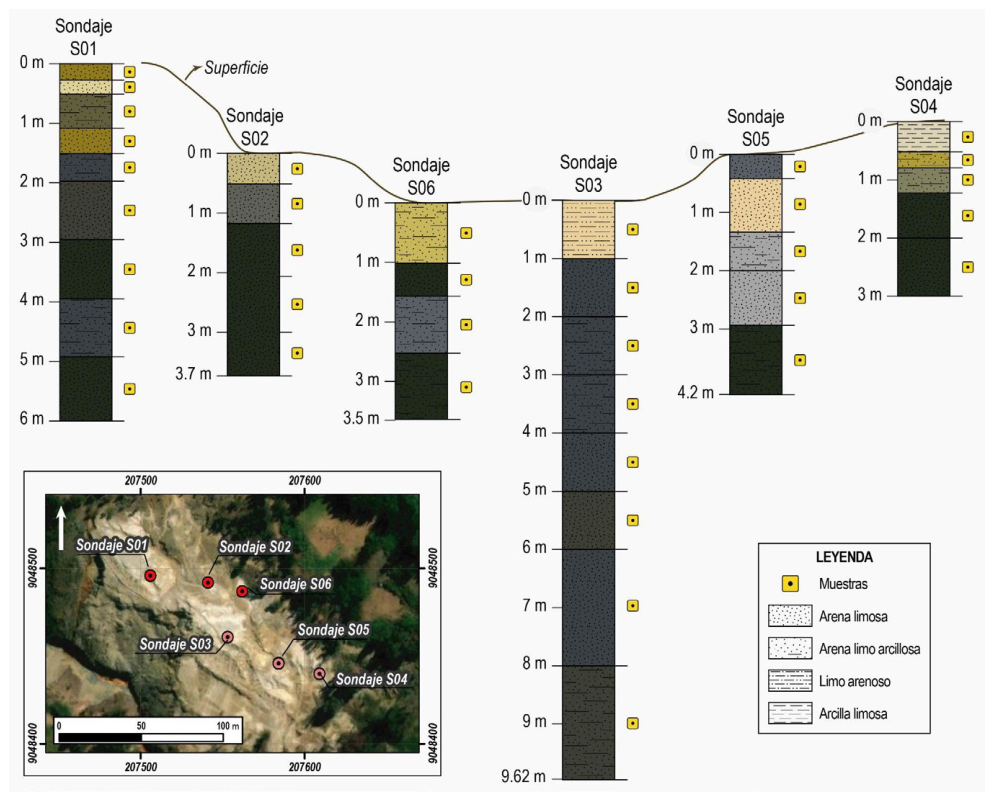
Applying this criteria, a strong predominance of sandy loam textures (coded as 310) was identified, accounting for 41% of the deposit, followed by sandy clay loam textures (coded as 211), which represent 28% of the total volume (Figure 1c and Figure 2). Minor facies consist of loam (121) and clay loam (112) textures, which together comprise 15% of the material. Spatially, the 310 textural facies is widely distributed across all vertical levels (surface, intermediate, and deep horizons) throughout the majority of the exploratory drill holes (Figure 1d). Conversely, the 121 and 112 textures are restricted to the upper surficial layers of drill holes S03 and S04, while the 211 class is highly representative of the deeper, unoxidized core levels of the deposit (Figure 2).
From a chromatic perspective, the core profiles reveal a well-defined vertical zoning (Figure 1c). The shallow surficial horizons exhibit lighter hues, including distinct yellows, dark browns, and light beige tones, which are directly associated with active supergene oxidation and environmental weathering. In contrast, the deeper, water-saturated strata display significantly darker colors—ranging from dark grays and greenish-browns—which are genetically related to pristine tailings possessing higher primary sulfide content (Figure 1d). Granulometric and sieve analyses classify the bulk of the processed material as fine sand, a physical characteristic that carries critical implications for the internal shear strength, liquefaction potential, and overall physical stability of the tailings structure.
5. Materials and Methods
5.1. Sample Collection
The characterization of the Halcón EUM tailings was based on a field campaign that included drilling, geological logging, and sampling. Six vertical boreholes were drilled using hydraulic, modular, and manual motor drill equipment, depending on the required depth (Figure 2).
Geological logging allowed for the recording of color, texture, mineralogy, and evidence of alteration, as well as the presence of carbonates through reaction to hydrochloric acid (HCl). Horizons were defined based on changes in hue, mineralogy, alteration, and texture. Colors were determined using the Munsell soil color chart [10].
For geochemical analysis, 37 representative samples were collected along the drilled boreholes, at regular intervals of 1 meter or per horizon, depending on the observed homogeneity. For quality assurance and control, 10 control samples were included: 4 blanks, 3 standards (medium grade), and 3 field duplicates. The samples were coded, packaged, and sent to the laboratory for analysis. In addition, samples were taken for mineralogical characterization. This methodology allowed for a detailed characterization of the deposit, both in terms of its physical and chemical properties and its vertical distribution, providing key information for its environmental assessment and potential exploitation
Figure 2.
Schematic profile of the boreholes.
5.2. Methodology
The study was developed using a comprehensive approach that combined direct and indirect methods, including surface sampling and drilling. This allowed four key aspects of the tailings deposit to be addressed: geophysical, physical (textural-granulometric), mineralogical, and geochemical characteristics. All this information was subsequently integrated to construct the geological model, estimate resources, and evaluate their potential for recovery. The general workflow followed in this research is summarized in Figure 3.
5.2.1. Chemical Analysis
The tailings samples were sent to the accredited SGS laboratory (Lima, Peru), in accordance with INACAL standard NTP-ISO/IEC 17025:2017. Multi-element quantification for 50 elements was conducted via multi-acid digestion followed by Inductively Coupled Plasma Mass Spectrometry (ICP-MS). Gold concentrations were determined by traditional fire assay followed by Atomic Absorption Spectroscopy (AAS). Rare earth elements (REEs) were solubilized using lithium metaborate fusion prior to ICP-MS analysis, whereas mercury (Hg) content was quantified via cold vapor atomic absorption.
5.2.2. Reflectance Spectrometry
For surface mineralogical identification, reflectance spectrometry was applied, a non-destructive technique that does not require prior sample preparation. Spectral measurements were performed on 16 samples using a Terraspec ASD Hi-Res 4 spectrometer, and the data obtained were processed with specialized TSG 8 software.
5.2.3. X-ray Diffraction
Complementary mineralogical characterization was carried out using X-ray diffraction (XRD) in the petromineralogy laboratory of the Geological, Mining and Metallurgical Institute (INGEMMET). This technique allowed the identification and quantification of crystalline phases present in the tailings samples obtained from the drill holes, although it does not detect amorphous components. The analysis was performed using a SHIMADZU XRD-7000 diffractometer using the powder method. Seven representative samples were selected for this study, considering their textural, physicochemical, and compositional variability, previously evaluated by X-ray fluorescence.
5.2.4. Scanning Electron Microscopy
Additionally, mineralogical studies and scanning electron microscopy (SEM) analyses were performed on four samples. Mineralogical characterization included macroscopic observations (color, shape, texture, grain size, magnetism, and reactivity with hydrochloric acid), as well as microscopic observations using reflected light polarization microscopy. The latter allowed the identification of metallic minerals, their forms of occurrence, and particle sizes. The study of the degree of liberation was based on the counting of individual grains, differentiating between free and mixed particles, to subsequently calculate the real percentages, volume by weight, and degree of liberation of each identified mineral.
5.2.5. X-ray energy Dispersive Spectroscopy
For scanning electron microscopy (SEM) analysis, high vacuum mode was used on conductive samples, employing secondary and backscattered electron detectors to obtain high-resolution images and compositional contrast. Qualitative and semi-quantitative chemical characterization was performed using X-ray energy dispersive spectroscopy (EDS), both at specific points and in compositional maps. This information complemented the mineralogical identification and provided further insight into the characterization of the mineral associations present.
5.2.6. Geostatistical Modeling
The valuation of the tailings from the former Halcon mining unit is a fundamental stage in this study, as it allows for the estimation of the economic potential associated with the metals contained in this mining environmental liability. In contexts where metal prices are favorable and viable reprocessing technologies exist, these deposits can become exploitable resources. For this assessment, both the metal content is inferred.
Using geostatistical modeling techniques and the market prices projected for 2025 were considered. Figure 4 schematically presents the methodological process applied for the valuation of the tailings.
The resource estimate began with the compositing of geochemical data, defining a composite length of 1 meter. This selection was based on the fact that this length coincided with the mode of the sampling interval, which ensures adequate statistical representativeness and improves the quality of the subsequent geostatistical analysis [11].
Using topographic data from photogrammetry, geophysical data interpretation, and survey results, a 3D geological model was created to define the deposit's geometry, including its lateral extent and depth.
Subsequently, those elements whose average concentration exceeds the cut-off grades reported in previous studies on mine tailings [3,4,5,6,12,13]. To calculate resources, an average density of 1.6 g/cm³ was used, a value supported by national and international studies [3,12,13,14,15], which allowed for a robust estimate of the tonnage and potential economic value of the deposit.
Geostatistical modeling was based on the development of variograms for the selected elements, identifying anisotropies with preferential directions. Spherical models were used to capture variability at small scales. Based on this information, a three-dimensional block model was constructed with dimensions of 10×10×1 meters, subdivided into sub-blocks of 2.5×2.5×0.25 meters, which allowed for greater spatial resolution.
The interpolation of grades was performed using the Inverse Distance Weighting (IDW) method, which was considered appropriate given the distribution characteristics and the size of the database (n=37) [16]. This technique adequately reflected the spatial variability revealed by the variograms, especially in the case of elements such as silver (Ag), zinc (Zn), and gold (Au), which had relatively high nugget values. The model was validated both visually and using Swath graphs, which allowed the consistency of the interpolation to be verified.
6. Results
6.1. Geochemistry
Geochemical characterization was performed using 37 samples collected from six drilling stations at depths ranging from 0 to 9.62 m. Twelve physicochemical parameters of the tailings in situ were recorded using the HANNA HI98194 portable multiparameter device. The measurements taken show a range of hydrogen potential (pH) values varying between 1.83 and 4.91, which classifies the nature of the tailings as acidic. The oxidation-reduction potential (ORP) of the samples obtained shows positive values ranging from 169.2 to 508 mV; these values characterize the tailings as potentially oxidizing.
The geochemical distributions of 16 elements were evaluated, in addition to rare earth oxides. The choice of these elements was based primarily on the main minerals previously mined at the site, due to their potential economic interest and environmental relevance. They were classified in descending order of average concentration: Zn > Pb > As > Cu > Sb > Cr > Mn > Sr > W > Ag > V > Sn > Co > Mo > Hg > Au and rare earth oxides.
The samples were chemically analyzed using the ICP-MS method at the SGS (Société Générale de Surveillance SA) laboratory, which reported Zn, Pb, As, and Ag contents above the upper detection limit of the analytes. These samples were reanalyzed using four-acid digestion and Atomic Absorption Spectrometry (AAS) analysis. The results obtained show abundances of 5.46% zinc, 1.58% lead, 1.29% copper, 244 ppm silver, 3.6 ppm gold, and 1.8% arsenic. The abundance of the other elements is summarized in Table 1.
Based on descriptive statistics, thirteen elements were identified as having a positive asymmetric distribution, while Zn, Mo, and Ag had a negative asymmetric distribution. Zinc concentrations were highest in samples obtained from boreholes S03 (5.46%) and S06 (5.14%), at depths between 2 and 5 meters, in a highly acidic pH sector associated with a sandy texture and slight presence of silt and clay with sphalerite. Meanwhile, at depths of less than one meter, its concentration decreases dramatically due to strong oxidation, as shown in Figure 5.
The highest concentrations of lead (Pb) are associated with samples with a sandy-silty-clay texture, located from the first meter of depth in borehole S01, under ultra- to extremely acidic pH conditions. As for copper (Cu), significantly high concentrations were observed between 1 and 3 meters deep, particularly in boreholes S02 and S04, with maximum values of 0.79% and 1.29%, respectively. These occur in sandy-silty-clayey (S02) and sandy (S04) textured materials.
Gold (Au) and silver (Ag) show a clear enrichment trend in the surface horizons, specifically between 0 and 1-meter depth. The presence of high Ag contents in drill holes S01, S02, S03, S04, and S05 is noteworthy. Likewise, the highest Au concentrations were recorded in drill hole S05, characterized by a silty sandy texture and an ultra-acidic pH. This distribution suggests a vertical and lateral differentiation of the elements according to the physical-chemical conditions of the environment and the texture of the material, aspects that are decisive in the mobility and fixation of metals in residual matrices [18,19].
Figure 6 shows a directly proportional correlation between the concentrations of gold (Au) and silver (Ag) in the samples analyzed. This association may be related to the mineral paragenesis characteristic of the deposit, in which both precious metals coexist in the same mineral phases, such as electrum, base metal sulfides, or silver minerals [20]. Furthermore, this correlation could reflect similar geochemical conditions during the evolution of the hydrothermal system, such as temperature, pH, and mineralizing fluid composition, which favor the co-precipitation of Au and Ag [21]. On the other hand, the joint presence of these elements in residual fractions of tailings could indicate deficiencies in metallurgical recovery processes, especially in contexts where both metals are associated with refractory matrices or finely disseminated in incompletely oxidized sulfides [22,23].
Regarding the geochemical distribution of rare earth elements, these were grouped and converted into rare earth oxides (TREO), which is equal to the sum of the oxides of heavy rare earth elements and light rare earth elements. They have an abundance ranging from 9.2 ppm to 148.9 ppm, decreasing irregularly with depth. However, based on analogous frameworks, where the cut-off grade for rare earth oxides in tailings in northern Chile is 200 ppm, the rare earth oxides present in the tailings from the Halcon EUM are not relevant [4].
Bivariate analysis using Pearson's coefficient identified a linear correlation between the elements under study, including tellurium (Te) and bismuth (Bi), due to their relationship with precious elements such as Au, Ag, Cu, and Pb. Table 2 shows the most notable correlations. Zinc (Zn) exhibits a correlation with siderophile and chalcophile elements, being particularly strong with cadmium (Cd) and cobalt (Co), and moderate with nickel (Ni). Silver (Ag) shows a predominant association with chalcophile elements, with a very strong correlation with lead (Pb) and antimony (Sb), a strong correlation with gold (Au), and a weak correlation with mercury (Hg) and sulfur (S). On the other hand, copper (Cu) shows a weak correlation with cobalt (Co) and tellurium (Te). Gold (Au) correlates with silver (Ag), antimony (Sb), lead (Pb), and mercury (Hg).
The mineralogical relationships observed indicate a common genetic origin for the mineral associations, where chalcopyrite (CuFeS₂) plays the main role as a copper carrier. Sphalerite (ZnS), on the other hand, acts as a host phase for valuable trace elements, particularly silver (Ag), which is often associated with other minor elements such as cadmium (Cd) and cobalt (Co) in substitution crystal structures or submicroscopic inclusions [24,25]. These mineralogical associations are characteristic of hydrothermal environments, in which the simultaneous precipitation of sulfides allows the incorporation of minor metals into the crystal lattice of the main minerals [26].
Principal component analysis (PCA) is a statistical technique widely used in geochemistry, as it reduces the complexity of large data sets while retaining essential information. This methodology facilitates the identification of underlying patterns and relationships between geochemical variables by converting a set of correlated variables into a small number of independent components, highlighting the main sources of variation present in the data [27].
In the present study, the application of PCA was considered appropriate, as the variables showed a sufficient level of correlation to meet the criteria established by the Kaiser-Meyer-Olkin (KMO) sample adequacy and Bartlett's sphericity tests. The first two principal components were selected, which together explain 95% of the cumulative variance, allowing for an effective representation of the multivariate structure of the dataset.
The first elemental association, composed of zinc, cadmium, cobalt, nickel, and sulfur, is predominantly observed in samples extracted from boreholes S01, S02, and S03, specifically in the depth interval between 1 and 4 meters (Figure 7). This grouping suggests the presence of a characteristic geochemical ensemble that may be related to specific mineralogical processes at these levels [27,28].
In contrast, the second association, consisting of arsenic, silver, lead, tin, mercury, and gold, is mainly found in boreholes S04, S01, and S03, concentrated in the first three meters of depth. This configuration could be linked to low-temperature hydrothermal processes or epithermal mineralization, in which these elements often coexist and are indicative of areas of significant mineral alteration [29,30].
A chemical analysis by sub-fractions was carried out on a representative sample of tailings to identify the granulometric fraction in which the chemical elements present are preferentially concentrated. To this end, the fractions corresponding to the following mesh sizes were considered: +80, +140, +200, +400, and -400.
Previous studies have shown that the distribution of elements in tailings can vary significantly depending on the grain size fraction. For example, research on tailings deposits has shown that elements such as lead and zinc are predominantly found in finer fractions, suggesting greater mobility and contamination potential in these fractions [17,18]. In addition, the granulometric characterization of the La Ciénaga tailings in La Libertad revealed that fractions smaller than 10 μm (-400 mesh) comprise between 37% and 67% of the material, reporting gold concentrations approximately 1.5 times higher than the coarsest fraction (140-400 mesh) [31].
The highest concentrations of gold, silver, cobalt, copper, nickel, lead, and zinc were recorded in the finest subfraction of the analyzed sample, corresponding to the -400 mesh (Table 3, Figure 8). In contrast, chromium and vanadium V showed their highest concentrations in the coarsest fraction, corresponding to the +80 mesh (Table 3). Among the elements analyzed, lead and zinc stood out for having the highest.
6.2. Mineralogy
Mineralogical studies of tailings from the Halcon EUM were conducted to determine the composition of minerals present in the waste from mineral extraction and processing, to understand their nature and the behavior of their physical and chemical properties. These studies are crucial for understanding the concentration potential and possibilities for reuse of tailings with safe environmental management.
6.2.1. Reflectance Spectrometry
Analysis using reflectance spectrometry allowed the identification of ten minerals, which were grouped into geological associations, alteration products, sulfates, and oxides/hydroxides. Among them, the most abundant minerals were quartz and muscovite. Jarosite, a sulfate characteristic of acidic and oxidizing environments (Figure 9), was also identified, which is associated with the oxidation of sulfides such as pyrite. Illite stood out as the most representative alteration mineral, a product of the transformation of feldspars.
Minerals such as goethite, paragonite, alunite, kaolinite, smectite, and chlorite were recognized in smaller proportions. This surface mineralogical association, dominated by quartz, muscovite, illite, jarosite, and goethite, clearly reflects the acidic and oxidizing geochemical conditions present in the exposed area of the tailings deposit.
6.2.2. X-ray Diffraction
A total of eleven main mineral phases were identified by X-ray diffraction, which were classified according to their origin in minerals from the geological environment, alteration products, sulfides, and sulfates (Table 4). The predominant minerals were quartz (51%) and muscovite (19%), typical of the geological environment, as well as albite and sanidine in smaller proportions (Table 4). Among the secondary minerals, pyrophyllite and scorodite stood out in drill hole S05, as well as diaspore in S03, all of which are associated with advanced argillaceous alteration processes. Scorodite, an arsenic-bearing mineral, forms in oxidizing environments during the oxidation of sulfides.
6.2.3. Microscopy
Mineralogical analyses using microscopy were performed on samples HAL-RE24-S01-009_011 and HAL-RE24-S05-006, specifically on the subfractions corresponding to particle sizes +140 and +200 mesh. A slight color change was observed between the fractions, with shades varying between greenish gray, brownish, and brownish gray, depending on the sample and particle size. In all subfractions, non-metallic gangue minerals were predominant, representing more than 73% of the total, with a slightly lower content in the finer fractions (+200).
Opaque minerals, such as pyrite, sphalerite, pyrrhotite, and arsenopyrite, were present in all fractions, with percentages equal to or greater than 0.5%, mostly as free particles (Figure 10). Pyrite is the most abundant metallic mineral, especially in the +200 fraction, where its content ranges from 8% to 15%, while in the +140 fraction varies between 7% and 8.5%. A similar behavior was observed in sphalerite (2.5%–4%), arsenopyrite (0.1%–2%), and pyrrhotite (0.5%–5%). In addition, trace minerals such as chalcopyrite, gray copper, galena, marcasite, sulfosalts, stannite, covellite, and bornite were identified
The mineralogical distribution as a function of particle size was also characterized by analyzing the degree of mineralogical liberation using scanning electron microscopy of the aforementioned subfractions (Table 5).
In general terms, the samples are mainly composed of gangue minerals, with proportions by weight ranging from 49% to 94%. The non-metallic gangue content decreases in the +200 subfraction compared to the +140 subfraction. These minerals are intergrown with metallic minerals, forming different types of mineralogical bonds. Among the metallic minerals of economic interest are pyrite, sphalerite, pyrrhotite, arsenopyrite, galena, chalcopyrite, argentotetrahedrite, covellite, and boulangerite. These minerals vary in percentage by weight and degree of liberation, which is usually higher in the finer subfractions (+200), as shown in Table 7.5.
Pyrite is the most abundant metallic mineral in all subfractions, predominating as a free particle (Figure 11), especially in the +200 fraction, where it reaches up to 31.91% by weight and degrees of liberation of up to 90.17%. Sphalerite, although less abundant, has a high degree of liberation in fine fractions (+200), exceeding 90% in some samples. On the other hand, galena exhibits low concentration and poor liberation, especially in the +140 fraction, where it is occluded. Arsenopyrite and chalcopyrite show variable behavior, with degrees of liberation fluctuating between 0% and 100%, and occur both as free particles and in association with pyrite or gangue minerals.
6.3. Modeling, Geostatistics, and Estimation
Geostatistical analysis was performed using Leapfrog 5.0 software, which allowed us to determine areas of greater depth (9.62 m), located mainly in the center and northwest of the tailings deposit (Figure 12). Among the elements analyzed, gold, silver, zinc, copper, and lead were considered economically viable, while other elements, such as molybdenum, cobalt, and rare earths, did not exceed the minimum thresholds for reuse.
The preparation of variograms for these elements of economic interest showed anisotropy with a preferential direction of N 133° and a dip of 8° SW, which is consistent with the layered arrangement of the tailings material. The variographic models adjusted with spherical models presented moderate to high nugget values, indicating considerable small-scale spatial variability. Based on these results, a three-dimensional block model was developed with dimensions of 10 x 10 x 1 meters and sub-blocks of 2.5 x 2.5 x 0.25 meters, comprising a total of 8,610 blocks. This model allowed for the estimation of an approximate volume of 54,776 m³, equivalent to 87,642 tons, considering an average dry density of 1.6 t/m³.
The model was validated both visually and using Swath graphs, which showed good overall agreement between the composite and estimated laws (Figure 13). More significant differences were observed at greater depths, attributable to a typical smoothing effect in scenarios with low sampling density.
Geostatistical modeling allowed the identification of variable concentrations of metals of economic interest in the deposit. In this regard, zinc had an average grade of 2.52%, with higher values at depths greater than 2 meters. Copper had an average grade of 0.2%, reaching its maximum between 1 and 5 meters deep. Gold registered an average grade of 0.58 g/t, with a higher concentration in the surface layers of the southeast sector. Silver reached an average of 80.2 g/t, with concentrations between 50 and 80 g/t predominating at intermediate levels. Finally, lead had an average grade of 0.64%, with concentrations above 1% in the southeast sector, at depths of less than 4 meters (Figure 14).
The economic evaluation of the Halcon EUM tailings indicates high potential for reuse (Table 6), with zinc standing out, with 68% of the tonnage profitable at a cut-off grade of 2%, equivalent to 56,988 tons with an average grade of 3.14%. Nine percent of the material exceeds a cut-off grade of 0.5% Cu, representing 6,641 tons with an average grade of 0.63%. In the case of gold, 14% of the tonnage is profitable at a cut-off grade of 1 g/t, reaching 10,751 tons and 16.25 kg of metal content. Silver shows the highest usable volume, with 86% of the tonnage profitable at a cut-off grade of 60 g/t, equivalent to 72,558 tons and a content of 6,081 kg. Finally, only 1% of the tonnage exceeds the 1% Pb cut-off grade, totaling 1,893 tons with an average grade of 1.04%.
Figure 15 shows the spatial distribution of metals with economic grades in the tailings of the Halcón EUM. Zinc and silver have exploitable concentrations at intermediate and deep levels, allowing them to be treated together. In contrast, gold and lead are concentrated in surface layers and intermediate zones in the southeast sector. Copper is distributed mainly in intermediate layers, with additional presence in surface and deep levels. The spatial similarity of high concentrations between Au, Pb, and Cu suggests the feasibility of their joint extraction.
To perform a realistic valuation, average recovery factors according to Peruvian mining were used: 85% on average for the metals analyzed. In addition, penalties for arsenic (US$4 /MT) were considered, as it is the only element that exceeds the limits in the concentrates. Transportation costs (US$35/MT) and processing costs (US$55/MT) were also included, reaching a total OPEX of US$90/MT.
Finally, the economic potential was calculated as the potential resources considering the recovery factors of each economic element analyzed in the tailings multiplied by the price of the corresponding metal (Table 7) [7,32]. Ag has the highest economic potential at US$11.68 million, followed by Zn at US$5.46 million. Pb has the lowest economic potential at US$32,675. The economic potential, considering the five economic elements, amounts to US$19.59 million in the tailings of the EUM Halcon (Table 7). Considering the inferred operating costs and penalties, an estimated economic benefit of US$11.35 million is obtained.

Table 7.
Economic valuation, projected revenue, operational expenditure, and net financial benefit for the potential reprocessing scenario of the Halcon EUM tailings.
Table 7.
Economic valuation, projected revenue, operational expenditure, and net financial benefit for the potential reprocessing scenario of the Halcon EUM tailings.
| Element | Potential Resources | Projected Metal Price | Estimated Value (US$) | Operating Expenses (US$) | Penalties (US$) | Net Economic Benefit (US$) |
|---|---|---|---|---|---|---|
| Zn | 1,520.16 t | 3,591.99 US$/t | 5,460,399 | — | — | — |
| Cu | 35.51 t | 13,735.89 US$/t | 487,761 | — | — | — |
| Au | 444.21 oz t | 4,339.96 US$/oz t | 1,927,853 | — | — | — |
| Ag | 166,191.46 oz t | 70.32 US$/oz t | 11,686,583 | — | — | — |
| Pb | 16.80 t | 1,944.92 US$/t | 32,675 | — | — | — |
| Total / Global Metrics | — | — | 19,595,271 | 7,887,745 | 350,566 | 11,356,960 |
* Note: Potential resources represent the total metal content calculated from metallurgical recovery factors. Base metal units are expressed in metric tons (t), and precious metals in troy ounces (oz t). Metal prices are based on global market dynamics projected for 2026. Operating expenses encompass reprocessing, transport, and environmental management costs. "—" indicates not applicable for individual rows.
4. Discussion
The in situ physicochemical results confirm that the tailings deposit has an acidic and strongly oxidizing environment, characterized by a hydrogen potential (pH) of 1.83 to 4.91 and a positive oxidation-reduction potential. These conditions favor the dissolution and mobility of metals, which explains the heterogeneous distribution and speciation observed in the geochemical analyses. The acidic pH, together with an oxidizing environment, promotes the release of toxic metals, increasing their bioavailability and the associated environmental risk.
From a mineralogical perspective, the tailings reflect these conditions through the dominant presence of secondary minerals such as jarosite, goethite, and scorodite, formed by the oxidation of sulfides such as pyrite and galena. The mineralogy is dominated by non-metallic gangue minerals, particularly quartz (40–65%) and muscovite (5–10%), with additional presence of albite, clinoclase, sanidine, and illite, reflecting the original geological environment. The abundance of jarosite and scorodite, especially in surface areas, confirms alteration processes and the potential generation of acid rock drainage.
Primary sulfides such as pyrite, sphalerite, pyrrhotite, and chalcopyrite represent up to 35.9% of the total mineral and are distributed at different depths, evidencing processed mineralization with remnants of economic value. Microscopic studies and mineralogical liberation analysis reveal that these metallic minerals have high degrees of liberation, especially in the finer grain size fractions (+200 mesh), where they predominate as free particles. This is particularly relevant for optimizing metallurgical processes, given that minerals such as sphalerite, pyrrhotite, and pyrite achieve liberation grades of over 90% in these fractions.
The identification of valuable metals such as zinc, lead, copper, silver, and gold, with significant concentrations, suggests that the tailings not only represent an environmental liability but also a potentially profitable source for the recovery of these elements. Multivariate analysis (PCA) reveals two distinct elemental clusters, pointing to complex geochemical processes and the existence of different geochemical horizons within the deposit. The surface concentration of noble metals such as gold and silver, in contrast to the enrichment of zinc and copper at deeper levels, suggests a migration and precipitation dynamic that may be conditioned by variations in pH, redox potential, and texture.
Likewise, the concentration of metals in the finer fractions highlights the importance of particle size in the chemical reactivity and mobility of metals, which must be considered in any environmental management and recovery strategy. This characteristic increases the risk of leaching and dispersion of contaminants, but also offers an opportunity for more efficient recovery processes using techniques that target the most reactive fractions.
This contrasts with the findings of Parviainen et al. (2020) in the Haveri tailings (Finland) and González- Díaz et al. (2022) in the El Buitre deposit (Chile), where the focus was on geochemical and mineralogical characterization without detailed economic valuation, the present study was able to quantify the economic potential of the tailings, despite their small surface area. From an economic perspective, the integrated analysis confirms that the grades of the main metallic elements exceed the conventional cut-off thresholds for economic viability in the tailings studied. Silver and zinc are positioned as the metals with the greatest potential for valuation, as evidenced by the grade-tonnage curves that reflect a high proportion of tonnage with economically exploitable concentrations. This positions the EUM Halcón tailings deposit as a strategic resource, the exploitation of which can convert an environmental liability into an economic asset, facilitating comprehensive and sustainable management of mining waste.
Despite the progress made, some restrictions limit the accuracy of recovery and environmental risk estimates, such as those related to the appropriate number of samples, the lack of density data per unit, the absence of metallurgical tests, sequential geochemistry, and mining planning.
In summary, these results highlight the importance of detailed geochemical, physicochemical, and mineralogical characterization of tailings to understand the mechanisms of metal concentration, mobility, and release. This information is essential for the design of economic utilization strategies articulated with effective environmental mitigation measures, optimizing the balance between profitability and sustainability in the management of tailings deposits.
5. Conclusions
Geochemical analysis revealed economically significant concentrations of Zn (5.46%), Pb (1.58%), Cu (1.29%), Ag (244 ppm), and Au (3.6 ppm), distributed heterogeneously both vertically and laterally, with a clear affinity for fine textures and more acidic pH environments. Gold and silver tend to enrich in surface horizons (0–1 m), while elements such as zinc and copper showed higher concentrations between 1 and 5 meters of depth. This behavior manifests itself in strongly oxidizing conditions, evidenced by their low pH (1.83–4.91) and positive redox potential (169.2–508 mV), which directly influences the mobility and speciation of metals.
From a mineralogical point of view, there was a clear dominance of non-metallic gangue minerals (64%– 94%), especially quartz and muscovite. The presence of jarosite, scorodite, alunite, and other secondary minerals indicates acidic and oxidizing geochemical conditions at the surface, with high potential for generating acid rock drainage. In terms of metallic minerals, pyrite, sphalerite, arsenopyrite, pyrrhotite, and chalcopyrite stand out, with high degrees of liberation in fine fractions, which is favorable for their eventual metallurgical recovery. In contrast, galena and argentotetrahedrite showed low concentration and low degree of liberation. This distribution and degree of mineralogical liberation indicate that the fine fractions of the tailings concentrate most of the valuable minerals, which is key to defining strategies for reprocessing and metal recovery.
The economic analysis estimated a net benefit of approximately US$11.35 million, with silver (Ag) as the most valuable metal (US$11.68 million), followed by zinc (US$5.46 million). The grade-tonnage curves indicate that between 68% and 86% of the tailings could be profitable for Zn and Ag, respectively. These results demonstrate the high potential for tailings recovery through reprocessing techniques, especially in fine fractions where valuable minerals are concentrated.
This study, the first of its kind at the national level and one of the first in South America promoted by the State, lays the foundation for more sustainable mining based on the circular economy.
Author Contributions
Conceptualization, C.D.L.C. and J.C.; methodology, C.D.L.C.; software, C.D.L.C. and R.D.L.C.; validation, C.D.L.C., J.C., R.D.L.C., A.A., J.A., D.C., L.V. and M.M.; formal analysis, R.D.L.C. and A.A.; investigation, C.D.L.C., J.A. and D.C.; resources, J.C.; data curation, C.D.L.C. and M.M.; writing—original draft preparation, C.D.L.C., R.D.L.C., A.A. and D.C.; writing—review and editing, A.A.; visualization, C.D.L.C. and R.D.L.C.; supervision, J.C.; project administration, C.D.L.C. and J.C.; funding acquisition, J.C. All authors have read and agreed to the published version of the manuscript.
Funding
This research received no external funding. The Article Processing Charge (APC) was funded by the Mineral and Energy Resources Directorate of the Geological, Mining, and Metallurgical Institute (INGEMMET).
Data Availability Statement
The data supporting the findings of this study are available upon reasonable request from the corresponding author at the email address provided in the affiliations section. Alternatively, formal data access requests can be submitted directly through the official document reception desk (Mesa de Partes) of the Geological, Mining, and Metallurgical Institute (INGEMMET).
Acknowledgments
The authors express their gratitude to the Mineral and Energy Resources Directorate of the Geological, Mining and Metallurgical Institute (INGEMMET) for its institutional, technical, and analytical support in the preparation of this work. During the preparation of this manuscript, the authors used Generative AI tools strictly for the purposes of style formatting, text structural alignment, and bibliographic reference adaptation according to the journal's layout guidelines. The authors have reviewed and edited the output and take full responsibility for the content of this publication.
Conflicts of Interest
The authors declare no conflicts of interest. The funders had no role in the design of the study; in the collection, analyses, or interpretation of data; in the writing of the manuscript; or in the decision to publish the results.
References
- Ministry of Energy and Mines (MINEM) - Government of Peru. Aprobación de la actualización del Inventario Inicial de Pasivos Ambientales Mineros (Resolución Ministerial No. 338-2025-MINEM/DM). Available online: https://www.gob.pe/institucion/minem/normas-legales/7307048-338-2025-minem-dm (accessed on 24 November 2025).
- Lemos, M.; Valente, T.; Reis, P.M.; Fonseca, R.; Pantaleão, J.P.; Guabiroba, F.; Gregorio Filho, J.; Magalhães, M.; Afonseca, B.; Silva, A.R.; et al. Geochemistry and mineralogy of auriferous tailings deposits and their potential for reuse in Nova Lima Region, Brazil. Sci. Rep. 2023, 13, 4339. [CrossRef]
- Blannin, R.; Frenzel, M.; Tolosana-Delgado, R.; Büttner, P.; Gutzmer, J. 3D geostatistical modelling of a tailings storage facility: Resource potential and environmental implications. Ore Geol. Rev. 2023, 154, 105337. [CrossRef]
- González-Díaz, E.; García, S.; Soto, F.; Navarro, F.; Townley, B.; Caraballo, M.A. Geochemical, mineralogical and geostatistical modelling of an IOCG tailings deposit (El Buitre, Chile): Implications for environmental safety and economic potential. J. Geochem. Explor. 2022, 239, 106997. [CrossRef]
- Parviainen, A.; Soto, F.; Caraballo, M.A. Revalorization of Haveri Au-Cu mine tailings (SW Finland) for potential reprocessing. J. Geochem. Explor. 2020, 218, 106614. [CrossRef]
- Mudd, G.M.; Jowitt, S.M.; Werner, T.T. The world's lead-zinc mineral resources: Scarcity, data, issues and opportunities. Ore Geol. Rev. 2017, 80, 1160–1190. doi.org. [CrossRef]
- Available online: https://www.dailymetalprice.com/metalprices.php (accessed on 24 November 2024).
- Ministerio de Energía y Minas. Proyecto de Remediación de Pasivos Ambientales Mineros de Exunidades Mineras: Recopilación de Información y Estudio de Verificación: Reporte Final (Resumen); Ministerio de Energía y Minas, Japan International Cooperation Agency (JICA), Mitsui Mineral Development Engineering Co., Ltd.: Lima, Peru, 2014.
- Vargas, L.; De La Cruz, C.; Pascual, O.; Aguilar, P.; Agurto, A.; Vargas, J.; Trelles, G.; Espinoza, I.; Amado, J.; Chero, D. Geoquímica multipropósito de suelos en la zona Jauja-Acostambo; INGEMMET, Boletín Serie B: Geología Económica No. 76; Instituto Geológico, Minero y Metalúrgico (INGEMMET): Lima, Peru, 2022; pp. 1–218. https://hdl.handle.net/20.500.12544/3595.
- Munsell Color Company. Munsell Soil Color Chart, 2009 ed.; Munsell Color Company: Grand Rapids, MI, USA, 2009.
- Canadian Institute of Mining, Metallurgy and Petroleum (CIM). Estimation of Mineral Resources and Mineral Reserves Best Practice Guidelines; CIM: Westmount, QC, Canada, 2019; p. 75.
- Pan, H.; Cheng, Z.; Zhou, G.; Yang, R.; Sun, B.; He, L.; Zeng, D.; Wang, J. Geochemical and mineralogical characterization of tailings of the Dexing copper mine, Jiangxi Province, China. Geochem. Explor. Environ. Anal. 2017, 17, 321–331. [CrossRef]
- Soto, F.; Navarro, F.; Díaz, G.; Emery, X.; Parviainen, A.; Egaña, Á. Transitive kriging for modeling tailings deposits: A case study in southwest Finland. J. Clean. Prod. 2022, 374, 133857. [CrossRef]
- López, J.M. Diseño hidráulico de un sistema gravimétrico para relaves mineros con un caudal de 202 m³/h y 220 m de desnivel. Tesis de Licenciatura, Pontificia Universidad Católica del Perú, Lima, Peru, 2014.
- Ortiz, S.; Canchari, G.; Giraldo, M. Diseño de disposición conjunta de relaves y desmonte en la mina Yauricocha. Rev. Inst. Investig. Fac. Minas Metal. Cienc. Geogr. 2011, 14, 71–77. [CrossRef]
- Coombes, J. The Art and Science of Resource Estimation: A Practical Guide for Geologists and Engineers; Coombes Capability: Perth, Australia, 2008; p. 246.
- Numminen, M. Mineral Resource Estimate, Viscaria Tailings Facility; Technical Report; Copperstone Resources AB: Kiruna, Sweden, 2022; pp. 1–36. Available online: https://www.viscaria.com/sv/wp-content/uploads/sites/4/2024/04/Viscaria-Tailings-PERC-2017-Feb-3-2022.pdf (accessed on 24 November 2025).
- Pearson, M.A.; Biagioni, R.N.; Gutiérrez, M. Geochemical fractionation of stream sediments impacted by Pb-Zn mining wastes: Missouri, USA. Mine Water Environ. 2019, 38, 378–384. [CrossRef]
- Gitari, M.W.; Akinyemi, S.A.; Ramugondo, L.; Matidza, M.; Mhlongo, S.E. Geochemical fractionation of metals and metalloids in tailings and appraisal of environmental pollution in the abandoned Musina Copper Mine, South Africa. Sci. Prog. 2018, 101, 003685041877759. [CrossRef]
- John, D.A.; Vikre, P.G.; du Bray, E.A.; Blakely, R.J.; Fey, D.L.; Rockwell, B.W.; Mauk, J.L.; Anderson, E.D.; Graybeal, F.T. Descriptive models for epithermal gold-silver deposits; Scientific Investigations Report 2010–5070–Q; U.S. Geological Survey: Reston, VA, USA, 2018; pp. 1–247. doi.org.
- Zhang, L.; Zhou, T.F.; Fan, Y.; Yuan, F. Geochemistry of hydrothermal gold deposits: A review. Geosci. Front. 2011, 2, 367–374. [CrossRef]
- Leont'eva, E.V.; Vafin, V.R.; Kladova, A.G.; Medyanik, N.L. Thermochemical Recovery of Gold and Silver from the Flotation Tailings of Copper Pyrite Ores. In Proceedings of the XXIX International Mineral Processing Congress (IMPC 2018), Moscow, Russia, 17–21 September 2018; OneMine.org [1.24]. Available online: https://www.onemine.org [1.24] (accessed on 24 November 2025).
- Silva, A.G.; Cordeiro, M.H.; Gasparon, M.; Ng, J.C.; Castro, P.T. Hydrochemistry, Elements Distribution and Their Potential Recoveries in Gold Metallurgical Treatment Tailings Dams. Water 2023, 15, 2714. [CrossRef]
- Cook, N.J.; Ciobanu, C.L.; Pring, A.; Skinner, W.; Shimizu, M.; Danyushevsky, L.; Saini-Eidukat, B.; Melcher, F. Trace and minor elements in sphalerite: A LA-ICPMS study. Geochim. Cosmochim. Acta 2009, 73, 4761–4791. [CrossRef]
- George, L.; Ciobanu, C.L.; Cook, N.J.; Ehrig, K. Mineralogical deportment of silver in the Olympic Dam Cu–U–Au–Ag deposit, South Australia. Ore Geol. Rev. 2015, 65, 771–785. [CrossRef]
- Harlov, D.E.; Aranovich, L.Y., Eds. The Role of Fluids in Subduction Zone Processes; Springer: Cham, Switzerland, 2018; pp. 1–320. [CrossRef]
- Grunsky, E.C. The interpretation of geochemical survey data. Geochem. Explor. Environ. Anal. 2010, 10, 27–74. [CrossRef]
- Carranza, E.J.M. Análisis de factores y modelación multifractal de concentración-área para la delimitación de anomalías pedogeoquímicas complejas. Rev. Mex. Cienc. Geol. 2009, 26, 215–230. scielo.org.mx.
- Nina-Palacios, M.L.; Tumi-Figueroa, E.N.; Ticona-Salluca, H. Aplicación de Análisis de Componentes Principales (PCA) y K-Means para la Clasificación de Unidades Estratigráficas en Muestras Geoquímicas del Volcán Misti. C&T Riqchary Rev. Investig. Cienc. Tecnol. 2024, 6, 14–20. [CrossRef]
- Turel, A.V. Interpretación geoquímica de los datos multielemento de sedimentos de corriente de la carta La Quiaca (1:250.000); Serie Contribuciones Técnicas; Servicio Geológico Minero Argentino (SEGEMAR): Buenos Aires, Argentina, 2012. http://repositorio.segemar.gov.ar/308849217/2532.
- Manrique, M.C.; Agurto, A. Caracterización geoquímica y mineralógica de relaves mineros La Ciénaga – La Libertad; INGEMMET, Boletín Serie B: Geología Económica No. 78; Instituto Geológico, Minero y Metalúrgico (INGEMMET): Lima, Peru, 2022; pp. 1–143. https://repositorio.ingemmet.gob.pe/handle/20.500.12544/3702.
- Portal Minero. Bolsa de Metales—Cobre, Oro, Plata y más. Available online: https://www.portalminero.com/wp/bolsa-de-metales-2/ (accessed on 06 July 2026).
Figure 1.
(a) Schematic map of the location of the Halcon EUM tailings. (b) Photograph of the tailings. (c) Layers of tailings material and d) Drill holes.
Figure 1.
(a) Schematic map of the location of the Halcon EUM tailings. (b) Photograph of the tailings. (c) Layers of tailings material and d) Drill holes.
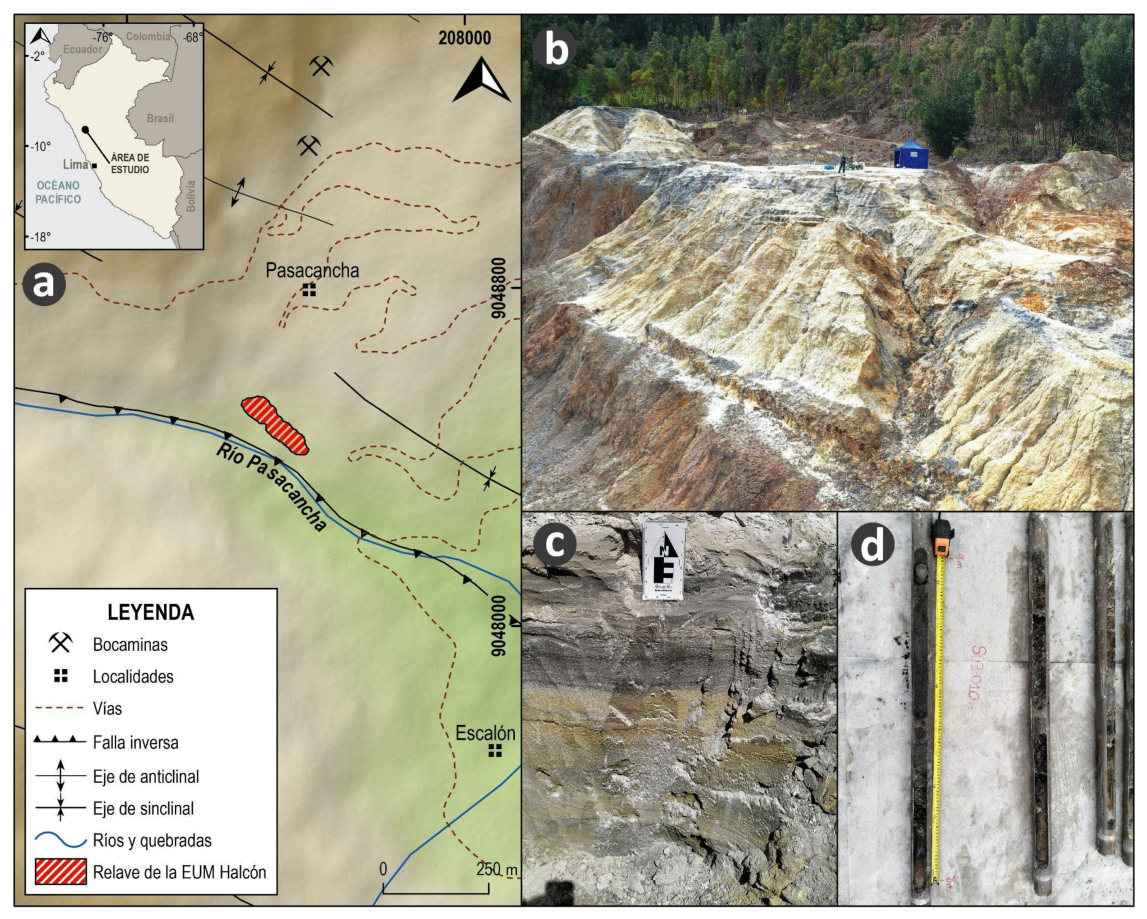
Figure 3.
Workflow applied in the study of the Halcón EUM tailings.
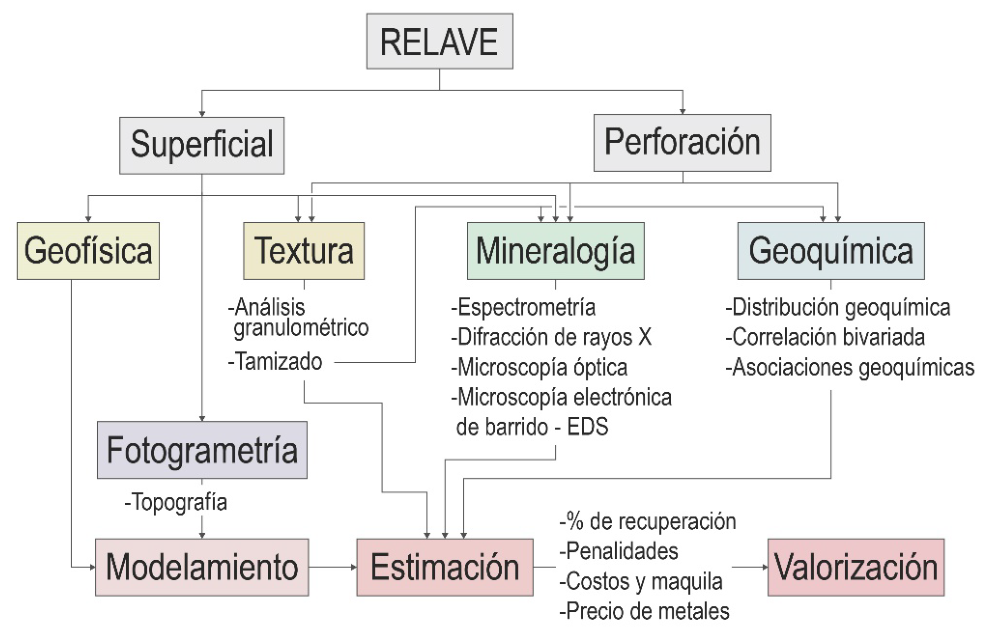
Figure 4.
Workflow for tailings valuation.
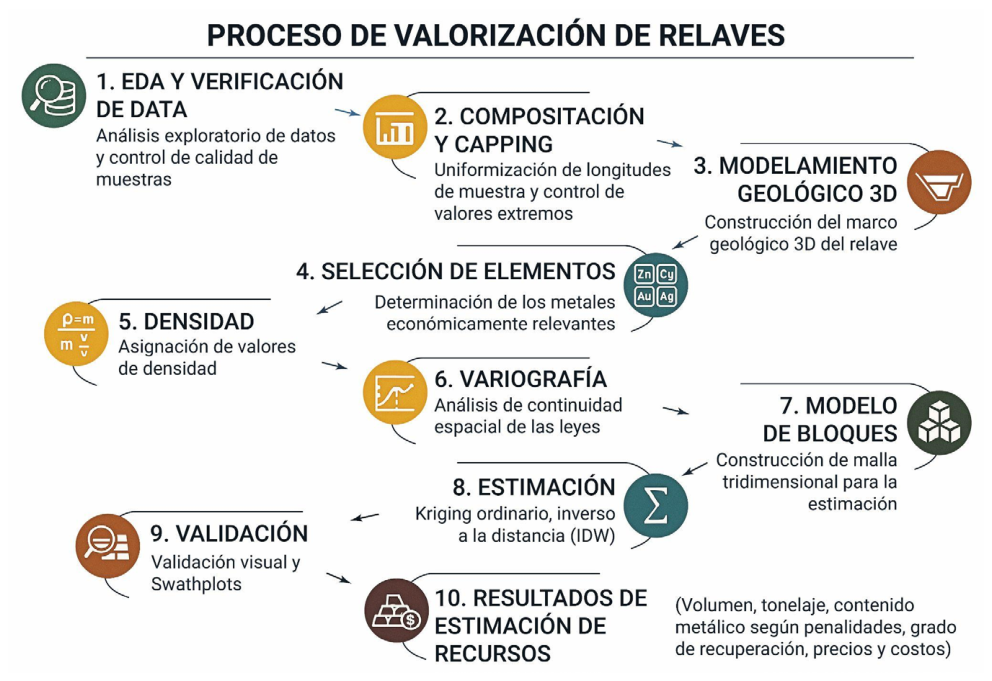
Figure 5.
Zinc distribution in drill hole S03 and details of sample HAL8381-RE24-S03-006.
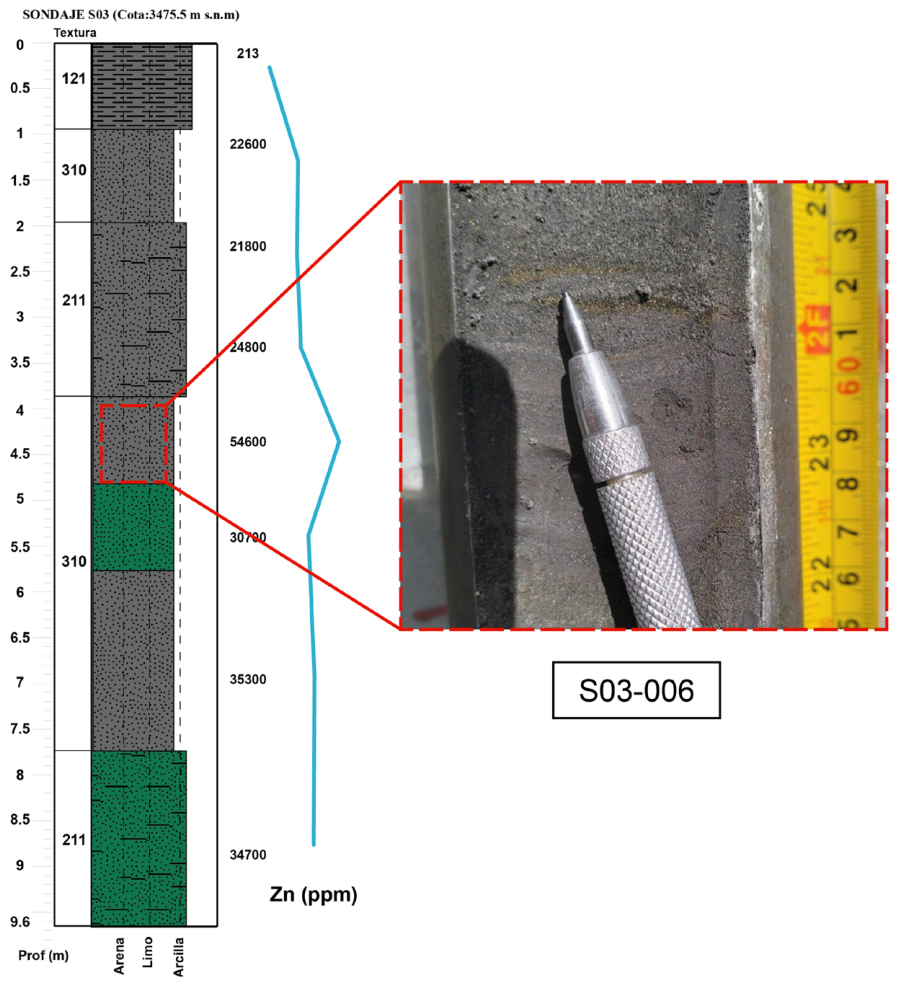
Figure 6.
Distribution of Ag and Au in relation to pH in drill hole S02.
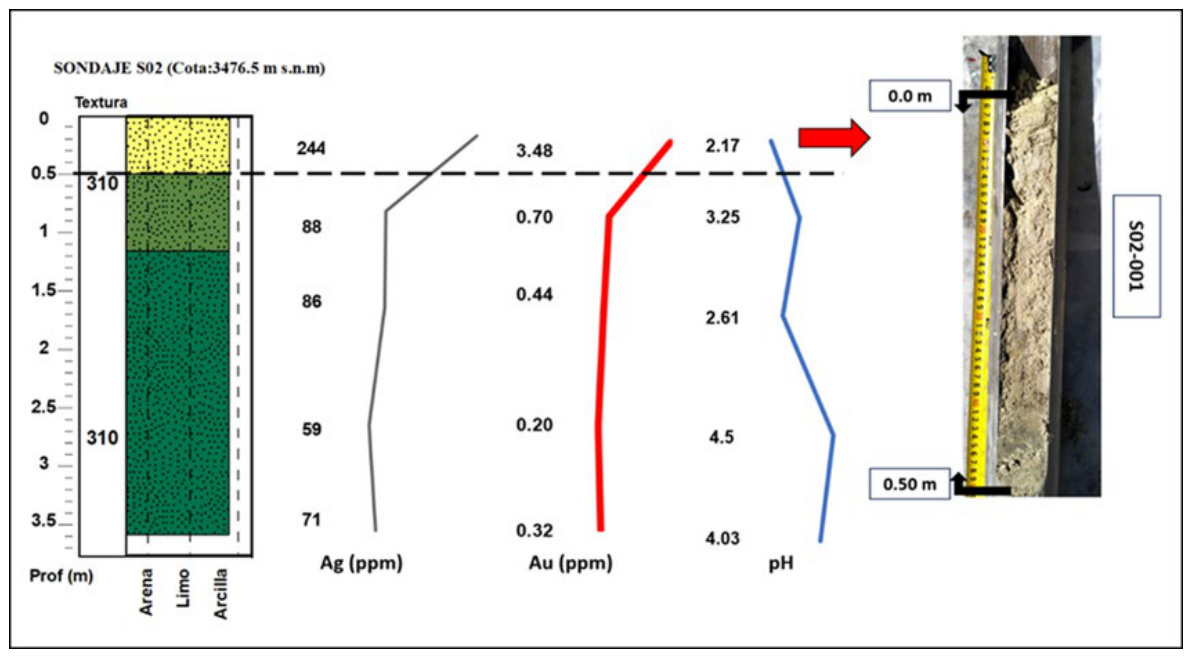
Figure 7.
Graph of the two main components.
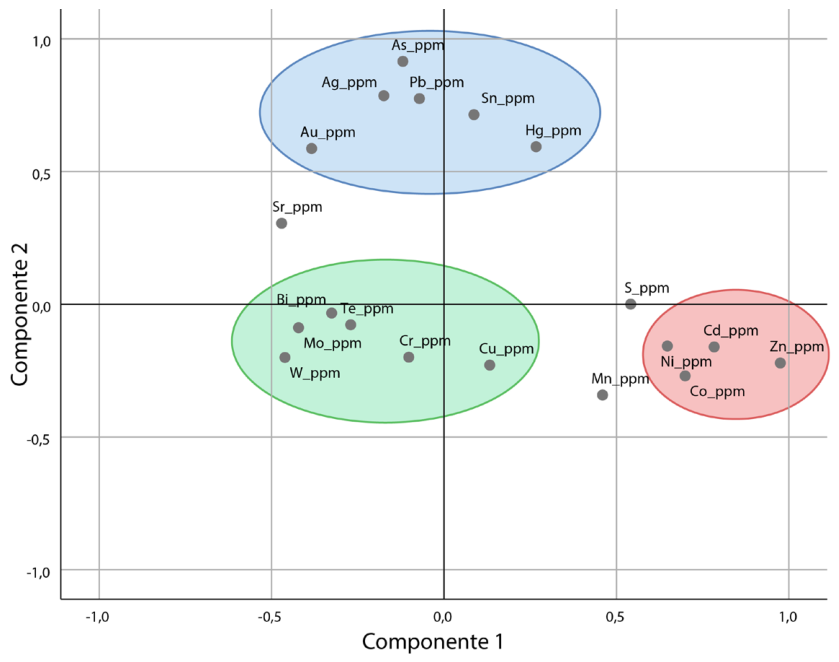
Figure 8.
Au, Ag, Cu, Pb, and Zn contents in subfractions.
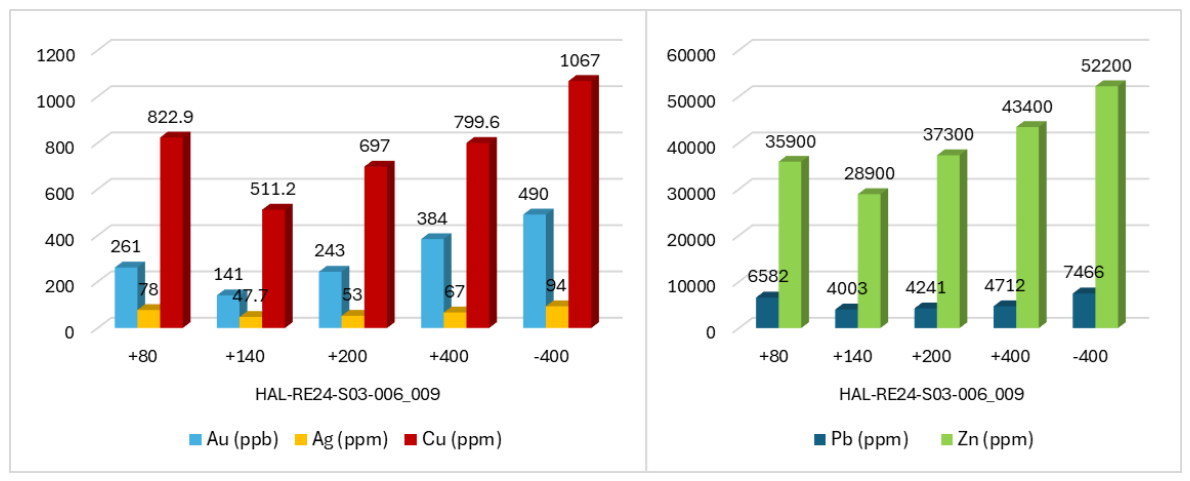
Figure 9.
Minerals (jarosite-goethite) are at the surface level of the tailings.
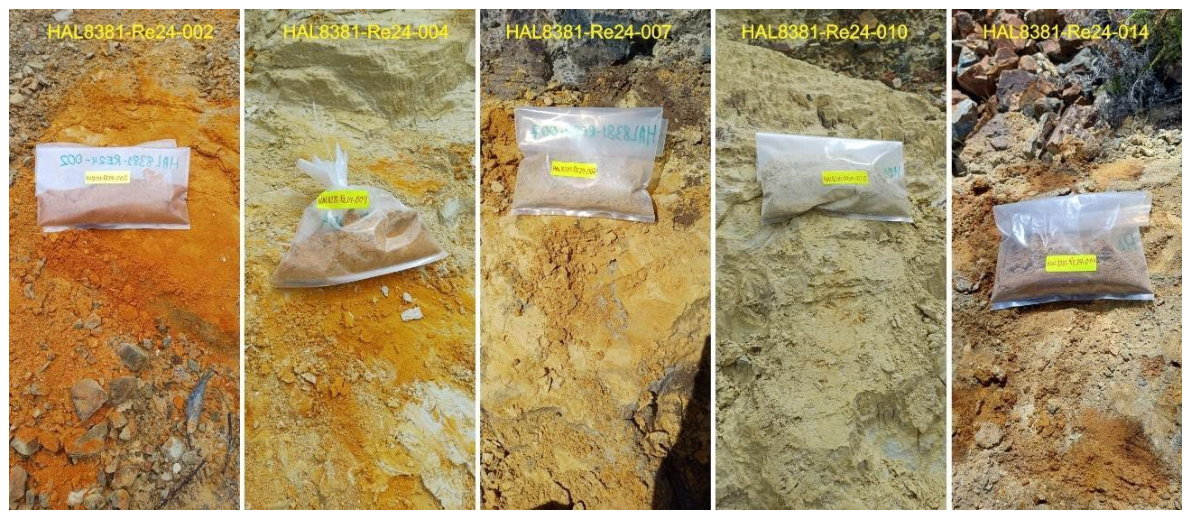
Figure 10.
Photomicrographs of the subfractions. A and B. Free crystals and intergrowths of pyrite (py), sphalerite (ef), galena (gn), sulfides (SFSs), pyrrhotite (po), chalcopyrite (cp), and gangue (GGs).
Figure 10.
Photomicrographs of the subfractions. A and B. Free crystals and intergrowths of pyrite (py), sphalerite (ef), galena (gn), sulfides (SFSs), pyrrhotite (po), chalcopyrite (cp), and gangue (GGs).
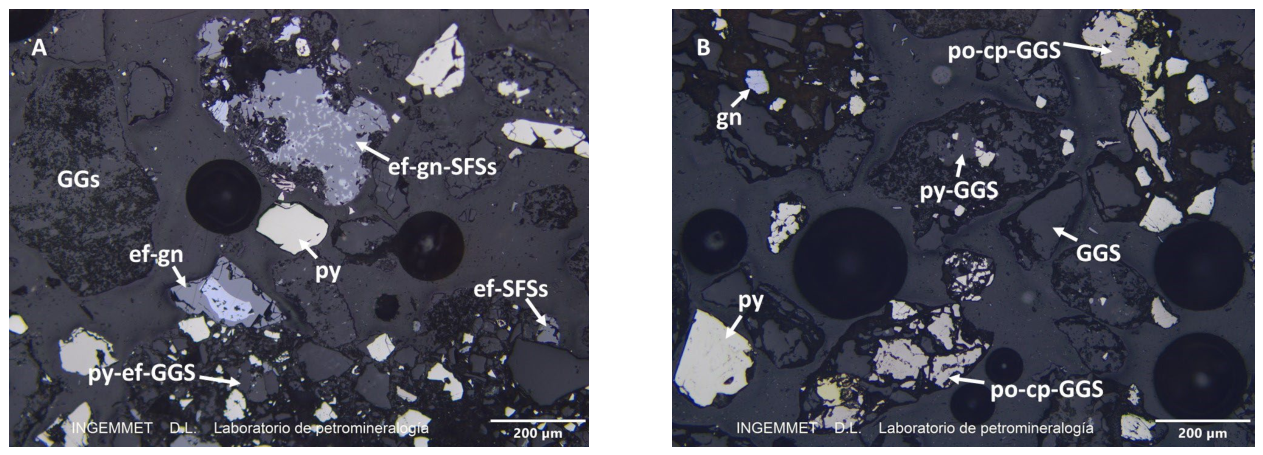
Figure 11.
A and B. Photomicrographs of the +140 subfractions, showing free grains of minerals such as pyrite (py), galena (gn), sphalerite (ef), pyrrhotite (po), arsenopyrite (apy), and gangue, together with mixed grains in various mineralogical combinations.
Figure 11.
A and B. Photomicrographs of the +140 subfractions, showing free grains of minerals such as pyrite (py), galena (gn), sphalerite (ef), pyrrhotite (po), arsenopyrite (apy), and gangue, together with mixed grains in various mineralogical combinations.
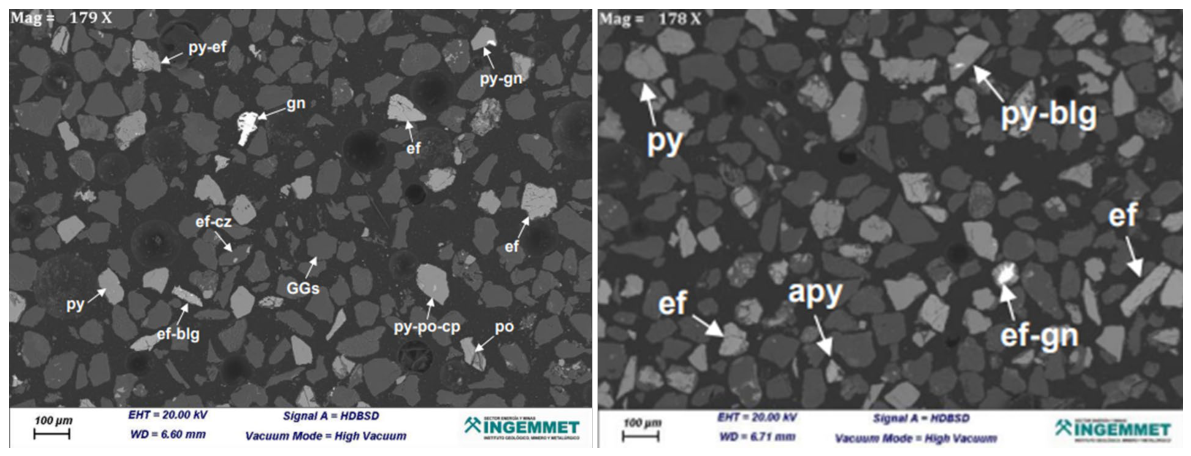
Figure 12.
3D model and profiles of the Halcón EUM tailings.
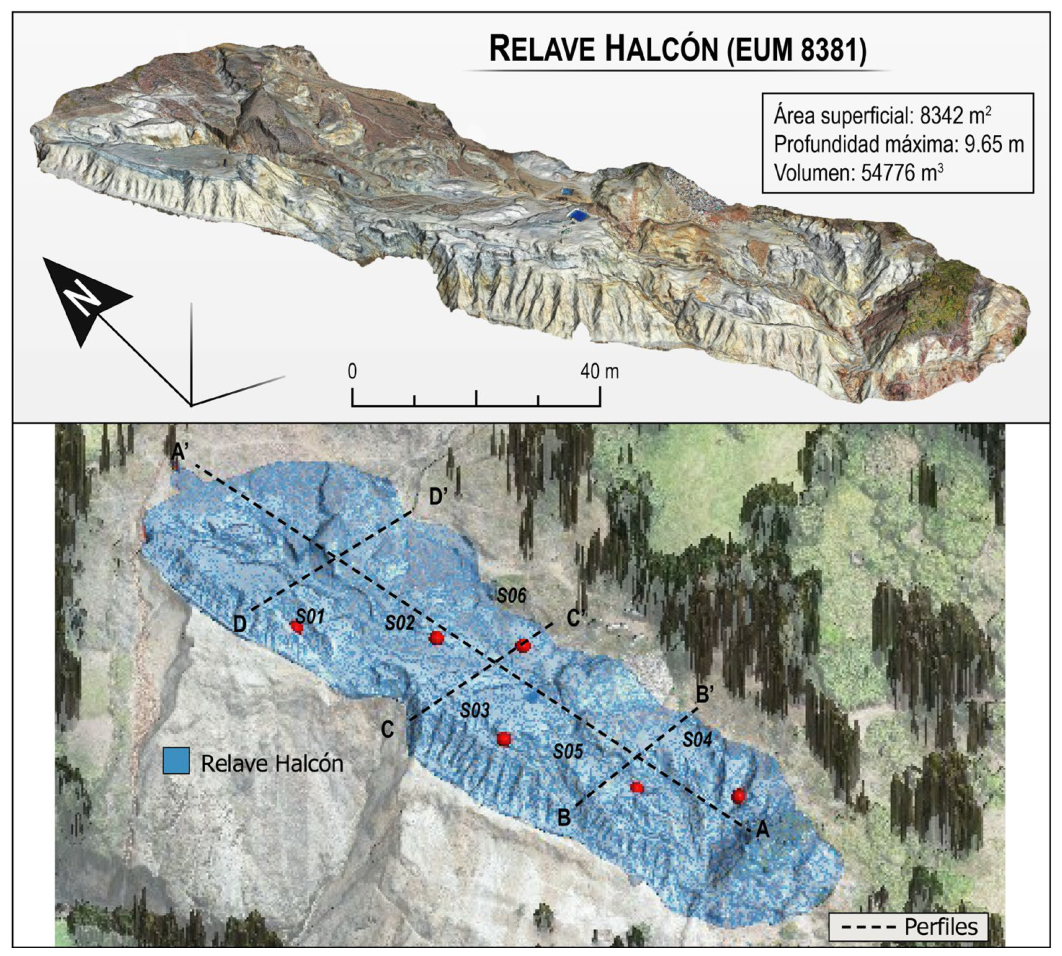
Figure 13.
Swathplot analysis for Pb in the north and east directions.
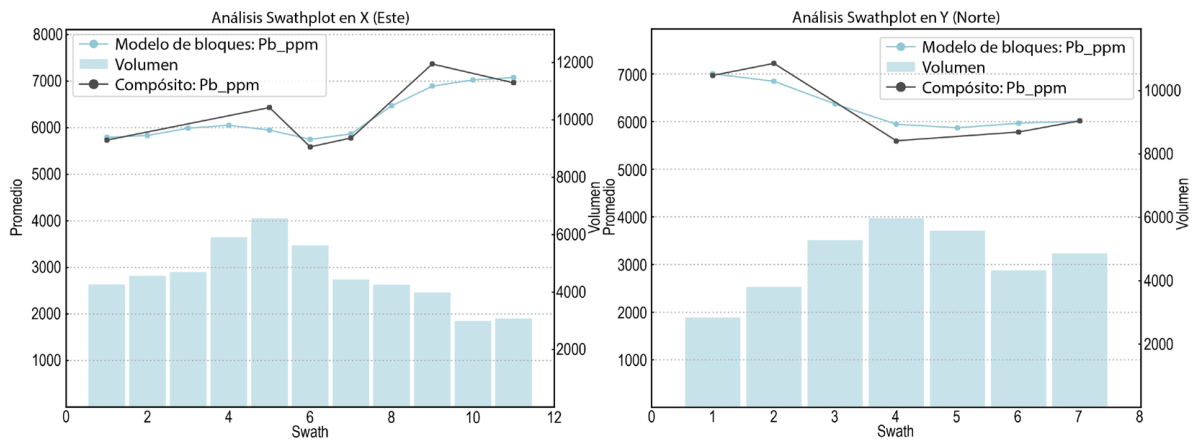
Figure 14.
Spatial distribution of Zn, Cu, Au, Ag, and Pb according to the EUM Halcón tailings block model.
Figure 14.
Spatial distribution of Zn, Cu, Au, Ag, and Pb according to the EUM Halcón tailings block model.
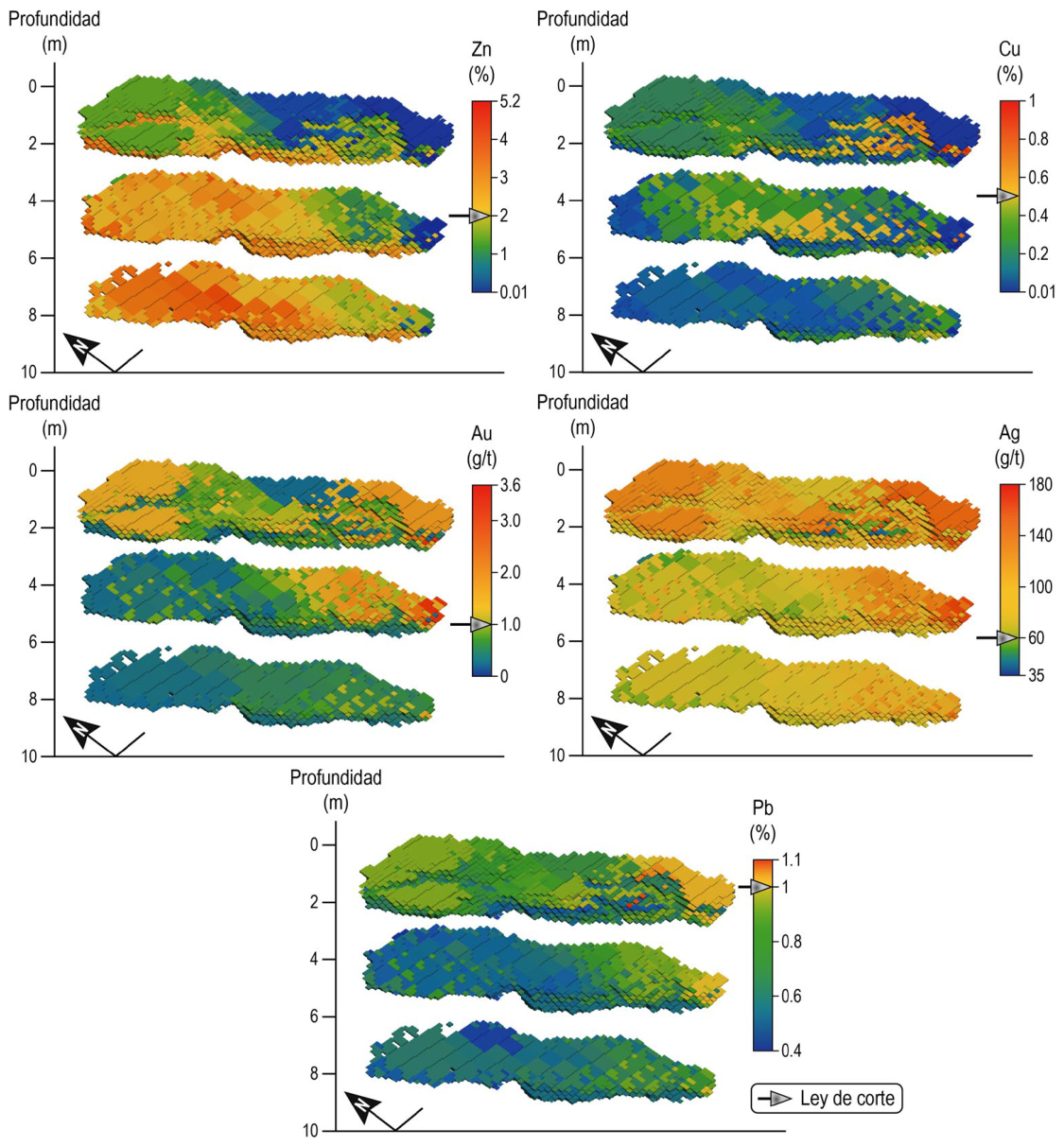
Figure 15.
Areas with economic grades in the tailings of the Halcón EUM.
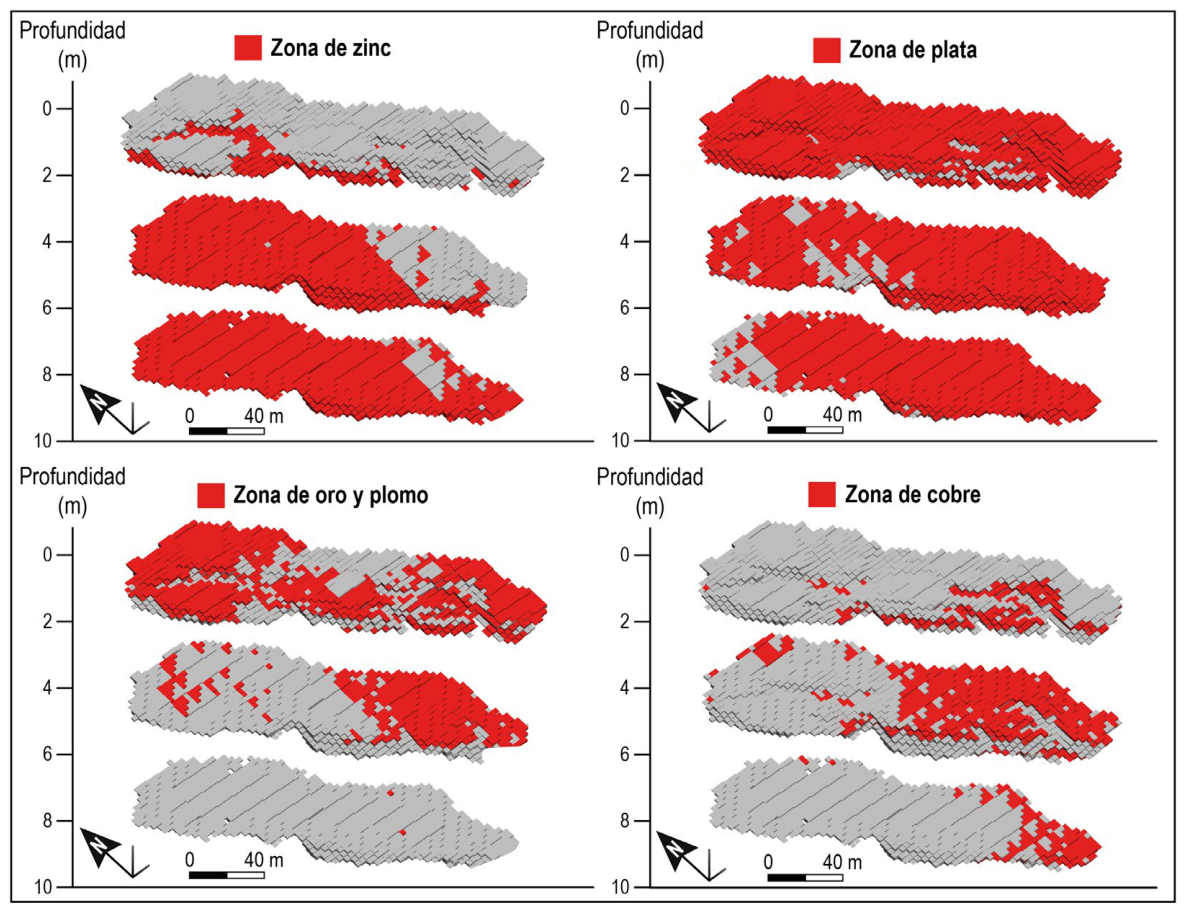
Table 1.
Statistical summary of the main elements studied in the tailings of the Halcon EUM.
| Element | Unit | Average | SD | Min | P25 | P50 | P75 | P95 | Max | |
|---|---|---|---|---|---|---|---|---|---|---|
| Zn | ppm | 19,721.0 | 16,755.0 | 108.0 | 1,624.0 | 17,100.0 | 33,300.0 | 50,520.0 | 54,600.0 | |
| Pb | ppm | 6,530.20 | 3,315.30 | 465.7 | 4,663.00 | 5,823.00 | 6,836.70 | 14,060.00 | 15,800.00 | |
| As | ppm | 4,846.80 | 4,028.50 | 532 | 2,775.00 | 3,588.00 | 4,558.00 | 13,600.00 | 18,000.00 | |
| Cu | ppm | 2,460.20 | 3,014.20 | 81.1 | 367.6 | 818.9 | 4,347.80 | 7,764.00 | 12,940.00 | |
| Sb | ppm | 615.1 | 822.3 | 90.8 | 201.6 | 263.1 | 480.1 | 2,517.60 | 3,100.00 | |
| Cr | ppm | 311.3 | 95.4 | 51 | 252 | 294 | 391 | 450.4 | 567 | |
| Mn | ppm | 129.4 | 66.5 | 16 | 88 | 124 | 165 | 248.6 | 292 | |
| Sr | ppm | 41.7 | 34.9 | 7.1 | 22.6 | 29.4 | 52 | 115.6 | 167.6 | |
| W | ppm | 97.3 | 159.1 | 11.7 | 24.6 | 34 | 66 | 414.6 | 814.4 | |
| Sn | ppm | 45.2 | 24 | 11 | 27.3 | 43.4 | 61 | 91.6 | 112 | |
| Ag | ppm | 84.3 | 58.4 | 11 | 57 | 70 | 88 | 223.4 | 244 | |
| Co | ppm | 25.3 | 18.8 | 1.3 | 8.9 | 21 | 36.7 | 58.8 | 69.5 | |
| Mo | ppm | 17.2 | 6.6 | 9 | 12.6 | 16.9 | 19 | 27.4 | 42.2 | |
| V | ppm | 46.9 | 19.2 | 6 | 41 | 48 | 59 | 73.6 | 78 | |
| Hg | ppm | 2.5 | 0.8 | 1.3 | 2.2 | 2.5 | 2.5 | 4.2 | 5.1 | |
| Au | ppm | 0.8 | 1 | 0.1 | 0.2 | 0.3 | 0.7 | 3.4 | 3.6 | |
| TREO | ppm | 42.5 | 27.1 | 9.2 | 24.4 | 31.1 | 58.5 | 71 | 148.9 |
* Note: TSF Area: 8,342 m²; Depth profile evaluated: 0 m – 9.62 m; Total exploratory drill holes: 6 surveys. SD: Standard Deviation; P: Percentile; TREO: Total Rare Earth Oxides.
Table 2.
Main Pearson correlations of elements in the tailings of the Halcon EUM.
| Element | Very strong | Strong | Moderate | Weak |
|---|---|---|---|---|
| Zn | - | Cd, Co | Ni | S |
| Pb | Pb, Sb | Au | - | Hg, S |
| As | - | - | - | Co, Te |
| Cu | - | Ag, Sb | Pb | Hg |
| Sb | Sb | - | Au | Hg |
| Cr | - | W | Co | Cr |
* Note: Very strong: 0.85-1.00; Strong: 0.73-0.84; Moderate: 0.58-0.72; Weak: 0.41-0.57.
Table 3.
Economic metal contents in five sub-fractions (Mesh) for the representative composite tailings sample HAL-RE24-S03-006_009.
Table 3.
Economic metal contents in five sub-fractions (Mesh) for the representative composite tailings sample HAL-RE24-S03-006_009.
| Element | Unit | +80 Mesh | +140 Mesh | +200 Mesh | +400 Mesh | −400 Mesh |
|---|---|---|---|---|---|---|
| Au | ppm | 0.261 | 0.141 | 0.243 | 0.384 | 0.49 |
| Ag | ppm | 78 | 47.7 | 53 | 67 | 94 |
| Co | ppm | 23.6 | 12.8 | 15.5 | 20.7 | 27.4 |
| Cr | ppm | 135 | 81 | 43 | 20 | 30 |
| Cu | ppm | 822.9 | 511.2 | 697 | 799.6 | 1,067.00 |
| Ni | ppm | 16.6 | 10.5 | 11.9 | 14.6 | 20.8 |
| Pb | ppm | 6,582.00 | 4,003.00 | 4,241.00 | 4,712.00 | 7,466.00 |
| V | ppm | 47 | 44 | 36 | 33 | 37 |
| Zn | % | 3.59 | 2.89 | 3.73 | 4.34 | 5.22 |
Table 4.
Average content of minerals identified by XRD.
| Element | Mineral Name | Chemical Formula | Average Content (%) |
|---|---|---|---|
| Associated with the geological environment | Quartz | SiO2 | 54.00 |
| Clinochlore | (Mg,Fe2+)5Al(Si3Al)O10(OH)8 | 2.00 | |
| Muscovite | KAl2(AlSi3O10)(OH)2 | 8.00 | |
| Albite | Na(AlSi3O8) | 2.00 | |
| Secondary or alteration | Alunite | K0.72Na0.28Al3(SO4)2(OH)6 | 2.00 |
| Sulfides | Sphalerite | ZnS | 18.00 |
| Pyrite | FeS2 | 11.00 | |
| Pyrrhotite | Fe7S8 | 2.00 | |
| Jarosite | KFe3(OH)6(SO4)2 | 4.00 | |
| Oxides | Magnetite | Fe3O4 | 2.00 |
| Rutile | TiO2 | 1.00% |
Table 5.
Mineralogical composition and degree of liberation by grain-size fractions for representative tailings samples HAL-RE24-S01-009_011 and HAL-RE24-S05-006.
Table 5.
Mineralogical composition and degree of liberation by grain-size fractions for representative tailings samples HAL-RE24-S01-009_011 and HAL-RE24-S05-006.
| Sample Code | HAL-RE24-S01-009_011 | HAL-RE24-S05-006 | ||||||
|---|---|---|---|---|---|---|---|---|
| Mesh Fraction | +140 Mesh | +200 Mesh | +140 Mesh | +200 Mesh | ||||
| Minerals | C (%) | GL (%) | C (%) | GL (%) | C (%) | GL (%) | C (%) | GL (%) |
| Pyrite | 6.55 | 69.39 | 14.56 | 73.49 | 20.93 | 72.99 | 31.91 | 90.17 |
| Pyrrhotite | 2.86 | 92.44 | 4.25 | 90.91 | 7.36 | 84.96 | 9.38 | 94.31 |
| Sphalerite | 6.55 | 59.41 | 4.23 | 76.19 | 10.92 | 66.46 | 7.86 | 91.14 |
| Chalcopyrite | 0.28 | 76.92 | 0.08 | 0 | 0.24 | 0 | 0.14 | 100 |
| Galena | 0.2 | 0 | 0.51 | 50 | 0.58 | 0 | 0.44 | 57.14 |
| Boulangerite | 0.04 | 0 | 0.04 | 0 | 0.19 | 0 | 0.03 | 0 |
| Hematite | 0.08 | 0 | — | — | — | — | — | — |
| Arsenopyrite | 0.15 | 0 | 0.18 | 0 | 0.38 | 90.91 | 0.82 | 98.77 |
| Gangue | 83.23 | 81.07 | 76.11 | 93.5 | 59.11 | 66.81 | 48.81 | 89.05 |
| Goethite | — | — | 0.01 | 0 | 0.02 | 0 | — | — |
| Silver - tetrahedrite | — | — | 0.03 | 0 | — | — | 0.14 | 100 |
* Note: C: Mineral composition in weight percent (%); GL: Degree of ore mineral liberation in percent (%). Gangue includes quartz, muscovite, albite, clinochlore, and alteration silicates/sulfates. "—" indicates concentrations below the analytical detection limit (trazas).
Table 6.
Estimated potential mineral resources of the Halcon EUM tailings.
| Element | Tonnage (t) | Cut-off Grade | Average Grade | Contained Metal (t) | Contained Metal (kg) | Contained Metal (oz t) |
|---|---|---|---|---|---|---|
| Zn | 56,988.37 | 2.00% | 3.14% | 1,788.42 | — | — |
| Cu | 6,640.85 | 0.50% | 0.63% | 41.78 | — | — |
| Pb | 1,893.10 | 1.00% | 1.04% | 19.76 | — | — |
| Au | 10,751.38 | 1.00 g/t | 1.51 g/t | — | 16.25 | 522.6 |
| Ag | 72,558.96 | 60.00 g/t | 83.80 g/t | — | 6,081.33 | 195,519.37 |
* Note: Tonnage represents the geostatistially modeled volume per metal facies. Cut-off and average grades for Zn, Cu, and Pb are expressed in percent (%), while Au and Ag are in grams per ton (g/t). Contained metal resources are converted to metric tons (t) for base metals, and kilograms (kg) or troy ounces (oz t) for precious metals. "—" indicates not applicable.
Disclaimer/Publisher’s Note: The statements, opinions and data contained in all publications are solely those of the individual author(s) and contributor(s) and not of MDPI and/or the editor(s). MDPI and/or the editor(s) disclaim responsibility for any injury to people or property resulting from any ideas, methods, instructions or products referred to in the content. |
© 2026 by the authors. Licensee MDPI, Basel, Switzerland. This article is an open access article distributed under the terms and conditions of the Creative Commons Attribution (CC BY) license (http://creativecommons.org/licenses/by/4.0/).
Copyright: This open access article is published under a Creative Commons CC BY 4.0 license, which permit the free download, distribution, and reuse, provided that the author and preprint are cited in any reuse.