
Submitted:
30 July 2026
Posted:
31 July 2026
You are already at the latest version
Abstract
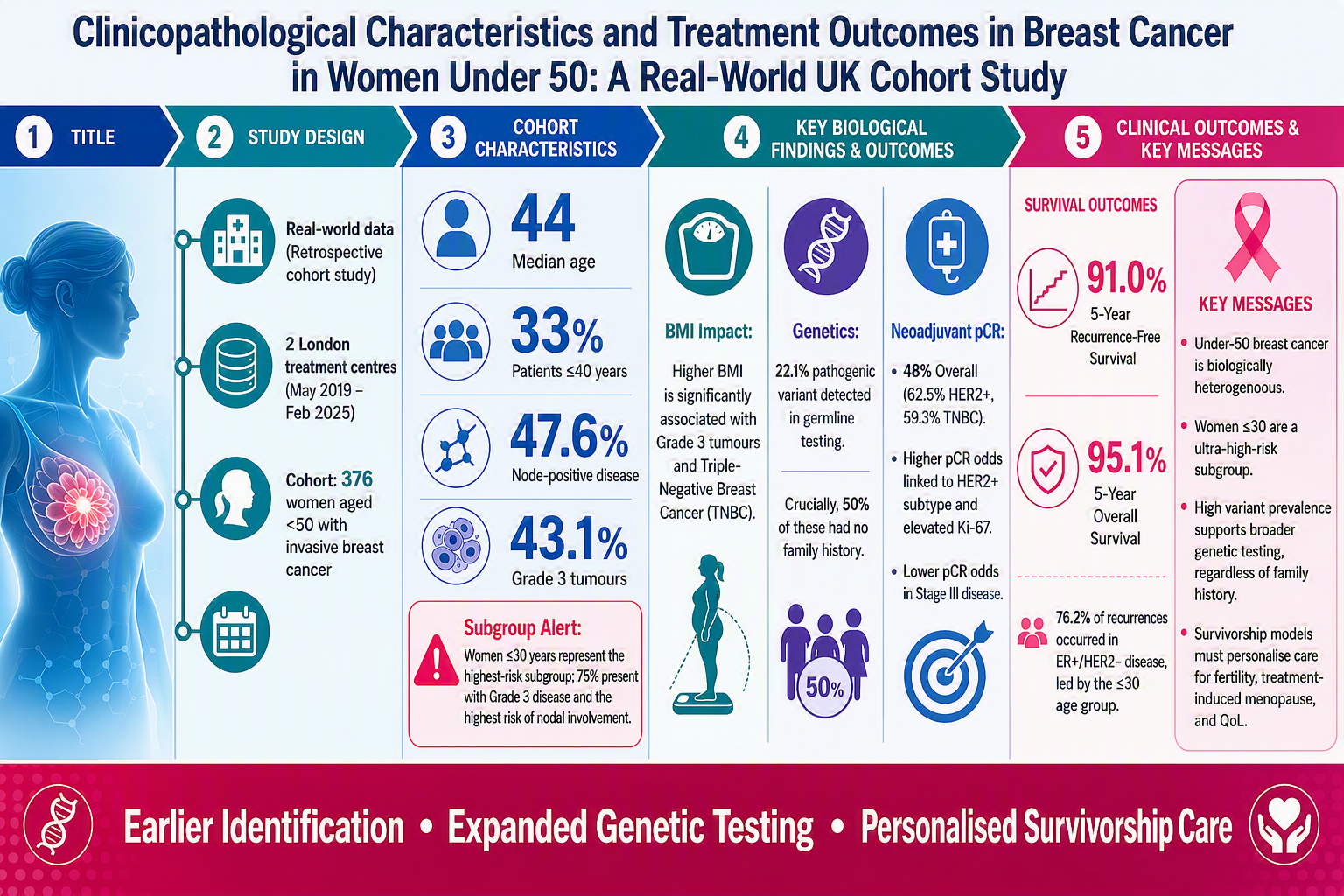
Background: Breast cancer incidence is increasing among women <50 years, a group diagnosed outside the UK screening programme. They have a distinct tumour biology, higher hereditary risk, and long-term survivorship challenges. Methods: We conducted a retrospective cohort study of 376 women aged <50 years diagnosed with invasive breast cancer at two London centres (May 2019 – February 2025). Demographic, clinicopathological, treatment, and outcome data were extracted from electronic health records. Survival was estimated using Kaplan-Meier methods. Univariable and multivariable analyses evaluated predictors of tumour characteristics and treatment response. Results: Median age at diagnosis was 44 years. Node-positive disease was present in 47.6% of patients and 43.1% had grade 3 tumours. Women aged ≤30 years had the most adverse tumour characteristics, with 75.0% grade 3 disease and higher odds of nodal involvement than women aged 41–49 years. Higher BMI was associated with grade 3 tumours and triple-negative disease. Among women undergoing germline testing, 22.1% carried a pathogenic variant; notably, 50.0% reported no family history of breast or ovarian cancer. Pathological complete response (pCR) was achieved in 48.0% of patients receiving neoadjuvant therapy (HER2+ 62.5%, triple-negative 59.3%). The estimated 5-year recurrence-free and overall survival were 91.0% and 95.1%, respectively Conclusions: Breast cancer in women <50 years demonstrates substantial biological heterogeneity, with those aged ≤30 years representing a particularly high-risk subgroup. The high prevalence of pathogenic variants despite an absent family history supports broader germline testing. Improving outcomes requires expanded genetic testing and tailored survivorship models addressing fertility, treatment-induced menopause, and quality of life.
Keywords:
young-onset breast cancer
; breast cancer in young women
; clinicopathological characteristics
; germline testing
; neoadjuvant therapy
; pathological complete response
; real-world evidence
; UK cohort
Copyright: This open access article is published under a Creative Commons CC BY 4.0 license, which permit the free download, distribution, and reuse, provided that the author and preprint are cited in any reuse.


