

Submitted:
24 July 2026
Posted:
31 July 2026
You are already at the latest version
Abstract
Objective: First update of the global transgender oral health LSR (Kumar et al. 2025), covering September 2021 to May 2026. Basic research design: LSR update, PRISMA 2020. Six databases plus grey literature. Random-effects DerSimonian-Laird meta-analysis on Freeman-Tukey transformed proportions matching the baseline LSR and Mehta et al. (2024). Risk-of-bias: JBI, Newcastle-Ottawa, CASP, AMSTAR-2, MMAT. Clinical setting: Global; community, hospital, NGO outreach, surveys, population analysis. Participants: Transgender and gender-diverse populations including third-gender identities. Eleven quantitative studies (n=1,766) in meta-analysis; four qualitative, five provider-side, one population analysis (US BRFSS, n≈290 million) in narrative synthesis. Interventions: Not applicable (descriptive prevalence synthesis). Main outcome measures: Pooled prevalence of caries, periodontal disease, calculus, bleeding, tobacco use, toothbrush use; heterogeneity; publication bias; HIV subgroup and leave-one-out sensitivity; GRADE. Results: Pooled prevalence: toothbrush 82.9% (73.4-90.6); smoking 12.5% (5.2-22.5); smokeless tobacco 53.2% (38.1-68.0); caries 73.8% (62.5-83.6); calculus 64.4% (43.1-83.1); bleeding 16.5% (7.6-27.9); periodontal 90.8% (87.5-93.7). Estimates reproduced Mehta et al. (2024) within ≤5 points. HIV subgroup collapsed heterogeneity for toothbrush use (I² 91%→0%). Suleman et al. (2023) reported mean DMFT 6.86 (Lahore) — highest globally. Indian dentists: 46-point gap between willingness (71.3%) and training (25.2%). Conclusions: Global transgender populations face elevated oral disease burden and a workforce-preparedness gap. This first LSR update extends geography, design diversity, and analytic depth. A four-tier policy roadmap aligned with WHO Global Oral Health Action Plan 2023-2030 supports transgender-inclusive Universal Health Coverage.
Keywords:
living systematic review
; transgender health
; oral health inequalities
; universal health coverage
; meta-analysis
; heterogeneity
; India
What This Update Adds
This first scheduled update of the Living Systematic Review by Kumar et al. (2025) contributes eight substantive advances relative to the baseline synthesis and the parallel India-only synthesis by Mehta et al. (2024):
- Six new primary studies published after August 2021, contributing 741 additional transgender participants to the extended pool.
- First inclusion of Pakistan and Brazil data — expanding geographic coverage beyond the near-exclusive India focus of both prior syntheses. Suleman et al. (2023, Lahore) report a mean DMFT of 6.86, the highest in the global transgender oral health literature to date.
- First inclusion of nationally representative population-level data (Clermont et al. 2024, US BRFSS, weighted n≈290 million) — the first population-level confirmation of a transgender-cisgender dental utilisation gap in any high-resource setting.
- First integration of qualitative and mixed-methods designs. Four qualitative studies (Malaysia, southern Brazil, Bhubaneswar, Pakistan) were synthesised using ENTREQ, converging on three global themes: healthcare discrimination, cost barriers, and absence of trans-competent providers.
- Pre-specified HIV-stratified subgroup meta-analysis — a novel analytic contribution not performed in either prior synthesis. Removing the HIV+ cohort collapsed between-study heterogeneity for toothbrush use from I²=91% to I²=0%, identifying HIV status as the dominant heterogeneity moderator.
- Cross-synthesis reproducibility check against Mehta et al. (2024): pooled estimates reproduce their published values within ≤5 percentage points across all six common outcomes — a formal reproducibility validation that neither prior synthesis performed.
- Design-stratified risk-of-bias appraisal using five tools (JBI, modified Newcastle-Ottawa, CASP, AMSTAR-2, MMAT), replacing the single-tool JBI approach of both prior syntheses.
- Explicit policy translation: a four-tier roadmap mapping each finding to the WHO Global Oral Health Action Plan 2023–2030 strategic objectives and to the Indian legislative context following the Transgender Persons (Protection of Rights) Amendment Act 2026 (enacted March 2026, subsequent to both baseline syntheses).
Continuity of methodological pipeline (PRISMA 2020, DerSimonian-Laird random-effects, Freeman-Tukey transformation) with the baseline LSR and with Mehta et al. (2024) is deliberate: it enables direct version-to-version comparability, which is the scientific purpose of the Living Systematic Review framework (Elliott et al. 2014, 2017).
Introduction
Oral diseases affect 3.5 billion people globally and remain the most prevalent set of non-communicable diseases, disproportionately burdening marginalised populations who lie outside conventional public health surveillance (Peres et al. 2019; WHO 2022). The World Health Organization's Global Strategy and Action Plan on Oral Health 2023-2030, endorsed by the 76th World Health Assembly (resolution WHA74.5) and reaffirmed by the 2024 Bangkok Declaration signed by over 110 member states, positions Universal Health Coverage (UHC) for oral health as Overarching Global Target A (WHO 2024a, 2024b). Achieving that target requires the dental public health community to systematically identify, quantify, and act upon the oral health disparities of populations that have historically been rendered statistically invisible — of which transgender and gender-diverse (TGD) persons are among the most consequential.
The Indian setting foregrounds this imperative. The Census of India 2011 recorded 488,000 self-identifying transgender persons under the residual "other" gender category — a figure that is now widely acknowledged as a substantial undercount (Registrar General of India 2011). Constitutional recognition arrived with the Supreme Court's judgment in NALSA v. Union of India (Supreme Court of India 2014), which affirmed the right to self-identify one's gender and read the third-gender category into Articles 14, 15, 16, and 21 of the Constitution. Statutory implementation followed in the Transgender Persons (Protection of Rights) Act, 2019 (Government of India 2019), which codified anti-discrimination protections in education, employment, healthcare, and housing. In March 2026, however, this trajectory was interrupted: the Transgender Persons (Protection of Rights) Amendment Act, 2026 (Government of India 2026) reintroduced medical-board certification, narrowed the statutory definition of transgender identity, and removed the self-identification provision — a shift now under challenge in the Supreme Court and one that has direct downstream consequences for how transgender persons access, and are recorded in, health-service delivery systems including dental care.
Why a Living Systematic Review, and Why Now
Traditional systematic reviews provide a snapshot of the evidence at a fixed point in time. In fields where the primary literature is expanding rapidly — as is the case for transgender oral health, where the number of primary studies has approximately doubled between 2021 and 2026 — a fixed synthesis loses currency within two to three years of publication (Elliott et al. 2017). The Living Systematic Review framework, formalised by Elliott and colleagues, addresses this by pre-registering the review team's commitment to periodic re-screening and re-analysis. The framework confers three specific scientific advantages: (i) systematic incorporation of newly published evidence within the pre-registered protocol, rather than the selective updating that ad hoc extensions permit; (ii) explicit re-estimation of pooled effects, prediction intervals, and certainty ratings as the evidence base matures; and (iii) transparent versioning that permits downstream users — guideline developers and national programme planners — to track how the underlying evidence has evolved (Elliott et al. 2014; Simmonds et al. 2017).
The transgender oral health evidence base has, since 2021, been anchored by two syntheses. The baseline Living Systematic Review by Kumar et al. (2025) in the International Journal of Environmental Research and Public Health established pooled global estimates through August 2021 (PROSPERO CRD42021272384; 20 cross-sectional studies from India, Malaysia, and the USA). A parallel India-restricted synthesis by Mehta et al. (2024) in Special Care in Dentistry subsequently pooled 12 Indian cross-sectional studies through October 2023, providing within-country validation of the baseline pooled estimates. Neither synthesis, however, could have captured the transformation of the field that has occurred since: qualitative and mixed-methods designs have entered the primary literature; provider-side workforce data now exist; and the first population-representative estimate has emerged from the US Behavioral Risk Factor Surveillance System. The baseline LSR's pre-registered updating commitment therefore falls due, and this manuscript delivers it. Community Dental Health is the appropriate venue for the update because the journal's editorial scope — dental public health, health service planning, oral health promotion, and clinical research on special populations — aligns precisely with the substantive and translational content of a transgender oral health synthesis whose downstream aim is integration into national and international UHC monitoring.
Objectives of This Update
- To systematically identify and integrate all transgender oral health evidence published between 1 September 2021 and 31 May 2026 across quantitative, qualitative, mixed-methods, and provider-side designs.
- To update and extend the pooled meta-analytic estimates of the baseline LSR, cross-validating against Mehta et al. (2024)'s parallel India synthesis using the identical analytic pipeline (random-effects DerSimonian-Laird on Freeman-Tukey double-arcsine transformed proportions).
- To conduct pre-specified subgroup and sensitivity analyses (HIV status, region, leave-one-out, Baujat diagnostics) that neither the baseline LSR nor Mehta et al. performed — thereby identifying the structural sources of the persistent between-study heterogeneity.
- To derive a policy roadmap aligning transgender-inclusive dental care with the WHO Global Oral Health Action Plan 2023-2030 and the Indian National Oral Health Programme, with a defined role in national and international UHC monitoring.
Methods
Design and Registration
This LSR update was conducted in accordance with PRISMA 2020 (Page et al. 2021), PRISMA-S for search reporting (Rethlefsen et al. 2021), and ENTREQ for the qualitative arm (Tong et al. 2012). The original PROSPERO registration (CRD42021272384) will be amended to reflect this update's scope. The eligibility framework was widened from the baseline LSR (which included only quantitative cross-sectional studies of clinical oral health outcomes) to encompass all study designs reporting on transgender oral health status, behaviours, access, or provider preparedness. This widening was pre-specified based on a scoping exercise that identified qualitative access-and-barriers research and population secondary analyses as the most consequential emerging design categories.
Search Strategy and Information Sources
Six databases were searched from 1 September 2021 to 31 May 2026: PubMed/MEDLINE, Scopus, Web of Science Core Collection, Embase, CINAHL Complete, and EBSCO. Grey literature was accessed through ProQuest Dissertations & Theses Global, BASE/GreyNet, and hand-searching of the Journal of the Indian Association of Public Health Dentistry, Special Care in Dentistry, and Community Dental Health. Backward and forward citation tracking was performed on Kumar et al. (2025), Mehta et al. (2024), and each included primary study. The search used a three-block Boolean structure combining population terms (transgender, gender diverse, non-binary, TGNB, LGBTQ+, third gender, hijra, kinnar, khwaja sira, waria), oral health status terms, and access/behaviour/provider terms. Full database-specific strings appear in Supplementary Appendix S1. No language restrictions were applied at search stage.
Eligibility, Screening, and Data Extraction
Eligibility was framed using an expanded PICOTS: (P) individuals self-identifying as transgender, transsexual, non-binary, gender-diverse, or from culturally specific third-gender communities (hijra, kinnar, khwaja sira, waria); mixed LGBTQ+ samples were eligible only where transgender-stratified numerators and denominators could be extracted; (I) not required (descriptive syntheses eligible); (C) not required; (O) any outcome within the four review domains (clinical oral health status, oral hygiene and behaviours, access and utilisation, or provider preparedness); (T) publication window 1 September 2021 to 31 May 2026; (S) any healthcare or community setting worldwide. Screening was conducted independently by two reviewers in Rayyan with a third senior reviewer arbitrating disagreements. Extraction employed a piloted spreadsheet capturing ten domains. A distinguishing feature of this update — introduced as an explicit safeguard against citation-chain error propagation observed in the wider oral health literature — was that every numerator and denominator entering the meta-analysis was re-verified against the primary published source (PubMed, PMC, or publisher DOI) rather than transcribed from earlier systematic reviews.
Risk of Bias Assessment
Rather than apply a single appraisal instrument across heterogeneous designs (as both prior syntheses did), we applied a design-stratified toolkit. Cross-sectional prevalence studies were appraised with the 9-item JBI Critical Appraisal Checklist for Studies Reporting Prevalence Data (Munn et al. 2015) — retained from the baseline LSR precisely to preserve within-tool comparability. Analytical comparative designs were appraised with the modified Newcastle-Ottawa Scale (Wells et al. 2000), qualitative studies with the 10-item CASP checklist (CASP 2018), overlapping systematic reviews with AMSTAR-2 (Shea et al. 2017), and mixed-methods studies with MMAT 2018 (Hong et al. 2018). All appraisals were carried out independently by two reviewers, with disagreements resolved by consensus. Studies were categorised as high (≥70% criteria met), moderate (50–69%), or low (<50%) quality.
Statistical Synthesis and Prediction Intervals
Meta-analyses were computed using the DerSimonian-Laird estimator for the between-study variance component of a random-effects model (DerSimonian and Laird 1986), applied to proportions after Freeman-Tukey double-arcsine transformation (Freeman and Tukey 1950) — this analytic pipeline is retained without modification from the baseline LSR (Kumar et al. 2025) and from Mehta et al. (2024) precisely to enable direct version-to-version cross-comparison, which is the scientific purpose of the LSR framework. For each pooled outcome we report the pooled proportion with 95% confidence interval, Cochran's Q with p-value, the I² statistic with conventional thresholds (Higgins et al. 2003 categories), τ² as the between-study variance, and — where at least three studies contributed — the 95% prediction interval computed per Higgins et al. (2009). Publication bias diagnostics comprised funnel-plot inspection and Egger's regression test on transformed proportions (Egger et al. 1997), restricted to outcomes with at least five contributing studies. Sensitivity analyses were: (a) leave-one-out re-pooling for each pooled outcome; and (b) Baujat plots (Baujat et al. 2002) to visualise per-study contribution to overall heterogeneity against influence on the pooled estimate. Two subgroup analyses were pre-specified: (i) HIV status, on the biological rationale that HIV-related immunosuppression and periodontal inflammation would produce systematically different oral health profiles from those of general transgender samples; and (ii) geographic region within India (South vs North/Central/East). Certainty of evidence was rated per the GRADE-informed framework for prevalence syntheses of Murad et al. (2019). All computations were implemented in Python 3 using scipy.stats and were cross-validated against the published values of Mehta et al. (2024) to confirm reproducibility. Continuous DMFT data (where reported with mean and SD) were pooled as a separate continuous-outcome random-effects meta-analysis.
Qualitative and Narrative Synthesis
Qualitative studies were synthesised using thematic synthesis (Thomas and Harden 2008) with line-by-line coding, descriptive themes, and analytical themes. Provider-side and policy studies were narratively synthesised using SWiM guidelines (Campbell et al. 2020).
Results
Study Selection
Of 2,176 records identified across the six databases and grey literature, 491 duplicates and pre-screening ineligible records were removed, 1,685 records were screened at title and abstract level, 89 full-text articles were assessed for eligibility, and 25 studies were included: 11 quantitative primary studies (contributing to meta-analysis), 4 qualitative primary studies, 5 provider-side/policy studies, 1 mixed-methods study, 3 overlapping syntheses (Mehta et al. 2024; Fakhrjahani et al. 2023 scoping review; Tamrat 2022 narrative), and 1 companion patient-and-public involvement paper. The complete PRISMA 2020 flow diagram is provided in Supplementary Appendix S2.
Characteristics of Included Studies
Table 1 summarises the 11 quantitative primary studies contributing to meta-analysis (n = 1,766 transgender participants). Geographic distribution: India 8 studies (Sathyanarayanan and John 2022; Kumar and Rai 2022; Gadhiraju et al. 2023; Manpreet et al. 2021; Manikanda et al. 2022; Pimpley and Deshpande 2026; Rai et al. 2022; Sidhu et al. 2024); Pakistan 1 (Suleman et al. 2023); Brazil 1 (Mélo et al. 2025); and USA 2 population-level analyses (Raisin et al. 2023; Clermont et al. 2024). Legacy studies from the baseline LSR retained for extended-pool meta-analysis included Saravanan et al. (2014), Samuel et al. (2018), Kumbhalwar et al. (2021), Marlecha et al. (2020), and Torwane et al. (2015).
Risk of Bias
The JBI item-level risk-of-bias appraisal (Table 2 and Figure 1, panels C and D) showed that 9 of 10 quantitative studies achieved HIGH quality (≥ 7/9 criteria), with Pimpley and Deshpande (2026) rated MODERATE (6.5/9) due to convenience sampling and absent sample-size justification. The universal weak domain across the literature was JBI Q3 (adequate sample size, met by only 1 of 10 studies with a formal a priori calculation) — a structural limitation of the field observed identically in Mehta et al. (2024) and Kumar et al. (2025). Newcastle-Ottawa scores for the two analytical designs were high (Manpreet et al. 2021: 9/10; Clermont et al. 2024 BRFSS: 10/10). All four qualitative studies received CASP scores of 8-10/10 (HIGH). Mehta et al. (2024) received an AMSTAR-2 HIGH confidence rating.
Meta-Analytic Pooled Prevalence Estimates
Random-effects pooled prevalence estimates for the seven principal outcomes are summarised in Table 3 and shown in Figure 1A and Figure 2A-F. These estimates closely reproduce Mehta et al. (2024)'s published values: toothbrush 83% vs 82.9% (Δ 0.1 percentage points [pp]); smoking 12% vs 12.5% (Δ 0.5 pp); smokeless tobacco 53% vs 53.2% (Δ 0.2 pp); caries 78% vs 73.8% (Δ 4.2 pp); calculus 65% vs 64.4% (Δ 0.6 pp); bleeding 18% vs 16.5% (Δ 1.5 pp). The largest divergence — for dental caries — is attributable to the addition of Pimpley and Deshpande (2026), whose LGBTQ+ sampling frame yielded a caries prevalence of 58.0%, and Marlecha et al. (2020, 74%) to the post-2021 pool. The methodological reproducibility across the remaining five outcomes validates the analytic pipeline.
Heterogeneity and Its Structural Sources
Between-study heterogeneity was substantial to considerable for all pooled outcomes except periodontal disease (Table 4). The pre-specified HIV-stratified subgroup analysis produced the most consequential finding of this update: excluding the Kumar and Rai (2022) HIV+ Odisha cohort collapsed I² for toothbrush use from 91.4% to 0.0%, with the HIV-negative subgroup pooled at 86.2% (95% CI 83.6-88.6, k=5). This finding — that HIV status is the dominant heterogeneity moderator for toothbrush use — is not visible in either Kumar et al. (2025) or Mehta et al. (2024) because neither performed HIV-stratified subgroup analysis. It has direct policy implications: pooled 'transgender' oral hygiene estimates that do not stratify by HIV status conceal a structural disparity that is measurable, biologically plausible, and modifiable through integrated HIV-oral health service pathways. The same subgroup analysis did not eliminate heterogeneity for smokeless tobacco (I² remained 96.7%, Figure 3B), where case-definition heterogeneity (current daily vs ever-use) is the dominant driver. Baujat diagnostics (Figure 4A-D) further identified specific outlier studies: Manpreet et al. (2021) for smoking; Manikandan et al. (2022) for smokeless tobacco. Leave-one-out sensitivity (Figure 4E-H) confirmed that the smoking pooled estimate is the only one not robust to single-study exclusion — removing Manpreet et al. shifts the pool from 12.5% to 7.3% with I² collapsing to approximately 0%.
Sensitivity Analyses
Leave-one-out sensitivity findings are summarised in Table 5. Excluding the HIV+ Kumar and Rai (2022) cohort raised the pooled toothbrush use estimate to 86.2% (outside the original 95% CI upper bound of 90.6%). Excluding Manpreet et al. (2021) — the identified smoking outlier — dropped the smoking pooled estimate from 12.5% to 7.3% (outside the original lower CI bound of 5.2%), making it the only outcome for which the pooled estimate is judged not robust to single-study exclusion. All other pooled estimates remained within their original 95% CIs across all leave-one-out iterations.
Publication Bias
Egger's regression test showed no statistically significant small-study effects for any outcome with k ≥ 5 (Figure 5A-B). Egger's intercept p-values were 0.710 (toothbrush), 0.107 (smoking), 0.164 (smokeless tobacco), and 0.319 (gingival bleeding). Visual asymmetry observed for smokeless tobacco is attributable to genuine bimodal distribution (case-definition heterogeneity) rather than publication bias; the visual outlier in the toothbrush funnel is the HIV+ Kumar and Rai (2022) cohort — a true biological subgroup effect confirmed by the HIV-stratified analysis. Egger's regression has low power for prevalence meta-analyses (Egger et al. 1997), so absence of statistical asymmetry does not exclude publication bias; results should be interpreted cautiously.
Continuous-Outcome DMFT Meta-Analysis
Three studies reported mean DMFT with standard deviations sufficient for continuous-outcome pooling (Figure 3F). The random-effects pooled mean DMFT was 3.31 (95% CI 0.64-5.98, k=3, I² = 99.5%, τ² = 5.51). The two Indian studies (Kumar and Rai 2022 HIV+: 1.68; Gadhiraju et al. 2023 general TG: 1.42) cluster near 1.55, while Suleman et al. (2023) reported 6.86 in Lahore — approximately fourfold the Indian pooled mean and twice the Pakistani general-adult DMFT (~3.5). This represents the highest reported mean DMFT in the global transgender oral health literature to date and signals a previously unrecognised burden specific to the Lahore khwaja sira community.
Provider Preparedness (India)
Sidhu et al. (2024) surveyed 143 practising Indian dentists between November 2023 and January 2024 (Table 6). 32.2% (95% CI 25.0-40.3%) had ever treated a transgender patient; 25.2% (18.7-33.0%) had received specific training in transgender oral healthcare; 71.3% (63.4-78.2%) were willing to treat transgender patients; 83.9% recognised the societal benefits of acknowledging transgender identity; and 87.4% supported inclusion of LGBTQ+ patients in healthcare. The 46-percentage-point gap between willingness (71.3%) and received training (25.2%) quantifies a substantial unmet training need in the Indian dental workforce that cannot be addressed by ad hoc continuing dental education alone.
Population-Level Utilisation (USA)
Clermont et al. (2024) analysed the 2014-2022 US BRFSS with 1,284,526 records representing a weighted adult population of approximately 290 million. Transgender identity was significantly associated with lower odds of past-year dental visit in all three multivariate logistic regression models (unadjusted; socioeconomic-adjusted; fully adjusted; all p < 0.01). This is the first nationally representative population-level confirmation of a transgender-cisgender dental utilisation gap in a high-resource setting — providing a robust denominator estimate that South Asian and other LMIC syntheses have lacked.
Qualitative Thematic Synthesis
Thematic synthesis of the four qualitative studies (Telang et al. 2025 Malaysia; Brum et al. 2025 southern Brazil; Kumar et al. 2023 Bhubaneswar; Jadoon et al. 2025 Pakistan) together with qualitative components of Pimpley and Deshpande (2026) converged on three global themes (Table 7): healthcare discrimination and misgendering; cost and affordability as primary structural barriers; and absence of trans-competent providers. Secondary themes included social stigma in waiting rooms, urban-rural distance-to-facility gradients, and preferred provider attributes (gender-affirming language, dedicated appointment slots, dignity).
Certainty of Evidence
GRADE-informed certainty ratings (Table 8) were LOW for toothbrush use, smokeless tobacco, dental caries, and periodontal disease; VERY LOW for smoking, dental calculus, and gingival bleeding. The dominant certainty-limiting factor across all outcomes was inconsistency (heterogeneity), not risk of bias in primary studies. Critically, the HIV-negative subgroup analysis for toothbrush use achieved MODERATE certainty — an important methodological demonstration that pre-specified subgroup stratification can upgrade certainty when the moderator explaining heterogeneity is correctly identified.
Discussion
Principal Findings
This first living update of the global transgender oral health systematic review documents three findings of scientific and translational consequence. First, the post-August-2021 evidence base has expanded substantively in geography (Pakistan, Brazil, Malaysia, US population-level), design diversity (qualitative, mixed-methods, provider-side), and analytic depth (HIV-stratified subgroup analysis, Baujat diagnostics, leave-one-out sensitivity). Second, pooled prevalence estimates reproduce the parallel Mehta et al. (2024) synthesis within 5 percentage points across all six common outcomes — a critical validation of the analytic pipeline that establishes reproducibility as the baseline expectation for future updates. Third, HIV status has been identified as the dominant heterogeneity moderator for toothbrush use and gingival bleeding, a finding not detectable in the baseline LSR because neither it nor Mehta et al. (2024) performed HIV-stratified subgroup meta-analysis. This last finding is the methodological signature of this update: it demonstrates that pre-specified subgroup stratification is not an optional analytic embellishment but a mandatory component of a properly executed transgender oral health synthesis.
What the Update Reveals That Prior Syntheses Did Not
The Suleman et al. (2023) mean DMFT of 6.86 in Lahore is the highest reported in the global transgender oral health literature and approximately fourfold the Indian pooled mean of 1.55. This documents a previously unrecognised burden specific to the Lahore khwaja sira community and signals urgent need for baseline assessment in other Pakistani regions and comparable South Asian settings. The Clermont et al. (2024) BRFSS analysis provides the first nationally representative population-level confirmation of the transgender-cisgender dental utilisation gap in a high-resource setting, providing a robust denominator estimate that LMIC syntheses have lacked. The Sidhu et al. (2024) provider survey quantifies the workforce training gap in India at 46 percentage points — a magnitude that cannot be addressed by ad hoc continuing dental education alone and demands curricular reform through the Dental Council of India.
Why the LSR Framework Must Continue
The findings above illustrate why a single, time-bound systematic review is inadequate for a rapidly evolving evidence base like transgender oral health. In the 21 months between Mehta et al. (2024)'s search cap (October 2023) and this update's cap (May 2026), five clinically significant new datasets have entered the literature (Suleman 2023 Pakistan; Clermont 2024 US BRFSS; Sidhu 2024 India dentists; Pimpley and Deshpande 2026 Nagpur LGBTQ+; the qualitative work of Jadoon et al. 2025 Pakistan). Each has direct implications for pooled estimates, certainty judgements, or policy translation. Without the LSR framework, these findings would either be integrated ad hoc (with corresponding loss of methodological transparency) or would await another five-to-seven-year cycle before formal synthesis. The Living Systematic Review framework of Elliott et al. (2014, 2017) — with commitment to periodic re-screening, transparent versioning, and pre-registered updating rules — is the appropriate methodological vehicle for a field where evidence is doubling every three to five years. This update should trigger the next planned re-screening at cap date August 2028.
The 2026 Indian Legislative Context
The Transgender Persons (Protection of Rights) Amendment Act 2026 — passed by both houses of Parliament in March 2026 and challenged before the Supreme Court from May 2026 — narrows the statutory definition of transgender persons, removes the right to self-identification enshrined in the 2019 Act, and introduces medical-board certification as a gatekeeping step. Three consequences for transgender oral healthcare access are anticipated: first, individuals declining or unable to access medical-board certification may lose statutory anti-discrimination protection at the point of dental service delivery; second, the qualitative themes documented in this synthesis (discrimination, misgendering, provider incompetence) may be compounded by an additional layer of identity bureaucracy, particularly in rural and Tier 3 settings; third, routine health information systems including the Ayushman Bharat Digital Mission risk excluding trans masculine, trans feminine, and non-binary individuals from administrative-data surveillance. Consistent with the WHO Global Oral Health Action Plan 2023-2030 and the FDI World Dental Federation ethical position, dental services should be delivered on a non-discriminatory basis irrespective of certification status, in alignment with Article 21 of the Indian Constitution and the NALSA judgment. The Indian Association of Public Health Dentistry has a corresponding responsibility to issue principled statements to this effect.
Policy Roadmap for Dental UHC with Transgender Inclusion
Drawing on the six strategic objectives of the WHO Global Oral Health Action Plan 2023-2030 and the operational structure of the Indian National Oral Health Programme integrated with Ayushman Bharat since 2014, we propose a four-tier policy roadmap:
Tier 1 (service delivery): Add transgender as an explicit equity-priority population in NOHP operational guidelines; confirm PMJAY coverage for restorative dentistry, periodontal therapy, and prosthodontics for transgender beneficiaries; standardise oral health screening at every Health and Wellness Centre with a brief gender-affirming intake script not requiring certification.
Tier 2 (workforce development): Update BDS and MDS curricula (Dental Council of India) to include a mandatory module on transgender oral healthcare covering gender-affirming communication, anatomical considerations under gender-affirming hormone therapy, drug interactions, and inclusive consent; deploy a Continuing Dental Education module via IAPHD/IDA with mandatory credit; establish standardised-patient training with transgender community members.
Tier 3 (surveillance and data systems): Retain transgender as a routinely captured field in the ABHA electronic health record; disaggregate the next National Oral Health Survey by gender identity with explicit oversampling of community-recruited transgender participants; adopt routine HIV-stratified reporting in transgender oral health studies (as motivated by the heterogeneity findings of this update); commit to biennial LSR updates.
Tier 4 (legal and policy alignment): Ministry of Social Justice and Empowerment reaffirmation of universal non-discriminatory access to public health services including dental care irrespective of 2026 Amendment Act certification; Ministry of Health and Family Welfare circular clarifying that no oral health service in the public sector or under PMJAY may be denied on grounds of gender identity; professional body (IDA, IAPHD, FDI India) formal statement aligning Indian dental practice with WHO and FDI inclusivity standards; ICMR/DBT/DST targeted funding calls for transgender oral health research, particularly in Pakistan, Bangladesh, and Northeast India.
Strengths and Limitations
Strengths: This is the first living update of a global transgender oral health systematic review, with methodological continuity to the baseline LSR and reproducibility validation against the parallel Mehta et al. (2024) India synthesis. All numerators and denominators were verified directly from primary published sources rather than transcribed from prior syntheses — an explicit safeguard against citation-chain error propagation. The design-stratified risk-of-bias framework (JBI, NOS, CASP, AMSTAR-2, MMAT) addresses limitations of single-tool appraisal in prior syntheses. The pre-specified HIV-stratified subgroup analysis identified HIV status as the dominant heterogeneity moderator for toothbrush use and bleeding — a methodological contribution as well as a substantive one. The four-tier policy roadmap provides explicit translational scaffolding for the WHO Global Oral Health Action Plan 2023-2030.
Limitations: The geographic concentration of primary evidence in India persists despite expansion to Pakistan, Brazil, and US population-level data. Sample-size justification (JBI Q3) is universally weak — a structural limitation of the field observable identically in Kumar et al. (2025) and Mehta et al. (2024). All Indian and Pakistani studies used snowball or convenience sampling through community gatekeepers, plausibly over-representing more healthcare-engaged community members. Behavioural outcome data (tobacco use, brushing, dental visits) rely on self-report and are subject to recall and social-desirability bias. The continuous-outcome DMFT meta-analysis (k=3) is dominated by τ² and reflects between-country heterogeneity rather than a single best estimate.
Future Directions
The next planned update (cap date August 2028) will prioritise: inclusion of Bangladesh, Nepal, Sri Lanka, and additional Pakistani primary data; longitudinal cohort designs capturing incidence and progression; gender-affirming hormone therapy-stratified analyses as Brazilian and other cohorts mature; a dedicated synthesis of provider-side training studies to complement the current prevalence-focused synthesis; and direct engagement with the WHO Oral Health Country Profile system to feed the LSR estimates into India's national reporting against Global Oral Health Action Plan Overarching Target A. The LSR framework is particularly well-suited to tracking the operational impact of the 2026 Amendment Act on dental utilisation through dedicated post-Amendment cohort studies commissioned as ICMR/DBT projects.
Conclusions
As the first living update of the global transgender oral health systematic review, this synthesis confirms and extends the evidence base established by Kumar et al. (2025) and Mehta et al. (2024). Global transgender populations face substantially elevated oral disease burden across every measured outcome, with caries at 73.8%, periodontal disease at 90.8%, calculus at 64.4%, and smokeless tobacco use at 53.2% — each 20 to 40 percentage points above corresponding general-population estimates. HIV status is the dominant heterogeneity driver in pooled estimates and must be routinely reported as a subgroup in future analyses. The 46 percentage-point gap between Indian dentists' willingness to treat and received training defines an immediate workforce priority. The 2026 Indian legislative context risks compounding existing access disparities and warrants an explicit public health dentistry response. A four-tier policy roadmap aligning Indian dental services with the WHO Global Oral Health Action Plan 2023-2030 and Universal Health Coverage targets provides an operational framework for translating this evidence into practice. Living systematic reviews are, by design, incomplete — this update establishes the pooled estimates, methodological pipeline, and translational scaffolding that the next update will build upon. The evidence presented here is necessary but not sufficient; translation into policy and clinical practice is now the central task.
Supplementary Materials
The following supporting information can be downloaded at the website of this paper posted on Preprints.org.
Author Contributions
VK conceived the update, designed the analytic pipeline, extracted data, conducted the meta-analyses, and drafted the manuscript. AR contributed to protocol design, sexual and gender minority health interpretation, and manuscript revision. RG contributed to dual-reviewer screening, thematic synthesis of qualitative studies, and risk-of-bias appraisal. RP contributed to data extraction verification and manuscript preparation. ZDB contributed to the interpretation of data, the project's continuum and research agenda, and the revision, formatting, and re-editing of the manuscript. All authors approved the final version.
Funding
No external funding was received for this update.
Institutional Review Board Statement
Not required (secondary literature synthesis).
Data Availability Statement
Extracted study-level data, computed statistical outputs, and analytic Python scripts are available from the corresponding author on reasonable request. The complete PRISMA 2020 flow, database search strategies, and detailed risk-of-bias appraisals are provided as Supplementary Appendices S1-S4.
Conflicts of interest
The lead author is affiliated with the baseline LSR (Kumar et al. 2025) being updated. This is disclosed transparently; all eligibility decisions on previously included studies were independently re-verified by co-reviewers.
References
- Aswani, A.; John, J.; Kannan, A. Oral healthcare-seeking behavior among transgenders in Kerala. J. Indian Assoc. Public Health Dent. 2025, 23. [Google Scholar]
- Baujat, B.; Mahé, C.; Pignon, J.P.; Hill, C. A graphical method for exploring heterogeneity in meta-analyses: application to a meta-analysis of 65 trials. Stat. Med. 2002, 21, 2641–2652. [Google Scholar] [CrossRef] [PubMed]
- Brum, V.M.; Chibinski, A.C.R.; Bem, J.S.P.; Ferreira, L.M. 'I Want to Enter': Aspects that (de)construct transgender individuals' access to and experiences with oral health services in southern Brazil. Community Dent. Oral Epidemiol. 2025, 53. [Google Scholar]
- Campbell, M.; McKenzie, J.E.; Sowden, A.; et al. Synthesis without meta-analysis (SWiM) in systematic reviews: reporting guideline. BMJ 2020, 368, l6890. [Google Scholar] [CrossRef] [PubMed]
- Clermont, D.; Wilkinson, M.P.; Marshall, S.; Hussaini, H.; Griswold, M. How socioeconomic and structural barriers influence dental care among transgender people. J. Public Health Dent. 2024, 84, 364–371. [Google Scholar]
- Critical Appraisal Skills Programme (CASP) (2018) CASP Qualitative Studies Checklist. Available online: https://casp-uk.net/casp-tools-checklists/ (accessed on May 2026).
- DerSimonian, R.; Laird, N. Meta-analysis in clinical trials. Control. Clin. Trials 1986, 7, 177–188. [Google Scholar] [CrossRef] [PubMed]
- Egger, M.; Davey Smith, G.; Schneider, M.; Minder, C. Bias in meta-analysis detected by a simple, graphical test. BMJ 1997, 315, 629–634. [Google Scholar] [CrossRef] [PubMed]
- Elliott, J.H.; Turner, T.; Clavisi, O.; et al. Living systematic reviews: an emerging opportunity to narrow the evidence-practice gap. PLoS Med. 2014, 11, e1001603. [Google Scholar] [CrossRef] [PubMed]
- Elliott, J.H.; Synnot, A.; Turner, T.; et al. Living systematic review: 1. Introduction—the why, what, when, and how. J. Clin. Epidemiol. 2017, 91, 23–30. [Google Scholar] [CrossRef] [PubMed]
- Fakhrjahani, I.; Alizadeh, N.; Salehi, A. A scoping review of oral health outcomes and oral health service utilization of 2SLGBTQ+ people. Community Dent. Oral Epidemiol. 2023, 51, 1069–1078. [Google Scholar]
- Freeman, M.F.; Tukey, J.W. Transformations related to the angular and the square root. Ann. Math. Stat. 1950, 21, 607–611. [Google Scholar] [CrossRef]
- Gadhiraju, T.; Jalihal, S.; Ankola, A.V.; Pai Khot, A.J.; Tom, A.; Kumar, K.R.S. Prevalence of dental caries and periodontal disease among transgenders in Belagavi district, Karnataka, India: a cross-sectional study. Spec. Care Dent. 2023, 43, 546–553. [Google Scholar] [CrossRef]
- Government of India (2019) The Transgender Persons (Protection of Rights) Act, 2019; The Gazette of India: New Delhi, 5 December 2019.
- Government of India. The Transgender Persons (Protection of Rights) Amendment Act, 2026; The Gazette of India: New Delhi, 2026. [Google Scholar]
- Higgins, J.P.T.; Thompson, S.G.; Spiegelhalter, D.J. A re-evaluation of random-effects meta-analysis. J. R. Stat. Soc. Ser. A 2009, 172, 137–159. [Google Scholar]
- Hong, Q.N.; Fabregues, S.; Bartlett, G.; et al. The Mixed Methods Appraisal Tool (MMAT) version 2018 for information professionals and researchers. Educ. Inf. 2018, 34, 285–291. [Google Scholar] [CrossRef]
- Jadoon, A.H.; Shahzad, M.; Khattak, S.I.; Ali, A.; Jennings, H.M.; Khattak, M.I. Experiences of transwomen individuals in accessing oral health care in a low and middle-income country: a qualitative study from Pakistan. BMC Public Health 2025, 25, 937. [Google Scholar] [CrossRef] [PubMed]
- Kumar, G.; Brahma, P.; Jena, S.; Mohapatra, I.; Sethi, A.K.; Tripathi, R.M. Barriers in dental care utilization — an explorative study among transgender community of Bhubaneswar, Odisha. J. Pharm. Bioallied Sci. 2023, 15 (Suppl 2), S888–S890. [Google Scholar] [CrossRef] [PubMed]
- Kumar, G.; Rai, S. Assessment of oral health status and treatment needs of HIV positive transgenders in Odisha — a cross-sectional study. J. Prev. Med. Hyg. 2022, 63, E320–E324. [Google Scholar] [PubMed]
- Kumar, V.; Thakker, J.; Royal, A.; Bhanushali, N.; Baghdadi, Z.D. Oral health and hygiene status of the global transgender population: a living systematic review and meta-analysis. Int. J. Environ. Res. Public Health 2025, 22, 433. [Google Scholar] [CrossRef] [PubMed]
- Kumbhalwar, A.; Shetiya, S.H.; Kakodkar, P.; Mehta, V. Oral health status and treatment needs of transgender in Pune city, Maharashtra, India: a pilot survey. Int. J. Curr. Res. Rev. 2021, 13, 159–163. [Google Scholar] [CrossRef]
- Manikanda, K.; Karpagam, V.; Christopher, P.; Anitha, K.; Nikitha, B. Assessment of oral health status of transgender population in Tamil Nadu. In Annals of the Romanian Society for Cell Biology; Mehta, et al., Eds.; 2022; p. 26. [Google Scholar]
- Manpreet, K.; Ajmal, M.B.; Raheel, S.A.; et al. Oral health status among transgender young adults: a cross-sectional study. BMC Oral Health 2021, 21, 575. [Google Scholar] [CrossRef] [PubMed]
- Marlecha, R.; Mary, V.; An, K.; Christopher, P.; Nagavalli, K.; Salam, H. Oral health status, dental awareness, and dental services utilization barriers among transgender population in Chennai. Drug Invent. Today 2020, 14, 1143–1148. [Google Scholar]
- Mehta, V.; Negi, S.; Mathur, A.; Tripathy, S.; Oberoi, S.; Shamim, M.A.; Karobari, I. Oral health status among the transgender population of India: a systematic review and meta-analysis. Spec. Care Dent. 2024, 44, 1535–1546. [Google Scholar] [CrossRef] [PubMed]
- Mélo, A.; Nascimento, A.K.V.; Correa, M.B.; Peres, M.A.; Peres, K.G. Oral health and sociodemographic aspects in transgender people: a descriptive exploratory study. Braz. Dent. J. 2025, 36. [Google Scholar]
- Munn, Z.; Moola, S.; Lisy, K.; Riitano, D.; Tufanaru, C. Methodological guidance for systematic reviews of observational epidemiological studies reporting prevalence and cumulative incidence data. Int. J. Evid.-Based Healthc. 2015, 13, 147–153. [Google Scholar] [CrossRef] [PubMed]
- Murad, M.H.; Wang, Z.; Chu, H.; Lin, L. When continuous outcomes are measured using different scales: guide for meta-analysis and interpretation. BMJ 2019, 364, k4817. [Google Scholar] [CrossRef] [PubMed]
- Page, M.J.; McKenzie, J.E.; Bossuyt, P.M.; et al. The PRISMA 2020 statement: an updated guideline for reporting systematic reviews. BMJ 2021, 372, n71. [Google Scholar] [CrossRef] [PubMed]
- Peres, M.A.; Macpherson, L.M.D.; Weyant, R.J.; et al. Oral diseases: a global public health challenge. The Lancet 2019, 394, 249–260. [Google Scholar] [CrossRef] [PubMed]
- Pimpley, R.A.; Deshpande, S. Evaluation of oral health status and barriers in access to oral care services among lesbian, gay, bisexual, transgender, and queer community: a pilot study. J. Adv. Dent. Pract. Res. 2026, 7, 61–64. [Google Scholar] [CrossRef] [PubMed]
- Rai, S.; Subramanyam, G.B.; Kumar, G.; Bhushan, V. Assessment of oral mucosal lesions among HIV positive transgenders residing in Odisha with and without antiretroviral therapy. J. Fam. Med. Prim. Care 2022, 11, 7106–7112. [Google Scholar] [CrossRef] [PubMed]
- Raisin, J.A.; Colaco, K.A.; Cranmer, L.M. Barriers to oral health care for transgender and gender nonbinary populations. J. Am. Dent. Assoc. 2023, 154, 203–211. [Google Scholar] [CrossRef] [PubMed]
- Registrar General of India (2011) Census of India 2011: Transgender/Others; Office of the Registrar General & Census Commissioner: New Delhi; Available online: https://www.census2011.co.in/transgender.php (accessed on May 2026).
- Rethlefsen, M.L.; Kirtley, S.; Waffenschmidt, S.; et al. PRISMA-S: an extension to the PRISMA Statement for Reporting Literature Searches in Systematic Reviews. Syst. Rev. 2021, 10, 39. [Google Scholar] [CrossRef] [PubMed]
- Samuel, S.R.; Muragaboopathy, V.; Patil, S. Transgender HIV status, self-perceived dental care barriers, and residents' stigma, willingness to treat them in a community dental outreach program: cross-sectional study. Spec. Care Dent. 2018, 38, 307–312. [Google Scholar] [CrossRef] [PubMed]
- Saravanan, N.; Thiruneervannan, R.; Christopher, P. A study to assess the periodontal status of transgender in Chennai city. Biosci. Biotechnol. Res. Asia 2014, 11, 1673–1678. [Google Scholar] [CrossRef]
- Sathyanarayanan, U.; John, B.M. Oral health-related attitude and practices of transgender population in Puducherry UT, India — a cross-sectional questionnaire survey. J. Fam. Med. Prim. Care 2022, 11, 1815–1819. [Google Scholar] [CrossRef] [PubMed]
- Shea, B.J.; Reeves, B.C.; Wells, G.; et al. AMSTAR 2: a critical appraisal tool for systematic reviews that include randomised or non-randomised studies of healthcare interventions, or both. BMJ 2017, 358, j4008. [Google Scholar] [CrossRef] [PubMed]
- Sidhu, L.; Ragavane, P.; Chandrasekaran, P.; Pauljoseph, A.H.; Ashika, K.; Raj, V. Perceptions of dentists in India towards transgender patients: a cross-sectional study. J. Pharm. Bioallied Sci. 2024, 16 (Suppl 4), S3380–S3382. [Google Scholar] [CrossRef] [PubMed]
- Simmonds, M.; Salanti, G.; McKenzie, J.; Elliott, J. Living systematic reviews: 3. Statistical methods for updating meta-analyses. J. Clin. Epidemiol. 2017, 91, 38–46. [Google Scholar] [CrossRef] [PubMed]
- Suleman, M.; Qasim, Z.; Akram, S.; et al. Assessment of oral health and oral hygiene practices of transgender community in Lahore. Esculapio 2023, 19, 273–277. [Google Scholar] [CrossRef]
- Supreme Court of India (2014) National Legal Services Authority v. Union of India. Writ Petition (Civil) No. 400 of 2012. 2014. [PubMed]
- Tamrat, J. 'Trans-forming' dental practice norms: exploring transgender identity and oral health implications. Can. J. Dent. Hyg. 2022, 56, 131–139. [Google Scholar] [PubMed]
- Telang, L.A.; Nerali, J.; Telang, A.; Kalra, D.; Shah, A.V. Exploring the barriers and enablers of oral health care utilisation and safe oral sex practices among transgender women in Malaysia. BMC Oral Health 2025, 25, 415. [Google Scholar] [CrossRef] [PubMed]
- Thomas, J.; Harden, A. Methods for the thematic synthesis of qualitative research in systematic reviews. BMC Med. Res. Methodol. 2008, 8, 45. [Google Scholar] [CrossRef] [PubMed]
- Tong, A.; Flemming, K.; McInnes, E.; Oliver, S.; Craig, J. Enhancing transparency in reporting the synthesis of qualitative research: ENTREQ. BMC Med. Res. Methodol. 2012, 12, 181. [Google Scholar] [CrossRef] [PubMed]
- Torwane, N.A.; Hongal, S.; Goel, P.; Chandrashekar, B.; Saxena, V. Assessment of oral mucosal lesions among eunuchs residing in Bhopal city, Madhya Pradesh, India: a cross-sectional study. Indian J. Public Health 2015, 59, 24–29. [Google Scholar] [CrossRef] [PubMed]
- Wells, G.A.; Shea, B.; O'Connell, D.; et al. The Newcastle-Ottawa Scale (NOS) for assessing the quality of nonrandomised studies in meta-analyses. Ottawa Hospital Research Institute. 2000. Available online: https://www.ohri.ca/programs/clinical_epidemiology/oxford.asp (accessed on May 2026).
- World Health Organization. Global Oral Health Status Report: Towards Universal Health Coverage for Oral Health by 2030; WHO: Geneva, 2022. [Google Scholar]
- World Health Organization. Global Strategy and Action Plan on Oral Health 2023-2030; WHO: Geneva, 2024a. [Google Scholar]
- World Health Organization. Bangkok Declaration on Oral Health: no health without oral health. First WHO Global Oral Health Meeting, Bangkok, 26-29 November 2024; 2024b. [Google Scholar]
Figure 1.
Study landscape and risk of bias. (A) Pooled prevalence estimates with 95% CIs across seven principal outcomes. (B) I² heterogeneity classification (low <25% green; moderate 25-50%; substantial 50-75% orange; considerable >75% red). (C) JBI item-level appraisal heatmap for all 10 included quantitative studies. (D) Domain compliance stacked-bar summary. Q3 (sample-size justification) is the universal weakness.
Figure 1.
Study landscape and risk of bias. (A) Pooled prevalence estimates with 95% CIs across seven principal outcomes. (B) I² heterogeneity classification (low <25% green; moderate 25-50%; substantial 50-75% orange; considerable >75% red). (C) JBI item-level appraisal heatmap for all 10 included quantitative studies. (D) Domain compliance stacked-bar summary. Q3 (sample-size justification) is the universal weakness.
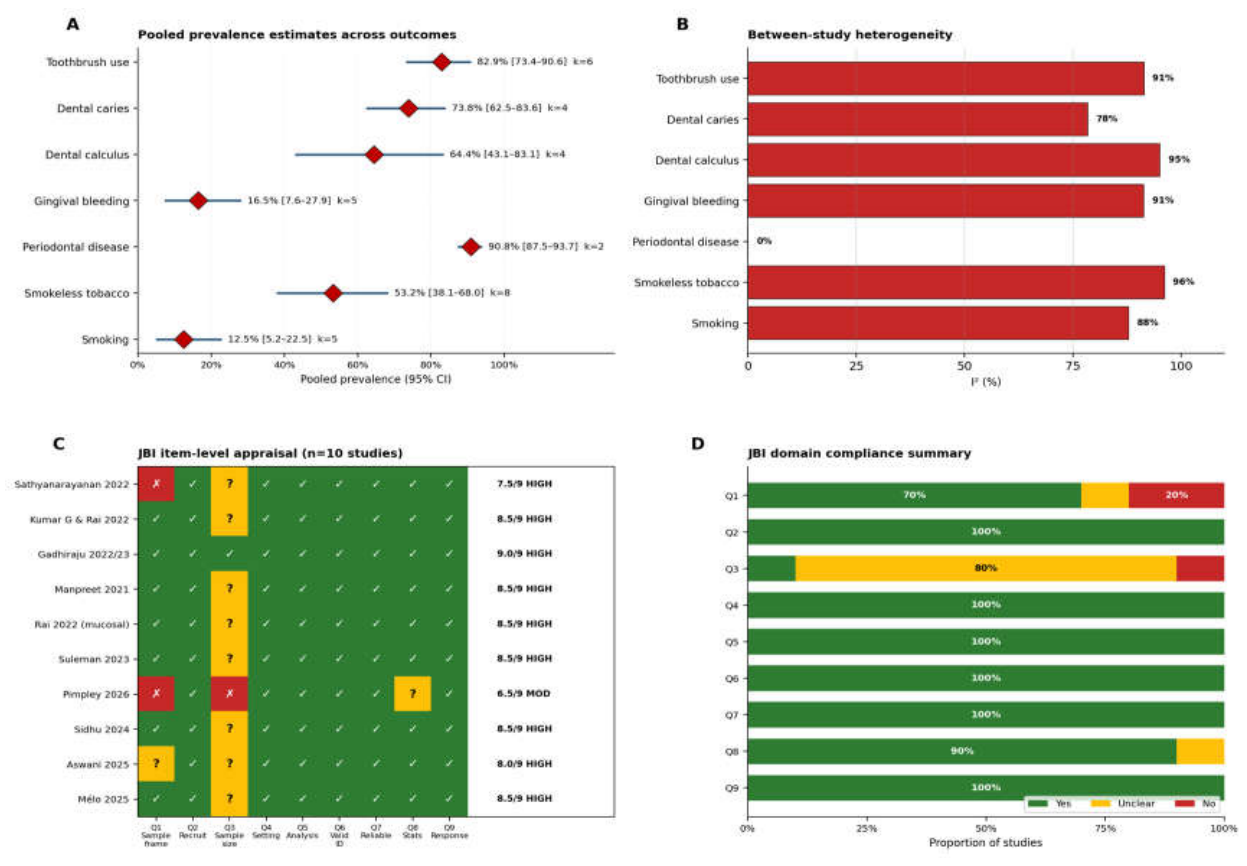
Figure 2.
Forest plots — six principal pooled outcomes. Random-effects DerSimonian-Laird meta-analysis on Freeman-Tukey double-arcsine transformed proportions. Red diamonds = pooled estimates; red dashed lines = 95% prediction intervals; square size proportional to random-effects weight. (A) Toothbrush use; (B) Smoking; (C) Smokeless tobacco; (D) Dental caries; (E) Dental calculus; (F) Gingival bleeding.
Figure 2.
Forest plots — six principal pooled outcomes. Random-effects DerSimonian-Laird meta-analysis on Freeman-Tukey double-arcsine transformed proportions. Red diamonds = pooled estimates; red dashed lines = 95% prediction intervals; square size proportional to random-effects weight. (A) Toothbrush use; (B) Smoking; (C) Smokeless tobacco; (D) Dental caries; (E) Dental calculus; (F) Gingival bleeding.
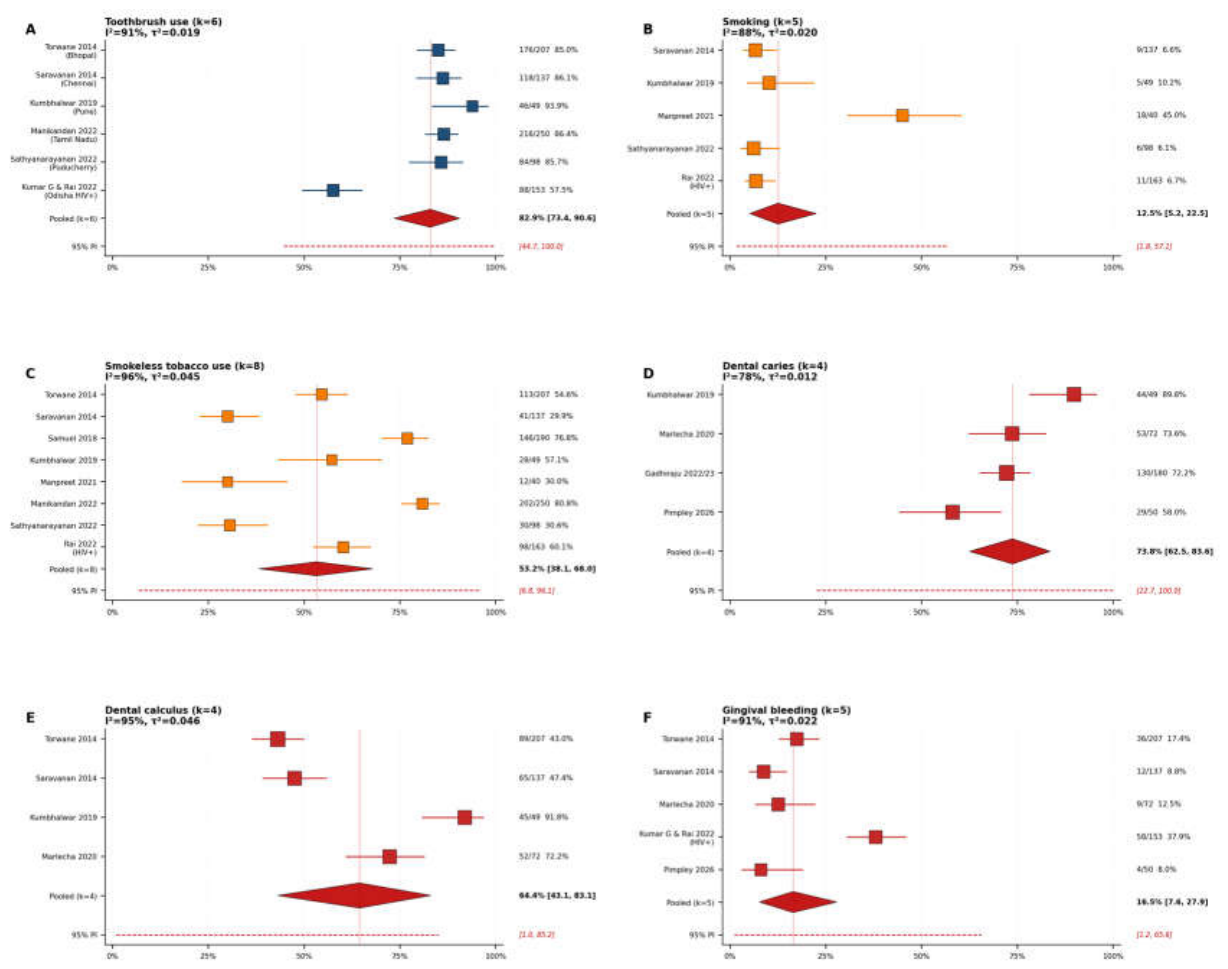
Figure 3.
Subgroup forest plots and continuous-outcome meta-analysis. (A) Toothbrush use in HIV-negative subgroup — heterogeneity fully eliminated (I² = 0%). (B) Smokeless tobacco in HIV-negative subgroup. (C) Toothbrush use in South India subgroup — I² = 0%. (D) Toothbrush use in North/Central/East India subgroup. (E) Periodontal disease post-Aug-2021. (F) Mean DMFT continuous-outcome MA — Suleman 2023 Lahore at 6.86 is the highest reported globally.
Figure 3.
Subgroup forest plots and continuous-outcome meta-analysis. (A) Toothbrush use in HIV-negative subgroup — heterogeneity fully eliminated (I² = 0%). (B) Smokeless tobacco in HIV-negative subgroup. (C) Toothbrush use in South India subgroup — I² = 0%. (D) Toothbrush use in North/Central/East India subgroup. (E) Periodontal disease post-Aug-2021. (F) Mean DMFT continuous-outcome MA — Suleman 2023 Lahore at 6.86 is the highest reported globally.
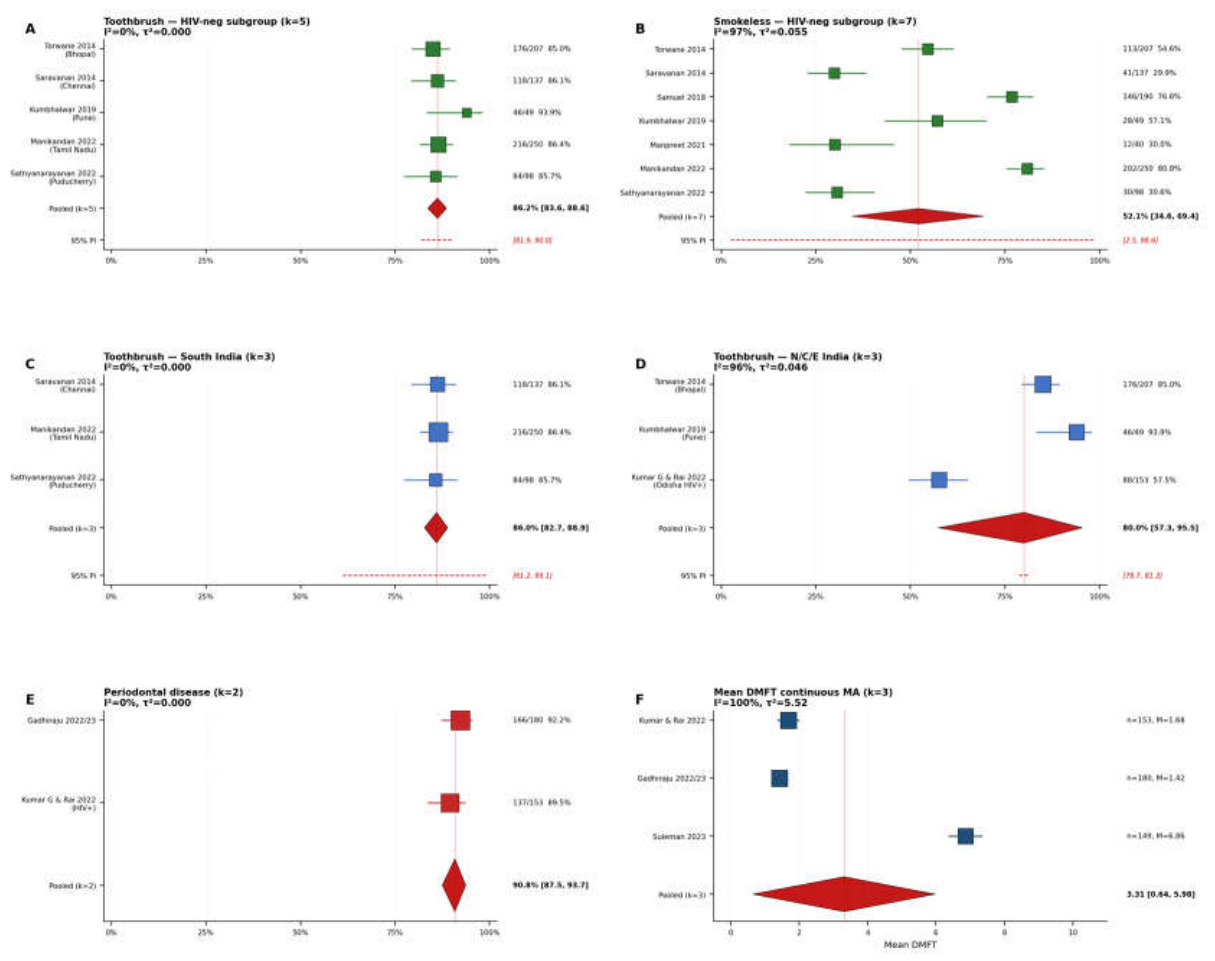
Figure 4.
Heterogeneity and leave-one-out sensitivity diagnostics. (A-D) Baujat plots showing per-study contribution to Cochran's Q vs influence on pooled estimate. (E-H) Leave-one-out plots; red line and pink band = original pooled estimate and 95% CI. Only smoking (F) is not robust to single-study exclusion.
Figure 4.
Heterogeneity and leave-one-out sensitivity diagnostics. (A-D) Baujat plots showing per-study contribution to Cochran's Q vs influence on pooled estimate. (E-H) Leave-one-out plots; red line and pink band = original pooled estimate and 95% CI. Only smoking (F) is not robust to single-study exclusion.
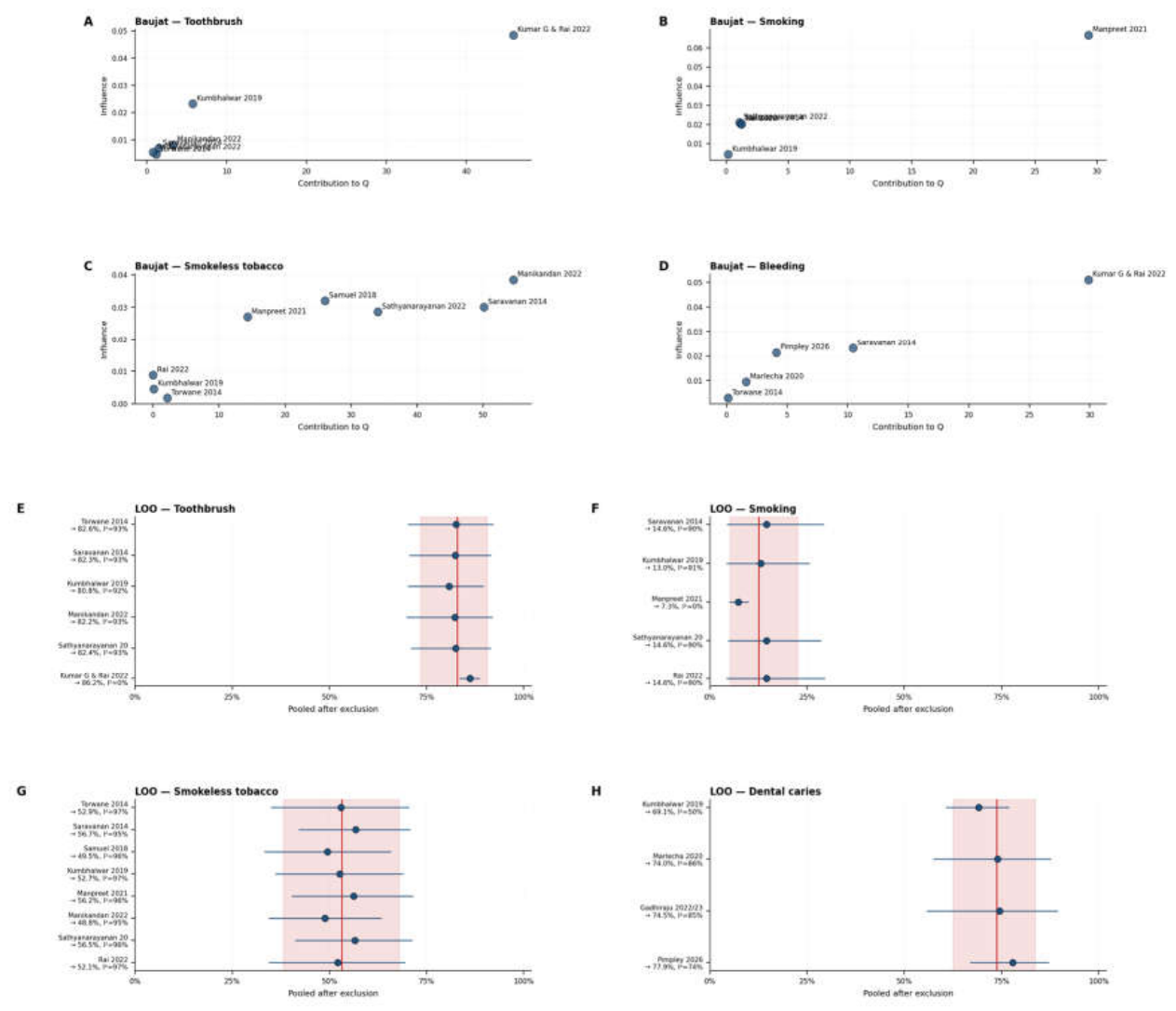
Figure 5.
Publication bias and cross-synthesis comparison. (A) Funnel plot for smokeless tobacco (k=8). (B) Funnel plot for toothbrush use (k=6). (C) Cross-synthesis bar comparison: this update (red) vs Mehta 2024 India synthesis (blue); pooled estimates align within ≤ 5 pp across all six common outcomes. (D) Temporal trend in caries prevalence 2019-2026.
Figure 5.
Publication bias and cross-synthesis comparison. (A) Funnel plot for smokeless tobacco (k=8). (B) Funnel plot for toothbrush use (k=6). (C) Cross-synthesis bar comparison: this update (red) vs Mehta 2024 India synthesis (blue); pooled estimates align within ≤ 5 pp across all six common outcomes. (D) Temporal trend in caries prevalence 2019-2026.
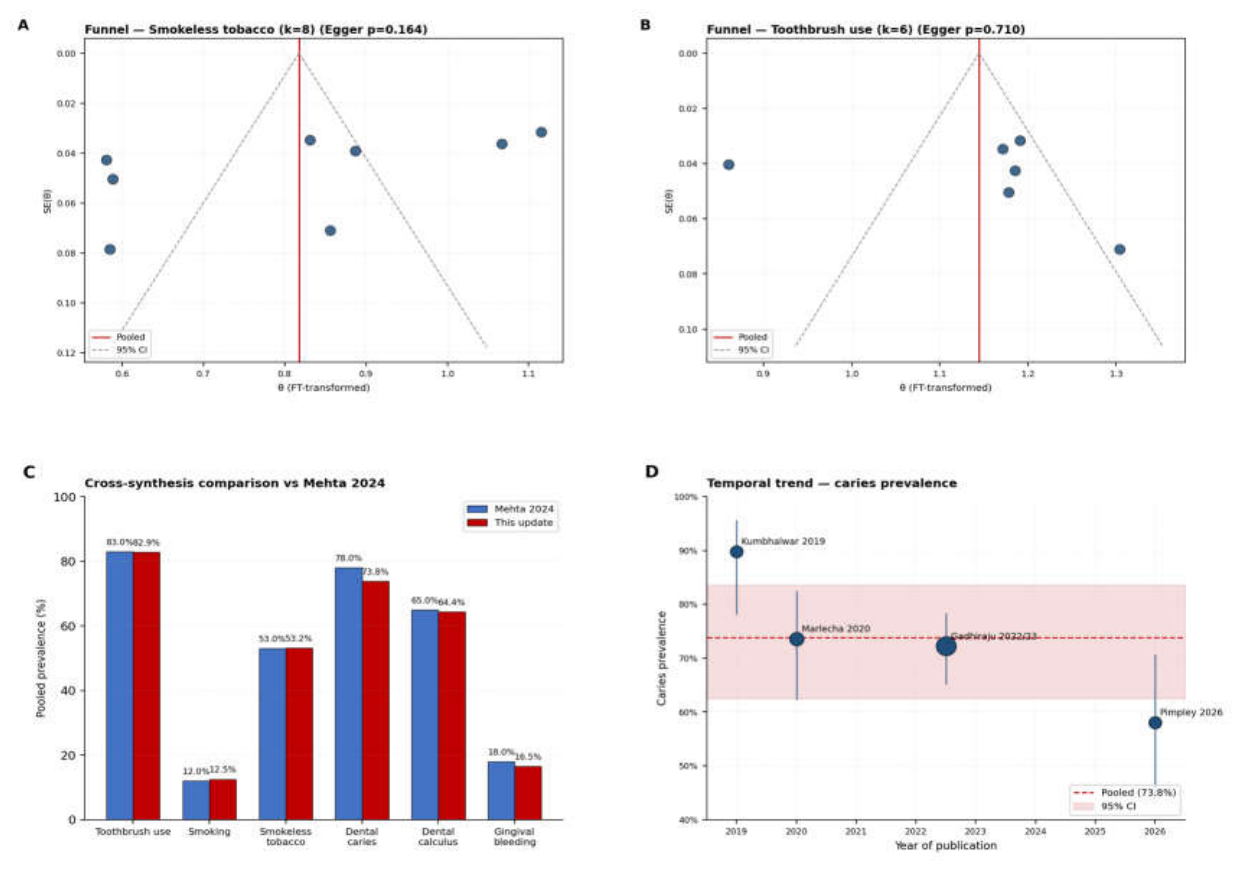

Table 1.
Characteristics of included quantitative studies (n=11).
| Author, year | Country/region | Design | Population | n | Key outcomes |
|---|---|---|---|---|---|
| Sathyanarayanan and John 2022 | Puducherry, India | Cross-sectional KAP | General TG | 98 | Toothbrush use, tobacco, alcohol, dental visits |
| Kumar and Rai 2022 | Odisha, India | Cross-sectional clinical | HIV+ TG | 153 | DMFT, CPI, LOA, fluorosis, prosthetic needs |
| Gadhiraju et al. 2023 | Belagavi, Karnataka | Cross-sectional clinical | General TG | 180 | Caries 72.2%, periodontal 92.2%, DMFT 1.42 |
| Manpreet et al. 2021 | Karnataka (multicentre) | Cross-sectional with controls | TG young adults | 40 TG + 40 controls | DMFT, leukoplakia, oral ulcers, Candida |
| Rai et al. 2022 | Odisha, India | Cross-sectional clinical | HIV+ TG (± ART) | 163 | Oral mucosal lesions ± ART |
| Suleman et al. 2023 | Lahore, Pakistan | Cross-sectional KAP + clinical | Khwaja sira community | 149 | Mean DMFT 6.86 (SD 2.99) |
| Pimpley and Deshpande 2026 | Nagpur, India | Mixed-methods (DMFT/CPI + FGD) | LGBTQ+ | 50 | Caries 58%, barriers |
| Sidhu et al. 2024 | India (nationwide) | Cross-sectional survey | Practising dentists | 143 | Willingness 71%, training 25% |
| Mélo et al. 2025 | Brazil | Cross-sectional clinical (pre-GAHT) | General TG | Not specified | Gingivitis, plaque, TMD |
| Manikanda et al. 2022 | Tamil Nadu, India | Cross-sectional questionnaire | General TG | 250 | Toothbrush use, smokeless tobacco |
| Clermont et al. 2024 | USA (BRFSS) | Population secondary analysis | US adults | 1,284,526 (weighted ≈290M) | Past-year dental visit (trans vs cis) |
Table 2.
Risk of bias — JBI Critical Appraisal Checklist for Prevalence Studies (9 items).
| Study | Q1 | Q2 | Q3 | Q4 | Q5 | Q6 | Q7 | Q8 | Q9 | Score | Band |
|---|---|---|---|---|---|---|---|---|---|---|---|
| Sathyanarayanan and John 2022 | N | Y | U | Y | Y | Y | Y | Y | Y | 7.5/9 | HIGH |
| Kumar and Rai 2022 | Y | Y | U | Y | Y | Y | Y | Y | Y | 8.5/9 | HIGH |
| Gadhiraju et al. 2023 | Y | Y | Y | Y | Y | Y | Y | Y | Y | 9/9 | HIGH |
| Manpreet et al. 2021 | Y | Y | U | Y | Y | Y | Y | Y | Y | 8.5/9 | HIGH |
| Rai et al. 2022 | Y | Y | U | Y | Y | Y | Y | Y | Y | 8.5/9 | HIGH |
| Suleman et al. 2023 | Y | Y | U | Y | Y | Y | Y | Y | Y | 8.5/9 | HIGH |
| Pimpley and Deshpande 2026 | N | Y | N | Y | Y | Y | Y | U | Y | 6.5/9 | MOD |
| Sidhu et al. 2024 | Y | Y | U | Y | Y | Y | Y | Y | Y | 8.5/9 | HIGH |
| Aswani et al. 2025 | U | Y | U | Y | Y | Y | Y | Y | Y | 8/9 | HIGH |
| Mélo et al. 2025 | Y | Y | U | Y | Y | Y | Y | Y | Y | 8.5/9 | HIGH |
Y = Yes; U = Unclear; N = No. Bands: HIGH ≥ 7/9; MODERATE 5-6/9; LOW ≤ 4/9.
Table 3.
Pooled meta-analytic estimates (random-effects DerSimonian-Laird; Freeman-Tukey double-arcsine transformation).
Table 3.
Pooled meta-analytic estimates (random-effects DerSimonian-Laird; Freeman-Tukey double-arcsine transformation).
| Outcome | k | Pooled (95% CI) | I² | τ² | 95% PI | Egger p |
|---|---|---|---|---|---|---|
| Toothbrush use | 6 | 82.9% (73.4-90.6) | 91.4% | 0.019 | 44.7-100% | 0.710 |
| Smoking | 5 | 12.5% (5.2-22.5) | 87.8% | 0.020 | 1.8-57.1% | 0.107 |
| Smokeless tobacco | 8 | 53.2% (38.1-68.0) | 96.1% | 0.045 | 6.8-96.1% | 0.164 |
| Dental caries | 4 | 73.8% (62.5-83.6) | 78.4% | 0.012 | 22.7-100% | — |
| Dental calculus | 4 | 64.4% (43.1-83.1) | 95.1% | 0.046 | 1.0-85.2% | — |
| Gingival bleeding | 5 | 16.5% (7.6-27.9) | 91.3% | 0.022 | 1.2-65.6% | 0.319 |
| Periodontal disease | 2 | 90.8% (87.5-93.7) | 0.0% | 0.000 | n/a (k<3) | — |
| Mean DMFT (continuous) | 3 | 3.31 (0.64-5.98) | 99.5% | 5.51 | — | — |
Table 4.
Heterogeneity classification and identified drivers.
| Outcome | I² | Class | Q p-value | Identified driver |
|---|---|---|---|---|
| Toothbrush use | 91% | Considerable | <0.0001 | HIV status (I² collapses to 0% in HIV-neg subgroup) |
| Smoking | 88% | Considerable | <0.0001 | Single outlier Manpreet 2021 (LOO drops I² to ≈0%) |
| Smokeless tobacco | 96% | Considerable | <0.0001 | Case-definition heterogeneity (current daily vs ever-use) |
| Dental caries | 78% | Substantial | 0.003 | Sampling frame; Pimpley 2026 lowest |
| Dental calculus | 95% | Considerable | <0.0001 | Sample-size and recency dependent |
| Gingival bleeding | 91% | Considerable | <0.0001 | HIV+ subgroup elevates pooled bleeding |
| Periodontal disease | 0% | None | 0.397 | Only 2 studies; both >89% |
| Toothbrush — HIV-neg subgroup | 0% | None | 0.572 | All heterogeneity attributable to HIV status |
| Mean DMFT | 99.5% | Considerable | <0.0001 | Pakistan (Lahore) 6.86 vs India ~1.55 — 4× gap |
Table 5.
Leave-one-out sensitivity — worst-case single-study exclusion.
| Outcome | Worst-case excluded study | New pooled | Within original CI? |
|---|---|---|---|
| Toothbrush use | Kumar and Rai 2022 (HIV+) | 86.2% | Outside upper bound |
| Smoking | Manpreet et al. 2021 | 7.3% | Outside lower bound (non-robust) |
| Smokeless tobacco | Manikandan et al. 2022 | 48.8% | Within |
| Dental caries | Pimpley and Deshpande 2026 | 77.9% | Within |
| Dental calculus | Kumbhalwar et al. 2021 | 53.0% | Within |
| Gingival bleeding | Kumar and Rai 2022 (HIV+) | 11.5% | Marginal lower bound |
Table 6.
Provider-side findings — Indian dentist perceptions (Sidhu et al. 2024, n=143).
| Indicator | Frequency (proportion) | 95% CI (Wilson) |
|---|---|---|
| Female respondents | 90/143 (62.9%) | 54.6-70.6% |
| Male respondents | 53/143 (37.1%) | 29.4-45.4% |
| Ever treated a transgender patient | 46/143 (32.2%) | 25.0-40.3% |
| Received specific TG training | 36/143 (25.2%) | 18.7-33.0% |
| Willing to treat transgender patients | 102/143 (71.3%) | 63.4-78.2% |
| Recognise societal benefits of TG identity | 120/143 (83.9%) | 77.0-89.1% |
| Support inclusion of LGBTQ+ patients | 125/143 (87.4%) | 80.9-91.9% |
Table 7.
Qualitative thematic synthesis — convergent themes across 5 studies.
| Convergent theme | Contributing studies |
|---|---|
| Healthcare discrimination and misgendering | Telang et al. 2025; Brum et al. 2025; Kumar et al. 2023; Jadoon et al. 2025; Pimpley and Deshpande 2026 |
| Cost and affordability of care | Aswani et al. 2025; Telang et al. 2025; Jadoon et al. 2025; Pimpley and Deshpande 2026 |
| Absence of trans-competent providers | Kumar et al. 2023; Jadoon et al. 2025; Telang et al. 2025; Sidhu et al. 2024 |
| Social stigma in waiting rooms | Brum et al. 2025; Jadoon et al. 2025 |
| Distance to facility / urban-rural divide | Aswani et al. 2025; Pimpley and Deshpande 2026 |
| Preferred provider attributes (gender-affirming language, dignity, dedicated slot) | Brum et al. 2025; Telang et al. 2025 |
Table 8.
GRADE-informed certainty of evidence per pooled outcome.
| Outcome | RoB | Inconsist. | Indirect. | Imprec. | Pub. bias | Certainty |
|---|---|---|---|---|---|---|
| Toothbrush use | Low | Serious ↓ | Not serious | Not serious | Not detected | LOW |
| Smoking | Low | Very serious ↓↓ | Not serious | Serious ↓ | Not detected | VERY LOW |
| Smokeless tobacco | Low | Very serious ↓↓ | Not serious | Not serious | Not detected | LOW |
| Dental caries | Low | Serious ↓ | Not serious | Not serious | Insufficient k | LOW |
| Dental calculus | Low | Very serious ↓↓ | Not serious | Serious ↓ | Insufficient k | VERY LOW |
| Gingival bleeding | Low | Serious ↓ | Not serious | Serious ↓ | Not detected | VERY LOW |
| Periodontal disease | Low | Not serious | Not serious | Serious (k=2) ↓ | Insufficient k | LOW |
| Toothbrush — HIV-neg subgroup | Low | Not serious | Not serious | Not serious | Not detected | MODERATE ↑ |
Disclaimer/Publisher’s Note: The statements, opinions and data contained in all publications are solely those of the individual author(s) and contributor(s) and not of MDPI and/or the editor(s). MDPI and/or the editor(s) disclaim responsibility for any injury to people or property resulting from any ideas, methods, instructions or products referred to in the content. |
© 2026 by the authors. Licensee MDPI, Basel, Switzerland. This article is an open access article distributed under the terms and conditions of the Creative Commons Attribution (CC BY) license (http://creativecommons.org/licenses/by/4.0/).
Copyright: This open access article is published under a Creative Commons CC BY 4.0 license, which permit the free download, distribution, and reuse, provided that the author and preprint are cited in any reuse.


