

Submitted:
27 July 2026
Posted:
29 July 2026
You are already at the latest version
Abstract
Hearing and vision are the most important sensory functions. Genetic studies have revealed that specific genetic mutations can concurrently induce auditory and visual dysfunction. The comorbid deafness-blindness prevent mutual sensory compensation, thereby severely delaying speech, cognitive, and intellectual development in affected pediatric patients and imposing a profound burden on their families. In this review, we summarize the currently identified genes that cause hearing and vision impairments and classify them based on their pathological mechanisms. Furthermore, recent advances in gene therapy have brought new hope for the definitive treatment of genetic hearing loss and visual impairment, and relevant clinical trials have demonstrated promising therapeutic efficacy. Therefore, we also summarize the latest progress of gene therapy and ongoing clinical trial programs targeting these otooculopathies, aiming to provide references and basis for the subsequent treatment of comorbid auditory and visual dysfunctions.
Keywords:
deafness
; blindness
; pathogenic gene
; gene therapy
1. Introduction
Hearing and vision are the two principal sensory gateways connecting individuals to the external world and are indispensable for language acquisition, cognitive development, communication, mobility, and independent living. According to the World Health Organization, more than 1.5 billion people worldwide currently live with some degree of hearing loss [1]. The global burden of visual impairment is even greater, with at least 2.2 billion people affected by near- or distance-vision impairment creating a significant public health burden [2].
However, a subset of genetic disorders affects both sensory systems and gives rise to combined auditory and visual impairment, hereafter referred to as hereditary auditory-visual comorbidity [3]. It encompasses classical deaf-blind syndromes, such as Usher syndrome, as well as disorders associated with retinal degeneration, congenital ocular malformation, optic neuropathy, corneal disease, or visual-pathway dysfunction accompanied by hearing loss [4,5]. Dual sensory impairment cannot be regarded simply as the additive effect of isolated deafness and blindness. Because vision often compensates for impaired hearing and hearing compensates for reduced vision, simultaneous dysfunction of both systems markedly restricts access to language, environmental information, interpersonal communication, education, mobility, and social participation [6]. In children with congenital or early-onset disease, inadequate sensory and language access may interfere with speech and cognitive development, whereas affected individuals across the lifespan face increased risks of social isolation, psychological distress, and reduced quality of life [7].
The diagnosis of hereditary auditory-visual disorders is complicated by marked clinical and genetic heterogeneity [8,9,10,11,12]. Hearing loss may be congenital, delayed-onset, stable, or progressive and may arise from abnormalities of cochlear hair cells, the stria vascularis, spiral ganglion neurons, auditory nerves, or middle-ear structures. Similarly, visual manifestations range from retinitis pigmentosa, cone or cone-rod dysfunction, and congenital blindness to optic atrophy, retinal vascular dysplasia, ocular coloboma, corneal dystrophy, and cortical visual impairment [6,7,8,9,10]. Furthermore, variants in the same gene may produce isolated hearing loss, isolated ocular disease, or combined auditory-visual involvement depending on the variant type, residual protein function, inheritance pattern, and genetic background [18,19].
Despite this phenotypic diversity, the auditory and visual systems share several molecular and cellular requirements. Cochlear hair cells and retinal photoreceptors are highly specialized sensory cells that depend on precisely organized cytoskeletal structures, ciliary or stereociliary protein complexes, intracellular cargo trafficking, membrane adhesion, synaptic integrity, and tightly regulated metabolic homeostasis [20,21]. Accordingly, pathogenic mechanisms underlying auditory-visual comorbidity include disruption of Usher adhesion-scaffold complexes, impaired actin-dependent transport, defective ciliary trafficking, mitochondrial or endoplasmic-reticulum dysfunction, peroxisomal biogenesis defects, extracellular-matrix abnormalities, and altered developmental or vascular signaling [22,23,24,25,26]. However, not all associated genes act through an identical mechanism in both organs; some affect a shared molecular pathway but different tissue-specific targets, whereas others produce auditory and visual phenotypes through distinct allelic or developmental mechanisms.
A mechanism-based understanding of these disorders is therefore essential for accurate molecular diagnosis, genotype-phenotype interpretation, prognostic counselling, and therapeutic development. Recent advances in gene therapys have provided proof of concept that inherited sensory dysfunction may be treated at its molecular origin. Nevertheless, current therapies generally target either the inner ear or the eye, and simultaneous restoration of hearing and vision remains challenging. In this review, we summarize the major genes and syndromes associated with hereditary auditory-visual comorbidity, classify them according to their shared or organ-specific pathogenic mechanisms, and discuss emerging gene therapeutic strategies.
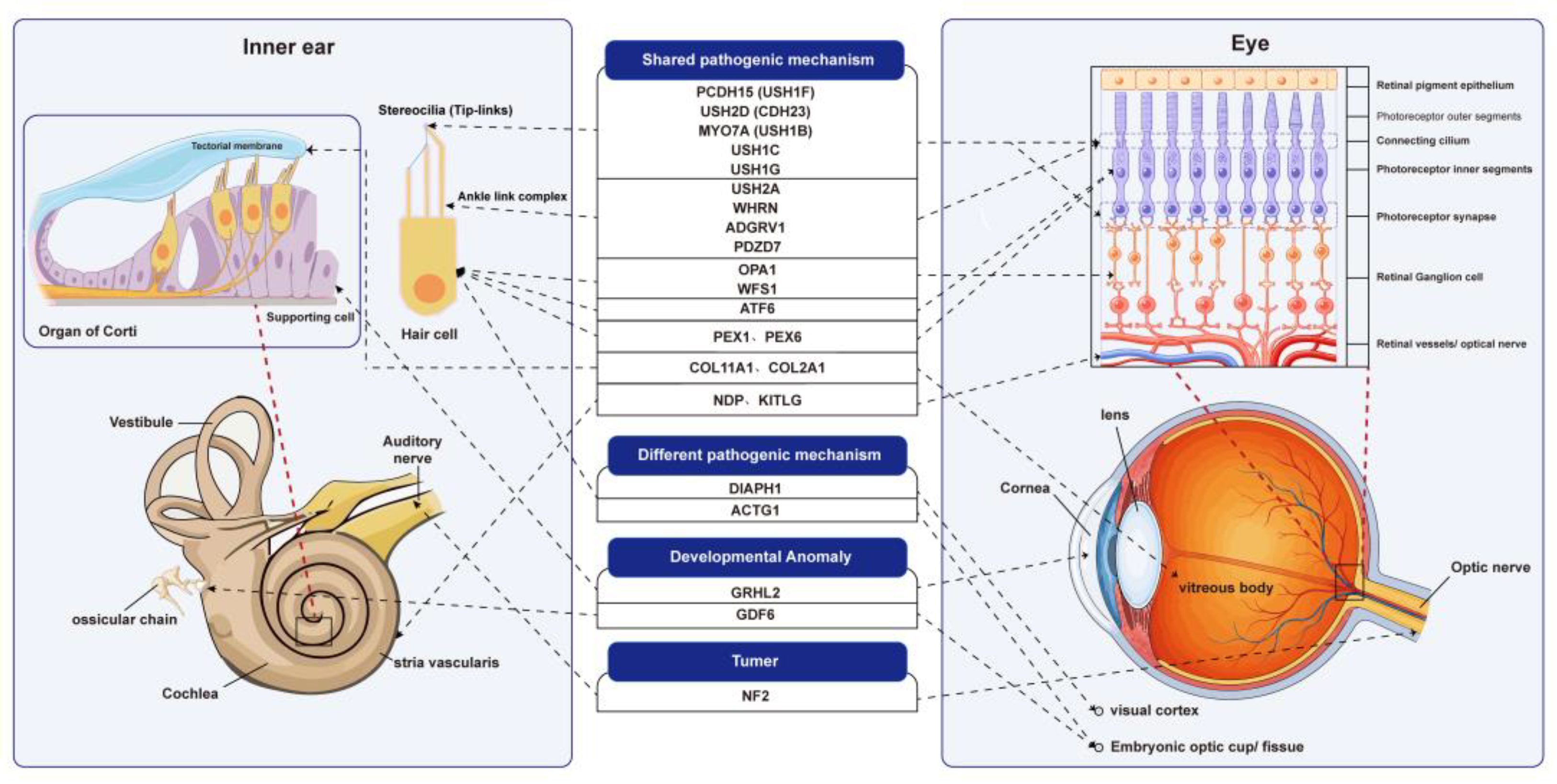
Figure 1.
Pathogenic mechanisms of comorbid auditory and visual dysfunction.
2. Deafness-Blindness Syndromes
2.1. Usher Syndrome
Usher syndrome (USH) is an autosomal recessive disorder characterized by the combination of sensorineural hearing loss and progressive retinal degeneration, most commonly retinitis pigmentosa. It represents the leading inherited cause of combined hearing and visual impairment [24,29]. The two defining sensory abnormalities have different temporal courses. Hearing loss is usually congenital or begins early in life, whereas retinal degeneration typically becomes evident later, initially presenting with nyctalopia and impaired dark adaptation, followed by progressive constriction of the peripheral visual field and, in advanced disease, loss of central vision [30,31]. Vestibular dysfunction is an additional major phenotypic discriminator and is especially prominent in Usher syndrome type 1. The delayed onset of retinal symptoms means that affected children may initially be diagnosed as having isolated congenital deafness, highlighting the importance of early molecular testing and longitudinal ophthalmologic surveillance [4,19]. Usher syndrome is traditionally divided into three clinical subtypes according to the severity and onset of hearing loss, vestibular function, and the age at onset and progression of retinal degeneration. This clinical classification remains useful, although substantial phenotypic overlap and atypical presentations are increasingly recognized [32].
2.1.1. Usher Syndrome Type 1
Usher syndrome type 1 (USH1) is the most severe classical subtype. It is characterized by congenital bilateral severe-to-profound sensorineural hearing loss, marked vestibular hypofunction or areflexia, and progressive retinitis pigmentosa, usually becoming symptomatic during childhood or adolescence [30,33]. Because of vestibular dysfunction, affected children often exhibit delayed independent walking and impaired balance. Without early auditory rehabilitation, including timely cochlear implantation when appropriate, spoken-language development may be profoundly compromised [34].
Five genes are currently regarded as the principal, well-established causes of classical USH1: MYO7A, USH1C, CDH23, PCDH15, and USH1G [35]. These genes encode proteins that form an interconnected molecular network in sensory hair cells and retinal photoreceptors. In cochlear hair cells, the USH1 proteins participate in the development, organization, cohesion, and mechanotransduction function of stereociliary bundles [36]. In the retina, the same proteins contribute to photoreceptor ciliary trafficking, synaptic organization, and the functional interaction between photoreceptors and the retinal pigment epithelium. However, their precise retinal localization and functions differ from those in the inner ear. Thus, USH1 proteins act through a shared molecular network in both sensory systems, but the immediate cellular consequences are organ specific. CIB2 was previously proposed as the cause of an additional USH1 subtype [37]. Subsequent genetic and phenotypic studies, however, have more consistently associated biallelic CIB2 variants with autosomal recessive nonsyndromic hearing loss, and its status as a definitive Usher syndrome gene remains uncertain.
2.1.2. Usher Syndrome Type 2
Usher syndrome type 2 (USH2) is generally characterized by congenital bilateral moderate-to-severe sensorineural hearing loss, relatively preserved vestibular function, and retinitis pigmentosa that commonly becomes symptomatic in late adolescence or early adulthood [38]. Hearing loss is often greater at higher frequencies and may initially be managed with hearing aids, although progression and severity vary among individuals. Vestibular function is usually normal, but mild or subclinical vestibular abnormalities have been reported in a subset of patients [39].
The three established USH2 genes are: USH2A, ADGRV1, and WHRN. These proteins assemble with other components into the USH2 protein complex, which is localized to the ankle-link region of developing cochlear stereocilia and to the periciliary membrane complex of retinal photoreceptors [40,41]. The complex supports hair-bundle maturation in the inner ear and protein trafficking between the inner and outer segments of photoreceptors. USH2A is by far the most common cause of USH2, accounting for approximately 70%-80% of genetically resolved cases in many populations [42]. Importantly, biallelic USH2A variants may cause either syndromic USH2 or nonsyndromic autosomal recessive retinitis pigmentosa. Genotype-phenotype correlations suggest that individuals with two severe or truncating alleles are more likely to develop combined hearing and retinal disease, whereas some hypomorphic alleles may retain sufficient cochlear function and predominantly produce retinal degeneration. Nevertheless, these correlations are not absolute, and marked intrafamilial and interfamilial variability can occur [43].
2.1.3. Usher Syndrome Type 3
Usher syndrome type 3 (USH3) is distinguished by progressive, rather than uniformly congenital, sensorineural hearing loss. Hearing may initially be normal or only mildly impaired but deteriorates over time [44]. Retinal degeneration is also progressive, and vestibular dysfunction is variable. The age at onset and rate of progression differ substantially among patients, making USH3 more difficult to recognize on clinical grounds alone. The only widely accepted canonical USH3 gene is: CLRN1. CLRN1 encodes clarin-1, a membrane-associated protein involved in the organization and maintenance of sensory-cell membrane domains, synaptic integrity, and hair-bundle function [45]. Biallelic CLRN1 variants cause USH3A. The disorder is particularly prevalent in certain founder populations, including individuals of Finnish and Ashkenazi Jewish ancestry, but occurs worldwide. The severity and progression of hearing, retinal, and vestibular manifestations vary according to genotype and genetic background. HARS1, encoding cytoplasmic histidyl-tRNA synthetase, was previously proposed as a cause of USH3B. However, the evidence supporting HARS1 as an established Usher syndrome gene remains limited, and it is not generally included among the canonical USH genes in recent stringent classifications.
2.1.4. Atypical Usher Phenotypes
Beyond the classical USH1-USH3 spectrum, combined hearing loss and retinal degeneration may result from pathogenic variants in genes such as CEP78, CEP250, ARSG, and ABHD12 [46]. These conditions are often referred to as atypical Usher syndrome, Usher-like disorders, or syndromic retinal dystrophies with hearing loss. Some have additional neurological or systemic manifestations that distinguish them from classical Usher syndrome [47]. For example, ABHD12-related disease is associated with PHARC syndrome, whereas CEP78-related disease may present with cone-rod dystrophy and sensorineural hearing loss. These genes should therefore be discussed separately from the canonical USH genes to avoid conflating a shared deaf-blind phenotype with membership in the classical Usher protein network.
Overall, the considerable genetic and phenotypic heterogeneity of Usher syndrome complicates diagnosis and prognosis [48]. Variants in the same gene may produce classical Usher syndrome, atypical disease, or apparently nonsyndromic hearing or retinal impairment, depending on their molecular consequences and residual protein function. Comprehensive genomic testing, combined with detailed audiological, vestibular, and retinal phenotyping, is therefore essential for establishing an accurate molecular diagnosis, guiding surveillance, providing genetic counseling, and identifying patients who may be eligible for gene- or RNA-based therapies.
2.2. Heimler Syndrome
Heimler syndrome is a rare autosomal recessive disorder caused predominantly by hypomorphic biallelic variants in the peroxisome-biogenesis genes PEX1 and PEX6 [49]. Rare patients carrying biallelic PEX26 variants with a Heimler-like phenotype have also been reported, although the gene-disease evidence is substantially more limited than that for PEX1 and PEX6 [50,51]. The condition is traditionally classified as Heimler syndrome type 1, caused by PEX1 variants, and Heimler syndrome type 2, caused by PEX6 variants. Rather than representing an isolated disease entity, Heimler syndrome is now considered the mildest phenotypic end of the Zellweger spectrum of peroxisome-biogenesis disorders [52,53,54].
PEX1 and PEX6 encode interacting AAA-ATPases that form a heterohexameric complex required for recycling the peroxisomal matrix-protein import receptor PEX5 [55,56]. Severe loss-of-function variants markedly impair peroxisomal protein import and cause multisystem Zellweger spectrum disorders, whereas Heimler syndrome is generally associated with at least one hypomorphic allele that preserves partial peroxisomal activity. This residual function explains the absence of the profound neurological, hepatic, and craniofacial abnormalities typically observed in severe peroxisomal disease.
The cardinal clinical features include congenital or early-onset bilateral sensorineural hearing loss, amelogenesis imperfecta or enamel hypoplasia of the permanent dentition, and variable nail abnormalities [57]. Retinal involvement is increasingly recognized and may manifest as rod-cone or cone-rod dystrophy, pigmentary retinopathy, macular dystrophy, photoreceptor loss, intraretinal cystoid spaces, and progressive visual-field constriction. However, the ocular phenotype is heterogeneous, and some genetically confirmed patients have no clinically apparent retinal disease at the time of diagnosis [58,59]. Because hearing loss may precede retinal and dental manifestations, affected children can initially be misdiagnosed as having nonsyndromic hereditary deafness or Usher syndrome. Detailed ophthalmologic examination, dental assessment, peroxisomal biochemical testing, and molecular analysis of PEX1, PEX6, and, in selected unresolved cases, PEX26, are therefore important for establishing the diagnosis and guiding longitudinal surveillance.
2.3. Norrie Disease
Norrie disease is a rare X-linked recessive disorder caused by hemizygous pathogenic variants in NDP, located on chromosome Xp11.4 [60,61,62]. It predominantly affects males, whereas heterozygous female carriers are usually asymptomatic but may occasionally exhibit peripheral retinal vascular abnormalities or, more rarely, clinically significant ocular disease because of skewed X-chromosome inactivation [63,64,65]. NDP encodes Norrin, a secreted cystine-knot growth factor that binds to the Frizzled-4 receptor together with the co-receptors LRP5 and TSPAN12, thereby activating canonical β-catenin signaling. This pathway is essential for the development and maintenance of specialized vascular beds and barrier properties in the retina and cochlea [66,67].
The ocular phenotype is typically severe and manifests prenatally or during early infancy. Affected boys commonly present with bilateral retinal dysplasia, incomplete retinal vascularization, retinal folds or detachment, vitreoretinal proliferation, and leukocoria, termed retinal pseudoglioma. Visual function is frequently profoundly impaired at birth or lost during the first months of life. Progressive secondary changes may include vitreous hemorrhage, cataract, anterior synechiae, corneal opacity, glaucoma, and eventual phthisis bulbi [68,69].
In contrast to the congenital ocular phenotype, hearing is frequently normal at birth. Progressive sensorineural hearing loss develops in approximately 80%-90% of affected males, although its onset and rate of progression vary considerably. Earlier studies frequently placed the onset in late childhood or adolescence, but longitudinal audiological data have demonstrated detectable abnormalities as early as 3-8 years of age [70]. Hearing loss may initially be mild, fluctuating, asymmetric, or frequency restricted, but it generally progresses toward bilateral, relatively flat, moderate-to-profound sensorineural loss during adolescence or adulthood [71]. Experimental studies indicate that Norrin deficiency primarily disrupts the development and integrity of the stria vascularis and spiral-ligament microvasculature. Subsequent breakdown of the blood-labyrinth barrier, reduction of the endocochlear potential, and deterioration of cochlear homeostasis precede secondary hair-cell loss and auditory dysfunction [72].
Neurological and behavioral manifestations are variable rather than obligatory. In a cohort of 56 patients, cognitive impairment was reported in approximately 28%, autism or autism-like behavior in 27%, seizures in 16%, and peripheral vascular abnormalities in 38% [73]. Earlier estimates that 30%-50% of affected individuals have developmental delay or intellectual disability should therefore be interpreted cautiously because of differences in diagnostic definitions, ascertainment methods, and the difficulty of evaluating cognition in individuals with congenital blindness and progressive hearing loss.
2.4. Stickler Syndrome
Stickler syndrome (also known as hereditary arthro-ophthalmopathy) is a genetically heterogeneous connective tissue disorder caused by pathogenic variants affecting collagen and extracellular matrix components. Its core clinical features include ocular abnormalities (high myopia, retinal detachment), hearing loss, facial dysmorphism (flat facial profile), and early-onset arthritis [74,75]. The incidence of this condition in newborns is approximately 1 in 7,500 [75,76,77], although the true prevalence is likely underestimated because of variable expressivity and incomplete recognition of milder phenotypes.
The molecular basis of Stickler syndrome primarily involves abnormalities of fibrillar collagens and extracellular matrix organization. Its primarily classified into several types based on the pathogenic genes and clinical phenotypes. The three phenotypes caused by autosomal dominant inheritance are respectively due to mutations in COL2A1, COL11A1, and COL11A2 [74,78,79]. The majority of cases are caused by heterozygous variants in COL2A1, which account for approximately 80% of genetically confirmed cases and are classified as type 1 Stickler syndrome (STL1) [80]. COL2A1 encodes type II collagen, the predominant collagen component of cartilage and the vitreous humor. Consequently, COL2A1-associated disease typically demonstrates prominent ocular manifestations, including membranous vitreous degeneration, high myopia, peripheral retinal degeneration, and a markedly increased risk of retinal detachment. Hearing impairment is usually mild to moderate and may result from abnormalities of the middle ear, cochlear structures, or both [74,81].
COL11A1 variants cause type 2 Stickler syndrome (STL2) and account for a smaller but clinically important proportion of cases [82]. Type XI collagen regulates the assembly and organization of collagen fibrils, and COL11A1-associated disease is characterized by a higher frequency and severity of sensorineural hearing loss compared with COL2A1-related disease. Ocular manifestations may include congenital cataracts, abnormal vitreous architecture, myopia, and retinal detachment, although the vitreoretinal phenotype is often less severe than that observed in COL2A1-related Stickler syndrome [83,84].
COL11A2 variants cause an autosomal dominant Stickler-like phenotype (referred to as STL3) and are distinct from classic Stickler syndrome because ocular abnormalities are usually absent. Instead, patients primarily present with progressive or congenital hearing loss and skeletal abnormalities, overlapping with otospondylomegaepiphyseal dysplasia (OSMED) [85].
In addition to the dominant forms, rare autosomal recessive Stickler syndromes caused by biallelic variants in COL9A1, COL9A2, and COL9A3 have been reported [81,86]. These genes encode collagen IX, a FACIT (fibril-associated collagen with interrupted triple helices) collagen that interacts with collagen II fibrils. COL9A1- and COL9A2-associated disease commonly presents with high myopia, vitreoretinal abnormalities, progressive sensorineural hearing loss, and epiphyseal abnormalities. COL9A3 variants have been associated with a milder ocular phenotype, although considerable phenotypic variability exists among affected individuals.
The shared pathogenic mechanism underlying auditory and visual involvement in Stickler syndrome is disruption of collagen-dependent extracellular matrix integrity. In the eye, abnormal collagen composition alters vitreous architecture and retinal adhesion, predisposing patients to retinal degeneration and detachment. In the inner ear, defective collagen organization affects the structural integrity of the tectorial membrane, basilar membrane, and supporting structures of the cochlea, resulting in sensorineural or mixed hearing loss.
3. Pathogenic Genes of Comorbid Auditory and Visual Dysfunction
3.1. MYO7A
Deafness and blindness caused by MYO7A mutations share a common molecular pathogenesis: impaired intracellular molecular motor function disrupts cargo transport and impairs the structural assembly of specialized sensory cells. MYO7A encodes myosin VIIa, an unconventional actin-based molecular motor that transports and anchors specific protein complexes required for the development, maintenance, and function of cochlear hair cells and retinal photoreceptors [28,87,88]. However, because cochlear hair cells and photoreceptor cells utilize MYO7A-dependent transport systems for distinct cellular processes, MYO7A deficiency results in different organ-specific manifestations [89].
In cochlear hair cells, mechanosensory stereocilia located at the apical surface convert sound-induced mechanical displacement into electrical signals. The stereociliary bundle requires precise organization of actin filaments and specialized adhesion complexes, including the cadherin 23 (CDH23)-protocadherin 15 (PCDH15) tip-link complex, which directly participates in mechanotransduction channel gating [90,91]. MYO7A is localized at the tips and upper regions of stereocilia, where it interacts with multiple Usher syndrome proteins, including CDH23, PCDH15, harmonin, and SANS [92,93]. MYO7A regulates the trafficking, anchoring, and maturation of these protein complexes, thereby maintaining stereociliary architecture and mechanotransduction competence [94]. Pathogenic MYO7A variants disrupt these processes, resulting in abnormal stereocilia development, defective tip-link organization, impaired mechanotransduction currents, and ultimately congenital severe-to-profound sensorineural hearing loss characteristic of Usher syndrome type 1B [95].
In the retina, MYO7A plays essential roles in both photoreceptor cells and retinal pigment epithelial (RPE) cells [96]. Photoreceptor outer segments undergo continuous renewal, requiring coordinated transport of newly synthesized proteins and removal of aged photoreceptor disc material. Unlike a simple cargo transporter for rhodopsin delivery, MYO7A primarily regulates actin-dependent intracellular trafficking pathways, including transport of opsin-associated cargo, melanosome movement within RPE cells, and phagocytosis of shed photoreceptor outer-segment discs by RPE cells [97]. Loss of MYO7A function disrupts the interaction between photoreceptors and RPE cells, leading to defective outer-segment turnover, accumulation of cellular debris, progressive photoreceptor degeneration, and retinal pigment epithelium dysfunction. Clinically, affected individuals develop progressive retinitis pigmentosa characterized by night blindness, peripheral visual-field constriction, and eventual severe visual impairment or blindness [28,98,99,100,101].
Therefore, MYO7A represents a typical example of a shared molecular mechanism producing auditory-visual comorbidity: the same intracellular transport defect affects different specialized cellular structures-stereociliary mechanotransduction machinery in the cochlea and photoreceptor-RPE homeostasis in the retina-resulting in combined deafness and blindness.
3.2. USH1C
The USH1C gene is located on chromosome 11p15.1 and spans approximately 51 kb, comprising 28 exons, of which eight undergo alternative splicing to generate multiple transcript isoforms [102]. Pathogenic variants in USH1C are associated with both Usher syndrome type 1C (USH1C) and autosomal recessive nonsyndromic hearing loss (DFNB18), representing an example of allelic heterogeneity in hereditary auditory-visual disorders. The USH1C gene encodes harmonin, a multifunctional scaffold protein containing multiple PDZ domains. Several harmonin isoforms are generated through alternative splicing, allowing interaction with distinct molecular partners in sensory cells [103]. Through its PDZ domains, harmonin organizes macromolecular complexes by binding to other Usher proteins in cochlear hair cells, thereby contributing to stereocilia development, tip-link organization, and mechanotransduction. Loss of harmonin function disrupts stereocilia organization and mechanotransduction, resulting in congenital severe-to-profound sensorineural hearing loss and vestibular dysfunction characteristic of USH1C [104].
In the retina, harmonin is expressed in photoreceptor cells and participates in the organization of protein complexes involved in photoreceptor maintenance and synaptic function [36]. Through interactions with other Usher proteins, harmonin contributes to the stability of photoreceptor synaptic architecture and the trafficking network required for photoreceptor homeostasis. Consequently, pathogenic USH1C variants lead to progressive retinal degeneration, typically presenting as retinitis pigmentosa with night blindness and progressive visual-field loss.
Thus, USH1C shared molecular machine of scaffold defect underlying auditory-visual comorbidity, in which disruption of a common protein-interaction network compromises mechanotransduction in cochlear hair cells and photoreceptor maintenance in the retina.
3.3. USH1G
The USH1G gene is one of the smallest genes associated with Usher syndrome, spanning approximately 7 kb and containing three exons, two of which encode protein-coding sequences. Biallelic pathogenic variants in USH1G cause Usher syndrome type 1G (USH1G), characterized by congenital severe-to-profound sensorineural hearing loss, vestibular dysfunction, and progressive retinitis pigmentosa. Rare atypical Usher phenotypes and nonsyndromic hearing loss associated with USH1G variants have also been reported, suggesting allelic and phenotypic heterogeneity [105].
The USH1G gene encodes SANS, a 461-amino-acid multifunctional scaffold protein containing three ankyrin repeat domains, a sterile alpha motif (SAM) domain, and a C-terminal PDZ-binding motif. Through these domains, SANS interacts with other Usher proteins to the assembly and stabilization of the Usher protein network [106].
In cochlear hair cells, SANS localizes to stereocilia and the tip-link region, where it participates in the organization of the mechanotransduction complex and regulates actin cytoskeleton dynamics required for hair-bundle maturation and maintenance. Loss of SANS disrupts tip-link integrity, stereocilia organization, and mechanotransduction, resulting in profound congenital hearing loss. In photoreceptors, SANS contributes to the organization of Usher protein complexes and intracellular cargo transport, and its deficiency leads to impaired photoreceptor homeostasis and progressive retinal degeneration [107].
3.4. PCDH15
The PCDH15 gene is one of the largest genes associated with Usher syndrome, spanning approximately 1 Mb and containing multiple alternatively spliced exons that generate several protein isoforms, including long isoforms of nearly 2000 amino acids. Biallelic pathogenic variants in PCDH15 cause Usher syndrome type 1F (USH1F), characterized by congenital severe-to-profound sensorineural hearing loss, vestibular dysfunction, and progressive retinitis pigmentosa. Hypomorphic variants may instead result in autosomal recessive nonsyndromic hearing loss (DFNB23), demonstrating genotype-phenotype variability [108,109,110].
PCDH15 encodes protocadherin-15, a member of the cadherin superfamily and a calcium-dependent cell adhesion molecule. In cochlear hair cells, PCDH15 forms the lower component of the CDH23-PCDH15 tip-link complex, which connects adjacent stereocilia and regulates mechanically gated ion-channel activation. Disruption of PCDH15 impairs tip-link formation, stereocilia organization, and mechanotransduction, leading to profound hearing loss [107,111]. In retinal photoreceptors, PCDH15 contributes to Usher protein network organization and photoreceptor maintenance, and its deficiency results in progressive retinal degeneration [112].
3.5. CDH23
CDH23 is one of the most common causes of USH1 after MYO7A and is also responsible for autosomal recessive nonsyndromic hearing loss (DFNB12). Genotype-phenotype correlations indicate that hypomorphic missense variants retaining partial CDH23 function are frequently associated with isolated hearing loss, whereas severe loss-of-function variants are more commonly associated with USH1D, characterized by congenital profound hearing loss, vestibular dysfunction, and progressive retinitis pigmentosa [113,114,115].
CDH23 spans approximately 300 kb and encodes a large cadherin protein containing multiple extracellular calcium-binding cadherin repeats. CDH23 forms the upper component of the CDH23-PCDH15 tip-link complex in cochlear hair cells, where it connects adjacent stereocilia and regulates mechanotransduction channel activation [116,117]. Loss of CDH23 disrupts tip-link integrity, leading to abnormal stereocilia organization and profound auditory dysfunction. In retinal photoreceptors, CDH23 is expressed in specialized membrane domains and contributes to photoreceptor structural maintenance and Usher protein network organization. Defective CDH23 function therefore results in progressive photoreceptor degeneration and retinitis pigmentosa [118].
3.6. USH2A
USH2A is the most frequently mutated gene associated with Usher syndrome and is responsible for approximately 70–80% of genetically confirmed Usher syndrome type 2 (USH2) cases. Biallelic USH2A variants also represent one of the major causes of autosomal recessive nonsyndromic retinitis pigmentosa, demonstrating substantial genotype-phenotype variability [119,120]. The USH2A gene spans approximately 800 kb and contains 72 exons, generating two major protein isoforms. Isoform a (usherin-short), encoded by the first 21 exons, is a secreted extracellular matrix protein, whereas isoform b (usherin-long), encoded by the full-length transcript, is a large transmembrane protein of 5202 amino acids containing extracellular laminin G and fibronectin type III domains [121].
In cochlear hair cells, usherin forms the USH2 protein complex with ADGRV1 and WHRN at the ankle-link region of developing stereocilia, contributing to hair-bundle maturation and mechanotransduction [122]. In photoreceptors, long usherin localizes to the connecting cilium and periciliary region, where it participates in protein trafficking and maintenance of photoreceptor outer-segment homeostasis. Loss of usherin function therefore disrupts sensory-cell structural integrity in both organs, resulting in progressive retinal degeneration and hearing impairment [102].
3.7. WHRN
The WHRN gene encodes whirlin and is associated with both Usher syndrome type 2D (USH2D) and autosomal recessive nonsyndromic hearing loss (DFNB31). Whirlin is a cytoplasmic scaffold protein that interacts with other Usher proteins, including usherin (USH2A) and ADGRV1, through PDZ-mediated interactions [123,124]. In cochlear hair cells, whirlin localizes to stereocilia and regulates hair-bundle elongation, organization, and mechanotransduction complex assembly [125]. In photoreceptors, the long isoform is expressed at the connecting cilium and synaptic regions, where it contributes to photoreceptor structural maintenance and protein trafficking. Loss of whirlin function therefore disrupts sensory-cell homeostasis, resulting in hearing loss and progressive retinal degeneration [126].
3.8. ADGRV1
ADGRV1 is also known as GPR98 and VLGR1. ADGRV1 is highly expressed in the cilia of hair cells and the synaptic membranes of photoreceptors, where it is responsible for the development of cochlear hair cells and the connectivity of photoreceptor fibers. The USH2C protein is crucial for the developmental function of both hair cells and photoreceptors. The ankle-link complex consists of ADGRV1, USH2A, WHRN, and PDZD7. ADGRV1 contributes to deaf-blindness through three major mechanisms: first, by disrupting the integrity of the ankle-link complex in hair cell stereocilia, leading to impaired mechanoelectrical transduction; second, by interfering with the structural formation of retinal photoreceptor connecting ciliary fibers, thereby affecting molecular transport; third, by losing G protein-coupled receptor signaling function, resulting in dysregulation of cAMP levels. Mutations in this gene cause Usher syndrome type IIC, which accounts for approximately 5.2% of all USH2 cases. Clinically, it presents with congenital sensorineural hearing loss and progressive retinitis pigmentosa [127,128,129,130,131,132].
3.9. PDZD7
PDZD7 encodes a scaffold protein containing PDZ domains and is a core component of the USH2 protein complex. Mutations in the PDZD7 gene cause deafness (DFNB57) by disrupting the assembly of the ankle link complex in inner ear hair cells, and it can act as a modifier factor for USH2A-related retinal dystrophy or contribute to biallelic inheritance of USH2C. Loss of PDZD7 function primarily affects hearing, while the severity of the phenotype (isolated deafness or deaf-blindness) depends on the presence of other gene mutations. First, when only PDZD7 mutations are present, biallelic inactivation occurs and affects only the inner ear, leading to autosomal recessive non-syndromic hearing loss (DFNB57). Second, in the case of biallelic heterozygosity with ADGRV1, both the inner ear and retina are affected, resulting in Usher syndrome (USH2C). Third, as a heterozygous modifier superimposed on the USH2A background, it exacerbates retinal dystrophy, causing PDZD7 to act as a modifier that accelerates the onset and increases the severity of retinal degeneration in USH2A patients [133,134].
3.10. OPA1
OPA1 gene mutations are the most common cause of autosomal dominant optic atrophy (ADOA, Kjer type) [135,136]. This gene encodes a GTPase located in the inner mitochondrial membrane, which is crucial for mitochondrial fusion, cristae structure maintenance, and mtDNA stability [137]. Its core pathological mechanism leads to retinal ganglion cell (RGC) degeneration, but there is significant clinical phenotypic variability, primarily divided into two types [138]. The most common is simple optic atrophy, with a core mechanism of haploinsufficiency, where mutation of one gene copy reduces functional OPA1 protein by approximately 50%. This impairs mitochondrial fusion capacity, and RGC axons, being extremely long and having high energy demands, are particularly sensitive to mitochondrial dysfunction. The main clinical manifestations include bilateral symmetric, progressive visual acuity loss [139,140]. Characteristic visual field defects are central or paracentral scotomas; characteristic fundus changes are temporal optic disc pallor. It typically presents in childhood to early adulthood, usually before the age of 20. The other type is the syndromic form (ADOA "PLUS") [141,142]. Its core pathogenic mechanism is a dominant-negative effect, predominantly observed with missense mutations in the GTPase domain [143]. The mutant protein is not only non-functional itself but also interferes with the function of normal protein, exerting a more destructive effect and causing more severe mitochondrial dysfunction. Clinical features, in addition to the aforementioned ocular symptoms, include sensorineural hearing loss in approximately 20% of patients [144]. A minority may present with progressive external ophthalmoplegia, ataxia, peripheral neuropathy, Parkinsonism, or multiple sclerosis.
3.11. WFS1
Patients with WFS1 mutation-related deafness typically present with gradually progressive hearing loss in the mid-to-low frequency range. In contrast, patients with visual impairment may exhibit various manifestations such as cataracts, optic atrophy, ptosis, nystagmus, and pigmentary retinopathy [145,146]. This is due to the diverse mutation sites and inheritance patterns of WFS1. From a molecular perspective: WFS1 has 9 central transmembrane domains, an extracellular N-terminus, and a cytoplasmic C-terminus. Using biochemical methods, Takeda et al. demonstrated that the WFS1 protein is an integral membrane glycoprotein sensitive to endoglycosidase H, primarily localized in the endoplasmic reticulum (ER) [147,148,149,150,151].
3.12. ATF6
ATF6 (activating transcription factor 6) encodes an ER transmembrane transcription factor that functions as one of the three major sensors of the unfolded protein response (UPR). Under ER stress, ATF6 is transported from the ER to the Golgi apparatus, where it is cleaved to release an active transcription factor that induces expression of molecular chaperones and ER quality-control genes, thereby maintaining protein-folding homeostasis [152].
Biallelic loss-of-function variants in ATF6 have recently been identified as a cause of a novel inherited blindness-deafness syndrome [153]. In the retina, impaired ATF6 signaling primarily affects cone photoreceptors, resulting in achromatopsia and progressive cone dysfunction. In the inner ear, ATF6 deficiency disrupts cochlear homeostasis, leading to progressive sensorineural hearing loss associated with stereocilia abnormalities and outer hair-cell degeneration [154].
3.13. PEX1
PEX1 gene mutations are the most common cause of Zellweger spectrum disorders (ZSD), with the core mechanism involving defective peroxisome assembly due to mutations, leading to accumulation of various metabolites such as long-chain fatty acids and deficiency of plasmalogens, resulting in severe multisystem damage. The core pathogenic mechanism is the loss of ATPase function and abnormality of the PEX1-PEX6 complex. PEX1 encodes an AAA-ATPase essential for peroxisome biogenesis, which forms a heterohexameric complex with PEX6 to perform the following key functions: Receptor cycling: Extracting and releasing PEX5/PEX20 receptors carrying cargo (enzymes) from the peroxisomal membrane back into the cytoplasm to complete a new round of protein transport. Complex assembly: The function of this complex is ATP hydrolysis-dependent. Pathogenic ZSD mutations (particularly those in the ATP-binding domain) disrupt ATP hydrolysis or complex assembly, causing the receptor (PEX5) to be "locked" on the membrane and unable to cycle. Consequences: All matrix proteins dependent on PEX5/20 receptors (including the majority of enzymes) fail to enter peroxisomes, resulting in complete loss of peroxisomal function [155,156,157].
ZSD encompasses a continuous spectrum of three phenotypic severities, all caused by bi-allelic loss-of-function mutations in PEX1. There is a clear genotype-phenotype correlation: truncating mutations lead to loss of function and result in severe Zellweger syndrome phenotype; missense mutations may retain residual function, resulting in mild-to-moderate ZSD phenotype, with a typical example being Heimler syndrome 1 (HMLR1). In contrast to severe ZSDs, Heimler syndrome is characterized by manifestations primarily affecting ectoderm-derived tissues and sensory systems, with normal intelligence. The four core features of HMLR1 are hearing impairment, enamel hypoplasia, retinitis pigmentosa, and nail abnormalities [158,159,160,161].
3.14. PEX6
PEX6 and PEX1 functionally synergize highly, and mutations in either lead to Zellweger spectrum disorders; however, there are subtle differences in their pathogenicity and phenotypes [162]. Simply put, PEX1 mutations are more prevalent in the population, while retinopathy caused by PEX6 mutations may be more severe. Clinically, differentiation based solely on symptoms is challenging and must rely on genetic testing [157]. The proteins encoded by both genes belong to different subunits of the same functionally synergistic complex. Both encode AAA-ATPases essential for peroxisome biogenesis, which co-assemble into a PEX1-PEX6 heterohexameric complex to perform the same core task (recycling the import receptor PEX5). Therefore, the consequences of mutations in either gene (peroxisome assembly failure) are fundamentally identical [163,164,165].
3.15. COL11A1
There are four possible outcomes of COL11A1 mutations. First, it can cause bilateral sensorineural deafness inherited in an autosomal dominant manner. Second, it can manifest as autosomal recessive fibrochondrogenesis, a condition characterized by malformed ears and exophthalmos. Third, it can lead to Marshall syndrome (MRSHS), which is distinguished by midfacial hypoplasia, high myopia, and sensorineural hearing loss. Finally, Stickler Syndrome, Type II (STL2) shares several features with Marshall syndrome, and the latter is an allelic syndrome of the former. Collagen XI, alpha-1 polypeptide, expressed by COL11A1, influences the normal differentiation and spatial organization of chondrocytes to an extreme degree. The occurrence of these four distinct phenotypes is caused by mutations in the collagen XI, alpha-1 polypeptide gene [166,167,168,169,170,171,172,173,174].
3.16. COL2A1
COL2A1 gene mutations cause a spectrum of chondrodysplastic and ophthalmic disorders characterized by skeletal dysplasia, early-onset osteoarthritis, and vitreoretinal eye abnormalities through disruption of the structure and function of type II collagen [175,176]. COL2A1-related diseases are inherited in an autosomal dominant manner (with rare recessive forms), encompassing a broad spectrum ranging from perinatal lethality to mild adult-onset joint and eye manifestations. They are typically classified based on severity and clinical features. COL2A1 mutations result in a continuous spectrum of disorders ranging from lethal chondrodysplasia (severe skeletal malformations) to early-onset osteoarthritis with adult onset (SED) and high myopia with risk of retinal detachment (Stickler type I) [177]. The mutation type (haploinsufficiency versus dominant-negative effect) and location (triple-helical domain glycine substitutions versus non-glycine missense/truncating mutations) collectively determine phenotypic severity [178,179,180,181,182].
3.17. NDP
The NDP gene encodes Norrin, a secreted ligand that activates canonical Wnt signaling through binding to the receptor complex composed of FZD4, LRP5, and TSPAN12. This pathway is essential for retinal angiogenesis, vascular maturation, and maintenance of the blood-retinal barrier [66,183]. Pathogenic NDP variants, including missense, nonsense, frameshift, and deletion mutations, impair Norrin secretion, receptor binding, or downstream Wnt/β-catenin activation, resulting in abnormal retinal vascular development, peripheral avascular retina, pathological neovascularization, and exudative retinal degeneration [184].
NDP-related disorders exhibit an X-linked inheritance pattern and represent a phenotypic spectrum ranging from familial exudative vitreoretinopathy (FEVR) to severe Norrie disease. Complete or severe loss-of-function variants typically cause congenital blindness due to retinal dysgenesis, whereas hypomorphic variants may present with milder retinal vascular abnormalities [185]. Beyond ocular manifestations, some patients with Norrie disease develop progressive sensorineural hearing loss and neurodevelopmental abnormalities, suggesting that Norrin signaling also contributes to inner-ear and central nervous system development. Female carriers are usually asymptomatic but may occasionally show mild retinal vascular abnormalities due to skewed X-chromosome inactivation [186].
3.18. KITLG
KITLG encodes KIT ligand (KITL, also known as stem cell factor), the major ligand of the receptor tyrosine kinase KIT. The KITLG-KIT signaling pathway plays essential roles in neural crest-derived melanocyte migration, proliferation, survival, and differentiation. In the inner ear, melanocytes derived from the neural crest contribute to the development and maintenance of intermediate cells in the stria vascularis, which are required for normal endocochlear potential generation and auditory function.
Pathogenic KITLG variants disrupt KIT signaling and result in pigmentary abnormalities accompanied by sensorineural hearing loss. Biallelic or dominant-negative loss-of-function variants have been associated with Waardenburg syndrome type 2F (WS2F), characterized by congenital profound hearing loss, iris heterochromia, white forelock, and skin hypopigmentation. The severity of the phenotype depends on residual KITLG activity, with reduced ligand secretion or impaired KIT activation leading to variable degrees of melanocyte deficiency. In addition, rare KITLG variants may cause isolated nonsyndromic hearing loss without obvious pigmentary abnormalities, suggesting tissue-specific sensitivity to KITLG dosage [187,188].
3.19. DIAPH1
DIAPH1 (diaphanous-related formin 1) encodes a member of the formin family of actin nucleation factors and functions as a downstream effector of RhoA signaling to regulate actin polymerization, cytoskeletal remodeling, cell migration, and cellular architecture. In cochlear hair cells, DIAPH1-mediated actin cytoskeleton regulation is essential for maintaining stereocilia structure and mechanotransduction. Loss of DIAPH1 function disrupts actin organization, leading to impaired hair-cell function and hearing loss. In the nervous system and visual pathways, complete DIAPH1 deficiency affects neuronal development and cytoskeletal homeostasis, resulting in variable ocular manifestations. Therefore, DIAPH1 represents a model gene linking actin cytoskeleton dysfunction with auditory and visual system abnormalities [189,190].
3.20. ACTG1
ACTG1 encodes cytoplasmic γ-actin, a highly conserved actin isoform essential for maintaining cytoskeletal organization, cell morphology, and intracellular mechanical stability. Pathogenic variants in ACTG1 cause autosomal dominant nonsyndromic hearing loss (DFNA20/DFNA26) and, in some cases, Baraitser–Winter syndrome type 2 (BRWS2), demonstrating allelic heterogeneity [191]. In cochlear hair cells, γ-actin is a major component of the cortical actin network that maintains stereocilia structure, hair-bundle stability, and mechanotransduction function. Missense variants affecting conserved actin domains impair actin filament organization and disrupt hair-cell integrity, leading to progressive bilateral sensorineural hearing loss, typically beginning at high frequencies and progressing to severe impairment with age [192]. More severe or syndromic ACTG1 variants cause BRWS2, characterized by ocular abnormalities (including iris coloboma and ptosis), developmental delay, intellectual disability, microcephaly, and cortical malformations such as lissencephaly [193].
3.21. GRHL2
GRHL2 (grainyhead-like transcription factor 2) encodes an epithelial transcription factor that regulates epithelial morphogenesis, differentiation, and maintenance of barrier integrity through transcriptional control of genes involved in cell adhesion and tight-junction formation. Pathogenic variants in GRHL2 cause phenotypically diverse disorders, including autosomal dominant nonsyndromic hearing loss (DFNA28), posterior polymorphous corneal dystrophy type 4 (PPCD4), and rare ectodermal dysplasia-related syndromes [194,195,196].
In the inner ear, GRHL2 regulates epithelial gene networks required for cochlear development and maintenance. Dominant-negative or loss-of-function variants disrupt epithelial homeostasis and result in progressive sensorineural hearing loss, typically affecting high frequencies initially and worsening with age. In the cornea, impaired GRHL2 function affects corneal endothelial epithelial characteristics, leading to abnormal posterior corneal morphology, corneal edema, visual impairment, and secondary glaucoma in PPCD4 [197]. Recessive GRHL2 variants have also been associated with ectodermal dysplasia, characterized by short stature, dental abnormalities, skin changes, and variable hearing impairment. Thus, GRHL2 represents a shared regulator of epithelial integrity underlying auditory and ocular developmental disorders [198,199].
3.22. GDF6
GDF6 gene mutations disrupt the normal development of bone, joint, and ocular tissues by affecting the TGF-β superfamily signaling pathway, leading to a series of autosomal dominant genetic disorders characterized by vertebral fusion and ocular developmental abnormalities [200]. Additionally, this gene acts as an oncogene in melanoma progression. The core pathogenic mechanism of the gene is the dysfunction of secreted signaling ligands. GDF6 encodes growth differentiation factor 6 (also known as BMP13), a member of the bone morphogenetic protein (BMP) family within the TGF-β superfamily. The GDF6 protein is secreted as a homodimer, binds to BMP receptors on the cell membrane (e.g., BMPR1A/ALK3), activates the intracellular SMAD1/5/8 signaling pathway, and regulates target gene transcription. During embryonic development, GDF6 is crucial for the normal formation of bones and joints (limbs, skull, spine, ribs) and the survival of retinal photoreceptor cells [201,202,203,204,205,206].
Klippel-Feil Syndrome Type 1 (KFS1): The core feature is congenital cervical vertebral fusion (abnormal connection of two or more cervical vertebrae). The clinical triad includes short neck, low posterior hairline, and limited neck mobility. It may be accompanied by sensorineural or mixed hearing loss. Pathogenesis: Genetic variants are often missense mutations, leading to reduced levels of normal GDF6 protein and impaired normal segmentation of the cervical vertebrae [207,208,209].
Multiple Synostosis Syndrome Type 4 (SYNS4): The core features are osseous fusion of the hands and feet, and conductive or sensorineural hearing loss. Temporal bone CT in some patients suggests stapes fixation [210].
Microphthalmia/Anophthalmia Type 4 (MCOP4): The core feature is significant reduction in the volume of one or both eyes, which may be accompanied by corneal/cataract opacity and retinal scarring. GDF6 protein plays a key role in the formation of the optic vesicle and survival of photoreceptors during embryonic development [211].
Leber Congenital Amaurosis Type 17 (LCA17): The core feature is severe congenital visual impairment, with electroretinography (ERG) showing extinguished or severely reduced photoreceptor function. It can occur in an autosomal recessive background (compound heterozygous mutations) [212].
Microphthalmia with Choroidal Coloboma Type 6 (MCOPCB6): The core feature is ocular tissue defects (e.g., iris and retinal colobomatous areas) and may exhibit a biallelic inheritance pattern [213].
3.23. NF2
NF2 gene mutations are the fundamental cause of Neurofibromatosis Type 2 (NF2). The protein encoded by this gene, Merlin (also known as Schwannomin), is an important tumor suppressor. Mutations in the NF2 gene lead to loss of protein function, thereby triggering the growth of multiple benign tumors within the nervous system. [214] The NF2 gene is located on chromosome 22q12.2 and consists of 17 exons. Its pathogenic core mechanism follows the "two-hit" hypothesis. Patients typically inherit one mutated NF2 allele from a parent, and subsequently, the second normal NF2 allele in a particular cell undergoes mutation or deletion due to somatic factors. This results in the complete loss of functional Merlin protein in that cell, leading to abnormal proliferation and tumor formation. A notable feature of NF2 is "genotype-phenotype correlation": mutations causing protein truncation (e.g., nonsense, frameshift) generally result in more severe disease; whereas missense mutations or splice site mutations are associated with milder phenotypes [215,216].
Mutations in the NF2 gene itself do not directly cause congenital deafness or blindness. However, as the disease progresses, it can lead to severe hearing and visual impairments, even complete loss. Its pathogenic mechanism is not through direct destruction of photoreceptor or hair cells, but rather by inducing benign tumors within the cranial cavity and eyes. These tumors, upon growth, compress nerves or critical structures, resulting in functional loss. The deaf-blindness caused by NF2 is not a hereditary sensory and neural degeneration that begins at birth or in early childhood, such as Usher syndrome. Instead, it is a late-onset, progressive disorder. Patients typically have normal or only mild hearing abnormalities in adolescence or early adulthood, with gradual functional loss occurring over time due to tumor growth [216,217].
Bilateral vestibular schwannomas (acoustic neuromas) are the hallmark lesions of NF2 and the primary cause of its impact on hearing. These tumors grow on the eighth cranial nerve, which is responsible for balance and audition. As the tumors enlarge, they continuously compress and damage the auditory nerve, ultimately leading to bilateral, progressive, and asymmetric sensorineural hearing loss. Most patients progress to a stage requiring hearing assistive devices or even complete deafness before middle age. Hearing improvement can often be achieved through surgical intervention in these patients.
The effects of NF2 on the eyes are more diverse and primarily result in visual impairment through three mechanisms. First, intracranial tumors (e.g., sphenoid wing meningiomas) growing near the optic nerve or optic chiasm can cause decreased vision and visual field defects through compression. Second, posterior subcapsular cataracts are a highly characteristic early ocular manifestation of NF2 and may present in childhood. Third, small meningiomas or retinal epiretinal membranes within the eye can lead to retinal epiretinal membrane formation and macular involvement, ultimately resulting in macular distortion, metamorphopsia, and decreased vision [215,218].

Table 1.
The pathogenic genes of comorbid auditory and visual dysfunction.
| Classification | Pathogenic Mechanism | Genes |
|---|---|---|
| 1 Shared pathogenic mechanism causes deafness and blindness | 1.1 Junctional complex | USH1C, PCDH15, USH2A, CDH23, USH1G, WHRN, ADGRV1, PDZD7 |
| 1.2 Cytoskeleton | MYO7A | |
| 1.3 Mitochondria and metabolism | OPA1 | |
| 1.4 Endoplasmic-reticulum stress and proteostasis | ATF6, WFS1 | |
| 1.5 Peroxisome | PEX1, PEX6 | |
| 1.6 Extracellular matrix | COL11A1, COL2A1 | |
| 1.7 Signal pathway | NDP, KITLG | |
| 2 Different pathogenic mechanism causes deafness and blindness | Cytoskeletal/ Developmental anomaly | DIAPH1, ACTG1 |
| 3 Developmental anomaly | Transcription factors and developmental regulation | GRHL2, GDF6 |
| 4 Tumer | Tumor | NF2 |
4. Gene Therapy for Genetic Deafness-Blindness
Gene therapy for hereditary auditory and visual disorders encompasses several distinct strategies [219]. Gene augmentation or replacement aims to deliver a functional copy of a defective gene to the relevant target cells, most commonly using adeno-associated viral vectors. This approach is particularly suitable for recessive loss-of-function disorders in which the affected sensory cells remain structurally preserved. However, the limited packaging capacity of conventional AAV vectors, approximately 4.7 kb, creates a major obstacle for large genes implicated in deaf–blind syndromes, including MYO7A, USH2A, ADGRV1, and CDH23. To overcome this limitation, dual-AAV systems, truncated functional constructs, lentiviral vectors, and nonviral delivery systems are being explored. However, at present, NDP only has animal models and lacks clinical research [220,221,222,223,224,225,226,227]. A second major strategy is RNA modulation, particularly antisense oligonucleotide-mediated correction of aberrant pre-mRNA splicing. Unlike gene replacement, this approach does not introduce a complete gene copy or permanently modify genomic DNA. Instead, sequence-specific oligonucleotides bind to pre-mRNA and alter exon recognition, thereby bypassing selected pathogenic variants. This strategy is highly mutation specific, as illustrated by ultevursen, an antisense oligonucleotide designed to induce skipping of exon 13 in USH2A transcripts [228,229]. Additional therapeutic platforms include genome editing, allele-specific gene silencing, RNA interference, nonsense-readthrough approaches, and gene-independent neuroprotective strategies. Although these methods remain largely preclinical for combined auditory and visual disorders, they may ultimately be required for dominant-negative mutations, large genes, or diseases in which simple gene supplementation is insufficient.
A fundamental challenge in treating hereditary deaf-blindness is that the inner ear and retina are anatomically isolated and require different routes of administration. The cochlea is generally accessed through the round-window membrane, cochleostomy, or intracochlear infusion, whereas retinal therapy is commonly delivered through subretinal or intravitreal injection. Consequently, most current programs target either hearing or vision, even when the underlying gene causes disease in both organs. No clinical therapy has yet demonstrated simultaneous restoration of auditory and visual function following a single systemic or local intervention.
4.1. Current Status of Gene Therapy in Otolaryngology and Ophthalmology
4.1.1. Gene Therapy for Hereditary Hearing Loss
Clinical translation of inner-ear gene therapy has advanced most rapidly in OTOF-related autosomal recessive deafness 9 (DFNB9). OTOF encodes otoferlin, a protein required for synaptic vesicle exocytosis at the inner-hair-cell ribbon synapse. Patients with biallelic OTOF loss-of-function variants generally retain structurally intact inner and outer hair cells but cannot efficiently transmit acoustic signals from inner hair cells to auditory nerve fibers [230,231]. This preserved cellular substrate makes OTOF-related deafness particularly suitable for gene augmentation [232,233]. In a 2026 multicentre study, 42 participants aged 0.8-32.3 years received AAV1-hOTOF and were followed for up to 2.5 years [234]. Hearing recovery was observed in 90% of treated participants, with progressive and sustained improvements in auditory brainstem response thresholds, behavioural audiometry, and speech perception. Younger participants generally achieved greater recovery than adults, supporting the importance of early intervention before prolonged auditory deprivation causes irreversible central auditory changes.
The regulatory development of OTOF therapy has also reached a major milestone. In April 2026, the US Food and Drug Administration granted accelerated approval to Otarmeni, formerly DB-OTO, for selected patients with molecularly confirmed biallelic OTOF-related severe-to-profound hearing loss, preserved outer-hair-cell function, and no previous cochlear implantation in the treated ear [235]. This represents the first approved in vivo gene therapy for a genetic hearing disorder and provides proof of concept that gene augmentation can restore a complex neurosensory function in humans. The success of OTOF demonstrates the feasibility of cochlear gene delivery and long-term monitoring of surgical safety.
4.1.2. Gene Therapy for Inherited Retinal Disease
The eye has historically been a favourable target for gene therapy because of its small volume, relative immune privilege, accessibility for local injection, and availability of high-resolution structural and functional outcome measures. Therapeutic strategies for inherited retinal disease include AAV-mediated gene augmentation, antisense oligonucleotides, genome editing, optogenetics, and cell-based therapy [236,237].
Gene augmentation is currently the most clinically mature strategy and is particularly suitable for recessive loss-of-function disorders in which sufficient target cells remain viable. The landmark example is voretigene neparvovec-rzyl (Luxturna), an AAV2-based therapy approved for patients with confirmed biallelic RPE65 mutation-associated retinal dystrophy and viable retinal tissue [238]. Subretinal delivery of a functional RPE65 copy restores visual-cycle activity and can improve functional vision and retinal light sensitivity, establishing proof of concept for in vivo retinal gene replacement. However, it cannot regenerate photoreceptors that have already been lost, emphasizing the importance of early diagnosis and intervention.
Multiple investigational AAV therapies are being developed for RPGR, GUCY2D, CNGA3, CNGB3, and other IRD genes. Their efficacy depends on vector design, target-cell transduction, residual retinal structure, treatment age, surgical accuracy, and the sensitivity of clinical endpoints. Large genes, including USH2A and MYO7A, exceed the packaging capacity of conventional AAV vectors and require alternative approaches such as dual-AAV delivery or RNA-based therapy. Antisense oligonucleotides can modify pre-mRNA splicing and are particularly suitable for recurrent splice variants, as illustrated by ultevursen-mediated skipping of USH2A exon 13 [239,240,241].
Genome editing offers the possibility of permanent correction of pathogenic variants. EDIT-101, an in vivo CRISPR-Cas9 therapy targeting the common intronic CEP290 variant, demonstrated acceptable safety and preliminary improvements in photoreceptor function in a Phase 1-2 study, providing clinical proof of principle for direct retinal genome editing [241]. Nevertheless, off-target effects, irreversible genomic alterations, immune responses, limited editing efficiency, and heterogeneous disease progression remain important concerns [242].
Overall, retinal gene therapy has progressed from experimental proof of concept to approved treatment and multiple clinical programs. However, most therapies remain highly gene- or mutation-specific, require surviving retinal cells, and are limited by vector capacity, delivery-related risks, narrow therapeutic windows, variable outcome measures, and high cost. Comprehensive genetic diagnosis, detailed retinal phenotyping, and long-term safety monitoring are therefore essential for patient selection and clinical implementation.
4.2. Gene Therapy of Comorbid Auditory and Visual Dysfunction
4.2.1. Usher Syndrome
Usher syndrome is the most common inherited cause of combined sensorineural hearing loss and progressive retinal degeneration. The underlying genes encode proteins involved in stereociliary organization, mechanotransduction, photoreceptor ciliary trafficking, intracellular transport, and synaptic integrity. The therapeutic approach must therefore be tailored not only to the gene but also to the mutation type, residual cell population, disease stage, and affected organ.
At present, clinical development is most advanced for USH2A- and MYO7A-associated retinal disease [102]. However, these programs are directed at preserving or restoring vision and have not been shown to improve hearing.
USH2A is particularly challenging for conventional gene augmentation because its full-length coding sequence is substantially larger than the capacity of a single AAV vector. One strategy is therefore to correct selected mutations at the RNA level. Ultevursen, previously known as QR-421a, is an antisense oligonucleotide developed for patients with retinitis pigmentosa caused by pathogenic variants involving exon 13 of USH2A [243]. It binds to USH2A pre-mRNA and promotes skipping of exon 13 during splicing. Because exon 13 can be removed without disrupting the downstream reading frame, the resulting transcript encodes a shortened usherin protein that may retain partial biological function. The first-in-human Phase 1/2 study evaluated intravitreal ultevursen in patients with USH2A exon 13-associated retinal degeneration. Subsequent Sirius and Celeste studies were initiated to evaluate efficacy in different disease stages; however, the Sirius study was terminated for a business decision rather than a reported safety reason. A new two-year, double-masked, randomized, sham-controlled Phase 2b LUNA study, registered as NCT06627179, was subsequently launched to evaluate repeated intravitreal administration of ultevursen [244].
Ultevursen is applicable only to patients carrying eligible pathogenic variants in exon 13. It cannot be extrapolated to all USH2A-associated disease, and it is not expected to restore hearing because intravitreal administration confines treatment to the eye. Its development illustrates both the promise and limitation of precision RNA therapy: a large gene that is difficult to package can be targeted without viral gene replacement, but only a genetically defined subgroup is eligible.
MYO7A causes Usher syndrome type 1B and encodes myosin VIIA, an actin-based molecular motor required for cochlear hair-bundle integrity, photoreceptor-associated transport, and RPE function. The MYO7A coding sequence is too large for a conventional single AAV vector, prompting development of oversized-gene delivery platforms [245].
An earlier lentiviral product, UshStat/SAR421869, entered a Phase 1/2a subretinal dose-escalation study for USH1B-associated retinitis pigmentosa. The study primarily evaluated safety and potential biological activity, but the lentiviral program did not progress to an established therapy [246,247].
A newer candidate, AAVB-081, uses a dual-AAV strategy in which the MYO7A expression cassette is divided between two vectors [248]. After both vectors transduce the same retinal cell, the two components are designed to reconstitute a functional full-length MYO7A transcript. The Phase 1/2 LUCE-1 trial evaluates a single subretinal injection of AAVB-081 in adults with USH1B-associated retinitis pigmentosa. Enrollment of 15 adult participants was completed in January 2026, with safety, tolerability and preliminary visual efficacy as the principal objectives.
4.2.2. Norrie Disease
Norrie disease is caused by loss-of-function variants in NDP, which encodes the secreted ligand norrin. Norrin activates the FZD4–LRP5–TSPAN12/β-catenin pathway and is essential for retinal vascular development and maintenance of vascular-barrier integrity in both the retina and cochlea. Affected males typically develop severe congenital or very early visual impairment because of abnormal retinal vascularization, whereas progressive sensorineural hearing loss usually appears later in childhood or adolescence [227].
NDP is particularly attractive as a therapeutic target because norrin is a secreted protein and the delayed onset of hearing loss creates a clinically meaningful intervention window. In a Norrie disease mouse model, systemic AAV9-mediated NDP gene augmentation improved vascular abnormalities in both the retina and cochlea. Neonatal administration rescued both retinal and auditory phenotypes more effectively, whereas treatment at later stages had limited ability to reverse established retinal dysfunction but still reduced or slowed progressive hearing deterioration.
These results reveal an important organ-specific therapeutic-window problem. Retinal vascular maldevelopment begins prenatally or very early after birth, meaning that treatment after clinical diagnosis may be too late to reconstruct normal retinal architecture. By contrast, hearing may initially be preserved, allowing postnatal gene therapy to maintain cochlear vascular integrity and prevent secondary hair-cell degeneration.
Despite encouraging preclinical findings, NDP gene therapy has not yet entered a registered human interventional trial. Questions remain regarding vector dose, systemic exposure, immune responses, age at treatment, long-term norrin expression and whether sufficient retinal benefit can be achieved after birth. Accordingly, NDP therapy should be described as a promising preclinical strategy rather than as a treatment already approaching routine clinical use [252,253].
4.3. Why Simultaneous Treatment of Hearing and Vision Remains Difficult
The concept of treating a deaf-blind syndrome with a single genetic intervention is biologically attractive but technically challenging. The main barriers include the following.
First, the blood-retinal and blood–labyrinth barriers limit systemic vector access to the relevant target cells. A vector that efficiently reaches photoreceptors may not transduce cochlear hair cells, and vice versa. Second, the two organs have markedly different therapeutic windows. Congenital hearing loss may require treatment during infancy to support auditory-cortex development, whereas retinal degeneration may remain clinically silent for years. Conversely, Norrie disease causes severe prenatal retinal abnormalities but delayed hearing loss. Third, the relevant target cells differ. Usher proteins may need to be restored in cochlear hair cells, retinal photoreceptors and RPE cells, potentially requiring different promoters and vector capsids. Fourth, many deaf-blind genes are exceptionally large. USH2A, ADGRV1, CDH23, PCDH15, and MYO7A cannot be accommodated by a conventional single AAV vector, increasing the complexity of manufacturing and reducing the probability that all vector components enter the same cell. Fifth, established structural degeneration is difficult to reverse. Gene supplementation is most effective when target cells remain alive. Once hair cells, photoreceptors, retinal ganglion cells or auditory neurons are lost, combination approaches involving regeneration, cell replacement or sensory prostheses may be necessary.
Therefore, the near-term clinical model is likely to involve genotype-specific but organ-specific therapy: one product administered to the cochlea and another to the retina, potentially at different ages. A future systemic treatment capable of safely reaching both organs remains an important but unproven goal.
Gene therapy for hereditary auditory–visual comorbidity has entered early clinical translation, but current interventions remain predominantly organ specific. Ultevursen and AAVB-081 target the retinal manifestations of USH2A- and MYO7A-associated Usher syndrome, respectively, whereas NDP gene augmentation has demonstrated dual-organ efficacy only in animal models. Future progress will depend on overcoming large-gene delivery, defining organ-specific therapeutic windows, developing vectors capable of targeting both the retina and inner ear, and integrating genotype-guided treatment with long-term auditory and visual rehabilitation.
The core logic of gene therapy is divided into two categories [219]. One is gene replacement, which involves delivering normal gene copies into cells using AAV vectors (e.g., MYO7A, OTOF, NDP), however, at present, NDP only has animal models and lacks clinical research [220,221,222,223,224,225,226,227]. The other is RNA therapy, which does not alter DNA but instead uses special molecules to "correct" the processing of RNA, applicable to specific types of splice site mutations (e.g., exon 13 mutation in USH2A) [228,229]. Currently, gene therapies for several genes causing "deaf-blindness" syndromes have entered clinical trials [151], primarily focusing on different subtypes of Usher syndrome. Additionally, gene therapy for Norrie disease has achieved breakthroughs in animal models and is advancing toward clinical application [254].
5. Conclusions
Hereditary auditory-visual comorbidity represents a clinically and genetically heterogeneous group of disorders in which defects in shared biological pathways impair two highly specialized sensory systems. In this review, we summarized 23 representative genes associated with combined hearing and visual dysfunction and classified them according to their underlying pathogenic mechanisms, including Usher protein network disruption, cytoskeletal abnormalities, mitochondrial and metabolic dysfunction, endoplasmic reticulum stress, peroxisomal defects, extracellular matrix abnormalities, and developmental signaling disorders. These findings highlight that deafness and blindness are not independent phenotypes but frequently arise from disruption of common molecular processes required for sensory-cell development, maintenance, and homeostasis.
Although advances in gene augmentation, RNA-based therapy, and genome editing have opened new possibilities for treating inherited sensory disorders, current therapeutic approaches remain largely organ-specific and mutation-dependent. Most existing strategies aim to restore either auditory or visual function, while simultaneous recovery of both sensory systems remains an unmet challenge due to differences in anatomical accessibility, delivery routes, disease progression, and therapeutic windows. Future progress will require integrated approaches combining early genetic diagnosis, longitudinal natural-history studies, optimized delivery platforms, and dual-organ precision therapies.
Author Contributions
Conceptualization, Y.S.; writing—original draft preparation, J.H.; writing—review and editing, C.K. All authors have read and agreed to the published version of the manuscript.
Funding
National Natural Science Foundation of China (No. 82430035), the National Key Research and Development Program of China (Nos. 2021YFF0702301, 2024YFC2511101, 2023YFE0203200), the Fundamental Research Funds for the Central Universities (No. 2024BRA019), the China Postdoctoral Science Foundation (No.2025M782010), and the Open Research Fund of Shanghai Key Laboratory of Gene Editing and Cell Therapy for Rare Diseases (No.gect-2025-Z12).
Data Availability Statement
No new data were created or analyzed in this study. Data sharing is not applicable. All figures in the manuscript were designed by the authors and created using BioRender.com under an appropriate publication license. No previously published third-party figures were reproduced or adapted.
Conflicts of Interest
The authors declare no conflicts of interest.
References
- Deafness and Hearing Loss. Available online: https://www.who.int/news-room/fact-sheets/detail/deafness-and-hearing-loss (accessed on 18 July 2026).
- Vision Impairment and Blindness. Available online: https://www.who.int/news-room/fact-sheets/detail/blindness-and-visual-impairment (accessed on 19 July 2026).
- Bright, T.; Ramke, J.; Zhang, J.H.; Kitema, G.F.; Safi, S.; Mdala, S.; Yoshizaki, M.; Brennan-Jones, C.G.; Mactaggart, I.; Gordon, I.; et al. Prevalence and Impact of Combined Vision and Hearing (Dual Sensory) Impairment: A Scoping Review. PLoS Glob. Public Health 2023, 3, e0001905. [Google Scholar] [CrossRef] [PubMed]
- Stiff, H.A.; Sloan-Heggen, C.M.; Ko, A.; Pfeifer, W.L.; Kolbe, D.L.; Nishimura, C.J.; Frees, K.L.; Booth, K.T.; Wang, D.; Weaver, A.E.; et al. Is It Usher Syndrome? Collaborative Diagnosis and Molecular Genetics of Patients with Visual Impairment and Hearing Loss. Ophthalmic Genet. 2020, 41, 151–158. [Google Scholar] [CrossRef] [PubMed]
- Castiglione, A.; Möller, C. Usher Syndrome. Audiol. Res. 2022, 12, 42–65. [Google Scholar] [CrossRef] [PubMed]
- Heine, C.; Browning, C. Dual Sensory Loss in Older Adults: A Systematic Review. The Gerontologist 2015, 55, 913–928. [Google Scholar] [CrossRef] [PubMed]
- Nicholas, J. Cognitive Assessment of Children Who Are Deafblind: Perspectives and Suggestions for Assessments. Front. Psychol. 2020, 11. [Google Scholar] [CrossRef] [PubMed]
- Genetic Study of Syndromic Inherited Deafness | Semantic Scholar. Available online: https://www.semanticscholar.org/paper/Genetic-Study-of-Syndromic-Inherited-Deafness-Ismail-Hashishe/a1efaefb75dd63730fa86a58cdf6ef66e1ed1f0a (accessed on 12 July 2026).
- Machado, T.; Cortinhal, T.; Carvalho, A.L.; Teixeira-Marques, F.; Silva, R.; Murta, J.; Marques, J.P. Unraveling the Genetic Spectrum of Inherited Deaf-Blindness in Portugal. Orphanet J. Rare Dis. 2025, 20, 22. [Google Scholar] [CrossRef] [PubMed]
- Unraveling the Genetic Complexities of Combined Retinal Dystrophy and Hearing Impairment | Human Genetics | Springer Nature Link. Available online: https://link.springer.com/article/10.1007/s00439-021-02303-1 (accessed on 12 July 2026).
- Comparative Study of Whole Exome Sequencing-Based Copy Number Variation Detection Tools | BMC Bioinformatics | Springer Nature Link. Available online: https://link.springer.com/article/10.1186/s12859-020-3421-1 (accessed on 12 July 2026).
- Hiding in Plain Sight: Genetic Deaf-Blindness Is Not Always Usher Syndrome. Available online: https://molecularcasestudies.cshlp.org/content/7/4/a006088.full (accessed on 12 July 2026).
- Witters, J.; ZAEYTIJD, J.; Leys, M.; Leroy, B. Progressive Cone Dystrophy and Sensorineural Hearing Loss. Bull. Société Belge. Ophtalmol. 2004, 35–42. [Google Scholar]
- Pater, J. A Multi-Omic Approach to Genetic Hearing Loss in the Newfoundland Founder Population; 2019. [Google Scholar]
- Broadgate, S.; Yu, J.; Downes, S.M.; Halford, S. Unravelling the Genetics of Inherited Retinal Dystrophies: Past, Present and Future. Prog. Retin. Eye Res. 2017, 59, 53–96. [Google Scholar] [CrossRef] [PubMed]
- Retrospective Cohort Study to Examine Disease Progression in Retinitis pigmentosa Patients Seen at the University of Ottawa Eye Institute. Available online: https://prod-ruor.uottawa.ca/500 (accessed on 12 July 2026).
- Millán, J.M.; Aller, E.; Jaijo, T.; Blanco-Kelly, F.; Gimenez-Pardo, A.; Ayuso, C. An Update on the Genetics of Usher Syndrome. J. Ophthalmol. 2011, 2011, 417217. [Google Scholar] [CrossRef] [PubMed]
- Delmaghani, S.; El-Amraoui, A. The Genetic and Phenotypic Landscapes of Usher Syndrome: From Disease Mechanisms to a New Classification. Hum. Genet. 2022, 141, 709–735. [Google Scholar] [CrossRef] [PubMed]
- Pontikos, N.; Arno, G.; Jurkute, N.; Schiff, E.; Ba-Abbad, R.; Malka, S.; Gimenez, A.; Georgiou, M.; Wright, G.; Armengol, M.; et al. Genetic Basis of Inherited Retinal Disease in a Molecularly Characterized Cohort of More than 3000 Families from the United Kingdom. Ophthalmology 2020, 127, 1384–1394. [Google Scholar] [CrossRef] [PubMed]
- Cosgrove, D.; Zallocchi, M. Usher Protein Functions in Hair Cells and Photoreceptors. Int. J. Biochem. Cell Biol. 2014, 46, 80–89. [Google Scholar] [CrossRef] [PubMed]
- Richardson, G.P.; Petit, C. Hair-Bundle Links: Genetics as the Gateway to Function. Cold Spring Harb. Perspect. Med. 2019, 9, a033142. [Google Scholar] [CrossRef] [PubMed]
- The Genetic and Phenotypic Landscapes of Usher Syndrome: From Disease Mechanisms to a New Classification | Human Genetics | Springer Nature Link. Available online: https://link.springer.com/article/10.1007/s00439-022-02448-7 (accessed on 16 July 2026).
- Ben-Rebeh, I.; Grati, M.; Bonnet, C.; Bouassida, W.; Hadjamor, I.; Ayadi, H.; Ghorbel, A.; Petit, C.; Masmoudi, S. Genetic Analysis of Tunisian Families with Usher Syndrome Type 1: Toward Improving Early Molecular Diagnosis. Mol. Vis. 2016, 22, 827–835. [Google Scholar] [PubMed]
- Usher Syndrome: New Insights into Classification, Genotype–Phenotype Correlation, and Management | Semantic Scholar. Available online: https://www.semanticscholar.org/paper/Usher-Syndrome%3A-New-Insights-into-Classification%2C-D%E2%80%99Esposito-Gagliano/ba6d532bda043ad0ad79558a15bd552c1be4bf16?p2df (accessed on 12 July 2026).
- Coene, K. Molecular Mechanisms of Cilium Dysfunction. In Phys. Rev. Lett. - PHYS REV LETT; 2012. [Google Scholar]
- Interactions in the Network of Usher Syndrome Type 1 Proteins | Human Molecular Genetics | Oxford Academic. Available online: https://academic.oup.com/hmg/article/14/3/347/746518?login=true (accessed on 12 July 2026).
- Bonnet, C.; Grati, M.; Marlin, S.; Levilliers, J.; Hardelin, J.-P.; Parodi, M.; Niasme-Grare, M.; Zelenika, D.; Délépine, M.; Feldmann, D.; et al. Complete Exon Sequencing of All Known Usher Syndrome Genes Greatly Improves Molecular Diagnosis. Orphanet J. Rare Dis. 2011, 6, 21. [Google Scholar] [CrossRef] [PubMed]
- Liu, X.; Udovichenko, I.; Brown, S.; Steel, K.; Williams, D. Myosin VIIa Participates in Opsin Transport through The Photoreceptor Cilium. J. Neurosci. Off. J. Soc. Neurosci. 1999, 19, 6267–6274. [Google Scholar] [CrossRef]
- Ahmed, Z.; Riazuddin, S.; Riazuddin, S.; Wilcox, E. The Molecular Genetics of Usher Syndrome. Clin. Genet. 2003, 63, 431–444. [Google Scholar] [CrossRef] [PubMed]
- Delmaghani, S.; El-Amraoui, A. The Genetic and Phenotypic Landscapes of Usher Syndrome: From Disease Mechanisms to a New Classification. Hum. Genet. 2022, 141, 709–735. [Google Scholar] [CrossRef] [PubMed]
- Castiglione, A.; Möller, C. Usher Syndrome. Audiol. Res. 2022, 12, 42–65. [Google Scholar] [CrossRef] [PubMed]
- D’Esposito, F.; Gagliano, G.; Gagliano, C.; Maniaci, A.; Avitabile, A.; Giglio, R.; Reibaldi, M.; Cordeiro, M.F.; Zeppieri, M. Usher Syndrome: New Insights into Classification, Genotype–Phenotype Correlation, and Management. Genes 2025, 16, 332. [Google Scholar] [CrossRef] [PubMed]
- Cornwall, H.L.; Lam, C.M.; Chaudhry, D.; Muzaffar, J.; Monksfield, P.; Bance, M.L. Outcomes of Cochlear Implantation in Usher Syndrome: A Systematic Review. Eur. Arch. Otorhinolaryngol. 2024, 281, 1115–1129. [Google Scholar] [PubMed]
- Fehrmann, M.L.A.; Lanting, C.P.; Haer-Wigman, L.; Yntema, H.G.; Mylanus, E.A.M.; Huinck, W.J.; Pennings, R.J.E. Long-Term Outcomes of Cochlear Implantation in Usher Syndrome. Ear Hear. 2024, 45, 1542–1553. [Google Scholar] [CrossRef] [PubMed]
- DiStefano, M.T.; Hemphill, S.E.; Oza, A.M.; Siegert, R.K.; Grant, A.R.; Hughes, M.Y.; Cushman, B.J.; Azaiez, H.; Booth, K.T.; Chapin, A.; et al. ClinGen Expert Clinical Validity Curation of 164 Hearing Loss Gene–Disease Pairs. Genet. Med. 2019, 21, 2239–2247. [Google Scholar] [CrossRef] [PubMed]
- Reiners, J.; Reidel, B.; El-Amraoui, A.; Boëda, B.; Huber, I.; Petit, C.; Wolfrum, U. Differential Distribution of Harmonin Isoforms and Their Possible Role in Usher-1 Protein Complexes in Mammalian Photoreceptor Cells. Invest. Ophthalmol. Vis. Sci. 2003, 44, 5006–5015. [Google Scholar] [CrossRef] [PubMed]
- Booth, K.T.; Kahrizi, K.; Babanejad, M.; Daghagh, H.; Bademci, G.; Arzhangi, S.; Zareabdollahi, D.; Duman, D.; El-Amraoui, A.; Tekin, M.; et al. Variants in CIB2 Cause DFNB48 and Not USH1J. Clin. Genet. 2018, 93, 812–821. [Google Scholar] [CrossRef] [PubMed]
- Nisenbaum, E.; Thielhelm, T.; Nourbakhsh, A.; Yan, D.; Blanton, S.; Shu, Y.; Koehler, K.; El-Amraoui, A.; Chen, Z.; Lam, B.; et al. Review of Genotype-Phenotype Correlations in Usher Syndrome. In Ear Hear; Publish Ahead of Print; 2021. [Google Scholar]
- Stemerdink, M.; García-Bohórquez, B.; Schellens, R.; Garcia-Garcia, G.; Van Wijk, E.; Millan, J.M. Genetics, Pathogenesis and Therapeutic Developments for Usher Syndrome Type 2. Hum. Genet. 2022, 141, 737–758. [Google Scholar] [PubMed]
- Tom, W.A.; Chandel, D.S.; Jiang, C.; Krzyzanowski, G.; Fernando, N.; Olou, A.; Fernando, M.R. Genotype Characterization and MiRNA Expression Profiling in Usher Syndrome Cell Lines. Int. J. Mol. Sci. 2024, 25, 9993. [Google Scholar] [CrossRef] [PubMed]
- Zou, J.; Yu, D.; Mathur, P.D.; Nordhagen, C.P.; Zou, X.; Bonaldo, P.; Yang, J. Characterization of Usher Syndrome Type 2-Associated Proteins in the Retina via Affinity Purification-Mass Spectrometry. Mol. Cell. Proteom. MCP 2026, 25, 101526. [Google Scholar] [CrossRef] [PubMed]
- Toualbi, L.; Toms, M.; Moosajee, M. USH2A-Retinopathy: From Genetics to Therapeutics. Exp. Eye Res. 2020, 201, 108330. [Google Scholar] [CrossRef] [PubMed]
- Feenstra, H.M.; Al-Khuzaei, S.; Shah, M.; Broadgate, S.; Shanks, M.; Kamath, A.; Yu, J.; Jolly, J.K.; MacLaren, R.E.; Clouston, P.; et al. Phenotypic and Genetic Characteristics in a Cohort of Patients with Usher Genes. Genes 2022, 13, 1423. [Google Scholar] [CrossRef] [PubMed]
- Wentling, M.; Yakhlef Sanchez, A.; Thelen, N.; Senarisoy, M.; Hogg, M.; Condamine, S.; Lelli, A.; Wysocka, E.; Patni, P.; Vitry, S.; et al. Compensatory Interplay between Clarin-1 and Clarin-2 Deafness-Associated Proteins Governs Phenotypic Variability in Hearing. Adv. Sci. 2026, 13, e21853. [Google Scholar] [CrossRef]
- Xu, L.; Boch, S.N.; Santiago, C.P.; Dyka, F.M.; Akil, O.; Lobanova, E.S.; Wang, Y.; Martemyanov, K.A.; Hauswirth, W.W.; Smith, W.C.; et al. Clarin-1 Expression in Adult Mouse and Human Retina Highlights a Role of Müller Glia in Usher Syndrome. J. Pathol. 2020, 250, 195–204. [Google Scholar] [PubMed]
- Li, T.; Feng, Y.; Liu, Y.; He, C.; Liu, J.; Chen, H.; Deng, Y.; Li, M.; Li, W.; Song, J.; et al. A Novel ABHD12 Nonsense Variant in Usher Syndrome Type 3 Family with Genotype-Phenotype Spectrum Review. Gene 2019, 704, 113–120. [Google Scholar] [CrossRef] [PubMed]
- Nolen, R.M.; Hufnagel, R.B.; Friedman, T.B.; Turriff, A.E.; Brewer, C.C.; Zalewski, C.K.; King, K.A.; Wafa, T.T.; Griffith, A.J.; Brooks, B.P.; et al. Atypical and Ultra-Rare Usher Syndrome: A Review. Ophthalmic Genet. 2020, 41, 401–412. [Google Scholar] [CrossRef] [PubMed]
- Colbert, B.M.; Smeal, M.; Cromar, Z.J.; Rosa, P.; Blanton, S.H.; Lam, B.L.; Liu, X.Z. Prevalence of Molecular Diagnoses for Usher Syndrome and the Need for Coordinated Care. The Laryngoscope 2025, 135, 1777–1780. [Google Scholar] [PubMed]
- Ratbi, I.; Falkenberg, K.D.; Sommen, M.; Al-Sheqaih, N.; Guaoua, S.; Vandeweyer, G.; Urquhart, J.E.; Chandler, K.E.; Williams, S.G.; Roberts, N.A.; et al. Heimler Syndrome Is Caused by Hypomorphic Mutations in the Peroxisome-Biogenesis Genes PEX1 and PEX6. Am. J. Hum. Genet. 2015, 97, 535–545. [Google Scholar] [CrossRef] [PubMed]
- AlMoallem, B. Heimler Syndrome Caused by Novel PEX6 Variants: Clinical and Genetic Characterization in a Saudi Cohort. Genes 2026, 17, 360. [Google Scholar] [CrossRef] [PubMed]
- Kim, Y.J.; Abe, Y.; Kim, Y.-J.; Fujiki, Y.; Kim, J.-W. Identification of a Homozygous PEX26 Mutation in a Heimler Syndrome Patient. Genes 2021, 12, 646. [Google Scholar] [CrossRef] [PubMed]
- Méchaussier, S. Caractérisation Des Bases Moléculaires et Physiopathologiques Des Cécités Rétiniennes Héréditaires de l’enfant et Validation Fonctionnelle de Nouveaux Gènes Impliqués. In Theses; Université Paris Cité, March 2021. [Google Scholar]
- Expanding the Clinical and Genetic Spectrum of Heimler Syndrome | Orphanet Journal of Rare Diseases | Springer Nature Link. Available online: https://link.springer.com/article/10.1186/s13023-019-1243-x (accessed on 12 July 2026).
- Insights into the Structure and Function of the Pex1/Pex6 AAA-ATPase in Peroxisome Homeostasis. Available online: https://www.mdpi.com/2073-4409/11/13/2067 (accessed on 12 July 2026).
- Heimler Syndrome Is Caused by Hypomorphic Mutations in the Peroxisome-Biogenesis Genes PEX1 and PEX6 - PubMed. Available online: https://pubmed.ncbi.nlm.nih.gov/26387595/ (accessed on 12 July 2026).
- Peroxisomal Disorders and Their Mouse Models Point to Essential Roles of Peroxisomes for Retinal Integrity. Available online: https://www.mdpi.com/1422-0067/22/8/4101 (accessed on 12 July 2026).
- Gao, F.-J.; Hu, F.-Y.; Xu, P.; Qi, Y.-H.; Li, J.-K.; Zhang, Y.-J.; Chen, F.; Chang, Q.; Song, F.; Shen, S.-M.; et al. Expanding the Clinical and Genetic Spectrum of Heimler Syndrome. Orphanet J. Rare Dis. 2019, 14, 290. [Google Scholar] [CrossRef] [PubMed]
- Ratbi, I.; Jaouad, I.C.; Elorch, H.; Al-Sheqaih, N.; Elalloussi, M.; Lyahyai, J.; Berraho, A.; Newman, W.G.; Sefiani, A. Severe Early Onset Retinitis Pigmentosa in a Moroccan Patient with Heimler Syndrome Due to Novel Homozygous Mutation of PEX1 Gene. Eur. J. Med. Genet. 2016, 59, 507–511. [Google Scholar] [CrossRef] [PubMed]
- Wangtiraumnuay, N.; Alnabi, W.A.; Tsukikawa, M.; Thau, A.; Capasso, J.; Sharony, R.; Inglehearn, C.F.; Levin, A.V. Ophthalmic Manifestations of Heimler Syndrome Due to PEX6 Mutations. Ophthalmic Genet. 2018, 39, 384–390. [Google Scholar] [CrossRef] [PubMed]
- Norrie Disease - An Overview. Available online: https://www.jfophth.com/norrie-disease-an-overview/ (accessed on 13 July 2026).
- Mansoor, M.; Coussa, R.G.; Strampe, M.R.; Larson, S.A.; Russell, J.F. Xp11.3 Microdeletion Causing Norrie Disease and X-Linked Kabuki Syndrome. Am. J. Ophthalmol. Case Rep. 2023, 29, 101798. [Google Scholar] [CrossRef] [PubMed]
- Talebi, F.; Ghanbari Mardasi, F.; Mohammadi Asl, J.; Lashgari, A.; Farhadi, F. Identification of A Novel Missense Mutation in The Norrie Disease Gene: The First Molecular Genetic Analysis and Prenatal Diagnosis of Norrie Disease in An Iranian Family. Cell J. Yakhteh 2018, 20, 290–292. [Google Scholar] [CrossRef]
- Dickinson, J.L.; Sale, M.M.; Passmore, A.; FitzGerald, L.M.; Wheatley, C.M.; Burdon, K.P.; Craig, J.E.; Tengtrisorn, S.; Carden, S.M.; Maclean, H.; et al. Mutations in the NDP Gene: Contribution to Norrie Disease, Familial Exudative Vitreoretinopathy and Retinopathy of Prematurity. Clin. Exp. Ophthalmol. 2006, 34, 682–688. [Google Scholar] [CrossRef] [PubMed]
- Sudha, D.; Ganapathy, A.; Mohan, P.; Mannan, A.U.; Krishna, S.; Neriyanuri, S.; Swaminathan, M.; Rishi, P.; Chidambaram, S.; Arunachalam, J.P. Clinical and Genetic Analysis of Indian Patients with NDP-Related Retinopathies. Int. Ophthalmol. 2018, 38, 1251–1260. [Google Scholar] [PubMed]
- Liu, S.; Xiong, K.; Jiang, X.; Tang, L.; Chen, L.; Li, Y.; Jia, B. 5′ UTR Variant in the NDP Gene Leads to Incorrect Splicing and Familial Exudative Vitreoretinopathy. Orphanet J. Rare Dis. 2025, 20, 553. [Google Scholar] [CrossRef] [PubMed]
- Xu, Q.; Wang, Y.; Dabdoub, A.; Smallwood, P.M.; Williams, J.; Woods, C.; Kelley, M.W.; Jiang, L.; Tasman, W.; Zhang, K.; et al. Vascular Development in the Retina and Inner Ear: Control by Norrin and Frizzled-4, a High-Affinity Ligand-Receptor Pair. Cell 2004, 116, 883–895. [Google Scholar] [PubMed]
- Ye, X.; Wang, Y.; Cahill, H.; Yu, M.; Badea, T.C.; Smallwood, P.M.; Peachey, N.S.; Nathans, J. Norrin, Frizzled-4, and Lrp5 Signaling in Endothelial Cells Controls a Genetic Program for Retinal Vascularization. Cell 2009, 139, 285–298. [Google Scholar] [CrossRef] [PubMed]
- Shastry, B.S.; Hiraoka, M.; Trese, D.C.; Trese, M.T. Norrie Disease and Exudative Vitreoretinopathy in Families with Affected Female Carriers. Eur. J. Ophthalmol. 1999, 9, 238–242. [Google Scholar] [CrossRef] [PubMed]
- Walsh, M.K.; Drenser, K.A.; Capone, A.; Trese, M.T. Early Vitrectomy Effective for Norrie Disease. Arch. Ophthalmol. 2010, 128, 456–460. [Google Scholar] [CrossRef] [PubMed]
- Halpin, C.; Sims, K. Twenty Years of Audiology in a Patient with Norrie Disease. Int. J. Pediatr. Otorhinolaryngol. 2008, 72, 1705–1710. [Google Scholar] [CrossRef] [PubMed]
- Scruggs, B.A.; Reding, M.Q.; Schimmenti, L.A. NDP-Related Retinopathies. In GeneReviews® [Internet]; University of Washington: Seattle, 2023. [Google Scholar]
- Bryant, D.; Pauzuolyte, V.; Ingham, N.J.; Patel, A.; Pagarkar, W.; Anderson, L.A.; Smith, K.E.; Moulding, D.A.; Leong, Y.C.; Jafree, D.J.; et al. The Timing of Auditory Sensory Deficits in Norrie Disease Has Implications for Therapeutic Intervention. JCI Insight 2022, 7. [Google Scholar] [CrossRef] [PubMed]
- LeRoy, A.; Indorewalla, K.K.; Phenis, R.; Ku, J.Y.H. 49 Case Study: Cognitive Deficits Associated with Norrie Disease. J. Int. Neuropsychol. Soc. 2023, 29, 655–656. [Google Scholar] [CrossRef]
- Hearing Loss in Stickler Syndrome: An Update. Available online: https://www.mdpi.com/2073-4425/13/9/1571 (accessed on 13 July 2026).
- Higuchi, Y.; Hasegawa, K.; Yamashita, M.; Tanaka, H.; Tsukahara, H. A Novel Mutation in the COL2A1 Gene in a Patient with Stickler Syndrome Type 1: A Case Report and Review of the Literature. J. Med. Case Rep. 2017, 11, 237. [Google Scholar] [CrossRef] [PubMed]
- Stickler Syndrome Caused by COL2A1 Mutations: Genotype–Phenotype Correlation in a Series of 100 Patients | European Journal of Human Genetics. Available online: https://www.nature.com/articles/ejhg201023 (accessed on 13 July 2026).
- Sheffield, A.M.; Smith, R.J.H. The Epidemiology of Deafness. Cold Spring Harb. Perspect. Med. 2019, 9, a033258. [Google Scholar] [PubMed]
- Tian, R.; Tong, P.; He, Y.; Zang, L.; Zhou, S.; Tian, Q. Exome Sequencing-aided Precise Diagnosis of Four Families with Type I Stickler Syndrome. Mol. Genet. Genom. Med. 2023, 12, e2331. [Google Scholar] [CrossRef]
- Rad, A.; Najafi, M.; Suri, F.; Abedini, S.; Loum, S.; Karimiani, E.G.; Daftarian, N.; Murphy, D.; Doosti, M.; Moghaddasi, A.; et al. Identification of Three Novel Homozygous Variants in COL9A3 Causing Autosomal Recessive Stickler Syndrome. Orphanet J. Rare Dis. 2022, 17, 97. [Google Scholar] [CrossRef] [PubMed]
- Carvalho, V.; Oliveira, D.R.; Silva, M.R.; Leite, L.; Rocha, M.G.; Pinheiro, L.; Pereira, A. Stickler Syndrome: Case Report. J. Pediatr. Neonatal Individ. Med. JPNIM 2022, 11, e110128–e110128. [Google Scholar]
- Hearing Impairment in Stickler Syndrome: A Systematic Review | Orphanet Journal of Rare Diseases | Springer Nature Link. Available online: https://link.springer.com/article/10.1186/1750-1172-7-84 (accessed on 13 July 2026).
- Snead, M.; Yates, J. Clinical and Molecular Genetics of Stickler Syndrome. J. Med. Genet. 1999, 36, 353–359. [Google Scholar] [CrossRef] [PubMed]
- Kohmoto, T.; Naruto, T.; Kobayashi, H.; Watanabe, M.; Okamoto, N.; Masuda, K.; Imoto, I.; Okamoto, N. A Novel COL11A1 Mutation Affecting Splicing in a Patient with Stickler Syndrome. Hum. Genome Var. 2015, 2, 15043. [Google Scholar] [CrossRef] [PubMed]
- Zhang, J.; Huang, Y.; Deng, Y.; Yang, X.; Shi, H.; Yang, Y.; Lv, T.; Yan, Y.; He, M.; Liu, F. Novel Pathogenic Splicing Mutation in COL11A1 in a Patient with Stickler Syndrome Verified by Minigene Splicing Assay. Front. Genet. 2025, 16. [Google Scholar] [CrossRef] [PubMed]
- Su, Y.; Ran, C.-Q.; Liu, Z.-L.; Yang, Y.; Yuan, G.; Hu, S.-H.; Yu, X.-F.; He, W.-T. Case Report: Autosomal Recessive Type 3 Stickler Syndrome Caused by Compound Heterozygous Mutations in COL11A2. Front. Genet. 2023, 14, 1154087. [Google Scholar] [CrossRef] [PubMed]
- Van Camp, G.; Snoeckx, R.L.; Hilgert, N.; van den Ende, J.; Fukuoka, H.; Wagatsuma, M.; Suzuki, H.; Erica Smets, R.M.; Vanhoenacker, F.; Declau, F.; et al. A New Autosomal Recessive Form of Stickler Syndrome Is Caused by a Mutation in the COL9A1 Gene. Am. J. Hum. Genet. 2006, 79, 449–457. [Google Scholar] [CrossRef] [PubMed]
- Jacobson, S.G.; Cideciyan, A.V.; Aleman, T.S.; Sumaroka, A.; Roman, A.J.; Gardner, L.M.; Prosser, H.M.; Mishra, M.; Bech-Hansen, N.T.; Herrera, W.; et al. Usher Syndromes Due to MYO7A, PCDH15, USH2A or GPR98 Mutations Share Retinal Disease Mechanism. Hum. Mol. Genet. 2008, 17, 2405–2415. [Google Scholar] [CrossRef] [PubMed]
- He, Y.; Li, J.; Zhang, M. Myosin VII, USH1C, and ANKS4B or USH1G Together Form Condensed Molecular Assembly via Liquid-Liquid Phase Separation. Cell Rep. 2019, 29, 974–986.e4. [Google Scholar] [CrossRef] [PubMed]
- Molecular Studies of a Novel Mutation in MYO7A Gene in Usher Syndrome Type I | Semantic Scholar. Available online: https://www.semanticscholar.org/paper/Molecular-studies-of-a-novel-mutation-in-MYO7A-gene-Jorge/2512f6be16d384517f75ee96d1f6e2689ddfa4aa (accessed on 13 July 2026).
- Lin, L.; Shi, Y.; Wang, M.; Wang, C.; Lu, Q.; Zhu, J.; Zhang, R. Phase Separation-Mediated Condensation of Whirlin-Myo15-Eps8 Stereocilia Tip Complex. Cell Rep. 2021, 34, 108770. [Google Scholar] [CrossRef] [PubMed]
- Kazmierczak, P.; Müller, U. Sensing Sound: Molecules That Orchestrate Mechanotransduction by Hair Cells. Trends Neurosci. 2012, 35, 220–229. [Google Scholar] [CrossRef] [PubMed]
- Senften, M.; Schwander, M.; Kazmierczak, P.; Lillo, C.; Shin, J.-B.; Hasson, T.; Géléoc, G.S.G.; Gillespie, P.G.; Williams, D.; Holt, J.R.; et al. Physical and Functional Interaction between Protocadherin 15 and Myosin VIIa in Mechanosensory Hair Cells. J. Neurosci. 2006, 26, 2060–2071. [Google Scholar] [CrossRef] [PubMed]
- Sato, O.; Komatsu, S.; Sakai, T.; Tsukasaki, Y.; Tanaka, R.; Mizutani, T.; Watanabe, T.M.; Ikebe, R.; Ikebe, M. Human Myosin VIIa Is a Very Slow Processive Motor Protein on Various Cellular Actin Structures. J. Biol. Chem. 2017, 292, 10950–10960. [Google Scholar] [CrossRef] [PubMed]
- Xiong, A.; Haithcock, J.; Liu, Y.; Eusner, L.; McConnell, M.; White, H.D.; Belknap, B.; Forgacs, E. The Shaker-1 Mouse Myosin VIIa Deafness Mutation Results in a Severely Reduced Rate of the ATP Hydrolysis Step. J. Biol. Chem. 2018, 293, 819–829. [Google Scholar] [CrossRef] [PubMed]
- Weil, D.; Levy, G.; Sahly, I.; Levi-Acobas, F.; Blanchard, S.; El-Amraoui, A.; Crozet, F.; Philippe, H.; Abitbol, M.; Petit, C. Human Myosin VIIA Responsible for the Usher 1B Syndrome: A Predicted Membrane-Associated Motor Protein Expressed in Developing Sensory Epithelia. Proc. Natl. Acad. Sci. U. S. A. 1996, 93, 3232–3237. [Google Scholar] [CrossRef] [PubMed]
- Gibbs, D.; Azarian, S.M.; Lillo, C.; Kitamoto, J.; Klomp, A.E.; Steel, K.P.; Libby, R.T.; Williams, D.S. Role of Myosin VIIa and Rab27a in the Motility and Localization of RPE Melanosomes. J. Cell Sci. 2004, 117, 6473–6483. [Google Scholar] [CrossRef] [PubMed]
- Gibbs, D.; Kitamoto, J.; Williams, D.S. Abnormal Phagocytosis by Retinal Pigmented Epithelium That Lacks Myosin VIIa, the Usher Syndrome 1B Protein. Proc. Natl. Acad. Sci. 2003, 100, 6481–6486. [Google Scholar] [CrossRef] [PubMed]
- Abdelkader, E.; Enani, L.; Schatz, P.; Safieh, L. Severe Retinal Degeneration at an Early Age in Usher Syndrome Type 1B Associated with Homozygous Splice Site Mutations in MYO7A Gene. Saudi J. Ophthalmol. 2018, 32, 119–125. [Google Scholar] [CrossRef] [PubMed]
- Outer Retinal Changes Including the Ellipsoid Zone Band in Usher Syndrome 1B Due to MYO7A Mutations | IOVS | ARVO Journals. Available online: https://iovs.arvojournals.org/article.aspx?articleid=2535995 (accessed on 16 July 2026).
- Molecular Studies of a Novel Mutation in MYO7A Gene in Usher Syndrome Type I | Guide Books. Available online: https://dl.acm.org/doi/10.5555/AAI29098431 (accessed on 16 July 2026).
- Gibbs, D.; Kitamoto, J.; Williams, D.S. Abnormal Phagocytosis by Retinal Pigmented Epithelium That Lacks Myosin VIIa, the Usher Syndrome 1B Protein. Proc. Natl. Acad. Sci. U. S. A. 2003, 100, 6481–6486. [Google Scholar] [CrossRef] [PubMed]
- Fuster-García, C.; García-Bohórquez, B.; Rodríguez-Muñoz, A.; Aller, E.; Jaijo, T.; Millán, J.M.; García-García, G. Usher Syndrome: Genetics of a Human Ciliopathy. Int. J. Mol. Sci. 2021, 22, 6723. [Google Scholar] [CrossRef] [PubMed]
- Verpy, E.; Leibovici, M.; Zwaenepoel, I.; Liu, X.-Z.; Gal, A.; Salem, N.; Mansour, A.; Blanchard, S.; Kobayashi, I.; Keats, B.J.B.; et al. A Defect in Harmonin, a PDZ Domain-Containing Protein Expressed in the Inner Ear Sensory Hair Cells, Underlies Usher Syndrome Type 1C. Nat. Genet. 2000, 26, 51–55. [Google Scholar] [CrossRef] [PubMed]
- Grillet, N.; Xiong, W.; Reynolds, A.; Kazmierczak, P.; Sato, T.; Lillo, C.; Dumont, R.A.; Hintermann, E.; Sczaniecka, A.; Schwander, M.; et al. Harmonin Mutations Cause Mechanotransduction Defects in Cochlear Hair Cells. Neuron 2009, 62, 375–387. [Google Scholar] [CrossRef] [PubMed]
- Weil, D.; El-Amraoui, A.; Masmoudi, S.; Mustapha, M.; Kikkawa, Y.; Lainé, S.; Delmaghani, S.; Adato, A.; Nadifi, S.; Zina, Z.B.; et al. Usher Syndrome Type I G (USH1G) Is Caused by Mutations in the Gene Encoding SANS, a Protein That Associates with the USH1C Protein, Harmonin. Hum. Mol. Genet. 2003, 12, 463–471. [Google Scholar] [CrossRef] [PubMed]
- Caberlotto, E.; Michel, V.; Foucher, I.; Bahloul, A.; Goodyear, R.J.; Pepermans, E.; Michalski, N.; Perfettini, I.; Alegria-Prévot, O.; Chardenoux, S.; et al. Usher Type 1G Protein sans Is a Critical Component of the Tip-Link Complex, a Structure Controlling Actin Polymerization in Stereocilia. Proc. Natl. Acad. Sci. 2011, 108, 5825–5830. [Google Scholar] [CrossRef] [PubMed]
- Overlack, N.; Kilic, D.; Bauß, K.; Märker, T.; Kremer, H.; van Wijk, E.; Wolfrum, U. Direct Interaction of the Usher Syndrome 1G Protein SANS and Myomegalin in the Retina. Biochim. Biophys. Acta BBA-Mol. Cell Res. 2011, 1813, 1883–1892. [Google Scholar] [CrossRef]
- Alagramam, K.N.; Yuan, H.; Kuehn, M.H.; Murcia, C.L.; Wayne, S.; Srisailpathy, C.R.; Lowry, R.B.; Knaus, R.; Van Laer, L.; Bernier, F.P.; et al. Mutations in the Novel Protocadherin PCDH15 Cause Usher Syndrome Type 1F. Hum. Mol. Genet. 2001, 10, 1709–1718. [Google Scholar] [CrossRef] [PubMed]
- Ahmed, Z.M.; Riazuddin, S.; Ahmad, J.; Bernstein, S.L.; Guo, Y.; Sabar, M.F.; Sieving, P.; Riazuddin, S.; Griffith, A.J.; Friedman, T.B.; et al. PCDH15 Is Expressed in the Neurosensory Epithelium of the Eye and Ear and Mutant Alleles Are Responsible for Both USH1F and DFNB23. Hum. Mol. Genet. 2003, 12, 3215–3223. [Google Scholar] [CrossRef] [PubMed]
- Ahmed, Z.M.; Riazuddin, S.; Aye, S.; Ali, R.A.; Venselaar, H.; Anwar, S.; Belyantseva, P.P.; Qasim, M.; Riazuddin, S.; Friedman, T.B. Gene Structure and Mutant Alleles of PCDH15: Nonsyndromic Deafness DFNB23 and Type 1 Usher Syndrome. Hum. Genet. 2008, 124, 215–223. [Google Scholar] [CrossRef] [PubMed]
- Webb, S.W.; Grillet, N.; Andrade, L.R.; Xiong, W.; Swarthout, L.; Della Santina, C.C.; Kachar, B.; Müller, U. Regulation of PCDH15 Function in Mechanosensory Hair Cells by Alternative Splicing of the Cytoplasmic Domain. Dev. Camb. Engl. 2011, 138, 1607–1617. [Google Scholar] [CrossRef]
- Delmaghani, S.; El-Amraoui, A. The Genetic and Phenotypic Landscapes of Usher Syndrome: From Disease Mechanisms to a New Classification. Hum. Genet. 2022, 141, 709–735. [Google Scholar] [CrossRef] [PubMed]
- Bolz, H.; von Brederlow, B.; Ramírez, A.; Bryda, E.C.; Kutsche, K.; Nothwang, H.G.; Seeliger, M.; Cabrera, M. del C.-S.; Vila, M.C.; Molina, O.P.; et al. Mutation of CDH23, Encoding a New Member of the Cadherin Gene Family, Causes Usher Syndrome Type 1D. Nat. Genet. 2001, 27, 108–112. [Google Scholar] [CrossRef] [PubMed]
- Okano, S.; Makita, Y.; Katada, A.; Harabuchi, Y.; Kohmoto, T.; Naruto, T.; Masuda, K.; Imoto, I. Novel Compound Heterozygous CDH23 Variants in a Patient with Usher Syndrome Type I. Hum. Genome Var. 2019, 6, 8. [Google Scholar] [CrossRef] [PubMed]
- Liao, B.; Xie, W.; Liu, R.; Zhang, Q.; Xie, T.; Jia, D.; He, S.; Huang, H. Identification of Novel CDH23 Heterozygous Variants Causing Autosomal Recessive Nonsyndromic Hearing Loss. Genes Genom. 2025, 47, 293–305. [Google Scholar] [CrossRef]
- Siemens, J.; Lillo, C.; Dumont, R.A.; Reynolds, A.; Williams, D.S.; Gillespie, P.G.; Müller, U. Cadherin 23 Is a Component of the Tip Link in Hair-Cell Stereocilia. Nature 2004, 428, 950–955. [Google Scholar] [CrossRef] [PubMed]
- Kazmierczak, P.; Sakaguchi, H.; Tokita, J.; Wilson-Kubalek, E.M.; Milligan, R.A.; Müller, U.; Kachar, B. Cadherin 23 and Protocadherin 15 Interact to Form Tip-Link Filaments in Sensory Hair Cells. Nature 2007, 449, 87–91. [Google Scholar] [CrossRef] [PubMed]
- Yusuf, I.H.; Garrett, A.M.; MacLaren, R.E.; Charbel Issa, P. Retinal Cadherins and the Retinal Cadherinopathies: Current Concepts and Future Directions. Prog. Retin. Eye Res. 2022, 90, 101038. [Google Scholar] [CrossRef] [PubMed]
- Eudy, J.D.; Weston, M.D.; Yao, S.; Hoover, D.M.; Rehm, H.L.; Ma-Edmonds, M.; Yan, D.; Ahmad, I.; Cheng, J.J.; Ayuso, C.; et al. Mutation of a Gene Encoding a Protein with Extracellular Matrix Motifs in Usher Syndrome Type IIa. Science 1998, 280, 1753–1757. [Google Scholar] [CrossRef] [PubMed]
- Sanjurjo-Soriano, C.; Jimenez-Medina, C.; Erkilic, N.; Cappellino, L.; Lefevre, A.; Nagel-Wolfrum, K.; Wolfrum, U.; Van Wijk, E.; Roux, A.-F.; Meunier, I.; et al. USH2A Variants Causing Retinitis Pigmentosa or Usher Syndrome Provoke Differential Retinal Phenotypes in Disease-Specific Organoids. Hum. Genet. Genom. Adv. 2023, 4, 100229. [Google Scholar] [CrossRef]
- van Wijk, E.; Pennings, R.J.E.; te Brinke, H.; Claassen, A.; Yntema, H.G.; Hoefsloot, L.H.; Cremers, F.P.M.; Cremers, Cor.W.R.J.; Kremer, H. Identification of 51 Novel Exons of the Usher Syndrome Type 2A (USH2A) Gene That Encode Multiple Conserved Functional Domains and That Are Mutated in Patients with Usher Syndrome Type II. Am. J. Hum. Genet. 2004, 74, 738–744. [Google Scholar] [CrossRef] [PubMed]
- Michalski, N.; Michel, V.; Bahloul, A.; Lefèvre, G.; Barral, J.; Yagi, H.; Chardenoux, S.; Weil, D.; Martin, P.; Hardelin, J.-P.; et al. Molecular Characterization of the Ankle-Link Complex in Cochlear Hair Cells and Its Role in the Hair Bundle Functioning. J. Neurosci. 2007, 27, 6478–6488. [Google Scholar] [CrossRef] [PubMed]
- Mburu, P.; Mustapha, M.; Varela, A.; Weil, D.; El-Amraoui, A.; Holme, R.H.; Rump, A.; Hardisty, R.E.; Blanchard, S.; Coimbra, R.S.; et al. Defects in Whirlin, a PDZ Domain Molecule Involved in Stereocilia Elongation, Cause Deafness in the Whirler Mouse and Families with DFNB31. Nat. Genet. 2003, 34, 421–428. [Google Scholar] [CrossRef] [PubMed]
- Bolz, H.J.; Scholl, H.P.N.; Issa, P.C.; Becirovic, E.; Lamprecht, J.; Jurklies, B.; Millán, J.M.; Aller, E.; Mitter, D.; Ebermann, I. A Novel Gene for Usher Syndrome Type 2 (USH2D): Mutations in the Long Isoform of Whirlin Are Associated with Retinitis Pigmentosa and Sensorineural Hearing Loss | IOVS | ARVO Journals. [CrossRef] [PubMed]
- Delprat, B.; Michel, V.; Goodyear, R.; Yamasaki, Y.; Michalski, N.; El-Amraoui, A.; Perfettini, I.; Legrain, P.; Richardson, G.; Hardelin, J.-P.; et al. Myosin XVa and Whirlin, Two Deafness Gene Products Required for Hair Bundle Growth, Are Located at the Stereocilia Tips and Interact Directly. Hum. Mol. Genet. 2005, 14, 401–410. [Google Scholar] [PubMed]
- Aguilar, C.; Williams, D.; Kurapati, R.; Bains, R.S.; Mburu, P.; Parker, A.; Williams, J.; Concas, D.; Tateossian, H.; Haynes, A.R.; et al. Pleiotropic Brain Function of Whirlin Identified by a Novel Mutation. iScience 2024, 27, 110170. [Google Scholar] [CrossRef] [PubMed]
- Usher Syndrome: Genes, Proteins, Models, Molecular Mechanisms, and Therapies | IntechOpen. Available online: https://www.intechopen.com/chapters/33874 (accessed on 12 July 2026).
- Folts, C.J.; Giera, S.; Li, T.; Piao, X. Adhesion G Protein-Coupled Receptors as Drug Targets for Neurological Diseases. Trends Pharmacol. Sci. 2019, 40, 278–293. [Google Scholar] [CrossRef] [PubMed]
- García, G.M.G. Usher Syndrome: Molecular Analysis of the Ush2 Genes and Development of a next-Generation Sequencing Platform. In Proceedings of the, 2013. [Google Scholar]
- Linnert, J.; Knapp, B.; Güler, B.E.; Boldt, K.; Ueffing, M.; Wolfrum, U. Usher Syndrome Proteins ADGRV1 (USH2C) and CIB2 (USH1J) Interact and Share a Common Interactome Containing TRiC/CCT-BBS Chaperonins. Front. Cell Dev. Biol. 2023, 11, 1199069. [Google Scholar] [CrossRef] [PubMed]
- Usher Syndrome: Genes, Proteins, Models, Molecular Mechanisms, and Therapies | Request PDF. ResearchGate.
- Weston, M.D.; Luijendijk, M.W.J.; Humphrey, K.D.; Möller, C.; Kimberling, W.J. Mutations in the VLGR1 Gene Implicate G-Protein Signaling in the Pathogenesis of Usher Syndrome Type II. Am. J. Hum. Genet. 2004, 74, 357–366. [Google Scholar] [CrossRef] [PubMed]
- Luo, H.; Hassan, R.N.; Yan, J.; Xie, J.; Du, P.; Hu, Q.; Zhu, Y.; Jiang, W. Novel Recessive PDZD7 Biallelic Mutations Associated with Hereditary Hearing Loss in a Chinese Pedigree. Gene 2019, 709, 65–74. [Google Scholar] [CrossRef] [PubMed]
- Ebermann, I.; Phillips, J.B.; Liebau, M.C.; Koenekoop, R.K.; Schermer, B.; Lopez, I.; Schäfer, E.; Roux, A.-F.; Dafinger, C.; Bernd, A.; et al. PDZD7 Is a Modifier of Retinal Disease and a Contributor to Digenic Usher Syndrome. J. Clin. Invest. 2010, 120, 1812–1823. [Google Scholar] [CrossRef] [PubMed]
- Human Retinal Organoids with an OPA1 Mutation Are Defective in Retinal Ganglion Cell Differentiation and Function - PMC. Available online: https://pmc.ncbi.nlm.nih.gov/articles/PMC10828684/ (accessed on 13 July 2026).
- Almind, G.J.; Grønskov, K.; Milea, D.; Larsen, M.; Brøndum-Nielsen, K.; Ek, J. Genomic Deletions in OPA1 in Danish Patients with Autosomal Dominant Optic Atrophy. BMC Med. Genet. 2011, 12, 49. [Google Scholar] [CrossRef] [PubMed]
- Modelling Autosomal Dominant Optic Atrophy Associated with OPA1 Variants in iPSC-Derived Retinal Ganglion Cells - PMC. Available online: https://pmc.ncbi.nlm.nih.gov/articles/PMC9558835/ (accessed on 13 July 2026).
- OPA1 Mutations Associated with Dominant Optic Atrophy Impair Oxidative Phosphorylation and Mitochondrial Fusion. ResearchGate. [CrossRef]
- Ng, W.S.V.; Trigano, M.; Freeman, T.; Varrichio, C.; Kandaswamy, D.K.; Newland, B.; Brancale, A.; Rozanowska, M.; Votruba, M. New Avenues for Therapy in Mitochondrial Optic Neuropathies. Ther. Adv. Rare Dis. 2021, 2, 26330040211029037. [Google Scholar] [CrossRef] [PubMed]
- Retinal Ganglion Cells—Diversity of Cell Types and Clinical Relevance. Available online: https://www.researchgate.net/publication/351760995_Retinal_Ganglion_Cells-Diversity_of_Cell_Types_and_Clinical_Relevance (accessed on 13 July 2026).
- Prabu, V.R.; Ranjini, H.; Wasnik, R.B.; Priyambada, P. Autosomal Dominant Optic Atrophy plus Syndrome: A Case Report. Delhi J. Ophthalmol. 2020, 31, 57–60. [Google Scholar] [CrossRef]
- Ocular Manifestations in Patients with Sensorineural Hearing Loss | Semantic Scholar. Available online: https://www.semanticscholar.org/paper/Ocular-Manifestations-in-Patients-with-Hearing-Loss-Zaheer-Parameswarappa/26487d741d7ce076c3f62119e751ae9edaaaf363 (accessed on 13 July 2026).
- Yu-Wai-Man, P.; Griffiths, P.G.; Gorman, G.S.; Lourenco, C.M.; Wright, A.F.; Auer-Grumbach, M.; Toscano, A.; Musumeci, O.; Valentino, M.L.; Caporali, L.; et al. Multi-System Neurological Disease Is Common in Patients with OPA1 Mutations. Brain 2010, 133, 771–786. [Google Scholar] [CrossRef] [PubMed]
- Wang, E.H.-H.; Lin, P.-H.; Wu, P.-L.; Kang, E.Y.-C.; Liu, L.; Yeh, L.-K.; Chen, K.-J.; Hsiao, M.-C.; Wang, N.-K. Genetic Underpinnings Explored: OPA1 Deletion and Complex Phenotypes on Chromosome 3q29. BMC Med. Genom. 2024, 17, 94. [Google Scholar] [CrossRef]
- Genomics of Wolfram Syndrome 1 (WFS1). Available online: https://www.mdpi.com/2218-273X/13/9/1346 (accessed on 17 July 2026).
- Prohormone Convertase 2 Activity Is Increased in the Hippocampus of Wfs1 Knockout Mice - PMC. Available online: https://pmc.ncbi.nlm.nih.gov/articles/PMC4548212/ (accessed on 17 July 2026).
- Monogenic Diabetes: Gene Directed Therapy and Mutation Specific Phenotypes | Semantic Scholar. Available online: https://www.semanticscholar.org/paper/Monogenic-Diabetes%3A-Gene-directed-therapy-and-Carmody/4d8b328672c6e2e6f53f0126cc0ec3d31db80c84 (accessed on 17 July 2026).
- Wolfram Syndrome 1 Gene Regulates Pathways Maintaining Beta-Cell Health and Survival | Laboratory Investigation. Available online: https://www.nature.com/articles/s41374-020-0408-5 (accessed on 17 July 2026).
- Bespalova, I.N.; Van Camp, G.; Bom, S.J.H.; Brown, D.J.; Cryns, K.; DeWan, A.T.; Erson, A.E.; Flothmann, K.; Kunst, H.P.M.; Kurnool, P.; et al. Mutations in the Wolfram Syndrome 1 Gene (WFS1) Are a Common Cause of Low Frequency Sensorineural Hearing Loss. Hum. Mol. Genet. 2001, 10, 2501–2508. [Google Scholar] [CrossRef] [PubMed]
- Through the Cat-Map Gateway: A Brief History of Cataract Genetics. Available online: https://www.mdpi.com/2073-4425/15/6/785 (accessed on 17 July 2026).
- Shiels, A. Through the Cat-Map Gateway: A Brief History of Cataract Genetics. Genes 2024, 15, 785. [Google Scholar] [CrossRef] [PubMed]
- Yoshida, H.; Haze, K.; Yanagi, H.; Yura, T.; Mori, K. Identification of the Cis-Acting Endoplasmic Reticulum Stress Response Element Responsible for Transcriptional Induction of Mammalian Glucose-Regulated Proteins. J. Biol. Chem. 1998, 273, 33741–33749. [Google Scholar] [CrossRef] [PubMed]
- Kohl, S.; Zobor, D.; Chiang, W.-C.; Weisschuh, N.; Staller, J.; Menendez, I.G.; Chang, S.; Beck, S.C.; Garrido, M.G.; Sothilingam, V.; et al. Mutations in the Unfolded Protein Response Regulator ATF6 Cause the Cone Dysfunction Disorder Achromatopsia. Nat. Genet. 2015, 47, 757–765. [Google Scholar] [CrossRef] [PubMed]
- Lee, E.-J.; Kim, K.; Diaz-Aguilar, M.S.; Min, H.; Chavez, E.; Steinbergs, K.J.; Safarta, L.A.; Zhang, G.; Ryan, A.F.; Lin, J.H. Mutations in Unfolded Protein Response Regulator ATF6 Cause Hearing and Vision Loss Syndrome. J. Clin. Invest. 2025, 135, e175562. [Google Scholar] [CrossRef] [PubMed]
- Mouzaaber, C. The Role of Peroxins 1 and 6 in the Retinal Pigment Epithelium; 2024. [Google Scholar]
- Characterization of Pex3 and Pex16 Trafficking during de Novo Peroxisome Biogenesis. Available online: https://researchportal.hkust.edu.hk/en/studentTheses/characterization-of-pex3-and-pex16-trafficking-during-de-novo-per/ (accessed on 17 July 2026).
- Structure of the Peroxisomal Pex1/Pex6 ATPase Complex Bound to a Substrate | Nature Communications. Available online: https://www.nature.com/articles/s41467-023-41640-9 (accessed on 17 July 2026).
- Preuss, N.; Brosius, U.; Biermanns, M.; Muntau, A.C.; Conzelmann, E.; Gartner, J. PEX1 Mutations in Complementation Group 1 of Zellweger Spectrum Patients Correlate with Severity of Disease. Pediatr. Res. 2002, 51, 706–714. [Google Scholar] [CrossRef] [PubMed]
- Lu, P.; Ma, L.; Sun, J.; Gong, X.; Cai, C. A Chinese Newborn with Zellweger Syndrome and Compound Heterozygous Mutations Novel in the PEX1 Gene: A Case Report and Literature Review. Transl. Pediatr. 2021, 10, 446–453. [Google Scholar] [CrossRef] [PubMed]
- PEX1 Mutations in the Zellweger Spectrum of the Peroxisome Biogenesis Disorders - Crane - 2005 - Human Mutation; Wiley Online Library; Available online: https://onlinelibrary.wiley.com/doi/10.1002/humu.20211 (accessed on 17 July 2026).
- Heimler Syndrome with Tooth Agenesis, Abnormal Enamel and Dentin Mineralization, Root Maldevelopment, and PEX1 Mutation - PMC. Available online: https://pmc.ncbi.nlm.nih.gov/articles/PMC12172258/ (accessed on 17 July 2026).
- Gardner, B.M.; Castanzo, D.T.; Chowdhury, S.; Stjepanovic, G.; Stefely, M.S.; Hurley, J.H.; Lander, G.C.; Martin, A. The Peroxisomal AAA-ATPase Pex1/Pex6 Unfolds Substrates by Processive Threading. Nat. Commun. 2018, 9, 135. [Google Scholar] [CrossRef] [PubMed]
- Zellweger Spectrum Disorders: Clinical Overview and Management Approach | Orphanet Journal of Rare Diseases | Springer Nature Link. Available online: https://link.springer.com/article/10.1186/s13023-015-0368-9 (accessed on 17 July 2026).
- Clinical Utility Gene Card for: Zellweger Syndrome Spectrum | European Journal of Human Genetics. Available online: https://www.nature.com/articles/ejhg2014250 (accessed on 17 July 2026).
- Genetic Classification and Mutational Spectrum of More than 600 Patients with a Zellweger Syndrome Spectrum Disorder - Ebberink - 2011 - Human Mutation; Wiley Online Library; Available online: https://onlinelibrary.wiley.com/doi/full/10.1002/humu.21388 (accessed on 17 July 2026).
- Mutation Update for COL2A1 Gene Variants Associated with Type II Collagenopathies - Barat-Houari - 2016 - Human Mutation; Wiley Online Library; Available online: https://onlinelibrary.wiley.com/doi/10.1002/humu.22915 (accessed on 17 July 2026).
- Snead, M.; Yates, J. Clinical and Molecular Genetics of Stickler Syndrome. J. Med. Genet. 1999, 36, 353–359. [Google Scholar] [CrossRef] [PubMed]
- Bateman, J.F.; Boot-Handford, R.P.; Lamandé, S.R. Genetic Diseases of Connective Tissues: Cellular and Extracellular Effects of ECM Mutations. Nat. Rev. Genet. 2009, 10, 173–183. [Google Scholar] [CrossRef] [PubMed]
- The Phenotypic Spectrum in Patients with Arginine to Cysteine Mutations in the COL2A1 Gene. - Abstract - Europe PMC. Available online: https://europepmc.org/article/MED/16155195 (accessed on 17 July 2026).
- Tompson, S.W.; Bacino, C.A.; Safina, N.P.; Bober, M.B.; Proud, V.K.; Funari, T.; Wangler, M.F.; Nevarez, L.; Ala-Kokko, L.; Wilcox, W.R.; et al. Fibrochondrogenesis Results from Mutations in the COL11A1 Type XI Collagen Gene. Am. J. Hum. Genet. 2010, 87, 708–712. [Google Scholar] [CrossRef] [PubMed]
- Marshall Syndrome Associated with a Splicing Defect at the COL11A1 Locus - PMC. Available online: https://pmc.ncbi.nlm.nih.gov/articles/PMC1377029/ (accessed on 17 July 2026).
- Aldè, M.; Cantarella, G.; Zanetti, D.; Pignataro, L.; La Mantia, I.; Maiolino, L.; Ferlito, S.; Di Mauro, P.; Cocuzza, S.; Lechien, J.R.; et al. Autosomal Dominant Non-Syndromic Hearing Loss (DFNA): A Comprehensive Narrative Review. Biomedicines 2023, 11, 1616. [Google Scholar] [CrossRef] [PubMed]
- Annunen, S.; Körkkö, J.; Czarny, M.; Warman, M.L.; Brunner, H.G.; Kääriäinen, H.; Mulliken, J.B.; Tranebjaerg, L.; Brooks, D.G.; Cox, G.F.; et al. Splicing Mutations of 54-Bp Exons in the COL11A1 Gene Cause Marshall Syndrome, but Other Mutations Cause Overlapping Marshall/Stickler Phenotypes. Am. J. Hum. Genet. 1999, 65, 974–983. [Google Scholar] [CrossRef] [PubMed]
- Mapping Critical Sites in Collagen II for Rational Design of Gene-Engineered Proteins for Cell-Supporting Materials - Fertala - 2001 - Journal of Biomedical Materials Research - Wiley Online Library. Available online: https://onlinelibrary.wiley.com/doi/full/10.1002/1097-4636%28200110%2957%3A1%3C48%3A%3AAID-JBM1140%3E3.0.CO%3B2-S (accessed on 17 July 2026).
- Wang, D.-D.; Gao, F.-J.; Hu, F.-Y.; Zhang, S.-H.; Xu, P.; Wu, J.-H. Mutation Spectrum of Stickler Syndrome Type I and Genotype-Phenotype Analysis in East Asian Population: A Systematic Review. BMC Med. Genet. 2020, 21, 27. [Google Scholar] [CrossRef] [PubMed]
- Viakhireva, I.; Bychkov, I.; Markova, T.; Shatokhina, O.; Karandasheva, K.; Udalova, V.; Bekhtereva, Y.; Ryzhkova, O.; Skoblov, M. The Molecular Complexity of COL2A1 Splicing Variants and Their Significance in Phenotype Severity. Bone 2024, 181, 117013. [Google Scholar] [CrossRef] [PubMed]
- Rose, P.S.; Levy, H.P.; Liberfarb, R.M.; Davis, J.; Szymko-Bennett, Y.; Rubin, B.I.; Tsilou, E.; Griffith, A.J.; Francomano, C.A. Stickler Syndrome: Clinical Characteristics and Diagnostic Criteria. Am. J. Med. Genet. A. 2005, 138A, 199–207. [Google Scholar] [CrossRef] [PubMed]
- Godfrey, M.; Hollister, D.W. Type II Achondrogenesis-Hypochondrogenesis: Identification of Abnormal Type II Collagen. Am. J. Hum. Genet. 1988, 43, 904–913. [Google Scholar] [PubMed]
- Zhou, T.; Yang, X.; Chen, Z.; Zhou, Y.; Cao, X.; Zhao, C.; Zhao, J. A Novel COL2A1 Mutation Causing Spondyloepiphyseal Dysplasia Congenita in a Chinese Family. J. Clin. Lab. Anal. 2021, 35, e23728. [Google Scholar] [CrossRef] [PubMed]
- Stickler Syndrome and the Vitreous Phenotype: Mutations in COL2A1 and COL11A1 - Richards - 2010 - Human Mutation; Wiley Online Library; Available online: https://onlinelibrary.wiley.com/doi/10.1002/humu.21257 (accessed on 17 July 2026).
- Deng, H.; Huang, X.; Yuan, L. Molecular Genetics of the COL2A1-Related Disorders. Mutat. Res. Mutat. Res. 2016, 768, 1–13. [Google Scholar] [CrossRef]
- Xu, Y.; Li, L.; Wang, C.; Yue, H.; Zhang, H.; Gu, J.; Hu, W.; Liu, L.; Zhang, Z. Clinical and Molecular Characterization and Discovery of Novel Genetic Mutations of Chinese Patients with COL2A1-Related Dysplasia. Int. J. Biol. Sci. 2020, 16, 859–868. [Google Scholar] [CrossRef] [PubMed]
- Junge, H.J.; Yang, S.; Burton, J.B.; Paes, K.; Shu, X.; French, D.M.; Costa, M.; Rice, D.S.; Ye, W. TSPAN12 Regulates Retinal Vascular Development by Promoting Norrin- but Not Wnt-Induced FZD4/β-Catenin Signaling. Cell 2009, 139, 299–311. [Google Scholar] [CrossRef] [PubMed]
- Berger, W.; Meindl, A.; van de Pol, T.J.R.; Cremers, F.P.M.; Ropers, H.H.; Döerner, C.; Monaco, A.; Bergen, A. a. B.; Lebo, R.; Warburg, M.; et al. Isolation of a Candidate Gene for Norrie Disease by Positional Cloning. Nat. Genet. 1992, 1, 199–203. [Google Scholar] [CrossRef] [PubMed]
- Jia, L.-Y.; Ma, K. Novel Norrie Disease Gene Mutations in Chinese Patients with Familial Exudative Vitreoretinopathy. BMC Ophthalmol. 2021, 21, 84. [Google Scholar] [CrossRef] [PubMed]
- Shen, G.; Ke, J.; Wang, Z.; Cheng, Z.; Gu, X.; Wei, Y.; Melcher, K.; Xu, H.E.; Xu, W. Structural Basis of the Norrin-Frizzled 4 Interaction. Cell Res. 2015, 25, 1078–1081. [Google Scholar] [CrossRef] [PubMed]
- Ezoe, K.; Holmes, S.A.; Ho, L.; Bennett, C.P.; Bolognia, J.L.; Brueton, L.; Burn, J.; Falabella, R.; Gatto, E.M.; Ishii, N.; et al. Novel Mutations and Deletions of the KIT (Steel Factor Receptor) Gene in Human Piebaldism. Am. J. Hum. Genet. 1995, 56, 58–66. [Google Scholar] [PubMed]
- Shi, W.; Yang, K.; Sun, Y.; Chu, Y.; Zhang, Y.; Hao, B.; Liao, S. A Novel c. Am. J. Transl. Res. 2020, 12, 6501–6508. [Google Scholar] [CrossRef] [PubMed]
- Lynch, E.D.; Lee, M.K.; Morrow, J.E.; Welcsh, P.L.; León, P.E.; King, M.-C. Nonsyndromic Deafness DFNA1 Associated with Mutation of a Human Homolog of the Drosophila Gene Diaphanous. Science 1997, 278, 1315–1318. [Google Scholar] [CrossRef] [PubMed]
- Esmaeilzadeh, H.; Noeiaghdam, R.; Johari, L.; Hosseini, S.A.; Nabavizadeh, S.H.; Alyasin, S.S. Homozygous Autosomal Recessive DIAPH1 Mutation Associated with Central Nervous System Involvement and Aspergillosis: A Rare Case. Case Rep. Genet. 2022, 2022, 4142214. [Google Scholar] [CrossRef] [PubMed]
- Zhu, M.; Yang, T.; Wei, S.; DeWan, A.T.; Morell, R.J.; Elfenbein, J.L.; Fisher, R.A.; Leal, S.M.; Smith, R.J.H.; Friderici, K.H. Mutations in the γ-Actin Gene (ACTG1) Are Associated with Dominant Progressive Deafness (DFNA20/26). Am. J. Hum. Genet. 2003, 73, 1082–1091. [Google Scholar] [CrossRef] [PubMed]
- Rivière, J.-B.; van Bon, B.W.M.; Hoischen, A.; Kholmanskikh, S.S.; O’Roak, B.J.; Gilissen, C.; Gijsen, S.; Sullivan, C.T.; Christian, S.L.; Abdul-Rahman, O.A.; et al. De Novo Mutations in the Actin Genes ACTB and ACTG1 Cause Baraitser-Winter Syndrome. Nat. Genet. 2012, 44, 440–444. [Google Scholar] [CrossRef] [PubMed]
- Green, H.A.L. A Digital Examination of Medicine. Nat. Genet. 2012, 44, 114–114. [Google Scholar] [CrossRef]
- Ectopic GRHL2 Expression Due to Non-Coding Mutations Promotes Cell State Transition and Causes Posterior Polymorphous Corneal Dystrophy 4 - PMC. Available online: https://pmc.ncbi.nlm.nih.gov/articles/PMC5985340/ (accessed on 17 July 2026).
- CUGC for Posterior Polymorphous Corneal Dystrophy (PPCD) | European Journal of Human Genetics. Available online: https://www.nature.com/articles/s41431-019-0448-8 (accessed on 17 July 2026).
- Novel Frameshift Mutation in ZEB1 in a Family with a Severe Form of Posterior Polymorphous Corneal Dystrophy (PPCD) | IOVS | ARVO Journals. Available online: https://iovs.arvojournals.org/article.aspx?articleid=2807059 (accessed on 17 July 2026).
- Vona, B.; Nanda, I.; Neuner, C.; Müller, T.; Haaf, T. Confirmation of GRHL2 as the Gene for the DFNA28 Locus. Am. J. Med. Genet. A. 2013, 161, 2060–2065. [Google Scholar] [CrossRef]
- Petrof, G.; Nanda, A.; Howden, J.; Takeichi, T.; McMillan, J.R.; Aristodemou, S.; Ozoemena, L.; Liu, L.; South, A.P.; Pourreyron, C.; et al. Mutations in GRHL2 Result in an Autosomal-Recessive Ectodermal Dysplasia Syndrome. Am. J. Hum. Genet. 2014, 95, 308–314. [Google Scholar] [CrossRef] [PubMed]
- Grainyhead-like 2 (GRHL2) Inhibits Keratinocyte Differentiation through Epigenetic Mechanism | Cell Death & Disease. Available online: https://www.nature.com/articles/cddis2012190 (accessed on 17 July 2026).
- Bayrakli, F.; Guclu, B.; Yakicier, C.; Balaban, H.; Kartal, U.; Erguner, B.; Sagiroglu, M.S.; Yuksel, S.; Ozturk, A.R.; Kazanci, B.; et al. Mutation in MEOX1 Gene Causes a Recessive Klippel-Feil Syndrome Subtype. BMC Genet. 2013, 14, 95. [Google Scholar] [CrossRef] [PubMed]
- Rare Heterozygous GDF6 Variants in Patients with Renal Anomalies - PMC. Available online: https://pmc.ncbi.nlm.nih.gov/articles/PMC7784874/ (accessed on 17 July 2026).
- Growth Differentiation Factor 6 Promotes Vascular Stability by Restraining Vascular Endothelial Growth Factor Signaling | Arteriosclerosis, Thrombosis, and Vascular Biology. Available online: https://www.ahajournals.org/doi/10.1161/atvbaha.117.309571 (accessed on 17 July 2026).
- Evgeniou, M.; Sacnun, J.M.; Kratochwill, K.; Perco, P. A Meta-Analysis of Human Transcriptomics Data in the Context of Peritoneal Dialysis Identifies Novel Receptor-Ligand Interactions as Potential Therapeutic Targets. Int. J. Mol. Sci. 2021, 22, 13277. [Google Scholar] [CrossRef] [PubMed]
- Clarke, R.A.; Fang, Z.; Murrell, D.; Sheriff, T.; Eapen, V. GDF6 Knockdown in a Family with Multiple Synostosis Syndrome and Speech Impairment. Genes 2021, 12, 1354. [Google Scholar] [CrossRef] [PubMed]
- Drage Berentsen, R.; Haukanes, B.I.; Júlíusson, P.B.; Rosendahl, K.; Houge, G. A Novel GDF6 Mutation in a Family with Multiple Synostoses Syndrome without Hearing Loss. Mol. Syndromol. 2019, 9, 228–234. [Google Scholar] [PubMed]
- Alberta, J.A.; Epstein, L.F.; Pon, L.A.; Orme-Johnson, N.R. Mitochondrial Localization of a Phosphoprotein That Rapidly Accumulates in Adrenal Cortex Cells Exposed to Adrenocorticotropic Hormone or to cAMP. J. Biol. Chem. 1989, 264, 2368–2372. [Google Scholar] [CrossRef] [PubMed]
- Mutations in GDF6 Are Associated with Vertebral Segmentation Defects in Klippel-Feil Syndrome - Tassabehji - 2008 - Human Mutation - Wiley Online Library. Available online: https://onlinelibrary.wiley.com/doi/10.1002/humu.20741 (accessed on 17 July 2026).
- Mutation in MEOX1 Gene Causes a Recessive Klippel-Feil Syndrome Subtype - PMC. Available online: https://pmc.ncbi.nlm.nih.gov/articles/PMC3849745/ (accessed on 17 July 2026).
- Klippel–Feil Syndrome with Sprengel Deformity and Extensive Upper Extremity Deformity: A Case Report and Literature Review - Stelzer - 2018 - Case Reports in Orthopedics - Wiley Online Library. Available online: https://onlinelibrary.wiley.com/doi/10.1155/2018/5796730 (accessed on 17 July 2026).
- A New Subtype of Multiple Synostoses Syndrome Is Caused by a Mutation in GDF6 That Decreases Its Sensitivity to Noggin and Enhances Its Potency as a BMP Signal - Wang - 2016 - Journal of Bone and Mineral Research - Wiley Online Library. Available online: https://onlinelibrary.wiley.com/doi/10.1002/jbmr.2761 (accessed on 17 July 2026).
- Asai-Coakwell, M.; French, C.R.; Berry, K.M.; Ye, M.; Koss, R.; Somerville, M.; Mueller, R.; van Heyningen, V.; Waskiewicz, A.J.; Lehmann, O.J. GDF6, a Novel Locus for a Spectrum of Ocular Developmental Anomalies. Am. J. Hum. Genet. 2007, 80, 306–315. [Google Scholar] [CrossRef]
- Clarke, R.A.; Fang, Z.; Murrell, D.; Sheriff, T.; Eapen, V. GDF6 Knockdown in a Family with Multiple Synostosis Syndrome and Speech Impairment. Genes 2021, 12, 1354. [Google Scholar] [CrossRef] [PubMed]
- Comparative Oncogenomics Identifies Novel Regulators and Clinical Relevance of Neural Crest Identities in Melanoma. Available online: https://www.researchgate.net/publication/322328552_Comparative_Oncogenomics_Identifies_Novel_Regulators_and_Clinical_Relevance_of_Neural_Crest_Identities_in_Melanoma (accessed on 17 July 2026).
- Neurofibromatosis Type 2 (NF2): Molecular Insights and Therapeutic Avenues [v1] | Preprints. Available online: https://www.preprints.org/manuscript/202405.0384 (accessed on 17 July 2026).
- Yang, C.; Asthagiri, A.R.; Iyer, R.R.; Lu, J.; Xu, D.S.; Ksendzovsky, A.; Brady, R.O.; Zhuang, Z.; Lonser, R.R. Missense Mutations in the NF2 Gene Result in the Quantitative Loss of Merlin Protein and Minimally Affect Protein Intrinsic Function. Proc. Natl. Acad. Sci. U. S. A. 2011, 108, 4980–4985. [Google Scholar] [CrossRef] [PubMed]
- McClatchey, A.I.; Saotome, I.; Mercer, K.; Crowley, D.; Gusella, J.F.; Bronson, R.T.; Jacks, T. Mice Heterozygous for a Mutation at the Nf2 Tumor Suppressor Locus Develop a Range of Highly Metastatic Tumors. Genes Dev. 1998, 12, 1121–1133. [Google Scholar] [CrossRef] [PubMed]
- Okada, T.; You, L.; Giancotti, F.G. Shedding Light on Merlin’s Wizardry. Trends Cell Biol. 2007, 17, 222–229. [Google Scholar] [CrossRef] [PubMed]
- Loss of the Tumor Suppressor Gene NF2, Encoding Merlin, Constitutively Activates Integrin-Dependent mTORC1 Signaling - PMC. Available online: https://pmc.ncbi.nlm.nih.gov/articles/PMC2715795/ (accessed on 17 July 2026).
- Nimani, S.; Barbieri, M.; Rieder, M.; Odening, K.E. Current and Future Precision Therapy Approaches in the Long QT Syndrome. Med. Genet. Mitteilungsblatt Berufsverb. Med. Genet. 2025, 37, 189–196. [Google Scholar] [CrossRef]
- Future of Raav Gene Therapy: Platform for Rnai, Gene Editing, and Beyond. Available online: https://docslib.org/doc/11685047/future-of-raav-gene-therapy-platform-for-rnai-gene-editing-and-beyond (accessed on 13 July 2026).
- Therapeutic Efficacy Of Intrathecal Administration Of AAVrh10-mHEXA Vector In A Mouse Model Of Tay-Sachs Disease. Available online: https://gcris.iyte.edu.tr/entities/publication/9dacea6b-ff73-4bc9-b1a7-abd03118940b (accessed on 13 July 2026).
- Iranfar, S. AAV-Mediated Gene Therapy Restores Hearing and Central Auditory Processing in a Mouse Model of Human DFNB16 Deafness. Theses 2024. [Google Scholar] [CrossRef]
- Retinal Gene Therapy with a Large MYO7A cDNA Using Adeno-Associated Virus | Gene Therapy. Available online: https://www.nature.com/articles/gt20133 (accessed on 13 July 2026).
- Dyka, F.M.; Boye, S.L.; Chiodo, V.A.; Hauswirth, W.W.; Boye, S.E. Dual Adeno-Associated Virus Vectors Result in Efficient in Vitro and in Vivo Expression of an Oversized Gene, MYO7A. Hum. Gene Ther. Methods 2014, 25, 166–177. [Google Scholar] [CrossRef] [PubMed]
- A Sound Vision: MYO7A Gene Therapy Reaches the Inner Ear - Taiber - 2025 - The Journal of Physiology - Wiley Online Library. Available online: https://physoc.onlinelibrary.wiley.com/doi/full/10.1113/JP290105 (accessed on 13 July 2026).
- Zhang, H.; Mao, X.; Chu, C. AAV-Mediated Gene Therapy for the Inner Ear: Progress, Challenges, and Future Directions. ENT Discov. 2025, 1, 39. [Google Scholar] [CrossRef]
- Systemic Gene Therapy Rescues Retinal Dysfunction and Hearing Loss in a Model of Norrie Disease | EMBO Molecular Medicine | Springer Nature Link. Available online: https://link.springer.com/article/10.15252/emmm.202317393 (accessed on 13 July 2026).
- Cuzzuol, B.R.; Apolonio, J.S.; Júnior, R.T. da S.; de Carvalho, L.S.; Santos, L.K. de S.; Malheiro, L.H.; Luz, M.S.; Calmon, M.S.; Crivellaro, H. de L.; Lemos, F.F.B.; et al. Usher Syndrome: Genetic Diagnosis and Current Therapeutic Approaches. World J. Otorhinolaryngol. 2024, 11, 1–17. [Google Scholar] [CrossRef]
- (PDF) Exon 13-Skipped USH2A Protein Retains Functional Integrity in Mice, Suggesting an Exo-Skipping Therapeutic Approach to Treat USH2A-Associated Disease. Available online: https://www.researchgate.net/publication/339044991_Exon_13-skipped_USH2A_protein_retains_functional_integrity_in_mice_suggesting_an_exo-skipping_therapeutic_approach_to_treat_USH2A-associated_disease (accessed on 13 July 2026).
- Qi, J.; Zhang, L.; Tan, F.; Zhang, Y.; Zhou, Y.; Zhang, Z.; Wang, H.; Yu, C.; Jiang, L.; Liu, J.; et al. Preclinical Efficacy And Safety Evaluation of AAV-OTOF in DFNB9 Mouse Model And Nonhuman Primate. Adv. Sci. Weinh. Baden.-Wurtt. Ger. 2024, 11, e2306201. [Google Scholar] [CrossRef]
- Qi, J.; Tan, F.; Zhang, L.; Lu, L.; Zhang, S.; Zhai, Y.; Lu, Y.; Qian, X.; Dong, W.; Zhou, Y.; et al. AAV-Mediated Gene Therapy Restores Hearing in Patients with DFNB9 Deafness. Adv. Sci. Weinh. Baden.-Wurtt. Ger. 2024, 11, e2306788. [Google Scholar] [CrossRef]
- Lv, J.; Wang, H.; Cheng, X.; Chen, Y.; Wang, D.; Zhang, L.; Cao, Q.; Tang, H.; Hu, S.; Gao, K.; et al. AAV1-hOTOF Gene Therapy for Autosomal Recessive Deafness 9: A Single-Arm Trial. The Lancet 2024. [Google Scholar] [CrossRef]
- Qi, J.; Zhang, L.; Lu, L.; Tan, F.; Cheng, C.; Lu, Y.; Dong, W.; Zhou, Y.; Fu, X.; Jiang, L.; et al. AAV Gene Therapy for Autosomal Recessive Deafness 9: A Single-Arm Trial. Nat. Med. 2025, 31, 2917–2926. [Google Scholar] [CrossRef] [PubMed]
- Fan, X.; Zhang, L.; Gao, Z.; Han, L.; Yang, P.; Wang, D.; Yu, H.; Cao, Q.; Jiang, L.; Chen, X.; et al. Re-Administration of AAV-Mediated Gene Therapy for OTOF-Related Deafness: A Single-Arm Trial. Nat. Med. 2026, 1–11. [Google Scholar]
- Reisinger, E.; Cederroth, C.R. FDA Approval of the Congenital OTOF Gene Therapy Otarmeni Reshapes the Future of Hearing Care. J. Assoc. Res. Otolaryngol. JARO 2026. [Google Scholar] [CrossRef] [PubMed]
- Trapani, I.; Auricchio, A. Seeing the Light after 25 Years of Retinal Gene Therapy. Trends Mol. Med. 2018, 24, 669–681. [Google Scholar] [CrossRef] [PubMed]
- Sahel, J.-A.; Marazova, K.; Audo, I. Clinical Characteristics and Current Therapies for Inherited Retinal Degenerations. Cold Spring Harb. Perspect. Med. 2015, 5, a017111. [Google Scholar]
- Russell, S.; Bennett, J.; Wellman, J.A.; Chung, D.C.; Yu, Z.-F.; Tillman, A.; Wittes, J.; Pappas, J.; Elci, O.; McCague, S.; et al. Efficacy and Safety of Voretigene Neparvovec (AAV2-hRPE65v2) in Patients with RPE65-Mediated Inherited Retinal Dystrophy: A Randomised, Controlled, Open-Label, Phase 3 Trial. The Lancet 2017, 390, 849–860. [Google Scholar] [CrossRef]
- Fischer, M.D.; Michalakis, S.; Wilhelm, B.; Zobor, D.; Muehlfriedel, R.; Kohl, S.; Weisschuh, N.; Ochakovski, G.A.; Klein, R.; Schoen, C.; et al. Safety and Vision Outcomes of Subretinal Gene Therapy Targeting Cone Photoreceptors in Achromatopsia: A Nonrandomized Controlled Trial. JAMA Ophthalmol. 2020, 138, 643–651. [Google Scholar] [CrossRef] [PubMed]
- Cehajic-Kapetanovic, J.; Xue, K.; Martinez-Fernandez de la Camara, C.; Nanda, A.; Davies, A.; Wood, L.J.; Salvetti, A.P.; Fischer, M.D.; Aylward, J.W.; Barnard, A.R.; et al. Initial Results from a First-in-Human Gene Therapy Trial on X-Linked Retinitis Pigmentosa Caused by Mutations in RPGR. Nat. Med. 2020, 26, 354–359. [Google Scholar] [CrossRef] [PubMed]
- Maeder, M.L.; Stefanidakis, M.; Wilson, C.J.; Baral, R.; Barrera, L.A.; Bounoutas, G.S.; Bumcrot, D.; Chao, H.; Ciulla, D.M.; DaSilva, J.A.; et al. Development of a Gene-Editing Approach to Restore Vision Loss in Leber Congenital Amaurosis Type 10. Nat. Med. 2019, 25, 229–233. [Google Scholar] [CrossRef] [PubMed]
- Brar, A.S.; Parameswarappa, D.C.; Takkar, B.; Narayanan, R.; Jalali, S.; Mandal, S.; Fujinami, K.; Padhy, S.K. Gene Therapy for Inherited Retinal Diseases: From Laboratory Bench to Patient Bedside and Beyond. Ophthalmol. Ther. 2024, 13, 21–50. [Google Scholar] [CrossRef] [PubMed]
- Dulla, K.; Slijkerman, R.; van Diepen, H.C.; Albert, S.; Dona, M.; Beumer, W.; Turunen, J.J.; Chan, H.L.; Schulkens, I.A.; Vorthoren, L.; et al. Antisense Oligonucleotide-Based Treatment of Retinitis Pigmentosa Caused by USH2A Exon 13 Mutations. Mol. Ther. 2021, 29, 2441–2455. [Google Scholar] [CrossRef] [PubMed]
- Thea, Laboratoires. A Two-Year Double-Masked, Randomized, Sham-Controlled Study to Evaluate the Efficacy, Safety and Tolerability of Ultevursen in Subjects with Retinitis Pigmentosa (RP) Due to Mutations in Exon 13 of the USH2A Gene. 2026. [Google Scholar] [CrossRef] [PubMed]
- Li, S.; Mecca, A.; Kim, J.; Caprara, G.A.; Wagner, E.L.; Du, T.-T.; Petrov, L.; Xu, W.; Cui, R.; Rebustini, I.T.; et al. Myosin-VIIa Is Expressed in Multiple Isoforms and Essential for Tensioning the Hair Cell Mechanotransduction Complex. Nat. Commun. 2020, 11, 2066. [Google Scholar] [CrossRef] [PubMed]
- Six-Year Results of a Phase I/IIa Gene Therapy Trial in Patients with Usher Syndrome Type-1B (USH1B) | IOVS | ARVO Journals. Available online: https://iovs.arvojournals.org/article.aspx?articleid=2794295 (accessed on 13 July 2026).
- Zallocchi, M.; Binley, K.; Lad, Y.; Ellis, S.; Widdowson, P.; Iqball, S.; Scripps, V.; Kelleher, M.; Loader, J.; Miskin, J.; et al. EIAV-Based Retinal Gene Therapy in the Shaker1 Mouse Model for Usher Syndrome Type 1B: Development of UshStat. PLoS ONE 2014, 9, e94272. [Google Scholar] [CrossRef] [PubMed]
- AAVantgarde Bio Srl A Phase 1/2 Multicenter, Open-Label, Dose Escalation, Safety and Efficacy Study of Subretinal Administration of Dual AAV8.MYO7A, AAVB-081 in Subjects with Usher Syndrome Type IB (USH1B) Retinitis Pigmentosa. 2025. [CrossRef] [PubMed]
- Pan, B.; Askew, C.; Galvin, A.; Heman-Ackah, S.; Asai, Y.; Indzhykulian, A.A.; Jodelka, F.M.; Hastings, M.L.; Lentz, J.J.; Vandenberghe, L.H.; et al. Gene Therapy Restores Auditory and Vestibular Function in a Mouse Model of Usher Syndrome Type 1c. Nat. Biotechnol. 2017, 35, 264–272. [Google Scholar] [CrossRef] [PubMed]
- Schott, J.W.; Huang, P.; Morgan, M.; Nelson-Brantley, J.; Koehler, A.; Renslo, B.; Büning, H.; Warnecke, A.; Schambach, A.; Staecker, H. Third-Generation Lentiviral Gene Therapy Rescues Function in a Mouse Model of Usher 1B. Mol. Ther. 2023, 31, 3502–3519. [Google Scholar] [CrossRef] [PubMed]
- Ivanchenko, M.V.; Hathaway, D.M.; Klein, A.J.; Pan, B.; Strelkova, O.; De-la-Torre, P.; Wu, X.; Peters, C.W.; Mulhall, E.M.; Booth, K.T.; et al. Mini-PCDH15 Gene Therapy Rescues Hearing in a Mouse Model of Usher Syndrome Type 1F. Nat. Commun. 2023, 14, 2400. [Google Scholar] [CrossRef] [PubMed]
- Targeting the Eye: RNA-Based Therapies, Interferences, and Delivery Strategies. Available online: https://www.mdpi.com/1999-4923/17/10/1326 (accessed on 13 July 2026).
- Eryiğit Eroğul, L.; Avcı, K.; Eroğul, Ö. Gene Therapy Applications in Ophthalmology. Arch. Ophthalmol. Res. 2025, 2, 69–74. [Google Scholar] [CrossRef]
- Pauzuolyte, V.; Patel, A.; Wawrzynski, J.R.; Ingham, N.J.; Leong, Y.C.; Karda, R.; Bitner-Glindzicz, M.; Berger, W.; Waddington, S.N.; Steel, K.P.; et al. Systemic Gene Therapy Rescues Retinal Dysfunction and Hearing Loss in a Model of Norrie Disease. EMBO Mol. Med. 2023, 15, e17393. [Google Scholar] [CrossRef] [PubMed]
Disclaimer/Publisher’s Note: The statements, opinions and data contained in all publications are solely those of the individual author(s) and contributor(s) and not of MDPI and/or the editor(s). MDPI and/or the editor(s) disclaim responsibility for any injury to people or property resulting from any ideas, methods, instructions or products referred to in the content. |
© 2026 by the authors. Licensee MDPI, Basel, Switzerland. This article is an open access article distributed under the terms and conditions of the Creative Commons Attribution (CC BY) license (http://creativecommons.org/licenses/by/4.0/).
Copyright: This open access article is published under a Creative Commons CC BY 4.0 license, which permit the free download, distribution, and reuse, provided that the author and preprint are cited in any reuse.