
Submitted:
27 July 2026
Posted:
28 July 2026
You are already at the latest version
Abstract
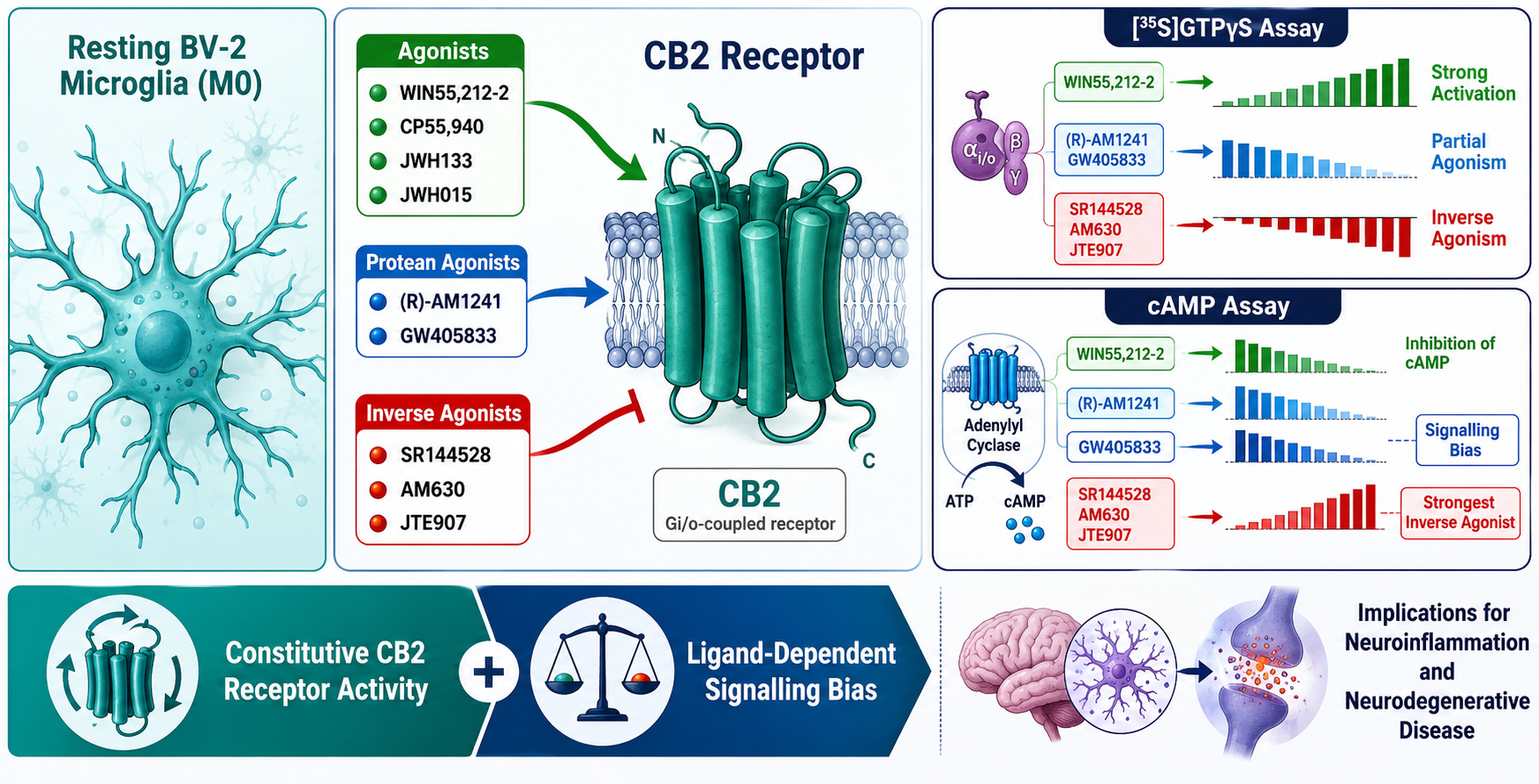
Microglia are key regulators of central nervous system homeostasis and neuroinflammation, with cannabinoid type 2 receptors (CB2Rs) proposed as important modulators of microglial phenotype and function. This study investigated the pharmacological properties of several CB2R ligands in resting BV2 microglial cells using [35S]GTPγS binding and forskolin-stimulated cAMP assays. Classical CB2R agonists (CP 55,940, WIN 55,212-2, JWH 133, and JWH 015), protean agonists ((R)-AM 1241 and GW 405833), and inverse agonists (SR144528, AM630, and JTE907) were evaluated. In the [35S]GTPγS assay, WIN 55,212-2 displayed the highest intrinsic activity, while protean agonists behaved as partial agonists and inverse agonists reduced basal CB2R signalling, indicating constitutive receptor activity. In contrast, cAMP measurements revealed greater signal amplification, with (R)-AM 1241 and GW 405833 acting as full agonists and SR144528 producing marked inverse agonism. These significant differences in ligand rank, order and efficacy between assays highlighted the influence of downstream signalling and ligand-dependent signalling bias. Notably, GW 405833 exhibited a strongly biased profile, whereas SR144528 showed the most pronounced inverse agonist properties. These findings demonstrate that CB2R ligands display distinct pharmacological behaviours in native resting microglia and suggest that constitutive receptor activity and signalling bias are important determinants of CB2R function. The results support further investigation of CB2R inverse agonists, particularly SR144528, as tools to explore microglial regulation across different neuroinflammatory and neurodegenerative disease states.
Keywords:
BV2 cells
; microglia
; CB2 receptors
; cAMP
; [35S]GTPγS
Copyright: This open access article is published under a Creative Commons CC BY 4.0 license, which permit the free download, distribution, and reuse, provided that the author and preprint are cited in any reuse.


