
Submitted:
27 July 2026
Posted:
28 July 2026
You are already at the latest version
Abstract
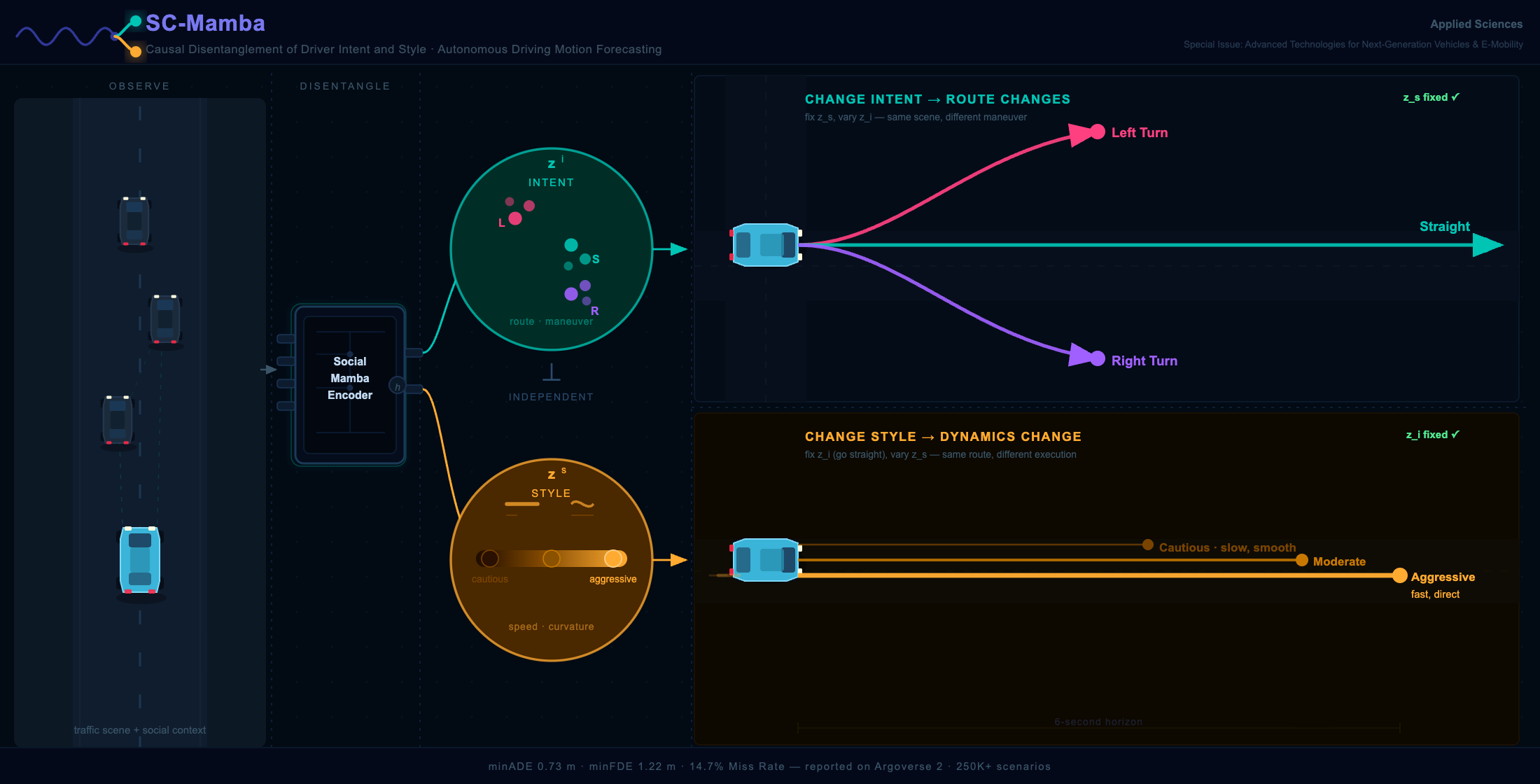
Predicting where a traffic agent will go and how it will get there are fundamentally different questions, yet most learning-based forecasters conflate them. When a model entangles agent intent (e.g., turning left) with driving style (e.g., cautious versus aggressive execution), spurious correlations arise that degrade predictions under distribution shift. This paper proposes SC-Mamba, a forecasting architecture built on selective state-space modeling and causal representation learning that explicitly disentangles these two factors. The model factorizes its latent space into independent intent and style variables, enforcing their separation through counterfactual do-interventions applied during training. A differentiable Signal Temporal Logic (STL) safety layer additionally constrains predicted trajectories to satisfy formal driving rules. Evaluated on the Argoverse 2 Motion Forecasting Dataset, SC-Mamba achieves 0.73 m minADE6, 1.22 m minFDE6, and 14.7% Miss Rate using only 1.35M parameters at 6.16 ms per scene—competitive with Transformer baselines at a fraction of computational cost. Critically, it is demonstrated that the learned intent latents correspond to identifiable maneuver categories (left turn, right turn, straight), style latents correlate with measurable execution dynamics (speed, curvature), and counterfactual manipulation of either factor independently controls trajectory shape without retraining. These results establish that linear-complexity SSM backbones can support structured causal reasoning for motion prediction while maintaining real-time performance.
Keywords:
autonomous vehicles
; motion forecasting
; causal modeling
; state-space models
; counterfactual reasoning
; latent disentanglement
Copyright: This open access article is published under a Creative Commons CC BY 4.0 license, which permit the free download, distribution, and reuse, provided that the author and preprint are cited in any reuse.


