

Submitted:
25 July 2026
Posted:
28 July 2026
You are already at the latest version
Abstract
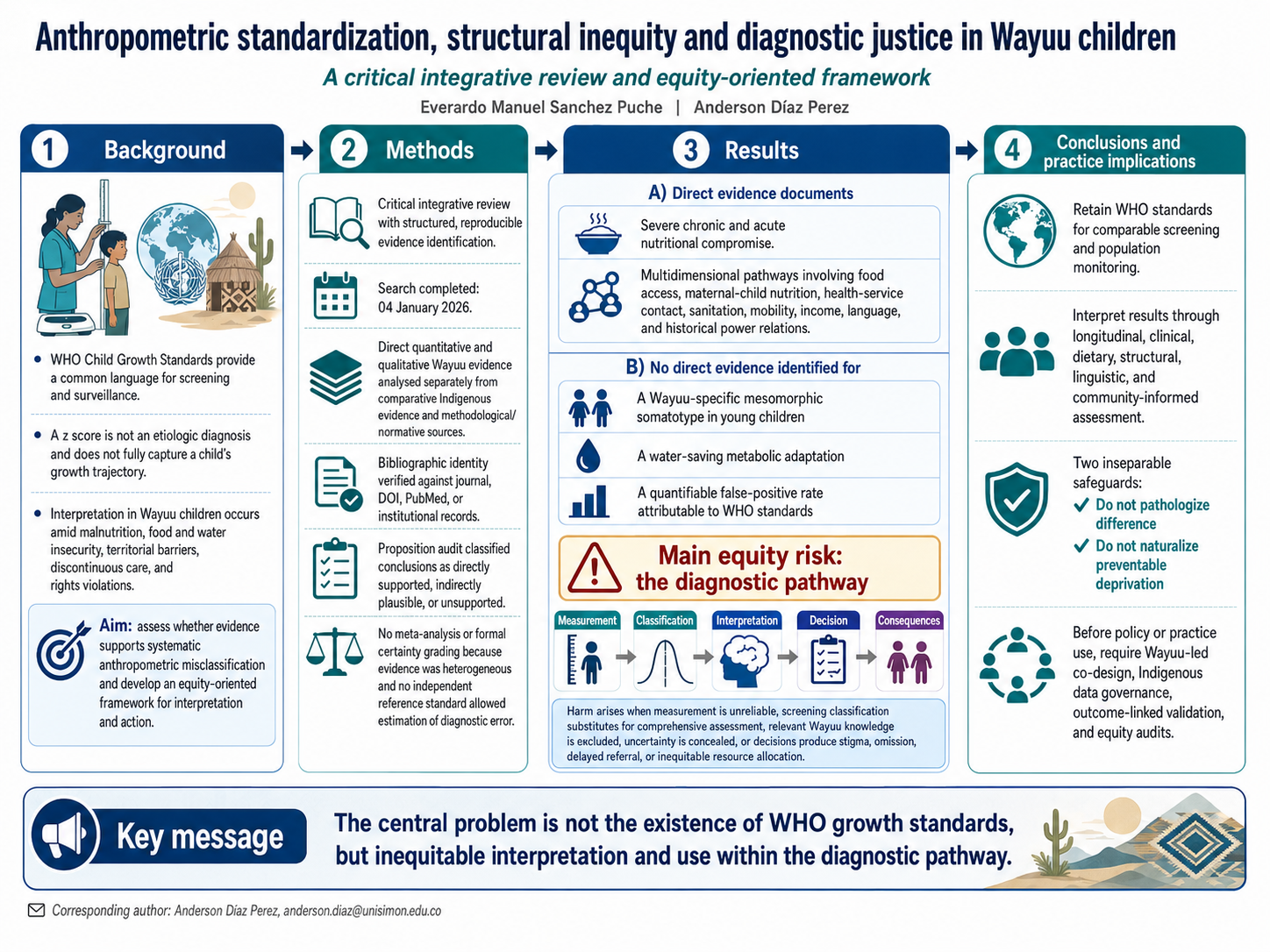
Background. The World Health Organization (WHO) Child Growth Standards provide a common language for screening and surveillance, but a z score is neither an etiologic diagnosis nor a complete account of a child’s growth trajectory. In Wayuu children, interpretation occurs amid documented malnutrition, food and water insecurity, territorial barriers, discontinuous care, and rights violations. This review examined whether current evidence supports claims of systematic anthropometric misclassification and developed an equity-oriented model for interpretation and action. Methods. We conducted a critical integrative review with structured, reproducible evidence identification completed on 04 January 2026. Direct quantitative and qualitative Wayuu evidence was analysed separately from comparative Indigenous evidence and methodological or normative sources. Bibliographic identity was verified against journal, DOI, PubMed, or institutional records. Findings were integrated through a proposition audit that distinguished directly supported conclusions, indirect plausibility, and unsupported claims. Meta-analysis and formal certainty grading were not undertaken because outcomes and designs were heterogeneous and no independent reference standard allowed estimation of diagnostic error. Results. Direct studies document a severe burden of chronic and acute nutritional compromise and multidimensional pathways involving food access, maternal-child nutrition, health-service contact, sanitation, mobility, income, language, and historical power relations. No direct evidence was identified for a Wayuu-specific mesomorphic somatotype in young children, a water-saving metabolic adaptation, or a quantifiable false-positive rate attributable to WHO standards. The main equity risk lies in the diagnostic pathway: harm can arise when measurement is unreliable, a screening classification substitutes for comprehensive assessment, relevant Wayuu knowledge is excluded, uncertainty is concealed, or decisions produce stigma, omission, delayed referral, or inequitable resource allocation. Conclusions. WHO standards should be retained for comparable screening and population monitoring, but interpreted through longitudinal, clinical, dietary, structural, linguistic, and community-informed assessment. Two safeguards are inseparable: do not pathologize difference, and do not naturalize preventable deprivation. Wayuu-led co-design, Indigenous data governance, outcome-linked validation, and equity audits are required before the proposed framework is used in policy or practice.
Keywords:
indigenous peoples
; Wayuu
; anthropometry
; child growth
; malnutrition
; diagnostic equity
; epistemic justice
; Indigenous data governance
Copyright: This open access article is published under a Creative Commons CC BY 4.0 license, which permit the free download, distribution, and reuse, provided that the author and preprint are cited in any reuse.


