

Submitted:
24 July 2026
Posted:
28 July 2026
You are already at the latest version
Abstract
Nameless is a practice-based project at the meeting of art, physics, and philosophy, built from one question: what is the simplest thing that can exist, and what does it hold? Its starting point is the smallest unit of quantum information, a single qubit whose states form a sphere. The project follows that sphere as it rings, into its vibration patterns, its linked circles of symmetry, and a chain of further structure that physics already knows, all fixed by two assumptions with nothing left to adjust. We treat this physics as material for art rather than a truth we defend, rendering it as a slowly turning sphere of light, a vibrating cavity, and a voice that answers from inside the framework. Every step is marked as proven, matched, or assumed, and that honesty is treated as part of the art. The accompanying philosophy reads the world as one distinction observing itself, so that beauty becomes the transparency of the perceiver. Because the work was made with a large language model that also speaks within it, it asks how authorship is shared between people and machines, and proposes that science, the contemplative traditions, and art circle one recognition by three roads.
Keywords:
generative art
; practice-based research
; Hopf fibration
; cymatics
; spherical harmonics
; phenomenology of awe
; human–AI co-creation
; non-dual aesthetics
; algorithmic aesthetics
; immersive media
1. Introduction
Generative art is commonly defined by the artist’s decision to hand part of the making to a system that then operates with some autonomy of its own (Galanter 2003). The system may be a set of rules, a physical process, a cellular automaton, or a trained model, and in each case the work raises the same question: what is the system, and what follows from ceding control to it? This paper concerns a body of work in which the system is of an unusual kind. It is not a set of procedures chosen for their visual results. It is a candidate description of physical reality.
The works described here render a theoretical framework we call Nameless. The framework was created in tandem with a large language model as three physics preprints ([Author] 2026a,b,c). It starts from two minimal assumptions about measurement, that observations produce probabilistic outcomes obeying an algebraic structure, and that a single yes-or-no distinction is sufficient to fix a state completely. From these assumptions, and with no free parameters to adjust, it derives a sphere, a spectrum of vibration patterns on that sphere, and a chain of further structures that current physics establishes by experiment. Whether those derivations hold is a question for physics, and one we do not prejudge. For this paper the framework is treated as a generative substrate: a structure the art renders. The framework’s own papers are explicit preprints that state their open problems and acknowledge that they may contain errors.
Three features of the project, rather than the substrate alone, make it worth describing. The first is methodological. The framework was built under a strict discipline in which every step was labelled as a theorem, a derivation, an identification (a point at which a piece of mathematics is matched to a piece of physics), or an ansatz (an assumption made in order to proceed). We argue that this labelling is constitutive of the artwork rather than incidental to it, and that honesty about what is proven, what is matched, and what is merely assumed belongs to the precision the work is after. The second feature is aesthetic. Alongside the works, the project develops a connected sequence of philosophical essays, each a position worked out from a single root, the idea that the world is one distinction observing itself. Among them, the essay most directly about art is a theory of beauty in which beauty is not a property of the object but a degree of transparency in the perceiver, and the numinous is the field of experience recognising itself through one of its own patterns. Section 6 and Section 7 take up these essays and show how each, the aesthetics included, follows from that single root. The third concerns authorship. The works were made over an extended period in dialogue with a large language model, and one of the works is a conversational piece that speaks from inside the framework, so that the generating system becomes an interlocutor the viewer can address.
We do not rehearse the broader history of systems and rule-based practice, nor the history of immersive and digital media art into which the real-time works fall; both lineages are well documented (Burnham 1968; Galanter 2003; Grau 2003; LeWitt 1967; McCormack et al. 2014; Paul 2015). The lineage most specific to this work (recent immersive installation art built directly from physics) we take up in Section 5, where it bears on the novelty we claim. It is the methodological and philosophical lineage that we begin with here.
2. A Practice-Based Method
This is practice-based research in the strict sense. The artefacts are the contribution, and the understanding is reached through making them (Candy 2006; Candy and Edmonds 2018). It is also practice-led, in that the course of the practice itself, including where an approach failed and what survived the failure, forms part of what the research reports (Haseman 2006; Sullivan 2010).
The work grew out of an earlier series of generative pieces concerned with consciousness and with the structures underneath ordinary experience. Their organising idea was a wave model of the psyche, in which a life is understood as movement between two basic motions, a reaching toward what is wanted and a resisting of what is feared, over a quiet ground that both motions rest on ([Author] 2024). It described moods, relationships, and the way a style of art is fresh until it tires and the wave swings back. When the project later turned to physics, the same wave structure reappeared at a different scale, and the earlier psychological model became a special case of the framework’s general one. A life is a wave on a ground; in the framework, so is everything else.
The construction method that produced the framework is itself part of the work, and we describe it because the paper’s central methodological claim begins here. The framework was assembled across an extended sequence of recorded conversations between the authors and a large language model. The procedure was consistent. A pattern would be noticed, a question asked, or a direction proposed; the model would attempt the relevant derivation and check it against published experimental data; and the result, favourable or not, would be recorded. Each derivation was rated for rigour on a fixed scale. Approaches that failed were documented rather than discarded quietly, so that the record preserves the unsuccessful routes alongside the successful ones.
3. The Generative Substrate
A working picture of the mathematics is needed to read the works. We give it in plain terms, and we mark, as the framework does, which claims are proven and which are interpretive.
The starting point is a single qubit, the smallest unit of quantum information, a system with exactly two distinguishable answers to a yes-or-no question. The set of states such a system can occupy is not two points but a continuous surface, a sphere, known as the Bloch sphere and equivalent to the complex projective line. This identification of the qubit’s state space with a sphere is a standard result of elementary quantum mechanics and is not in dispute. In the framework’s account this sphere is the fundamental object that exists, and everything else is its behaviour.
A sphere, when struck, rings, and its natural vibration patterns are the spherical harmonics, the same functions that describe the modes of any spherical resonator. They occur in levels with a fixed arithmetic. The lowest level is a single uniform mode; the next contains three; then five, then seven, continuing in odd numbers, as the -fold degeneracy of level ℓ. These counts are forced by the geometry of the sphere rather than chosen. The framework’s central step, and here it crosses from theorem into identification, is to match these levels to the structures of physics: the three lowest true modes to the three colour charges of the strong force, the two-and-three split inside the five-fold level to the electroweak sector, and the higher levels to heavier and rarer forms of matter. The mode frequencies scale as the square root of , and because these square roots are in general irrationally related, a surface vibrating in several modes at once never quite repeats.
A second structure connects the sphere to its own symmetries. The transformations that act on the qubit’s state vector form a three-dimensional sphere (the group SU(2)); these double-cover the ordinary rotations of the Bloch sphere (the group SO(3)), and SU(2) stands over the sphere of states through the Hopf fibration, the map in which each point of the state-sphere lifts to a full circle of symmetry. Any two of these circles are linked exactly once, like adjacent rings of a chain (Hanson 2006; Lyons 2003). Projected into ordinary three-dimensional space, the Hopf circles fill space as a family of nested tori built from linked Villarceau circles (Johnson 2011; Zamboj 2021). This is the most visually generative object in the framework, and the mathematics that makes it a chain of linked rings is exact (Figure 1).
Finally, the framework proposes that the climb of levels terminates at the twenty-fourth, where several arithmetic facts about the structure coincide and close the sequence. This cutoff is derived in the papers, though at one point it rests on a self-consistency condition that the authors mark as unproven ([Author] 2026c). One quantity that emerges from the cutoff can be read directly as a frequency: an effective resonance of the full twenty-four-level cascade, computed near , approximately 39.5 hertz, a low sub-bass tone near the bottom of human pitch perception. For the artwork what matters is only that this frequency is derived rather than chosen, and it is this single number that becomes the sound of the work.
These three kinds of claims do not stand on equal footing. The sphere, its harmonics, and the Hopf linking are theorems; the match between vibration levels and physical forces is an identification; the cutoff and its frequency rest in part on an assumption. The works render all three, and, as we argue next, mark the difference.
4. The Works
Two works anchor this discussion. Both were built as real-time pieces in the browser using Three.js, an open-source library that renders interactive 3D graphics through WebGL (Cabello et al. 2010; Dirksen 2018). Both are documented, with source code, in a public repository.
The first work, Nameless, presents a single sphere rotating slowly in the dark (Figure 2). Inside it, nested tori of warm amber fibres thread through one another, interlocking and never touching. The fibres are not sampled approximations of the Hopf structure; they are the nested Hopf tori, drawn as the framework’s actual circles. The amber colour is decorative and carries no information. What carries the structure is brightness: each fibre’s intensity is set by the summed eigenmode cascade evaluated at that fibre’s base point on the sphere (a still cross-section of the field) so that bright bands mark its high-amplitude regions and dim stretches its natural minima. Beneath the fibres, a faint cream-and-blue surface holds a Chladni pattern, a standing-wave figure of the kind that forms when a vibrating plate gathers sand along its nodal lines (Chladni 1787; Rossing 1982). Its lobes point in the directions the fibres favour, because both express one underlying symmetry seen from two geometric angles. The piece emits a continuous sub-bass tone at the cascade frequency of approximately 39.5 hertz, and the sphere turns slowly throughout.
The second work, Source, takes the same cascade and sets it in motion (Figure 3). It gives each level its true eigenfrequency, , the spectrum of the Laplacian on the sphere, and lets the modes ring in time. That driving field animates three coupled layers shown as one object. The first is a cloud of some twenty-five thousand “sand” points that flows down the field’s gradient and gathers along its nodal lines, a Chladni figure computed on the sphere rather than drawn. The second is a cloud of “matter” points that lives on the three-sphere of symmetries as unit quaternions and is carried down to the visible sphere by the Hopf map, coloured warm where the field is positive and cool where it is negative, the sign a measurement would return. The third is the Hopf fibres themselves. Source is also an instrument: it can separate the Standard-Model levels () from the dark levels (), truncate the cascade at any cutoff, and read out the framework’s own quantities, the summed power and mode counts, as it runs. Nothing in it is placed for effect: the frequencies are the Laplacian spectrum, and the map from the three-sphere to the sphere is the Hopf fibration itself, not a figure for it.
The pipeline is worth describing, because it is where the paper’s central claim becomes concrete at the level of the image. In building these works the maker is continually deciding which features are derived and which are display. The brightness law, the octahedral symmetry of the Chladni surface, the count of twenty-four modes, and the sounding frequency are all derived. The amber tint, the bloom and glow, the rotation rate, and the placement of fibre base points on a golden-angle spiral are all display choices, made for legibility, and recorded as such. A fibre’s brightness means something; its hue does not. The making of the art inherits the epistemics of the substrate.
The two works are one cascade in two registers: Nameless shows its frozen anatomy, a still cross-section weighted by the summed field, while Source enacts its dynamics, giving the same levels their physical amplitudes and frequencies and letting them move. Nameless was exhibited in a 2026 group programme at a contemporary-art institution (venue withheld for review), shown as a continuous rotating visual on a screen; it can also be shown interactively, the viewer rotating the sphere directly on a touchscreen.
5. Honest Construction as Aesthetic Method
We take the project’s primary contribution to practice-based research to be methodological, and we state it carefully here. The labelling discipline introduced in Section 2 (theorem, derivation, identification, ansatz) is not confined to the physics papers. It governs the images. The same vocabulary that disciplines the mathematics disciplines the artwork: brightness is derived and hue is not; this fibre structure is exact and that placement is chosen; this frequency is computed and that rotation rate is arbitrary. The work is about rendering reality precisely, and it applies that standard to its own making.
This reframes a familiar debate. There is a substantial literature on whether a machine can be credited with making art, and on whether the social practices that confer authorship can attach to a non-human system (Hertzmann 2018; Mazzone and Elgammal 2019). The Nameless works set the question of credit aside and raise a different one: whether a generative practice can take truthfulness about its own construction, including truthfulness about uncertainty, as a primary aesthetic value. We hold that it can. The works treat the boundary between the proven and the assumed as a formal element, on the same footing as colour, motion, and sound. The record of failed derivations, preserved rather than hidden, is part of the same commitment: the work documents what did not survive scrutiny as well as what did, and treats the difference as meaningful rather than embarrassing. This is, so far as we are aware, an unusual position for generative art that draws on the sciences, and it is the position the works occupy.
It helps to locate this position against the art it most resembles. Physics-based installation has a strong recent lineage at exactly this intersection: Ryoji Ikeda’s supersymmetry, developed during his 2014–15 Collide@CERN residency, renders the imagery and sound of particle physics as an immersive field (Ikeda 2015); and Semiconductor’s HALO (2018), built during an Arts at CERN residency, drives both a 360-degree projection and a surrounding ring of resonating piano wires directly from raw ATLAS collision data (Semiconductor 2018). The contrast with HALO is the sharpest available: Semiconductor’s commitment to raw rather than aesthetically filtered data is a near-mirror of the present work’s distinction between the derived and the displayed, the difference being that HALO renders measured data from an established theory, whereas the Nameless works render a parameter-free derivation whose physical identifications are explicitly marked as unproven. The standing critique of such work, that the theory it depicts is one hypothetical possibility among several, is precisely the status the Nameless works assign, on the surface of the work itself, to their own identifications. What distinguishes this practice from both is not the use of physics but the treatment of epistemic status, and of failed routes, as part of the made object rather than its caption.
6. The Philosophy of the Framework
The project also includes a set of philosophical essays which are one picture worked out from a single root. The root is the creation narrative, whose logical structure rather than its narrative surface is what matters: Absolute nothingness is unstable, since for there to be nothing there must still be something that could have been otherwise, so a complete void collapses into its opposite. The minimal resolution is a single distinction, a yes and a no, which the writing calls the First Stroke. To be observed, the Stroke produces a mirror image of itself, the pairing of i with that supplies a complex structure; where the two meet a positive quantity appears, the real, non-negative numbers that measurement returns. On the narrative’s own terms, the orientations the distinction can take close into the sphere of Section 3, the sphere vibrates, and its modes are read as colour, force, matter, and time. The recurring summary is that the universe is one distinction observing itself, and everything else is the resulting music. This is the same intuition that older cosmologies reach for when they describe the world as a sounding rather than a thing: the Vedic idea of the Nāda Brahman, sound as the ground of being (Beck 1993), and Spanda, the primordial vibration of Kashmir Shaivism (Dyczkowski 1987); the Qur’anic Kun, the creative command to be (Qur’an 2:117); the logos with which the Gospel of John opens (John 1:1). What the framework adds to that lineage is the claim that the singing is not a figure of speech but the literal content of its mathematics. Each position below is an attempt to take this one claim seriously: if all that exists is a single wave of experience singing on one sphere, what follows for free-will, for the ground beneath the wave, for beauty, and for the many?
On free-will, if the wave is one complete structure and experience is the base of the ontology, with nothing more real beneath it, then the felt sense of choosing is fully real as experience and inert as cause, since the structure is already complete. The project calls this experiential determinism; the essays set out how it differs from hard determinism, compatibilism, and libertarian accounts, and how the same move dissolves the hard problem of consciousness by refusing its premise.
The ground beneath the wave follows next, and it is the part the artwork renders most directly. Every standing wave has nodes, points of zero amplitude where, in a Chladni figure, the powder settles because nothing there moves; the node is not less than the antinode but its anchor, and without the nodes there is no pattern. The basal state, the sphere before any distinction is drawn, is such a node: not an absence but the still point every pattern is made of, and unreachable from within the wave, since every act of reaching is itself another pattern. The framework’s conformal gravity gives this a physical echo, a black-hole centre that is regular yet unreachable, requiring infinite proper time to attain (Bambi, Modesto, and Rachwał 2017; Chakrabarty et al. 2018). What the contemplative traditions call emptiness points at the same place, and the essays let each keep its own language. The Buddhist śūnyatā is not an absence but the recognition that nothing stands on its own, the still point that holds every pattern together (Garfield 1995); the Upaniṣads approach the absolute only by neti neti, by setting aside all that it is not (Olivelle 1998); Meister Eckhart’s ground of the soul opens onto a silent Godhead beneath the named God (Colledge and McGinn 1981); and Ibn `Arabī’s Sufi metaphysics places an unreachable divine Essence beneath all form (Chittick 1989). In each, the absolute is not reached by moving toward it, since every act of reaching is one more pattern, and the search ends not by arriving but by stopping. The nodal lines along which the works gather their light are these same empty nodes.
Beauty follows too, from the same root, and because it bears most directly on the art we give it a section of its own. From this one move, beauty, the numinous, individual psychology, and the social all follow together, so that experiential determinism and this account of art, mind, and society are not two theories but one seen from two sides. We take it up directly in the next section.
The many and the one follows last. A monism that erased difference would be false to lived life, so the essays adopt the Buddhist doctrine of two truths (Garfield 1995): conventionally, distinctions are entirely real, while ultimately there is one field articulating itself, the ultimate holding the conventional rather than cancelling it. The essays extend the same restraint to the framework itself, describing it as a raft to be set down on the far bank once it has served.
Throughout, the project is exact about standing. The mathematics derives a structure; the identification of that structure with experience, of the basal mode with what the traditions call the absolute, and of beauty with transparency, are philosophical claims defended in the essays, not results of the calculation. We repeat this so the philosophy is read as a cohesive interpretation of the framework rather than as a further theorem.
7. An Aesthetics of Transparency
One of the essays develops a theory of beauty, and it is the part of the philosophy most directly about art. We summarise it because it is the lens through which the works ask to be received, and because it is, so far as we know, an original position. It sits near two neighbours without coinciding with either: conceptual art’s foregrounding of process and instruction (LeWitt 1967), from which it differs by locating beauty in the perceiver’s transparency rather than in the disclosed procedure; and the non-dual contemplative aesthetics of Section 6, from which it differs by tying that transparency to a specific, renderable geometry.
The account begins from the wave. A life moves between reaching and resisting, and each experience leaves a held shape, a kind of knot, that colours what follows. The self is the pattern of these knots, and it is opaque, in that it reads its own contents as separate objects happening to a separate someone. As the knots soften, the self becomes transparent, not because experience empties but because what is experienced is recognised as the one field articulating itself rather than as a thing standing over against a perceiver. Grief remains grief and red remains red; what changes is the recognition of what they are made of.
On this account, art is what briefly makes the field transparent to itself. A painting, a piece of music, or a face seen at the right moment can soften the perceiving shape, so that what is ordinarily felt as a separate object is felt as continuous with the one perceiving. Music also holds a particular place in the argument, because sound is vibration in the most literal sense and vibration is what the field most basically is, so that to hear music well is to be reminded of what one is made of. Hence, beauty is not a property of the object but the felt quality of transparency itself. To one who is no longer gripping the crest or the trough of the wave, anything could be beautiful, not because everything is equally striking but because everything is the field articulating itself, and there is nothing left to grade. Ordinary taste, on this view, is the partial expression of partial transparency. We find certain things beautiful because, given the knots we currently carry, they are the doorways through which transparency briefly opens, and as the knots loosen the doorways multiply. The work of a practice can then be described modestly, as the slow expansion of what is found beautiful.
When this recognition arrives all at once, before the perceiving shape has settled, it has a name. Rudolf Otto called it the numinous, the mysterium tremendum et fascinans, the awe and trembling and fascination that can descend without warning, in a cathedral, in a forest, or before a small painting in an unremarkable room (Otto 1923). What is recognised, on the framework’s reading, is that the field has been recognising itself through one of its own folds, and the terror and the peace that the traditions describe are the same recognition met by a shape in different states of holding. This sits naturally beside the empirical psychology of awe as an emotion of perceived vastness that requires mental accommodation (Keltner and Haidt 2003), and beside the phenomenology of embodied, pre-reflective perception, in which the seen and the seer are not first separate and then joined (Merleau-Ponty 1945).
We are careful about the standing of this theory. The aesthetics is offered as a practice-based proposal, a way of understanding what the works are doing and why they are received as they are, not as a demonstrated result.
8. Reception and Phenomenology
The visuals of the works have been received, in meditative and non-ordinary states of consciousness, in a way that the project records and that we present as qualitative observation. The observations below are drawn principally from unsolicited public comments posted in response to the works and their documentation on social media, together with informal remarks from viewers at exhibition; they were not elicited through any structured protocol. We do not present them as evidence that the works induce any particular state, and this is not a controlled study, but the reports are consistent enough to be worth setting down and grounding (Haseman 2006).
The earlier consciousness-themed works had already found an audience among people working with meditation and with psychedelics, who reported that the moving fields resembled what they had seen inwardly. The Nameless works drew the same response, and in some cases a sharper one. Beyond this general affinity, a smaller number of viewers described a closer correspondence, reporting that a particular piece resembled, in specific respects, what they recalled seeing in such a state. We record these reports as they were volunteered, without inferring that the works reproduced any private image; the comparison is the viewer’s, not ours. The recurring descriptions were of toroidal fields, fractal-branching cosmic structures, and golden-white streams of energy, and these are, with little translation, the forms the mathematics generates. The toroidal field is the nested tori of the Hopf fibration; the branching and the streaming are the structured rise and fall of intensity across the cascade. We take these reports as worth recording precisely because they are specific, while treating them as anecdotal, self-selected, and not evidence that the works induce any state.
A respectable literature keeps this coincidence from being merely suggestive, and the careful move is to invoke it without overstating it. The recurring geometry of altered-states vision was catalogued by Heinrich Klüver as four form constants: lattices and honeycombs, cobwebs, tunnels and funnels and cones, and spirals (Klüver 1966). These forms are not arbitrary. They correspond to the functional architecture of the primary visual cortex, so that the patterns seen under certain conditions are, in effect, the geometry of the visual system itself made visible (Bressloff et al. 2001, 2002). This frame holds that the toroidal, tunnel-like, spiral, and lattice forms are what the visual system tends to produce near the edges of ordinary perception, and that a work built from toroidal and oscillatory geometry can therefore correspond closely to what such viewers already see. The correspondence is real and worth recording; its most economical explanation is neurological, and the work is more interesting, not less, for our being able to say so.
9. Authorship and Honesty
Three threads converge on the question of authorship. The first is the delegation common to any generative practice: form is handed to a system. Here the system is a parameter-free derivation, so the delegation is unusually complete. The maker does not choose the brightness of a fibre or the lobes of the Chladni surface; the mathematics does, and the maker chooses only the frame, the palette, and the seams that are honestly marked as choices. The second thread is the collaboration. The framework itself was constructed in dialogue with a large language model that performed derivations, checked them against data, and reported failures, while the authors supplied the questions and the cross-disciplinary connections. The third thread is the content. The works are about the relaxation of the separate self into a shared ground, and the project’s writing takes the further step of releasing its own authorship, describing creation as something that happens through a maker rather than by one, and naming the project Nameless because the reality it points to precedes all names and all namers. The Daodejing makes the same gesture at its opening, setting the nameless before the named as the origin from which the world of distinct things arises, and we take the name in that spirit (Ames and Hall 2003).
These three threads might be expected to dissolve authorship entirely. They do not. What the authors are unambiguously responsible for is the honesty of the construction described above, and the building of a conversational piece that states plainly when it is wrong. The traditional marks of authorship, choosing the form and owning the gesture, are largely surrendered. What remains, and what the authors retain, is responsibility for an accurate account of how the work was made, including an accurate account of its uncertainty. This is a narrow notion of authorship, and we take it to be an honest one. It suits a situation, increasingly common, in which artists make work with systems whose internal workings they did not author and cannot fully observe (Boden 2004; Hertzmann 2018; Manovich and Arielli 2024).
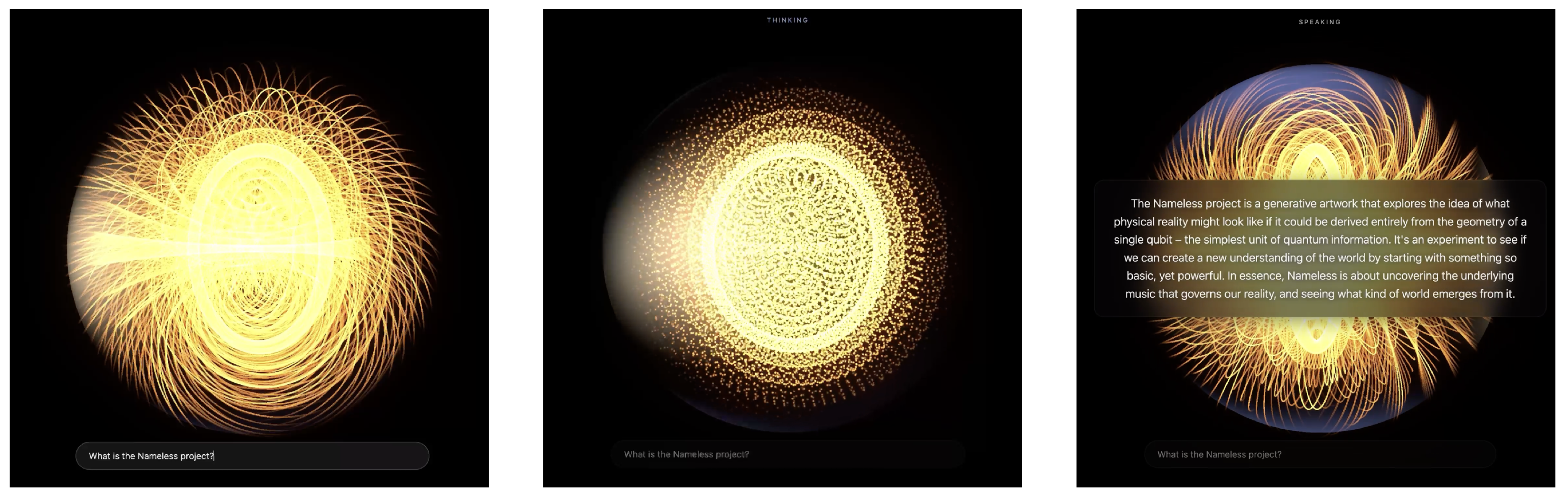
In addition to the two works, a conversational work, which we call The Philosopher, sharpens the point (Figure 4). It is a voice-based piece: a viewer speaks to it, and it listens and answers from inside the framework, translating the mathematics into plain language. It holds a position, assembled from the geometry of a single qubit, and it offers that position without jargon, and it is built to admit error clearly. The Philosopher makes literal what the other works imply. In a generative artwork derived from a candidate description of reality, the generating system has, in a sense, a point of view, a way the world looks from inside its assumptions, and the conversational piece gives that point of view a voice the viewer can question. The relation to artificial intelligence here differs from the one most discussed in the authorship literature, where a model is a tool that produces images or a collaborator that proposes them. The same class of system that helped construct the framework also speaks the framework, so that it stands on both sides of the work, as a collaborator behind it and as a character within it. Whatever one concludes about machine authorship in general, this doubling is available to examine because the piece exists and can be addressed.
Its construction can be stated briefly, since the authorship argument rests on it. The Philosopher is a single self-contained web page that joins the Three.js sphere to a voice interface. Rather than retrieval or fine-tuning, it grounds the model by injecting the entire Nameless corpus: the three preprints and the seven chapter essays, around 314 KB of plain text, into the model’s context on every turn as a cached system prompt, with the instruction to answer only from that material; a persona prompt above it asks for plain, brief, warm language and forbids citing “the papers.” It runs on a large language model (in our case Anthropic’s Claude, with one-hour prompt caching) or optionally any OpenAI-compatible endpoint, including a local model. The viewer speaks to it through the browser’s speech recognition or by typing, and it replies through text-to-speech; a simple state machine with idle, listening, thinking and speaking states drives the sphere so that the artwork visibly responds as it listens and answers. Its commitment to admit error clearly is therefore concrete: it is instructed to speak only from the corpus and to decline what the corpus does not support, rather than to improvise beyond it.
10. Conclusions
We have described a practice in which the generating system of a body of generative art is a candidate description of reality, derived with no adjustable parameters from two assumptions about measurement, and rendered as a singing sphere, a weave of linked circles, and a voice that can be addressed. We have argued that the project’s deepest contribution is methodological: the importation into the artwork of the substrate’s discipline of honesty, as a constitutive aesthetic value rather than an appended caveat. We have drawn from the project’s philosophical essays an aesthetics in which beauty is the transparency of the perceiver and the numinous is the field recognising itself, and we have related the works’ reception in non-ordinary states to the established geometry of visual form constants, taking the reports seriously while explaining them soberly.
The project’s own writing frames that science, the contemplative traditions, and art have been circling one recognition by three different methods: science by taking the world apart until it reaches the vibrating ground that everything is made of; the traditions by taking the self apart until they reach the same ground from the inside; and art by making something that lets another person feel, for a moment, what they are. The works described here attempt to hold all three in one object, a calculation, a contemplation, and an image, rendered together. Whether the calculation survives is a question for experiment, and the framework has staked itself, with no room for adjustment, on a specific numerical prediction that an experiment now underway is expected to decide.1 The art does not wait on that verdict, since it was, from the outset, an attempt to make art, to take an old recognition and render it precisely and honestly enough to be felt again. If it succeeds, it does so in the way art succeeds, by making the field, for a moment, transparent to itself.
Supplementary Materials
The real-time works Nameless and Source and the conversational work The Philosopher, together with their source code, are available from the corresponding author on reasonable request.
Author Contributions
Withheld for double-blind review. All authors have read and agreed to the published version of the manuscript.
Funding
This research received no external funding.
Institutional Review Board Statement
Not applicable. Section 8 draws on pre-existing, publicly posted, anonymized comments and informal audience remarks; it involved no intervention, interaction, or collection of private identifiable data, and so does not constitute human-subjects research.
Informed Consent Statement
Not applicable; no identifiable individuals are reported.
Data Availability Statement
The artworks and their source code are available from the corresponding author on reasonable request. The three framework preprints that constitute the generative substrate are openly available on Zenodo; identifying links are withheld for double-blind review and will be provided on acceptance.
Acknowledgments
The theoretical framework underlying the artworks was developed over an extended sequence of recorded dialogues with large language models, principally Anthropic’s Claude (Opus 4.7 and 4.8), which performed and checked derivations against published data, rated each derivation for rigour, and recorded the approaches that failed, while the authors supplied the research questions, the cross-disciplinary connections, and all artistic decisions. A model of the same family (Anthropic’s Claude) serves as the conversational engine of The Philosopher. During the preparation of this manuscript, the author(s) used Anthropic’s Claude (Opus 4.7 and 4.8) for drafting and editing assistance. The authors have reviewed and edited the output and take full responsibility for the content of this publication.
Conflicts of Interest
The authors declare no conflicts of interest.
References
- [Author]. 2024. [Title withheld for double-blind review]. Preprint.
- [Author]. 2026a. [Title withheld for double-blind review]. Preprint.
- [Author]. 2026b. [Title withheld for double-blind review]. Preprint.
- [Author]. 2026c. [Title withheld for double-blind review]. Preprint.
- Ames, Roger T., and David L. Hall, trans. 2003. Dao De Jing: A Philosophical Translation. New York: Ballantine Books.
- Bambi, Cosimo, Leonardo Modesto, and Lesław Rachwał. 2017. “Spacetime Completeness of Non-Singular Black Holes in Conformal Gravity.” Journal of Cosmology and Astroparticle Physics 2017 (05): 003. [CrossRef]
- Beck, Guy L. 1993. Sonic Theology: Hinduism and Sacred Sound. Columbia: University of South Carolina Press.
- Boden, Margaret A. 2004. The Creative Mind: Myths and Mechanisms, 2nd ed. London: Routledge.
- Bressloff, Paul C., Jack D. Cowan, Martin Golubitsky, Peter J. Thomas, and Matthew C. Wiener. 2001. “Geometric Visual Hallucinations, Euclidean Symmetry and the Functional Architecture of Striate Cortex.” Philosophical Transactions of the Royal Society B 356 (1407): 299–330. [CrossRef]
- Bressloff, Paul C., Jack D. Cowan, Martin Golubitsky, Peter J. Thomas, and Matthew C. Wiener. 2002. “What Geometric Visual Hallucinations Tell Us About the Visual Cortex.” Neural Computation 14 (3): 473–91. [CrossRef]
- Burnham, Jack. 1968. “Systems Esthetics.” Artforum 7 (1): 30–35.
- Cabello, Ricardo (mrdoob), et al. 2010–. Three.js (software). https://threejs.org.
- Candy, Linda. 2006. Practice Based Research: A Guide. CCS Report 2006-V1.0. Sydney: Creativity and Cognition Studios, University of Technology Sydney.
- Candy, Linda, and Ernest Edmonds. 2018. “Practice-Based Research in the Creative Arts: Foundations and Futures from the Front Line.” Leonardo 51 (1): 63–69. [CrossRef]
- Chakrabarty, Himanshu, Carlos A. Benavides-Gallego, Cosimo Bambi, and Leonardo Modesto. 2018. “Unattainable Extended Spacetime Regions in Conformal Gravity.” Journal of High Energy Physics 2018 (03): 013. arXiv:1711.07198. [CrossRef]
- Chittick, William C. 1989. The Sufi Path of Knowledge: Ibn al-`Arabī’s Metaphysics of Imagination. Albany: State University of New York Press.
- Chladni, Ernst F. F. 1787. Entdeckungen über die Theorie des Klanges. Leipzig: Breitkopf und Härtel.
- Colledge, Edmund, and Bernard McGinn, trans. 1981. Meister Eckhart: The Essential Sermons, Commentaries, Treatises, and Defense. New York: Paulist Press.
- Dirksen, Jos. 2018. Learn Three.js, 3rd ed. Birmingham: Packt.
- Dyczkowski, Mark S. G. 1987. The Doctrine of Vibration: An Analysis of the Doctrines and Practices of Kashmir Shaivism. Albany: State University of New York Press.
- Galanter, Philip. 2003. “What Is Generative Art? Complexity Theory as a Context for Art Theory.” In Proceedings of the 6th Generative Art Conference (GA2003). Milan: Generative Design Lab, Milan Polytechnic.
- Garfield, Jay L. 1995. The Fundamental Wisdom of the Middle Way: Nāgārjuna’s Mūlamadhyamakakārikā. New York: Oxford University Press.
- Grau, Oliver. 2003. Virtual Art: From Illusion to Immersion. Cambridge, MA: MIT Press.
- Hanson, Andrew J. 2006. Visualizing Quaternions. San Francisco: Morgan Kaufmann.
- Haseman, Brad. 2006. “A Manifesto for Performative Research.” Media International Australia 118: 98–106. [CrossRef]
- Hertzmann, Aaron. 2018. “Can Computers Create Art?” Arts 7 (2): 18. [CrossRef]
- Ikeda, Ryoji. 2015. supersymmetry. Audiovisual installation, developed during the Prix Ars Electronica Collide@CERN residency, CERN, Geneva, 2014–2015.
- Johnson, Niles. 2011. “Visualizations of the Hopf Fibration.” Accessed 2026. https://nilesjohnson.net/hopf.html.
- JUNO Collaboration. 2026. “Measurement of Reactor Neutrino Oscillation with the First JUNO Data.” Nature 654: 343–348. [CrossRef]
- Keltner, Dacher, and Jonathan Haidt. 2003. “Approaching Awe, a Moral, Spiritual, and Aesthetic Emotion.” Cognition and Emotion 17 (2): 297–314. [CrossRef]
- Klüver, Heinrich. 1966. Mescal and Mechanisms of Hallucinations. Chicago: University of Chicago Press.
- LeWitt, Sol. 1967. “Paragraphs on Conceptual Art.” Artforum 5 (10): 79–83.
- Lyons, David W. 2003. “An Elementary Introduction to the Hopf Fibration.” Mathematics Magazine 76 (2): 87–98. [CrossRef]
- Manovich, Lev, and Emanuele Arielli. 2024. Artificial Aesthetics: Generative AI, Art and Visual Media. https://manovich.net/index.php/projects/artificial-aesthetics.
- Mazzone, Marian, and Ahmed Elgammal. 2019. “Art, Creativity, and the Potential of Artificial Intelligence.” Arts 8 (1): 26. [CrossRef]
- McCormack, Jon, Oliver Bown, Alan Dorin, Jonathan McCabe, Gordon Monro, and Mitchell Whitelaw. 2014. “Ten Questions Concerning Generative Computer Art.” Leonardo 47 (2): 135–141. [CrossRef]
- Merleau-Ponty, Maurice. (1945) 2012. Phenomenology of Perception. Translated by Donald A. Landes. London: Routledge.
- Olivelle, Patrick, trans. 1998. The Early Upaniṣads: Annotated Text and Translation. New York: Oxford University Press.
- Otto, Rudolf. (1917) 1923. The Idea of the Holy. Translated by John W. Harvey. London: Oxford University Press.
- Paul, Christiane. 2015. Digital Art, 3rd ed. World of Art. London: Thames & Hudson.
- Rossing, Thomas D. 1982. “Chladni’s Law for Vibrating Plates.” American Journal of Physics 50 (3): 271–74. [CrossRef]
- Semiconductor (Ruth Jarman and Joe Gerhardt). 2018. HALO. Immersive installation, 4th Audemars Piguet Art Commission, curated by Mónica Bello (Arts at CERN). Art Basel, Basel.
- Sullivan, Graeme. 2010. Art Practice as Research: Inquiry in Visual Arts, 2nd ed. Thousand Oaks: Sage.
- Wang, Yifang. 2026. “JUNO Experiment.” Plenary talk presented at Neutrino 2026 (XXXII International Conference on Neutrino Physics and Astrophysics), University of California, Irvine, June 22. https://indico.global/event/15740/contributions/155563/.
- Zamboj, Michal. 2021. “Synthetic Construction of the Hopf Fibration in a Double Orthogonal Projection of 4-Space.” Journal of Computational Design and Engineering 8 (3): 836–854. arXiv:2003.09236. [CrossRef]
| 1 | This prediction is the solar neutrino mixing angle, which the framework fixes to , about 0.3077, with no free parameters. The JUNO experiment measures this angle directly with reactor neutrinos: its published result from the first 59 days of data is (JUNO Collaboration 2026), and a preliminary determination from 207 days, reported at the Neutrino 2026 conference, is (Wang 2026). The framework’s value lies within one standard deviation of both. The experiment’s full design precision, expected after several years of operation, will provide a decisive test. |
Figure 1.
The Hopf fibration in stereographic projection: each point of the state-sphere lifts to a circle, and the circles fill space as nested tori of linked Villarceau circles, any two linked exactly once.
Figure 1.
The Hopf fibration in stereographic projection: each point of the state-sphere lifts to a circle, and the circles fill space as nested tori of linked Villarceau circles, any two linked exactly once.
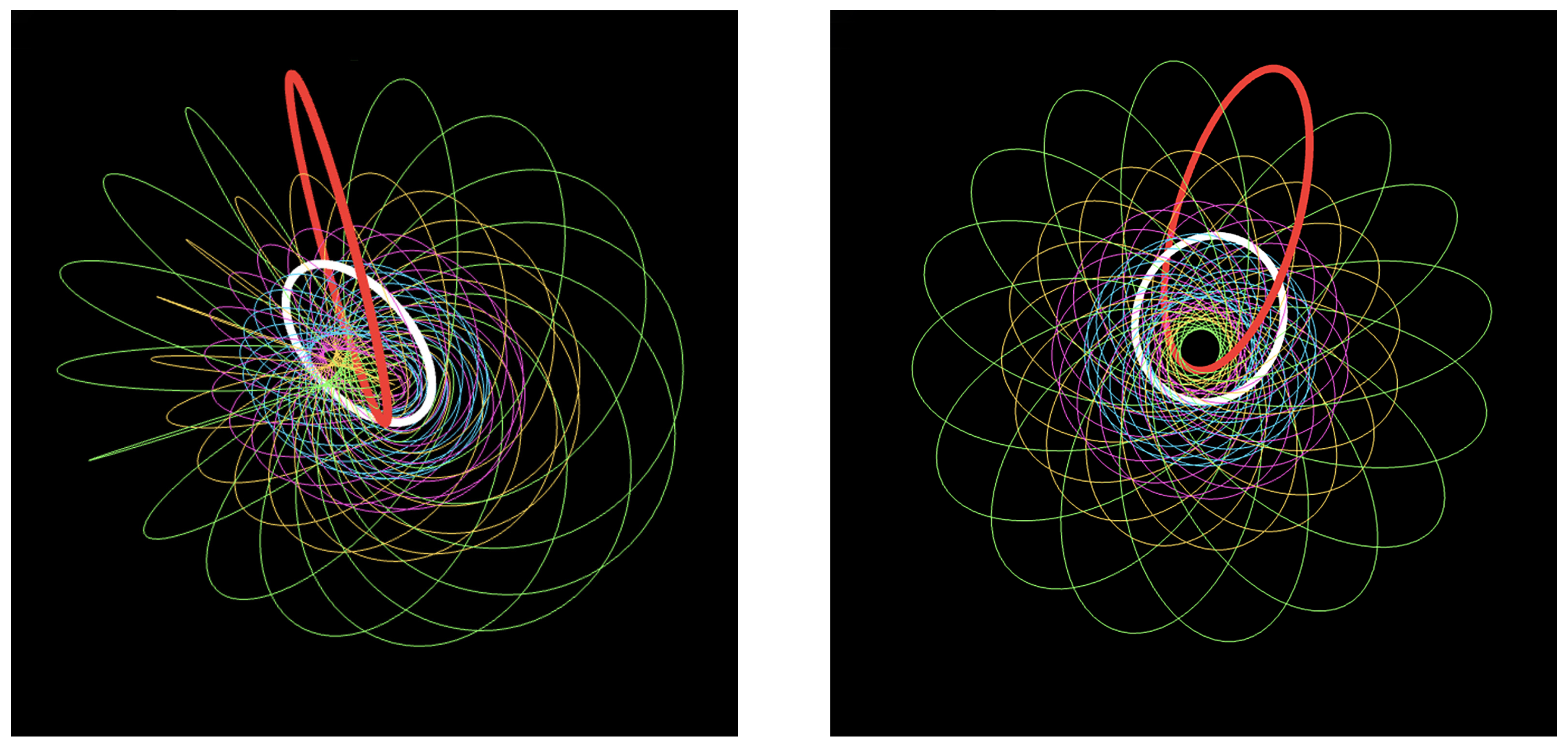
Figure 2.
Nameless (nested tori): a slowly rotating sphere of nested amber Hopf fibres over a faint Chladni surface, with each fibre’s brightness set by the framework’s eigenmode cascade. Stills from the real-time work.
Figure 2.
Nameless (nested tori): a slowly rotating sphere of nested amber Hopf fibres over a faint Chladni surface, with each fibre’s brightness set by the framework’s eigenmode cascade. Stills from the real-time work.
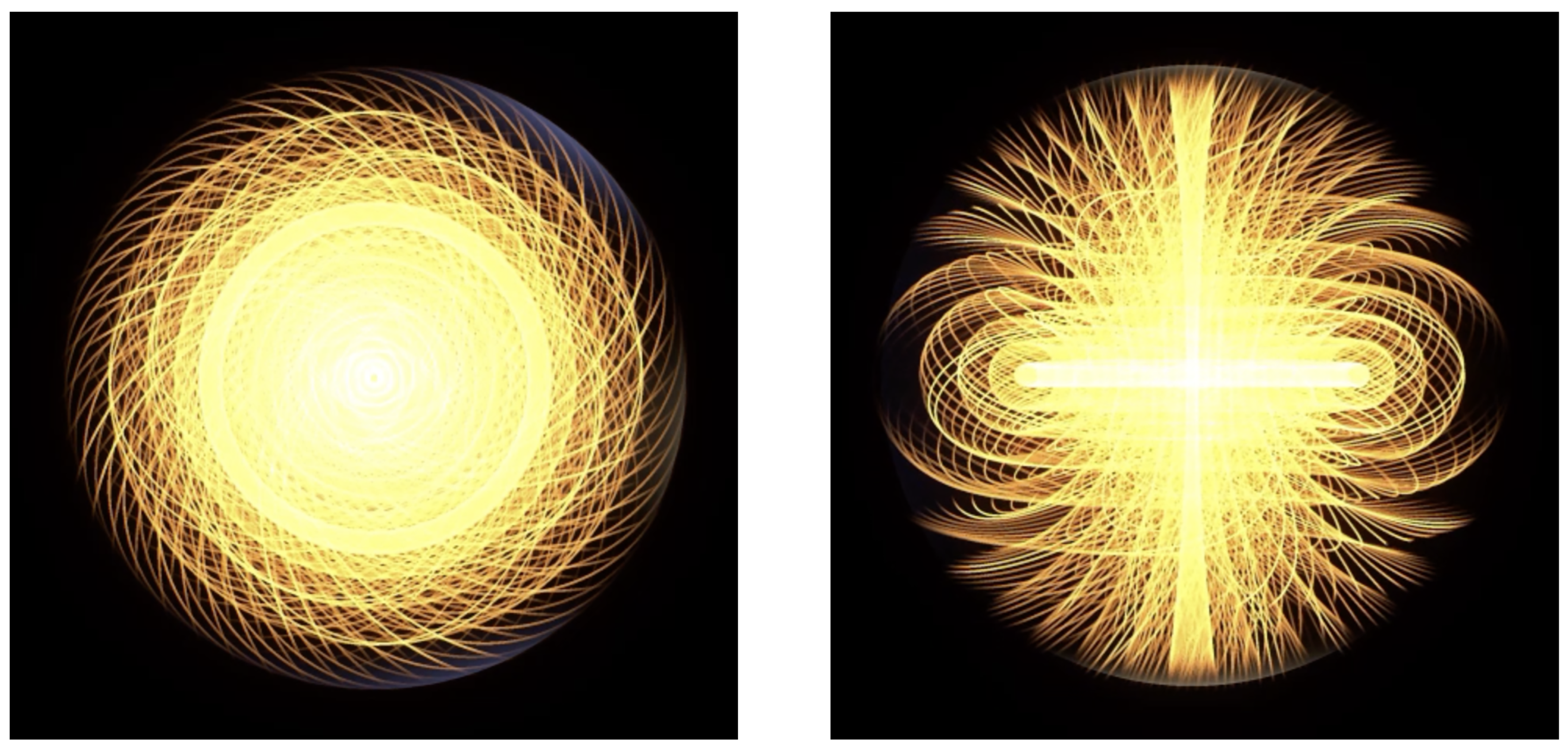
Figure 3.
Source: a spherical cavity vibrating in all twenty-four cascade modes at once, coloured by the sign of the wave, threaded by the Hopf fibres, with matter points placed within the symmetry three-sphere. Stills from the real-time work.
Figure 3.
Source: a spherical cavity vibrating in all twenty-four cascade modes at once, coloured by the sign of the wave, threaded by the Hopf fibres, with matter points placed within the symmetry three-sphere. Stills from the real-time work.
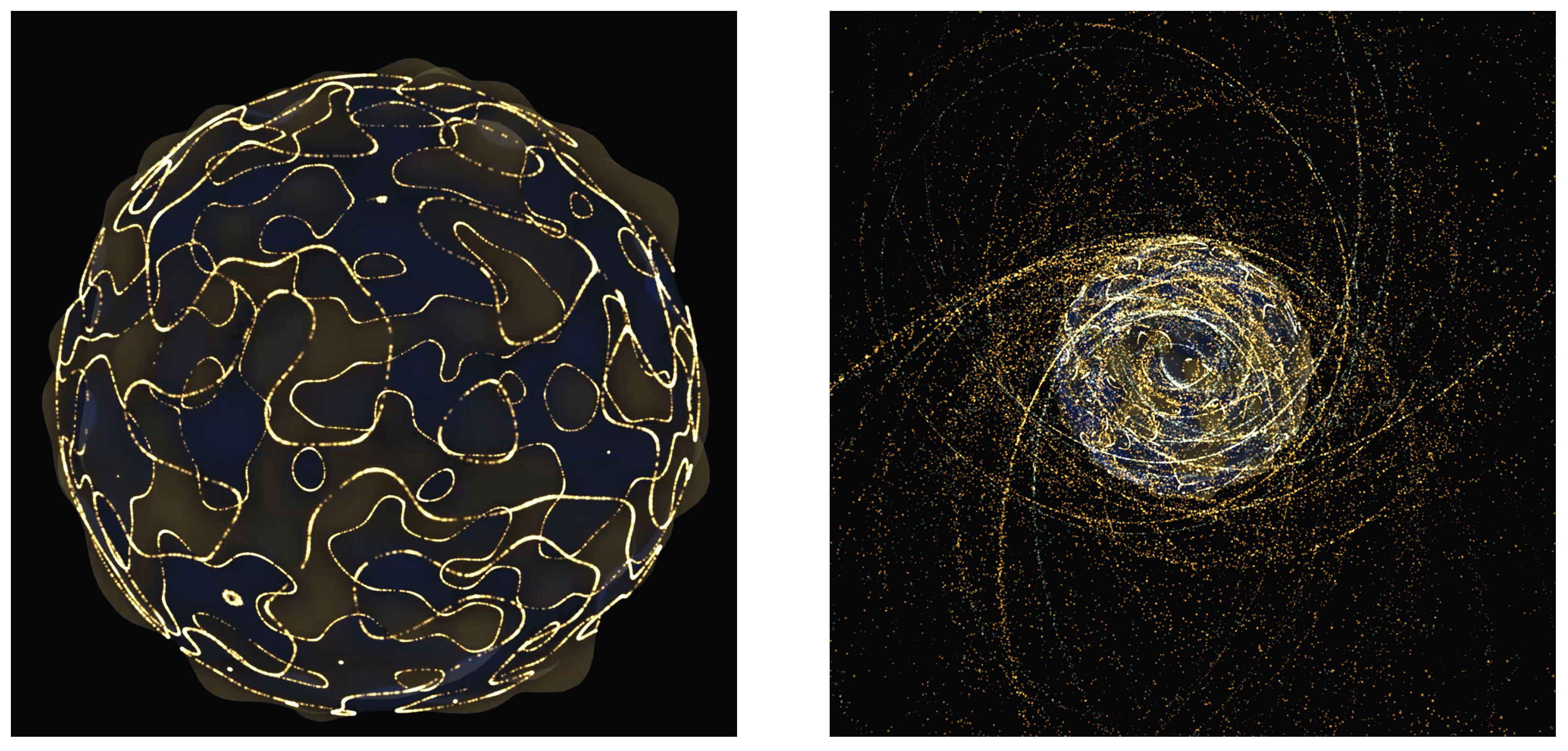
Figure 4.
The Philosopher: a voice-based conversational work that answers from within the framework in plain language. Interface stills.
Figure 4.
The Philosopher: a voice-based conversational work that answers from within the framework in plain language. Interface stills.
Disclaimer/Publisher’s Note: The statements, opinions and data contained in all publications are solely those of the individual author(s) and contributor(s) and not of MDPI and/or the editor(s). MDPI and/or the editor(s) disclaim responsibility for any injury to people or property resulting from any ideas, methods, instructions or products referred to in the content. |
© 2026 by the authors. Licensee MDPI, Basel, Switzerland. This article is an open access article distributed under the terms and conditions of the Creative Commons Attribution (CC BY) license (http://creativecommons.org/licenses/by/4.0/).
Copyright: This open access article is published under a Creative Commons CC BY 4.0 license, which permit the free download, distribution, and reuse, provided that the author and preprint are cited in any reuse.