
Submitted:
24 July 2026
Posted:
27 July 2026
You are already at the latest version
Abstract
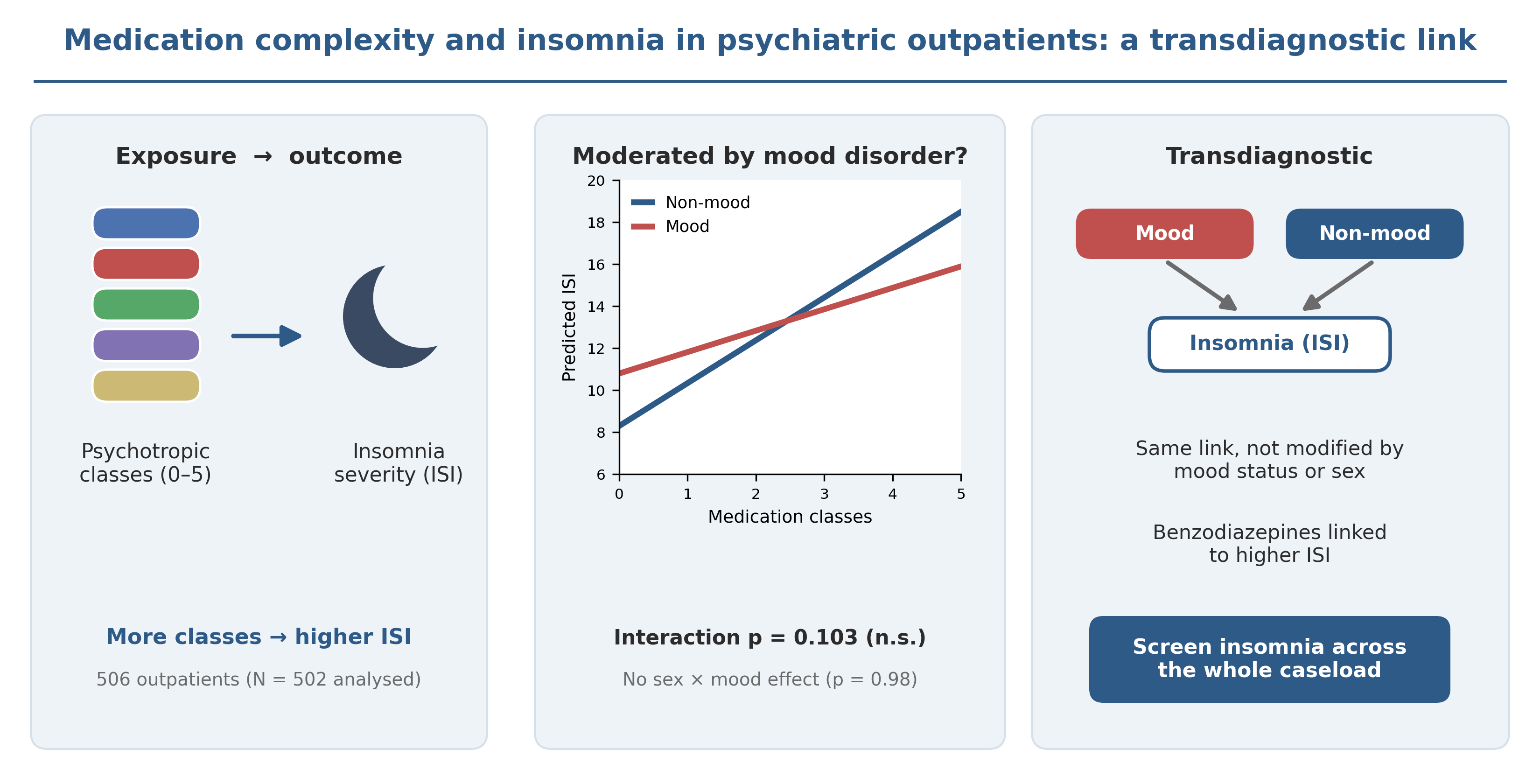
Background: Insomnia is common and transdiagnostic in psychiatric care. A prior analysis of this community outpatient cohort found that psychotropic medication complexity was associated with insomnia severity, but whether this association is uniform across diagnoses was not examined. We preregistered a moderation analysis to test whether mood disorder status, or sex, modifies the association between medication complexity and insomnia.
Methods: Secondary analysis of cross-sectional, routinely collected data from 506 adult outpatients (analytic N = 502) at an Italian community mental health centre. The primary model regressed the Insomnia Severity Index (ISI) total score on medication complexity × mood disorder status (depressive and bipolar vs. other), adjusting for age, sex and education; it was preregistered on the OSF before any interaction model was estimated.
Results: Medication complexity was associated with ISI overall (b = 1.54 per class, 95% CI 0.92–2.16). The medication complexity × mood interaction was not significant (b = −1.02, 95% CI −2.25 to 0.21, p = 0.103; ΔR² = 0.005) and did not indicate a clinically meaningful stronger association in mood disorders. Slopes were positive in both groups (non-mood 2.03; mood 1.01 ISI points per class). There was no sex × mood moderation (p = 0.98), and benzodiazepine prescription was independently associated with ISI (b = 1.82, p = 0.013).
Conclusions: In community psychiatric outpatients, medication complexity is a robust, transdiagnostic marker of insomnia severity that is not amplified in mood disorders or by sex. These preregistered findings support routine insomnia screening across the caseload, regardless of diagnosis, with prescribing intensity, benzodiazepines in particular, flagging patients who merit closer assessment focused on sleep.
Keywords:
insomnia
; insomnia severity index
; psychotropic medication
; mood disorders
; moderation
; community mental health
Copyright: This open access article is published under a Creative Commons CC BY 4.0 license, which permit the free download, distribution, and reuse, provided that the author and preprint are cited in any reuse.


