

Submitted:
24 July 2026
Posted:
27 July 2026
You are already at the latest version
Abstract
Background: Continuous epidural analgesia is widely used for postoperative pain management in neonates and small-weight infants. Epidural catheters may be inserted via a caudal-threaded approach or by direct lumbar/thoracic placement; however, comparative data on placement success, clinical use, postoperative analgesic outcomes, and complications remain limited. This study compared these two epidural techniques in neonates and small-weight infants undergoing surgery.Methods: This retrospective observational cohort study included all neonates and infants admitted to the Neonatal Intensive Care Unit at UPMC Children's Hospital of Pittsburgh who underwent attempted epidural catheter placement between January 2018 and December 2024. Demographic and perioperative data were extracted from the electronic medical record. Outcomes included patient, surgical, and epidural characteristics, epidural medications, postoperative pain and sedation scores, opioid consumption, technical success of catheter placement, and epidural catheter complications. Results: A total of 104 patients underwent attempted epidural catheter placement; five procedures were unsuccessful in four patients, resulting in 100 successful epidural catheter placements (70 caudal-threaded and 30 direct lumbar/thoracic). Epidural catheter placement was successful in 96.2% of patients. Patient and surgical characteristics, postoperative pain and sedation scores, and opioid consumption were similar between groups. Direct lumbar/thoracic epidural catheter placement required longer procedure times. Patients in the direct lumbar/thoracic epidural group were more likely than those in the caudal-threaded group to receive a ropivacaine/clonidine infusion (47% vs. 4%; p < 0.001) and a programmed intermittent bolus of epidural infusion (60% vs. 3%; p < 0.001). The direct lumbar/thoracic group experienced more postoperative catheter-related complications than the caudal-threaded group (20% vs. 4%; p = 0.02), primarily catheter leakage requiring premature catheter removal. Conclusions: Caudal-threaded and direct lumbar/thoracic epidural catheters provided comparable postoperative analgesic outcomes in neonates and small-weight infants when placed by a Pediatric Acute Pain Service. Direct lumbar/thoracic epidural catheters were associated with a higher incidence of postoperative catheter leakage and premature catheter removal. These findings may help clinicians select the most appropriate epidural technique for postoperative pain management in this population.
Keywords:
epidural catheter
; neonate
1. Introduction
Continuous epidural analgesia via a caudal or lumbar/thoracic approach is an established technique for providing perioperative analgesia in neonates and small-weight infants.[1,2,3,4,5,6,7,8,9,10]In these patients, the relative fluidity of epidural fat permits caudal epidural catheters to be advanced cranially to the lumbar or thoracic levels.[11,12] This approach is often used because it is technically easier, and ultrasound guidance facilitates needle placement through the sacral hiatus and confirms catheter location within the epidural space at the desired spinal level. [13,14] Unfortunately, advancing the catheter from the sacral canal over several vertebral levels may result in catheter misplacement or failure to reach the intended spinal level. Direct lumbar or thoracic epidural catheter placement offers an alternative by allowing insertion at or near the desired dermatomal level.[15] This technique may be advantageous for procedures requiring precise segmental analgesia in small infants undergoing surgery. However, it is technically more demanding and is generally performed by clinicians with expertise in pediatric regional anesthesia. Although both caudal-threaded and direct lumbar/thoracic epidural catheter techniques are routinely used in neonates and small-weight infants, comparative data on their clinical applications and outcomes remain limited. Little is known about the patient populations selected for each technique, the surgical procedures for which each approach is used, epidural catheter characteristics, the technical success of catheter placement, postoperative analgesic outcomes, and epidural catheter-related complications. Consequently, the choice of epidural approach is largely based on clinician experience and institutional practice rather than comparative clinical evidence.
This study describes one institution’s experience with caudal-threaded and direct lumbar/thoracic epidural catheters placed for neonates and small-weight infants. The primary objective was to describe the technical success and compare the clinical use of these techniques, including patient characteristics, surgical procedures, epidural catheter location, and medications used for epidural analgesia. Secondary objectives were to compare postoperative analgesic outcomes, including postoperative pain and sedation scores, opioid consumption, and adjunct analgesic use, and to compare the incidence of intraoperative and postoperative complications between the two techniques. We hypothesized that direct lumbar/thoracic epidural catheter placement would provide postoperative analgesia comparable to caudal-threaded epidural catheters but would differ with respect to procedural characteristics and catheter-related complications.
2. Materials and Methods
2.1. Study Design
This retrospective observational cohort study was conducted at UPMC Children’s Hospital of Pittsburgh after approval by the University of Pittsburgh Institutional Review Board (IRB Study #STUDY22120083; approved July 18, 2023). Medical records were reviewed for all infants admitted to the neonatal intensive care unit (NICU) who underwent surgical procedures and were scheduled to receive continuous epidural analgesia for postoperative pain management between January 2018 and December 2024. The study was conducted in accordance with the principles of the Declaration of Helsinki. The requirement for informed consent was waived due to the retrospective study design, and only de-identified data were collected.
2.2. Epidural Catheter Placement
The infants were scheduled to receive either a caudal- threaded epidural catheter or a directly placed lumbar or thoracic epidural catheter. The choice of epidural technique and infusion medication was based on the attending pediatric regional anesthesiologist’s clinical judgment and preference. All epidural catheters were placed and managed by the Pediatric Acute Pain Service. Ultrasound guidance was used to identify the caudal or epidural space, guide needle placement, monitor catheter advancement when feasible, and/or confirm epidural catheter tip location. No additional imaging modalities or confirmation techniques, including fluoroscopy or radiography, were used. Catheters were tunneled per the attending’s preference; however, this information was not reliably documented in the patient’s chart. Medication for epidural infusions, including programmed intermittent bolus (PIB) administration when prescribed, was individualized based on each patient’s age and weight.
2.3. Data Collection
Data were collected retrospectively from the electronic medical record and included demographic and perioperative variables. Demographic variables included gestational age at birth, sex, postnatal age at surgery, corrected gestational age at surgery, and weight at the time of surgery.
Intraoperative variables included American Society of Anesthesiologists (ASA) physical status, surgical procedure, anesthesia and surgical duration, epidural placement technique (caudal-threaded or direct lumbar/thoracic), vertebral level of needle insertion, epidural catheter tip location, time required for epidural catheter placement, technical success of catheter placement, intraoperative complications from epidural placement, and analgesic administration. Technical success was defined as successful placement of an epidural catheter with initiation of the planned epidural medication administration. Placement failure was defined as abandonment of the procedure because of inability to access the epidural space, inability to advance the catheter to the desired level, suspected intrathecal or intravascular catheter placement, or needle and catheter resistance during the placement.
Epidural analgesia variables include the administered local anesthetic and its concentration, use of clonidine, epidural infusion rates, total ropivacaine dose (mg/kg), use of programmed intermittent bolus (PIB), duration of epidural infusion, postoperative day (POD) of epidural catheter removal, and the documented reason for catheter removal.
Postoperative variables included pain and sedation scores assessed every 4 hours using the Neonatal Pain, Agitation, and Sedation Scale (N-PASS) from POD 0 through POD 5, postoperative daily and total opioid consumption, administration of non opioid analgesic medications, and catheter-related complications. Medication administration was recorded in 24-hour intervals until epidural catheter removal. Intraoperative analgesics included fentanyl, morphine, methadone, and acetaminophen. Postoperative medications included morphine, fentanyl, and acetaminophen. All intraoperative and postoperative opioid doses were converted to intravenous morphine milligram equivalents (MMEs; mg/kg) for analysis.
Procedure-related complications were identified from the anesthesia and Pediatric Acute Pain Service consults. Intraoperative complications included intravascular catheter placement and suspected intrathecal catheter placement. Postoperative complications included catheter leakage, accidental catheter disconnection, catheter dislodgement, and other catheter-related events requiring premature catheter removal.
2.4. Study Outcomes
The primary objective of this retrospective observational cohort study was to describe and compare the clinical characteristics of neonates and small-weight infants who received caudal-threaded or direct lumbar/thoracic epidural catheters, including patient demographics, surgical procedures, epidural catheter characteristics, and epidural analgesic management.
The secondary objective was to compare postoperative analgesic outcomes between the two epidural techniques by evaluating longitudinal postoperative pain and sedation scores and postoperative opioid consumption.
The third objective was to compare the technical success of epidural catheter placement and the incidence of intraoperative and postoperative complications associated with each technique.
Exploratory analyses were performed to evaluate the associations of epidural catheter technique, programmed intermittent bolus (PIB) administration, and epidural medications with postoperative opioid consumption.
2.5. Statistical Analysis
Continuous variables are presented as median and interquartile range (IQR), and categorical variables as counts and percentages. Continuous variables were compared using the Wilcoxon rank-sum test, and categorical variables were compared using the chi-square test or Fisher’s exact test, as appropriate. Data distributions were evaluated using histograms, and correlations among continuous variables were assessed using correlation matrices.
Linear mixed-effects models were used to compare postoperative pain and sedation scores between the caudal-threaded and direct lumbar/thoracic epidural groups over POD 0–5. Fixed effects included treatment group and POD, with a random intercept for each patient to account for repeated measurements. Interaction effects between treatment group and postoperative day were evaluated.
Exploratory univariate linear regression analyses were performed to evaluate the associations between epidural catheter technique, PIB administration, total epidural clonidine dose, and epidural ropivacaine dose and total postoperative opioid consumption, expressed as intravenous morphine milligram equivalents (MME/kg). Total postoperative MME/kg values were log-transformed before analysis because postoperative opioid consumption was right-skewed.
Results are reported as estimated mean differences with 95% confidence intervals (CI). Missing observations were excluded from the corresponding analyses. All statistical tests were two-sided, and a p-value < 0.05 was considered statistically significant. Statistical analyses were performed using R version 4.3.1 (R Foundation for Statistical Computing, Vienna, Austria)
3. Results
A total of 104 infants underwent attempted epidural catheter placement by the Pediatric Acute Pain Service.
3.1. Epidural Catheter Placement Success Rate
Epidural catheter placement was unsuccessful in four patients despite ultrasound guidance. One infant had an unsuccessful caudal-threaded epidural attempt because the catheter could not be advanced, and a very high resistance was felt. During the second attempt, aspiration of clear fluid raised concern for intrathecal catheter placement, prompting termination of the procedure. In a second patient, both caudal-threaded (three) and direct lumbar/thoracic (T12-L1) epidural catheter placement (two) attempts were unsuccessful because the catheter could not be advanced beyond the T12–L1 vertebral space. A very high resistance was felt with each attempt to advance the catheter. In the third infant, direct lumbar/ thoracic (T12-L1) epidural catheter placement was abandoned after two intravascular catheter placements (blood aspiration and positive test dose). In the fourth patient, direct thoracic (T8-T9, T9-T10) epidural catheter placement was unsuccessful after five failed attempts to access the epidural space. None of these patients developed any complications from the failed epidural placement attempts.
3.2. Epidural Catheter Technique
The remaining 100 patients underwent successful epidural catheter placement. Of these, 70 received caudal-threaded epidural catheters, and 30 underwent direct epidural catheter placement, with lumbar insertion levels ranging from L4 to L1 (n = 8) and thoracic insertion levels ranging from T12 to T7 (n = 22). Epidural catheter tips were positioned between T4 and T12. During the placement, in the caudal-threaded epidural group, one patient experienced intravascular needle placement, and two patients had intravascular catheter placement; all were immediately recognized, and the epidural catheters were successfully repositioned. None of these patients developed any complications from the intravascular catheter placement. Caudal catheter tunneling was performed in some patients at provider discretion, although this information was not consistently documented in the medical record.
3.3. Patient Demographics, Surgical and Epidural Characteristics
Patient demographics, surgical and epidural characteristics are summarized in Table 1. The infants who received a direct lumbar/thoracic epidural catheter had a slightly higher corrected gestational age at the time of surgery (p=0.045). Laparotomy with bowel resection was the most common procedure in the caudal- threaded epidural group. In contrast, jejunostomy, ileostomy, and colostomy procedures were proportionally more frequent in the direct lumbar/thoracic epidural group (Table 1).
3.4. Epidural Medication Administration
There was no significant difference between groups in the total intraoperative ropivacaine dose administered. The postoperative epidural infusion consisted of ropivacaine at concentrations of 0.05%–1%, 0.1%- 90%, or 0.2%–9%, with clonidine (1 or 2 μg/mL) added in 17 patients. Ropivacaine 0.1% was used more often in the caudal-threaded epidural group (96% vs. 77%), whereas ropivacaine 0.2% was used more frequently in the direct lumbar/thoracic epidural group (23% vs. 3%) (Table 2).
More patients in the direct lumbar/thoracic epidural group received ropivacaine with clonidine (14 [47%]) than in the caudal-threaded group (3 [4%]; p < 0.001) as per provider’s preference. However, there was no statistical difference in total clonidine administered between the groups. Programmed intermittent bolus (PIB) administration was used in 20 patients at the provider’s discretion. Patients in the direct lumbar/thoracic epidural group were significantly more likely to receive PIB than those in the caudal-threaded group (60% vs. 3%; p < 0.001). Patients who received a direct lumbar/thoracic epidural catheter had a lower ropivacaine infusion on POD 3 (p=0.006) and, overall, received higher cumulative postoperative ropivacaine doses. However, the difference was not statistically significant (p = 0.058) (Table 2).
3.5. Postoperative Pain Scores
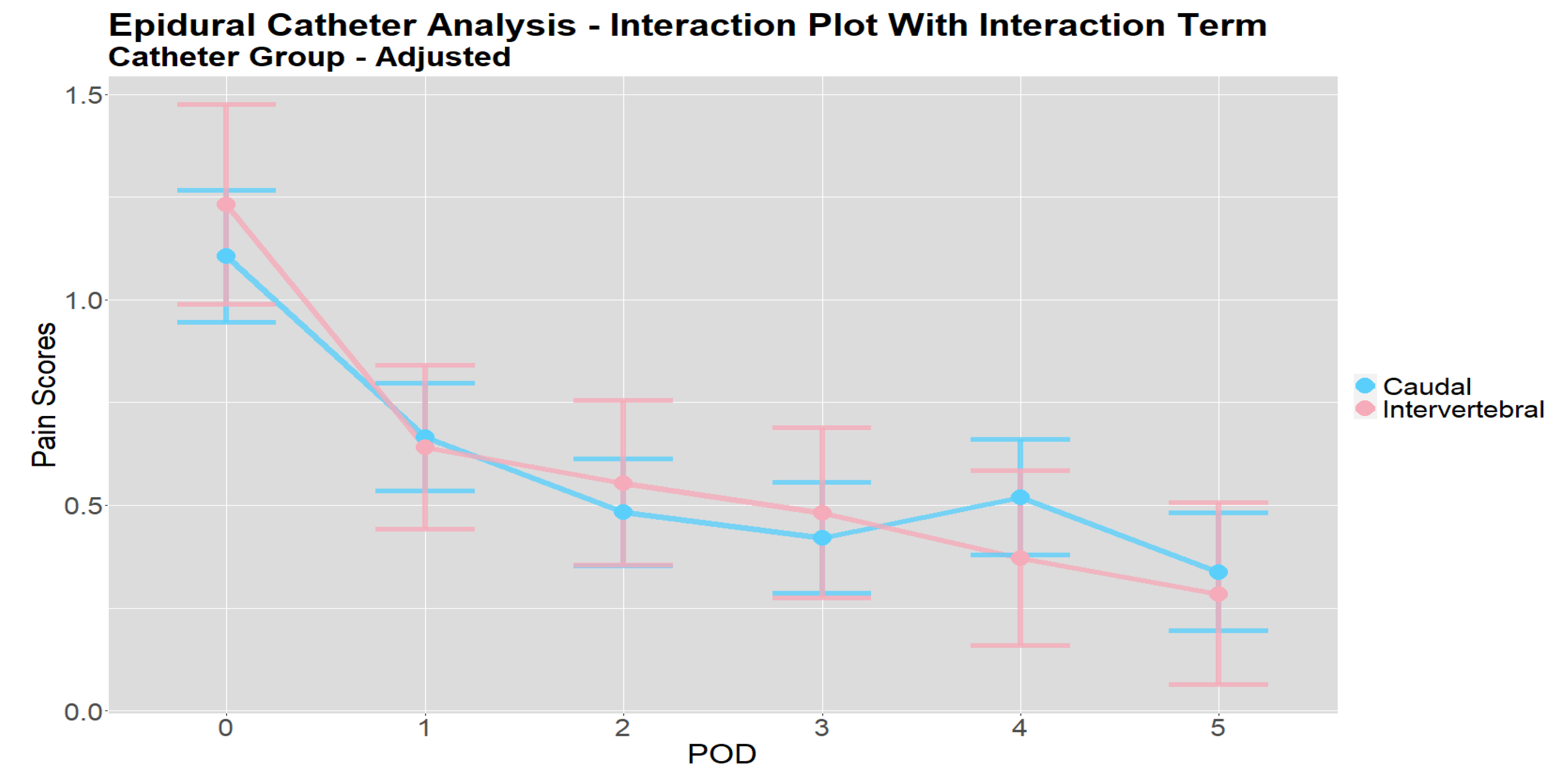
There was no significant difference in mean postoperative pain scores between the caudal-threaded and direct lumbar/thoracic epidural groups (estimated mean difference, 0.00; 95% CI, −0.21 to 0.22; p = 0.972). Overall, postoperative pain scores decreased significantly over time (p < 0.001), with significantly lower N-PASS scores observed on each postoperative day compared with POD 0.
Figure 1.
Adjusted mean postoperative pain scores over postoperative days (POD) 0–5 estimated from the linear mixed-effects model. The “Caudal” group shown in the figure corresponds to the caudal- threaded epidural catheter group, and the “Intervertebral” group corresponds to the direct lumbar/thoracic epidural catheter group. Points represent the adjusted mean pain scores, and error bars indicate the 95% confidence intervals. Pain scores decreased significantly over time (p < 0.001), with no significant difference between epidural catheter techniques (p = 0.972). POD is postoperative day.
Figure 1.
Adjusted mean postoperative pain scores over postoperative days (POD) 0–5 estimated from the linear mixed-effects model. The “Caudal” group shown in the figure corresponds to the caudal- threaded epidural catheter group, and the “Intervertebral” group corresponds to the direct lumbar/thoracic epidural catheter group. Points represent the adjusted mean pain scores, and error bars indicate the 95% confidence intervals. Pain scores decreased significantly over time (p < 0.001), with no significant difference between epidural catheter techniques (p = 0.972). POD is postoperative day.
3.6. Postoperative Sedation Scores
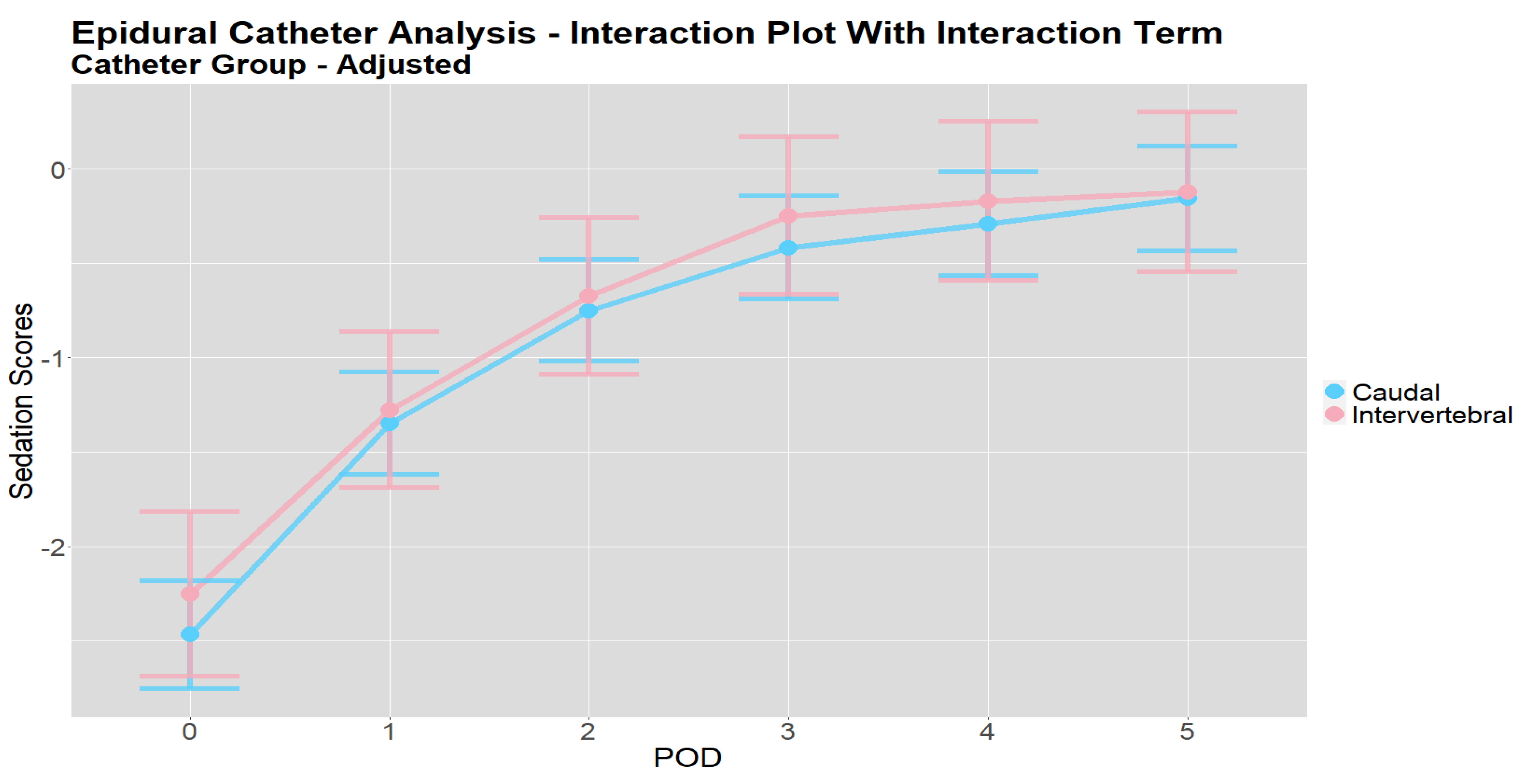
There was no significant difference in sedation scores between the caudal-threaded and direct lumbar/thoracic epidural groups (estimated mean difference, 0.10; 95% CI, −0.38 to 0.59; p = 0.673). Sedation scores changed significantly over time (p < 0.001), with progressively higher N-PASS sedation scores on each postoperative day compared with POD 0, indicating decreasing sedation levels during postoperative recovery.
Figure 2.
Adjusted mean postoperative sedation scores over postoperative days (POD) 0–5 estimated from the linear mixed-effects model. In the figure, “Caudal” refers to the caudally threaded epidural catheter group and “Intervertebral” refers to the direct lumbar/thoracic epidural catheter group. Points represent the adjusted mean sedation scores, and error bars indicate the 95% confidence intervals. Sedation scores increased significantly over time (became less negative), indicating decreasing levels of sedation during postoperative recovery (p < 0.001), with no significant difference between the two epidural catheter techniques (p = 0.672).
Figure 2.
Adjusted mean postoperative sedation scores over postoperative days (POD) 0–5 estimated from the linear mixed-effects model. In the figure, “Caudal” refers to the caudally threaded epidural catheter group and “Intervertebral” refers to the direct lumbar/thoracic epidural catheter group. Points represent the adjusted mean sedation scores, and error bars indicate the 95% confidence intervals. Sedation scores increased significantly over time (became less negative), indicating decreasing levels of sedation during postoperative recovery (p < 0.001), with no significant difference between the two epidural catheter techniques (p = 0.672).
3.7. Perioperative Analgesics Consumption
There was no difference in the intravenous MME (mg/kg) administered intraoperatively and postoperatively between the groups (p=0.199). However, more patients in the caudal -threaded group, 62 (92%) vs 21 (70%), received acetaminophen postoperatively (p=0.019).
Epidural catheter technique was not associated with postoperative opioid consumption (estimate, −0.06; 95% CI, −0.77 to 0.64; p = 0.857). Similarly, neither PIB administration (estimate, −0.06; 95% CI, −0.87 to 0.76; p = 0.889) nor total epidural clonidine dose (estimate, 0.08; 95% CI, −0.01 to 0.17; p = 0.081) was associated with postoperative opioid consumption. In contrast, higher cumulative epidural ropivacaine doses, including the combined intraoperative and postoperative dose (estimate, 0.08; 95% CI, 0.04 to 0.13; p = 0.001) and the postoperative dose alone (estimate, 0.02; 95% CI, 0.01 to 0.03; p = 0.001), were associated with greater postoperative opioid consumption. The intraoperative epidural ropivacaine bolus dose was not associated with postoperative opioid consumption (estimate, 0.05; 95% CI, −0.06 to 0.16; p = 0.370).
3.8. Postoperative Epidural Catheter Complications
Postoperative catheter-related complications occurred more frequently in the direct lumbar/thoracic epidural group than in the caudal-threaded epidural group (p = 0.02). In the caudal-threaded group, complications included catheter leakage (n = 2) and ecchymosis (n = 1); none required premature catheter removal. In the direct lumbar/thoracic epidural group, complications included catheter leakage (n = 5) and accidental catheter disconnection (n = 1), all of which resulted in premature catheter removal. All patients, except one in the caudal-threaded group who experienced a catheter leakage complication, received programmed intermittent bolus administration.
3.8 A summary of the characteristics of both epidural continuous techniques is presented in Table 3.
| Characteristic | Caudal-Threaded | Direct Lumbar/Thoracic |
| Technical success | High | High |
| Placement time | Shorter | Longer |
| Analgesic efficacy | Equivalent | Equivalent |
| Postoperative opioid use | Equivalent | Equivalent |
| Catheter leakage | Lower | Higher |
| Premature catheter removal | Rare | More frequent |
| Advantages | Technically easier | More targeted segmental placement |
| Potential limitations | Catheter advancement | Technically demanding; potential vascular puncture |
4. Discussion
This retrospective observational cohort study describes a seven-year institutional experience with continuous epidural analgesia in neonates and small-weight infants. It compares caudal- threaded and direct lumbar/thoracic epidural catheter techniques. Patients undergoing direct lumbar/thoracic epidural placement were slightly older, with greater corrected gestational age, and had longer procedure times than those receiving caudal- threaded catheters.
A key finding was that postoperative analgesic outcomes were comparable between the two techniques. Pain scores remained low throughout the postoperative period, and postoperative opioid requirements did not differ significantly between groups. These findings suggest that, when successfully placed, both caudal- threaded and direct lumbar/thoracic epidural catheters can provide adequate postoperative analgesia in neonates and small-weight infants.
Nevertheless, successful epidural catheter placement was achieved in 100 of 104 attempted procedures. Previous studies have shown that successful advancement of a caudally placed epidural catheter depends on patient age and size. For example, Bösenberg et al. reported a 95% success rate in infants aged 4 weeks to 5 months (2.7–6.5 kg), with success declining in older children as lumbar lordosis develops.[11] Similarly, Tsui et al. reported an overall technical success rate of 98.2% when electrical stimulation guidance was used; however, in five patients (aged 5 months to 1.6 years), the catheter could not be advanced to the desired thoracic or lumbar level, and the procedure was abandoned. [2]In contrast, Valairucha et al. reported successful advancement of caudally placed epidural catheters to the lumbar or thoracic epidural space in only 68% of infants younger than six months, as confirmed radiographically. [16]
Our cohort consisted predominantly of young infants, with a median postnatal age of approximately two months, and a median weight of 3 kg, characteristics consistent with the age group in which successful catheter advancement has been reported to be most common. Despite the favorable age and size of our cohort, advancement of the caudally placed epidural catheter was unsuccessful in 2 of 72 attempts. Unfortunately, one of these two patients also could not have the epidural catheter placed at the T12-L1 intervertebral level. These findings highlight that caudal epidural catheter advancement from the sacral hiatus to a thoracic vertebral level can remain technically challenging even in neonates and small-weight infants, despite the use of ultrasound to assist with placement. Resistance encountered during catheter advancement should prompt reassessment rather than forceful advancement, as it may indicate catheter contact with a nerve root, dura, or another anatomic obstruction.
Direct lumbar or thoracic epidural catheter placement avoids the need to advance the catheter over multiple vertebral levels and may reduce the risk of malposition associated with the caudal approach. However, both techniques have their own technical challenges. In a study by Baidya et al, advancement of an epidural catheter from the lumbar interspace to the thoracic level was successful in only 5 of 40 patients, with 4 of the 5 patients being infants. [17] Similarly, Blanco et al. reported successful advancement from the L4-L5 interspace to the T12 level in only 17% of patients aged 0 to 96 months.[18]
The direct thoracic epidural approach offers the theoretical advantage of more precise catheter placement, potentially reducing catheter migration and allowing lower volumes of local anesthetic to achieve adequate segmental analgesia. However, this technique carries potential risks, including vascular puncture, dural puncture, spinal cord injury, intravascular catheter placement, and inadvertent subarachnoid catheter placement. [19] Although these complications are uncommon, their consequences in neonates and small infants may be particularly serious. In the present study, the placement of the epidural catheter at the thoracic or lumbar intervertebral levels was unsuccessful in 3 of 33 attempts.
Large pediatric registries have shown that neuraxial regional anesthesia is associated with a very low rate of serious complications. The French-Language Society of Pediatric Anesthesiologists and the United Kingdom pediatric regional anesthesia audit both reported serious incident rates below 0.1%. [8,10] Similarly, the Pediatric Regional Anesthesia Network (PRAN) reported extremely low rates of severe neurologic injury and local anesthetic systemic toxicity across more than 100,000 regional anesthetic procedures, with most severe local anesthetic toxicity events occurring after intravascular bolus administration in infants younger than six months. [3,9] Consistent with these reports, no neurologic complications or local anesthetic systemic toxicity were observed in our cohort.
The most common adverse events were catheter-related complications. The incidence of postoperative catheter-related complications differed between techniques. Catheter leakage occurred more frequently after direct lumbar/thoracic epidural placement and was the primary reason for premature catheter removal. An important observation was that most patients in the direct lumbar/thoracic group received PIB administration, whereas PIB was rarely used in the caudal-threaded group. Although our study was not designed to determine causality, the higher use of PIB may have contributed to the increased frequency of catheter leakage, secondary to the delivery of additional volume at high pressure. Alternatively, differences in catheter insertion site, catheter length left in the epidural space, catheter tunneling, dressing stability, or catheter securement may have influenced leakage rates. While tunneling was described in some of the caudally placed catheters, none of the direct thoracic/lumbar catheters described tunneling. Future prospective studies should evaluate the relationship between epidural infusion technique, catheter fixation methods, and catheter-related complications.
Despite the technical challenges associated with both approaches, unsuccessful epidural placement was uncommon. Five procedures were aborted because of inability to advance the catheter, suspected intrathecal placement, repeated intravascular placement, or inability to access the epidural space successfully. In addition, several intravascular catheter placements were recognized immediately and successfully replaced without reported complications. These findings emphasize the importance of meticulous technique, ultrasound guidance, and experienced practitioners when performing epidural catheter placement in this vulnerable population.
This study has several limitations. Its retrospective design introduces the possibility of selection and information bias. The choice of epidural technique was determined by clinician preference rather than randomization, and differences in patient characteristics and surgical procedures may have influenced outcomes. The relatively small sample size, particularly in the direct lumbar/thoracic epidural group, and the low number of catheter-related complications warrant caution when interpreting the observed differences in complication rates. Documentation of catheter tunneling and some procedural details was inconsistent, preventing analysis of their potential impact on catheter-related complications. In addition, postoperative analgesic management was not fully standardized, as PIB administration varied substantially between groups and may have influenced catheter leakage and other postoperative outcomes.
Despite these limitations, this study included all NICU epidural catheters managed by a dedicated Pediatric Acute Pain Service over seven years. It provided a comprehensive description of patient selection, procedural characteristics, postoperative analgesic outcomes, and complications associated with caudal-threaded and direct lumbar/thoracic epidural techniques. It showed that both techniques provide comparable postoperative analgesic outcomes. The primary distinction between the techniques was a higher incidence of postoperative catheter-related complications after direct lumbar/thoracic epidural placement. Prospective multicenter studies are needed to determine whether catheter placement technique, catheter securement methods, or postoperative infusion strategies influence catheter-related complications in this population.
5. Conclusions
In this single-center retrospective cohort, caudal-threaded and direct lumbar/thoracic epidural catheters yielded similar postoperative analgesic outcomes in neonates and small-weight infants. Direct lumbar/thoracic epidural catheter placement required longer placement times and was associated with a higher incidence of catheter leakage, necessitating premature catheter removal. Because postoperative management differed between groups, particularly in programmed intermittent bolus administration, the observed differences in complications should be interpreted with caution. Prospective multicenter studies with standardized epidural management protocols are needed to better define the optimal epidural catheter technique and identify modifiable factors associated with catheter-related complications in this population.
References
- Bosenberg, A.; Flick, R.P. Regional anesthesia in neonates and infants. Clin Perinatol 2013, 40, 525–538. [CrossRef]
- Tsui, B.C.; Wagner, A.; Cave, D.; Kearney, R. Thoracic and lumbar epidural analgesia via the caudal approach using electrical stimulation guidance in pediatric patients: a review of 289 patients. Anesthesiology 2004, 100, 683–689. [CrossRef]
- Polaner, D.M.; Taenzer, A.H.; Walker, B.J.; Bosenberg, A.; Krane, E.J.; Suresh, S.; Wolf, C.; Martin, L.D. Pediatric Regional Anesthesia Network (PRAN): a multi-institutional study of the use and incidence of complications of pediatric regional anesthesia. Anesth Analg 2012, 115, 1353–1364. [CrossRef]
- Bösenberg, A.T. Epidural analgesia for major neonatal surgery. Paediatr Anaesth 1998, 8, 479–483. [CrossRef]
- Visoiu, M. Evolving approaches in neonatal postoperative pain management. Semin Pediatr Surg 2022, 31, 151203. [CrossRef]
- Puthoff, T.D.; Veneziano, G.; Kulaylat, A.N.; Seabrook, R.B.; Diefenbach, K.A.; Ryshen, G.; Hastie, S.; Lane, A.; Renner, L.; Bapat, R. Development of a Structured Regional Analgesia Program for Postoperative Pain Management. Pediatrics 2021, 147. [CrossRef]
- Goeller, J.K.; Bhalla, T.; Tobias, J.D. Combined use of neuraxial and general anesthesia during major abdominal procedures in neonates and infants. Paediatr Anaesth 2014, 24, 553–560. [CrossRef]
- Llewellyn, N.; Moriarty, A. The national pediatric epidural audit. Paediatr Anaesth 2007, 17, 520–533. [CrossRef]
- Walker, B.J.; Long, J.B.; Sathyamoorthy, M.; Birstler, J.; Wolf, C.; Bosenberg, A.T.; Flack, S.H.; Krane, E.J.; Sethna, N.F.; Suresh, S.; et al. Complications in Pediatric Regional Anesthesia: An Analysis of More than 100,000 Blocks from the Pediatric Regional Anesthesia Network. Anesthesiology 2018, 129, 721–732. [CrossRef]
- Ecoffey, C.; Lacroix, F.; Giaufré, E.; Orliaguet, G.; Courrèges, P. Epidemiology and morbidity of regional anesthesia in children: a follow-up one-year prospective survey of the French-Language Society of Paediatric Anaesthesiologists (ADARPEF). Paediatr Anaesth 2010, 20, 1061–1069. [CrossRef]
- Bösenberg, A.T.; Bland, B.A.; Schulte-Steinberg, O.; Downing, J.W. Thoracic epidural anesthesia via caudal route in infants. Anesthesiology 1988, 69, 265–269. [CrossRef]
- Wiegele, M.; Marhofer, P.; Lönnqvist, P.A. Caudal epidural blocks in paediatric patients: a review and practical considerations. Br J Anaesth 2019, 122, 509–517. [CrossRef]
- Tsui, B.C.; Suresh, S. Ultrasound imaging for regional anesthesia in infants, children, and adolescents: a review of current literature and its application in the practice of neuraxial blocks. Anesthesiology 2010, 112, 719–728. [CrossRef]
- Ponde, V.C.; Bedekar, V.V.; Desai, A.P.; Puranik, K.A. Does ultrasound guidance add accuracy to continuous caudal-epidural catheter placements in neonates and infants? Paediatr Anaesth 2017, 27, 1010–1014. [CrossRef]
- Maitra, S.; Baidya, D.K.; Pawar, D.K.; Arora, M.K.; Khanna, P. Epidural anesthesia and analgesia in the neonate: a review of current evidences. J Anesth 2014, 28, 768–779. [CrossRef]
- Valairucha, S.; Seefelder, C.; Houck, C.S. Thoracic epidural catheters placed by the caudal route in infants: the importance of radiographic confirmation. Paediatr Anaesth 2002, 12, 424–428. [CrossRef]
- Baidya, D.K.; Pawar, D.K.; Dehran, M.; Gupta, A.K. Advancement of epidural catheter from lumbar to thoracic space in children: Comparison between 18G and 23G catheters. J Anaesthesiol Clin Pharmacol 2012, 28, 21–27. [CrossRef]
- Blanco, D.; Llamazares, J.; Rincón, R.; Ortiz, M.; Vidal, F. Thoracic epidural anesthesia via the lumbar approach in infants and children. Anesthesiology 1996, 84, 1312–1316. [CrossRef]
- Murat, I.; Delleur, M.M.; Esteve, C.; Egu, J.F.; Raynaud, P.; Saint-Maurice, C. Continuous extradural anaesthesia in children. Clinical and haemodynamic implications. Br J Anaesth 1987, 59, 1441–1450. [CrossRef]

Table 1.
The demographics of the patient population, surgical and epidural characteristics. Data are presented as median and interquartile range (IQR). Categorical variables are presented as n (%) percentage calculated within each treatment group. POD is postoperative day. Thoracic procedures included tracheoesophageal fistula repair and congenital diaphragmatic hernia repair. Laparoscopic procedures were performed for intestinal malrotation, Nissen procedure, and colostomy opening.
Table 1.
The demographics of the patient population, surgical and epidural characteristics. Data are presented as median and interquartile range (IQR). Categorical variables are presented as n (%) percentage calculated within each treatment group. POD is postoperative day. Thoracic procedures included tracheoesophageal fistula repair and congenital diaphragmatic hernia repair. Laparoscopic procedures were performed for intestinal malrotation, Nissen procedure, and colostomy opening.
| Variable |
Caudal- Threaded Epidural n=70 n (%) |
Direct Lumbar/Thoracic Epidural n=30 n (%) |
P-Value |
| Patient Characteristics | |||
| Male | 40 (57%) | 17 (57%) | 0.964 |
| Female | 30 (43%) | 13 (43%) | |
| Gestational Age at Birth (Weeks) | 35.1 (27.6 - 38) | 34.1 (26.1 - 37.3) | |
| Days of Life at Surgery | 52 (4 - 88) | 66 (7.5 - 108.5) | 0.154 |
| Corrected Gestational Age at Surgery (weeks) | 39.8 (38 - 41.4) | 40.8 (39.4 - 44.8) | 0.045 |
| Weight (kg) | 3 (2.5 - 3.2) | 3.2 (2.6 - 3.8) | 0.117 |
| Surgical Characteristics | |||
| Thoracic Procedure | 11 (16%) | 3 (10%) | |
| Laparotomy with Bowel Resection |
31(44%) | 10(33%) | 0.073 |
| Jejunostomy, Ileostomy, Colostomy Creation | 24(34%) | 15(50%) | |
| Laparoscopic Procedure | 4(6%) | 2(7%) | |
| Epidural Characteristics | |||
| Time for Placement (minutes) | 20 (15.2 - 26.8) | 26 (22.2 - 30.8) | 0.006 |
| Postoperative Day of Epidural Removal |
3 (3 - 3) | 3 (2 - 4) | 0.763 |
Table 2.
Epidural medication characteristics. Data are presented as median and interquartile range (IQR). Categorical variables are presented as n (%) percentage calculated within each treatment group. POD is postoperative day. mg is milligrams, mcg is micrograms, kg is kilogram, hrs is hour.
Table 2.
Epidural medication characteristics. Data are presented as median and interquartile range (IQR). Categorical variables are presented as n (%) percentage calculated within each treatment group. POD is postoperative day. mg is milligrams, mcg is micrograms, kg is kilogram, hrs is hour.
| Variable |
Caudal-Threaded Epidural n=70 n (%) |
Direct Lumbar/Thoracic Epidural n=30 n (%) |
P-Value |
| Ropivacaine Infusion 0.05% | 1 (1%) | 0 (0%) |
0.003 |
| Ropivacaine Infusion 0.1% | 67 (96%) | 23 (77%) | |
| Ropivacaine Infusion 0.2% | 2 (3%) | 7 (23%) | |
| Epidural Infusion Duration (hrs) | 63.8 (60.6 - 69) | 63.7 (47.1 - 84.6) | 0.946 |
| Ropivacaine Infusion 0.1% (POD 0) | 0.7 (0.6 - 0.8) | 0.7 (0.5 - 0.8) | 0.810 |
| Epidural Infusion Rate (ml/hr) (POD 1) |
0.7 (0.6 - 0.8) | 0.7 (0.5 - 0.8) | 0.831 |
| Epidural Infusion Rate (ml/hr) (POD 2) |
0.7 (0.6 - 0.8) | 0.6 (0.5 - 0.8) | 0.237 |
| Epidural Infusion Rate (ml/hr) (POD 3) |
0.7 (0.5 - 0.8) |
0.4 (0 - 0.8) |
0.006 |
| Ropivacaine Postoperatively (mg) |
46.4 (36.9 - 57.3) |
56 (31.9 - 88) |
0.058 |
| Total Combined Ropivacaine Intraoperatively and Postoperatively (mg/kg) |
17.4 (15.3 - 20) | 18 (14.7 - 29.5) | 0.336 |
Disclaimer/Publisher’s Note: The statements, opinions and data contained in all publications are solely those of the individual author(s) and contributor(s) and not of MDPI and/or the editor(s). MDPI and/or the editor(s) disclaim responsibility for any injury to people or property resulting from any ideas, methods, instructions or products referred to in the content. |
© 2026 by the authors. Licensee MDPI, Basel, Switzerland. This article is an open access article distributed under the terms and conditions of the Creative Commons Attribution (CC BY) license (http://creativecommons.org/licenses/by/4.0/).
Copyright: This open access article is published under a Creative Commons CC BY 4.0 license, which permit the free download, distribution, and reuse, provided that the author and preprint are cited in any reuse.