

Submitted:
23 July 2026
Posted:
24 July 2026
You are already at the latest version
Abstract
Waste generation continues to increase despite advances in recycling, waste valorization, and circular economy policies. Existing explanations commonly emphasize technological, economic, or governance factors, yet provide limited insight into why waste persists even when circularity becomes increasingly embedded in policy discourse and institutional frameworks.This article introduces transition decoupling as an interpretative concept for understanding why waste persists despite growing commitments to circular economy transitions. To examine this phenomenon, the article develops the Neuroecology of Waste as a framework linking cognitive-discursive, institutional, and material dimensions of urban systems.The article develops the concept of transition decoupling to explain how cognitive-discursive change, institutional adaptation, and material reconfiguration may evolve at different rates during circular economy transitions. When these dimensions become misaligned, circular narratives and institutional reforms may advance while disposal-oriented material configurations remain dominant.The framework is illustrated through a comparative assessment of three Latin American metropolitan systems: Mexico City, Bogotá, and Santiago. The analysis reveals strong cognitive-discursive and institutional commitments to circularity across all cases, while material transformation remains partial or limited. Mexico City was classified as a case of Transitional Coupling, whereas Bogotá and Santiago were classified as Decoupled Transitions.The findings suggest that waste persistence may be interpreted as a consequence of unevenly synchronized transition processes rather than simply the absence of transition itself, providing empirical support for the concept of transition decoupling.
Keywords:
urban metabolism
; circular economy
; waste persistence
; sustainability transitions
; socio-technical transitions
; transition decoupling
1. Introduction
Cities currently concentrate more than 55% of the global population and a dominant share of resource consumption and waste generation, configuring urban systems characterized by high material metabolic rates. Within this context, urban metabolism has provided a valuable framework to analyze cities as systems that process large volumes of energy and materials, enabling the quantification of flows, stock accumulation, and emissions (Kennedy et al., 2007; Haas et al., 2015). However, these approaches remain limited in explaining how such flows are socially and spatially configured, particularly why, even in contexts with technological and policy improvements, waste persists as a structural feature of urban metabolism.
Global municipal solid waste generation is estimated at approximately 2.1–2.3 billion tonnes annually (2023) and is projected to reach 3.8 billion tonnes by 2050 (Kaza et al., 2018; UNEP, 2024). In response, the circular economy has been promoted as a strategy to reorganize urban metabolism by closing material loops, reducing inputs, and valorizing waste (Geissdoerfer et al., 2017; Kirchherr et al., 2017). In principle, these strategies should alter both metabolic rates—by reducing waste generation—and system functions, by enabling material recirculation and redistribution within urban systems.
However, empirical evidence reveals a persistent paradox: improvements in recycling and material efficiency coexist with increasing absolute levels of waste generation and resource use at the systemic level (Haas et al., 2015; Zink & Geyer, 2017). This suggests that circular economy interventions, while necessary, are insufficient to transform urban metabolic patterns when embedded within systems that continue to operate under linear logics. Recent sustainability research has increasingly questioned whether institutional and technological advances are sufficient to achieve material reductions in environmental pressures, highlighting the importance of evaluating forms of absolute sustainability decoupling (Acevedo et al., 2026).
Existing explanations attribute this limitation to economic, technological, or governance factors. While relevant, these perspectives remain incomplete as they overlook the cognitive dimension of urban systems. Research in environmental psychology has shown that environmental practices are shaped not only by individual values, but also by perceptions, social norms, and institutional contexts (Kollmuss & Agyeman, 2002; Steg et al., 2014a). Similarly, socio-technical transition studies highlight the co-evolution of infrastructures, policies, and practices within relatively stable configurations (Geels, 2002). Yet, these approaches rarely conceptualize cognition as a structural property capable of directly shaping material flows within urban metabolism.
Addressing this gap, this article introduces the concept of the neuroecology of waste as an analytical framework to examine how institutionalized cognitive regimes influence the organization of urban metabolism and its material flows. From this perspective, cognition is not understood as an individual attribute, but as a structural property embedded in infrastructures, policies, and governance arrangements that shapes how materials are classified, managed, and ultimately discarded.
Within this framework, waste is not merely a consequence of technical inefficiencies, but a systemic outcome of cognitive configurations that determine which material flows are integrated into the system and which are externalized. Accordingly, cognitive regimes directly influence urban metabolic rates—by conditioning waste generation—and system functions—by defining whether materials are recovered, recirculated, or disposed of.
This article proposes transition decoupling as a concept for explaining waste persistence in circular economy transitions. Building on socio-technical transition research (Geels, 2002), we argue that cognitive-discursive change, institutional adaptation, and material reconfiguration do not necessarily evolve at the same pace during circular transitions. To operationalize this perspective, we develop the Neuroecology of Waste framework, which links cognitive-discursive, institutional, and material dimensions of urban systems and enables the assessment of alignment among them.
From this perspective, waste persistence can be interpreted as the observable manifestation of incomplete synchronization among cognitive-discursive, institutional, and material dimensions of urban transitions. The framework is illustrated through a comparative assessment of waste-management trajectories in Mexico City, Bogotá, and Santiago.
2. Municipal solid waste and circular economy: technical, systemic, and socio-economic foundations
Integrated municipal solid waste management encompasses the stages of generation, storage, collection, transport, treatment, valorization, and final disposal, structuring how material flows are processed within urban metabolism. Historically, policy and planning have focused on downstream stages—particularly landfilling and incineration—reflecting a reactive approach in which waste is addressed after production and consumption processes, rather than shaping upstream metabolic dynamics.
This orientation is reinforced by the widespread use of technical performance indicators such as per capita waste generation, recycling rates, recovery rates, and final disposal shares. While useful, these indicators primarily reflect system outputs and provide limited insight into how underlying structures shape metabolic rates and functions. At the global scale, they consistently reveal high waste generation and limited circularity, underscoring the persistence of linear socio-technical configurations sustaining high-throughput urban metabolic regimes (Eurostat, 2020; World Bank, 2021; Haas et al., 2015).
The circular economy emerged as a response to these limitations, drawing on industrial ecology and systems thinking to propose a reorganization of urban metabolic systems toward cyclical material flows. Productive systems are conceptualized as networks of interdependent flows, where outputs become inputs in interconnected cycles (Graedel & Allenby, 2010; Ghisellini et al., 2016). Circularity thus extends beyond end-of-pipe strategies by integrating reduction, reuse, recycling, and recovery across the production–consumption continuum, redefining both the rates and functions of urban metabolism (Geissdoerfer et al., 2017; Kirchherr et al., 2017).
A growing body of evidence indicates that efficiency gains are frequently offset by rebound effects and increasing consumption levels, resulting in limited reductions in absolute waste volumes (Haas et al., 2015; Zink & Geyer, 2017). These findings challenge the assumption that circularity can be achieved through technological optimization alone.
Recent critical contributions further argue that many circular economy implementations remain conceptually narrow, focusing on material loops while leaving underlying production logics, consumption norms, and institutional priorities largely unchanged (Korhonen et al., 2018; Friant et al., 2021), thereby limiting their capacity to reconfigure urban metabolic systems. As a result, circular initiatives may coexist with, rather than transform, fundamentally linear socio-economic structures.
Taken together, this evidence suggests that the persistence of waste cannot be adequately explained by technical inefficiencies or policy gaps alone. While the circular economy provides an essential framework for reorganizing material flows, its transformative potential remains constrained when embedded within socio-technical systems that continue to normalize disposability and externalize systemic complexity. This points to the need for analytical approaches capable of explaining how these patterns are cognitively structured and sustained within urban metabolism.
3. Waste as a Cognitive Construction
Building on the limitations identified in circular economy approaches, this section proposes understanding waste not merely as a technical outcome, but as a cognitive construction embedded in urban metabolic systems. From a systems ecology perspective, natural ecosystems do not generate waste in a strict sense: the by-products of one process become inputs for another, maintaining the continuity of material and energy flows (Odum & Barrett, 2005). In contrast, contemporary urban systems, understood as metabolic systems, operate predominantly under linear logics, in which a significant proportion of materials is ultimately expelled as waste.
From cognitive science, it has been shown that individuals simplify environmental complexity through categorization processes and heuristic rules that guide decision-making (Kahneman, 2011). Through these processes, distinctions are constructed between what is considered useful, reusable, or disposable. In urban contexts, these distinctions do not remain at the individual level, but are stabilized through institutional routines, market dynamics, and infrastructures. In this way, shared modes of classifying and managing materials become consolidated, ultimately determining which flows are integrated into the system and which are externalized within urban metabolism.
The literature on social norms complements this perspective by conceptualizing norms as collective patterns sustained through shared expectations and institutional arrangements (Nyborg et al., 2016). In this line, norms operate through coordinated belief structures that guide behaviour in specific contexts (Bicchieri et al., 2023). These dynamics contribute to stabilizing shared cognitive frameworks that influence how waste is defined and managed. These institutionalized cognitive frameworks influence not only how materials are classified, but also the conditions under which environmental action becomes possible.
Research in environmental psychology increasingly suggests that environmental action is shaped not only by individual values and intentions, but also by the institutional and infrastructural contexts within which decisions occur (Bamberg & Möser, 2007; Steg et al., 2014). Recent evidence indicates that even individuals with strong pro-environmental orientations may show limited participation in actions supporting systemic transitions when they perceive low efficacy or limited opportunities to influence existing institutional arrangements (Pacheco et al., 2026). These findings suggest that environmental action depends not only on individual motivations but also on the broader socio-technical contexts that define which actions are possible, meaningful, and effective.
From a neuroecological perspective, waste can be understood as an institutionalized cognitive category: that which a socio-technical system fails to integrate within its dominant logic of value. In this sense, waste is not merely a material object, but the result of how the system classifies and organizes material flows. The persistence of waste is not explained by isolated individual failures, but by the interaction between cognitive expectations, institutional coherence, and infrastructural design, which together configure material flow patterns within urban metabolism. This conceptual shift requires an analytical framework capable of explicitly linking cognitive structures with the organization of material flows in urban metabolism.
4. The Neuroecology of Waste as a Framework for Assessing Transition Alignment
To address this gap, the neuroecology of waste is defined as an interdisciplinary framework for analysing the relationship between cognitive configurations, socio-technical systems, and material flows within urban metabolism. The term neuroecology is used conceptually to describe system-level cognitive structures embedded in institutions and infrastructures, rather than neurobiological mechanisms (Bateson, 1972; Hutchins, 1995). This distinction is central to the framework and prevents reductionist interpretations. As shown in Figure 1, the framework conceptualizes urban metabolism as the outcome of interactions among cognitive configurations, socio-technical systems, and ecological-material flows.
The framework comprises three interdependent levels: cognitive configurations, socio-technical systems, and ecological-material flows. Cognitive configurations refer to the dominant interpretative structures through which societies understand production, consumption, and disposal, including mental models, narratives, heuristics, and categorization schemes (Kahneman, 2011; Meadows, 2008). Socio-technical systems comprise the institutional and organizational arrangements through which these interpretations become operational, including infrastructures, technologies, governance structures, and regulatory frameworks (Geels, 2002; Graedel & Allenby, 2010). Ecological-material flows refer to the circulation of materials and energy within urban systems and their interactions with surrounding ecosystems (Odum & Barrett, 2005).
Within this framework, cognition is understood as a structural property of socio-technical systems rather than as an attribute of individual actors. Cognitive patterns become systemic through processes of institutionalization, normalization, and infrastructural embedding that stabilize particular ways of organizing material flows (Hutchins, 1995; Geels, 2002). Systemic cognitive regimes are reproduced through governance arrangements, regulatory frameworks, organizational routines, and infrastructures that collectively shape how materials are classified, managed, recovered, or discarded within urban metabolism.
Two ideal-typical cognitive orientations are distinguished. Linear cognition is characterized by fragmentation, short-term optimization, and the externalization of interdependencies, reinforcing disposal-oriented material flows and high-throughput urban metabolic regimes (Meadows, 2008; World Bank, 2021). Systemic cognition emphasizes integration, long-term feedbacks, and recognition of material interdependencies, aligning with circular and regenerative approaches in which materials are understood as components of interconnected cycles rather than as disposable outputs (Korhonen et al., 2018; Geissdoerfer et al., 2017).
From a neuroecological perspective, waste represents an epistemological boundary produced by the cognitive and institutional organization of material flows. It marks the point at which socio-technical systems classify materials as external to their dominant logic of value and circulation (Bateson, 1972). Waste persistence therefore reflects the continued reproduction of linear cognitive regimes through institutional arrangements and infrastructural configurations (Geels, 2002; Zink & Geyer, 2017). Circular transitions can be understood as processes through which these boundaries are progressively reconfigured, enabling a broader integration of material flows within urban metabolism (Korhonen et al., 2018; Meadows, 2008).
However, transitions toward circularity rarely occur as synchronized transformations across all dimensions of an urban system. Cognitive-discursive reorientations, institutional reforms, and material reconfigurations operate through different mechanisms and temporal dynamics, and therefore do not necessarily evolve at the same pace.
Within the Neuroecology of Waste framework, circular transitions are examined through three corresponding dimensions: cognitive-discursive orientations, institutional arrangements, and material outcomes. These dimensions represent the transition dynamics associated with cognitive configurations, socio-technical systems, and ecological-material flows, respectively, and provide the basis for analysing the degree of alignment among them.
Circular economy narratives may become widely institutionalized through plans, strategies, and regulatory reforms, while material flows continue to exhibit characteristics associated with disposal-oriented systems. Under such conditions, cognitive-discursive and institutional transformations are not necessarily accompanied by equivalent changes in urban metabolism.
This phenomenon is conceptualized here as transition decoupling. Transition decoupling occurs when cognitive-discursive, institutional, and material dimensions evolve asynchronously, producing different degrees of transformation across the system. From this perspective, waste persistence should not necessarily be interpreted as evidence of transition failure. Rather, it may represent the observable manifestation of incomplete or uneven transitions, in which advances in discourse and governance coexist with persistent disposal-oriented material configurations. Understanding the degree to which these dimensions remain aligned or decoupled is therefore central to explaining why waste persists despite growing commitments to circularity.
5. Interpretative Operationalization of the Neuroecology of Waste Framework
The Neuroecology of Waste framework is conceived as an interpretative rather than predictive framework. Its objective is not to model waste generation mathematically, but to examine the degree of alignment among cognitive-discursive, institutional, and material dimensions of urban systems. Because cognitive configurations are not directly observable, they are inferred through the socio-technical arrangements and material outcomes they consistently reproduce. This interpretative logic provides the basis for the exploratory operationalization proposed through the Neuroecological Index of Waste (NIW), which is introduced in the following section.
5.1. Operationalization through the Neuroecological Index of Waste (NIW)
The Neuroecological Index of Waste (NIW) is proposed as an exploratory operationalization of the Neuroecology of Waste framework. Its purpose is not to measure cognition directly, but to support the comparative interpretation of neuroecological coupling and transition decoupling through observable waste-management patterns. The index is based on the assumption that cognitive configurations become visible through the institutional arrangements and material outcomes they consistently reproduce.
Figure 2 illustrates how the NIW translates conventional waste indicators into proxies of dominant cognitive regimes expressed as qualitative profiles.
The NIW is explicitly interpretative and comparative. It is designed to capture the relative dominance of competing cognitive configurations shaping urban metabolic patterns, rather than to estimate absolute waste quantities.
The indicators included in the NIW are not treated as neutral technical metrics, but as proxies for institutionalized cognitive orientations. In this framework, cognitive regimes are not measured directly but inferred through the material and institutional patterns they consistently reproduce. For example, landfill dependency reflects the normalization of disposal as a default systemic outcome, whereas material recovery rates indicate the extent to which material interdependencies are cognitively and institutionally recognized. Policy-based and institutional metrics, such as the Prevention Policy Index, capture how circular narratives and systemic goals are formally embedded in governance arrangements, reflecting how urban metabolism is cognitively structured and operationalized.
The NIW is therefore presented as an exploratory interpretative tool rather than as a validated performance metric. Its purpose is to facilitate comparative assessments of the degree of alignment among cognitive-discursive, institutional, and material dimensions within urban waste systems.
6. Qualitative Assessment of Coupling and Decoupling
Table 1 presents illustrative neuroecological configurations associated with different degrees of coupling and decoupling within urban waste systems. The configurations are intended as interpretative categories rather than fixed classifications and are used to support comparative assessments of alignment among cognitive-discursive, institutional, and material dimensions.
6.1. Qualitative Assessment of Coupling and Decoupling
The assessment of coupling and decoupling patterns was based on qualitative triangulation of documentary evidence across three dimensions: cognitive-discursive orientation, institutional structures, and material outcomes. Evidence was drawn from official waste-management plans, circular economy strategies, regulatory frameworks, governance instruments, infrastructure initiatives, and reported waste-management outcomes.
The objective of the assessment was not to generate a formal score or ranking, but to identify patterns of alignment and misalignment among the three dimensions. Coupling profiles were therefore assigned interpretatively based on the extent to which circular economy narratives, institutional arrangements, and observed material outcomes converged within each metropolitan system.
Table 2 presents the qualitative criteria used to assess coupling and decoupling patterns in the metropolitan cases examined in this study. The metropolitan cases were selected through theory-informed purposive sampling following a most-similar systems design. Mexico City, Bogotá, and Santiago were chosen because they are large Latin American metropolitan systems characterized by high waste generation, formal circular economy commitments, established waste-governance structures, and publicly available evidence across cognitive-discursive, institutional, and material dimensions. This design allows the analysis to focus on differences in the degree of alignment among transition dimensions rather than on broader contextual variation.
It is important to clarify that cognitive configurations were not inferred exclusively from material outcomes. To avoid circular interpretation, the assessment was based on the triangulation of evidence across cognitive-discursive, institutional, and material dimensions. Material indicators alone were not considered sufficient evidence of dominant cognitive orientations. Instead, cognitive configurations were interpreted from the degree of convergence among policy narratives, governance arrangements, and observed waste-management outcomes. This approach allows cognitive regimes to be examined as broader socio-technical configurations rather than as direct reflections of any single performance indicator.
7. Methods and Empirical Evidence
This article adopts a theoretical–exploratory design aimed at conceptually linking cognitive structures with urban metabolic dynamics, supported by empirical evidence. Conceptual development is based on an integrative review of literature in environmental psychology, systems ecology, socio-technical transitions, and circular economy research. Empirical evidence was derived from documentary analysis of metropolitan waste systems and policy frameworks used to illustrate the interpretative application of the proposed framework.
7.1. Exploratory application to metropolitan waste systems
To illustrate the interpretative application of the Neuroecology of Waste framework, three metropolitan waste systems were examined through documentary analysis: Mexico City, Bogotá, and Santiago. The assessment followed the qualitative protocol presented in Table 2 and focused on the degree of alignment among cognitive-discursive, institutional, and material dimensions. Detailed evidence matrices for each metropolitan case are provided in the Supplementary Material.
Table 3 reveals a consistent pattern across the three metropolitan systems. In all cases, circular economy principles are strongly represented within cognitive-discursive and institutional dimensions. Circularity is explicitly articulated through waste-management plans, circular economy roadmaps, regulatory instruments, governance mechanisms, and recovery-oriented strategies. These findings suggest that circular economy principles have become increasingly embedded within policy discourse and formal governance structures.
However, material indicators reveal a markedly different trajectory. Mexico City generated approximately 12,454 tons of municipal solid waste per day, while 6,777 tons continued to be transported to final disposal facilities despite substantial recovery infrastructure. Bogotá remained highly dependent on the Doña Juana landfill, where approximately 84% of municipal waste continued to be disposed of, while total waste generation increased by 14% between 2011 and 2021. Santiago reported a recycling rate of only 11.3%, with approximately 4.5 million tons remaining outside recovery circuits and landfill dependency continuing to dominate overall material outcomes. Although the specific indicators differ, all three metropolitan systems exhibit a common characteristic: disposal-oriented material configurations remain significant despite the expansion of circular economy discourse and institutional development.
These findings are particularly significant because they reveal the coexistence of competing transition dynamics within the same urban systems. Circular economy plans, recovery programs, governance arrangements, and regulatory frameworks provide evidence of cognitive-discursive and institutional transformation, whereas persistent landfill dependency, large disposal volumes, and limited material recovery indicate that disposal-oriented material configurations remain influential. This coexistence suggests that urban waste systems may occupy hybrid transition states rather than fully linear or fully circular conditions.
The comparison therefore provides a qualitative illustration of transition decoupling. Across all three cases, cognitive-discursive and institutional dimensions exhibit stronger evidence of transformation than material outcomes. This asymmetry suggests that cognitive and institutional transitions may advance more rapidly than material reconfiguration, generating different degrees of alignment among transition dimensions.
Using the interpretative criteria established in Table 2, Mexico City was classified as a case of Transitional Coupling, reflecting substantial alignment between cognitive-discursive and institutional dimensions together with evidence of partial material transformation. Bogotá and Santiago were classified as Decoupled Transitions, as strong circular economy commitments coexisted with material outcomes that remained largely inconsistent with stated circular objectives (Table 3). These classifications should not be interpreted as measures of success or failure, but as qualitative expressions of the degree of synchronization among transition dimensions.
The metropolitan cases provide empirical support for the concept of transition decoupling by showing that cognitive-discursive and institutional transformations may advance in the absence of equivalent material reconfiguration. The findings suggest that waste persistence can emerge from unevenly synchronized transition processes rather than from the absence of transition itself.
The comparative evidence suggests that waste-management outcomes should be interpreted in relation to the degree of alignment among cognitive-discursive, institutional, and material dimensions. Across the three metropolitan systems, material outcomes lag behind cognitive-discursive and institutional transformations, providing empirical support for the concept of transition decoupling. These findings reinforce the argument that waste persistence may emerge from unevenly synchronized transition processes rather than from the absence of transition itself.
8. Discussion
This discussion develops the central theoretical contribution of the article: the concept of transition decoupling as an explanation for the persistence of waste within circular economy transitions. The comparative evidence suggests that cognitive-discursive change, institutional adaptation, and material reconfiguration do not necessarily evolve at the same pace. Under these conditions, the persistence of disposal-oriented material outcomes should not be interpreted solely as evidence of transition failure or insufficient policy implementation. Rather, it may represent the observable manifestation of unevenly synchronized transitions across different dimensions of urban systems. The Neuroecology of Waste framework provides a conceptual basis for interpreting these dynamics by linking cognitive regimes, socio-technical structures, and urban metabolic outcomes. In doing so, it contributes to sustainability transitions research by highlighting how varying degrees of alignment among transition dimensions influence the material outcomes of circular economy transformations.
8.1. Cognitive Regimes within Socio-Technical Waste Systems
A key theoretical contribution of this article lies in repositioning cognition from an individual-level explanatory variable to a structural property of urban socio-technical systems. In this view, cognition operates not only as a driver of behaviour, but as a structuring force of urban metabolic systems.
Environmental psychology has traditionally focused on attitudes, norms, intentions, and perceived control to explain pro-environmental behavior (Ajzen, 1991; Steg et al., 2012). More recent work highlights that pro-environmental action is strongly conditioned by contextual and institutional signals that shape the perceived meaning and efficacy of individual behavior (Steg, 2023). While these frameworks have generated valuable insights, they often struggle to explain persistent mismatches between expressed environmental concern and observed waste practices at scale.
The findings of Pacheco et al. (2026) further illustrate the limits of individual-level explanatory models in addressing systemic environmental challenges. Although their extended value–belief–norm framework explains variation in circular citizenship behaviours, the overall low engagement in actions targeting governments and businesses points to deeper structural constraints. From a neuroecological perspective, these constraints reflect the dominance of linear cognitive regimes embedded in institutional and infrastructural arrangements, which undermine perceived efficacy and agency regardless of individual values.
The neuroecological framework extends this literature by arguing that cognitive patterns become systemic through processes of institutionalization, normalization, and infrastructural embedding. Linear cognition—characterized by sequential reasoning, short-term temporal horizons, and the externalization of complexity—should therefore be understood not as an individual bias, but as a historically stabilized cognitive regime encoded in waste infrastructures, regulatory frameworks, and economic incentives (Geels, 2002; Meadows, 2008). Disposal-oriented systems materialize this regime by structurally separating production, consumption, and ecological consequences.
This interpretation aligns with socio-technical transition theory, which conceptualizes regimes as relatively stable configurations of technologies, policies, markets, and user practices (Geels, 2002).
The contribution of the neuroecological perspective lies in making explicit that such regimes are also cognitive formations. Waste, in this sense, emerges as an epistemological boundary that structures the inclusion or exclusion of material flows within urban metabolism.
8.2. Circular economy as a cognitive transition rather than a technical fix
Within this framework, the circular economy is interpreted not merely as a set of technical strategies, but as a process of cognitive reconfiguration. This shifts the analytical focus from technological optimization to the cognitive conditions that enable or constrain metabolic transformation. Circularity requires the ability to perceive interdependencies across spatial and temporal scales, recognize feedback loops, and redefine categories of value and obsolescence—capacities associated with systemic cognition (Korhonen et al., 2018; Geissdoerfer et al., 2017).
The persistence of high levels of waste generation despite improvements in recycling infrastructure and policy instruments supports this interpretation. Empirical research shows that efficiency gains are frequently offset by rebound effects and throughput growth, resulting in limited reductions in absolute waste volumes (Zink & Geyer, 2017; Haas et al., 2015). From a neuroecological perspective, these outcomes reflect cognitive lock-in: linear cognitive regimes continue to shape infrastructures and institutional priorities, thereby constraining the transformative potential of circular initiatives.
Circular economy transitions can therefore be understood as contested cognitive processes. Systemic cognitive orientations may emerge within niches, but remain structurally constrained by dominant linear regimes. This interpretation complements critical circular economy scholarship, which argues that closing material loops is insufficient if underlying production logics and consumption norms remain unchanged (Friant et al., 2021). Under these conditions, high-throughput urban metabolic patterns persist despite the adoption of circular practices.
8.3. Transition Decoupling as an Explanation for Waste Persistence
Sustainability transition research has extensively examined how socio-technical systems evolve through regime transformation, path dependency, lock-in processes, and multiple transition pathways (Geels, 2002; Geels & Schot, 2007; Loorbach, 2010; Unruh, 2000). While these perspectives have significantly advanced understanding of systemic change, less attention has been devoted to assessing the degree of alignment among cognitive-discursive, institutional, and material dimensions during transition processes. The concept of transition decoupling contributes to this discussion by suggesting that these dimensions may evolve at different rates, generating uneven transition outcomes despite strong commitments to circularity.
Transition decoupling provides a possible explanation for one of the most persistent paradoxes in contemporary waste management: the coexistence of expanding circular economy commitments with continued dependence on disposal-oriented material flows.
Conventional transition frameworks have primarily focused on system-level transformation processes, while less attention has been given to assessing the degree of alignment among cognitive-discursive, institutional, and material dimensions.
From a neuroecological perspective, cognitive-discursive change can emerge relatively rapidly through the diffusion of new narratives, policy visions, and sustainability agendas. Institutional adaptation may subsequently occur through regulatory reforms, governance arrangements, and investments in recovery infrastructure. Material reconfiguration, however, frequently depends on longer-term processes involving technological replacement, infrastructural lock-in, path dependency, and the reorganization of established metabolic flows.
Under these conditions, the persistence of waste should not necessarily be interpreted as evidence that transition has failed. Instead, it may represent the observable manifestation of unevenly synchronized transitions across cognitive-discursive, institutional, and material dimensions. Waste persistence therefore becomes a diagnostic signal of transition decoupling rather than a simple indicator of technical inefficiency or policy failure.
This interpretation complements existing sustainability transition perspectives by shifting attention from the presence or absence of change toward the degree of alignment among transition dimensions. From this perspective, the effectiveness of circular economy strategies depends not only on the adoption of circular narratives or institutional reforms, but also on the extent to which these transformations become reflected in the material organization of urban metabolism.
8.4. Epistemological scope and limitations of the neuroecological framework
The Neuroecology of Waste framework is intended as an interpretative framework for analyzing the relationships among cognitive-discursive, institutional, and material dimensions of urban systems. Several limitations should therefore be acknowledged.
First, cognitive configurations are not directly observable and must be inferred from documentary evidence, institutional arrangements, and material outcomes. Although the framework relies on triangulation across these dimensions, interpretations remain sensitive to the quality and availability of evidence.
Second, the relationships among cognitive-discursive, institutional, and material dimensions are recursive and path-dependent. The framework therefore does not seek to establish linear causal relationships, but rather to identify patterns of alignment and decoupling among dimensions that evolve through mutually reinforcing processes.
Third, the exploratory assessment presented in this study is based on a limited number of metropolitan cases and does not allow generalization across all urban contexts. Future research should examine the applicability of the framework across different governance systems, socio-economic conditions, and stages of circular transition.
Despite these limitations, the framework provides a useful analytical lens for examining why waste may persist even in contexts characterized by strong circular economy commitments and institutional reform.
9. Future Research Directions
Future research should further investigate the mechanisms through which transition decoupling emerges, persists, or diminishes across urban waste systems. Comparative studies could examine how cognitive-discursive, institutional, and material dimensions evolve under different governance arrangements, policy contexts, and socioecological conditions, identifying the factors that facilitate or hinder their alignment.
A second research avenue concerns the temporal dynamics of circular transitions. Longitudinal analyses could examine whether observed patterns of decoupling represent temporary transition phases or more persistent structural conditions. Such studies would contribute to understanding how cognitive-discursive change, institutional adaptation, and material reconfiguration interact over time and whether increasing alignment is associated with measurable reductions in waste persistence.
Future research may also explore the applicability of the Neuroecology of Waste framework across different urban contexts, scales of governance, and resource-management systems. Extending the framework beyond municipal solid waste could help assess whether similar patterns of coupling and decoupling occur in other domains of urban metabolism.
Finally, additional work is required to develop and evaluate operational approaches capable of assessing alignment among cognitive-discursive, institutional, and material dimensions. Such efforts may contribute to the comparative analysis of transition processes while preserving the interpretative character of the framework.
10. Conclusions
This article argues that waste persistence cannot be fully explained through technical inefficiencies, governance limitations, or deficiencies in circular economy implementation alone. Instead, the Neuroecology of Waste framework suggests that persistent waste reflects uneven transitions across cognitive-discursive, institutional, and material dimensions of urban systems.
Within this perspective, waste is understood not merely as a material outcome, but as the observable manifestation of incomplete or decoupled transitions. While circular economy narratives and institutional reforms may advance, material flows often remain embedded in disposal-oriented configurations, generating persistent mismatches between circular ambitions and metabolic outcomes.
The comparative assessment of Mexico City, Bogotá, and Santiago illustrates this pattern. Across all three metropolitan systems, cognitive-discursive and institutional commitments to circularity are substantially more advanced than material transformation. These findings suggest that progress toward circularity is not necessarily synchronized across system dimensions and that waste persistence may emerge from transition decoupling rather than from the absence of transition itself.
The principal theoretical contribution of this study is the concept of transition decoupling, which explains how cognitive-discursive change, institutional adaptation, and material reconfiguration may evolve at different rates during circular economy transitions. From this perspective, waste persistence becomes a diagnostic signal of misalignment among transition dimensions rather than a simple indicator of technical failure or insufficient policy implementation.
The findings suggest that circular economy transitions should not be evaluated solely according to the presence of circular narratives, policy commitments, or institutional reforms. Equally important is the degree to which these transformations become reflected in the material organization of urban metabolism. When cognitive-discursive and institutional dimensions advance more rapidly than material reconfiguration, transition decoupling may emerge, generating persistent waste outcomes despite strong commitments to circularity.
The Neuroecology of Waste framework contributes an analytical lens for examining these dynamics by linking cognitive-discursive orientations, socio-technical arrangements, and material outcomes within a common interpretative structure. In this sense, the framework does not seek to replace existing sustainability transition perspectives, but to provide a means of assessing the degree of alignment among transition dimensions and interpreting how such alignment influences material outcomes.
Understanding waste persistence through the lens of transition decoupling offers a new perspective on why circular economy ambitions frequently coexist with disposal-oriented material configurations. More broadly, it suggests that the effectiveness of sustainability transitions depends not only on the presence of change, but also on the synchronization of change across multiple dimensions of socio-technical systems.
Declaration of generative AI and AI-assisted technologies in the manuscript preparation process
During the preparation of this work, the author used generative AI tools (ChatGPT, Gemini) to support language refinement, structural organization, and clarity of expression. All content was critically reviewed, edited, and validated by the author, who takes full responsibility for the accuracy, originality, and integrity of the published article.
References
- Acevedo, L. I., Pigosso, D. C. A., & McAloone, T. C. (2026). Understanding a new emerging philosophy: Absolute Sustainability. Sustainable Production and Consumption, 66, 74–91. [CrossRef]
- Ajzen, I. (1991). The theory of planned behavior. Organizational Behavior and Human Decision Processes, 50(2), 179–211. [CrossRef]
- Alcaldía Mayor de Bogotá & Unidad Administrativa Especial de Servicios Públicos (AMB-UAESP). (2023). Plan de Gestión Integral de Residuos Sólidos (PGIRS) de Bogotá D.C.
- Bamberg, S., & Möser, G. (2007). Twenty years after Hines, Hungerford, and Tomera: A meta-analysis of psycho-social determinants of pro-environmental behaviour. Journal of Environmental Psychology, 27(1), 14–25. [CrossRef]
- Bateson, G. (1972). Steps to an Ecology of Mind: Collected Essays in Anthropology, Psychiatry, Evolution, and Epistemology. Chicago, IL: University of Chicago Press.
- Bicchieri, Cristina & Dimant, Eugen & Gelfand, Michele & Sonderegger, Silvia. (2023). Social norms and behavior change: The interdisciplinary research frontier. Journal of Economic Behavior & Organization. 205, A4-A7. ISSN 0167-2681. [CrossRef]
- Cámara de Diputados del H. Congreso de la Unión. (2026, 19 de enero). Ley General de Economía Circular. Diario Oficial de la Federación. Available at: https://www.diputados.gob.mx/LeyesBiblio/pdf/LGEC.pdf.
- Dirección Observatorio y Gestión del Conocimiento Cultural. (2023). Gestión Integral de los Residuos Sólidos en Bogotá: Análisis de los resultados de la Encuesta de Cultura Ambiental (ECA) 2022. Secretaría Distrital de Cultura, Recreación y Deporte. Bogotá, Colombia. Available at: https://www.culturarecreacionydeporte.gov.co/sites/default/files/2023-09/resultados-eca-2022.pdf.
- Eurostat. (2026, 20 de enero). Circular Economy. https://ec.europa.eu/eurostat/web/circular-economy. Acccesed February 02, 2026.
- Friant, M. C., Vermeulen, W. J. V., & Salomone, R. (2021). Analysing European Union circular economy policies: Words versus actions. Sustainable Production and Consumption, 27, 337–353. ISSN 2352-5509. [CrossRef]
- Fundación Chile. (2024). Reciclaje y residuos en grandes ciudades de Chile. Santiago, Chile: Fundación Chile. Available at: https://corporacionciudades.cl/wp-content/uploads/2024/07/Estudio-reciclaje-2024.pdf.
- Geels, F. W. (2002). Technological transitions as evolutionary reconfiguration processes: A multi-level perspective. Research Policy, 31(8–9), 1257–1274. [CrossRef]
- Geels, F. W., & Schot, J. (2007). Comment on ‘Techno therapy or nurtured niches?’ by Hommels et al. [Res. Policy 36 (7) (2007)]. Research Policy, 36(7), 1100-1101. [CrossRef]
- Geissdoerfer, M., Savaget, P., Bocken, N. M. P., & Hultink, E. J. (2017). The circular economy: A new sustainability paradigm? Journal of Cleaner Production, 143, 757–768. [CrossRef]
- Ghisellini, P., Cialani, C., & Ulgiati, S. (2016). A review on circular economy: The expected transition to a balanced interplay of environmental and economic systems. Journal of Cleaner Production, 114, 11–32. [CrossRef]
- Gobierno de la Ciudad de México. (2015). NADF-024-AMBT-2013, que establece los criterios y especificaciones técnicas bajo los cuales se deberá realizar la separación, clasificación, recolección selectiva y almacenamiento de los residuos de la Ciudad de México. Gaceta Oficial de la Ciudad de México. Available at: https://www.gob.mx/cms/uploads/attachment/file/680139/NADF-024-AMBT-2013.pdf.
- Gobierno Regional Metropolitano de Santiago & Ministerio del Medio Ambiente (MMA). (2024). Hoja de Ruta de Economía Circular para la Región Metropolitana. Santiago, Chile: Gobierno Regional Metropolitano. Available at: https://santiagorecicla.mma.gob.cl/wp-content/uploads/2024/08/Hoja-de-Ruta-EC-RM-19ago.pdf.
- Graedel, T. E., & Allenby, B. R. (2010). Industrial ecology and sustainable engineering. Prentice Hall. Pearson. 352 pp. ISBN10: 0138140340 / ISBN 13: 9780138140342.
- Haas, W., Krausmann, F., Wiedenhofer, D., & Heinz, M. (2015). How circular is the global economy? An assessment of material flows, waste production, and recycling in the European Union and the world in 2005. Journal of Industrial Ecology, 19(5), 765–777. [CrossRef]
- Holguín Aguirre, M. T., Giraldo Uribe, J. J., Sánchez Muñoz, M. del P., & Valencia Aguirre, E. (2022). Análisis de la actividad de contenerización de residuos sólidos en Bogotá. Administración & Desarrollo, 52(2), 122-152. [CrossRef]
- Hutchins E. (1995). Cognition in the wild. Cambridge: MIT Press, 402 p. ISBN: 9780262581462.
- Instituto Nacional de Estadísticas. (2025). Estadísticas del Medio Ambiente: Informe anual 2024. Instituto Nacional de Estadísticas de Chile. Available at: https://www.ine.gob.cl/docs/default-source/variables-basicas-ambientales/publicaciones-y-anuarios/informe-anual-de-medio-ambiente/informe-anual-de-estadisticas-del-medio-ambiente-2024.pdf.
- Kahneman, D. (2011). Thinking, fast and slow. Farrar, Straus and Giroux.
- Kaza, S.; Yao, L. C.; Bhada-Tata, P.; Van Woerden, F. (2018). What a Waste 2.0: A Global Snapshot of Solid Waste Management to 2050. Urban Development; World Bank. [CrossRef]
- Kennedy, C., Cuddihy, J., & Engel-Yan, J. (2007). The changing metabolism of cities. Journal of Industrial Ecology, 11(2), 43–59. [CrossRef]
- Kirchherr, J., Reike, D., & Hekkert, M. (2017). Conceptualizing the circular economy: An analysis of 114 definitions. Resources, Conservation and Recycling, 127, 221–232. [CrossRef]
- Kollmuss, A., & Agyeman, J. (2002). Mind the gap: Why do people act environmentally and what are the barriers to pro-environmental behavior? Environmental Education Research, 8(3), 239–260. [CrossRef]
- Korhonen, J., Honkasalo, A., & Seppälä, J. (2018). Circular economy: The concept and its limitations. Ecological Economics, 143, 37–46. [CrossRef]
- Loorbach, D. (2010), Transition Management for Sustainable Development: A Prescriptive, Complexity-Based Governance Framework. Governance, 23: 161-183. [CrossRef]
- Meadows, D. H. (2008). Thinking in systems: A primer (Wrigth, D. ed). Chelsea Green Publishing. ISBN 978-1-60358-055-7.
- Ministerio del Medio Ambiente (MMA). (2016a). Ley N° 20.920: Marco para la Gestión de Residuos, la Responsabilidad Extendida del Productor y Fomento al Reciclaje (Ley REP). Biblioteca del Congreso Nacional de Chile. Santiago, Chile: Gobierno de Chile. Available at: https://www.bcn.cl/leychile/navegar?idNorma=1090894.
- Ministerio del Medio Ambiente (MMA). (2021b). Hoja de Ruta para un Chile Circular al 2040. Santiago, Chile: Gobierno de Chile. Available at: https://economiacircular.mma.gob.cl/wp-content/uploads/2021/07/HOJA-DE-RUTA-PARA-UN-CHILE-CIRCULAR-AL-2040-ES-VERSION-ABREVIADA.pdf.
- Nyborg, K., Anderies, J. M., Dannenberg et al., (2016). Social norms as solutions. Science, 354 (6308), pp. 42–43. [CrossRef]
- Odum EP & Barrett GW. 2005. Fundamentals of Ecology. 5th ed. Belmont (CA): Thomson Brooks/Cole.
- Pacheco, I. M., van der Werff, E., & Steg, L. (2026). Circular citizenship behaviours to promote systemic change: Influences of values, beliefs, norms, and personal agency. Journal of Environmental Psychology, 110, 102890. [CrossRef]
- Resilient Cities Network (R-Cities); Ocean Conservancy (OC); The Circulate Initiative (TCI); Kyklos; Acción Circular; Do!Smart. (2024). Perfil de gestión de residuos de la Región Metropolitana de Santiago. Programa: Cities Urban Ocean. Ross Fitzgerald (Ed.) Available at: https://resilientcitiesnetwork.org/wp-content/uploads/2024/07/ES_UrbanOcean_WasteProfile_Santiago.pdf.
- Secretaría del Medio Ambiente de la Ciudad de México (SEDEMA). (2021a). Programa de Gestión Integral de los Residuos de la Ciudad de México 2021–2025 (PGIR). Mexico City: Government of Mexico City. Available at: https://www.sedema.cdmx.gob.mx/storage/app/media/DGEIRA/PGIR/PGIR%202021-2025_N_ago21.pdf.
- Secretaría del Medio Ambiente de la Ciudad de México (SEDEMA). (2021b). Inventario de Residuos Sólidos de la Ciudad de México 2021. Mexico City: Government of Mexico City. Available at: https://www.sedema.cdmx.gob.mx/storage/app/media/DGCPCA/residuos/InventariodeResiduosSolidos2021.pdf.
- Secretaría del Medio Ambiente de la Ciudad de México (SEDEMA). (2022c). Inventario de Residuos Sólidos de la Ciudad de México 2022. Mexico City: Government of Mexico City. Available at: https://www.sedema.cdmx.gob.mx/storage/app/media/DGCPCA/residuos/IRS_2022_Completo.pdf.
- Secretaría del Medio Ambiente de la Ciudad de México (SEDEMA). (2023d). Inventario de Residuos Sólidos de la Ciudad de México 2023. Mexico City: Government of Mexico City. Available at: https://www.sedema.cdmx.gob.mx/storage/app/media/DGCPCA/residuos/IRS_2023_Completo.pdf.
- Secretaría del Medio Ambiente de la Ciudad de México (SEDEMA). (2023e). Residuos por alcaldía. Gobierno de la Ciudad de México. Available at: https://proyectos.sedema.cdmx.gob.mx/datos/residuos-por-alcaldia.
- Secretaría del Medio Ambiente de la Ciudad de México (SEDEMA). (2026f). Basura Cero (Zero Waste Action Plan). Mexico City: Government of Mexico City. Available at: https://www.sedema.cdmx.gob.mx/programas/programa/basura-cero.
- Steg, L., Perlaviciute, G., van der Werff, E., & Lurvink, J. (2012). The significance of hedonic values for environmentally relevant attitudes, preferences, and actions. Environment and Behavior, 46(2), 163–192. [CrossRef]
- Steg, L., Bolderdijk, J. W., Keizer, K., & Perlaviciute, G. (2014a). An integrated framework for encouraging pro-environmental behaviour. Journal of Environmental Psychology, 38, 104–115. [CrossRef]
- Steg L. (2023). Psychology of Climate Change. Annual review of psychology, 74, 391–421. [CrossRef]
- Subsecretaría de Desarrollo Regional y Administrativo, Ministerio del Medio Ambiente (MMA) & Ministerio de Salud. (2021). Estrategia Nacional para la Gestión Integral de Residuos Sólidos Municipales 2025. Santiago, Chile: Gobierno de Chile. Available at: https://catastronacionalrsd.subdere.gob.cl/docs/Estrategia%20nacional%20gestion%20residuos%20solidos-digital%2011.08.2025.pdf?v=2.
- United Nations Environment Programme (UNEP). (2024). Global Waste Management Outlook 2024: Beyond an age of waste—Turning rubbish into a resource. Nairobi: UNEP. [CrossRef]
- Unidad Administrativa Especial de Servicios Públicos (UAESP). (2016a). Plan de Gestión Integral de Residuos Sólidos de Bogotá Distrito Capital (PGIRS). Bogotá, Colombia: Alcaldía Mayor de Bogotá.
- Unidad Administrativa Especial de Servicios Públicos (UAESP). (2024b). Relleno Sanitario Doña Juana. Alcaldía Mayor de Bogotá.
- Unruh, G.C. (2000) Understanding Carbon Lock-In. Energy Policy, 28, 817-830. [CrossRef]
- Vásquez, Ó. C. (2011). Gestión de los residuos sólidos municipales en la ciudad del Gran Santiago de Chile: desafíos y oportunidades. Revista internacional de contaminación ambiental, 27(4), 347-355.
- Veeduría Distrital. (2020a). Recomendaciones para la adopción y modificación del Plan de Gestión Integral de Residuos Sólidos (PGIRS) de Bogotá. Bogotá, Colombia: Veeduría Distrital.
- Veeduría Distrital. (2023b). Observaciones y recomendaciones al Plan de Gestión Integral de Residuos Sólidos de Bogotá.
- World Bank. (2021). Circular Economy in Industrial Parks: Technologies for Competitiveness. © World Bank. [CrossRef]
- Zink, T., & Geyer, R. (2017). Circular economy rebound. Journal of Industrial Ecology, 21(3), 593–602. [CrossRef]
Figure 1.
Neuroecology of waste framework linking cognitive regimes, socio-technical systems, and urban metabolism.
Figure 1.
Neuroecology of waste framework linking cognitive regimes, socio-technical systems, and urban metabolism.
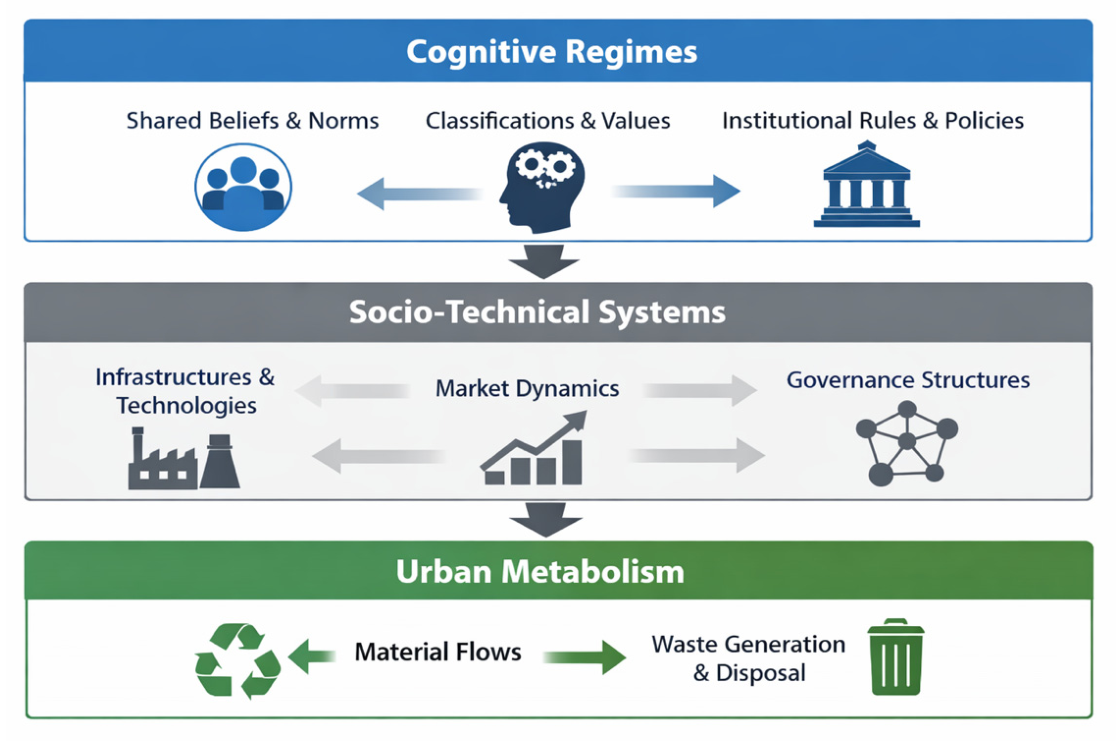
Figure 2.
Conceptual representation of transition decoupling. Circular transitions are assessed through cognitive-discursive, institutional, and material dimensions. By evaluating the degree of alignment among these dimensions, the framework identifies different transition states. Transition decoupling describes conditions in which cognitive-discursive and institutional transformations exceed material reconfiguration, providing a conceptual explanation for explaining waste persistence despite increasing commitments to circularity.
Figure 2.
Conceptual representation of transition decoupling. Circular transitions are assessed through cognitive-discursive, institutional, and material dimensions. By evaluating the degree of alignment among these dimensions, the framework identifies different transition states. Transition decoupling describes conditions in which cognitive-discursive and institutional transformations exceed material reconfiguration, providing a conceptual explanation for explaining waste persistence despite increasing commitments to circularity.
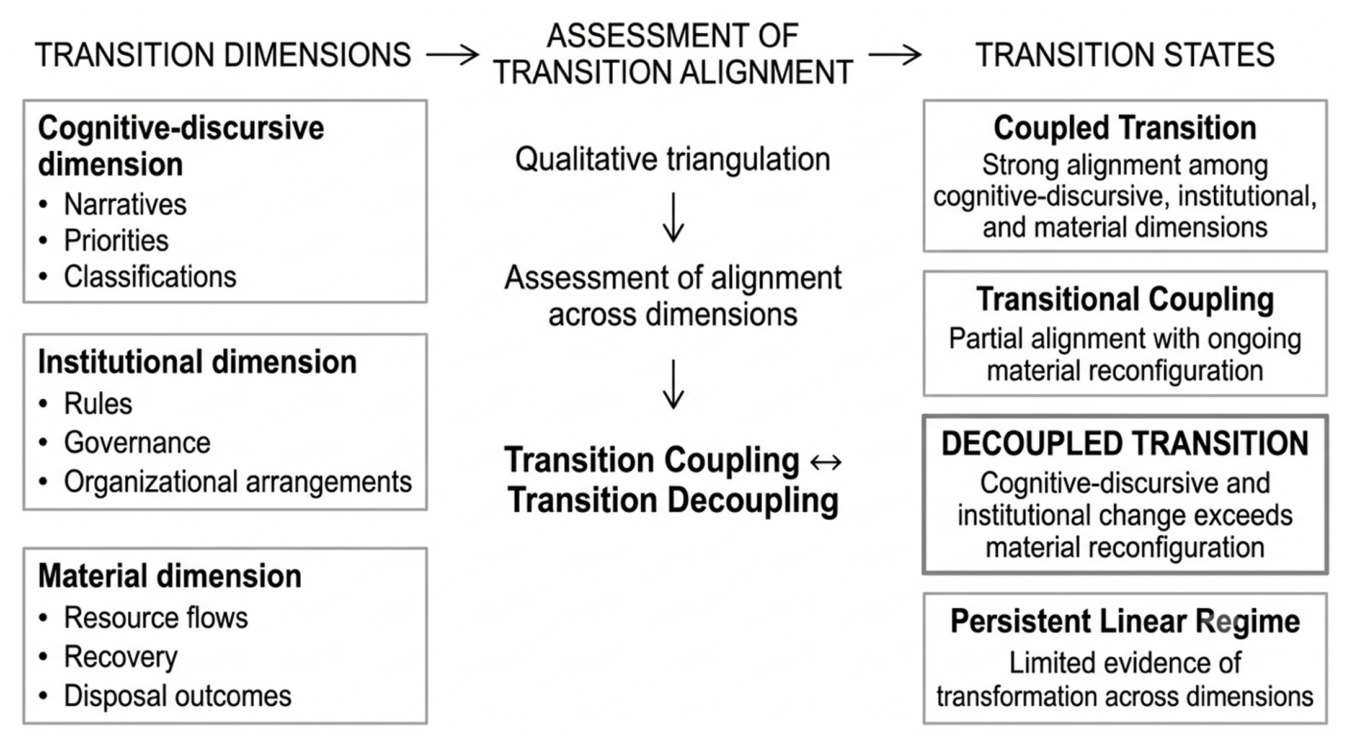

Table 1.
Illustrative Configurations of Coupling and Decoupling in Urban Waste Systems.
| Dominant Cognitive Configuration |
Neuroecological Interpretation |
Illustrative Transition Pattern |
| Strong linear cognition | Linear cognitive regimes dominate cognitive-discursive, institutional, and material dimensions, reinforcing disposal-oriented urban metabolic configurations. | Persistent disposal-oriented metabolism |
| Predominantly linear cognition with emerging systemic elements | Linear and systemic cognitive regimes coexist, although disposal-oriented practices remain dominant. | Early transition signals |
| Cognitive transition zone | Significant coexistence of competing cognitive regimes across dimensions, generating hybrid socio-technical and metabolic configurations. | Hybrid transition state |
| Predominantly systemic cognition | Systemic cognitive orientations increasingly influence governance arrangements and material-flow management, although residual linear structures may persist. | Advanced transition |
| Systemic–ecosystemic cognition | Strong predominance of systemic cognitive orientations associated with highly integrated and circular metabolic configurations. | Illustrative high-coupling condition |
Table 2.
Interpretative Protocol for Assessing Coupling and Decoupling Patterns.
| Dimension | Evidence Examined | Guiding Question | |
| Cognitive-discursive dimension | Official waste-management plans, circular economy strategies, roadmaps, public policy documents, planning instruments, and sustainability narratives. | To what extent is circularity formally articulated as a strategic objective through narratives emphasizing waste prevention, resource recovery, material recirculation, and systemic transformation? | |
| Institutional dimension | Regulatory frameworks, governance arrangements, waste-management programs, implementation mechanisms, infrastructure investments, recovery initiatives, and operational capacities. | To what extent have circular economy objectives been translated into institutional structures capable of supporting systemic change? | |
| Material dimension | Reported waste-management outcomes, landfill dependency, recovery and diversion efforts, evidence of material recirculation, and observable changes in urban metabolic flows. | To what extent do material outcomes reflect the circular objectives expressed in discourse and institutional arrangements? | |
| Coupling Profile | Interpretative Pattern | ||
| Coupled Transition | Cognitive-discursive, institutional, and material dimensions exhibit substantial alignment. Circular objectives are consistently reflected across discourse, governance structures, and material outcomes. | ||
| Transitional Coupling | Cognitive-discursive and institutional dimensions exhibit strong development and alignment, while material outcomes show evidence of partial but incomplete transformation. Circular transition is observable, although disposal-oriented configurations remain significant. | ||
| Decoupled Transition | Cognitive-discursive and institutional dimensions exhibit strong development and alignment, but material outcomes remain largely inconsistent with stated circular objectives. Circular narratives and institutional commitments advance more rapidly than material transformation. | ||
Table 3.
Comparative Assessment of Transition Alignment Profiles.
| City | Cognitive-Discursive Evidence |
Institutional Evidence |
Material Evidence |
Neuroecological Transition Profile |
| Mexico City | Circular Economy Law, PGIR 2021–2025, Zero Waste policies | Recovery infrastructure, transfer stations, sorting facilities, composting plants, and governance instruments | 12,454 t/day generated; 6,777 t/day sent to final disposal facilities despite recovery infrastructure | Transitional Coupling |
| Bogotá | PGIRS, waste valorization strategies, source-separation policies, and circular economy commitments | UAESP governance framework, recycling programs, inclusion of waste-pickers, and recovery initiatives | Approximately 84% of waste continues to be disposed of at Doña Juana; waste generation increased by 14% between 2011 and 2021 | Decoupled Transition |
| Santiago | Circular Chile 2040 Roadmap, Metropolitan Circular Economy Roadmap, and National Waste Strategy | National and regional governance architecture, EPR framework, and long-term circular planning instruments | Recycling rate of 11.3%; approximately 4.5 million tonnes remain outside recovery circuits; landfill dependency remains dominant | Decoupled Transition |
Note: Classifications were derived through qualitative triangulation of cognitive-discursive, institutional, and material evidence following the protocol presented in Table 2. Detailed evidence matrices, documentary sources, and supporting documentation for each metropolitan case are provided in Supplementary Tables S1–S3.
Disclaimer/Publisher’s Note: The statements, opinions and data contained in all publications are solely those of the individual author(s) and contributor(s) and not of MDPI and/or the editor(s). MDPI and/or the editor(s) disclaim responsibility for any injury to people or property resulting from any ideas, methods, instructions or products referred to in the content. |
© 2026 by the authors. Licensee MDPI, Basel, Switzerland. This article is an open access article distributed under the terms and conditions of the Creative Commons Attribution (CC BY) license (http://creativecommons.org/licenses/by/4.0/).
Copyright: This open access article is published under a Creative Commons CC BY 4.0 license, which permit the free download, distribution, and reuse, provided that the author and preprint are cited in any reuse.


