

Submitted:
23 July 2026
Posted:
24 July 2026
You are already at the latest version
Abstract
Digitalisation is increasingly viewed as an important instrument for narrowing the VAT gap in the European Union, yet it remains unclear which forms of digitalisation are most closely associated with improved collection. This study distinguishes between two channels: the voluntary adoption of cloud accounting by firms and the mandatory digital reporting of transactions to tax administrations. The analysis uses an unbalanced panel for the EU-27 covering 2013–2024, with the main econometric estimations restricted to 2013–2023. Data from the European Commission, Eurostat and the World Bank are examined through sequential pooled OLS specifications, two-way fixed-effects models and robustness checks. The initially negative association between cloud accounting and the VAT gap disappears after income and government effectiveness are controlled for. Mandatory digital reporting, by contrast, is associated with a VAT gap approximately 3–4 percentage points lower across the main specifications. However, the limited number of adopting countries and the presence of a pre-adoption downward trend restrict causal interpretation. The findings suggest that digitalisation is more closely related to VAT collection when it provides tax administrations with timely, structured and verifiable transaction data. Voluntary business digitalisation may support compliance, but it does not substitute for mandatory administrative reporting.
Keywords:
VAT gap
; tax compliance
; digitalisation
; e-invoicing
; continuous transaction controls
; cloud accounting
; e-government
; EU-27
; tax administration
; ViDA
1. Introduction
Every year, the European Union member states fail to collect a substantial share of the value added tax that is theoretically due. In 2023, the uncollected amount stands at around €128 billion–a considerable fiscal resource that could finance key public expenditure (European Commission, 2025). This shortfall is known as the VAT gap and measures the difference between the tax that should theoretically reach the budget and the VAT revenue actually collected. The significance of this indicator extends beyond the purely fiscal dimension. A high VAT gap constrains the resources available for public services, increases the pressure on compliant taxpayers, and creates an unfair advantage for economic agents that conceal or misreport their tax liabilities. Narrowing the VAT gap therefore remains a lasting priority of tax policy in the European Union.
Over the past decade, digitalisation has increasingly come to be regarded as one of the principal instruments for improving VAT collection. Both firms and tax administrations are undergoing an accelerated digital transformation, and EU policies increasingly link the fight against tax fraud to electronic invoicing, digital reporting, and the exchange of data in real or near-real time. This rationale also underpins the ‘VAT in the Digital Age’ (ViDA) initiative, which provides for the phased expansion of mandatory electronic invoicing and digital reporting across the Union. Even so, an important research question remains: which type of digitalisation is actually associated with a narrowing of the VAT gap?
This question matters because digitalisation is not a homogeneous process. It proceeds through different channels and may alter different parts of the information environment. On the one hand, firms voluntarily adopt digital tools, including cloud-based accounting systems, which facilitate internal reporting, reduce administrative costs, and improve the organisation of accounting information. On the other hand, states introduce mandatory digital reporting, whereby transaction data are submitted to the tax administration in real or near-real time through continuous transaction control systems. The two processes are often grouped together under the general notion of ‘digitalisation’, yet their underlying mechanisms differ. The first primarily improves the internal information of the firm, whereas the second alters the information available to the tax administration.
Despite the growing interest in the subject, the existing empirical literature leaves this question without a clear answer. A large share of the studies focus on individual countries or on single reforms–most often on the effect of introducing electronic invoicing or real-time reporting within a particular national system–which makes it difficult to generalise the findings to the Union as a whole. At the same time, the two channels of digitalisation–the voluntary business channel and the mandatory administrative one–are seldom considered together or assessed separately within the same comparative framework. Moreover, the observed negative relationship between digitalisation and the VAT gap is sometimes interpreted as a direct technological effect, without allowing for the fact that higher levels of digitalisation accompany higher incomes and stronger institutions, which in themselves improve collection. As a result, it remains unclear both whether digitalisation is associated with a narrower VAT gap and–if it is–through which channel.
The present study addresses these limitations in three ways. First, it introduces a clear conceptual distinction between the business channel (voluntary cloud accounting) and the administrative channel (mandatory digital reporting) and assesses them separately within a single empirical framework. The underlying premise is that the effect of digitalisation may depend not only on the technology itself, but also on who receives and can verify the information it generates. Second, the analysis draws on an unbalanced panel covering the EU-27 over the period 2013–2024, with the main econometric estimations restricted to 2013–2023 because the VAT gap values for 2024 are preliminary. It combines the European Commission’s official VAT gap estimates, Eurostat indicators of business digitalisation, and an author-coded indicator of the introduction of mandatory reporting. This combination supports a comparative assessment of the two channels, while the differences in data availability and national reporting regimes are explicitly acknowledged. Third, the study applies a consistent empirical strategy that makes it possible to trace whether the relationship between digitalisation and the VAT gap persists once income and institutional quality are accounted for. In this way, it addresses two specific questions: is the voluntary use of cloud accounting associated with a lower VAT gap, and is mandatory digital reporting associated with better VAT collection?
The remainder of the paper reviews the relevant literature and develops the hypotheses, describes the data and empirical strategy, presents the results for the two digitalisation channels, and discusses their implications for the ViDA initiative.
2. Literature Review and Hypotheses
2.1. The VAT Gap as a Result of Economic, Fiscal, and Institutional Factors
The VAT compliance gap is defined as the difference between the VAT revenue that would theoretically be collected under full compliance with the legislation in force and the revenue actually received. In the European Commission’s methodology, the theoretical amount is represented by the VAT Total Tax Liability (VTTL), while the gap is expressed as a percentage of the VTTL. It should not be interpreted solely as a measure of tax fraud. It also includes revenue losses arising from tax evasion, insolvencies, reporting errors, late payments, and statistical or methodological adjustments in the estimation of the theoretical tax base (European Commission, 2025).
The VAT compliance gap should be distinguished from the VAT policy gap. The compliance gap reflects the difference between liabilities under the existing legislation and the revenue actually collected. The policy gap, by contrast, arises from the design of the VAT system, including reduced rates, exemptions, and restrictions of the tax base. This distinction is important because weak VAT revenue performance may result either from non-compliance or from the regulatory structure of the tax system (Cnossen, 2022). The present study focuses specifically on the VAT compliance gap and on the economic, institutional, and technological factors associated with revenue collection under the existing regulatory framework.
Early comparative studies show that VAT collection depends on the interaction between the design of the tax system and the administrative capacity to enforce it. Agha and Haughton (1996) find that the complexity of the VAT regime, the number of rates, the length of time the system has been in operation, and the resources available to the tax administration help explain differences in compliance across countries. VAT collection is therefore not a mechanical function of the statutory rate, but also depends on the ability of the administration to monitor transactions and apply the rules consistently.
Studies of the European Union confirm the multifactorial nature of the VAT compliance gap. Zídková (2014) associates differences in the gap with the shadow economy, the structure of consumption, the level of economic development, and characteristics of the tax system. Majerová (2016) highlights the role of corruption and the broader institutional environment, while Pastusiak et al. (2022) identify economic growth and government effectiveness as important determinants of the VAT gap in the EU. Taken together, these studies indicate that higher income levels and stronger administrative institutions are generally associated with better VAT collection.
The method used to estimate the VAT gap also affects its interpretation. The European Commission’s official estimates are based on a macroeconomic top-down approach in which the theoretical VAT base is reconstructed using national accounts, tax revenue data, and information on final and intermediate consumption. Nerudová and Dobranschi (2019) propose an alternative stochastic tax frontier approach that distinguishes between a persistent country-specific component and a time-varying component of the gap. These methodological differences demonstrate that the VAT gap is an estimated rather than directly observed quantity. Its value may change following revisions to national accounts, tax revenue data, or the assumptions used to calculate the theoretical liability.
These considerations are particularly important when examining the relationship between digitalisation and VAT collection. Higher-income and better-governed countries generally have both a more digitalised business sector and more effective tax administrations. An observed negative correlation between digital technology adoption and the VAT gap does not therefore demonstrate an independent technological relationship. It may instead reflect broader differences in economic development, institutional quality, and enforcement capacity. Income and government effectiveness must consequently be taken into account when assessing whether different forms of digitalisation are independently associated with the VAT compliance gap.
2.2. Voluntary Business Digitalisation and Cloud Accounting
The digital transformation of accounting is changing the way in which firms create, process, store, and use financial information. Cloud accounting refers to the provision of accounting software, computing resources, and data storage over the internet, usually in the form of a service that users access remotely. Unlike traditional on-premises systems, cloud-based solutions can provide a centralised database, automatic updates, real-time access to information, and closer interaction between firms and their accountants (Dimitriu & Matei, 2015).
The potential benefits include a reduction in the initial cost of information infrastructure, the automation of repetitive operations, the faster closing of accounting periods, and a decrease in some of the errors involved in manual data entry. The cloud architecture facilitates the integration of accounting systems with banking platforms, customer relationship management systems, e-commerce, and other sources of transaction information. This can enhance the timeliness, completeness, and traceability of accounting records and improve internal control (Moll & Yigitbasioglu, 2019; Mihai & Duțescu, 2022; Chipriyanova & Krasteva-Hristova, 2023).
From the standpoint of tax compliance, these features suggest several possible mechanisms. The automated recording of invoices and payments may reduce unintentional errors, assist in the correct determination of the tax base, and facilitate the timely submission of returns. The systematic storage of source documents may create a more reliable audit trail, while integration between individual business processes may make discrepancies between reported sales, purchases, and cash flows harder to sustain. In this sense, cloud accounting may indirectly encourage the formalisation of activity and compliance with tax obligations.
This mechanism nevertheless has significant limitations. First, the adoption of cloud systems is voluntary and is not evenly distributed across firms and countries. The decision to adopt the technology depends on firm size, financial and human resources, digital skills, perceived security, the regulatory environment, and the quality of the information infrastructure (Tawfik et al., 2023). Firms that use cloud accounting may already be more productive, more formalised, and more inclined to comply with legislation even before adopting it. The observed relationship between the technology and tax compliance may therefore reflect pre-existing characteristics of the firms.
Second, a cloud accounting system primarily improves the internal information environment of the firm. Its use alone does not mean that transaction data are automatically supplied to the tax administration, nor that they are submitted in a standardised format and can be matched against the information held by trading counterparties. A firm may maintain detailed digital records without the tax authority obtaining any more direct or more timely access to them than under traditional periodic reporting.
Third, technology may reduce unintentional errors, but it does not necessarily eliminate the deliberate concealment of transactions. When information remains under the control of the taxpayer and is not verified through an independent source, the scope for the incomplete reporting of sales or for the manipulation of accounting records does not disappear. The benefits of cloud accounting to the firm should not, therefore, be automatically equated with benefits to the tax administration.
The existing research on cloud accounting focuses mainly on the determinants of its adoption, cost savings, the quality of accounting information, and the changing role of accountants. Evidence on whether the wider adoption of cloud accounting is independently associated with a lower country-level VAT gap remains limited. Even so, the improved quality of records, the automation, and the higher traceability give grounds to expect a negative relationship, at least before the economic and institutional differences between countries are accounted for. On this basis, the first hypothesis is formulated:
Hypothesis 1 (H1).
The use of cloud accounting in firms is associated with a lower VAT gap.
2.3. Mandatory Digital Reporting and the Information Position of the Tax Administration
Administrative digitalisation differs from voluntary business digitalisation because it changes not only how firms process accounting information, but also how tax administrations receive and use transaction data. Under continuous transaction control systems, information from invoices or individual transactions is transmitted to the tax authority in real or near-real time. Depending on the national model, the administration may receive invoice data after issuance, validate selected information, or require prior clearance before an invoice acquires legal validity.
The theoretical basis of this mechanism lies in the informational structure of VAT. The tax creates a connected chain of sales, output tax, purchases, and deductible input tax. Information reported by the seller can therefore be compared with the input tax claimed by the buyer. Pomeranz (2015) shows that third-party information and the possibility of cross-checking strengthen the self-enforcing properties of VAT. The consequences are not limited to the firms directly audited, but may spread through the supply chain. Naritomi (2019) reaches a related conclusion for the final stage of the transaction chain, showing that encouraging consumers to request receipts increases the likelihood that sales are reported.
Mandatory digital reporting strengthens this information mechanism by reducing the period between the occurrence of a transaction and the receipt of the relevant data by the tax administration. Under traditional reporting systems, information is submitted periodically and often in an aggregated form. This creates a longer interval in which transactions may be concealed, modified, or omitted. The submission of structured transaction-level data allows invoices to be matched automatically, discrepancies to be detected more rapidly, and audits to be directed towards taxpayers presenting a higher compliance risk.
Empirical studies of national reforms support this mechanism. Bellon et al. (2022) find that the introduction of mandatory electronic invoicing in Peru increases reported sales, purchases, and VAT liabilities, with stronger responses among smaller firms and in sectors characterised by higher initial non-compliance. Bellon et al. (2023) further show that the consequences of the reform may spread through networks of suppliers and customers. Digital reporting can therefore influence not only the directly reporting firm, but also the behaviour of its trading partners.
Evidence from Rwanda similarly indicates that electronic invoicing can improve the information available for tax control. Kotsogiannis et al. (2025) find that digital invoices support more precise audit targeting and are associated with higher net VAT payments. The administrative contribution of electronic invoicing therefore arises not only from the reporting of additional transactions, but also from the more efficient use of limited enforcement resources.
The systematic review by Hesami et al. (2024) concludes that electronic invoicing and pre-filled tax returns can reduce administrative costs and support compliance when they are accompanied by suitable institutional and technological infrastructure. More broadly, Okunogbe and Santoro (2023) emphasise that information technologies can assist tax administrations in identifying the tax base, facilitating compliance, and monitoring taxpayer behaviour. Their effectiveness nevertheless depends on the quality of the information generated and on the administration’s capacity to integrate that information into enforcement and taxpayer services.
At the European level, comparative evidence remains more limited. The European Commission’s assessment of digital reporting requirements distinguishes periodic transaction controls from continuous transaction controls and identifies substantial differences between national systems in terms of reporting frequency, taxpayer coverage, transaction scope, and data format (European Commission, 2022). Spain, Hungary, and Italy introduced different forms of continuous transaction control between 2017 and 2019, while Greece subsequently implemented the myDATA system through a phased process. Other Member States apply periodic transaction reporting, electronic ledgers, or SAF-T-based requirements that do not necessarily provide information in real or near-real time.
This diversity highlights the need to distinguish between electronic invoicing and mandatory digital reporting. An electronic invoice may be used only for the exchange of information between a seller and a buyer, without its data being transmitted automatically to the tax authority. In such cases, its function remains mainly operational and resembles voluntary business digitalisation. Under continuous transaction control, by contrast, the invoice or transaction record becomes a direct source of administrative information. The expected relationship with the VAT gap therefore depends not merely on the digital format of the document, but on the mandatory and timely transmission of structured data to the tax administration.
The presence of a reporting obligation does not guarantee the same outcome in every country. National regimes differ in their coverage, technical design, reporting deadlines, and enforcement intensity. Their effectiveness also depends on data quality, system interoperability, analytical capacity, and the subsequent use of the reported information. Incomplete coverage, frequent technical changes, and limited administrative capacity may weaken the relationship between digital reporting and VAT collection. The new systems may also impose initial costs on firms through software adaptation, staff training, and changes in internal accounting processes.
Despite these qualifications, mandatory digital reporting directly alters the information relationship between taxpayers and the state. It provides the tax administration with more timely and potentially verifiable information than voluntary business digitalisation alone. On this basis, the second hypothesis is formulated:
Hypothesis 2 (H2).
The mandatory digital reporting of transactions is associated with a lower VAT gap.
2.4. The EU Regulatory Framework and the Research Gap
The common VAT system of the European Union is based on Council Directive 2006/112/EC, which harmonises the main rules governing taxable transactions, the tax base, the right to deduct input tax, invoicing, and VAT reporting (Council Directive 2006/112/EC, 2006). Although the Directive establishes a common legal framework, Member States retain a degree of discretion over administrative procedures and control mechanisms. Administrative cooperation and the exchange of information between national tax authorities are governed by Regulation (EU) No 904/2010, which provides the institutional framework for combating cross-border VAT fraud (Council Regulation (EU) No 904/2010, 2010).
Directive 2014/55/EU represents an important step towards the standardisation of electronic invoicing. It establishes a European standard for electronic invoices in public procurement and supports greater semantic and technical interoperability between national systems (Directive 2014/55/EU, 2014). Its scope is primarily limited to transactions between businesses and public authorities. It does not introduce a general requirement for the real-time reporting of private-sector transactions for VAT purposes, but it provides part of the technical foundation on which broader electronic invoicing and digital reporting systems can be developed.
In the absence of an initially harmonised EU model, Member States introduced different national reporting regimes. These include electronic ledgers, VAT listings, SAF-T-based systems, mandatory electronic invoicing, the transmission of invoice data after issuance, and clearance models in which an invoice is validated before it can be issued. These systems differ in reporting frequency, taxpayer coverage, transaction scope, technical format, and legal effect (European Commission, 2022). The existence of an electronic reporting requirement is therefore not sufficient in itself to classify a national system as continuous transaction control.
The regulatory framework changed substantially with the adoption of the ‘VAT in the Digital Age’ package on 11 March 2025. The package comprises Directive (EU) 2025/516, which amends Directive 2006/112/EC; Regulation (EU) 2025/517, which modifies the rules on administrative cooperation; and Implementing Regulation (EU) 2025/518, which revises information requirements for certain VAT schemes (Council Directive (EU) 2025/516, 2025; Council Regulation (EU) 2025/517, 2025; Council Implementing Regulation (EU) 2025/518, 2025).
The new framework provides for the phased introduction of digital reporting requirements based on electronic invoicing. From 1 July 2030, the requirements will apply to intra-Community B2B transactions. Existing national real-time digital reporting systems introduced before 1 January 2024 must be aligned with the common EU standards by 1 January 2035. The reform is intended to improve the availability and exchange of transaction-level information while reducing the fragmentation created by different national requirements.
The ViDA package confirms that electronic invoicing is regarded not only as a means of reducing the administrative burden on businesses, but also as an information infrastructure for tax control. Directive (EU) 2025/516 provides for an assessment of the consequences of electronic invoicing and digital reporting for VAT collection, the VAT gap, and the administrative costs faced by taxpayers and tax authorities (Council Directive (EU) 2025/516, 2025). The distinction between business digitalisation and administrative reporting therefore has direct regulatory significance.
Existing research provides substantial evidence that electronic invoicing and transaction-level reporting can improve the information available to tax administrations. Much of this evidence, however, is based on individual national reforms or firm-level data. Comparative research for the EU remains limited, particularly with regard to the distinction between digital technologies adopted voluntarily by firms and reporting systems imposed by tax administrations. Comparison is further complicated by the heterogeneity of the national regimes, which differ in their timing, coverage, reporting frequency, and technical design.
The present study addresses this gap by comparing two distinct channels within a common EU framework: the voluntary use of cloud accounting by firms and the mandatory digital reporting of transactions to tax authorities. It examines whether the relationships between these channels and the VAT gap remain visible after economic development, tax structure, and government effectiveness are taken into account. The analysis therefore considers not only whether digitalisation is associated with VAT collection, but also whether that association depends on who receives and can verify the information generated.
3. Materials and Methods
3.1. Data and Variables
The empirical analysis is based on panel data for the 27 member states of the European Union over the period 2013–2024. The dependent variable is the difference between the theoretically due and the actually collected VAT, referred to hereafter as the VAT gap. It represents the discrepancy between the theoretically due value added tax (VAT Total Tax Liability, VTTL) and the VAT revenue actually received, expressed as a percentage of the VTTL.
This indicator measures the share of potential revenue that is not collected owing to tax evasion, insolvency, reporting errors, technical corrections, or forms of tax optimisation. The data are drawn from the annual report of the European Commission’s Directorate-General for Taxation and Customs Union (European Commission, 2025). A single edition of the report is used, so as not to mix revised estimates from different years. For the main regression estimates, the sample is restricted to 2023 inclusive, since the values for 2024 are preliminary forecasts. The few negative values of the VAT gap–Ireland in 2021 and Luxembourg in 2021–2022–are treated as technical corrections and set to zero.
The two digitalisation channels under examination are measured through separate indicators. The business channel is represented by the share of firms using cloud accounting. The data are drawn from the Eurostat surveys on the use of information and communication technologies in enterprises. This indicator is not available for every year, and the analysis therefore uses the years for which comparable observations exist. As alternative measures of business digitalisation, the study uses the broader share of firms with paid-for cloud services, an indicator of the use of more sophisticated cloud services, and the share of firms that voluntarily apply electronic invoicing.
The administrative channel is measured through a binary indicator for the presence of mandatory digital reporting of transactions in real or near-real time. These are continuous transaction control (CTC) systems, under which transaction information is submitted to the tax administration considerably earlier and in a more structured form than under traditional periodic reporting.
In order to separate any independent relationship between digitalisation and the VAT gap from the influence of accompanying factors, three control variables are included in the models. The first is gross domestic product per capita in purchasing power standards, which reflects the level of economic development. The second is the implicit tax rate on consumption, which characterises the tax structure. The third is the government effectiveness index from the World Bank’s Worldwide Governance Indicators, used as a measure of administrative and institutional capacity. The definitions, units of measurement, and sources of all the variables are summarised in Table 1.
3.2. Coding of Mandatory Digital Reporting
The indicator for mandatory digital reporting takes the value of one for a country and year in which a continuous transaction control regime is in operation. Over the observed period, four member states introduce such a regime: Spain in 2017, Hungary in 2018, Italy in 2019, and Greece in 2021. The start of the regime is taken to be the first year in which the mandatory requirement applies.
Since the moment of introduction may be interpreted in different ways, a check with an alternative coding is also carried out. Under it, the start is taken to be the first full calendar year in which the regime is in operation. This makes it possible to test whether the results depend on the choice of starting year.
Countries that apply periodic electronic reporting, but not real-time or near-real-time submission of transaction data, are not included in the group of countries with a CTC regime. This is the case for Portugal, which does not meet the definition of continuous transaction control used in the study. Romania introduces a similar regime in 2024, but remains outside the main estimation sample, which is restricted to 2023. The robustness of the results to its exclusion is nevertheless tested separately.
3.3. Empirical Strategy
The empirical strategy is directed at distinguishing the two channels of digitalisation and at assessing their relationship with the VAT gap while taking account of the economic and institutional context. The dependent variable is modelled directly as a percentage of the VTTL. The estimated coefficients can therefore be interpreted directly in percentage points. In all the regressions, the standard errors are clustered at the country level, in order to account for the possible dependence between the observations for the same country over time.
To test Hypothesis 1, relating to the business channel, a stepwise ordinary least squares regression is used. The VAT gap is regressed on the share of firms using cloud accounting, with the control variables added in sequence. The income level is included first, followed by government effectiveness. The aim is to trace whether the initial negative relationship between the use of cloud accounting and the VAT gap remains independent, or weakens once the economic and institutional context is accounted for.
The robustness of the results for the business channel is tested through several additional specifications. Alternative measures of business digitalisation are used: a broader indicator of paid-for cloud services, an indicator of cloud accounting lagged by one year, and an indicator of voluntary electronic invoicing. In addition, a two-way fixed-effects model–by country and by year–is applied. This model exploits the changes within individual countries over time and limits the influence of the constant differences between them.
To test Hypothesis 2, relating to the administrative channel, two complementary comparisons are used. The first is descriptive and compares the average VAT gap before and after the introduction of mandatory digital reporting in the four countries that apply such a regime. This change is set against the simultaneous change in the countries without such a regime. This yields a simple difference-in-differences, which gives an initial impression of the magnitude of the relationship.
The second comparison is regression-based and uses a two-way fixed-effects model–by country and by year. In practice, this means that each country is compared with itself before and after the introduction of mandatory digital reporting, while the general development across all countries in the corresponding year is accounted for at the same time. This controls both for the persistent differences between countries and for the common shocks that affect the whole EU in a given year.
The robustness of the results for the administrative channel is tested through several approaches: the addition of control variables, an alternative coding of the starting year of the regime, the exclusion of the pandemic years 2020–2021, and the exclusion of Romania. These checks are intended to show whether the result is maintained under different assumptions and sample restrictions.
To assess the extent to which the observed reduction can be linked to the introduction of mandatory digital reporting itself, the dynamics around the year of introduction are also traced. An event-study comparison is used for this purpose, in which the average VAT gap in the countries that have introduced such a regime is arranged by year relative to the moment of introduction. If the gap is already falling before the regime itself, this would indicate the presence of a prior downward trend. Such a trend would mean that part of the improvement may be due to broader administrative reforms, and not solely to mandatory digital reporting itself.
Finally, to analyse the convergence between the member states, a beta-convergence regression is applied in Section 4.2. Under this approach, the change in the VAT gap over the period is regressed on its initial level. A negative coefficient means that countries with an initially higher VAT gap reduce it faster than the others. The analysis is conducted both without additional controls and with a control for the initial institutional quality. In this way, unconditional and conditional convergence are distinguished.
4. Results
4.1. Descriptive Statistics and Dynamics
The VAT gap remains one of the significant problems facing the public finances of the European Union. In 2023, the member states fail to collect nearly €128 billion of the theoretically due value added tax. This represents around 9% of the total theoretically due VAT in the Union, against an average level of 12% over the observed period (Table 2). Behind this aggregate figure, however, considerable differences between the member states stand out. The distribution of the uncollected tax and its dynamics over time show that the problem cannot be explained through a single ‘average’ model. On the contrary, the data delineate progress, persistent structural differences, and renewed deterioration after the period of the sharpest narrowing of the VAT gap, all at the same time.
The first important result is the high heterogeneity between the member states (Table A1). In 2023, Luxembourg and Austria collect almost all of the theoretically due VAT, with the uncollected share standing at 0.2% and 1.0% respectively. At the other end of the distribution, Romania loses close to one-third of its theoretical receipts (30.0%), and Malta almost one-quarter (24.2%). Between these extreme values, a familiar structural pattern emerges: the southern and eastern member states are more often located at the high end of the distribution, whereas the western and Scandinavian economies are characterised by lower levels of uncollected VAT. The VAT gap is therefore not an evenly distributed problem across the EU, but rather a concentrated phenomenon whose weight is more strongly pronounced in a limited group of economies.
The dynamics over time initially show a clear improvement (Table 3). The average EU-27 VAT gap narrows from 15.7% of the theoretically due VAT in 2014 to 7.9% in 2021. In absolute terms, the aggregate amount of uncollected VAT in the Union falls from around €145 billion to €83 billion over seven years. After 2021, however, this downward trajectory is interrupted. The VAT gap rises again–to 9.3% in 2023 and 9.6% according to the preliminary estimate for 2024–with the uncollected sum returning to approximately €128 billion. This reversal shows that the progress achieved is not irreversible and raises the question of which factors actually contribute to the sustained narrowing of the VAT gap.
The same period coincides with an accelerated digitalisation of the accounting function in firms. The share of firms using cloud accounting increases almost fourfold–from 6.6% in 2014 to 26.0% in 2023 (Table 3). Here too, however, substantial differences between the member states are observed. The Scandinavian economies have a clear advantage: Finland (56%), Sweden (54%), and Denmark (49%) are considerably further ahead than the rest of the Union. At the same time, in Bulgaria (6%), Greece (7%), and Romania (10%), the use of cloud accounting remains limited. Alongside the differences in VAT collection, a second, digital stratification between the member states thus emerges.
At first glance, these two trends can be interpreted as related: digitalisation expands while the VAT gap narrows. The raw correlation between the share of uncollected VAT and the use of cloud accounting is negative (r = −0.37; Figure 1), which suggests the existence of a relationship between the two processes. This relationship should not, however, be interpreted hastily as a direct causal effect. The ranking of countries by the degree of cloud accounting use does not fully coincide with their ranking by the level of uncollected VAT. Bulgaria, for example, has one of the lowest levels of cloud accounting use, yet a VAT gap below the EU average. Conversely, Belgium combines a comparatively wide use of cloud accounting with a persistently higher uncollected share. The scatter plot (Figure 1) likewise shows considerable dispersion: at similar levels of digitalisation, the VAT gap can vary by tens of percentage points. Moreover, the use of cloud accounting is closely related to the income level and the quality of institutions, which may in themselves account for the better collection. The observed negative relationship may therefore reflect not an independent effect of the technology, but broader differences in economic and institutional development.
The narrowing of the VAT gap is accompanied by a certain convergence between the member states. The standard deviation falls from 10.3 percentage points in 2014 to 6.6 percentage points in 2023, which shows that some of the countries with initially higher levels of uncollected VAT have achieved a more substantial improvement. This convergence is an important result, but it also raises a further analytical question: through which channels does the catching-up of the lagging countries take place?
The present section outlines this empirical picture without giving a definitive answer as to the causal relationships. The decline and partial convergence of the VAT gap coincide with several processes: the expansion of business digitalisation, rising incomes, an improving institutional environment, and the introduction of mandatory digital reporting of transactions in some member states. Disentangling these interwoven processes is the task of the following parts of the analysis. Section 4.2 formally tests for the presence of convergence, while Section 4.3 and Section 4.4 isolate the two main channels of digitalisation–the voluntary use of cloud accounting by firms and the mandatory digital reporting introduced by the tax administrations.
4.2. Convergence Between the Member States
The reduction in dispersion reported in Section 4.1 shows that the VAT gap not only narrows on average across the EU, but also gradually converges between the member states. In other words, the countries with a higher uncollected share at the start of the period appear to reduce that share faster than the countries that were already in a better position in 2014.
To test this formally, the change in the VAT gap over the period 2014–2023 is regressed on its initial level in 2014. This is a standard approach for assessing so-called beta-convergence. The logic is as follows: if the coefficient on the initial level is negative, this means that the countries with a higher initial uncollected share have achieved a stronger subsequent reduction. In that case, one can speak of catching-up. The relationship is presented graphically in Figure 2.
The results show a clearly pronounced and statistically significant convergence. The estimated coefficient on the initial level is −0.49 (p < 0.001), and the model accounts for around 62% of the differences in the subsequent change between the member states (R² = 0.62). In practical terms, this means that each additional percentage point of uncollected VAT at the start of the period is associated with an approximately half a percentage point larger subsequent reduction. The estimated annual speed of convergence is around 7%, which implies a half-life of approximately nine years.
Individual countries illustrate this pattern well (Table A2). The countries with the highest uncollected share in 2014–Romania (40.6%), Italy (30.5%), Slovakia (29.6%), Lithuania (28.7%), and Greece (26.7%)–also record the largest reductions over the period. For these countries, the narrowing is of the order of between 11 and 19 percentage points. Conversely, economies with an initially low uncollected share, such as Luxembourg, Sweden, and Cyprus, remain relatively stable or record only a slight increase. This confirms that the main progress comes precisely from the countries that began the period with a more serious problem in VAT collection.
The convergence remains visible under a different choice of time period as well. The coefficient stays within close bounds: −0.50 for the period 2013–2023 and −0.46 for the period 2014–2021, that is, before the subsequent deterioration following the pandemic. This shows that the result does not depend on the particular choice of starting or ending year.
It is also important that the convergence cannot be explained solely by the differences in the quality of institutions. When a control for the initial level of government effectiveness is included in the model, the coefficient on the initial uncollected share remains negative and statistically significant (−0.40; p = 0.002). This means that the convergence relationship is not explained solely by differences in initial government effectiveness; it does not, however, identify the role of subsequent improvements in institutional capacity.
This result is important for the present study, because it shows that a genuine process of catching-up in VAT collection is indeed under way in the EU. At the same time, it does not in itself explain through which mechanism this catching-up takes place. Part of the improvement may be due to the wider use of digital accounting solutions by business. It is possible, however, that administrative measures, such as the mandatory digital reporting of transactions and the more direct submission of data to the tax authorities, have a stronger effect.
A methodological qualification is also required. Part of the reported convergence may be due to mechanical regression to the mean or to temporary errors in the measurement of the initial values. Nevertheless, the size of the effect, its robustness across different periods, and its persistence after controlling for institutional quality support the conclusion that this is not merely a statistical artefact, but a real improvement in some of the member states.
The convergence therefore establishes an important fact: the countries with a higher initial VAT gap improve faster. It does not, however, show which is the main channel of this improvement. It is precisely this question that lies at the centre of the next two subsections.
4.3. The Business Channel: Cloud Accounting (Hypothesis 1)
The first hypothesis tests whether the voluntary digitalisation of accounting in firms is associated with a lower VAT gap. In this section, the focus is on the use of cloud accounting by business. The main question is whether this form of digitalisation has an independent relationship with better VAT collection, or whether the observed relationship is explained by other factors, such as income and the quality of institutions.
To test this, the VAT gap, measured as a percentage of the VTTL, is regressed on the share of firms using cloud accounting. The control variables are added in sequence. This approach makes it possible to trace how the coefficient on cloud accounting changes when the income level is included in the model first, and then the quality of institutions as well. The results are presented in Table 4.
The initial relationship between cloud accounting and the VAT gap is negative and statistically significant. In the model without control variables, the coefficient is −0.25 (p < 0.001). This means that each additional percentage point of firms using cloud accounting is associated with an approximately 0.25 percentage point lower VAT gap (Table 4, column 1). At first glance, this result supports Hypothesis 1.
The relationship weakens considerably, however, once the broader economic and institutional context is taken into account. After the inclusion of income, the coefficient falls to −0.11 (column 2). After government effectiveness is added, it drops to −0.03 and is no longer statistically significant (column 3). In the full specification, the coefficient is practically zero (+0.01; column 4). This means that the independent relationship between cloud accounting and the VAT gap disappears once income and institutional quality are accounted for.
The result for government effectiveness is particularly important. It remains strongly and statistically significantly associated with a lower VAT gap (−8.2; p < 0.01). This shows that the seemingly negative relationship between cloud accounting and uncollected VAT largely reflects the institutional context. The countries in which business more frequently uses cloud accounting systems are usually also countries with higher incomes and a more efficient administration. Better VAT collection cannot, therefore, be attributed directly to cloud accounting itself.
This conclusion is confirmed by the additional checks presented in Table 5. With a full set of control variables, none of the alternative specifications shows a robust and statistically significant negative effect. The broader indicator of paid-for cloud services use is practically zero. Cloud accounting lagged by one year is likewise not statistically significant. Voluntary electronic invoicing shows no independent relationship with a lower VAT gap. The two-way fixed-effects model, which exploits the changes within individual countries over time, also finds no significant effect.
In one of the checks, using a narrower indicator of more sophisticated cloud services, the coefficient is even positive. This means that the direction is the opposite of that expected in Hypothesis 1. This result should not be interpreted as evidence that cloud services increase the VAT gap. Rather, it shows that the relationship is unstable and depends on the way in which digitalisation is measured. This further weakens the argument that voluntary business digitalisation in itself leads to better VAT collection.
In sum, Hypothesis 1 does not find empirical support. The use of cloud accounting is negatively related to the VAT gap only in the simplest model, without control variables. Once income and the quality of institutions are accounted for, this relationship disappears. Cloud accounting cannot, therefore, be regarded as an independent factor in reducing uncollected VAT in the EU.
This result is logical from the standpoint of the mechanism of impact. Cloud accounting facilitates the internal reporting of firms, reduces administrative costs, and improves the organisation of accounting information. It does not, however, automatically mean that the tax administration receives more, better-quality, or more timely data on transactions. If the information remains largely within the firm, the effect on tax control is limited.
The results therefore direct attention to the distinction between two different types of digitalisation. The first is voluntary business digitalisation, in which firms themselves choose to use digital accounting solutions. The second is administrative digitalisation, in which the state requires the digital reporting of transactions and obtains more direct access to data. The present subsection shows that the first channel is not sufficient to explain the narrowing of the VAT gap. The next subsection therefore examines the second channel–the mandatory digital reporting introduced by the tax administrations.
4.4. The Administrative Channel: Mandatory Digital Reporting (Hypothesis 2)
The second hypothesis tests whether the mandatory digital reporting of transactions in real or near-real time is associated with a lower VAT gap. Here the focus is on continuous transaction control systems, under which the tax administration obtains more direct and more timely access to information on the transactions carried out.
This channel differs substantially from the voluntary use of cloud accounting by business. Cloud accounting digitalises the internal reporting of the firm. Mandatory digital reporting, by contrast, changes the way in which information on transactions reaches the tax administration. The expected effect on VAT collection should therefore be more direct.
Over the observed period, four member states introduce such a regime: Spain in 2017, Hungary in 2018, Italy in 2019, and Greece in 2021. The estimate is based on a comparison of each of these countries with itself before and after the introduction of the regime, while at the same time accounting for developments in the other member states. The results are presented in Table 6 and Table A3.
The simplest comparison is the ‘before and after’ comparison of the introduction of mandatory digital reporting (Table A3). For the four countries that introduce such a regime, the average VAT gap falls from 19.7% before the introduction to 10.8% after it. This represents a decline of 8.8 percentage points. This value cannot, however, be taken as the pure effect of the measure, because over the same period the gap also narrows in the EU as a whole. For the countries without such a regime, the decline is 3.4 percentage points. The simple difference between the two groups therefore shows an additional reduction of approximately 5.5 percentage points for the countries that have introduced mandatory digital reporting.
The more precise model gives a more moderate but robust estimate. When each country is compared with its own baseline level and the general conditions for the corresponding year are accounted for, the introduction of the regime is associated with an approximately 4.24 percentage point lower VAT gap (Table 6, column 1). This means that, following the introduction of mandatory digital reporting, the VAT gap is approximately 4 points lower than would be expected given the initial state of the respective country and the general dynamics in the EU.
This result is robust across various checks. When control variables are added, the estimate is −3.68 percentage points. Under an alternative coding of the year of introduction, it is −4.00 points. When the pandemic years are excluded, the effect is −4.40 points, and when Romania is excluded, it is −4.34 points. In all the specifications, the estimate remains within a narrow interval of between around −3.7 and −4.4 percentage points. This shows that the relationship between mandatory digital reporting and a lower VAT gap is stable across different methods of checking.
This is consistent with the logic of the measure: once the tax administration begins to receive more timely and more complete information on transactions, the scope for evading, delaying, or misreporting VAT diminishes.
The results must nevertheless be interpreted with care. The VAT gap in the countries that have introduced mandatory digital reporting had already begun to fall before the introduction of the regime itself. The average value drops from 21.6% four years before the introduction to 15.9% in the year immediately preceding it. This means that part of the improvement is probably due to a broader package of reforms, and not solely to digital reporting itself.
This qualification is significant. The introduction of mandatory digital reporting is usually not an isolated measure. It is often part of a more general strategy for modernising the tax administration, strengthening control, improving electronic services, and curbing tax fraud. Moreover, the number of countries that introduced such a regime over the period under consideration is small–only four. The result should not, therefore, be presented as definitive evidence of a pure causal effect. It is more accurate to speak of a robust empirical relationship between mandatory digital reporting and a lower VAT gap.
Even with this caution, the result for Hypothesis 2 clearly differs from the result for Hypothesis 1. The voluntary use of cloud accounting by business shows no independent relationship with a lower VAT gap once income and the quality of institutions are accounted for. Mandatory digital reporting, by contrast, remains consistently associated with a lower VAT gap of around 3–4 percentage points.
This distinction is central to the present study. The data show that not every form of digitalisation matters equally for VAT collection. What appears to be more important is not the mere fact that firms use digital accounting solutions, but whether the tax administration obtains timely and structured access to information on transactions. The VAT gap therefore responds more strongly to the digitalisation that changes the information position of the state than to the digitalisation that remains largely an internal instrument of business.
Hypothesis 2 thus receives empirical support, albeit with the necessary caution in the causal interpretation. Mandatory digital reporting is associated with a lower VAT gap, but this result must be understood as part of a broader process of administrative modernisation. The systematic comparison between the business channel and the administrative channel is the subject of the next subsection.
4.5. The Two Channels Side by Side
In the previous two sections, the two channels of digitalisation were examined separately. When the results are set against each other, a clear difference emerges between them. This is expressed not only in the magnitude of the estimated effects, but also in their robustness when control variables are added and when different checks are applied.
For the business channel, the initial relationship between cloud accounting and the VAT gap appears to be negative. In the specification without control variables, each additional percentage point of firms using cloud accounting corresponds to around 0.25 percentage points lower VAT gap (Table 4, column 1). This relationship weakens, however, in the fuller specifications. After the income level is accounted for, the effect diminishes, and after government effectiveness is included, the coefficient comes practically close to zero and ceases to be statistically significant (Table 4, columns 3–4).
A similar result is observed for the other measures of business digitalisation as well–paid-for cloud services, cloud accounting lagged by one year, and voluntary electronic invoicing. None of these indicators, nor the model that traces the changes within individual countries, shows a robust independent relationship with a lower VAT gap (Table 5).
For the administrative channel, the result is different and considerably more stable. The introduction of mandatory digital reporting is associated with a reduction in the VAT gap of around 3.7 to 4.4 percentage points. More significantly, this estimate remains close in magnitude across all the checks applied–with and without control variables, under an alternative definition of the starting year, when the pandemic years 2020–2021 are excluded, and when Romania is excluded (Table 6).
The two channels therefore display different empirical robustness. The relationship between cloud accounting and the VAT gap is maintained only in the more limited specifications and disappears once income and the quality of institutions are accounted for. The relationship between mandatory digital reporting and a lower VAT gap, by contrast, remains relatively stable regardless of the method of checking.
5. Discussion
5.1. Main Results and Scholarly Contribution
The findings reveal a clear difference between voluntary business digitalisation and mandatory administrative reporting. The initially negative association between cloud accounting and the VAT gap disappears after income and government effectiveness are included. The coefficient on mandatory digital reporting, by contrast, remains negative across the main specifications, with estimates ranging from approximately 3.7 to 4.4 percentage points. However, these estimates are based on only four adopting countries, and the VAT gap was already declining before the introduction of the respective regimes. They should therefore be interpreted as evidence of a stable association rather than as estimates of a causal effect.
This distinction complements the existing literature, in which digitalisation is often treated as a single, general phenomenon. The results show that digital technology in itself does not constitute a sufficient mechanism for improving tax compliance. What matters is whether it creates information that remains an internal resource of the firm, or forms a standardised and promptly accessible information trail for the tax administration. The contribution of the study is thus not only empirical but also conceptual: it offers a distinction between technologies that improve the accounting processes within the firm and technologies that alter the information position of the tax authority.
The result is consistent with the more general theory of tax compliance, according to which the effectiveness of control depends on the availability of verifiable information, the probability of detecting discrepancies, and the administration’s ability to apply penalties and corrective action (Slemrod, 2019). Under VAT, this mechanism is particularly important, because the input tax credit creates an interdependence between the seller and the buyer. When the information from the two sides of a transaction can be matched, the scope for unilateral concealment or improper deduction is reduced.
The analysis further indicates that the VAT gap is associated with a broader set of economic, fiscal, and institutional conditions. Neither business digitalisation nor mandatory reporting can be considered in isolation from income, the tax structure, administrative capacity, and the quality of institutions. This accords with the conclusions of Agha and Haughton (1996), Zídková (2014), Majerová (2016), and Pastusiak et al. (2022), according to which the outcomes of the VAT system depend simultaneously on its regulatory design and on the state’s ability to administer the tax.
5.2. Voluntary Cloud Accounting and the Absence of a Statistically Detectable Independent Association
Hypothesis 1 is not supported in the fully controlled specifications. The initial negative relationship between the use of cloud accounting and the VAT gap weakens considerably after income is included and disappears once government effectiveness is accounted for. A similar result is obtained with alternative indicators of business digitalisation, including paid-for cloud services, electronic invoicing, and cloud accounting lagged by one year.
This result does not mean that cloud accounting is economically ineffective or that it is immaterial to the quality of accounting information. Previous studies show that cloud-based solutions can reduce the cost of information infrastructure, automate document processing, facilitate access to data, and improve the interaction between firms and accountants (Dimitriu & Matei, 2015; Moll & Yigitbasioglu, 2019). They can also enhance the timeliness and traceability of accounting records and reduce some unintentional errors.
The present results show, however, that these intra-organisational advantages do not translate automatically into a lower national VAT gap. A cloud system may contain detailed and up-to-date accounting information without that information being accessible to the tax administration before the submission of the periodic return. The technology improves the way in which the firm processes the data, but does not necessarily change the moment, scope, and format in which the state receives them.
The absence of an independent relationship may also be explained through the selection of the firms and countries that adopt cloud technologies more actively. The adoption of cloud accounting is usually more widespread in economies with higher incomes, better digital infrastructure, more highly qualified personnel, and more efficient institutions. At the firm level, adoption also depends on size, resources, managerial attitudes, perceived security, and the availability of digital skills (Tawfik et al., 2023). The initial negative correlation with the VAT gap may therefore reflect a broader environment of economic and institutional modernisation, rather than an independent effect of the cloud software.
This explanation is supported by the strong relationship between government effectiveness and the VAT gap in the present analysis. After the institutional variable is included, the coefficient on cloud accounting approaches zero. Cloud digitalisation therefore appears to be closely associated with broader economic and institutional development, while no separate relationship with the VAT gap can be identified in the fully controlled specifications.
The result for voluntary electronic invoicing is particularly telling. The digital format of the invoice is not in itself sufficient when its use is not mandatory and the data are not transmitted automatically to the tax administration. This confirms the need to distinguish between the electronic invoice as a business document and the electronic invoice as an element of an administrative continuous transaction control system.
The rejection of Hypothesis 1 must therefore be interpreted with care. It does not deny the benefits of cloud accounting to firms, but rather shows the limits of its impact on tax collection. Voluntary business digitalisation may create the technical preconditions for the easier fulfilment of future electronic invoicing and reporting obligations, but it does not replace the administrative mechanism through which data become accessible to and verifiable by the tax authorities.
5.3. Mandatory Digital Reporting as an Information and Control Mechanism
The results are consistent with Hypothesis 2, although they should be interpreted with caution. The coefficient on mandatory digital reporting remains negative across the main specifications, with estimates ranging from approximately 3.7 to 4.4 percentage points. The direction and approximate magnitude are maintained after the addition of control variables, under an alternative coding of the starting year, and when the pandemic years or Romania are excluded. Statistical precision nevertheless varies across the specifications. Moreover, the estimates are based on only four adopting countries. The findings therefore indicate a stable negative association, but should not be interpreted as evidence of a uniform causal effect.
The result is consistent with the information-based theory of tax compliance. Pomeranz (2015) shows that third-party information and the possibility of matching transaction records strengthen the self-enforcing properties of VAT. When the purchases reported by one firm can be compared with the sales reported by its supplier, concealment on one side creates a discrepancy that can be identified by the tax administration. Naritomi (2019) similarly demonstrates that involving other participants in documenting transactions can improve compliance in parts of the transaction chain where the traditional VAT mechanism is weaker.
Mandatory digital reporting reinforces this information mechanism in several ways. It shortens the period between the occurrence of a transaction and the receipt of the relevant data by the tax authority. It also provides information in a structured format, allowing the automated comparison of sales, purchases, and input tax credit claims. These records can be used to construct risk profiles and target audits more precisely. The expectation that discrepancies may be detected quickly can also create a preventive incentive for compliance, even when no immediate audit takes place.
The findings are in line with evidence from national reforms. Bellon et al. (2022) find that mandatory electronic invoicing in Peru is associated with higher reported sales, purchases, and VAT liabilities. Bellon et al. (2023) further show that the consequences may spread through networks of suppliers and customers. This indicates that the information generated by electronic reporting may affect not only the directly reporting firm, but also the behaviour of its trading partners. Kotsogiannis et al. (2025) reach a related conclusion for Rwanda, where electronic invoicing supports the targeting of tax audits and is associated with higher net VAT payments. Mandatory reporting does not replace administrative control, but may improve the information on which that control is based.
The systematic review by Hesami et al. (2024) likewise suggests that electronic invoicing and pre-filled returns can reduce administrative costs and support tax compliance when they are accompanied by suitable institutional and technological capacity. More broadly, Okunogbe and Santoro (2023) emphasise that information technologies can assist tax administrations in identifying the tax base, facilitating compliance, and monitoring taxpayer behaviour. The present results are consistent with this literature, but extend it by comparing mandatory administrative reporting with the voluntary adoption of cloud accounting within a common EU framework.
At the same time, the national regimes included in the analysis differ in their timing, coverage, reporting frequency, and groups of taxpayers affected. The binary indicator captures whether a mandatory digital reporting regime is in operation, but it cannot reflect differences in the design or intensity of the individual systems. The estimated coefficient should therefore be understood as an average association across heterogeneous national arrangements rather than as the effect of a single uniform policy intervention.
A further limitation arises from the dynamics before adoption. The VAT gap in the adopting countries had already begun to decline before the formal introduction of the respective regimes. This suggests that mandatory reporting was introduced as part of a broader process of administrative modernisation, which may also have included legislative changes, stronger enforcement capacity, improved electronic services, and other measures against VAT fraud. Countries may also adopt mandatory reporting precisely when reforms are already under way. Consequently, the estimated coefficient may capture both the introduction of the reporting regime and accompanying institutional changes.
Despite these qualifications, the comparison between the two channels remains informative. The association between voluntary cloud accounting and the VAT gap disappears after economic and institutional conditions are taken into account. Mandatory reporting, by contrast, retains a negative coefficient across the main specifications. The evidence is therefore consistent with the view that digitalisation is more closely related to VAT collection when it provides tax administrations with timely, structured, and verifiable transaction information. This conclusion supports Hypothesis 2 as an empirical association, while the limited number of adopting countries, the heterogeneity of the regimes, and the pre-adoption trend prevent a stronger causal interpretation.
5.4. Institutional Quality and Convergence of the VAT Gap
The strong negative association between government effectiveness and the VAT gap indicates that digital technologies operate within a broader institutional environment. A reporting system may generate large volumes of transaction data, but the fiscal outcome depends on the administration’s ability to verify their quality, identify risky cases, match information from different sources, and take timely enforcement action. The collection of digital data should therefore not be equated with their effective use.
This conclusion is consistent with the OECD’s Tax Administration 3.0 model, according to which tax obligations should gradually be integrated into the natural systems used by businesses and fulfilled closer to the moment at which the taxable event occurs. Such integration may reduce the administrative burden while also improving control. Its success, however, requires interoperability, reliable digital identification, appropriate data protection, and sufficient organisational and analytical capacity within the tax administration (OECD, 2020, 2025).
The convergence analysis shows that countries with a higher initial VAT gap generally achieved a larger subsequent reduction. This pattern is particularly visible in several of the countries that introduced mandatory digital reporting. Italy, Greece, and Hungary combined relatively high initial gaps with substantial improvements over the period analysed. Their experience is consistent with the possibility that digital reporting contributed to the broader modernisation of VAT administration.
Convergence cannot, however, be attributed solely to the introduction of mandatory reporting. Considerable reductions are also observed in countries that were not classified as operating continuous transaction control systems during the main estimation period. In addition, the convergence coefficient remains negative and statistically significant after controlling for the initial level of government effectiveness. This indicates that convergence is not explained solely by differences in initial institutional quality. It does not show, however, whether subsequent improvements in institutional capacity contributed to the reduction in the VAT gap.
The broader catching-up process may reflect several simultaneous developments, including economic growth, the formalisation of business activity, stronger administrative capacity, improved exchange of information, and national measures against VAT evasion. Mandatory digital reporting may be one of the factors associated with the improvement observed in the adopting countries, but the present analysis does not identify its precise contribution to overall convergence. Its relationship with the VAT gap is likely to depend on how the reporting system is designed and on the institutional and technological capacity of the tax administration to use the information effectively.
5.5. Implications for European Union Policy
The findings have direct relevance to the ‘VAT in the Digital Age’ package. Directive (EU) 2025/516 introduces the main changes to Directive 2006/112/EC concerning electronic invoicing and digital reporting. Regulation (EU) 2025/517 adapts the rules on administrative cooperation and the exchange of information, while Implementing Regulation (EU) 2025/518 amends the information requirements for certain VAT schemes (Council Directive (EU) 2025/516, 2025; Council Regulation (EU) 2025/517, 2025; Council Implementing Regulation (EU) 2025/518, 2025).
From 1 July 2030, the new digital reporting requirements will apply to intra-Community B2B transactions, with electronic invoicing forming the basis of the system. By 1 January 2035, existing national real-time digital reporting regimes must be aligned with the common EU standards. The results of the present study are consistent with the rationale underlying this reform. Mandatory administrative reporting shows a more stable negative association with the VAT gap than voluntary business digitalisation. This does not, however, establish that introducing a reporting obligation alone will produce the same outcome in every Member State.
The effectiveness of mandatory digital reporting depends first on the structure and interoperability of the data. Incompatible formats, different semantic standards, and fragmented technical requirements may hinder cross-border matching and increase compliance costs. The standards developed under Directive 2014/55/EU on electronic invoicing in public procurement provide an important foundation, but they do not resolve all the technical and institutional challenges associated with VAT reporting (Directive 2014/55/EU, 2014).
Second, the reform should avoid the duplication of reporting obligations. If firms are required to provide the same information through electronic invoices, separate transaction registers, periodic statements, and traditional VAT returns, digitalisation may increase rather than reduce the administrative burden. Data submitted once in a reliable and structured format should, where possible, be reused by the administration for cross-checking, risk assessment, and the pre-filling of VAT returns.
Third, particular attention should be paid to small and medium-sized enterprises. Large firms may be able to absorb the costs of adapting their ERP and accounting systems, whereas software, training, and technical support may create a disproportionate burden for smaller businesses. Transitional periods, affordable software solutions, public reporting interfaces, and clear technical guidance may help to reduce these difficulties. Voluntary cloud accounting can play a complementary role by providing the technical infrastructure through which firms meet their reporting obligations more efficiently.
Fourth, the accumulation of detailed transaction data raises important questions concerning data protection, cybersecurity, and proportionate use. The requirements of Regulation (EU) 2016/679 should be integrated into the design of the reporting systems from the outset (Regulation (EU) 2016/679, 2016). Regulation (EU) 2025/517 also establishes the framework for processing and exchanging information through the future central VIES system (Council Regulation (EU) 2025/517, 2025). Effective control therefore needs to be accompanied by clearly defined access rights, retention periods, audit trails, and safeguards against unauthorised use.
Fifth, the success of ViDA should not be assessed solely on the basis of whether electronic invoicing and digital reporting have been formally introduced. More informative indicators would include the share of transactions covered, the timeliness and quality of the submitted data, the number of automatically detected discrepancies, the targeting and yield of tax audits, the change in compliance costs, and the subsequent development of the VAT gap. Directive (EU) 2025/516 itself provides for an assessment of the consequences for VAT collection and the administrative costs faced by businesses and tax authorities (Council Directive (EU) 2025/516, 2025).
The policy implication is not that voluntary business digitalisation is unimportant. Cloud accounting and integrated business systems may reduce compliance costs and facilitate the submission of structured transaction data. Their contribution is therefore complementary. They provide part of the technical infrastructure needed for digital reporting, but they do not substitute for the administrative mechanism through which transaction information becomes available to and verifiable by the tax authorities.
6. Conclusion
This study examines the relationship between digitalisation and the VAT gap in the EU-27 by distinguishing between two channels: the voluntary adoption of cloud accounting by firms and the mandatory digital reporting of transactions to tax administrations. This distinction reflects a fundamental difference in the information generated by the two processes. Cloud accounting primarily improves the internal processing of business information, whereas mandatory reporting provides tax authorities with more timely, structured, and potentially verifiable transaction data.
The descriptive results show that the VAT gap narrowed considerably over most of the period analysed, although the improvement was not continuous. The average gap across the Member States fell from approximately 16% of the theoretically due VAT in 2014 to about 8% in 2021, before increasing to around 9% in 2023. The uncollected amount in 2023 was approximately €128 billion. Considerable differences between countries nevertheless remain. The convergence analysis indicates that countries with a higher initial VAT gap generally achieved a larger subsequent reduction. This finding should be interpreted cautiously, since part of the observed convergence may reflect regression to the mean or measurement uncertainty in the initial estimates.
The econometric results reveal a clear difference between the two digitalisation channels. The initially negative association between cloud accounting and the VAT gap weakens after income is included and becomes statistically insignificant once government effectiveness is taken into account. Similar results are obtained with alternative indicators of business digitalisation. Hypothesis 1 is therefore not supported in the fully controlled specifications. This does not imply that cloud accounting provides no benefits to firms or tax compliance. It indicates that no separate association with the national VAT gap can be identified after broader economic and institutional conditions are considered.
The results for mandatory digital reporting are different. The estimated coefficient remains negative across the main specifications, with values ranging from approximately 3.7 to 4.4 percentage points. The direction and approximate magnitude are maintained after the addition of control variables, under an alternative coding of the starting year, and when the pandemic years or Romania are excluded. The evidence is therefore consistent with Hypothesis 2. At the same time, the estimates should not be interpreted as causal effects. Only four countries introduced a regime classified as continuous transaction control during the main estimation period, and their VAT gaps had already begun to decline before adoption. Mandatory reporting was also introduced alongside other administrative and legislative reforms that cannot be fully separated from the reporting regimes themselves.
The main contribution of the study is therefore conceptual as well as empirical. Digitalisation should not be treated as a single and homogeneous process. Its relationship with VAT collection depends on whether the technology improves only the internal information environment of the firm or changes the information available to the tax administration. The findings suggest that digitalisation is more closely associated with a lower VAT gap when it provides tax authorities with timely and structured transaction information. Voluntary business digitalisation may facilitate compliance and reduce administrative costs, but it does not substitute for mandatory administrative reporting.
This conclusion is relevant to the ‘VAT in the Digital Age’ initiative. The results are consistent with the rationale for expanding electronic invoicing and digital reporting across the European Union. They do not, however, imply that the formal introduction of a reporting obligation will automatically improve VAT collection in every Member State. The outcome is likely to depend on the scope of the regime, the quality and interoperability of the data, the administrative capacity to use the information, and the costs imposed on businesses. Particular attention should therefore be paid to small and medium-sized enterprises, the avoidance of duplicate reporting obligations, data protection, and the development of suitable indicators for evaluating the implementation of ViDA.
Several limitations should be acknowledged. First, the analysis relies on an unbalanced country-level panel, and the availability of the business digitalisation indicators differs across years and countries. Second, the administrative channel is identified from only four adopting countries. This limits statistical precision and makes the estimates sensitive to differences between the national systems. Third, the binary indicator records the presence of mandatory reporting but does not capture variation in taxpayer coverage, transaction scope, reporting frequency, or enforcement intensity. Fourth, the VAT gap is an estimated rather than directly observed measure and may be revised following changes in national accounts, tax revenue data, or the underlying methodology. Finally, the aggregate country-level analysis cannot identify the responses of individual firms or the specific enforcement mechanisms through which reporting systems may influence compliance.
Future research could address these limitations as more countries introduce mandatory digital reporting. Longer panels would allow the application of staggered difference-in-differences methods that account for differences in adoption timing and treatment effects (Callaway & Sant’Anna, 2021; Sun & Abraham, 2021). Firm- and transaction-level data could provide more direct evidence on changes in reported sales, input tax deductions, audit targeting, and VAT payments. Further analysis should also move beyond a binary indicator and examine the design, coverage, and quality of the national reporting systems. Such evidence would allow a more precise assessment of the conditions under which digital reporting contributes to improved VAT compliance.
Author Contributions
Conceptualization, V.G. and R.K.-H.; methodology, V.G.; software, V.G.; validation, V.G. and R.K.-H.; formal analysis, V.G.; investigation, V.G. and R.K.-H.; resources, V.G.; data curation, V.G.; writing–original draft preparation, V.G. and R.K.-H.; writing–review and editing, V.G. and R.K.-H.; visualization, V.G.; supervision, V.G. and R.K.-H.; project administration, V.G.; funding acquisition, V.G. All authors have read and agreed to the published version of the manuscript.
Funding
This research received no external funding.
Institutional Review Board Statement
Not applicable. The study is based exclusively on publicly available aggregate statistical data and does not involve human participants or animals.
Informed Consent Statement
Not applicable.
Data Availability Statement
This study is based entirely on publicly available secondary data. The VAT gap estimates are drawn from the European Commission, Directorate-General for Taxation and Customs Union (DG TAXUD), VAT Gap in the EU – 2025 Edition. The indicators of business digitalisation and economic development are obtained from Eurostat, namely cloud accounting and paid cloud services (isoc_cicce_use), voluntary e-invoicing (isoc_eb_ics) and GDP per capita in purchasing power standards (nama_10_pc). The implicit tax rate on consumption is taken from DG TAXUD, Taxation Trends in the European Union (tax_itr), and government effectiveness from the World Bank Worldwide Governance Indicators (2025). The binary indicator of mandatory continuous transaction controls (CTC) was coded by the authors on the basis of national legislation. The compiled country–year panel and the accompanying coding of the CTC mandate are available from the corresponding author upon reasonable request.
Conflicts of Interest
The authors declare no conflicts of interest.:
Abbreviations
| CTC | Continuous Transaction Controls |
| DG TAXUD | Directorate-General for Taxation and Customs Union |
| DiD | Difference-in-Differences |
| EU | European Union |
| GDP | Gross Domestic Product |
| ITR | Implicit Tax Rate (on consumption) |
| OLS | Ordinary Least Squares |
| PPS | Purchasing Power Standard |
| VAT | Value Added Tax |
| ViDA | VAT in the Digital Age |
| VTTL | VAT Total Tax Liability |
| WGI | Worldwide Governance Indicators |
Appendix A

Table A1.
VAT gap and cloud accounting by country.
| Country | VAT gap 2013 (%) | VAT gap 2023 (%) | Change 2013->2023 (pp) | Cloud accounting 2014 (%) | Cloud accounting 2023 (%) | Gov. effectiveness 2023 (WGI) |
| Austria | 10.3% | 1.0% | -9.2 | 2.7% | 15.6% | 1.58 |
| Belgium | 12.7% | 12.3% | -0.4 | 7.1% | 34.5% | 1.16 |
| Bulgaria | 16.3% | 8.6% | -7.8 | 3.9% | 6.3% | 0.11 |
| Croatia | 7.7% | 11.1% | 25.7% | 0.75 | ||
| Cyprus | 3.3% | 2.3% | 23.0% | 0.93 | ||
| Czechia | 19.3% | 8.0% | -11.3 | 5.3% | 20.6% | 1.24 |
| Denmark | 12.2% | 8.9% | -3.3 | 18.3% | 48.7% | 1.96 |
| Estonia | 14.1% | 10.3% | -3.8 | 7.0% | 43.2% | 1.27 |
| Finland | 5.6% | 3.0% | -2.6 | 19.9% | 56.3% | 1.79 |
| France | 10.0% | 5.6% | -4.5 | 3.1% | 14.4% | 1.35 |
| Germany | 11.7% | 9.7% | -1.9 | 2.8% | 23.0% | 1.56 |
| Greece | 33.0% | 11.4% | -21.7 | 2.5% | 7.0% | 0.26 |
| Hungary | 21.1% | 7.4% | -13.6 | 2.8% | 21.8% | 0.55 |
| Ireland | 11.1% | 8.3% | -2.8 | 6.9% | 39.9% | 1.66 |
| Italy | 30.1% | 15.0% | -15.0 | 13.4% | 34.8% | 0.85 |
| Latvia | 23.9% | 5.4% | -18.5 | 2.7% | 19.0% | 0.64 |
| Lithuania | 29.5% | 15.1% | -14.5 | 6.1% | 21.8% | 0.94 |
| Luxembourg | 3.0% | 0.2% | -2.8 | 2.3% | 16.0% | 2.15 |
| Malta | 28.0% | 24.2% | -3.8 | 2.9% | 36.2% | 0.76 |
| Netherlands | 10.0% | 7.0% | -3.0 | 14.3% | 45.4% | 1.75 |
| Poland | 26.6% | 16.0% | -10.6 | 1.6% | 14.9% | 0.63 |
| Portugal | 15.5% | 3.6% | -11.9 | 3.9% | 17.8% | 0.97 |
| Romania | 38.0% | 30.0% | -8.0 | 1.6% | 10.1% | 0.13 |
| Slovakia | 31.4% | 10.5% | -20.9 | 10.4% | 19.1% | 0.58 |
| Slovenia | 5.7% | 4.9% | -0.8 | 5.1% | 18.5% | 1.16 |
| Spain | 11.8% | 7.6% | -4.1 | 3.0% | 14.3% | 1.08 |
| Sweden | 3.4% | 5.3% | +1.9 | 14.7% | 53.7% | 1.69 |
Source: Authors’ calculations based on DG TAXUD (VAT Gap in the EU – 2025 Edition); Eurostat (isoc_cicce_use); and the World Bank Worldwide Governance Indicators (2025).
Table A2.
Beta-convergence of the VAT gap, 2014-2023.
| Country | Initial gap 2014 (%) | Change 2014->2023 (pp) |
|---|---|---|
| Austria | 9.2% | -8.2 |
| Belgium | 9.1% | +3.2 |
| Bulgaria | 22.7% | -14.2 |
| Croatia | 8.9% | -1.2 |
| Cyprus | 0.6% | +2.7 |
| Czechia | 16.8% | -8.8 |
| Denmark | 10.8% | -1.9 |
| Estonia | 10.4% | -0.2 |
| Finland | 6.1% | -3.1 |
| France | 10.3% | -4.8 |
| Germany | 11.8% | -2.1 |
| Greece | 26.7% | -15.3 |
| Hungary | 18.5% | -11.1 |
| Ireland | 7.1% | +1.2 |
| Italy | 30.5% | -15.5 |
| Latvia | 20.5% | -15.1 |
| Lithuania | 28.7% | -13.7 |
| Luxembourg | 3.6% | -3.4 |
| Malta | 31.1% | -6.9 |
| Netherlands | 9.0% | -2.0 |
| Poland | 24.4% | -8.5 |
| Portugal | 13.7% | -10.1 |
| Romania | 40.6% | -10.6 |
| Slovakia | 29.6% | -19.1 |
| Slovenia | 9.6% | -4.7 |
| Spain | 10.5% | -2.8 |
| Sweden | 3.2% | +2.1 |
Source: Authors’ calculations based on DG TAXUD (VAT Gap in the EU – 2025 Edition).
Table A3.
The VAT gap before and after the CTC mandate.
| Country | Mandate year | Mean gap before (%) | Mean gap after (%) | Change (pp) |
|---|---|---|---|---|
| Spain | 2017 | 8.6% | 6.1% | -2.5 |
| Hungary | 2018 | 16.9% | 7.1% | -9.8 |
| Italy | 2019 | 26.5% | 16.7% | -9.8 |
| Greece | 2021 | 26.6% | 13.4% | -13.2 |
| Mean, 4 adopters | 19.7% | 10.8% | -8.8 | |
| Non-adopters, 2016->2023 | -3.4 | |||
| Simple difference (DiD) | -5.5 | |||
Source: Authors’ calculations based on DG TAXUD (VAT Gap in the EU – 2025 Edition); CTC mandate dates coded by the authors from national legislation.
References
- Agha, A., & Haughton, J. (1996). Designing VAT systems: Some efficiency considerations. The Review of Economics and Statistics, 78, 303–308. [CrossRef]
- Bellon, M., Dabla-Norris, E., Khalid, S., & Lima, F. (2022). Digitalization to improve tax compliance: Evidence from VAT e-invoicing in Peru. Journal of Public Economics, 210, Article 104661. [CrossRef]
- Bellon, M., Dabla-Norris, E., & Khalid, S. (2023). Technology and tax compliance spillovers: Evidence from a VAT e-invoicing reform in Peru. Journal of Economic Behavior & Organization, 212, 756–777. [CrossRef]
- Callaway, B., & Sant’Anna, P. H. C. (2021). Difference-in-differences with multiple time periods. Journal of Econometrics, 225, 200–230. [CrossRef]
- Cnossen, S. (2022). The C-inefficiency of the EU-VAT and what can be done about it. International Tax and Public Finance, 29, 215–236. [CrossRef]
- Council Directive 2006/112/EC of 28 November 2006 on the common system of value added tax. (2006). Official Journal of the European Union, L 347, 1–118. Available online: https://eur-lex.europa.eu/eli/dir/2006/112/oj/eng (accessed on 20 June 2026).
- Council Directive (EU) 2025/516 of 11 March 2025 amending Directive 2006/112/EC as regards VAT rules for the digital age. (2025). Official Journal of the European Union, L, 2025/516, 25 March 2025. Available online: https://eur-lex.europa.eu/eli/dir/2025/516/oj/eng (accessed on 20 June 2026).
- Council Implementing Regulation (EU) 2025/518 of 11 March 2025 amending Implementing Regulation (EU) No 282/2011 as regards information requirements for certain VAT schemes. (2025). Official Journal of the European Union, L, 2025/518, 25 March 2025. Available online: https://eur-lex.europa.eu/eli/reg_impl/2025/518/oj/eng (accessed on 20 June 2026).
- Council Regulation (EU) No 904/2010 of 7 October 2010 on administrative cooperation and combating fraud in the field of value added tax (recast). (2010). Official Journal of the European Union, L 268, 1–18. Available online: https://eur-lex.europa.eu/eli/reg/2010/904/oj/eng (accessed on 20 June 2026).
- Council Regulation (EU) 2025/517 of 11 March 2025 amending Regulation (EU) No 904/2010 as regards the VAT administrative cooperation arrangements needed for the digital age. (2025). Official Journal of the European Union, L, 2025/517, 25 March 2025. Available online: https://eur-lex.europa.eu/eli/reg/2025/517/oj/eng (accessed on 20 June 2026).
- Chipriyanova, G., & Krasteva-Hristova, R. (2023). Technological aspects of accounting automation system as a decision support system. Environment. Technology. Resources. Proceedings of the International Scientific and Practical Conference, 2, 28–33. [CrossRef]
- Dimitriu, O., & Matei, M. (2015). Cloud accounting: A new business model in a challenging context. Procedia Economics and Finance, 32, 665–671. [CrossRef]
- Directive 2014/55/EU of the European Parliament and of the Council of 16 April 2014 on electronic invoicing in public procurement. (2014). Official Journal of the European Union, L 133, 1–11. https://eur-lex.europa.eu/eli/dir/2014/55/oj/eng (accessed on 20 June 2026).
- European Commission, Directorate-General for Taxation and Customs Union. (2022). VAT in the Digital Age: Final Report, Volume 1–Digital Reporting Requirements. Publications Office of the European Union. Available online: https://taxation-customs.ec.europa.eu/system/files/2022-12/VAT%20in%20the%20Digital%20Age_Final%20Report%20Volume%201.pdf (accessed on 20 June 2026).
- European Commission, Directorate-General for Taxation and Customs Union. (2025). VAT gap in the EU: 2025 edition. Publications Office of the European Union. [CrossRef]
- Hesami, S., Jenkins, H., & Jenkins, G. P. (2024). Digital transformation of tax administration and compliance: A systematic literature review on e-invoicing and prefilled returns. Digital Government: Research and Practice, 5, 1–20. [CrossRef]
- Kotsogiannis, C., Salvadori, L., Karangwa, J., & Murasi, I. (2025). E-invoicing, tax audits and VAT compliance. Journal of Development Economics, 172, Article 103403. [CrossRef]
- Majerová, I. (2016). The impact of some variables on the VAT gap in the Member States of the European Union. Oeconomia Copernicana, 7, 339–355. [CrossRef]
- Mihai, M. S., & Duțescu, A. (2022). How cloud accounting and integrated services based on AI can impact accounting companies? Proceedings of the International Conference on Business Excellence, 16, 849–858. [CrossRef]
- Moll, J., & Yigitbasioglu, O. (2019). The role of internet-related technologies in shaping the work of accountants: New directions for accounting research. The British Accounting Review, 51, Article 100833. [CrossRef]
- Naritomi, J. (2019). Consumers as tax auditors. American Economic Review, 109, 3031–3072. [CrossRef]
- Nerudová, D., & Dobranschi, M. (2019). Alternative method to measure the VAT gap in the EU: Stochastic tax frontier model approach. PLOS ONE, 14, Article e0211317. [CrossRef]
- OECD. (2020). Tax administration 3.0: The digital transformation of tax administration. OECD Publishing. [CrossRef]
- OECD. (2025). Tax administration digitalisation and digital transformation initiatives. OECD Publishing. [CrossRef]
- Okunogbe, O., & Santoro, F. (2023). The promise and limitations of information technology for tax mobilization. The World Bank Research Observer, 38, 295–324. [CrossRef]
- Pastusiak, R., Bolek, M., & Pluskota, A. (2022). VAT gap determinants in the European Union. Studia Prawno-Ekonomiczne, 123, 119–132. [CrossRef]
- Pomeranz, D. (2015). No taxation without information: Deterrence and self-enforcement in the value added tax. American Economic Review, 105, 2539–2569. [CrossRef]
- Regulation (EU) 2016/679 of the European Parliament and of the Council of 27 April 2016 on the protection of natural persons with regard to the processing of personal data and on the free movement of such data. (2016). Official Journal of the European Union, L 119, 1–88. Available online: https://eur-lex.europa.eu/eli/reg/2016/679/oj/eng.
- Slemrod, J. (2019). Tax compliance and enforcement. Journal of Economic Literature, 57, 904–954. [CrossRef]
- Sun, L., & Abraham, S. (2021). Estimating dynamic treatment effects in event studies with heterogeneous treatment effects. Journal of Econometrics, 225, 175–199. [CrossRef]
- Tawfik, O. I., Durrah, O., Hussainey, K., & Elmaasrawy, H. E. (2023). Factors influencing the implementation of cloud accounting: Evidence from small and medium enterprises in Oman. Journal of Science and Technology Policy Management, 14, 859–884. [CrossRef]
- Zídková, H. (2014). Determinants of VAT gap in EU. Prague Economic Papers, 23, 514–530. [CrossRef]
Figure 1.
VAT gap versus cloud accounting (pooled panel, 2014-2023).
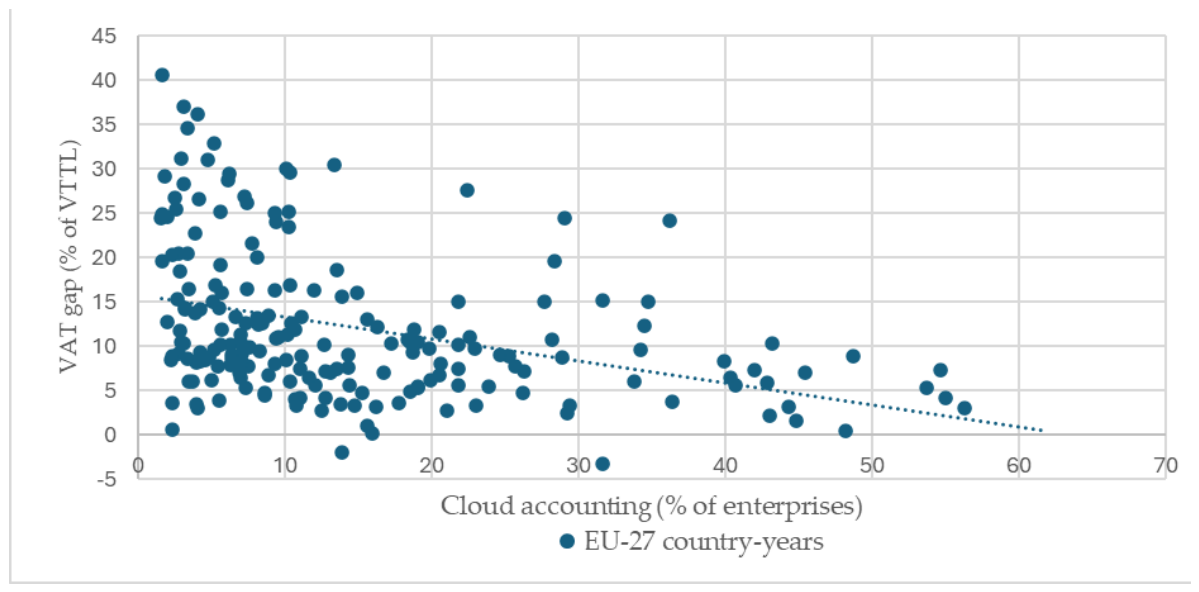
Figure 2.
Convergence of the VAT gap (2014-2023).
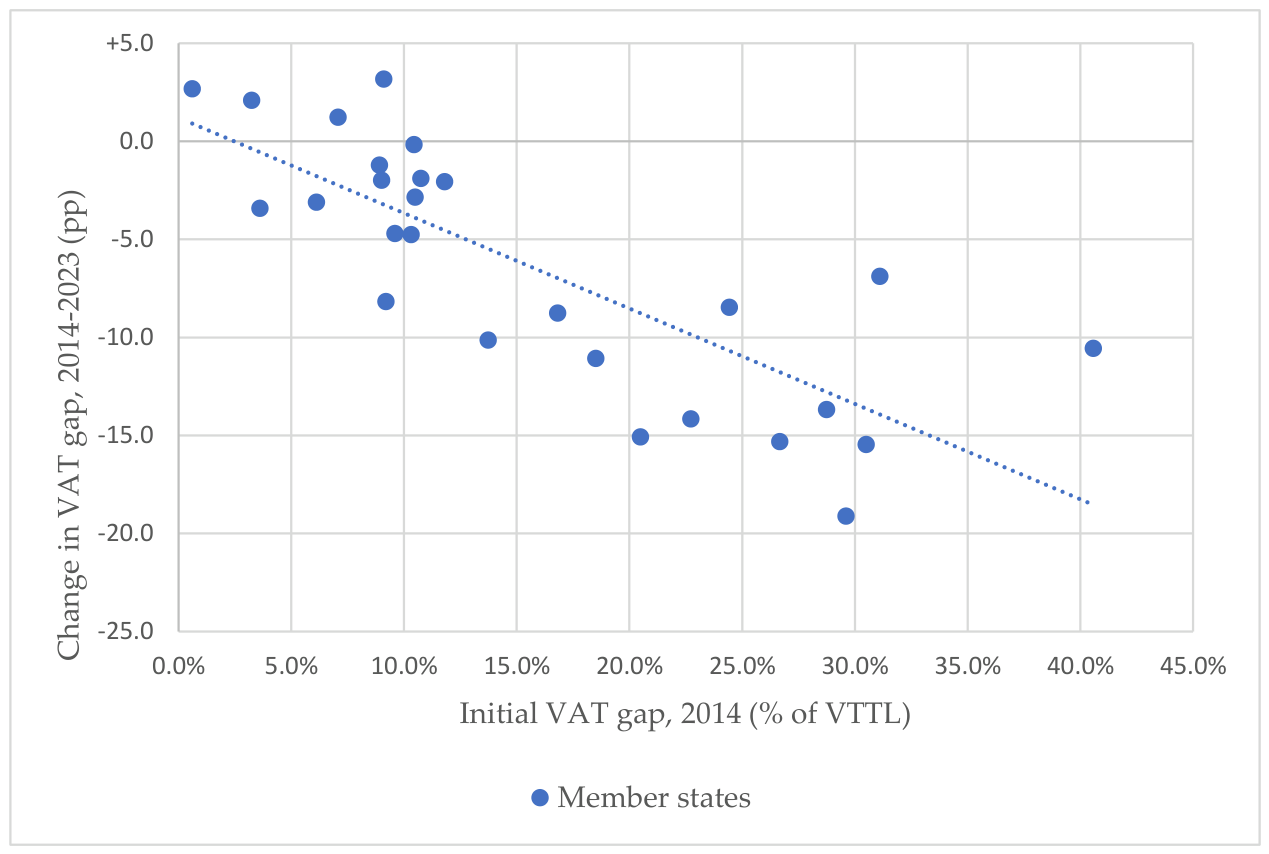
Table 1.
Variables, definitions and sources.
| Variable | Definition | Unit | Source |
|---|---|---|---|
| Dependent variable | |||
| VAT gap | Difference between expected (theoretical, VTTL) and actually collected VAT, as a share of VTTL | % of VTTL | DG TAXUD, VAT Gap in the EU (2025 ed.) |
| Channels of digitalisation | |||
| Cloud accounting | Share of enterprises using cloud-based accounting software | % of enterprises | Eurostat (isoc_cicce_use) |
| Any paid cloud services | Share of enterprises buying any paid cloud computing service | % of enterprises | Eurostat (isoc_cicce_use) |
| Sophisticated cloud services | Share of enterprises using more advanced (sophisticated) cloud services | % of enterprises | Eurostat (isoc_cicce_use) |
| Voluntary e-invoicing | Share of enterprises sending e-invoices suitable for automated processing | % of enterprises | Eurostat (isoc_eb_ics) |
| CTC mandate | Equals 1 if mandatory continuous transaction controls (real-time / near-real-time digital reporting) are in force | binary (0/1) | Author’s coding (national legislation) |
| Control variables | |||
| GDP per capita (PPS) | Gross domestic product per capita in purchasing power standards | EUR (PPS) | Eurostat (nama_10_pc) |
| ITR on consumption | Implicit tax rate on consumption (consumption tax revenue over final consumption) | % | DG TAXUD, Taxation Trends (tax_itr) |
| Government effectiveness | Worldwide Governance Indicators - government effectiveness estimate | index (-2.5 to 2.5) | World Bank, WGI (2025) |
Source: Author’s compilation based on European Commission/DG TAXUD (VAT Gap in the EU – 2025 Edition), Eurostat, and the World Bank Worldwide Governance Indicators.
Table 2.
Descriptive statistics.
| Variable | Unit | N | Mean | Std. dev. | Min | Median | Max |
|---|---|---|---|---|---|---|---|
| VAT gap (difference: expected vs collected VAT) | % of VTTL | 317 | 12.0% | 8.4% | -3.2% | 9.9% | 40.6% |
| VAT gap (difference: expected vs collected VAT) | EUR mn | 317 | 4 621 | 7 533 | -519 | 1 713 | 42 379 |
| Expected (theoretical) VAT - VTTL | EUR mn | 317 | 42 016 | 62 624 | 808 | 19 217 | 328 860 |
| Actually collected VAT | EUR mn | 318 | 37 337 | 56 397 | 582 | 15 639 | 296 831 |
| Cloud accounting software | % of enterprises | 225 | 16.8% | 14.3% | 1.6% | 12.0% | 61.5% |
| Any paid cloud services | % of enterprises | 228 | 33.6% | 19.3% | 4.9% | 28.9% | 79.2% |
| Voluntary e-invoicing | % of enterprises | 80 | 30.8% | 20.9% | 6.9% | 23.9% | 97.5% |
| GDP per capita (PPS) | EUR | 270 | 34 976 | 15 418 | 14 411 | 31 555 | 99 348 |
| Implicit tax rate on consumption | % | 324 | 18.9% | 2.6% | 12.9% | 18.4% | 25.0% |
| Government effectiveness (WGI) | index -2.5..2.5 | 324 | 1.11 | 0.60 | -0.25 | 1.07 | 2.23 |
Source: DG TAXUD, VAT Gap in the EU - 2025 edition; Eurostat (isoc_cicce_use, isoc_eb_ics, nama_10_pc); DG TAXUD tax_itr; World Bank WGI 2025. Author’s calculations.
Table 3.
Year-by-year dynamics, EU-27 (cross-country averages).
| Year | Countries | VAT gap, mean (% of VTTL) | VAT gap, std. dev. across countries (pp) | VAT gap, EU total (EUR bn) | Cloud accounting, mean (%) | Δ gap vs 2014 (pp) | Δ cloud vs 2014 (pp) |
|---|---|---|---|---|---|---|---|
| 2013 | 25 | 17.4 | 10.1 | 145.9 | +1.7 | ||
| 2014 | 27 | 15.7 | 10.3 | 145.1 | 6.6 | 0.0 | 0.0 |
| 2015 | 27 | 15.4 | 8.4 | 132.0 | 7.1 | -0.4 | +0.6 |
| 2016 | 27 | 13.2 | 8.6 | 124.2 | 8.0 | -2.5 | +1.5 |
| 2017 | 27 | 13.0 | 8.3 | 125.5 | 9.0 | -2.7 | +2.4 |
| 2018 | 27 | 12.1 | 7.4 | 121.2 | 11.9 | -3.6 | +5.4 |
| 2019 | 27 | 11.5 | 7.4 | 125.3 | -4.2 | ||
| 2020 | 27 | 11.1 | 7.5 | 102.5 | 19.2 | -4.6 | +12.6 |
| 2021 | 27 | 7.9 | 7.4 | 82.7 | 22.0 | -7.8 | +15.4 |
| 2022 | 27 | 8.1 | 6.4 | 100.7 | -7.6 | ||
| 2023 | 27 | 9.3 | 6.6 | 128.0 | 26.0 | -6.4 | +19.4 |
| 2024 | 22 | 9.6 | 6.7 | 131.7 | 30.4 | -6.1 | +23.8 |
Source: Authors’ calculations based on DG TAXUD (VAT Gap in the EU – 2025 Edition) and Eurostat (isoc_cicce_use).
Table 4.
The VAT gap and cloud accounting – stepwise OLS.
| Regressor | (1) | (2) | (3) | (4) |
|---|---|---|---|---|
| Cloud accounting | -0.252*** (0.069) |
-0.111** (0.053) |
-0.027 (0.036) |
+0.014 (0.033) |
| ln GDP per capita (PPS) | -6.91*** (2.49) |
+2.01 (2.81) |
-0.46 (2.58) |
|
| Government effectiveness (WGI) | -8.22*** (3.03) |
-6.55** (2.68) |
||
| ITR on consumption | -0.89* (0.48) |
|||
| R-squared | 0.14 | 0.19 | 0.36 | 0.43 |
| N | 194 | 151 | 151 | 151 |
Note: *** p<0.01, ** p<0.05, * p<0.10. Source: Authors’ own estimations.
Table 5.
H1 robustness - alternative measures and within-country variation.
| Specification / focal measure | Coefficient (std. error) | N |
|---|---|---|
| Any paid cloud services | +0.000 (0.037), n.s. | 153 |
| Cloud accounting, lagged 1 year | +0.043 (0.043), n.s. | 140 |
| Voluntary e-invoicing (share) | +0.012 (0.024), n.s. | 80 |
| Within-country (two-way fixed effects) | +0.109 (0.096), n.s. | 151 |
Note: n.s. = not significant. Source: Authors’ own estimations.
Table 6.
The VAT gap and the mandatory digital reporting (CTC) mandate.
| (1) Baseline | (2) + Controls | (3) Alt. coding | (4) Excl. COVID | (5) Excl. Romania | |
|---|---|---|---|---|---|
| CTC mandate | -4.24** (2.13) |
-3.68*** (1.43) |
-4.00* (2.19) |
-4.40* (2.59) |
-4.34** (2.14) |
| Controls (income, ITR, gov.) | No | Yes | No | No | No |
| Country & year fixed effects | Yes | Yes | Yes | Yes | Yes |
| N | 295 | 216 | 295 | 241 | 284 |
| Countries | 27 | 27 | 27 | 27 | 26 |
Note: *** p<0.01, ** p<0.05, * p<0.10. The estimate stays between -3.7 and -4.4 pp across all specifications and codings. Source: Authors’ own estimations.
Disclaimer/Publisher’s Note: The statements, opinions and data contained in all publications are solely those of the individual author(s) and contributor(s) and not of MDPI and/or the editor(s). MDPI and/or the editor(s) disclaim responsibility for any injury to people or property resulting from any ideas, methods, instructions or products referred to in the content. |
© 2026 by the authors. Licensee MDPI, Basel, Switzerland. This article is an open access article distributed under the terms and conditions of the Creative Commons Attribution (CC BY) license (http://creativecommons.org/licenses/by/4.0/).
Copyright: This open access article is published under a Creative Commons CC BY 4.0 license, which permit the free download, distribution, and reuse, provided that the author and preprint are cited in any reuse.