

Submitted:
22 July 2026
Posted:
22 July 2026
You are already at the latest version
Abstract
There is a dearth of research on the readiness of the multiple stakeholder groups needing to adopt competency-based education (CBE) reform in a single optometry program context. This study assessed and compared readiness for transition to CBE across four stakeholder groups—students, educators, regulators, and employers—in Nigerian optometry training on six domains: knowledge, skills, institutional/system readiness, regulatory alignment, workforce relevance, and change readiness. A structured questionnaire (36 items, three-point format) was administered to students (n = 656), educators (n = 26), regulators (n = 3), and employers (n = 16). Scores were computed as a Readiness Index (0–100%), with group differences tested using Kruskal-Wallis and Mann-Whitney U tests. All four groups scored above the scale midpoint. Educators reported significantly higher readiness than students (86.9% vs. 77.3%; H = 14.03, p = 0.003); differences between students and regulators (87.5%) or employers (84.9%) were not significant after Bonferroni correction. The lowest-scoring domain across all groups was institutional/system readiness, particularly among students (mean = 2.20/3.00), and student readiness varied significantly by training institution. Nigerian optometry stakeholders broadly support CBE adoption in principle, but institutional and system-level preparedness lags behind attitudinal support, indicating that reform will require deliberate investment in institutional infrastructure.
Keywords:
competency-based education
; optometry education
; stakeholder readiness
; health professions education
; Nigeria
; curriculum reform
1. Introduction
The shift from time-bound, credit hour-based curricula to ones based on a certificate of “competence” has been taking place over an extended period in health professions education worldwide. Competency-based education (CBE) has been widely embraced across medical, nursing, midwifery, and allied health professions, as it connects the skills a trainee is competent to practice with the skills a program certifies a student to perform [1]. In 2025, the WHO Regional Office for Africa convened national experts from 12 countries to develop prototype competency-based curricula for health professions training, concluding that most curricula in African settings were outmoded and awarded degrees with minimal relevance to community health needs. This uptake has not been matched in optometry, a profession that in most Sub-Saharan African countries carries major responsibility for primary eye care delivery. While entrustable professional activities (EPAs) and competency-based frameworks are well established in medical education, they remain sparsely used in optometric education, creating a disparity in the pace of change [2].
There is ample precedent from early adopters of CBE in U.S. medical education. Across 59 competencies in nine domains, Makerere University College of Health Sciences successfully adopted CBE; on evaluation, nearly all competencies were assessed in the curriculum, yet faculty still identified a need for ongoing capacity development, underscoring that early success does not remove the need for continued institutional investment [3]. A scoping review protocol for competency-based midwifery education in Africa suggested that the learner-centered progression at the root of the competency approach aligns well with addressing workforce quality gaps in resource-constrained health systems when appropriately resourced [4], while a review of assessment approaches in undergraduate health professions education recommended adapting models from highly resourced settings for resource-constrained ones [5]. In optometry, regional training has grown steadily since 2000, but a twelve-country survey of 32 optometry schools identified a lack of standardization and insufficient regulatory support, limiting workforce development [6].
Nigeria occupies a distinctive position in this regional picture, accounting for over one in four of the region's optometry training institutions and the majority of enrolled students, with Nigerian programs alone reporting almost four thousand students [6]. Given this scale, competency-based reform in Nigerian optometry schools will likely have far-reaching implications for the region. Scale, however, does not guarantee readiness. Evidence from South African medical education shows a meaningful gap between document-level alignment to a competency framework and substantive classroom implementation, with the gap remaining unbridged even where formal alignment was strong [7]. Whether such a gap exists in Nigerian optometry is not evident from curriculum documents alone; it must be assessed directly with those who will implement the change.
Such a reform cannot be the sole concern of a single group. At least four stakeholder groups have vastly different interests in a transition to competency-based optometric training: students to be trained under the new system, educators tasked with redesigning and teaching it, regulatory bodies that would certify graduates, and employers who would employ those graduates. A reform well designed on paper but stalled at the point of delivery is doomed to fail unless embraced by those who must implement and sustain it. This cross-sectional survey measured readiness in six conceptually distinct domains (knowledge, skills, institutional/system, regulatory alignment, workforce relevance, and change readiness), compared readiness across the four stakeholder groups, and compared students across their training institutions. The objectives were to quantify domain-level and overall readiness for each group, determine whether readiness differed significantly by stakeholder role, and identify the domain representing the major constraint to a successful shift toward CBE in optometry in Nigeria.
This study draws on the six-domain model of organizational readiness for change, which defines readiness as a psychological and structural state varying with a person's commitment toward the change and the organization's efficacy in delivering it, without assuming the two necessarily correspond [8]. A systematic review of this theory found that readiness operates simultaneously at the individual, team, and organizational level. A similar four-stratum stakeholder structure was applied in health professions curriculum reform in Oman [9] and informs the stratification used here: institutional insiders (staff and students) and external stakeholders (employers, regulators, government bodies). Psychological safety should be assessed alongside readiness, since participants may report positive attitudes without being genuinely ready; similarly, readiness, though descriptive rather than predictive, is meaningfully associated with implementation outcomes [10]. The six domains here separate attitudinal commitment from structural efficacy: Knowledge and Change Readiness reflect commitment; Skills Readiness and Workforce Relevance reflect perceived personal and professional efficacy; and Institutional/System Readiness and Regulatory Alignment reflect perceived structural efficacy, whether the institutional and policy environment will enable the change. These dimensions do not necessarily correlate: medical students at Ebonyi State University reported favorable attitudes toward educational innovation but identified infrastructural obstacles, rather than attitudes, as the major constraint [11]. A single undifferentiated readiness score would mask precisely this divergence, which is why the six domains are reported separately here.
2. Materials and Methods
2.1. Study Design and Setting
This study used a cross-sectional, multi-stakeholder survey design to measure readiness for competency-based education among four groups connected to optometry training in Nigeria. Data were collected in March 2026 through structured, self-administered online questionnaires distributed to respondents drawn from optometry training institutions — including Institution A, Institution B, Institution C, Institution D, Institution E, and several smaller programs — together with regulatory officials of the Nigerian Optometric Association and employers of optometry graduates operating clinics across multiple Nigerian states.
2.2. Population and Sampling
Four strata were recruited. The student stratum consisted of 656 enrolled optometry students; 26 faculty members who taught and clinically supervised optometry constituted the educator stratum; and three executive officers of the Nigerian Optometric Association constituted the regulatory stratum, reflecting the small size of this national population.
The employer stratum comprised 16 employers practicing across State 1 through State 7. In total, 701 respondents were recruited across all four strata (656 + 26 + 3 + 16 = 701). The regulatory and employer strata are small relative to the national population of regulatory leaders and employers, so comparisons involving them should be interpreted descriptively rather than inferentially, and these two strata are underpowered relative to the much larger student and educator strata (see Section 4.5, Limitations).

Table 1.
Participant characteristics across the four stakeholder groups.
| Stakeholder group | Institution or setting | n | Data collection method |
| Students | Institution A, Institution B, Institution C, Institution D, Institution E, and other institutions | 656 | Online structured questionnaire (CBERS) |
| Educators | Same institutions as students | 26 | Online structured questionnaire (CBERS) |
| Regulatory officials | Nigerian Optometric Association | 3 | Online structured questionnaire (CBERS) |
| Employers | Practices across State 1, State 2, State 3, State 4, State 5, State 6, and State 7 | 16 | Online structured questionnaire (CBERS) |
| Total | Nationwide (multiple institutions and practice sites) | 701 | — |
2.3. Instrumentation
Readiness was assessed with four parallel versions of an identically structured instrument, the Competency Based Education Readiness Survey (CBERS): 36 closed-ended items across six domains of six items each. The six domains were: Knowledge Readiness (readiness to learn, teach, assess, or evaluate in a competency-based model); Skills Readiness (perceived capacity to do so, depending on role); Institutional/System Readiness (perceived organizational and infrastructural capacity to support transition); Regulatory Alignment (perceived compatibility of CBE with existing accreditation and policy frameworks); Workforce Relevance (perceived impact of CBE training on graduate clinical performance and employability); and Change Readiness (psychological willingness to support the transition) [12]. Items were adapted per stakeholder without changing the underlying construct: for example, ‘Skills Readiness’ items asked students about their own ability to learn, educators about their ability to teach and assess, and regulators and employers about their ability to evaluate competency-based graduates. A three-point response format (Agree, Neutral, Disagree) was used throughout. Due to a form-administration artifact, the employer Skills/Practice Readiness domain was scored from 5 items rather than 6 (see Section 4.5, Limitations).
2.4. Data Analysis
Responses were scored 3, 2, or 1 for Agree, Neutral, and Disagree, and domain scores were the average of the six items in each domain. The composite readiness score (mean across domains) was also expressed as a Readiness Index (0–100%): (composite mean − 1) / 2 × 100. Cronbach's alpha was calculated per domain where sample size permitted. Because scores were ordinal and group sizes were unevenly distributed, group comparisons used the Kruskal-Wallis H test and post hoc Mann-Whitney U tests, with Bonferroni correction (α = 0.05 divided by the number of comparisons). A supplementary Kruskal-Wallis test compared readiness across the five largest institutions. Analysis was performed in Python 3 (Python Software Foundation, Wilmington, DE, USA) using the pandas and SciPy libraries.
2.5. Ethical Considerations
Participation was voluntary; respondents received a participant information sheet and gave informed consent before completing the questionnaire online. No personally identifying data were obtained; affiliation was recorded only at the institution or state level. Ethical approval was obtained from the research ethics committee of each participating institution before data collection (see the Institutional Review Board Statement).
3. Results
Of 701 respondents, 656 were students, 26 educators, 3 regulatory officials, and 16 employers, all usable. Of the 656 students, 230 were from Institution A, 180 from Institution B, 74 from Institution C, 70 from Institution D, and 27 from Institution E, with the remaining 75 (11.4%) from other institutions. Seven students had incomplete responses and were excluded from composite-score analyses (Table 3), yielding an analytic sample of 649 for those analyses; all 656 were retained for the domain-level analyses in Table 2.
3.1. Domain-Level Readiness
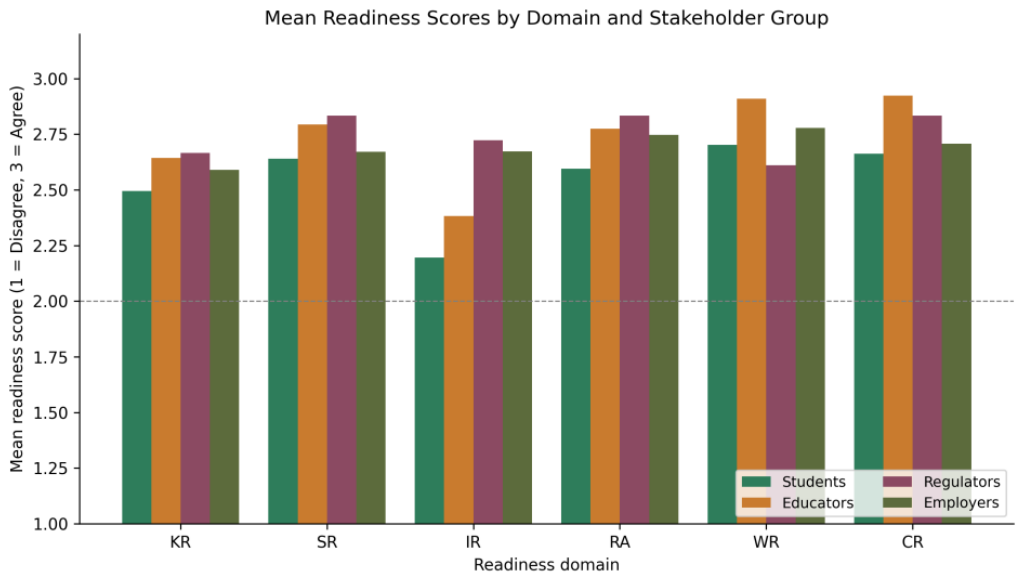
Mean domain scores (1–3 scale) are provided for each stakeholder group in Table 2. In all four groups, Workforce Relevance and Change Readiness were consistently the highest-rated domains, suggesting a shared perception that CBE would improve graduate readiness and a shared willingness to make the transition. The lowest-scoring domain in every group was Institutional/System Readiness, with the lowest single score (2.20) recorded by students. At the item level, 39.8% of student responses on institutional readiness items were Agree, 40.0% Neutral, and 20.2% Disagree, the highest disagreement rate of any domain among students; educators showed a similar pattern (mean 2.38). Regulators and employers rated institutional readiness more favorably (2.72 and 2.67) than those inside the training environment (students, 2.20; educators, 2.38). Employers were the exception: their own lowest-rated domain was Workforce Relevance (2.61), suggesting their hesitancy centers more on anticipated graduate clinical performance than on the training institutions themselves.
Figure 1.
Mean readiness scores by domain (KR = Knowledge Readiness, SR = Skills Readiness, IR = Institutional/System Readiness, RA = Regulatory Alignment, WR = Workforce Relevance, CR = Change Readiness) across the four stakeholder groups.
Figure 1.
Mean readiness scores by domain (KR = Knowledge Readiness, SR = Skills Readiness, IR = Institutional/System Readiness, RA = Regulatory Alignment, WR = Workforce Relevance, CR = Change Readiness) across the four stakeholder groups.
3.2. Composite Readiness and Between-Group Comparison
The results of the composite readiness scores and Readiness Index by each group of stakeholders are displayed in Table 3.
All four groups scored above the scale midpoint (2.00), although the groups differed significantly (Kruskal-Wallis H(3) = 14.03, p = 0.003). Pairwise Mann-Whitney U tests showed a significant difference between students and educators (p = 0.002); the difference between students and employers was significant uncorrected (p = 0.043) but did not survive Bonferroni correction for six pairwise comparisons (α = 0.05/6 = 0.0083); students and regulators did not differ significantly (p = 0.278), though the small regulator sample limits power. Applying the same corrected threshold, no significant differences were found among educators, regulators, and employers (all p > 0.88): these three externally positioned groups held similarly positive views, whereas students were significantly less positive than educators specifically, with comparisons against regulators and employers better treated as suggestive given the correction and small sample.
Figure 1 shows mean domain scores for each stakeholder group; Figure 2 shows the overall composite Readiness Index with standard deviation bars. As in Table 2 and Table 3, the between-group differences shown in both figures are concentrated in the institutional and system readiness domain rather than being evenly distributed across all six domains.
3.3. Institution-Level Variation Among Students
Composite readiness scores for the five largest institutions are shown in Table 4. A Kruskal-Wallis test revealed a significant difference between institutions, H(4) = 52.79, p < 0.001. Students at Institution C (M = 2.66) and Institution B (M = 2.64) had the highest readiness; those at Institution D (M = 2.45) and Institution A (M = 2.49) had the lowest. This gap (0.21) is comparable in size to the overall student-educator gap, suggesting that local institutional context affects readiness beyond stakeholder role alone.
3.4. Internal Consistency
Cronbach's alpha ranged from 0.77 to 0.88 for students and from 0.65 to 0.86 for employers, indicating acceptable-to-good internal consistency for these six-item subscales. For educators, alpha ranged from 0.66 to 0.91 across five of the six domains; alpha for Workforce Relevance was very low (α = 0.07), which is attributable to a ceiling effect rather than a lack of conceptual coherence — more than 93% of educator responses to these items were Agree, restricting item variance near the top of the response scale. Because the regulatory stratum consisted of only three respondents, reliability statistics could not be reliably estimated for this stratum and are therefore not reported.
4. Discussion
The overall findings indicate that readiness for competency-based optometry education is generally good among the four stakeholder groups, but the groups differed significantly, as summarized by the composite Readiness Index. All four groups recorded values above 75%, but the difference between them was concentrated in a single domain: institutional and system readiness. Students, the group most directly and continuously exposed to changes under CBE, reported the lowest composite readiness scores, not because they disagreed broadly with the premise of CBE, but almost entirely because of this one domain. Their attitudes toward workforce relevance and change readiness, the domains closest to their personal stake in the reform, were strongly positive, while their assessments of their institutions' capacity to provide the infrastructure and support needed for the transition were markedly less favorable.
This is in line with organizational readiness for change theory, which distinguishes commitment to change from efficacy at delivering it and holds that the two need not go hand in hand [8]. Students feel highly motivated about the concept of CBE but considerably less positive about their institutions' ability to deliver it; a single composite score would likely have masked this difference. This resonates with evidence from South Africa's AfriMEDS framework, where formal curricular alignment proved slower to implement in practice than intended, and with evidence from Nigerian medical education, where students at Ebonyi State University were willing to adopt educational innovation but identified infrastructural limitations, rather than attitudes, as the overriding constraint [11].
The contrast between students, directly embedded in the training environment, and the more externally positioned regulators and employers illustrates the diagnostic value of multi-stakeholder measurement: the latter interact with the environment far less directly and may assess readiness based on program reputation rather than direct experience, consistent with a health professions case study in Oman recommending that readiness be assessed both within and beyond the institution, since perspectives often differ [9]. A sample limited to educators, regulators, and employers would have painted a considerably more positive, and less complete, picture of readiness. The significant difference between training institutions, larger than the student-educator gap overall, shows that readiness depended not only on stakeholder role but on the specific institution.
This corroborates the broader mapping of optometric education in Sub-Saharan Africa, which found significant disparities in staffing ratios, clinical training capacity, and technological tools across institutions, indicating that a uniform national policy alone would not close these gaps and that a standardization framework combined with targeted institutional investment is needed [6].
A national rollout of CBE in Nigerian optometry programs should not be a single blanket demand applied uniformly across all institutions. External enabling conditions, regulatory alignment and employer demand, are already robust, consistent with the broader continental trend reflected in the WHO's 2025 prototype curricula initiative. Far less developed is internal institutional capacity: clinical training depth, competency-tracking systems, and staff development support at the point of delivery, which vary meaningfully between institutions. An entrustment-based framework that clearly outlines competency progression would give institutions and regulators an actionable pathway for closing these gaps.
The instrument's reliability profile also carries a practical lesson: instruments are likely to be most diagnostic in domains where genuine disagreement exists, such as institutional and system readiness, and least diagnostic where near-universal agreement is expected, as the near-ceiling educator agreement on workforce relevance illustrates. Future monitoring would benefit from weighting institutional readiness items more heavily and adding open-ended or mixed-methods supplements at the institutional level, where quantitative scores were most discriminating and the attitude-capacity gap was greatest.
4.5. Limitations
These results should be interpreted with several limitations in mind. The regulatory and employer strata were small, reflecting the genuinely small national populations of these groups, so comparisons involving them should be treated as indicative rather than definitive. Online distribution may have introduced self-selection bias toward more technologically comfortable respondents. The three-point response format, though appropriate given the survey's scope, is coarser than longer Likert formats and may have compressed variation, relevant to the near-ceiling responses in the educator Workforce Relevance domain. The cross-sectional design cannot establish whether readiness changes over time or demonstrate causal relationships between domains, and all measures were self-reported rather than independently audited. Finally, a form-administration artifact reduced the employer Skills/Practice Readiness domain to 5 items instead of 6.
4.6. Recommendations
First, national stakeholders should prioritize institutional capacity building, clinical infrastructure, staff development, and digital competency-tracking systems, ahead of formal curriculum implementation, since institutional capacity, not attitude or regulatory acceptance, is the primary constraint identified here. Second, the Nigerian Optometric Association and the Optometrists and Dispensing Opticians Registration Board of Nigeria (ODORBN) should translate the strong regulatory alignment found here into competency-based accreditation standards and implementation guidance. Third, since institutions vary in readiness, the national rollout should use institutional readiness profiles and a phased, differentiated timeline so students at less-equipped institutions are not disadvantaged. Fourth, given students' comparatively low readiness, institutions should provide structured orientation and mentorship from the outset to build student confidence and trust. Finally, the six-domain framework validated here should support ongoing multi-stakeholder monitoring throughout the transition, so that Nigeria's optometric training sector, the largest in Sub-Saharan Africa, can lead competency-based eye care reform across the region.
5. Conclusions
This study established that students, educators, regulators, and employers involved in optometry training in Nigeria are generally prepared to undergo the shift toward competency-based education, although readiness differs significantly by stakeholder role and by training institution. This preparedness is uneven: it remains substantially lower among students than among educators and employers, and varies significantly across training institutions. Among students, readiness is constrained primarily by institutional and system-level capacity, not by deficits in knowledge, skills, regulatory alignment, or attitudes.
Supplementary Materials
The four CBERS instrument versions (student, educator, regulator, employer) and the anonymized dataset supporting the findings of this study can be made available as Supplementary Files S1–S2.
Author Contributions
Conceptualization, K.E. and D.v.S.; methodology, K.E., D.v.S. and K.P.M.; software, K.E.; validation, K.E., D.v.S. and K.P.M.; formal analysis, K.E.; investigation, K.E., C.E., A.O.E., O.I., O.M.O., O.A., D.U., J.O.-E. and E.K.T.; resources, C.E., O.I., J.O.-E. and E.K.T.; data curation, K.E., O.A. and D.U.; writing—original draft preparation, K.E.; writing—review and editing, D.v.S., K.P.M., C.E., A.O.E., O.I., O.M.O., O.A., D.U., J.O.-E. and E.K.T.; visualization, K.E.; supervision, D.v.S. and K.P.M.; project administration, K.E. All authors have read and agreed to the published version of the manuscript.
Funding
This research received no external funding.
Institutional Review Board Statement
The study was conducted in accordance with the Declaration of Helsinki and approved by the Biomedical Research Ethics Committee of the University of KwaZulu-Natal, South Africa (BREC/00006693/2024; approval date: 25 August 2024 and the Health Research Ethics Committee of the Benue State University Teaching Hospital, Nigeria (BSUTH/CMAC/HREC/101/V.III/[XX]; approval date: 27 November 2024, with additional approval from the research ethics committee of each of the five participating training institutions.
Informed Consent Statement
Informed consent was obtained from all subjects involved in the study. All participants received an online participant information sheet explaining the purpose, procedures, risks, benefits, and voluntary nature of participation, and provided informed consent electronically before completing the questionnaire. Participants were informed of their right to withdraw at any stage without penalty or adverse consequences.
Data Availability Statement
The data presented in this study are available on request from the corresponding author. The data are not publicly available due to privacy and ethical restrictions: although all responses were anonymized, the dataset contains institution-level information that could risk identifying participants or participating institutions if released publicly.
Acknowledgments
The authors thank the students, educators, regulatory officials, and employers who participated in this survey, and the training institutions that facilitated data collection.
Conflicts of Interest
The authors declare no conflicts of interest.
References
- Ige, W.B.; Ngcobo, W.B.; Afolabi, O. Implementation of competency-based education for quality midwifery programs in Africa: Protocol for a scoping review. JMIR Res. Protoc. 2023, 12, e47603. [Google Scholar] [CrossRef] [PubMed]
- Buthelezi, S. Bridging competence and practice: The role of Entrustable Professional Activities (EPAs) in optometric education. Ophthalmic Physiol. Opt. 2025. [Google Scholar] [CrossRef] [PubMed]
- McKenzie-White, J.; Mubuuke, A.G.; Westergaard, S.; Munabi, I.G.; Bollinger, R.C.; Opoka, R.; Mbalinda, S.N.; Katete, D.; Manabe, Y.C.; Kiguli, S. Evaluation of a competency based medical curriculum in a Sub-Saharan African medical school. BMC Med. Educ. 2022, 22, 724. [Google Scholar] [CrossRef] [PubMed]
- Gruppen, L.D.; Mangrulkar, R.S.; Kolars, J.C. The promise of competency-based education in the health professions for improving global health. Hum. Resour. Health 2012, 10, 43. [Google Scholar] [CrossRef] [PubMed]
- Mukurunge, E.; Nyoni, C.N.; Hugo, L. Assessment approaches in undergraduate health professions education: Towards the development of feasible assessment approaches for low-resource settings. BMC Med. Educ. 2024, 24, 318. [Google Scholar] [CrossRef] [PubMed]
- Osuagwu, U.L.; Rasengane, T.; Ovenseri-Ogbomo, G.O.; Nsubuga, N.; Govender, P.; Metsing, T.I.; Kyeremeh, S.; Mashige, K.P.; Daoudu, D.; Ekpenyong, B.; et al. Mapping the landscape of optometric education in Sub-Saharan Africa. Clin. Exp. Optom. 2025, 108, 282–292. [Google Scholar] [CrossRef]
- Mofolo, N.; Jama, P.M.; Wisker, G. Beyond compliance: Evaluating AfriMEDS competencies in South African medical education. Adv. Health Sci. Educ. 2026, 31, 863–880. [Google Scholar] [CrossRef] [PubMed]
- Caci, L.; Nyantakyi, E.; Blum, K.; Sonpar, A.; Schultes, M.T.; Albers, B.; Clack, L. Organizational readiness for change: A systematic review of the healthcare literature. Implement. Res. Pract. 2025, 6, 26334895251334536. [Google Scholar] [CrossRef] [PubMed]
- Al-Moosa, N.H.; Sharts-Hopko, N. Using change management to redesign Oman's health professions education sector. Health Prof. Educ. 2017, 3, 7. [Google Scholar] [CrossRef]
- Santos, M.E.; Ferreira, R.C.; Pinheiro, E.L.; Vieira, S.S.A.; Senna, M.I.B. Organizational readiness for change and work process of oral health teams in Primary Health Care: An exploratory study in the initial implementation phase of MonitoraSB, Minas Gerais, Brazil, 2024. Epidemiol. Serv. Saude 2025, 34, e20240802. [Google Scholar] [CrossRef] [PubMed]
- Ossai, E.N.; Eze, I.I.; Umeokonkwo, C.D.; Izuagba, C.O.; Ogbonnaya, L.U. Readiness, barriers, and attitude of students towards online medical education amidst COVID-19 pandemic: A study among medical students of Ebonyi State University Abakaliki, Nigeria. PLoS ONE 2023, 18, e0284980. [Google Scholar] [CrossRef]
- Lepre, B.; Palermo, C.; Mansfield, K.J.; Beck, E.J. Stakeholder engagement in competency framework development in health professions: A systematic review. Front. Med. 2021, 8, 759848. [Google Scholar] [CrossRef]
Figure 2.
Overall composite Readiness Index (%) by stakeholder group, with standard deviation bars.
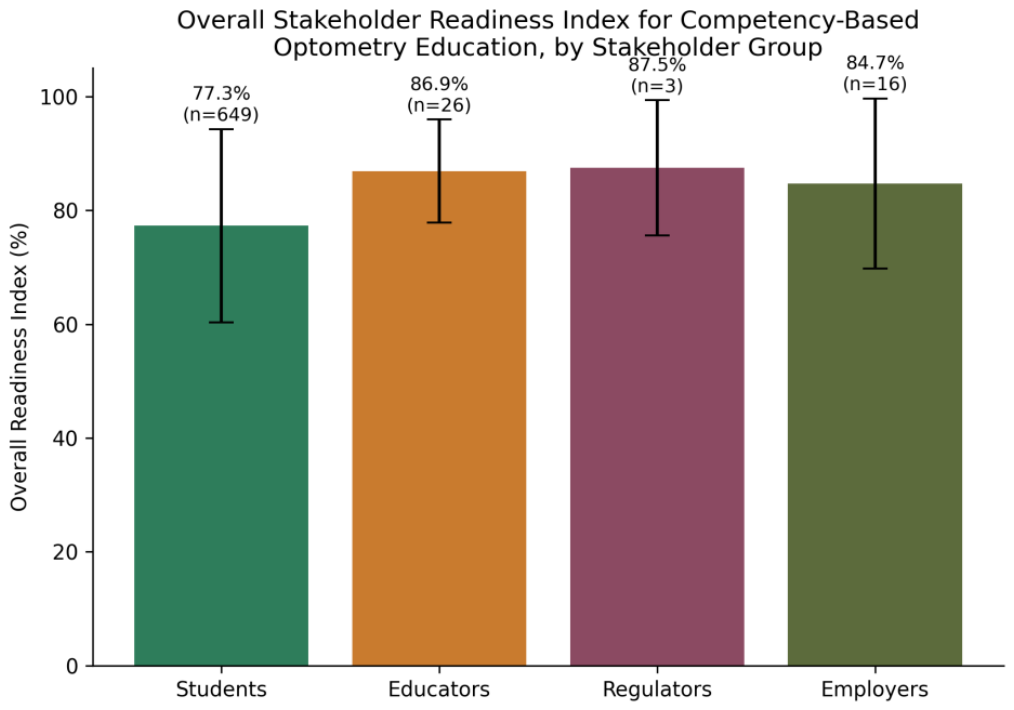
Table 2.
Mean readiness scores by domain and stakeholder group (scale: 1 = Disagree to 3 = Agree).
| Domain | Students (n=656) | Educators (n=26) | Regulators (n=3) | Employers (n=16) |
| Knowledge Readiness | 2.50 | 2.64 | 2.67 | 2.59 |
| Skills Readiness | 2.64 | 2.79 | 2.83 | 2.67 |
| Institutional/System Readiness | 2.20 | 2.38 | 2.72 | 2.67 |
| Regulatory Alignment | 2.59 | 2.78 | 2.83 | 2.75 |
| Workforce Relevance | 2.70 | 2.91 | 2.61 | 2.78 |
| Change Readiness | 2.66 | 2.92 | 2.83 | 2.71 |
Table 3.
Composite readiness score and Readiness Index by stakeholder group.
| Group | N | Mean (1 to 3) | SD | Readiness Index (%) |
| Students | 649 | 2.55 | 0.34 | 77.3 |
| Educators | 26 | 2.74 | 0.18 | 86.9 |
| Regulators | 3 | 2.75 | 0.24 | 87.5 |
| Employers | 16 | 2.70 | 0.30 | 84.9 |
Table 4.
Composite readiness score of students by training institution.
| Institution | N | Mean (1 to 3) | SD |
| Institution C | 74 | 2.66 | 0.26 |
| Institution B | 180 | 2.64 | 0.37 |
| Institution E | 27 | 2.52 | 0.42 |
| Institution A | 230 | 2.49 | 0.33 |
| Institution D | 70 | 2.45 | 0.24 |
Disclaimer/Publisher’s Note: The statements, opinions and data contained in all publications are solely those of the individual author(s) and contributor(s) and not of MDPI and/or the editor(s). MDPI and/or the editor(s) disclaim responsibility for any injury to people or property resulting from any ideas, methods, instructions or products referred to in the content. |
© 2026 by the authors. Licensee MDPI, Basel, Switzerland. This article is an open access article distributed under the terms and conditions of the Creative Commons Attribution (CC BY) license.
Copyright: This open access article is published under a Creative Commons CC BY 4.0 license, which permit the free download, distribution, and reuse, provided that the author and preprint are cited in any reuse.