
Submitted:
21 July 2026
Posted:
21 July 2026
You are already at the latest version
Abstract
The removal of five neonicotinoid insecticides, acetamiprid (ACE), chlothianidin (CLO), imidacloprid (IMI), thiacloprid (THC), and thiamethoxam (THM), was explored using various commercial ultrafiltration (UF) and nanofiltration (NF) membranes. Several modification techniques have also been implemented for one UF membrane, including immersion in hot water, sodium hydroxide, and ethanol solutions, as well as polymerization with monomers such as polyethyleneimine (PEI) and trimesoyl chloride (TMC), to improve micropollutant retention while maintaining adequate permeability. The results show that only immersion in ethanol (60% solution or absolute ethanol) was a suitable immersion technique for improving membrane performance. The use of various reagents and conditions for the membrane surface modification via polymerization yielded the best results, with the sequential application of PEI+TMC+60°C followed by immersion in glycerol solution (GLY) being the most efficient. Once the optimal modification procedure was established, these membranes were tested with real water matrices (two secondary effluents from wastewater treatment plants (WWTP) and a surface water sample) in which the neonicotinoids were dissolved. The modified UF membrane showed improved retention levels compared with commercial UF and NF membranes, demonstrating greater efficiency in retaining neonicotinoids under real water conditions. Therefore, the proposed modification process is a promising alternative to commercial membranes for removing micropollutants from urban wastewater.
Keywords:
neonicotinoids
; membrane technologies
; ultrafiltration
; nanofiltration
; modified membranes
; WWTP effluents
1. Introduction
Neonicotinoids are systemic pesticides widely used in agriculture to control harmful insects because they are more toxic to invertebrates than to mammals and birds. However, the use of neonicotinoids as insecticides has raised numerous concerns about their harmful effects on bees and even humans [1,2,3] due to their environmental persistence and high water solubility. Neonicotinoids have been found in low concentrations in soils, water, and food [4]. Although the use of most neonicotinoids as pesticides is now more restricted due to their negative effects on pollinating species, they are still found in the environment, including surface water and wastewater, through the food chain [5,6,7]. Long-term environmental exposure to neonicotinoids, even at very low concentrations, may pose risks to humans and other mammals due to their potential to disrupt physiological functions [2,8].
Because most micropollutants, including neonicotinoids, are not efficiently removed by conventional wastewater treatment plants (WWTPs), the European Union recently adopted Directive (EU) 2024/3019 [9], which establishes a framework for implementing quaternary treatment technologies to efficiently remove poorly biodegradable micropollutants from WWTP effluents. The main technologies for removing these micropollutants are based on chemical oxidation processes, including ozonation, and combinations with other agents through advanced oxidation processes, as well as physical filtration techniques using activated carbon and membranes [10,11].
Among membrane processes for quaternary treatment, reverse osmosis (RO) and nanofiltration (NF) are efficient techniques, as these offer retention levels that approach the minimum of 80% required by the European directive [10,12]. Although ultrafiltration (UF) is not considered a quaternary treatment on its own due to its low retention levels, it can be used as a pretreatment. Furthermore, several hybrid technologies have gained importance as promising solutions for removing these micropollutants from water [13,14] as they improve membrane properties such as hydrophilicity, fouling resistance, permeability, and mechanical stability. Among these, adsorption-membrane hybrid technologies, the use of magnetic nanocomposites, and membrane modification stand out [15]. In the last decade, considerable research has focused on modifying commercial UF membranes to improve their retention performance. These improvements include modifying the membrane surface layer by immersion in solutions, adding a chemical reagent, or inserting an extra polymer layer using monomers. Thus, Ji et al. [16] explored the improvements and drawbacks experienced by membranes after pretreatment by immersion in hot water, ethanol, and NaOH solutions, processes previously reported to produce structural changes, such as pore enlargement in polysulfone membranes. They observed a significant improvement in the permeability of these membranes, especially with ethanol, as well as an increase in adsorption retention. The modification of polysulfone membranes by polymerization has been studied more extensively [17,18]. Several investigations demonstrated that sequential application of polyethyleneimine (PEI) and trimesoyl chloride (TMC) monomers onto a polysulfone membrane resulted in instantaneous polymerization through cross-linking between the two monomers [19,20]. Yu et al. [21] studied a crosslinked UF membrane polymerization using PEI and phenolphthalein-based poly(ether ether ketone), which led to improvements in dye retention, antifouling performance, and even water permeability. Also, Li et al. [22] cross-linked an UF membrane with PEI and carboxylic acid, which were introduced into the inner pores, achieving a pore size on the NF scale, leading to excellent dye retention, antifouling performance, hydrophilicity, and long-term operational stability.
The removal of the neonicotinoids under study through chemical oxidation processes, considered as quaternary treatment, has already been carried out in previous studies, including combinations of ozonation with adsorption onto activated carbon [23,24]. However, filtration techniques have been applied to neonicotinoids very rarely. Therefore, this study has focused on the removal of the five neonicotinoids (acetamiprid (ACE), chlothianidin (CLO), imidacloprid (IMI), thiacloprid (THC), and thiamethoxam (THM)) using UF and NF membranes. Special emphasis will be placed on the preparation of modified membranes using immersion and polymerization techniques, and their performance will be evaluated in u ultrapure water, surface water, and WWTP effluents. The main objectives were to study the performance of different types of membranes, as well as the possible improvements in retention levels of the five neonicotinoids and in permeability resulting from the modification of UF membranes, and to investigate the filtration process of real water matrices containing these pollutants to meet the required levels of pollution reduction.
2. Materials and Methods
2.1. Reagents, Membranes, and Water Matrices Used
Neonicotinoids ACE, CLO, IMI, THC, and THM were purchased from Sigma-Aldrich (Spain) of the highest available purity. Table 1 compiles their main physicochemical properties. PEI ((C2H5N)n) and TMC (C9H3Cl3O3), used to modify the surface of UF membranes, were also obtained from Sigma-Aldrich (Spain). The surfactant sodium dodecyl sulphate (SDS), used in some polymerization experiments, was purchased from Scharlab S.L. (Spain). The remaining general reagents were purchased from Panreac S.L.U. (Spain).
Four different membranes purchased from GE Osmonics Labstore (Florida, USA) were used in this research: the UF membranes denoted as MW, PT, and GK, made of polyacrylonitrile (PAN), polyethersulfone (PES), and polysulfone-polyamide thin-film composite (TF), respectively; and the NF membrane HL, also made of TF. The main properties of these filtration membranes are shown in Table 2.
Ultrapure (UP) water to prepare the solutions was provided by a Milli-Q water system (Millipore, USA). Three water matrices (surface water (SW) and two secondary effluents from WWTPs (SE1 and SE2)) were collected in the Extremadura Community (Southwest of Spain). Their main quality parameters are compiled in Table S1 of the Supplementary Material.
2.2. Experimental Procedures
The UF and NF filtration experiments were carried out in the laboratory cross-flow membrane filtration unit model P-28 supplied by CM-CELFA Membrantechnik AG (Seewen, Switzerland), which was described in detail in previous research [25,26]. Briefly, it consisted of a 500 mL pressurized storage vessel with a device containing the membrane. The effective surface area (A) was 28 cm2. The transmembrane pressure (TMP) varied from 2 to 20 bar depending on the membrane used in each experiment. This TMP was controlled by feeding nitrogen gas to the head of the storage vessel. The temperature and tangential velocity (v) were kept constant at 20 °C and 2 m/s, respectively. A new membrane was used for each experiment.
The experiments were carried out in batch concentration mode, with the permeate stream collected separately and the retentate stream recycled to the feed tank. Before starting each experiment, the UP water permeate flux (Jw1) was measured (Equation (1)) to determine the pure-water permeability (PWP, Jw1/TMP). Then, the filtration experiment began after adding an initial volume (V0) of 300 mL of the water matrix containing 1 μM of individual neonicotinoids (C0i). At regular time intervals (t), the permeate flux (Jv) was determined from the permeate volume (VP), which was measured by weighing the permeate on an analytical balance. Also, some permeate samples were taken to determine the remaining content of each neonicotinoid (CPi), as well as the retention percentage (Equation (2)).
The experiments were stopped when a volume reduction factor (VRF, Equation (3)) of 3 was reached, leading to permeate and retentate volumes of VP = 200 mL and VR = 100 mL, respectively, which were stored for analysis.
After each experiment, the membrane was rinsed with UP water for 5-10 minutes to remove external fouling. The UP water permeate flux was then determined again (Jw2) to assess irreversible membrane fouling (internal fouling) as a function of membrane recovery (Equation (4)). The adsorption percentages of each neonicotinoid on the membrane surface were also determined from the volume and concentrations in each fraction (Equation (5)). Suitable blanks and replicates were also performed for some experiments.
Modified membranes were prepared by immersion and polymerization methods according to the work of Ji et al. [16] and Ang et al. [19], respectively. Three substances were selected for immersion: water, sodium hydroxide, and ethanol. Surface modification by polymerization was performed with monomers such as PEI and TMC. Text S1 details the procedures applied to modify the membrane surface.
2.3. Analytical Methods
The concentration of each neonicotinoid was determined by HPLC, following the analytical methods described in previous works [24,27]. The characterization of real water matrices was carried out following the Standard Methods [28]. Further details about the analysis of neonicotinoids and water characterization are described in Text S2.
3. Results and Discussion
3.1. Removal of Neonicotinoids by Virgin UF and NF Membranes in Different Water Matrices
Filtration experiments have been carried out with an initial concentration of 1 µM for each of the five neonicotinoids dissolved in different water matrices using three UF membranes (denoted MW, PT, and GK) and one NF membrane (denoted HL).
As a first step, filtration experiments were performed with the five neonicotinoids dissolved in UP water. Results obtained with the four commercial membranes are collected in Table 3. Permeability studies were conducted, and the degree of fouling of each membrane used was analyzed. As can be deduced from the permeate flow values at the end of the experiments (Jvss) exposed in Table 3, no apparent fouling of the membranes was observed since, in all cases, complete recovery of membrane permeability was verified after surface cleaning, demonstrating the absence of internal fouling (despite micropollutant adsorption).
The retention and adsorption percentages of each neonicotinoid were also evaluated according to Equations (2) and (5), respectively, and different micropollutant retention mechanisms can be proposed. The results (Table 3) clearly show that the HL membrane was the most efficient in micropollutant retention, followed by the PT membrane. Retention of neonicotinoids with the MW membrane was low, probably due to its high MWCO (50000 Da), so the only micropollutant retention mechanism was adsorption. The PT membrane (MWCO of 5000 Da) exhibited moderate retention of neonicotinoids, mainly due to the adsorption mechanism. Moreover, the PT membrane had the highest adsorption capacity of the four membranes tested, likely due to its greater hydrophobicity (see contact angles in Table 2). The GK membrane also exhibited low micropollutant retention despite its small MWCO (2000 Da), meaning that even this UF membrane with the smallest pore size was unable to retain micropollutants through size exclusion. Furthermore, the GK membrane presented reduced micropollutant retention by adsorption onto its surface, probably due to its greater hydrophilicity.
The MW membrane, with low retention values, showed that the percentage of compound removal was practically the same for the five neonicotinoids, and the adsorption levels were also very similar. The PT membrane, which achieved higher removal percentages, showed retention values for the five neonicotinoids that fairly coincide with those of adsorption. THC had the highest removal percentage at almost 50%, followed by IMI, CLO, ACE, and THM. Similar results were observed for the GK membrane, where the retention and adsorption order was THC > CLO > IMI > THM > ACE. THC, the most retained compound, has the second-highest log KOW value, implying higher hydrophobicity and, consequently, greater adsorption. THM, one of the least retained compounds, had the lowest log KOW and exhibited the least hydrophobic character. However, ACE, which had one of the lowest retention percentages, had the highest log KOW value. Therefore, the three UF membranes exhibited a similar order of micropollutant retention and adsorption. Furthermore, the fact that the retention and adsorption percentages were almost identical indicates that the retention of neonicotinoids was primarily due to adsorption. The absence of internal fouling, as previously established, suggests adsorption on the membrane surface.
The retention order for the HL membrane was THM > ACE > THC > IMI > CLO, while the adsorption order was THC > IMI > CLO > ACE > THM. Furthermore, the retention values were much higher than the adsorption percentages, meaning that adsorption was not the primary factor contributing to micropollutant removal. The most retained compound, THM, has the highest MW (291.71), followed by THC and IMI, which have very similar MW values (252.73 and 255.67, respectively). The least retained compound, CLO, has an MW of 249.68. ACE was the second most retained neonicotinoid and has the lowest MW (222.68); however, ACE has the highest molar volume. Therefore, the HL membrane retains neonicotinoids mainly through size exclusion, and the UF membranes (MW, PT, and GK) retain them by adsorption onto the membrane surface. Similar tendencies were observed in previous studies using these types of membranes to remove different micropollutants [25,29].
Additional filtration experiments of the five neonicotinoids were performed by varying the pH of the UP water, which was initially at pH 6. The pH was adjusted to values of 7 and 9 by adding NaOH. The membranes with the highest micropollutant separation efficiency, PT (UF) and HL (NF), were used in these experiments. Table S2 shows the results obtained. These results indicate that the increase in pH had a slight effect on membrane permeability, with only a very small decrease in Jvss values. Membrane fouling was negligible, with 100% recovery achieved after washing in almost all cases. A decrease in neonicotinoid removal was observed for the UF PT membrane when the pH increased, although the values at pH 7 and 9 were similar. The decrease in retention with increasing pH was more pronounced with the NF HL membrane, especially at pH 9. The adsorption results for the PT membrane indicate that the adsorption percentage decreased when the pH increased. In contrast, the HL membrane exhibited a slight increase in adsorption as the pH increased to 7, followed by a decrease or stabilization in adsorption at pH 9. Typically, an increase in pH leads to increased pollutant retention levels in membrane filtration due to electrostatic repulsion [30]. However, since neonicotinoids are neutral compounds (Table 1), this effect was not observed. The decrease in retention with pH observed in the HL membrane suggests that pH 6-7 should be used to maintain proper NF efficiency.
Next, filtration experiments were carried out with membranes PT and HL by dissolving the neonicotinoids in the water matrices mentioned in Section 2.1: a surface water (SW) and two secondary effluents (SE1 and SE2). The objectives of these experiments were to evaluate the influence of the water matrix on the retention coefficients of each pollutant and to analyze the evolution of water quality parameters, such as total nitrogen and total phosphorus, absorbance at 254 nm (A254nm), and dissolved organic carbon (DOC). Table S3 summarizes the results on permeability, retention, and adsorption of the neonicotinoids obtained in these experiments. According to these results, there was hardly any fouling of the membrane when different water matrices were used (Jvss/Jw1 close to 1), and the permeability was recovered to values close to 100% after washing. Regarding the reduction of neonicotinoids in the permeate stream, the PT membrane efficiency decreased significantly when water matrices other than UP water were used. This decrease may be associated with a similar reduction in the adsorption of neonicotinoids on the membrane. There is likely competition between neonicotinoids and components of the real water samples for adsorption onto the membrane surface, limiting the adsorption of neonicotinoids. In fact, the greatest decrease in neonicotinoid retention and adsorption occurred with SE2 effluent, which had the highest organic matter content. The removal of neonicotinoids by the HL membrane was only slightly reduced in secondary effluents, while adsorption remained the same or even increased slightly, especially in the experiment with SE1, which had the highest concentration of ionic species and the lowest content of organic matter. The order of retention of the neonicotinoids in real waters was very similar to that observed in UP water, with THC being the most retained in the PT membrane and THM the least, as also occurred with the adsorption levels; while THM was the most retained and CLO the least with the HL membrane, regardless of the water matrix used.
Table S4 shows the removal percentages of water pollution parameters in these experiments. As expected, the removal percentages of A254nm, turbidity, total nitrogen, total phosphorus, and DOC were higher with the HL membrane than with the PT membrane. A254nm and DOC decreased by more than 85 and 76%, respectively, with the HL membrane, while the PT membrane showed much lower removals. Retention was lower in the SE1 effluent, likely due to its low initial pollutant load. Therefore, NF treatment with the HL membrane produced a final effluent or reclaimed water of good quality to be reused for several purposes. Since the quality of the final effluent from the UF treatment with the PT membrane was poor, we investigated the modification of the PT membrane surface to obtain reclaimed water of good quality to be reused.
3.2. Removal of Neonicotinoids Using Modified UF Membranes: Testing Different Modification Techniques in UP Water
After completing the filtration experiments with the original commercial membranes, several modification tests were performed on the PT membrane using two techniques, immersion and polymerization, according to the procedures described in Text S1.
In a first stage, membrane modification tests by immersion in hot water (70 °C for 90 min) were performed. In addition, some experiments were carried out by subsequent immersion of the membranes in 1 M NaOH solution, absolute ethanol, or 60% ethanol solution. After that, the membranes were stored in cold water for different times. Table 4 summarizes the results obtained in the experiments carried out. It can be seen that the membrane permeate flux values improved with the modifications, especially after immersion in NaOH and ethanol, increasing Jvss from 100 to about 160 L/(h m2). This general increase in permeate fluxes can be explained by the partial removal of preservative reagents present on the membrane surface, such as polyvinylpyrrolidone (PVP), one of the most common additives, which is added during membrane manufacturing to form pores [16]. Furthermore, NaOH treatment induces hydrolysis of the lactam ring of PVP, generating additional hydrophilic functional groups that enhance membrane permeability [31]. The ethanol pretreatment led to the highest permeability values, which can be explained by two mechanisms: the previously described removal of preservatives from the membrane surface and swelling of the outermost membrane layer due to ethanol interactions [32]. Both mechanisms produce changes in the composition and structure of the membrane, such as an increase in pore size. The results obtained at different storage times (1 and 7 days) after the membrane was modified with NaOH and absolute ethanol were very similar. Therefore, only a storage time of one day was tested in subsequent experiments using a 60% ethanol solution as an immersion reagent. The use of different ethanol concentrations did not appear to significantly modify membrane permeability, although some studies reported higher permeability with absolute ethanol than with 60% solutions [16]. Based on the results obtained, it can be concluded that surface modifications with NaOH and ethanol were more effective at improving permeability than pretreatment with hot water alone, and that the storage time after the modification process did not affect the membranes.
However, the neonicotinoid removal percentages were lower in experiments conducted with PT membranes modified with hot water and 1 M NaOH than those obtained with the virgin PT membrane. It is also worth noting that the retention percentages of the five pollutants in the experiments with hot water and 1 M NaOH pretreatment were very low, ranging from 9.5% to 14.1%, except for THC, which ranged from 16% to 21.4%, while in the experiment performed without pretreatment, the retention values were moderate, ranging from 22.6% to 51.3% for THM and THC, respectively. As a result of these findings, further work with hot water and NaOH is not recommended. However, in experiments conducted with ethanol modification, neonicotinoid retention was considerably higher than that achieved with the virgin membrane. Conversely, a slight decrease in pollutant retention was observed with storage time (from 1 to 7 days) after pretreatment, suggesting a negative effect of storage time on retention. Finally, in the experiment conducted with a 60% ethanol solution, a somewhat less significant increase in pollutant retention (compared to absolute ethanol experiments) was observed. In general, adsorption percentages were very similar to retention percentages, indicating that the primary retention mechanism remains adsorption onto the membrane surface. In conclusion, in this set of experiments modifying the PT membrane by immersion, it can be stated that the best modification is immersion in ethanol solutions, since it improves both permeability and retention capacity by adsorption of the membrane, while reducing the operating time. However, the high levels of adsorption, the main retention mechanism, make it difficult to use this modified membrane for long periods, requiring a greater number of stops for membrane cleaning.
In a second stage, polymerization techniques were applied following the procedure described in Text S1 to find the best membrane efficiency in terms of permeability and micropollutant retention. Several experiments were conducted adding two monomers, PEI and TMC, although only PEI was used in some experiments, and in others the surfactant SDS was also added, as described in Text S1. After these pretreatments, the membrane was cured in an oven at 60 °C, and additional modifications (such as immersion in GLY solution) were also considered. Table S5 summarizes the results from experiments conducted with neonicotinoids dissolved in ultrapure (UP) water, in which the reagents used for membrane modification via polymerization were varied, while oven curing was applied as the sole post-treatment step. The first consequence of using these modified membranes, compared to the virgin one, was a decrease in PWP by around an order of magnitude, regardless of the number of reagents used. This leads to an excessive increase in the time required to reach previous filtration levels (VRF 3), even when the TMP was raised from 6 to 30 bar in some experiments. Therefore, Table S5 shows the retention of neonicotinoids when only a small volume of permeate was produced, corresponding to VRF of 1.1 (VP = 27.3 mL versus 300 mL of feed). Table S5 also summarizes the permeate fluxes obtained in these experiments. A decrease in permeate flux was observed throughout the experiment (Jvss < Jw1), indicating slight fouling, which was scarcely recovered after washing (Jw2 < Jw1). This suggests some internal fouling within the membrane pores, as well as external fouling on its surface.
Regarding the neonicotinoid retention data obtained in this set of experiments, there was a remarkable increase in the elimination of these compounds compared to the blank experiment with the virgin membrane. In some experiments, retention values of approximately 90% were achieved for all compounds, whereas the virgin membrane exhibited retention values ranging from 17% to 38%. These results, both the retention of micropollutants and the decrease in permeability, are likely because the membrane transitioned from the UF to the NF range. The surface polymerization reduced the pore size, thus changing its filtration range. Among the various experiments with membranes modified with different agents, the PEI+TMC combination achieved the highest levels of retention. Experiments with membranes modified solely with PEI resulted in lower retention levels, while experiments with SDS showed no improvement; therefore, these membrane modification methods are ruled out, despite previous studies [19] reporting that the addition of SDS surfactant was favourable. These results suggest that TMC contributes to membrane surface modification by cross-linking PEI chains. This leads to reduced permeability and increased pollutant retention due to the increased membrane surface density. Therefore, the best option among those investigated so far is the treatment with PEI+TMC+60°C, since it allows the construction of a network of chains between the base membrane, the PEI polymer, and the TMC, creating a new NF membrane, which presents the best data on micropollutant retention in the first stages of the filtration process, assuming that the retention trend will be similar over time. Consequently, the modification procedure using PEI and TMC monomers followed by heat treatment at 60 °C was applied in subsequent stages of the research.
As previously mentioned, crosslinking between the PEI and TMC chains is responsible for the densification of the membrane and the change in pore size [18]. This densification process is largely beneficial, but if the membrane becomes too dense, the pore size becomes so small that it can be detrimental to the filtration process [20]. Therefore, a new variable was introduced: the subsequent immersion of the modified membrane in a 15% glycerol (GLY) solution (15 wt%) after curing at 60 °C for 10 min. This allows the crosslinking process to be stopped before the membrane collapses. Furthermore, since the first part of this Section 3.2 demonstrated the effectiveness of ethanol in removing preservative residues from the membrane surface and its ability to increase hydrophilicity and pore size, improving permeability, the effect of combining this ethanol immersion pretreatment with the subsequent polymerization treatment was investigated. Table 5 summarizes the results obtained with modified membranes following these procedures.
It can be observed in Table 5 that when the polymerized membrane was immersed in a GLY solution for 4 hours, the permeability decreased, and the TMP had to be increased from 4 bar (using the virgin PT membrane) to 20 bar. However, when these results are compared with those obtained for the complete treatment without stopping the densification process, there was an improvement, since the pressure could be reduced from 30 to 20 bar, and the experiment could be completed to VRF 3. Therefore, post-treatment with glycerol effectively reduced membrane densification. This process increased neonicotinoid retention and adsorption compared to the virgin membrane. The retention levels at VRF 3 were lower than those achieved at VRF 1.1 due to increasing neonicotinoid concentrations in the retentate stream, which was recirculated, while its volume, VR, decreased. It should be noted that this decrease did not occur in the blank experiment, since when adsorption was the primary retention mechanism, there was no increase in pollutant concentration in the recirculated solution [33]. This reduction of the retention levels with increasing VRF also implies that the overall retention value in the permeate volume at VRF 3 (VP = 200 mL) was greater than the specific retention measured at that time. Regarding the ethanol pretreatment, Table 5 shows that the TMP could be reduced to 8 bar, and the permeate flux decreased steadily as filtration progressed, falling at a VRF of 3 (Jvss) to below 40% of the initial value. This indicates that the membrane collapsed over time. At the same time, there was no apparent improvement in neonicotinoid retention and adsorption compared to experiments without this pretreatment. Therefore, ethanol pretreatment was not very suitable for improving the efficiency of modified membranes.
Finally, the effect of curing time at 60 °C (5 and 8 min) was investigated, as well as the TMP applied in each experiment (between 8 and 15 bar) in experiments with membranes modified by polymerization using PEI+TMC+60°C+GLY. Table S6 summarizes the results obtained in this set of experiments. The first objective was to determine the minimum oven curing time. Reducing the oven curing time decreased membrane densification, and therefore chain crosslinking, resulting in a larger pore size. However, the ideal pore size is not necessarily the smallest, as excessively small pores can also cause problems with filtration development. If the pore size is too small, permeability decreases to the point where the process is no longer viable [20]. According to the results in Table S6 for experiments performed at a TMP of 10 bar, decreasing the curing time from 8 to 5 minutes increased the membrane permeability. At the same time, neonicotinoid retention was slightly higher in the experiment with 5 min of curing time. Preliminary experiments showed that reducing the curing time below 4 min decreased neonicotinoid retention levels. For a curing time of 5 min, a TMP of 10 bar resulted in higher pollutant retention and adsorption similar to those obtained with longer curing times and higher TMP. Therefore, 5 min was the best balance between permeability and pollutant retention, combined with a TMP of 10 bar.
As a summary of all the studies carried out in UP water, Figure 1 presents the most favourable results obtained after different surface modifications of the PT membrane (both by immersion in ethanol and by polymerization), as well as under different conditions and variables used (results shown in Table 4 and Table 5 and Tables S5 and S6). As can be observed, the polymerization with PEI+TMC+60°C+GLY with a 5 min curing time and operating at 10 bars results in neonicotinoid retention values between 60% and 83%, while maintaining an adequate permeate flow rate at steady state. The PEI+TMC+60°C experiment, in the absence of GLY, was measured at VRF 1.1 due to its very low permeability, which represents a disadvantage for the process. Therefore, the configuration PEI+TMC+60°C+GLY was chosen for the next stage of the study.
3.3. Removal of Neonicotinoids Using Modified UF Membranes by Polymerization in Real Water Matrices
Once the performance of modified UF membranes using different techniques was established in UP water, the most suitable modification conditions (polymerization with PEI, TMC, heat at 60 °C, and immersion in GLY solution) were selected for use in real water matrices. According to the conclusions reached in the previous section, PEI and TMC were applied only to the active layer using an agitated cell (9 min for PEI and 30 s for TMC), the curing time at 60 °C was 5 min, and the chosen pressure was 10 bar, seeking a balance between high levels of permeability and retention of neonicotinoids. The results obtained with this modified membrane using the water matrices under study are shown in Table 6. The retention percentages were calculated both at a VRF 3 and for the entire mass of permeate extracted up to that point (200 mL). The permeate flux obtained with real water matrices was lower than that with UP water. Moreover, the Jvss/Jw1 values were slightly lower than 1, indicating membrane fouling during the filtration of real water matrices, although the membrane recovery was very close to 100%, meaning that the fouling was predominantly external [21]. Neonicotinoid retentions were, in all cases, significantly higher than those achieved with the virgin PT membrane (see Table S3 for experiments performed at 4 bar), and even slightly higher than those obtained with the NF HL membrane. This trend is clearly seen when comparing the retention percentages at VRF 3 using virgin PT and HL membranes (Table S3) and the modified PT membrane (Table 6). While the average retention of the five neonicotinoids was around 35% in UP water and 15% in real water matrices with the virgin PT membrane, and 70-80% with the HL membrane, an average retention of 70-95% was obtained with the modified PT membrane. In addition, neonicotinoid retentions were higher in real water matrices than in UP water with the modified PT membrane, especially in the SW matrix, with retentions exceeding 94% for all compounds. The retention percentages obtained for the total permeate mass (200 mL) were significantly higher than those measured at VRF 3 due to the increasing concentration of neonicotinoids in the retentate stream as VRF increased, which led to a reduction in the specific retention percentages measured from the initial pollutant concentration. To properly compare these retention percentages for the entire mass of permeate extracted, Figure 2 represents overall retention values for the same experiments listed in Tables S3 (virgin PT and HL membranes) and 6 (modified PT membranes). The results clearly show the low performance of the virgin PT membrane, with values below 30% in almost all experiments, except for the retention of the more favourable neonicotinoid (THC), and the high performance of the modified membrane, which was at the level of the HL membrane, or even better, for most pollutants. The removal of each neonicotinoid in the permeate stream was almost always above 80%, reaching around 90% in experiments in SW.
According to Table 6 and Table S3, adsorption levels were only slightly higher in the modified PT membrane than in the virgin, although retention levels were much higher. This again indicates that the modified membrane behaves more like an NF membrane and that adsorption was not the primary mechanism for neonicotinoid retention, thus facilitating continuous operation. These adsorption levels of the modified PT membrane were lower in real water matrices than in UP water, likely due to organic matter competing with neonicotinoids for adsorption, but clearly higher than those observed with the HL membrane.
Water quality parameters were analyzed, and the corresponding retention values are presented in Figure 3, along with those achieved with the virgin PT and HL membranes (see also Table S4). It can be observed that the modified membrane reduced both A254nm and DOC values considerably, reaching similar levels to those of the HL membrane. Specifically, the removal percentages for A254nm ranged from 78% to 96%. Turbidity reductions were more modest, remaining below 40% and lower than those achieved with the HL membrane. Meanwhile, DOC retentions ranged from 57% to 88%, indicating that the organic load of the water matrix was also satisfactorily reduced.
5. Conclusions
This study investigated the performance of various commercial UF and NF membranes, as well as the UF PT membrane modified using immersion and polymerization techniques. Neonicotinoid retention percentages with commercial UF membranes, such as MW, PT, and GK, were very low, with adsorption on the membrane surface being the primary retention mechanism for these micropollutants. Only the NF HL membrane achieved high retention levels, mainly through size exclusion. Increasing the pH from 6 to 9 resulted in a slight decrease in neonicotinoid retention by UF membranes without affecting permeability. A more pronounced decrease in retention was observed for the HL membrane, suggesting the use of a near-neutral pH. The decrease in retention observed in experiments performed with real water matrices (SW, SE1, and SE2) was significant for the UF PT membrane and very slight for the NF HL membrane.
Several surface modification techniques were applied to the PT membrane due to its better behaviour among the UF membranes. The PT membrane modification by immersion was promising only with ethanol solutions, with clear increases in neonicotinoid retentions and permeability due to the removal of preservatives from the membrane surface and swelling of the outermost membrane layer. Conversely, the high levels of adsorption on the membrane, which was the main retention mechanism, make it difficult to use for long filtration periods.
Surface modification by polymerization techniques enabled the production of membranes with a surface layer that significantly outperformed the retention capacity of commercial PT membranes, bringing them to a range similar to that of an NF membrane. Consequently, permeability decreased, so that a higher TMP was required. Among the multiple reagents, operations, conditions, and operating times tested, the most favourable configuration in terms of retention, permeability, and adsorption levels was the sequence of stages PEI+TMC+60°C+GLY with an oven curing time of 5 minutes, followed by immersion in a 15% GLY solution for 4 hours and subsequent operation at a TMP of 10 bar.
Final tests using this configuration with real water samples enabled a comparison of the performance of the modified membranes with that of the previously evaluated commercial PT and HL membranes. Improvements in neonicotinoid retention levels were observed in these water samples when using the modified PT membrane, reaching 80-95% of retention, even higher than the HL membrane, and using a lower TMP. These results make this method a promising alternative to commercial membranes, potentially meeting the removal percentage requirements imposed by the EU for the removal of micropollutants in WWTPs by quaternary treatment.
Supplementary Materials
The following supporting information can be downloaded at the website of this paper posted on Preprints.org, Table S1: quality parameters of the selected water matrices; Text S1: procedure for the preparation of modified membranes; Text S2: Analysis of the neonicotinoids and water quality parameters; Table S2: results from membrane filtration experiments using UP water at varying pH level; Table S3: results from membrane filtration experiments performed with several water matrices; Table S4: removal percentages of water pollution parameters obtained from filtration experiments performed with several water matrices; Table S5: results from membrane filtration experiments performed with UP water using PT membranes modified by polymerization. Influence of the monomer used; Table S6: results from experiments performed with PT membranes modified by polymerization using PEI+TMC+60°C+GLY. Effect of curing time at 60 °C and TMP.
Author Contributions
Conceptualization, F.J.R and J.L.A.; methodology and investigation, F.J.R., J.L.A., E.M. and C.G.; validation, F.J.R and J.L.A.; writing–original draft and review, F.J.R and J.L.A.; formal analysis, F.J.R., J.L.A., E.M. and C.G.; Project administration, J.L.A.; Funding acquisition, F.J.R and J.L.A. All authors have read and agreed to the published version of the manuscript.
Funding
The authors wish to acknowledge financial support through Grant PID2023-149919OB-I00 funded by MICIU/AEI/10.13039/501100011033 and by ERDF/UE.
Data Availability Statement
The original contributions presented in this study are included in the article. Further inquiries can be directed to the corresponding authors.
Conflicts of Interest
The authors declare no conflicts of interest.
References
- Stokstad, E. Field research on bees raises concern about low-dose pesticides. Science 2012, 335(6076), 1555. [CrossRef]
- Li, F.; Xiong, W.; Zhang, C.; Wang, D.; Zhou, C.; Li, W.; Zeng, G.; Song, B.; Zeng, Z. Neonicotinoid insecticides in non-target organisms: Occurrence, exposure, toxicity, and human health risks. J. Environ. Manag. 2025, 383, 125432. [CrossRef]
- Ajermoun, N.; El Haddioui, L.; berd, A.; Laghrib, F.; Farahi, A.; Lahrich, S.; Bakasse, M.; Saqrane, S.; El Mhammedi. M.A. Environmental and human health impacts of neonicotinoid insecticides: A review. Pedosphere 2026, 36(1), 165-185. [CrossRef]
- Ji, K.; Rong, Y.; Zhang, Z.; Chen, Y.; Hu, R.; Chu, Y.; Tang, Y.; Qian, L.; Yang, C. Neonicotinoids and human health. Environmental fate, toxicity mechanism, and future directions. Pestic. Biochem. Physiol. 2025, 215, 106636. [CrossRef]
- Wang, J.; Yin, R.; Liu, Y.; Wang, B.; Wang, N.; Xiao, P.; Xiao, T.; Hirai H. Meta-analysis of neonicotinoid insecticides in global surface waters. Environ. Sci. Pollut. Res. Int. 2023, 30, 1039-1047. [CrossRef]
- Thompson, D.A.; Lehmler, H.-J.; Kolpin, D.W.; Hladik, M.L.; Vargo, J.D.; Schilling, K.E.; LeFevre, G.H.; Peeples, T.L.; Poch, M.C.; LaDuca, L.E.; Cwiertny, D.M.; Field, R.W. A critical review on the potential impacts of neonicotinoid insecticide use: current knowledge of environmental fate, toxicity, and implications for human health. Environ. Sci.: Process. Impacts 2020, 22, 1315-1346. [CrossRef]
- Berens, M.; Capel, P.; Arnold, W. Neonicotinoid insecticides in surface water, groundwater, and wastewater across land-use gradients and potential effects. Environ. Toxicol. Chem. 2021, 40, 1017-1033. [CrossRef]
- Han, W.; Tian, Y.; Shen, X. Human exposure to neonicotinoid insecticides and the evaluation of their potential toxicity: an overview. Chemosphere 2018, 192, 59-65. [CrossRef]
- EU. Directive (EU) 2024/3019 of the European Parliament and of the Council of 27 November 2024 concerning urban wastewater treatment. 2024.
- Deme, G.D.; Genet, M.B.; Terefe, A.; Bóna, A.; Gerencsér-Berta, R.; Galambos, I. Advances in nanofiltration membrane design for water purification: Enhancing micropollutant rejection and salt passage. Chem. Eng. J. Adv. 2026, 27, 101266. [CrossRef]
- Xu, R.; Zhang, Z.; Deng, C.; Nie, C.; Wang, L.; Shi, W.; Lyu, T.; Yang, Q. Micropollutant rejection by nanofiltration membranes: A mini review dedicated to the critical factors and modelling prediction. Environ. Res. 2024, 244, 117935. [CrossRef]
- Sharma, M.; Bains, A.; Sridhar, K.; Chawla, P.; Sharma, M. Environmental impact and source-controlled approaches for emerging micropollutants: Current status and future prospects. Food Chem. Toxicol. 2024, 193, 115038. [CrossRef]
- Ahmed, S.F.; Mofijur, M.; Nuzhat, S.; Chowdhury, A.T.; Rafa, N.; Uddin, M.A.; Inayat, A.; Mahlia, T.M.I.; Ong, H.C.; Chia, W.Y.; Show, P.L. Recent developments in physical, biological, chemical, and hybrid treatment techniques for removing emerging contaminants from wastewater. J. Hazard. Mater. 2021, 416, 125912. [CrossRef]
- Ebrahimi, M.; Prykhodko, Y.; Lemouchi, C.; Fatyeyeva, K.; Le Pluart, L. Polymer ultrafiltration membranes with improved morphological, mechanical, transport, and antifouling characteristics – a comprehensive review. Chem. Eng. J. 2026, 534, 174981. [CrossRef]
- Nure, J.F.; Nkambule, T.T.I. The recent advances in adsorption and membrane separation and their hybrid technologies for micropollutants removal from wastewater. J. Ind. Eng. Chem. 2023, 126, 92-114. [CrossRef]
- Ji, M.; Luo, J.; Wei, J.; Woodley, J.; Daugaard, A.E.; Pinelo, M. Commercial Polysulfone Membranes Pretreated with Ethanol and NaOH: Effects on Permeability, Selectivity and Antifouling Properties. Sep. Purif. Technol. 2019, 219, 82-89. [CrossRef]
- Seah, M.Q.; Chua, S.F.; Ang, W.L.; Lau, W.J.; Mansourizadeh, A.; Thamaraiselvan, C. Advancements in polymeric membranes for challenging water filtration environments: A comprehensive review. J. Environ. Chem. Eng. 2024, 12, 112628. [CrossRef]
- Arshad, T.; Rahman, Z.U.; Rauf, A.; Al-Ghamdi, Y.O.; Iqbal, M.; Ablajan, K.; Guo, B.; Khan, S.A. An overview of polymer nanocomposite membranes for environmental and biomedical applications: current challenges and future perspectives. Eur. Polym. J. 2026, 252, 114743. [CrossRef]
- Ang, M.B.M.Y.; Tang, C.-L.; De Guzman, M.R.; Maganto, H.L.C.; Caparanga, A.R.; Huang, S.-H.; Tsai, H.-A.; Hu, C.-C.; Lee, K.-R.; Lai, J.-Y. Improved performance of thin-film nanofiltration membranes fabricated with the intervention of surfactants having different structures for water treatment. Desalination 2020, 481, 114352. [CrossRef]
- Liu, Y.; Liu, L.; Narendra, B.; Chen, X.; Feng, S.; Wan, Y.; Luo, J. Advancing high-performance nanofiltration membranes: Tailoring monomer molecular design to enhance diffusion-reaction synergy in interfacial polymerization. Desalination, 2025, 598, 118415. [CrossRef]
- Yu, Y.; Wu, Y.; Li, Z.; Wang, Y.; Liu, P.; Wang, L.; Liu, C.; Wan, Y.; Sun, X.; Pan, W. Separation performance enhancement of PEEKWC/PEI cross-linked ultrafiltration membranes by poly(ethylene glycol) and polyvinylpyrrolidone as polymeric additives. J. Environ. Chem. Eng. 2024, 12, 111678. [CrossRef]
- Li, S.-L.; Guan, Y.; Qin, Y.; Chen, Y.; Cheng, D.; Gong, G.; Hu, Y. An antifouling loose nanofiltration membrane prepared by cross-linking HPAN ultrafiltration membrane with zwitterionic polymer PEI-CA for efficient dye desalination. Desalination 2023, 549, 116354. [CrossRef]
- Real, F.J.; Acero, J.L.; Benitez F.J.; Matamoros, E. Elimination of Neonicotinoids by Ozone-Based Advanced Oxidation Processes: Kinetics and Performance in Real Water Matrices. Sep. Purif. Technol. 2022, 301, 121975. [CrossRef]
- Real, F.J.; Acero, J.L.; Matamoros, E. Removal of Neonicotinoids Present in Secondary Effluents by Ferrate(VI)-Based Oxidation Processes. Environ. Sci. Pollut. Res. 2024, 31, 29684-29694. [CrossRef]
- Benitez, F.J.; Acero, J.L.; Real, F.J.; Garcia, C. Combination of Chemical Oxidation-Membrane Filtration Processes for the Elimination of Phenyl-Ureas in Water Matrices. J. Chem. Technol. Biotechnol. 2009, 84, 1883-1893. [CrossRef]
- Aldana, J.C.; Agudelo, C.; Álvarez, P.M.; Acero, J.L. Removal of Micropollutants in Water Reclamation by Membrane Filtration: Impact of Pretreatments and Adsorption. Membranes 2024, 14, 146. [CrossRef]
- Acero, J.L.; Real, F.J.; Benitez, F.J.; Matamoros, E. Degradation of Neonicotinoids by UV Irradiation: Kinetics and Effect of Real Water Constituents. Sep. Purif. Technol. 2019, 211, 218-226. [CrossRef]
- Clesceri, L.S.; Greenberg, A.E.; Trussell, R.R. Standard Methods for the Examination of Water and Wastewater, 17th edn., APHA, AWWA, WPCF, Washington, DC. 1989. ISBN 9780875531618.
- Taheran, M.; Brar, S.K.; Verma, M.; Surampalli, R.Y.; Zhang, T.C.; Valero, J.R. Membrane processes for removal of pharmaceutically active compounds (PhACs) from water and wastewaters. Sci. Total Environ. 2016, 547, 60-77. [CrossRef]
- Chang, E.-E.; Chang, U.-C.; Liang, C.-H.; Huang, C.-P.; Chiang, P.-C. Identifying the rejection mechanism for nanofiltration membranes fouled by humic acids and calcium ions exemplified by acetaminophen, sulfamethoxazole, and triclosan. J. Hazard. Mater. 2012, 221-222, 19-27. [CrossRef]
- Lencki, R.W.; Williams, S. Effect of nonaqueous solvents on the flux behavior of ultrafiltration membranes. J. Memb. Sci. 1995, 101, 43-51. [CrossRef]
- Teella, A.; Zydney, A.L.; Zhou, H.; Olsen, C.; Robinson, C. Effects of chemical sanitization using NaOH on the properties of polysulfone and polyethersulfone ultrafiltration membranes. Biotechnol. Prog. 2015, 31, 90-96. [CrossRef]
- Sánchez-Arévalo, C.M.; Croes, T.; Van der Bruggen, B.; Vincent-Vela, M.C.; Álvarez-Blanco, S. Feasibility of several commercial membranes to recover valuable phenolic compounds from extracts of wet olive pomace through organic-solvent nanofiltration. Sep. Purif. Technol. 2023, 305, 122396. [CrossRef]
Figure 1.
Summary of the most favourable techniques for modifying PT membranes: permeability, TMP, and neonicotinoid retention percentages.
Figure 1.
Summary of the most favourable techniques for modifying PT membranes: permeability, TMP, and neonicotinoid retention percentages.
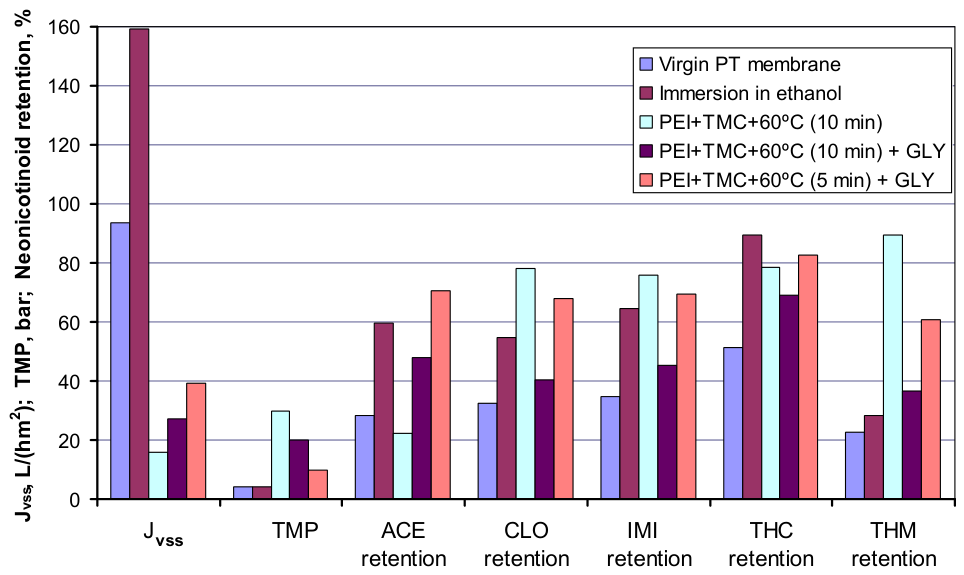
Figure 2.
Neonicotinoid retention percentages obtained during filtration of real water matrices with virgin PT and HL membranes, and modified PT membranes by polymerization using PEI+TMC+60°C+GLY.
Figure 2.
Neonicotinoid retention percentages obtained during filtration of real water matrices with virgin PT and HL membranes, and modified PT membranes by polymerization using PEI+TMC+60°C+GLY.
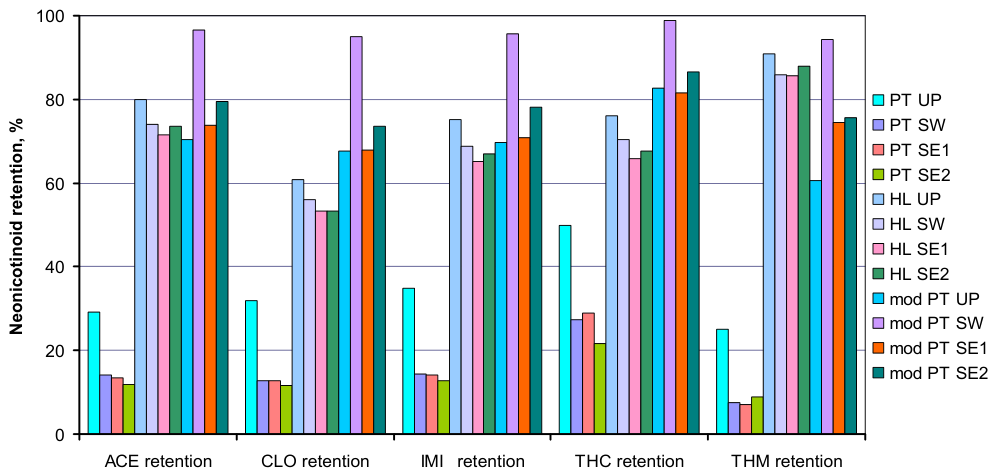
Figure 3.
Retention percentages of water pollution parameters (A254nm, turbidity, and DOC) during filtration of real water matrices with virgin PT and HL membranes, and modified PT membranes by polymerization using PEI+TMC+60°C+GLY.
Figure 3.
Retention percentages of water pollution parameters (A254nm, turbidity, and DOC) during filtration of real water matrices with virgin PT and HL membranes, and modified PT membranes by polymerization using PEI+TMC+60°C+GLY.
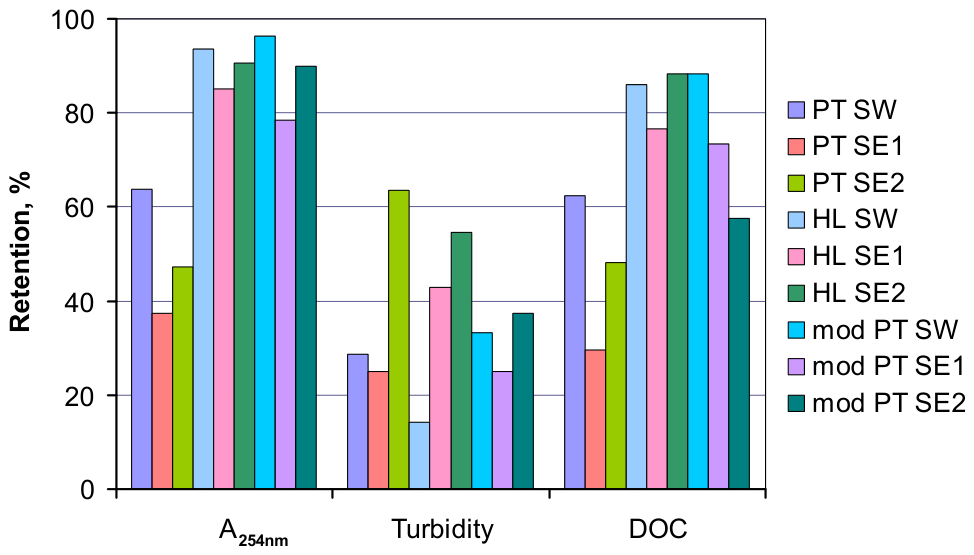

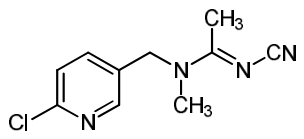
Table 1.
Physico-chemical properties of selected neonicotinoids.
| Neonicotinoid | Chemical Structure | MW, g/mol | log KOW1 | Charge at pH 6-9 | Vm1, cm3 |
|---|---|---|---|---|---|
| Acetamiprid (ACE) C10H11ClN4 |
 |
222.68 | 0.62 | neutral | 189.6 |
| Clothianidin (CLO) C6H8ClN5O2S |
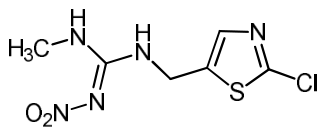 |
249.68 | 0.40 | neutral | 147.8 |
| Imidacloprid (IMI) C9H10ClN5O2 |
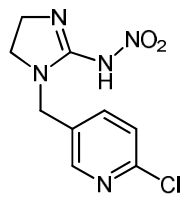 |
255.67 | -0.43 | neutral | 160.1 |
| Thiacloprid (THC) C10H9ClN4S |
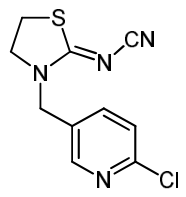 |
252.73 | 0.55 | neutral | 177.4 |
| Thiamethoxam (THM) C8H10ClN5O3S |
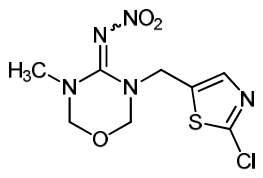 |
291.71 | -1.16 | neutral | 170.2 |
1 Octanol-water distribution coefficient (log KOW) and molar volume (Vm) have been determined with the software ACD/ChemSketch.
Table 2.
Properties of target membranes.
| Membrane | Material1 | MWCO, Da | pH | Contact angle, ° | PWP, L/h/m2/bar |
|---|---|---|---|---|---|
| MW | PAN | 50000 | 2 - 9 | - | 134.5 ± 4.3 |
| PT | PES | 5000 | 2 - 11 | 52.8 ± 2 | 24.3 ± 2.3 |
| GK | TF | 2000 | 2 - 11 | 44 ± 3 | 3.9 ± 0.4 |
| HL | TF | 150 - 300 | 3 - 9 | 30 ± 3 | 8.8 ± 0.6 |
1 PAN: Polyacrylonitrile; PES: Polyethersulfone; TF: Polysulfone-polyamide thin-film composite.
Table 3.
Results obtained in the membrane filtration experiments performed with UP water.
| MW | PT | GK | HL | ||
|---|---|---|---|---|---|
| TMP, bar | 2 | 4 | 6 | 20 | |
| Jw1, L/(h m2) | 269.0 | 95.2 | 23.7 | 177.6 | |
| Jvss, L/(h m2) | 256.5 | 97.6 | 24.9 | 186.6 | |
| Jw2, L/(h m2) | 275.7 | 102.0 | 25.9 | 185.2 | |
| Jvss/Jw1 | 0.95 | 1.03 | 1.05 | 1.05 | |
| Membrane recovery, % | 103 | 107 | 109 | 104 | |
| PWP, L/(h m2 bar) | 134.5 | 23.8 | 3.9 | 8.9 | |
| ACE | 5.5 | 29.3 | 11.8 | 79.9 | |
| Retention | CLO | 6.9 | 31.8 | 15.5 | 60.9 |
| at VRF 3, % | IMI | 7.3 | 34.7 | 14.2 | 75.1 |
| THC | 7.1 | 49.9 | 18.1 | 76.0 | |
| THM | 6.8 | 25.1 | 13.4 | 90.8 | |
| ACE | 8.1 | 30.5 | 12.9 | 11.9 | |
| Adsorption, | CLO | 8.3 | 33.0 | 14.7 | 12.7 |
| % | IMI | 9.1 | 35.3 | 14.5 | 13.8 |
| THC | 9.2 | 57.4 | 19.2 | 18.6 | |
| THM | 8.8 | 26.2 | 13.2 | 10.3 | |
Table 4.
Results obtained in the membrane filtration experiments performed with UP water using PT membranes modified by immersion.
Table 4.
Results obtained in the membrane filtration experiments performed with UP water using PT membranes modified by immersion.
| Blank | Hot water | 1 M NaOH | Abs. ethanol | 60% ethanol | |||||
|---|---|---|---|---|---|---|---|---|---|
| Storage time in cold water | 1 day | 7 days | 1 day | 7 days | 1 day | 7 days | 1 day | ||
| TMP, bar | 4 | 4 | 4 | 4 | 4 | 4 | 4 | 4 | |
| Jw1, L/(h m2) | 94.0 | 112.0 | 99.9 | 148.6 | 141.0 | 161.7 | 157.1 | 164.9 | |
| Jvss, L/(h m2) | 93.6 | 110.6 | 100.9 | 150.8 | 140.1 | 159.1 | 156.1 | 164.8 | |
| Jw2, L/(h m2) | 103.0 | 119.6 | 104.4 | 161.9 | 142.4 | 165.9 | 163.0 | 172.9 | |
| Jvss/Jw1 | 1.00 | 0.99 | 1.01 | 1.01 | 0.99 | 0.98 | 0.99 | 1.00 | |
| Membrane recovery, % | 110% | 107% | 105% | 109% | 101% | 103% | 104% | 105% | |
| PWP, L/(h m2 bar) | 23.5 | 28.0 | 25.0 | 37.1 | 35.3 | 40.4 | 39.3 | 41.2 | |
| ACE | 28.3 | 11.3 | 11.2 | 12.2 | 12.9 | 59.7 | 44.4 | 45.8 | |
| Retention | CLO | 32.6 | 12.3 | 12.6 | 12.7 | 14.1 | 54.9 | 44.0 | 43.9 |
| at VRF 3, % | IMI | 34.7 | 12.3 | 12.3 | 11.4 | 13.7 | 64.6 | 50.5 | 54.4 |
| THC | 51.3 | 16.0 | 19.7 | 21.4 | 19.1 | 89.3 | 76.5 | 78.2 | |
| THM | 22.6 | 10.3 | 9.5 | 10.9 | 12.2 | 28.4 | 28.9 | 21.8 | |
| ACE | 29.4 | 16.1 | 16.5 | 18.0 | 18.1 | 61.9 | 50.2 | 27.2 | |
| Adsorption, | CLO | 34.0 | 18.6 | 19.8 | 20.9 | 21.7 | 59.9 | 50.4 | 50.5 |
| % | IMI | 35.8 | 18.7 | 19.4 | 19.7 | 20.8 | 66.4 | 56.2 | 58.2 |
| THC | 55.3 | 33.0 | 32.7 | 36.4 | 32.6 | 87.6 | 76.7 | 78.1 | |
| THM | 26.3 | 9.7 | 9.9 | 12.3 | 14.8 | 31.4 | 32.8 | 27.2 | |
Table 5.
Results from experiments performed with PT membranes modified by polymerization using PEI+TMC+60°C. Influence of glycerol (15% ww) immersion post-treatment and ethanol immersion pre-treatment.
Table 5.
Results from experiments performed with PT membranes modified by polymerization using PEI+TMC+60°C. Influence of glycerol (15% ww) immersion post-treatment and ethanol immersion pre-treatment.
| Modification treatment | Blank | PEI+TMC + 60 °C |
PEI+TMC +60 °C + GLY (4h) |
Ethanol (24h) + PEI+TMC + 60 °C |
|
|---|---|---|---|---|---|
| TMP, bar | 4 | 30 | 20 | 8 | |
| Jw1, L/(h m2) | 94.0 | 16.0 | 26.6 | 65.0 | |
| Jvss, L/(h m2) | 93.6 | 14.4 | 27.1 | 25.5 | |
| Jw2, L/(h m2) | 103.0 | 14.0 | 24.8 | 24.5 | |
| Jvss/Jw1 | 1.00 | 0.91 | 1.02 | 0.39 | |
| Membrane recovery, % | 110% | 87% | 93% | 38% | |
| PWP, L/(h m2 bar) | 23.5 | 0.53 | 1.33 | 8.1 | |
| Operation time, min | 45 | 92 | 163 | 177 | |
| ACE | 28.7 | 78.0 | 79.5 | 82.8 | |
| Retention | CLO | 34.8 | 75.7 | 76.5 | 82.8 |
| at VRF 1.1, % | IMI | 37.7 | 78.6 | 83.2 | 84.8 |
| THC | 77.6 | 89.4 | 94.0 | 95.6 | |
| THM | 17.5 | 75.1 | 65.0 | 74.3 | |
| ACE | 28.3 | - | 47.9 | 55.5 | |
| Retention | CLO | 32.6 | - | 40.3 | 53.0 |
| at VRF 3, % | IMI | 34.7 | - | 45.1 | 54.3 |
| THC | 51.3 | - | 68.9 | 70.5 | |
| THM | 22.5 | - | 36.5 | 46.2 | |
| ACE | 29.4 | - | 34.7 | 34.1 | |
| Adsorption, | CLO | 34.0 | - | 29.4 | 25.9 |
| % | IMI | 35.8 | - | 64.6 | 73.6 |
| THC | 55.3 | - | 56.1 | 47.2 | |
| THM | 26.3 | - | 19.4 | 19.8 | |
Table 6.
Results obtained in the filtration experiments performed with the PT membrane modified by polymerization using PEI+TMC+60°C+GLY with several water matrices.
Table 6.
Results obtained in the filtration experiments performed with the PT membrane modified by polymerization using PEI+TMC+60°C+GLY with several water matrices.
| UP | SW | SE1 | SE2 | ||
|---|---|---|---|---|---|
| TMP, bar | 10 | 10 | 10 | 10 | |
| Jw1, L/(h m2) | 39.8 | 21.1 | 22.1 | 27.9 | |
| Jvss, L/(h m2) | 39.3 | 20.6 | 18.8 | 25.5 | |
| Jw2, L/(h m2) | 37.1 | 21.0 | 21.9 | 27.4 | |
| Jvss/Jw1 | 0.99 | 0.98 | 0.85 | 0.92 | |
| Membrane recovery, % | 93% | 100% | 99% | 98% | |
| PWP, L/(h m2 bar) | 4.0 | 2.1 | 2.2 | 2.8 | |
| ACE | 70.4 | 96.6 | 73.7 | 79.5 | |
| Retention | CLO | 67.8 | 94.9 | 67.8 | 73.7 |
| at VRF 3, % | IMI | 69.7 | 95.6 | 70.9 | 78.2 |
| THC | 82.6 | 99.0 | 81.6 | 86.5 | |
| THM | 60.7 | 94.3 | 74.6 | 75.7 | |
| Overall | ACE | 84.7 | 98.2 | 83.5 | 87.7 |
| retention | CLO | 84.1 | 97.5 | 80.3 | 83.8 |
| in 200 mL | IMI | 85.9 | 97.5 | 83.4 | 88.2 |
| of permeate, | THC | 95.2 | 99.5 | 89.0 | 92.5 |
| % | THM | 79.3 | 96.4 | 84.0 | 84.7 |
| ACE | 34.4 | 30.9 | 28.6 | 26.3 | |
| Adsorption, | CLO | 30.3 | 23.0 | 18.5 | 21.4 |
| % | IMI | 88.2 | 22.7 | 20.7 | 23.4 |
| THC | 51.7 | 42.2 | 42.9 | 37.4 | |
| THM | 28.4 | 19.1 | 34.1 | 15.6 | |
Disclaimer/Publisher’s Note: The statements, opinions and data contained in all publications are solely those of the individual author(s) and contributor(s) and not of MDPI and/or the editor(s). MDPI and/or the editor(s) disclaim responsibility for any injury to people or property resulting from any ideas, methods, instructions or products referred to in the content. |
© 2026 by the authors. Licensee MDPI, Basel, Switzerland. This article is an open access article distributed under the terms and conditions of the Creative Commons Attribution (CC BY) license (http://creativecommons.org/licenses/by/4.0/).
Copyright: This open access article is published under a Creative Commons CC BY 4.0 license, which permit the free download, distribution, and reuse, provided that the author and preprint are cited in any reuse.


