
Submitted:
20 July 2026
Posted:
21 July 2026
You are already at the latest version
Abstract
The construction industry is still one of the most dangerous industries around the world, and the safety management process within it continues to be highly hierarchical and designed by engineers, regulators, and site managers rather than those workers whose exposure to risks is the highest. In this paper, I argue that the asymmetry in the processes of design of safety is systemic and results from the intersection of hierarchy, power-distance of the nation, and subcontracting of multi-level nature which reduce both accountability and voice of the workers. Using the theoretical framework consisting of the analysis of the safety-voice, power distance, and STAMP literature in addition to structural analysis of the construction sector of Istanbul, this paper shows that the mechanisms of law, contract, and culture prevent the processes of feedback which are important for resilience-oriented safety management. Based on the thresholds of Turkish labor laws for union recognition, subcontracting data, and a case of worker protest on the construction of Istanbul’s largest infrastructure project, there are three mechanisms of exclusion identified in this paper: legal threshold of representation that excludes construction workers structurally, subcontracting chains that diffuse responsibility for safety results from workers who bear the risk, and organizational hierarchy that discourages safety voice long before reaching any channel. There is a list of design principles that re-integrate workers’ feedback into safety control structure suggested in this paper as a contribution to resilience engineering practice.
Keywords:
construction safety
; worker voice
; STAMP
; human-centred safety
; resilience engineer-ing
; safety governance
1. Introduction
Safety design for construction sites usually involves people that have nothing to do with operating scaffolds. Standards are set by the regulators, control measures are specified by the engineers, and instructions are issued by the site managers; in most formalized safety frameworks, the task for workers is compliance with such designs. Such a distribution of roles raises no questions but, on the contrary, contradicts the increasing awareness among the researchers in both construction safety and resilience engineering that it is precisely the people working close to hazards that are able to spot them at their initial stages. The main question posed by this paper is quite simple to formulate but hard to answer: Who designs safety of construction sites and how does safety design that occurs far away from the place of risk affect safety outcomes?
The risks are quite real. Even under the conditions of effective regulation, the probability of injuries increases significantly in relation to construction workers due to the division of work along the subcontracting chains, when the highest tier contractors shift the most hazardous tasks to lower tier companies that are less accessible and able to invest in safety [1]. At the places where subcontracting is combined with poor labor representation, such structural risk stratification is additionally enhanced by the lack of feedback channels that allow for hazard emergence detection.
Turkey serves as a very good example of how such effects multiply. In major constructions, it has become a rule for every part of the construction process to be divided and assigned to different subcontractors, who procure their OHS services according to the legislation allowing this approach. This approach is connected to high levels of accidents at work, unemployment, and a structurally immature system of inspections and controls [2]. The problem is not a minor empirical oddity: there were over 1.4 million registered construction workers in Turkey in January 2022, and the sector has consistently had one of the highest fatality rates of occupational accidents among comparable countries. Official national-level analyses of accidents in Turkey show a statistically significant increase from 2013 to 2020 despite increasing awareness of undercounting due to informality [2,3]. The persistence of this record despite decades of regulatory reform suggests that the problem is not primarily a lack of rules, but a lack of channels through which the people exposed to risk can shape how that risk is managed.
Recent research has begun to reframe construction safety through the lens of systems thinking, arguing that the transition from a purely technology-driven paradigm toward one that is human-centred and resilience-oriented is already underway conceptually, even if empirical grounding remains limited [4]. That literature operates primarily at the level of paradigm description: it documents that a shift from Industry-4.0-style technological optimisation toward Industry-5.0-style human-centred, resilience-oriented safety management is occurring across the field, without specifying the causal mechanism by which any particular site or sector fails to make that transition. This paper's contribution is at a different level of analysis: rather than describing the paradigm shift itself, it identifies a specific, testable mechanism, structurally suppressed upward feedback, that explains why the transition remains incomplete in a particular class of high-subcontracting, high power-distance contexts, and grounds that mechanism in a documented case rather than in paradigm-level description alone. This paper contributes to that reframing, but from a different angle than most of the literature associated with it. Rather than treating "human-centredness" primarily as a matter of ergonomic design or technology adoption, it treats it as a question of power: who holds the authority to define what counts as an acceptable risk, who is consulted before that definition is fixed, and what structural features of the industry make consultation more or less likely. It does so by combining three bodies of theory that are rarely brought together in construction safety research, namely safety voice, power distance, and the systems-theoretic accident model and processes (STAMP), and applying that combined lens to a structural analysis of the Istanbul construction sector, illustrated by a documented case of collective worker action at a major national infrastructure project.
2. Theoretical Framework
2.1. Safety Voice as a Structural, Not Only Individual, Phenomenon
Safety voice, defined as the act of speaking up about hazards in order to prevent harm, has become an established construct in occupational safety research. A systematic review integrating 48 studies found that safety voice occurs across contexts ranging from healthcare to aviation to construction, and synthesised 256 distinct antecedents of the behaviour into an ecological framework spanning individual, group, organisational, and hazard-specific levels of analysis [5]. Much of this literature, however, is disproportionately weighted toward the individual and dyadic levels of that framework, predicting whether a given worker speaks up as a function of psychological safety, leadership style, or personality, with organisational and institutional context entering mainly as background. This is valuable but incomplete: it explains why a given worker on a given day might or might not speak up, without explaining why an entire sector might be structurally organised so that speaking up rarely happens at all, regardless of individual disposition.
This paper treats safety voice instead as an emergent property of a control structure, following the logic developed in Section 2.3. Before making that connection explicit, it is necessary to establish why voice is unevenly distributed across hierarchical positions in the first place, which is where power distance becomes relevant.
This structural reading of voice has an established parallel outside safety science, in the industrial-relations concept of the "representation gap": the proportion of a workforce that would want formal representation, whether through a union or another channel, but is structurally excluded from it, a concept developed to explain declining union coverage in Britain and the United States and later extended to explain gaps in workplace voice more broadly [6]. The concept originates in the liberal-market, common-law industrial-relations systems of Britain and the United States, quite different institutionally from Turkey's more state-corporatist labour relations tradition; it is invoked here for its structural logic, that representation gaps are properties of institutional design rather than of individual worker preference, not for the specific British/American policy diagnosis that accompanied its original formulation. That literature's central insight maps directly onto this paper's claim that safety voice is a structural rather than individual phenomenon; Section 4.2 returns to this concept directly when analysing Turkish labour law's representation thresholds.
2.2. Power Distance and the Legitimacy of Speaking Up
Power distance, understood as the degree to which a culture accepts and expects unequal distribution of power [7], shapes more than how safety culture is experienced, a construct descending from the safety climate literature's original concern with workers' shared perceptions of how much their organisation genuinely prioritises safety [8]. It also shapes whether raising a concern is considered a legitimate act in the first place. A large comparative study across 21 national air traffic providers, covering over 13,500 staff, found that workers in countries with established values for hierarchy and power reported safety culture as less positive than those from countries with low power distance, and that the gap between how positively managers and frontline staff perceived safety culture widened specifically in high power-distance national contexts [9]. This is a structural finding in contrast to psychological: it demonstrates that actions motivated by power dynamics (actions like raising concerns, speaking up against unacceptable behavior, and communicating needs for improvements in safety measures) are simultaneously determined by one’s position in a hierarchical structure and the degree of social tolerance for differential power [9]. In the construction industry specifically, it means that this dynamic operates in interaction with a leader’s style. Thus, a 2025 study of paternalistic leadership of foremen on Chinese construction sites, based on a cross-sectional survey of 263 workers in the field, found significant power distance to mediate the connection between paternalistic leadership and both the safety climate and psychological safety of teams, with the effect being greater for workers experiencing high power distance [10]. In other words, power is not an extraneous variable controlled for in the safety culture studies but one of its mechanisms.
This is especially relevant to the hierarchical and patronizing construction industry in Turkey, where the relationship between foreman and workers on one hand and the relationship between contractor and subcontractors on another create the combination of steep hierarchical structure and social tolerance for the exercise of hierarchical power. If power distance increases the difference between managers and frontline workers in their perception of safety and reduces workers’ readiness to challenge the decisions made at higher levels, then any system of safety that relies on workers’ reporting of their observations cannot detect risks reliably.
2.3. Re-Reading STAMP as a Map of Blocked Feedback
The STAMP (System-Theoretic Accident Model and Processes) approach was first suggested as an alternative for the accident models that focused on failure in particular system components. Safety in this framework is presented as a control problem, not a question of the reliability of components: an accident happens when the hierarchical control structure does not provide necessary safety constraints to keep the system within safe bounds because of either ineffective top-down control actions or inadequate bottom-up feedback. A recent review of the history and application of STAMP in 2022 showed that while the approach is used for various fields (transportation, food safety, hazardous industries), the key feature of the model is its capacity to connect different causes of the accidents and to reveal relationships between the interrelated components in the system, rather than consider isolated failures of individual components. The systematic analysis of the practical use of STAMP in the built environment showed that, despite all these theoretical insights, industry cooperation in most studies was almost nonexistent.
The aspect of the STAMP model that is underutilized in this literature is its consideration of the feedback structure. In the conventional STAMP control structure, the commands go from high-level organizations to low-level ones; for safety, though, the feedback from the lower levels is necessary to know whether the safe state was achieved through these control actions. This paper's central theoretical move is to read this feedback channel not merely as an information-engineering problem but as a political one: the same hierarchical control structure that transmits instructions downward is also, in principle, the channel through which worker observations should travel upward, and it is precisely this channel that power distance, subcontracting fragmentation, and weak labour representation combine to narrow or sever. A STAMP-informed safety system that ignores who is structurally permitted to generate feedback, and who is structurally prevented from doing so, will misdiagnose why its control loops fail.
2.4. Resilience Engineering and the Cost of Centralised Control
This reframing connects naturally to the distinction between Safety-I and Safety-II articulated in the resilience engineering literature, a field established as a distinct paradigm in the mid-2000s [14]. Safety-I treats safety as the absence of unwanted outcomes and pursues it by identifying failure modes in advance and constraining behaviour to prevent them; Safety-II instead treats safety as the ability to succeed under varying conditions, achieved through the everyday adaptive performance of the people actually doing the work [15]. This distinction has direct implications for how authority should be distributed, beyond its philosophical interest. An analysis of the safety professional's role under this paradigm distinguishes two modes of safety management: centralised control, which aims to align an organisation and its people through decisions made at the centre, and guided adaptability, which aims to enable the organisation and its people to adapt safely to conditions that were never fully specified in advance [16]. That analysis found that safety professionals and their organisations remain overwhelmingly focused on the centralised-control mode, and that this focus can itself be detrimental to safety, since it under-uses the distributed judgement of the workforce as a safety resource rather than treating it as a compliance risk to be managed away [16]. Resilience engineering more broadly asks what technologies, cognitive systems, and organisational practices support a system's ability to adjust its functioning before, during, or after changes and disturbances, so that it can sustain required operations even after a major mishap or in the continuous presence of stress [17].
When put together, these three strands of theory provide us with a coherent hypothesis that suggests that safety performance is poor within hierarchical, subcontractor-based environments with high power distance, not due to a lack of regulation but because the necessary structural features for upward feedback, on which both STAMP’s control loop model and Safety II’s adaptive capabilities are based, do not exist. Figure 1 shows our coherent hypothesis framework, in which the progression from the three necessary structural features discussed in sections 2.1 and 2.2, through the blocked feedback process discussed in sections 2.3 and 2.4, and into the two distinct outcome paths explored in section 4 are shown.
3. Methods
In this study, the design used is a combination of theoretical integration and structure case analysis. In other words, instead of choosing between a conceptual design and an incident case study, a combination of both has been opted for. This is consistent with the research question, which aims to determine the reasons behind the suppression of worker voice through the structures in place within a certain sector.
The theoretical framework in Section 2 was constructed through a targeted synthesis of three literatures identified as jointly relevant to the research question: safety voice, power distance in safety culture, and STAMP-based systems safety, read alongside the resilience engineering distinction between Safety-I and Safety-II. Sources were selected for direct relevance to the mechanism under study, the structural determinants of upward safety feedback, rather than through an exhaustive systematic review protocol, consistent with the paper's aim of building an integrative theoretical bridge rather than mapping the full breadth of any one literature.
The structural case analysis in Section 4 draws on three categories of secondary evidence. First, sector-level statistics on occupational accidents, subcontracting prevalence, and informal employment in the Turkish construction sector, drawn from peer-reviewed occupational health literature and official social security data as reported in that literature. Second, the legal and regulatory architecture governing union recognition and collective bargaining in Turkey, drawn from labour law sources and comparative OECD data on union density. Third, a documented case of collective worker action, the September 2018 protests by construction workers at Istanbul's new airport project, reconstructed from contemporaneous reporting by international human rights organisations and labour bodies. The reason for choosing this case is not because it represents all construction sites in Istanbul, but because of the abundance of evidence provided about it through the observations of independent inspectors, which provides verified information on things like the frequency of inspections, underreporting of deaths, and the handling of workers’ representatives, which are hard to see otherwise. It is treated in this paper as an illustrative instance of structural dynamics that the sector-level data suggest are widespread, not as a representative sample in the statistical sense; this scope limitation is revisited in Section 6.
This selection strategy carries a specific trade-off that should be stated rather than left implicit. The Istanbul Airport project's scale and political prominence are precisely what generated the independent documentation this paper relies on, but that same prominence may make the suppression mechanism observed there unusually visible rather than unusually severe. A smaller, less politically salient site might exhibit the same underlying dynamic, power distance and subcontracting fragmentation narrowing the channel for upward feedback, through quieter mechanisms with no documentary trace at all: for example, the simple non-renewal of a complaining worker's short-term subcontract, rather than the mass detention documented in Section 4.4. If anything, this suggests the mechanism identified here is a conservative, lower-bound illustration of a dynamic that may be harder to detect, not necessarily milder, at less visible sites. The paper does not have evidence to confirm this directly, and it is flagged here as an open question rather than a claim, but it is the correct way to read the relationship between this case's visibility and its generalisability. No primary data collection (interviews, surveys, or site access) was undertaken for this study; all evidence is drawn from published, citable secondary sources.
4. Structural Analysis of Istanbul's Construction Sector
4.1. A Sector Organised Around Fragmentation
The Turkish construction sector expanded rapidly in the post-2000 period, at its peak contributing close to a tenth of GDP and around seven percent of national employment, with over 1.4 million registered construction workers recorded as of January 2022 [2]. Within this expansion, subcontracting became the dominant organising principle of employment: in large-scale building projects it is now standard practice for almost every component of the construction product to be divided into pieces and outsourced to separate subcontractors, each operating under its own arrangements for supervision and, critically, for OHS [2]. Turkish OHS legislation compounds this fragmentation by granting subcontractor firms the freedom to arrange their own OHS services independently of the main contractor, which means that a single site can host multiple, uncoordinated OHS regimes operating side by side [2].
This is not a uniquely Turkish phenomenon: multi-tiered subcontracting, the subletting of work tasks that creates a hierarchy or pyramid of contractual relationships, has grown substantially since the mid-1970s across many high-hazard industries, and a growing international research base has linked it to higher injury rates, disease exposure, and mental health problems in sectors including construction, mining, and trucking [18]. What distinguishes the Turkish case is the scale at which this dynamic combines with informality: estimates place unregistered and purely informal work at around 35 to 40 percent of the sector, alongside widespread unpaid family labour and contract manufacturing arrangements that further obscure who is actually responsible for a given worker's safety on a given day [19]. National trend analysis of Turkish occupational accident data covering 2013 to 2020 found a statistically significant positive trend over that period, even as awareness of undercounting linked to informal employment grew [3], and sector-specific analysis of Turkish shipyards, a trade that shares construction's reliance on subcontracting and its physical hazard profile, found that having workers from multiple different subcontracting firms present on the same site simultaneously worsened work schedules, organisational integration, and coordination in ways that negatively affected safety [20]. Broader accounts of occupational health ethics in Turkey describe the country's informal and subcontracted sector as very large and firmly established, and link it directly to severe, sometimes fatal, occupational disease outbreaks in poorly regulated conditions [21].
One dimension of this workforce that the framework developed in Section 2 does not, on its own, capture is demographic composition, and specifically the prevalence of internal, rural-to-urban migrant labour. Large Turkish construction projects have historically drawn heavily on internal migrant workers moving from rural provinces to major urban and infrastructure projects, a pattern widely noted in accounts of the sector, though sector-wide, project-level data on the specific demographic composition of any single site's workforce, including the Istanbul Airport project discussed in Section 4.4, is not systematically published and cannot be independently verified from the sources this paper relies on. This matters because migrant status, whether internal or international, is documented elsewhere in the global construction-labour literature as a mechanism of voice suppression in its own right, operating through channels, unfamiliarity with local grievance procedures, employer-controlled housing and transport, and a more acute fear of job loss given fewer local alternatives, that are analytically distinct from the power-distance and subcontracting mechanisms this paper foregrounds. Comparable qualitative research across Italy, Spain, and the UK has independently identified several of these same channels, including diluted safety standards moving down the subcontracting chain and language and cultural barriers to raising concerns, as recurring, cross-nationally consistent challenges facing migrant construction workers specifically [22]. The paper's framework should therefore be read as identifying mechanisms that plausibly operate in addition to, and interact with, workforce composition effects that a dedicated study with direct site-level demographic data would be needed to disentangle.
4.2. A Legal Architecture that Structurally Excludes Construction's Workforce from Representation
If subcontracting fragments responsibility for safety, Turkish labour law compounds the effect by making collective representation exceptionally difficult for a workforce organised this way to achieve. Under the Trade Unions and Collective Bargaining Agreements Law (Law No. 6356), a union seeking authorisation to bargain collectively must simultaneously clear two thresholds: it must represent at least one percent of the total registered workforce in the relevant industry nationwide, and it must also represent either a majority of employees at a specific workplace or at least 40 percent of employees across an enterprise's multiple workplaces [23]. Where short-term subcontracting, scattered worksites, and an informal employment sector which, by its nature, remains excluded from the “registered” labor force on which such thresholds are based are features of this industry, the double standard serves as a structural hurdle rather than simply a logistical difficulty: laborers who are moved around among different subcontracting companies every few months at worksites that begin and end within a single project cycle are the very laborers unable to gain the continuity of membership needed for such thresholds.
The impact of this can be seen in general statistics. The trade union density rate in Turkey stood at six percent, according to OECD comparative figures, and is thus one of the lowest among OECD countries [24]. Detailed national analysis found that the gap between formal union membership and workers actually able to exercise the right to collective bargaining widened from 1.6 percentage points in 2012 to 3.7 points in 2020, meaning that a growing share of workers who do hold union membership are nonetheless unable to bargain collectively because of the authorisation mechanism itself [25]. Even where unions have made membership gains, as in the case of public-sector subcontracted workers who accounted for a large share of union growth in the past decade, the underlying employment relationship, subcontracted, insecure, and dependent on repeated re-authorisation, limits how durable that representation can be [25]. International labour bodies monitoring the sector have documented outsourcing as a direct threat to union density and collective bargaining, describing management tactics in some firms that include dismissing key union organisers, alongside broader patterns of low unionisation and low bargaining power tied to Turkey's high rates of subcontracting and unregistered work [2,26]. This matters for safety outcomes specifically, beyond its relevance to labour relations more broadly: comparative research on worker representation in health and safety has found that the presence and strength of trade union backing is one of the most consistent predictors of whether formal safety representation structures actually function as intended, rather than existing only on paper [27].
4.3. The Limited Authority of the Safety Specialist Inside this Structure
A further mechanism narrows the feedback channel even where formal OHS structures exist on paper. Turkish OHS legislation requires the assignment of OHS professionals, but because subcontractors are legally permitted to arrange their OHS services independently of the principal contractor, on-site specialists and inspectors operate within a structure that is difficult to coordinate across a multi-employer site, limiting their practical authority to compel action once a hazard is identified [2]. In this regard, there is a paradox that results from the situation presented here: despite the OHS professional having identified the hazard correctly, it could be a completely different subcontracting firm responsible for remediation that is not vested in the matter, hence the inability of the worker to reach the relevant people.
4.4. Illustrative Case: Worker Protest at Istanbul's New Airport Construction Site
The Istanbul airport project, a among the largest infrastructure projects implemented in Turkey in the reviewed period, shows how all the above features function in reality. Implemented on the basis of the Build-Operate-Transfer scheme through an international consortium, the project involved some 35,000 to 40,000 employees working at its peak construction stage [28]. According to the independent, on-the-record testimonies gathered by Human Rights Watch, the head of the trade union of the construction workers on the site, Dev Yapı-İş, stated at least 38 work-related fatalities as of September 2018, alongside many other injuries, which he described as preventable accidents [29]. Depending on the organization reporting them and the time of their reporting, the number of fatalities on the site varied quite a lot. The number estimated initially by the labor ministry is 27, whereas according to the answer given to a parliamentary question by the Istanbul Provincial Social Security Directorate, there were 52 fatal work-related accidents registered on the site during the years 2013-2018 [28,30]. The very fact of the difference in official estimates provided by different organs of the same state apparatus is illustrative per se as it signals an extremely fragmented fatality tracking and reporting system.
The control structure described above is depicted schematically in Table 1 using the terminology of STAMP. In this context, the case becomes not just a catalogue of complaints but a control structure in which almost all upward channels are either missing or weak or, in the case of the one actually used, actively blocked. This structure is depicted graphically in Figure 2 below.
Independent audit activity at the site was correspondingly thin. According to social security officials' own account, the site had been inspected 22 times between 2013 and 2018, but only two of those inspections were scheduled in advance; the remainder were triggered by complaints, meaning that in the absence of a worker or bystander raising a concern, the site's safety performance was essentially unaudited for most of a five-year construction period [30]. This falls well short of the international benchmark set by the ILO's Labour Inspection Convention, which Turkey has ratified and which requires workplaces to be inspected "as often and as thoroughly as is necessary" to secure effective enforcement, a standard understood to require a substantial proactive, scheduled component rather than reliance on complaints alone [32]. This is consistent with, though on its own does not conclusively prove, the theoretical claim advanced in Section 2.3: in a system where the great majority of external safety checks are complaint-triggered rather than scheduled, the entire audit function is downstream of worker willingness to raise a formal complaint, which is exactly the channel that Section 2.2's power-distance literature predicts will be least used in a high power-distance, hierarchical setting.
Figure 3.
(A) Composition of the 22 inspections recorded at the Istanbul Airport site, 2013–2018, by type [30]. (B) Trade union density in Turkey compared with the OECD average, 2023/24 [24,33]. The two panels jointly illustrate the audit and representation gaps documented in Section 4.2 and Section 4.4.
Figure 3.
(A) Composition of the 22 inspections recorded at the Istanbul Airport site, 2013–2018, by type [30]. (B) Trade union density in Turkey compared with the OECD average, 2023/24 [24,33]. The two panels jointly illustrate the audit and representation gaps documented in Section 4.2 and Section 4.4.
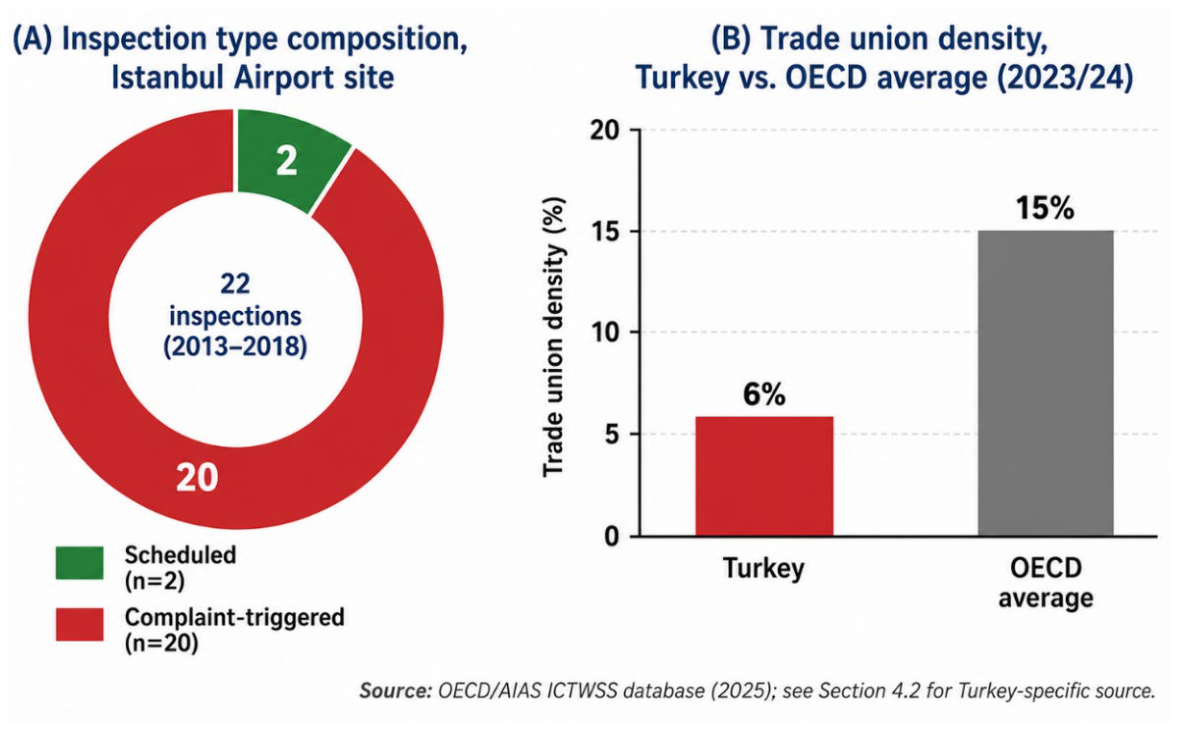
When workers did attempt to use that channel collectively, in a strike and protest action on 14 September 2018 triggered by unsafe transport, unpaid wages, and unsanitary living conditions, the response documented by independent monitors was not investigation of the underlying hazards but suppression of the workers who raised them: several hundred workers were detained overnight, and Amnesty International reported that 31 workers and trade unionists, including representatives of the site union İnşaat-İş and the head of Dev Yapı-İş, were held in pretrial detention for approximately two months on charges related to obstructing work and resisting security forces during the protest [31]. Another international study undertaken by a trade union regarding the same project found out that Turkey has ratified the core conventions of the International Labour Organization with regard to freedom of association and the right to organize and collective bargaining [28]. Without being related to this specific issue, the supervising bodies of the International Labour Organization, on various occasions, have raised issues related to Turkey’s ratification of these conventions and the problems encountered in representing the trade unions among some categories of workers [34]. It seems that the existing tension in this particular case is just another episode of this ongoing trend. The case is consistent with, and illustrates with unusual documentary clarity, the mechanism this paper's framework predicts: when the routine channels for feedback are structurally too narrow to carry information about a genuinely dangerous system, as evidenced by the near-total reliance on complaint-triggered inspection, and workers escalate to the one channel still available to them, collective action, the response can be to close that channel too, rather than to treat the escalation itself as safety-relevant feedback about a system operating outside its safe boundaries.
This is not the only plausible explanation for the case's fatality record, and it is worth stating the strongest alternative explicitly rather than leaving it unaddressed. The project was built under extreme schedule compression, publicly celebrated at its opening as having been completed in 42 months against a comparable European airport project the same source described as taking considerably longer, and involved close to 40,000 workers on a single site at peak construction [28]. Extreme schedule compression and unprecedented single-site scale are independently plausible drivers of elevated fatality rates in construction, essentially irrespective of any power-distance or voice-suppression mechanism: classic sociological accounts of accidents in complex, tightly coupled systems suggest that scale and time pressure of this kind elevate risk largely on their own, through unpredictable interactions among components that no single actor fully oversees [35]. A project moving this fast with this many workers concentrated on one site would likely show both elevated risk and inspection capacity that could not keep pace with the site's growth, even under stronger labour representation. This paper's framework and a speed-and-scale explanation are not mutually exclusive, and the evidence presented here cannot cleanly separate their relative contributions; a single documentary case study is not the right instrument for that decomposition, and disentangling them is precisely the kind of question the multi-site quantitative research proposed in Section 6 would need to address. What speed and scale alone do not explain, however, is why the specific response to workers' collective raising of concerns was detention rather than, for example, schedule adjustment or a safety stand-down; that response is better explained by the power-distance and representation-suppression mechanisms this paper foregrounds than by construction pace on its own, which is the narrower but more defensible claim this case actually supports.
This narrative draws entirely on third-party human-rights and labour-body documentation (Human Rights Watch, Amnesty International, the ITUC, and Turkish state social security data as reported by independent media); it has not been independently re-verified by the author beyond cross-checking consistency across these sources, and should be read with that provenance in mind.
A further factor worth naming explicitly is the broader political climate surrounding the September 2018 protest. Turkey's extended state of emergency, declared after the July 2016 coup attempt, had only been lifted some two months earlier, and the period was widely characterised by heightened state responses to public assembly and labour organising well beyond the construction sector specifically. The detention response documented above should therefore be read against this general political backdrop and not solely as a construction-sector-specific instance of power-distance-driven feedback suppression. This qualifies, in particular, Principle 4 in Section 5, which draws more heavily on this single episode than the paper's other three principles do on their respective evidence bases (Section 4.1, Section 4.2 and Section 4.3); the routine, non-episodic evidence for suppressed feedback, the inspection ratio, the fragmented OHS authority, the representation thresholds, does not depend on this specific protest and is not affected by this qualification.
5. Discussion: Design Principles for Redistributing Power in Safety Control Structures
The Istanbul case and the sector-level statistics that contextualise it point toward a common conclusion: the technical vocabulary of safety management, hazard identification, control measures, audit cycles, is fully present in the Turkish construction sector's formal regulatory architecture, yet the structural preconditions for that vocabulary to function are largely absent for the workforce it is meant to protect. This section draws out what a STAMP- and resilience-engineering-informed response to that gap would look like, framed as design principles rather than policy recommendations in the narrow sense, since the intent is to identify what any safety control structure operating under similar conditions of subcontracting fragmentation and high power distance would need to incorporate.
These principles concern the worker-management control relationship specifically, and are deliberately narrower than a complete systems-thinking account of the site would require. A fuller account would also model subcontracting firms' own position in the control structure, squeezed between principal-contractor pricing and their own safety obligations in ways that plausibly drive some of the corner-cutting this paper attributes to voice suppression, and the state labour inspectorate's own resourcing constraints, which may limit scheduled-inspection capacity for reasons unrelated to construction-sector power dynamics specifically. Both are treated here as boundary conditions on the four principles below rather than as targets for redesign in their own right, since the available evidence does not extend to their internal constraints.
- Principle 1: Treat complaint-triggered inspection as a diagnostic failure, not a baseline. The finding that only two of 22 inspections at the airport site over five years were scheduled rather than complaint-driven should not be read as evidence that the complaint mechanism was working; it should be read as evidence that the scheduled-inspection function had effectively collapsed, leaving the entire external audit burden on a channel that the power-distance literature predicts will be underused precisely where it is most needed [9,10]. A resilience-oriented system would treat a low ratio of scheduled to complaint-triggered inspections as an early-warning indicator in its own right, analogous to a leading rather than lagging safety metric, and would investigate why the scheduled function is not generating findings independently of whether complaints arrive. As a hypothesis for testing and not merely as a diagnostic interpretation: sites where there is a single, overarching authority responsible for OHS for the entire site (Principle 2), will have a greater number of inspections on a schedule basis as opposed to inspections that arise out of complaints and a lesser average delay from the time when the hazard first occurs to when the first recorded inspection takes place compared to other sites, where each subcontractor manages their OHS service requirements separately.
- Principle 2: Decouple OHS authority from subcontractor employment relationships. In terms of Turkish legislation, each individual subcontractor is currently allowed to arrange its own OHS activities, leading to situations where the person detecting an OHS problem and the body responsible for addressing it may find themselves belonging to entirely separate organizational hierarchies. Thus, in such a case, the major contractor at the construction site does not have any direct obligation to ensure that these hierarchies will be coordinated [2]. On the contrary, an effective control system corresponding to the STAMP principles should include a single safety controller within the site having the necessary powers to address the problem reported by a particular employee regardless of his subcontractor.
- Principle 3: Build representation thresholds around how construction workers actually work, not how factory workers do. However, the provisions concerning dual citizenship and employment under Law No. 6356 have not been designed to take into account a mobile and temporary workforce. The result of this is that, regardless of intentions, they work to make union representation difficult to achieve, especially in the very sector where subcontracting precludes informal complaint mechanisms [25,23]. In the terms introduced in Section 2.1, this is a textbook representation gap [6]: a workforce that plausibly wants representation but is structurally prevented from sustaining it by thresholds designed around a different, more stable pattern of employment. Sectoral or project-based representation mechanisms, of the kind that already exist in some other high-subcontracting industries, would allow representation to track the worker rather than the employer of the month, without requiring wholesale reform of the general labour relations framework.
- Principle 4: Recognise collective action as safety feedback, not merely a labour dispute. The response to the September 2018 protest, treating the escalation itself as the problem to be contained rather than as information about the underlying hazard profile of the site, is the clearest illustration in this case of what STAMP would characterise as feedback suppression at the highest level of the control structure [12,31]. This is also an instance of what the just-culture literature identifies as a more general organisational reflex: responding to a safety-relevant disclosure with blame or punishment rather than investigation, which reliably teaches a workforce to stop disclosing rather than to stop taking risks [36]. As noted in Section 4.4, this specific episode should be read alongside Turkey's broader political climate at the time, and this principle accordingly rests more heavily on a single case episode than Principles 1–3 do on their sector-wide evidence base. A genuinely resilience-oriented approach, consistent with the Safety-II literature's emphasis on treating adaptive worker behaviour as a resource rather than a threat to be managed [15,16], would treat large-scale, coordinated worker concern as a signal warranting the same investigatory seriousness as a near-miss report, rather than as a matter to be resolved through detention of the workers who raised it.
None of these four principles demands any novel technologies, regulations, or theory; what it demands is to redesign the roles of those who should produce, transmit and use relevant information in a particular hierarchical system of control. Ultimately, this represents the key thesis of the present paper: the lack of safety on building sites in the environment with high subcontracting and high power distance cannot be attributed to the lack of rules, but to the lack of feedback in those rules.
6. Limitations and Future Research
The current study identifies a number of limitations, which affect the robustness of the conclusions drawn above. The first of these concerns the reliance on a case analysis based on a unique, but highly detailed illustrative example – while the aggregate statistics in sections 4.1 and 4.2 clearly suggest that the underlying structural dynamics are widespread, the specific pattern of events that occurred at the Istanbul Airport project site cannot be generalized mechanically to all other projects in the sector, especially since smaller-scale projects with less publicity may display other dynamics, even if not necessarily less intense. The second limitation refers to the absence of primary data in the form of direct interviews conducted with construction workers, subcontractor managers, OHS experts, and labor inspectors; this lack prevents the suggested mechanisms from being tested against the firsthand experiences of those concerned. Third, while the theoretical framework of the paper has been built on extant literature, no hypothesis testing was done as part of the paper – even though the framework proposed in section 2 provides an evidence-consistent account of why hazard information is silenced in the construction industry, a quantitative test of the relationship between power distance, subcontracting depth, and concrete safety outcomes will require a separate study, ideally based on site-level data on inspection rate, subcontracting stage, and workers' reporting of hazards. Such a study can certainly be pursued as a follow-up to the one presented above.
7. Conclusion
Construction safety systems tend to be developed from the perspective of those insulated from the risks involved. As the current paper suggests, it is not just professional practice, but a structural property generated by the interrelation between the hierarchies of organization, the country-specific power-distance culture, and subcontracting fragmentation. At the same time, the same combination may be analyzed using the feedback loop structure of the systems-theory accident model. In the context of construction industry in Istanbul, this approach allows us to reveal the peculiarities ignored by the statistical information gathered for regulatory purposes: a sector operating according to the laws, having its occupational health and safety experts and inspection procedures and still experiencing high number of fatalities; an almost complaint-only-triggered inspection process; an example when the joint raising of the safety issue led to arrest instead of investigation. Human-centered redesign of construction safety systems, taking into account the trends outlined in the existing construction safety literature, should involve not only implementation of digital technologies and ergonomic improvements within the established authority structure. There is a need to analyze, from the system design standpoint, whose speech will be heard, whose speech will be listened to and which structural, legal, contractual and organizational modifications have to be made to include the voice of the worker in the scaffold in the conversation.
References
- CPWR – The Center for Construction Research and Training. Measuring Injuries Along the Subcontracting Chain in the U.S. Construction Industry; CPWR: Silver Spring, MD, USA, 2024. [Google Scholar]
- Yıldırım, N.; Gültekin, D. An Institutional System Proposal for Advanced Occupational Safety and Labor Standards in the Turkish Construction Industry. Int. J. Environ. Res. Public Health 2022, 19, 15113. [Google Scholar] [CrossRef] [PubMed]
- Isik, V.; Yilmaz Isikhan, S. Trend analysis of occupational accidents during 2013–2020 based on various characteristics in Turkey. Work 2025, 81, 2086–2096. [Google Scholar] [CrossRef] [PubMed]
- Zou, J.; Mohandes, S.R.; Cheung, C.; Rahbarimanesh, A.; Majumdar, A.; Arashpour, M. From industry 4.0 to industry 5.0 in construction safety management: a comparative systematic review. Saf. Sci. 2026. [Google Scholar] [CrossRef]
- Noort, M.C.; Reader, T.W.; Gillespie, A. Speaking up to prevent harm: A systematic review of the safety voice literature. Saf. Sci. 2019, 117, 375–387. [Google Scholar] [CrossRef]
- Heery, E. The representation gap and the future of worker representation. Ind. Relat. J. 2009, 40, 324–336. [Google Scholar] [CrossRef]
- Hofstede, G. Culture's Consequences: International Differences in Work-Related Values; Sage: Beverly Hills, CA, USA, 1980. [Google Scholar]
- Zohar, D. Safety climate in industrial organizations: Theoretical and applied implications. J. Appl. Psychol. 1980, 65, 96–102. [Google Scholar] [CrossRef]
- Tear, M.J.; Reader, T.W.; Shorrock, S.; Kirwan, B. Safety culture and power: Interactions between perceptions of safety culture, organisational hierarchy, and national culture. Saf. Sci. 2020, 121, 550–561. [Google Scholar] [CrossRef]
- Wang, L.; Luo, X.; Li, H.; Chen, H. The impact of foremen's paternalistic leadership on construction workers' safety behaviors: considering the effects of team safety climate, workers' psychological safety and power distance. Front. Public Health 2025, 13, 1633467. [Google Scholar] [CrossRef] [PubMed]
- Leveson, N. A new accident model for engineering safer systems. Saf. Sci. 2004, 42, 237–270. [Google Scholar] [CrossRef]
- Zhang, Y.; Dong, C.; Guo, W.; Dai, J.; Zhao, Z. Systems theoretic accident model and process (STAMP): A literature review. Saf. Sci. 2022, 152, 105596. [Google Scholar] [CrossRef]
- Ortega, N.; Sutrisna, M.; Paes, D.; Feng, Z.; Wing Yiu, K.T. A Systematic Literature Review of the Previous Applications to the Systems Theoretic Accident Model and Process (STAMP). In Creating Capacity and Capability: Embracing Advanced Technologies and Innovations for Sustainable Future in Building Education and Practice; Jelodar, M.B., Lovreglio, R., Feng, Z., Paes, D., Kumar, V., Siriwardana, C., Eds.; Springer: Cham, Switzerland, 2025. [Google Scholar]
- Hollnagel, E.; Woods, D.D.; Leveson, N. (Eds.) Resilience Engineering: Concepts and Precepts; Ashgate: Aldershot, UK, 2006. [Google Scholar]
- Hollnagel, E. Safety-I and Safety-II. Available online: https://erikhollnagel.com/ideas/safety-i%20and%20safety-ii.html (accessed on 11 July 2026).
- Provan, D.J.; Woods, D.D.; Dekker, S.W.A.; Rae, A.J. Safety II professionals: How resilience engineering can transform safety practice. Reliab. Eng. Syst. Saf. 2020, 195, 106740. [Google Scholar] [CrossRef]
- Hollnagel, E. What is Resilience Engineering? Resilience Engineering Association, 2019. Available online: https://www.resilience-engineering-association.org/blog/2019/11/09/what-is-resilience-engineering/ (accessed on 11 July 2026).
- Quinlan, M. Subcontracting, Repeat Latent Failures and Workplace Disasters. In Safe Performance in a World of Global Networks: Case Studies, Collaborative Practices and Governance Principles;SpringerBriefs in Applied Sciences and Technology; Le Coze, J.C., Journé, B., Eds.; Springer: Cham, Switzerland, 2024; pp. 27–36. [Google Scholar]
- Magazine, Hazards. #IWMD19 special report: Making work-related murders visible in Turkey. 2019. Available online: https://hazards.org/workingworld/turkeyreport.htm (accessed on 11 July 2026).
- Barlas, B.; Izci, F.B. Individual and workplace factors related to fatal occupational accidents among shipyard workers in Turkey. Saf. Sci. 2018, 101, 173–179. [Google Scholar] [CrossRef]
- Artvinli, F. The ethics of occupational health and safety in Turkey: responsibility and consent to risk. Acta Bioeth. 2016, 22, 111–118. [Google Scholar] [CrossRef] [PubMed]
- Shepherd, R.; Lorente, L.; Vignoli, M.; Nielsen, K.; Peiró, J.M. Challenges influencing the safety of migrant workers in the construction industry: A qualitative study in Italy, Spain, and the UK. Saf. Sci. 2021, 142, 105388. [Google Scholar] [CrossRef]
- International Comparative Legal Guides (ICLG). Employment & Labour Laws and Regulations Report 2026: Turkey. 2026. Available online: https://iclg.com/practice-areas/employment-and-labour-laws-and-regulations/turkey/ (accessed on 11 July 2026).
- Centre for Economic Policy Research (CEPR). The state of trade unions, employer organisations, and collective bargaining in OECD countries. VoxEU. 2018. Available online: https://cepr.org/voxeu/columns/state-trade-unions-employer-organisations-and-collective-bargaining-oecd-countries (accessed on 11 July 2026).
- Birelma, A. Trade Unions in Turkey 2022; Friedrich-Ebert-Stiftung: Berlin, Germany, 2022. [Google Scholar]
- IndustriALL Global Union. PROFILE: Unions in Turkey: holding the line for workers. 2016. Available online: https://www.industriall-union.org/profile-unions-in-turkey-holding-the-line-for-workers (accessed on 11 July 2026).
- Walters, D.; Nichols, T. Worker Representation and Workplace Health and Safety; Palgrave Macmillan: London, UK, 2007. [Google Scholar]
- International Trade Union Confederation (ITUC). Turkey's Istanbul New Airport: Occupational Safety and Health Violations and the High Cost to Workers' Lives; ITUC: Brussels, Belgium, 2018. [Google Scholar]
- Human Rights Watch. Construction Workers At Turkey's New Airport Jailed For Protesting Work Conditions. 2018. Available online: https://www.hrw.org/news/2018/09/21/construction-workers-turkeys-new-airport-jailed-protesting-work-conditions (accessed on 11 July 2026).
- Minute, Turkish. Official statement claims 52 workers died during construction of İstanbul's new airport. 2018. Available online: https://www.turkishminute.com/2018/12/03/official-statement-claims-52-workers-died-during-construction-of-istanbuls-new-airport/ (accessed on 11 July 2026).
- Amnesty International. Workers arrested in Turkey for protesting conditions at airport construction site must be released. 2018. Available online: https://www.amnesty.org/en/latest/press-release/2018/12/workers-arrested-in-turkey-for-protesting-conditions-at-airport-construction-site-must-be-released/ (accessed on 11 July 2026).
- International Labour Organization (ILO). Labour Inspection Convention, 1947 (No. 81); ILO: Geneva, Switzerland, 1947. [Google Scholar]
- OECD. Membership of Unions and Employers' Organisations, and Bargaining Coverage; OECD Publishing: Paris, France, 2025; Available online: https://www.oecd.org/en/publications/membership-of-unions-and-employers-organisations-and-bargaining-coverage_fe47107c-en.html (accessed on 11 July 2026).
- International Labour Organization (ILO). Summary of Observations on Ratified Conventions Related to Turkey; ILO: Geneva, Switzerland, 2024; Available online: https://www.ilo.org/resource/news/summary-observations-ratified-conventions-related-turkey (accessed on 11 July 2026).
- Perrow, C. Normal Accidents: Living with High-Risk Technologies; Basic Books: New York, NY, USA, 1984. [Google Scholar]
- Dekker, S. Just Culture: Balancing Safety and Accountability, 1st ed.; Ashgate: Aldershot, UK, 2007. [Google Scholar]
Figure 1.
A theoretical model that links the structure (power distance, fragmentation through subcontracting, lack of worker representation) with the silencing of safety voice, blocking of STAMP information, and different Safety-I and Safety-II outcomes. The red solid line is the outcome trajectory that has been identified empirically in Section 4; the green dotted line is the alternative outcome trajectory designed in Section 5.
Figure 1.
A theoretical model that links the structure (power distance, fragmentation through subcontracting, lack of worker representation) with the silencing of safety voice, blocking of STAMP information, and different Safety-I and Safety-II outcomes. The red solid line is the outcome trajectory that has been identified empirically in Section 4; the green dotted line is the alternative outcome trajectory designed in Section 5.
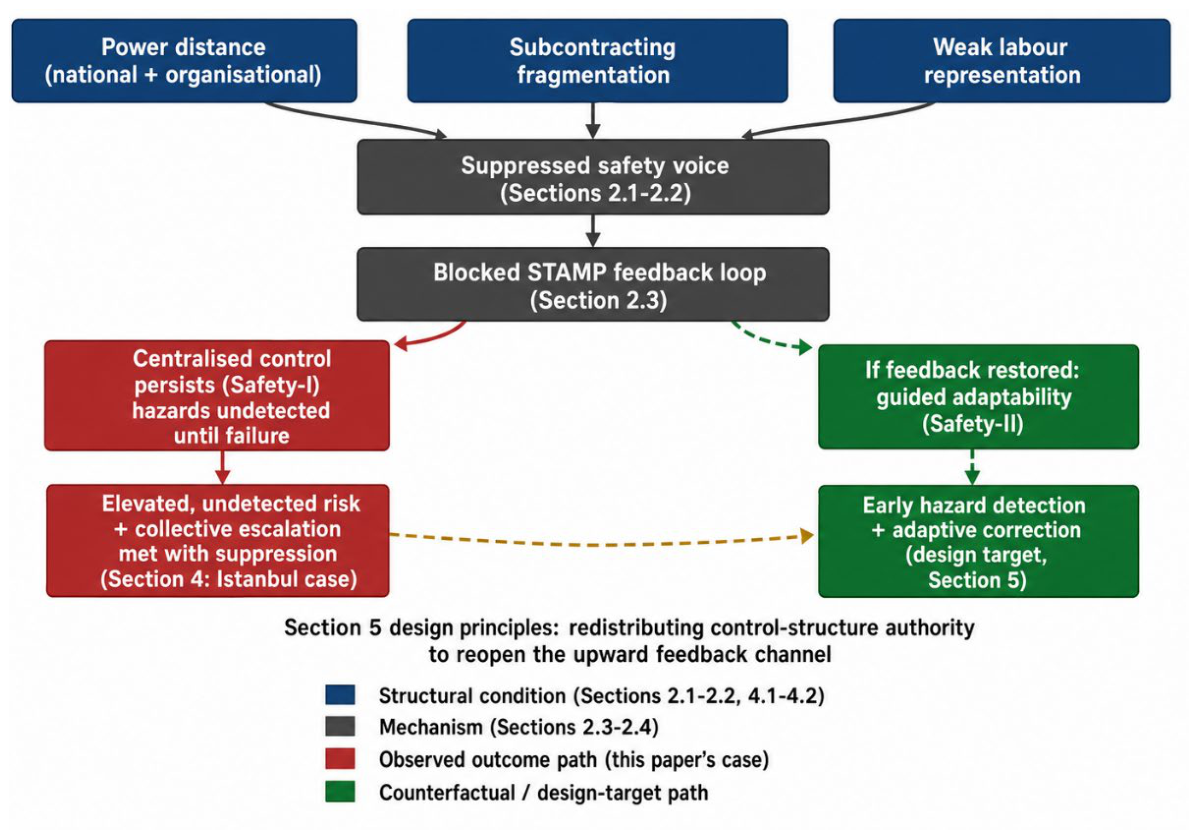
Figure 2.
Stamp Control Structure of the Istanbul Airport Case. The STAMP control structure of the Istanbul Airport case highlighting the downward control activities on the left hand side and the current status of upward feedback channels on the right hand side of the hierarchy, starting from the state level going down to the worker level. Compare Table 1 for the corresponding source citations.
Figure 2.
Stamp Control Structure of the Istanbul Airport Case. The STAMP control structure of the Istanbul Airport case highlighting the downward control activities on the left hand side and the current status of upward feedback channels on the right hand side of the hierarchy, starting from the state level going down to the worker level. Compare Table 1 for the corresponding source citations.
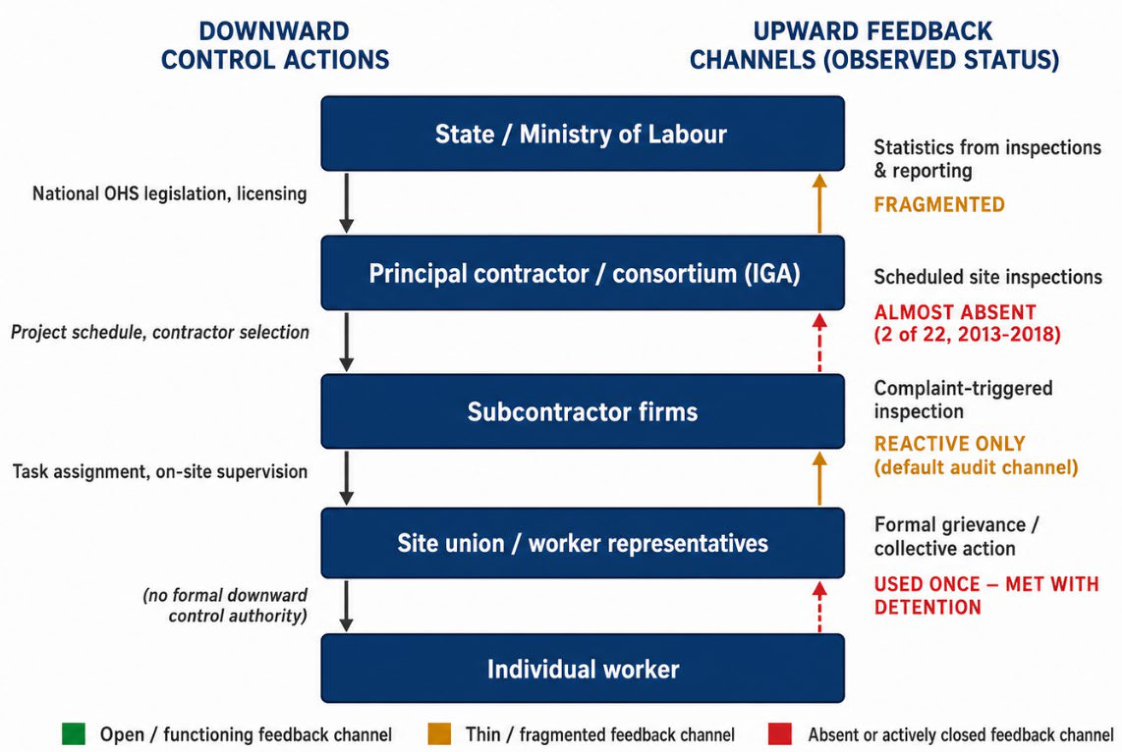

Table 1.
Schematic STAMP control structure for the Istanbul Airport case.
| Control level | Nominal downward control action | Nominal upward feedback channel | Observed status of feedback channel |
| State / Ministry of Labour | National OHS legislation, licensing | Statistics from inspections and reporting | Fragmented and inconsistent across state bodies (27 vs. 52 fatality counts) [28,30] |
| Principal contractor / consortium (IGA) | Project schedule, contractor selection | Scheduled site inspections | Almost entirely absent: 2 of 22 inspections scheduled, 2013–2018 [30] |
| Subcontractor firms | Task assignment, on-site supervision | Complaint-triggered inspection | Present but reactive only; carries the entire audit burden by default [30] |
| Site union / worker representatives | — | Formal grievance and collective action | Used once (14 September 2018 strike); met with detention rather than investigation [31] |
| Individual worker | N/A — base of control hierarchy | Informal, individual hazard reporting | No documented channel independent of the above [28,29,30,31] |
Disclaimer/Publisher’s Note: The statements, opinions and data contained in all publications are solely those of the individual author(s) and contributor(s) and not of MDPI and/or the editor(s). MDPI and/or the editor(s) disclaim responsibility for any injury to people or property resulting from any ideas, methods, instructions or products referred to in the content. |
© 2026 by the authors. Licensee MDPI, Basel, Switzerland. This article is an open access article distributed under the terms and conditions of the Creative Commons Attribution (CC BY) license (http://creativecommons.org/licenses/by/4.0/).
Copyright: This open access article is published under a Creative Commons CC BY 4.0 license, which permit the free download, distribution, and reuse, provided that the author and preprint are cited in any reuse.


