

Submitted:
17 July 2026
Posted:
21 July 2026
You are already at the latest version
Abstract
We develop a symmetric-polynomial framework for the study of one-parameter families of Poncelet triangles. For triangles inscribed in the unit circle and circumscribed about a central conic, we show that the elementary symmetric polynomials of the vertices depend linearly on a single complex parameter. It follows that every symmetric rational function of the vertices is a rational function of this parameter, providing a unified algebraic approach to the investigation of geometric invariants. As applications, we recover several known invariance results and establish new ones involving angles, orthic triangles, tangential triangles, polar circles, and other classical constructions. We also obtain explicit formulas and loci for several associated geometric objects, leading to new invariance phenomena within Poncelet families.
Keywords:
poncelet porism
; central conic
; symmetric polynomial
; orthic triangle
; tangential triangle
; polar circle
MSC: Primary: 51M04, 51N20; Secondary: 51M15
1. Introduction
One of the central themes in the geometry of Poncelet polygons is the existence of geometric invariant quantities. Numerous invariants have been discovered recently for families of Poncelet triangles, concerning classical centers, areas, associated circles and triangles.
The present paper is the third in a series devoted to the geometry of Poncelet triangles and central conics. In the first paper [1], we established generalized Chapple–Euler relations together with several related geometric properties. In the second paper [2], using Marden’s theorem, we developed an explicit parametrization for the associated Poncelet triangles inscribed in the unit circle and circumscribed about a central conic in elementary symmetric polynomials of its vertices. See Theorem 2. This parametrization provides the algebraic foundation for the present paper and allows the study of geometric invariants to be reduced to the analysis of a single complex parameter.
This viewpoint has played an important role in the study of invariant quantities associated with families of triangles circumscribed about ellipses contained in their common circumcircle. See, for example, [3,4,5].
The purpose of the present paper is to demonstrate that this parametrization provides a unified and effective framework for the study of geometric invariants associated with Poncelet families. The central observation is simple but powerful. Since the elementary symmetric polynomials generate the algebra of symmetric polynomials, every symmetric polynomial in the vertices of a Poncelet triangle can be expressed as a polynomial in . Upon substituting the symmetric parametrization, these become polynomials in the single parameter , while symmetric rational functions become rational functions of . Consequently, every problem concerning a symmetric geometric quantity associated with a Poncelet family can be reduced to the study of a single complex parameter.
A subtle point deserves mention. Every triangle in a Poncelet family determines a unimodular parameter , but the converse is not true in general [2]. Accordingly, we define
Thus . When both foci satisfy , it follows from the results of Daepp et al. [6] that every unimodular parameter generates a Poncelet triangle, so that .
Throughout the paper whenever we say that a quantity is invariant throughout the family , we mean that it is independent of the parameter .
Theorem 1
(Reduction Principle). Every symmetric rational function of the vertices of a triangle inscribed in a circle and circumscribed about a central conic is a rational function of the parameter λ and the foci of the inconic. Consequently, a geometric quantity remains invariant throughout the family if and only if the corresponding rational function is constant on Λ.
This reduction transforms many geometric problems into elementary algebraic ones. Rather than proving each invariant separately, one first expresses the relevant geometric quantity as a symmetric polynomial or rational function of the vertices and then substitutes the symmetric parametrization. The problem of deciding whether the quantity remains invariant is thereby reduced to determining whether the resulting rational function is constant on . In this sense, the symmetric parametrization serves as a general computational tool for the invariants of Poncelet triangles.
The effectiveness of this approach is illustrated through a variety of applications. We recover several previously known invariants by short and uniform proofs, including the invariance of the sum of the squares of the side lengths and the total area of the power circles established in [1]. More importantly, we obtain several new results for orthic triangles, midpoint configurations, angle identities, tangential triangles, polar triangles, power circles, and de Longchamps circles. These applications demonstrate that the symmetric parametrization is not merely a description of Poncelet triangles but a practical framework for discovering and proving geometric invariants.
A special case of one of the recovered invariants, originally observed by Dan Reznik, was recently established in [7] using degree-3 Blaschke products under the assumption that both foci of the associated ellipse lie inside the circumcircle. Our approach provides a considerably shorter proof of a stronger form of the observation and applies uniformly to all central conics arising from 3-Poncelet pairs, including ellipses with both foci lying outside the circumcircle and hyperbolas with one focus lying outside the circumcircle. See the proof in Subsection 4.6.
The paper is organized as follows. Section 2 recalls the symmetric parametrization and the necessary preliminaries from [2]. Section 3 and the remaining sections apply this framework to derive and study a broad collection of related geometric invariants associated with Poncelet triangles, including orthic and tangential triangles; polar, power and de Longchamps circles.
2. The Symmetric Polynomial Framework
Throughout the paper, we use
and denote the vertices of a Poncelet triangle. We write
for the elementary symmetric polynomials of the vertices.
will denote the family of triangles inscribed in a circle and circumscribed about a central conic. In sections where the circumcircle is normalized to the unit circle, we write for the circumcircle.
The following theorem was proved using Marden’s theorem in [2].
Theorem 2
(Parametrization of Poncelet Triangles). Let be the vertices of a triangle circumscribed about a central conic with foci . Then there exists such that
The importance of Theorem 2 is that, given the foci of the central conic, each elementary symmetric polynomial depends on a single unimodular complex parameter. This simple observation forms the basis of the unified approach developed in this paper.
We begin with a simple illustration involving the orthocenter. Readers may consult [8] for an introduction to the complex-number approach to Euclidean geometry.
Theorem 3
(Orthocenter Criterion). Let be the family of triangles inscribed in the unit circle and circumscribed about a central conic. Let and let
denote the complex coordinate of its orthocenter. Then the following statements are equivalent.
- (i)
-
For every function , the quantityremains invariant throughout the family .
- (ii)
- The center of coincides either with the center of the conic or with one of its foci.
Proof.
By Theorem 2,
Hence
It follows that is independent of if and only if either
or
These conditions are equivalent to the circumcenter of the triangle coinciding either with the center of the conic or with one of its foci.
Finally, every quantity of the form is invariant throughout if and only if itself is invariant, since the identity function is obtained by taking . This establishes the equivalence of (i) and (ii). □
For convenience, we shall say that a geometric quantity associated with a triangle in satisfies the orthocenter criterion if it is invariant throughout precisely when the distance between the circumcenter and the orthocenter of the triangle is constant, that is, does not depend on the choice of the triangle in . Equivalently, this condition holds if and only if the circumcenter of the triangle coincides either with the center of the conic or with one of its foci.
The next corollary illustrates how Theorem 3 immediately produces invariant quantities.
Corollary 1.
Let
where are independent of the triangle. Then
satisfies the orthocenter criterion.
Proof.
From Theorem 2, it follows that
Hence
Since ,
The conclusion follows immediately from Theorem 3. □
Example 1.
Consider the symmetric polynomial
Using the elementary symmetric polynomials, can be written as
where are independent of .
Therefore
Consequently, satisfies the orthocenter criterion. In other words, remains invariant throughout the family if and only if the circumcenter of the triangle coincides either with the center of the conic or with one of its foci.
Remark 1.
The modulus of the symmetric polynomial in Example 1 admits two natural geometric interpretations. Indeed,
where , , and are the midpoints of the sides of , and
where H is the orthocenter of . Thus the same symmetric polynomial can be used to study whether the product of distances from the circumcenter to the side midpoints, or a product of distances from the orthocenter to the vertices satisfy orthocenter criterion. See Subsection 4.3.
3. Geometric Applications
In this section we illustrate the effectiveness of the symmetric parametrization by deriving several geometric consequences for Poncelet triangles. Throughout, the principal tool is the orthocenter parametrization (4). As we shall see, many geometric properties follow immediately from this simple identity.
3.1. The Orthocenter Locus
Theorem 4
(Orthocenter Locus). Let a triangle be inscribed in and circumscribed about a central conic with foci . Then the orthocenter of the triangle lies on the circle centered at with radius .
Figure 1.
is inscribed in and circumscribed about . The orthocenter H of lies on the circle with center and radius . is also a 3-Poncelet pair. The orthocenter of the triangle inscribed in and circumscribed about lies on . See Corollary 3.
Figure 1.
is inscribed in and circumscribed about . The orthocenter H of lies on the circle with center and radius . is also a 3-Poncelet pair. The orthocenter of the triangle inscribed in and circumscribed about lies on . See Corollary 3.
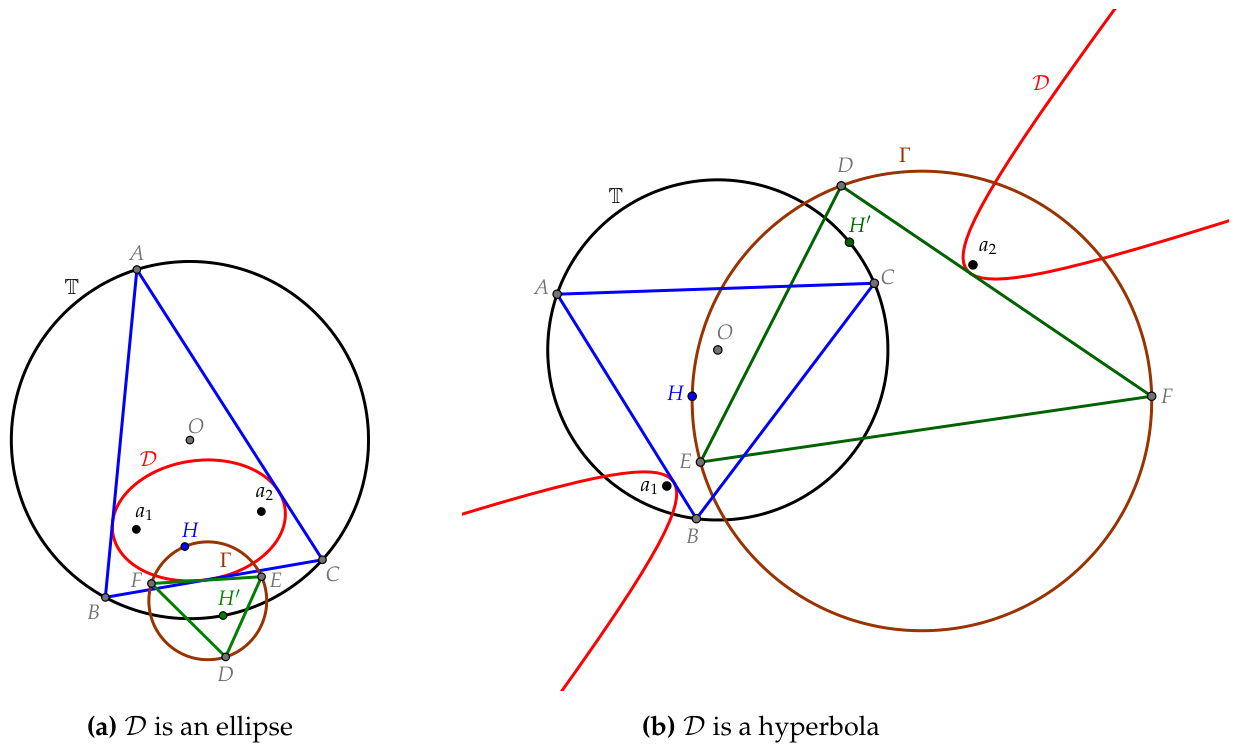
Proof.
The two most important special cases occur when the circumcenter of the triangle coincides with either the center or a focus of the inscribed conic.
Corollary 2.
Let a triangle be inscribed in a circle and circumscribed about an ellipse. Assume that the circumcenter of the triangle coincides with the center of the ellipse. Then the orthocenter of the triangle lies on a circle concentric with the circumcircle of the triangle.
Proof.
We may assume that and be the foci of the conic. By Theorem 4, the locus circle reduces to
which proves the claim. □
Corollary 3.
Let be the family of triangles inscribed in a circle and circumscribed about a central conic . Let Γ denote the locus of the orthocenters of the triangles in . Assume that the center of is distinct from the foci of . Then forms a 3-Poncelet pair if and only if forms a 3-Poncelet pair.
Moreover, the orthocenters of the triangles inscribed in Γ and circumscribed about lies on .
Proof.
Without loss of generality, assume that , and let denote the foci of . Since the circumcenter of is distinct from the foci of , we have .
Suppose first that is a 3-Poncelet pair. By Theorem 4, the locus of the orthocenters of the triangles in is the circle
Consider the affine transformation , defined by
It maps onto the unit circle and transforms into the central conic
where the positive sign corresponds to an ellipse and the negative sign to a hyperbola.
By [2, Theorem 2.1], the pair is a 3-Poncelet pair. Since affine transformations preserve the Poncelet property, it follows that is also a 3-Poncelet pair. The converse follows by applying the same argument to the inverse affine transformation .
Finally, let be the orthocenter of a triangle inscribed in and circumscribed about . Since is a 3-Poncelet pair with circumcircle , Theorem 4 shows that
Applying the inverse transformation
yields
Hence the orthocenters of the triangles inscribed in and circumscribed about lie on the original circumcircle . □
Corollary 4.
Let a triangle be circumscribed about a central conic. Then the circumcenter of the triangle coincides with one focus of the conic if and only if the orthocenter coincides with the other focus.
Proof.
If , then
Conversely, assume . Equation (4) gives
If , then
whose modulus yields
contrary to the fact that a focus of a nondegenerate central conic cannot lie on the circumcircle. Hence . □
Corollary 5.
Let a triangle be inscribed in a unit circle and circumscribed about a central conic. Assume that the circumcenter of the triangle coincides with one of the foci of the conic. Then the eccentricity of the conic equals the distance from the circumcenter to the other focus. Equivalently,
where e denotes the eccentricity, and O and H denote the circumcenter and orthocenter of the triangle, respectively.
Proof.
The eccentricity of the conic with foci inscribed in a triangle inscribed in is given by ([2, Corollary 1])
Assuming and using (Corollary 4), we find
This completes the proof. □
3.2. Families with Constant Orthocenter Modulus
The orthocenter locus immediately yields information about the possible types of triangles occurring in a particular Poncelet family.
Proposition 1.
The Poncelet family contains at most two right triangles.
Moreover, if the circumcenter of a triangle in coincides either with the center of the conic or with one of its foci, then the triangle is oblique.
Proof.
A triangle is right if and only if its orthocenter lies on its circumcircle. Since the orthocenter moves on a circle, there are at most two intersections with the circumcircle.
Assume that the triangles in are inscribed in and circumscribed about a central conic with foci . Suppose . By Theorem 4,
- if the circumcenter of coincides with the center of , thenin this case, , since ;
- if the circumcenter of coincides with one focus of , say , thenin this case, , since if is an ellipse and if is a hyperbola.
In either case, , which proves the claim. □
The preceding proposition immediately gives the following geometric characterizations.
Corollary 6.
Let a triangle be circumscribed about an ellipse. Assume that the circumcenter of the triangle coincides with the center of the ellipse. Then the triangle is acute if the foci of the ellipse lie inside the circumcircle of the triangle and obtuse if the foci lie outside the circumcircle.
Proof.
Since, from Proposition 1,
the orthocenter lies inside the circumcircle precisely when , and outside when . The conclusion follows from the classical characterization of acute and obtuse triangles. □
Corollary 7.
Let a triangle be circumscribed about a central conic having the circumcenter of the triangle as one of its foci. Then the triangle is acute if the conic is an ellipse and obtuse if it is a hyperbola.
Proof.
Since, from Proposition 1
the conclusion follows immediately from for ellipses and for hyperbolas. □
3.3. Bounds on the Focal Parameters
The orthocenter parametrization also yields several relations between the focal parameters and the geometry of the conic.
The following identity (see Corollary 9)
immediately yields bounds on the focal parameters.
Proposition 2.
Let a triangle be inscribed in the unit circle and circumscribed about a central conic.
- (a)
- If the circumcenter coincides with the center of the conic, thenwhere is a focus of the conic.
- (b)
- If the circumcenter coincides with one focus of the conic, thenwhere is the other focus of the conic.
Proof.
Since
we have
In case (a),
which gives
In case (b),
and therefore
□
Corollary 8.
Let a triangle be circumscribed about a hyperbola . Assume that the circumcenter of the triangle coincides with one of the foci of . Then the eccentricity e of satisfies
Proof.
Since (Corollary 5), the result follows immediately from Proposition 2. □
We conclude with one final application concerning the congruence between the circumcircle of a triangle circumscribed about a central conic and the circle traced by its orthocenter.
Proposition 3.
Let Γ denote the locus of the orthocenters of the triangles in the Poncelet family . If Γ is congruent to the common circumcircle of the triangles in , then the associated central conic is necessarily a hyperbola.
Proof.
The congruence assumption gives
Hence
so one focus lies inside the unit circle if and only if the other lies outside. Therefore the conic is a hyperbola. See [1, Theorem 2.2]. □
4. Some Invariants from Symmetric Parametrization
In [1], we proved that if a triangle is circumscribed about a central conic, then the sum of the squared side lengths,
remains invariant throughout the associated Poncelet family if and only if the circumcenter of coincides either with the center of the conic or with one of its foci. Equivalently, the sum satisfies the orthocenter criterion.
In this section we show that many other geometric quantities associated with the triangles in the Poncelet family, such as squared distances, angles, ratio of areas, and circles associated with orthic triangles, tangential triangles, polar circles satisfy the orthocenter criterion as well.
4.1. Length Invariants
Lemma 1.
Let . Then
Proof.
Corollary 9.
If , then
Proof.
The preceding corollary immediately yields an alternative proof of the invariance of the sum of the squared lengths established in [1, Theorem 3.5].
Proposition 4.
Let and let . Then
Proof.
Corollary 10.
Let . Then
Proof.
Corollary 11.
The sum of the squares of the median lengths of a triangle in the family satisfies the orthocenter criterion.
Proof.
The median from the vertex has length
and similarly for the other two vertices. The result therefore follows immediately from Corollary 10 together with Theorem 3. □
Corollary 12.
The sum of the areas of the regular convex polygons on the sides of a triangle in satisfies the orthocenter criterion.
Proof.
Let . For each vertex , let denote the regular convex n-gon on the side containing the remaining two vertices of . Then
In particular, the sum of the areas of the outer (equivalently, inner) Napoleon triangles of satisfies the orthocenter criterion. For further background on Napoleon triangles, see, for example, [8]. □
4.2. Angular Invariants
The identities established in the previous subsection immediately yield several invariant angular quantities. We begin with a characterization involving the sums of squared sines and the product of the cosines of the angles.
Theorem 5.
Let . Then the sum
and the product
satisfy the orthocenter criterion.
Proof.
We may assume that the common circumcircle of is the unit circle . By the law of sines,
and hence
Let be the complex coordinates of the vertices , respectively. By Corollary 9,
so that
The trigonometric identity
for triangles gives
Therefore both quantities satisfy the orthocenter criterion. □
Corollary 13.
Let be inscribed in and circumscribed about a central conic. Assume that the circumcenter of coincides with one of the foci of the conic. Then
where e is the eccentricity of the conic.
Proof.
The result follows immediately from Theorem 5 together with Corollary 5. □
The next result provides another example of angular invariants associated with the family .
Theorem 6.
Let and ℓ be a line through the circumcenter O of . Let
denote the corresponding angles measured counterclockwise. Then the quantity
satisfy the orthocenter criterion.
Proof.
We may assume that is inscribed in . Choose coordinates so that ℓ is the real axis and the perpendicular through O is the imaginary axis.
Let and denote the complex coordinates of the vertices and the orthocenter of , respectively. Then
By (8),
Since
we obtain
This proves the claim. □
Corollary 14.
Let be inscribed in and circumscribed about a central conic . Let ℓ be the major axis of and be the angles defined as in Theorem 6.
- (a)
-
If the circumcenter of coincides with the center of , thenwhere is either focus of .
- (b)
-
If the circumcenter of coincides with one of the foci of , thenwhere is the focus of distinct from O.
4.3. Orthic Triangles
Throughout this subsection, H denotes the orthocenter of a triangle , and , , and denote the feet of the altitudes from A, B, and C, respectively.
Proposition 5.
Let be inscribed in the unit circle , and let be the feet of the altitudes from respectively. If , then
where the indices are taken modulo 3.
Proof.
Since lies on the side , there exists a real parameter t such that
Moreover, is perpendicular to , so
Equivalently,
Using , so that , and solving together with the linear relation (15), we obtain
Since , this becomes
The remaining formulas follow by cyclic permutation of the indices. □
Theorem 7.
Let , and let H denote its orthocenter. Then
Moreover, this common value satisfies the orthocenter criterion.
Proof.
We may assume that is inscribed in the unit circle . Let the complex coordinates of the vertices be . Then
so that
By Proposition 5,
Hence
Since , we have , and therefore
Taking absolute values gives
Consequently,
Similarly,
By Example 1,
and the conclusion follows from Theorem 3. □
Theorem 8.
Let the triangle be inscribed in and circumscribed about a central conic. Then the centroid of the orthic triangle of lies on the circle
where denotes the complex coordinate of the orthocenter of .
Proof.
Let be the complex coordinate of the foot of altitude from , .
By Proposition 5,
where the indices are taken modulo 3. Therefore,
Let . Then
Using the identity
we obtain
Hence the centroid w of the orthic triangle satisfies
Hence,
Since , it follows that
which proves the theorem. □
In [1], we established that the area of a Poncelet triangle is invariant precisely when the associated central conic is a circle. The next theorem shows an invariance for the ratio of the areas of a triangle and its orthic triangle. This invariance is characterized by the same orthocenter criterion developed in Theorem 3.
Theorem 9.
The ratio of the area of a triangle in to the area of its orthic triangle satisfies the orthocenter criterion.
Proof.
Let , and let denote the feet of altitudes from .
By Proposition 5
where the indices are taken modulo 3. This gives
The remaining two identities follow cyclically.
This gives
Now Example 1 and Theorem 3 complete the proof. □
Corollary 15.
Let be circumscribed about an ellipse . Assume that the circumcenter of coincides with the center of . Then
where and are the circumscribed square of the circumcircle of and the circumscribed rectangle of the ellipse .
Proof.
Let a and b denote the lengths of the semi-axes of the ellipse. It follows from [2, Corollary 2.2] that
Hence, Theorem 9 gives
The same ratio can also be written as
This completes the proof. □
Corollary 16.
Let be circumscribed about a central conic. Assume that the circumcenter of coincides with one of the foci of the conic. Then
where a and b are the semi-axes of the conic.
Theorem 10.
Let be an oblique triangle. Assume that is obtuse whenever is obtuse. Set
Then
with (respectively, ) if is acute (respectively, obtuse).
Consequently,
satisfies the orthocenter criterion.
Proof.
It follows from the property of orthic triangle of that
if is acute; and
if is obtuse with obtuse angle .
Now, to prove (a), we first assume is acute. Then we have
Similarly, if is obtuse with obtuse angle , then we have
The conclusion follows from Theorem 5. □
Theorem 11.
Let be inscribed in a circle and circumscribed about an ellipse. Assume that the foci of the ellipse lie inside the circumcircle of . Let denote the orthic triangle of . Then the area of the incircle of satisfies the orthocenter criterion.
Proof.
Let and be the inradius and circumradius of , respectively. It is well known that the circumcircle of the orthic triangle is the nine-point circle of , and hence
We apply the identity
valid for any triangle, to the orthic triangle . This yields
Now satisfies the orthocenter criterion as the sum
satisfies (Theorem 10). This completes the proof. □
Corollary 17.
Let be an acute triangle circumscribed about an ellipse whose center coincides with the circumcenter of . Then the inradius of the orthic triangle of is equal to one-half of the harmonic mean of the semi-axes a and b of the ellipse.
Proof.
Let R be the circumradius of and a and b be the semi-axes of the central conic.
Corollary 18.
Let be an acute triangle circumscribed about an ellipse one of whose foci coincides with the circumcenter of . Then the inradius of the orthic triangle of is equal to one-half of the semi-latus rectum of the ellipse.
Proof.
Let R be the circumradius of and a and b be the semi-axes of the central conic. It follows from Theorem 10, Theorem 11, and Theorem 5 that
We also have . See [2, Corollary 2.3]. This gives
as required. □
Theorem 12.
Let and let H be its orthocenter. Then the sum
and the product
satisfy the orthocenter criterion.
Proof.
By Proposition 4,
On the other hand, Theorem 7 and Example 1 yield
Since both quantities are functions of , the conclusion follows from Theorem 3. □
The preceding results naturally lead to another invariant involving the vertices and the midpoints of the sides. Although these quantities are not directly attached to the orthic triangle, they are closely related to the nine-point circle, so we include them here.
Theorem 13.
Let denote the midpoints of the sides of a triangle in , and let be the center of the conic. Then the quantities
satisfy the orthocenter criterion.
Moreover, if the circumcenter of the triangle coincides with one of the foci of the conic, then
where R is the circumradius of the triangle.
Proof.
Assume that is the common circumcircle of triangles in and be the foci of the conic. Then
Hence
Using (4) gives
Since ranges over the admissible parameter set , the last expression is independent of if and only if
that is, if and only if
This proves that the first quantity satisfies the orthocenter criterion.
Similarly, if be the midpoint of the opposite side of the vertex . Then
Summing (17) cyclically gives
Using (4) again we obtain
Hence
The last expression is independent of if and only if
Thus the second quantity satisfies the orthocenter criterion.
Finally, if , then (17) gives
and similarly
Thus every midpoint is at distance from the center of the conic. Restoring the circumradius R gives
which completes the proof. □
Remark 2.
The second assertion of Theorem 13 also follows from a result established in [1, Corollary 3.4]. Indeed, when the circumcenter coincides with a focus of the conic, the nine-point circle of the triangle coincides with the auxiliary circle of the conic. Hence the three side midpoints, which lie on the nine-point circle, are all at distance from the center of the conic.
4.4. Polar Circles
The invariance of established in Theorem 7 naturally gives rise to a circle associated with an obtuse triangle. We show that this circle also exhibits similar invariance properties along Poncelet families.
Definition 1.
The polar circle of an obtuse triangle is the circle centered at its orthocenter H with radius satisfying
Remark 3.
Since
the value of defined above is independent of the choice of the vertex of .
Theorem 14
(Area Invariance of Polar Circles in a Poncelet Family). The area of the polar circle of a triangle in satisfies the orthocenter criterion.
In particular, the polar circle remains fixed throughout the family if and only if the common circumcenter of the triangles coincides with one of the foci of the conic.
Proof.
By Definition 1 and Theorem 7, the radius of the polar circle of a triangle in remains invariant if and only if the circumcenter of the triangles coincides either with the center of the conic or with one of its foci.
Since the center of the polar circle is the orthocenter of the reference triangle, by Corollary 4, the center of the polar circle remains fixed throughout the family if and only if the circumcenter of the reference triangle coincides with one of the foci of the conic. Hence both the center and the radius of the polar circle remain fixed throughout the family, and therefore the area of the polar circle (equivalently, the circle itself) remains invariant.
This completes the proof. □
Corollary 19.
Let be an obtuse triangle circumscribed about an ellipse whose center coincides with the circumcenter of . Then the area of the polar circle of is twice the area of the ellipse .
Proof.
Since is obtuse, its polar circle is well defined. By Theorem 7,
On the other hand, it follows from [2, Corollary 2.2] that
where a and b denote the lengths of the semi-axes of the ellipse. Hence
Therefore,
which proves the result. □
Corollary 20.
Let be circumscribed about a hyperbola . Assume that the circumcenter of coincides with one of the foci of . Then the area of the polar circle of is twice the area of the minor auxiliary circle of .
Proof.
By Corollary 7, the triangle is obtuse, so its polar circle is well defined. By Theorem 7,
On the other hand,
where b denotes the length of the semi-minor axis of the hyperbola (see [2, Corollary 2.3]). Hence
Since the area of the polar circle is and the area of the minor auxiliary circle is , the assertion follows. □
4.5. Tangential Triangles
The identities obtained in the preceding subsections also lead to invariants associated with the tangential triangle. Since the tangential triangle is projectively dual to the original triangle with respect to the circumcircle, its geometry is closely related to the orthocenter parameter . We show that several metric properties of the tangential triangle depend only on .
Throughout this subsection, for each vertex , denotes the intersection of the tangents to the circumcircle of at its remaining two vertices.
Definition 2.
The triangle formed by the polars of the vertices of with respect to a conic is called the polar triangle of .
When the conic is the circumcircle of , the polar triangle is called thetangential triangle. Its circumcircle is called the tangential circle of .
Proposition 6.
Let be inscribed in the unit circle . Let denote the complex coordinate of the intersection of the tangents to at and . Then
Cyclically,
Proof.
The complex number satisfies
Subtracting these equations gives
Since , we have
and hence
Substituting this into the first tangent equation yields
or equivalently,
Therefore,
The formulas for and follow by cyclic permutation of the indices. □
Theorem 15.
Let , and let denote its tangential triangle. For each vertex , let be the point dividing internally in the ratio , and let O denote the circumcenter of . Then the products
satisfy the orthocenter criterion.
Proof.
Assume that the circumcircle is the unit circle , so that the circumcenter is the origin O. Let be the complex coordinates of the vertices , respectively, and let denote the vertices of its tangential triangle. By Proposition 6,
Since , we obtain
and cyclically,
Hence
where the last equality followed from Example (1) and denotes the complex coordinate of the orthocenter.
Now let be the complex coordinates of , , and , respectively. Then
A direct computation yields
and the expressions for and follow cyclically.
Consequently,
Since the products depend only on the quantity , they satisfy the orthocenter criterion (Theorem 3). □
Theorem 16.
Let be inscribed in . Then the tangential circle of is
provided , where denotes the complex coordinate of the orthocenter of .
Proof.
Let denote the complex coordinate of the intersection of the tangents to the circumcircle at and . From Proposition 6,
Using
in the last equation, we obtain
Since , we have
Let . Then
Squaring both sides gives
which simplifies to
Assuming , divide by to obtain
Comparing this with the standard equation of a circle,
shows that
and
Hence
which proves the theorem. □
Corollary 21.
Let be inscribed in , and let be its tangential triangle. If denotes the complex coordinate of the orthocenter of , then the quantity
satisfies the orthocenter criterion.
Proof.
By Proposition 6,
Since , we have
Summing cyclically yields
Hence,
The conclusion now follows immediately from Theorem 3. □
Corollary 22.
The area of the tangential circle of a triangle in satisfies the orthocenter criterion.
In particular, the tangential circle remains fixed throughout if and only if the circumcenter of the triangle coincides with one of the foci of .
Proof.
Let . By Theorem 16, the radius of its tangential circle is
which depends only on . Note that (Proposition 1).
It follows from (18) that the center c of the tangential triangle of remains fixed if and only if is. The conclusion therefore follows from Theorem 3. □
The tangential triangle and the orthic triangle of a triangle are homothetic. Consequently, the following theorem is an immediate consequence of Theorem 9. So we state the result without proof.
Theorem 17.
The ratio of the area of a triangle in and the area of its tangential triangle satisfies the orthocenter criterion.
4.6. Power Circle
The power circles constitute another natural family of circles associated with a triangle. In this subsection, we investigate their behavior in a Poncelet family and identify the geometric configurations for which they remain invariant.
Definition 3.
The circles each passing through a vertex of a triangle and centered at the midpoint of the opposifte side are called the power circles of the triangle.
Corollary 10 provides a particularly short alternative proof of Theorem 6.1 from [1], which we reformulate and include here for completeness.
Theorem 18.
The total area of the power circles of a triangle in satisfies the orthocenter criterion.
Proof.
We may assume that the common circumcircle of the family is , and let . Then the total area of the power circles of is
where denotes the power circle passing through the vertex , for .
The conclusion now follows immediately from (12) and Theorem 3. In particular,
whenever the circumcenter coincides with the center of the conic, and
whenever the circumcenter coincides with one of the foci, say . □
4.7. de Longchamps Circle
The de Longchamps circle is another classical object associated with a triangle via the power circles.
Definition 4.
Let be an obtuse triangle. The radical circle of the three power circles of is called the de Longchamps circle. It is centered at the de Longchamps point L and has radius
Theorem 19.
Let .
- (a)
- The area of the de Longchamps circle of satisfies the orthocenter criterion.
- (b)
- The de Longchamps circle of remains fixed throughout the family if and only if the circumcenter of coincides with one of the foci of .
Proof.
Assume that . It follows from Definition 4 and Theorem 5 that satisfies the orthocenter criterion.
For the second assertion, the de Longchamps point is the reflection of the orthocenter about the circumcenter. Since the circumcenter is the origin, we have
Thus the center of the de Longchamps circle is fixed if and only if is fixed. By Theorem 3, this occurs precisely when the circumcenter coincides with one of the foci of . □
5. Analytic Construction of Central Inconics
We now consider an inverse problem. Given an oblique triangle, construct a central conic inscribed in the triangle whose foci are the circumcenter and orthocenter of the triangle. The following proposition shows that such a conic always exists, is unique, and can be written explicitly.
Proposition 7.
Every oblique triangle admits a unique central conic inscribed in it whose foci are the circumcenter and the orthocenter of the triangle. Moreover, the conic is an ellipse if the triangle is acute and a hyperbola if it is obtuse.
Proof.
Let be an oblique triangle inscribed in . A central conic with foci inscribed in is given by the following equation [2]:
where the positive sign corresponds to an ellipse and the negative sign corresponds to a hyperbola.
If is acute, then must be an ellipse (Corollary 7). Therefore, using and , we find
is the required ellipse.
Similarly, if is obtuse,
is the required hyperbola. See Figure 2. □
6. Concluding Remarks
The applications developed in this paper exhibit a striking common phenomenon: a wide variety of geometric quantities associated with a Poncelet triangle remain invariant precisely when the circumcenter occupies one of two distinguished positions with respect to the underlying central conic. For the reader’s convenience, Table 1 summarizes the principal invariance results established in this paper.
All the listed quantities in Table 1 satisfy the orthocenter criterion. Consequently, the invariance of any one of them throughout the family is equivalent to the invariance of every other.
We conclude this paper by proposing a conjecture that extends [1, Theorem 3.5] from triangles to cyclic n-gons.
Conjecture 1.
Let be the family of n-gons. inscribed in a circle and circumscribed about a central conic. Then the sum of the areas of the squares constructed on the sides of a polygon in remains invariant throughout the family if and only if the circumcenter of the polygon coincides either with the center of the conic or with one of its foci.
Funding
The author received no financial support for the research, authorship, and/or publication of this article.
Acknowledgments
The author acknowledges the use of Mathematica and GeoGebra for symbolic and numerical computations, as well as for generating figures in this work.
References
- Dragović, V.; Murad, M.H. Generalized Chapple–Euler Relation 2026. accepted for publication in European Journal of Mathematics. arXiv:2603.00003.
- Murad, M.H. Marden’s Theorem and Symmetric Parametrizations of Triangles Circumscribed about Central Conics. (submitted to a journal) . [CrossRef]
- Helman, M.; Laurain, D.; Garcia, R.; Reznik, D. Poncelet Triangles: a Theory for Locus Ellipticity. Beitr Algebra Geom 2022, 63, 445–457. [CrossRef]
- Helman, M.; Laurain, D.; Garcia, R.; Reznik, D. Invariant Center Power and Elliptic Loci of Poncelet Triangles. J. Dyn. Control Syst. 2023, 29, 157–184. [CrossRef]
- Garcia, R.; Helman, M.; Reznik, D. Graceful Loci of Poncelet Triangles about the Incircle and their Degeneracies. Beitr Algebra Geom 2026. [CrossRef]
- Daepp, U.; Gorkin, P.; Mortini, R. Ellipses and Finite Blaschke Products. The American Mathematical Monthly 2002, 109, 785–795. [CrossRef]
- Çelik, M.; Duguin, M.; Guo, J.; Luo, D.; Spinelli, K.; Zeytuncu, Y.; Zhu, Z. Exploring a Geometric Conjecture, Some Properties of Blaschke Products, and the Geometry of Curves Formed by Them. Computational Methods and Function Theory 2026, 26, 183–198. [CrossRef]
- Hahn, L.S. Complex Numbers and Geometry; Vol. 52, AMS/MAA Textbooks, American Mathematical Society: Providence, RI, 2019.
Figure 2.
Proposition 7.
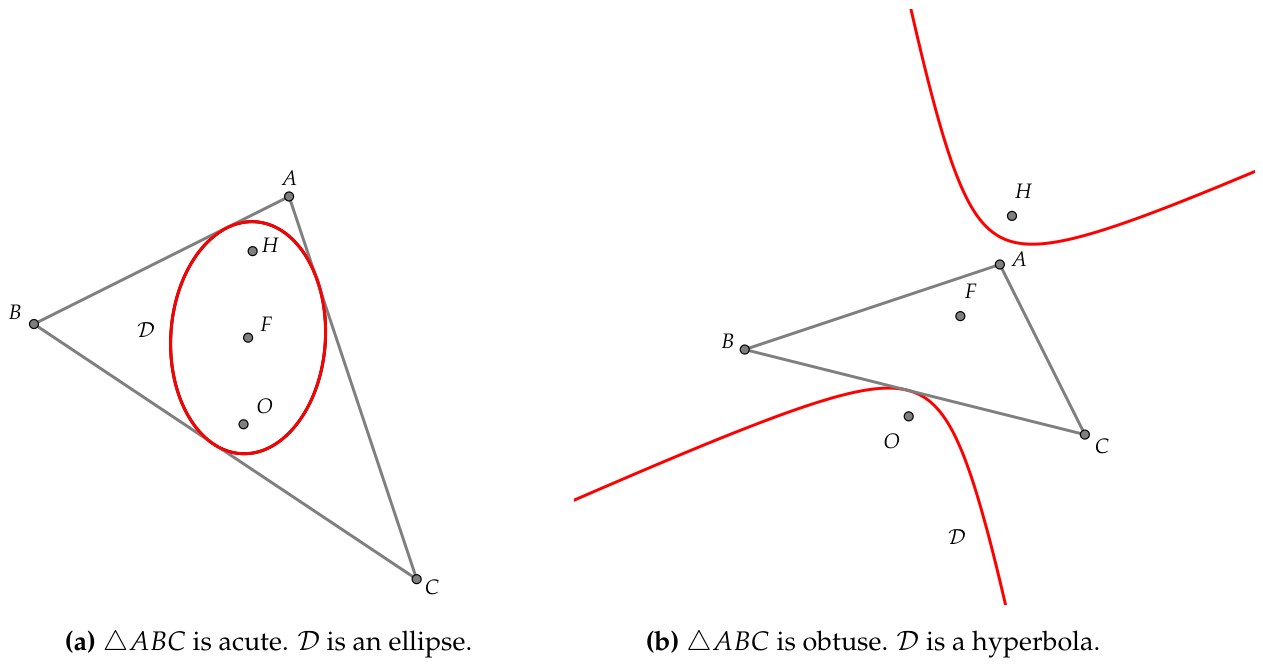

Table 1.
Summary of the principal invariance results established in Section 4.
Table 1.
Summary of the principal invariance results established in Section 4.
| Subsection | Invariant quantity | |
|---|---|---|
| 4.1 | ||
| 4.2 | , | |
| 4.2 | ||
| 4.3 | ||
| 4.3 | Orthic angle invariant: | |
| 4.3 | , | |
| 4.3 | , | |
| 4.4 | Radius (equivalently, area) of the polar circle | |
| 4.5 | Radius (equivalently, area) of the tangential circle of a triangle | |
| 4.5 | , | |
| 4.6 | ||
| 4.7 | Radius (equivalently, area) of the de Longchamps circle |
Disclaimer/Publisher’s Note: The statements, opinions and data contained in all publications are solely those of the individual author(s) and contributor(s) and not of MDPI and/or the editor(s). MDPI and/or the editor(s) disclaim responsibility for any injury to people or property resulting from any ideas, methods, instructions or products referred to in the content. |
© 2026 by the authors. Licensee MDPI, Basel, Switzerland. This article is an open access article distributed under the terms and conditions of the Creative Commons Attribution (CC BY) license (http://creativecommons.org/licenses/by/4.0/).
Copyright: This open access article is published under a Creative Commons CC BY 4.0 license, which permit the free download, distribution, and reuse, provided that the author and preprint are cited in any reuse.


