

Submitted:
03 September 2026
Posted:
15 September 2026
You are already at the latest version
Abstract
Mechanically ventilated ICU patients face vulnerability, disorientation, loss of control, and reduced communication. We report two later phases of an iterative program testing positive suggestion-based psychological support. Study 3 randomized 112 adults to standard care, audio-recorded positive suggestions (ARPS), or ARPS plus reduced-frequency live positive suggestion-based psychological support (PSBPS); Study 4 randomized 35 patients to standard care or reduced-frequency live PSBPS. Primary outcomes were mechanical ventilation (MV) duration and ICU length of stay (LOS). In Study 3, neither intervention significantly reduced MV duration or ICU LOS in the full randomized sample. Planned sex-stratified analyses showed 63.69 fewer MV hours among female ARPS patients than female controls, but treatment-by-sex interaction was nonsignificant. Exploratory post hoc engagement analyses yielded a hypothesis-consistent pattern: consistently engaged ARPS patients had approximately 1.7 days shorter MV and 2.8 days shorter ICU LOS than controls, while HEG patients had longer courses. In Study 4, live PSBPS reduced MV duration by 76.62 hours (95% CI [1.07, 152.16]; p = 0.047), supported by nonparametric, SAPS II-adjusted, and competing-risk sensitivity analyses; ICU LOS was nonsignificantly shorter by 51.45 hours. Mortality was numerically lower in intervention groups but nonsignificant. These historical randomized findings support confirmatory evaluation of coherent, acceptable PSBPS delivery in contemporary ICU care.
Keywords:
intensive care
; mechanical ventilation
; positive suggestion
; psychological support
; hypnosis
; ICU communication
; audio-recorded intervention
; patient engagement
; sex-stratified analysis
; randomized controlled trial
1. Introduction
The present manuscript reports the third and fourth phases of a four-study iterative research program on positive suggestion-based psychological support for mechanically ventilated intensive care unit (ICU) patients. Prolonged mechanical ventilation (MV) and ICU length of stay (LOS) are clinically important outcomes associated with morbidity, mortality, long-term functional and psychological burden, and healthcare resource use (Jubran et al., 2019; Hiser et al., 2023; Inoue, 2024). Recovery nevertheless occurs in an extreme psychological and social context: mechanically ventilated patients may be unable to speak or act autonomously, separated from familiar people, exposed to unfamiliar procedures and technology, and subject to fear, sensory disturbance, fluctuating consciousness, and loss of control (Samuelson, 2011; ten Hoorn et al., 2016; Dziadzko et al., 2017).
Several approaches have sought to reduce psychological distress during or after critical illness, including ICU diaries, nurse-led preventive interventions, communication-support strategies, and early intra-ICU psychological care. Results have been mixed, and relatively little randomized work has tested structured psychological communication during invasive mechanical ventilation using immediate objective ICU outcomes (Peris et al., 2011; Wade et al., 2019; Garrouste-Orgeas et al., 2019). More closely related suggestion-based approaches have since been developed for ICU safety and psychological support, including work in non-invasively ventilated patients and adaptations of the Hungarian PSBPS approach using intensivists or trained ICU doulas (Schmidt et al., 2021; Tan et al., 2020; Karnatovskaia et al., 2021). The present program remains distinctive in testing positive suggestion-based psychological support during invasive mechanical ventilation using robust ICU outcomes, while framing the patient’s relationship with the ICU environment itself as a potential therapeutic target.
Positive Suggestion-Based Psychological Support (PSBPS) and Audio-Recorded Positive Suggestions (ARPS) use structured therapeutic communication rather than nonspecific reassurance alone. Their strategies include orientation, positive reframing, reassurance, support for cooperation and agency, ego-strengthening, goal setting, recovery-oriented future perspective, and activation of internal resources (Kekecs & Varga, 2013; Varga et al., 2007; K. Szilagyi, 2011). ARPS was developed to make the core recovery-oriented frame available in a standardized, reproducible form, while live PSBPS permits moment-to-moment adaptation to the patient’s condition and responses.
The intervention was originally grounded in an evolutionary group-systems perspective, with Social Safety Theory providing a later, complementary psychobiological framework. Csányi’s evolutionary perspective emphasizes coordinated group membership, shared roles and rules, and reliable social partners as fundamental contexts for human survival (Csányi, 1989, 1993). Social Safety Theory emphasizes the biological relevance of perceived social connection and safety versus isolation and threat (Slavich, 2020, 2023). In the ICU application, these levels are linked by helping the patient experience unfamiliar staff, procedures, equipment, and their own cooperation as parts of a coherent, coordinated, recovery-oriented protective system. The evolutionary framework therefore helps explain why belonging to a coordinated protective group may matter, while Social Safety Theory helps explain why perceived social safety versus threat may have psychobiological relevance. The proposed pathway remains a theoretical mechanism requiring direct empirical testing (Kelemen-Szilagyi, 2024).
The research program developed iteratively from ICU clinical work with hypnotic communication and therapeutic suggestions (Varga & Diószeghy, 2003). The first randomized phase tested live suggestion-based psychological support, and the second introduced standardized ARPS and a music-control condition to separate suggestion-specific effects from additional auditory stimulation and the broader supportive context (K. Szilagyi et al., 2007, 2014). These earlier phases raised two implementation questions that shaped the later studies: whether standardized audio support could retain clinically useful effects, and whether the relational and individualized elements of live support could be delivered in a lower-frequency, more scalable form.
Study 3 therefore compared standard ICU care, daily ARPS, and daily ARPS combined with reduced-frequency live PSBPS. The combined condition tested whether standardized daily coverage plus individualized live support would improve outcomes beyond either standard care or standardized support alone. Acceptance and refusal of ARPS were monitored prospectively because refusal had already emerged as an implementation-relevant phenomenon in the preceding phase. Respecting a patient’s clear refusal was both an ethical safeguard and a practical expression of agency; the specific intermittent refusal pattern later labelled the Hesitant Engagement Group (HEG) was identified only post hoc and is analysed exploratorily.
Study 4 represented the next implementation-oriented step. A contemporaneous 2012 research plan had already specified that the approximately three-times-weekly individualized live component would later be introduced as a stand-alone intervention. Study 4 therefore tested reduced-frequency live PSBPS without ARPS, delivered by the same ICU-embedded psychologist who delivered the live component in Study 3. Because the later live interventions were delivered by a psychologist different from the clinician who had delivered most of the live PSBPS in the earlier Study 1 JFK phase, these later phases also provided an opportunity to examine whether clinically useful effects could be observed across trained providers rather than depend on one individual clinician.
The principal randomized outcomes in both studies were MV duration and ICU LOS. In Study 3, we hypothesized that ARPS combined with individualized live PSBPS would reduce these outcomes compared with standard care; sex-stratified analyses were planned, while engagement-pattern analyses were exploratory. Study 4 tested whether reduced-frequency live PSBPS would reduce MV duration and ICU LOS compared with standard care. ICU mortality was recorded as a secondary or exploratory outcome.
2. Materials and Methods
2.1. Reporting Approach, Ethical Approval, and Study Setting
The studies are reported in accordance with the CONSORT 2025 statement for randomized trials (Hopewell et al., 2025).
The present manuscript reports two later phases of a four-study iterative research program on positive suggestion-based psychological support in mechanically ventilated ICU patients. The two studies are presented together because they used the same ICU setting, core intervention framework, and principal clinical outcomes and addressed closely related implementation questions. They are nevertheless reported and analysed separately as distinct randomized phases. No pooled inferential analysis across the two studies is presented here; program-level pooled analyses are reserved for a separate manuscript including all four phases.
Both studies were conducted in the adult intensive care unit of Jahn Ferenc South-Pest Hospital, Budapest, Hungary, a multidisciplinary Level III ICU treating a heterogeneous, high-acuity adult population. Study 3 was conducted between May 3 and December 21, 2012. Study 4 was conducted between October 1 and November 27, 2013.
Studies 3 and 4 were conducted as successive phases of the same ethics-approved research program under approval granted by the Scientific and Research Ethics Committee of the Hungarian Health Science Council on April 20, 2012 [Ref. No. 11489/2012/EKU, 192/PI/12]. The approved research framework included the positive-suggestion intervention procedures used in these later phases, including audio-recorded support and individualized live psychological support, together with the consent and clinical data-collection framework for mechanically ventilated ICU patients. The studies were conducted in accordance with the Declaration of Helsinki.
The studies were not prospectively registered in a public trial registry, and no formal prospective statistical analysis plan was archived. A contemporaneous pre-study research plan submitted for ethical review documented the randomized intervention framework, consent procedures, and prospectively collected clinical outcomes. Because this document was prepared for research-ethics review rather than as a formal statistical analysis plan, it did not enumerate every analytic decision subsequently used in the final analyses. Analysis provenance is therefore stated explicitly below and summarized in Supplementary Table S1.
2.2. Participants, Consent, Patient Acceptance/Refusal, and Withdrawal
Eligible patients were adults admitted to the study ICU while receiving mechanical ventilation. Patients who were not mechanically ventilated at the time of ICU admission were not screened for later entry into the study. Exclusion criteria included age below 18 years, documented severe psychiatric illness, documented hearing impairment, and continuation of mechanical ventilation in another ICU after transfer. The population reflected the heterogeneous case mix of a multidisciplinary Level III ICU.
All patients lacked decision-making capacity at study entry, and initial written proxy consent for study participation was therefore obtained from a relative in all cases. During ARPS delivery, however, the patient’s own preference was sought before each daily exposure. The recording was not given, or was stopped, whenever the patient expressed an unequivocal verbal or behavioral refusal; in the absence of such a refusal, the intervention could proceed. This ongoing acceptance/refusal procedure was treated as an additional safeguard of patient agency rather than as a substitute for formal informed consent. Before transfer from the ICU, patients with sufficient decision-making capacity were informed about the study and asked separately for consent to the post-ICU interview and continued use of their study data. No patient approached at this stage declined continued data use. For patients who died before such consent could be obtained, the initial relative-provided consent remained the basis for use of the collected study data.
At the time of the studies, patients admitted to the ICU who did not meet the study-entry criteria were not entered into a separate trial screening log. The CONSORT diagram therefore begins with the randomized study sample. Eligibility and exclusion criteria are described above.
2.3. Study Designs and Intervention Groups
Both studies were prospective randomized controlled studies conducted within the same intervention-development program. All groups received standard ICU care according to clinical need, and the psychological interventions were delivered in addition to standard ICU care.
Across the two studies, the intervention configurations comprised standard ICU care alone, ARPS, reduced-frequency live PSBPS, and the combination of ARPS plus reduced-frequency live PSBPS. These represented different delivery modes and combinations within the same core positive suggestion-based psychological support framework. For practical feasibility, these intervention questions were examined sequentially in two randomized studies rather than within a single multi-arm trial. Study 3 tested ARPS alone and in combination with reduced-frequency live PSBPS, whereas Study 4 tested reduced-frequency live PSBPS alone. Because the two studies represent complementary phases within the same intervention-development program, ICU setting, and outcome framework, they are reported together here while analysed separately.
No formal a priori sample-size calculation was performed for either study. Sample sizes reflected recruitment achieved during the study periods and the practical scope of these later-phase investigations. Accordingly, statistical inference emphasizes effect estimates and 95% confidence intervals in addition to p values.
2.4. Randomization and Blinding
An adaptive restricted randomization procedure was used to maintain both overall balance among study groups and a manageable concurrent intervention workload. Before each study day, the target composition of up to four allocation positions was determined on the basis of the current cumulative group distribution and the number of intervention patients concurrently requiring protocol delivery. This adaptation was based only on group balance and operational treatment capacity; the identities and clinical characteristics of patients to be enrolled the following day were not known when the allocation sequence was generated.
The order of the selected treatment assignments was then randomized manually using labeled tokens. The required group-specific tokens were shaken together by hand and drawn sequentially with the sequence generator’s eyes closed. The resulting allocation sequence was recorded and sent prospectively by e-mail or text message to the person implementing study allocation on the following day.
Eligible newly admitted mechanically ventilated patients were assigned sequentially according to increasing ICU bed number. Bed placement was determined independently by ICU staff according to routine clinical and bed-availability considerations. Personnel determining eligibility and obtaining proxy consent did not have access to the allocation sequence, and ICU physicians assigning beds were likewise unaware of treatment allocation. The person implementing the allocation sequence had no discretion to alter eligibility, bed assignment, or the order in which eligible patients received assignments. If fewer than four eligible patients were enrolled on a given day, unused assignments were discarded, and a new sequence was generated for the following day according to the updated group balance and intervention workload. These four-position daily sequences were therefore not conventional fixed randomization blocks.
Importantly, intervention-provider availability was not used to restrict or override treatment allocation. Patients entering the study late in the week or during weekends remained eligible for assignment to the combined condition; protocol delivery was adapted when needed rather than altering allocation. Thus, logistical convenience did not determine or constrain group assignment.
Because the interventions were visible, complete blinding of patients and ICU staff was not possible. Formal group allocation was not communicated to treating ICU clinicians, although staff could sometimes observe intervention exposure through headphone use or psychological contact. The study psychologist had no role in ventilator management, weaning, extubation, or ICU-discharge decisions, which remained entirely under the responsibility of the treating ICU team. Research personnel involved in chart extraction or patient interviews were not informed of group allocation.
2.5. Interventions
The intervention procedures were based on the positive suggestion-based communication framework described in earlier publications from the program (Varga et al., 2007; K. Szilagyi, 2011; K. Szilagyi et al., 2014).
2.5.1. Standard ICU Care
Standard ICU care was provided to all patients in all groups and included medical, ventilatory, nursing, pharmacological, and supportive procedures required by the patient’s clinical condition. Control-group patients received no additional structured positive suggestion-based psychological intervention.
2.5.2. Audio-Recorded Positive Suggestions
ARPS consisted of an approximately 30-minute standardized audio recording delivered through headphones once daily, seven days per week. The recording used structured positive suggestion-based communication, including orientation, reassurance regarding safety and coordinated care, positive framing of mechanical ventilation and treatment, support for cooperation and agency, recovery-oriented goal setting, and strengthening of internal resources. The patient was addressed as someone temporarily held within a coordinated ICU care system whose shared goal was recovery.
Headphones were placed by the psychologist or trained ICU nurses according to a brief standardized protocol that included orientation to place and date, stating how many days the patient had been recovering in the ICU, and the following standardized explanation, translated from Hungarian: “I am putting on these headphones also so that what you hear through them may support your recovery.” The placement procedure did not include individualized therapeutic explanation; the standardized recording itself carried the structured relational and recovery-oriented frame.
Acceptance and refusal of the audio intervention were monitored prospectively. Refusal required an unequivocal verbal or behavioral rejection of the audio intervention; nonspecific agitation, an uninterpretable response, or inability to respond was not by itself classified as refusal. Any clear refusal was respected, and the patient could be offered the recording again on a subsequent occasion. Permanent discontinuation was planned after three consecutive refusals or explicit permanent withdrawal. No patient in Study 3 met the permanent-discontinuation criterion.
The specific pattern of intermittent clear refusal followed by renewed acceptance was recognized retrospectively during later analysis. For the exploratory engagement analysis, patients showing this intermittent refusal pattern without permanent discontinuation were classified as the Hesitant Engagement Group (HEG); intervention patients without a documented intermittent refusal pattern were classified as engaged. Classification did not require a minimum duration of ventilation or a minimum number or proportion of accepted sessions. All patients remained in their originally randomized groups for the primary randomized analyses.
2.5.3. Live Positive Suggestion-Based Psychological Support
Live PSBPS consisted of individualized positive suggestion-based psychological support delivered by an ICU-embedded psychologist. Sessions lasted approximately 30 minutes and followed the same core framework as ARPS while allowing adaptation to the patient’s current condition, procedures, reactions, and personal context.
In both Studies 3 and 4, reduced-frequency live PSBPS followed a planned routine of three sessions per week, ordinarily on Monday, Wednesday, and Friday. The schedule was fixed by protocol rather than titrated according to patient severity or clinical response. Patients entered the studies continuously, and weekday or weekend admission did not alter treatment allocation. Where ARPS was assigned, it began within the protocol-defined initial period and continued daily, seven days per week; the psychologist delivered it when present and trained ICU nursing staff did so otherwise. A first live PSBPS contact could occur later according to the fixed schedule. When weekend timing would otherwise have caused a prolonged delay before a newly assigned patient’s first live contact, the psychologist made an additional weekend visit; on these occasions, other current live-PSBPS patients were generally also seen. Actual live exposure therefore corresponded to approximately three to four sessions per week. Exact patient-level live-session counts are not reliably reconstructable, precluding a formal patient-level dose-response analysis.
In Study 3, reduced-frequency live PSBPS was delivered in addition to daily ARPS in the combined group. In Study 4, the same ICU-embedded psychologist delivered the same reduced-frequency live format without ARPS, thereby testing the live strategy directly. This psychologist differed from the clinician who had delivered most of the live PSBPS in the earlier Study 1 JFK phase.
2.6. Baseline Variables and Clinical Characteristics
Baseline variables included age, sex, and disease severity assessed using the Simplified Acute Physiology Score II (SAPS II) (Le Gall et al., 1993). SAPS II analyses used available cases; no missing value was imputed.
Sedation level was documented as part of routine care using the Ramsay Sedation Scale but was not treated as a baseline severity variable or study outcome because it reflected treatment stage and clinical trajectory rather than a stable pre-intervention characteristic.
2.7. Outcomes and Follow-Up
The primary clinical outcomes in both studies were duration of mechanical ventilation, measured in hours, and ICU length of stay, measured in hours. ICU mortality was recorded as a secondary or exploratory outcome. MV duration and ICU LOS were prospectively collected objective clinical outcomes throughout the research program.
Follow-up for these ICU clinical outcomes extended through the end of the ICU stay, with no losses for MV duration, ICU LOS, or ICU mortality. The studies did not include systematic long-term post-hospital-discharge psychological follow-up. However, an ancillary Study 3 substudy obtained semi-structured interviews from 27 of the 76 ICU survivors (35.5%) after transfer from the ICU to another hospital ward, generally within 2 days and no later than 4 days after ICU discharge. By the nature of the procedure, interviews were feasible only in patients sufficiently recovered cognitively and physically to participate. These interviews assessed patients’ recollections and subjective experiences of the ICU stay and were not prespecified primary or secondary outcomes of the present trial report (Tóth, 2013).
2.8. Statistical Analysis
Analyses were conducted separately for Study 3 and Study 4. The full-sample randomized comparisons were treated as the principal inferential analyses. In Study 3, continuous outcomes were compared across the three randomized groups using Welch’s one-way ANOVA, with Welch independent-samples t-tests for relevant pairwise comparisons. In Study 4, randomized-group comparisons of continuous outcomes used Welch’s independent-samples t-test. Equality of group variances was therefore not assumed. Duration outcomes are reported as mean ± SD and median [IQR]; absolute mean differences in hours, 95% confidence intervals, and Hedges’ g are reported for relevant contrasts. Rank-based sensitivity analyses used Kruskal–Wallis tests for overall Study 3 comparisons and Mann–Whitney tests for relevant pairwise or Study 4 comparisons. Mortality was analysed using exact tests and is reported as n/N (%), with risk ratios or odds ratios and 95% confidence intervals where appropriate.
For Study 3, sex-stratified analyses were planned before examination of the Study 3 outcomes. An analysis restricted to patients ventilated for at least 48 h was also planned, following the analytic convention used in earlier phases of the program and to facilitate comparison with prior ICU literature. Because the ≥48-h restriction is defined by a post-randomization characteristic closely related to the outcome, these restricted analyses are interpreted more cautiously than the full randomized-group comparisons. To evaluate whether treatment effects differed statistically by sex, an additional treatment-by-sex interaction analysis was performed during manuscript revision for MV duration using a linear model including treatment group, sex, and treatment-by-sex interaction terms.
Engagement with ARPS was monitored prospectively, but the specific intermittent acceptance/refusal pattern and its classification as HEG were identified post hoc. Because the engaged and HEG categories were formed from post-randomization behavior, between-category differences are exploratory and do not retain the causal interpretation of randomized treatment comparisons. Because complete session-level timing records are unavailable across the full Study 3 sample, a formal time-dependent analysis was not feasible.
SAPS II-adjusted linear or logistic regression models were used as sensitivity analyses to assess robustness to observed baseline severity imbalance.
Because mechanical ventilation and ICU stay could end either through successful recovery-related transition or death, additional death-aware competing-risk analyses were performed during manuscript revision. Cumulative incidence functions were estimated for successful liberation from mechanical ventilation, with death during mechanical ventilation treated as a competing event, and for live ICU discharge, with ICU death treated as a competing event. Group differences in cumulative incidence were evaluated using Gray’s test. These analyses were not part of the original analysis plan and are presented as reviewer-requested sensitivity analyses rather than replacements for the principal duration outcomes.
No formal adjustment for multiplicity was prespecified or applied. The full-sample randomized comparisons were treated as the principal inferential analyses. Planned subgroup analyses were interpreted with greater caution, whereas post hoc engagement analyses were treated as exploratory; their direction was interpreted as hypothesis-consistent with the pre-existing engagement/refusal hypothesis rather than as confirmatory evidence. Nonparametric and SAPS II-adjusted analyses were used as sensitivity analyses to assess robustness rather than as independent confirmatory hypothesis tests. Effect estimates and 95% confidence intervals are therefore reported alongside p values throughout. Missing data were handled using available-case analysis; no formal imputation procedure was applied. All tests were two-sided.
2.9. Safety and Intervention-Related Harms
The interventions were non-pharmacological communication-based interventions delivered in addition to standard ICU care. No intervention-related adverse events were recorded. Clear patient refusal was respected throughout intervention delivery. In live PSBPS, the psychologist adjusted or discontinued contact according to the patient’s clinical state, signs of discomfort, or refusal. Harms or unintended psychological effects were not assessed using a separate systematic adverse-event instrument.
3. Results
3.1. Participant Flow and Analysed Samples
The results are presented separately for Study 3 and Study 4. No pooled statistical analysis across the two studies was performed, because pooled individual-patient-level analyses are reserved for a separate program-level manuscript including all four studies.
In Study 3, the randomized study sample comprised 112 mechanically ventilated ICU patients: 37 in the control group, 37 in the ARPS group, and 38 in the combined ARPS plus live PSBPS group. In Study 4, the randomized sample comprised 35 patients: 17 in the control group and 18 in the live PSBPS group. All randomized patients in both studies were included in the analyses of ICU clinical outcomes, with no loss to follow-up for MV duration, ICU LOS, or ICU mortality.
Participant flow for both randomized phases is shown in Figure 1.
3.2. Baseline Characteristics
Baseline characteristics are summarized in Table 1.
In Study 3, age and sex distribution did not differ significantly across the three randomized groups. Mean age was 71.43 ± 11.96 years in the control group, 70.03 ± 12.83 years in the ARPS group, and 68.00 ± 12.30 years in the combined group. Women represented 35.1% of the control group, 40.5% of the ARPS group, and 50.0% of the combined group. Baseline disease severity, assessed using SAPS II, differed between groups. Mean SAPS II was 68.72 ± 16.18 in the control group, 66.35 ± 15.48 in the ARPS group, and 59.05 ± 13.30 in the combined group, with the lowest baseline severity observed in the combined group.
In Study 4, the control and live PSBPS groups were comparable in age, sex distribution, and baseline disease severity. Mean age was 65.71 ± 10.70 years in the control group and 64.56 ± 16.13 years in the live PSBPS group. Women represented 35.3% of the control group and 55.6% of the live PSBPS group. Mean SAPS II was 58.29 ± 12.52 in the control group and 53.17 ± 17.73 in the live PSBPS group.
3.3. Primary Randomized Outcomes
Primary randomized outcomes, including ICU mortality, are summarized in Table 2.
3.3.1. Study 3: ARPS and Combined ARPS Plus Live PSBPS
In the full randomized sample of Study 3, MV duration did not differ significantly among the three groups (Welch’s one-way ANOVA, p = 0.319). Mean MV duration was 112.80 ± 104.40 h in control, 84.05 ± 78.84 h in ARPS, and 108.68 ± 97.99 h in combined; corresponding medians [IQR] were 81 [42–175], 62 [26–122], and 75 [40.25–119.50] h. The ARPS–control mean reduction was 28.74 h, 95% CI [−14.19, 71.67], g = 0.31, p = 0.186. The combined–control reduction was 4.11 h, 95% CI [−42.52, 50.74], g = 0.04, p = 0.861. The Kruskal–Wallis sensitivity analysis was likewise nonsignificant (p = 0.355).
ICU LOS also did not differ significantly among the three groups (Welch’s one-way ANOVA, p = 0.437). Mean LOS was 178.54 ± 185.49 h in control, 137.30 ± 114.81 h in ARPS, and 165.30 ± 136.75 h in combined; medians [IQR] were 119 [58.50–230], 119 [70–168], and 124 [58–213.25] h. The ARPS–control reduction was 41.24 h, 95% CI [−30.49, 112.98], p = 0.255; the combined–control reduction was 13.24 h, 95% CI [−62.05, 88.52], p = 0.727. The Kruskal–Wallis sensitivity analysis was nonsignificant (p = 0.772).
Thus, the full randomized three-group Study 3 analysis did not provide statistically conclusive evidence of benefit on MV duration or ICU LOS. The point estimates, particularly for ARPS, remain imprecise and should not be interpreted as demonstrating absence of a potentially meaningful effect.
3.3.2. Study 4: Reduced-Frequency Live PSBPS
In Study 4, reduced-frequency live PSBPS was associated with shorter MV duration. Mean MV duration was 176.59 ± 119.32 h in control and 99.97 ± 98.11 h in live PSBPS; medians [IQR] were 159 [67–242] and 68.50 [30–133.13] h. The mean reduction was 76.62 h, 95% CI [1.07, 152.16], Hedges’ g = 0.69, Welch p = 0.047. The Mann–Whitney sensitivity analysis also favoured live PSBPS (p = 0.032)
ICU LOS was numerically shorter in the live PSBPS group. Mean LOS was 208.68 ± 143.66 h in control and 157.22 ± 106.97 h in live PSBPS; medians [IQR] were 168 [115–265.50] and 136.25 [81.25–197.25] h. The mean reduction was 51.45 h, 95% CI [−36.44, 139.35], g = 0.40, Welch p = 0.241; the Mann–Whitney sensitivity analysis was also nonsignificant (p = 0.262).
Study 4 therefore produced the clearest randomized total-sample signal in these later program phases: MV duration was shorter with reduced-frequency live PSBPS, although the wide confidence interval indicates substantial uncertainty in the magnitude of the effect.
Reduced-frequency live PSBPS shortened mechanical ventilation duration by 76.62 hours (3.19 days) and ICU length of stay by 51.45 hours (2.14 days) compared with standard ICU care.
3.4. ICU Mortality
ICU mortality is reported in Table 2.
In Study 3, ICU mortality was numerically lower in both intervention groups than in the control group, overall p = 0.192. Sixteen of 37 patients died in the control group, compared with 9 of 37 patients in the ARPS group and 11 of 38 patients in the combined group. Mortality was therefore 43.2% in the control group, 24.3% in the ARPS group, and 28.9% in the combined group. Compared with control, the risk ratio was 0.56 for ARPS, 95% CI [0.29, 1.11], p = 0.140, and 0.67 for the combined group, 95% CI [0.36, 1.24], p = 0.234. These differences did not reach statistical significance.
In Study 4, ICU mortality was also numerically lower in the live PSBPS group than in the control group. Ten of 17 control patients died, compared with 5 of 18 patients in the live PSBPS group. Mortality was therefore 58.8% in the control group and 27.8% in the live PSBPS group. The risk ratio was 0.47, 95% CI [0.20, 1.10], p = 0.092. This difference did not reach statistical significance.
3.5. Death-Aware Competing-Risk Sensitivity Analyses
To examine whether differences in MV duration or ICU LOS could be influenced by death terminating the observed duration, additional competing-risk analyses were performed. Successful liberation from mechanical ventilation was treated as the event of interest, with death during mechanical ventilation as the competing event. Live ICU discharge was analysed analogously, with ICU death as the competing event.
In Study 4, cumulative incidence of successful liberation from mechanical ventilation differed significantly between the live-PSBPS and control groups (Gray’s test, p = 0.019), favouring earlier successful weaning in the intervention group. Cumulative incidence of live ICU discharge also differed significantly between groups (p = 0.028). Thus, the shorter clinical course observed in Study 4 was not attributable to treating death as an equivalent endpoint to successful completion of mechanical ventilation or ICU stay.
In Study 3, the overall three-group comparison of cumulative incidence of successful weaning was not statistically significant (p = 0.148), nor was the overall three-group comparison for live ICU discharge (p = 0.142). The ARPS-versus-control comparison showed a higher cumulative incidence of successful weaning in the ARPS group (Gray’s test, p = 0.047). The corresponding ARPS-versus-control analysis of live ICU discharge showed a similar direction but did not reach statistical significance (p = 0.058). These analyses were conducted as post hoc sensitivity analyses and do not alter the primary inferential status of the full three-group randomized comparisons.
3.6. SAPS II-Adjusted Sensitivity Analyses
Because SAPS II differed significantly between groups in Study 3, SAPS II-adjusted sensitivity analyses were conducted and are reported in Table 3. Adjustment did not materially change the interpretation of the randomized findings. For MV duration, the adjusted reduction relative to control was 24.28 h in ARPS, 95% CI [−19.38, 67.93], p = 0.273. The combined group did not show an adjusted reduction relative to control (reduction = −7.32 h, 95% CI [−52.11, 37.47], p = 0.747).
For ICU LOS, the adjusted reduction relative to control was 33.67 hours in the ARPS group, 95% CI [−34.79, 102.12], p = 0.332. The combined group again showed no adjusted reduction relative to control, adjusted MD = −6.68 hours, 95% CI [−76.92, 63.56], p = 0.851.
In the Study 3 mortality model adjusted for SAPS II, intervention-group effects remained non-significant. Compared with control, the adjusted odds ratio was 0.41 for ARPS, 95% CI [0.15, 1.17], p = 0.096, and 0.71 for the combined group, 95% CI [0.26, 1.97], p = 0.509.
In Study 4, SAPS II did not differ significantly between groups, but SAPS II-adjusted sensitivity analyses were also examined. The live PSBPS effect on MV duration remained statistically significant after adjustment for SAPS II, adjusted MD = 82.60 hours, 95% CI [6.37, 158.84], p = 0.035. The adjusted difference in ICU LOS remained non-significant, adjusted MD = 60.40 hours, 95% CI [−27.04, 147.83], p = 0.169. In the mortality model adjusted for SAPS II, the adjusted odds ratio for live PSBPS compared with control was 0.29, 95% CI [0.07, 1.26], p = 0.098.
3.7. Planned Sex-Stratified Analyses in Study 3
Planned sex-stratified analyses for Study 3 are summarized in Table 4.
Among female patients, ARPS was associated with shorter MV duration compared with control. Female control patients required 144.69 ± 89.77 hours of mechanical ventilation, whereas female patients in the ARPS group required 81.00 ± 55.37 hours, corresponding to a reduction of 63.69 hours, 95% CI [3.69, 123.70], Hedges’ g = 0.84, p = 0.039. The nonparametric sensitivity analysis was at trend level, p = 0.053. The combined group did not differ significantly from control among female patients.
Among female patients ventilated for at least 48 hours, the ARPS effect on MV duration was again observed. Female control patients required 166.73 ± 78.29 hours of mechanical ventilation, compared with 102.36 ± 48.95 hours in the ARPS group, corresponding to a reduction of 64.36 hours, 95% CI [5.57, 123.16], Hedges’ g = 0.95, p = 0.034. The nonparametric sensitivity analysis was also significant, p = 0.042.
No comparable intervention-related differences were observed among male patients. The combined group did not show a significant advantage over control in either sex.
A treatment-by-sex interaction analysis did not provide evidence of statistically significant effect modification by sex (overall group-by-sex interaction: F(2,106) = 0.735, p = 0.482). For the ARPS-versus-control contrast, the estimated reduction in MV duration was 54.31 h greater among women than among men, but the interaction contrast was not statistically significant (95% CI [−35.52, 144.14], p = 0.233). Thus, the significant ARPS–control difference observed within the female subgroup should be interpreted as a planned subgroup finding rather than as evidence that ARPS efficacy differs by sex.
3.8. Post Hoc Engagement-Pattern analysis in Study 3
Acceptance and refusal of ARPS were monitored prospectively. No patient met the predefined permanent-discontinuation criterion. Fourteen patients showed one or more unequivocal verbal or behavioral refusals followed by renewed acceptance and were classified post hoc as the Hesitant Engagement Group (HEG). Intervention patients without a documented intermittent refusal pattern were classified as engaged for this exploratory analysis; all patients remained in their original randomized groups for primary analyses.
Exploratory engagement-pattern analyses suggested that outcomes differed according to whether patients consistently engaged with the audio intervention. Patients in the engaged ARPS subgroup showed the shortest values on both primary outcomes. Mean MV duration was 72.59 ± 59.27 hours in the engaged ARPS subgroup, compared with 112.80 ± 104.40 hours in the control group, corresponding to a reduction of 40.21 hours, 95% CI [−0.59, 81.01], Hedges’ g = 0.45, p = 0.053. ICU LOS was 112.45 ± 71.40 hours in the engaged ARPS subgroup, compared with 178.54 ± 185.49 hours in the control group, corresponding to a reduction of 66.09 hours, 95% CI [−0.74, 132.93], Hedges’ g = 0.44, p = 0.052.
The engaged combined subgroup also showed numerically shorter MV duration and ICU LOS than controls, although the differences were smaller than in the engaged ARPS subgroup and did not reach statistical significance. In contrast, hesitant engagement was associated with less favourable outcomes. Compared with control, the Hesitant Engagement Group showed longer MV duration, 172.79 ± 138.84 hours versus 112.80 ± 104.40 hours, and longer ICU LOS, 282.29 ± 192.34 hours versus 178.54 ± 185.49 hours. The ICU LOS comparison reached significance in the nonparametric sensitivity analysis, p = 0.015.
The HEG pattern was not accompanied by greater baseline physiological severity. Mean SAPS II was 61.29 ± 10.70 in HEG patients, compared with 68.72 ± 16.18 in controls, 67.24 ± 16.68 in the engaged ARPS subgroup, and 59.09 ± 13.73 in the engaged combined subgroup. Thus, the prolonged clinical course observed in HEG patients was not associated with a pattern of greater physiological severity at study entry.
These analyses were post hoc and based on behavior observed after randomization; they therefore cannot establish that hesitant engagement caused the longer clinical course or otherwise support a causal direction. The observed pattern was nevertheless consistent with the pre-existing engagement/refusal hypothesis that motivated prospective monitoring. In the available timing records, refusals occurred at varying points in the clinical course, including early episodes followed by renewed acceptance; no consistent late-emerging temporal pattern was apparent, but incomplete session-level timing records preclude formal time-dependent analysis.
3.9. Harms and Adverse Events
No intervention-related adverse events were recorded in either study.
4. Discussion
The two later phases of this iterative program produced different patterns across delivery formats. Study 3 did not demonstrate statistically significant effects on MV duration or ICU LOS in the full randomized three-group sample. Study 4, in contrast, showed shorter MV duration with reduced-frequency live PSBPS, supported by nonparametric, SAPS II-adjusted, and death-aware competing-risk sensitivity analyses. These results are most informative when considered as successive randomized tests of complementary delivery configurations rather than as interchangeable replications of one intervention dose.
The non-significant full-sample findings in Study 3 should not be interpreted as demonstrating absence of an intervention effect. The study was not prospectively powered to exclude effects of a predefined clinically important magnitude, and the confidence intervals remain compatible with a range of effects. For example, the estimated ARPS–control difference in MV duration was 28.74 h in favour of ARPS, but the 95% CI ranged from a 14.19-h disadvantage to a 71.67-h benefit. Thus, the randomized full-sample analysis provides no statistically conclusive evidence of benefit while remaining too imprecise to exclude a potentially meaningful effect.
The combined condition is informative for a different reason. The combined group entered Study 3 with the lowest mean SAPS II and therefore had, if anything, a baseline prognostic advantage, yet neither the unadjusted nor SAPS II-adjusted analysis showed superior MV or ICU-LOS outcomes. This makes greater baseline illness severity an implausible explanation for the combined-condition null result. One hypothesis generated by this phase is that increasing the quantity of psychological input is not necessarily beneficial if the different channels are not sufficiently integrated. Coherence need not imply uniformity of communication across the multidisciplinary ICU team. Future ARPS protocols could explicitly normalize the fact that different professionals may communicate differently while providing a stable overarching frame in which these different voices are understood as serving the same recovery-oriented goal, and the patient is supported in identifying and using the information most relevant to their own situation.
The planned sex-stratified analyses yielded a notable within-female signal: female patients receiving ARPS had substantially shorter MV duration than female controls, both in the full female subgroup and among female patients ventilated for at least 48 h. However, the treatment-by-sex interaction was not statistically significant, and the present data therefore do not establish that ARPS has a differential effect in women and men. The findings consequently do not justify restricting the potential relevance of the intervention to female patients. Rather, they leave open both the possibility of sex-related heterogeneity that would require much larger samples to test and the broader possibility that psychologically supportive, recovery-oriented care may be relevant across sexes. The female subgroup signal remains a planned observation and a rationale for prospective investigation of sex-related response heterogeneity rather than evidence of female-specific efficacy. A related conceptual possibility is that the more informative implication of this recurring female signal may lie partly on the caregiving side rather than in recipient sex itself: under critical stress, a maternal-type relational-regulatory mode—characterized by bodily-affective attunement, close pacing, and responsive co-regulation, and not tied to the caregiver’s biological sex—may become especially important. This hypothesis is developed in greater detail in a separate conceptual paper (Kelemen-Szilágyi, 2026) and was not directly tested in the present studies.
The post hoc engagement analysis yielded an exploratory pattern consistent with a pre-existing engagement/refusal hypothesis. Because HEG and engaged subgroups were defined by behavior observed after randomization, their outcome difference does not establish a causal direction. The behavior itself was nevertheless prospectively observed: 14 patients showed intermittent unequivocal refusal followed by renewed acceptance, no patient met the permanent-discontinuation criterion, and HEG patients did not enter the study with greater baseline physiological severity. Available timing records showed refusals at varying points in the clinical course, including several early occurrences (approximately days 2–5) followed by renewed acceptance while ventilation continued; no consistent temporal pattern was apparent, but incomplete session-level timing records preclude formal time-dependent analysis. What generated this refusal pattern remains unknown. One hypothesis is that intermittent refusal may mark difficulty consolidating a coherent recovery-oriented stance toward the ICU situation—for example, a less stable adoption of the ICU team as a temporary protective group or a less stable trust-based transfer of vigilance to the treatment system. Under this interpretation, refusal would be one observable sign of a broader regulatory process rather than its cause. This mechanism was not measured directly, and other explanations remain possible. The observed association therefore warrants prospective study with explicit measurement of engagement and its timing. Regardless of mechanism, intermittent unequivocal refusal indicates that acceptability cannot be assumed; monitoring and respecting refusal is relevant both as an implementation variable and as a safeguard of patient agency.
Study 4 provides a randomized signal that reduced-frequency live PSBPS may remain clinically useful without daily psychologist contact. The estimated reduction in MV duration was 76.62 h, but the 95% CI was wide (1.07–152.16 h), so the magnitude of the effect is imprecisely estimated and requires confirmation in a larger contemporary trial. The result was nevertheless supported by Mann–Whitney and SAPS II-adjusted sensitivity analyses, and the competing-risk analysis likewise favoured earlier successful liberation from mechanical ventilation and live ICU discharge. The same ICU-embedded psychologist delivered the live component in Studies 3 and 4; she differed from the clinician who had delivered most of the live PSBPS in the earlier Study 1 JFK phase. The Study 4 signal is therefore consistent with the possibility that clinically useful live-PSBPS effects are not unique to one clinician’s personal style, although these historical single-centre data cannot establish generalizable transferability across providers or settings. Although delivery by a single ICU-embedded psychologist was feasible during the study periods, maintaining coverage across routine weekdays, new admissions, and occasional weekend requirements was operationally demanding; routine implementation may benefit from cross-coverage by more than one trained provider rather than reliance on a single clinician.
One possible mechanism is that the provider helps the patient become psychologically embedded in the ICU care system, experiencing staff, procedures, equipment, and their own cooperation as organized around survival and recovery. In this interpretation, a sufficiently coherent and trustworthy treatment context may allow some vigilance and regulatory burden to be transferred to the care system rather than continuously maintained by the patient. This remains an interpretive hypothesis rather than a directly demonstrated mediator of the clinical effects. Potentially relevant pathways include improved orientation and predictability, greater perceived safety and trust, enhanced cooperation and agency, reduced need for continuous vigilance, lower avoidable psychological and physiological stress load, and, potentially, reduced sedative requirements. These pathways were not formally tested as mediators and require prospective investigation.
The original studies were designed primarily to test robust ICU clinical outcomes rather than to test a formal psychological mediation model. Accordingly, perceived safety, trust, agency, vigilance, anxiety, and related processes were not systematically measured as prospective process variables. Psychological experience was nevertheless not entirely unexamined: a contemporaneous ancillary analysis of post-ICU semi-structured interviews from 27 of 76 Study 3 ICU survivors found a more favourable experiential pattern among intervention-exposed patients; negative mental-psychological content was more frequent among controls (p = 0.050), and evaluation of the positive-suggestion intervention differed across groups (p = 0.019; Tóth, 2013). These findings provide supportive, hypothesis-consistent psychological evidence but do not establish mediation. Future studies should therefore combine robust ICU endpoints with prospective measurement of the psychological processes proposed here, allowing the relationships among safety, trust, agency, vigilance, engagement, and clinical outcomes to be tested directly.
Because PSBPS/ARPS is a relational intervention, effects mediated through changes in the patient–staff system need not be treated as extraneous to the intervention itself. Greater patient orientation, trust, agency, and cooperation may make the patient’s signals easier for staff to detect and interpret, while more attuned staff responses may in turn reinforce safety and reduce the patient’s need for continuous vigilance. Such reciprocal improvement in signal detection and coordination could plausibly reduce avoidable psychological and physiological stress load and, potentially, downstream sedative requirements, while allowing genuine readiness for weaning to be recognized promptly. Clinical decisions regarding ventilator weaning and extubation naturally remained governed by standard clinical criteria and physiological parameters. If intervention visibility had instead prompted clinicians to extubate patients despite inadequate physiological readiness, this would constitute premature extubation rather than a therapeutic effect and would be expected to result in extubation failure and reintubation; no intervention-related pattern of reintubation was observed. By contrast, if seeing the intervention contributed to shorter MV by increasing clinicians’ attention to the patient, improving staff–patient attunement, or allowing genuine readiness for weaning to be recognized earlier, this would be consistent with the intended relational pathway of the intervention rather than an artefact to be removed from it. Staff attention, staff–patient attunement, stress processes, and sedative reduction were not formally tested as mediators in the present studies.
The mortality findings should be interpreted cautiously. Mortality was numerically lower in intervention groups but was not statistically significant, and the studies were not powered for survival. Reviewer-requested competing-risk analyses are therefore particularly useful because they distinguish successful weaning and live ICU discharge from death as competing endpoints rather than treating a shorter observed duration caused by death as equivalent to recovery. These analyses supported the Study 4 clinical-course finding and showed a favourable ARPS-versus-control pattern for successful weaning in Study 3, while the overall three-group Study 3 comparison remained nonsignificant.
Several limitations remain. Both studies were single-centre and relatively small, with particularly limited precision in Study 4 and in subgroup analyses. No formal a priori sample-size calculation was performed. The studies were not prospectively registered, and no formal prospective statistical analysis plan was archived. The contemporaneous ethics research plan documents the randomized intervention framework, consent procedures, and clinical outcomes but does not provide the analytic detail expected in a modern preregistration. The present report therefore distinguishes principal randomized analyses, planned subgroup analyses, post hoc exploratory analyses, and sensitivity analyses (Supplementary Table S1); this retrospective reconstruction of analysis provenance cannot substitute for prospective registration. No formal multiplicity adjustment was prespecified, so subgroup and post hoc findings require cautious interpretation. Baseline SAPS II imbalance in Study 3 was addressed by sensitivity analyses and did not materially alter the outcome pattern.
Systematic long-term psychological outcomes such as PTSD, anxiety, and depression were not part of the original study questions, so the present studies cannot determine whether the intervention influenced later psychological morbidity. The ancillary early post-ICU interview substudy does not substitute for prospective long-term psychological assessment. Future studies should combine robust ICU endpoints with repeated measures of safety, trust, agency, engagement, vigilance, distress, and later post-ICU psychological outcomes, allowing the hypotheses generated by the present program to be tested more directly. Potential unintended psychological effects were not assessed using a dedicated harms instrument, although no intervention-related adverse events were recorded and clear refusal was respected throughout intervention delivery.
Preliminary findings from Study 3 and later program-level analyses incorporating data from Studies 3 and 4 were presented at several scientific conferences and in conference abstracts, using analytic groupings and questions that differed from those of the present report. Neither Study 3 nor Study 4 has previously been published as a complete peer-reviewed research article. Further publication and doctoral work on the research program were interrupted, and the program remained inactive for several years. A recent invitation to contribute to the present Special Issue prompted re-examination and formal reporting of these later-phase data. The present manuscript provides the first comprehensive study-level report of Studies 3 and 4.
The age of the data should nevertheless be considered when interpreting effect magnitudes, because ICU practice has evolved since 2012–2013. However, the intervention did not target a treatment-specific feature of early-2010s critical care. It addressed enduring psychological challenges of critical illness and mechanical ventilation, including loss of control and communication, dependence on unfamiliar caregivers and technology, unpredictability, threat, and the need to establish safety and a comprehensible recovery-oriented social context. Contemporary evidence continues to document substantial post-intensive-care psychological morbidity, while the evidence base for preventive psychological interventions remains heterogeneous and incomplete (Ayenew et al., 2025; Hall-Melnychuk et al., 2025; Cesari et al., 2026). The underlying clinical problem therefore remains relevant, although the magnitude and implementation of any intervention effect require confirmation under contemporary ICU conditions.
5. Conclusion
In conclusion, Study 3 did not demonstrate statistically significant effects on MV duration or ICU LOS in the full randomized three-group sample, whereas Study 4 produced a randomized signal favouring reduced-frequency live PSBPS for MV duration, supported by sensitivity analyses but imprecisely estimated. The planned female ARPS subgroup finding and the post hoc engagement analysis yielded hypothesis-consistent signals. In the engagement analysis, which was motivated by a pre-existing engagement/refusal hypothesis, consistently engaged ARPS patients showed shorter MV/LOS whereas HEG patients showed a longer clinical course; because the categories were defined from post-randomization behavior, this finding remains exploratory and does not establish causal moderation. The female finding likewise does not establish differential efficacy by sex. The combined-condition result suggests that increasing intervention quantity may not be beneficial unless multiple delivery channels are integrated within a coherent therapeutic frame. Together, these later phases support adequately powered contemporary evaluation of positive suggestion-based psychological support, with prospective measurement of the psychological and relational processes—including patient engagement and staff–patient attunement—that may connect intervention delivery to clinical outcomes.
Supplementary Materials
The following supporting information can be downloaded at the website of this paper posted on Preprints.org. Supplementary Table S1: Analysis provenance and inferential status of the principal, planned, post hoc, and sensitivity analyses.
Author Contributions
Conceptualization, A.K.-S., C.D. and K.V.; methodology, A.K.-S., C.D. and K.V.; investigation, A.K.-S. and Z.L.; resources, A.K.-S. and Z.L.; data curation, A.K.-S.; formal analysis, A.K.-S.; validation, A.K.-S.; visualization, A.K.-S.; writing—original draft preparation, A.K.-S.; writing—review and editing, A.K.-S., Z.L., C.D. and K.V.; project administration, A.K.-S.; supervision, C.D. and K.V. All authors have read and agreed to the published version of the manuscript.
Funding
This research received no external funding.
Institutional Review Board Statement
The studies were conducted in accordance with the Declaration of Helsinki and as successive phases of the same ethics-approved research program under approval granted by the Scientific and Research Ethics Committee of the Hungarian Health Science Council on April 20, 2012 (Ref. No. 11489/2012/EKU, 192/PI/12).
Informed Consent Statement
All patients lacked decision-making capacity at study entry; initial written proxy consent was obtained from a relative in all cases according to the ethics-approved procedure. Patients’ clear verbal or behavioral refusal of the intervention was respected throughout delivery. Before transfer from the ICU, patients with sufficient decision-making capacity were informed about the study and asked to consent to continued use of their data and, where applicable, the post-ICU interview; no patient approached at this stage declined. For patients who died before this could occur, the initial relative-provided consent remained the basis for use of the collected data.
Data Availability Statement
The data presented in this study are not publicly available due to ethical and privacy restrictions concerning clinical data from critically ill ICU patients. De-identified data may be available from the corresponding author upon reasonable request and subject to applicable ethical and institutional approvals.
Acknowledgments
During preparation and revision of this manuscript, the authors used OpenAI ChatGPT (GPT-5.6 Sol) as a language, editorial, structural, and computational support tool, including assistance in drafting and refining text and in checking selected reviewer-requested statistical analyses using de-identified study data. All statistical specifications, data mappings, numerical outputs, and scientific interpretations were reviewed by the authors, who take full responsibility for the analyses and the content of this publication. No synthetic or external study data were introduced by the AI tool.
Conflicts of Interest
The authors declare no conflicts of interest.
Abbreviations
The following abbreviations are used in this manuscript:
| ICU Intensive care unit MV Mechanical ventilation LOS Length of stay PSBPS Positive Suggestion-Based Psychological Support ARPS Audio-Recorded Positive Suggestions HEG Hesitant Engagement Group SAPS II Simplified Acute Physiology Score II CONSORT Consolidated Standards of Reporting Trials RCT Randomized controlled trial PICS Post-intensive care syndrome PTSD Post-traumatic stress disorder SD Standard deviation CI Confidence interval OR Odds ratio RR Risk ratio |
References
- Ayenew, T.; Gete, M.; Gedfew, M.; Getie, A.; Afenigus, A. D.; Edmealem, A.; et al. Prevalence of post-intensive care syndrome among intensive care unit survivors and its association with intensive care unit length of stay: Systematic review and meta-analysis. PLoS ONE 2025, 20(5), e0323311. [Google Scholar] [CrossRef]
- Csányi, V. Evolutionary systems and society: A general theory of life, mind, and culture; Duke University Press, 1989. [Google Scholar]
- Csányi, V. Human evolution: Emergence of the group-self. Behav. Brain Sci. 1993, 16(4), 755–756. [Google Scholar] [CrossRef]
- Cesari, J.; Poujol, A.-L.; Guinot, P.-G.; Gerard, P.; Laurent, A. Impact of ICU and post-ICU interventions on the psychological dimensions of patients’ PICS: A systematic review with narrative synthesis. J. Crit. Care 2026, 95, 155658. [Google Scholar] [CrossRef]
- Dziadzko, V.; Dziadzko, M. A.; Johnson, M. M.; Gajic, O.; Karnatovskaia, L. V. Acute psychological trauma in the critically ill: Patient and family perspectives. General. Hosp. Psychiatry 2017, 47, 68–74. [Google Scholar] [CrossRef]
- Garrouste-Orgeas, M.; Flahault, C.; Fasse, L.; Ruckly, S.; Amdjar-Badidi, N.; Argaud, L.; et al. Effect of an ICU diary on posttraumatic stress disorder symptoms among patients receiving mechanical ventilation: A randomized clinical trial. JAMA 2019, 322(3), 229–239. [Google Scholar] [CrossRef]
- Girard, T. D.; Shintani, A. K.; Jackson, J. C.; Gordon, S. M.; Pun, B. T.; Henderson, M. S.; Dittus, R. S.; Bernard, G. R.; Ely, E. W. Risk factors for post-traumatic stress disorder symptoms following critical illness requiring mechanical ventilation: A prospective cohort study. Crit. Care 2007, 11, R28. [Google Scholar] [CrossRef]
- Hall-Melnychuk, E. L.; Hopkins, R. O.; Deffner, T.-M. Post-Intensive Care Syndrome-Mental Health. Crit. Care Clin. 2025, 41(1), 21–39. [Google Scholar] [CrossRef]
- Hiser, S. L.; Fatima, A.; Ali, M.; Needham, D. M. Post-intensive care syndrome (PICS): Recent updates. J. Intensive Care 2023, 11, 23. [Google Scholar] [CrossRef]
- Hopewell, S.; Chan, A.-W.; Collins, G. S.; Hróbjartsson, A.; Moher, D.; Schulz, K. F.; Tunn, R.; et al. CONSORT 2025 statement: Updated guideline for reporting randomised trials. BMJ 2025, 389, e081123. [Google Scholar] [CrossRef]
- Inoue, S. Post-intensive care syndrome: Recent advances and future directions. Acute Med. Surg. 2024, 11, e929. [Google Scholar] [CrossRef]
- Jubran, A.; Grant, B. J. B.; Duffner, L. A.; Collins, E. G.; Lanuza, D. M.; Hoffman, L. A.; Tobin, M. J. Long-term outcome after prolonged mechanical ventilation: A long-term acute-care hospital study. Am. J. Respir. Crit. Care Med. 2019, 199(12), 1508–1516. [Google Scholar] [CrossRef]
- Karnatovskaia, L. V.; Schultz, J. M.; Niven, A. S.; Steele, A. J.; Baker, B. A.; Philbrick, K. L.; Del Valle, K. T.; Johnson, K. R.; Gajic, O.; Varga, K. System of psychological support based on positive suggestions to the critically ill using ICU doulas. Crit. Care Explor. 2021, 3(4), e0403. [Google Scholar] [CrossRef]
- Kekecs, Z.; Varga, K. Positive suggestion techniques in somatic medicine: A review of the empirical studies. Interv. Med. Appl. Sci. 2013, 5(3), 101–111. [Google Scholar] [CrossRef]
- Kelemen-Szilagyi, A. Hypnosis in the intensive care unit—Utilisation of the superorganismic connection state. In Routledge international handbook of clinical hypnosis; Linden, J. H., De Benedittis, G., Sugarman, L. I., Varga, K., Eds.; Routledge, 2024; pp. pp. 710–737. [Google Scholar]
- Kelemen-Szilágyi, A. Critical Illness as a Magnifying Glass for a Better Understanding of Hypnosis: From Helplessness toward Agency [Preprint]; Preprints.org., 2026. [Google Scholar] [CrossRef]
- Kimerling, R.; Allen, M. C.; Duncan, L. E. Chromosomes to social contexts: Sex and gender differences in PTSD. Curr. Psychiatry Rep. 2018, 20, 114. [Google Scholar] [CrossRef]
- K. Szilagyi, A. Suggestive communication in the intensive care unit. In Beyond the words: Communication and suggestion in medical practice; Varga, K., Ed.; Nova Science Publishers, 2011; pp. pp. 223–237. [Google Scholar]
- K. Szilagyi, A.; Diószeghy, Cs.; Benczúr, L.; Varga, K. Effectiveness of psychological support based on positive suggestion with the ventilated patient. Eur. J. Ment. Health 2007, 2, 149–170. [Google Scholar] [CrossRef]
- K. Szilagyi, A.; Diószeghy, Cs.; Fritúz, G.; Gál, J.; Varga, K. Shortening the length of stay and mechanical ventilation time by using positive suggestions via MP3 players for ventilated patients. Interv. Med. Appl. Sci. 2014, 6(1), 3–15. [Google Scholar] [CrossRef]
- Le Gall, J.-R.; Lemeshow, S.; Saulnier, F. A new Simplified Acute Physiology Score (SAPS II) based on a European/North American multicenter study. JAMA 1993, 270(24), 2957–2963. [Google Scholar] [CrossRef]
- Lee, M.; Kang, J.; Jeong, Y. J. Risk factors for post-intensive care syndrome: A systematic review and meta-analysis. Aust. Crit. Care 2020, 33(3), 287–294. [Google Scholar] [CrossRef]
- Olff, M. Sex and gender differences in post-traumatic stress disorder: An update. Eur. J. Psychotraumatology 2017, 8(sup4), 1351204. [Google Scholar] [CrossRef]
- Peris, A.; Bonizzoli, M.; Iozzelli, D.; Migliaccio, M. L.; Zagli, G.; Bacchereti, A.; Debolini, M.; Vannini, E.; Solaro, M.; Balzi, I.; Bendoni, E.; Bacchi, I.; Trevisan, M.; Giovannini, V.; Belloni, L. Early intra-intensive care unit psychological intervention promotes recovery from post traumatic stress disorders, anxiety and depression symptoms in critically ill patients. Crit. Care 2011, 15, R41. [Google Scholar] [CrossRef]
- Samuelson, K. A. M. Unpleasant and pleasant memories of intensive care in adult mechanically ventilated patients: Findings from 250 interviews. Intensive Crit. Care Nurs. 2011, 27(2), 76–84. [Google Scholar] [CrossRef]
- Schmidt, B.; Schneider, J.; Deffner, T.; Rosendahl, J. Hypnotic suggestions of safety improve well-being in non-invasively ventilated patients in the intensive care unit. Intensive Care Med. 2021, 47, 485–486. [Google Scholar] [CrossRef]
- Slavich, G. M. Social Safety Theory: A biologically based evolutionary perspective on life stress, health, and behavior. Annu. Rev. Clin. Psychol. 2020, 16, 265–295. [Google Scholar] [CrossRef]
- Slavich, G. M.; Roos, L. G.; Mengelkoch, S.; Webb, C. A.; Shattuck, E. C.; Moriarity, D. P.; Alley, J. C. Social Safety Theory: Conceptual foundation, underlying mechanisms, and future directions. Health Psychol. Rev. 2023, 17(1), 5–59. [Google Scholar] [CrossRef]
- Tan, Y.; Gajic, O.; Schulte, P. J.; Clark, M. M.; Philbrick, K. L.; Karnatovskaia, L. V. Feasibility of a behavioral intervention to reduce psychological distress in mechanically ventilated patients. Int. J. Clin. Exp. Hypn. 2020, 68(4), 419–432. [Google Scholar] [CrossRef]
- ten Hoorn, S.; Elbers, P. W.; Girbes, A. R. J.; Tuinman, P. R. Communicating with conscious and mechanically ventilated critically ill patients: A systematic review. Crit. Care 2016, 20, 333. [Google Scholar] [CrossRef]
- Tóth, Á. Szuggesztív hatások tükröződése az élménymintázatban – Intenzív osztályon kezelt, lélegeztetett betegek élményeinek vizsgálata. Master’s thesis, Károli Gáspár University of the Reformed Church in Hungary, 2013. [Google Scholar]
- Varga, K.; Diószeghy, Cs. The use of hypnotic communication and hypnotic suggestions in the intensive care unit. Hypnos 2003, 30, 16–26. [Google Scholar]
- Varga, K.; Diószeghy, Cs.; Fritúz, G. Suggestive communication with the ventilated patient. Eur. J. Ment. Health 2007, 2(2), 137–147. [Google Scholar] [CrossRef]
- Wade, D. M.; Mouncey, P. R.; Richards-Belle, A.; Wulff, J.; Harrison, D. A.; Sadique, M. Z.; Grieve, R. D.; Emerson, L. M.; Mason, A. J.; Aaronovitch, D.; Als, N.; Brewin, C. R.; Harvey, S. E.; Howell, D. C. J.; Hudson, N.; Mythen, M. G.; Smyth, D.; Weinman, J. A.; Welch, J.; Whitman, C.; Rowan, K. M.; POPPI Trial Investigators. Effect of a nurse-led preventive psychological intervention on symptoms of posttraumatic stress disorder among critically ill patients: A randomized clinical trial. JAMA 2019, 321(7), 665–675. [Google Scholar] [CrossRef]
Figure 1.
CONSORT flow diagram of Study 3 and Study 4.
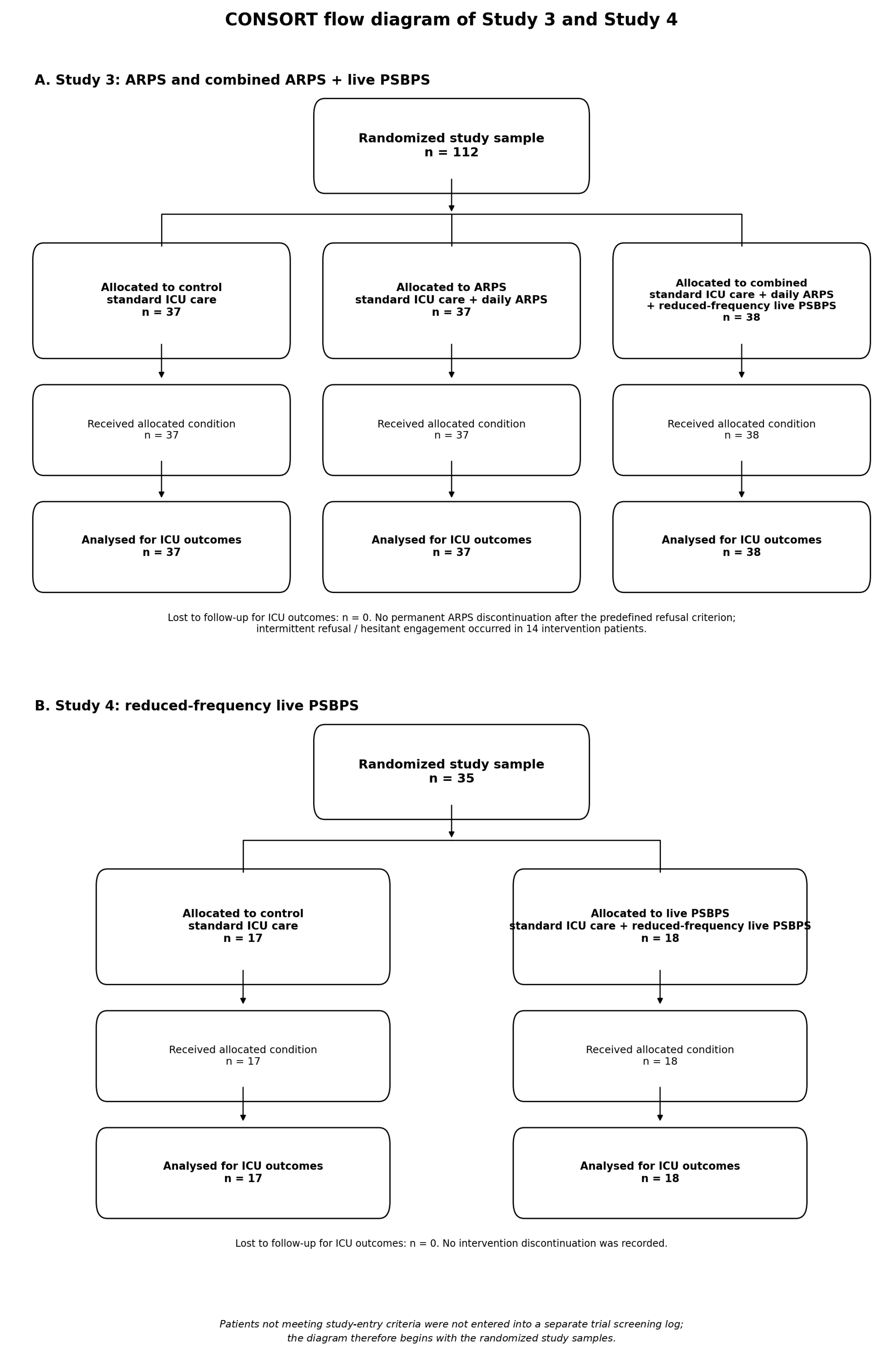
Figure 2.
Main randomized outcomes in Study 4.
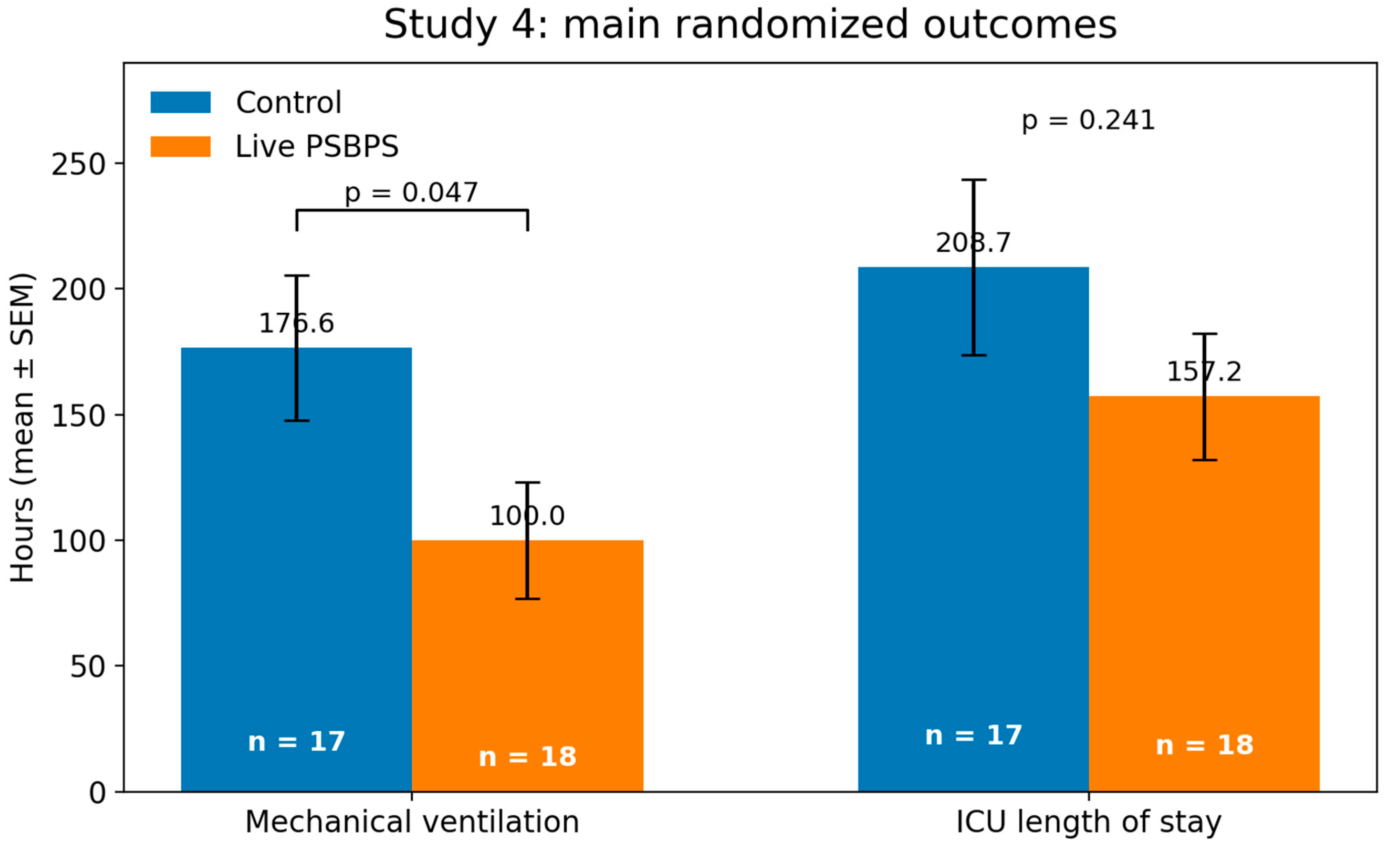
Figure 3.
Mechanical ventilation duration among female patients in Study 3.Female patients receiving ARPS required 63.69 fewer hours (2.65 days) of mechanical ventilation than female control patients. Among female patients ventilated for at least 48 hours, the difference was 64.36 hours (2.68 days).
Figure 3.
Mechanical ventilation duration among female patients in Study 3.Female patients receiving ARPS required 63.69 fewer hours (2.65 days) of mechanical ventilation than female control patients. Among female patients ventilated for at least 48 hours, the difference was 64.36 hours (2.68 days).
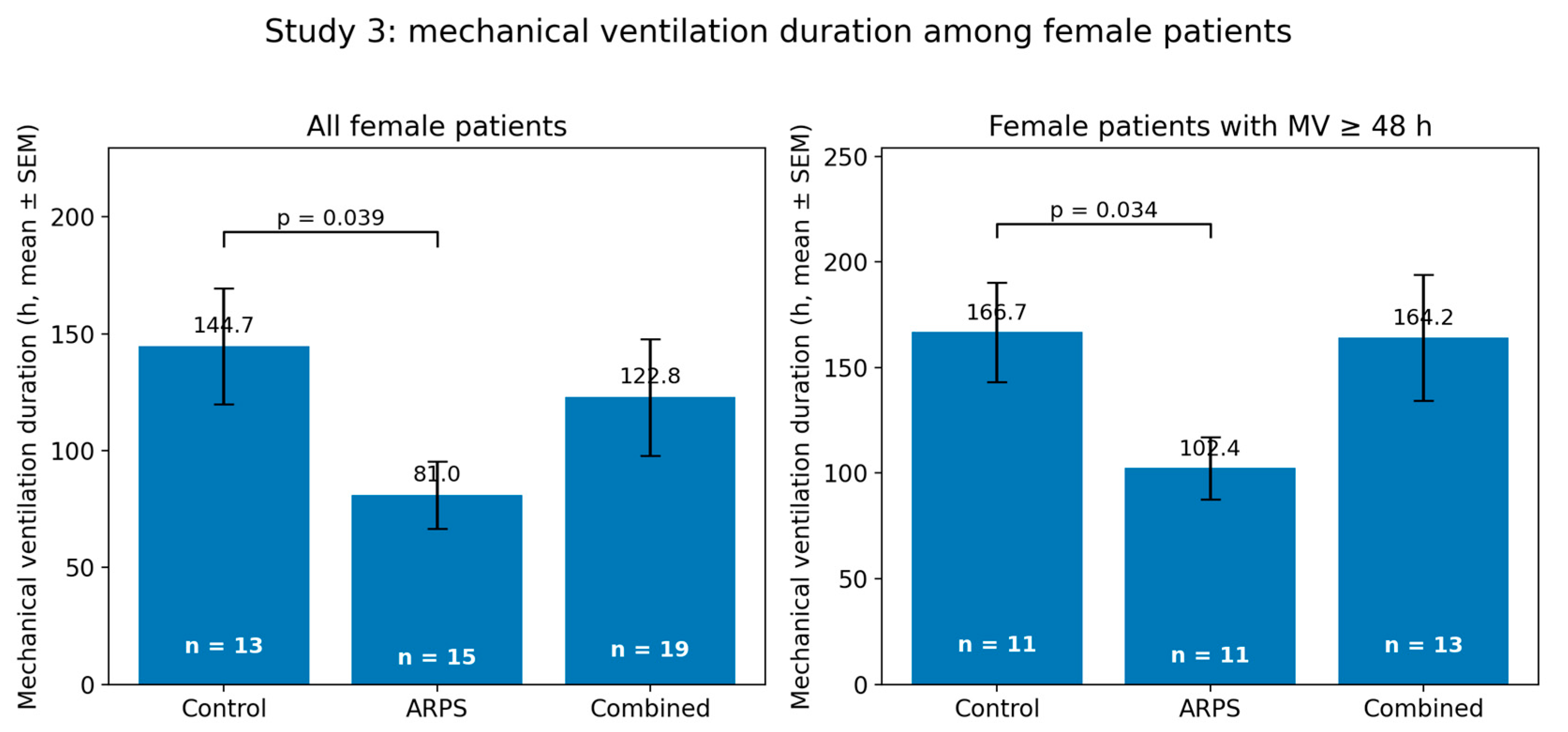
Figure 4.
Mechanical ventilation duration and ICU length of stay according to engagement pattern in Study 3.Patients who consistently engaged with ARPS had 40.21 hours (1.68 days) shorter mechanical ventilation duration than controls and 66.09 hours (2.75 days) shorter ICU length of stay. Patients with hesitant engagement showed longer ICU length of stay than controls.
Figure 4.
Mechanical ventilation duration and ICU length of stay according to engagement pattern in Study 3.Patients who consistently engaged with ARPS had 40.21 hours (1.68 days) shorter mechanical ventilation duration than controls and 66.09 hours (2.75 days) shorter ICU length of stay. Patients with hesitant engagement showed longer ICU length of stay than controls.
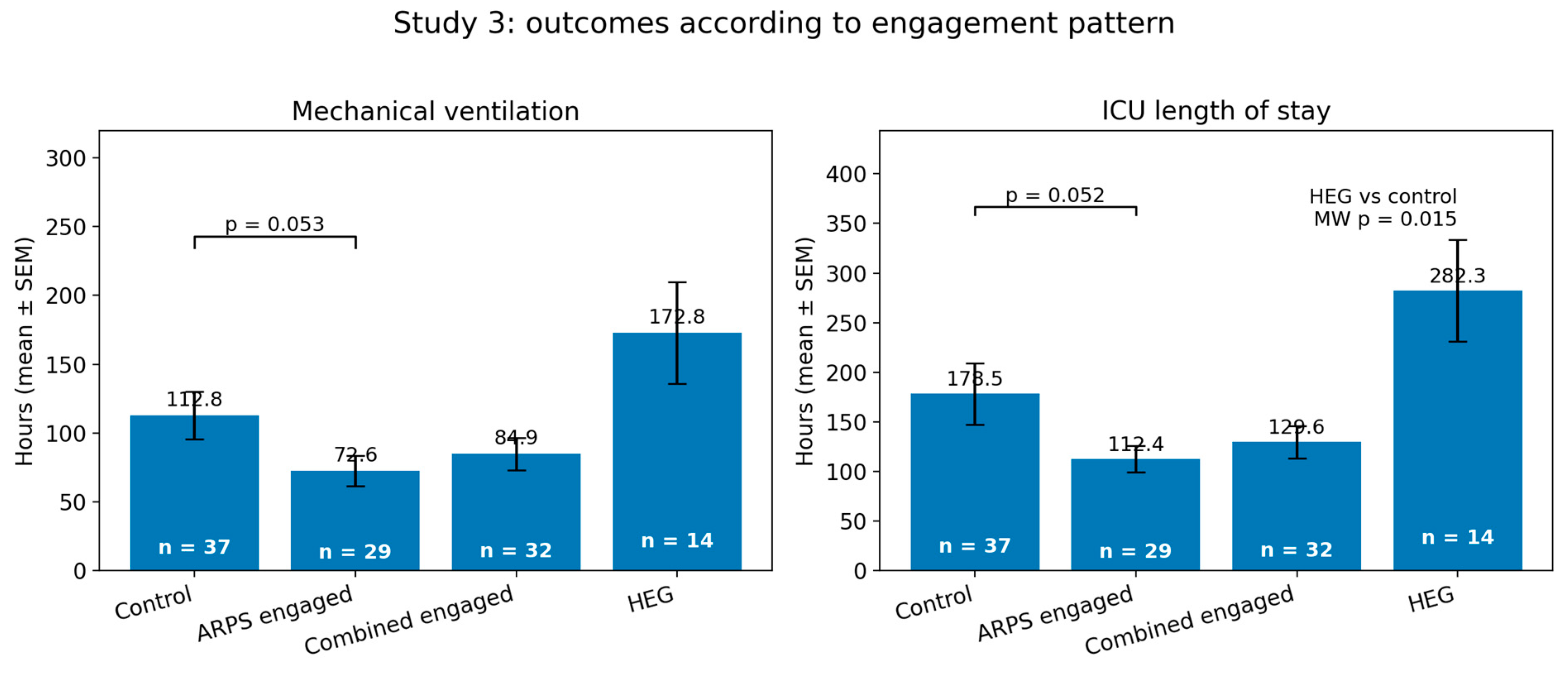

Table 1.
Baseline characteristics of randomized patients in Study 3 and Study 4 Baseline demographic and clinical characteristics of mechanically ventilated ICU patients randomized in the two later phases of the iterative research program. Values are presented as mean ± SD or n (%). P values refer to between-group comparisons within each study.
Table 1.
Baseline characteristics of randomized patients in Study 3 and Study 4 Baseline demographic and clinical characteristics of mechanically ventilated ICU patients randomized in the two later phases of the iterative research program. Values are presented as mean ± SD or n (%). P values refer to between-group comparisons within each study.
| Panel A. Study 3 | |||||||
|---|---|---|---|---|---|---|---|
| Variable | Control (n = 37) |
ARPS (n = 37) |
Combined ARPS + live PSBPS (n = 38) |
p value | |||
| Age, years | 71.43 ± 11.96 | 70.03 ± 12.83 | 68.00 ± 12.30 | 0.484 | |||
| Female sex, n (%) | 13 (35.1%) | 15 (40.5%) | 19 (50.0%) | 0.418 | |||
| SAPS II | 68.72 ± 16.18 | 66.35 ± 15.48 | 59.05 ± 13.30 | 0.017 | |||
| Panel B. Study 4 | |||||||
| Variable | Control (n = 17) |
Live PSBPS (n = 18) |
p value | ||||
| Age, years | 65.71 ± 10.70 | 64.56 ± 16.13 | 0.804 | ||||
| Female sex, n (%) | 6 (35.3%) | 10 (55.6%) | 0.315 | ||||
| SAPS II | 58.29 ± 12.52 | 53.17 ± 17.73 | 0.329 | ||||
Note. ARPS = Audio-Recorded Positive Suggestions; PSBPS = Positive Suggestion-Based Psychological Support; SAPS II = Simplified Acute Physiology Score II. SAPS II was available for 36/37 control patients in Study 3 and for all other groups. For the single missing value, the GCS component was unavailable and could not be reliably reconstructed; no value was imputed.
Table 2.
Primary randomized outcomes and ICU mortality in Study 3 and Study 4. Main clinical outcomes in the randomized groups. Continuous outcomes are presented as mean ± SD and median [IQR]. Mortality is presented as n/N (%). For continuous outcomes, positive reductions indicate shorter duration compared with control. For mortality, risk ratios below 1.00 favour the intervention group.
Table 2.
Primary randomized outcomes and ICU mortality in Study 3 and Study 4. Main clinical outcomes in the randomized groups. Continuous outcomes are presented as mean ± SD and median [IQR]. Mortality is presented as n/N (%). For continuous outcomes, positive reductions indicate shorter duration compared with control. For mortality, risk ratios below 1.00 favour the intervention group.
| Panel A. Study 3 | |||||||||||
|---|---|---|---|---|---|---|---|---|---|---|---|
| Outcome | Control (n = 37) |
ARPS (n = 37) |
Combined (n = 38) |
Overall p | ARPS vs control | Combined vs control | |||||
| Mechanical ventilation, h | 112.80 ± 104.40 Median [IQR]: 81 [42–175] | 84.05 ± 78.84 Median [IQR]: 62 [26–122] |
108.68 ± 97.99 Median [IQR]: 75 [40.25–119.50] |
0.319 | Reduction = 28.74 h 95% CI [−14.19, 71.67] g = 0.31; p = 0.186 |
Reduction = 4.11 h 95% CI [−42.52, 50.74] g = 0.04; p = 0.861 |
|||||
| ICU length of stay, h | 178.54 ± 185.49 Median [IQR]: 119 [58.50–230] |
137.30 ± 114.81 Median [IQR]: 119 [70–168] |
165.30 ± 136.75 Median [IQR]: 124 [58–213.25] |
0.437 | Reduction = 41.24 h 95% CI [−30.49, 112.98] g = 0.26; p = 0.255 |
Reduction = 13.24 h 95% CI [−62.05, 88.52] g = 0.08; p = 0.727 |
|||||
| ICU mortality | 16/37 (43.2%) | 9/37 (24.3%) | 11/38 (28.9%) | 0.192 | RR = 0.56 95% CI [0.29, 1.11] p = 0.140 |
RR = 0.67 95% CI [0.36, 1.24] p = 0.234 |
|||||
| Panel B. Study 4 | |||||||||||
| Outcome | Control (n = 17) |
Live PSBPS (n = 18) |
Live PSBPS vs control | p value | Sensitivity p | ||||||
| Mechanical ventilation, h | 176.59 ± 119.32 Median [IQR]: 159 [67–242] |
99.97 ± 98.11 Median [IQR]: 68.50 [30–133.13] |
Reduction = 76.62 h 95% CI [1.07, 152.16] g = 0.69 |
0.047 | 0.032 | ||||||
| ICU length of stay, h | 208.68 ± 143.66 Median [IQR]: 168 [115–265.50] |
157.22 ± 106.97 Median [IQR]: 136.25 [81.25–197.25] |
Reduction = 51.45 h 95% CI [−36.44, 139.35] g = 0.40 |
0.241 | 0.262 | ||||||
| ICU mortality | 10/17 (58.8%) | 5/18 (27.8%) | RR = 0.47 95% CI [0.20, 1.10] |
0.092 | — | ||||||
Note. CI = confidence interval; g = Hedges’ g; RR = risk ratio. Overall Study 3 continuous-outcome p values are from Welch’s one-way ANOVA; pairwise and Study 4 p values are from Welch independent-samples t-tests. Sensitivity p values refer to rank-based analyses (Kruskal–Wallis or Mann–Whitney as applicable).
Table 3.
SAPS II-adjusted sensitivity analyses. Sensitivity analyses adjusted for baseline disease severity. For continuous outcomes, adjusted mean differences are shown relative to the control group; positive values indicate reductions compared with control. Mortality effects are shown as adjusted odds ratios.
Table 3.
SAPS II-adjusted sensitivity analyses. Sensitivity analyses adjusted for baseline disease severity. For continuous outcomes, adjusted mean differences are shown relative to the control group; positive values indicate reductions compared with control. Mortality effects are shown as adjusted odds ratios.
| Study | Outcome | Comparison | Adjusted effect | 95% CI | p value |
|---|---|---|---|---|---|
| Study 3 | Mechanical ventilation | ARPS vs control | Reduction = 24.28 h | [−19.38, 67.93] | 0.273 |
| Study 3 | Mechanical ventilation | Combined vs control | Reduction = −7.32 h | [−52.11, 37.47] | 0.747 |
| Study 3 | ICU length of stay | ARPS vs control | Reduction = 33.67 h | [−34.79, 102.12] | 0.332 |
| Study 3 | ICU length of stay | Combined vs control | Reduction = −6.68 h | [−76.92, 63.56] | 0.851 |
| Study 3 | ICU mortality | ARPS vs control | OR = 0.41 | [0.15, 1.17] | 0.096 |
| Study 3 | ICU mortality | Combined vs control | OR = 0.71 | [0.26, 1.97] | 0.509 |
| Study 4 | Mechanical ventilation | Live PSBPS vs control | Reduction = 82.60 h | [6.37, 158.84] | 0.035 |
| Study 4 | ICU length of stay | Live PSBPS vs control | Reduction = 60.40 h | [−27.04, 147.83] | 0.169 |
| Study 4 | ICU mortality | Live PSBPS vs control | OR = 0.29 | [0.07, 1.26] | 0.098 |
Note. OR = odds ratio; CI = confidence interval; SAPS II = Simplified Acute Physiology Score II.
Table 4.
Planned sex-stratified analyses in Study 3. Planned sex-stratified analyses of mechanical ventilation duration. Values are mean ± SD. Positive reductions indicate shorter mechanical ventilation duration compared with the control group.
Table 4.
Planned sex-stratified analyses in Study 3. Planned sex-stratified analyses of mechanical ventilation duration. Values are mean ± SD. Positive reductions indicate shorter mechanical ventilation duration compared with the control group.
| Analysis | Control | ARPS | Combined | ARPS vs control | Combined vs control |
|---|---|---|---|---|---|
| Female patients | 144.69 ± 89.77 (n = 13) |
81.00 ± 55.37 (n = 15) |
122.79 ± 108.18 (n = 19) |
Reduction = 63.69 h 95% CI [3.69, 123.70] g = 0.84; p = 0.039 MW p = 0.053 |
Not significant |
| Female patients with MV ≥ 48 h | 166.73 ± 78.29 (n = 11) |
102.36 ± 48.95 (n = 11) |
164.15 ± 107.95 (n = 13) |
Reduction = 64.36 h 95% CI [5.57, 123.16] g = 0.95; p = 0.034 MW p = 0.042 |
Not significant |
Note. MV = mechanical ventilation; MW = Mann–Whitney sensitivity analysis. The overall treatment-group-by-sex interaction for MV duration was not statistically significant, F(2,106) = 0.735, p = 0.482. Accordingly, the within-female ARPS finding should not be interpreted as demonstrating differential efficacy by sex.
Table 5.
Post hoc engagement-pattern analyses in Study 3. Exploratory post hoc analysis according to engagement with the audio intervention. Values are mean ± SD. Positive reductions indicate shorter duration compared with the control group.
Table 5.
Post hoc engagement-pattern analyses in Study 3. Exploratory post hoc analysis according to engagement with the audio intervention. Values are mean ± SD. Positive reductions indicate shorter duration compared with the control group.
| Outcome | Control (n = 37) |
ARPS engaged (n = 29) |
Combined engaged (n = 32) |
HEG (n = 14) |
Key comparison |
|---|---|---|---|---|---|
| Mechanical ventilation, h | 112.80 ± 104.40 | 72.59 ± 59.27 | 84.88 ± 66.98 | 172.79 ± 138.84 | ARPS engaged vs control: Reduction = 40.21 h 95% CI [−0.59, 81.01] g = 0.45; p = 0.053 |
| ICU length of stay, h | 178.54 ± 185.49 | 112.45 ± 71.40 | 129.64 ± 91.31 | 282.29 ± 192.34 | ARPS engaged vs control: Reduction = 66.09 h 95% CI [−0.74, 132.93] g = 0.44; p = 0.052 HEG vs control: MW p = 0.015 |
| SAPS II | 68.72 ± 16.18 | 67.24 ± 16.68 | 59.09 ± 13.73 | 61.29 ± 10.70 | HEG did not show higher baseline severity than controls. |
| Female sex, n (%) | 13/37 (35.1%) | 13/29 (44.8%) | 15/32 (46.9%) | 6/14 (42.9%) | HEG sex distribution was similar to the total Study 3 sample. |
Note. HEG = Hesitant Engagement Group; SAPS II = Simplified Acute Physiology Score II. Engaged patients were intervention recipients without a documented intermittent refusal pattern. Hesitant engagement was defined post hoc as one or more unequivocal verbal or behavioral refusals of ARPS followed by renewed acceptance, without permanent discontinuation. Engagement classification was exploratory and did not alter randomized-group assignment for the primary analyses.
Disclaimer/Publisher’s Note: The statements, opinions and data contained in all publications are solely those of the individual author(s) and contributor(s) and not of MDPI and/or the editor(s). MDPI and/or the editor(s) disclaim responsibility for any injury to people or property resulting from any ideas, methods, instructions or products referred to in the content. |
© 2026 by the authors. Licensee MDPI, Basel, Switzerland. This article is an open access article distributed under the terms and conditions of the Creative Commons Attribution (CC BY) license (http://creativecommons.org/licenses/by/4.0/).
Copyright: This open access article is published under a Creative Commons CC BY 4.0 license, which permit the free download, distribution, and reuse, provided that the author and preprint are cited in any reuse.