

Submitted:
17 July 2026
Posted:
20 July 2026
You are already at the latest version
Abstract
The incorporation of recycled coarse aggregates (RCA) derived from dispersed waste concrete into lining concrete for underground engineering presents a potential strategy to reduce primary resource depletion. However, the actual environmental benefits of this approach are highly contingent upon logistical factors, such as transport distances, and the mix design adjustments necessary to compensate for RCA quality variations. In this study, a cradle-to-gate life cycle assessment (LCA) was conducted for C30/37 underground lining concrete to evaluate the combined effects of RCA replacement ratio, waste concrete transport distance, and cement-compensation assumptions. Literature-based RCA properties-including density, water absorption, and mechanical performance indicators-were employed to support four cement-compensation scenarios (0%, 5%, 10%, and 15%) at a fixed 30% RCA replacement rate. The results reveal that cement production accounts for over 80% of the total global warming potential (GWP). Under an equal cement content scenario, each 10% substitution of natural coarse aggregate with RCA reduces aggregate-related GWP by approximately 0.233 kg CO2 eq/m³. However, the total GWP of the CC0 scenario is only 0.18% lower than that of conventional concrete. In contrast, cement-compensation levels of 5%, 10%, and 15% increase the GWP to 455.3, 474.7, and 494.1kg CO2eq/m3, which are 4.26%, 8.72%, and 13.17% higher than conventional concrete, respectively. The previously identified critical transport distance of 26.04 km is therefore specifically applicable only to the equal-cement CC0 aggregate-substitution scenario. These findings demonstrate that the environmental feasibility of RCA-based lining concrete is jointly governed by the quality of the recycled material, the additional cement demand, and regional transport conditions. The outcomes provide a quantitative foundation for decision-making in the production and environmental performance evaluation of underground lining concrete, particularly in the context of extreme environments, where material reliability and resource security are of paramount importance.
Keywords:
underground engineering
; lining concrete
; recycled aggregate
; life cycle assessment
; global warming potential
; transport distance
1. Introduction
With the continuous acceleration of global urbanization and the vigorous development of the construction industry, construction waste has become one of the fastest-growing waste streams worldwide. According to the United Nations Environment Programme, construction and demolition waste accounts for more than 25% of total municipal solid waste globally, and this proportion reaches as high as 36% in the European Union [1]. As the country with the most active construction industry in the world, China generates more than 1.1×10¹⁰ tons of various solid wastes annually, with a historical stockpile exceeding 6.0×10¹⁰ tons occupying more than 20,000 km2 of land. Improper disposal can easily lead to water pollution, soil contamination, air pollution, and other environmental problems [2]. The proper disposal and utilization of these wastes have become key issues constraining urban sustainable development.
Traditional disposal methods for construction waste are mainly landfilling and stockpiling, which not only occupy substantial land resources but also pose potential threats to the surrounding environment and human health. At the same time, the construction industry is a major consumer of natural resources, consuming approximately 50% of the Earth's natural resources and contributing to 50% of global waste generation [3]. Traditional landfilling and stockpiling of construction waste occupy valuable land resources and generate secondary environmental impacts. Recycling construction waste into value-added building materials can reduce virgin resource extraction and environmental burdens while promoting circular construction and sustainable infrastructure development [4].
Among the potential applications of recycled concrete materials, underground lining concrete represents an important engineering scenario because concrete linings provide structural support and protection for tunnels and underground spaces under complex geological and service conditions [5]. In addition to satisfying mechanical and construction requirements, lining concrete may be affected by hydration heat [6], groundwater pressure, carbonation [7], sulfate-bearing groundwater [8], chloride attack, and high geothermal conditions, which can influence cracking resistance, durability, and structural reliability [9]. Recent research has also investigated recycled coarse aggregate shotcrete for repairing corroded tunnel linings, indicating the potential application of recycled concrete materials in underground engineering [10]. Therefore, the incorporation of RCA produced from dispersed waste concrete into underground lining concrete should be evaluated by jointly considering material-quality variations, possible mixture adjustments, recycling processes, and regional transport conditions.
Life cycle assessment (LCA), as a systematic environmental management tool, can quantify the environmental impacts of a product or service throughout its entire life cycle and has become a mainstream method for evaluating the environmental benefits of construction waste recycling. LCA adopts a "cradle-to-gate" perspective, covering the whole life cycle from raw material extraction, transportation, processing and manufacturing, use, to final disposal, systematically evaluating the environmental impacts of construction waste recycling and providing a scientific basis for the development and application of green building materials [11].
In the field of construction waste management, LCA can scientifically evaluate the energy consumption, environmental emissions, and recycled product benefits of different recycling routes, helping decision-makers identify the most environmentally friendly treatment options [12]. Unlike traditional end-of-pipe approaches, LCA can fully reveal the hidden environmental costs in construction waste recycling, such as carbon emissions from transportation and energy consumption during reprocessing, avoiding the inappropriate shifting of environmental burdens between different life cycle stages or impact categories.
Previous concrete LCA studies have demonstrated that the calculated environmental performance is strongly influenced by cement content, binder composition, functional-unit definition, system boundaries, inventory datasets and transport assumptions [13,14,15,16]. Cement-related impacts are particularly important because changes in cement demand may outweigh the environmental savings achieved through the substitution of natural aggregates. Therefore, an environmental comparison between conventional and recycled aggregate concrete should account not only for the replacement ratio, but also for possible mixture adjustments required to achieve comparable material performance.
Beyond recycled aggregate concrete, LCA has also been widely applied to evaluate the environmental performance of other recycled construction materials. Previous LCA studies have also investigated a wide range of recycled construction materials, including recycled aggregates, autoclaved aerated concrete (AAC), recycled bricks, geopolymer-based materials, and other construction wastes. These studies consistently demonstrate that the environmental performance of recycling systems depends on transport distance, recycling technology, substitution efficiency, and regional energy structure rather than on the recycled material itself [17,18,19,20,21]. For recycled aggregate concrete in particular, transport distance, cement demand, and mixture design have repeatedly been identified as the dominant factors governing environmental performance [22].
In addition to logistics and processing conditions, the environmental performance of RAC is linked to the intrinsic quality of RCA. Recycled concrete aggregates generally contain residual cement mortar, which increases porosity and water absorption and may reduce density and mechanical quality compared with natural aggregates [23,24,25]. The moisture condition of RCA also affects slump development, effective water-to-cement ratio and early-age strength [26,27]. Therefore, RCA replacement should not be regarded simply as a mass substitution in environmental assessment; potential changes in water demand, workability, and additional cement demand should also be considered. These quality-related effects are particularly relevant to underground lining concrete because maintaining the required workability, mechanical reliability, impermeability, and durability may require additional cement or mixture adjustments.
Despite significant progress in LCA research on construction waste recycling, important research gaps and methodological challenges remain. First, most existing studies focus on centrally generated, compositionally relatively homogeneous industrial or demolition waste, with insufficient attention to construction waste that is highly dispersed and has complex collection and pretreatment processes. The environmental benefits of recycling such dispersed waste are affected by multiple interacting factors-collection radius, transport energy consumption, sorting efficiency-requiring more refined modeling.
Second, although many previous studies compared recycled and conventional concrete under equal-cement assumptions, the influence of RCA-quality-related additional cement demand has received much less attention. Because cement production dominates the environmental burden of concrete, even modest increases in cement demand may substantially alter the environmental feasibility of recycled concrete.
Furthermore, transport-distance thresholds reported in previous studies are usually scenario-dependent and cannot be directly generalized to recycled concrete mixtures requiring additional cement. More comprehensive multi-indicator assessment and uncertainty analysis are therefore needed to support reliable environmental decision-making.
To address these research gaps, this study develops a cradle-to-gate LCA model for C30/37 underground lining concrete incorporating RCA produced from dispersed waste concrete. The study evaluates the effects of RCA replacement ratio, waste-concrete transport distance, and cement-compensation assumptions on environmental performance. Literature-derived RCA properties, including density, water absorption, and mechanical-quality indicators, are used to support quality-related cement-compensation scenarios. Through sensitivity and uncertainty analyses, the study identifies how RCA quality, additional cement demand, and regional transport conditions jointly affect the environmental feasibility of RCA-based lining concrete. The results are intended to provide a quantitative basis for material selection and production-stage environmental decision-making in underground engineering.
2. Methodology
2.1. Method Description and System Boundary
This study adopts life cycle assessment (LCA) to quantify the environmental benefits of producing recycled coarse aggregate (RCA) from dispersed waste concrete and using it in concrete mixtures, as well as to identify key influencing factors. The functional unit is defined as 1 m³ C30/37 ready-mixed concrete. The system boundary follows a “cradle-to-gate” approach, as illustrated in Figure 1, covering all processes from raw material acquisition (or waste collection), transport, recycling treatment, concrete mixing, to the finished product leaving the factory. The use phase and end-of-life disposal are not included in this study. The impact assessment method selected is IPCC 2021, with a focus on global warming potential and ReCiPe 2016 v1.03, Midpoint (H) for acidification potential.
2.2. Life Cycle Inventory and Model Construction
Based on openLCA software and the ecoinvent 3 database, comparative models of conventional concrete and recycled concrete were constructed, with detailed data as follows.
1. Baseline scenario (conventional concrete): The model was established based on a typical C30 mix design, with main input data shown in Table 1.
2. Alternative scenario (recycled concrete): Natural coarse aggregate was replaced by recycled coarse aggregate at replacement ratios of 0% to 40% by mass. The recycled aggregate production subsystem includes waste concrete collection, recycling treatment energy consumption, and transport to the treatment facility. Key parameter settings are presented in Table 2.
2.3. Literature-Derived RCA Quality Parameters and Quality-Dependent LCA Assumptions
Recycled aggregate concrete is a composite material whose environmental performance is closely related to the quality of recycled aggregates. Previous studies have shown that recycled aggregates are generally more heterogeneous than natural aggregates and that their composition, attached mortar content, porosity and water absorption can significantly influence the fresh, mechanical, durability and environmental properties of concrete [28]. Residual mortar is considered a major source of the lower density and higher water absorption of RCA, while aggregate moisture state and preconditioning can substantially affect workability and the effective water-to-cement ratio of RAC [29]. Therefore, in this study, RCA quality was not treated as a fixed material property. Instead, representative literature-derived parameters were used to construct quality-dependent LCA scenarios.
Table 3 summarizes the literature-derived RCA/RAC quality parameters used in this study. These parameters were not used as experimentally measured inputs, but as evidence-based assumptions for defining RCA quality levels, cement-compensation scenarios and sensitivity analysis settings.
Based on the literature data summarized in Table 3, the literature data were used to characterize the possible variability in RCA quality and to support the range of cement-compensation assumptions adopted in the sensitivity analysis. The high/medium-quality scenario was represented by recycled coarse aggregates with relatively high apparent density, moderate water absorption and low crushing index, whereas the low-quality scenario was represented by CDW-derived recycled aggregates with lower density, higher water absorption and higher abrasion loss. These quality levels were used to support the quality-dependent assumptions in the LCA model rather than as experimentally measured material inputs.
RCA water absorption was considered as an important uncertainty source because it can affect the effective water-to-cement ratio, workability, cement hydration and compressive strength of RAC. Since the 24 h water absorption of RCA does not necessarily represent the actual water absorbed from fresh mortar, the potential influence of water absorption was represented indirectly through the cement-compensation scenarios rather than through a direct water-absorption input.
The equal-cement CC0 scenario, containing 461.00 kg/m³ of cement, was adopted as the base RCA scenario. A 5% cement increase was selected as a literature-informed compensation scenario to represent the possible additional cement demand associated with RCA incorporation. Additional compensation levels of 10% and 15% were included as upper sensitivity scenarios. Accordingly, cement contents of 461.00, 484.05, 507.10 and 530.15 kg/m³ were evaluated at a fixed RCA replacement ratio of 30%.
A one-factor-at-a-time approach was used. The amounts of natural coarse aggregate, recycled coarse aggregate, sand and water, together with the electricity consumption for concrete mixing, RCA-processing inputs and the baseline transport setting, were kept constant across the four scenarios. Only the cement input was changed. Therefore, the resulting differences in environmental impacts represent the sensitivity of the LCA model to additional cement demand rather than experimentally validated changes in concrete mix design.
The literature-derived RCA properties summarized in Table 3 were used to support the selection of the cement-compensation range rather than as direct numerical inputs to the openLCA model. In particular, RCA water absorption, density and mechanical quality were regarded as material-quality factors that may indirectly result in additional cement demand. The environmental impacts were consequently evaluated as a function of the cement-compensation assumption under the fixed 30% RCA replacement scenario.
2.4. Impact Assessment Method
Climate-change impacts were calculated using the IPCC 2021 GWP 100 method. Terrestrial acidification-related impacts were separately evaluated using ReCiPe 2016 v1.03, Midpoint (H), with results expressed in species·yr. Given the study’s focus on the key drivers of concrete’s carbon footprint and the sensitivity of transport distance, we analyzed the following two core environmental impact indicators:
(1) Global warming potential (GWP), kg CO₂-eq, to quantify the contribution of the whole concrete production process to climate change;
(2) Terrestrial acidification potential (TAP), species·yr, to evaluate the potential damage to terrestrial ecosystems from NOₓ, SO₂, and other acidifying gas emissions during transport and production.
These two indicators capture the most concerned climate change impact of recycled concrete as well as the cross-media environmental issues potentially caused by transport. All calculations were performed using openLCA software and the ecoinvent 3 database.
3. LCA Model Calculation Results
3.1. Sankey Diagram of GWP Impact for Concrete Production
Global warming potential (GWP) is a standardized metric that measures the contribution of a given mass of a greenhouse gas to global warming over a specified time horizon (e.g., 100 years) relative to an equivalent mass of CO₂. It converts different greenhouse gases into comparable “carbon dioxide equivalents”, thereby quantifying the climate change contribution of a product or service throughout its life cycle.
Figure 2 and Figure 3 present Sankey diagrams of GWP for conventional concrete and recycled concrete with a 30% coarse aggregate replacement ratio, respectively. It can be seen that cement production is the largest contributor to carbon emissions in concrete production, generating 387.9 kg CO2 -eq per cubic meter of concrete and accounting for more than 80% of the total. This finding is consistent with the conclusions of Schneider [36], Hafez [37], Xiao [38], highlighting that cement is the dominant source of concrete’s carbon footprint. The fundamental reason lies in the large amount of CO2 released during the decomposition of calcium carbonate and high-temperature calcination in cement clinker production. In contrast, the extraction and transport of natural aggregate, as well as the crushing, screening, and short-distance transport of recycled aggregate, have far lower carbon emission intensities than cement. From a broader decarbonization perspective, the primary strategy for reducing concrete’s carbon footprint is to reduce cement consumption or use low-carbon cement. Under this premise, promoting recycled aggregate utilization can further reduce natural resource consumption and bring additional carbon reduction benefits, serving as a key complementary measure for achieving a circular economy.
3.2. Effect of Coarse Aggregate Replacement Ratio on GWP
Conventional and recycled concrete were modeled according to the methodology described in Section 2 and then input into the LCA model for calculation. The results are shown in Figure 4a–e (note: the cement GWP contribution is omitted because it remains unchanged across scenarios). It can be seen that using waste concrete to produce recycled coarse aggregate effectively reduces the GWP of concrete production. When the replacement ratio of natural coarse aggregate by recycled coarse aggregate is 10%, 20%, 30%, and 40%, the total GWP of the aggregate decreases by 0.234, 0.467, 0.701, and 0.935 kg CO2 -eq, respectively. On average, each 10% replacement of natural coarse aggregate with recycled aggregate reduces the GWP of the aggregate by approximately 0.233 kg CO2 -eq, corresponding to a carbon emission reduction of about 1.87%. This indicates that, without considering the negative impact of long-distance transport, the recycling technology itself has a clear carbon reduction benefit.
This trend is consistent with previous LCA studies indicating that RCA can reduce the burdens associated with virgin aggregate extraction and production [39]. However, the magnitude of this benefit is not universal and depends on crushing and screening technology, electricity supply, allocation procedures and transport conditions [40].
3.3. Effect of Waste Concrete Transport Distance on Acidification
Beyond GWP, a comprehensive LCA requires attention to multiple environmental impact categories. Terrestrial acidification is one such critical regional impact category. It is primarily caused by emissions of acidifying gases such as SO2 and NOx, which alter the chemistry of soils and freshwater through acid deposition, thereby posing serious threats to terrestrial plant growth, forest health, and biodiversity.
Although carbon emissions have received much attention in LCA studies of construction waste recycling, systematic assessments of acidification potential are relatively lacking, and the mechanisms and key drivers of acidification are often overlooked. However, fuel combustion in cement production and additional transport and processing of recycled aggregate are all important sources of acidifying gases. This implies that the environmental benefits of recycled concrete may involve trade-offs or synergies between climate change and acidification—a complex relationship that has not yet been fully elucidated. Therefore, we modeled the acidification of 30% recycled concrete under different transport distances using the ReCiPe 2016 v1.03, Midpoint (H) method to evaluate terrestrial acidification potential and compare its environmental impact. The results are shown in Table 4 and Figure 5.
As shown in Table 4, cement production is the dominant contributor, accounting for approximately 74.5% of the total impact. Its main contributing substance is SO2, originating from coal combustion in cement kilns and oxidation of sulfur in raw materials. The transport of coarse aggregate contributes about 7.30%, with its main emissions being NOx from diesel trucks during transport. This reveals that the acidification impact of recycled concrete shares a common origin with its carbon emissions, but the contribution structures differ: the acidification impact is more concentrated in direct atmospheric emissions from fuel combustion. Compared with conventional concrete, the use of 30% recycled aggregate reduces terrestrial acidification potential by 0.21-0.51%. Notably, although the recycling scenario results in higher NOx emissions from additional transport and processing, the larger avoided SO2 emissions from cement substitution lead to a net reduction in acidification potential. Furthermore, cement production is the primary contributor to both acidification (74.5%) and global warming (>80%), but the relative contribution of transport to acidification is significantly higher than its contribution to climate change, highlighting the importance of multi-indicator assessment.
Compared with the baseline natural aggregate concrete, the use of recycled aggregate reduces acidification potential at all transport distances (no transport, 10 km, 20 km, 30 km). Specifically, with no transport, the total acidification potential of the coarse aggregate is 9.808×10⁻⁹ species·yr, a reduction of about 0.51% relative to the baseline; at 10 km, it is 9.952×10⁻⁹ species·yr (0.41% reduction); at 20 km, it rises to 1.010×10⁻⁸ species·yr (0.31% reduction); and at 30 km, it reaches 1.024×10⁻⁸ species·yr, still 0.21% lower than the baseline.
Although the acidification potential of recycled concrete increases linearly with transport distance-increasing by about 0.1% per 10 km-its values remain below those of natural concrete across the range of distances examined. This indicates that the net acidification reduction benefit of recycled aggregate is robust, though its efficiency decreases with increasing transport distance. The reduction in acidification potential is attributed to the direct reduction in natural aggregate extraction and primary processing enabled by the use of recycled aggregate. However, the recycling system also introduces new environmental burdens: NOₓ emissions from diesel combustion during transport. Our model shows that the contribution of transport to the acidification potential of recycled coarse aggregate increases from 6.88% at 0 km to 7.18% at 30 km, becoming the main factor offsetting the reduction benefit. Thus, the net reduction in acidification potential is the result of a trade-off between the emission reductions from avoiding natural aggregate extraction and the increased emissions from transport.
3.4. Effect of Waste Concrete Transport Distance on GWP
The transport link is a key connector between dispersed waste concrete generation points and treatment facilities. Its environmental cost, particularly its contribution to GWP, can be used to assess the net environmental benefit of recycled aggregate technology.
The net carbon emission of the recycled aggregate system depends on the balance between the avoided emissions from natural aggregate production and the additional emissions from recycling treatment and transport. This relationship can be simplified as:
where is the net GWP of carbon emissions, is the GWP of natural aggregate production, is the GWP of recycled aggregate production, and is the GWP of recycled aggregate transport.
Using the established LCA model with a 30% recycled coarse aggregate replacement ratio, we analyzed the dynamic relationship between different transport distances and the life-cycle carbon emissions of recycled concrete to determine the critical condition for environmental benefit. Transport distances from 0 to 30 km were considered, and the results are shown in Figure 6.
The results show that the GWP of recycled concrete increases linearly with transport distance. Under the ideal scenario of baseline recycling energy consumption and zero transport distance, the use of 30% recycled aggregate achieves an approximately 5.61% GWP reduction. However, as transport distance increases, this reduction benefit is progressively offset. Each additional kilometer of average transport distance in the waste concrete collection phase increases the GWP of recycled coarse aggregate by 0.027 kg CO2 -eq. When the average transport distance reaches the critical value of 26.04 km, the GWP of recycled concrete equals that of conventional concrete, and the net emission reduction becomes zero. Beyond this critical distance, the GWP of recycled concrete surpasses that of conventional concrete, and the environmental benefit becomes negative. This finding is consistent with the conclusions of Navarro [41], Hosseini [42], namely that the environmental radius of bulky, low-value recycled materials is limited.
The strong influence of transport distance is consistent with previous studies showing that the environmental advantage of RCA is determined by the balance between avoided virgin-aggregate production and the additional burdens of waste collection, recycling and delivery [43]. Marinković et al. showed that transport assumptions can substantially change the comparison between natural and recycled aggregate concrete, while Coelho and de Brito identified plant operation and transportation as major contributors to the impacts of CDW recycling systems [44].
3.5. Effect of Cement-Compensation Level on GWP
To evaluate the influence of RCA quality-related mixture compensation on the environmental performance of recycled concrete, the RCA replacement ratio was fixed at 30%, while the cement-compensation level was varied from 0% to 15%. The corresponding cement contents were 461.00, 484.05, 507.10 and 530.15 kg/m³. All other life-cycle inventory inputs were maintained at their baseline values. The calculated results are summarized in Table 5 and Figure 7.
The GWP values of the CC0, CC5, CC10 and CC15 scenarios were 435.9, 455.3, 474.7 and 494.1 kg CO2 -eq/m³, respectively. Compared with the zero-compensation scenario, increasing the cement content by 5%, 10% and 15% changed the total GWP by 4.45%, 8.90% and 13.35%, respectively. The results demonstrate that the environmental performance of recycled concrete is highly sensitive to the assumed additional cement demand.
The GWP contribution increased approximately linearly with the cement-compensation level because cement production was the dominant source of greenhouse gas emissions in all scenarios. Although RCA incorporation reduced the environmental burden associated with natural coarse aggregate production, this benefit was progressively offset by the additional impacts of cement production.
The pronounced sensitivity to cement compensation agrees with previous carbon assessments showing that cement content is a decisive variable in comparisons between recycled and natural aggregate concrete. This also indicates that the environmental performance of RAC can be improved more effectively by limiting clinker-based cement demand or incorporating suitable supplementary cementitious materials than by increasing the RCA replacement ratio alone [45].
Compared with conventional concrete, the CC0 scenarios retained a net GWP reduction of 0.18%, whereas the CC5, CC10 and CC15 scenarios showed higher GWP. This indicates that the environmental advantage of RCA cannot be determined solely from the aggregate replacement ratio. It also depends on whether additional cement is required to satisfy the targeted material performance.
Based on linear interpolation between the CC0 and CC5 scenarios, the critical cement-compensation level at which the GWP of recycled concrete becomes equal to that of conventional concrete was approximately 0.21% under the fixed transport assumptions adopted in Table 5. This corresponds to an additional cement demand of approximately 0.95 kg/m³. Therefore, the environmental margin generated by coarse aggregate substitution was relatively narrow, and even a small increase in cement demand could offset the direct GWP benefit of RCA incorporation.
3.6. Uncertainty Simulation of Waste Concrete Transport Distance
Previous studies have shown that the environmental inventories of aggregate production vary with quarry characteristics, regional electricity supply, processing equipment, plant capacity and transportation assumptions [46]. Therefore, uncertainty analysis is necessary when the modeled environmental advantage of RCA is relatively small.
Given the high uncertainty in the actual transport distance of waste concrete in practice, Monte Carlo simulation with 1000 iterations was performed to propagate the uncertainty of the transport distance input parameter. The results are presented as 95% confidence intervals (95% CI), meaning that we are 95% confident that the true output value of the model falls within this interval. These intervals reflect the range of result variability due to background data variability and model parameter uncertainty. The calculated results are shown in Figure 8.
The bars in Figure 8 represent the mean values, and the error bars represent the 95% confidence intervals from 1000 Monte Carlo iterations. It can be seen that transport distance has a significant effect on the GWP of recycled coarse aggregate. For a transport distance of 10 km, the mean GWP of recycled coarse aggregate is 9.281 kg CO2 -eq per ton, with a 95% CI ranging from 6.755 to 12.484 kg CO2 -eq, giving a relative interval width (interval width/mean) of 61.728%. For 20 km, the mean GWP is 10.075 kg CO2 -eq per ton, with a 95% CI of 7.159 to 14.152 kg CO2 -eq (relative width 69.409%). For 30 km, the mean GWP is 10.889 kg CO2 -eq per ton, with a 95% CI of 7.775 to 14.723 kg CO2 -eq (relative width 63.808%).
Calculated at a 30% coarse aggregate replacement ratio, even under the most unfavorable scenario at the upper bound of the confidence interval, the total GWP of recycled coarse aggregate transported 10 km remains below the baseline value of natural coarse aggregate (12.727 kg CO2 -eq). For transport distances of 20 km and 30 km, the mean GWP per ton is also significantly lower than the baseline value. This indicates that the conclusion that recycled aggregate has a carbon reduction benefit is statistically robust when the average transport distance for waste concrete collection is within 10 km, and the mean GWP values for 20 km and 30 km also lie significantly below the baseline.
The uncertainty analysis shows that despite fluctuations in model results, the majority of the confidence intervals for the GWP of recycled coarse aggregate fall below the baseline value of primary coarse aggregate, which is consistent with the conclusion that recycled aggregate provides a carbon reduction benefit under baseline conditions. However, the analysis also reveals a point of vulnerability: when the transport distance parameter takes its upper bound value, the lower bound of the confidence interval for the reduction benefit approaches zero. This highlights the importance of controlling waste concrete transport distance to ensure the certainty of environmental benefits. Furthermore, the uncertainty in cement production emission factors is the dominant contributor to the width of the result intervals, and future studies are recommended to refine these factors using locally measured data.
4. Summary and Discussion
4.1. Theoretical and Practical Implications of Key Findings
Through life cycle assessment, this study quantitatively reveals that the environmental performance of RCA-based concrete depends on the trade-off between the environmental benefit of natural-aggregate substitution and the additional burdens associated with waste-concrete transport, RCA processing, and possible cement compensation. The finding that cement production contributes more than 80% of the GWP of concrete is consistent with the LCA quantification by Sunita K [47], which showed that cement accounts for approximately 80% of the GWP in a conventional concrete mix. Therefore, low-carbon concrete research should focus on the technology pathway of prioritizing cement reduction over aggregate replacement.
The newly proposed critical transport distance of 26.04 km provides a clear quantitative basis for the resource-oriented planning of dispersed construction waste. This critical value is close to but slightly lower than the conclusion of Shen et al. on the use of MSWI bottom ash for road base (approximately 30 km). The main reason is that the unit-mass environmental benefit of recycled aggregate is lower than that of bottom ash, which can replace a portion of cement, whereas in this study recycled aggregate only replaces natural aggregate. Thus, for recycled materials with lower unit-mass environmental value, the “environmental radius” is shorter, and a highly regionalized recycling system is more urgently needed.
4.2. Influence of Cement Compensation on the Environmental Feasibility of RAC
The cement-compensation sensitivity analysis demonstrates that the environmental benefit of recycled aggregate concrete is much more sensitive to cement demand than to coarse aggregate substitution. At equal cement content, the CC0 scenario achieved a GWP reduction of only 0.18% relative to conventional concrete. In contrast, cement-compensation levels of 5%, 10% and 15% increased total GWP by 4.26%, 8.72% and 13.17% relative to conventional concrete, respectively. This difference arises because cement production dominates the carbon footprint of concrete, whereas natural coarse aggregate production represents a comparatively small contribution.
These results indicate that RCA replacement ratio alone is insufficient for determining the environmental feasibility of recycled concrete. When high-quality RCA can be used without increasing cement content, a limited GWP advantage may be retained. However, when additional cement is required to compensate for higher water absorption, attached mortar or lower mechanical quality, the environmental benefit may be rapidly offset.
The calculated transport-distance threshold should therefore be interpreted as scenario-specific. The value of 26.04 km applies to the equal-cement CC0 aggregate-substitution scenario and should not be generalized to cement-compensated mixtures. Under the fixed transport setting used in Table 5, the CC5, CC10 and CC15 scenarios already exhibited higher GWP than conventional concrete. Consequently, increasing cement demand would shorten, or potentially eliminate, the environmentally feasible transport radius.
The cement-compensation scenarios used in this study are literature-informed LCA assumptions rather than experimentally optimized mixture designs. Nevertheless, they quantitatively demonstrate the importance of controlling RCA quality and avoiding unnecessary increases in clinker-based cement. In practical applications, RCA pretreatment, moisture conditioning, supplementary cementitious materials and mixture optimization may help maintain target performance without imposing a large additional cement burden.
For underground lining applications, these results indicate that RCA selection should be coordinated with project-specific workability, mechanical, impermeability, and durability requirements. High-quality and locally available RCA may retain a limited production-stage environmental advantage, whereas additional cement demand caused by lower RCA quality may rapidly eliminate this benefit. The present LCA results therefore provide an environmental screening basis rather than direct verification of the structural or durability performance of underground lining concrete.
4.3. Trade-Offs Revealed by Multi-Indicator Assessment
The two-indicator assessment results of this study reveal an important phenomenon: the environmental performance of recycled concrete is not synchronous across different impact categories. Specifically, as the average transport distance of waste concrete increases from 0 to 30 km, the GWP reduction benefit decreases linearly and reaches zero at 26.04 km. In contrast, although the TAP reduction benefit also decreases with increasing transport distance (by about 0.10 percentage points per 10 km), a net reduction of 0.21% remains at 30 km.
The root cause of this difference lies in the different dominant emission sources for the two impact categories. The main contribution to GWP comes from process emissions from calcium carbonate decomposition and energy-related emissions from fuel combustion during cement clinker production. The CO2,CH4 and N2O emitted from diesel combustion during recycled aggregate transport are the main factors offsetting the GWP reduction benefit. For TAP, SO2 emissions from cement production (from sulfur in raw materials and coal combustion) remain dominant at approximately 74.5%. Although NOx emissions from recycled aggregate transport increase TAP, their unit-mass acidification potential expressed in SO2 equivalent is lower. Moreover, the use of recycled aggregate avoids acidifying emissions from natural aggregate extraction, such as NOx from blasting and mechanical operations. Consequently, the acidification reduction benefit is more robust.
This finding is corroborated by similar trade-offs in the existing literature. Shen [48] conducted an LCA study on MSWI bottom ash for road base and also observed non-synchronous changes in GWP and TAP: bottom ash substitution reduced GWP but contributed more to TAP than natural aggregate due to the potential release of soluble chloride salts during transport and landfilling. In contrast, the TAP of recycled concrete in this study remained positive at all transport distances, benefiting from the lower chemically active pollutant content of waste concrete compared to MSWI bottom ash, thereby demonstrating better environmental compatibility in terms of acidification.
These findings have clear implications for the formulation of solid waste recycling policies. First, single-indicator assessment may lead to policy bias. If only GWP is used as the evaluation metric, recycled concrete with a transport distance exceeding 26.04 km would be judged as “unfriendly to the environment” and excluded from green building material procurement catalogs. However, when acidification is also considered, recycled concrete within this distance range still has net environmental benefits. Second, the weighting of different environmental indicators directly affects decision outcomes. The European Union’s Product Environmental Footprint (PEF) method assigns standardized weights to impact categories, with GWP typically weighted significantly higher than TAP. Under the PEF framework, recycled concrete beyond the critical distance in this study might still have a negative composite score. Finally, for bulky low-value recycled materials, controlling transport distance should take priority over technological optimization. The sensitivity analysis in this study shows that the negative contribution to GWP of each additional 10 km of transport distance is equivalent to a 50% increase in recycling energy consumption. This suggests that practitioners should prioritize the layout of distributed recycling nodes rather than pursuing single-plant large-scale operations.
In summary, multi-indicator assessment not only reveals the complexity of the environmental benefits of recycled concrete but also provides a quantitative basis for constructing a more scientific green building material evaluation system. Future research can extend the analysis to a more complete life-cycle boundary and additional environmental impact categories, such as mineral resource depletion and freshwater eutrophication, and combine it with multi-criteria decision analysis (MCDA) to further quantify the sensitivity of comprehensive evaluation results to different indicator weightings.
4.4. Research Limitations
Due to data limitations and the idealized assumptions of the constructed model, this study has the following limitations that should be noted when interpreting the results:
(1) The system boundary is “cradle-to-gate”, excluding durability differences during the use phase of recycled concrete. In practice, recycled aggregate may reduce freeze-thaw resistance and carbonation life, and the environmental impacts of end-of-life disposal also need to be considered. In particular, the model did not directly evaluate the structural performance, impermeability, deterioration, maintenance, or service life of RCA-based underground lining concrete under groundwater pressure, sulfate or chloride attack, high geothermal conditions, freeze-thaw cycling, or other extreme underground environments.
(2) The cement-compensation levels of 0%, 5%, 10% and 15% were established as literature-informed sensitivity scenarios and were not validated using experimental mixture designs for the specific RCA considered. Moreover, only the cement input was varied, while water, aggregate contents and concrete output volume were held constant. Therefore, these scenarios represent environmental sensitivity to additional cement demand rather than physically rebalanced or experimentally optimized concrete mixtures.
(3) The transport distance is treated as a deterministic variable. Although uncertainty was quantified via Monte Carlo simulation, practical logistics characteristics such as route detour factors and multi-source aggregation were not considered.
Future research can be deepened along the following directions: conduct durability acceleration experiments on recycled concrete to incorporate service life into a modified functional unit; combine geographic information systems (GIS) with LCA to construct spatially explicit optimization models for construction waste recycling networks; and supplement life-cycle cost analysis (LCC) to evaluate the synergy between environmental benefits and economic feasibility.
5. Conclusions
This study developed a cradle-to-gate LCA model for C30/37 underground lining concrete incorporating recycled coarse aggregate derived from dispersed waste concrete. The analysis focused on the effects of RCA replacement ratio, waste-concrete transport distance, and literature-informed cement-compensation assumptions used to represent RCA-quality variability. The main conclusions are as follows:
(1) Cement production was the dominant source of the production-stage GWP of both conventional and recycled aggregate concrete, accounting for more than 80% of the total. Therefore, limiting clinker-based cement demand or using lower-carbon binders is more influential for reducing the carbon footprint of concrete than aggregate substitution alone.
(2) Under the equal-cement assumption, replacing natural coarse aggregate with RCA reduced the environmental burden associated with aggregate production. Each 10% increase in the RCA replacement ratio reduced the aggregate-related GWP by approximately 0.233 kg CO₂-eq/m³. However, because coarse aggregate contributed only a small proportion of the total concrete GWP, the overall reduction remained limited.
(3) At a fixed RCA replacement ratio of 30%, the CC0 scenario reduced the total GWP by only 0.18% relative to conventional concrete. In contrast, cement-compensation levels of 5%, 10%, and 15% increased the total GWP by 4.26%, 8.72%, and 13.17%, respectively. Thus, the production-stage environmental benefit obtained from aggregate substitution can be rapidly offset when additional cement is required to compensate for RCA-quality-related mixture changes.
(4) Under the equal-cement CC0 scenario, the calculated break-even transport distance was 26.04 km. This value is specific to the 30% RCA replacement scenario and to the inventory, processing, and transport assumptions adopted in this study. It should not be interpreted as a universal transport limit, particularly for mixtures requiring additional cement.
(5) The model results indicated that the terrestrial acidification potential of the 30% RCA concrete was 0.21–0.51% lower than that of conventional concrete over the investigated transport-distance range of 0–30 km. However, the magnitude and transport sensitivity of this difference were not identical to those observed for GWP, demonstrating the importance of considering more than one environmental impact indicator.
(6) Overall, the production-stage environmental feasibility of RCA-based underground lining concrete depends jointly on the quality of the recycled aggregate, the additional cement demand, and the regional transport conditions. Locally available, relatively high-quality RCA that can be incorporated without increasing cement content is more likely to retain an environmental advantage. The present results provide an environmental screening basis for RCA source selection and mixture-scenario comparison.
Acknowledgments
This research was supported by the National Natural Science Foundation of China (51778227), the Natural Science Foundation of Hunan Province, China (2026JJ50476).
References
- Yi, Y.; Fei, X.; Lavagnolo, M.C.; Manzardo, A. An integrated model of life cycle assessment and system dynamics for construction and demolition waste management and reduction in Italy. J. Clean. Prod. 2025, 486, 144469. [Google Scholar] [CrossRef]
- Chen, L.L.; Zhu, J.K.; Ye, Q.; et al. Progress and trends of low-carbon application of waste materials in asphalt pavements. J. Traffic Transp. Eng. 2026, 26, 93–115. [Google Scholar] [CrossRef]
- Hossain, M.U.; Xuan, D.; Ng, S.T.; Amor, B. Designing sustainable partition wall blocks using secondary materials: A life cycle assessment approach. J. Build. Eng. 2021, 43, 103035. [Google Scholar] [CrossRef]
- Hossain, M.U. Life Cycle Assessment of Recycled Construction Materials: Methodology Framework Development and Results Evaluation. Ph.D. Thesis, The Hong Kong Polytechnic University, Hong Kong, China, 2021. [Google Scholar]
- Wang, X.; Fan, F.; Lai, J.; Xie, Y. Steel fiber reinforced concrete: A review of its material properties and usage in tunnel lining. Structures 2021, 34, 1080–1098. [Google Scholar] [CrossRef]
- Zhao, D.; Zhu, L.; Shen, Z.; Miu, Z.; Liu, X. Effect of hydration heat of super-large-section tunnel-lining concrete on structural stress and its mitigation measures. Tunn. Undergr. Space Technol. 2025, 157, 106324. [Google Scholar] [CrossRef]
- Ba, M.; Xue, T.; Huang, G.; Li, Y. Prediction and analysis of carbonation durability of lining concrete with low water–cement ratio for vehicle tunnels. J. Highw. Transp. Res. Dev. 2018, 35, 56–62. [Google Scholar] [CrossRef]
- Ma, K.; Long, G.; Xie, Y. Railway tunnel concrete lining damaged by formation of gypsum, thaumasite and sulfate crystallization products in southwest of China. J. Cent. South Univ. 2012, 19, 2340–2347. [Google Scholar] [CrossRef]
- Wang, Y.; Wu, J.; Zhang, S.; Niu, D. Corrosion behavior of steel reinforcement in simulated concrete pore solutions under multiple factors in high-geothermal environments. J. Chin. Ceram. Soc. 2024, 52, 3583–3593. [Google Scholar] [CrossRef]
- Liu, C.; Zhang, X.; Lai, J.; Qin, Y. Steel fiber-reinforced recycled coarse aggregate shotcrete repair for tunnel lining corrosion: Experimental tests and calculation analysis. Tunn. Undergr. Space Technol. 2025, 157, 106236. [Google Scholar] [CrossRef]
- Xie, K. The Environmental Load Research of Construction Waste Recycling. Thesis, Beijing University of Technology, Beijing, China, 2013. [Google Scholar]
- Luo, Y.J.; Zhao, W. The research development of construction and demolition waste resource utilization and its life cycle assessment. Environ. Pollut. Control 2024, 46, 901–907. [Google Scholar] [CrossRef]
- Gursel, A.P.; Masanet, E.; Horvath, A.; Stadel, A. Life-cycle inventory analysis of concrete production: A critical review. Cem. Concr. Compos. 2014, 51, 38–48. [Google Scholar] [CrossRef]
- Van den Heede, P.; De Belie, N. Environmental impact and life cycle assessment (LCA) of traditional and ‘green’ concretes: Literature review and theoretical calculations. Cem. Concr. Compos. 2012, 34, 431–442. [Google Scholar] [CrossRef]
- Tait, M.W.; Cheung, W.M. A comparative cradle-to-gate life cycle assessment of three concrete mix designs. Int. J. Life Cycle Assess. 2016, 21, 847–860. [Google Scholar] [CrossRef]
- Knoeri, C.; Sanyé-Mengual, E.; Althaus, H.-J. Comparative LCA of recycled and conventional concrete for structural applications. Int. J. Life Cycle Assess. 2013, 18, 909–918. [Google Scholar] [CrossRef]
- Volk, R.; Steins, J.J.; Kreft, O.; Schultmann, F. Life cycle assessment of post-demolition autoclaved aerated concrete (AAC) recycling options. Resour. Conserv. Recycl. 2023, 188, 106716. [Google Scholar] [CrossRef]
- Yin, Z.; Liu, G.; Dong, Y.; Wang, B.; Li, Z.; Yuan, T.; Yin, H. Research on carbon reduction benefits and spatial optimization of construction waste resource utilization under transport distance thresholds: A case study in Jiangsu, China. Case Stud. Constr. Mater. 2026, 24, e05804. [Google Scholar] [CrossRef]
- Zeng, K.; Zou, Q.; Song, S.; Zhang, W.; Wang, S.; Liu, Z.; Gong, M.; Zhang, L. Thermal insulation, acoustic absorption, and environmental benefits of a cellular green recycling brick cement-based material used in energy-efficient buildings. J. Build. Eng. 2026, 117, 114803. [Google Scholar] [CrossRef]
- D’Angelo, G. Technologies for the reuse of demolition waste in the production of geopolymer-based building materials: Prospects and opportunities. Renew. Energy Environ. Sustain. 2025, 10, 1. [Google Scholar] [CrossRef]
- Shi, D.; Ma, X.; Zhao, Y.; Wang, J.; Xia, Y.; Liu, M. Utilization of industrial wastes in non-sintered bricks: Microstructure and environmental impacts. Environ. Sci. Pollut. Res. 2024, 31, 50709–50721. [Google Scholar] [CrossRef] [PubMed]
- Sabău, M.; Bompa, D.V.; Silva, L.F.O. Comparative carbon emission assessments of recycled and natural aggregate concrete: Environmental influence of cement content. Geosci. Front. 2021, 12, 101235. [Google Scholar] [CrossRef]
- Verian, K.P.; Ashraf, W.; Cao, Y. Properties of recycled concrete aggregate and their influence in new concrete production. Resour. Conserv. Recycl. 2018, 133, 30–49. [Google Scholar] [CrossRef]
- McNeil, K.; Kang, T.H.-K. Recycled concrete aggregates: A review. Int. J. Concr. Struct. Mater. 2013, 7, 61–69. [Google Scholar] [CrossRef]
- Tam, V.W.Y.; Soomro, M.; Evangelista, A.C.J. A review of recycled aggregate in concrete applications (2000–2017). Constr. Build. Mater. 2018, 172, 272–292. [Google Scholar] [CrossRef]
- Poon, C.S.; Shui, Z.H.; Lam, L.; Fok, H.; Kou, S.C. Influence of moisture states of natural and recycled aggregates on the slump and compressive strength of concrete. Cem. Concr. Res. 2004, 34, 31–36. [Google Scholar] [CrossRef]
- Etxeberria, M.; Vázquez, E.; Marí, A.; Barra, M. Influence of amount of recycled coarse aggregates and production process on properties of recycled aggregate concrete. Cem. Concr. Res. 2007, 37, 735–742. [Google Scholar] [CrossRef]
- Piccinali, A.; Diotti, A.; Plizzari, G.; Sorlini, S. Impact of recycled aggregate on the mechanical and environmental properties of concrete: A review. Materials 2022, 15, 1818. [Google Scholar] [CrossRef] [PubMed]
- Silva, R.V.; de Brito, J.; Dhir, R.K. Properties and composition of recycled aggregates from construction and demolition waste suitable for concrete production. Constr. Build. Mater. 2014, 65, 201–217. [Google Scholar] [CrossRef]
- Ding, Y.; She, A.; Yao, W. Investigation of water absorption behavior of recycled aggregates and its effect on concrete strength. Materials 2023, 16, 4505. [Google Scholar] [CrossRef] [PubMed]
- Tran, D.V.P.; Allawi, A.; Albayati, A.; Cao, T.N.; El-Zohairy, A.; Nguyen, Y.T.H. Recycled concrete aggregate for medium-quality structural concrete. Materials 2021, 14, 4612. [Google Scholar] [CrossRef] [PubMed]
- Leite, M.B.; Lima, P.R.L. Experimental and statistical evaluation of the interaction effect of recycled aggregate and water/cement ratio on concrete compressive strength. Recent Prog. Mater. 2021, 3, 032. [Google Scholar] [CrossRef]
- Marvila, M.; de Matos, P.; Rodríguez, E.; Monteiro, S.; de Azevedo, A. Recycled aggregate: A viable solution for sustainable concrete production. Materials 2022, 15, 5276. [Google Scholar] [CrossRef] [PubMed]
- Xing, W.; Tam, V.W.Y.; Le, K.N.; Hao, J.L.; Wang, J. Life cycle assessment of recycled aggregate concrete on its environmental impacts: A critical review. Constr. Build. Mater. 2022, 317, 125950. [Google Scholar] [CrossRef]
- Zhang, Y.; Luo, W.; Wang, J.; Wang, Y.; Xu, Y.; Xiao, J. A review of life cycle assessment of recycled aggregate concrete. Constr. Build. Mater. 2019, 209, 115–125. [Google Scholar] [CrossRef]
- Schneider, M. The cement industry on the way to a low-carbon future. Cem. Concr. Res. 2019, 124, 105792. [Google Scholar] [CrossRef]
- Olsson, J.A.; Hafez, H.; Miller, S.A.; Scrivener, K.L. Greenhouse gas emissions and decarbonization potential of global fired clay brick production. Environ. Sci. Technol. 2025, 59, 1909–1920. [Google Scholar] [CrossRef] [PubMed]
- Xiao, J.; Zou, S.; Poon, C.S.; Sham, M.L.; Li, Z.; Shah, S.P. We use 30 billion tonnes of concrete each year—Here’s how to make it sustainable. Nature 2025, 638, 888–890. [Google Scholar] [CrossRef] [PubMed]
- Serres, N.; Braymand, S.; Feugeas, F. Environmental evaluation of concrete made from recycled concrete aggregate implementing life cycle assessment. J. Build. Eng. 2016, 5, 24–33. [Google Scholar] [CrossRef]
- Jullien, A.; Proust, C.; Martaud, T.; Rayssac, E.; Ropert, C. Variability in the environmental impacts of aggregate production. Resour. Conserv. Recycl. 2012, 62, 1–13. [Google Scholar] [CrossRef]
- Ferronato, N.; Guisbert Lizarazu, G.E.; Gorritty Portillo, M.A.; Moresco, L.; Conti, F.; Torretta, V. Environmental assessment of construction and demolition waste recycling in Bolivia: Focus on transportation distances and selective collection rates. Waste Manag. Res. 2022, 40, 793–805. [Google Scholar] [CrossRef] [PubMed]
- Hosseini, S.A.; Asghari, V.; Liu, X.; Hsu, S.-C.; Poon, C.-S. Cross-country life cycle assessment of construction and demolition waste recycling with evaluation of energy use, carbon emissions, and regional trade-offs. Sci. Rep. 2025, 15, 41377. [Google Scholar] [CrossRef] [PubMed]
- Marinković, S.; Radonjanin, V.; Malešev, M.; Ignjatović, I. Comparative environmental assessment of natural and recycled aggregate concrete. Waste Manag. 2010, 30, 2255–2264. [Google Scholar] [CrossRef] [PubMed]
- Coelho, A.; de Brito, J. Environmental analysis of a construction and demolition waste recycling plant in Portugal—Part I: Energy consumption and CO₂ emissions. Waste Manag. 2013, 33, 1258–1267. [Google Scholar] [CrossRef] [PubMed]
- Kurda, R.; Silvestre, J.D.; de Brito, J. Life cycle assessment of concrete made with high volume of recycled concrete aggregates and fly ash. Resour. Conserv. Recycl. 2018, 139, 407–417. [Google Scholar] [CrossRef]
- Hossain, M.U.; Poon, C.S.; Lo, I.M.C.; Cheng, J.C.P. Comparative environmental evaluation of aggregate production from recycled waste materials and virgin sources by LCA. Resour. Conserv. Recycl. 2016, 109, 67–77. [Google Scholar] [CrossRef]
- Kumari, S.; Walia, R. Life cycle assessment of sustainable concrete by utilizing groundnut husk ash in concrete. Mater. Today Proc. 2022, 49, 1910–1915. [Google Scholar] [CrossRef]
- Shen, X.; Liu, C.; Zhao, Y.; Li, Q.; Wang, J. The recycling use of MSWI bottom ash as road construction material for carbon emissions reduction based on life cycle assessment—A case study in China. Waste Manag. 2025, 207, 115122. [Google Scholar] [CrossRef] [PubMed]
Figure 1.
System boundary of the LCA model.
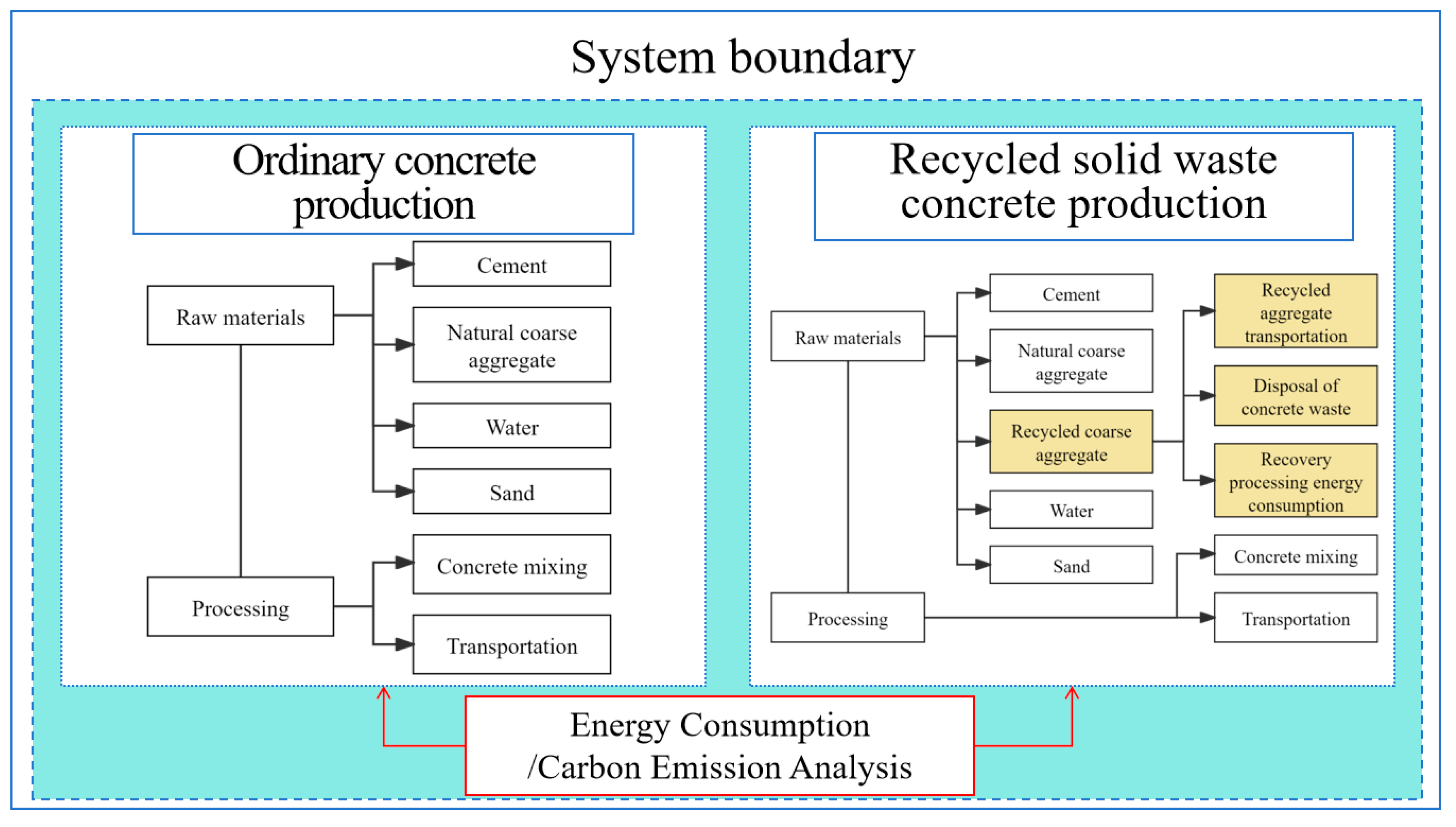
Figure 2.
Sankey diagram of GWP for conventional concrete.
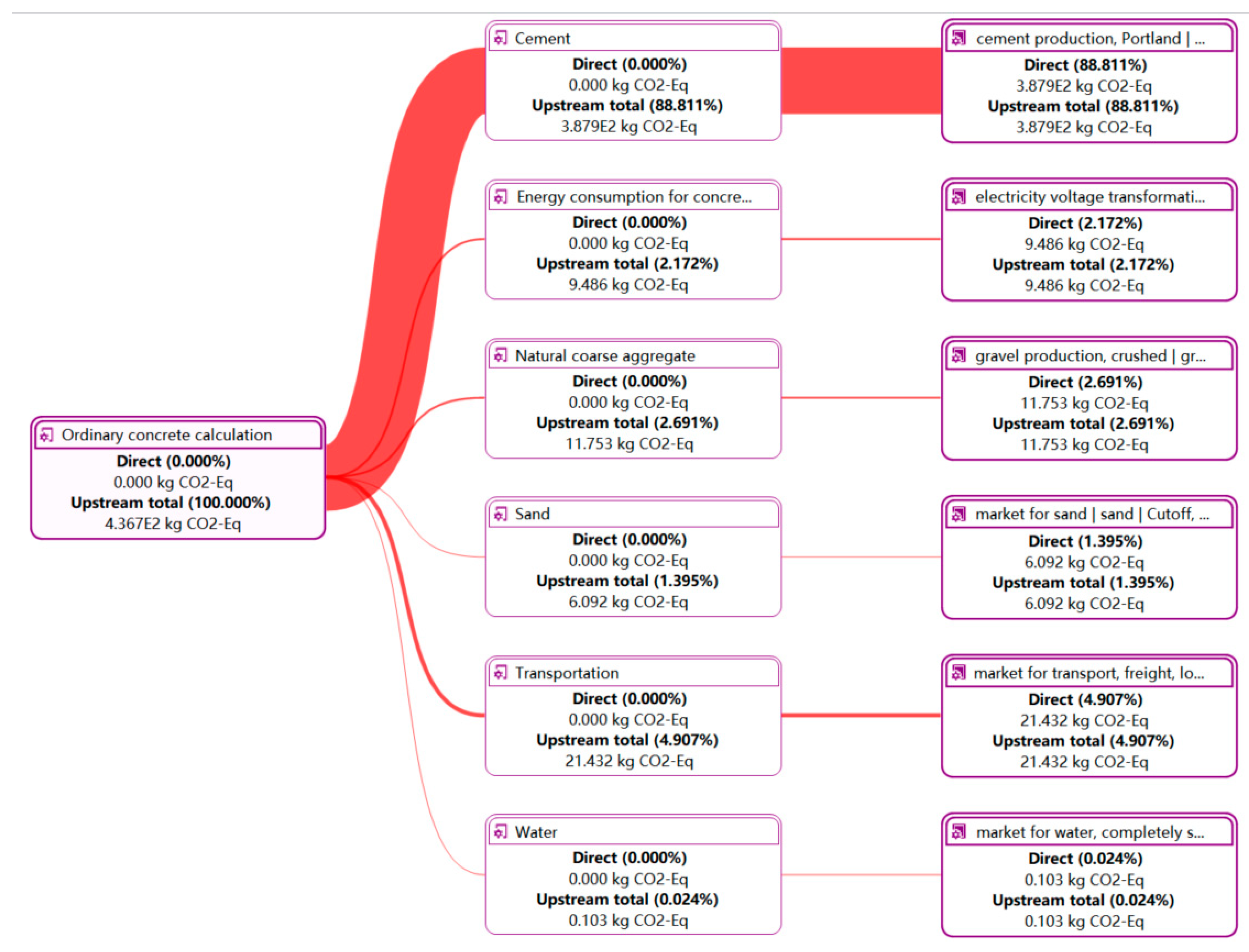
Figure 3.
Sankey diagram of GWP for recycled concrete with 30% coarse aggregate replacement.
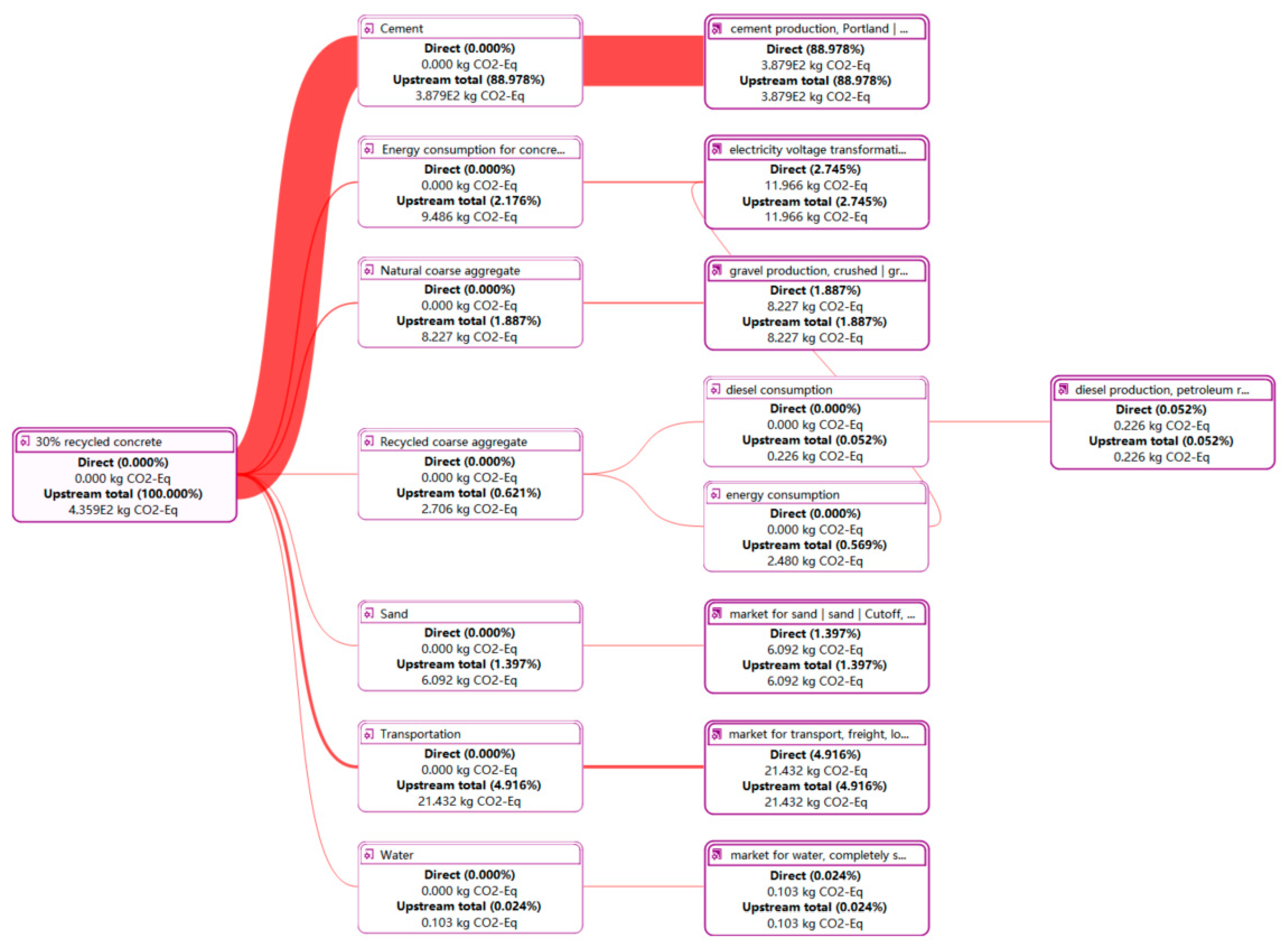
Figure 4.
GWP results for different recycled concrete replacement ratios.
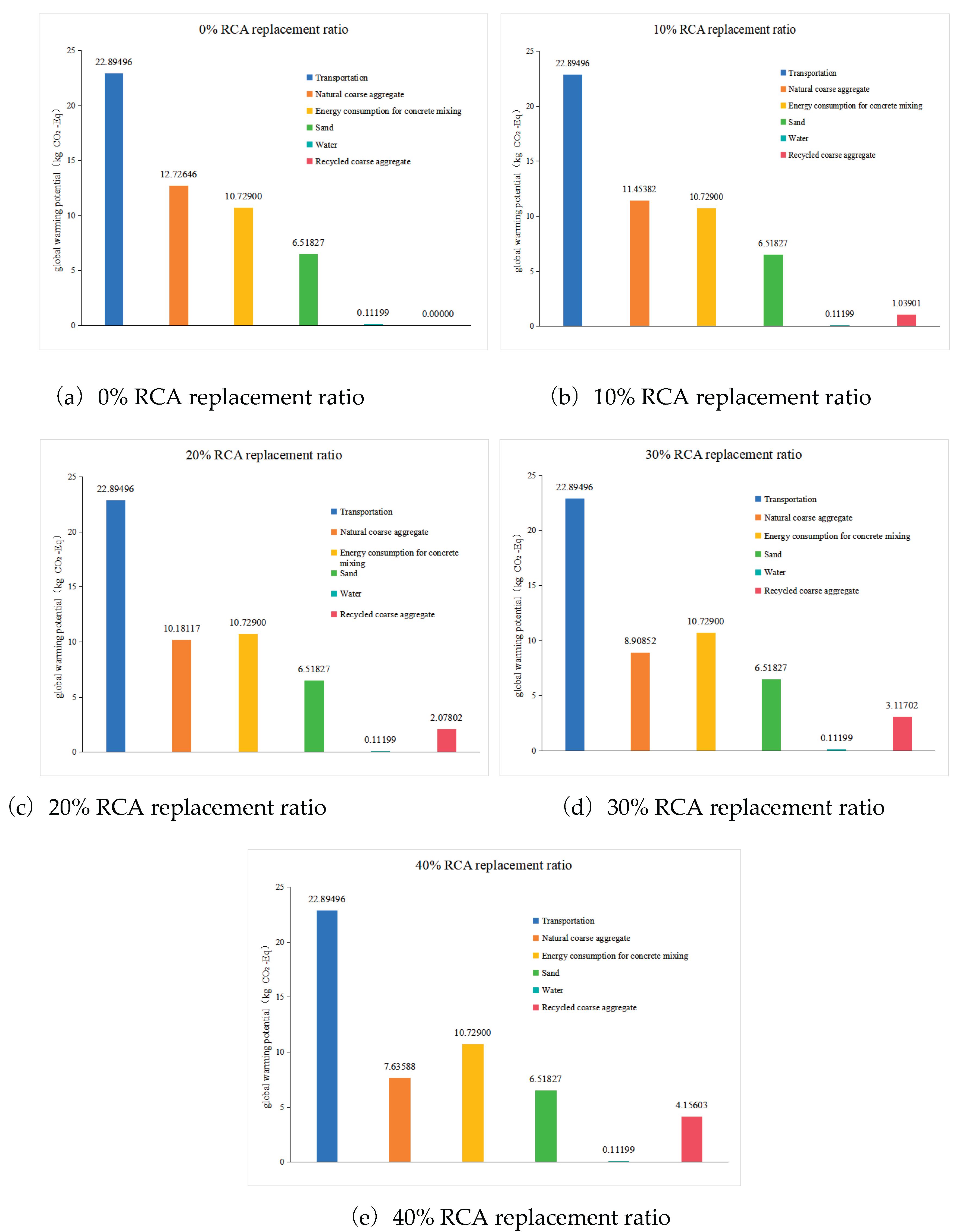
Figure 5.
Comparison of acidification potential for different indicators.
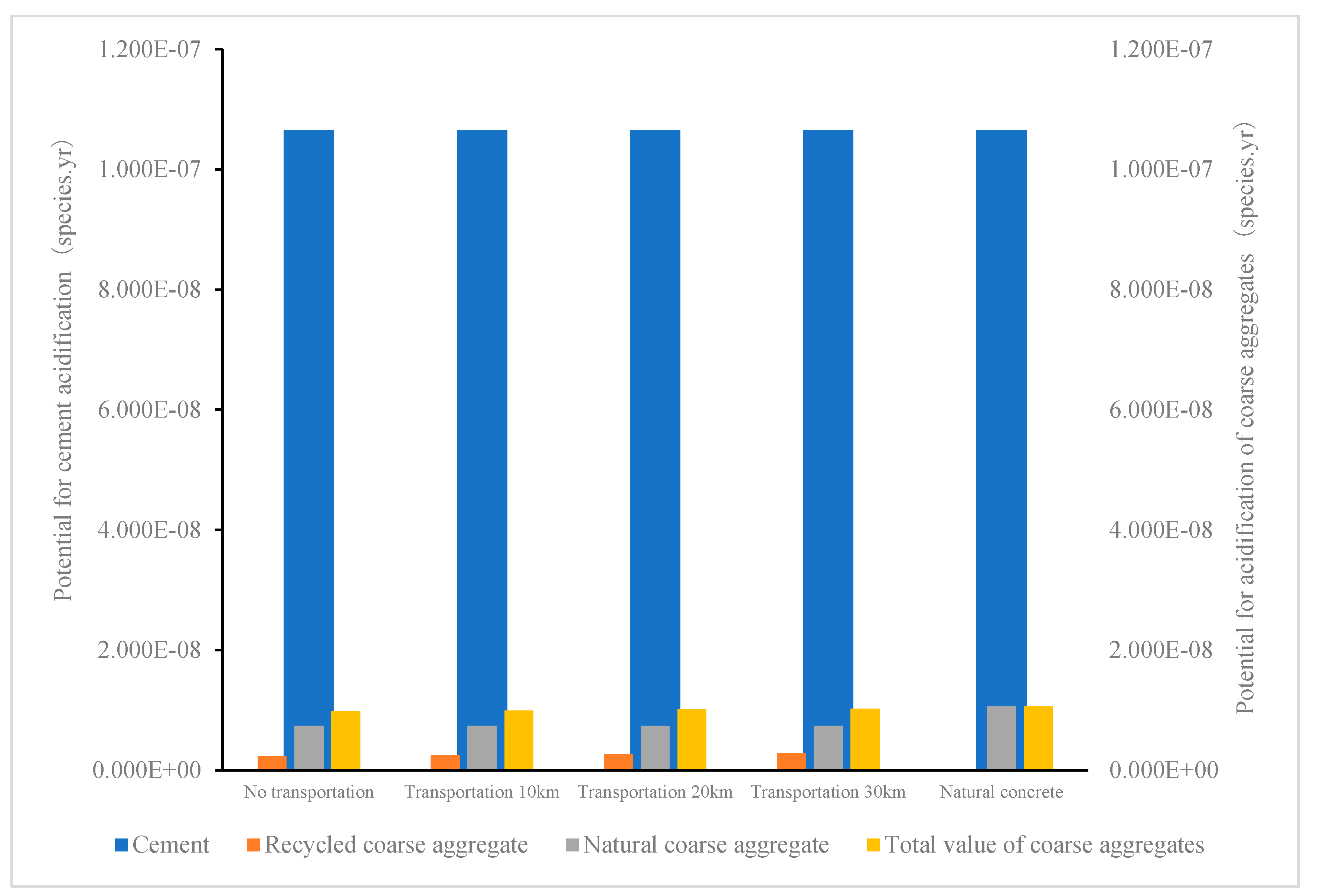
Figure 6.
Comparison of GWP at different transport distances after coarse aggregate replacement.
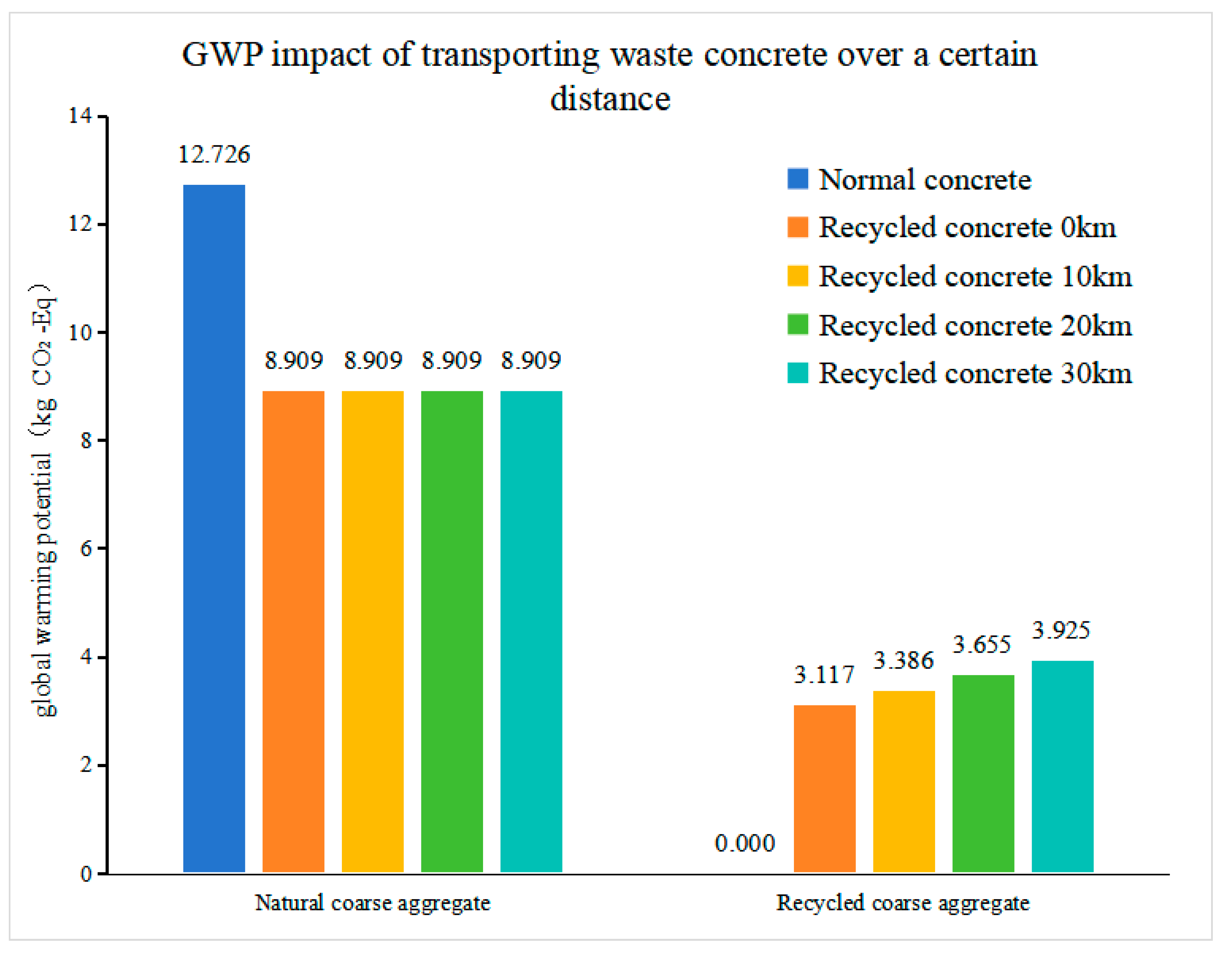
Figure 7.
Effect of cement-compensation level on the GWP of concrete with 30% RCA replacement.
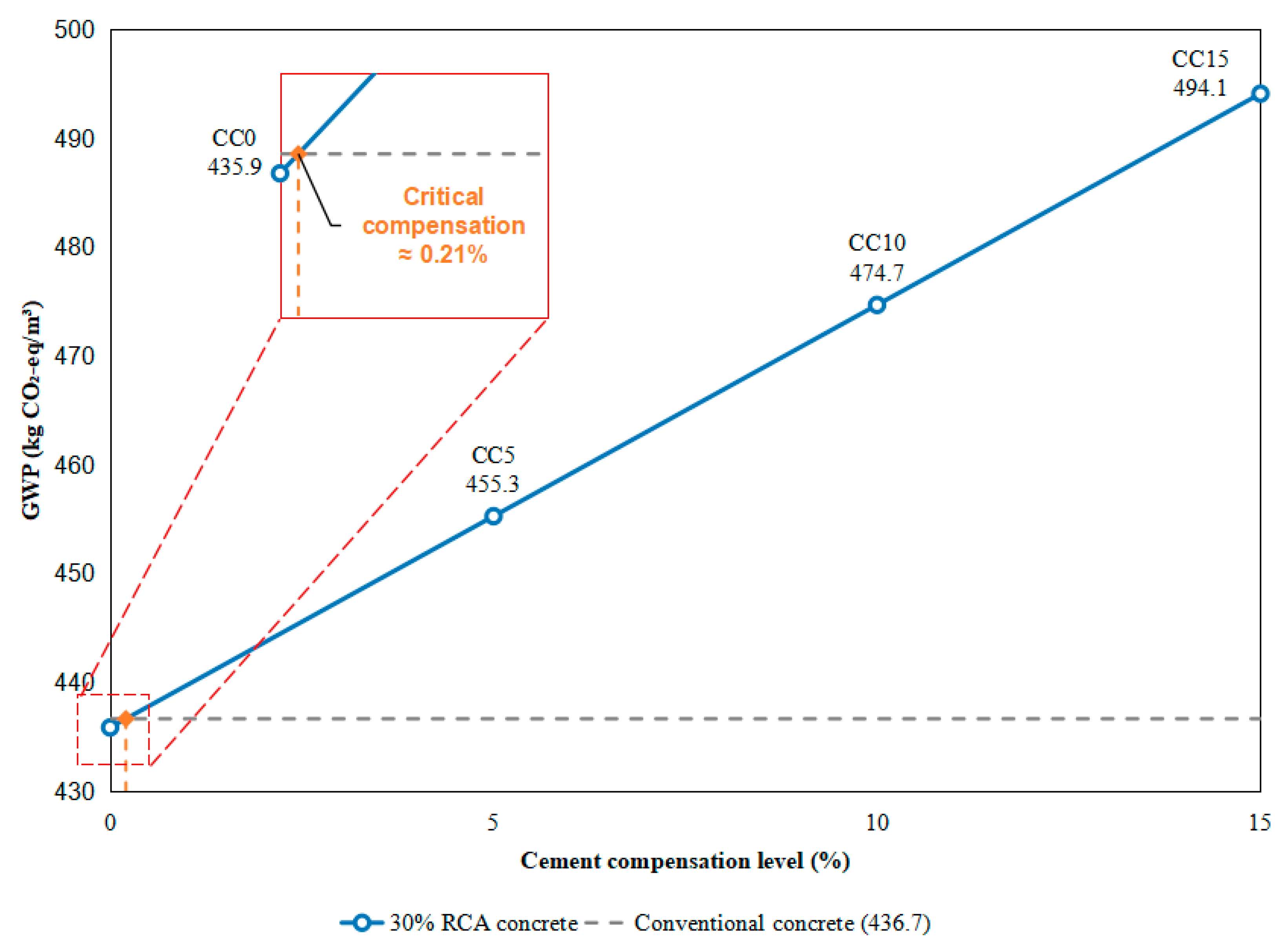
Figure 8.
Monte Carlo simulation of GWP at different transport distances.
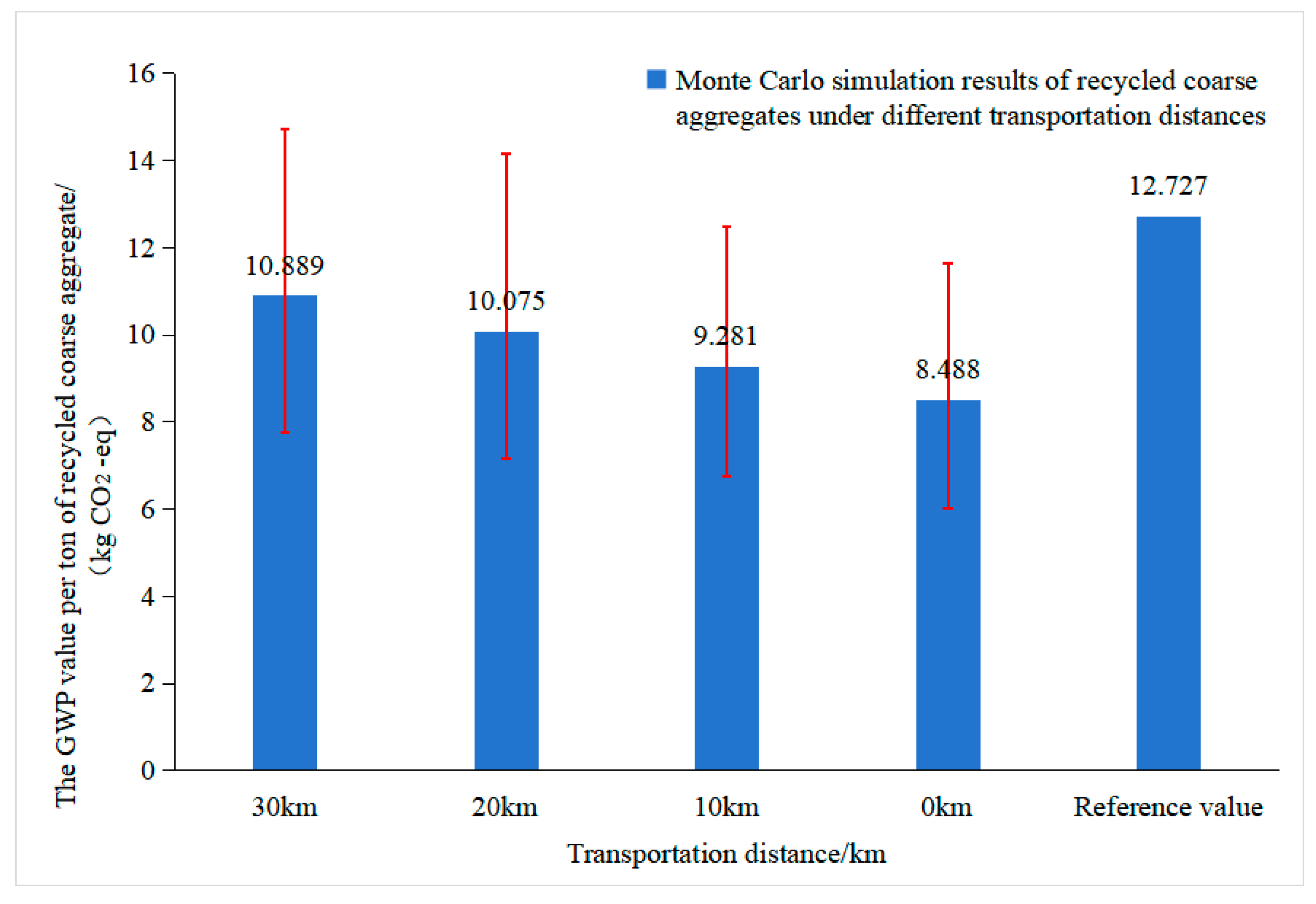

Table 1.
Input data for the conventional concrete LCA model.
| Stage | Material/Process | Amount | Unit | Proportion/Note |
| Raw material acquisition | Natural coarse aggregate | 1252 | kg/m³ | 52.17% |
| Cement | 461 | kg/m³ | 19.21% | |
| Sand | 512 | kg/m³ | 21.33% | |
| Water | 175 | kg/m³ | 7.29% | |
| Production stage | Concrete mixing | 8.98 | kW·h/m³ | -- |
| Transport | 52.72 | km | -- |
Table 2.
Input data for the recycled concrete LCA model.
| Stage | Material/Process | Amount | Unit | Note |
| Recycled aggregate production | Waste concrete | 1250 | kg | -- |
| Recycling electricity consumption | -- | kWh/m³ | -- | |
| Recycling diesel consumption | -- | L/m3 | -- | |
| Collection and transport | 93.75 | t·km | Average from dispersed sources to treatment plant | |
| Recycled concrete production | Natural coarse aggregate | 876.4 | kg/m³ | 70% |
| Recycled coarse aggregate | 375.6 | kg/m³ | 30% | |
| Cement | 461 | kg/m³ | Base RCA scenario without cement compensation; cement-compensation levels of 5%, 10% and 15% were evaluated separately. | |
| Sand | 512 | kg/m³ | -- | |
| Water | 175 | kg/m³ | -- | |
| Transport | 23.68 | t·km | Average from cement plant to use location |
Table 3.
Literature-derived RCA/RAC quality parameters used for scenario definition.
| Scenario / assumption | Literature basis | Parameter | Reported value | Function in this study |
| Medium-quality RCA | Ding et al. [30] | Apparent density | 2580–2590 kg/m³ | Defines representative medium-quality RCA |
| Crushing index | 10.6% | Supports mechanical-quality assumption | ||
| Water absorption | 4.7–6.4% | Supports water-absorption uncertainty | ||
| Structural RAC performance | Tran et al. [31] | Workability reduction | 8–38% | Explains potential workability loss |
| Compressive strength reduction | 5.0–9.3% | Supports selection of the 5% cement-compensation scenario | ||
| Low-quality RCA | Leite and Lima [32] | Specific gravity of recycled coarse aggregate | 2.41 kg/dm³ | Defines low-quality RCA scenario |
| Bulk density of recycled coarse aggregate | 0.99 kg/dm³ | Defines low-quality RCA scenario | ||
| Water absorption of recycled coarse aggregate | 11.3% | Defines high-absorption RCA scenario | ||
| Los Angeles abrasion value | 63.70% | Represents low mechanical quality | ||
| Main replacement ratio | Marvila et al. [33] | Low RCA replacement level | ≤30% | Supports the 30% RCA main scenario |
| LCA modelling uncertainty | Xing et al. [34] ; Zhang et al. [35] | Mixture design, functional unit, system boundary and transport distance | Qualitative basis | Supports quality-dependent and transport-sensitive LCA modelling |
Table 4.
Acidification potential under different transport distances.
| Cement | Recycled coarse aggregate | Natural coarse aggregate | ||||
| Transport distance | Acidification proportion | Acidification value(species·yr*) | Acidification proportion | Acidification value(species·yr) | Acidification proportion | Acidification value(species·yr) |
| 0 | 74.76% | 1.065E-07 | 1.68% | 2.394E-09 | 5.20% | 7.414E-09 |
| 10 km | 74.68% | 1.065E-07 | 1.78% | 2.538E-09 | 5.20% | 7.414E-09 |
| 20 km | 74.61% | 1.065E-07 | 1.88% | 2.682E-09 | 5.20% | 7.414E-09 |
| 30 km | 74.53% | 1.065E-07 | 1.98% | 2.827E-09 | 5.20% | 7.414E-09 |
| Conventional concrete | 74.35% | 1.065E-07 | - | - | 7.39% | 1.059E-08 |
*:species·yr is the characterization unit for terrestrial acidification potential, standing for ‘potentially disappeared fraction of species per year.’ It represents the potential loss of species years that may result from the emission of 1 kg of a given pollutant, such as SO2, over the long-term average, and is a normalized comparative value.
Table 5.
GWP results under different cement-compensation levels at a 30% RCA replacement ratio.
| Scenario | Cement compensation (%) | Cement content (kg/m³) | GWP (kg CO₂-eq/m³) | Change relative to CC0 (%) | Difference from conventional concrete (%) |
| Conventional concrete | — | 461.00 | 436.7 | — | 0 |
| CC0 | 0 | 461.00 | 435.9 | — | -0.18 |
| CC5** | 5 | 484.05 | 455.3 | 4.45 | 4.26 |
| CC10** | 10 | 507.10 | 474.7 | 8.90 | 8.72 |
| CC15** | 15 | 530.15 | 494.1 | 13.35 | 13.17 |
**: All cement-compensation scenarios were calculated using the same transport assumptions as the CC0 scenario.
Disclaimer/Publisher’s Note: The statements, opinions and data contained in all publications are solely those of the individual author(s) and contributor(s) and not of MDPI and/or the editor(s). MDPI and/or the editor(s) disclaim responsibility for any injury to people or property resulting from any ideas, methods, instructions or products referred to in the content. |
© 2026 by the authors. Licensee MDPI, Basel, Switzerland. This article is an open access article distributed under the terms and conditions of the Creative Commons Attribution (CC BY) license (http://creativecommons.org/licenses/by/4.0/).
Copyright: This open access article is published under a Creative Commons CC BY 4.0 license, which permit the free download, distribution, and reuse, provided that the author and preprint are cited in any reuse.